International Trauma Life Support for Emergency Care Providers
Case-Based Learning Scenarios
Improving Trauma Care Worldwide ITRAUMA.org
Version 1.0 (2019) Copyright © International Trauma Life Support
International Trauma Life Support for Emergency Care Providers
Case-Based Learning Scenarios
TABLE OF CONTENTS
Case-Based Learning Overview 4
What is the Case-Based Learning Format? 5
What are the Objectives of Case-Based Learning? 5
What are the Attributes of Case-Based Learning? 5
What are the Challenges of Case-Based Learning? 5
How to Use ITLS Case-Based Scenarios 6
ITLS Scenario Format 6
Scenario Pages Overview 7
Synopsis 8
Assessment 10
Expanded Content 12
Patient Monitor 14
Version 1.0 (2019) Copyright © International Trauma Life Support Page 2
International Trauma Life Support for Emergency Care Providers
Case-Based Learning Scenarios
TABLE OF CONTENTS
Evaluating Case-Based Learning Scenarios 15
Summary 15
Scenario Evaluation Rubric 16
Using the Rubric 17
Practice & Test: Comparing Two Types of Evaluation 17
Evaluation Rubric 18
Clarification of Criteria 19
References 20
Practice Scenarios 22
Set 1 23
Set 2 64
Version 1.0 (2019) Copyright © International Trauma Life Support Page 3
Case-Based Learning
Overview
Improving Trauma Care Worldwide ITRAUMA.org
International Trauma Life Support for Emergency Care Providers
Case-Based Learning Scenarios
Version 1.0 (2019) Copyright © International Trauma Life Support Page 4
What is the Case-Based Learning Format?
Typically, cases are presented in a story-telling format and are experiential or learning through reflection on doing. The
learning process is guided by the instructor, who generates discussion before, during, and after the case. The goal is for the
learner to become fully involved in the case, so they can anticipate what they would do if faced with the case
circumstances (Stanford, 1994).
What are the Objectives of Case-Based Learning?
The learner will be able to:
1) Present a case analysis that includes identifying relevant facts and developing those facts into logical
conclusions.
2) Given a character role in a case, demonstrate appropriate actions specific to the characters role in the case.
3) Conduct themselves in a manner which fosters collaboration and cooperation among members of the
trauma team.
4) Perform the skills necessary to assess a trauma patient through multi-sensory perception.
5) Demonstrate the physical ability required to treat and transport a trauma patient.
What are the Attributes of Case-Based Learning?
Case-based learning creates the ability to address the cognitive, affectiveand psychomotor domainsof learning.
Learners are guided through advancement fromlearning toward mastery and are introduced to multiple perspectives
through applied group discussions. The case-based model encourages learners to take responsibility, accountability
and authority in their learning.
What are the Challenges of Case-Based Learning?
Instructors are required to take an active role in facilitating learner understanding through carefully crafted
questions and feedback and enabling learners to integrate the key points and learning objectives. Instructors must
ensure cases and course content are synonymous and carefully integrated while encompassing the key points and
learning objectives. It is necessary for the entire team to prepare and be comfortable with the material to facilitate
an efficient and meaningful case-based learning opportunity.
Version 1.0 (2019) Copyright © International Trauma Life Support Page 5
How to Use ITLS Case-Based Scenarios
Cases will be provided in two banks of scenarios for instructors. The Practice Scenario Bank provides instructors with
a selection of practice scenarios relating to the various concepts in the ITLS course. Practice scenarios are designed to
build learner knowledge, skill and critical thinking through a case-based learning experience. Ask open-ended
questions that involve the combinations of variables that learners could encounter in the real world. For example,
engage the team in critical thinking. Ask, how could a left-sided bubbling chest wound with decreased lung sounds
and paradoxical movement affect a head trauma patient?
The Test Scenario Bank (under development for future release) provides instructors with a selection of testing
scenarios relating to the various concepts in the ITLS course. Testing scenarios are designed to evaluate the learner’s
knowledge, skill and competency using the ITLS objectives as the standard.
As the names suggest, the Practice Scenario Bank should be used during skill station practice, and the Test Scenario
Bank should be used during the final practical exam.
ITLS Scenario Format
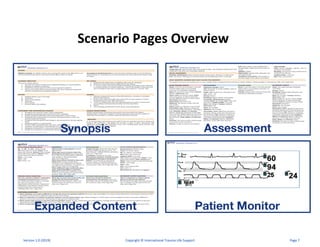
Each scenario consists of 4 primary pages:
Synopsis: Provides the foundational information the scenario is built around. Even without the remaining
scenario pages, many experienced ITLS instructors would be able to provide learners with accurate assessment
findings and appropriate interactive discussions and questions.
Assessment: Provides assessment findings, in sections, that relate directly to the scene and patient assessment
algorithms outlined in the ITLS course and approved materials. These sections include:
• Scene Size-up • Reassessment (formerly Ongoing Exam)
• Initial Assessment • Focused Exam
• Rapid Trauma Survey • Secondary Survey
Expanded Content: Provides additional assessment findings reflecting the initial patient status and status
secondary to treatment.
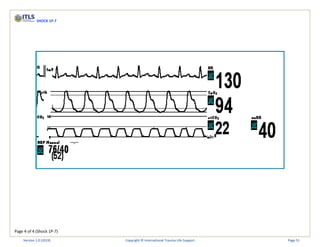
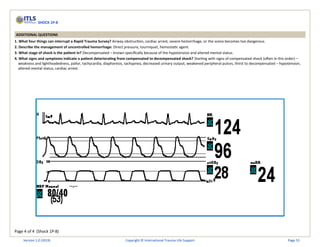
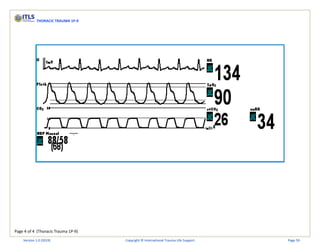
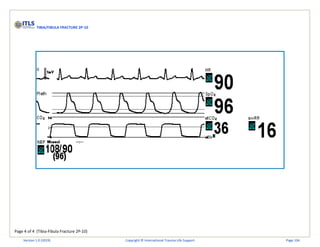
Patient Monitor: Provides a static view of the patient-specific ECG, SPO2, capnography value and wave form,
and vital signs. This information is usually based on the initial vital signs provided in the scenario (most
common exception is a stable patient, when it would likely be applied during the Secondary Survey).
Version 1.0 (2019) Copyright © International Trauma Life Support Page 6
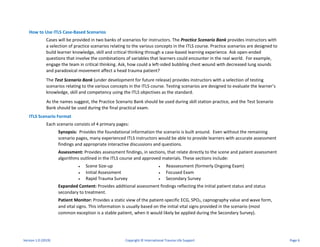
Scenario Pages Overview
Version 1.0 (2019) Copyright © International Trauma Life Support Page 7
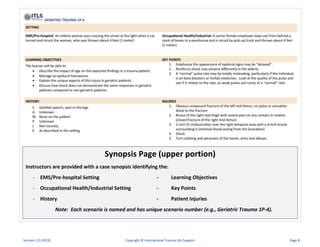
Synopsis Page (upper portion)
Instructors are provided with a case synopsis identifying the:
- EMS/Pre-hospital Setting - Learning Objectives
- Occupational Health/Industrial Setting - Key Points
- History - Patient Injuries
Note: Each scenario is named and has unique scenario number (e.g., Geriatric Trauma 1P-4).
Version 1.0 (2019) Copyright © International Trauma Life Support Page 8
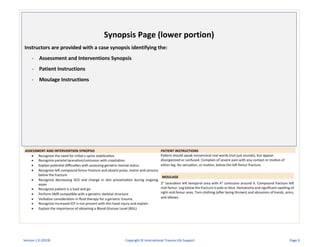
Synopsis Page (lower portion)
Instructors are provided with a case synopsis identifying the:
- Assessment and Interventions Synopsis
- Patient Instructions
- Moulage Instructions
Version 1.0 (2019) Copyright © International Trauma Life Support Page 9
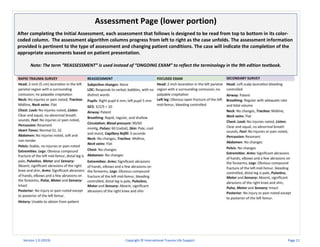
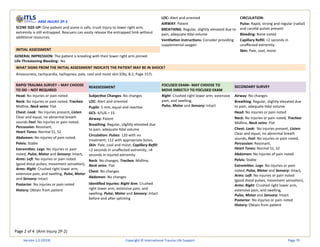
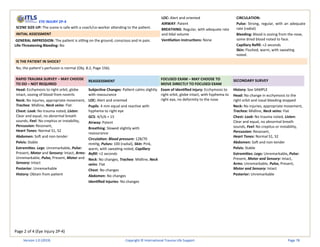
Assessment Page (upper portion)
Instructors are provided with pertinent assessment information broken down as described in the ITLS course and
approved materials. The Initial Assessment section provides:
- Scene Size-Up
- General Impression
- Level of Consciousness
- Airway Status
- Breathing
- Ventilation Instructions
- Circulation (Pulse, Bleeding, Capillary Refill, Skin)
In addition to the Initial Assessment findings, this section provides recommended questions regarding the
findings. Instructors may ask additional questions.
Version 1.0 (2019) Copyright © International Trauma Life Support Page 10
L R
Assessment Page (lower portion)
After completing the Initial Assessment, each assessment that follows is designed to be read from top to bottom in its color-
coded column. The assessment algorithm columns progress from left to right as the case unfolds. The assessment information
provided is pertinent to the type of assessment and changing patient conditions. The case will indicate the completion of the
appropriate assessments based on patient presentation.
Note: The term “REASSESSMENT” is used instead of “ONGOING EXAM” to reflect the terminology in the 9th edition textbook.
Version 1.0 (2019) Copyright © International Trauma Life Support Page 11
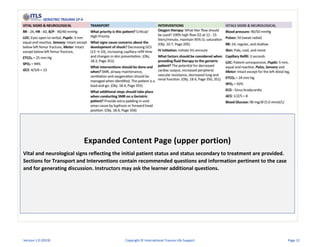
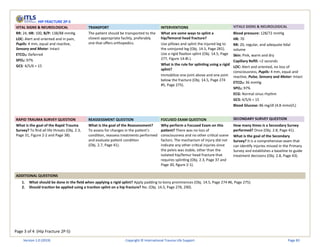
Expanded Content Page (upper portion)
Vital and neurological signs reflecting the initial patient status and status secondary to treatment are provided.
Sections for Transport and Interventions contain recommended questions and information pertinent to the case
and for generating discussion. Instructors may ask the learner additional questions.
Version 1.0 (2019) Copyright © International Trauma Life Support Page 12
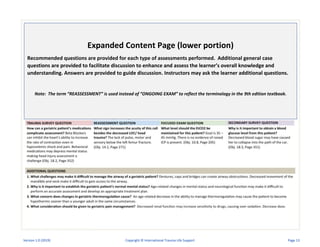
Expanded Content Page (lower portion)
Recommended questions are provided for each type of assessments performed. Additional general case
questions are provided to facilitate discussion to enhance and assess the learner’s overall knowledge and
understanding. Answers are provided to guide discussion. Instructors may ask the learner additional questions.
Note: The term “REASSESSMENT” is used instead of “ONGOING EXAM” to reflect the terminology in the 9th edition textbook.
Version 1.0 (2019) Copyright © International Trauma Life Support Page 13
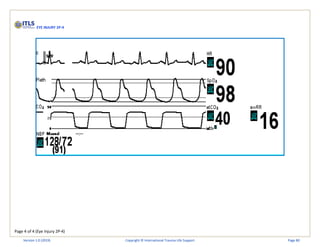
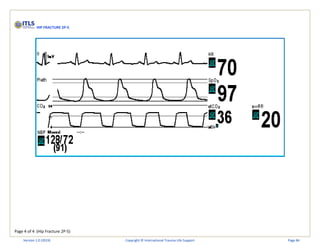
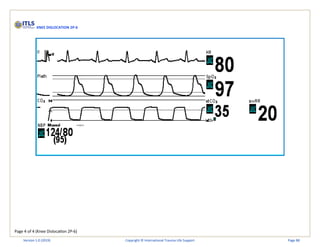
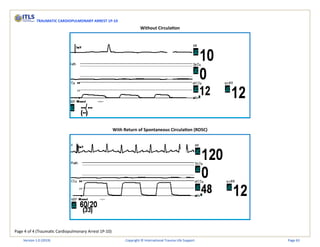
Patient Monitor Page
Each case includes a patient-specific ECG, SPO2, capnography value and wave form and vital signs as displayed on a
monitor for learner reference. This information is usually based on the initial vital signs provided in the scenario
(most common exception is a stable patient, when it would likely be applied during the Secondary Survey).
Additional monitor displays may be provided to represent significant changes after patient interventions.
-
Version 1.0 (2019) Copyright © International Trauma Life Support Page 14
Evaluating Case-Based Learning Scenarios
ITLS chose to use a rubric for guiding learner progress. A rubric is an assessment tool for use by the team to provide
ongoing feedback for improving team skill performance and knowledge. Typically, a rubric is comprised of criteria,
definitions or descriptors for the degree of achievement, and a rating scale or scoring strategy known as levels
(Dawson, 2015).
Rubrics are often designed in a table format, allowing instructors to assess team performance efficiently and
providing a framework for the team throughout the learning process. Rubrics aid in simplifying learning criteria.
Learners may also use the rubric as a basis for self-assessment, reflection and peer review. A rubric facilitates fair
and accurate assessment, fosters understanding and defines the pathway for subsequent learning and teaching.
Rubric use integrates performance and feedback, providing ongoing or formative assessment, which has been
shown to have a positive impact on learning (Panadero and Jonsson, 2013).
Given the multitude of potential patient interventions and resulting responses, it is the responsibility of the
instructor to ensure reasonable and realistic patient responses are provided to interventions.
Summary
ITLS believes in the value of experiential learning to strengthen learner understanding of core
concepts and transition the learner from a basic knowledge to mastery of trauma assessment
and skills. Clear case objectives and learner expectations are provided to ensure learners
benefit from consistent case delivery. Instructor-guided discussion reinforcing key concepts throughout a case is
designed to increase learner success.
Questions relating to the use of case-based learning may be directed to your local Chapter or Training Centre or
ITLS International.
Version 1.0 (2019) Copyright © International Trauma Life Support Page 15
Scenario Evaluation
Rubric
Improving Trauma Care Worldwide ITRAUMA.org
International Trauma Life Support for Emergency Care Providers
Case-Based Learning Scenarios
Version 1.0 (2019) Copyright © International Trauma Life Support Page 16
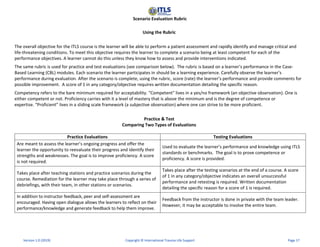
Using the Rubric
The overall objective for the ITLS course is the learner will be able to perform a patient assessment and rapidly identify and manage critical and
life-threatening conditions. To meet this objective requires the learner to complete a scenario being at least competent for each of the
performance objectives. A learner cannot do this unless they know how to assess and provide interventions indicated.
The same rubric is used for practice and test evaluations (see comparison below). The rubric is based on a learner’s performance in the Case-
Based Learning (CBL) modules. Each scenario the learner participates in should be a learning experience. Carefully observe the learner’s
performance during evaluation. After the scenario is complete, using the rubric, score (rate) the learner’s performance and provide comments for
possible improvement. A score of 1 in any category/objective requires written documentation detailing the specific reason.
Competency refers to the bare minimum required for acceptability. "Competent" lives in a yes/no framework (an objective observation). One is
either competent or not. Proficiency carries with it a level of mastery that is above the minimum and is the degree of competence or
expertise. “Proficient” lives in a sliding scale framework (a subjective observation) where one can strive to be more proficient.
Practice & Test
Comparing Two Types of Evaluations
Practice Evaluations Testing Evaluations
Are meant to assess the learner’s ongoing progress and offer the
learner the opportunity to reevaluate their progress and identify their
strengths and weaknesses. The goal is to improve proficiency. A score
is not required.
Used to evaluate the learner’s performance and knowledge using ITLS
standards or benchmarks. The goal is to prove competence or
proficiency. A score is provided.
Takes place after teaching stations and practice scenarios during the
course. Remediation for the learner may take place through a series of
debriefings, with their team, in other stations or scenarios.
Takes place after the testing scenarios at the end of a course. A score
of 1 in any category/objective indicates an overall unsuccessful
performance and retesting is required. Written documentation
detailing the specific reason for a score of 1 is required.
In addition to instructor feedback, peer and self-assessment are
encouraged. Having open dialogue allows the learners to reflect on their
performance/knowledge and generate feedback to help them improve.
Feedback from the instructor is done in private with the team leader.
However, it may be acceptable to involve the entire team.
Scenario Evaluation Rubric
Version 1.0 (2019) Copyright © International Trauma Life Support Page 17
Team Leader Team Members Scenario Identification:
Objective
Proficient Competent Remediation needed Score
3 points 2 points 1 point 1-3
Scene Survey
Efficiently and effectively identifies all existing
and potential hazards and does not place team
or patient at risk of additional injury or illness
Identifies existing hazards and does not
place team or patient at risk of additional
injury or illness
Does not identify existing hazards placing
team or patient at risk of additional injury
or illness
Initial Assessment
Performs an efficient and effective
Assessment assessing all critical areas
Performs an Assessment and assesses all
critical areas
Does not perform an Assessment or misses
at least one critical area
Rapid Trauma Survey
or Focused Exam
Performs an efficient and effective Survey or
Exam and identifies all critical injuries
Performs a Survey or Exam and identifies
all critical injuries
Does not perform a Survey or Exam or does
not identify all critical injuries
Patient Care
Efficiently and effectively performs or directs
indicated interventions that are prioritized
Performs or directs indicated
interventions
Does not perform or direct indicated
interventions
Team Management
Efficiently and effectively coordinates team
members and resources to perform tasks and
meet objectives
Coordinates team members and resources
to perform tasks and meet objectives
Does not coordinate team members or
resources to perform tasks and meet
objectives
Reassessment
Performs efficient and effective
Reassessments at defined intervals. Correctly
adapts interventions
Performs Reassessments at defined
intervals. Correctly adapts interventions
Does not perform a Reassessment at
defined intervals or does not correctly
adapt interventions
Secondary Survey
Prioritizes Survey and if done, is efficient,
effective and identifies all additional injuries
Prioritizes Survey and if done, identifies
additional injuries
Does not prioritize Survey or if done, does
not identify additional injuries
TOTAL SCORE
Rubric Scoring Scale: 18 - 21 Proficient (Instructor Potential) 14 - 17 Competent Any score of 1 needs remediation
Comments:
Instructor:
Scenario Evaluation Rubric
Version 1.0 (2019) Copyright © International Trauma Life Support Page 18
Objective
Clarification of Criteria
Scene Survey
Refer to the scenario setting to assess this. Hazards include assessing the mechanism of injury. Adapt to the
local environments as needed.
Initial Assessment
Refer to the scenario to provide findings. Conforms to the ITLS Initial Assessment described in the course and
approved materials.
Rapid Trauma Survey
or Focused Exam
The mechanism of injury and the patient’s level of consciousness determines which one should be performed.
Conforms to the ITLS Rapid Trauma Survey or Focused Exam described in the course and approved materials.
Patient Care
Refer to the scenario sections “Assessment and Interventions Synopsis” and “Injuries” for
expected/anticipated care. Given the multitude of potential patient interventions and resulting responses, it is
the responsibility of the instructor to ensure reasonable and realistic patient responses are provided to
interventions. Care should be prioritized and timely to enhance a favorable outcome of the patient.
Team Management
Effectively and efficiently uses available resources. The instructor should include team members in the
interactive questions asked during and after the scenario.
Reassessment
(formerly Ongoing Exam)
Refer to the scenario sections “Assessment and Interventions Synopsis,” “Reassessment,” “Transport,” and
“Interventions” for expected/anticipated care. Conforms to the ITLS Reassessment (formerly Ongoing Exam)
described in the course and approved materials.
Secondary Survey
A Secondary Survey may not be indicated in all scenarios (e.g. Load and Go, short transport times, etc.);
however, the Secondary Survey findings are provided for all scenarios. Learners may choose to do a
Secondary Survey and as long as it does not unnecessarily extend scene time or delay indicated interventions
they may be rated as competent or proficient. If performing a Secondary Survey could have a detrimental
effect on the patient, the Secondary Survey is not prioritized appropriately and indicates the need for
remediation. If completed, conforms to the ITLS Secondary Survey described in the course and approved
materials.
Primary
Survey should
take less than
2 minutes for
critical
patients
Critical
patients
should have a
scene time of
less than 5
minutes
Critical
patients
should have it
performed
every 5
minutes or if
patient
deteriorates
Scenario Evaluation Rubric
Version 1.0 (2019) Copyright © International Trauma Life Support Page 19
References
Improving Trauma Care Worldwide ITRAUMA.org
International Trauma Life Support for Emergency Care Providers
Case-Based Learning Scenarios
Version 1.0 (2019) Copyright © International Trauma Life Support Page 20
References
Blackmon, M., Hong, Y., & Choi, I. (2007). Case-Based Learning. In M. Orey (Ed.), Emerging perspectives on learning,
teaching, andtechnology. Retrieved October 26, 2017, from http://epltt.coe.uga.edu/
Clonts, W. (2018, May 21). Comparing CBL and PBL (56800). Retrieved July 27, 2018, from
https://wclontsportfolio.com/competencies/competency-synthesize-knowledge/comparing-cbl-and-pbl/
Dawson, Phillip (December 2015). Assessment rubrics: towards clearer and more replicable design, research and
practice Phillip. Assessment & Evaluation in Higher Education. doi:10.1080/02602938.2015.1111294.
Kharbach, M. (2014, February 05). A Visual Chart on Summative Vs Formative Assessment. Retrieved June 14, 2018, from
https://www.educatorstechnology.com/2014/02/a-visual-chart-on-summative-vs.html
Panadero, Ernesto; Jonsson, Anders (2013). The use of scoring rubrics for formative assessment purposes revisited:
A review. Educational Research Review. 9 (0). doi:10.1016/j.edurev.2013.01.002.
Seitz, R.S. (2017). Case-based learning; What’s this all about? ITLS Leadership Forum.
Stanford University Newsletter on Teaching. (1994). Speaking of Teaching. Center for Teaching and Learning;
Stanford, CA: Vol 5:2
Wohner, I. (2015, December 30). Word difference between 'proficient’, 'competent' and 'accomplished'. Retrieved July 24,
2018, from https://ell.stackexchange.com/questions/77365/word-difference-between-proficient-competent-and-
accomplished
Wood, D.F. (2003). Problem Based Learning. BMJ 2003; 326: 328. doi:https://doi.org/10.1136/bmj.326.7384.328
Version 1.0 (2019) Copyright © International Trauma Life Support Page 21
Practice Scenarios
Improving Trauma Care Worldwide ITRAUMA.org
International Trauma Life Support for Emergency Care Providers
Case-Based Learning Scenarios
Version 1.0 (2019) Copyright © International Trauma Life Support Page 22
International Trauma Life Support for Emergency Care Providers
Practice Scenarios Set 1
TABLE OF CONTENTS
Abdominal Trauma 1P-1 24
Abdominal Trauma 1P-2 28
Burns 1P-3 32
Geriatric Trauma 1P-4 36
Head Injury 1P-5 40
Head Injury 1P-6 44
Shock 1P-7 48
Shock 1P-8 52
Thoracic Trauma 1P-9 56
Traumatic Cardiopulmonary Arrest 1P-10 60
Version 1.0 (2019) Copyright © International Trauma Life Support Page 23
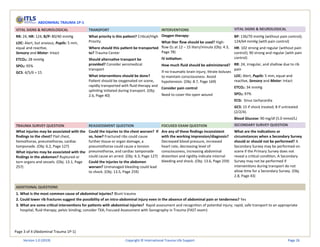
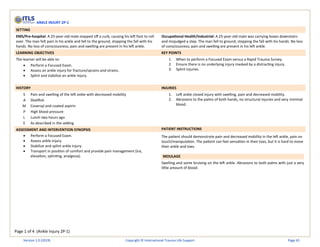
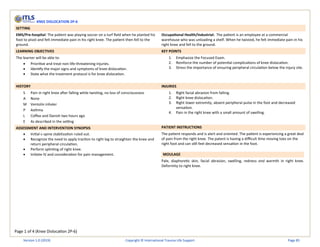
Page 1 of 4 (Abdominal Trauma 1P-1)
ABDOMINAL TRAUMA 1P-1
SETTING
EMS/Pre-hospital: An ambulance has been dispatched to a local sports stadium for an
injured soccer/football player who collided with a metal bench on the sidelines.
Occupational Health/Industrial: An ambulance has been dispatched to the warehouse
for an injured employee who was struck by a forklift.
LEARNING OBJECTIVES KEY POINTS
The learner will be able to:
• Identify a critical blunt abdominal injury and identify associated
complications.
• Assess and manage a critical trauma patient with a blunt abdominal injury.
• Describe possible intra-abdominal injuries based on findings of history,
physical examination, and mechanism of injury.
1. Blunt trauma is the most common cause of abdominal injuries.
2. Blunt trauma may be from direct compression of the abdomen against a fixed
object resulting in tears or subcapsular hematomas involving solid intra-
abdominal organs (liver/spleen).
3. Injuries may arise from deceleration forces, with tearing of organs and their
blood vessels at fixed areas within the abdominal region.
4. Lower rib fractures suggest the possibility of an intra-abdominal injury even
in the absence of abdominal pain or tenderness.
5. Be prepared to treat hypovolemic shock from occult intra-abdominal
bleeding.
6. Blunt abdominal trauma with pain or tenderness may indicate serious
abdominal trauma and the potential for quick development of shock even if
initial vital signs are normal.
HISTORY INJURIES
S Left-sided lower rib pain and wrist pain
A None
M Albuterol, Solu-Medrol, naproxen and ibuprofen
P Asthma
L Sports drink 30 minutes
E As described in the setting
1. Intra-abdominal bleeding
2. Left lower rib fractures
3. Shock
4. Open left distal radial fracture
ASSESSMENT AND INTERVENTION SYNOPSIS PATIENT INSTRUCTIONS
• Recognize significant Mechanism of Injury and load and go
• Recognize difficulty breathing and delegate high-flow O2
• Recognize significance of injuries to chest, abdomen and the potential for rapid
deterioration
• Initiate fluid therapy during transport titrated to maintain level of
consciousness, and avoid hypotension
• Recognize significance of evolving changes in abdominal presentation
• Obtain a blood glucose level
• Consider aeromedical transport
• Consider pain control
• Splint wrist fracture if time allows
Patient should be alert, but anxious and complaining of left-sided rib pain, left wrist
pain and left shoulder (referred pain). Complain of pain on left side of abdomen only
when upper left quadrant is palpated. Speak in short sentences (2-3 words) due to rib
pain. Simulate shallow and rapid respirations if able to do so safely. No head, neck or
back pain and no loss of consciousness.
MOULAGE
Open left wrist fracture with minor distracting bleeding. (If open fracture is not
possible, show bruising over the left wrist [closed fracture]). Bruising to lower left ribs
on the mid-axillary line. Simulate shock with pale and moist skin.
Version 1.0 (2019) Copyright © International Trauma Life Support Page 24
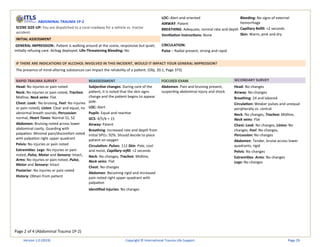
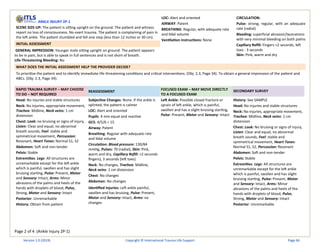
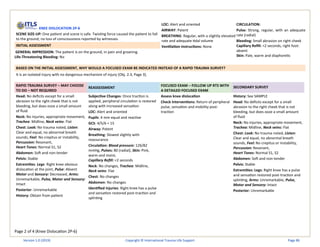
Page 2 of 4 (Abdominal Trauma 1P-1)
ABDOMINAL TRAUMA 1P-1
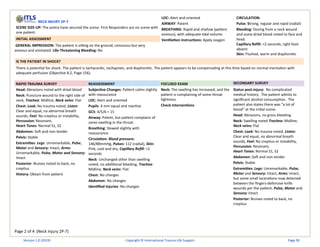
SCENE SIZE-UP: One patient and scene is safe. Blunt force abdominal trauma from
colliding with an immoveable object.
INITIAL ASSESSMENT
GENERAL IMPRESSION: Patient is lying on their left side in a recumbent position.
Awake with obvious signs of shock and difficulty breathing complaining of wrist and rib
pain. Life-Threatening Bleeding: No
LOC: Alert and oriented
AIRWAY: Patent
BREATHING: Rapid, regular, and shallow
Ventilation instructions: Direct team to
consider oxygen via non-rebreather mask.
Bleeding: Minor active bleeding from
left wrist fracture; no major bleeding
Capillary Refill: <2 seconds
Skin: Pale, moist and cool
CIRCULATION:
Pulse – Rapid, strong and regular radial and
carotid pulses present
WHAT SIGNS FROM THE INITIAL ASSESSMENT INDICATE THE PATIENT MAY BE IN SHOCK?
Anxiousness, tachycardia, tachypnea, pale, cool and moist skin (Obj. 8.2, Page 157)
RAPID TRAUMA SURVEY REASEESSMENT FOCUSED EXAM SECONDARY SURVEY
Head: No injuries or pain noted
Neck: No injuries or pain noted, Trachea:
Midline, Neck veins: Flat
Chest: Look: Left lateral lower chest
bruising mid-axillary line, Feel: Crepitus on
left side (lower ribs), Listen: Clear and
equal, no abnormal breath sounds,
Percussion: Resonant, Heart Tones:
Normal S1, S2
Abdomen: Pain and rigidity in left upper
quadrant, right quadrants unremarkable
Pelvis: Stable
Extremities: Legs: No injuries or pain
noted, Pulse, Motor and Sensory: Intact,
Arms: Left: open wrist fracture (good
distal pulses, movement sensation), Arms:
Right: no injuries, Pulse, Motor and
Sensory: Intact
Posterior: No injuries or pain noted
History: Obtain from patient
Subjective changes: No changes
LOC: Alert
Pupils: 5 mm, equal and reactive
GCS: 4/5/6 = 15
Airway: Patent
Breathing: Rapid, irregular, and shallow
due to rib pain
Circulation: Pulses: 140 with no
treatment; 112 with appropriate bolus,
Skin: Pale, cool and moist,
Capillary refill: <2 seconds
Neck: No changes, Trachea: Midline,
Neck veins: Flat
Chest: No changes
Abdomen: Left side tender, rigid and now
distended
Identified injuries: No changes
Chest: Rib fractures
Abdomen: Pain
Left Arm: Wrist fracture
Head: No changes
Airway: No changes
Breathing: Rapid, irregular, and shallow
due to rib pain.
Neck: No changes, Trachea: Midline,
Neck veins: Flat
Chest: Look: No changes, Listen: No
changes, Feel: No changes,
Percussion: No changes
Abdomen: Left upper and lower quadrant
pain, rigidity and distention
Pelvis: No changes
Extremities: Arms: No changes,
Legs: No changes
Version 1.0 (2019) Copyright © International Trauma Life Support Page 25
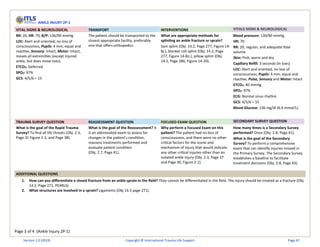
Page 3 of 4 (Abdominal Trauma 1P-1)
ABDOMINAL TRAUMA 1P-1
VITAL SIGNS & NEUROLOGICAL TRANSPORT INTERVENTIONS VITAL SIGNS & NEUROLOGICAL
RR: 24, HR: 124, B/P: 80/40 mmHg
LOC: Alert, but anxious, Pupils: 5 mm,
equal and reactive,
Sensory and Motor: Intact
ETCO2: 28 mmHg
SPO2: 95%
GCS: 4/5/6 = 15
What priority is this patient? Critical/High
Priority
Where should this patient be transported
to? Trauma Center
Should alternative transport be
provided? Consider aeromedical
transport
What interventions should be done?
Patient should be oxygenated on scene,
rapidly transported with fluid therapy and
splinting initiated during transport. (Obj:
2.6, Page 40)
Oxygen therapy:
What liter flow should be used? High-
flow O2 at 12 – 15 liters/minute (Obj: 4.3,
Page 78)
IV initiation:
How much fluid should be administered?
If no traumatic brain injury, titrate boluses
to maintain consciousness. Avoid
hypotension. (Obj: 8.7, Page 169)
Consider pain control
Need to cover the open wound
BP: 136/70 mmHg (without pain control);
124/64 mmHg (with pain control)
HR: 102 strong and regular (without pain
control); 90 strong and regular (with pain
control)
RR: 24, irregular, and shallow due to rib
pain
LOC: Alert, Pupils: 5 mm, equal and
reactive, Sensory and Motor: Intact
ETCO2: 34 mmHg
SPO2: 97%
ECG: Sinus tachycardia
GCS: 15 if shock treated; 8 if untreated
(2/2/4).
Blood Glucose: 90 mg/dl (5.0 mmol/L)
TRAUMA SURVEY QUESTION REASSESSMENT QUESTION FOCUSED EXAM QUESTION SECONDARY SURVEY QUESTION
What injuries may be associated with the
findings to the chest? Flail chest,
hemothorax, pneumothorax, cardiac
tamponade. (Obj: 6.2, Page 127)
What injuries may be associated with the
findings in the abdomen? Ruptured or
torn organs and vessels. (Obj: 13.1, Page
257)
Could the injuries to the chest worsen? If
so, how? Fractured ribs could cause
further tissue or organ damage, a
pneumothorax could cause a tension
pneumothorax, and cardiac tamponade
could cause an arrest. (Obj: 6.3, Page 127)
Could the injuries to the abdomen
worsen? Unmanaged bleeding could lead
to shock. (Obj: 13.5, Page 259)
Are any of these findings inconsistent
with the working impression/diagnosis?
Decreased blood pressure, increased
heart rate, decreasing level of
consciousness, increasing abdominal
distention and rigidity indicate internal
bleeding and shock. (Obj: 13.6, Page 259)
What are the indications or
circumstances when a Secondary Survey
should or should not be performed? A
Secondary Survey may be performed on
scene if the Primary Survey does not
reveal a critical condition. A Secondary
Survey may not be performed if
interventions during transport do not
allow time for a Secondary Survey. (Obj.
2.8, Page 43)
ADDITIONAL QUESTIONS
1. What is the most common cause of abdominal injuries? Blunt trauma
2. Could lower rib fractures suggest the possibility of an intra-abdominal injury even in the absence of abdominal pain or tenderness? Yes
3. What are some critical interventions for patients with abdominal injuries? Rapid assessment and recognition of potential injury; rapid, safe transport to an appropriate
hospital; fluid therapy; pelvic binding; consider TXA; Focused Assessment with Sonography in Trauma (FAST exam)
Version 1.0 (2019) Copyright © International Trauma Life Support Page 26
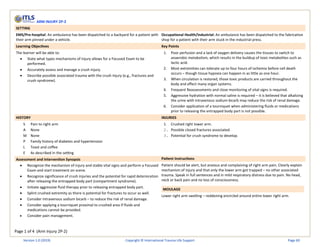
Page 4 of 4 (Abdominal Trauma 1P-1)
ABDOMINAL TRAUMA 1P-1
Version 1.0 (2019) Copyright © International Trauma Life Support Page 27
Page 1 of 4 (Abdominal Trauma 1P-2)
ABDOMINAL TRAUMA 1P-2
SETTING
EMS/Pre-hospital: You are dispatched at nighttime to a rural roadway for a vehicle vs.
farm tractor accident.
Occupational Health/Industrial: You are dispatched to your local parking lot for a
vehicle that struck an industrial vehicle that is moving metal casting ingots.
LEARNING OBJECTIVES KEY POINTS
The learner will be able to:
• Prioritize and treat life-threatening injuries.
• Identify the major signs and symptoms of abdominal trauma.
• Explain the pathophysiology of shock and the relationship with abdominal
trauma.
• Describe the appropriate management of abdominal injuries.
1. Emphasize the need for appropriate examinations of all patients.
2. Reinforce the potentials for occult injuries.
3. Reinforce the potentials of patients that could worsen during care and
treatment
HISTORY INJURIES
S Slight tenderness at seatbelt abrasions
A Penicillin
M Beta blocker; Statin medications
P High blood pressure and high cholesterol
L Several hours ago at lunch
E As described in the setting
1. Liver laceration
2. Shock presentation
ASSESSMENT AND INTERVENTION SYNOPSIS PATIENT INSTRUCTIONS
• Recognize significant Mechanism of Injury and load and go
• Recognize significance of injuries to abdomen, and the potential for rapid
deterioration
• Frequently reassess patient for signs or symptoms of shock
• Initiate fluid therapy during transport titrated to maintain peripheral pulses
• Recognize significance of changes in abdominal presentation
• Consider aeromedical transport
You are quiet but when approached by EMS, advise them that you wore your seatbelt
and you think you are fine.
MOULAGE
Seatbelt marks (abrasions) across abdomen
Version 1.0 (2019) Copyright © International Trauma Life Support Page 28
Page 2 of 4 (Abdominal Trauma 1P-2)
ABDOMINAL TRAUMA 1P-2
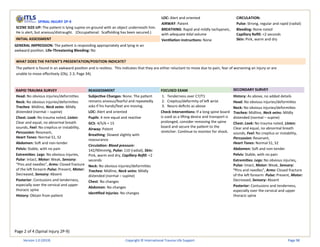
SCENE SIZE-UP: You are dispatched to a rural roadway for a vehicle vs. tractor
accident.
INITIAL ASSESSMENT
GENERAL IMPRESSION:. Patient is walking around at the scene, responsive but quiet;
initially refusing care. Airbag deployed. Life-Threatening Bleeding: No
LOC: Alert and oriented
AIRWAY: Patent
BREATHING: Adequate, normal rate and depth
Ventilation instructions: None
Bleeding: No signs of external
hemorrhage
Capillary Refill: <2 seconds
Skin: Warm, pink and dry
CIRCULATION:
Pulse – Radial present, strong and rapid
IF THERE ARE INDICATIONS OF ALCOHOL INVOLVED IN THIS INCIDENT, WOULD IT IMPACT YOUR GENERAL IMPRESSION?
The presence of mind-altering substances can impact the reliability of a patient. (Obj. 20.1, Page 373)
RAPID TRAUMA SURVEY REASSESSMENT FOCUSED EXAM SECONDARY SURVEY
Head: No injuries or pain noted
Neck: No injuries or pain noted, Trachea:
Midline, Neck veins: Flat
Chest: Look: No bruising, Feel: No injuries
or pain noted), Listen: Clear and equal, no
abnormal breath sounds, Percussion:
normal, Heart Tones: Normal S1, S2
Abdomen: Bruising noted across lower
abdominal cavity. Guarding with
palpation. Minimal pain/discomfort noted
with palpation right upper quadrant
Pelvis: No injuries or pain noted
Extremities: Legs: No injuries or pain
noted, Pulse, Motor and Sensory: Intact,
Arms: No injuries or pain noted, Pulse,
Motor and Sensory: Intact
Posterior: No injuries or pain noted
History: Obtain from patient
Subjective changes: During care of the
patient, it is noted that the skin signs
change and the patient begins to appear
pale.
LOC: Alert
Pupils: Equal and reactive
GCS: 4/5/6 = 15
Airway: Patent
Breathing: Increased rate and depth from
initial SPO2: 92%. Should decide to place
patient on oxygen
Circulation: Pulses: 112 Skin: Pale, cool
and moist, Capillary refill: <2 seconds
Neck: No changes, Trachea: Midline,
Neck veins: Flat
Chest: No changes
Abdomen: Becoming rigid and increased
pain noted right upper quadrant with
palpation
Identified injuries: No changes
Abdomen: Pain and bruising present,
suspecting abdominal injury and shock
Head: No changes
Airway: No changes
Breathing: 24 and labored
Circulation: Weaker pulses and unequal
peripherally vs. central
Neck: No changes, Trachea: Midline,
Neck veins: Flat
Chest: Look: No changes, Listen: No
changes, Feel: No changes,
Percussion: No changes
Abdomen: Tender, bruise across lower
quadrants, rigid
Pelvis: No changes
Extremities: Arms: No changes
Legs: No changes
Version 1.0 (2019) Copyright © International Trauma Life Support Page 29
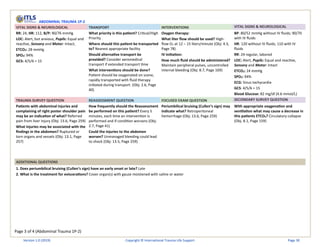
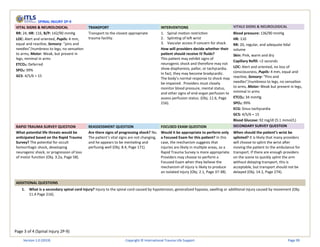
Page 3 of 4 (Abdominal Trauma 1P-2)
ABDOMINAL TRAUMA 1P-2
VITAL SIGNS & NEUROLOGICAL TRANSPORT INTERVENTIONS VITAL SIGNS & NEUROLOGICAL
RR: 24, HR: 112, B/P: 90/76 mmHg
LOC: Alert, but anxious, Pupils: Equal and
reactive, Sensory and Motor: Intact,
ETCO2: 28 mmHg
SPO2: 94%
GCS: 4/5/6 = 15
What priority is this patient? Critical/High
Priority
Where should this patient be transported
to? Nearest appropriate facility
Should alternative transport be
provided? Consider aeromedical
transport if extended transport time
What interventions should be done?
Patient should be oxygenated on scene,
rapidly transported with fluid therapy
initiated during transport. (Obj: 2.6, Page
40)
Oxygen therapy:
What liter flow should be used? High-
flow O2 at 12 – 15 liters/minute (Obj: 4.3,
Page 78)
IV initiation:
How much fluid should be administered?
Maintain peripheral pulses, uncontrolled
internal bleeding (Obj: 8.7, Page 169)
BP: 80/52 mmHg without IV fluids; 90/70
with IV fluids
HR: 120 without IV fluids; 110 with IV
fluids
RR: 24 regular, labored
LOC: Alert, Pupils: Equal and reactive,
Sensory and Motor: Intact
ETCO2: 24 mmHg
SPO2: 94%
ECG: Sinus tachycardia
GCS: 4/5/6 = 15
Blood Glucose: 82 mg/dl (4.6 mmol/L)
TRAUMA SURVEY QUESTION REASSESSMENT QUESTION FOCUSED EXAM QUESTION SECONDARY SURVEY QUESTION
Patients with abdominal injuries and
complaining of right poster shoulder pain
may be an indication of what? Referred
pain from liver injury (Obj: 13.6, Page 259)
What injuries may be associated with the
findings in the abdomen? Ruptured or
torn organs and vessels (Obj: 13.1, Page
257)
How frequently should the Reassessment
be performed on this patient? Every 5
minutes, each time an intervention is
performed and if condition worsens (Obj:
2.7, Page 41)
Could the injuries to the abdomen
worsen? Unmanaged bleeding could lead
to shock (Obj: 13.5, Page 259)
Periumbilical bruising (Cullen’s sign) may
indicate what? Retroperitoneal
hemorrhage (Obj: 13.6, Page 259)
With appropriate oxygenation and
ventilation what may cause a decrease in
this patients ETCO2? Circulatory collapse
(Obj. 8.1, Page 159)
ADDITIONAL QUESTIONS
1. Does periumbilical bruising (Cullen’s sign) have an early onset or late? Late
2. What is the treatment for eviscerations? Cover organ(s) with gauze moistened with saline or water
Version 1.0 (2019) Copyright © International Trauma Life Support Page 30
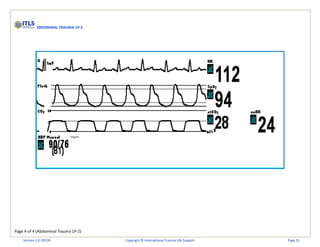
Page 4 of 4 (Abdominal Trauma 1P-2)
ABDOMINAL TRAUMA 1P-2
Version 1.0 (2019) Copyright © International Trauma Life Support Page 31
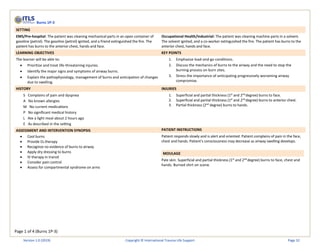
Page 1 of 4 (Burns 1P-3)
Burns 1P-3
SETTING
EMS/Pre-hospital: The patient was cleaning mechanical parts in an open container of
gasoline (petrol). The gasoline (petrol) ignited, and a friend extinguished the fire. The
patient has burns to the anterior chest, hands and face.
Occupational Health/Industrial: The patient was cleaning machine parts in a solvent.
The solvent ignited, and a co-worker extinguished the fire. The patient has burns to the
anterior chest, hands and face.
LEARNING OBJECTIVES KEY POINTS
The learner will be able to:
• Prioritize and treat life-threatening injuries.
• Identify the major signs and symptoms of airway burns.
• Explain the pathophysiology, management of burns and anticipation of changes
due to swelling.
1. Emphasize load-and-go conditions.
2. Discuss the mechanics of burns to the airway and the need to stop the
burning process on burn sites.
3. Stress the importance of anticipating progressively worsening airway
compromise.
HISTORY INJURIES
S Complains of pain and dyspnea
A No known allergies
M No current medications
P No significant medical history
L Ate a light meal about 2 hours ago
E As described in the setting
1. Superficial and partial thickness (1st
and 2nd
degree) burns to face.
2. Superficial and partial thickness (1st
and 2nd
degree) burns to anterior chest.
3. Partial thickness (2nd
degree) burns to hands.
ASSESSMENT AND INTERVENTION SYNOPSIS PATIENT INSTRUCTIONS
• Cool burns
• Provide O2 therapy
• Recognize no evidence of burns to airway
• Apply dry dressing to burns
• IV therapy in transit
• Consider pain control
• Assess for compartmental syndrome on arms
Patient responds slowly and is alert and oriented. Patient complains of pain in the face,
chest and hands. Patient's consciousness may decrease as airway swelling develops.
MOULAGE
Pale skin. Superficial and partial thickness (1st
and 2nd
degree) burns to face, chest and
hands. Burned shirt on scene.
Version 1.0 (2019) Copyright © International Trauma Life Support Page 32
Page 2 of 4 (Burns 1P-3)
BURNS 1P-3
SCENE SIZE-UP: One patient and scene is safe. Cleaning parts and solvent ignited.
INITIAL ASSESSMENT
GENERAL IMPRESSION: Potentially unstable, medium priority with possibility of
becoming high priority. Burns to face, chest and hands.
Life-Threatening Bleeding: No
LOC: Alert and answering questions
AIRWAY: Patent
BREATHING: Slightly elevated rate, regular,
with adequate bilateral chest wall excursions
Bleeding: None
Capillary Refill: < 2 seconds
Skin: Non-burned skin is pink, warm
and dry
CIRCULATION:
Pulse – Slightly elevated rate, strong and
regular (Radial)
WHAT IS THE PURPOSE OF THE INITIAL ASSESSMENT?
To prioritize the patient and to identify immediately life-threatening conditions (Obj.2.3, Page 34)
RAPID TRAUMA SURVEY REASSESSMENT FOCUSED EXAM SECONDARY SURVEY
Head: Superficial and partial thickness (1st
and 2nd
degree) burns to face and neck;
singed eyebrows; no swelling of lips or
nose; no evidence of soot
Neck: Trachea: Midline, Neck veins: Flat
Chest: Pain to the anterior aspect, Look:
Superficial and partial thickness (1st
and
2nd)
degree burns, Listen: Clear and equal,
no abnormal breath sounds, Feel: No
instability or crepitus, Percussion:
Resonant, Heart Tones: Normal S1, S2
Abdomen: No injuries or pain noted
Pelvis: No injuries or pain noted
Extremities: Legs: No injuries or pain
noted, Pulse, Motor and Sensory: Intact,
Arms: 2nd
degree burns to the front and
back of both hands and hands, Pulse,
Motor and Sensory: Intact
Posterior: No injury or pain noted
History: (Obtain from patient)
Subjective changes: No changes
LOC: Alert, responds verbally
Pupils: 4 mm, equal and reactive
GCS: 4/5/6 = 15
Airway: Patent
Breathing: Slightly elevated rate, regular,
with adequate tidal volume, no abnormal
sounds
Circulation: Pulses: Slightly elevated rate,
strong and regular (radial)
Skin: Unburned skin is pink, warm and dry
Neck: No swelling, 1st
and 2nd
degree
burns, Trachea: Midline, Neck veins: Flat
Chest: No changes
Breath sounds: No changes
Abdomen: No changes
Pelvis: No changes
Extremities: Arms: 2nd
degree burns to
both hands, Pulse, Motor and Sensory:
Intact
Head: Red, dry, painful skin, some areas
mottled red, blistered painful skin
Neck: Red, dry, painful skin, some areas
red, blistered painful skin, no apparent
swelling
Chest: Red, dry, painful skin, some areas
mottled red, blistered painful skin, no
apparent swelling
Upper Extremities: Red, blistered painful
skin
Head: No changes
Airway: Patent
Breathing: Slightly elevated rate, regular,
with adequate tidal volume, no abnormal
sounds
Circulation: Pulses: Slightly elevated rate,
strong and regular (radial)
Skin: Unburned skin is pink, warm and dry
Neck: 1st
and 2nd
degree burns, no
apparent swelling, Trachea: Midline, Neck
veins: Flat
Chest: Pain to the anterior aspect, Look: 1st
and 2nd
degree burns, Listen: Clear and
equal, Feel: No instability or crepitus,
Percussion: Resonant
Abdomen: No changes
Pelvis: No changes
Extremities: Arms: 2nd
degree burns to
both hands, Pulse, Motor and Sensory:
Intact, Legs: No changes,
Pulse, Motor and Sensory: Intact
Posterior: No changes
Version 1.0 (2019) Copyright © International Trauma Life Support Page 33
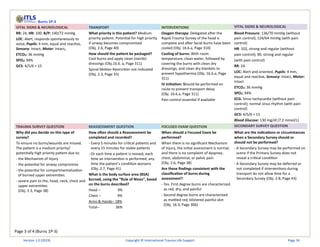
Page 3 of 4 (Burns 1P-3)
Burns 1P-3
VITAL SIGNS & NEUROLOGICAL TRANSPORT INTERVENTIONS VITAL SIGNS & NEUROLOGICAL
RR: 24, HR: 100, B/P: 140/72 mmHg
LOC: Alert, responds spontaneously to
voice, Pupils: 4 mm, equal and reactive,
Sensory: Intact, Motor: Intact,
ETCO2: 36 mmHg
SPO2: 94%
GCS: 4/5/6 = 15
What priority is this patient? Medium
priority patient. Potential for high priority
if airway becomes compromised
(Obj. 2.6, Page 40)
How should the patient be packaged?
Cool burns and apply clean (sterile)
dressings (Obj.16.6. a, Page 311)
Spinal Motion Restriction not indicated
(Obj. 2.3, Page 35)
Oxygen therapy: Delegated after the
Rapid Trauma Survey of the head is
complete and after facial burns have been
cooled (Obj. 16.6.a, Page 310)
Cooling of burns: With room
temperature, clean water, followed by
covering the burns with clean dry
dressings, and clean dry blankets to
prevent hypothermia (Obj. 16.6.a, Page
311)
IV initiation: Should be performed en
route to prevent transport delay
(Obj. 16.6.a, Page 311)
Pain control essential if available
Blood Pressure: 136/70 mmHg (without
pain control); 124/64 mmHg (with pain
control)
HR: 102, strong and regular (without
pain control); 90, strong and regular
(with pain control)
RR: 24
LOC: Alert and oriented, Pupils: 4 mm,
equal and reactive, Sensory: Intact, Motor:
Intact
ETCO2: 36 mmHg
SPO2: 94%
ECG: Sinus tachycardia (without pain
control); normal sinus rhythm (with pain
control)
GCS: 4/5/6 = 15
Blood Glucose: 130 mg/dl (7.2 mmol/L)
TRAUMA SURVEY QUESTION REASSESSMENT QUESTION FOCUSED EXAM QUESTION SECONDARY SURVEY QUESTION
Why did you decide on this type of
survey?
To ensure no burns/wounds are missed.
The patient is a medium priority/
potentially high priority patient due to:
- the Mechanism of Injury
- the potential for airway compromise
- the potential for compartmentalization
of burned upper extremities.
- severe pain to the, head, neck, chest and
upper extremities
(Obj. 2.3, Page 38)
How often should a Reassessment be
completed and recorded?
- Every 5 minutes for critical patients and
every 15 minutes for stable patients
- Or each time a patient is moved; each
time an intervention is performed; any
time the patient’s condition worsens
(Obj. 2.7, Page 41)
What is the body surface area (BSA)
burned, using the “Rule of Nines”, based
on the burns described?
Head – 9%
Chest – 9%
Arms & Hands– 18%
Total– 36%
When should a Focused Exam be
performed?
When there is no significant Mechanism
of Injury, the initial assessment is normal,
and there is no complaint of dyspnea,
chest, abdominal, or pelvic pain
(Obj. 2.6, Page 38)
Are these findings consistent with the
classification of burns during
assessment?
- Yes. First degree burns are characterized
as red, dry, and painful
- Second degree burns are characterized
as mottled red, blistered painful skin
(Obj. 16.3, Page 306)
What are the indications or circumstances
when a Secondary Survey should or
should not be performed?
- A Secondary Survey may be performed on
scene if the Primary Survey does not
reveal a critical condition
- A Secondary Survey may be deferred or
not completed if interventions during
transport do not allow time for a
Secondary Survey (Obj. 2.8, Page 43)
Version 1.0 (2019) Copyright © International Trauma Life Support Page 34
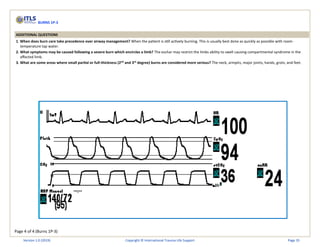
Page 4 of 4 (Burns 1P-3)
BURNS 1P-3
ADDITIONAL QUESTIONS
1. When does burn care take precedence over airway management? When the patient is still actively burning. This is usually best done as quickly as possible with room-
temperature tap water.
2. What symptoms may be caused following a severe burn which encircles a limb? The eschar may restrict the limbs ability to swell causing compartmental syndrome in the
affected limb.
3. What are some areas where small partial or full-thickness (2nd
and 3rd
degree) burns are considered more serious? The neck, armpits, major joints, hands, groin, and feet.
Version 1.0 (2019) Copyright © International Trauma Life Support Page 35
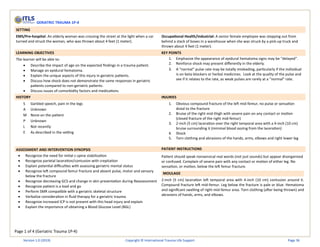
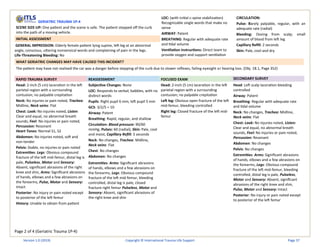
Page 1 of 4 (Geriatric Trauma 1P-4)
GERIATRIC TRAUMA 1P-4
SETTING
EMS/Pre-hospital: An elderly woman was crossing the street at the light when a car
turned and struck the woman, who was thrown about 4 feet (1 meter).
Occupational Health/Industrial: A senior female employee was stepping out from
behind a stack of boxes in a warehouse when she was struck by a pick-up truck and
thrown about 4 feet (1 meter).
LEARNING OBJECTIVES KEY POINTS
The learner will be able to:
• Describe the impact of age on the expected findings in a trauma patient.
• Manage an epidural hematoma.
• Explain the unique aspects of this injury in geriatric patients.
• Discuss how shock does not demonstrate the same responses in geriatric
patients compared to non-geriatric patients.
• Discuss issues of comorbidity factors and medications
1. Emphasize the appearance of epidural hematoma signs may be “delayed”.
2. Reinforce shock may present differently in the elderly.
3. A “normal” pulse rate may be totally misleading, particularly if the individual
is on beta-blockers or herbal medicines. Look at the quality of the pulse and
see if it relates to the rate, as weak pulses are rarely at a “normal” rate.
HISTORY INJURIES
S Garbled speech, pain in the legs
A Unknown
M None on the patient
P Unknown
L Not recently
E As described in the setting
1. Obvious compound fracture of the left mid-femur, no pulse or sensation
distal to the fracture
2. Bruise of the right mid-thigh with severe pain on any contact or motion
(closed fracture of the right mid-femur)
3. 2-inch (5 cm) laceration over the right temporal area with a 4-inch (10 cm)
bruise surrounding it (minimal blood oozing from the laceration)
4. Shock
5. Torn clothing and abrasions of the hands, arms, elbows and right lower leg
ASSESSMENT AND INTERVENTION SYNOPSIS PATIENT INSTRUCTIONS
• Recognize the need for initial c-spine stabilization
• Recognize parietal laceration/contusion with crepitation
• Explain potential difficulties with assessing geriatric mental status
• Recognize left compound femur fracture and absent pulse, motor and sensory
below the fracture
• Recognize decreasing GCS and change in skin presentation during Reassessment
• Recognize patient is a load and go
• Perform SMR compatible with a geriatric skeletal structure
• Verbalize consideration in fluid therapy for a geriatric trauma
• Recognize increased ICP is not present with this head injury and explain
• Explain the importance of obtaining a Blood Glucose Level (BGL)
Patient should speak nonsensical real words (not just sounds) but appear disorganized
or confused. Complain of severe pain with any contact or motion of either leg. No
sensation, or motion, below the left femur fracture.
MOULAGE
2-inch (5 cm) laceration left temporal area with 4-inch (10 cm) contusion around it.
Compound fracture left mid-femur. Leg below the fracture is pale or blue. Hematoma
and significant swelling of right mid-femur area. Torn clothing (after being thrown) and
abrasions of hands, arms, and elbows.
Version 1.0 (2019) Copyright © International Trauma Life Support Page 36
Page 2 of 4 (Geriatric Trauma 1P-4)
GERIATRIC TRAUMA 1P-4
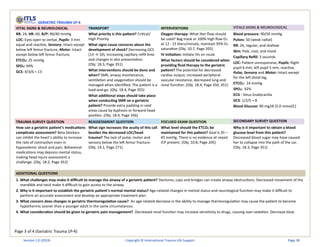
SCENE SIZE-UP: One patient and the scene is safe. The patient stepped off the curb
into the path of a moving vehicle.
INITIAL ASSESSMENT
GENERAL IMPRESSION: Elderly female patient lying supine, left leg at an abnormal
angle, conscious, uttering nonsensical words and complaining of pain in the legs.
Life-Threatening Bleeding: No
LOC: (with initial c-spine stabilization)
Recognizable single words that make no
sense
AIRWAY: Patent
BREATHING: Regular with adequate rate
and tidal volume
Ventilation instructions: Direct team to
provide oxygen and support ventilation
CIRCULATION:
Pulse: Barely palpable, regular, with an
adequate rate (radial)
Bleeding: Oozing from scalp; small
amount of blood from left leg
Capillary Refill: 2 seconds
Skin: Pale, cool and dry
WHAT GERIATRIC CHANGES MAY HAVE CAUSED THIS INCIDENT?
The patient may have not realized the car was a danger before stepping of the curb due to slower reflexes, failing eyesight or hearing loss. (Obj. 18.1, Page 352)
RAPID TRAUMA SURVEY REASSESSMENT FOCUSED EXAM SECONDARY SURVEY
Head: 2-inch (5 cm) laceration in the left
parietal region with a surrounding
contusion; no palpable crepitation
Neck: No injuries or pain noted, Trachea:
Midline, Neck veins: Flat
Chest: Look: No injuries noted, Listen:
Clear and equal, no abnormal breath
sounds, Feel: No injuries or pain noted,
Percussion: Resonant
Heart Tones: Normal S1, S2
Abdomen: No injuries noted, soft and
non-tender
Pelvis: Stable, no injuries or pain noted
Extremities: Legs: Obvious compound
fracture of the left mid-femur, distal leg is
pale, Pulseless, Motor and Sensory:
Absent, significant abrasions of the right
knee and shin, Arms: Significant abrasions
of hands, elbows and a few abrasions on
the forearms, Pulse, Motor and Sensory:
Intact
Posterior: No injury or pain noted except
to posterior of the left femur
History: Unable to obtain from patient
Subjective Changes: None
LOC: Responds to verbal; babbles, with no
distinct words
Pupils: Right pupil 6 mm; left pupil 5 mm
GCS: 3/2/5 = 10
Airway: Patent
Breathing: Rapid, regular, and shallow
Circulation: Blood pressure: 90/60
mmHg, Pulses: 60 (radial), Skin: Pale, cool
and moist, Capillary Refill: 3 seconds
Neck: No changes, Trachea: Midline,
Neck veins: Flat
Chest: No changes
Abdomen: No changes
Extremities: Arms: Significant abrasions
of hands, elbows and a few abrasions on
the forearms, Legs: Obvious compound
fracture of the left mid-femur, bleeding
controlled, distal leg is pale, closed
fracture right femur Pulseless, Motor and
Sensory: Absent, significant abrasions of
the right knee and shin
Head: 2-inch (5 cm) laceration in the left
parietal region with a surrounding
contusion; no palpable crepitation
Left leg: Obvious open fracture of the left
mid-femur, bleeding controlled
Right leg: Closed fracture of the left mid-
femur
Head: Left scalp laceration bleeding
controlled
Airway: Patent
Breathing: Regular with adequate rate
and tidal volume
Neck: No changes, Trachea: Midline,
Neck veins: Flat
Chest: Look: No injuries noted, Listen:
Clear and equal, no abnormal breath
sounds, Feel: No injuries or pain noted,
Percussion: Resonant
Abdomen: No changes
Pelvis: No changes
Extremities: Arms: Significant abrasions
of hands, elbows and a few abrasions on
the forearms, Legs: Obvious compound
fracture of the left mid-femur, bleeding
controlled, distal leg is pale, Pulseless,
Motor and Sensory: Absent, significant
abrasions of the right knee and shin,
Pulse, Motor and Sensory: Intact
Posterior: No injury or pain noted except
to posterior of the left femur
Version 1.0 (2019) Copyright © International Trauma Life Support Page 37
Page 3 of 4 (Geriatric Trauma 1P-4)
GERIATRIC TRAUMA 1P-4
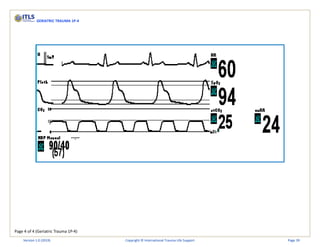
VITAL SIGNS & NEUROLOGICAL TRANSPORT INTERVENTIONS VITALS SIGNS & NEUROLOGICAL
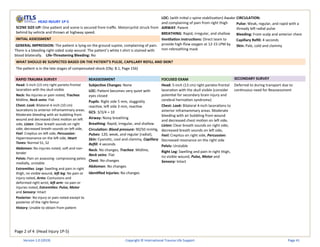
RR: 24, HR: 60, B/P: 90/40 mmHg
LOC: Eyes open to verbal, Pupils: 3 mm
equal and reactive, Sensory: Intact except
below left femur fracture, Motor: Intact
except below left femur fracture,
ETCO2: 25 mmHg
SPO2: 94%
GCS: 4/3/6 = 13
What priority is this patient? Critical/
High Priority
What signs cause concerns about the
development of shock? Decreasing GCS
(13 → 10), increasing capillary refill time
and changes in skin presentation.
(Obj. 18.3, Page 351)
What interventions should be done and
when? SMR, airway maintenance,
ventilation and oxygenation should be
managed when identified. The patient is a
load-and-go. (Obj. 18.4, Page 355)
What additional steps should take place
when conducting SMR on a geriatric
patient? Provide extra padding in void
areas cause by kyphosis or forward head
position. (Obj. 18.4, Page 356)
Oxygen therapy: What liter flow should
be used? Bag mask or 100% high flow O2
at 12 - 15 liters/minute, maintain 95% O2
saturation (Obj. 10.7, Page 205)
IV initiation: Initiate IVs en route
What factors should be considered when
providing fluid therapy to the geriatric
patient? The potential for decreased
cardiac output, increased peripheral
vascular resistance, decreased lung and
renal function. (Obj. 18.4, Page 350, 351)
Blood pressure: 90/50 mmHg
Pulses: 50 (weak radial)
RR: 24, regular, and shallow
Skin: Pale, cool, and moist
Capillary Refill: 3 seconds
LOC: Patient unresponsive, Pupils: Right
pupil 6 mm; left pupil 5 mm, reactive,
Pulse, Sensory and Motor: Intact except
for the left distal leg,
ETCO2: 24 mmHg
SPO2: 92%
ECG - Sinus bradycardia
GCS: 1/2/5 = 8
Blood Glucose: 90 mg/dl (5.0 mmol/L)
TRAUMA SURVEY QUESTION REASSESSMENT QUESTION FOCUSED EXAM QUESTION SECONDARY SURVEY QUESTION
How can a geriatric patient’s medications
complicate assessment? Beta blockers
can inhibit the heart’s ability to increase
the rate of contraction even in
hypovolemic shock and pain. Behavioral
medications may depress mental status,
making head injury assessment a
challenge. (Obj. 18.2, Page 352)
What sign increases the acuity of this call
besides the decreased LOC/head
trauma? The lack of pulse, motor and
sensory below the left femur fracture.
(Obj. 14.1, Page 271)
What level should the ETCO2 be
maintained for this patient? Goal is 35 –
45 mmHg. There is no evidence of raised
ICP present. (Obj. 10.8, Page 205)
Why is it important to obtain a blood
glucose level from this patient?
Decreased blood sugar may have caused
her to collapse into the path of the car.
(Obj. 18.3, Page 351)
ADDITIONAL QUESTIONS
1. What challenges may make it difficult to manage the airway of a geriatric patient? Dentures, caps and bridges can create airway obstructions. Decreased movement of the
mandible and neck make it difficult to gain access to the airway.
2. Why is it important to establish the geriatric patient’s normal mental status? Age-related changes in mental status and neurological function may make it difficult to
perform an accurate assessment and develop an appropriate treatment plan.
3. What concern does changes in geriatric thermoregulation cause? An age-related decrease in the ability to manage thermoregulation may cause the patient to become
hypothermic sooner than a younger adult in the same circumstances.
4. What consideration should be given to geriatric pain management? Decreased renal function may increase sensitivity to drugs, causing over-sedation. Decrease dose.
Version 1.0 (2019) Copyright © International Trauma Life Support Page 38
Page 4 of 4 (Geriatric Trauma 1P-4)
GERIATRIC TRAUMA 1P-4
Version 1.0 (2019) Copyright © International Trauma Life Support Page 39
Page 1 of 4 (Head Injury 1P-5)
HEAD INJURY 1P-5
SETTING
EMS/Pre-hospital: ALS and BLS partners are dispatched to a male motorcyclist struck
by a large delivery van (lorry) at an approximate speed of 65 mph (100 kph). The
cyclist was not wearing a helmet and was thrown off his bike, landing on a metal crash
barrier in the middle of the highway (motorway). The fire department (fire brigade) is
arriving at the same time as the ambulance.
Occupational Health/Industrial: An Occupational Health and Safety (OH&S) Team has
been called to an internal road leading to a staff car park zone. A worker who was late
for his shift was travelling by motor bike without a helmet. While negotiating a sharp
bend, he collided with an oncoming SUV and was thrown off his bike landing on a
metal barrier. EMS and Fire are arriving just behind the OH&S Team.
LEARNING OBJECTIVES KEY POINTS
The learner will be able to:
• Describe potential hazards on the scene and how to mitigate them.
• Identify primary traumatic brain injury and the development of secondary brain
injury.
• Describe the proper evaluation and prehospital management of the head-injured
patient with associated multi-system trauma.
• Demonstrate treatment of an open chest wound.
1. Emphasize the importance of teamwork in the structured assessment and
stabilization of the patient.
2. Reinforce assessment of the head-injured patient should be directed toward the
recognition of primary brain injury and prevention of secondary injury prior to
arrival in a facility where imaging and definitive care can be offered.
3. Emphasize the importance of maintaining optimal perfusion of the brain to
prevent hypoxic brain injury which may be irreversible and permanent. Include
the following:
a. What cerebral herniation syndrome does to perfusion.
b. How hyperventilation and osmotic diuretics buy time in cerebral herniation
syndrome.
HISTORY INJURIES
S Patient is initially responsive, confused, then decreased level of consciousness
A Unknown
M Unknown
P Unknown
L Unknown
E As described in the setting
1.Laceration to right fronto-parietal area. Raccoon eyes. Bleeding from both nostrils.
2.Unstable pelvis.
3.Closed fracture to right femur.
4.Bilateral deep anterior chest lacerations.
5.Open pneumothorax left chest.
6.Deformed right wrist.
ASSESSMENT AND INTERVENTION SYNOPSIS PATIENT INSTRUCTIONS
• Recognize the significance of the mechanism of injury and load and go
• C-spine stabilization and spinal motion restriction with pelvic binding
• Recognize late signs of compensated shock
• Maintain a patent airway, ventilate and oxygenate as needed
• Place occlusive dressing or flutter valve over open chest wound
• Chest decompression if required
• Implement capnography
• Initiate fluid therapy in transit
A manikin can be used for this case. If using live patient, he should be responsive for
the first 5 minutes and then has altered level of consciousness.
MOULAGE
Lacerations to scalp and anterior chest, sucking chest wound, deformity to right
femur, bruising to right wrist, pale
Version 1.0 (2019) Copyright © International Trauma Life Support Page 40
Page 2 of 4 (Head Injury 1P-5)
HEAD INJURY 1P-5
SCENE SIZE-UP: One patient and scene is secured from traffic. Motorcyclist struck from
behind by vehicle and thrown at highway speed.
INITIAL ASSESSMENT
GENERAL IMPRESSION: The patient is lying on the ground supine, complaining of pain.
There is a bleeding right-sided scalp wound. The patient’s white t-shirt is stained with
blood bilaterally. Life-Threatening Bleeding: No
LOC: (with initial c-spine stabilization) Awake
and complaining of pain from right thigh
AIRWAY: Patent
BREATHING: Rapid, irregular, and shallow
Ventilation instructions: Direct team to
provide high-flow oxygen at 12-15 LPM by
non-rebreathing mask
CIRCULATION:
Pulse: Weak, regular, and rapid with a
thready left radial pulse
Bleeding: From scalp and anterior chest
Capillary Refill: 4 seconds
Skin: Pale, cold and clammy
WHAT SHOULD BE SUSPECTED BASED ON THE PATIENT’S PULSE, CAPILLARY REFILL AND SKIN?
The patient is in the late stages of compensated shock (Obj: 8.1, Page 156)
RAPID TRAUMA SURVEY REASSESSMENT FOCUSED EXAM SECONDARY SURVEY
Head: 5-inch (13 cm) right parieto-frontal
laceration with the skull visible
Neck: No injuries or pain noted, Trachea:
Midline, Neck veins: Flat
Chest: Look: Bilateral 4-inch (10 cm)
lacerations to anterior inframammary areas.
Moderate bleeding with air bubbling from
wound and decreased chest motion on left
side, Listen: Clear breath sounds on right
side; decreased breath sounds on left side,
Feel: Crepitus on left side, Percussion:
Hyperresonance on the left side, Heart
Tones: Normal S1, S2
Abdomen: No injuries noted, soft and non-
tender
Pelvis: Pain on assessing- compressing pelvis
medially, unstable
Extremities: Legs: Swelling and pain in right
thigh, no visible wound, left leg: No pain or
injury noted, Arms: Contusions and
deformed right wrist; left arm: no pain or
injuries noted, Extremities: Pulse, Motor
and Sensory: Intact
Posterior: No injury or pain noted except to
posterior of the right femur
History: Unable to obtain from patient
Subjective Changes: None
LOC: Patient becomes very quiet with
eyes closed
Pupils: Right side 5 mm, sluggishly
reactive, left side 3 mm, reactive
GCS: 3/3/4 = 10
Airway: Noisy breathing
Breathing: Rapid, irregular, and shallow
Circulation: Blood pressure: 90/50 mmHg,
Pulses: 120, weak, and regular (radial),
Skin: Cyanotic, cool and clammy, Capillary
Refill: 4 seconds
Neck: No changes, Trachea: Midline,
Neck veins: Flat
Chest: No changes
Abdomen: No changes
Identified Injuries: No changes
Head: 5-inch (13 cm) right parieto-frontal
laceration with the skull visible (consider
potential for secondary brain injury and
cerebral herniation syndrome)
Chest: Look: Bilateral 4-inch lacerations to
anterior inframammary areas. Moderate
bleeding with air bubbling from wound
and decreased chest motion on left side,
Listen: Clear breath sounds on right side;
decreased breath sounds on left side,
Feel: Crepitus on right side, Percussion:
Decreased resonance on the right side
Pelvis: Unstable
Right Leg: Swelling and pain in right thigh,
no visible wound, Pulse, Motor and
Sensory: Intact
Deferred to during transport due to
continuous need for Reassessment
Version 1.0 (2019) Copyright © International Trauma Life Support Page 41
Page 3 of 4 (Head Injury 1P-5)
HEAD INJURY 1P-5
VITAL SIGNS & NEUROLOGICAL TRANSPORT INTERVENTIONS VITALS SIGNS & NEUROLOGICAL
RR: 24, HR: 120, B/P: 90/40 mmHg
LOC: Eyes open to verbal, Pupils: 5 mm
equal and reactive, Sensory and Motor:
Intact
ETCO2: 39 mmHg
SPO2: 95%
GCS: 4/4/6 = 14
What priority is this patient? Critical/
High Priority
Where should this patient be transported
to? Trauma Center
Should alternative transport be
provided? Consider aeromedical
transport
What interventions should be done and
when? Spinal motion restriction, airway
maintenance and ventilation and
potentially needle decompression should
be managed when identified
(Obj. 2.3, Page 40)
What position should the patient be
placed in? Position the patients with 30-
degree head elevation to assist with
venous drainage (Obj. 10.7, Page 205)
Airway/Breathing: Airway adjunct and
manual ventilation if required
Place occlusive dressing or flutter valve
over wound (Obj. 6.5, Page 132)
Oxygen therapy: What liter flow should
be used? 100% high flow O2 at 12 - 15
liters/minute, maintain 95% O2 saturation
(Obj. 10.7, Page 205)
IV initiation: Start IVs en route
How much fluid should be administered?
The goal of fluid therapy should be to
maintain systolic blood pressure at 110 to
120 mmHg in TBI. Avoid hypotension.
(Obj. 10.6, Page 204)
SMR including pelvic binding (Obj. 14.5,
Page, 280)
Blood pressure: 90/50 mmHg
Pulses: 120 (weak radial)
RR: 10, irregular, and adequate tidal
volume
Skin: Cyanotic, cold and clammy
Capillary Refill: 4 seconds
LOC: Patient unresponsive, Pupils: Right
side 5 mm, sluggishly reactive. Left side 3
mm, reactive, Pulse, Sensory and Motor:
Intact,
ETCO2: 39 mmHg
SPO2: 95%
ECG: Sinus tachycardia
GCS: 3/3/3 = 9
Blood Glucose: 130 mg/dl (7.2 mmol/L)
TRAUMA SURVEY QUESTION REASSESSMENT QUESTION FOCUSED EXAM QUESTION SECONDARY SURVEY QUESTION
What injuries may be associated with the
findings to the head? Linear or depressed
skull fractures, lacerations, bleeding or
fluid from the nose or ears. (Obj. 10.5,
Page 201)
What is the significance of the moderate
bleeding with air bubbling and decreased
chest motion on left side? The presence
of an open pneumothorax, broken ribs or
flail chest. (Obj. 6.5, Page 135)
Are these findings consistent with the
working impression/diagnosis of this
patient? Decreasing level of
consciousness, and unequal pupils in the
presence of a head injury may indicate
TBI. (Obj. 10.7, Page 201 - 204)
Could the injuries to the head worsen?
Increased intracranial pressure could lead
to anoxic brain injury and herniation. (Obj.
10.7, Page 194)
What rate should you ventilate the
patient? 8 – 10 breaths/minute.
What level should the EtCO2 be
maintained? 35 – 45 mmHg, or 30 – 35
mmHg if increased ICP is evident. (Obj.
10.8, Page 205)
What are the indications or
circumstances when a Secondary Survey
should or should not be performed?
Patients with suspected traumatic brain
injury are load and go. A Secondary
Survey may not be performed due to
critical interventions/care required during
transport. (Obj. 10.5, Page 204)
Version 1.0 (2019) Copyright © International Trauma Life Support Page 42
Page 4 of 4 (Head Injury 1P-5)
HEAD INJURY 1P-5
ADDITIONAL QUESTIONS
1. What challenge does the patient’s chest injuries present in managing a traumatic brain injury? The chest injuries significantly increase the difficulty in brain oxygenation.
2. What ominous change develops between the Rapid Trauma Survey and Reassessment? The patient closes his eyes and becomes very quiet.
3. Explain the Monroe-Kellie Doctrine. The contents of the skull (brain, blood and CSF) are at a fixed volume. An increase in the volume of one is compensated by a decrease in
the other two.
4. What are the indications for performing a chest decompression? The presence of a tension pneumothorax with decompensation evidenced by respiratory distress and
cyanosis, signs of shock, or a decreasing level of consciousness.
Version 1.0 (2019) Copyright © International Trauma Life Support Page 43
Page 1 of 4 (Head Injury 1P-6)
HEAD INJURY 1P-6
SETTING
EMS/Pre-hospital: Called to the scene of an altercation between two young men. The
patient was hit and kicked during the fight, which caused him to fall backward and hit
the back of his head.
Occupational Health/Industrial: Same as EMS/Pre-hospital.
LEARNING OBJECTIVES KEY POINTS
The learner will be able to:
• Prioritize and treat life-threatening head injuries.
• Identify the major signs and symptoms of head injury.
• Discuss the pathophysiology and management of an epidural hematoma.
• Describe Cushing’s Triad.
1. Reinforce what the adverse effects of hypoventilation and hyperventilation are
in the head-injured patient.
2. Highlight Cushing’s reflex (increased blood pressure, decreased pulse).
3. Stress what the recommended minimum systolic BP (110 mmHg) is for the
adult traumatic brain injury patient with GCS < 8.
4. Stress why barbiturates should not be administered as a sedative for the head-
injured patient as they cause a decrease in systemic BP.
5. Reinforce how the Monroe-Kelli Doctrine affects secondary brain injury.
HISTORY INJURIES
S Brief loss of consciousness at time of injury
A Unknown
M Unknown
P Unremarkable
L Two hours ago
E As described in the setting
1. Closed major head injury.
2. Facial injuries and edema.
ASSESSMENT AND INTERVENTION SYNOPSIS PATIENT INSTRUCTIONS
• Initial c-spine stabilization.
• High-flow O2 via non-rebreather mask at 12-15 liters/minute, maintain O2
saturation at 95%.
• Recognize load and go.
• Recognize decreasing level of consciousness, respiratory rate, non-patent
airway, pupil changes.
• Maintain airway through an airway adjunct or intubation.
• Ventilate with bag-valve mask.
• Recognize Cushing’s Triad.
• Monitor ETCO2 and maintain between 30-35 mmHg.
• Initiate fluid therapy during transport. Maintain systolic blood pressure at 110 -
120 mmHg. Avoid hypotension.
The patient is initially confused, then becomes rapidly unconscious as they are loaded
into the ambulance.
MOULAGE
Patient has bruising to the face and a hematoma to the occipital area.
Version 1.0 (2019) Copyright © International Trauma Life Support Page 44
Page 2 of 4 (Head Injury 1P-6)
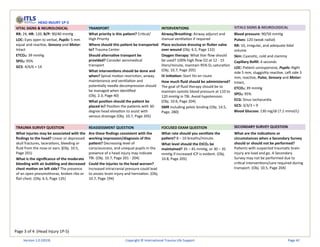
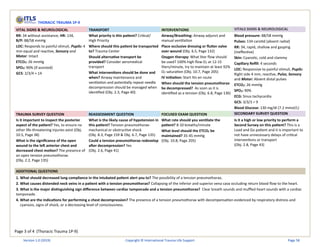
HEAD INJURY 1P-6
SCENE SIZE-UP: one patient and scene is safe. Police have secured the scene and the
perpetrator. The patient was assaulted with fists and feet. The patient fell backward
and hit his head.
INITIAL ASSESSMENT
GENERAL IMPRESSION: Young male, lying on the ground, with obvious facial swelling
and contusions. Life-Threatening Bleeding: No.
LOC: (with initial c-spine stabilization)
Confused, but vocalizing
AIRWAY: Patent
BREATHING: Regular with adequate rate and
tidal volume
Ventilation instructions: Apply oxygen by
non-rebreather mask
CIRCULATION:
Pulse: Strong, regular, with an adequate rate
(radial)
Bleeding: Small oozing from hematoma
on the occiput; small oozing from facial
swelling and injuries
Capillary Refill: <2 seconds
Skin: Pale, warm and dry
WHAT IS THE INITIAL ASSESSMENT PURPOSE?
To prioritize the patient and to identify immediately life-threatening conditions (Obj. 2.3, Page 34)
RAPID TRAUMA SURVEY REASSESSMENT FOCUSED EXAM SECONDARY SURVEY
Head: Significant facial swelling with
laceration on the corner of the right eye.
Hematoma felt over the occipital region.
Neck: Tender, Trachea: Midline, Neck
veins: Flat
Chest: Look: No injuries noted, Listen:
Clear and equal, no abnormal breath
sounds, Feel: No injuries or pain noted,
Percussion: Resonant, Heart Tones:
Normal S1, S2
Abdomen: No injuries noted, soft and
non-tender
Pelvis: Stable, no injuries or pain noted
Extremities: Legs and Arms: No injuries or
pain noted,
Pulse, Motor and Sensory: Intact
Posterior: Hematoma on the occiput, no
other findings
History: Unable to obtain, as patient
becomes suddenly unresponsive
Subjective changes: Patient becomes less
responsive
LOC: Eyes open to pain
Pupils: Right pupil 5 mm and sluggish; left
pupil 3 mm and brisk
GCS: 1/1/3=5
Airway: No gag reflex/non-patent
Breathing: RR drops to 10/minute and
becomes irregular. Patient should be
intubated or have an airway adjunct
inserted, bag mask ventilation
Circulation: Blood pressure: 150/105
mmHg, Pulses: 50 (radial), Skin: Pale,
warm and dry, Capillary Refill: <2 seconds
Neck: No changes, Trachea: Midline,
Neck veins: Flat
Chest: No changes
Abdomen: No changes
Identified injuries: No changes
Head: Significant facial swelling with
laceration on the corner of the right eye
Scalp: Occipital hematoma
Head: Significant facial swelling with
laceration on the corner of the right eye;
hematoma on occipital area
Airway: Maintained with airway adjunct
Breathing: Patient should be
hyperventilated with BVM
Neck: No changes, Trachea: Midline,
Neck veins: Flat
Chest: Look: No injuries noted, Listen:
Clear and equal, no abnormal breath
sounds, Feel: No injuries or pain noted,
Percussion: Resonant
Abdomen: No changes
Pelvis: No changes
Extremities: No changes
Posterior: No changes
Version 1.0 (2019) Copyright © International Trauma Life Support Page 45
Page 3 of 4 (Head Injury 1P-6)
HEAD INJURY 1P-6
VITAL SIGNS & NEUROLOGICAL TRANSPORT INTERVENTIONS VITALS SIGNS & NEUROLOGICAL
RR: 12, HR: 70, B/P: 130/80 mmHg
LOC: Eyes open to pain, Pupils: 3 mm
equal and reactive, Sensory: Groans to
pain, Motor: Localizes pain,
ETCO2: 28 mmHg
SPO2: 96%
GCS: 2/2/5 = 9
Should you delay scene time to obtain an
accurate blood pressure? Vital signs for
this patient should be taken during
transport. (Obj. 2.5, Page 39)
What priority is this patient? Critical/
High Priority
Where should this patient be transported
to? Trauma Center
Should alternative transport be
provided? Consider aeromedical
transport.
Should you delay scene time to obtain an
accurate blood pressure? Vital signs for
this patient should be taken during
transport. (Obj. 2.5, Page 39)
What position should the patient be
placed in? Position the patients with 30-
degree head elevation to assist with
venous drainage. (Obj. 10.7, Page 205)
Airway/Breathing: Airway adjunct and
bag mask ventilation at RR at 20
Oxygen therapy: What liter flow should
be used? 100% high-flow O2 at 12-15
liters/minute, maintain 95% O2 saturation
(Obj. 10.7, Page 205)
IV initiation: Start IVs en route
How much fluid should be administered?
The goal of fluid therapy should be to
maintain systolic blood pressure at 110 to
120 mmHg in TBI. Avoid hypotension.
(Obj. 10.6, Page 204)
Blood pressure: 170/105 mmHg
Pulses: 50 (radial)
RR: 20 (BVM)
Skin: Pale, warm and dry
Capillary Refill: <2 seconds
LOC: Patient unresponsive, Pupils: Right
pupil fixed and dilated; left pupil 4 and
sluggish, Sensory and Motor: No response
ETCO2: 28 mmHg
SPO2: 96%
ECG: Sinus bradycardia
GCS: 1/1/1=3
Blood Glucose: 160 mg/dl (8.9 mmol/L)
TRAUMA SURVEY QUESTION REASSESSMENT QUESTION FOCUSED EXAM QUESTION SECONDARY SURVEY QUESTION
What injuries may be associated with the
findings to the head? Skull fractures or
depressions, lacerations, bleeding or fluid
from the nose or ears. (Obj. 10.5, Page
201)
Could the injuries to the head worsen?
Increased cerebral pressure could lead to
anoxic brain injury and herniation.
(Obj. 10.7, Page 194)
Are these findings consistent with the
working impression/diagnosis of this
patient? Decreasing level of
consciousness, loss of gag reflex,
increasing blood pressure with widening
pulse pressure and developing
bradycardia are consistent with Traumatic
Brain Injury. (Obj. 10.7, Page 201 - 204)
What rate should you ventilate the
patient? 8-10 breaths/minute.
What level should the ETCO2 be
maintained? 35-45 mmHg, or 30-35
mmHg if raised ICP is evident. (Obj. 10.8,
Page 205)
What are the indications or
circumstances when a Secondary Survey
should or should not be performed?
Suspected TBI patients are load and go. A
Secondary Survey may not be performed
due to critical interventions/care required
during transport. (Obj. 10.5, Page 204)
ADDITIONAL QUESTIONS
1. The primary job of a provider treating a patient with a Traumatic Brain Injury is? Prevent secondary injury.
2. What is the significance of posturing in a head injury patient? Ominous signs of deep cerebral hemispheric or upper brain stem injury.
3. What are the differences in decorticate and decerebrate posturing? Decerebrate is worse and signifies cerebral herniation.
4. What are some critical interventions for patients with head injuries? Rapid assessment and recognition of potential injury; rapid, safe transport to an appropriate hospital;
secure the airway and provide good oxygenation with pulse oximeter maintained at a level of 95%; try to keep ETCO2 between 35-45 mmHg; if hyperventilation is needed,
maintain ETCO2 between 30-35 mmHg; apply spinal motion restriction based on the mechanism of injury; consider sedation for combative patients to reduce ICP; IV lines
and maintain systolic BP between 110-120 mmHg.
Version 1.0 (2019) Copyright © International Trauma Life Support Page 46
Page 4 of 4 (Head Injury 1P-6)
HEAD INJURY 1P-6
Version 1.0 (2019) Copyright © International Trauma Life Support Page 47
Page 1 of 4 (Shock 1P-7)
SHOCK 1P-7
SETTING
EMS/Pre-hospital: The patient is a passenger in a two-car collision at an intersection.
The vehicle was struck broadside to the right passenger door at 30 mph (50 kph). The
patient was restrained and removed from the vehicle by bystanders. The restrained
driver was unhurt.
*Note: If the vehicle is driven from the right side (e.g., UK) injuries to the passenger will
be on the patient’s left.
Occupational Health/Industrial: The patient is an employee at a commercial
warehouse struck by a fork lift. The hi-lo struck the patient on the right side. The patient
was was knocked to the ground but not run over.
LEARNING OBJECTIVES KEY POINTS
The learner will be able to:
• Prioritize and treat life-threatening injuries.
• Identify the major signs and symptoms of hypovolemic shock.
• State what injuries can lead to hypovolemic shock.
• Emphasize load and go conditions.
• Reinforce the amount of potential blood loss from fractures.
• Stress the importance of anticipating deterioration from torso trauma.
HISTORY INJURIES
S Multiple blunt force trauma
A None
M Unknown
P Unknown
L Unknown
E As described in the setting
1. Right facial lacerations and abrasions.
2. Right lateral chest wall contusion.
3. Right blunt abdominal trauma.
4. Pelvic fracture.
5. Right femur fracture.
6. Right humerus fracture.
ASSESSMENT AND INTERVENTION SYNOPSIS PATIENT INSTRUCTIONS
• Initial c-spine stabilization.
• Assist ventilations with bag-valve mask and hi-flow O2 at 12–15 liters/minute.
• Recognize load and go.
• Bind pelvis.
• Apply Spinal Motion Restriction.
• Recognize shock.
• Perform blood glucose.
• Initiate fluid therapy in transport. Titrate fluid to maintain LOC in a non-TBI
patient, or to maintain a radial pulse if bleeding is controlled.
Patient responds slowly and is weak. Patient complains of shortness of breath and pain
to right chest wall. He/she complains of pain when any of the injuries are palpated.
Patient should act confused and dazed. Patient's consciousness may decrease as shock
develops.
MOULAGE
Pale, diaphoretic skin, facial lacerations, bruising to right lateral chest and abdomen.
Deformity to right humerus and femur.
Version 1.0 (2019) Copyright © International Trauma Life Support Page 48
Page 2 of 4 (Shock 1P-7)
SHOCK 1P-7
SCENE SIZE-UP: One patient and scene is safe. Mechanism of injury: Blunt force
trauma to right side (left side if vehicle is driven from the right).
INITIAL ASSESSMENT
GENERAL IMPRESSION: Complaining of pain to entire right side. Looks unwell, high
priority. Life-Threatening Bleeding: No.
LOC: (with initial c-spine stabilization)
Responds verbally; confused, dazed
AIRWAY: Patent
BREATHING: Rapid, shallow, and labored
Ventilation instructions: Assist ventilations
with bag-mask
CIRCULATION:
Pulse: Rapid, weak and regular (carotid,
no radial pulse)
Bleeding: Small oozing from facial injuries
Capillary Refill: 4 seconds
Skin: Pale, cool and moist
SHOULD VITAL SIGNS FOR THIS PATIENT BE DELEGATED AFTER THE INITIAL ASSESSMENT?
Vital signs for this patient should be taken during transport. (Obj: 2.5, Page 39)
RAPID TRAUMA SURVEY REASSESSMENT FOCUSED EXAM SECONDARY SURVEY
Head: Facial lacerations and abrasions,
bleeding controlled
Neck: No injuries or pain noted, Trachea:
Midline, Neck veins: Flat
Chest: Pain in right chest wall, Look:
Bruises to right lateral chest with equal
chest rise, Listen: Clear and equal, no
abnormal breath sounds Feel: Crepitus,
Percussion: Resonant, Heart Tones:
Normal S1, S2
Abdomen: Pain in upper right abdomen
Pelvis: Unstable with crepitus on the right
Extremities: Legs: Right femur fracture,
Pulse, Motor and Sensory: Intact,
Arms: Pain, deformity to right humerus,
Pulse, Motor and Sensory: Intact
Posterior: No injuries or pain noted
History: (Obtain from patient)
Subjective Changes: No changes
LOC: Responds verbally, confused, dazed
Pupils: 4 mm, equal and reactive
GCS: 3/4/4=11
Airway: Patent
Breathing: RR 40, shallow, and labored
Circulation: Blood pressure: 74/40 mmHg
(without fluid resuscitation; 80/60 mmHg
with fluid resuscitation), Pulses: 130,
weak and regular (carotid, no radial
pulse), Skin: Pale, moist and cool,
Capillary Refill: 4 seconds
Neck: No changes, Trachea: Midline,
Neck veins: Flat
Chest: Pain in right ribs, Look: Bruises to
right lateral chest with equal chest rise,
Feel: Crepitus, Listen: Clear and equal, no
abnormal breath sounds,
Percussion: Resonant
Abdomen: No changes
Identified Injuries: Extremities: Arms:
Pain, deformity right humerus, Pulse,
Motor and Sensory: Intact, Legs: Right
femur fracture, Pulse, Motor and Sensory:
Intact after splinting
Head: Facial lacerations and abrasions
Chest: Rib fractures
Abdomen: Right blunt abdominal trauma
Pelvis: Pelvic fracture
Lower Extremities: Right femur fracture
and right humerus fracture
Head: Right facial lacerations and
abrasions; bleeding controlled
Airway: Patent
Breathing: Rapid, shallow, and labored
Circulation: Rapid, weak and regular
(radial)
Skin: Pale, cool, and moist
Neck: No changes, Trachea: Midline,
Neck veins: Flat
Chest: Pain in right ribs, Look: Bruises to
right lateral chest with equal chest rise,
Feel: Crepitus, Listen: Clear and equal, no
abnormal breath sounds,
Percussion: Resonant
Abdomen: Bruising and tenderness
Pelvis: Unstable
Extremities: Arms: Pain, deformity right
humerus, Pulse, Motor and Sensory:
Intact, Legs: Right femur fracture,
Pulse, Motor and Sensory: Intact
Posterior: No changes
Version 1.0 (2019) Copyright © International Trauma Life Support Page 49
Page 3 of 4 (Shock 1P-7)
SHOCK 1P-7
VITAL SIGNS & NEUROLOGICAL TRANSPORT INTERVENTIONS VITAL SIGNS & NEUROLOGICAL
RR: 40, HR: 130, B/P: 76/40 mmHg
LOC: Responds verbally, confused, dazed
Pupils: 3 mm, equal and reactive,
Sensory: Intact, Motor: Intact,
ETCO2: 22 mmHg
SPO2: 94%
GCS: 3/4/4 = 11
Blood Glucose: 124 mg/dl (8.9mmol/L)
What priority is this patient? Critical/
high priority
Where should this patient be transported
to? The nearest appropriate emergency
facility
Should alternative transport be
provided? Aeromedical transport may be
considered based on transport factors
What interventions should be done on
scene? Control the airway, ventilate,
oxygenate, Spinal Motion Restriction.
(Obj. 2.6, Page 40)
Oxygen therapy: What liter flow should
be used? 12 to 15 liters/minute and
maintain O2 saturation at 95%
(Obj. 8.5 Page 166)
IV initiation: BP 70/40 mmHg with no
bolus; BP 90/60 mmHg with bolus
Pulses: 140 with no treatment; 130 with
appropriate bolus
GCS: 11 unless shock is not treated; GCS
drops to 8 if no fluid therapy
Bind Pelvis: if the pelvis is unstable
BP: 74/40 mmHg (no fluid resuscitation);
82/50 mmHg (with fluid resuscitation)
HR: 130, weak and regular (carotid, no
radial pulse)
RR: 40, shallow, and labored
Skin: Pale, moist, cool, delayed capillary refill
LOC: Responds verbally, confused, dazed,
Pupils: 3mm, equal and reactive, Sensory:
Intact, Motor: Withdraws from pain,
ETCO2: 22 mmHg
SPO2: 94%
ECG: Sinus tachycardia
GCS: 3/4/4=11
Blood Glucose: 130 mg/dl (7.2 mmol/L)
TRAUMA SURVEY QUESTION REASSESSMENT QUESTION FOCUSED EXAM QUESTION SECONDARY SURVEY QUESTION
What type of shock is developing in this
patient? Hypovolemic shock
(Obj. 8.3, Page 160)
What injuries may be the source(s) of
bleeding in this patient? Blunt abdominal
trauma, pelvic fracture and femur fracture
(Obj. 13.6, Page 259)
Are these findings consistent with the
working impression/diagnosis of this
patient? Yes, rib fractures, blunt
abdominal trauma, pelvic fracture, femur
fracture and a humerus fracture all have
the potential to cause significant blood
loss (Obj. 13.6, Page 259)
What vital sign would be important for
monitoring this patient? Capnography
(Obj. 8.5 Page.159)
How much fluid should be administered?
Titrate fluid to maintain level of
consciousness in a non-traumatic brain
injury patient, or to maintain a radial
pulse if bleeding is controlled
(Obj. 8.7, Page 169)
What location would be preferred for an
intraosseous access if needed? Proximal
humerus; the other locations are sub-
diaphragmatic points of vascular access
which may be compromised due to
potential injuries identified in the
assessment (Obj. 9.3, Page 179)
What are the indications or
circumstances when a Secondary Survey
should or should not be performed?
Assessment of pelvis. It shouldn’t be
checked again to prevent further trauma/
potential bleeding. (Obj. 2.3, Page 39)
ADDITIONAL QUESTIONS
1. What are the most common causes of hypovolemic shock? External bleeding, hemothorax, blunt abdominal trauma, pelvic fracture and bilateral femur fracture.
2. Could intra-abdominal injuries be missed in patient with low level of consciousness or distracting injuries (painful femur fracture)? Yes.
3. What are some critical interventions for patients with abdominal injuries? Rapid assessment and recognition of potential injury; rapid, safe transport to an appropriate
hospital; IV lines; pelvic binding; consider TXA; Focused Assessment with Sonography in Trauma (FAST exam).
4. What part of a neurological exam shouldn't you forget in the Rapid Trauma Survey on this patient as a part of the differential diagnosis? Blood Glucose (Obj. 2.3. Page 39)
Version 1.0 (2019) Copyright © International Trauma Life Support Page 50
Page 4 of 4 (Shock 1P-7)
SHOCK 1P-7
Version 1.0 (2019) Copyright © International Trauma Life Support Page 51
Page 1 of 4 (Shock 1P-8)
SHOCK 1P-8
SETTING
EMS/Pre-hospital: An ambulance has been dispatched to an equestrian event where a
horse has thrown its rider when it refused to jump a fence. The patient is lying in the
arena next to the fence.
Occupational Health/Industrial: An ambulance has been dispatched to the factory
floor where a patient was hit by a fork lift.
LEARNING OBJECTIVES KEY POINTS
The learner will be able to:
• Perform the management of controllable hemorrhage.
• Describe the management of uncontrolled hemorrhage.
• State the signs and symptoms of shock in the order that they develop from
compensated to uncompensated.
1. Emphasize the importance of teamwork in the structured assessment and
stabilization of the patient.
2. Reinforce the recognition of controlled and uncontrolled hemorrhage directs
the management of the patients.
3. Stress how to recognize compensated and decompensated shock.
HISTORY INJURIES
S Leg is bleeding
A None
M None
P None
L One hour ago
E As described in the setting
1. Open wound to left femur, arterial bleed.
2. Left femur fracture.
3. Hypovolemic shock.
ASSESSMENT AND INTERVENTION SYNOPSIS PATIENT INSTRUCTIONS
• Recognize life-threatening bleeding.
• Delegate tourniquet application.
• Recognize load and go.
• Reassess deadly bleeding after Rapid Trauma Survey.
• Delegate high-flow O2 application.
• Recognize low volume shock.
• Recognize decreased level of consciousness.
• Establish fluid therapy during transport and titrate to maintain level of
consciousness.
• Consider hemostatic agent if tourniquet does not control bleeding.
• Consider aeromedical transport.
Complaining of pain and bleeding from the left leg. No loss of consciousness.
MOULAGE
Arterial bleeding from an open left femur. Pale and diaphoretic.
Version 1.0 (2019) Copyright © International Trauma Life Support Page 52
Page 2 of 4 (Shock 1P-8)
SHOCK 1P-8
SCENE SIZE-UP: One patient and scene is safe. Mechanism of injury: Severe blunt
force trauma to the left femur.
INITIAL ASSESSMENT
GENERAL IMPRESSION: Patient is lying supine on the ground, with a large pool of
blood around the left femur, and active bleeding from the wound
Life-Threatening Bleeding: Yes.
LOC: Alert and oriented
AIRWAY: Patent
BREATHING: Elevated, regular, adequate
tidal volume
Ventilation instructions: Direct team to
consider oxygen via non-rebreather mask
CIRCULATION:
Pulse: Rapid, weak, and regular (carotid, no
radial pulses)
Bleeding: Arterial bleed from left femur
wound
Capillary Refill: 4 seconds
Skin: Pale, cool, clammy
WHAT IS THE IMMEDIATE INTERVENTION REQUIRED FOR THIS PATIENT BASED ON THE INITITAL ASSESSMENT?
Control the arterial (life-threatening) bleed from the left femur (Obj: 3.1, Page 55)
RAPID TRAUMA SURVEY REASSESSMENT FOCUSED EXAM SECONDARY SURVEY
Head: No injuries or pain noted
Neck: No injuries or pain noted, Trachea:
Midline, Neck veins: Flat
Chest: Look: No injuries noted, equal
chest rise, Listen: Clear and equal, no
abnormal breath sounds, Feel: No injuries
or pain noted, Percussion: Resonant
Heart Tones: Normal S1, S2
Abdomen: No injuries noted, soft and
non-tender
Pelvis: Stable
Extremities: Legs: Upper Legs: Open left
femur fracture. (if no intervention and
tourniquet applied, continues bleeding at
a rate that results in death), Lower legs:
No injuries or pain noted, Arms: No
injuries or pain noted, Pulse, Sensory and
Motor: Intact,
Pulse, Sensory and Motor: Intact
Posterior: No injuries or pain noted
History: (Obtain from patient)
Subjective Changes: Left femur bleeding
controlled with tourniquet. Patient will
arrest if deadly bleed is not controlled.
LOC: Alert
Pupils: 4 mm, equal and reactive
GCS: 3/4/4 = 11 GCS
1/1/1 = 3 if tourniquet has not been
applied.
Airway: Patent
Breathing: RR 20, regular, with adequate
tidal volume
Circulation: BP: 74/40 mmHg (if no fluid
resuscitation; 80/60 mmHg if fluid
resuscitation) Pulses: 130, regular, and
weak (radial) Skin: Pale, moist and
clammy
Neck: No changes, Trachea: Midline,
Neck veins: Flat
Chest: No changes
Abdomen: No changes
Identified injuries: Lower Legs: Open
fracture left femur with bleeding
controlled, Upper Legs: No changes,
Pulse, Sensory and Motor: Intact
Lower Extremities: Open left femur
fracture
Head: No changes
Airway: No changes
Breathing: RR 20, regular, with adequate
tidal volume
Neck: No changes, Trachea: Midline,
Neck veins: Flat
Chest: Look: No changes,
Listen: No changes, Feeling: No changes,
Percussion: No changes
Abdomen: No changes
Pelvis: No changes
Extremities: Arms: No changes, Legs:
Lower Legs: Open fracture left femur
with bleeding controlled, Upper Legs: No
changes, Pulse, Sensory and Motor:
Intact
Version 1.0 (2019) Copyright © International Trauma Life Support Page 53
Page 3 of 4 (Shock 1P-8)
SHOCK 1P-8
VITAL SIGNS & NEUROLOGICAL TRANSPORT INTERVENTIONS VITAL SIGNS & NEUROLOGICAL
RR: 24, HR: 124, B/P: 80/40 mmHg
LOC: Alert, Pupils: 4 mm, equal and
reactive, Sensory: Intact, Motor: Cannot
move left leg due to fracture,
ETCO2: 28 mmHg
SPO2: 96%
GCS: 4/5/6 = 15
What priority is this patient? Critical
Where should this patient be transported
to? Trauma center
Should alternative transport be
provided? Consider aeromedical
transport with long transport time
What interventions should be done and
when? Tourniquet as soon as
uncontrollable bleed recognized
(Obj. 2.6, Page 40)
What factors should you consider when
deciding whether to do vitals en route or
on scene? Presence of radial pulse, critical
patient, number of rescuers
(Obj. 2.6, Page 40)
Oxygen therapy: What liter flow should
be used? 12 to 15 liters/ minute and
maintain O2 saturation at 95%
(Obj: 8.5 Page 166)
How much fluid should be administered?
500-1000 mL until a normal BP is achieved
Why should this amount of IV fluid be
given? Controllable bleed.
(Obj. 8.7, Page 167)
BP: 70/40 mmHg with no fluid; 90/40
mmHg with appropriate fluid bolus
HR: 130, weak, and regular (carotid, no
radial pulses)
Skin: Pale, moist, cool, delayed capillary
refill
LOC: Confused, responds to voice, Pupils:
4 mm, equal and reactive, Sensory: Intact,
Motor: Cannot move left leg due to
fracture
ETCO2: 28 mmHg
SPO2: 96%
ECG: Sinus tachycardia
GCS: 4/4/4=12, if shock recognized;
1/1/1= 3 if unrecognized
Blood Glucose: 106 mg/dl (6.0 mmol/L)
TRAUMA SURVEY QUESTION REASSESSMENT QUESTION FOCUSED EXAM QUESTION SECONDARY SURVEY QUESTION
What critical intervention should be
done as soon as it’s identified? Treat
uncontrollable bleeding
(Obj. 25, Page 40)
If the tourniquet does not control the
bleed, what additional treatments can be
done? Use hemostatic agent
(Obj. 15.6, Page 300)
What type of shock is present? Low
volume shock (absolute hypovolemia)
(Obj. 8.3, Page 160)
Are these findings consistent with the
working impression/diagnosis of this
patient? Yes, the sympathetic response,
thready pulse, decreased level of
consciousness, and a known deadly bleed
indicate low-volume shock
(Obj. 8.3, Page 160)
Are any of these findings inconsistent
with the working impression/diagnosis?
Yes, open femur fractures can bleed
profusely if uncontrolled; a closed femur
fracture can lose 1-2 liters of blood. (Obj.
14.4, Page 267-268)
What are the indications or
circumstances when a Secondary Survey
should or should not be performed? As a
rule, the Reassessment should be
repeated prior to beginning a Secondary
Survey. Critical patients get a Secondary
Survey en route to the hospital if time
permits. (Obj. 3.2.c, Page 60)
Version 1.0 (2019) Copyright © International Trauma Life Support Page 54
Page 4 of 4 (Shock 1P-8)
SHOCK 1P-8
ADDITIONAL QUESTIONS
1. What four things can interrupt a Rapid Trauma Survey? Airway obstruction, cardiac arrest, severe hemorrhage, or the scene becomes too dangerous.
2. Describe the management of uncontrolled hemorrhage: Direct pressure, tourniquet, hemostatic agent.
3. What stage of shock is the patient in? Decompensated – known specifically because of the hypotension and altered mental status.
4. What signs and symptoms indicate a patient deteriorating from compensated to decompensated shock? Starting with signs of compensated shock (often in this order) –
weakness and lightheadedness, pallor, tachycardia, diaphoresis, tachypnea, decreased urinary output, weakened peripheral pulses, thirst to decompensated – hypotension,
altered mental status, cardiac arrest.
Version 1.0 (2019) Copyright © International Trauma Life Support Page 55
Page 1 of 4 (Thoracic Trauma 1P-9)
THORACIC TRAUMA 1P-9
SETTING
EMS/Pre-hospital: You have been called to the scene of an assault. A male has been
stabbed and struck with a tire iron/lever. The police tell you the scene is secure.
Occupational Health/Industrial: You have been called to the scene of a workplace
violence incident. According to security, the scene is safe and the perpetrator is in
custody. One worker has been stabbed and beaten with a pipe.
LEARNING OBJECTIVES KEY POINTS
The learner will be able to:
• Prioritize and treat life-threatening injuries.
• Identify the major signs and symptoms of thoracic trauma.
• Explain the pathophysiology and management of tension pneumothorax.
• Treat a closed fracture.
• Emphasize load and go conditions.
• Reinforce the effects a tension pneumothorax has on ventilation and
circulation.
• Stress the importance of anticipating deterioration from life-threatening
chest injuries.
HISTORY INJURIES
S Shortness of breath
A Penicillin
M Effexor
P Depression
L 2 hours ago
E As described in the setting
1. Tension pneumothorax in right chest from a stab wound.
2. Closed left forearm fracture.
3. Shock.
4. Contusion left temporal
ASSESSMENT AND INTERVENTION SYNOPSIS PATIENT INSTRUCTIONS
• Recognize the significance of the mechanism of injury and load and go.
• Recognize ineffective respirations and assist ventilations immediately.
• Recognize late signs of compensated shock.
• Maintain a patent airway; ventilate and oxygenate as needed.
• Place occlusive dressing or flutter valve over open chest wound.
• Chest decompression if required.
• Implement capnography.
• Initiate fluid therapy in transit.
You should be alert and having difficulty breathing. Complain of pain when your right
chest or your lower forearm is examined.
MOULAGE
Stab wound to right chest and bruises on the left forearm. Simulate shock. Contusion
left temporal.
Version 1.0 (2019) Copyright © International Trauma Life Support Page 56
Page 2 of 4 (Thoracic Trauma 1P-9)
THORACIC TRAUMA 1P-9
SCENE SIZE-UP: Security have the scene secured. Police and fire are on scene and can
assist. There is one patient.
INITIAL ASSESSMENT
GENERAL IMPRESSION: Patient is lying prone, conscious, with obvious dyspnea.
Life-Threatening Bleeding: No
LOC: (Responsive to painful stimuli
AIRWAY: Patent
BREATHING: Rapid, shallow and gasping
Ventilation instructions: Direct team to
assist ventilations
CIRCULATION:
Pulse: Weak, regular, and rapid radial
pulse
Bleeding: Blood visible left anterior chest;
no major external bleeding
Capillary Refill: 4 seconds
Skin: Cyanotic, cold and clammy
WHAT SHOULD BE SUSPECTED BASED ON THE PATIENT’S PULSE, CAPILLARY REFILL AND SKIN?
The patient is in the late stages of compensated shock (Obj. 8.1, Page 156)
RAPID TRAUMA SURVEY REASSESSMENT FOCUSED EXAM SECONDARY SURVEY
Head: Contusions left temporal area
Neck: No injuries or pain noted, Trachea:
Midline, Neck veins: Distended
Chest: Look: Open chest wound left
anterior chest, Listen: No breath sounds
left side; normal heart tones, Feel: No
crepitus, Percussion: Hyperresonance on
left side, Heart Tones: Normal S1, S2
Abdomen: No injuries noted, soft and
non-tender
Pelvis: No injuries or pain noted
Extremities: Legs: No pain or injuries
noted, Arms: left arm: Swelling,
tenderness, deformity, Extremities: Pulse,
Motor and Sensory: No pulses
Posterior: No injury or pain noted.
History: Unable to obtain from patient
Subjective Changes: None
LOC: Responsive to painful stimuli
Pupils: Right side and left side 4 mm,
reactive
GCS: 2/3/4 = 9
Airway: Clear and open
Breathing: Continued assisting
ventilations
Circulation: Blood pressure: 88/58 mmHg,
Pulses: 134, weak, and regular carotid
(radial absent), Skin: Cyanotic, cool and
clammy, Capillary Refill: 4 seconds
Neck: No changes, Trachea: Midline,
Neck veins: Distended
Chest: No changes
Abdomen: No changes
Identified Injuries: No changes
Head: Contusion left temporal area
Chest: Look: Open chest wound left
anterior chest (should be sealed), Listen:
Absent breath sounds on left side, Feel:
No crepitus, Percussion: Hyperresonance
on left side
Left Arm: Swelling, pain and deformity,
Pulse, Motor and Sensory: Absent pulse
Deferred to during transport due to
continuous Reassessments
Version 1.0 (2019) Copyright © International Trauma Life Support Page 57
Page 3 of 4 (Thoracic Trauma 1P-9)
THORACIC TRAUMA 1P-9
VITAL SIGNS & NEUROLOGICAL TRANSPORT INTERVENTIONS VITALS SIGNS & NEUROLOGICAL
RR: 34 without assistance, HR: 134,
B/P: 88/58 mmHg
LOC: Responds to painful stimuli, Pupils: 4
mm equal and reactive, Sensory and
Motor: Intact
ETCO2: 26 mmHg
SPO2: 90% (if assisted)
GCS: 2/3/4 = 14
What priority is this patient? Critical/
High Priority
Where should this patient be transported
to? Trauma Center
Should alternative transport be
provided? Consider aeromedical
transport
What interventions should be done and
when? Airway maintenance and
ventilation and potentially repeat needle
decompression should be managed when
identified (Obj. 2.3, Page 40)
Airway/Breathing: Airway adjunct and
manual ventilation
Place occlusive dressing or flutter valve
over wound (Obj. 6.5, Page 132)
Oxygen therapy: What liter flow should
be used? 100% high flow O2 at 12-15
liters/minute, try to maintain at least 92%
O2 saturation (Obj. 10.7, Page 205)
IV initiation: Start IVs en route
When should the tension pneumothorax
be decompressed? As soon as it is
identified as a tension (Obj. 6.8, Page 136)
Blood pressure: 88/58 mmHg
Pulses: 134 carotid (absent radial)
RR: 34, rapid, shallow and gasping
(ineffective)
Skin: Cyanotic, cold and clammy
Capillary Refill: 4 seconds
LOC: Responsive to painful stimuli, Pupils:
Right side 4 mm, reactive, Pulse, Sensory
and Motor: Absent distal pulses
ETCO2: 26 mmHg
SPO2: 90%
ECG: Sinus tachycardia
GCS: 3/3/3 = 9
Blood Glucose: 130 mg/dl (7.2 mmol/L)
TRAUMA SURVEY QUESTION REASSESSMENT QUESTION FOCUSED EXAM QUESTION SECONDARY SURVEY QUESTION
Is it important to inspect the posterior
aspect of the patient? Yes, to ensure no
other life-threatening injuries exist (Obj.
10.5, Page 38)
What is the significance of the open
wound to the left anterior chest and
decreased chest motion? The presence of
an open tension pneumothorax.
(Obj. 2.2, Page 135)
What is the likely cause of hypotension in
this patient? Tension pneumothorax-
mechanical or obstructive shock
(Obj. 8.3, Page 159 & Obj. 6.7, Page 135)
Could a tension pneumothorax redevelop
after decompression? Yes
(Obj. 2.6, Page 41)
What rate should you ventilate the
patient? 8-10 breaths/minute
What level should the ETCO2 be
maintained? 35-45 mmHg
(Obj. 10.8, Page 205)
Is it a high or low priority to perform a
Second Survey on this patient? This is a
Load and Go patient and it is important to
not have unnecessary delays of critical
interventions or transport
(Obj. 2.8, Page 43)
ADDITIONAL QUESTIONS
1. What should decreased lung compliance in the intubated patient alert you to? The possibility of a tension pneumothorax.
2. What causes distended neck veins in a patient with a tension pneumothorax? Collapsing of the inferior and superior vena cava occluding return blood flow to the heart.
3. What is the major distinguishing sign difference between cardiac tamponade and a tension pneumothorax? Clear breath sounds and muffled heart sounds with a cardiac
tamponade.
4. What are the indications for performing a chest decompression? The presence of a tension pneumothorax with decompensation evidenced by respiratory distress and
cyanosis, signs of shock, or a decreasing level of consciousness.
Version 1.0 (2019) Copyright © International Trauma Life Support Page 58
Page 4 of 4 (Thoracic Trauma 1P-9)
THORACIC TRAUMA 1P-9
Version 1.0 (2019) Copyright © International Trauma Life Support Page 59
Page 1 of 4 (Traumatic Cardiopulmonary Arrest 1P-10)
TRAUMATIC CARDIOPULMONARY ARREST 1P-10
SETTING
EMS/Pre-hospital: ALS and BLS partners are dispatched to the scene of a pedestrian
struck on a multi-lane highway (motorway). Police report he was hit by a large transfer
truck (lorry) at 65 mph (100 kph). The fire department (fire brigade) is arriving at
same time as EMS.
Occupational Health/Industrial: The Occupational Health & Safety Team has been
called to the large trash compactor at the back an industrial plant. A worker has fallen
in and been crushed. Workers have stopped the machine and are removing him from
the hopper as the team arrives. EMS and Fire are arriving immediately after the team.
LEARNING OBJECTIVES KEY POINTS
The learner will be able to:
• Describe hazards on the scene and how to mitigate them.
• State treatable causes of traumatic cardiopulmonary arrest.
• Demonstrate the evaluation and management of the patient in traumatic
cardiopulmonary arrest.
• Describe patients in traumatic cardiopulmonary arrest for whom you should
withhold resuscitation attempts.
1. Teamwork is important in the assessment and stabilization of the patient.
2. Assessing potential causes (the H’s and T’s) in a Traumatic Cardiac Arrest (TCA)
help to direct management of treatable causes.
3. Tourniquets should be used, when applicable, for external hemorrhage control.
4. Extensive resuscitation efforts may be futile in the TCA patient and it may be
appropriate to terminate resuscitation based on guidelines of National
Association of EMS Physicians (NAEMSP) and American College of Surgeons
(ACS). Consider any relevant local regulations/laws.
HISTORY INJURIES
S Patient unresponsive
A Unknown
M Unknown
P Unknown
L Unknown
E As described in the setting
1. Near amputation above the right knee with major hemorrhage.
2. Unstable pelvis.
3. Agonal respirations.
4. Extensive facial injuries with blood from nose and mouth.
5. Cyanosis from shoulders up (Occupational/Industrial Health only).
ASSESSMENT AND INTERVENTION SYNOPSIS PATIENT INSTRUCTIONS
• Recognize significant mechanism of injury.
• Determine if resuscitation is appropriate and if so, load and go.
• Manual c-spine stabilization.
• Manage deadly bleed (tourniquet application).
• Manage airway patency, ventilation and oxygenation.
• Initiate CPR.
• Chest decompression.
• If Return of Spontaneous Circulation (ROSC), manage potential increased
intracranial pressure.
A manikin can be used. If using a live patient, he/she is unresponsive.
MOULAGE
Manikin can have leg removed. Simulate bleeding with syringe pumping fake blood
through piece of IV tube. Use manikin for needle decompression. Alternative is to use
ribs from market covered with under pad or shirt and use a tire inner tube partially
inflated behind it to simulate escape of air. Need needle long enough to reach through
ribs.
Version 1.0 (2019) Copyright © International Trauma Life Support Page 60
Page 2 of 4 (Traumatic Cardiopulmonary Arrest 1P-10)
TRAUMATIC CARDIOPULMONARY ARREST 1P-10
SCENE SIZE-UP: One patient and scene is secured from hazards.
INITIAL ASSESSMENT
GENERAL IMPRESSION: The patient is lying supine, blood bubbling in mouth, with
agonal respirations and massive bleeding from right leg. (Delegate tourniquet
application). Life-Threatening Bleeding: Yes
LOC: (with initial c-spine stabilization)
Unresponsive
AIRWAY: Blood in airway
BREATHING: Agonal, ineffective, and shallow
Ventilation instructions: Direct team to
assist ventilations
CIRCULATION:
Pulse: Very slow, weak carotid pulses, no
radials, Bleeding: Massive bleeding from
right leg; blood bubbling in mouth and in
airway
Capillary Refill: Delayed
Skin: Cyanotic, cold and clammy
BASED ON THE MOI, WHAT POTENTIAL CAUSES OF POTENTIAL ARREST MAY BE SUSPECTED FROM THE INITIAL ASSESSMENT?
Hemorrhage in the airway, tension pneumothorax, diaphragmatic injury, hemorrhagic shock, flail chest (Obj. 21.1, Page 382)
RAPID TRAUMA SURVEY REASSESSMENT FOCUSED EXAM SECONDARY SURVEY
Head: Mid-face unstable
Neck: No injuries or pain noted,
Trachea: Midline, Neck veins: Flat
Chest: Look: Contusion, marked
ecchymosis, Listen: No breath sounds on
right side, present on the left; no heart
sounds, Feel: Crepitus on right side,
Percussion: Decreased resonance on the
right side, Heart Tones: Absent
Abdomen: No injuries noted, soft and
non-tender
Pelvis: Unstable
Extremities: Legs: Traumatic amputation
above right knee (If tourniquet applied
correctly, hemorrhage is controlled),
Arms: Contusions and lacerations to both
arms, Extremity Pulse, Motor and
Sensory: Absent
Posterior: No injury noted
History: Unable to obtain from patient
Subjective changes: None
LOC: Unresponsive
Pupils: Non-reactive
GCS: 1/1/1 = 3
Airway: Supraglottic airway inserted
Breathing: Assisted ventilations
Circulation: CPR initiated, Blood pressure:
n/a, Pulses: If Return of Spontaneous
Circulation (ROSC) rapid, weak, and
regular carotid, if no ROSC absent,
Skin: Cyanotic, cool and clammy,
Capillary Refill: Delayed
Neck: No changes, Trachea: Midline,
Neck veins: Flat
Chest: No changes
Abdomen: No changes
Identified injuries: Tourniquet applied,
bleeding controlled
Head: Mid-facial fractures
Chest: Blunt chest trauma
Pelvis: Unstable
Left Leg: Amputated
Not performed due to the critical nature
of the patient
Version 1.0 (2019) Copyright © International Trauma Life Support Page 61
Page 3 of 4 (Traumatic Cardiopulmonary Arrest 1P-10)
TRAUMATIC CARDIOPULMONARY ARREST 1P-10
VITAL SIGNS & NEUROLOGICAL TRANSPORT INTERVENTIONS VITALS SIGNS & NEUROLOGICAL
RR: Absent, HR: 10, B/P: N/A
LOC: Unresponsive Pupils: 8 mm, equal
and unreactive, Sensory and Motor:
Absent
ETCO2: 12 mmHg (with manual
ventilations)
SPO2: N/A
GCS: 1/1/1 = 3
What interventions should be done on
scene? Spinal Motion Restriction, airway
management, ventilation and CPR should
be managed when identified as required
(Obj. 21.2, Page 385)
What ratio of chest compressions to
breathes is recommended for two-
rescuer CPR? 30:2
What number of chest compressions is
recommended per minute with two-
rescuer CPR? 100-110
(Obj. 21.2, Page 385)
Airway/Breathing: Supraglottic airway
and BVM at RR of 8-10
Chest Decompression and Tourniquet
Oxygen therapy: What liter flow should
be used? 100% high flow O2 at 12 - 15
liters/minute, maintain 95% O2 saturation
after ROSC (Obj. 10.7, Page 205)
IV initiation: Start IVs en route
How much fluid should be administered?
Prior to ROSC, two liters of a resuscitation
fluid or as directed by medical control.
(Obj. 21.2, Page 387) Post-ROSC, the goal
of fluid therapy should be to maintain
systolic blood pressure at 110 to 120
mmHg in Traumatic Brain Injury (TBI).
Avoid hypotension. (Obj. 10.6, Page 204)
Blood pressure: 60/P mmHg if ROSC
Pulses: 120, weak carotid if ROSC
RR: Assisted according to ETCO2 if ROSC
Skin: Cyanotic, cold and clammy
Capillary Refill: Delayed
LOC: Patient unresponsive, Pupils: 8 mm
and unreactive,
Pulse, Sensory and Motor: Absent
ETCO2: 48 mmHg (with ventilations)
SPO2: N/A
ECG: Idioventricular
GCS: 1/1/1 = 3
Blood Glucose: N/A
TRAUMA SURVEY QUESTION REASSESSMENT QUESTION FOCUSED EXAM QUESTION SECONDARY SURVEY QUESTION
What injuries are most concerning to
patient survival? Cranial instability, Chest:
Marked ecchymosis, right-sided crepitus
and absent lung sounds
(Obj. 21.2, Page 386)
If circulation can be restored, what
potential secondary injury could evolve?
Increased cerebral pressure could lead to
anoxic brain injury and herniation
(Obj. 10.7, Page 194)
What is the most likely reason ROSC will
not be achieved following initial
interventions? There is inadequate
circulating blood volume due to
hemorrhagic blood loss
(Obj. 21.2, Page 384)
What rate should you ventilate the
patient? 8-10 breaths/minute
If the capnography reading is less than 10
mmHg during resuscitation, what
correction should be considered?
Reducing the ventilatory rate and
improving chest compression
(Obj. 21.2, Page 389)
Is it likely a Secondary Survey will be
performed on this patient if ROSC is
achieved? Although it would be
dependent on availability of caregivers,
even if ROSC is achieved, the nature of
continued patient management and
number of critical injuries would make the
opportunity to perform a Secondary
Survey unlikely (Obj. 2.8, Page 43)
ADDITIONAL QUESTIONS
1. What situations in this scenario would allow for interruption of the assessment sequence if they are unable to be delegated? Exsanguinating hemorrhage, airway
obstruction and cardiac arrest.
2. What are some circumstances that require special consideration for traumatic cardiac arrest? Drowning, lightning strike and hypothermia.
3. What are some benefits of prehospital portable ultrasound? Identification of cardiac tamponade, pneumothoraces and assessment of cardiac activity in suspected PEA.
4. In what cases should resuscitation be withheld? Blunt or penetrating trauma with no breathing, pulse, pupillary reflexes, spontaneous movement or organized ECG activity
upon EMS arrival on scene; trauma with injures obviously incompatible with life; trauma with evidence of significant time lapse since pulselessness including dependent
lividity, rigor mortis, etc.
Version 1.0 (2019) Copyright © International Trauma Life Support Page 62
Page 4 of 4 (Traumatic Cardiopulmonary Arrest 1P-10)
TRAUMATIC CARDIOPULMONARY ARREST 1P-10
Without Circulation
With Return of Spontaneous Circulation (ROSC)
Version 1.0 (2019) Copyright © International Trauma Life Support Page 63
International Trauma Life Support for Emergency Care Providers
Practice Scenarios Set 2
TABLE OF CONTENTS
65
69
73
77
81
85
89
93
97
Ankle Injury 2P-1
Arm Injury 2P-2
Clavicle Fracture 2P-3
Eye Injury 2P-4
Hip Fracture 2P-5
Knee Dislocation 2P-6
Neck Injury 2P-7
Rib Fracture 2P-8
Spinal Injury 2P-9
Tibia-Fibula Fracture 2P-10 101
Version 1.0 (2019) Copyright © International Trauma Life Support Page 64
Page 1 of 4 (Ankle Injury 2P-1)
ANKLE INJURY 2P-1
SETTING
EMS/Pre-hospital: A 25-year-old male stepped off a curb, causing his left foot to roll
over. The man felt pain in his ankle and fell to the ground, stopping the fall with his
hands. No loss of consciousness; pain and swelling are present in his left ankle.
Occupational Health/Industrial: A 25-year-old male was carrying boxes downstairs
and misjudged a step. The man fell to ground, stopping the fall with his hands. No loss
of consciousness; pain and swelling are present in his left ankle.
LEARNING OBJECTIVES KEY POINTS
The learner will be able to:
• Perform a Focused Exam.
• Assess an ankle injury for fracture/sprains and strains.
• Splint and stabilize an ankle injury.
1. When to perform a Focused Exam versus a Rapid Trauma Survey.
2. Ensure there is no underlying injury masked by a distracting injury.
3. Splint injuries.
HISTORY INJURIES
S Pain and swelling of the left ankle with decreased mobility
A Shellfish
M Coversyl and coated aspirin
P High blood pressure
L Lunch two hours ago
E As described in the setting
1. Left ankle closed injury with swelling, pain and decreased mobility.
2. Abrasions to the palms of both hands, no structural injuries and very minimal
blood.
ASSESSMENT AND INTERVENTION SYNOPSIS PATIENT INSTRUCTIONS
• Perform a Focused Exam.
• Assess ankle injury.
• Stabilize and splint ankle injury.
• Transport in position of comfort and provide pain management (ice,
elevation, splinting, analgesia).
The patient should demonstrate pain and decreased mobility in the left ankle, pain on
touch/manipulation. The patient can feel sensation in their toes, but it is hard to move
their ankle and toes.
MOULAGE
Swelling and some bruising on the left ankle. Abrasions to both palms with just a very
little amount of blood.
Version 1.0 (2019) Copyright © International Trauma Life Support Page 65
Page 2 of 4 (Ankle Injury 2P-1)
ANKLE INJURY 2P-1
SCENE SIZE-UP: The patient is sitting upright on the ground. The patient and witness
report no loss of consciousness. No overt trauma. The patient is complaining of pain in
the left ankle. The patient stumbled and fell one step (less than 12 inches or 30 cm).
INITIAL ASSESSMENT
GENERAL IMPRESSION: Younger male sitting upright on ground. The patient appears
to be in pain, but is able to speak in full sentences and is not short of breath.
Life-Threatening Bleeding: No
LOC: Alert and oriented
AIRWAY: Patent
BREATHING: Regular, with adequate rate
and tidal volume
Ventilation instructions: None
CIRCULATION:
Pulse: strong, regular, with an adequate
rate (radial)
Bleeding: superficial abrasion/lacerations
with very minimal bleeding on both palms
Capillary Refill: Fingers <2 seconds, left
toes - 3 seconds
Skin: Pink, warm and dry
WHAT DOES THE INITIAL ASSESSMENT HELP THE PROVIDER DECIDE?
To prioritize the patient and to identify immediate life-threatening conditions and critical interventions. (Obj. 2.3, Page 34). To obtain a general impression of the patient and
ABCs. (Obj. 2.3, Page 34).
RAPID TRAUMA SURVEY – MAY CHOOSE
TO DO – NOT REQUIRED
REASSESSMENT
FOCUSED EXAM – MAY MOVE DIRECTLY
TO A FOCUSED EXAM
SECONDARY SURVEY
Head: No injuries and stable structures
Neck: No injuries, appropriate movement,
Trachea: Midline, Neck veins: 1 cm
distension
Chest: Look: no bruising or signs of injury,
Listen: Clear and equal, no abnormal
breath sounds, Feel: stable and
symmetrical movement, Percussion:
Resonant, Heart Tones: Normal S1, S2
Abdomen: Soft and non-tender
Pelvis: Stable
Extremities: Legs: All structures are
unremarkable except for the left ankle
which is painful, swollen and has slight
bruising starting, Pulse: Present, Motor
and Sensory: Intact, Arms: Minor
abrasions of the palms and heels of the
hands with droplets of blood, Pulse,
Strong, Motor and Sensory: Intact
Posterior: Unremarkable
History: Obtain from patient
Subjective Changes: None. If the ankle is
splinted, the patient is calmer
LOC: Alert and oriented
Pupils: 4 mm equal and reactive
GCS: 4/5/6 = 15
Airway: Patent
Breathing: Regular with adequate rate
and tidal volume
Circulation: Blood pressure: 130/84
mmHg, Pulses: 70 (radial), Skin: Pink,
warm and dry, Capillary Refill: <2 seconds
fingers), 3 seconds (left toes)
Neck: No changes, Trachea: Midline,
Neck veins: 1 cm distension
Chest: No changes
Abdomen: No changes
Identified Injuries: Left ankle painful,
swollen and has bruising, Pulse: Present,
Motor and Sensory: Intact, Arms: no
changes
Left Ankle: Possible closed fracture or
sprain of left ankle, which is painful,
swollen and has a slight bruising starting,
Pulse: Present, Motor and Sensory: Intact
History: See SAMPLE
Head: No injuries and stable structures
Neck: No injuries, appropriate movement,
Trachea: Midline, Neck veins: 1 cm
distension
Chest: Look: No bruising or signs of injury,
Listen: Clear and equal, no abnormal
breath sounds, Feel: stable and
symmetrical movement, Heart Tones:
Normal S1, S2, Percussion: Resonant
Abdomen: Soft and non-tender
Pelvis: Stable
Extremities: Legs: All structures are
unremarkable except for the left ankle
which is painful, swollen and has slight
bruising starting, Pulse: Present, Motor
and Sensory: Intact, Arms: Minor
abrasions of the palms and heels of the
hands with droplets of blood, Pulse,
Strong, Motor and Sensory: Intact
Posterior: Unremarkable
Version 1.0 (2019) Copyright © International Trauma Life Support Page 66
Page 3 of 4 (Ankle Injury 2P-1)
ANKLE INJURY 2P-1
VITAL SIGNS & NEUROLOGICAL TRANSPORT INTERVENTIONS VITALS SIGNS & NEUROLOGICAL
RR: 20, HR: 70, B/P: 136/90 mmHg
LOC: Alert and oriented, no loss of
consciousness, Pupils: 4 mm, equal and
reactive, Sensory: Intact, Motor: Intact,
moves all extremities (except injured
ankle, but does move toes).
ETCO2: Deferred
SPO2: 97%
GCS: 4/5/6 = 15
The patient should be transported to the
closest appropriate facility, preferably
one that offers orthopedics.
What are appropriate methods for
splinting an ankle fracture or sprain?
Sam splint (Obj. 14.2, Page 277, Figure 14-
8j.), blanket roll splint (Obj. 14.2, Page
277, Figure 14-8n.), pillow splint (Obj.
14.2, Page 286, Figure 14-20).
Blood pressure: 130/90 mmHg
HR: 70
RR: 20, regular, and adequate tidal
volume
Skin: Pink, warm and dry
Capillary Refill: 3 seconds (in toes)
LOC: Alert and oriented, no loss of
consciousness, Pupils: 4 mm, equal and
reactive, Pulse, Sensory and Motor: Intact
ETCO2: 40 mmHg
SPO2: 97%
ECG: Normal sinus rhythm
GCS: 4/5/6 = 15
Blood Glucose: 136 mg/dl (6.4 mmol/L)
TRAUMA SURVEY QUESTION REASSESSMENT QUESTION FOCUSED EXAM QUESTION SECONDARY SURVEY QUESTION
What is the goal of the Rapid Trauma
Survey? To find all life threats (Obj. 2.3,
Page 31 Figure 2-2, and Page 38).
What is the goal of the Reassessment? It
is an abbreviated exam to assess for
changes in the patient's condition,
reassess treatments performed and
evaluate patient condition
(Obj. 2.7, Page 41).
Why perform a Focused Exam on this
patient? The patient had no loss of
consciousness, and there were no other
critical factors for the scene and
mechanism of injury that would indicate
any other critical injuries other than an
isolated ankle injury (Obj. 2.3, Page 37
and Page 30, Figure 2-1).
How many times is a Secondary Survey
performed? Once (Obj. 2.8, Page 41).
What is the goal of the Secondary
Survey? To perform a comprehensive
exam that can identify injuries missed in
the Primary Survey. The Secondary Survey
establishes a baseline to facilitate
treatment decisions (Obj. 2.8, Page 43).
ADDITIONAL QUESTIONS
1. How can you differentiate a closed fracture from an ankle sprain in the field? They cannot be differentiated in the field. The injury should be treated as a fracture (Obj.
14.2, Page 271, PEARLS).
2. What structures are involved in a sprain? Ligaments (Obj 14.5 page 271).
Version 1.0 (2019) Copyright © International Trauma Life Support Page 67
Page 4 of 4 (Ankle Injury 2P-1)
ANKLE INJURY 2P-1
Version 1.0 (2019) Copyright © International Trauma Life Support Page 68
Page 1 of 4 (Arm Injury 2P-2)
ARM INJURY 2P-2
SETTING
EMS/Pre-hospital: An ambulance has been dispatched to a backyard for a patient with
their arm pinned under a vehicle.
Occupational Health/Industrial: An ambulance has been dispatched to the fabrication
shop for a patient with their arm stuck in the industrial press.
Learning Objec�ves Key Points
The learner will be able to:
• State what types mechanisms of injury allows for a Focused Exam to be
performed.
• Accurately assess and manage a crush injury.
• Describe possible associated trauma with the crush injury (e.g., fractures and
crush syndrome).
1. Poor perfusion and a lack of oxygen delivery causes the tissues to switch to
anaerobic metabolism, which results in the buildup of toxic metabolites such as
lactic acid.
2. Most extremities can tolerate up to four hours of ischemia before cell death
occurs – though tissue hypoxia can happen in as little as one hour.
3. When circulation is restored, those toxic products are carried throughout the
body and affect many organ systems.
4. Frequent Reassessments and close monitoring of vital signs is required.
5. Aggressive hydration with normal saline is required – it is believed that alkalizing
the urine with intravenous sodium bicarb may reduce the risk of renal damage.
6. Consider application of a tourniquet when administering fluids or medications
prior to releasing the entrapped body part is not possible.
HISTORY INJURIES
S Pain to right arm
A None
M None
P Family history of diabetes and hypertension
L Toast and coffee
E As described in the se�ng
1. Crushed right lower arm.
2. Possible closed fractures associated.
3. Potential for crush syndrome to develop.
Assessment and Interven�on Synopsis Pa�ent Instruc�ons
• Recognize the mechanism of injury and stable vital signs and perform a Focused
Exam and start treatment on scene.
• Recognize significance of crush injuries and the potential for rapid deterioration
after releasing the entrapped body part (compartment syndrome).
• Initiate aggressive fluid therapy prior to releasing entrapped body part.
• Splint crushed extremity as there is potential for fractures to occur as well.
• Consider intravenous sodium bicarb – to reduce the risk of renal damage.
• Consider applying a tourniquet proximal to crushed area if fluids and
medications cannot be provided.
• Consider pain management.
Patient should be alert, but anxious and complaining of right arm pain. Clearly explain
mechanism of injury and that only the lower arm got trapped – no other associated
trauma. Speak in full sentences and in mild respiratory distress due to pain. No head,
neck or back pain and no loss of consciousness.
MOULAGE
Lower right arm swelling – reddening encircled around entire lower right arm.
Version 1.0 (2019) Copyright © International Trauma Life Support Page 69
Page 2 of 4 (Arm Injury 2P-2)
ARM INJURY 2P-2
SCENE SIZE-UP: One pa�ent and scene is safe, crush injury to lower right arm,
extremity is s�ll entrapped. Rescuers can easily release the entrapped limb without
addi�onal resources.
INITIAL ASSESSMENT
GENERAL IMPRESSION: The pa�ent is kneeling with their lower right arm pinned.
Life-Threatening Bleeding: No
LOC: Alert and oriented
AIRWAY: Patent
BREATHING: Regular, slightly elevated due to
pain, adequate �dal volume
Ven�la�on instruc�ons: Consider providing
supplemental oxygen
CIRCULATION:
Pulse: Rapid, strong and regular (radial)
and caro�d pulses present
Bleeding: None noted
Capillary Refill: <2 seconds in
unaffected extremity
Skin: Pale, cool, moist
WHAT SIGNS FROM THE INITIAL ASSESSMENT INDICATE THE PATIENT MAY BE IN SHOCK?
Anxiousness, tachycardia, tachypnea, pale, cool and moist skin (Obj. 8.2, Page 157).
RAPID TRAUMA SURVEY – MAY CHOOSE
TO DO – NOT REQUIRED
REASSESSMENT
FOCUSED EXAM– MAY CHOOSE TO
MOVE DIRECTLY TO FOCUSED EXAM
SECONDARY SURVEY
Head: No injuries or pain noted
Neck: No injuries or pain noted, Trachea:
Midline, Neck veins: Flat
Chest: Look: No injuries present, Listen:
Clear and equal, no abnormal breath
sounds Feel: No injuries or pain noted,
Percussion: Resonant,
Heart Tones: Normal S1, S2
Abdomen: No injuries of pain noted.
Pelvis: Stable
Extremi�es: Legs: No injuries or pain
noted, Pulse, Motor and Sensory: Intact,
Arms: Left: No injuries or pain noted
(good distal pulses, movement sensa�on),
Arms: Right: Crushed right lower arm,
extensive pain, and swelling, Pulse, Motor
and Sensory: Intact
Posterior: No injuries or pain noted
History: Obtain from pa�ent
Subjec�ve Changes: No changes
LOC: Alert and oriented
Pupils: 5 mm, equal and reac�ve
GCS: 4/5/6 = 15
Airway: Patent
Breathing: Regular, slightly elevated due
to pain, adequate �dal volume
Circula�on: Pulses: 120 with no
treatment; 112 with appropriate bolus,
Skin: Pale, cool and moist, Capillary Refill:
<2 seconds in unaffected extremity, >4
seconds in injured extremity
Neck: No changes, Trachea: Midline,
Neck veins: Flat
Chest: No changes
Abdomen: No changes
Iden�fied Injuries: Right Arm: Crushed
right lower arm, extensive pain, and
swelling, Pulse, Motor and Sensory: Intact
before and a�er splin�ng
Right: Crushed right lower arm, extensive
pain, and swelling,
Pulse, Motor and Sensory: Intact
Airway: No changes
Breathing: Regular, slightly elevated due
to pain, adequate �dal volume
Head: No injuries or pain noted
Neck: No injuries or pain noted, Trachea:
Midline, Neck veins: Flat
Chest: Look: No injuries present, Listen:
Clear and equal, no abnormal breath
sounds, Feel: No injuries or pain noted,
Percussion: Resonant,
Heart Tones: Normal S1, S2
Abdomen: No injuries of pain noted
Pelvis: Stable
Extremi�es: Legs: No injuries or pain
noted, Pulse, Motor and Sensory: Intact,
Arms: Left: No injuries or pain noted
(good distal pulses, movement sensa�on),
Arms: Right: Crushed right lower arm,
extensive pain, and swelling,
Pulse, Motor and Sensory: Intact
Posterior: No injuries or pain noted
History: Obtain from pa�ent
Version 1.0 (2019) Copyright © International Trauma Life Support Page 70
Page 3 of 4 (Arm Injury 2P-2)
ARM INJURY 2P-2
VITAL SIGNS & NEUROLOGICAL TRANSPORT INTERVENTIONS VITAL SIGNS & NEUROLOGICAL
RR: 18, HR: 122, B/P: 136/70 mmHg
LOC: Alert, but anxious, Pupils: 5 mm,
equal and reac�ve, Sensory and Motor:
Intact
ETCO2: 36 mmHg
SPO2: 98%
GCS: 4/5/6 = 15
What priority is this pa�ent? Medium
priority with poten�al to deteriorate
Where should this pa�ent be transported
to? Trauma Center
Should alterna�ve transport be
provided? Consider resources that can
provide intravenous sodium bicarb.
What interven�ons should be done?
Pa�ent should have aggressive fluid
therapy and consider applying a
tourniquet before releasing the entrapped
extremity to slow the release of toxins.
The extremity should be splinted
appropriately a�er it is released.
Oxygen therapy:
What liter flow should be used? High-
flow O2 at 12-15 liters/minute.
IV ini�a�on:
How much fluid should be administered?
Large boluses should be ini�ated to assist
in flushing out the toxins (Obj. 14.2, Page
272). Normal saline is preferred as
lactated ringers contains potassium.
The lower arm should be splinted a�er
being released.
Consider pain management.
BP: 136/70 mmHg (without pain control);
124/64 mmHg (with pain control)
HR: 122, strong and regular (without pain
control); 90, strong and regular (with pain
control)
RR: 18, Regular, slightly elevated due to
pain, adequate �dal volume
LOC: Alert, Pupils: 5 mm, equal and
reac�ve, Sensory and Motor: Intact
ETCO2: 36 mmHg
SPO2: 98%
ECG: Sinus tachycardia or normal sinus
rhythm (depending on pain)
GCS: 4/5/6 = 15
Blood Glucose: 90 mg/dl (5.0 mmol/L)
RAPID TRAUMA SURVEY QUESTION REASSESSMENT QUESTION FOCUSED EXAM QUESTION SECONDARY SURVEY QUESTION
What injuries might you expect to find
based on the mechanism of injury?
So� �ssue injury, compartment syndrome
Could the crush injury to the lower arm
affect other body systems? The heart may
pump less effec�vely due to acidosis and
hyperkalemia. The accumula�on of
myoglobin may affect the kidneys causing
renal damage (Obj. 14.5, Page 272).
How can you minimize these risks?
Aggressive fluid therapy before releasing
the entrapped extremity, alkaliza�on of
the urine with intravenous sodium bicarb,
applying a tourniquet proximally before
releasing the entrapped extremity if fluids
or medica�on cannot be administered
(Obj. 14.2, Page 272).
Are any of these findings inconsistent
with the working impression/diagnosis?
What are the indica�ons or
circumstances when a Secondary Survey
should or should not be performed? A
Secondary Survey may be performed on
scene if the Primary Survey does not
reveal a cri�cal condi�on. A Secondary
Survey may not be performed if
interven�ons during transport do not
allow �me for a Secondary Survey
(Obj. 2.8, Page 43).
Version 1.0 (2019) Copyright © International Trauma Life Support Page 71
Page 4 of 4 (Arm Injury 2P-2)
ARM INJURY 2P-2
ADDITIONAL QUESTIONS
1. What is the most serious complica�on with crush injuries? The build-up of toxins that could affect other body systems.
2. Could there be fractures associated with the crush injury? Yes.
3. What are some cri�cal interven�ons for pa�ents with crush injuries? Recognizing the risk of releasing the entrapped extremity and providing appropriate treatments prior
to release to decrease future complica�ons.
Version 1.0 (2019) Copyright © International Trauma Life Support Page 72
Page 1 of 4 (Clavicle Fracture 2P-3)
CLAVICLE FRACTURE 2P-3
SETTING
EMS/Pre-hospital: A 22-year-old female gymnast slipped on the balance beam,
striking her right anterior shoulder on the beam. She is complaining of right anterior
shoulder/chest pain. No loss of consciousness. Her coach has applied ice to the injured
area.
Occupational Health/Industrial: A 22-year-old female tripped on a pneumatic hose
while walking through a machine shop. The patient tried to cushion her fall by
extending her right arm before hitting the floor. She complains of right anterior
shoulder pain/chest pain. No loss of consciousness. First aid staff have applied ice to
the injured area.
LEARNING OBJECTIVES KEY POINTS
The learner will be able to:
• Perform an Initial Assessment and Focused Exam.
• Splint the right arm and clavicle.
• Provide ice, compression/immobilization, elevation and analgesia for pain
management as needed.
1. Recognize a focused mechanism of injury resulting in an isolated injury.
2. Identify the need to assess breath sounds due to possible lung involvement
from the clavicle fracture.
3. Minimize secondary injury and discomfort by immobilization of injury.
HISTORY INJURIES
S Deformity to right mid-shaft clavicle localized pain
A No known medical allergies
M None
P None, regularly participates in triathlons
L Lunch three hours ago
E As described in the setting
1. Right, mid-shaft, clavicle fracture.
ASSESSMENT AND INTERVENTION SYNOPSIS PATIENT INSTRUCTIONS
• Perform an Initial Assessment and Focused Exam.
• Splint right shoulder/arm ensuring adequate perfusion distal to injury site.
• Transport in position of comfort and provide pain management (ice,
elevation, splinting, analgesia).
The patient should present as alert and oriented, complaining of 8/10 pain to right
clavicle with the right shoulder sagging and rotated anteriorly.
MOULAGE
Mild diaphoresis, deformity right mid-shaft clavicle.
Version 1.0 (2019) Copyright © International Trauma Life Support Page 73
Page 2 of 4 (Clavicle Fracture 2P-3)
CLAVICLE FRACTURE 2P-3
SCENE SIZE-UP: The patient is sitting upright on the floor. Patient and witness report
no loss of consciousness. Bystanders are providing aid.
INITIAL ASSESSMENT
GENERAL IMPRESSION: The patient appears to be in excellent physical health. Her
facial expression indicates discomfort. She is in a sitting position, with no apparent
respiratory distress. Life-Threatening Bleeding: No
LOC: Alert and oriented
AIRWAY: Patent
BREATHING: Regular, with adequate rate
and tidal volume
Ventilation instructions: None
CIRCULATION:
Pulse: Strong, regular, with an adequate
rate bilaterally (radial)
Bleeding: None
Capillary Refill: <2 seconds
Skin: Pink, warm and slight diaphoresis
on forehead
WHAT MAY CAUSE THIS PATIENT’S DIAPHORESIS OTHER THAN SHOCK?
Environmental (exertion, ambient temperature) and pain (catecholamines on sweat glands) (Obj. 8.2, Page 156).
RAPID TRAUMA SURVEY – MAY CHOOSE
TO DO – NOT REQUIRED
REASSESSMENT
FOCUSED EXAM – MAY CHOOSE TO
MOVE DIRECTLY TO FOCUSED EXAM
SECONDARY SURVEY
Head: No injuries and stable structures
Neck: No injuries, appropriate movement,
Trachea: Midline, Neck veins: Flat
Chest: Look: Deformity to the right
clavicle, Listen: Clear and equal, no
abnormal breath sounds, Feel: Deformity
to the right clavicle, no subcutaneous
emphysema, Percussion: Resonant, Heart
Tones: Normal S1, S2
Abdomen: Soft and non-tender
Pelvis: Stable
Extremities: Legs: unremarkable Pulse:
Present, Motor and Sensory: Intact, Arms:
Right arm restricted range of motion due
to pain, Pulse, Strong, Motor and
Sensory: Intact
Posterior: Unremarkable
History: Obtain from patient
Subjective Changes: Appears to be in less
pain
LOC: Alert and oriented
Pupils: 4 mm equal and reactive
GCS: 4/5/6 = 15
Airway: Patent
Breathing: Regular with adequate rate
and tidal volume
Circulation: Blood pressure: 112/56
mmHg, Pulses: 60 (radial), Skin: Pink,
warm and dry, Capillary Refill: <2 seconds
Neck: No changes, Trachea: Midline,
Neck veins: Flat
Chest: No changes
Abdomen: No changes
Identified Injuries: No changes
Mid-shaft deformity to right clavicle, no
edema or subcutaneous emphysema,
Pulse: Present, Motor and Sensory: Intact
History: See SAMPLE
Head: No injuries and stable structures
Neck: No injuries, appropriate movement,
Trachea: Midline, Neck veins: Flat
Chest: Look: Deformity to the right
clavicle, Listen: Clear and equal, no
abnormal breath sounds, Feel: Deformity
to the right clavicle, no subcutaneous
emphysema, Percussion: Resonant, Heart
Tones: Normal S1, S2
Abdomen: Soft and non-tender
Pelvis: Stable
Extremities: Legs: unremarkable, Pulse:
Present, Motor and Sensory: Intact, Arms:
Right arm restricted range of motion due
to pain, Pulse, Strong, Motor and
Sensory: Intact
Posterior: Unremarkable
Version 1.0 (2019) Copyright © International Trauma Life Support Page 74
Page 3 of 4 (Clavicle Fracture 2P-3)
CLAVICLE FRACTURE 2P-3
VITAL SIGNS & NEUROLOGICAL TRANSPORT INTERVENTIONS VITALS SIGNS & NEUROLOGICAL
RR: 20, HR: 70, B/P: 120/58 mmHg
LOC: Alert and oriented, no loss of
consciousness, Pupils: 4 mm, equal and
reactive, Sensory: Intact, Motor: Intact,
moves all extremities (except right arm
guarded)
ETCO2: deferred
SPO2: 97%
GCS: 4/5/6 = 15
The patient should be transported to the
closest appropriate facility, preferably
one that offers orthopedics.
Splint right arm/shoulder: Sling and
swath, ice to injured area, analgesia as
needed.
Even with proper, pre-hospital splinting
of the clavicle, could movement cause
additional injury? Yes, complete
stabilization of a fracture is difficult to
obtain in the pre-hospital setting. Broken
bone movement can damage muscles,
nerves and blood vessels.
(Obj. 14.5, Page 274).
Blood pressure: 120/58 mmHg
HR: 68
RR: 16, regular, and adequate tidal
volume
Skin: Pink, warm and dry
Capillary Refill: <2 seconds
LOC: Alert and oriented, no loss of
consciousness, Pupils: 4 mm, equal and
reactive, Pulse, Sensory and Motor: Intact
ETCO2: 43 mmHg
SPO2: 98%
ECG: Normal sinus rhythm
GCS: 4/5/6 = 15
Blood Glucose: Deferred
RAPID TRAUMA SURVEY QUESTION REASSESSMENT QUESTION FOCUSED EXAM QUESTION SECONDARY SURVEY QUESTION
Why, or why did you not perform a
Rapid Trauma Survey instead of a
Focused Exam?
Why – A fall could be considered a
dangerous generalized mechanism of
injury, fall from a height
(Obj. 2.3, Page 37).
Why not – A focused mechanism of injury
and isolated injury site (Obj. 2.3, Page 37).
How frequently should the
Reassessment be performed on this
patient? Every 15 minutes, or if the
patient is moved, an intervention is
performed, or the patient’s condition
worsens
(Obj. 2.7, Page 41).
Are the vital signs consistent with the
injury and the general healthy fitness of
the patient? Yes, although normal
response to pain is the release of
catecholamines causing increased heart
rate and blood pressure, the fitness level
of the patient may minimize this
response. (Obj. 8.2, Page 158).
During the Secondary Survey and asking
additional history questions, you are told
the patient is in her first trimester of
pregnancy. Does this change the priority
of the patient? No; however, normal
physiological changes during pregnancy
may mask hypovolemia.
(Obj. 19.2, Pages 361-362).
ADDITIONAL QUESTIONS
1. What general rules of splinting apply to this scenario and did you follow them? Expose injured part; check pulses, movement and sensation distal to injury before and
after splinting; splint one joint above and below injury site; pad the splint well. (Obj. 14.5, Page 274).
2. What rules of splinting do not apply to this scenario? Straightening severely angulated extremity if absent pulses; dress open wounds; do not push bone ends back
under the skin; in life-threatening situations, splinting may occur during transport; if in doubt, splint.
Version 1.0 (2019) Copyright © International Trauma Life Support Page 75
Page 4 of 4 (Clavicle Fracture 2P-3)
CLAVICLE FRACTURE 2P-3
Version 1.0 (2019) Copyright © International Trauma Life Support Page 76
Page 1 of 4 (Eye Injury 2P-4)
EYE INJURY 2P-4
SETTING
EMS/Pre-hospital: Dispatched to a ballpark for a patient reported to have been hit in
the face with a baseball/cricket ball.
Occupational Health/Industrial: Dispatched to a machine shop where a large piece of
metal broke off and struck the patient in the face.
LEARNING OBJECTIVES KEY POINTS
The learner will be able to:
• Prioritize and treat life-threatening injuries.
• List structures (anatomy) relevant to injury site.
• Explain management of facial injuries in relation to airway and c-spine.
1. Emphasize the need to ensure there is no airway compromise due to possible
swelling and bleeding.
2. Reinforce that the impact of energy to the face could result in the need to
maintain spinal motion restriction.
3. Fractures or an open globe need protection with an eye shield.
HISTORY INJURIES
S Minimal bleeding, pain to right eye, nose and face
A No known medical allergies
M Albuterol
P Asthma
L One hour ago
E As described in the setting
1. Nasal fracture.
2. Fracture to the right zygomatic bone area of the orbit.
3. Hyphema to the right eye.
ASSESSMENT AND INTERVENTION SYNOPSIS PATIENT INSTRUCTIONS
• Recognize significance of the mechanism of injury.
• Maintain airway.
• Control bleeding.
• Spinal Motion Restriction.
• Consider protecting the eye with an eye shield.
• Apply ice to injury without putting pressure on globe.
The patient should present as alert and complaining of pain to right eye, nose and
face.
MOULAGE
Bruising to the right orbit and nose with minimal blood from the nostrils.
Version 1.0 (2019) Copyright © International Trauma Life Support Page 77
Page 2 of 4 (Eye Injury 2P-4)
EYE INJURY 2P-4
SCENE SIZE-UP: The scene is safe with a coach/co-worker attending to the patient.
INITIAL ASSESSMENT
GENERAL IMPRESSION: The patient is sitting on the ground, conscious and in pain.
Life-Threatening Bleeding: No
LOC: Alert and oriented
AIRWAY: Patent
BREATHING: Regular, with adequate rate
and tidal volume
Ventilation instructions: None
CIRCULATION:
Pulse: Strong, regular, with an adequate
rate (radial)
Bleeding: Blood is oozing from the nose,
some dried blood noted to face.
Capillary Refill: <2 seconds
Skin: Flushed, warm, with sweating
noted.
IS THE PATIENT IN SHOCK?
No, the patient’s perfusion is normal (Obj. 8.2, Page 156).
RAPID TRAUMA SURVEY – MAY CHOOSE
TO DO – NOT REQUIRED
REASSESSMENT
FOCUSED EXAM – MAY CHOOSE TO
MOVE DIRECTLY TO FOCUSED EXAM
SECONDARY SURVEY
Head: Ecchymosis to right orbit, globe
intact, oozing of blood from nostrils
Neck: No injuries, appropriate movement,
Trachea: Midline, Neck veins: Flat
Chest: Look: No trauma noted, Listen:
Clear and equal, no abnormal breath
sounds, Feel: No crepitus or instability,
Percussion: Resonant,
Heart Tones: Normal S1, S2
Abdomen: Soft and non-tender
Pelvis: Stable
Extremities: Legs: Unremarkable, Pulse:
Present, Motor and Sensory: Intact, Arms:
Unremarkable, Pulse, Present, Motor and
Sensory: Intact
Posterior: Unremarkable
History: Obtain from patient
Subjective Changes: Patient calms slightly
with reassurance
LOC: Alert and oriented
Pupils: 4 mm equal and reactive with
hyphema to right eye
GCS: 4/5/6 = 15
Airway: Patent
Breathing: Slowed slightly with
reassurance
Circulation: Blood pressure: 128/70
mmHg, Pulses: 100 (radial), Skin: Pink,
warm, with sweating noted, Capillary
Refill: <2 seconds
Neck: No changes, Trachea: Midline, Neck
veins: Flat
Chest: No changes
Abdomen: No changes
Identified Injuries: No changes
Exam of identified injury: Ecchymosis to
right orbit, globe intact, with hyphema to
right eye, no deformity to the nose
History: See SAMPLE
Head: No change in ecchymosis to the
right orbit and nasal bleeding stopped
Neck: No injuries, appropriate movement,
Trachea: Midline, Neck veins: Flat
Chest: Look: No trauma noted, Listen:
Clear and equal, no abnormal breath
sounds, Feel: No crepitus or instability,
Percussion: Resonant,
Heart Tones: Normal S1, S2
Abdomen: Soft and non-tender
Pelvis: Stable
Extremities: Legs: Unremarkable, Pulse:
Present, Motor and Sensory: Intact,
Arms: Unremarkable, Pulse, Present,
Motor and Sensory: Intact
Posterior: Unremarkable
Version 1.0 (2019) Copyright © International Trauma Life Support Page 78
Page 3 of 4 (Eye Injury 2P-4)
EYE INJURY 2P-4
VITAL SIGNS & NEUROLOGICAL TRANSPORT INTERVENTIONS VITALS SIGNS & NEUROLOGICAL
RR: 22, HR: 112, B/P: 130/74 mmHg
LOC: Alert and oriented, no loss of
consciousness, Pupils: 4 mm, equal and
reactive with hyphema to right eye,
Sensory and Motor: Intact
ETCO2: Deferred
SPO2: 97%
GCS: 4/5/6 = 15
The patient should be transported to the
closest appropriate facility.
Should c-spine precautions be a concern,
and how should the c-spine be
managed? With a blunt force injury to the
face causing an orbit fracture and
hyphema to the eye, c-spine precautions
should be considered due to the blunt
trauma. A cervical collar should be
applied, and the patient allowed to sit
upright to protect their airway from any
nasal blood leakage. Allowing the patient
to sit upright will also help reduce
intraocular pressure (Obj. 11.3, Page 221).
Blood pressure: 128/72 mmHg
HR: 90
RR: 16, regular, and adequate tidal
volume
Skin: Pink, warm, with sweating noted
Capillary Refill: <2 seconds
LOC: Alert and oriented, no loss of
consciousness, Pupils: 4 mm, equal and
reactive, Pulse, Sensory and Motor: Intact
ETCO2: 40 mmHg
SPO2: 98%
ECG: Normal sinus rhythm
GCS: 4/5/6 = 15
Blood Glucose: 100 mg/dl (5.5 mmol/L)
TRAUMA SURVEY QUESTION REASSESSMENT QUESTION FOCUSED EXAM QUESTION SECONDARY SURVEY QUESTION
What is a primary area of concern to be
reassessed during the Reassessment?
Continued airway patency (watching for
swelling) (Obj 2.7, Page 41).
If needed, what options for airway
control may be used? Clear the airway of
secretions and assist ventilation if
required. Position the patient to protect
the airway if bleeding continues. Monitor
the airway to ensure patency from
swelling. Insert advanced airway if
needed. (Obj. 4.3, Page 79).
Were any further concerns identified
during the Secondary Survey? No
additional injuries were noted. However,
as part of the Reassessment, continue to
monitor the swelling in the face to ensure
a patent airway (Obj. 2.8, Page 43).
ADDITIONAL QUESTIONS
1. What is your treatment for an open globe fracture? Possible open globe, characterized by an irregularly shaped pupil, should not be irrigated but covered with an eye
shield. Consider applying ice to face to decrease pain and swelling. Do not allow any pressure on the globe itself to prevent extrusion of the eye contents.
(Obj. 10.5, Page 195).
Version 1.0 (2019) Copyright © International Trauma Life Support Page 79
Page 4 of 4 (Eye Injury 2P-4)
EYE INJURY 2P-4
Version 1.0 (2019) Copyright © International Trauma Life Support Page 80
Page 1 of 4 (Hip Fracture 2P-5)
HIP FRACTURE 2P-5
SETTING
EMS/Pre-hospital: A 65-year-old female was wheeling garbage bins to the curb for
collection when she stumbled, falling to the sidewalk on her right side. The patient is
complaining of pain in her right hip and groin and felt immediate pain when she
landed on the ground. The patient had no loss of consciousness. The patient was
rolled onto her back by a neighbor. A small abrasion is visible on the patient’s right
cheek.
Occupational Health/Industrial: A 65-year-old female was working at a large retail
store as the greeter and distributor of shopping carts. The patient was moving a row of
carts that began to roll away from her, and she slid to ground, landing on her right
side. The patient is complaining of pain in her right hip and groin. No loss of
consciousness was reported by coworkers who witnessed the event. A coworker rolled
the patient onto her back. The patient has a small abrasion visible on her right cheek.
LEARNING OBJECTIVES KEY POINTS
The learner will be able to:
• Perform a Rapid Trauma Survey.
• Assess hip/pelvis for injuries.
• Splint and stabilize the hip/head of the femur.
1. When to perform a Focused Exam versus a Rapid Trauma Survey.
2. Obtain vital information for the decision-making process.
3. Splint injuries.
HISTORY INJURIES
S Pain in right hip post-fall, unable to bear weight
A Blueberries
M Fosamax, Captopril, calcium and vitamin D supplements, enteric-coated
aspirin
P Osteoporosis, hypertension
L Brunch two hours ago
E As described in the setting
1. Right femoral head/hip fracture with pain, external rotation, shortening and
decreased mobility.
2. Abrasion to right cheek.
ASSESSMENT AND INTERVENTION SYNOPSIS PATIENT INSTRUCTIONS
• Perform a Rapid Trauma Survey.
• Assess hip injury.
• Stabilize hip/head of femur fracture.
• Consider pain management.
The patient should present with pain in the right hip and groin, shortening and
external rotation of the right leg, unable to get up or weight bear. Pain on
touch/manipulation. The patient can feel sensation in the right toes, but it is hard to
move her foot and toes, good distal circulation. The patient is on her back.
MOULAGE
Shortening and external rotation of the right leg. Abrasion to right cheek.
Version 1.0 (2019) Copyright © International Trauma Life Support Page 81
Page 2 of 4 (Hip Fracture 2P-5)
HIP FRACTURE 2P-5
SCENE SIZE-UP: The patient is on the ground laying supine. Patient and witness report
no loss of consciousness. The patient slid forward holding onto an object and hit the
ground on her right side. The patient is complaining of pain in the right hip and groin
and has a small skin tear-like abrasion on her right cheek. The witness rolled the
patient supine before responders arrived.
INITIAL ASSESSMENT
GENERAL IMPRESSION: The patient’s eyes are open and she is laying supine on the
ground. The patient appears to be in pain, but is able to speak in full sentences and is
not short of breath. Life-Threatening Bleeding: No
LOC: Alert and oriented
AIRWAY: Patent
BREATHING: Regular, with adequate rate
and tidal volume
Ventilation instructions: None
CIRCULATION:
Pulse: Strong, regular, with an adequate
rate (radial)
Bleeding: Superficial abrasion/skin tear
on right cheek.
Capillary Refill: <2 seconds, right toes - 3
seconds
Skin: Pink, warm and dry
WHAT DOES THE INITIAL ASSESSMENT HELP THE PROVIDER DECIDE REGARDING ELDERLY PATIENTS?
If a Rapid Trauma Survey is required. Elderly patients are at an increased risk for serious injuries (Obj. 18.2, Page 349). As part of a high-risk group (Obj. 2.2, Page 38), the
elderly patient will require a Rapid Trauma Survey.
RAPID TRAUMA SURVEY – DUE TO
PATIENT AGE AND POTENTIAL LIFE
THREATS
REASSESSMENT
FOCUSED EXAM – FOLLOW UP RTS WITH
A DETAILED FOCUSED EXAM
SECONDARY SURVEY
Head: No obvious injuries; a superficial
abrasion and skin tear on the right cheek
Neck: No injuries, appropriate movement,
Trachea: Midline, Neck veins: Flat
Chest: Look: No trauma noted, Listen:
Clear and equal, no abnormal breath
sounds, Feel: No crepitus or instability,
Percussion: Resonant,
Heart Tones: Normal S1, S2
Abdomen: Soft and non-tender
Pelvis: Stable
Extremities: Legs: Pain and crepitus at
right hip, shortening, external rotation
and slightly delayed capillary refill, Pulse,
Motor and Sensory: Intact, Arms:
Unremarkable, Pulse, Motor and Sensory:
Intact, Posterior: Unremarkable, History:
Obtain from patient
Subjective Changes: None; if splinted, the
patient is calmer but still has pain
LOC: Alert and oriented
Pupils: 4 mm equal and reactive with
hyphema to right eye
GCS: 4/5/6 = 15
Airway: Patent
Breathing: Slowed slightly with
reassurance
Circulation: Blood pressure: 128/78
mmHg, Pulses: 80 (radial), Skin: Pink,
warm and dry, Capillary Refill: <2 seconds
Neck: No changes, Trachea: Midline,
Neck veins: Flat
Chest: No changes
Abdomen: No changes
Identified Injuries: No changes
Possible Fracture: Right femoral head, no
distal compromise
Check Interventions: If the splint was
applied and properly performed, then the
patient appears more comfortable and
calmer
History: See SAMPLE
Head: No obvious injuries, a superficial
abrasion and skin tear on the right cheek
Neck: No injuries, appropriate movement,
Trachea: Midline, Neck veins: Flat
Chest: Look: No trauma noted, Listen:
Clear and equal, no abnormal breath
sounds, Feel: No crepitus or instability,
Percussion: Resonant,
Heart Tones: Normal S1, S2
Abdomen: Soft and non-tender
Pelvis: Stable
Extremities: Legs: Pain and crepitus at
right hip, shortening, external rotation
and slightly delayed capillary refill, Pulse,
Motor and Sensory: Intact, Arms:
Unremarkable, Pulse, Motor and Sensory:
Intact, Posterior: Unremarkable
Version 1.0 (2019) Copyright © International Trauma Life Support Page 82
Page 3 of 4 (Hip Fracture 2P-5)
HIP FRACTURE 2P-5
VITAL SIGNS & NEUROLOGICAL TRANSPORT INTERVENTIONS VITALS SIGNS & NEUROLOGICAL
RR: 24, HR: 100, B/P: 138/88 mmHg
LOC: Alert and oriented and in pain,
Pupils: 4 mm, equal and reactive,
Sensory and Motor: Intact
ETCO2: Deferred
SPO2: 97%
GCS: 4/5/6 = 15
The patient should be transported to the
closest appropriate facility, preferably
one that offers orthopedics.
What are some ways to splint a
hip/femoral head fracture?
Use pillows and splint the injured leg to
the uninjured leg (Obj. 14.5, Page 281).
Use a rigid fixation splint (Obj. 14.5, Page
277, Figure 14-8l.).
What is the rule for splinting using a rigid
splint?
Immobilize one joint above and one joint
below the fracture (Obj. 14.5, Page 274
#5, Page 275).
Blood pressure: 128/72 mmHg
HR: 70
RR: 20, regular, and adequate tidal
volume
Skin: Pink, warm and dry
Capillary Refill: <2 seconds
LOC: Alert and oriented, no loss of
consciousness, Pupils: 4 mm, equal and
reactive, Pulse, Sensory and Motor: Intact
ETCO2: 36 mmHg
SPO2: 97%
ECG: Normal sinus rhythm
GCS: 4/5/6 = 15
Blood Glucose: 86 mg/dl (4.8 mmol/L)
RAPID TRAUMA SURVEY QUESTION REASSESSMENT QUESTION FOCUSED EXAM QUESTION SECONDARY SURVEY QUESTION
What is the goal of the Rapid Trauma
Survey? To find all life threats (Obj. 2.3,
Page 31, Figure 2-2 and Page 38).
What is the goal of the Reassessment?
To assess for changes in the patient's
condition, reassess treatments performed
and evaluate patient condition
(Obj. 2.7, Page 41).
Why perform a Focused Exam on this
patient? There was no loss of
consciousness and no other critical scene
factors. The mechanism of injury did not
indicate any other critical injuries since
the pelvis was stable, other than the
isolated hip/femur head fracture that
requires splinting (Obj. 2.3, Page 37 and
Page 30, figure 2-1).
How many times is a Secondary Survey
performed? Once (Obj. 2.8, Page 41).
What is the goal of the Secondary
Survey? It is a comprehensive exam that
can identify injuries missed in the Primary
Survey and establishes a baseline to guide
treatment decisions (Obj. 2.8, Page 43).
ADDITIONAL QUESTIONS
1. What should be done in the field when applying a rigid splint? Apply padding to bony prominences (Obj. 14.5, Page 274 #6, Page 275).
2. Should traction be applied using a traction splint on a hip fracture? No. (Obj. 14.5, Page 278, 290).
Version 1.0 (2019) Copyright © International Trauma Life Support Page 83
Page 4 of 4 (Hip Fracture 2P-5)
HIP FRACTURE 2P-5
Version 1.0 (2019) Copyright © International Trauma Life Support Page 84
Page 1 of 4 (Knee Dislocation 2P-6)
KNEE DISLOCATION 2P-6
SETTING
EMS/Pre-hospital: The patient was playing soccer on a turf field when he planted his
foot to pivot and felt immediate pain in his right knee. The patient then fell to the
ground.
Occupational Health/Industrial: The patient is an employee at a commercial
warehouse who was unloading a shelf. When he twisted, he felt immediate pain in his
right knee and fell to the ground.
LEARNING OBJECTIVES KEY POINTS
The learner will be able to:
• Prioritize and treat non-life-threatening injuries.
• Identify the major signs and symptoms of knee dislocation.
• State what the treatment protocol is for knee dislocation.
1. Emphasize the Focused Exam.
2. Reinforce the number of potential complications of knee dislocation.
3. Stress the importance of ensuring peripheral circulation below the injury site.
HISTORY INJURIES
S Pain in right knee after falling while twisting, no loss of consciousness
A None
M Ventolin inhaler
P Asthma
L Coffee and Danish two hours ago
E As described in the setting
1. Right facial abrasion from falling.
2. Right knee dislocation.
3. Right lower extremity, absent peripheral pulse in the foot and decreased
sensation.
4. Pain in the right knee with a small amount of swelling.
ASSESSMENT AND INTERVENTION SYNOPSIS PATIENT INSTRUCTIONS
• Initial c-spine stabilization ruled out.
• Recognize the need to apply traction to right leg to straighten the knee and
return peripheral circulation.
• Perform splinting of right knee.
• Initiate IV and consideration for pain management.
The patient responds and is alert and oriented. The patient is experiencing a great deal
of pain from the right knee. The patent is having a difficult time moving toes on the
right foot and can still feel decreased sensation in the foot.
MOULAGE
Pale, diaphoretic skin, facial abrasion, swelling, redness and warmth in right knee.
Deformity to right knee.
Version 1.0 (2019) Copyright © International Trauma Life Support Page 85
Page 2 of 4 (Knee Dislocation 2P-6)
KNEE DISLOCATION 2P-6
SCENE SIZE-UP: One patient and scene is safe. Twisting force caused the patient to fall
to the ground; no loss of consciousness reported by witnesses.
INITIAL ASSESSMENT
GENERAL IMPRESSION: The patient is on the ground, in pain and groaning.
Life-Threatening Bleeding: No
LOC: Alert and oriented
AIRWAY: Patent
BREATHING: Regular, with a slightly elevated
rate and adequate tidal volume
Ventilation instructions: None
CIRCULATION:
Pulse: Strong, regular, with an adequate
rate (radial)
Bleeding: Small abrasion on right cheek
Capillary Refill: <2 seconds, right foot:
absent
Skin: Pale, warm and diaphoretic
BASED ON THE INITIAL ASSESSMENT, WHY WOULD A FOCUSED EXAM BE INDICATED INSTEAD OF A RAPID TRAUMA SURVEY?
It is an isolated injury with no dangerous mechanism of injury (Obj. 2.3, Page 3).
RAPID TRAUMA SURVEY – MAY CHOOSE
TO DO – NOT REQUIRED
REASSESSMENT
FOCUSED EXAM – FOLLOW UP RTS WITH
A DETAILED FOCUSED EXAM
SECONDARY SURVEY
Head: No deficits except for a small
abrasion to the right cheek that is not
bleeding, but does ooze a small amount
of fluid
Neck: No injuries, appropriate movement,
Trachea: Midline, Neck veins: Flat
Chest: Look: No trauma noted, Listen:
Clear and equal, no abnormal breath
sounds, Feel: No crepitus or instability,
Percussion: Resonant,
Heart Tones: Normal S1, S2
Abdomen: Soft and non-tender
Pelvis: Stable
Extremities: Legs: Right knee obvious
dislocation at the joint, Pulse: Absent
Motor and Sensory: Decreased, Arms:
Unremarkable, Pulse, Motor and Sensory:
Intact
Posterior: Unremarkable
History: Obtain from patient
Subjective Changes: Once traction is
applied, peripheral circulation is restored
along with increased sensation
LOC: Alert and oriented
Pupils: 4 mm equal and reactive
GCS: 4/5/6 = 15
Airway: Patent
Breathing: Slowed slightly with
reassurance
Circulation: Blood pressure: 126/82
mmHg, Pulses: 80 (radial), Skin: Pink,
warm and moist,
Capillary Refill: <2 seconds
Neck: No changes, Trachea: Midline,
Neck veins: Flat
Chest: No changes
Abdomen: No changes
Identified Injuries: Right knee has a pulse
and sensation restored post-traction and
splinting
Assess knee dislocation
Check Interventions: Return of peripheral
pulse, sensation and mobility post-
traction
History: See SAMPLE
Head: No deficits except for a small
abrasion to the right cheek that is not
bleeding, but does ooze a small amount
of fluid
Neck: No injuries, appropriate movement,
Trachea: Midline, Neck veins: Flat
Chest: Look: No trauma noted, Listen:
Clear and equal, no abnormal breath
sounds, Feel: No crepitus or instability,
Percussion: Resonant,
Heart Tones: Normal S1, S2
Abdomen: Soft and non-tender
Pelvis: Stable
Extremities: Legs: Right knee has a pulse
and sensation restored post-traction and
splinting, Arms: Unremarkable, Pulse,
Motor and Sensory: Intact
Posterior: Unremarkable
Version 1.0 (2019) Copyright © International Trauma Life Support Page 86
Page 3 of 4 (Knee Dislocation 2P-6)
KNEE DISLOCATION 2P-6
VITAL SIGNS & NEUROLOGICAL TRANSPORT INTERVENTIONS VITALS SIGNS & NEUROLOGICAL
RR: 28, HR: 100, B/P: 130/84 mmHg
LOC: Alert and oriented and in pain,
Pupils: 4 mm, equal and reactive, Sensory
and Motor: all other extremities are
intact, right knee dislocation markedly
decreased sensation below the site
ETCO2: Deferred
SPO2: 96%
GCS: 4/5/6 = 15
Load and go patient? No, the patient
requires traction to restore peripheral
pulse.
Transport to the closest appropriate
facility offering orthopedics; if not
available, closest emergency department.
What is the most appropriate treatment
for this patient? Gentle traction to
restore a peripheral pulse and once
performed, splint in place. (Obj. 14.5,
Pages 269, 271, 277, 282, Figure 14-8).
Blood pressure: 124/80 mmHg
HR: 80
RR: 20, regular, and adequate tidal
volume
Skin: Pink, warm and dry
Capillary Refill: <2 seconds
LOC: Alert and oriented, no loss of
consciousness, Pupils: 4 mm, equal and
reactive, Pulse, Sensory and Motor: Intact
ETCO2: 35 mmHg
SPO2: 97%
ECG: Normal sinus rhythm
GCS: 4/5/6 = 15
Blood Glucose: 130 mg/dl (7.2 mmol/L)
RAPID TRAUMA SURVEY QUESTION REASSESSMENT QUESTION FOCUSED EXAM QUESTION SECONDARY SURVEY QUESTION
Why would a Rapid Trauma Survey be
performed in this case? There may be
only one isolated injury, but there may be
others of which the patient is unaware. A
provider may have a low threshold for
doing a Rapid Trauma Survey (Obj. 2.3,
Page 37-38).
When should you perform a
Reassessment for this patient? Every 15
minutes for the stable patient, after an
intervention is performed, if the patient is
moved, or if the patient’s condition
worsens (Obj. 2.8, Page 41).
What criteria would lead a provider to
choose to perform a Focused Exam?
When there is a focused mechanism of
injury with one isolated injury (Obj. 2.3,
Page 37), and the Initial Assessment is
normal (Obj. 2.3, Page 38) then move
directly to the Focused Exam.
Does the Secondary Survey need to be
performed and why? No, stable patients
with no dangerous mechanism of injury
do not require a Secondary Survey (Obj.
2.8, Page 43).
What components of a Secondary Survey
would be performed on a stable patient?
Vital signs, detailed history of
event/patient medical history, reexamine
injury site (Obj. 2.8, Page 45).
ADDITIONAL QUESTIONS
1. How is the treatment of this knee dislocation performed? Use gentle traction to place the knee in a more anatomically correct position (Obj. 14.5, Page 269) and
restore peripheral pulse by using hand traction along the long axis of the leg (Obj. 14.5, Page 282). If resistance is met, then splint the knee in place (Obj. 14.5, Page 277,
Figure 14-8).
2. What other treatment consideration is there for this patient? Pain management for isolated injury (Obj. 14.2, Pages 268-269).
Version 1.0 (2019) Copyright © International Trauma Life Support Page 87
Page 4 of 4 (Knee Dislocation 2P-6)
KNEE DISLOCATION 2P-6
Version 1.0 (2019) Copyright © International Trauma Life Support Page 88
Page 1 of 4 (Neck Injury 2P-7)
NECK INJURY 2P-7
SETTING
EMS/Pre-hospital: Dispatched to a male assault victim. Reportedly the patient was
beaten and stabbed. Police are on the scene.
Occupational Health/Industrial: Dispatched to a manufacturing site where a
pneumatic staple gun accidentally discharged, and a projectile struck the worker in the
neck.
LEARNING OBJECTIVES KEY POINTS
The learner will be able to:
• Prioritize and treat presenting injuries.
• List anatomical structures relevant to the injury site.
• Explain the management of a potential impaled object about airway and c-
spine.
1. Emphasize the need to complete thorough assessment and reassessment due
to the potential for deterioration.
2. Reinforce impact of penetrating injuries especially to head, neck, and torso.
3. Bleeding control in a non-compressible site (e.g., QuikClot, HemCon, etc.)
when tourniquet is not an option.
HISTORY INJURIES
S Minimal bleeding, pain to the right side of neck and head
A Penicillin
M None
P Tonsillectomy and appendectomy
L One hour ago
E As described in the setting
1. Scattered abrasions to face.
2. The object was impaled right side of the neck, but pulled out by the patient,
minimal bleeding.
3. Bruising to back.
ASSESSMENT AND INTERVENTION SYNOPSIS PATIENT INSTRUCTIONS
• Recognize the significance of the mechanism of injury. Patient stable, but
there is potential for load and go due to the area of injury.
• Maintain c-spine and airway.
• Control bleeding.
• Demonstrate or state how to secure impaled object.
• Oxygen, hemorrhage control, IV access and medications during transport.
The patient is awake and alert, complaining of pain to face, head, back and right neck.
Also acting mildly inebriated.
MOULAGE
Puncture wound right neck, minimal blood at the site. Abrasions to face and head.
Bruising to back.
Version 1.0 (2019) Copyright © International Trauma Life Support Page 89
Page 2 of 4 (Neck Injury 2P-7)
NECK INJURY 2P-7
SCENE SIZE-UP: The police have secured the scene. First Responders are on scene with
one patient.
INITIAL ASSESSMENT
GENERAL IMPRESSION: The patient is sitting on the ground, conscious but very
anxious and animated. Life-Threatening Bleeding: No
LOC: Alert and oriented
AIRWAY: Patent
BREATHING: Rapid and shallow (patient
anxious), with adequate tidal volume
Ventilation instructions: Apply oxygen
CIRCULATION:
Pulse: Strong, regular and rapid (radial)
Bleeding: Oozing from a neck wound
and some dried blood noted to face and
head.
Capillary Refill: <2 seconds, right foot:
absent
Skin: Flushed, warm and diaphoretic
IS THE PATIENT IN SHOCK?
There is potential for shock. The patient is tachycardic, tachypneic, and diaphoretic. The patient appears to be compensating at this time based on normal mentation with
adequate perfusion (Objective 8.2, Page 156).
RAPID TRAUMA SURVEY REASSESSMENT FOCUSED EXAM SECONDARY SURVEY
Head: Abrasions noted with dried blood
Neck: Puncture wound to the right side of
neck, Trachea: Midline, Neck veins: Flat
Chest: Look: No trauma noted, Listen:
Clear and equal, no abnormal breath
sounds, Feel: No crepitus or instability,
Percussion: Resonant,
Heart Tones: Normal S1, S2
Abdomen: Soft and non-tender
Pelvis: Stable
Extremities: Legs: Unremarkable, Pulse,
Motor and Sensory: Intact, Arms:
Unremarkable, Pulse, Motor and Sensory:
Intact
Posterior: Bruises noted to back, no
crepitus
History: Obtain from patient
Subjective Changes: Patient calms slightly
with reassurance
LOC: Alert and oriented
Pupils: 4 mm equal and reactive
GCS: 4/5/6 = 15
Airway: Patent, but patient complains of
some swelling in the throat.
Breathing: Slowed slightly with
reassurance
Circulation: Blood pressure:
146/88mmHg, Pulses: 112 (radial), Skin:
Pink, cool and dry, Capillary Refill: <2
seconds
Neck: Unchanged other than swelling
noted, no additional bleeding, Trachea:
Midline, Neck veins: Flat
Chest: No changes
Abdomen: No changes
Identified Injuries: No changes
Neck: The swelling has increased, and the
patient is complaining of some throat
tightness.
Check Interventions
Status post-injury: No complicated
medical history. The patient admits to
significant alcohol consumption. The
patient also states there was "a lot of
blood" at the initial scene.
Head: Abrasions, no gross bleeding
Neck: Swelling noted Trachea: Midline,
Neck veins: Flat
Chest: Look: No trauma noted, Listen:
Clear and equal, no abnormal breath
sounds, Feel: No crepitus or instability,
Percussion: Resonant,
Heart Tones: Normal S1, S2
Abdomen: Soft and non-tender
Pelvis: Stable
Extremities: Legs: Unremarkable, Pulse,
Motor and Sensory: Intact, Arms: Intact,
but some small lacerations now detected
between the fingers-defensive knife
wounds per the patient, Pulse, Motor and
Sensory: Intact
Posterior: Bruises noted to back, no
crepitus
Version 1.0 (2019) Copyright © International Trauma Life Support Page 90
Page 3 of 4 (Neck Injury 2P-7)
NECK INJURY 2P-7
VITAL SIGNS & NEUROLOGICAL TRANSPORT INTERVENTIONS VITALS SIGNS & NEUROLOGICAL
RR: 24, HR: 120, B/P: 160/96 mmHg
LOC: Alert, oriented and in pain, Pupils: 4
mm, equal and reactive, Sensory and
Motor: Intact, moves all extremities
ETCO2: Deferred
SPO2: 94% (room air); 98% (low flow
oxygen)
GCS: 4/5/6 = 15
Transport to the closest appropriate
facility.
Should c-spine precautions be a concern,
and if so, how should they be managed?
If it is not possible to place a cervical
collar on the patient, towel rolls may be
used to stabilize the neck, or encourage
the patient to maintain their neck in
neutral alignment. Placing patient in an
upright position may be necessary
(Obj. 11.2 and 11.4, Page 231).
Blood pressure: 124/80 mmHg
HR: 112
RR: 20, regular, and adequate tidal
volume
Skin: Pink, warm and dry
Capillary Refill: <2 seconds
LOC: Alert and oriented, no loss of
consciousness, Pupils: 4 mm, equal and
reactive, Pulse, Sensory and Motor: Intact
ETCO2: 37 mmHg
SPO2: 96%
ECG: Sinus tachycardia
GCS: 4/5/6 = 15
Blood Glucose: 130 mg/dl (7.2 mmol/L)
RAPID TRAUMA SURVEY QUESTION REASSESSMENT QUESTION FOCUSED EXAM QUESTION SECONDARY SURVEY QUESTION
Did this patient require a Rapid Trauma
Survey versus a Focused Exam? A Rapid
Trauma Survey is appropriate based on
multiple injuries.
(Obj. 2.3, Pages 37 and 38).
What concerns do assessment changes
raise? The patient’s vital signs are stable
but need to be closely monitored for
continued airway patency,
swelling/edema and possibly secretions
due to nausea.
(Obj. 3.2a and 2c, Pages 58, 59 and 60).
What options should be considered for
airway control if needed? Assist
ventilation if required and clear airway of
secretions. Position the patient to protect
airway (Obj. 4.3 and 4.4, Page 72).
Are there any concerns identified during
the Secondary Survey? While monitoring
airway and bleeding control are
imperative, it is also identified the
patient’s tachycardia continues; monitor
for shock (Obj. 2.8, Page 43).
ADDITIONAL QUESTIONS
1. Should an impaled knife blade be removed? Only if the knife impairs the airway or if airway insertion is required (Obj.6.3, Page 142).
2. What could cause the patient's anxiety other than the trauma? Hypoxia or hypovolemia should be considered. Don’t assume alcohol is contributing to altered mental
status (Obj. 8.2, Page 159).
Version 1.0 (2019) Copyright © International Trauma Life Support Page 91
Page 4 of 4 (Neck Injury 2P-7)
NECK INJURY 2P-7
Version 1.0 (2019) Copyright © International Trauma Life Support Page 92
Page 1 of 4 (Rib Fracture 2P-8)
RIB FRACTURE 2P-8
SETTING
EMS/Pre-hospital: Providers are on standby at a professional baseball game. A batter
is hit in the chest by a fastball. The team trainer states that the patient was not
involved in the ensuing melee.
Occupational Health/Industrial: A patient is working in a machine shop when a heavy
press ejected a molded piece of hard plastic shaped like a baseball. The object struck
the worker in the chest. No history of falling after incident.
LEARNING OBJECTIVES KEY POINTS
The learner will be able to:
• Perform a Primary Survey, including a Focused Exam.
• State whether there appears to be any life-threatening conditions.
• Perform a Reassessment and a Secondary Survey.
1. When to perform a Focused Exam rather than a Rapid Trauma Survey.
2. What potential critical injuries to look for in the presence of a rib fracture.
3. To distinguish between a load-and-go situation and a routine, non-emergent
transport.
HISTORY INJURIES
S Rib pain that makes it hurt to breath
A None
M None
P None
L Lunch three hours ago
E As described in the setting
1. Simple rib fracture of the left, 5th
rib at the anterior axillary line.
2. Minor abrasion to proximal condyle of the left ulna.
ASSESSMENT AND INTERVENTION SYNOPSIS PATIENT INSTRUCTIONS
• Perform a Primary Survey to include a Focused Exam.
• Identify possible rib fracture.
• Assess for possible pneumo/hemothorax or cardiac contusion.
• Discover and treat abrasion to left elbow.
• Obtain electrocardiogram.
Hold left arm against side with right hand on left wrist. Speak normally, but in 4-5-
word phrases.
MOULAGE
Baseball size contusion left 5th rib, left anterior axillary line and abrasion medial left
elbow.
Version 1.0 (2019) Copyright © International Trauma Life Support Page 93
Page 2 of 4 (Rib Fracture 2P-8)
RIB FRACTURE 2P-8
SCENE SIZE-UP: The scene is safe. The patient is standing with the trainer speaking to
the patient.
INITIAL ASSESSMENT
GENERAL IMPRESSION: The patient is a male in his mid-20s who appears distressed,
“splinting” his left chest with his arm. He is aware of his surroundings and tracks the
providers’ arrival. There is no obvious external bleeding.
Life-Threatening Bleeding: No
LOC: Alert and oriented
AIRWAY: Patent
BREATHING: Mildly tachypneic and shallow
with adequate tidal volume
Ventilation instructions: None
CIRCULATION:
Pulse: Strong, regular and rapid (radial)
Bleeding: None noted
Capillary Refill: <2 seconds
Skin: Pink, warm and moist
WHAT HAVE YOU LEARNED FROM YOUR INITIAL ASSESSMENT?
There is no indication of an immediately life-threatening condition (Obj. 2.6, Page 37).
RAPID TRAUMA SURVEY – MAY CHOOSE
TO DO – NOT REQUIRED
REASSESSMENT
FOCUSED EXAM – MAY CHOOSE TO
MOVE DIRECTLY TO FOCUSED EXAM
SECONDARY SURVEY
Head: No obvious injuries/deformities
Neck: No obvious injuries and adequate
movement, Trachea: Midline,
Neck veins: Flat
Chest: Look: Growing bruise at injury site,
Listen: Clear and equal, no abnormal
breath sounds, Feel: Tender with crepitus
at injury site, Percussion: Deferred,
Heart Tones: Normal S1, S2
Abdomen: Soft and non-tender
Pelvis: Stable
Extremities: Legs: No obvious injuries,
Pulse, Motor, Sensory: Intact, Arms:
Minor abrasion to left proximal ulnar
condyle, Pulse: Present, Motor: Full range
of motion, Sensory: Intact
Posterior: Unremarkable
History: Obtain from patient
Subjective Changes: None
LOC: Alert and oriented
Pupils: 5 mm equal and reactive
GCS: 4/5/6 = 15
Airway: Patent
Breathing: Shallow with adequate tidal
volume
Circulation: Blood pressure: 120/74
mmHg, Pulse: 90 (radial), regular, Skin:
Pink, warm and dry, Capillary Refill: <2
seconds
ECG: NSR without ectopy, without S-T/T-
wave changes
Neck: No obvious injuries/deformities
Trachea: Midline, Neck veins: Mildly
distended (normal – supine)
Chest: No changes
Abdomen: No changes
Identified Injuries: No changes
Chest:
Look: Round contusion in area of left 5th
rib, anterior axillary line. Moving
symmetrically.
Listen: Clear all fields, equal bilaterally,
Heart tones: Audible
Feel: Tender at site of contusion with
crepitus 5th rib only
Percussion: Deferred
Left Wrist: Possible closed fracture or
sprain of left elboq, no distal compromise
History: As above, no added details
Head: No obvious injuries/deformities
Neck: No obvious injuries and adequate
movement, Trachea: Midline,
Neck veins: Flat
Chest: Look: Growing bruise at injury site,
Listen: Clear and equal, no abnormal
breath sounds, Feel: Tender with crepitus
at injury site, Percussion: Deferred,
Heart Tones: Normal S1, S2
Abdomen: Soft and non-tender
Pelvis: Stable
Extremities: Legs: No obvious injuries,
Pulse, Motor, Sensory: Intact, Arms:
Minor abrasion to left proximal ulnar
condyle, Pulse: Present, Motor: Full range
of motion, Sensory: Intact
Posterior: Unremarkable
Version 1.0 (2019) Copyright © International Trauma Life Support Page 94
Page 3 of 4 (Rib Fracture 2P-8)
RIB FRACTURE 2P-8
VITAL SIGNS & NEUROLOGICAL TRANSPORT INTERVENTIONS VITALS SIGNS & NEUROLOGICAL
RR: 24, HR: 96, B/P: 134/78 mmHg
LOC: Alert and oriented, Pupils: 4 mm,
equal and reactive, Sensory: Intact,
Motor: Intact
ETCO2: Deferred
SPO2: 95%
GCS: 4/5/6 = 15
Transfer the patient to the ambulance for
non-emergent transport to a designated
team hospital (rather than trauma
center). Reassess the patient once en
route.
1. Spinal motion restriction
2. Splinting of left wrist
3. Vascular access if concern for shock
How will providers decide whether their
patient should receive IV fluids?
This patient may exhibit signs of
neurogenic shock and therefore may not
show diaphoresis, pallor, or tachycardia.
In fact, they may become bradycardic.
The body’s normal response to shock may
be impaired. Providers must closely
monitor blood pressure, mental status,
and other signs of end-organ perfusion to
assess perfusion status (Obj. 11.6, Page
216).
Blood pressure: 120/74 mmHg
HR: 88
RR: 20, shallow with adequate tidal
volume
Skin: Pink, warm and dry
Capillary Refill: <2 seconds
LOC: Alert and oriented, Pupils: 4 mm,
equal and reactive, Sensory and Motor:
Intact
ETCO2: 40 mmHg
SPO2: 96%
ECG: Normal sinus rhythm
GCS: 4/5/6 = 15
Blood Glucose: Deferred
RAPID TRAUMA SURVEY QUESTION REASSESSMENT QUESTION FOCUSED EXAM QUESTION SECONDARY SURVEY QUESTION
What is the reason for assessing the
neck? To rule out a possible tension
pneumothorax or cardiac tamponade
(Obj. 6.2, Page 135-137).
Why should cardiac monitoring be
performed? To look for signs of cardiac
contusion (Obj 6.10, Page 138-139)
Does the Focused Exam identify any life
threats? No. Does it suggest any
potential life-threatening developments?
Yes. Providers should be aware of the
possibility of a developing pneumo-
/hemothorax or a cardiac contusion
(Obj. 6.10, Page 145).
Why should a Secondary Survey be
performed? To look for any additional
injuries and form a baseline for further
treatment (Obj. 2.8, Page 43).
ADDITIONAL QUESTIONS
1. What signs and symptoms may indicate a cardiac contusion? Chest pain, neck vein distension, irregular pulse, frequent PVCs, 12-lead ECG with S-T or T-wave changes,
usually in leads II, III, aVF, V1, and V4R (Obj. 6.10, Page 138-139).
2. How should a cardiac contusion be treated? Treat according to ILCOR guidelines for dysrhythmias/chest pain (Obj. 6.10, Page 139).
Version 1.0 (2019) Copyright © International Trauma Life Support Page 95
Page 4 of 4 (Rib Fracture 2P-8)
RIB FRACTURE 2P-8
Version 1.0 (2019) Copyright © International Trauma Life Support Page 96
Page 1 of 4 (Spinal Injury 2P-9)
SPINAL INJURY 2P-9
SETTING
EMS/Pre-hospital: A 22-year-old male was attempting a new skateboarding trick when
he fell approximately 12 feet (3 meters), striking his neck and upper back on a metal
bench.
Occupational Health/Industrial: A 22-year-old male laborer was assembling a scaffold
when he fell approximately 12 feet (3 meters), striking his neck and upper back on
partially assembled scaffolding.
LEARNING OBJECTIVES KEY POINTS
The learner will be able to:
• Assess for the presence of a spinal cord injury.
• Package the patient for transport.
• Discuss proper destination and mode of transport for a patient with a spinal
injury.
• State assessment findings that would cause concern for neurogenic shock.
1. Spinal cord injuries can present with varying degrees of loss of function.
2. Spinal motion restriction would be appropriate and can be accomplished
carefully and methodically due to the absence of immediate life threats. A
discussion of the appropriateness of various spinal motion restriction
devices/strategies should follow.
3. Although this patient’s presentation is not immediately life-threatening,
transport to a trauma center is still necessary and could impact long-term
disability.
HISTORY INJURIES
S Pain and tenderness to upper back, with weakness to extremities
A None
M Ibuprofen PRN
P None
L Breakfast three hours ago
E As described in the setting
1. Contusions to the posterior thoracic torso.
2. Weakness in all extremities, with arms weaker than legs. Sensation absent to
shoulders and bilateral arms.
3. Closed fracture of the left distal forearm.
ASSESSMENT AND INTERVENTION SYNOPSIS PATIENT INSTRUCTIONS
• Initiate manual spinal motion restriction on approach, based on the mechanism
of injury.
• Assess spinal injury, including distal motor and sensory function in all
extremities.
• Apply spinal motion restriction and coordinate transport to appropriate trauma
center.
The patient is anxious/fearful, with pain and tenderness to the upper back and can
only weakly wiggle fingers bilaterally. The patient can weakly flex/extend hips, knees,
and ankles. The sensation is absent in arms and shoulders.
MOULAGE
Contusions to upper back and contusions/closed deformity to left forearm.
Version 1.0 (2019) Copyright © International Trauma Life Support Page 97
Page 2 of 4 (Spinal Injury 2P-9)
SPINAL INJURY 2P-9
SCENE SIZE-UP: The patient is lying supine on ground with an object underneath him.
He is alert, but anxious/distraught. (Occupational: Scaffolding has been secured.)
INITIAL ASSESSMENT
GENERAL IMPRESSION: The patient is responding appropriately and lying in an
awkward position. Life-Threatening Bleeding: No
LOC: Alert and oriented
AIRWAY: Patent
BREATHING: Rapid and mildly tachypneic,
with adequate tidal volume
Ventilation instructions: None
CIRCULATION:
Pulse: Strong, regular and rapid (radial)
Bleeding: None noted
Capillary Refill: <2 seconds
Skin: Pink, warm and dry
WHAT DOES THE PATIENT’S PRESENTATION/POSITION INDICATE?
The patient is found in an awkward position and is restless. This indicates that they are either reluctant to move due to pain, fear of worsening an injury or are
unable to move effectively (Obj. 2.3, Page 34).
RAPID TRAUMA SURVEY REASSESSMENT FOCUSED EXAM SECONDARY SURVEY
Head: No obvious injuries/deformities
Neck: No obvious injuries/deformities
Trachea: Midline, Neck veins: Mildly
distended (normal – supine)
Chest: Look: No trauma noted, Listen:
Clear and equal, no abnormal breath
sounds, Feel: No crepitus or instability,
Percussion: Resonant,
Heart Tones: Normal S1, S2
Abdomen: Soft and non-tender
Pelvis: Stable, with no pain
Extremities: Legs: No obvious injuries,
Pulse: Intact, Motor: Weak, Sensory:
“Pins and needles”, Arms: Closed fracture
of the left forearm Pulse: Present, Motor:
Decreased, Sensory: Absent
Posterior: Contusions and tenderness,
especially over the cervical and upper
thoracic spine
History: Obtain from patient
Subjective Changes: None. The patient
remains anxious/fearful and repeatedly
asks if his hands/feet are moving.
LOC: Alert and oriented
Pupils: 4 mm equal and reactive
GCS: 4/5/6 = 15
Airway: Patent
Breathing: Slowed slightly with
reassurance
Circulation: Blood pressure:
142/90mmHg, Pulse: 110 (radial), Skin:
Pink, warm and dry, Capillary Refill: <2
seconds
Neck: No obvious injuries/deformities
Trachea: Midline, Neck veins: Mildly
distended (normal – supine)
Chest: No changes
Abdomen: No changes
Identified Injuries: No changes
1. Tenderness over C7/T1
2. Crepitus/deformity of left wrist
3. Neuro deficits as above
Check Interventions: If a long spine board
is used as a lifting device and transport is
prolonged, consider removing the spine
board and secure the patient to the
stretcher. Continue to monitor for shock.
History: As above, no added details
Head: No obvious injuries/deformities
Neck: No obvious injuries/deformities
Trachea: Midline, Neck veins: Mildly
distended (normal – supine)
Chest: Look: No trauma noted, Listen:
Clear and equal, no abnormal breath
sounds, Feel: No crepitus or instability,
Percussion: Resonant,
Heart Tones: Normal S1, S2
Abdomen: Soft and non-tender
Pelvis: Stable, with no pain
Extremities: Legs: No obvious injuries,
Pulse: Intact, Motor: Weak, Sensory:
“Pins and needles”, Arms: Closed fracture
of the left forearm Pulse: Present, Motor:
Decreased, Sensory: Absent
Posterior: Contusions and tenderness,
especially over the cervical and upper
thoracic spine
Version 1.0 (2019) Copyright © International Trauma Life Support Page 98
Page 3 of 4 (Spinal Injury 2P-9)
SPINAL INJURY 2P-9
VITAL SIGNS & NEUROLOGICAL TRANSPORT INTERVENTIONS VITALS SIGNS & NEUROLOGICAL
RR: 24, HR: 116, B/P: 142/90 mmHg
LOC: Alert and oriented, Pupils: 4 mm,
equal and reactive, Sensory: “pins and
needles”/numbness to legs, no sensation
to arms, Motor: Weak, but present in
legs, minimal in arms
ETCO2: Deferred
SPO2: 99%
GCS: 4/5/6 = 15
Transport to the closest appropriate
trauma facility.
1. Spinal motion restriction
2. Splinting of left wrist
3. Vascular access if concern for shock
How will providers decide whether their
patient should receive IV fluids?
This patient may exhibit signs of
neurogenic shock and therefore may not
show diaphoresis, pallor, or tachycardia.
In fact, they may become bradycardic.
The body’s normal response to shock may
be impaired. Providers must closely
monitor blood pressure, mental status,
and other signs of end-organ perfusion to
assess perfusion status. (Obj. 11.6, Page
216).
Blood pressure: 136/90 mmHg
HR: 110
RR: 20, regular, and adequate tidal
volume
Skin: Pink, warm and dry
Capillary Refill: <2 seconds
LOC: Alert and oriented, no loss of
consciousness, Pupils: 4 mm, equal and
reactive, Sensory: “Pins and
needles”/numbness to legs, no sensation
to arms, Motor: Weak but present in legs,
minimal in arms
ETCO2: 34 mmHg
SPO2: 99%
ECG: Sinus tachycardia
GCS: 4/5/6 = 15
Blood Glucose: 92 mg/dl (5.1 mmol/L)
RAPID TRAUMA SURVEY QUESTION REASSESSMENT QUESTION FOCUSED EXAM QUESTION SECONDARY SURVEY QUESTION
What potential life threats would be
anticipated based on the Rapid Trauma
Survey? The potential for occult
hemorrhagic shock, developing
neurogenic shock, or progression of loss
of motor function (Obj. 3.2a, Page 58).
Are there signs of progressing shock? No.
The patient’s vital signs are not changing,
and he appears to be mentating and
perfusing well (Obj. 8.4, Page 171).
Would it be appropriate to perform only
a Focused Exam for this patient? In this
case, the mechanism suggests that
injuries are likely in multiple areas, so a
Rapid Trauma Survey is more appropriate.
Providers may choose to perform a
Focused Exam when they believe the
mechanism of injury is likely to produce
an isolated injury (Obj. 2.1, Page 37-38).
When should the patient’s wrist be
splinted? It is likely that many providers
will choose to splint the wrist after
moving the patient to the ambulance for
transport. If there are enough providers
on the scene to quickly splint the arm
without delaying transport, this is
acceptable, but transport should not be
delayed (Obj. 14.1, Page 274).
ADDITIONAL QUESTIONS
1. What is a secondary spinal cord injury? Injury to the spinal cord caused by hypotension, generalized hypoxia, swelling or additional injury caused by movement (Obj.
11.4 Page 216).
Version 1.0 (2019) Copyright © International Trauma Life Support Page 99
Page 4 of 4 (Spinal Injury 2P-9)
SPINAL INJURY 2P-9
Version 1.0 (2019) Copyright © International Trauma Life Support Page 100
Page 1 of 4 (Tibia-Fibula Fracture 2P-10)
TIBIA/FIBULA FRACTURE 2P-10
SETTING
EMS/Pre-hospital: A 25-year-old female who is five months pregnant has fallen off a
mini-trampoline at a low-impact fitness class. When the patient fell, she planted her
right leg and felt immediate pain in her right shin. Bystanders confirm the patient had
no loss of consciousness. The patient landed on the rubberized gym floor and broke
her fall with her hand. There is a small abrasion on her right elbow/forearm.
Occupational Health/Industrial: A 25-year-old female who is five months pregnant
was using a small 2-foot step stool and placing clothes on a high rack in a retail
clothing store. The patient misjudged the step and fell off the stool. She landed on her
right leg and felt immediate pain in her right shin. The patient struck her forearm on a
shelf before landing on the floor. No loss of consciousness was reported by the patient
or coworkers. The patient has a small abrasion to her right elbow/forearm.
LEARNING OBJECTIVES KEY POINTS
The learner will be able to:
• Perform a Focused Exam.
• Assess the tibia/fibula for injuries.
• Splint and stabilize the lower leg.
1. When to perform a Focused Exam versus a Rapid Trauma Survey.
2. Obtain vital information for the decision-making process.
3. Splint injuries.
HISTORY INJURIES
S Pain and swelling and instability in the middle of the right lower leg
A Peanuts
M Prenatal vitamins
P 5 months pregnant, prenatal examinations have been unremarkable
L Lunch two hours ago
E As described in the setting
1. Right tibia/fibula closed injury with swelling, pain and decreased mobility.
2. Abrasion to the right elbow/forearm, no structural injuries with very minimal
blood.
ASSESSMENT AND INTERVENTION SYNOPSIS PATIENT INSTRUCTIONS
• Perform a Focused Exam.
• Assess lower leg injury.
• Stabilize lower leg injury.
• Consider ice, elevation, and analgesia.
Pain, swelling and instability in the middle of the right lower leg. Pain on
touch/manipulation. The patient can feel sensation in her toes, but it’s hard to move
ankle and toes, good distal circulation.
MOULAGE
Swelling and some discoloration to the middle of the right shin. Abrasion to the right
forearm at the elbow, with a small amount of blood.
Version 1.0 (2019) Copyright © International Trauma Life Support Page 101
Page 2 of 4 (Tibia-Fibula Fracture 2P-10)
TIBIA/FIBULA FRACTURE 2P-10
SCENE SIZE-UP: The patient is sitting upright on the ground. The patient and witness
report no loss of consciousness and no overt trauma. The patient is complaining of
pain in the middle of right lower leg. Swelling is evident.
INITIAL ASSESSMENT
GENERAL IMPRESSION: The patient is sitting upright on the ground. She appears to be
in pain, but can speak in full sentences and is not short of breath.
Life-Threatening Bleeding: No
LOC: Alert and oriented
AIRWAY: Patent
BREATHING: Mildly tachypneic and deep,
with adequate tidal volume
Ventilation instructions: None
CIRCULATION:
Pulse: Strong, regular and rapid (radial)
Bleeding: Superficial abrasion/
lacerations with very minimal bleeding
on right forearm at the elbow.
Capillary Refill: <2 seconds, right toes 3
seconds
Skin: Pink, warm and moist
WHAT DOES THE INITIAL ASSESSMENT HELP THE PROVIDER DECIDE?
To prioritize the patient, to identify immediate life-threatening conditions, critical interventions and obtain a general impression of the patient and ABCs (Obj. 2.3, Page 34).
RAPID TRAUMA SURVEY – MAY CHOOSE
TO DO – NOT REQUIRED
REASSESSMENT
FOCUSED EXAM – MAY CHOOSE TO
MOVE DIRECTLY TO A FOCUSED EXAM
SECONDARY SURVEY
Head: No obvious injuries/deformities
Neck: No obvious injuries and adequate
movement, Trachea: Midline,
Neck veins: Flat
Chest: Look: Symmetrical, no obvious
injuries, Listen: Clear and equal, no
abnormal breath sounds, Feel: No obvious
injury, crepitus or instability, Percussion:
Resonant, Heart Tones: Normal S1, S2
Abdomen: Pregnant, no obvious injuries
and no pain/discomfort
Pelvis: Stable
Extremities: Legs: Swelling, pain,
instability, crepitus and some bruising to
right mid-shaft tibia/fibula, Pulse: Delayed
capillary refill, Motor: Right foot/toes
decreased movement due to pain and
swelling above, Sensory: Intact, Arms:
Small abrasion to right forearm, no
crepitus, Pulse: Present, Motor: Full range
of motion, Sensory: Intact
Posterior: Unremarkable
History: Obtain from patient
Subjective Changes: None; the patient is
calmer if their leg is splinted
LOC: Alert and oriented
Pupils: 5 mm equal and reactive
GCS: 4/5/6 = 15
Airway: Patent
Breathing: Appropriate rate and tidal
volume
Circulation: Blood pressure: 108/78
mmHg, Pulse: 100 (radial), Skin: Pink,
warm and moist, Capillary Refill: <2
seconds, 3 seconds right toes
Neck: No obvious injuries/deformities
Trachea: Midline, Neck veins: Flat
Chest: No changes
Abdomen: No changes
Identified Injuries: No changes
Exam of Identified Injury: Right lower
leg normal except for swelling, pain and
some bruising forming to the right
midshaft tibia/fibula, decreased mobility
in right foot/toes due to pain and
swelling above. Instability and crepitus in
the right midshaft tibia/fibula and slight
delayed capillary refill in right toes 3
seconds.
1. Possible closed fracture of right
midshaft tibia/fibula, no distal
compromise.
Check Interventions: If a splint was
properly applied, the patient appears
more comfortable and calmer
History: As above, no added details
Head: No obvious injuries/deformities
Neck: No obvious injuries and adequate
movement, Trachea: Midline,
Neck veins: Flat
Chest: Look: Symmetrical, no obvious
injuries, Listen: Clear and equal, no
abnormal breath sounds, Feel: No obvious
injury, crepitus or instability, Percussion:
Resonant, Heart Tones: Normal S1, S2
Abdomen: Pregnant, non-tender
Pelvis: Stable
Extremities: Legs: Swelling, pain, crepitus
and some bruising to right mid-shaft
tibia/fibula, Pulse: Intact, Motor: Right
foot/toes decreased movement due to
pain and swelling above, Sensory: Intact,
Arms: Small abrasion to right forearm, no
crepitus, Pulse: Present, Motor: Full range
of motion, Sensory: Intact
Posterior: Unremarkable
Version 1.0 (2019) Copyright © International Trauma Life Support Page 102
Page 3 of 4 (Tibia-Fibula Fracture 2P-10)
TIBIA/FIBULA FRACTURE 2P-10
VITAL SIGNS & NEUROLOGICAL TRANSPORT INTERVENTIONS VITALS SIGNS & NEUROLOGICAL
RR: 20, HR: 100, B/P: 108/78 mmHg
LOC: Alert and oriented, Pupils: 4 mm,
equal and reactive, Sensory: Intact,
Motor: Moving all limbs with a slight
decrease in right foot/ toes due to injury
ETCO2: Deferred
SPO2: 97%
GCS: 4/5/6 = 15
Transport the patient to a facility that has
orthopedics and maternity, or to the
closest appropriate facility
What are appropriate methods for
splinting a tibia/fibula fracture? The
technique (Obj. 14.5, Page 275, Figure 14-
7); Sam Splint (Obj. 14.5, Page 277, Figure
14-8j); air splint (Obj. 14.5, Page 276,
Figure 14-8e); rigid splint (Obj. 14.5, Page
275, including Figure 14-7).
What is the rule for splinting using a rigid
splint? Immobilize one joint above and
one joint below the fracture
(Obj. 14.5, Page 274 #5 and Page 275).
Blood pressure: 108/80 mmHg
HR: 90
RR: 16, regular and adequate tidal volume
Skin: Pink, warm and moist
Capillary Refill: <2 seconds
LOC: Alert and oriented, Pupils: 4 mm,
equal and reactive, Sensory and Motor:
Intact
ETCO2: 36 mmHg
SPO2: 96%
ECG: Normal sinus rhythm
GCS: 4/5/6 = 15
Blood Glucose: 97 mg/dL (5.4 mmol/L)
RAPID TRAUMA SURVEY QUESTION REASSESSMENT QUESTION FOCUSED EXAM QUESTION SECONDARY SURVEY QUESTION
What conditions would need to be
different to indicate the need for a Rapid
Trauma Survey instead of a Focused
Exam? A dangerous mechanism of injury,
high-risk group, altered mental status,
abnormal breathing or circulation, loss of
consciousness, severe pain to the head,
neck or torso. Find all life threats
(Obj. 2.3, Page 38).
How often should the Reassessment be
repeated? When the patient is moved, an
intervention is performed, or the patient’s
condition worsens (Obj. 2.7 page 41).
Why perform a Focused Exam on this
patient? No loss of consciousness, and no
other critical scene factors or mechanism
of injury that would indicate critical
injuries other than a lower leg and
elbow/forearm injury (Obj. 2.3, Page 37
and Page 30, Figure 2-1).
How many times is a Secondary Survey
performed? Once (Obj. 2.8, Page 41).
What is the goal of the Secondary
Survey? To identify injuries missed in the
Primary Survey. The Secondary Survey
establishes a baseline to help treatment
decisions (Obj. 2.8, Page 43).
ADDITIONAL QUESTIONS
1. What must you remember to do in the field when applying a rigid splint? To apply padding to bony prominences (Obj 14.5, Page 274 #6 and Page 275).
2. May a traction splint be used on a tibia/fibula fracture? No. (Obj, 14.5, Page 278, 290).
Version 1.0 (2019) Copyright © International Trauma Life Support Page 103
Page 4 of 4 (Tibia-Fibula Fracture 2P-10)
TIBIA/FIBULA FRACTURE 2P-10
Version 1.0 (2019) Copyright © International Trauma Life Support Page 104

ITLS-Case-Based-Learning-Scenarios-Version-1.0-2019.pdf

  • 1.
    International Trauma LifeSupport for Emergency Care Providers Case-Based Learning Scenarios Improving Trauma Care Worldwide ITRAUMA.org Version 1.0 (2019) Copyright © International Trauma Life Support
  • 2.
    International Trauma LifeSupport for Emergency Care Providers Case-Based Learning Scenarios TABLE OF CONTENTS Case-Based Learning Overview 4 What is the Case-Based Learning Format? 5 What are the Objectives of Case-Based Learning? 5 What are the Attributes of Case-Based Learning? 5 What are the Challenges of Case-Based Learning? 5 How to Use ITLS Case-Based Scenarios 6 ITLS Scenario Format 6 Scenario Pages Overview 7 Synopsis 8 Assessment 10 Expanded Content 12 Patient Monitor 14 Version 1.0 (2019) Copyright © International Trauma Life Support Page 2
  • 3.
    International Trauma LifeSupport for Emergency Care Providers Case-Based Learning Scenarios TABLE OF CONTENTS Evaluating Case-Based Learning Scenarios 15 Summary 15 Scenario Evaluation Rubric 16 Using the Rubric 17 Practice & Test: Comparing Two Types of Evaluation 17 Evaluation Rubric 18 Clarification of Criteria 19 References 20 Practice Scenarios 22 Set 1 23 Set 2 64 Version 1.0 (2019) Copyright © International Trauma Life Support Page 3
  • 4.
    Case-Based Learning Overview Improving TraumaCare Worldwide ITRAUMA.org International Trauma Life Support for Emergency Care Providers Case-Based Learning Scenarios Version 1.0 (2019) Copyright © International Trauma Life Support Page 4
  • 5.
    What is theCase-Based Learning Format? Typically, cases are presented in a story-telling format and are experiential or learning through reflection on doing. The learning process is guided by the instructor, who generates discussion before, during, and after the case. The goal is for the learner to become fully involved in the case, so they can anticipate what they would do if faced with the case circumstances (Stanford, 1994). What are the Objectives of Case-Based Learning? The learner will be able to: 1) Present a case analysis that includes identifying relevant facts and developing those facts into logical conclusions. 2) Given a character role in a case, demonstrate appropriate actions specific to the characters role in the case. 3) Conduct themselves in a manner which fosters collaboration and cooperation among members of the trauma team. 4) Perform the skills necessary to assess a trauma patient through multi-sensory perception. 5) Demonstrate the physical ability required to treat and transport a trauma patient. What are the Attributes of Case-Based Learning? Case-based learning creates the ability to address the cognitive, affectiveand psychomotor domainsof learning. Learners are guided through advancement fromlearning toward mastery and are introduced to multiple perspectives through applied group discussions. The case-based model encourages learners to take responsibility, accountability and authority in their learning. What are the Challenges of Case-Based Learning? Instructors are required to take an active role in facilitating learner understanding through carefully crafted questions and feedback and enabling learners to integrate the key points and learning objectives. Instructors must ensure cases and course content are synonymous and carefully integrated while encompassing the key points and learning objectives. It is necessary for the entire team to prepare and be comfortable with the material to facilitate an efficient and meaningful case-based learning opportunity. Version 1.0 (2019) Copyright © International Trauma Life Support Page 5
  • 6.
    How to UseITLS Case-Based Scenarios Cases will be provided in two banks of scenarios for instructors. The Practice Scenario Bank provides instructors with a selection of practice scenarios relating to the various concepts in the ITLS course. Practice scenarios are designed to build learner knowledge, skill and critical thinking through a case-based learning experience. Ask open-ended questions that involve the combinations of variables that learners could encounter in the real world. For example, engage the team in critical thinking. Ask, how could a left-sided bubbling chest wound with decreased lung sounds and paradoxical movement affect a head trauma patient? The Test Scenario Bank (under development for future release) provides instructors with a selection of testing scenarios relating to the various concepts in the ITLS course. Testing scenarios are designed to evaluate the learner’s knowledge, skill and competency using the ITLS objectives as the standard. As the names suggest, the Practice Scenario Bank should be used during skill station practice, and the Test Scenario Bank should be used during the final practical exam. ITLS Scenario Format Each scenario consists of 4 primary pages: Synopsis: Provides the foundational information the scenario is built around. Even without the remaining scenario pages, many experienced ITLS instructors would be able to provide learners with accurate assessment findings and appropriate interactive discussions and questions. Assessment: Provides assessment findings, in sections, that relate directly to the scene and patient assessment algorithms outlined in the ITLS course and approved materials. These sections include: • Scene Size-up • Reassessment (formerly Ongoing Exam) • Initial Assessment • Focused Exam • Rapid Trauma Survey • Secondary Survey Expanded Content: Provides additional assessment findings reflecting the initial patient status and status secondary to treatment. Patient Monitor: Provides a static view of the patient-specific ECG, SPO2, capnography value and wave form, and vital signs. This information is usually based on the initial vital signs provided in the scenario (most common exception is a stable patient, when it would likely be applied during the Secondary Survey). Version 1.0 (2019) Copyright © International Trauma Life Support Page 6
  • 7.
    Scenario Pages Overview Version1.0 (2019) Copyright © International Trauma Life Support Page 7
  • 8.
    Synopsis Page (upperportion) Instructors are provided with a case synopsis identifying the: - EMS/Pre-hospital Setting - Learning Objectives - Occupational Health/Industrial Setting - Key Points - History - Patient Injuries Note: Each scenario is named and has unique scenario number (e.g., Geriatric Trauma 1P-4). Version 1.0 (2019) Copyright © International Trauma Life Support Page 8
  • 9.
    Synopsis Page (lowerportion) Instructors are provided with a case synopsis identifying the: - Assessment and Interventions Synopsis - Patient Instructions - Moulage Instructions Version 1.0 (2019) Copyright © International Trauma Life Support Page 9
  • 10.
    Assessment Page (upperportion) Instructors are provided with pertinent assessment information broken down as described in the ITLS course and approved materials. The Initial Assessment section provides: - Scene Size-Up - General Impression - Level of Consciousness - Airway Status - Breathing - Ventilation Instructions - Circulation (Pulse, Bleeding, Capillary Refill, Skin) In addition to the Initial Assessment findings, this section provides recommended questions regarding the findings. Instructors may ask additional questions. Version 1.0 (2019) Copyright © International Trauma Life Support Page 10
  • 11.
    L R Assessment Page(lower portion) After completing the Initial Assessment, each assessment that follows is designed to be read from top to bottom in its color- coded column. The assessment algorithm columns progress from left to right as the case unfolds. The assessment information provided is pertinent to the type of assessment and changing patient conditions. The case will indicate the completion of the appropriate assessments based on patient presentation. Note: The term “REASSESSMENT” is used instead of “ONGOING EXAM” to reflect the terminology in the 9th edition textbook. Version 1.0 (2019) Copyright © International Trauma Life Support Page 11
  • 12.
    Expanded Content Page(upper portion) Vital and neurological signs reflecting the initial patient status and status secondary to treatment are provided. Sections for Transport and Interventions contain recommended questions and information pertinent to the case and for generating discussion. Instructors may ask the learner additional questions. Version 1.0 (2019) Copyright © International Trauma Life Support Page 12
  • 13.
    Expanded Content Page(lower portion) Recommended questions are provided for each type of assessments performed. Additional general case questions are provided to facilitate discussion to enhance and assess the learner’s overall knowledge and understanding. Answers are provided to guide discussion. Instructors may ask the learner additional questions. Note: The term “REASSESSMENT” is used instead of “ONGOING EXAM” to reflect the terminology in the 9th edition textbook. Version 1.0 (2019) Copyright © International Trauma Life Support Page 13
  • 14.
    Patient Monitor Page Eachcase includes a patient-specific ECG, SPO2, capnography value and wave form and vital signs as displayed on a monitor for learner reference. This information is usually based on the initial vital signs provided in the scenario (most common exception is a stable patient, when it would likely be applied during the Secondary Survey). Additional monitor displays may be provided to represent significant changes after patient interventions. - Version 1.0 (2019) Copyright © International Trauma Life Support Page 14
  • 15.
    Evaluating Case-Based LearningScenarios ITLS chose to use a rubric for guiding learner progress. A rubric is an assessment tool for use by the team to provide ongoing feedback for improving team skill performance and knowledge. Typically, a rubric is comprised of criteria, definitions or descriptors for the degree of achievement, and a rating scale or scoring strategy known as levels (Dawson, 2015). Rubrics are often designed in a table format, allowing instructors to assess team performance efficiently and providing a framework for the team throughout the learning process. Rubrics aid in simplifying learning criteria. Learners may also use the rubric as a basis for self-assessment, reflection and peer review. A rubric facilitates fair and accurate assessment, fosters understanding and defines the pathway for subsequent learning and teaching. Rubric use integrates performance and feedback, providing ongoing or formative assessment, which has been shown to have a positive impact on learning (Panadero and Jonsson, 2013). Given the multitude of potential patient interventions and resulting responses, it is the responsibility of the instructor to ensure reasonable and realistic patient responses are provided to interventions. Summary ITLS believes in the value of experiential learning to strengthen learner understanding of core concepts and transition the learner from a basic knowledge to mastery of trauma assessment and skills. Clear case objectives and learner expectations are provided to ensure learners benefit from consistent case delivery. Instructor-guided discussion reinforcing key concepts throughout a case is designed to increase learner success. Questions relating to the use of case-based learning may be directed to your local Chapter or Training Centre or ITLS International. Version 1.0 (2019) Copyright © International Trauma Life Support Page 15
  • 16.
    Scenario Evaluation Rubric Improving TraumaCare Worldwide ITRAUMA.org International Trauma Life Support for Emergency Care Providers Case-Based Learning Scenarios Version 1.0 (2019) Copyright © International Trauma Life Support Page 16
  • 17.
    Using the Rubric Theoverall objective for the ITLS course is the learner will be able to perform a patient assessment and rapidly identify and manage critical and life-threatening conditions. To meet this objective requires the learner to complete a scenario being at least competent for each of the performance objectives. A learner cannot do this unless they know how to assess and provide interventions indicated. The same rubric is used for practice and test evaluations (see comparison below). The rubric is based on a learner’s performance in the Case- Based Learning (CBL) modules. Each scenario the learner participates in should be a learning experience. Carefully observe the learner’s performance during evaluation. After the scenario is complete, using the rubric, score (rate) the learner’s performance and provide comments for possible improvement. A score of 1 in any category/objective requires written documentation detailing the specific reason. Competency refers to the bare minimum required for acceptability. "Competent" lives in a yes/no framework (an objective observation). One is either competent or not. Proficiency carries with it a level of mastery that is above the minimum and is the degree of competence or expertise. “Proficient” lives in a sliding scale framework (a subjective observation) where one can strive to be more proficient. Practice & Test Comparing Two Types of Evaluations Practice Evaluations Testing Evaluations Are meant to assess the learner’s ongoing progress and offer the learner the opportunity to reevaluate their progress and identify their strengths and weaknesses. The goal is to improve proficiency. A score is not required. Used to evaluate the learner’s performance and knowledge using ITLS standards or benchmarks. The goal is to prove competence or proficiency. A score is provided. Takes place after teaching stations and practice scenarios during the course. Remediation for the learner may take place through a series of debriefings, with their team, in other stations or scenarios. Takes place after the testing scenarios at the end of a course. A score of 1 in any category/objective indicates an overall unsuccessful performance and retesting is required. Written documentation detailing the specific reason for a score of 1 is required. In addition to instructor feedback, peer and self-assessment are encouraged. Having open dialogue allows the learners to reflect on their performance/knowledge and generate feedback to help them improve. Feedback from the instructor is done in private with the team leader. However, it may be acceptable to involve the entire team. Scenario Evaluation Rubric Version 1.0 (2019) Copyright © International Trauma Life Support Page 17
  • 18.
    Team Leader TeamMembers Scenario Identification: Objective Proficient Competent Remediation needed Score 3 points 2 points 1 point 1-3 Scene Survey Efficiently and effectively identifies all existing and potential hazards and does not place team or patient at risk of additional injury or illness Identifies existing hazards and does not place team or patient at risk of additional injury or illness Does not identify existing hazards placing team or patient at risk of additional injury or illness Initial Assessment Performs an efficient and effective Assessment assessing all critical areas Performs an Assessment and assesses all critical areas Does not perform an Assessment or misses at least one critical area Rapid Trauma Survey or Focused Exam Performs an efficient and effective Survey or Exam and identifies all critical injuries Performs a Survey or Exam and identifies all critical injuries Does not perform a Survey or Exam or does not identify all critical injuries Patient Care Efficiently and effectively performs or directs indicated interventions that are prioritized Performs or directs indicated interventions Does not perform or direct indicated interventions Team Management Efficiently and effectively coordinates team members and resources to perform tasks and meet objectives Coordinates team members and resources to perform tasks and meet objectives Does not coordinate team members or resources to perform tasks and meet objectives Reassessment Performs efficient and effective Reassessments at defined intervals. Correctly adapts interventions Performs Reassessments at defined intervals. Correctly adapts interventions Does not perform a Reassessment at defined intervals or does not correctly adapt interventions Secondary Survey Prioritizes Survey and if done, is efficient, effective and identifies all additional injuries Prioritizes Survey and if done, identifies additional injuries Does not prioritize Survey or if done, does not identify additional injuries TOTAL SCORE Rubric Scoring Scale: 18 - 21 Proficient (Instructor Potential) 14 - 17 Competent Any score of 1 needs remediation Comments: Instructor: Scenario Evaluation Rubric Version 1.0 (2019) Copyright © International Trauma Life Support Page 18
  • 19.
    Objective Clarification of Criteria SceneSurvey Refer to the scenario setting to assess this. Hazards include assessing the mechanism of injury. Adapt to the local environments as needed. Initial Assessment Refer to the scenario to provide findings. Conforms to the ITLS Initial Assessment described in the course and approved materials. Rapid Trauma Survey or Focused Exam The mechanism of injury and the patient’s level of consciousness determines which one should be performed. Conforms to the ITLS Rapid Trauma Survey or Focused Exam described in the course and approved materials. Patient Care Refer to the scenario sections “Assessment and Interventions Synopsis” and “Injuries” for expected/anticipated care. Given the multitude of potential patient interventions and resulting responses, it is the responsibility of the instructor to ensure reasonable and realistic patient responses are provided to interventions. Care should be prioritized and timely to enhance a favorable outcome of the patient. Team Management Effectively and efficiently uses available resources. The instructor should include team members in the interactive questions asked during and after the scenario. Reassessment (formerly Ongoing Exam) Refer to the scenario sections “Assessment and Interventions Synopsis,” “Reassessment,” “Transport,” and “Interventions” for expected/anticipated care. Conforms to the ITLS Reassessment (formerly Ongoing Exam) described in the course and approved materials. Secondary Survey A Secondary Survey may not be indicated in all scenarios (e.g. Load and Go, short transport times, etc.); however, the Secondary Survey findings are provided for all scenarios. Learners may choose to do a Secondary Survey and as long as it does not unnecessarily extend scene time or delay indicated interventions they may be rated as competent or proficient. If performing a Secondary Survey could have a detrimental effect on the patient, the Secondary Survey is not prioritized appropriately and indicates the need for remediation. If completed, conforms to the ITLS Secondary Survey described in the course and approved materials. Primary Survey should take less than 2 minutes for critical patients Critical patients should have a scene time of less than 5 minutes Critical patients should have it performed every 5 minutes or if patient deteriorates Scenario Evaluation Rubric Version 1.0 (2019) Copyright © International Trauma Life Support Page 19
  • 20.
    References Improving Trauma CareWorldwide ITRAUMA.org International Trauma Life Support for Emergency Care Providers Case-Based Learning Scenarios Version 1.0 (2019) Copyright © International Trauma Life Support Page 20
  • 21.
    References Blackmon, M., Hong,Y., & Choi, I. (2007). Case-Based Learning. In M. Orey (Ed.), Emerging perspectives on learning, teaching, andtechnology. Retrieved October 26, 2017, from http://epltt.coe.uga.edu/ Clonts, W. (2018, May 21). Comparing CBL and PBL (56800). Retrieved July 27, 2018, from https://wclontsportfolio.com/competencies/competency-synthesize-knowledge/comparing-cbl-and-pbl/ Dawson, Phillip (December 2015). Assessment rubrics: towards clearer and more replicable design, research and practice Phillip. Assessment & Evaluation in Higher Education. doi:10.1080/02602938.2015.1111294. Kharbach, M. (2014, February 05). A Visual Chart on Summative Vs Formative Assessment. Retrieved June 14, 2018, from https://www.educatorstechnology.com/2014/02/a-visual-chart-on-summative-vs.html Panadero, Ernesto; Jonsson, Anders (2013). The use of scoring rubrics for formative assessment purposes revisited: A review. Educational Research Review. 9 (0). doi:10.1016/j.edurev.2013.01.002. Seitz, R.S. (2017). Case-based learning; What’s this all about? ITLS Leadership Forum. Stanford University Newsletter on Teaching. (1994). Speaking of Teaching. Center for Teaching and Learning; Stanford, CA: Vol 5:2 Wohner, I. (2015, December 30). Word difference between 'proficient’, 'competent' and 'accomplished'. Retrieved July 24, 2018, from https://ell.stackexchange.com/questions/77365/word-difference-between-proficient-competent-and- accomplished Wood, D.F. (2003). Problem Based Learning. BMJ 2003; 326: 328. doi:https://doi.org/10.1136/bmj.326.7384.328 Version 1.0 (2019) Copyright © International Trauma Life Support Page 21
  • 22.
    Practice Scenarios Improving TraumaCare Worldwide ITRAUMA.org International Trauma Life Support for Emergency Care Providers Case-Based Learning Scenarios Version 1.0 (2019) Copyright © International Trauma Life Support Page 22
  • 23.
    International Trauma LifeSupport for Emergency Care Providers Practice Scenarios Set 1 TABLE OF CONTENTS Abdominal Trauma 1P-1 24 Abdominal Trauma 1P-2 28 Burns 1P-3 32 Geriatric Trauma 1P-4 36 Head Injury 1P-5 40 Head Injury 1P-6 44 Shock 1P-7 48 Shock 1P-8 52 Thoracic Trauma 1P-9 56 Traumatic Cardiopulmonary Arrest 1P-10 60 Version 1.0 (2019) Copyright © International Trauma Life Support Page 23
  • 24.
    Page 1 of4 (Abdominal Trauma 1P-1) ABDOMINAL TRAUMA 1P-1 SETTING EMS/Pre-hospital: An ambulance has been dispatched to a local sports stadium for an injured soccer/football player who collided with a metal bench on the sidelines. Occupational Health/Industrial: An ambulance has been dispatched to the warehouse for an injured employee who was struck by a forklift. LEARNING OBJECTIVES KEY POINTS The learner will be able to: • Identify a critical blunt abdominal injury and identify associated complications. • Assess and manage a critical trauma patient with a blunt abdominal injury. • Describe possible intra-abdominal injuries based on findings of history, physical examination, and mechanism of injury. 1. Blunt trauma is the most common cause of abdominal injuries. 2. Blunt trauma may be from direct compression of the abdomen against a fixed object resulting in tears or subcapsular hematomas involving solid intra- abdominal organs (liver/spleen). 3. Injuries may arise from deceleration forces, with tearing of organs and their blood vessels at fixed areas within the abdominal region. 4. Lower rib fractures suggest the possibility of an intra-abdominal injury even in the absence of abdominal pain or tenderness. 5. Be prepared to treat hypovolemic shock from occult intra-abdominal bleeding. 6. Blunt abdominal trauma with pain or tenderness may indicate serious abdominal trauma and the potential for quick development of shock even if initial vital signs are normal. HISTORY INJURIES S Left-sided lower rib pain and wrist pain A None M Albuterol, Solu-Medrol, naproxen and ibuprofen P Asthma L Sports drink 30 minutes E As described in the setting 1. Intra-abdominal bleeding 2. Left lower rib fractures 3. Shock 4. Open left distal radial fracture ASSESSMENT AND INTERVENTION SYNOPSIS PATIENT INSTRUCTIONS • Recognize significant Mechanism of Injury and load and go • Recognize difficulty breathing and delegate high-flow O2 • Recognize significance of injuries to chest, abdomen and the potential for rapid deterioration • Initiate fluid therapy during transport titrated to maintain level of consciousness, and avoid hypotension • Recognize significance of evolving changes in abdominal presentation • Obtain a blood glucose level • Consider aeromedical transport • Consider pain control • Splint wrist fracture if time allows Patient should be alert, but anxious and complaining of left-sided rib pain, left wrist pain and left shoulder (referred pain). Complain of pain on left side of abdomen only when upper left quadrant is palpated. Speak in short sentences (2-3 words) due to rib pain. Simulate shallow and rapid respirations if able to do so safely. No head, neck or back pain and no loss of consciousness. MOULAGE Open left wrist fracture with minor distracting bleeding. (If open fracture is not possible, show bruising over the left wrist [closed fracture]). Bruising to lower left ribs on the mid-axillary line. Simulate shock with pale and moist skin. Version 1.0 (2019) Copyright © International Trauma Life Support Page 24
  • 25.
    Page 2 of4 (Abdominal Trauma 1P-1) ABDOMINAL TRAUMA 1P-1 SCENE SIZE-UP: One patient and scene is safe. Blunt force abdominal trauma from colliding with an immoveable object. INITIAL ASSESSMENT GENERAL IMPRESSION: Patient is lying on their left side in a recumbent position. Awake with obvious signs of shock and difficulty breathing complaining of wrist and rib pain. Life-Threatening Bleeding: No LOC: Alert and oriented AIRWAY: Patent BREATHING: Rapid, regular, and shallow Ventilation instructions: Direct team to consider oxygen via non-rebreather mask. Bleeding: Minor active bleeding from left wrist fracture; no major bleeding Capillary Refill: <2 seconds Skin: Pale, moist and cool CIRCULATION: Pulse – Rapid, strong and regular radial and carotid pulses present WHAT SIGNS FROM THE INITIAL ASSESSMENT INDICATE THE PATIENT MAY BE IN SHOCK? Anxiousness, tachycardia, tachypnea, pale, cool and moist skin (Obj. 8.2, Page 157) RAPID TRAUMA SURVEY REASEESSMENT FOCUSED EXAM SECONDARY SURVEY Head: No injuries or pain noted Neck: No injuries or pain noted, Trachea: Midline, Neck veins: Flat Chest: Look: Left lateral lower chest bruising mid-axillary line, Feel: Crepitus on left side (lower ribs), Listen: Clear and equal, no abnormal breath sounds, Percussion: Resonant, Heart Tones: Normal S1, S2 Abdomen: Pain and rigidity in left upper quadrant, right quadrants unremarkable Pelvis: Stable Extremities: Legs: No injuries or pain noted, Pulse, Motor and Sensory: Intact, Arms: Left: open wrist fracture (good distal pulses, movement sensation), Arms: Right: no injuries, Pulse, Motor and Sensory: Intact Posterior: No injuries or pain noted History: Obtain from patient Subjective changes: No changes LOC: Alert Pupils: 5 mm, equal and reactive GCS: 4/5/6 = 15 Airway: Patent Breathing: Rapid, irregular, and shallow due to rib pain Circulation: Pulses: 140 with no treatment; 112 with appropriate bolus, Skin: Pale, cool and moist, Capillary refill: <2 seconds Neck: No changes, Trachea: Midline, Neck veins: Flat Chest: No changes Abdomen: Left side tender, rigid and now distended Identified injuries: No changes Chest: Rib fractures Abdomen: Pain Left Arm: Wrist fracture Head: No changes Airway: No changes Breathing: Rapid, irregular, and shallow due to rib pain. Neck: No changes, Trachea: Midline, Neck veins: Flat Chest: Look: No changes, Listen: No changes, Feel: No changes, Percussion: No changes Abdomen: Left upper and lower quadrant pain, rigidity and distention Pelvis: No changes Extremities: Arms: No changes, Legs: No changes Version 1.0 (2019) Copyright © International Trauma Life Support Page 25
  • 26.
    Page 3 of4 (Abdominal Trauma 1P-1) ABDOMINAL TRAUMA 1P-1 VITAL SIGNS & NEUROLOGICAL TRANSPORT INTERVENTIONS VITAL SIGNS & NEUROLOGICAL RR: 24, HR: 124, B/P: 80/40 mmHg LOC: Alert, but anxious, Pupils: 5 mm, equal and reactive, Sensory and Motor: Intact ETCO2: 28 mmHg SPO2: 95% GCS: 4/5/6 = 15 What priority is this patient? Critical/High Priority Where should this patient be transported to? Trauma Center Should alternative transport be provided? Consider aeromedical transport What interventions should be done? Patient should be oxygenated on scene, rapidly transported with fluid therapy and splinting initiated during transport. (Obj: 2.6, Page 40) Oxygen therapy: What liter flow should be used? High- flow O2 at 12 – 15 liters/minute (Obj: 4.3, Page 78) IV initiation: How much fluid should be administered? If no traumatic brain injury, titrate boluses to maintain consciousness. Avoid hypotension. (Obj: 8.7, Page 169) Consider pain control Need to cover the open wound BP: 136/70 mmHg (without pain control); 124/64 mmHg (with pain control) HR: 102 strong and regular (without pain control); 90 strong and regular (with pain control) RR: 24, irregular, and shallow due to rib pain LOC: Alert, Pupils: 5 mm, equal and reactive, Sensory and Motor: Intact ETCO2: 34 mmHg SPO2: 97% ECG: Sinus tachycardia GCS: 15 if shock treated; 8 if untreated (2/2/4). Blood Glucose: 90 mg/dl (5.0 mmol/L) TRAUMA SURVEY QUESTION REASSESSMENT QUESTION FOCUSED EXAM QUESTION SECONDARY SURVEY QUESTION What injuries may be associated with the findings to the chest? Flail chest, hemothorax, pneumothorax, cardiac tamponade. (Obj: 6.2, Page 127) What injuries may be associated with the findings in the abdomen? Ruptured or torn organs and vessels. (Obj: 13.1, Page 257) Could the injuries to the chest worsen? If so, how? Fractured ribs could cause further tissue or organ damage, a pneumothorax could cause a tension pneumothorax, and cardiac tamponade could cause an arrest. (Obj: 6.3, Page 127) Could the injuries to the abdomen worsen? Unmanaged bleeding could lead to shock. (Obj: 13.5, Page 259) Are any of these findings inconsistent with the working impression/diagnosis? Decreased blood pressure, increased heart rate, decreasing level of consciousness, increasing abdominal distention and rigidity indicate internal bleeding and shock. (Obj: 13.6, Page 259) What are the indications or circumstances when a Secondary Survey should or should not be performed? A Secondary Survey may be performed on scene if the Primary Survey does not reveal a critical condition. A Secondary Survey may not be performed if interventions during transport do not allow time for a Secondary Survey. (Obj. 2.8, Page 43) ADDITIONAL QUESTIONS 1. What is the most common cause of abdominal injuries? Blunt trauma 2. Could lower rib fractures suggest the possibility of an intra-abdominal injury even in the absence of abdominal pain or tenderness? Yes 3. What are some critical interventions for patients with abdominal injuries? Rapid assessment and recognition of potential injury; rapid, safe transport to an appropriate hospital; fluid therapy; pelvic binding; consider TXA; Focused Assessment with Sonography in Trauma (FAST exam) Version 1.0 (2019) Copyright © International Trauma Life Support Page 26
  • 27.
    Page 4 of4 (Abdominal Trauma 1P-1) ABDOMINAL TRAUMA 1P-1 Version 1.0 (2019) Copyright © International Trauma Life Support Page 27
  • 28.
    Page 1 of4 (Abdominal Trauma 1P-2) ABDOMINAL TRAUMA 1P-2 SETTING EMS/Pre-hospital: You are dispatched at nighttime to a rural roadway for a vehicle vs. farm tractor accident. Occupational Health/Industrial: You are dispatched to your local parking lot for a vehicle that struck an industrial vehicle that is moving metal casting ingots. LEARNING OBJECTIVES KEY POINTS The learner will be able to: • Prioritize and treat life-threatening injuries. • Identify the major signs and symptoms of abdominal trauma. • Explain the pathophysiology of shock and the relationship with abdominal trauma. • Describe the appropriate management of abdominal injuries. 1. Emphasize the need for appropriate examinations of all patients. 2. Reinforce the potentials for occult injuries. 3. Reinforce the potentials of patients that could worsen during care and treatment HISTORY INJURIES S Slight tenderness at seatbelt abrasions A Penicillin M Beta blocker; Statin medications P High blood pressure and high cholesterol L Several hours ago at lunch E As described in the setting 1. Liver laceration 2. Shock presentation ASSESSMENT AND INTERVENTION SYNOPSIS PATIENT INSTRUCTIONS • Recognize significant Mechanism of Injury and load and go • Recognize significance of injuries to abdomen, and the potential for rapid deterioration • Frequently reassess patient for signs or symptoms of shock • Initiate fluid therapy during transport titrated to maintain peripheral pulses • Recognize significance of changes in abdominal presentation • Consider aeromedical transport You are quiet but when approached by EMS, advise them that you wore your seatbelt and you think you are fine. MOULAGE Seatbelt marks (abrasions) across abdomen Version 1.0 (2019) Copyright © International Trauma Life Support Page 28
  • 29.
    Page 2 of4 (Abdominal Trauma 1P-2) ABDOMINAL TRAUMA 1P-2 SCENE SIZE-UP: You are dispatched to a rural roadway for a vehicle vs. tractor accident. INITIAL ASSESSMENT GENERAL IMPRESSION:. Patient is walking around at the scene, responsive but quiet; initially refusing care. Airbag deployed. Life-Threatening Bleeding: No LOC: Alert and oriented AIRWAY: Patent BREATHING: Adequate, normal rate and depth Ventilation instructions: None Bleeding: No signs of external hemorrhage Capillary Refill: <2 seconds Skin: Warm, pink and dry CIRCULATION: Pulse – Radial present, strong and rapid IF THERE ARE INDICATIONS OF ALCOHOL INVOLVED IN THIS INCIDENT, WOULD IT IMPACT YOUR GENERAL IMPRESSION? The presence of mind-altering substances can impact the reliability of a patient. (Obj. 20.1, Page 373) RAPID TRAUMA SURVEY REASSESSMENT FOCUSED EXAM SECONDARY SURVEY Head: No injuries or pain noted Neck: No injuries or pain noted, Trachea: Midline, Neck veins: Flat Chest: Look: No bruising, Feel: No injuries or pain noted), Listen: Clear and equal, no abnormal breath sounds, Percussion: normal, Heart Tones: Normal S1, S2 Abdomen: Bruising noted across lower abdominal cavity. Guarding with palpation. Minimal pain/discomfort noted with palpation right upper quadrant Pelvis: No injuries or pain noted Extremities: Legs: No injuries or pain noted, Pulse, Motor and Sensory: Intact, Arms: No injuries or pain noted, Pulse, Motor and Sensory: Intact Posterior: No injuries or pain noted History: Obtain from patient Subjective changes: During care of the patient, it is noted that the skin signs change and the patient begins to appear pale. LOC: Alert Pupils: Equal and reactive GCS: 4/5/6 = 15 Airway: Patent Breathing: Increased rate and depth from initial SPO2: 92%. Should decide to place patient on oxygen Circulation: Pulses: 112 Skin: Pale, cool and moist, Capillary refill: <2 seconds Neck: No changes, Trachea: Midline, Neck veins: Flat Chest: No changes Abdomen: Becoming rigid and increased pain noted right upper quadrant with palpation Identified injuries: No changes Abdomen: Pain and bruising present, suspecting abdominal injury and shock Head: No changes Airway: No changes Breathing: 24 and labored Circulation: Weaker pulses and unequal peripherally vs. central Neck: No changes, Trachea: Midline, Neck veins: Flat Chest: Look: No changes, Listen: No changes, Feel: No changes, Percussion: No changes Abdomen: Tender, bruise across lower quadrants, rigid Pelvis: No changes Extremities: Arms: No changes Legs: No changes Version 1.0 (2019) Copyright © International Trauma Life Support Page 29
  • 30.
    Page 3 of4 (Abdominal Trauma 1P-2) ABDOMINAL TRAUMA 1P-2 VITAL SIGNS & NEUROLOGICAL TRANSPORT INTERVENTIONS VITAL SIGNS & NEUROLOGICAL RR: 24, HR: 112, B/P: 90/76 mmHg LOC: Alert, but anxious, Pupils: Equal and reactive, Sensory and Motor: Intact, ETCO2: 28 mmHg SPO2: 94% GCS: 4/5/6 = 15 What priority is this patient? Critical/High Priority Where should this patient be transported to? Nearest appropriate facility Should alternative transport be provided? Consider aeromedical transport if extended transport time What interventions should be done? Patient should be oxygenated on scene, rapidly transported with fluid therapy initiated during transport. (Obj: 2.6, Page 40) Oxygen therapy: What liter flow should be used? High- flow O2 at 12 – 15 liters/minute (Obj: 4.3, Page 78) IV initiation: How much fluid should be administered? Maintain peripheral pulses, uncontrolled internal bleeding (Obj: 8.7, Page 169) BP: 80/52 mmHg without IV fluids; 90/70 with IV fluids HR: 120 without IV fluids; 110 with IV fluids RR: 24 regular, labored LOC: Alert, Pupils: Equal and reactive, Sensory and Motor: Intact ETCO2: 24 mmHg SPO2: 94% ECG: Sinus tachycardia GCS: 4/5/6 = 15 Blood Glucose: 82 mg/dl (4.6 mmol/L) TRAUMA SURVEY QUESTION REASSESSMENT QUESTION FOCUSED EXAM QUESTION SECONDARY SURVEY QUESTION Patients with abdominal injuries and complaining of right poster shoulder pain may be an indication of what? Referred pain from liver injury (Obj: 13.6, Page 259) What injuries may be associated with the findings in the abdomen? Ruptured or torn organs and vessels (Obj: 13.1, Page 257) How frequently should the Reassessment be performed on this patient? Every 5 minutes, each time an intervention is performed and if condition worsens (Obj: 2.7, Page 41) Could the injuries to the abdomen worsen? Unmanaged bleeding could lead to shock (Obj: 13.5, Page 259) Periumbilical bruising (Cullen’s sign) may indicate what? Retroperitoneal hemorrhage (Obj: 13.6, Page 259) With appropriate oxygenation and ventilation what may cause a decrease in this patients ETCO2? Circulatory collapse (Obj. 8.1, Page 159) ADDITIONAL QUESTIONS 1. Does periumbilical bruising (Cullen’s sign) have an early onset or late? Late 2. What is the treatment for eviscerations? Cover organ(s) with gauze moistened with saline or water Version 1.0 (2019) Copyright © International Trauma Life Support Page 30
  • 31.
    Page 4 of4 (Abdominal Trauma 1P-2) ABDOMINAL TRAUMA 1P-2 Version 1.0 (2019) Copyright © International Trauma Life Support Page 31
  • 32.
    Page 1 of4 (Burns 1P-3) Burns 1P-3 SETTING EMS/Pre-hospital: The patient was cleaning mechanical parts in an open container of gasoline (petrol). The gasoline (petrol) ignited, and a friend extinguished the fire. The patient has burns to the anterior chest, hands and face. Occupational Health/Industrial: The patient was cleaning machine parts in a solvent. The solvent ignited, and a co-worker extinguished the fire. The patient has burns to the anterior chest, hands and face. LEARNING OBJECTIVES KEY POINTS The learner will be able to: • Prioritize and treat life-threatening injuries. • Identify the major signs and symptoms of airway burns. • Explain the pathophysiology, management of burns and anticipation of changes due to swelling. 1. Emphasize load-and-go conditions. 2. Discuss the mechanics of burns to the airway and the need to stop the burning process on burn sites. 3. Stress the importance of anticipating progressively worsening airway compromise. HISTORY INJURIES S Complains of pain and dyspnea A No known allergies M No current medications P No significant medical history L Ate a light meal about 2 hours ago E As described in the setting 1. Superficial and partial thickness (1st and 2nd degree) burns to face. 2. Superficial and partial thickness (1st and 2nd degree) burns to anterior chest. 3. Partial thickness (2nd degree) burns to hands. ASSESSMENT AND INTERVENTION SYNOPSIS PATIENT INSTRUCTIONS • Cool burns • Provide O2 therapy • Recognize no evidence of burns to airway • Apply dry dressing to burns • IV therapy in transit • Consider pain control • Assess for compartmental syndrome on arms Patient responds slowly and is alert and oriented. Patient complains of pain in the face, chest and hands. Patient's consciousness may decrease as airway swelling develops. MOULAGE Pale skin. Superficial and partial thickness (1st and 2nd degree) burns to face, chest and hands. Burned shirt on scene. Version 1.0 (2019) Copyright © International Trauma Life Support Page 32
  • 33.
    Page 2 of4 (Burns 1P-3) BURNS 1P-3 SCENE SIZE-UP: One patient and scene is safe. Cleaning parts and solvent ignited. INITIAL ASSESSMENT GENERAL IMPRESSION: Potentially unstable, medium priority with possibility of becoming high priority. Burns to face, chest and hands. Life-Threatening Bleeding: No LOC: Alert and answering questions AIRWAY: Patent BREATHING: Slightly elevated rate, regular, with adequate bilateral chest wall excursions Bleeding: None Capillary Refill: < 2 seconds Skin: Non-burned skin is pink, warm and dry CIRCULATION: Pulse – Slightly elevated rate, strong and regular (Radial) WHAT IS THE PURPOSE OF THE INITIAL ASSESSMENT? To prioritize the patient and to identify immediately life-threatening conditions (Obj.2.3, Page 34) RAPID TRAUMA SURVEY REASSESSMENT FOCUSED EXAM SECONDARY SURVEY Head: Superficial and partial thickness (1st and 2nd degree) burns to face and neck; singed eyebrows; no swelling of lips or nose; no evidence of soot Neck: Trachea: Midline, Neck veins: Flat Chest: Pain to the anterior aspect, Look: Superficial and partial thickness (1st and 2nd) degree burns, Listen: Clear and equal, no abnormal breath sounds, Feel: No instability or crepitus, Percussion: Resonant, Heart Tones: Normal S1, S2 Abdomen: No injuries or pain noted Pelvis: No injuries or pain noted Extremities: Legs: No injuries or pain noted, Pulse, Motor and Sensory: Intact, Arms: 2nd degree burns to the front and back of both hands and hands, Pulse, Motor and Sensory: Intact Posterior: No injury or pain noted History: (Obtain from patient) Subjective changes: No changes LOC: Alert, responds verbally Pupils: 4 mm, equal and reactive GCS: 4/5/6 = 15 Airway: Patent Breathing: Slightly elevated rate, regular, with adequate tidal volume, no abnormal sounds Circulation: Pulses: Slightly elevated rate, strong and regular (radial) Skin: Unburned skin is pink, warm and dry Neck: No swelling, 1st and 2nd degree burns, Trachea: Midline, Neck veins: Flat Chest: No changes Breath sounds: No changes Abdomen: No changes Pelvis: No changes Extremities: Arms: 2nd degree burns to both hands, Pulse, Motor and Sensory: Intact Head: Red, dry, painful skin, some areas mottled red, blistered painful skin Neck: Red, dry, painful skin, some areas red, blistered painful skin, no apparent swelling Chest: Red, dry, painful skin, some areas mottled red, blistered painful skin, no apparent swelling Upper Extremities: Red, blistered painful skin Head: No changes Airway: Patent Breathing: Slightly elevated rate, regular, with adequate tidal volume, no abnormal sounds Circulation: Pulses: Slightly elevated rate, strong and regular (radial) Skin: Unburned skin is pink, warm and dry Neck: 1st and 2nd degree burns, no apparent swelling, Trachea: Midline, Neck veins: Flat Chest: Pain to the anterior aspect, Look: 1st and 2nd degree burns, Listen: Clear and equal, Feel: No instability or crepitus, Percussion: Resonant Abdomen: No changes Pelvis: No changes Extremities: Arms: 2nd degree burns to both hands, Pulse, Motor and Sensory: Intact, Legs: No changes, Pulse, Motor and Sensory: Intact Posterior: No changes Version 1.0 (2019) Copyright © International Trauma Life Support Page 33
  • 34.
    Page 3 of4 (Burns 1P-3) Burns 1P-3 VITAL SIGNS & NEUROLOGICAL TRANSPORT INTERVENTIONS VITAL SIGNS & NEUROLOGICAL RR: 24, HR: 100, B/P: 140/72 mmHg LOC: Alert, responds spontaneously to voice, Pupils: 4 mm, equal and reactive, Sensory: Intact, Motor: Intact, ETCO2: 36 mmHg SPO2: 94% GCS: 4/5/6 = 15 What priority is this patient? Medium priority patient. Potential for high priority if airway becomes compromised (Obj. 2.6, Page 40) How should the patient be packaged? Cool burns and apply clean (sterile) dressings (Obj.16.6. a, Page 311) Spinal Motion Restriction not indicated (Obj. 2.3, Page 35) Oxygen therapy: Delegated after the Rapid Trauma Survey of the head is complete and after facial burns have been cooled (Obj. 16.6.a, Page 310) Cooling of burns: With room temperature, clean water, followed by covering the burns with clean dry dressings, and clean dry blankets to prevent hypothermia (Obj. 16.6.a, Page 311) IV initiation: Should be performed en route to prevent transport delay (Obj. 16.6.a, Page 311) Pain control essential if available Blood Pressure: 136/70 mmHg (without pain control); 124/64 mmHg (with pain control) HR: 102, strong and regular (without pain control); 90, strong and regular (with pain control) RR: 24 LOC: Alert and oriented, Pupils: 4 mm, equal and reactive, Sensory: Intact, Motor: Intact ETCO2: 36 mmHg SPO2: 94% ECG: Sinus tachycardia (without pain control); normal sinus rhythm (with pain control) GCS: 4/5/6 = 15 Blood Glucose: 130 mg/dl (7.2 mmol/L) TRAUMA SURVEY QUESTION REASSESSMENT QUESTION FOCUSED EXAM QUESTION SECONDARY SURVEY QUESTION Why did you decide on this type of survey? To ensure no burns/wounds are missed. The patient is a medium priority/ potentially high priority patient due to: - the Mechanism of Injury - the potential for airway compromise - the potential for compartmentalization of burned upper extremities. - severe pain to the, head, neck, chest and upper extremities (Obj. 2.3, Page 38) How often should a Reassessment be completed and recorded? - Every 5 minutes for critical patients and every 15 minutes for stable patients - Or each time a patient is moved; each time an intervention is performed; any time the patient’s condition worsens (Obj. 2.7, Page 41) What is the body surface area (BSA) burned, using the “Rule of Nines”, based on the burns described? Head – 9% Chest – 9% Arms & Hands– 18% Total– 36% When should a Focused Exam be performed? When there is no significant Mechanism of Injury, the initial assessment is normal, and there is no complaint of dyspnea, chest, abdominal, or pelvic pain (Obj. 2.6, Page 38) Are these findings consistent with the classification of burns during assessment? - Yes. First degree burns are characterized as red, dry, and painful - Second degree burns are characterized as mottled red, blistered painful skin (Obj. 16.3, Page 306) What are the indications or circumstances when a Secondary Survey should or should not be performed? - A Secondary Survey may be performed on scene if the Primary Survey does not reveal a critical condition - A Secondary Survey may be deferred or not completed if interventions during transport do not allow time for a Secondary Survey (Obj. 2.8, Page 43) Version 1.0 (2019) Copyright © International Trauma Life Support Page 34
  • 35.
    Page 4 of4 (Burns 1P-3) BURNS 1P-3 ADDITIONAL QUESTIONS 1. When does burn care take precedence over airway management? When the patient is still actively burning. This is usually best done as quickly as possible with room- temperature tap water. 2. What symptoms may be caused following a severe burn which encircles a limb? The eschar may restrict the limbs ability to swell causing compartmental syndrome in the affected limb. 3. What are some areas where small partial or full-thickness (2nd and 3rd degree) burns are considered more serious? The neck, armpits, major joints, hands, groin, and feet. Version 1.0 (2019) Copyright © International Trauma Life Support Page 35
  • 36.
    Page 1 of4 (Geriatric Trauma 1P-4) GERIATRIC TRAUMA 1P-4 SETTING EMS/Pre-hospital: An elderly woman was crossing the street at the light when a car turned and struck the woman, who was thrown about 4 feet (1 meter). Occupational Health/Industrial: A senior female employee was stepping out from behind a stack of boxes in a warehouse when she was struck by a pick-up truck and thrown about 4 feet (1 meter). LEARNING OBJECTIVES KEY POINTS The learner will be able to: • Describe the impact of age on the expected findings in a trauma patient. • Manage an epidural hematoma. • Explain the unique aspects of this injury in geriatric patients. • Discuss how shock does not demonstrate the same responses in geriatric patients compared to non-geriatric patients. • Discuss issues of comorbidity factors and medications 1. Emphasize the appearance of epidural hematoma signs may be “delayed”. 2. Reinforce shock may present differently in the elderly. 3. A “normal” pulse rate may be totally misleading, particularly if the individual is on beta-blockers or herbal medicines. Look at the quality of the pulse and see if it relates to the rate, as weak pulses are rarely at a “normal” rate. HISTORY INJURIES S Garbled speech, pain in the legs A Unknown M None on the patient P Unknown L Not recently E As described in the setting 1. Obvious compound fracture of the left mid-femur, no pulse or sensation distal to the fracture 2. Bruise of the right mid-thigh with severe pain on any contact or motion (closed fracture of the right mid-femur) 3. 2-inch (5 cm) laceration over the right temporal area with a 4-inch (10 cm) bruise surrounding it (minimal blood oozing from the laceration) 4. Shock 5. Torn clothing and abrasions of the hands, arms, elbows and right lower leg ASSESSMENT AND INTERVENTION SYNOPSIS PATIENT INSTRUCTIONS • Recognize the need for initial c-spine stabilization • Recognize parietal laceration/contusion with crepitation • Explain potential difficulties with assessing geriatric mental status • Recognize left compound femur fracture and absent pulse, motor and sensory below the fracture • Recognize decreasing GCS and change in skin presentation during Reassessment • Recognize patient is a load and go • Perform SMR compatible with a geriatric skeletal structure • Verbalize consideration in fluid therapy for a geriatric trauma • Recognize increased ICP is not present with this head injury and explain • Explain the importance of obtaining a Blood Glucose Level (BGL) Patient should speak nonsensical real words (not just sounds) but appear disorganized or confused. Complain of severe pain with any contact or motion of either leg. No sensation, or motion, below the left femur fracture. MOULAGE 2-inch (5 cm) laceration left temporal area with 4-inch (10 cm) contusion around it. Compound fracture left mid-femur. Leg below the fracture is pale or blue. Hematoma and significant swelling of right mid-femur area. Torn clothing (after being thrown) and abrasions of hands, arms, and elbows. Version 1.0 (2019) Copyright © International Trauma Life Support Page 36
  • 37.
    Page 2 of4 (Geriatric Trauma 1P-4) GERIATRIC TRAUMA 1P-4 SCENE SIZE-UP: One patient and the scene is safe. The patient stepped off the curb into the path of a moving vehicle. INITIAL ASSESSMENT GENERAL IMPRESSION: Elderly female patient lying supine, left leg at an abnormal angle, conscious, uttering nonsensical words and complaining of pain in the legs. Life-Threatening Bleeding: No LOC: (with initial c-spine stabilization) Recognizable single words that make no sense AIRWAY: Patent BREATHING: Regular with adequate rate and tidal volume Ventilation instructions: Direct team to provide oxygen and support ventilation CIRCULATION: Pulse: Barely palpable, regular, with an adequate rate (radial) Bleeding: Oozing from scalp; small amount of blood from left leg Capillary Refill: 2 seconds Skin: Pale, cool and dry WHAT GERIATRIC CHANGES MAY HAVE CAUSED THIS INCIDENT? The patient may have not realized the car was a danger before stepping of the curb due to slower reflexes, failing eyesight or hearing loss. (Obj. 18.1, Page 352) RAPID TRAUMA SURVEY REASSESSMENT FOCUSED EXAM SECONDARY SURVEY Head: 2-inch (5 cm) laceration in the left parietal region with a surrounding contusion; no palpable crepitation Neck: No injuries or pain noted, Trachea: Midline, Neck veins: Flat Chest: Look: No injuries noted, Listen: Clear and equal, no abnormal breath sounds, Feel: No injuries or pain noted, Percussion: Resonant Heart Tones: Normal S1, S2 Abdomen: No injuries noted, soft and non-tender Pelvis: Stable, no injuries or pain noted Extremities: Legs: Obvious compound fracture of the left mid-femur, distal leg is pale, Pulseless, Motor and Sensory: Absent, significant abrasions of the right knee and shin, Arms: Significant abrasions of hands, elbows and a few abrasions on the forearms, Pulse, Motor and Sensory: Intact Posterior: No injury or pain noted except to posterior of the left femur History: Unable to obtain from patient Subjective Changes: None LOC: Responds to verbal; babbles, with no distinct words Pupils: Right pupil 6 mm; left pupil 5 mm GCS: 3/2/5 = 10 Airway: Patent Breathing: Rapid, regular, and shallow Circulation: Blood pressure: 90/60 mmHg, Pulses: 60 (radial), Skin: Pale, cool and moist, Capillary Refill: 3 seconds Neck: No changes, Trachea: Midline, Neck veins: Flat Chest: No changes Abdomen: No changes Extremities: Arms: Significant abrasions of hands, elbows and a few abrasions on the forearms, Legs: Obvious compound fracture of the left mid-femur, bleeding controlled, distal leg is pale, closed fracture right femur Pulseless, Motor and Sensory: Absent, significant abrasions of the right knee and shin Head: 2-inch (5 cm) laceration in the left parietal region with a surrounding contusion; no palpable crepitation Left leg: Obvious open fracture of the left mid-femur, bleeding controlled Right leg: Closed fracture of the left mid- femur Head: Left scalp laceration bleeding controlled Airway: Patent Breathing: Regular with adequate rate and tidal volume Neck: No changes, Trachea: Midline, Neck veins: Flat Chest: Look: No injuries noted, Listen: Clear and equal, no abnormal breath sounds, Feel: No injuries or pain noted, Percussion: Resonant Abdomen: No changes Pelvis: No changes Extremities: Arms: Significant abrasions of hands, elbows and a few abrasions on the forearms, Legs: Obvious compound fracture of the left mid-femur, bleeding controlled, distal leg is pale, Pulseless, Motor and Sensory: Absent, significant abrasions of the right knee and shin, Pulse, Motor and Sensory: Intact Posterior: No injury or pain noted except to posterior of the left femur Version 1.0 (2019) Copyright © International Trauma Life Support Page 37
  • 38.
    Page 3 of4 (Geriatric Trauma 1P-4) GERIATRIC TRAUMA 1P-4 VITAL SIGNS & NEUROLOGICAL TRANSPORT INTERVENTIONS VITALS SIGNS & NEUROLOGICAL RR: 24, HR: 60, B/P: 90/40 mmHg LOC: Eyes open to verbal, Pupils: 3 mm equal and reactive, Sensory: Intact except below left femur fracture, Motor: Intact except below left femur fracture, ETCO2: 25 mmHg SPO2: 94% GCS: 4/3/6 = 13 What priority is this patient? Critical/ High Priority What signs cause concerns about the development of shock? Decreasing GCS (13 → 10), increasing capillary refill time and changes in skin presentation. (Obj. 18.3, Page 351) What interventions should be done and when? SMR, airway maintenance, ventilation and oxygenation should be managed when identified. The patient is a load-and-go. (Obj. 18.4, Page 355) What additional steps should take place when conducting SMR on a geriatric patient? Provide extra padding in void areas cause by kyphosis or forward head position. (Obj. 18.4, Page 356) Oxygen therapy: What liter flow should be used? Bag mask or 100% high flow O2 at 12 - 15 liters/minute, maintain 95% O2 saturation (Obj. 10.7, Page 205) IV initiation: Initiate IVs en route What factors should be considered when providing fluid therapy to the geriatric patient? The potential for decreased cardiac output, increased peripheral vascular resistance, decreased lung and renal function. (Obj. 18.4, Page 350, 351) Blood pressure: 90/50 mmHg Pulses: 50 (weak radial) RR: 24, regular, and shallow Skin: Pale, cool, and moist Capillary Refill: 3 seconds LOC: Patient unresponsive, Pupils: Right pupil 6 mm; left pupil 5 mm, reactive, Pulse, Sensory and Motor: Intact except for the left distal leg, ETCO2: 24 mmHg SPO2: 92% ECG - Sinus bradycardia GCS: 1/2/5 = 8 Blood Glucose: 90 mg/dl (5.0 mmol/L) TRAUMA SURVEY QUESTION REASSESSMENT QUESTION FOCUSED EXAM QUESTION SECONDARY SURVEY QUESTION How can a geriatric patient’s medications complicate assessment? Beta blockers can inhibit the heart’s ability to increase the rate of contraction even in hypovolemic shock and pain. Behavioral medications may depress mental status, making head injury assessment a challenge. (Obj. 18.2, Page 352) What sign increases the acuity of this call besides the decreased LOC/head trauma? The lack of pulse, motor and sensory below the left femur fracture. (Obj. 14.1, Page 271) What level should the ETCO2 be maintained for this patient? Goal is 35 – 45 mmHg. There is no evidence of raised ICP present. (Obj. 10.8, Page 205) Why is it important to obtain a blood glucose level from this patient? Decreased blood sugar may have caused her to collapse into the path of the car. (Obj. 18.3, Page 351) ADDITIONAL QUESTIONS 1. What challenges may make it difficult to manage the airway of a geriatric patient? Dentures, caps and bridges can create airway obstructions. Decreased movement of the mandible and neck make it difficult to gain access to the airway. 2. Why is it important to establish the geriatric patient’s normal mental status? Age-related changes in mental status and neurological function may make it difficult to perform an accurate assessment and develop an appropriate treatment plan. 3. What concern does changes in geriatric thermoregulation cause? An age-related decrease in the ability to manage thermoregulation may cause the patient to become hypothermic sooner than a younger adult in the same circumstances. 4. What consideration should be given to geriatric pain management? Decreased renal function may increase sensitivity to drugs, causing over-sedation. Decrease dose. Version 1.0 (2019) Copyright © International Trauma Life Support Page 38
  • 39.
    Page 4 of4 (Geriatric Trauma 1P-4) GERIATRIC TRAUMA 1P-4 Version 1.0 (2019) Copyright © International Trauma Life Support Page 39
  • 40.
    Page 1 of4 (Head Injury 1P-5) HEAD INJURY 1P-5 SETTING EMS/Pre-hospital: ALS and BLS partners are dispatched to a male motorcyclist struck by a large delivery van (lorry) at an approximate speed of 65 mph (100 kph). The cyclist was not wearing a helmet and was thrown off his bike, landing on a metal crash barrier in the middle of the highway (motorway). The fire department (fire brigade) is arriving at the same time as the ambulance. Occupational Health/Industrial: An Occupational Health and Safety (OH&S) Team has been called to an internal road leading to a staff car park zone. A worker who was late for his shift was travelling by motor bike without a helmet. While negotiating a sharp bend, he collided with an oncoming SUV and was thrown off his bike landing on a metal barrier. EMS and Fire are arriving just behind the OH&S Team. LEARNING OBJECTIVES KEY POINTS The learner will be able to: • Describe potential hazards on the scene and how to mitigate them. • Identify primary traumatic brain injury and the development of secondary brain injury. • Describe the proper evaluation and prehospital management of the head-injured patient with associated multi-system trauma. • Demonstrate treatment of an open chest wound. 1. Emphasize the importance of teamwork in the structured assessment and stabilization of the patient. 2. Reinforce assessment of the head-injured patient should be directed toward the recognition of primary brain injury and prevention of secondary injury prior to arrival in a facility where imaging and definitive care can be offered. 3. Emphasize the importance of maintaining optimal perfusion of the brain to prevent hypoxic brain injury which may be irreversible and permanent. Include the following: a. What cerebral herniation syndrome does to perfusion. b. How hyperventilation and osmotic diuretics buy time in cerebral herniation syndrome. HISTORY INJURIES S Patient is initially responsive, confused, then decreased level of consciousness A Unknown M Unknown P Unknown L Unknown E As described in the setting 1.Laceration to right fronto-parietal area. Raccoon eyes. Bleeding from both nostrils. 2.Unstable pelvis. 3.Closed fracture to right femur. 4.Bilateral deep anterior chest lacerations. 5.Open pneumothorax left chest. 6.Deformed right wrist. ASSESSMENT AND INTERVENTION SYNOPSIS PATIENT INSTRUCTIONS • Recognize the significance of the mechanism of injury and load and go • C-spine stabilization and spinal motion restriction with pelvic binding • Recognize late signs of compensated shock • Maintain a patent airway, ventilate and oxygenate as needed • Place occlusive dressing or flutter valve over open chest wound • Chest decompression if required • Implement capnography • Initiate fluid therapy in transit A manikin can be used for this case. If using live patient, he should be responsive for the first 5 minutes and then has altered level of consciousness. MOULAGE Lacerations to scalp and anterior chest, sucking chest wound, deformity to right femur, bruising to right wrist, pale Version 1.0 (2019) Copyright © International Trauma Life Support Page 40
  • 41.
    Page 2 of4 (Head Injury 1P-5) HEAD INJURY 1P-5 SCENE SIZE-UP: One patient and scene is secured from traffic. Motorcyclist struck from behind by vehicle and thrown at highway speed. INITIAL ASSESSMENT GENERAL IMPRESSION: The patient is lying on the ground supine, complaining of pain. There is a bleeding right-sided scalp wound. The patient’s white t-shirt is stained with blood bilaterally. Life-Threatening Bleeding: No LOC: (with initial c-spine stabilization) Awake and complaining of pain from right thigh AIRWAY: Patent BREATHING: Rapid, irregular, and shallow Ventilation instructions: Direct team to provide high-flow oxygen at 12-15 LPM by non-rebreathing mask CIRCULATION: Pulse: Weak, regular, and rapid with a thready left radial pulse Bleeding: From scalp and anterior chest Capillary Refill: 4 seconds Skin: Pale, cold and clammy WHAT SHOULD BE SUSPECTED BASED ON THE PATIENT’S PULSE, CAPILLARY REFILL AND SKIN? The patient is in the late stages of compensated shock (Obj: 8.1, Page 156) RAPID TRAUMA SURVEY REASSESSMENT FOCUSED EXAM SECONDARY SURVEY Head: 5-inch (13 cm) right parieto-frontal laceration with the skull visible Neck: No injuries or pain noted, Trachea: Midline, Neck veins: Flat Chest: Look: Bilateral 4-inch (10 cm) lacerations to anterior inframammary areas. Moderate bleeding with air bubbling from wound and decreased chest motion on left side, Listen: Clear breath sounds on right side; decreased breath sounds on left side, Feel: Crepitus on left side, Percussion: Hyperresonance on the left side, Heart Tones: Normal S1, S2 Abdomen: No injuries noted, soft and non- tender Pelvis: Pain on assessing- compressing pelvis medially, unstable Extremities: Legs: Swelling and pain in right thigh, no visible wound, left leg: No pain or injury noted, Arms: Contusions and deformed right wrist; left arm: no pain or injuries noted, Extremities: Pulse, Motor and Sensory: Intact Posterior: No injury or pain noted except to posterior of the right femur History: Unable to obtain from patient Subjective Changes: None LOC: Patient becomes very quiet with eyes closed Pupils: Right side 5 mm, sluggishly reactive, left side 3 mm, reactive GCS: 3/3/4 = 10 Airway: Noisy breathing Breathing: Rapid, irregular, and shallow Circulation: Blood pressure: 90/50 mmHg, Pulses: 120, weak, and regular (radial), Skin: Cyanotic, cool and clammy, Capillary Refill: 4 seconds Neck: No changes, Trachea: Midline, Neck veins: Flat Chest: No changes Abdomen: No changes Identified Injuries: No changes Head: 5-inch (13 cm) right parieto-frontal laceration with the skull visible (consider potential for secondary brain injury and cerebral herniation syndrome) Chest: Look: Bilateral 4-inch lacerations to anterior inframammary areas. Moderate bleeding with air bubbling from wound and decreased chest motion on left side, Listen: Clear breath sounds on right side; decreased breath sounds on left side, Feel: Crepitus on right side, Percussion: Decreased resonance on the right side Pelvis: Unstable Right Leg: Swelling and pain in right thigh, no visible wound, Pulse, Motor and Sensory: Intact Deferred to during transport due to continuous need for Reassessment Version 1.0 (2019) Copyright © International Trauma Life Support Page 41
  • 42.
    Page 3 of4 (Head Injury 1P-5) HEAD INJURY 1P-5 VITAL SIGNS & NEUROLOGICAL TRANSPORT INTERVENTIONS VITALS SIGNS & NEUROLOGICAL RR: 24, HR: 120, B/P: 90/40 mmHg LOC: Eyes open to verbal, Pupils: 5 mm equal and reactive, Sensory and Motor: Intact ETCO2: 39 mmHg SPO2: 95% GCS: 4/4/6 = 14 What priority is this patient? Critical/ High Priority Where should this patient be transported to? Trauma Center Should alternative transport be provided? Consider aeromedical transport What interventions should be done and when? Spinal motion restriction, airway maintenance and ventilation and potentially needle decompression should be managed when identified (Obj. 2.3, Page 40) What position should the patient be placed in? Position the patients with 30- degree head elevation to assist with venous drainage (Obj. 10.7, Page 205) Airway/Breathing: Airway adjunct and manual ventilation if required Place occlusive dressing or flutter valve over wound (Obj. 6.5, Page 132) Oxygen therapy: What liter flow should be used? 100% high flow O2 at 12 - 15 liters/minute, maintain 95% O2 saturation (Obj. 10.7, Page 205) IV initiation: Start IVs en route How much fluid should be administered? The goal of fluid therapy should be to maintain systolic blood pressure at 110 to 120 mmHg in TBI. Avoid hypotension. (Obj. 10.6, Page 204) SMR including pelvic binding (Obj. 14.5, Page, 280) Blood pressure: 90/50 mmHg Pulses: 120 (weak radial) RR: 10, irregular, and adequate tidal volume Skin: Cyanotic, cold and clammy Capillary Refill: 4 seconds LOC: Patient unresponsive, Pupils: Right side 5 mm, sluggishly reactive. Left side 3 mm, reactive, Pulse, Sensory and Motor: Intact, ETCO2: 39 mmHg SPO2: 95% ECG: Sinus tachycardia GCS: 3/3/3 = 9 Blood Glucose: 130 mg/dl (7.2 mmol/L) TRAUMA SURVEY QUESTION REASSESSMENT QUESTION FOCUSED EXAM QUESTION SECONDARY SURVEY QUESTION What injuries may be associated with the findings to the head? Linear or depressed skull fractures, lacerations, bleeding or fluid from the nose or ears. (Obj. 10.5, Page 201) What is the significance of the moderate bleeding with air bubbling and decreased chest motion on left side? The presence of an open pneumothorax, broken ribs or flail chest. (Obj. 6.5, Page 135) Are these findings consistent with the working impression/diagnosis of this patient? Decreasing level of consciousness, and unequal pupils in the presence of a head injury may indicate TBI. (Obj. 10.7, Page 201 - 204) Could the injuries to the head worsen? Increased intracranial pressure could lead to anoxic brain injury and herniation. (Obj. 10.7, Page 194) What rate should you ventilate the patient? 8 – 10 breaths/minute. What level should the EtCO2 be maintained? 35 – 45 mmHg, or 30 – 35 mmHg if increased ICP is evident. (Obj. 10.8, Page 205) What are the indications or circumstances when a Secondary Survey should or should not be performed? Patients with suspected traumatic brain injury are load and go. A Secondary Survey may not be performed due to critical interventions/care required during transport. (Obj. 10.5, Page 204) Version 1.0 (2019) Copyright © International Trauma Life Support Page 42
  • 43.
    Page 4 of4 (Head Injury 1P-5) HEAD INJURY 1P-5 ADDITIONAL QUESTIONS 1. What challenge does the patient’s chest injuries present in managing a traumatic brain injury? The chest injuries significantly increase the difficulty in brain oxygenation. 2. What ominous change develops between the Rapid Trauma Survey and Reassessment? The patient closes his eyes and becomes very quiet. 3. Explain the Monroe-Kellie Doctrine. The contents of the skull (brain, blood and CSF) are at a fixed volume. An increase in the volume of one is compensated by a decrease in the other two. 4. What are the indications for performing a chest decompression? The presence of a tension pneumothorax with decompensation evidenced by respiratory distress and cyanosis, signs of shock, or a decreasing level of consciousness. Version 1.0 (2019) Copyright © International Trauma Life Support Page 43
  • 44.
    Page 1 of4 (Head Injury 1P-6) HEAD INJURY 1P-6 SETTING EMS/Pre-hospital: Called to the scene of an altercation between two young men. The patient was hit and kicked during the fight, which caused him to fall backward and hit the back of his head. Occupational Health/Industrial: Same as EMS/Pre-hospital. LEARNING OBJECTIVES KEY POINTS The learner will be able to: • Prioritize and treat life-threatening head injuries. • Identify the major signs and symptoms of head injury. • Discuss the pathophysiology and management of an epidural hematoma. • Describe Cushing’s Triad. 1. Reinforce what the adverse effects of hypoventilation and hyperventilation are in the head-injured patient. 2. Highlight Cushing’s reflex (increased blood pressure, decreased pulse). 3. Stress what the recommended minimum systolic BP (110 mmHg) is for the adult traumatic brain injury patient with GCS < 8. 4. Stress why barbiturates should not be administered as a sedative for the head- injured patient as they cause a decrease in systemic BP. 5. Reinforce how the Monroe-Kelli Doctrine affects secondary brain injury. HISTORY INJURIES S Brief loss of consciousness at time of injury A Unknown M Unknown P Unremarkable L Two hours ago E As described in the setting 1. Closed major head injury. 2. Facial injuries and edema. ASSESSMENT AND INTERVENTION SYNOPSIS PATIENT INSTRUCTIONS • Initial c-spine stabilization. • High-flow O2 via non-rebreather mask at 12-15 liters/minute, maintain O2 saturation at 95%. • Recognize load and go. • Recognize decreasing level of consciousness, respiratory rate, non-patent airway, pupil changes. • Maintain airway through an airway adjunct or intubation. • Ventilate with bag-valve mask. • Recognize Cushing’s Triad. • Monitor ETCO2 and maintain between 30-35 mmHg. • Initiate fluid therapy during transport. Maintain systolic blood pressure at 110 - 120 mmHg. Avoid hypotension. The patient is initially confused, then becomes rapidly unconscious as they are loaded into the ambulance. MOULAGE Patient has bruising to the face and a hematoma to the occipital area. Version 1.0 (2019) Copyright © International Trauma Life Support Page 44
  • 45.
    Page 2 of4 (Head Injury 1P-6) HEAD INJURY 1P-6 SCENE SIZE-UP: one patient and scene is safe. Police have secured the scene and the perpetrator. The patient was assaulted with fists and feet. The patient fell backward and hit his head. INITIAL ASSESSMENT GENERAL IMPRESSION: Young male, lying on the ground, with obvious facial swelling and contusions. Life-Threatening Bleeding: No. LOC: (with initial c-spine stabilization) Confused, but vocalizing AIRWAY: Patent BREATHING: Regular with adequate rate and tidal volume Ventilation instructions: Apply oxygen by non-rebreather mask CIRCULATION: Pulse: Strong, regular, with an adequate rate (radial) Bleeding: Small oozing from hematoma on the occiput; small oozing from facial swelling and injuries Capillary Refill: <2 seconds Skin: Pale, warm and dry WHAT IS THE INITIAL ASSESSMENT PURPOSE? To prioritize the patient and to identify immediately life-threatening conditions (Obj. 2.3, Page 34) RAPID TRAUMA SURVEY REASSESSMENT FOCUSED EXAM SECONDARY SURVEY Head: Significant facial swelling with laceration on the corner of the right eye. Hematoma felt over the occipital region. Neck: Tender, Trachea: Midline, Neck veins: Flat Chest: Look: No injuries noted, Listen: Clear and equal, no abnormal breath sounds, Feel: No injuries or pain noted, Percussion: Resonant, Heart Tones: Normal S1, S2 Abdomen: No injuries noted, soft and non-tender Pelvis: Stable, no injuries or pain noted Extremities: Legs and Arms: No injuries or pain noted, Pulse, Motor and Sensory: Intact Posterior: Hematoma on the occiput, no other findings History: Unable to obtain, as patient becomes suddenly unresponsive Subjective changes: Patient becomes less responsive LOC: Eyes open to pain Pupils: Right pupil 5 mm and sluggish; left pupil 3 mm and brisk GCS: 1/1/3=5 Airway: No gag reflex/non-patent Breathing: RR drops to 10/minute and becomes irregular. Patient should be intubated or have an airway adjunct inserted, bag mask ventilation Circulation: Blood pressure: 150/105 mmHg, Pulses: 50 (radial), Skin: Pale, warm and dry, Capillary Refill: <2 seconds Neck: No changes, Trachea: Midline, Neck veins: Flat Chest: No changes Abdomen: No changes Identified injuries: No changes Head: Significant facial swelling with laceration on the corner of the right eye Scalp: Occipital hematoma Head: Significant facial swelling with laceration on the corner of the right eye; hematoma on occipital area Airway: Maintained with airway adjunct Breathing: Patient should be hyperventilated with BVM Neck: No changes, Trachea: Midline, Neck veins: Flat Chest: Look: No injuries noted, Listen: Clear and equal, no abnormal breath sounds, Feel: No injuries or pain noted, Percussion: Resonant Abdomen: No changes Pelvis: No changes Extremities: No changes Posterior: No changes Version 1.0 (2019) Copyright © International Trauma Life Support Page 45
  • 46.
    Page 3 of4 (Head Injury 1P-6) HEAD INJURY 1P-6 VITAL SIGNS & NEUROLOGICAL TRANSPORT INTERVENTIONS VITALS SIGNS & NEUROLOGICAL RR: 12, HR: 70, B/P: 130/80 mmHg LOC: Eyes open to pain, Pupils: 3 mm equal and reactive, Sensory: Groans to pain, Motor: Localizes pain, ETCO2: 28 mmHg SPO2: 96% GCS: 2/2/5 = 9 Should you delay scene time to obtain an accurate blood pressure? Vital signs for this patient should be taken during transport. (Obj. 2.5, Page 39) What priority is this patient? Critical/ High Priority Where should this patient be transported to? Trauma Center Should alternative transport be provided? Consider aeromedical transport. Should you delay scene time to obtain an accurate blood pressure? Vital signs for this patient should be taken during transport. (Obj. 2.5, Page 39) What position should the patient be placed in? Position the patients with 30- degree head elevation to assist with venous drainage. (Obj. 10.7, Page 205) Airway/Breathing: Airway adjunct and bag mask ventilation at RR at 20 Oxygen therapy: What liter flow should be used? 100% high-flow O2 at 12-15 liters/minute, maintain 95% O2 saturation (Obj. 10.7, Page 205) IV initiation: Start IVs en route How much fluid should be administered? The goal of fluid therapy should be to maintain systolic blood pressure at 110 to 120 mmHg in TBI. Avoid hypotension. (Obj. 10.6, Page 204) Blood pressure: 170/105 mmHg Pulses: 50 (radial) RR: 20 (BVM) Skin: Pale, warm and dry Capillary Refill: <2 seconds LOC: Patient unresponsive, Pupils: Right pupil fixed and dilated; left pupil 4 and sluggish, Sensory and Motor: No response ETCO2: 28 mmHg SPO2: 96% ECG: Sinus bradycardia GCS: 1/1/1=3 Blood Glucose: 160 mg/dl (8.9 mmol/L) TRAUMA SURVEY QUESTION REASSESSMENT QUESTION FOCUSED EXAM QUESTION SECONDARY SURVEY QUESTION What injuries may be associated with the findings to the head? Skull fractures or depressions, lacerations, bleeding or fluid from the nose or ears. (Obj. 10.5, Page 201) Could the injuries to the head worsen? Increased cerebral pressure could lead to anoxic brain injury and herniation. (Obj. 10.7, Page 194) Are these findings consistent with the working impression/diagnosis of this patient? Decreasing level of consciousness, loss of gag reflex, increasing blood pressure with widening pulse pressure and developing bradycardia are consistent with Traumatic Brain Injury. (Obj. 10.7, Page 201 - 204) What rate should you ventilate the patient? 8-10 breaths/minute. What level should the ETCO2 be maintained? 35-45 mmHg, or 30-35 mmHg if raised ICP is evident. (Obj. 10.8, Page 205) What are the indications or circumstances when a Secondary Survey should or should not be performed? Suspected TBI patients are load and go. A Secondary Survey may not be performed due to critical interventions/care required during transport. (Obj. 10.5, Page 204) ADDITIONAL QUESTIONS 1. The primary job of a provider treating a patient with a Traumatic Brain Injury is? Prevent secondary injury. 2. What is the significance of posturing in a head injury patient? Ominous signs of deep cerebral hemispheric or upper brain stem injury. 3. What are the differences in decorticate and decerebrate posturing? Decerebrate is worse and signifies cerebral herniation. 4. What are some critical interventions for patients with head injuries? Rapid assessment and recognition of potential injury; rapid, safe transport to an appropriate hospital; secure the airway and provide good oxygenation with pulse oximeter maintained at a level of 95%; try to keep ETCO2 between 35-45 mmHg; if hyperventilation is needed, maintain ETCO2 between 30-35 mmHg; apply spinal motion restriction based on the mechanism of injury; consider sedation for combative patients to reduce ICP; IV lines and maintain systolic BP between 110-120 mmHg. Version 1.0 (2019) Copyright © International Trauma Life Support Page 46
  • 47.
    Page 4 of4 (Head Injury 1P-6) HEAD INJURY 1P-6 Version 1.0 (2019) Copyright © International Trauma Life Support Page 47
  • 48.
    Page 1 of4 (Shock 1P-7) SHOCK 1P-7 SETTING EMS/Pre-hospital: The patient is a passenger in a two-car collision at an intersection. The vehicle was struck broadside to the right passenger door at 30 mph (50 kph). The patient was restrained and removed from the vehicle by bystanders. The restrained driver was unhurt. *Note: If the vehicle is driven from the right side (e.g., UK) injuries to the passenger will be on the patient’s left. Occupational Health/Industrial: The patient is an employee at a commercial warehouse struck by a fork lift. The hi-lo struck the patient on the right side. The patient was was knocked to the ground but not run over. LEARNING OBJECTIVES KEY POINTS The learner will be able to: • Prioritize and treat life-threatening injuries. • Identify the major signs and symptoms of hypovolemic shock. • State what injuries can lead to hypovolemic shock. • Emphasize load and go conditions. • Reinforce the amount of potential blood loss from fractures. • Stress the importance of anticipating deterioration from torso trauma. HISTORY INJURIES S Multiple blunt force trauma A None M Unknown P Unknown L Unknown E As described in the setting 1. Right facial lacerations and abrasions. 2. Right lateral chest wall contusion. 3. Right blunt abdominal trauma. 4. Pelvic fracture. 5. Right femur fracture. 6. Right humerus fracture. ASSESSMENT AND INTERVENTION SYNOPSIS PATIENT INSTRUCTIONS • Initial c-spine stabilization. • Assist ventilations with bag-valve mask and hi-flow O2 at 12–15 liters/minute. • Recognize load and go. • Bind pelvis. • Apply Spinal Motion Restriction. • Recognize shock. • Perform blood glucose. • Initiate fluid therapy in transport. Titrate fluid to maintain LOC in a non-TBI patient, or to maintain a radial pulse if bleeding is controlled. Patient responds slowly and is weak. Patient complains of shortness of breath and pain to right chest wall. He/she complains of pain when any of the injuries are palpated. Patient should act confused and dazed. Patient's consciousness may decrease as shock develops. MOULAGE Pale, diaphoretic skin, facial lacerations, bruising to right lateral chest and abdomen. Deformity to right humerus and femur. Version 1.0 (2019) Copyright © International Trauma Life Support Page 48
  • 49.
    Page 2 of4 (Shock 1P-7) SHOCK 1P-7 SCENE SIZE-UP: One patient and scene is safe. Mechanism of injury: Blunt force trauma to right side (left side if vehicle is driven from the right). INITIAL ASSESSMENT GENERAL IMPRESSION: Complaining of pain to entire right side. Looks unwell, high priority. Life-Threatening Bleeding: No. LOC: (with initial c-spine stabilization) Responds verbally; confused, dazed AIRWAY: Patent BREATHING: Rapid, shallow, and labored Ventilation instructions: Assist ventilations with bag-mask CIRCULATION: Pulse: Rapid, weak and regular (carotid, no radial pulse) Bleeding: Small oozing from facial injuries Capillary Refill: 4 seconds Skin: Pale, cool and moist SHOULD VITAL SIGNS FOR THIS PATIENT BE DELEGATED AFTER THE INITIAL ASSESSMENT? Vital signs for this patient should be taken during transport. (Obj: 2.5, Page 39) RAPID TRAUMA SURVEY REASSESSMENT FOCUSED EXAM SECONDARY SURVEY Head: Facial lacerations and abrasions, bleeding controlled Neck: No injuries or pain noted, Trachea: Midline, Neck veins: Flat Chest: Pain in right chest wall, Look: Bruises to right lateral chest with equal chest rise, Listen: Clear and equal, no abnormal breath sounds Feel: Crepitus, Percussion: Resonant, Heart Tones: Normal S1, S2 Abdomen: Pain in upper right abdomen Pelvis: Unstable with crepitus on the right Extremities: Legs: Right femur fracture, Pulse, Motor and Sensory: Intact, Arms: Pain, deformity to right humerus, Pulse, Motor and Sensory: Intact Posterior: No injuries or pain noted History: (Obtain from patient) Subjective Changes: No changes LOC: Responds verbally, confused, dazed Pupils: 4 mm, equal and reactive GCS: 3/4/4=11 Airway: Patent Breathing: RR 40, shallow, and labored Circulation: Blood pressure: 74/40 mmHg (without fluid resuscitation; 80/60 mmHg with fluid resuscitation), Pulses: 130, weak and regular (carotid, no radial pulse), Skin: Pale, moist and cool, Capillary Refill: 4 seconds Neck: No changes, Trachea: Midline, Neck veins: Flat Chest: Pain in right ribs, Look: Bruises to right lateral chest with equal chest rise, Feel: Crepitus, Listen: Clear and equal, no abnormal breath sounds, Percussion: Resonant Abdomen: No changes Identified Injuries: Extremities: Arms: Pain, deformity right humerus, Pulse, Motor and Sensory: Intact, Legs: Right femur fracture, Pulse, Motor and Sensory: Intact after splinting Head: Facial lacerations and abrasions Chest: Rib fractures Abdomen: Right blunt abdominal trauma Pelvis: Pelvic fracture Lower Extremities: Right femur fracture and right humerus fracture Head: Right facial lacerations and abrasions; bleeding controlled Airway: Patent Breathing: Rapid, shallow, and labored Circulation: Rapid, weak and regular (radial) Skin: Pale, cool, and moist Neck: No changes, Trachea: Midline, Neck veins: Flat Chest: Pain in right ribs, Look: Bruises to right lateral chest with equal chest rise, Feel: Crepitus, Listen: Clear and equal, no abnormal breath sounds, Percussion: Resonant Abdomen: Bruising and tenderness Pelvis: Unstable Extremities: Arms: Pain, deformity right humerus, Pulse, Motor and Sensory: Intact, Legs: Right femur fracture, Pulse, Motor and Sensory: Intact Posterior: No changes Version 1.0 (2019) Copyright © International Trauma Life Support Page 49
  • 50.
    Page 3 of4 (Shock 1P-7) SHOCK 1P-7 VITAL SIGNS & NEUROLOGICAL TRANSPORT INTERVENTIONS VITAL SIGNS & NEUROLOGICAL RR: 40, HR: 130, B/P: 76/40 mmHg LOC: Responds verbally, confused, dazed Pupils: 3 mm, equal and reactive, Sensory: Intact, Motor: Intact, ETCO2: 22 mmHg SPO2: 94% GCS: 3/4/4 = 11 Blood Glucose: 124 mg/dl (8.9mmol/L) What priority is this patient? Critical/ high priority Where should this patient be transported to? The nearest appropriate emergency facility Should alternative transport be provided? Aeromedical transport may be considered based on transport factors What interventions should be done on scene? Control the airway, ventilate, oxygenate, Spinal Motion Restriction. (Obj. 2.6, Page 40) Oxygen therapy: What liter flow should be used? 12 to 15 liters/minute and maintain O2 saturation at 95% (Obj. 8.5 Page 166) IV initiation: BP 70/40 mmHg with no bolus; BP 90/60 mmHg with bolus Pulses: 140 with no treatment; 130 with appropriate bolus GCS: 11 unless shock is not treated; GCS drops to 8 if no fluid therapy Bind Pelvis: if the pelvis is unstable BP: 74/40 mmHg (no fluid resuscitation); 82/50 mmHg (with fluid resuscitation) HR: 130, weak and regular (carotid, no radial pulse) RR: 40, shallow, and labored Skin: Pale, moist, cool, delayed capillary refill LOC: Responds verbally, confused, dazed, Pupils: 3mm, equal and reactive, Sensory: Intact, Motor: Withdraws from pain, ETCO2: 22 mmHg SPO2: 94% ECG: Sinus tachycardia GCS: 3/4/4=11 Blood Glucose: 130 mg/dl (7.2 mmol/L) TRAUMA SURVEY QUESTION REASSESSMENT QUESTION FOCUSED EXAM QUESTION SECONDARY SURVEY QUESTION What type of shock is developing in this patient? Hypovolemic shock (Obj. 8.3, Page 160) What injuries may be the source(s) of bleeding in this patient? Blunt abdominal trauma, pelvic fracture and femur fracture (Obj. 13.6, Page 259) Are these findings consistent with the working impression/diagnosis of this patient? Yes, rib fractures, blunt abdominal trauma, pelvic fracture, femur fracture and a humerus fracture all have the potential to cause significant blood loss (Obj. 13.6, Page 259) What vital sign would be important for monitoring this patient? Capnography (Obj. 8.5 Page.159) How much fluid should be administered? Titrate fluid to maintain level of consciousness in a non-traumatic brain injury patient, or to maintain a radial pulse if bleeding is controlled (Obj. 8.7, Page 169) What location would be preferred for an intraosseous access if needed? Proximal humerus; the other locations are sub- diaphragmatic points of vascular access which may be compromised due to potential injuries identified in the assessment (Obj. 9.3, Page 179) What are the indications or circumstances when a Secondary Survey should or should not be performed? Assessment of pelvis. It shouldn’t be checked again to prevent further trauma/ potential bleeding. (Obj. 2.3, Page 39) ADDITIONAL QUESTIONS 1. What are the most common causes of hypovolemic shock? External bleeding, hemothorax, blunt abdominal trauma, pelvic fracture and bilateral femur fracture. 2. Could intra-abdominal injuries be missed in patient with low level of consciousness or distracting injuries (painful femur fracture)? Yes. 3. What are some critical interventions for patients with abdominal injuries? Rapid assessment and recognition of potential injury; rapid, safe transport to an appropriate hospital; IV lines; pelvic binding; consider TXA; Focused Assessment with Sonography in Trauma (FAST exam). 4. What part of a neurological exam shouldn't you forget in the Rapid Trauma Survey on this patient as a part of the differential diagnosis? Blood Glucose (Obj. 2.3. Page 39) Version 1.0 (2019) Copyright © International Trauma Life Support Page 50
  • 51.
    Page 4 of4 (Shock 1P-7) SHOCK 1P-7 Version 1.0 (2019) Copyright © International Trauma Life Support Page 51
  • 52.
    Page 1 of4 (Shock 1P-8) SHOCK 1P-8 SETTING EMS/Pre-hospital: An ambulance has been dispatched to an equestrian event where a horse has thrown its rider when it refused to jump a fence. The patient is lying in the arena next to the fence. Occupational Health/Industrial: An ambulance has been dispatched to the factory floor where a patient was hit by a fork lift. LEARNING OBJECTIVES KEY POINTS The learner will be able to: • Perform the management of controllable hemorrhage. • Describe the management of uncontrolled hemorrhage. • State the signs and symptoms of shock in the order that they develop from compensated to uncompensated. 1. Emphasize the importance of teamwork in the structured assessment and stabilization of the patient. 2. Reinforce the recognition of controlled and uncontrolled hemorrhage directs the management of the patients. 3. Stress how to recognize compensated and decompensated shock. HISTORY INJURIES S Leg is bleeding A None M None P None L One hour ago E As described in the setting 1. Open wound to left femur, arterial bleed. 2. Left femur fracture. 3. Hypovolemic shock. ASSESSMENT AND INTERVENTION SYNOPSIS PATIENT INSTRUCTIONS • Recognize life-threatening bleeding. • Delegate tourniquet application. • Recognize load and go. • Reassess deadly bleeding after Rapid Trauma Survey. • Delegate high-flow O2 application. • Recognize low volume shock. • Recognize decreased level of consciousness. • Establish fluid therapy during transport and titrate to maintain level of consciousness. • Consider hemostatic agent if tourniquet does not control bleeding. • Consider aeromedical transport. Complaining of pain and bleeding from the left leg. No loss of consciousness. MOULAGE Arterial bleeding from an open left femur. Pale and diaphoretic. Version 1.0 (2019) Copyright © International Trauma Life Support Page 52
  • 53.
    Page 2 of4 (Shock 1P-8) SHOCK 1P-8 SCENE SIZE-UP: One patient and scene is safe. Mechanism of injury: Severe blunt force trauma to the left femur. INITIAL ASSESSMENT GENERAL IMPRESSION: Patient is lying supine on the ground, with a large pool of blood around the left femur, and active bleeding from the wound Life-Threatening Bleeding: Yes. LOC: Alert and oriented AIRWAY: Patent BREATHING: Elevated, regular, adequate tidal volume Ventilation instructions: Direct team to consider oxygen via non-rebreather mask CIRCULATION: Pulse: Rapid, weak, and regular (carotid, no radial pulses) Bleeding: Arterial bleed from left femur wound Capillary Refill: 4 seconds Skin: Pale, cool, clammy WHAT IS THE IMMEDIATE INTERVENTION REQUIRED FOR THIS PATIENT BASED ON THE INITITAL ASSESSMENT? Control the arterial (life-threatening) bleed from the left femur (Obj: 3.1, Page 55) RAPID TRAUMA SURVEY REASSESSMENT FOCUSED EXAM SECONDARY SURVEY Head: No injuries or pain noted Neck: No injuries or pain noted, Trachea: Midline, Neck veins: Flat Chest: Look: No injuries noted, equal chest rise, Listen: Clear and equal, no abnormal breath sounds, Feel: No injuries or pain noted, Percussion: Resonant Heart Tones: Normal S1, S2 Abdomen: No injuries noted, soft and non-tender Pelvis: Stable Extremities: Legs: Upper Legs: Open left femur fracture. (if no intervention and tourniquet applied, continues bleeding at a rate that results in death), Lower legs: No injuries or pain noted, Arms: No injuries or pain noted, Pulse, Sensory and Motor: Intact, Pulse, Sensory and Motor: Intact Posterior: No injuries or pain noted History: (Obtain from patient) Subjective Changes: Left femur bleeding controlled with tourniquet. Patient will arrest if deadly bleed is not controlled. LOC: Alert Pupils: 4 mm, equal and reactive GCS: 3/4/4 = 11 GCS 1/1/1 = 3 if tourniquet has not been applied. Airway: Patent Breathing: RR 20, regular, with adequate tidal volume Circulation: BP: 74/40 mmHg (if no fluid resuscitation; 80/60 mmHg if fluid resuscitation) Pulses: 130, regular, and weak (radial) Skin: Pale, moist and clammy Neck: No changes, Trachea: Midline, Neck veins: Flat Chest: No changes Abdomen: No changes Identified injuries: Lower Legs: Open fracture left femur with bleeding controlled, Upper Legs: No changes, Pulse, Sensory and Motor: Intact Lower Extremities: Open left femur fracture Head: No changes Airway: No changes Breathing: RR 20, regular, with adequate tidal volume Neck: No changes, Trachea: Midline, Neck veins: Flat Chest: Look: No changes, Listen: No changes, Feeling: No changes, Percussion: No changes Abdomen: No changes Pelvis: No changes Extremities: Arms: No changes, Legs: Lower Legs: Open fracture left femur with bleeding controlled, Upper Legs: No changes, Pulse, Sensory and Motor: Intact Version 1.0 (2019) Copyright © International Trauma Life Support Page 53
  • 54.
    Page 3 of4 (Shock 1P-8) SHOCK 1P-8 VITAL SIGNS & NEUROLOGICAL TRANSPORT INTERVENTIONS VITAL SIGNS & NEUROLOGICAL RR: 24, HR: 124, B/P: 80/40 mmHg LOC: Alert, Pupils: 4 mm, equal and reactive, Sensory: Intact, Motor: Cannot move left leg due to fracture, ETCO2: 28 mmHg SPO2: 96% GCS: 4/5/6 = 15 What priority is this patient? Critical Where should this patient be transported to? Trauma center Should alternative transport be provided? Consider aeromedical transport with long transport time What interventions should be done and when? Tourniquet as soon as uncontrollable bleed recognized (Obj. 2.6, Page 40) What factors should you consider when deciding whether to do vitals en route or on scene? Presence of radial pulse, critical patient, number of rescuers (Obj. 2.6, Page 40) Oxygen therapy: What liter flow should be used? 12 to 15 liters/ minute and maintain O2 saturation at 95% (Obj: 8.5 Page 166) How much fluid should be administered? 500-1000 mL until a normal BP is achieved Why should this amount of IV fluid be given? Controllable bleed. (Obj. 8.7, Page 167) BP: 70/40 mmHg with no fluid; 90/40 mmHg with appropriate fluid bolus HR: 130, weak, and regular (carotid, no radial pulses) Skin: Pale, moist, cool, delayed capillary refill LOC: Confused, responds to voice, Pupils: 4 mm, equal and reactive, Sensory: Intact, Motor: Cannot move left leg due to fracture ETCO2: 28 mmHg SPO2: 96% ECG: Sinus tachycardia GCS: 4/4/4=12, if shock recognized; 1/1/1= 3 if unrecognized Blood Glucose: 106 mg/dl (6.0 mmol/L) TRAUMA SURVEY QUESTION REASSESSMENT QUESTION FOCUSED EXAM QUESTION SECONDARY SURVEY QUESTION What critical intervention should be done as soon as it’s identified? Treat uncontrollable bleeding (Obj. 25, Page 40) If the tourniquet does not control the bleed, what additional treatments can be done? Use hemostatic agent (Obj. 15.6, Page 300) What type of shock is present? Low volume shock (absolute hypovolemia) (Obj. 8.3, Page 160) Are these findings consistent with the working impression/diagnosis of this patient? Yes, the sympathetic response, thready pulse, decreased level of consciousness, and a known deadly bleed indicate low-volume shock (Obj. 8.3, Page 160) Are any of these findings inconsistent with the working impression/diagnosis? Yes, open femur fractures can bleed profusely if uncontrolled; a closed femur fracture can lose 1-2 liters of blood. (Obj. 14.4, Page 267-268) What are the indications or circumstances when a Secondary Survey should or should not be performed? As a rule, the Reassessment should be repeated prior to beginning a Secondary Survey. Critical patients get a Secondary Survey en route to the hospital if time permits. (Obj. 3.2.c, Page 60) Version 1.0 (2019) Copyright © International Trauma Life Support Page 54
  • 55.
    Page 4 of4 (Shock 1P-8) SHOCK 1P-8 ADDITIONAL QUESTIONS 1. What four things can interrupt a Rapid Trauma Survey? Airway obstruction, cardiac arrest, severe hemorrhage, or the scene becomes too dangerous. 2. Describe the management of uncontrolled hemorrhage: Direct pressure, tourniquet, hemostatic agent. 3. What stage of shock is the patient in? Decompensated – known specifically because of the hypotension and altered mental status. 4. What signs and symptoms indicate a patient deteriorating from compensated to decompensated shock? Starting with signs of compensated shock (often in this order) – weakness and lightheadedness, pallor, tachycardia, diaphoresis, tachypnea, decreased urinary output, weakened peripheral pulses, thirst to decompensated – hypotension, altered mental status, cardiac arrest. Version 1.0 (2019) Copyright © International Trauma Life Support Page 55
  • 56.
    Page 1 of4 (Thoracic Trauma 1P-9) THORACIC TRAUMA 1P-9 SETTING EMS/Pre-hospital: You have been called to the scene of an assault. A male has been stabbed and struck with a tire iron/lever. The police tell you the scene is secure. Occupational Health/Industrial: You have been called to the scene of a workplace violence incident. According to security, the scene is safe and the perpetrator is in custody. One worker has been stabbed and beaten with a pipe. LEARNING OBJECTIVES KEY POINTS The learner will be able to: • Prioritize and treat life-threatening injuries. • Identify the major signs and symptoms of thoracic trauma. • Explain the pathophysiology and management of tension pneumothorax. • Treat a closed fracture. • Emphasize load and go conditions. • Reinforce the effects a tension pneumothorax has on ventilation and circulation. • Stress the importance of anticipating deterioration from life-threatening chest injuries. HISTORY INJURIES S Shortness of breath A Penicillin M Effexor P Depression L 2 hours ago E As described in the setting 1. Tension pneumothorax in right chest from a stab wound. 2. Closed left forearm fracture. 3. Shock. 4. Contusion left temporal ASSESSMENT AND INTERVENTION SYNOPSIS PATIENT INSTRUCTIONS • Recognize the significance of the mechanism of injury and load and go. • Recognize ineffective respirations and assist ventilations immediately. • Recognize late signs of compensated shock. • Maintain a patent airway; ventilate and oxygenate as needed. • Place occlusive dressing or flutter valve over open chest wound. • Chest decompression if required. • Implement capnography. • Initiate fluid therapy in transit. You should be alert and having difficulty breathing. Complain of pain when your right chest or your lower forearm is examined. MOULAGE Stab wound to right chest and bruises on the left forearm. Simulate shock. Contusion left temporal. Version 1.0 (2019) Copyright © International Trauma Life Support Page 56
  • 57.
    Page 2 of4 (Thoracic Trauma 1P-9) THORACIC TRAUMA 1P-9 SCENE SIZE-UP: Security have the scene secured. Police and fire are on scene and can assist. There is one patient. INITIAL ASSESSMENT GENERAL IMPRESSION: Patient is lying prone, conscious, with obvious dyspnea. Life-Threatening Bleeding: No LOC: (Responsive to painful stimuli AIRWAY: Patent BREATHING: Rapid, shallow and gasping Ventilation instructions: Direct team to assist ventilations CIRCULATION: Pulse: Weak, regular, and rapid radial pulse Bleeding: Blood visible left anterior chest; no major external bleeding Capillary Refill: 4 seconds Skin: Cyanotic, cold and clammy WHAT SHOULD BE SUSPECTED BASED ON THE PATIENT’S PULSE, CAPILLARY REFILL AND SKIN? The patient is in the late stages of compensated shock (Obj. 8.1, Page 156) RAPID TRAUMA SURVEY REASSESSMENT FOCUSED EXAM SECONDARY SURVEY Head: Contusions left temporal area Neck: No injuries or pain noted, Trachea: Midline, Neck veins: Distended Chest: Look: Open chest wound left anterior chest, Listen: No breath sounds left side; normal heart tones, Feel: No crepitus, Percussion: Hyperresonance on left side, Heart Tones: Normal S1, S2 Abdomen: No injuries noted, soft and non-tender Pelvis: No injuries or pain noted Extremities: Legs: No pain or injuries noted, Arms: left arm: Swelling, tenderness, deformity, Extremities: Pulse, Motor and Sensory: No pulses Posterior: No injury or pain noted. History: Unable to obtain from patient Subjective Changes: None LOC: Responsive to painful stimuli Pupils: Right side and left side 4 mm, reactive GCS: 2/3/4 = 9 Airway: Clear and open Breathing: Continued assisting ventilations Circulation: Blood pressure: 88/58 mmHg, Pulses: 134, weak, and regular carotid (radial absent), Skin: Cyanotic, cool and clammy, Capillary Refill: 4 seconds Neck: No changes, Trachea: Midline, Neck veins: Distended Chest: No changes Abdomen: No changes Identified Injuries: No changes Head: Contusion left temporal area Chest: Look: Open chest wound left anterior chest (should be sealed), Listen: Absent breath sounds on left side, Feel: No crepitus, Percussion: Hyperresonance on left side Left Arm: Swelling, pain and deformity, Pulse, Motor and Sensory: Absent pulse Deferred to during transport due to continuous Reassessments Version 1.0 (2019) Copyright © International Trauma Life Support Page 57
  • 58.
    Page 3 of4 (Thoracic Trauma 1P-9) THORACIC TRAUMA 1P-9 VITAL SIGNS & NEUROLOGICAL TRANSPORT INTERVENTIONS VITALS SIGNS & NEUROLOGICAL RR: 34 without assistance, HR: 134, B/P: 88/58 mmHg LOC: Responds to painful stimuli, Pupils: 4 mm equal and reactive, Sensory and Motor: Intact ETCO2: 26 mmHg SPO2: 90% (if assisted) GCS: 2/3/4 = 14 What priority is this patient? Critical/ High Priority Where should this patient be transported to? Trauma Center Should alternative transport be provided? Consider aeromedical transport What interventions should be done and when? Airway maintenance and ventilation and potentially repeat needle decompression should be managed when identified (Obj. 2.3, Page 40) Airway/Breathing: Airway adjunct and manual ventilation Place occlusive dressing or flutter valve over wound (Obj. 6.5, Page 132) Oxygen therapy: What liter flow should be used? 100% high flow O2 at 12-15 liters/minute, try to maintain at least 92% O2 saturation (Obj. 10.7, Page 205) IV initiation: Start IVs en route When should the tension pneumothorax be decompressed? As soon as it is identified as a tension (Obj. 6.8, Page 136) Blood pressure: 88/58 mmHg Pulses: 134 carotid (absent radial) RR: 34, rapid, shallow and gasping (ineffective) Skin: Cyanotic, cold and clammy Capillary Refill: 4 seconds LOC: Responsive to painful stimuli, Pupils: Right side 4 mm, reactive, Pulse, Sensory and Motor: Absent distal pulses ETCO2: 26 mmHg SPO2: 90% ECG: Sinus tachycardia GCS: 3/3/3 = 9 Blood Glucose: 130 mg/dl (7.2 mmol/L) TRAUMA SURVEY QUESTION REASSESSMENT QUESTION FOCUSED EXAM QUESTION SECONDARY SURVEY QUESTION Is it important to inspect the posterior aspect of the patient? Yes, to ensure no other life-threatening injuries exist (Obj. 10.5, Page 38) What is the significance of the open wound to the left anterior chest and decreased chest motion? The presence of an open tension pneumothorax. (Obj. 2.2, Page 135) What is the likely cause of hypotension in this patient? Tension pneumothorax- mechanical or obstructive shock (Obj. 8.3, Page 159 & Obj. 6.7, Page 135) Could a tension pneumothorax redevelop after decompression? Yes (Obj. 2.6, Page 41) What rate should you ventilate the patient? 8-10 breaths/minute What level should the ETCO2 be maintained? 35-45 mmHg (Obj. 10.8, Page 205) Is it a high or low priority to perform a Second Survey on this patient? This is a Load and Go patient and it is important to not have unnecessary delays of critical interventions or transport (Obj. 2.8, Page 43) ADDITIONAL QUESTIONS 1. What should decreased lung compliance in the intubated patient alert you to? The possibility of a tension pneumothorax. 2. What causes distended neck veins in a patient with a tension pneumothorax? Collapsing of the inferior and superior vena cava occluding return blood flow to the heart. 3. What is the major distinguishing sign difference between cardiac tamponade and a tension pneumothorax? Clear breath sounds and muffled heart sounds with a cardiac tamponade. 4. What are the indications for performing a chest decompression? The presence of a tension pneumothorax with decompensation evidenced by respiratory distress and cyanosis, signs of shock, or a decreasing level of consciousness. Version 1.0 (2019) Copyright © International Trauma Life Support Page 58
  • 59.
    Page 4 of4 (Thoracic Trauma 1P-9) THORACIC TRAUMA 1P-9 Version 1.0 (2019) Copyright © International Trauma Life Support Page 59
  • 60.
    Page 1 of4 (Traumatic Cardiopulmonary Arrest 1P-10) TRAUMATIC CARDIOPULMONARY ARREST 1P-10 SETTING EMS/Pre-hospital: ALS and BLS partners are dispatched to the scene of a pedestrian struck on a multi-lane highway (motorway). Police report he was hit by a large transfer truck (lorry) at 65 mph (100 kph). The fire department (fire brigade) is arriving at same time as EMS. Occupational Health/Industrial: The Occupational Health & Safety Team has been called to the large trash compactor at the back an industrial plant. A worker has fallen in and been crushed. Workers have stopped the machine and are removing him from the hopper as the team arrives. EMS and Fire are arriving immediately after the team. LEARNING OBJECTIVES KEY POINTS The learner will be able to: • Describe hazards on the scene and how to mitigate them. • State treatable causes of traumatic cardiopulmonary arrest. • Demonstrate the evaluation and management of the patient in traumatic cardiopulmonary arrest. • Describe patients in traumatic cardiopulmonary arrest for whom you should withhold resuscitation attempts. 1. Teamwork is important in the assessment and stabilization of the patient. 2. Assessing potential causes (the H’s and T’s) in a Traumatic Cardiac Arrest (TCA) help to direct management of treatable causes. 3. Tourniquets should be used, when applicable, for external hemorrhage control. 4. Extensive resuscitation efforts may be futile in the TCA patient and it may be appropriate to terminate resuscitation based on guidelines of National Association of EMS Physicians (NAEMSP) and American College of Surgeons (ACS). Consider any relevant local regulations/laws. HISTORY INJURIES S Patient unresponsive A Unknown M Unknown P Unknown L Unknown E As described in the setting 1. Near amputation above the right knee with major hemorrhage. 2. Unstable pelvis. 3. Agonal respirations. 4. Extensive facial injuries with blood from nose and mouth. 5. Cyanosis from shoulders up (Occupational/Industrial Health only). ASSESSMENT AND INTERVENTION SYNOPSIS PATIENT INSTRUCTIONS • Recognize significant mechanism of injury. • Determine if resuscitation is appropriate and if so, load and go. • Manual c-spine stabilization. • Manage deadly bleed (tourniquet application). • Manage airway patency, ventilation and oxygenation. • Initiate CPR. • Chest decompression. • If Return of Spontaneous Circulation (ROSC), manage potential increased intracranial pressure. A manikin can be used. If using a live patient, he/she is unresponsive. MOULAGE Manikin can have leg removed. Simulate bleeding with syringe pumping fake blood through piece of IV tube. Use manikin for needle decompression. Alternative is to use ribs from market covered with under pad or shirt and use a tire inner tube partially inflated behind it to simulate escape of air. Need needle long enough to reach through ribs. Version 1.0 (2019) Copyright © International Trauma Life Support Page 60
  • 61.
    Page 2 of4 (Traumatic Cardiopulmonary Arrest 1P-10) TRAUMATIC CARDIOPULMONARY ARREST 1P-10 SCENE SIZE-UP: One patient and scene is secured from hazards. INITIAL ASSESSMENT GENERAL IMPRESSION: The patient is lying supine, blood bubbling in mouth, with agonal respirations and massive bleeding from right leg. (Delegate tourniquet application). Life-Threatening Bleeding: Yes LOC: (with initial c-spine stabilization) Unresponsive AIRWAY: Blood in airway BREATHING: Agonal, ineffective, and shallow Ventilation instructions: Direct team to assist ventilations CIRCULATION: Pulse: Very slow, weak carotid pulses, no radials, Bleeding: Massive bleeding from right leg; blood bubbling in mouth and in airway Capillary Refill: Delayed Skin: Cyanotic, cold and clammy BASED ON THE MOI, WHAT POTENTIAL CAUSES OF POTENTIAL ARREST MAY BE SUSPECTED FROM THE INITIAL ASSESSMENT? Hemorrhage in the airway, tension pneumothorax, diaphragmatic injury, hemorrhagic shock, flail chest (Obj. 21.1, Page 382) RAPID TRAUMA SURVEY REASSESSMENT FOCUSED EXAM SECONDARY SURVEY Head: Mid-face unstable Neck: No injuries or pain noted, Trachea: Midline, Neck veins: Flat Chest: Look: Contusion, marked ecchymosis, Listen: No breath sounds on right side, present on the left; no heart sounds, Feel: Crepitus on right side, Percussion: Decreased resonance on the right side, Heart Tones: Absent Abdomen: No injuries noted, soft and non-tender Pelvis: Unstable Extremities: Legs: Traumatic amputation above right knee (If tourniquet applied correctly, hemorrhage is controlled), Arms: Contusions and lacerations to both arms, Extremity Pulse, Motor and Sensory: Absent Posterior: No injury noted History: Unable to obtain from patient Subjective changes: None LOC: Unresponsive Pupils: Non-reactive GCS: 1/1/1 = 3 Airway: Supraglottic airway inserted Breathing: Assisted ventilations Circulation: CPR initiated, Blood pressure: n/a, Pulses: If Return of Spontaneous Circulation (ROSC) rapid, weak, and regular carotid, if no ROSC absent, Skin: Cyanotic, cool and clammy, Capillary Refill: Delayed Neck: No changes, Trachea: Midline, Neck veins: Flat Chest: No changes Abdomen: No changes Identified injuries: Tourniquet applied, bleeding controlled Head: Mid-facial fractures Chest: Blunt chest trauma Pelvis: Unstable Left Leg: Amputated Not performed due to the critical nature of the patient Version 1.0 (2019) Copyright © International Trauma Life Support Page 61
  • 62.
    Page 3 of4 (Traumatic Cardiopulmonary Arrest 1P-10) TRAUMATIC CARDIOPULMONARY ARREST 1P-10 VITAL SIGNS & NEUROLOGICAL TRANSPORT INTERVENTIONS VITALS SIGNS & NEUROLOGICAL RR: Absent, HR: 10, B/P: N/A LOC: Unresponsive Pupils: 8 mm, equal and unreactive, Sensory and Motor: Absent ETCO2: 12 mmHg (with manual ventilations) SPO2: N/A GCS: 1/1/1 = 3 What interventions should be done on scene? Spinal Motion Restriction, airway management, ventilation and CPR should be managed when identified as required (Obj. 21.2, Page 385) What ratio of chest compressions to breathes is recommended for two- rescuer CPR? 30:2 What number of chest compressions is recommended per minute with two- rescuer CPR? 100-110 (Obj. 21.2, Page 385) Airway/Breathing: Supraglottic airway and BVM at RR of 8-10 Chest Decompression and Tourniquet Oxygen therapy: What liter flow should be used? 100% high flow O2 at 12 - 15 liters/minute, maintain 95% O2 saturation after ROSC (Obj. 10.7, Page 205) IV initiation: Start IVs en route How much fluid should be administered? Prior to ROSC, two liters of a resuscitation fluid or as directed by medical control. (Obj. 21.2, Page 387) Post-ROSC, the goal of fluid therapy should be to maintain systolic blood pressure at 110 to 120 mmHg in Traumatic Brain Injury (TBI). Avoid hypotension. (Obj. 10.6, Page 204) Blood pressure: 60/P mmHg if ROSC Pulses: 120, weak carotid if ROSC RR: Assisted according to ETCO2 if ROSC Skin: Cyanotic, cold and clammy Capillary Refill: Delayed LOC: Patient unresponsive, Pupils: 8 mm and unreactive, Pulse, Sensory and Motor: Absent ETCO2: 48 mmHg (with ventilations) SPO2: N/A ECG: Idioventricular GCS: 1/1/1 = 3 Blood Glucose: N/A TRAUMA SURVEY QUESTION REASSESSMENT QUESTION FOCUSED EXAM QUESTION SECONDARY SURVEY QUESTION What injuries are most concerning to patient survival? Cranial instability, Chest: Marked ecchymosis, right-sided crepitus and absent lung sounds (Obj. 21.2, Page 386) If circulation can be restored, what potential secondary injury could evolve? Increased cerebral pressure could lead to anoxic brain injury and herniation (Obj. 10.7, Page 194) What is the most likely reason ROSC will not be achieved following initial interventions? There is inadequate circulating blood volume due to hemorrhagic blood loss (Obj. 21.2, Page 384) What rate should you ventilate the patient? 8-10 breaths/minute If the capnography reading is less than 10 mmHg during resuscitation, what correction should be considered? Reducing the ventilatory rate and improving chest compression (Obj. 21.2, Page 389) Is it likely a Secondary Survey will be performed on this patient if ROSC is achieved? Although it would be dependent on availability of caregivers, even if ROSC is achieved, the nature of continued patient management and number of critical injuries would make the opportunity to perform a Secondary Survey unlikely (Obj. 2.8, Page 43) ADDITIONAL QUESTIONS 1. What situations in this scenario would allow for interruption of the assessment sequence if they are unable to be delegated? Exsanguinating hemorrhage, airway obstruction and cardiac arrest. 2. What are some circumstances that require special consideration for traumatic cardiac arrest? Drowning, lightning strike and hypothermia. 3. What are some benefits of prehospital portable ultrasound? Identification of cardiac tamponade, pneumothoraces and assessment of cardiac activity in suspected PEA. 4. In what cases should resuscitation be withheld? Blunt or penetrating trauma with no breathing, pulse, pupillary reflexes, spontaneous movement or organized ECG activity upon EMS arrival on scene; trauma with injures obviously incompatible with life; trauma with evidence of significant time lapse since pulselessness including dependent lividity, rigor mortis, etc. Version 1.0 (2019) Copyright © International Trauma Life Support Page 62
  • 63.
    Page 4 of4 (Traumatic Cardiopulmonary Arrest 1P-10) TRAUMATIC CARDIOPULMONARY ARREST 1P-10 Without Circulation With Return of Spontaneous Circulation (ROSC) Version 1.0 (2019) Copyright © International Trauma Life Support Page 63
  • 64.
    International Trauma LifeSupport for Emergency Care Providers Practice Scenarios Set 2 TABLE OF CONTENTS 65 69 73 77 81 85 89 93 97 Ankle Injury 2P-1 Arm Injury 2P-2 Clavicle Fracture 2P-3 Eye Injury 2P-4 Hip Fracture 2P-5 Knee Dislocation 2P-6 Neck Injury 2P-7 Rib Fracture 2P-8 Spinal Injury 2P-9 Tibia-Fibula Fracture 2P-10 101 Version 1.0 (2019) Copyright © International Trauma Life Support Page 64
  • 65.
    Page 1 of4 (Ankle Injury 2P-1) ANKLE INJURY 2P-1 SETTING EMS/Pre-hospital: A 25-year-old male stepped off a curb, causing his left foot to roll over. The man felt pain in his ankle and fell to the ground, stopping the fall with his hands. No loss of consciousness; pain and swelling are present in his left ankle. Occupational Health/Industrial: A 25-year-old male was carrying boxes downstairs and misjudged a step. The man fell to ground, stopping the fall with his hands. No loss of consciousness; pain and swelling are present in his left ankle. LEARNING OBJECTIVES KEY POINTS The learner will be able to: • Perform a Focused Exam. • Assess an ankle injury for fracture/sprains and strains. • Splint and stabilize an ankle injury. 1. When to perform a Focused Exam versus a Rapid Trauma Survey. 2. Ensure there is no underlying injury masked by a distracting injury. 3. Splint injuries. HISTORY INJURIES S Pain and swelling of the left ankle with decreased mobility A Shellfish M Coversyl and coated aspirin P High blood pressure L Lunch two hours ago E As described in the setting 1. Left ankle closed injury with swelling, pain and decreased mobility. 2. Abrasions to the palms of both hands, no structural injuries and very minimal blood. ASSESSMENT AND INTERVENTION SYNOPSIS PATIENT INSTRUCTIONS • Perform a Focused Exam. • Assess ankle injury. • Stabilize and splint ankle injury. • Transport in position of comfort and provide pain management (ice, elevation, splinting, analgesia). The patient should demonstrate pain and decreased mobility in the left ankle, pain on touch/manipulation. The patient can feel sensation in their toes, but it is hard to move their ankle and toes. MOULAGE Swelling and some bruising on the left ankle. Abrasions to both palms with just a very little amount of blood. Version 1.0 (2019) Copyright © International Trauma Life Support Page 65
  • 66.
    Page 2 of4 (Ankle Injury 2P-1) ANKLE INJURY 2P-1 SCENE SIZE-UP: The patient is sitting upright on the ground. The patient and witness report no loss of consciousness. No overt trauma. The patient is complaining of pain in the left ankle. The patient stumbled and fell one step (less than 12 inches or 30 cm). INITIAL ASSESSMENT GENERAL IMPRESSION: Younger male sitting upright on ground. The patient appears to be in pain, but is able to speak in full sentences and is not short of breath. Life-Threatening Bleeding: No LOC: Alert and oriented AIRWAY: Patent BREATHING: Regular, with adequate rate and tidal volume Ventilation instructions: None CIRCULATION: Pulse: strong, regular, with an adequate rate (radial) Bleeding: superficial abrasion/lacerations with very minimal bleeding on both palms Capillary Refill: Fingers <2 seconds, left toes - 3 seconds Skin: Pink, warm and dry WHAT DOES THE INITIAL ASSESSMENT HELP THE PROVIDER DECIDE? To prioritize the patient and to identify immediate life-threatening conditions and critical interventions. (Obj. 2.3, Page 34). To obtain a general impression of the patient and ABCs. (Obj. 2.3, Page 34). RAPID TRAUMA SURVEY – MAY CHOOSE TO DO – NOT REQUIRED REASSESSMENT FOCUSED EXAM – MAY MOVE DIRECTLY TO A FOCUSED EXAM SECONDARY SURVEY Head: No injuries and stable structures Neck: No injuries, appropriate movement, Trachea: Midline, Neck veins: 1 cm distension Chest: Look: no bruising or signs of injury, Listen: Clear and equal, no abnormal breath sounds, Feel: stable and symmetrical movement, Percussion: Resonant, Heart Tones: Normal S1, S2 Abdomen: Soft and non-tender Pelvis: Stable Extremities: Legs: All structures are unremarkable except for the left ankle which is painful, swollen and has slight bruising starting, Pulse: Present, Motor and Sensory: Intact, Arms: Minor abrasions of the palms and heels of the hands with droplets of blood, Pulse, Strong, Motor and Sensory: Intact Posterior: Unremarkable History: Obtain from patient Subjective Changes: None. If the ankle is splinted, the patient is calmer LOC: Alert and oriented Pupils: 4 mm equal and reactive GCS: 4/5/6 = 15 Airway: Patent Breathing: Regular with adequate rate and tidal volume Circulation: Blood pressure: 130/84 mmHg, Pulses: 70 (radial), Skin: Pink, warm and dry, Capillary Refill: <2 seconds fingers), 3 seconds (left toes) Neck: No changes, Trachea: Midline, Neck veins: 1 cm distension Chest: No changes Abdomen: No changes Identified Injuries: Left ankle painful, swollen and has bruising, Pulse: Present, Motor and Sensory: Intact, Arms: no changes Left Ankle: Possible closed fracture or sprain of left ankle, which is painful, swollen and has a slight bruising starting, Pulse: Present, Motor and Sensory: Intact History: See SAMPLE Head: No injuries and stable structures Neck: No injuries, appropriate movement, Trachea: Midline, Neck veins: 1 cm distension Chest: Look: No bruising or signs of injury, Listen: Clear and equal, no abnormal breath sounds, Feel: stable and symmetrical movement, Heart Tones: Normal S1, S2, Percussion: Resonant Abdomen: Soft and non-tender Pelvis: Stable Extremities: Legs: All structures are unremarkable except for the left ankle which is painful, swollen and has slight bruising starting, Pulse: Present, Motor and Sensory: Intact, Arms: Minor abrasions of the palms and heels of the hands with droplets of blood, Pulse, Strong, Motor and Sensory: Intact Posterior: Unremarkable Version 1.0 (2019) Copyright © International Trauma Life Support Page 66
  • 67.
    Page 3 of4 (Ankle Injury 2P-1) ANKLE INJURY 2P-1 VITAL SIGNS & NEUROLOGICAL TRANSPORT INTERVENTIONS VITALS SIGNS & NEUROLOGICAL RR: 20, HR: 70, B/P: 136/90 mmHg LOC: Alert and oriented, no loss of consciousness, Pupils: 4 mm, equal and reactive, Sensory: Intact, Motor: Intact, moves all extremities (except injured ankle, but does move toes). ETCO2: Deferred SPO2: 97% GCS: 4/5/6 = 15 The patient should be transported to the closest appropriate facility, preferably one that offers orthopedics. What are appropriate methods for splinting an ankle fracture or sprain? Sam splint (Obj. 14.2, Page 277, Figure 14- 8j.), blanket roll splint (Obj. 14.2, Page 277, Figure 14-8n.), pillow splint (Obj. 14.2, Page 286, Figure 14-20). Blood pressure: 130/90 mmHg HR: 70 RR: 20, regular, and adequate tidal volume Skin: Pink, warm and dry Capillary Refill: 3 seconds (in toes) LOC: Alert and oriented, no loss of consciousness, Pupils: 4 mm, equal and reactive, Pulse, Sensory and Motor: Intact ETCO2: 40 mmHg SPO2: 97% ECG: Normal sinus rhythm GCS: 4/5/6 = 15 Blood Glucose: 136 mg/dl (6.4 mmol/L) TRAUMA SURVEY QUESTION REASSESSMENT QUESTION FOCUSED EXAM QUESTION SECONDARY SURVEY QUESTION What is the goal of the Rapid Trauma Survey? To find all life threats (Obj. 2.3, Page 31 Figure 2-2, and Page 38). What is the goal of the Reassessment? It is an abbreviated exam to assess for changes in the patient's condition, reassess treatments performed and evaluate patient condition (Obj. 2.7, Page 41). Why perform a Focused Exam on this patient? The patient had no loss of consciousness, and there were no other critical factors for the scene and mechanism of injury that would indicate any other critical injuries other than an isolated ankle injury (Obj. 2.3, Page 37 and Page 30, Figure 2-1). How many times is a Secondary Survey performed? Once (Obj. 2.8, Page 41). What is the goal of the Secondary Survey? To perform a comprehensive exam that can identify injuries missed in the Primary Survey. The Secondary Survey establishes a baseline to facilitate treatment decisions (Obj. 2.8, Page 43). ADDITIONAL QUESTIONS 1. How can you differentiate a closed fracture from an ankle sprain in the field? They cannot be differentiated in the field. The injury should be treated as a fracture (Obj. 14.2, Page 271, PEARLS). 2. What structures are involved in a sprain? Ligaments (Obj 14.5 page 271). Version 1.0 (2019) Copyright © International Trauma Life Support Page 67
  • 68.
    Page 4 of4 (Ankle Injury 2P-1) ANKLE INJURY 2P-1 Version 1.0 (2019) Copyright © International Trauma Life Support Page 68
  • 69.
    Page 1 of4 (Arm Injury 2P-2) ARM INJURY 2P-2 SETTING EMS/Pre-hospital: An ambulance has been dispatched to a backyard for a patient with their arm pinned under a vehicle. Occupational Health/Industrial: An ambulance has been dispatched to the fabrication shop for a patient with their arm stuck in the industrial press. Learning Objec�ves Key Points The learner will be able to: • State what types mechanisms of injury allows for a Focused Exam to be performed. • Accurately assess and manage a crush injury. • Describe possible associated trauma with the crush injury (e.g., fractures and crush syndrome). 1. Poor perfusion and a lack of oxygen delivery causes the tissues to switch to anaerobic metabolism, which results in the buildup of toxic metabolites such as lactic acid. 2. Most extremities can tolerate up to four hours of ischemia before cell death occurs – though tissue hypoxia can happen in as little as one hour. 3. When circulation is restored, those toxic products are carried throughout the body and affect many organ systems. 4. Frequent Reassessments and close monitoring of vital signs is required. 5. Aggressive hydration with normal saline is required – it is believed that alkalizing the urine with intravenous sodium bicarb may reduce the risk of renal damage. 6. Consider application of a tourniquet when administering fluids or medications prior to releasing the entrapped body part is not possible. HISTORY INJURIES S Pain to right arm A None M None P Family history of diabetes and hypertension L Toast and coffee E As described in the se�ng 1. Crushed right lower arm. 2. Possible closed fractures associated. 3. Potential for crush syndrome to develop. Assessment and Interven�on Synopsis Pa�ent Instruc�ons • Recognize the mechanism of injury and stable vital signs and perform a Focused Exam and start treatment on scene. • Recognize significance of crush injuries and the potential for rapid deterioration after releasing the entrapped body part (compartment syndrome). • Initiate aggressive fluid therapy prior to releasing entrapped body part. • Splint crushed extremity as there is potential for fractures to occur as well. • Consider intravenous sodium bicarb – to reduce the risk of renal damage. • Consider applying a tourniquet proximal to crushed area if fluids and medications cannot be provided. • Consider pain management. Patient should be alert, but anxious and complaining of right arm pain. Clearly explain mechanism of injury and that only the lower arm got trapped – no other associated trauma. Speak in full sentences and in mild respiratory distress due to pain. No head, neck or back pain and no loss of consciousness. MOULAGE Lower right arm swelling – reddening encircled around entire lower right arm. Version 1.0 (2019) Copyright © International Trauma Life Support Page 69
  • 70.
    Page 2 of4 (Arm Injury 2P-2) ARM INJURY 2P-2 SCENE SIZE-UP: One pa�ent and scene is safe, crush injury to lower right arm, extremity is s�ll entrapped. Rescuers can easily release the entrapped limb without addi�onal resources. INITIAL ASSESSMENT GENERAL IMPRESSION: The pa�ent is kneeling with their lower right arm pinned. Life-Threatening Bleeding: No LOC: Alert and oriented AIRWAY: Patent BREATHING: Regular, slightly elevated due to pain, adequate �dal volume Ven�la�on instruc�ons: Consider providing supplemental oxygen CIRCULATION: Pulse: Rapid, strong and regular (radial) and caro�d pulses present Bleeding: None noted Capillary Refill: <2 seconds in unaffected extremity Skin: Pale, cool, moist WHAT SIGNS FROM THE INITIAL ASSESSMENT INDICATE THE PATIENT MAY BE IN SHOCK? Anxiousness, tachycardia, tachypnea, pale, cool and moist skin (Obj. 8.2, Page 157). RAPID TRAUMA SURVEY – MAY CHOOSE TO DO – NOT REQUIRED REASSESSMENT FOCUSED EXAM– MAY CHOOSE TO MOVE DIRECTLY TO FOCUSED EXAM SECONDARY SURVEY Head: No injuries or pain noted Neck: No injuries or pain noted, Trachea: Midline, Neck veins: Flat Chest: Look: No injuries present, Listen: Clear and equal, no abnormal breath sounds Feel: No injuries or pain noted, Percussion: Resonant, Heart Tones: Normal S1, S2 Abdomen: No injuries of pain noted. Pelvis: Stable Extremi�es: Legs: No injuries or pain noted, Pulse, Motor and Sensory: Intact, Arms: Left: No injuries or pain noted (good distal pulses, movement sensa�on), Arms: Right: Crushed right lower arm, extensive pain, and swelling, Pulse, Motor and Sensory: Intact Posterior: No injuries or pain noted History: Obtain from pa�ent Subjec�ve Changes: No changes LOC: Alert and oriented Pupils: 5 mm, equal and reac�ve GCS: 4/5/6 = 15 Airway: Patent Breathing: Regular, slightly elevated due to pain, adequate �dal volume Circula�on: Pulses: 120 with no treatment; 112 with appropriate bolus, Skin: Pale, cool and moist, Capillary Refill: <2 seconds in unaffected extremity, >4 seconds in injured extremity Neck: No changes, Trachea: Midline, Neck veins: Flat Chest: No changes Abdomen: No changes Iden�fied Injuries: Right Arm: Crushed right lower arm, extensive pain, and swelling, Pulse, Motor and Sensory: Intact before and a�er splin�ng Right: Crushed right lower arm, extensive pain, and swelling, Pulse, Motor and Sensory: Intact Airway: No changes Breathing: Regular, slightly elevated due to pain, adequate �dal volume Head: No injuries or pain noted Neck: No injuries or pain noted, Trachea: Midline, Neck veins: Flat Chest: Look: No injuries present, Listen: Clear and equal, no abnormal breath sounds, Feel: No injuries or pain noted, Percussion: Resonant, Heart Tones: Normal S1, S2 Abdomen: No injuries of pain noted Pelvis: Stable Extremi�es: Legs: No injuries or pain noted, Pulse, Motor and Sensory: Intact, Arms: Left: No injuries or pain noted (good distal pulses, movement sensa�on), Arms: Right: Crushed right lower arm, extensive pain, and swelling, Pulse, Motor and Sensory: Intact Posterior: No injuries or pain noted History: Obtain from pa�ent Version 1.0 (2019) Copyright © International Trauma Life Support Page 70
  • 71.
    Page 3 of4 (Arm Injury 2P-2) ARM INJURY 2P-2 VITAL SIGNS & NEUROLOGICAL TRANSPORT INTERVENTIONS VITAL SIGNS & NEUROLOGICAL RR: 18, HR: 122, B/P: 136/70 mmHg LOC: Alert, but anxious, Pupils: 5 mm, equal and reac�ve, Sensory and Motor: Intact ETCO2: 36 mmHg SPO2: 98% GCS: 4/5/6 = 15 What priority is this pa�ent? Medium priority with poten�al to deteriorate Where should this pa�ent be transported to? Trauma Center Should alterna�ve transport be provided? Consider resources that can provide intravenous sodium bicarb. What interven�ons should be done? Pa�ent should have aggressive fluid therapy and consider applying a tourniquet before releasing the entrapped extremity to slow the release of toxins. The extremity should be splinted appropriately a�er it is released. Oxygen therapy: What liter flow should be used? High- flow O2 at 12-15 liters/minute. IV ini�a�on: How much fluid should be administered? Large boluses should be ini�ated to assist in flushing out the toxins (Obj. 14.2, Page 272). Normal saline is preferred as lactated ringers contains potassium. The lower arm should be splinted a�er being released. Consider pain management. BP: 136/70 mmHg (without pain control); 124/64 mmHg (with pain control) HR: 122, strong and regular (without pain control); 90, strong and regular (with pain control) RR: 18, Regular, slightly elevated due to pain, adequate �dal volume LOC: Alert, Pupils: 5 mm, equal and reac�ve, Sensory and Motor: Intact ETCO2: 36 mmHg SPO2: 98% ECG: Sinus tachycardia or normal sinus rhythm (depending on pain) GCS: 4/5/6 = 15 Blood Glucose: 90 mg/dl (5.0 mmol/L) RAPID TRAUMA SURVEY QUESTION REASSESSMENT QUESTION FOCUSED EXAM QUESTION SECONDARY SURVEY QUESTION What injuries might you expect to find based on the mechanism of injury? So� �ssue injury, compartment syndrome Could the crush injury to the lower arm affect other body systems? The heart may pump less effec�vely due to acidosis and hyperkalemia. The accumula�on of myoglobin may affect the kidneys causing renal damage (Obj. 14.5, Page 272). How can you minimize these risks? Aggressive fluid therapy before releasing the entrapped extremity, alkaliza�on of the urine with intravenous sodium bicarb, applying a tourniquet proximally before releasing the entrapped extremity if fluids or medica�on cannot be administered (Obj. 14.2, Page 272). Are any of these findings inconsistent with the working impression/diagnosis? What are the indica�ons or circumstances when a Secondary Survey should or should not be performed? A Secondary Survey may be performed on scene if the Primary Survey does not reveal a cri�cal condi�on. A Secondary Survey may not be performed if interven�ons during transport do not allow �me for a Secondary Survey (Obj. 2.8, Page 43). Version 1.0 (2019) Copyright © International Trauma Life Support Page 71
  • 72.
    Page 4 of4 (Arm Injury 2P-2) ARM INJURY 2P-2 ADDITIONAL QUESTIONS 1. What is the most serious complica�on with crush injuries? The build-up of toxins that could affect other body systems. 2. Could there be fractures associated with the crush injury? Yes. 3. What are some cri�cal interven�ons for pa�ents with crush injuries? Recognizing the risk of releasing the entrapped extremity and providing appropriate treatments prior to release to decrease future complica�ons. Version 1.0 (2019) Copyright © International Trauma Life Support Page 72
  • 73.
    Page 1 of4 (Clavicle Fracture 2P-3) CLAVICLE FRACTURE 2P-3 SETTING EMS/Pre-hospital: A 22-year-old female gymnast slipped on the balance beam, striking her right anterior shoulder on the beam. She is complaining of right anterior shoulder/chest pain. No loss of consciousness. Her coach has applied ice to the injured area. Occupational Health/Industrial: A 22-year-old female tripped on a pneumatic hose while walking through a machine shop. The patient tried to cushion her fall by extending her right arm before hitting the floor. She complains of right anterior shoulder pain/chest pain. No loss of consciousness. First aid staff have applied ice to the injured area. LEARNING OBJECTIVES KEY POINTS The learner will be able to: • Perform an Initial Assessment and Focused Exam. • Splint the right arm and clavicle. • Provide ice, compression/immobilization, elevation and analgesia for pain management as needed. 1. Recognize a focused mechanism of injury resulting in an isolated injury. 2. Identify the need to assess breath sounds due to possible lung involvement from the clavicle fracture. 3. Minimize secondary injury and discomfort by immobilization of injury. HISTORY INJURIES S Deformity to right mid-shaft clavicle localized pain A No known medical allergies M None P None, regularly participates in triathlons L Lunch three hours ago E As described in the setting 1. Right, mid-shaft, clavicle fracture. ASSESSMENT AND INTERVENTION SYNOPSIS PATIENT INSTRUCTIONS • Perform an Initial Assessment and Focused Exam. • Splint right shoulder/arm ensuring adequate perfusion distal to injury site. • Transport in position of comfort and provide pain management (ice, elevation, splinting, analgesia). The patient should present as alert and oriented, complaining of 8/10 pain to right clavicle with the right shoulder sagging and rotated anteriorly. MOULAGE Mild diaphoresis, deformity right mid-shaft clavicle. Version 1.0 (2019) Copyright © International Trauma Life Support Page 73
  • 74.
    Page 2 of4 (Clavicle Fracture 2P-3) CLAVICLE FRACTURE 2P-3 SCENE SIZE-UP: The patient is sitting upright on the floor. Patient and witness report no loss of consciousness. Bystanders are providing aid. INITIAL ASSESSMENT GENERAL IMPRESSION: The patient appears to be in excellent physical health. Her facial expression indicates discomfort. She is in a sitting position, with no apparent respiratory distress. Life-Threatening Bleeding: No LOC: Alert and oriented AIRWAY: Patent BREATHING: Regular, with adequate rate and tidal volume Ventilation instructions: None CIRCULATION: Pulse: Strong, regular, with an adequate rate bilaterally (radial) Bleeding: None Capillary Refill: <2 seconds Skin: Pink, warm and slight diaphoresis on forehead WHAT MAY CAUSE THIS PATIENT’S DIAPHORESIS OTHER THAN SHOCK? Environmental (exertion, ambient temperature) and pain (catecholamines on sweat glands) (Obj. 8.2, Page 156). RAPID TRAUMA SURVEY – MAY CHOOSE TO DO – NOT REQUIRED REASSESSMENT FOCUSED EXAM – MAY CHOOSE TO MOVE DIRECTLY TO FOCUSED EXAM SECONDARY SURVEY Head: No injuries and stable structures Neck: No injuries, appropriate movement, Trachea: Midline, Neck veins: Flat Chest: Look: Deformity to the right clavicle, Listen: Clear and equal, no abnormal breath sounds, Feel: Deformity to the right clavicle, no subcutaneous emphysema, Percussion: Resonant, Heart Tones: Normal S1, S2 Abdomen: Soft and non-tender Pelvis: Stable Extremities: Legs: unremarkable Pulse: Present, Motor and Sensory: Intact, Arms: Right arm restricted range of motion due to pain, Pulse, Strong, Motor and Sensory: Intact Posterior: Unremarkable History: Obtain from patient Subjective Changes: Appears to be in less pain LOC: Alert and oriented Pupils: 4 mm equal and reactive GCS: 4/5/6 = 15 Airway: Patent Breathing: Regular with adequate rate and tidal volume Circulation: Blood pressure: 112/56 mmHg, Pulses: 60 (radial), Skin: Pink, warm and dry, Capillary Refill: <2 seconds Neck: No changes, Trachea: Midline, Neck veins: Flat Chest: No changes Abdomen: No changes Identified Injuries: No changes Mid-shaft deformity to right clavicle, no edema or subcutaneous emphysema, Pulse: Present, Motor and Sensory: Intact History: See SAMPLE Head: No injuries and stable structures Neck: No injuries, appropriate movement, Trachea: Midline, Neck veins: Flat Chest: Look: Deformity to the right clavicle, Listen: Clear and equal, no abnormal breath sounds, Feel: Deformity to the right clavicle, no subcutaneous emphysema, Percussion: Resonant, Heart Tones: Normal S1, S2 Abdomen: Soft and non-tender Pelvis: Stable Extremities: Legs: unremarkable, Pulse: Present, Motor and Sensory: Intact, Arms: Right arm restricted range of motion due to pain, Pulse, Strong, Motor and Sensory: Intact Posterior: Unremarkable Version 1.0 (2019) Copyright © International Trauma Life Support Page 74
  • 75.
    Page 3 of4 (Clavicle Fracture 2P-3) CLAVICLE FRACTURE 2P-3 VITAL SIGNS & NEUROLOGICAL TRANSPORT INTERVENTIONS VITALS SIGNS & NEUROLOGICAL RR: 20, HR: 70, B/P: 120/58 mmHg LOC: Alert and oriented, no loss of consciousness, Pupils: 4 mm, equal and reactive, Sensory: Intact, Motor: Intact, moves all extremities (except right arm guarded) ETCO2: deferred SPO2: 97% GCS: 4/5/6 = 15 The patient should be transported to the closest appropriate facility, preferably one that offers orthopedics. Splint right arm/shoulder: Sling and swath, ice to injured area, analgesia as needed. Even with proper, pre-hospital splinting of the clavicle, could movement cause additional injury? Yes, complete stabilization of a fracture is difficult to obtain in the pre-hospital setting. Broken bone movement can damage muscles, nerves and blood vessels. (Obj. 14.5, Page 274). Blood pressure: 120/58 mmHg HR: 68 RR: 16, regular, and adequate tidal volume Skin: Pink, warm and dry Capillary Refill: <2 seconds LOC: Alert and oriented, no loss of consciousness, Pupils: 4 mm, equal and reactive, Pulse, Sensory and Motor: Intact ETCO2: 43 mmHg SPO2: 98% ECG: Normal sinus rhythm GCS: 4/5/6 = 15 Blood Glucose: Deferred RAPID TRAUMA SURVEY QUESTION REASSESSMENT QUESTION FOCUSED EXAM QUESTION SECONDARY SURVEY QUESTION Why, or why did you not perform a Rapid Trauma Survey instead of a Focused Exam? Why – A fall could be considered a dangerous generalized mechanism of injury, fall from a height (Obj. 2.3, Page 37). Why not – A focused mechanism of injury and isolated injury site (Obj. 2.3, Page 37). How frequently should the Reassessment be performed on this patient? Every 15 minutes, or if the patient is moved, an intervention is performed, or the patient’s condition worsens (Obj. 2.7, Page 41). Are the vital signs consistent with the injury and the general healthy fitness of the patient? Yes, although normal response to pain is the release of catecholamines causing increased heart rate and blood pressure, the fitness level of the patient may minimize this response. (Obj. 8.2, Page 158). During the Secondary Survey and asking additional history questions, you are told the patient is in her first trimester of pregnancy. Does this change the priority of the patient? No; however, normal physiological changes during pregnancy may mask hypovolemia. (Obj. 19.2, Pages 361-362). ADDITIONAL QUESTIONS 1. What general rules of splinting apply to this scenario and did you follow them? Expose injured part; check pulses, movement and sensation distal to injury before and after splinting; splint one joint above and below injury site; pad the splint well. (Obj. 14.5, Page 274). 2. What rules of splinting do not apply to this scenario? Straightening severely angulated extremity if absent pulses; dress open wounds; do not push bone ends back under the skin; in life-threatening situations, splinting may occur during transport; if in doubt, splint. Version 1.0 (2019) Copyright © International Trauma Life Support Page 75
  • 76.
    Page 4 of4 (Clavicle Fracture 2P-3) CLAVICLE FRACTURE 2P-3 Version 1.0 (2019) Copyright © International Trauma Life Support Page 76
  • 77.
    Page 1 of4 (Eye Injury 2P-4) EYE INJURY 2P-4 SETTING EMS/Pre-hospital: Dispatched to a ballpark for a patient reported to have been hit in the face with a baseball/cricket ball. Occupational Health/Industrial: Dispatched to a machine shop where a large piece of metal broke off and struck the patient in the face. LEARNING OBJECTIVES KEY POINTS The learner will be able to: • Prioritize and treat life-threatening injuries. • List structures (anatomy) relevant to injury site. • Explain management of facial injuries in relation to airway and c-spine. 1. Emphasize the need to ensure there is no airway compromise due to possible swelling and bleeding. 2. Reinforce that the impact of energy to the face could result in the need to maintain spinal motion restriction. 3. Fractures or an open globe need protection with an eye shield. HISTORY INJURIES S Minimal bleeding, pain to right eye, nose and face A No known medical allergies M Albuterol P Asthma L One hour ago E As described in the setting 1. Nasal fracture. 2. Fracture to the right zygomatic bone area of the orbit. 3. Hyphema to the right eye. ASSESSMENT AND INTERVENTION SYNOPSIS PATIENT INSTRUCTIONS • Recognize significance of the mechanism of injury. • Maintain airway. • Control bleeding. • Spinal Motion Restriction. • Consider protecting the eye with an eye shield. • Apply ice to injury without putting pressure on globe. The patient should present as alert and complaining of pain to right eye, nose and face. MOULAGE Bruising to the right orbit and nose with minimal blood from the nostrils. Version 1.0 (2019) Copyright © International Trauma Life Support Page 77
  • 78.
    Page 2 of4 (Eye Injury 2P-4) EYE INJURY 2P-4 SCENE SIZE-UP: The scene is safe with a coach/co-worker attending to the patient. INITIAL ASSESSMENT GENERAL IMPRESSION: The patient is sitting on the ground, conscious and in pain. Life-Threatening Bleeding: No LOC: Alert and oriented AIRWAY: Patent BREATHING: Regular, with adequate rate and tidal volume Ventilation instructions: None CIRCULATION: Pulse: Strong, regular, with an adequate rate (radial) Bleeding: Blood is oozing from the nose, some dried blood noted to face. Capillary Refill: <2 seconds Skin: Flushed, warm, with sweating noted. IS THE PATIENT IN SHOCK? No, the patient’s perfusion is normal (Obj. 8.2, Page 156). RAPID TRAUMA SURVEY – MAY CHOOSE TO DO – NOT REQUIRED REASSESSMENT FOCUSED EXAM – MAY CHOOSE TO MOVE DIRECTLY TO FOCUSED EXAM SECONDARY SURVEY Head: Ecchymosis to right orbit, globe intact, oozing of blood from nostrils Neck: No injuries, appropriate movement, Trachea: Midline, Neck veins: Flat Chest: Look: No trauma noted, Listen: Clear and equal, no abnormal breath sounds, Feel: No crepitus or instability, Percussion: Resonant, Heart Tones: Normal S1, S2 Abdomen: Soft and non-tender Pelvis: Stable Extremities: Legs: Unremarkable, Pulse: Present, Motor and Sensory: Intact, Arms: Unremarkable, Pulse, Present, Motor and Sensory: Intact Posterior: Unremarkable History: Obtain from patient Subjective Changes: Patient calms slightly with reassurance LOC: Alert and oriented Pupils: 4 mm equal and reactive with hyphema to right eye GCS: 4/5/6 = 15 Airway: Patent Breathing: Slowed slightly with reassurance Circulation: Blood pressure: 128/70 mmHg, Pulses: 100 (radial), Skin: Pink, warm, with sweating noted, Capillary Refill: <2 seconds Neck: No changes, Trachea: Midline, Neck veins: Flat Chest: No changes Abdomen: No changes Identified Injuries: No changes Exam of identified injury: Ecchymosis to right orbit, globe intact, with hyphema to right eye, no deformity to the nose History: See SAMPLE Head: No change in ecchymosis to the right orbit and nasal bleeding stopped Neck: No injuries, appropriate movement, Trachea: Midline, Neck veins: Flat Chest: Look: No trauma noted, Listen: Clear and equal, no abnormal breath sounds, Feel: No crepitus or instability, Percussion: Resonant, Heart Tones: Normal S1, S2 Abdomen: Soft and non-tender Pelvis: Stable Extremities: Legs: Unremarkable, Pulse: Present, Motor and Sensory: Intact, Arms: Unremarkable, Pulse, Present, Motor and Sensory: Intact Posterior: Unremarkable Version 1.0 (2019) Copyright © International Trauma Life Support Page 78
  • 79.
    Page 3 of4 (Eye Injury 2P-4) EYE INJURY 2P-4 VITAL SIGNS & NEUROLOGICAL TRANSPORT INTERVENTIONS VITALS SIGNS & NEUROLOGICAL RR: 22, HR: 112, B/P: 130/74 mmHg LOC: Alert and oriented, no loss of consciousness, Pupils: 4 mm, equal and reactive with hyphema to right eye, Sensory and Motor: Intact ETCO2: Deferred SPO2: 97% GCS: 4/5/6 = 15 The patient should be transported to the closest appropriate facility. Should c-spine precautions be a concern, and how should the c-spine be managed? With a blunt force injury to the face causing an orbit fracture and hyphema to the eye, c-spine precautions should be considered due to the blunt trauma. A cervical collar should be applied, and the patient allowed to sit upright to protect their airway from any nasal blood leakage. Allowing the patient to sit upright will also help reduce intraocular pressure (Obj. 11.3, Page 221). Blood pressure: 128/72 mmHg HR: 90 RR: 16, regular, and adequate tidal volume Skin: Pink, warm, with sweating noted Capillary Refill: <2 seconds LOC: Alert and oriented, no loss of consciousness, Pupils: 4 mm, equal and reactive, Pulse, Sensory and Motor: Intact ETCO2: 40 mmHg SPO2: 98% ECG: Normal sinus rhythm GCS: 4/5/6 = 15 Blood Glucose: 100 mg/dl (5.5 mmol/L) TRAUMA SURVEY QUESTION REASSESSMENT QUESTION FOCUSED EXAM QUESTION SECONDARY SURVEY QUESTION What is a primary area of concern to be reassessed during the Reassessment? Continued airway patency (watching for swelling) (Obj 2.7, Page 41). If needed, what options for airway control may be used? Clear the airway of secretions and assist ventilation if required. Position the patient to protect the airway if bleeding continues. Monitor the airway to ensure patency from swelling. Insert advanced airway if needed. (Obj. 4.3, Page 79). Were any further concerns identified during the Secondary Survey? No additional injuries were noted. However, as part of the Reassessment, continue to monitor the swelling in the face to ensure a patent airway (Obj. 2.8, Page 43). ADDITIONAL QUESTIONS 1. What is your treatment for an open globe fracture? Possible open globe, characterized by an irregularly shaped pupil, should not be irrigated but covered with an eye shield. Consider applying ice to face to decrease pain and swelling. Do not allow any pressure on the globe itself to prevent extrusion of the eye contents. (Obj. 10.5, Page 195). Version 1.0 (2019) Copyright © International Trauma Life Support Page 79
  • 80.
    Page 4 of4 (Eye Injury 2P-4) EYE INJURY 2P-4 Version 1.0 (2019) Copyright © International Trauma Life Support Page 80
  • 81.
    Page 1 of4 (Hip Fracture 2P-5) HIP FRACTURE 2P-5 SETTING EMS/Pre-hospital: A 65-year-old female was wheeling garbage bins to the curb for collection when she stumbled, falling to the sidewalk on her right side. The patient is complaining of pain in her right hip and groin and felt immediate pain when she landed on the ground. The patient had no loss of consciousness. The patient was rolled onto her back by a neighbor. A small abrasion is visible on the patient’s right cheek. Occupational Health/Industrial: A 65-year-old female was working at a large retail store as the greeter and distributor of shopping carts. The patient was moving a row of carts that began to roll away from her, and she slid to ground, landing on her right side. The patient is complaining of pain in her right hip and groin. No loss of consciousness was reported by coworkers who witnessed the event. A coworker rolled the patient onto her back. The patient has a small abrasion visible on her right cheek. LEARNING OBJECTIVES KEY POINTS The learner will be able to: • Perform a Rapid Trauma Survey. • Assess hip/pelvis for injuries. • Splint and stabilize the hip/head of the femur. 1. When to perform a Focused Exam versus a Rapid Trauma Survey. 2. Obtain vital information for the decision-making process. 3. Splint injuries. HISTORY INJURIES S Pain in right hip post-fall, unable to bear weight A Blueberries M Fosamax, Captopril, calcium and vitamin D supplements, enteric-coated aspirin P Osteoporosis, hypertension L Brunch two hours ago E As described in the setting 1. Right femoral head/hip fracture with pain, external rotation, shortening and decreased mobility. 2. Abrasion to right cheek. ASSESSMENT AND INTERVENTION SYNOPSIS PATIENT INSTRUCTIONS • Perform a Rapid Trauma Survey. • Assess hip injury. • Stabilize hip/head of femur fracture. • Consider pain management. The patient should present with pain in the right hip and groin, shortening and external rotation of the right leg, unable to get up or weight bear. Pain on touch/manipulation. The patient can feel sensation in the right toes, but it is hard to move her foot and toes, good distal circulation. The patient is on her back. MOULAGE Shortening and external rotation of the right leg. Abrasion to right cheek. Version 1.0 (2019) Copyright © International Trauma Life Support Page 81
  • 82.
    Page 2 of4 (Hip Fracture 2P-5) HIP FRACTURE 2P-5 SCENE SIZE-UP: The patient is on the ground laying supine. Patient and witness report no loss of consciousness. The patient slid forward holding onto an object and hit the ground on her right side. The patient is complaining of pain in the right hip and groin and has a small skin tear-like abrasion on her right cheek. The witness rolled the patient supine before responders arrived. INITIAL ASSESSMENT GENERAL IMPRESSION: The patient’s eyes are open and she is laying supine on the ground. The patient appears to be in pain, but is able to speak in full sentences and is not short of breath. Life-Threatening Bleeding: No LOC: Alert and oriented AIRWAY: Patent BREATHING: Regular, with adequate rate and tidal volume Ventilation instructions: None CIRCULATION: Pulse: Strong, regular, with an adequate rate (radial) Bleeding: Superficial abrasion/skin tear on right cheek. Capillary Refill: <2 seconds, right toes - 3 seconds Skin: Pink, warm and dry WHAT DOES THE INITIAL ASSESSMENT HELP THE PROVIDER DECIDE REGARDING ELDERLY PATIENTS? If a Rapid Trauma Survey is required. Elderly patients are at an increased risk for serious injuries (Obj. 18.2, Page 349). As part of a high-risk group (Obj. 2.2, Page 38), the elderly patient will require a Rapid Trauma Survey. RAPID TRAUMA SURVEY – DUE TO PATIENT AGE AND POTENTIAL LIFE THREATS REASSESSMENT FOCUSED EXAM – FOLLOW UP RTS WITH A DETAILED FOCUSED EXAM SECONDARY SURVEY Head: No obvious injuries; a superficial abrasion and skin tear on the right cheek Neck: No injuries, appropriate movement, Trachea: Midline, Neck veins: Flat Chest: Look: No trauma noted, Listen: Clear and equal, no abnormal breath sounds, Feel: No crepitus or instability, Percussion: Resonant, Heart Tones: Normal S1, S2 Abdomen: Soft and non-tender Pelvis: Stable Extremities: Legs: Pain and crepitus at right hip, shortening, external rotation and slightly delayed capillary refill, Pulse, Motor and Sensory: Intact, Arms: Unremarkable, Pulse, Motor and Sensory: Intact, Posterior: Unremarkable, History: Obtain from patient Subjective Changes: None; if splinted, the patient is calmer but still has pain LOC: Alert and oriented Pupils: 4 mm equal and reactive with hyphema to right eye GCS: 4/5/6 = 15 Airway: Patent Breathing: Slowed slightly with reassurance Circulation: Blood pressure: 128/78 mmHg, Pulses: 80 (radial), Skin: Pink, warm and dry, Capillary Refill: <2 seconds Neck: No changes, Trachea: Midline, Neck veins: Flat Chest: No changes Abdomen: No changes Identified Injuries: No changes Possible Fracture: Right femoral head, no distal compromise Check Interventions: If the splint was applied and properly performed, then the patient appears more comfortable and calmer History: See SAMPLE Head: No obvious injuries, a superficial abrasion and skin tear on the right cheek Neck: No injuries, appropriate movement, Trachea: Midline, Neck veins: Flat Chest: Look: No trauma noted, Listen: Clear and equal, no abnormal breath sounds, Feel: No crepitus or instability, Percussion: Resonant, Heart Tones: Normal S1, S2 Abdomen: Soft and non-tender Pelvis: Stable Extremities: Legs: Pain and crepitus at right hip, shortening, external rotation and slightly delayed capillary refill, Pulse, Motor and Sensory: Intact, Arms: Unremarkable, Pulse, Motor and Sensory: Intact, Posterior: Unremarkable Version 1.0 (2019) Copyright © International Trauma Life Support Page 82
  • 83.
    Page 3 of4 (Hip Fracture 2P-5) HIP FRACTURE 2P-5 VITAL SIGNS & NEUROLOGICAL TRANSPORT INTERVENTIONS VITALS SIGNS & NEUROLOGICAL RR: 24, HR: 100, B/P: 138/88 mmHg LOC: Alert and oriented and in pain, Pupils: 4 mm, equal and reactive, Sensory and Motor: Intact ETCO2: Deferred SPO2: 97% GCS: 4/5/6 = 15 The patient should be transported to the closest appropriate facility, preferably one that offers orthopedics. What are some ways to splint a hip/femoral head fracture? Use pillows and splint the injured leg to the uninjured leg (Obj. 14.5, Page 281). Use a rigid fixation splint (Obj. 14.5, Page 277, Figure 14-8l.). What is the rule for splinting using a rigid splint? Immobilize one joint above and one joint below the fracture (Obj. 14.5, Page 274 #5, Page 275). Blood pressure: 128/72 mmHg HR: 70 RR: 20, regular, and adequate tidal volume Skin: Pink, warm and dry Capillary Refill: <2 seconds LOC: Alert and oriented, no loss of consciousness, Pupils: 4 mm, equal and reactive, Pulse, Sensory and Motor: Intact ETCO2: 36 mmHg SPO2: 97% ECG: Normal sinus rhythm GCS: 4/5/6 = 15 Blood Glucose: 86 mg/dl (4.8 mmol/L) RAPID TRAUMA SURVEY QUESTION REASSESSMENT QUESTION FOCUSED EXAM QUESTION SECONDARY SURVEY QUESTION What is the goal of the Rapid Trauma Survey? To find all life threats (Obj. 2.3, Page 31, Figure 2-2 and Page 38). What is the goal of the Reassessment? To assess for changes in the patient's condition, reassess treatments performed and evaluate patient condition (Obj. 2.7, Page 41). Why perform a Focused Exam on this patient? There was no loss of consciousness and no other critical scene factors. The mechanism of injury did not indicate any other critical injuries since the pelvis was stable, other than the isolated hip/femur head fracture that requires splinting (Obj. 2.3, Page 37 and Page 30, figure 2-1). How many times is a Secondary Survey performed? Once (Obj. 2.8, Page 41). What is the goal of the Secondary Survey? It is a comprehensive exam that can identify injuries missed in the Primary Survey and establishes a baseline to guide treatment decisions (Obj. 2.8, Page 43). ADDITIONAL QUESTIONS 1. What should be done in the field when applying a rigid splint? Apply padding to bony prominences (Obj. 14.5, Page 274 #6, Page 275). 2. Should traction be applied using a traction splint on a hip fracture? No. (Obj. 14.5, Page 278, 290). Version 1.0 (2019) Copyright © International Trauma Life Support Page 83
  • 84.
    Page 4 of4 (Hip Fracture 2P-5) HIP FRACTURE 2P-5 Version 1.0 (2019) Copyright © International Trauma Life Support Page 84
  • 85.
    Page 1 of4 (Knee Dislocation 2P-6) KNEE DISLOCATION 2P-6 SETTING EMS/Pre-hospital: The patient was playing soccer on a turf field when he planted his foot to pivot and felt immediate pain in his right knee. The patient then fell to the ground. Occupational Health/Industrial: The patient is an employee at a commercial warehouse who was unloading a shelf. When he twisted, he felt immediate pain in his right knee and fell to the ground. LEARNING OBJECTIVES KEY POINTS The learner will be able to: • Prioritize and treat non-life-threatening injuries. • Identify the major signs and symptoms of knee dislocation. • State what the treatment protocol is for knee dislocation. 1. Emphasize the Focused Exam. 2. Reinforce the number of potential complications of knee dislocation. 3. Stress the importance of ensuring peripheral circulation below the injury site. HISTORY INJURIES S Pain in right knee after falling while twisting, no loss of consciousness A None M Ventolin inhaler P Asthma L Coffee and Danish two hours ago E As described in the setting 1. Right facial abrasion from falling. 2. Right knee dislocation. 3. Right lower extremity, absent peripheral pulse in the foot and decreased sensation. 4. Pain in the right knee with a small amount of swelling. ASSESSMENT AND INTERVENTION SYNOPSIS PATIENT INSTRUCTIONS • Initial c-spine stabilization ruled out. • Recognize the need to apply traction to right leg to straighten the knee and return peripheral circulation. • Perform splinting of right knee. • Initiate IV and consideration for pain management. The patient responds and is alert and oriented. The patient is experiencing a great deal of pain from the right knee. The patent is having a difficult time moving toes on the right foot and can still feel decreased sensation in the foot. MOULAGE Pale, diaphoretic skin, facial abrasion, swelling, redness and warmth in right knee. Deformity to right knee. Version 1.0 (2019) Copyright © International Trauma Life Support Page 85
  • 86.
    Page 2 of4 (Knee Dislocation 2P-6) KNEE DISLOCATION 2P-6 SCENE SIZE-UP: One patient and scene is safe. Twisting force caused the patient to fall to the ground; no loss of consciousness reported by witnesses. INITIAL ASSESSMENT GENERAL IMPRESSION: The patient is on the ground, in pain and groaning. Life-Threatening Bleeding: No LOC: Alert and oriented AIRWAY: Patent BREATHING: Regular, with a slightly elevated rate and adequate tidal volume Ventilation instructions: None CIRCULATION: Pulse: Strong, regular, with an adequate rate (radial) Bleeding: Small abrasion on right cheek Capillary Refill: <2 seconds, right foot: absent Skin: Pale, warm and diaphoretic BASED ON THE INITIAL ASSESSMENT, WHY WOULD A FOCUSED EXAM BE INDICATED INSTEAD OF A RAPID TRAUMA SURVEY? It is an isolated injury with no dangerous mechanism of injury (Obj. 2.3, Page 3). RAPID TRAUMA SURVEY – MAY CHOOSE TO DO – NOT REQUIRED REASSESSMENT FOCUSED EXAM – FOLLOW UP RTS WITH A DETAILED FOCUSED EXAM SECONDARY SURVEY Head: No deficits except for a small abrasion to the right cheek that is not bleeding, but does ooze a small amount of fluid Neck: No injuries, appropriate movement, Trachea: Midline, Neck veins: Flat Chest: Look: No trauma noted, Listen: Clear and equal, no abnormal breath sounds, Feel: No crepitus or instability, Percussion: Resonant, Heart Tones: Normal S1, S2 Abdomen: Soft and non-tender Pelvis: Stable Extremities: Legs: Right knee obvious dislocation at the joint, Pulse: Absent Motor and Sensory: Decreased, Arms: Unremarkable, Pulse, Motor and Sensory: Intact Posterior: Unremarkable History: Obtain from patient Subjective Changes: Once traction is applied, peripheral circulation is restored along with increased sensation LOC: Alert and oriented Pupils: 4 mm equal and reactive GCS: 4/5/6 = 15 Airway: Patent Breathing: Slowed slightly with reassurance Circulation: Blood pressure: 126/82 mmHg, Pulses: 80 (radial), Skin: Pink, warm and moist, Capillary Refill: <2 seconds Neck: No changes, Trachea: Midline, Neck veins: Flat Chest: No changes Abdomen: No changes Identified Injuries: Right knee has a pulse and sensation restored post-traction and splinting Assess knee dislocation Check Interventions: Return of peripheral pulse, sensation and mobility post- traction History: See SAMPLE Head: No deficits except for a small abrasion to the right cheek that is not bleeding, but does ooze a small amount of fluid Neck: No injuries, appropriate movement, Trachea: Midline, Neck veins: Flat Chest: Look: No trauma noted, Listen: Clear and equal, no abnormal breath sounds, Feel: No crepitus or instability, Percussion: Resonant, Heart Tones: Normal S1, S2 Abdomen: Soft and non-tender Pelvis: Stable Extremities: Legs: Right knee has a pulse and sensation restored post-traction and splinting, Arms: Unremarkable, Pulse, Motor and Sensory: Intact Posterior: Unremarkable Version 1.0 (2019) Copyright © International Trauma Life Support Page 86
  • 87.
    Page 3 of4 (Knee Dislocation 2P-6) KNEE DISLOCATION 2P-6 VITAL SIGNS & NEUROLOGICAL TRANSPORT INTERVENTIONS VITALS SIGNS & NEUROLOGICAL RR: 28, HR: 100, B/P: 130/84 mmHg LOC: Alert and oriented and in pain, Pupils: 4 mm, equal and reactive, Sensory and Motor: all other extremities are intact, right knee dislocation markedly decreased sensation below the site ETCO2: Deferred SPO2: 96% GCS: 4/5/6 = 15 Load and go patient? No, the patient requires traction to restore peripheral pulse. Transport to the closest appropriate facility offering orthopedics; if not available, closest emergency department. What is the most appropriate treatment for this patient? Gentle traction to restore a peripheral pulse and once performed, splint in place. (Obj. 14.5, Pages 269, 271, 277, 282, Figure 14-8). Blood pressure: 124/80 mmHg HR: 80 RR: 20, regular, and adequate tidal volume Skin: Pink, warm and dry Capillary Refill: <2 seconds LOC: Alert and oriented, no loss of consciousness, Pupils: 4 mm, equal and reactive, Pulse, Sensory and Motor: Intact ETCO2: 35 mmHg SPO2: 97% ECG: Normal sinus rhythm GCS: 4/5/6 = 15 Blood Glucose: 130 mg/dl (7.2 mmol/L) RAPID TRAUMA SURVEY QUESTION REASSESSMENT QUESTION FOCUSED EXAM QUESTION SECONDARY SURVEY QUESTION Why would a Rapid Trauma Survey be performed in this case? There may be only one isolated injury, but there may be others of which the patient is unaware. A provider may have a low threshold for doing a Rapid Trauma Survey (Obj. 2.3, Page 37-38). When should you perform a Reassessment for this patient? Every 15 minutes for the stable patient, after an intervention is performed, if the patient is moved, or if the patient’s condition worsens (Obj. 2.8, Page 41). What criteria would lead a provider to choose to perform a Focused Exam? When there is a focused mechanism of injury with one isolated injury (Obj. 2.3, Page 37), and the Initial Assessment is normal (Obj. 2.3, Page 38) then move directly to the Focused Exam. Does the Secondary Survey need to be performed and why? No, stable patients with no dangerous mechanism of injury do not require a Secondary Survey (Obj. 2.8, Page 43). What components of a Secondary Survey would be performed on a stable patient? Vital signs, detailed history of event/patient medical history, reexamine injury site (Obj. 2.8, Page 45). ADDITIONAL QUESTIONS 1. How is the treatment of this knee dislocation performed? Use gentle traction to place the knee in a more anatomically correct position (Obj. 14.5, Page 269) and restore peripheral pulse by using hand traction along the long axis of the leg (Obj. 14.5, Page 282). If resistance is met, then splint the knee in place (Obj. 14.5, Page 277, Figure 14-8). 2. What other treatment consideration is there for this patient? Pain management for isolated injury (Obj. 14.2, Pages 268-269). Version 1.0 (2019) Copyright © International Trauma Life Support Page 87
  • 88.
    Page 4 of4 (Knee Dislocation 2P-6) KNEE DISLOCATION 2P-6 Version 1.0 (2019) Copyright © International Trauma Life Support Page 88
  • 89.
    Page 1 of4 (Neck Injury 2P-7) NECK INJURY 2P-7 SETTING EMS/Pre-hospital: Dispatched to a male assault victim. Reportedly the patient was beaten and stabbed. Police are on the scene. Occupational Health/Industrial: Dispatched to a manufacturing site where a pneumatic staple gun accidentally discharged, and a projectile struck the worker in the neck. LEARNING OBJECTIVES KEY POINTS The learner will be able to: • Prioritize and treat presenting injuries. • List anatomical structures relevant to the injury site. • Explain the management of a potential impaled object about airway and c- spine. 1. Emphasize the need to complete thorough assessment and reassessment due to the potential for deterioration. 2. Reinforce impact of penetrating injuries especially to head, neck, and torso. 3. Bleeding control in a non-compressible site (e.g., QuikClot, HemCon, etc.) when tourniquet is not an option. HISTORY INJURIES S Minimal bleeding, pain to the right side of neck and head A Penicillin M None P Tonsillectomy and appendectomy L One hour ago E As described in the setting 1. Scattered abrasions to face. 2. The object was impaled right side of the neck, but pulled out by the patient, minimal bleeding. 3. Bruising to back. ASSESSMENT AND INTERVENTION SYNOPSIS PATIENT INSTRUCTIONS • Recognize the significance of the mechanism of injury. Patient stable, but there is potential for load and go due to the area of injury. • Maintain c-spine and airway. • Control bleeding. • Demonstrate or state how to secure impaled object. • Oxygen, hemorrhage control, IV access and medications during transport. The patient is awake and alert, complaining of pain to face, head, back and right neck. Also acting mildly inebriated. MOULAGE Puncture wound right neck, minimal blood at the site. Abrasions to face and head. Bruising to back. Version 1.0 (2019) Copyright © International Trauma Life Support Page 89
  • 90.
    Page 2 of4 (Neck Injury 2P-7) NECK INJURY 2P-7 SCENE SIZE-UP: The police have secured the scene. First Responders are on scene with one patient. INITIAL ASSESSMENT GENERAL IMPRESSION: The patient is sitting on the ground, conscious but very anxious and animated. Life-Threatening Bleeding: No LOC: Alert and oriented AIRWAY: Patent BREATHING: Rapid and shallow (patient anxious), with adequate tidal volume Ventilation instructions: Apply oxygen CIRCULATION: Pulse: Strong, regular and rapid (radial) Bleeding: Oozing from a neck wound and some dried blood noted to face and head. Capillary Refill: <2 seconds, right foot: absent Skin: Flushed, warm and diaphoretic IS THE PATIENT IN SHOCK? There is potential for shock. The patient is tachycardic, tachypneic, and diaphoretic. The patient appears to be compensating at this time based on normal mentation with adequate perfusion (Objective 8.2, Page 156). RAPID TRAUMA SURVEY REASSESSMENT FOCUSED EXAM SECONDARY SURVEY Head: Abrasions noted with dried blood Neck: Puncture wound to the right side of neck, Trachea: Midline, Neck veins: Flat Chest: Look: No trauma noted, Listen: Clear and equal, no abnormal breath sounds, Feel: No crepitus or instability, Percussion: Resonant, Heart Tones: Normal S1, S2 Abdomen: Soft and non-tender Pelvis: Stable Extremities: Legs: Unremarkable, Pulse, Motor and Sensory: Intact, Arms: Unremarkable, Pulse, Motor and Sensory: Intact Posterior: Bruises noted to back, no crepitus History: Obtain from patient Subjective Changes: Patient calms slightly with reassurance LOC: Alert and oriented Pupils: 4 mm equal and reactive GCS: 4/5/6 = 15 Airway: Patent, but patient complains of some swelling in the throat. Breathing: Slowed slightly with reassurance Circulation: Blood pressure: 146/88mmHg, Pulses: 112 (radial), Skin: Pink, cool and dry, Capillary Refill: <2 seconds Neck: Unchanged other than swelling noted, no additional bleeding, Trachea: Midline, Neck veins: Flat Chest: No changes Abdomen: No changes Identified Injuries: No changes Neck: The swelling has increased, and the patient is complaining of some throat tightness. Check Interventions Status post-injury: No complicated medical history. The patient admits to significant alcohol consumption. The patient also states there was "a lot of blood" at the initial scene. Head: Abrasions, no gross bleeding Neck: Swelling noted Trachea: Midline, Neck veins: Flat Chest: Look: No trauma noted, Listen: Clear and equal, no abnormal breath sounds, Feel: No crepitus or instability, Percussion: Resonant, Heart Tones: Normal S1, S2 Abdomen: Soft and non-tender Pelvis: Stable Extremities: Legs: Unremarkable, Pulse, Motor and Sensory: Intact, Arms: Intact, but some small lacerations now detected between the fingers-defensive knife wounds per the patient, Pulse, Motor and Sensory: Intact Posterior: Bruises noted to back, no crepitus Version 1.0 (2019) Copyright © International Trauma Life Support Page 90
  • 91.
    Page 3 of4 (Neck Injury 2P-7) NECK INJURY 2P-7 VITAL SIGNS & NEUROLOGICAL TRANSPORT INTERVENTIONS VITALS SIGNS & NEUROLOGICAL RR: 24, HR: 120, B/P: 160/96 mmHg LOC: Alert, oriented and in pain, Pupils: 4 mm, equal and reactive, Sensory and Motor: Intact, moves all extremities ETCO2: Deferred SPO2: 94% (room air); 98% (low flow oxygen) GCS: 4/5/6 = 15 Transport to the closest appropriate facility. Should c-spine precautions be a concern, and if so, how should they be managed? If it is not possible to place a cervical collar on the patient, towel rolls may be used to stabilize the neck, or encourage the patient to maintain their neck in neutral alignment. Placing patient in an upright position may be necessary (Obj. 11.2 and 11.4, Page 231). Blood pressure: 124/80 mmHg HR: 112 RR: 20, regular, and adequate tidal volume Skin: Pink, warm and dry Capillary Refill: <2 seconds LOC: Alert and oriented, no loss of consciousness, Pupils: 4 mm, equal and reactive, Pulse, Sensory and Motor: Intact ETCO2: 37 mmHg SPO2: 96% ECG: Sinus tachycardia GCS: 4/5/6 = 15 Blood Glucose: 130 mg/dl (7.2 mmol/L) RAPID TRAUMA SURVEY QUESTION REASSESSMENT QUESTION FOCUSED EXAM QUESTION SECONDARY SURVEY QUESTION Did this patient require a Rapid Trauma Survey versus a Focused Exam? A Rapid Trauma Survey is appropriate based on multiple injuries. (Obj. 2.3, Pages 37 and 38). What concerns do assessment changes raise? The patient’s vital signs are stable but need to be closely monitored for continued airway patency, swelling/edema and possibly secretions due to nausea. (Obj. 3.2a and 2c, Pages 58, 59 and 60). What options should be considered for airway control if needed? Assist ventilation if required and clear airway of secretions. Position the patient to protect airway (Obj. 4.3 and 4.4, Page 72). Are there any concerns identified during the Secondary Survey? While monitoring airway and bleeding control are imperative, it is also identified the patient’s tachycardia continues; monitor for shock (Obj. 2.8, Page 43). ADDITIONAL QUESTIONS 1. Should an impaled knife blade be removed? Only if the knife impairs the airway or if airway insertion is required (Obj.6.3, Page 142). 2. What could cause the patient's anxiety other than the trauma? Hypoxia or hypovolemia should be considered. Don’t assume alcohol is contributing to altered mental status (Obj. 8.2, Page 159). Version 1.0 (2019) Copyright © International Trauma Life Support Page 91
  • 92.
    Page 4 of4 (Neck Injury 2P-7) NECK INJURY 2P-7 Version 1.0 (2019) Copyright © International Trauma Life Support Page 92
  • 93.
    Page 1 of4 (Rib Fracture 2P-8) RIB FRACTURE 2P-8 SETTING EMS/Pre-hospital: Providers are on standby at a professional baseball game. A batter is hit in the chest by a fastball. The team trainer states that the patient was not involved in the ensuing melee. Occupational Health/Industrial: A patient is working in a machine shop when a heavy press ejected a molded piece of hard plastic shaped like a baseball. The object struck the worker in the chest. No history of falling after incident. LEARNING OBJECTIVES KEY POINTS The learner will be able to: • Perform a Primary Survey, including a Focused Exam. • State whether there appears to be any life-threatening conditions. • Perform a Reassessment and a Secondary Survey. 1. When to perform a Focused Exam rather than a Rapid Trauma Survey. 2. What potential critical injuries to look for in the presence of a rib fracture. 3. To distinguish between a load-and-go situation and a routine, non-emergent transport. HISTORY INJURIES S Rib pain that makes it hurt to breath A None M None P None L Lunch three hours ago E As described in the setting 1. Simple rib fracture of the left, 5th rib at the anterior axillary line. 2. Minor abrasion to proximal condyle of the left ulna. ASSESSMENT AND INTERVENTION SYNOPSIS PATIENT INSTRUCTIONS • Perform a Primary Survey to include a Focused Exam. • Identify possible rib fracture. • Assess for possible pneumo/hemothorax or cardiac contusion. • Discover and treat abrasion to left elbow. • Obtain electrocardiogram. Hold left arm against side with right hand on left wrist. Speak normally, but in 4-5- word phrases. MOULAGE Baseball size contusion left 5th rib, left anterior axillary line and abrasion medial left elbow. Version 1.0 (2019) Copyright © International Trauma Life Support Page 93
  • 94.
    Page 2 of4 (Rib Fracture 2P-8) RIB FRACTURE 2P-8 SCENE SIZE-UP: The scene is safe. The patient is standing with the trainer speaking to the patient. INITIAL ASSESSMENT GENERAL IMPRESSION: The patient is a male in his mid-20s who appears distressed, “splinting” his left chest with his arm. He is aware of his surroundings and tracks the providers’ arrival. There is no obvious external bleeding. Life-Threatening Bleeding: No LOC: Alert and oriented AIRWAY: Patent BREATHING: Mildly tachypneic and shallow with adequate tidal volume Ventilation instructions: None CIRCULATION: Pulse: Strong, regular and rapid (radial) Bleeding: None noted Capillary Refill: <2 seconds Skin: Pink, warm and moist WHAT HAVE YOU LEARNED FROM YOUR INITIAL ASSESSMENT? There is no indication of an immediately life-threatening condition (Obj. 2.6, Page 37). RAPID TRAUMA SURVEY – MAY CHOOSE TO DO – NOT REQUIRED REASSESSMENT FOCUSED EXAM – MAY CHOOSE TO MOVE DIRECTLY TO FOCUSED EXAM SECONDARY SURVEY Head: No obvious injuries/deformities Neck: No obvious injuries and adequate movement, Trachea: Midline, Neck veins: Flat Chest: Look: Growing bruise at injury site, Listen: Clear and equal, no abnormal breath sounds, Feel: Tender with crepitus at injury site, Percussion: Deferred, Heart Tones: Normal S1, S2 Abdomen: Soft and non-tender Pelvis: Stable Extremities: Legs: No obvious injuries, Pulse, Motor, Sensory: Intact, Arms: Minor abrasion to left proximal ulnar condyle, Pulse: Present, Motor: Full range of motion, Sensory: Intact Posterior: Unremarkable History: Obtain from patient Subjective Changes: None LOC: Alert and oriented Pupils: 5 mm equal and reactive GCS: 4/5/6 = 15 Airway: Patent Breathing: Shallow with adequate tidal volume Circulation: Blood pressure: 120/74 mmHg, Pulse: 90 (radial), regular, Skin: Pink, warm and dry, Capillary Refill: <2 seconds ECG: NSR without ectopy, without S-T/T- wave changes Neck: No obvious injuries/deformities Trachea: Midline, Neck veins: Mildly distended (normal – supine) Chest: No changes Abdomen: No changes Identified Injuries: No changes Chest: Look: Round contusion in area of left 5th rib, anterior axillary line. Moving symmetrically. Listen: Clear all fields, equal bilaterally, Heart tones: Audible Feel: Tender at site of contusion with crepitus 5th rib only Percussion: Deferred Left Wrist: Possible closed fracture or sprain of left elboq, no distal compromise History: As above, no added details Head: No obvious injuries/deformities Neck: No obvious injuries and adequate movement, Trachea: Midline, Neck veins: Flat Chest: Look: Growing bruise at injury site, Listen: Clear and equal, no abnormal breath sounds, Feel: Tender with crepitus at injury site, Percussion: Deferred, Heart Tones: Normal S1, S2 Abdomen: Soft and non-tender Pelvis: Stable Extremities: Legs: No obvious injuries, Pulse, Motor, Sensory: Intact, Arms: Minor abrasion to left proximal ulnar condyle, Pulse: Present, Motor: Full range of motion, Sensory: Intact Posterior: Unremarkable Version 1.0 (2019) Copyright © International Trauma Life Support Page 94
  • 95.
    Page 3 of4 (Rib Fracture 2P-8) RIB FRACTURE 2P-8 VITAL SIGNS & NEUROLOGICAL TRANSPORT INTERVENTIONS VITALS SIGNS & NEUROLOGICAL RR: 24, HR: 96, B/P: 134/78 mmHg LOC: Alert and oriented, Pupils: 4 mm, equal and reactive, Sensory: Intact, Motor: Intact ETCO2: Deferred SPO2: 95% GCS: 4/5/6 = 15 Transfer the patient to the ambulance for non-emergent transport to a designated team hospital (rather than trauma center). Reassess the patient once en route. 1. Spinal motion restriction 2. Splinting of left wrist 3. Vascular access if concern for shock How will providers decide whether their patient should receive IV fluids? This patient may exhibit signs of neurogenic shock and therefore may not show diaphoresis, pallor, or tachycardia. In fact, they may become bradycardic. The body’s normal response to shock may be impaired. Providers must closely monitor blood pressure, mental status, and other signs of end-organ perfusion to assess perfusion status (Obj. 11.6, Page 216). Blood pressure: 120/74 mmHg HR: 88 RR: 20, shallow with adequate tidal volume Skin: Pink, warm and dry Capillary Refill: <2 seconds LOC: Alert and oriented, Pupils: 4 mm, equal and reactive, Sensory and Motor: Intact ETCO2: 40 mmHg SPO2: 96% ECG: Normal sinus rhythm GCS: 4/5/6 = 15 Blood Glucose: Deferred RAPID TRAUMA SURVEY QUESTION REASSESSMENT QUESTION FOCUSED EXAM QUESTION SECONDARY SURVEY QUESTION What is the reason for assessing the neck? To rule out a possible tension pneumothorax or cardiac tamponade (Obj. 6.2, Page 135-137). Why should cardiac monitoring be performed? To look for signs of cardiac contusion (Obj 6.10, Page 138-139) Does the Focused Exam identify any life threats? No. Does it suggest any potential life-threatening developments? Yes. Providers should be aware of the possibility of a developing pneumo- /hemothorax or a cardiac contusion (Obj. 6.10, Page 145). Why should a Secondary Survey be performed? To look for any additional injuries and form a baseline for further treatment (Obj. 2.8, Page 43). ADDITIONAL QUESTIONS 1. What signs and symptoms may indicate a cardiac contusion? Chest pain, neck vein distension, irregular pulse, frequent PVCs, 12-lead ECG with S-T or T-wave changes, usually in leads II, III, aVF, V1, and V4R (Obj. 6.10, Page 138-139). 2. How should a cardiac contusion be treated? Treat according to ILCOR guidelines for dysrhythmias/chest pain (Obj. 6.10, Page 139). Version 1.0 (2019) Copyright © International Trauma Life Support Page 95
  • 96.
    Page 4 of4 (Rib Fracture 2P-8) RIB FRACTURE 2P-8 Version 1.0 (2019) Copyright © International Trauma Life Support Page 96
  • 97.
    Page 1 of4 (Spinal Injury 2P-9) SPINAL INJURY 2P-9 SETTING EMS/Pre-hospital: A 22-year-old male was attempting a new skateboarding trick when he fell approximately 12 feet (3 meters), striking his neck and upper back on a metal bench. Occupational Health/Industrial: A 22-year-old male laborer was assembling a scaffold when he fell approximately 12 feet (3 meters), striking his neck and upper back on partially assembled scaffolding. LEARNING OBJECTIVES KEY POINTS The learner will be able to: • Assess for the presence of a spinal cord injury. • Package the patient for transport. • Discuss proper destination and mode of transport for a patient with a spinal injury. • State assessment findings that would cause concern for neurogenic shock. 1. Spinal cord injuries can present with varying degrees of loss of function. 2. Spinal motion restriction would be appropriate and can be accomplished carefully and methodically due to the absence of immediate life threats. A discussion of the appropriateness of various spinal motion restriction devices/strategies should follow. 3. Although this patient’s presentation is not immediately life-threatening, transport to a trauma center is still necessary and could impact long-term disability. HISTORY INJURIES S Pain and tenderness to upper back, with weakness to extremities A None M Ibuprofen PRN P None L Breakfast three hours ago E As described in the setting 1. Contusions to the posterior thoracic torso. 2. Weakness in all extremities, with arms weaker than legs. Sensation absent to shoulders and bilateral arms. 3. Closed fracture of the left distal forearm. ASSESSMENT AND INTERVENTION SYNOPSIS PATIENT INSTRUCTIONS • Initiate manual spinal motion restriction on approach, based on the mechanism of injury. • Assess spinal injury, including distal motor and sensory function in all extremities. • Apply spinal motion restriction and coordinate transport to appropriate trauma center. The patient is anxious/fearful, with pain and tenderness to the upper back and can only weakly wiggle fingers bilaterally. The patient can weakly flex/extend hips, knees, and ankles. The sensation is absent in arms and shoulders. MOULAGE Contusions to upper back and contusions/closed deformity to left forearm. Version 1.0 (2019) Copyright © International Trauma Life Support Page 97
  • 98.
    Page 2 of4 (Spinal Injury 2P-9) SPINAL INJURY 2P-9 SCENE SIZE-UP: The patient is lying supine on ground with an object underneath him. He is alert, but anxious/distraught. (Occupational: Scaffolding has been secured.) INITIAL ASSESSMENT GENERAL IMPRESSION: The patient is responding appropriately and lying in an awkward position. Life-Threatening Bleeding: No LOC: Alert and oriented AIRWAY: Patent BREATHING: Rapid and mildly tachypneic, with adequate tidal volume Ventilation instructions: None CIRCULATION: Pulse: Strong, regular and rapid (radial) Bleeding: None noted Capillary Refill: <2 seconds Skin: Pink, warm and dry WHAT DOES THE PATIENT’S PRESENTATION/POSITION INDICATE? The patient is found in an awkward position and is restless. This indicates that they are either reluctant to move due to pain, fear of worsening an injury or are unable to move effectively (Obj. 2.3, Page 34). RAPID TRAUMA SURVEY REASSESSMENT FOCUSED EXAM SECONDARY SURVEY Head: No obvious injuries/deformities Neck: No obvious injuries/deformities Trachea: Midline, Neck veins: Mildly distended (normal – supine) Chest: Look: No trauma noted, Listen: Clear and equal, no abnormal breath sounds, Feel: No crepitus or instability, Percussion: Resonant, Heart Tones: Normal S1, S2 Abdomen: Soft and non-tender Pelvis: Stable, with no pain Extremities: Legs: No obvious injuries, Pulse: Intact, Motor: Weak, Sensory: “Pins and needles”, Arms: Closed fracture of the left forearm Pulse: Present, Motor: Decreased, Sensory: Absent Posterior: Contusions and tenderness, especially over the cervical and upper thoracic spine History: Obtain from patient Subjective Changes: None. The patient remains anxious/fearful and repeatedly asks if his hands/feet are moving. LOC: Alert and oriented Pupils: 4 mm equal and reactive GCS: 4/5/6 = 15 Airway: Patent Breathing: Slowed slightly with reassurance Circulation: Blood pressure: 142/90mmHg, Pulse: 110 (radial), Skin: Pink, warm and dry, Capillary Refill: <2 seconds Neck: No obvious injuries/deformities Trachea: Midline, Neck veins: Mildly distended (normal – supine) Chest: No changes Abdomen: No changes Identified Injuries: No changes 1. Tenderness over C7/T1 2. Crepitus/deformity of left wrist 3. Neuro deficits as above Check Interventions: If a long spine board is used as a lifting device and transport is prolonged, consider removing the spine board and secure the patient to the stretcher. Continue to monitor for shock. History: As above, no added details Head: No obvious injuries/deformities Neck: No obvious injuries/deformities Trachea: Midline, Neck veins: Mildly distended (normal – supine) Chest: Look: No trauma noted, Listen: Clear and equal, no abnormal breath sounds, Feel: No crepitus or instability, Percussion: Resonant, Heart Tones: Normal S1, S2 Abdomen: Soft and non-tender Pelvis: Stable, with no pain Extremities: Legs: No obvious injuries, Pulse: Intact, Motor: Weak, Sensory: “Pins and needles”, Arms: Closed fracture of the left forearm Pulse: Present, Motor: Decreased, Sensory: Absent Posterior: Contusions and tenderness, especially over the cervical and upper thoracic spine Version 1.0 (2019) Copyright © International Trauma Life Support Page 98
  • 99.
    Page 3 of4 (Spinal Injury 2P-9) SPINAL INJURY 2P-9 VITAL SIGNS & NEUROLOGICAL TRANSPORT INTERVENTIONS VITALS SIGNS & NEUROLOGICAL RR: 24, HR: 116, B/P: 142/90 mmHg LOC: Alert and oriented, Pupils: 4 mm, equal and reactive, Sensory: “pins and needles”/numbness to legs, no sensation to arms, Motor: Weak, but present in legs, minimal in arms ETCO2: Deferred SPO2: 99% GCS: 4/5/6 = 15 Transport to the closest appropriate trauma facility. 1. Spinal motion restriction 2. Splinting of left wrist 3. Vascular access if concern for shock How will providers decide whether their patient should receive IV fluids? This patient may exhibit signs of neurogenic shock and therefore may not show diaphoresis, pallor, or tachycardia. In fact, they may become bradycardic. The body’s normal response to shock may be impaired. Providers must closely monitor blood pressure, mental status, and other signs of end-organ perfusion to assess perfusion status. (Obj. 11.6, Page 216). Blood pressure: 136/90 mmHg HR: 110 RR: 20, regular, and adequate tidal volume Skin: Pink, warm and dry Capillary Refill: <2 seconds LOC: Alert and oriented, no loss of consciousness, Pupils: 4 mm, equal and reactive, Sensory: “Pins and needles”/numbness to legs, no sensation to arms, Motor: Weak but present in legs, minimal in arms ETCO2: 34 mmHg SPO2: 99% ECG: Sinus tachycardia GCS: 4/5/6 = 15 Blood Glucose: 92 mg/dl (5.1 mmol/L) RAPID TRAUMA SURVEY QUESTION REASSESSMENT QUESTION FOCUSED EXAM QUESTION SECONDARY SURVEY QUESTION What potential life threats would be anticipated based on the Rapid Trauma Survey? The potential for occult hemorrhagic shock, developing neurogenic shock, or progression of loss of motor function (Obj. 3.2a, Page 58). Are there signs of progressing shock? No. The patient’s vital signs are not changing, and he appears to be mentating and perfusing well (Obj. 8.4, Page 171). Would it be appropriate to perform only a Focused Exam for this patient? In this case, the mechanism suggests that injuries are likely in multiple areas, so a Rapid Trauma Survey is more appropriate. Providers may choose to perform a Focused Exam when they believe the mechanism of injury is likely to produce an isolated injury (Obj. 2.1, Page 37-38). When should the patient’s wrist be splinted? It is likely that many providers will choose to splint the wrist after moving the patient to the ambulance for transport. If there are enough providers on the scene to quickly splint the arm without delaying transport, this is acceptable, but transport should not be delayed (Obj. 14.1, Page 274). ADDITIONAL QUESTIONS 1. What is a secondary spinal cord injury? Injury to the spinal cord caused by hypotension, generalized hypoxia, swelling or additional injury caused by movement (Obj. 11.4 Page 216). Version 1.0 (2019) Copyright © International Trauma Life Support Page 99
  • 100.
    Page 4 of4 (Spinal Injury 2P-9) SPINAL INJURY 2P-9 Version 1.0 (2019) Copyright © International Trauma Life Support Page 100
  • 101.
    Page 1 of4 (Tibia-Fibula Fracture 2P-10) TIBIA/FIBULA FRACTURE 2P-10 SETTING EMS/Pre-hospital: A 25-year-old female who is five months pregnant has fallen off a mini-trampoline at a low-impact fitness class. When the patient fell, she planted her right leg and felt immediate pain in her right shin. Bystanders confirm the patient had no loss of consciousness. The patient landed on the rubberized gym floor and broke her fall with her hand. There is a small abrasion on her right elbow/forearm. Occupational Health/Industrial: A 25-year-old female who is five months pregnant was using a small 2-foot step stool and placing clothes on a high rack in a retail clothing store. The patient misjudged the step and fell off the stool. She landed on her right leg and felt immediate pain in her right shin. The patient struck her forearm on a shelf before landing on the floor. No loss of consciousness was reported by the patient or coworkers. The patient has a small abrasion to her right elbow/forearm. LEARNING OBJECTIVES KEY POINTS The learner will be able to: • Perform a Focused Exam. • Assess the tibia/fibula for injuries. • Splint and stabilize the lower leg. 1. When to perform a Focused Exam versus a Rapid Trauma Survey. 2. Obtain vital information for the decision-making process. 3. Splint injuries. HISTORY INJURIES S Pain and swelling and instability in the middle of the right lower leg A Peanuts M Prenatal vitamins P 5 months pregnant, prenatal examinations have been unremarkable L Lunch two hours ago E As described in the setting 1. Right tibia/fibula closed injury with swelling, pain and decreased mobility. 2. Abrasion to the right elbow/forearm, no structural injuries with very minimal blood. ASSESSMENT AND INTERVENTION SYNOPSIS PATIENT INSTRUCTIONS • Perform a Focused Exam. • Assess lower leg injury. • Stabilize lower leg injury. • Consider ice, elevation, and analgesia. Pain, swelling and instability in the middle of the right lower leg. Pain on touch/manipulation. The patient can feel sensation in her toes, but it’s hard to move ankle and toes, good distal circulation. MOULAGE Swelling and some discoloration to the middle of the right shin. Abrasion to the right forearm at the elbow, with a small amount of blood. Version 1.0 (2019) Copyright © International Trauma Life Support Page 101
  • 102.
    Page 2 of4 (Tibia-Fibula Fracture 2P-10) TIBIA/FIBULA FRACTURE 2P-10 SCENE SIZE-UP: The patient is sitting upright on the ground. The patient and witness report no loss of consciousness and no overt trauma. The patient is complaining of pain in the middle of right lower leg. Swelling is evident. INITIAL ASSESSMENT GENERAL IMPRESSION: The patient is sitting upright on the ground. She appears to be in pain, but can speak in full sentences and is not short of breath. Life-Threatening Bleeding: No LOC: Alert and oriented AIRWAY: Patent BREATHING: Mildly tachypneic and deep, with adequate tidal volume Ventilation instructions: None CIRCULATION: Pulse: Strong, regular and rapid (radial) Bleeding: Superficial abrasion/ lacerations with very minimal bleeding on right forearm at the elbow. Capillary Refill: <2 seconds, right toes 3 seconds Skin: Pink, warm and moist WHAT DOES THE INITIAL ASSESSMENT HELP THE PROVIDER DECIDE? To prioritize the patient, to identify immediate life-threatening conditions, critical interventions and obtain a general impression of the patient and ABCs (Obj. 2.3, Page 34). RAPID TRAUMA SURVEY – MAY CHOOSE TO DO – NOT REQUIRED REASSESSMENT FOCUSED EXAM – MAY CHOOSE TO MOVE DIRECTLY TO A FOCUSED EXAM SECONDARY SURVEY Head: No obvious injuries/deformities Neck: No obvious injuries and adequate movement, Trachea: Midline, Neck veins: Flat Chest: Look: Symmetrical, no obvious injuries, Listen: Clear and equal, no abnormal breath sounds, Feel: No obvious injury, crepitus or instability, Percussion: Resonant, Heart Tones: Normal S1, S2 Abdomen: Pregnant, no obvious injuries and no pain/discomfort Pelvis: Stable Extremities: Legs: Swelling, pain, instability, crepitus and some bruising to right mid-shaft tibia/fibula, Pulse: Delayed capillary refill, Motor: Right foot/toes decreased movement due to pain and swelling above, Sensory: Intact, Arms: Small abrasion to right forearm, no crepitus, Pulse: Present, Motor: Full range of motion, Sensory: Intact Posterior: Unremarkable History: Obtain from patient Subjective Changes: None; the patient is calmer if their leg is splinted LOC: Alert and oriented Pupils: 5 mm equal and reactive GCS: 4/5/6 = 15 Airway: Patent Breathing: Appropriate rate and tidal volume Circulation: Blood pressure: 108/78 mmHg, Pulse: 100 (radial), Skin: Pink, warm and moist, Capillary Refill: <2 seconds, 3 seconds right toes Neck: No obvious injuries/deformities Trachea: Midline, Neck veins: Flat Chest: No changes Abdomen: No changes Identified Injuries: No changes Exam of Identified Injury: Right lower leg normal except for swelling, pain and some bruising forming to the right midshaft tibia/fibula, decreased mobility in right foot/toes due to pain and swelling above. Instability and crepitus in the right midshaft tibia/fibula and slight delayed capillary refill in right toes 3 seconds. 1. Possible closed fracture of right midshaft tibia/fibula, no distal compromise. Check Interventions: If a splint was properly applied, the patient appears more comfortable and calmer History: As above, no added details Head: No obvious injuries/deformities Neck: No obvious injuries and adequate movement, Trachea: Midline, Neck veins: Flat Chest: Look: Symmetrical, no obvious injuries, Listen: Clear and equal, no abnormal breath sounds, Feel: No obvious injury, crepitus or instability, Percussion: Resonant, Heart Tones: Normal S1, S2 Abdomen: Pregnant, non-tender Pelvis: Stable Extremities: Legs: Swelling, pain, crepitus and some bruising to right mid-shaft tibia/fibula, Pulse: Intact, Motor: Right foot/toes decreased movement due to pain and swelling above, Sensory: Intact, Arms: Small abrasion to right forearm, no crepitus, Pulse: Present, Motor: Full range of motion, Sensory: Intact Posterior: Unremarkable Version 1.0 (2019) Copyright © International Trauma Life Support Page 102
  • 103.
    Page 3 of4 (Tibia-Fibula Fracture 2P-10) TIBIA/FIBULA FRACTURE 2P-10 VITAL SIGNS & NEUROLOGICAL TRANSPORT INTERVENTIONS VITALS SIGNS & NEUROLOGICAL RR: 20, HR: 100, B/P: 108/78 mmHg LOC: Alert and oriented, Pupils: 4 mm, equal and reactive, Sensory: Intact, Motor: Moving all limbs with a slight decrease in right foot/ toes due to injury ETCO2: Deferred SPO2: 97% GCS: 4/5/6 = 15 Transport the patient to a facility that has orthopedics and maternity, or to the closest appropriate facility What are appropriate methods for splinting a tibia/fibula fracture? The technique (Obj. 14.5, Page 275, Figure 14- 7); Sam Splint (Obj. 14.5, Page 277, Figure 14-8j); air splint (Obj. 14.5, Page 276, Figure 14-8e); rigid splint (Obj. 14.5, Page 275, including Figure 14-7). What is the rule for splinting using a rigid splint? Immobilize one joint above and one joint below the fracture (Obj. 14.5, Page 274 #5 and Page 275). Blood pressure: 108/80 mmHg HR: 90 RR: 16, regular and adequate tidal volume Skin: Pink, warm and moist Capillary Refill: <2 seconds LOC: Alert and oriented, Pupils: 4 mm, equal and reactive, Sensory and Motor: Intact ETCO2: 36 mmHg SPO2: 96% ECG: Normal sinus rhythm GCS: 4/5/6 = 15 Blood Glucose: 97 mg/dL (5.4 mmol/L) RAPID TRAUMA SURVEY QUESTION REASSESSMENT QUESTION FOCUSED EXAM QUESTION SECONDARY SURVEY QUESTION What conditions would need to be different to indicate the need for a Rapid Trauma Survey instead of a Focused Exam? A dangerous mechanism of injury, high-risk group, altered mental status, abnormal breathing or circulation, loss of consciousness, severe pain to the head, neck or torso. Find all life threats (Obj. 2.3, Page 38). How often should the Reassessment be repeated? When the patient is moved, an intervention is performed, or the patient’s condition worsens (Obj. 2.7 page 41). Why perform a Focused Exam on this patient? No loss of consciousness, and no other critical scene factors or mechanism of injury that would indicate critical injuries other than a lower leg and elbow/forearm injury (Obj. 2.3, Page 37 and Page 30, Figure 2-1). How many times is a Secondary Survey performed? Once (Obj. 2.8, Page 41). What is the goal of the Secondary Survey? To identify injuries missed in the Primary Survey. The Secondary Survey establishes a baseline to help treatment decisions (Obj. 2.8, Page 43). ADDITIONAL QUESTIONS 1. What must you remember to do in the field when applying a rigid splint? To apply padding to bony prominences (Obj 14.5, Page 274 #6 and Page 275). 2. May a traction splint be used on a tibia/fibula fracture? No. (Obj, 14.5, Page 278, 290). Version 1.0 (2019) Copyright © International Trauma Life Support Page 103
  • 104.
    Page 4 of4 (Tibia-Fibula Fracture 2P-10) TIBIA/FIBULA FRACTURE 2P-10 Version 1.0 (2019) Copyright © International Trauma Life Support Page 104