Creativity & Innovation in Teaching
and Learning
PART 1 : OVERVIEW
Why Creativity & Innovation in
Teaching and Learning?
“To achieve the bold ambitions that have been
set out, we will need to change the way we
have been doing things. In other words, we will
have to innovate”
YAB Dato’ Sri Mohd Najib bin Haji Tun Abdul Razak
Prime Minister of Malaysia
Source: National Innovation Strategy (Innovating Malaysia)
What is
i-THINK?
i-THINK is a program that is adapted and
adopted from The Thinking Schools
International (Kestrel Education, UK) focused
on developing, implementing, documenting
and openly sharing the practices of explicitly
improving all students’, teachers’ and
administrators’ thinking abilities
Why
i-THINK ?
Findings by 21st Century Schools (US) and
Kestrel Education (UK) via Needs Analysis
showed that Higher Order Thinking Skills
amongst Malaysian teachers and students
are extremely low (reported on 21st
September 2011 to DG)
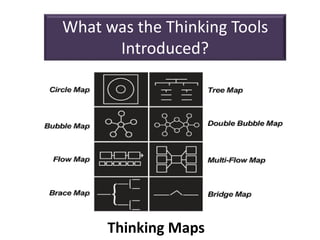
What was the Thinking Tools
Introduced?
Thinking Maps
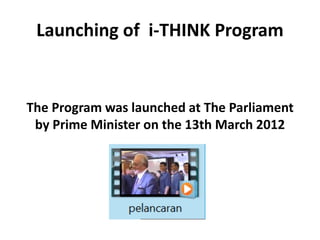
Launching of i-THINK Program
The Program was launched at The Parliament
by Prime Minister on the 13th March 2012
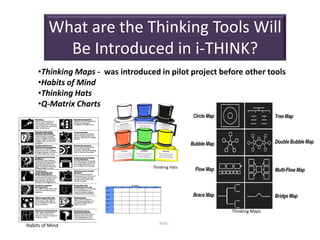
What are the Thinking Tools Will
Be Introduced in i-THINK?
•Thinking Maps - was introduced in pilot project before other tools
•Habits of Mind
•Thinking Hats
•Q-Matrix Charts
Thinking Hats
Thinking Maps
Habits of Mind
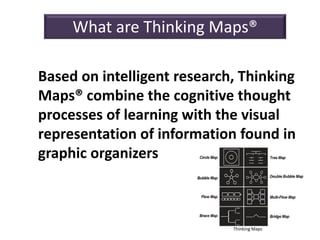
What are Thinking Maps®
Based on intelligent research, Thinking
Maps® combine the cognitive thought
processes of learning with the visual
representation of information found in
graphic organizers
Thinking Maps
When implemented as a whole school
basis, Thinking Maps® provide a
consistent and a brain compatible way
for teachers to present information, and
for students to learn and retain it.
Thinking Maps
Thinking Maps® is not a curriculum, but,
rather a set of tools to allow teachers to
present their existing curriculum in a
more meaningful way
Thinking Maps
Thinking Maps® is a language of 8 visual
patterns each based on a fundamental
thinking process
Thinking Maps
Dual Coding Theory
Knowledge is stored in two forms:
linguistically and non-linguistically.
Research proves that the more we use
both systems of representation, the
better we are able to think and recall
knowledge.
Robert Marzana – Classroom Instructions that Works
TYPES of VISUAL TOOLS
Brainstorm “Web”
• Mind mapping
• Webbing
• Clustering
• Concept Mapping
Task-Specific Graphic
Organisers
• Life Cycle : Science
• Timeline: History
• Venn Diagram:
Maths
Thinking Maps
• Defining in Context
• Describing
• Compare & Contrast
• Classifying
• Part-Whole
• Sequencing
• Cause & Effect
• Seeing Analogies
For Personal Knowledge For Isolated Tasks
A Common Visual Language
For Classrooms & Whole Schools
80% of all information that comes
into our brain is VISUAL
40% of all nerve fibres connected to
the brain are linked to the retina
36,000 visual messages per hour are
be registered by the eyes
• Eric Jensen, Brain Based Learning
Thinking Maps®
Must be implemented on the
whole school basis.
Implementation consists of staff
development and training
materials for each teacher
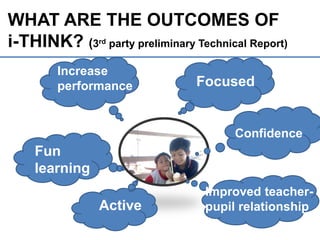
WHAT ARE THE OUTCOMES OF
i-THINK? (3rd party preliminary Technical Report)?
Focused
Active
Confidence
Improved teacher-
pupil relationship
Increase
performance
Fun
learning
16
**Dilaporkan dalam Mesyuarat Profesional KPM Bil 12/2012
Timeline of & Mode of Implementation
Pilot project of 10
schools all over
Malaysia (6 PS & 4 SS)
Extension to 1,000
schools nationwide
Extension to the
rest of 8,994
schools
• Training of
trainers phase 2
• Training the
driving teams of
1,000 schools
• Training the
teachers of 1000
schools
• Training the students
using thinking tools in
1,000 schools
• Training the driving
teams of 8,994
schools
• Training the teachers
of 8,994 schools
• Training the
students using
thinking tools in
8,994 schools
• Research on
implementation
of i-Think
Program THINK
in 1,010 schools
2012 2013 2014
How it works in UK
Thinking School Accreditation
by:
Kestrel Education partnership with
University of Exeter
(schools volunteer to participate )
THINKING TIME
• How is the difference in mode of
implementation between HOTS
program in UK and Malaysia can
benefit each country (by its own)?
• Focusing on our country alone, do you
think it would be as effective, if it is
done voluntarily by school?
POINTS TO DISCUSS OR TAKE HOME
Founder of Thinking Maps®
Prof. David Hyerle
Promotion (buy-in) Strategy by AIM
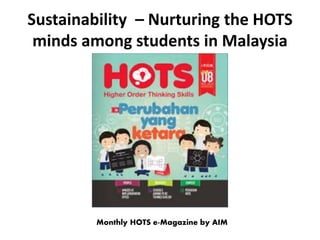
Sustainability – Nurturing the HOTS
minds among students in Malaysia
Monthly HOTS e-Magazine by AIM
Thank You

i-THINK - an overview

  • 1.
    Creativity & Innovationin Teaching and Learning PART 1 : OVERVIEW
  • 2.
    Why Creativity &Innovation in Teaching and Learning? “To achieve the bold ambitions that have been set out, we will need to change the way we have been doing things. In other words, we will have to innovate” YAB Dato’ Sri Mohd Najib bin Haji Tun Abdul Razak Prime Minister of Malaysia Source: National Innovation Strategy (Innovating Malaysia)
  • 3.
    What is i-THINK? i-THINK isa program that is adapted and adopted from The Thinking Schools International (Kestrel Education, UK) focused on developing, implementing, documenting and openly sharing the practices of explicitly improving all students’, teachers’ and administrators’ thinking abilities
  • 4.
    Why i-THINK ? Findings by21st Century Schools (US) and Kestrel Education (UK) via Needs Analysis showed that Higher Order Thinking Skills amongst Malaysian teachers and students are extremely low (reported on 21st September 2011 to DG)
  • 5.
    What was theThinking Tools Introduced? Thinking Maps
  • 6.
    Launching of i-THINKProgram The Program was launched at The Parliament by Prime Minister on the 13th March 2012
  • 7.
    What are theThinking Tools Will Be Introduced in i-THINK? •Thinking Maps - was introduced in pilot project before other tools •Habits of Mind •Thinking Hats •Q-Matrix Charts Thinking Hats Thinking Maps Habits of Mind
  • 8.
    What are ThinkingMaps® Based on intelligent research, Thinking Maps® combine the cognitive thought processes of learning with the visual representation of information found in graphic organizers Thinking Maps
  • 9.
    When implemented asa whole school basis, Thinking Maps® provide a consistent and a brain compatible way for teachers to present information, and for students to learn and retain it. Thinking Maps
  • 10.
    Thinking Maps® isnot a curriculum, but, rather a set of tools to allow teachers to present their existing curriculum in a more meaningful way Thinking Maps
  • 11.
    Thinking Maps® isa language of 8 visual patterns each based on a fundamental thinking process Thinking Maps
  • 12.
    Dual Coding Theory Knowledgeis stored in two forms: linguistically and non-linguistically. Research proves that the more we use both systems of representation, the better we are able to think and recall knowledge. Robert Marzana – Classroom Instructions that Works
  • 13.
    TYPES of VISUALTOOLS Brainstorm “Web” • Mind mapping • Webbing • Clustering • Concept Mapping Task-Specific Graphic Organisers • Life Cycle : Science • Timeline: History • Venn Diagram: Maths Thinking Maps • Defining in Context • Describing • Compare & Contrast • Classifying • Part-Whole • Sequencing • Cause & Effect • Seeing Analogies For Personal Knowledge For Isolated Tasks A Common Visual Language For Classrooms & Whole Schools
  • 14.
    80% of allinformation that comes into our brain is VISUAL 40% of all nerve fibres connected to the brain are linked to the retina 36,000 visual messages per hour are be registered by the eyes • Eric Jensen, Brain Based Learning
  • 15.
    Thinking Maps® Must beimplemented on the whole school basis. Implementation consists of staff development and training materials for each teacher
  • 16.
    WHAT ARE THEOUTCOMES OF i-THINK? (3rd party preliminary Technical Report)? Focused Active Confidence Improved teacher- pupil relationship Increase performance Fun learning 16 **Dilaporkan dalam Mesyuarat Profesional KPM Bil 12/2012
  • 17.
    Timeline of &Mode of Implementation Pilot project of 10 schools all over Malaysia (6 PS & 4 SS) Extension to 1,000 schools nationwide Extension to the rest of 8,994 schools • Training of trainers phase 2 • Training the driving teams of 1,000 schools • Training the teachers of 1000 schools • Training the students using thinking tools in 1,000 schools • Training the driving teams of 8,994 schools • Training the teachers of 8,994 schools • Training the students using thinking tools in 8,994 schools • Research on implementation of i-Think Program THINK in 1,010 schools 2012 2013 2014
  • 18.
    How it worksin UK Thinking School Accreditation by: Kestrel Education partnership with University of Exeter (schools volunteer to participate )
  • 19.
    THINKING TIME • Howis the difference in mode of implementation between HOTS program in UK and Malaysia can benefit each country (by its own)? • Focusing on our country alone, do you think it would be as effective, if it is done voluntarily by school? POINTS TO DISCUSS OR TAKE HOME
  • 20.
    Founder of ThinkingMaps® Prof. David Hyerle
  • 21.
  • 22.
    Sustainability – Nurturingthe HOTS minds among students in Malaysia Monthly HOTS e-Magazine by AIM
  • 23.