Changing face of editorial page
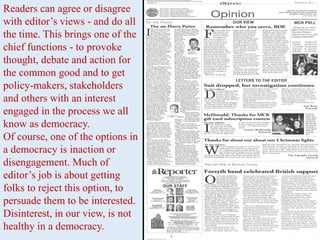
Readers can agree or disagree
with editor’s views - and do all
the time. This brings one of the
chief functions - to provoke
thought, debate and action for
the common good and to get
policy-makers, stakeholders
and others with an interest
engaged in the process we all
know as democracy.
Of course, one of the options in
a democracy is inaction or
disengagement. Much of
editor’s job is about getting
folks to reject this option, to
persuade them to be interested.
Disinterest, in our view, is not
healthy in a democracy.
Editorials reflect the consensus view
of the Editorial Board, a seven-
member body that includes the
publisher and editor.
The discussion points to a
consensus and the writer assigned
the topic writes that for the board.
If one doesn’t think he has enough
facts to make a decision, editor can
ask the writer to do some more
reporting and come back with a
recommendation. In any case, an
editorial is not about any individual
writer's opinion. It is the consensus
opinion of a board with members
who have some healthy diversity of
viewpoint. No news staffers
participate.
Editorial pages are not just about editorials, they offer a variety of
columns, many of them locally written but also including syndicated
columnists.
The world is changing for newspapers. The Web presents challenges
but also offers up more eyeballs for our news and our views. In the end,
however, we apply the same standards on what we write online as to
what we write for print.
Editorial independence is
one of the area which
has led the editorial
policies to take a
different route, Editorial
independence is
the freedom of editors t
o make decisions
without interference
from the owners of
a publication. Editorial
independence is tested,
for instance, if a
newspaper
runs articles that may be
unpopular with
its advertising clientele.
But editorials do take
sides.
A newspaper praises the selection of the new city council president as
the best person to lead the community through the year’s challenges.
An editorial looks skeptical upon the school district’s choice to close and
reconfigure school buildings as detrimental to student and family
interests.
An editor’s commentary applauds the compromise reached by all
stakeholders on the proposal to develop valuable riverfront property in
the downtown.
Closer examination reveals the editorials appeared after the fact – in
some instances following weeks or months of the newspaper detailing
community debate.
Newspapers as a clearinghouse for information have an opportunity to
be at the forefront of – to lead the conversation on – important
community decision-making. In short, editorials should not be an
afterthought. The role of editorials – in fact, the dynamics of the entire
editorial page – should be an integral part of newsroom planning.
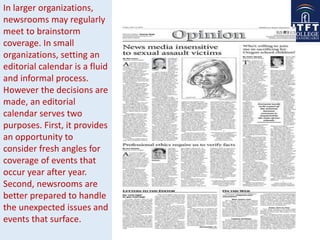
In larger organizations,
newsrooms may regularly
meet to brainstorm
coverage. In small
organizations, setting an
editorial calendar is a fluid
and informal process.
However the decisions are
made, an editorial
calendar serves two
purposes. First, it provides
an opportunity to
consider fresh angles for
coverage of events that
occur year after year.
Second, newsrooms are
better prepared to handle
the unexpected issues and
events that surface.
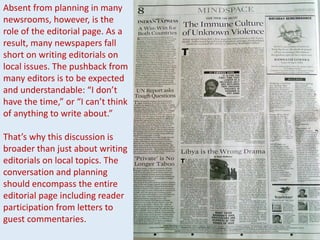
Absent from planning in many
newsrooms, however, is the
role of the editorial page. As a
result, many newspapers fall
short on writing editorials on
local issues. The pushback from
many editors is to be expected
and understandable: “I don’t
have the time,” or “I can’t think
of anything to write about.”
That’s why this discussion is
broader than just about writing
editorials on local topics. The
conversation and planning
should encompass the entire
editorial page including reader
participation from letters to
guest commentaries.
Developing editorial ideas is often the greatest challenge. Then it’s a matter of
researching the issue. Once you know where you’re going, the words may
come rather easily.
Incorporating an editorial page into everyday news coverage is also a chance to
issue a “call to action” to readers. For example, consider the school district that
is proposing to close neighborhood schools.
Here are some possible calls to action: Encourage letters to the editor: The
issues will likely prompt strong emotions from those both for and against the
school realignment. Ask readers to be specific in their arguments and in their
recommendations to guide the district through its financial challenges.
Elevate prominence of reader comments. Compile relevant
and appropriate comments from online readers and present
them in a broader context – basically turning reader
comments into a story. This supplements the regular news
coverage and provides a nod to readers who don’t often
receive enough recognition for their willingness to provide
their opinions.
Engaging the editorial page in everyday coverage is a natural
extension for those newspapers that aggressively pursue the
news. In the end, editorials can provide additional
interpretation and be the springboard for a lively exchange of
ideas among readers.

ITFT_Media_Changing face of editorial page

  • 1.
    Changing face ofeditorial page
  • 2.
    Readers can agreeor disagree with editor’s views - and do all the time. This brings one of the chief functions - to provoke thought, debate and action for the common good and to get policy-makers, stakeholders and others with an interest engaged in the process we all know as democracy. Of course, one of the options in a democracy is inaction or disengagement. Much of editor’s job is about getting folks to reject this option, to persuade them to be interested. Disinterest, in our view, is not healthy in a democracy.
  • 3.
    Editorials reflect theconsensus view of the Editorial Board, a seven- member body that includes the publisher and editor. The discussion points to a consensus and the writer assigned the topic writes that for the board. If one doesn’t think he has enough facts to make a decision, editor can ask the writer to do some more reporting and come back with a recommendation. In any case, an editorial is not about any individual writer's opinion. It is the consensus opinion of a board with members who have some healthy diversity of viewpoint. No news staffers participate.
  • 4.
    Editorial pages arenot just about editorials, they offer a variety of columns, many of them locally written but also including syndicated columnists. The world is changing for newspapers. The Web presents challenges but also offers up more eyeballs for our news and our views. In the end, however, we apply the same standards on what we write online as to what we write for print.
  • 5.
    Editorial independence is oneof the area which has led the editorial policies to take a different route, Editorial independence is the freedom of editors t o make decisions without interference from the owners of a publication. Editorial independence is tested, for instance, if a newspaper runs articles that may be unpopular with its advertising clientele. But editorials do take sides.
  • 6.
    A newspaper praisesthe selection of the new city council president as the best person to lead the community through the year’s challenges. An editorial looks skeptical upon the school district’s choice to close and reconfigure school buildings as detrimental to student and family interests. An editor’s commentary applauds the compromise reached by all stakeholders on the proposal to develop valuable riverfront property in the downtown. Closer examination reveals the editorials appeared after the fact – in some instances following weeks or months of the newspaper detailing community debate. Newspapers as a clearinghouse for information have an opportunity to be at the forefront of – to lead the conversation on – important community decision-making. In short, editorials should not be an afterthought. The role of editorials – in fact, the dynamics of the entire editorial page – should be an integral part of newsroom planning.
  • 7.
    In larger organizations, newsroomsmay regularly meet to brainstorm coverage. In small organizations, setting an editorial calendar is a fluid and informal process. However the decisions are made, an editorial calendar serves two purposes. First, it provides an opportunity to consider fresh angles for coverage of events that occur year after year. Second, newsrooms are better prepared to handle the unexpected issues and events that surface.
  • 8.
    Absent from planningin many newsrooms, however, is the role of the editorial page. As a result, many newspapers fall short on writing editorials on local issues. The pushback from many editors is to be expected and understandable: “I don’t have the time,” or “I can’t think of anything to write about.” That’s why this discussion is broader than just about writing editorials on local topics. The conversation and planning should encompass the entire editorial page including reader participation from letters to guest commentaries.
  • 9.
    Developing editorial ideasis often the greatest challenge. Then it’s a matter of researching the issue. Once you know where you’re going, the words may come rather easily. Incorporating an editorial page into everyday news coverage is also a chance to issue a “call to action” to readers. For example, consider the school district that is proposing to close neighborhood schools. Here are some possible calls to action: Encourage letters to the editor: The issues will likely prompt strong emotions from those both for and against the school realignment. Ask readers to be specific in their arguments and in their recommendations to guide the district through its financial challenges.
  • 10.
    Elevate prominence ofreader comments. Compile relevant and appropriate comments from online readers and present them in a broader context – basically turning reader comments into a story. This supplements the regular news coverage and provides a nod to readers who don’t often receive enough recognition for their willingness to provide their opinions. Engaging the editorial page in everyday coverage is a natural extension for those newspapers that aggressively pursue the news. In the end, editorials can provide additional interpretation and be the springboard for a lively exchange of ideas among readers.