
Literature
Know
thyself
    Socrates
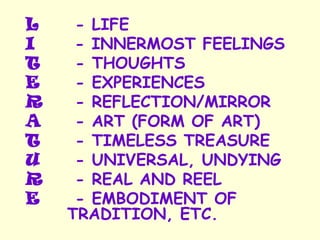
L    - LIFE
I    - INNERMOST FEELINGS
T    - THOUGHTS
E    - EXPERIENCES
R    - REFLECTION/MIRROR
A    - ART (FORM OF ART)
T    - TIMELESS TREASURE
U    - UNIVERSAL, UNDYING
R    - REAL AND REEL
E    - EMBODIMENT OF
    TRADITION, ETC.
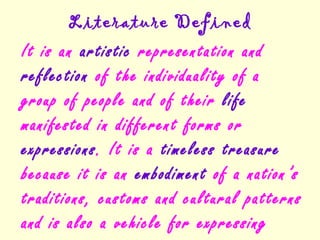
Literature Defined
It is an artistic representation and
reflection of the individuality of a
group of people and of their life
manifested in different forms or
expressions. It is a timeless treasure
because it is an embodiment of a nation’s
traditions, customs and cultural patterns
and is also a vehicle for expressing
Roles of Literature in
1.
              Society
   Transmitter of values
2. Preserver of ideals, customs and
   traditions
3. Mirror of culture
4. Agent of change
5. Source of pleasure
Transmitter of values
        Events, as we read them in literature,
make us look at ourselves and live through the
experiences of the characters. We glean from
the stories the morals that lend to good life:
honesty, respect, love of country, justice, honor,
etc.
Preserver of ideals, customs and traditions
        Literature is our link to the past. We get
a glimpse at our ancestors’ way of life by
reading their stories and poems. Reflecting on
their practice, beliefs and attitudes make us
understand more deeply our roots, thereby
inspiring us to strengthen our ideals, customs
and traditions at the present.
Mirror of culture
           Literature reflects the cultures of
different races. Those who do not have the
resources to travel and personally observe
the ways of people from other parts of the
world may enrich their knowledge
vicariously through literature. Knowing how
people from the other side of the planet live
broadens our perception of life and
humanity.
Agent of change
            History bears records of significant
changes in society brought about by literature. The
choice of Tagalog as basis for Filipino, the national
language of the Philippines, has been partly due to
the popularity of writings in Tagalog like Francisco
Balagtas’ Florante at Laura.
            Today, literature in the mass media is a
potent force swaying public opinion. Ideas
massively delivered, whether orally or in writing,
can greatly influence people’s thinking. They can
make or unmake heroes, presidents, etc.
Source of pleasure
        Like other forms of art, literature
entertains and gives pleasure. Some people
read literature for the fun of it, while some
people read for the wisdom they get from it.
Others enjoy analyzing the message in it or
the style and structure of the selection.

Intro lit

  • 1.
  • 2.
    Know thyself Socrates
  • 3.
    L - LIFE I - INNERMOST FEELINGS T - THOUGHTS E - EXPERIENCES R - REFLECTION/MIRROR A - ART (FORM OF ART) T - TIMELESS TREASURE U - UNIVERSAL, UNDYING R - REAL AND REEL E - EMBODIMENT OF TRADITION, ETC.
  • 4.
    Literature Defined It isan artistic representation and reflection of the individuality of a group of people and of their life manifested in different forms or expressions. It is a timeless treasure because it is an embodiment of a nation’s traditions, customs and cultural patterns and is also a vehicle for expressing
  • 5.
    Roles of Literaturein 1. Society Transmitter of values 2. Preserver of ideals, customs and traditions 3. Mirror of culture 4. Agent of change 5. Source of pleasure
  • 6.
    Transmitter of values Events, as we read them in literature, make us look at ourselves and live through the experiences of the characters. We glean from the stories the morals that lend to good life: honesty, respect, love of country, justice, honor, etc. Preserver of ideals, customs and traditions Literature is our link to the past. We get a glimpse at our ancestors’ way of life by reading their stories and poems. Reflecting on their practice, beliefs and attitudes make us understand more deeply our roots, thereby inspiring us to strengthen our ideals, customs and traditions at the present.
  • 7.
    Mirror of culture Literature reflects the cultures of different races. Those who do not have the resources to travel and personally observe the ways of people from other parts of the world may enrich their knowledge vicariously through literature. Knowing how people from the other side of the planet live broadens our perception of life and humanity.
  • 8.
    Agent of change History bears records of significant changes in society brought about by literature. The choice of Tagalog as basis for Filipino, the national language of the Philippines, has been partly due to the popularity of writings in Tagalog like Francisco Balagtas’ Florante at Laura. Today, literature in the mass media is a potent force swaying public opinion. Ideas massively delivered, whether orally or in writing, can greatly influence people’s thinking. They can make or unmake heroes, presidents, etc.
  • 9.
    Source of pleasure Like other forms of art, literature entertains and gives pleasure. Some people read literature for the fun of it, while some people read for the wisdom they get from it. Others enjoy analyzing the message in it or the style and structure of the selection.