Attribute-Based Data Sharing Scheme Revisited in
Cloud Computing
ABSTRACT:-
Cipher text policy attribute based cryptography could be
terribly promising cryptography technique for secure knowledge sharing within the context of cloud
computing. knowledge owner is allowed to fully management the access policy related
to his knowledge that to be shared. However, CP-ABE is restricted to a possible security
risk that's called key written agreement drawback whereby the key keys of users have to be compelled
to be issued by a trustworthy key authority. Besides, most of the present CP-ABE schemes cannot support
attribute with capricious state. during this paper, we have a tendency to get back attribute-based
knowledge sharing theme so as to unravel the key however conjointly improve the quality of attribute, in
order that the ensuing theme is a lot of friendly to cloud computing applications. we have a tendency
to propose Associate in Nursing improved two-party key issuance protocol will |which will| that may}
guarantee that neither key authority nor cloud service supplier can compromise the full secret key of a
user one by one. Moreover, we have a tendency to introduce the construct of attribute with weight, being
provided to boost the expression of attribute, which may not solely extend the expression from binary
to capricious state, however conjointly lighten the complexness of access policy
.
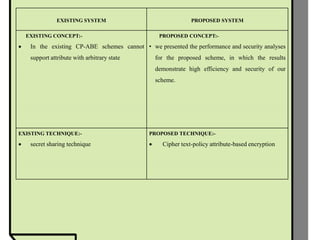
EXISTING SYSTEM PROPOSED SYSTEM
EXISTING CONCEPT:-
 In the existing CP-ABE schemes cannot
support attribute with arbitrary state
PROPOSED CONCEPT:-
• we presented the performance and security analyses
for the proposed scheme, in which the results
demonstrate high efficiency and security of our
scheme.
EXISTING TECHNIQUE:-
 secret sharing technique
PROPOSED TECHNIQUE:-
 Cipher text-policy attribute-based encryption
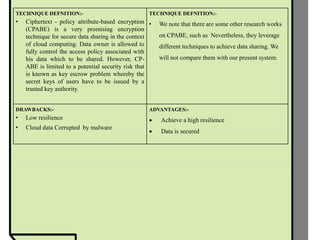
TECHNIQUE DEFNITION:-
• Ciphertext - policy attribute-based encryption
(CPABE) is a very promising encryption
technique for secure data sharing in the context
of cloud computing. Data owner is allowed to
fully control the access policy associated with
his data which to be shared. However, CP-
ABE is limited to a potential security risk that
is known as key escrow problem whereby the
secret keys of users have to be issued by a
trusted key authority.
TECHNIQUE DEFNITION:-
• We note that there are some other research works
on CPABE, such as Nevertheless, they leverage
different techniques to achieve data sharing. We
will not compare them with our present system.
DRAWBACKS:-
• Low resilience
• Cloud data Corrupted by malware
ADVANTAGES:-
 Achieve a high resilience
 Data is secured
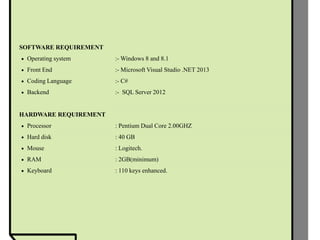
SOFTWARE REQUIREMENT
 Operating system :- Windows 8 and 8.1
 Front End :- Microsoft Visual Studio .NET 2013
 Coding Language :- C#
 Backend :- SQL Server 2012
HARDWARE REQUIREMENT
 Processor : Pentium Dual Core 2.00GHZ
 Hard disk : 40 GB
 Mouse : Logitech.
 RAM : 2GB(minimum)
 Keyboard : 110 keys enhanced.
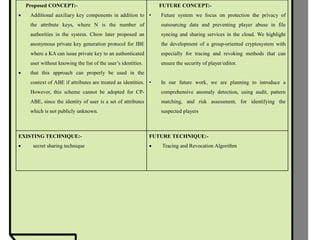
Proposed CONCEPT:-
 Additional auxiliary key components in addition to
the attribute keys, where N is the number of
authorities in the system. Chow later proposed an
anonymous private key generation protocol for IBE
where a KA can issue private key to an authenticated
user without knowing the list of the user’s identities.
 that this approach can properly be used in the
context of ABE if attributes are treated as identities.
However, this scheme cannot be adopted for CP-
ABE, since the identity of user is a set of attributes
which is not publicly unknown.
FUTURE CONCEPT:-
• Future system we focus on protection the privacy of
outsourcing data and preventing player abuse in file
syncing and sharing services in the cloud. We highlight
the development of a group-oriented cryptosystem with
especially for tracing and revoking methods that can
ensure the security of player/editor.
• In our future work, we are planning to introduce a
comprehensive anomaly detection, using audit, pattern
matching, and risk assessment, for identifying the
suspected players
EXISTING TECHNIQUE:-
 secret sharing technique
FUTURE TECHNIQUE:-
 Tracing and Revocation Algorithm
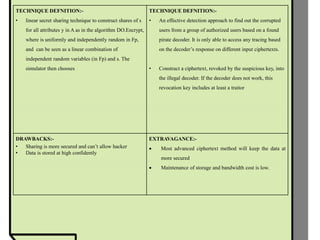
TECHNIQUE DEFNITION:-
• linear secret sharing technique to construct shares of s
for all attributes y in A as in the algorithm DO.Encrypt,
where is uniformly and independently random in Fp,
and can be seen as a linear combination of
independent random variables (in Fp) and s. The
simulator then chooses
TECHNIQUE DEFNITION:-
• An effective detection approach to find out the corrupted
users from a group of authorized users based on a found
pirate decoder. It is only able to access any tracing based
on the decoder’s response on different input ciphertexts.
• Construct a ciphertext, revoked by the suspicious key, into
the illegal decoder. If the decoder does not work, this
revocation key includes at least a traitor
DRAWBACKS:-
• Sharing is more secured and can’t allow hacker
• Data is stored at high confidently
EXTRAVAGANCE:-
 Most advanced ciphertext method will keep the data at
more secured
 Maintenance of storage and bandwidth cost is low.
ITDCC01.ppt

ITDCC01.ppt

  • 1.
    Attribute-Based Data SharingScheme Revisited in Cloud Computing
  • 2.
    ABSTRACT:- Cipher text policyattribute based cryptography could be terribly promising cryptography technique for secure knowledge sharing within the context of cloud computing. knowledge owner is allowed to fully management the access policy related to his knowledge that to be shared. However, CP-ABE is restricted to a possible security risk that's called key written agreement drawback whereby the key keys of users have to be compelled to be issued by a trustworthy key authority. Besides, most of the present CP-ABE schemes cannot support attribute with capricious state. during this paper, we have a tendency to get back attribute-based knowledge sharing theme so as to unravel the key however conjointly improve the quality of attribute, in order that the ensuing theme is a lot of friendly to cloud computing applications. we have a tendency to propose Associate in Nursing improved two-party key issuance protocol will |which will| that may} guarantee that neither key authority nor cloud service supplier can compromise the full secret key of a user one by one. Moreover, we have a tendency to introduce the construct of attribute with weight, being provided to boost the expression of attribute, which may not solely extend the expression from binary to capricious state, however conjointly lighten the complexness of access policy .
  • 3.
    EXISTING SYSTEM PROPOSEDSYSTEM EXISTING CONCEPT:-  In the existing CP-ABE schemes cannot support attribute with arbitrary state PROPOSED CONCEPT:- • we presented the performance and security analyses for the proposed scheme, in which the results demonstrate high efficiency and security of our scheme. EXISTING TECHNIQUE:-  secret sharing technique PROPOSED TECHNIQUE:-  Cipher text-policy attribute-based encryption
  • 4.
    TECHNIQUE DEFNITION:- • Ciphertext- policy attribute-based encryption (CPABE) is a very promising encryption technique for secure data sharing in the context of cloud computing. Data owner is allowed to fully control the access policy associated with his data which to be shared. However, CP- ABE is limited to a potential security risk that is known as key escrow problem whereby the secret keys of users have to be issued by a trusted key authority. TECHNIQUE DEFNITION:- • We note that there are some other research works on CPABE, such as Nevertheless, they leverage different techniques to achieve data sharing. We will not compare them with our present system. DRAWBACKS:- • Low resilience • Cloud data Corrupted by malware ADVANTAGES:-  Achieve a high resilience  Data is secured
  • 5.
    SOFTWARE REQUIREMENT  Operatingsystem :- Windows 8 and 8.1  Front End :- Microsoft Visual Studio .NET 2013  Coding Language :- C#  Backend :- SQL Server 2012 HARDWARE REQUIREMENT  Processor : Pentium Dual Core 2.00GHZ  Hard disk : 40 GB  Mouse : Logitech.  RAM : 2GB(minimum)  Keyboard : 110 keys enhanced.
  • 6.
    Proposed CONCEPT:-  Additionalauxiliary key components in addition to the attribute keys, where N is the number of authorities in the system. Chow later proposed an anonymous private key generation protocol for IBE where a KA can issue private key to an authenticated user without knowing the list of the user’s identities.  that this approach can properly be used in the context of ABE if attributes are treated as identities. However, this scheme cannot be adopted for CP- ABE, since the identity of user is a set of attributes which is not publicly unknown. FUTURE CONCEPT:- • Future system we focus on protection the privacy of outsourcing data and preventing player abuse in file syncing and sharing services in the cloud. We highlight the development of a group-oriented cryptosystem with especially for tracing and revoking methods that can ensure the security of player/editor. • In our future work, we are planning to introduce a comprehensive anomaly detection, using audit, pattern matching, and risk assessment, for identifying the suspected players EXISTING TECHNIQUE:-  secret sharing technique FUTURE TECHNIQUE:-  Tracing and Revocation Algorithm
  • 7.
    TECHNIQUE DEFNITION:- • linearsecret sharing technique to construct shares of s for all attributes y in A as in the algorithm DO.Encrypt, where is uniformly and independently random in Fp, and can be seen as a linear combination of independent random variables (in Fp) and s. The simulator then chooses TECHNIQUE DEFNITION:- • An effective detection approach to find out the corrupted users from a group of authorized users based on a found pirate decoder. It is only able to access any tracing based on the decoder’s response on different input ciphertexts. • Construct a ciphertext, revoked by the suspicious key, into the illegal decoder. If the decoder does not work, this revocation key includes at least a traitor DRAWBACKS:- • Sharing is more secured and can’t allow hacker • Data is stored at high confidently EXTRAVAGANCE:-  Most advanced ciphertext method will keep the data at more secured  Maintenance of storage and bandwidth cost is low.