Presentation by : Vishal
ABOUT ITALY
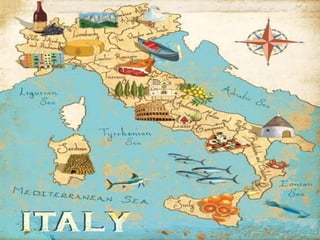
• Italy, officially the Italian Republic, is a unitary parliamentary republic in
South-Central Europe. To the north, it borders France, Switzerland,
Austria, and Slovenia along the Alps. To the south, it consists of the
entirety of the Italian Peninsula, Sicily, Sardinia–the two largest islands in
the Mediterranean Sea–and many other smaller islands
• Rome, the capital of Italy, has for centuries been a political and religious
Centre of Western civilization as the capital of the Roman Empire.
• After the decline of the Roman Empire, Italy endured numerous invasions
by foreign peoples, from Germanic tribes such as the Lombard's and
Ostrogoth's, to the Byzantines and later, the Normans, among others.
Centuries later, Italy became the birthplace of Maritime republics and the
Renaissance.
• Modern Italy is a democratic republic. It has been ranked as the world's
24th most-developed country.
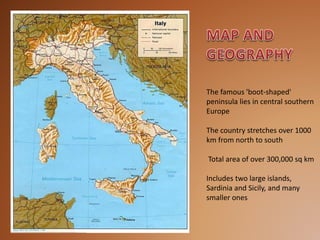
The famous 'boot-shaped'
peninsula lies in central southern
Europe
The country stretches over 1000
km from north to south
Total area of over 300,000 sq km
Includes two large islands,
Sardinia and Sicily, and many
smaller ones
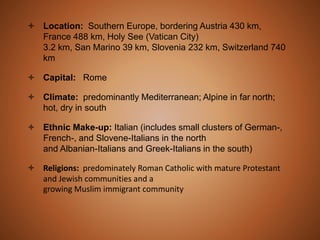
 Location: Southern Europe, bordering Austria 430 km,
France 488 km, Holy See (Vatican City)
3.2 km, San Marino 39 km, Slovenia 232 km, Switzerland 740
km
 Capital: Rome
 Climate: predominantly Mediterranean; Alpine in far north;
hot, dry in south
 Ethnic Make-up: Italian (includes small clusters of German-,
French-, and Slovene-Italians in the north
and Albanian-Italians and Greek-Italians in the south)
 Religions: predominately Roman Catholic with mature Protestant
and Jewish communities and a
growing Muslim immigrant community
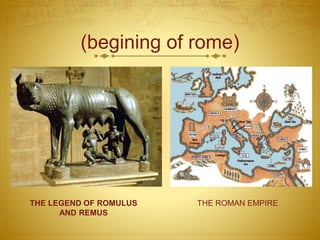
(begining of rome)
THE LEGEND OF ROMULUS
AND REMUS
THE ROMAN EMPIRE
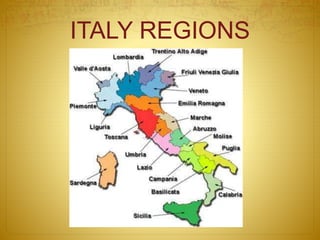
ITALY REGIONS
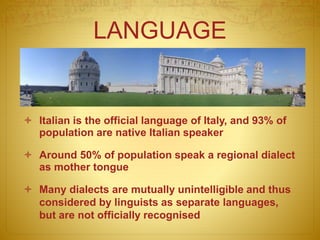
LANGUAGE
 Italian is the official language of Italy, and 93% of
population are native Italian speaker
 Around 50% of population speak a regional dialect
as mother tongue
 Many dialects are mutually unintelligible and thus
considered by linguists as separate languages,
but are not officially recognised
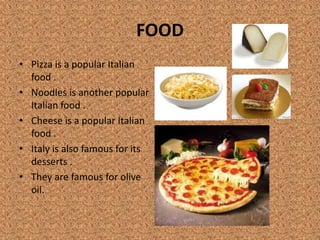
FOOD
• Pizza is a popular Italian
food .
• Noodles is another popular
Italian food .
• Cheese is a popular Italian
food .
• Italy is also famous for its
desserts .
• They are famous for olive
oil.
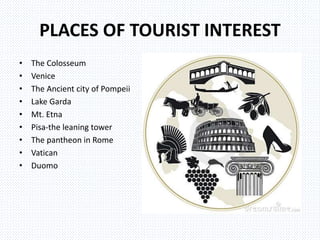
PLACES OF TOURIST INTEREST
• The Colosseum
• Venice
• The Ancient city of Pompeii
• Lake Garda
• Mt. Etna
• Pisa-the leaning tower
• The pantheon in Rome
• Vatican
• Duomo
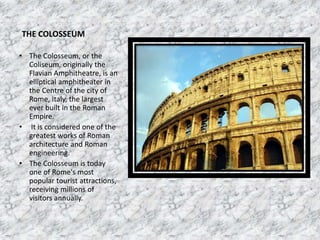
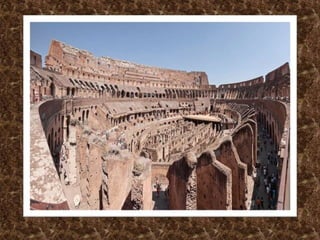
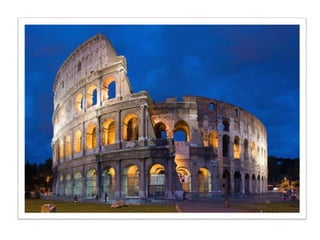
THE COLOSSEUM
• The Colosseum, or the
Coliseum, originally the
Flavian Amphitheatre, is an
elliptical amphitheater in
the Centre of the city of
Rome, Italy, the largest
ever built in the Roman
Empire.
• It is considered one of the
greatest works of Roman
architecture and Roman
engineering.
• The Colosseum is today
one of Rome's most
popular tourist attractions,
receiving millions of
visitors annually.
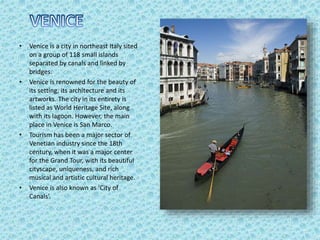
• Venice is a city in northeast Italy sited
on a group of 118 small islands
separated by canals and linked by
bridges.
• Venice is renowned for the beauty of
its setting, its architecture and its
artworks. The city in its entirety is
listed as World Heritage Site, along
with its lagoon. However, the main
place in Venice is San Marco.
• Tourism has been a major sector of
Venetian industry since the 18th
century, when it was a major center
for the Grand Tour, with its beautiful
cityscape, uniqueness, and rich
musical and artistic cultural heritage.
• Venice is also known as ‘City of
Canals’.
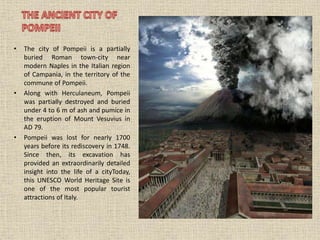
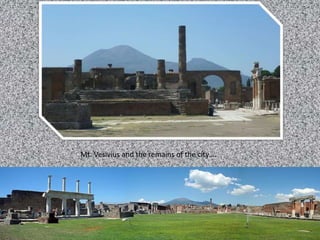
• The city of Pompeii is a partially
buried Roman town-city near
modern Naples in the Italian region
of Campania, in the territory of the
commune of Pompeii.
• Along with Herculaneum, Pompeii
was partially destroyed and buried
under 4 to 6 m of ash and pumice in
the eruption of Mount Vesuvius in
AD 79.
• Pompeii was lost for nearly 1700
years before its rediscovery in 1748.
Since then, its excavation has
provided an extraordinarily detailed
insight into the life of a cityToday,
this UNESCO World Heritage Site is
one of the most popular tourist
attractions of Italy.
Mt. Vesivius and the remains of the city….
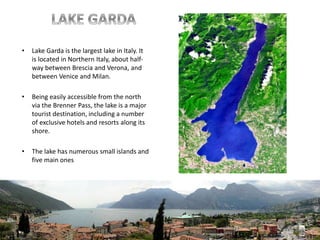
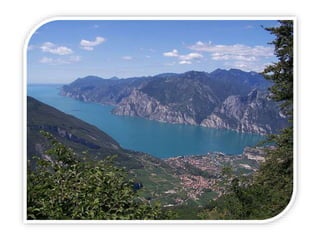
• Lake Garda is the largest lake in Italy. It
is located in Northern Italy, about half-
way between Brescia and Verona, and
between Venice and Milan.
• Being easily accessible from the north
via the Brenner Pass, the lake is a major
tourist destination, including a number
of exclusive hotels and resorts along its
shore.
• The lake has numerous small islands and
five main ones
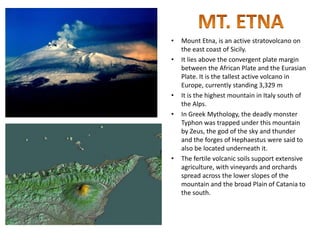
• Mount Etna, is an active stratovolcano on
the east coast of Sicily.
• It lies above the convergent plate margin
between the African Plate and the Eurasian
Plate. It is the tallest active volcano in
Europe, currently standing 3,329 m
• It is the highest mountain in Italy south of
the Alps.
• In Greek Mythology, the deadly monster
Typhon was trapped under this mountain
by Zeus, the god of the sky and thunder
and the forges of Hephaestus were said to
also be located underneath it.
• The fertile volcanic soils support extensive
agriculture, with vineyards and orchards
spread across the lower slopes of the
mountain and the broad Plain of Catania to
the south.
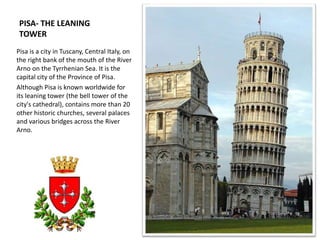
PISA- THE LEANING
TOWER
Pisa is a city in Tuscany, Central Italy, on
the right bank of the mouth of the River
Arno on the Tyrrhenian Sea. It is the
capital city of the Province of Pisa.
Although Pisa is known worldwide for
its leaning tower (the bell tower of the
city's cathedral), contains more than 20
other historic churches, several palaces
and various bridges across the River
Arno.
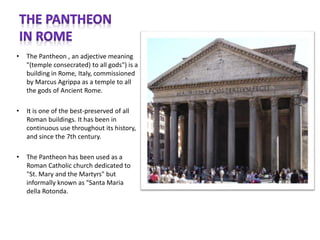
• The Pantheon , an adjective meaning
"(temple consecrated) to all gods") is a
building in Rome, Italy, commissioned
by Marcus Agrippa as a temple to all
the gods of Ancient Rome.
• It is one of the best-preserved of all
Roman buildings. It has been in
continuous use throughout its history,
and since the 7th century.
• The Pantheon has been used as a
Roman Catholic church dedicated to
"St. Mary and the Martyrs" but
informally known as "Santa Maria
della Rotonda.
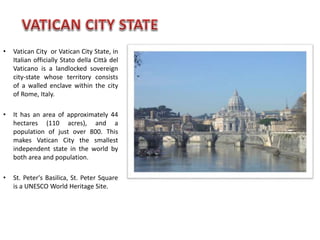
• Vatican City or Vatican City State, in
Italian officially Stato della Città del
Vaticano is a landlocked sovereign
city-state whose territory consists
of a walled enclave within the city
of Rome, Italy.
• It has an area of approximately 44
hectares (110 acres), and a
population of just over 800. This
makes Vatican City the smallest
independent state in the world by
both area and population.
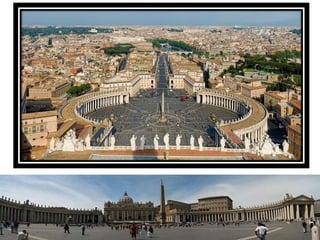
• St. Peter's Basilica, St. Peter Square
is a UNESCO World Heritage Site.
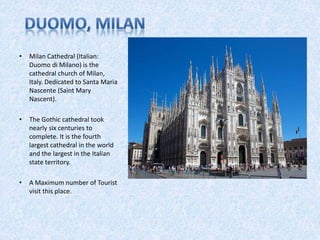
• Milan Cathedral (Italian:
Duomo di Milano) is the
cathedral church of Milan,
Italy. Dedicated to Santa Maria
Nascente (Saint Mary
Nascent).
• The Gothic cathedral took
nearly six centuries to
complete. It is the fourth
largest cathedral in the world
and the largest in the Italian
state territory.
• A Maximum number of Tourist
visit this place.
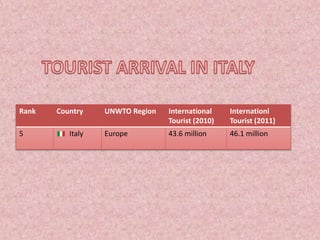
Rank Country UNWTO Region International
Tourist (2010)
Internationl
Tourist (2011)
5 Italy Europe 43.6 million 46.1 million
RELATIONSHIPS AND
COMMUNICATION
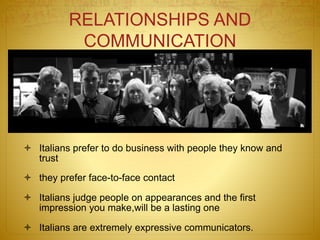
 Italians prefer to do business with people they know and
trust
 they prefer face-to-face contact
 Italians judge people on appearances and the first
impression you make,will be a lasting one
 Italians are extremely expressive communicators.
Italy

Italy

  • 1.
  • 2.
    ABOUT ITALY • Italy,officially the Italian Republic, is a unitary parliamentary republic in South-Central Europe. To the north, it borders France, Switzerland, Austria, and Slovenia along the Alps. To the south, it consists of the entirety of the Italian Peninsula, Sicily, Sardinia–the two largest islands in the Mediterranean Sea–and many other smaller islands • Rome, the capital of Italy, has for centuries been a political and religious Centre of Western civilization as the capital of the Roman Empire. • After the decline of the Roman Empire, Italy endured numerous invasions by foreign peoples, from Germanic tribes such as the Lombard's and Ostrogoth's, to the Byzantines and later, the Normans, among others. Centuries later, Italy became the birthplace of Maritime republics and the Renaissance. • Modern Italy is a democratic republic. It has been ranked as the world's 24th most-developed country.
  • 3.
    The famous 'boot-shaped' peninsulalies in central southern Europe The country stretches over 1000 km from north to south Total area of over 300,000 sq km Includes two large islands, Sardinia and Sicily, and many smaller ones
  • 4.
     Location: SouthernEurope, bordering Austria 430 km, France 488 km, Holy See (Vatican City) 3.2 km, San Marino 39 km, Slovenia 232 km, Switzerland 740 km  Capital: Rome  Climate: predominantly Mediterranean; Alpine in far north; hot, dry in south  Ethnic Make-up: Italian (includes small clusters of German-, French-, and Slovene-Italians in the north and Albanian-Italians and Greek-Italians in the south)  Religions: predominately Roman Catholic with mature Protestant and Jewish communities and a growing Muslim immigrant community
  • 5.
    (begining of rome) THELEGEND OF ROMULUS AND REMUS THE ROMAN EMPIRE
  • 6.
  • 7.
    LANGUAGE  Italian isthe official language of Italy, and 93% of population are native Italian speaker  Around 50% of population speak a regional dialect as mother tongue  Many dialects are mutually unintelligible and thus considered by linguists as separate languages, but are not officially recognised
  • 8.
    FOOD • Pizza isa popular Italian food . • Noodles is another popular Italian food . • Cheese is a popular Italian food . • Italy is also famous for its desserts . • They are famous for olive oil.
  • 10.
    PLACES OF TOURISTINTEREST • The Colosseum • Venice • The Ancient city of Pompeii • Lake Garda • Mt. Etna • Pisa-the leaning tower • The pantheon in Rome • Vatican • Duomo
  • 11.
    THE COLOSSEUM • TheColosseum, or the Coliseum, originally the Flavian Amphitheatre, is an elliptical amphitheater in the Centre of the city of Rome, Italy, the largest ever built in the Roman Empire. • It is considered one of the greatest works of Roman architecture and Roman engineering. • The Colosseum is today one of Rome's most popular tourist attractions, receiving millions of visitors annually.
  • 14.
    • Venice isa city in northeast Italy sited on a group of 118 small islands separated by canals and linked by bridges. • Venice is renowned for the beauty of its setting, its architecture and its artworks. The city in its entirety is listed as World Heritage Site, along with its lagoon. However, the main place in Venice is San Marco. • Tourism has been a major sector of Venetian industry since the 18th century, when it was a major center for the Grand Tour, with its beautiful cityscape, uniqueness, and rich musical and artistic cultural heritage. • Venice is also known as ‘City of Canals’.
  • 15.
    • The cityof Pompeii is a partially buried Roman town-city near modern Naples in the Italian region of Campania, in the territory of the commune of Pompeii. • Along with Herculaneum, Pompeii was partially destroyed and buried under 4 to 6 m of ash and pumice in the eruption of Mount Vesuvius in AD 79. • Pompeii was lost for nearly 1700 years before its rediscovery in 1748. Since then, its excavation has provided an extraordinarily detailed insight into the life of a cityToday, this UNESCO World Heritage Site is one of the most popular tourist attractions of Italy.
  • 16.
    Mt. Vesivius andthe remains of the city….
  • 17.
    • Lake Gardais the largest lake in Italy. It is located in Northern Italy, about half- way between Brescia and Verona, and between Venice and Milan. • Being easily accessible from the north via the Brenner Pass, the lake is a major tourist destination, including a number of exclusive hotels and resorts along its shore. • The lake has numerous small islands and five main ones
  • 19.
    • Mount Etna,is an active stratovolcano on the east coast of Sicily. • It lies above the convergent plate margin between the African Plate and the Eurasian Plate. It is the tallest active volcano in Europe, currently standing 3,329 m • It is the highest mountain in Italy south of the Alps. • In Greek Mythology, the deadly monster Typhon was trapped under this mountain by Zeus, the god of the sky and thunder and the forges of Hephaestus were said to also be located underneath it. • The fertile volcanic soils support extensive agriculture, with vineyards and orchards spread across the lower slopes of the mountain and the broad Plain of Catania to the south.
  • 20.
    PISA- THE LEANING TOWER Pisais a city in Tuscany, Central Italy, on the right bank of the mouth of the River Arno on the Tyrrhenian Sea. It is the capital city of the Province of Pisa. Although Pisa is known worldwide for its leaning tower (the bell tower of the city's cathedral), contains more than 20 other historic churches, several palaces and various bridges across the River Arno.
  • 21.
    • The Pantheon, an adjective meaning "(temple consecrated) to all gods") is a building in Rome, Italy, commissioned by Marcus Agrippa as a temple to all the gods of Ancient Rome. • It is one of the best-preserved of all Roman buildings. It has been in continuous use throughout its history, and since the 7th century. • The Pantheon has been used as a Roman Catholic church dedicated to "St. Mary and the Martyrs" but informally known as "Santa Maria della Rotonda.
  • 22.
    • Vatican Cityor Vatican City State, in Italian officially Stato della Città del Vaticano is a landlocked sovereign city-state whose territory consists of a walled enclave within the city of Rome, Italy. • It has an area of approximately 44 hectares (110 acres), and a population of just over 800. This makes Vatican City the smallest independent state in the world by both area and population. • St. Peter's Basilica, St. Peter Square is a UNESCO World Heritage Site.
  • 24.
    • Milan Cathedral(Italian: Duomo di Milano) is the cathedral church of Milan, Italy. Dedicated to Santa Maria Nascente (Saint Mary Nascent). • The Gothic cathedral took nearly six centuries to complete. It is the fourth largest cathedral in the world and the largest in the Italian state territory. • A Maximum number of Tourist visit this place.
  • 25.
    Rank Country UNWTORegion International Tourist (2010) Internationl Tourist (2011) 5 Italy Europe 43.6 million 46.1 million
  • 26.
    RELATIONSHIPS AND COMMUNICATION  Italiansprefer to do business with people they know and trust  they prefer face-to-face contact  Italians judge people on appearances and the first impression you make,will be a lasting one  Italians are extremely expressive communicators.