Page 1 of 2
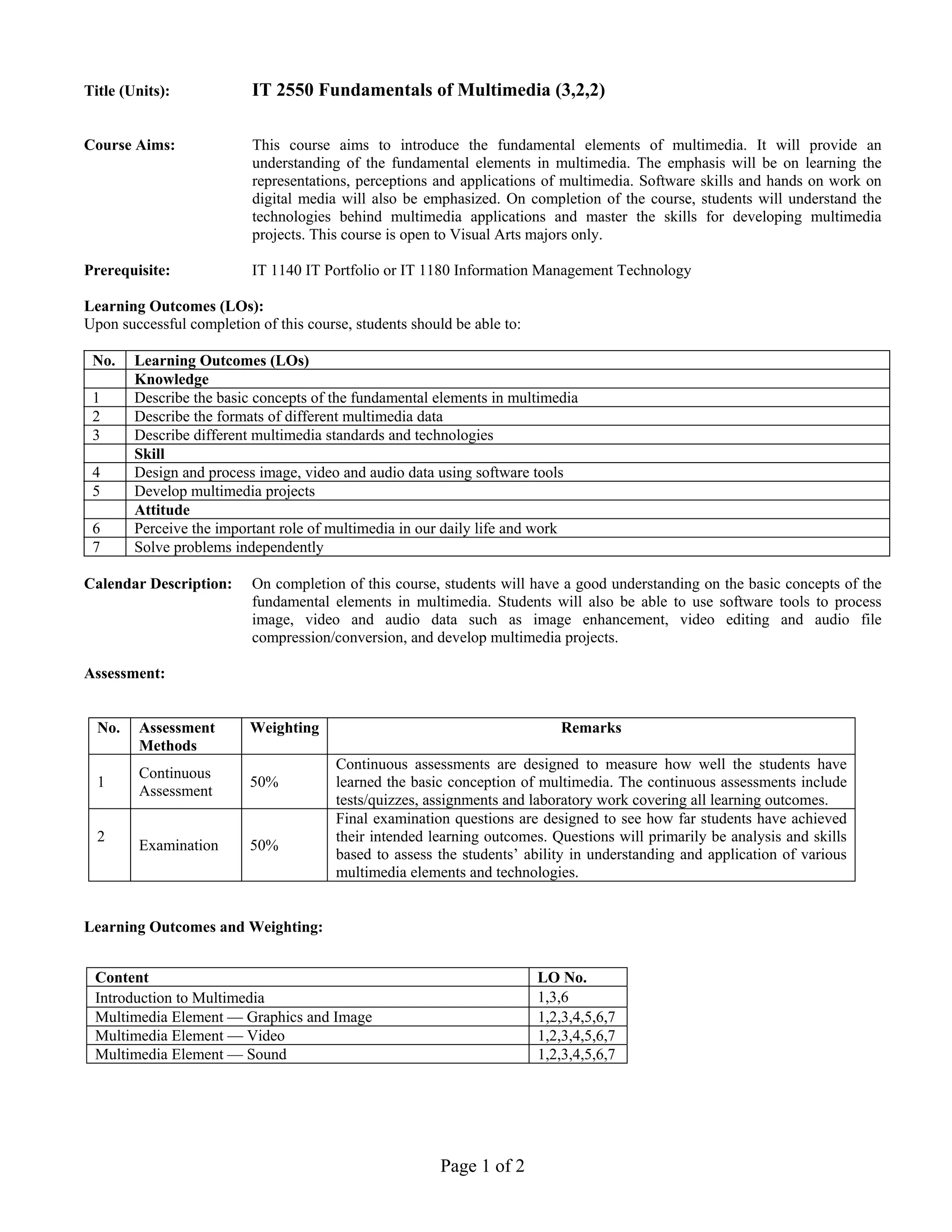
Title (Units): IT 2550 Fundamentals of Multimedia (3,2,2)
Course Aims: This course aims to introduce the fundamental elements of multimedia. It will provide an
understanding of the fundamental elements in multimedia. The emphasis will be on learning the
representations, perceptions and applications of multimedia. Software skills and hands on work on
digital media will also be emphasized. On completion of the course, students will understand the
technologies behind multimedia applications and master the skills for developing multimedia
projects. This course is open to Visual Arts majors only.
Prerequisite: IT 1140 IT Portfolio or IT 1180 Information Management Technology
Learning Outcomes (LOs):
Upon successful completion of this course, students should be able to:
No. Learning Outcomes (LOs)
Knowledge
1 Describe the basic concepts of the fundamental elements in multimedia
2 Describe the formats of different multimedia data
3 Describe different multimedia standards and technologies
Skill
4 Design and process image, video and audio data using software tools
5 Develop multimedia projects
Attitude
6 Perceive the important role of multimedia in our daily life and work
7 Solve problems independently
Calendar Description: On completion of this course, students will have a good understanding on the basic concepts of the
fundamental elements in multimedia. Students will also be able to use software tools to process
image, video and audio data such as image enhancement, video editing and audio file
compression/conversion, and develop multimedia projects.
Assessment:
No. Assessment
Methods
Weighting Remarks
1
Continuous
Assessment
50%
Continuous assessments are designed to measure how well the students have
learned the basic conception of multimedia. The continuous assessments include
tests/quizzes, assignments and laboratory work covering all learning outcomes.
2
Examination 50%
Final examination questions are designed to see how far students have achieved
their intended learning outcomes. Questions will primarily be analysis and skills
based to assess the students’ ability in understanding and application of various
multimedia elements and technologies.
Learning Outcomes and Weighting:
Content LO No.
Introduction to Multimedia 1,3,6
Multimedia Element — Graphics and Image 1,2,3,4,5,6,7
Multimedia Element — Video 1,2,3,4,5,6,7
Multimedia Element — Sound 1,2,3,4,5,6,7
Page 2 of 2
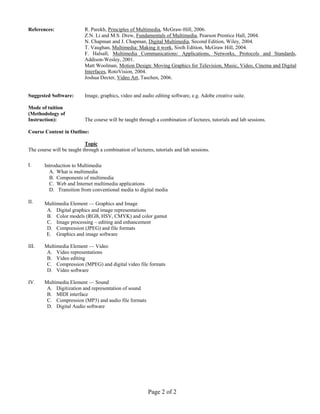
References: R. Parekh, Principles of Multimedia, McGraw-Hill, 2006.
Z.N. Li and M.S. Drew, Fundamentals of Multimedia, Pearson Prentice Hall, 2004.
N. Chapman and J. Chapman, Digital Multimedia, Second Edition, Wiley, 2004.
T. Vaughan, Multimedia: Making it work, Sixth Edition, McGraw Hill, 2004.
F. Halsall, Multimedia Communications: Applications, Networks, Protocols and Standards,
Addison-Wesley, 2001.
Matt Woolman, Motion Design: Moving Graphics for Television, Music, Video, Cinema and Digital
Interfaces, RotoVision, 2004.
Joshua Decter, Video Art, Taschen, 2006.
Suggested Software: Image, graphics, video and audio editing software, e.g. Adobe creative suite.
Mode of tuition
(Methodology of
Instruction): The course will be taught through a combination of lectures, tutorials and lab sessions.
Course Content in Outline:
Topic
The course will be taught through a combination of lectures, tutorials and lab sessions.
I. Introduction to Multimedia
A. What is multimedia
B. Components of multimedia
C. Web and Internet multimedia applications
D. Transition from conventional media to digital media
II. Multimedia Element — Graphics and Image
A. Digital graphics and image representations
B. Color models (RGB, HSV, CMYK) and color gamut
C. Image processing – editing and enhancement
D. Compression (JPEG) and file formats
E. Graphics and image software
III. Multimedia Element — Video
A. Video representations
B. Video editing
C. Compression (MPEG) and digital video file formats
D. Video software
IV. Multimedia Element — Sound
A. Digitization and representation of sound
B. MIDI interface
C. Compression (MP3) and audio file formats
D. Digital Audio software

It2550

  • 1.
    Page 1 of2 Title (Units): IT 2550 Fundamentals of Multimedia (3,2,2) Course Aims: This course aims to introduce the fundamental elements of multimedia. It will provide an understanding of the fundamental elements in multimedia. The emphasis will be on learning the representations, perceptions and applications of multimedia. Software skills and hands on work on digital media will also be emphasized. On completion of the course, students will understand the technologies behind multimedia applications and master the skills for developing multimedia projects. This course is open to Visual Arts majors only. Prerequisite: IT 1140 IT Portfolio or IT 1180 Information Management Technology Learning Outcomes (LOs): Upon successful completion of this course, students should be able to: No. Learning Outcomes (LOs) Knowledge 1 Describe the basic concepts of the fundamental elements in multimedia 2 Describe the formats of different multimedia data 3 Describe different multimedia standards and technologies Skill 4 Design and process image, video and audio data using software tools 5 Develop multimedia projects Attitude 6 Perceive the important role of multimedia in our daily life and work 7 Solve problems independently Calendar Description: On completion of this course, students will have a good understanding on the basic concepts of the fundamental elements in multimedia. Students will also be able to use software tools to process image, video and audio data such as image enhancement, video editing and audio file compression/conversion, and develop multimedia projects. Assessment: No. Assessment Methods Weighting Remarks 1 Continuous Assessment 50% Continuous assessments are designed to measure how well the students have learned the basic conception of multimedia. The continuous assessments include tests/quizzes, assignments and laboratory work covering all learning outcomes. 2 Examination 50% Final examination questions are designed to see how far students have achieved their intended learning outcomes. Questions will primarily be analysis and skills based to assess the students’ ability in understanding and application of various multimedia elements and technologies. Learning Outcomes and Weighting: Content LO No. Introduction to Multimedia 1,3,6 Multimedia Element — Graphics and Image 1,2,3,4,5,6,7 Multimedia Element — Video 1,2,3,4,5,6,7 Multimedia Element — Sound 1,2,3,4,5,6,7
  • 2.
    Page 2 of2 References: R. Parekh, Principles of Multimedia, McGraw-Hill, 2006. Z.N. Li and M.S. Drew, Fundamentals of Multimedia, Pearson Prentice Hall, 2004. N. Chapman and J. Chapman, Digital Multimedia, Second Edition, Wiley, 2004. T. Vaughan, Multimedia: Making it work, Sixth Edition, McGraw Hill, 2004. F. Halsall, Multimedia Communications: Applications, Networks, Protocols and Standards, Addison-Wesley, 2001. Matt Woolman, Motion Design: Moving Graphics for Television, Music, Video, Cinema and Digital Interfaces, RotoVision, 2004. Joshua Decter, Video Art, Taschen, 2006. Suggested Software: Image, graphics, video and audio editing software, e.g. Adobe creative suite. Mode of tuition (Methodology of Instruction): The course will be taught through a combination of lectures, tutorials and lab sessions. Course Content in Outline: Topic The course will be taught through a combination of lectures, tutorials and lab sessions. I. Introduction to Multimedia A. What is multimedia B. Components of multimedia C. Web and Internet multimedia applications D. Transition from conventional media to digital media II. Multimedia Element — Graphics and Image A. Digital graphics and image representations B. Color models (RGB, HSV, CMYK) and color gamut C. Image processing – editing and enhancement D. Compression (JPEG) and file formats E. Graphics and image software III. Multimedia Element — Video A. Video representations B. Video editing C. Compression (MPEG) and digital video file formats D. Video software IV. Multimedia Element — Sound A. Digitization and representation of sound B. MIDI interface C. Compression (MP3) and audio file formats D. Digital Audio software