BANKINGSECTORININDIA
CHALLENGES & REMEDIES
Compiled By:
Harshit Aggarwal
SNAP ID : 170111426
“I do not minimize the difficulties that lie ahead on the long and arduous journey on which
we have embarked. But as Victor Hugo once said, “no power on earth can stop an idea whose
time has come.”– Dr. Manmohan Singh, Ex- Prime Minister of India
Introduction
The banks are the lifelines of the economy and play a catalytic role in activating and sustaining
economic growth especially for growing economies like India. The emerging economies are
facing financial stability due to domestic imbalances, weak global demand and rising trade
protectionism in advanced economies. And since the onset of the Financial Crisis in 2008, the
global economy has continued to face rough weather and the Indian economy and our banking
system have not remained immune. Our banking system presently is facing significant challenges
from several quarters.
It is against this challenging backdrop that our banking sector has been operating for a relatively
long period of time that has resulted in an adverse impact on the asset quality, capital adequacy
and profitability of our banks. But the tough situation in which the banking system finds itself is
also attributable in a large measure to the bankers’ inexperience and aggression. If these issues
are not addressed, it may result in loss of opportunity and dampen economic growth. This
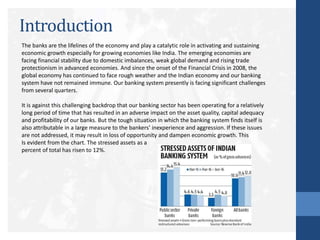
Is evident from the chart. The stressed assets as a
percent of total has risen to 12%.
Present Situation
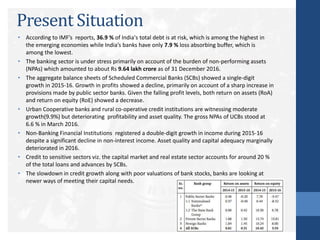
• According to IMF’s reports, 36.9 % of India's total debt is at risk, which is among the highest in
the emerging economies while India’s banks have only 7.9 % loss absorbing buffer, which is
among the lowest.
• The banking sector is under stress primarily on account of the burden of non-performing assets
(NPAs) which amounted to about Rs 9.64 lakh crore as of 31 December 2016.
• The aggregate balance sheets of Scheduled Commercial Banks (SCBs) showed a single-digit
growth in 2015-16. Growth in profits showed a decline, primarily on account of a sharp increase in
provisions made by public sector banks. Given the falling profit levels, both return on assets (RoA)
and return on equity (RoE) showed a decrease.
• Urban Cooperative banks and rural co-operative credit institutions are witnessing moderate
growth(9.9%) but deteriorating profitability and asset quality. The gross NPAs of UCBs stood at
6.6 % in March 2016.
• Non-Banking Financial Institutions registered a double-digit growth in income during 2015-16
despite a significant decline in non-interest income. Asset quality and capital adequacy marginally
deteriorated in 2016.
• Credit to sensitive sectors viz. the capital market and real estate sector accounts for around 20 %
of the total loans and advances by SCBs.
• The slowdown in credit growth along with poor valuations of bank stocks, banks are looking at
newer ways of meeting their capital needs.
Statistics
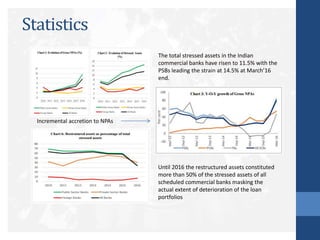
Incremental accretion to NPAs
The total stressed assets in the Indian
commercial banks have risen to 11.5% with the
PSBs leading the strain at 14.5% at March’16
end.
Until 2016 the restructured assets constituted
more than 50% of the stressed assets of all
scheduled commercial banks masking the
actual extent of deterioration of the loan
portfolios
Reasons & Challenges
Challenges:
• Bad loans & NPAs
• Bad Asset Quality
• Low Capital Adequacy
• Un-hedged Foreign Exposures
• Technology integration & cyber security
• Overlapping jurisdictions for PSBs
• HR Issues
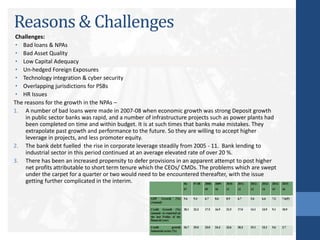
The reasons for the growth in the NPAs –
1. A number of bad loans were made in 2007-08 when economic growth was strong Deposit growth
in public sector banks was rapid, and a number of infrastructure projects such as power plants had
been completed on time and within budget. It is at such times that banks make mistakes. They
extrapolate past growth and performance to the future. So they are willing to accept higher
leverage in projects, and less promoter equity.
2. The bank debt fuelled the rise in corporate leverage steadily from 2005 - 11. Bank lending to
industrial sector in this period continued at an average elevated rate of over 20 %.
3. There has been an increased propensity to defer provisions in an apparent attempt to post higher
net profits attributable to short term tenure which the CEOs/ CMDs. The problems which are swept
under the carpet for a quarter or two would need to be encountered thereafter, with the issue
getting further complicated in the interim.
Current Policies & Initiatives
• The Scheme for Sustainable Structuring of Stressed Assets (S4A) for a deep financial
restructuring of large accounts(> Rs 500cr) by allowing lender (bank) to acquire equity of the
stressed project. It also envisages determination of the sustainable debt level for a stressed
borrower.
• Asset Quality Review – Asset classification to compare the quality of loan assets against
applicable Reserve Bank norms.
• Insolvency and Bankruptcy Code, 2016
• Large Exposure Framework (LEF) - lender's total advances to a single company cannot be
higher than 20 per cent of its capital base.
• Central Fraud Registry (CFR)-a web based searchable database of frauds containing data for
the last 13 years & help in timely identification and mitigation of frauds and also serve as a
potent tool for banks in taking informed business decisions.
• Non-performing assets ordinance - creation of a separate cell to identify issues pertaining to
NPAs and have a clause providing definitive time-frame(60-90 days) for the resolution process.
• Liquidity Coverage Ratio (LCR-60%)-ratio of High Quality Liquid Assets (HQLA) to the Total Net
Cash Outflows prescribed to address the short term liquidity risk of banks and the banks would
be required to maintain a stock of HQLAs on an ongoing basis equal to the Total Net Cash
Outflows.
• RBI has created a large loan database (CRILC) that covers all loans over Rs.5 cr. The data base
being accessible to all the banks allows them to identify incipient sickness once early signals
are notices.
Remedies
• Creation of Credit Rating Agencies of international standards to categorize borrowers
according to their credit worthiness.
• Efficient implementation of frameworks and policies formulated by the central bank to
resurrect the banking sector and clean up their stressed balance sheets.
• Good Credit Risk Management teams in individual branches for optimum Risk-Return trade-
off to “maximize return for a given risk” and “minimize risk for a given return”. Developing in-
house expertise for project evaluation, understanding demand projections for the project’s
output and the expertise and reliability of the promoter.
• Improving the operational efficiency and creating the right capital structure. The capital
structure should be related to residual risks of the project.
Greater risk Greater equity component Greater flexibility in debt structure
• Merging smaller banks and privatizing non-performing PSBs to reduce operational costs and
restructure management.
• Rebalance the loan portfolio of banks from sensitive and high-risk lending in favor of less
volatile sectors.
• To address crony capitalism and high bureaucracy, a dedicated legal framework needs to be
created for malfeasance.
• In context of higher Liquidity Coverage Ratio and priority sector lending, the central bank can
think of reducing SLR to give banks enough head room.
Bibliography
• RBI’s Reports:
Financial Stability Report 2015-16
Trends and Progress of Banking in India
Yearly and quarterly publications
• Links:
www.indianeconomy.net
www.financialexpress.com/
www.economictimes.indiatimes.com
www.rbi.org.in/
www.bloomberg.com
http://www.bis.org
“In the end. We will be living in interesting times. Whether it is a blessing or a
curse is up to us.”- On Banking in India Today
Dr. Raghuram G. Rajan, Ex-Governor, Reserve Bank of India

Issues with banking sector in india

  • 1.
    BANKINGSECTORININDIA CHALLENGES & REMEDIES CompiledBy: Harshit Aggarwal SNAP ID : 170111426 “I do not minimize the difficulties that lie ahead on the long and arduous journey on which we have embarked. But as Victor Hugo once said, “no power on earth can stop an idea whose time has come.”– Dr. Manmohan Singh, Ex- Prime Minister of India
  • 2.
    Introduction The banks arethe lifelines of the economy and play a catalytic role in activating and sustaining economic growth especially for growing economies like India. The emerging economies are facing financial stability due to domestic imbalances, weak global demand and rising trade protectionism in advanced economies. And since the onset of the Financial Crisis in 2008, the global economy has continued to face rough weather and the Indian economy and our banking system have not remained immune. Our banking system presently is facing significant challenges from several quarters. It is against this challenging backdrop that our banking sector has been operating for a relatively long period of time that has resulted in an adverse impact on the asset quality, capital adequacy and profitability of our banks. But the tough situation in which the banking system finds itself is also attributable in a large measure to the bankers’ inexperience and aggression. If these issues are not addressed, it may result in loss of opportunity and dampen economic growth. This Is evident from the chart. The stressed assets as a percent of total has risen to 12%.
  • 3.
    Present Situation • Accordingto IMF’s reports, 36.9 % of India's total debt is at risk, which is among the highest in the emerging economies while India’s banks have only 7.9 % loss absorbing buffer, which is among the lowest. • The banking sector is under stress primarily on account of the burden of non-performing assets (NPAs) which amounted to about Rs 9.64 lakh crore as of 31 December 2016. • The aggregate balance sheets of Scheduled Commercial Banks (SCBs) showed a single-digit growth in 2015-16. Growth in profits showed a decline, primarily on account of a sharp increase in provisions made by public sector banks. Given the falling profit levels, both return on assets (RoA) and return on equity (RoE) showed a decrease. • Urban Cooperative banks and rural co-operative credit institutions are witnessing moderate growth(9.9%) but deteriorating profitability and asset quality. The gross NPAs of UCBs stood at 6.6 % in March 2016. • Non-Banking Financial Institutions registered a double-digit growth in income during 2015-16 despite a significant decline in non-interest income. Asset quality and capital adequacy marginally deteriorated in 2016. • Credit to sensitive sectors viz. the capital market and real estate sector accounts for around 20 % of the total loans and advances by SCBs. • The slowdown in credit growth along with poor valuations of bank stocks, banks are looking at newer ways of meeting their capital needs.
  • 4.
    Statistics Incremental accretion toNPAs The total stressed assets in the Indian commercial banks have risen to 11.5% with the PSBs leading the strain at 14.5% at March’16 end. Until 2016 the restructured assets constituted more than 50% of the stressed assets of all scheduled commercial banks masking the actual extent of deterioration of the loan portfolios
  • 5.
    Reasons & Challenges Challenges: •Bad loans & NPAs • Bad Asset Quality • Low Capital Adequacy • Un-hedged Foreign Exposures • Technology integration & cyber security • Overlapping jurisdictions for PSBs • HR Issues The reasons for the growth in the NPAs – 1. A number of bad loans were made in 2007-08 when economic growth was strong Deposit growth in public sector banks was rapid, and a number of infrastructure projects such as power plants had been completed on time and within budget. It is at such times that banks make mistakes. They extrapolate past growth and performance to the future. So they are willing to accept higher leverage in projects, and less promoter equity. 2. The bank debt fuelled the rise in corporate leverage steadily from 2005 - 11. Bank lending to industrial sector in this period continued at an average elevated rate of over 20 %. 3. There has been an increased propensity to defer provisions in an apparent attempt to post higher net profits attributable to short term tenure which the CEOs/ CMDs. The problems which are swept under the carpet for a quarter or two would need to be encountered thereafter, with the issue getting further complicated in the interim.
  • 6.
    Current Policies &Initiatives • The Scheme for Sustainable Structuring of Stressed Assets (S4A) for a deep financial restructuring of large accounts(> Rs 500cr) by allowing lender (bank) to acquire equity of the stressed project. It also envisages determination of the sustainable debt level for a stressed borrower. • Asset Quality Review – Asset classification to compare the quality of loan assets against applicable Reserve Bank norms. • Insolvency and Bankruptcy Code, 2016 • Large Exposure Framework (LEF) - lender's total advances to a single company cannot be higher than 20 per cent of its capital base. • Central Fraud Registry (CFR)-a web based searchable database of frauds containing data for the last 13 years & help in timely identification and mitigation of frauds and also serve as a potent tool for banks in taking informed business decisions. • Non-performing assets ordinance - creation of a separate cell to identify issues pertaining to NPAs and have a clause providing definitive time-frame(60-90 days) for the resolution process. • Liquidity Coverage Ratio (LCR-60%)-ratio of High Quality Liquid Assets (HQLA) to the Total Net Cash Outflows prescribed to address the short term liquidity risk of banks and the banks would be required to maintain a stock of HQLAs on an ongoing basis equal to the Total Net Cash Outflows. • RBI has created a large loan database (CRILC) that covers all loans over Rs.5 cr. The data base being accessible to all the banks allows them to identify incipient sickness once early signals are notices.
  • 7.
    Remedies • Creation ofCredit Rating Agencies of international standards to categorize borrowers according to their credit worthiness. • Efficient implementation of frameworks and policies formulated by the central bank to resurrect the banking sector and clean up their stressed balance sheets. • Good Credit Risk Management teams in individual branches for optimum Risk-Return trade- off to “maximize return for a given risk” and “minimize risk for a given return”. Developing in- house expertise for project evaluation, understanding demand projections for the project’s output and the expertise and reliability of the promoter. • Improving the operational efficiency and creating the right capital structure. The capital structure should be related to residual risks of the project. Greater risk Greater equity component Greater flexibility in debt structure • Merging smaller banks and privatizing non-performing PSBs to reduce operational costs and restructure management. • Rebalance the loan portfolio of banks from sensitive and high-risk lending in favor of less volatile sectors. • To address crony capitalism and high bureaucracy, a dedicated legal framework needs to be created for malfeasance. • In context of higher Liquidity Coverage Ratio and priority sector lending, the central bank can think of reducing SLR to give banks enough head room.
  • 8.
    Bibliography • RBI’s Reports: FinancialStability Report 2015-16 Trends and Progress of Banking in India Yearly and quarterly publications • Links: www.indianeconomy.net www.financialexpress.com/ www.economictimes.indiatimes.com www.rbi.org.in/ www.bloomberg.com http://www.bis.org “In the end. We will be living in interesting times. Whether it is a blessing or a curse is up to us.”- On Banking in India Today Dr. Raghuram G. Rajan, Ex-Governor, Reserve Bank of India