57ΤΕΥΧΟΣ/ISSUE 35
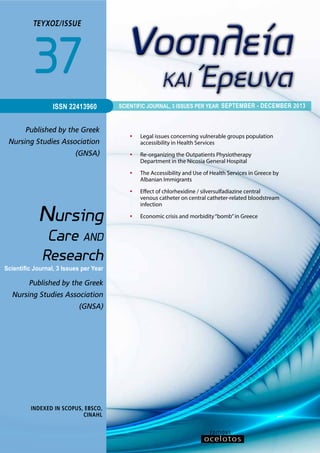
ΤΕΥΧΟΣ/ISSUE
37
Scientific Journal, 3 Issues per Year
Published by the Greek
Nursing Studies Association
(GNSA)
Nursing
Care AND
Research
INDEXED IN SCOPUS, ΕΒSCO,
CINAHL
EDITIONS
ocelotos
ISSN 22413960
•	 Legal issues concerning vulnerable groups population
accessibility in Health Services
•	 Re-organizing the Outpatients Physiotherapy
Department in the Nicosia General Hospital
•	 The Accessibility and Use of Health Services in Greece by
Albanian Immigrants
•	 Effect of chlorhexidine / silversulfadiazine central
venous catheter on central catheter-related bloodstream
infection
•	 Economic crisis and morbidity“bomb”in Greece
SEPTEMBER - DECEMBER 2013SCIENTIFIC JOURNAL, 3 ISSUES PER YEAR
Published by the Greek
Nursing Studies Association
(GNSA)
58
59ΤΕΥΧΟΣ/ISSUE 35
Scientific Journal, 3 Issues per Year
Published by the Greek Nursing Studies Association (GNSA)
Nursing
Care AND Research
EDITOR-IN-CHIEF
Chryssoula Lemonidou, RN, MSc, PhD, Professor
of Nursing, University of Athens
CO-EDITORS
Eleni Apostolopoulou, RN, PhD, Professor of Nursing,
University of Athens
Ioannis Elefsiniotis, PhD, Assistant Professor, Faculty of
Nursing, University of Athens
Panagiota Sourtzi, RN, MSc, PhD, Associate Professor,
Faculty of Nursing, University of Athens
EDITORIAL BOARD
Lambros Anthopoulos, Emeritus Professor, Faculty of
Nursing, University of Athens
George Baltopoulos, PhD, Professor, Faculty of Nurs-
ing, University of Athens
Thalia Bellali, RN, MSc, PhD, Associate Professor of
Nursing, Technological Educational Institute of Thes-
saloniki
Konstantinos Birbas, PhD, Associate Professor, Faculty
of Nursing, University of Athens
Gerasimos Bonatsos, PhD, Professor, Faculty of Nurs-
ing, University of Athens
Charalambos Economou, Associate Professor, Depart-
ment of Sociology, Panteion University,
Margarita Giannakopoulou, MSc, PhD, Associate Pro-
fessor, Faculty of Nursing, University of Athens
Leonidas Grigorakos, Associate Professor, Faculty of
Nursing, University of Athens
Dafni Kaitelidou, MSc, PhD, Assistant Professor, Faculty
of Nursing, University of Athens
Ioannis Kaklamanos, PhD, Associate Professor, Faculty
of Nursing, University of Athens
Maria Kalafati, RN, MSc, PhD, Faculty of Nursing, Uni-
versity of Athens
Athina Kalokerinou, RN, PhD, Αssociate Professor of
Nursing, Faculty of Nursing, University of Athens
Evangelos Konstantinou, RN, MSc, PhD, Associate
Professor, Faculty of Nursing, University of Athens
Vassiliki Matziou, RN, PhD, Associate Professor, Fac-
ulty of Nursing, University of Athens
Pavlos Myrianthefs, PhD, Associate Professor, Faculty
of Nursing, University of Athens
Elisabeth Patiraki, RN, PhD, Professor, Faculty of
Nursing, University of Athens
Sotiris Plakas, RN, MSc, PhD, General Hospital of At-
tika «Sismanoglion»
Olga Siskou, RN, MSc, PhD, Faculty of Nursing, Uni-
versity of Athens, General Secretary of the Greek
Nursing Studies Association
EleniTheodossopoulou, Associate Professor, Faculty
of Nursing, University of Athens
INTERNATIONAL EDITORIAL BOARD
John Albarran, Principal Lecturer in Critical Care
Nursing, University of the West of England, Bris-
tol, UK
Maria Katopodi, PhD, Assistant Professor, University
of Michigan, USA
Katerina Labrinou, PhD, Assistant Professor in Nurs-
ing, Cyprus University of Technology
Anastasia Mallidou, RN, MSc, PhD, Assistant
Professor, University of Victoria, Canada
Anastasios Merkouris, RN, MSc, PhD, Associate
Professor of Nursing, Faculty of Nursing, Cyprus
University of Technology
Evridiki Papastavrou, PhD, Assistant Professor in
Nursing, Cyprus University of Technology
Elisabeth D.E. Papathanassoglou, RN, MSc, PhD,
Associate Professor, Faculty of Nursing, Cyprus
University of Technology
Julie Scholes, Professor of Nursing, University of
Brighton, Brighton, UK
Riita Suhonen, RN, PhD, Profes sor, University of
Turku, Department of Nursing Science, Turku,
Finland
60
61ΤΕΥΧΟΣ/ISSUE 35
Contents
NursingCare AND Research
Published by the Greek Nursing Studies Association (GNSA)
Publisher and Editor-in-Chief: Chryssoula Lemonidou
Address: 123, Papadiamantopoulou st., 115 27 - Athens, GREECE
Tel.: +30 210-7461.485
e-mail: nviolaki@nurs.uoa.gr
Technical publisher: Ocelotos publishing
Annual Subscriptions 2012 for Εlectronic Version
Public Services, Libraries, Companies, Organisations: € 30,00
Individual Subscriptions: € 20,00
©	Copyright 2007 - 2014: All rights reserved. The reproduction of articles (or parts of them) is
prohibited without permission of the publisher and the writers.
Instructions to Authors�����������������������������������������������������������������209
EDITORIAL:
Legal issues concerning vulnerable groups’access in
Health Services ������������������������������������������������������������� 214
V. Stamou
ORIGINAL PAPERS
Re-organizing the Outpatients Physiotherapy
Department in the Nicosia General Hospital �������������� 219
I. Nikolaidou Rousou, O. Siskou, M. Theodorou
The Accessibility and Use of Health Services in
Greece by Albanian Immigrants ��������������������������������������������� 231
G. Anastopoulos, Ch. Economou, D. Zikos, E. Kouli, O. Siskou,
Ch. Lemonidou, D. Kaitelidou
REVIEWS
Effect of chlorhexidine / silversulfadiazine central
venous catheter on central catheter-related
bloodstream infection ���������������������������������������������������������� 243
M. Voutyraki
Economic crisis and morbidity“bomb”in Greece ������� 255
D. Kaitelidou, M. Kalogeropoulou, P. Galanis, L. Liaropoulos
62
ORIGINAL PAPER
Abstract
INTRODUCTION: BACKGROUND: Increased
demand for services in outpatient physiothera-
py department of theNicosia General Hospital
had led in long waiting lists. Staff reported that
they haveto work under great pressure and
stress trying to respond to the demand. Lim-
ited human resources have created the need
for alternative organizational forms of service
delivery in order to cope with excess demand.
PURPOSE: To investigate the effectiveness of
a specific organizational intervention, for bet-
ter management of referrals and high demand,
aiming to reduce the waiting lists without any
increase of human recourses or changes in the
physiotherapy interventions.
METHODOLOGY: Two independent samples
of patients, who visited the outpatient physio-
therapy department, were used.The pre inter-
vention sample, consisting of 352 patients (the
period: 14/11/2008 to 18/12/2008) and the post
intervention sample consisting of 356 patients
(the period:16/1/2009 to 19/2/2009). The two
samples were similar concerning demograph-
ic characteristics and health status of patients.
A pilot study was also conducted, in which
were involved 71 patients.
A series of outcome measures were used to
compare the new with the existing patient
management system. Using the relevant out-
come measure demographic and clinical data
was collected, patients’ health status was as-
sessed and patients and staff views on the
quality of the service provided were recorded.
The SPSS version 16 was used for the statisti-
cal analysis.
RESULTS: A significant reduction in average
waiting time from 20,88 days to 3,49 was re-
corded and the average number of physio-
therapy visits per patient were reduced from
4,96 to 3,58. All the above occurred without
any significant change in VAS score or EQ-5D
scores of patients’ symptoms. In addition pa-
tients were satisfied with the service provided
and staff reports were very positive.
CONCLUSION: The results suggest that re-
ducing waiting list is feasible without addition-
al human resources and that a more efficient
patient management system could improve
access and service delivery as well as patient
and staff satisfaction. The effectiveness of the
intervention needs a strict monitoring system
in place.
KEY WORDS: physiotherapy, outpatients,
waiting list, triage, Nicosia general hospital
ORIGINAL PAPER
Re-organizing the Outpatients Physiotherapy
Department in the Nicosia General Hospital
Ι. Nikolaidou Rousou, Physiotherapist MSc, Senior Superintendent Physiotherapist, Nicosia General
Hospital
O. Siskou, RN, MSc, PhD, Senior Researcher, Center for Health Services Management and Evaluation, Na-
tional and Kapodistrian University of Athens
M. Theodorou, Associate Professor in Health Policy, Open University of Cyprus
Corresponding Author:
Olga Siskou, Faculty of Nursing, National and Kapodistrian University of Athens.
123 Papadiamantopoulou str., 11527 Athens.
Tel: +30 210 7461471 Εmail: olsiskou@nurs.uoa.gr
63ΤΕΥΧΟΣ/ISSUE 35
ORIGINAL PAPER
Abstract
Introduction: The equal access of migrants to
health services is considered to be a key-point to
their integration in Greek society, ensuring of pub-
lic health and respect of the human right for equal
health care. The limited knowledge about availa-
ble health services makes their use by the migrants
even more difficult. Aim:The assessment of the ac-
cess and use of health services in Greece by Alba-
nian migrants and the investigation of the im-
pact of certain demographic data. Methodol-
ogy: The current study is a cross-sectional study,
conducted from 1st January to 30th April 2012.
Study population consisted of 189 Albanian mi-
grants (men and women), residents of Athens or
Thessaloniki for ≤10 years. The sample was select-
ed by snowball sampling type. Data were collected
through a questionnaire, which was created by the
researchers, based on the international literature.
Statistical analysis included chi-square tests, Fish-
er’s exact-test, Student’s t-test and analysis of vari-
ance test. Results: The 38.6 % of the total number
of migrants reported that they are well or very well
informed about health services in Greece, while
57,1% reported moderate or poor knowledge
about health services. The 60,8% of the partici-
pants, used health services in Greece in their last
12-month-staying in country. Specifically, 33.8%
of them visited emergency departments, 24.3%
visited private practitioners and 13.2% visited pri-
vate dentists. In addition, the 33.3% said that dur-
ing the last 12 months, happened to need health
services treatment, but finally they were not sat-
isfied by those services. The 88.9% of them said
that they do trust health professionals in Greece.
The increased ability to understand (p0,001) and
speak the Greek language (p0,001), and the big
duration of staying in Greece (p0,001) were asso-
ciated with increased knowledge about health ser-
vices. Also, the increased monthly family income
was associated with reduced difficulty for access-
ing the health services (p0,001). Conclusion: The
poor competence of understanding and speaking
the Greek language and the duration of staying
in the country as well, constitute the major prob-
lems of Albanian migrants regarding their access
to health services. It is important to undertake ac-
tions for the improvement of the quality of health
services, the training of health professionals, the
information of migrants and the facilitation of the
communication so as to improve migrants’ access
to health services in Greece. Keywords: Greece,
migrants, accessibility, cross sectional survey of
health services
The Accessibility and Use of Health Services in
Greece by Albanian Immigrants
G. Anastopoulos, Economist MSc, PhD (c), Center for Health Services Management and Evaluation, Faculty
of Nursing, National  Kapodistrian University of Athens
Ch. Economou, Assistant Professor Faculty of Sociology, Panteion University
D. Zikos, RN, MSc, PhD, Center for Health Services Management and Evaluation, Faculty of Nursing, National
 Kapodistrian University of Athens
E. Kouli, RN, MSc, PhD, Center for Health Services Management and Evaluation, Faculty of Nursing, National
 Kapodistrian University of Athens
O.Siskou,RN,MSc,PhD,CenterforHealthServicesManagementandEvaluation,FacultyofNursing,National
 Kapodistrian University of Athens
Ch. Lemonidou, Professor, Faculty of Nursing, National  Kapodistrian University of Athens
D. Kaitelidou, Assistant Professor, Center for Health Services Management and Evaluation, Faculty of
Nursing, National  Kapodistrian University of Athens
Corresponding Author: George Anastopoulos
8 Dramas str., 13676 Thrakomakedones, tel: +30 6942200407, email: anastog@gmail.com
This research has been co-financed by the European Union (European Social Fund – ESF) and Greek national
funds through the Operational Program“Education and Lifelong Learning”of the National Strategic Reference
Framework (NSRF) - Research Funding Program: THALIS –UOA – The Detection, Transcription and Analysis of
Inequalities to Healthcare access for Immigrants Living in Greece, MIS 377228, KA: 70/3/11671
64
REVIEW
Abstract
Introduction: In recent years the global
community faces a financial crisis with potential
significant impacts on population health
indicators.
Aim: The aim of the paper is to map the impact of
economic crisis on the Greek health care system
and on the population health.
Methodology:Asystematicliteraturereviewwas
conducted in databases Pubmed, Embase and
Scopus,usingthefollowingkey-words:economic
crisis, financial crisis, health problems, mortality,
morbidity, suicides, austerity, consequences,
Argentina, Mexico, Greece, Russia, Lietuvos,
Latvia, Estonia, Indonesia, Malaysia, Thailand.
Results: Greece entered a deep economic crisis
in 2009, the main features of which are the
large fiscal deficit reaching 15.6% in 2009 and
remaining high for the next three years (10 %
of GDP in 2012), and the enormous public debt
which shows an upward trend, exceeding 150%
of GDP in 2012. Unemployment rate exceeded
27% of the population in 2013, whereas the
percentage of people living below the poverty
threshold has increased from 27.6 % in 2009
to 31% in 2011. Total current expenditure on
health decreased by 19% while public current
expenditure decreased by 23% between 2009
and 2011. At the same time an increase in
both morbidity (eg infectious diseases rates,
mental health problems) and mortality rates
(total mortality rate was increased by 3.4%)
and expressed unmet needs (55% of the total
population) were recorded between 2009 and
2011.
Conclusions: Unfortunately, until now, first data
on the impact of the crisis in our country seem
to confirm the negative experience of countries
which found themselves in a similar situation.
Key-words: Greece, financial crisis, health
services, morbidity, mortality
Economic crisis and morbidity “bomb” in
Greece
D. Kaitelidou, Assistant Professor- Director of Center of Health Services Management and Evaluation,
Faculty of Nursing, University of Athens
M. Kalogeropoulou, ΜSc, PhD, RN
P. Galanis, ΜSc, PhD, RN
L. Liaropoulos Professor Emeritus, University of Athens
Corresponding Author:
Daphne Kaitelidou,
Faculty of Nursing, University of Athens,
123 Papadiamantopoulou str., 115 27 Athens
Tel: +30 210 7461470
email: dkaitelid@nurs.uoa.gr
65ΤΕΥΧΟΣ/ISSUE 35
ΑΝΑΣΚΟΠΗΣΗ
Abstract
Introduction: Central venous catheters (CVC)
are widely used in patients’treatment. Although
they provide easy venous access, their use is as-
sociated with infections. 90% of cases of bacte-
remia associated with a catheter are due to CVC.
Aim: The investigation of the effectiveness
of central venous catheter impregnated with
chlorhexidine- silver sulfadiazine in the control
and prevention of microbial colonization and
bacteremia due to central venous catheter in
adult patients in medical and surgical intensive
care units.
Methods:The search of published articles for the
period 2000 - 2012, took place in the databas-
es Medline and Cinahl. 693 articles were found
and of these only 9 were related to the specific
research question. The criteria for selecting the
studies were: clinical trials or studies comparing
CVC impregnated with Chlorhexidine- Silver Sul-
fadiazine (CSS) with standard, uncoated polyure-
thane or silicone CVC in adults in general or sur-
gical ICU.
Results: Most studies concerning the first gen-
eration CSS did not report significant additional
benefits in relation to the standard catheters in
rates of colonization and catheter related blood-
stream infections. Two clinical trials comparing
the second generation CSS CVC with the stan-
dard showed that the second generation CSS
CVC were effective in preventing microbial col-
onization, which is the first step in the develop-
ment of bacteremia.
Conclusion: The adherence to sterile precau-
tions during insertion and care of central venous
catheter is the most important measure of con-
trol and prevention of catheter related blood-
stream infections.
Key words: bacteremia, chlorhexidine- silver
sulfadiazine, central venous catheter, medical
ICU, surgical ICU
REVIEW
Effect of chlorhexidine/silversulfadiazine
central venous catheter on central catheter-
related bloodstream infection
M. Voutyraki, RN, MSc (c), University of Athens Athens, Faculty of Nursing, Athens
Address: Sepolion 25, 10445, Attikis Sq.
Phone number: 6983052303 / 2155405733
e-mail: mariavouti@hotmail.com
66
Βατάτζη 55, 114 73 Αθήνα ΤΗΛ. : 210 6431108
E-MAIL: ekdoseis.ocelotos@gmail.com
www. ocelotos. gr

Issue 37

  • 1.
    57ΤΕΥΧΟΣ/ISSUE 35 ΤΕΥΧΟΣ/ISSUE 37 Scientific Journal,3 Issues per Year Published by the Greek Nursing Studies Association (GNSA) Nursing Care AND Research INDEXED IN SCOPUS, ΕΒSCO, CINAHL EDITIONS ocelotos ISSN 22413960 • Legal issues concerning vulnerable groups population accessibility in Health Services • Re-organizing the Outpatients Physiotherapy Department in the Nicosia General Hospital • The Accessibility and Use of Health Services in Greece by Albanian Immigrants • Effect of chlorhexidine / silversulfadiazine central venous catheter on central catheter-related bloodstream infection • Economic crisis and morbidity“bomb”in Greece SEPTEMBER - DECEMBER 2013SCIENTIFIC JOURNAL, 3 ISSUES PER YEAR Published by the Greek Nursing Studies Association (GNSA)
  • 2.
  • 3.
    59ΤΕΥΧΟΣ/ISSUE 35 Scientific Journal,3 Issues per Year Published by the Greek Nursing Studies Association (GNSA) Nursing Care AND Research EDITOR-IN-CHIEF Chryssoula Lemonidou, RN, MSc, PhD, Professor of Nursing, University of Athens CO-EDITORS Eleni Apostolopoulou, RN, PhD, Professor of Nursing, University of Athens Ioannis Elefsiniotis, PhD, Assistant Professor, Faculty of Nursing, University of Athens Panagiota Sourtzi, RN, MSc, PhD, Associate Professor, Faculty of Nursing, University of Athens EDITORIAL BOARD Lambros Anthopoulos, Emeritus Professor, Faculty of Nursing, University of Athens George Baltopoulos, PhD, Professor, Faculty of Nurs- ing, University of Athens Thalia Bellali, RN, MSc, PhD, Associate Professor of Nursing, Technological Educational Institute of Thes- saloniki Konstantinos Birbas, PhD, Associate Professor, Faculty of Nursing, University of Athens Gerasimos Bonatsos, PhD, Professor, Faculty of Nurs- ing, University of Athens Charalambos Economou, Associate Professor, Depart- ment of Sociology, Panteion University, Margarita Giannakopoulou, MSc, PhD, Associate Pro- fessor, Faculty of Nursing, University of Athens Leonidas Grigorakos, Associate Professor, Faculty of Nursing, University of Athens Dafni Kaitelidou, MSc, PhD, Assistant Professor, Faculty of Nursing, University of Athens Ioannis Kaklamanos, PhD, Associate Professor, Faculty of Nursing, University of Athens Maria Kalafati, RN, MSc, PhD, Faculty of Nursing, Uni- versity of Athens Athina Kalokerinou, RN, PhD, Αssociate Professor of Nursing, Faculty of Nursing, University of Athens Evangelos Konstantinou, RN, MSc, PhD, Associate Professor, Faculty of Nursing, University of Athens Vassiliki Matziou, RN, PhD, Associate Professor, Fac- ulty of Nursing, University of Athens Pavlos Myrianthefs, PhD, Associate Professor, Faculty of Nursing, University of Athens Elisabeth Patiraki, RN, PhD, Professor, Faculty of Nursing, University of Athens Sotiris Plakas, RN, MSc, PhD, General Hospital of At- tika «Sismanoglion» Olga Siskou, RN, MSc, PhD, Faculty of Nursing, Uni- versity of Athens, General Secretary of the Greek Nursing Studies Association EleniTheodossopoulou, Associate Professor, Faculty of Nursing, University of Athens INTERNATIONAL EDITORIAL BOARD John Albarran, Principal Lecturer in Critical Care Nursing, University of the West of England, Bris- tol, UK Maria Katopodi, PhD, Assistant Professor, University of Michigan, USA Katerina Labrinou, PhD, Assistant Professor in Nurs- ing, Cyprus University of Technology Anastasia Mallidou, RN, MSc, PhD, Assistant Professor, University of Victoria, Canada Anastasios Merkouris, RN, MSc, PhD, Associate Professor of Nursing, Faculty of Nursing, Cyprus University of Technology Evridiki Papastavrou, PhD, Assistant Professor in Nursing, Cyprus University of Technology Elisabeth D.E. Papathanassoglou, RN, MSc, PhD, Associate Professor, Faculty of Nursing, Cyprus University of Technology Julie Scholes, Professor of Nursing, University of Brighton, Brighton, UK Riita Suhonen, RN, PhD, Profes sor, University of Turku, Department of Nursing Science, Turku, Finland
  • 4.
  • 5.
    61ΤΕΥΧΟΣ/ISSUE 35 Contents NursingCare ANDResearch Published by the Greek Nursing Studies Association (GNSA) Publisher and Editor-in-Chief: Chryssoula Lemonidou Address: 123, Papadiamantopoulou st., 115 27 - Athens, GREECE Tel.: +30 210-7461.485 e-mail: nviolaki@nurs.uoa.gr Technical publisher: Ocelotos publishing Annual Subscriptions 2012 for Εlectronic Version Public Services, Libraries, Companies, Organisations: € 30,00 Individual Subscriptions: € 20,00 © Copyright 2007 - 2014: All rights reserved. The reproduction of articles (or parts of them) is prohibited without permission of the publisher and the writers. Instructions to Authors�����������������������������������������������������������������209 EDITORIAL: Legal issues concerning vulnerable groups’access in Health Services ������������������������������������������������������������� 214 V. Stamou ORIGINAL PAPERS Re-organizing the Outpatients Physiotherapy Department in the Nicosia General Hospital �������������� 219 I. Nikolaidou Rousou, O. Siskou, M. Theodorou The Accessibility and Use of Health Services in Greece by Albanian Immigrants ��������������������������������������������� 231 G. Anastopoulos, Ch. Economou, D. Zikos, E. Kouli, O. Siskou, Ch. Lemonidou, D. Kaitelidou REVIEWS Effect of chlorhexidine / silversulfadiazine central venous catheter on central catheter-related bloodstream infection ���������������������������������������������������������� 243 M. Voutyraki Economic crisis and morbidity“bomb”in Greece ������� 255 D. Kaitelidou, M. Kalogeropoulou, P. Galanis, L. Liaropoulos
  • 6.
    62 ORIGINAL PAPER Abstract INTRODUCTION: BACKGROUND:Increased demand for services in outpatient physiothera- py department of theNicosia General Hospital had led in long waiting lists. Staff reported that they haveto work under great pressure and stress trying to respond to the demand. Lim- ited human resources have created the need for alternative organizational forms of service delivery in order to cope with excess demand. PURPOSE: To investigate the effectiveness of a specific organizational intervention, for bet- ter management of referrals and high demand, aiming to reduce the waiting lists without any increase of human recourses or changes in the physiotherapy interventions. METHODOLOGY: Two independent samples of patients, who visited the outpatient physio- therapy department, were used.The pre inter- vention sample, consisting of 352 patients (the period: 14/11/2008 to 18/12/2008) and the post intervention sample consisting of 356 patients (the period:16/1/2009 to 19/2/2009). The two samples were similar concerning demograph- ic characteristics and health status of patients. A pilot study was also conducted, in which were involved 71 patients. A series of outcome measures were used to compare the new with the existing patient management system. Using the relevant out- come measure demographic and clinical data was collected, patients’ health status was as- sessed and patients and staff views on the quality of the service provided were recorded. The SPSS version 16 was used for the statisti- cal analysis. RESULTS: A significant reduction in average waiting time from 20,88 days to 3,49 was re- corded and the average number of physio- therapy visits per patient were reduced from 4,96 to 3,58. All the above occurred without any significant change in VAS score or EQ-5D scores of patients’ symptoms. In addition pa- tients were satisfied with the service provided and staff reports were very positive. CONCLUSION: The results suggest that re- ducing waiting list is feasible without addition- al human resources and that a more efficient patient management system could improve access and service delivery as well as patient and staff satisfaction. The effectiveness of the intervention needs a strict monitoring system in place. KEY WORDS: physiotherapy, outpatients, waiting list, triage, Nicosia general hospital ORIGINAL PAPER Re-organizing the Outpatients Physiotherapy Department in the Nicosia General Hospital Ι. Nikolaidou Rousou, Physiotherapist MSc, Senior Superintendent Physiotherapist, Nicosia General Hospital O. Siskou, RN, MSc, PhD, Senior Researcher, Center for Health Services Management and Evaluation, Na- tional and Kapodistrian University of Athens M. Theodorou, Associate Professor in Health Policy, Open University of Cyprus Corresponding Author: Olga Siskou, Faculty of Nursing, National and Kapodistrian University of Athens. 123 Papadiamantopoulou str., 11527 Athens. Tel: +30 210 7461471 Εmail: olsiskou@nurs.uoa.gr
  • 7.
    63ΤΕΥΧΟΣ/ISSUE 35 ORIGINAL PAPER Abstract Introduction:The equal access of migrants to health services is considered to be a key-point to their integration in Greek society, ensuring of pub- lic health and respect of the human right for equal health care. The limited knowledge about availa- ble health services makes their use by the migrants even more difficult. Aim:The assessment of the ac- cess and use of health services in Greece by Alba- nian migrants and the investigation of the im- pact of certain demographic data. Methodol- ogy: The current study is a cross-sectional study, conducted from 1st January to 30th April 2012. Study population consisted of 189 Albanian mi- grants (men and women), residents of Athens or Thessaloniki for ≤10 years. The sample was select- ed by snowball sampling type. Data were collected through a questionnaire, which was created by the researchers, based on the international literature. Statistical analysis included chi-square tests, Fish- er’s exact-test, Student’s t-test and analysis of vari- ance test. Results: The 38.6 % of the total number of migrants reported that they are well or very well informed about health services in Greece, while 57,1% reported moderate or poor knowledge about health services. The 60,8% of the partici- pants, used health services in Greece in their last 12-month-staying in country. Specifically, 33.8% of them visited emergency departments, 24.3% visited private practitioners and 13.2% visited pri- vate dentists. In addition, the 33.3% said that dur- ing the last 12 months, happened to need health services treatment, but finally they were not sat- isfied by those services. The 88.9% of them said that they do trust health professionals in Greece. The increased ability to understand (p0,001) and speak the Greek language (p0,001), and the big duration of staying in Greece (p0,001) were asso- ciated with increased knowledge about health ser- vices. Also, the increased monthly family income was associated with reduced difficulty for access- ing the health services (p0,001). Conclusion: The poor competence of understanding and speaking the Greek language and the duration of staying in the country as well, constitute the major prob- lems of Albanian migrants regarding their access to health services. It is important to undertake ac- tions for the improvement of the quality of health services, the training of health professionals, the information of migrants and the facilitation of the communication so as to improve migrants’ access to health services in Greece. Keywords: Greece, migrants, accessibility, cross sectional survey of health services The Accessibility and Use of Health Services in Greece by Albanian Immigrants G. Anastopoulos, Economist MSc, PhD (c), Center for Health Services Management and Evaluation, Faculty of Nursing, National Kapodistrian University of Athens Ch. Economou, Assistant Professor Faculty of Sociology, Panteion University D. Zikos, RN, MSc, PhD, Center for Health Services Management and Evaluation, Faculty of Nursing, National Kapodistrian University of Athens E. Kouli, RN, MSc, PhD, Center for Health Services Management and Evaluation, Faculty of Nursing, National Kapodistrian University of Athens O.Siskou,RN,MSc,PhD,CenterforHealthServicesManagementandEvaluation,FacultyofNursing,National Kapodistrian University of Athens Ch. Lemonidou, Professor, Faculty of Nursing, National Kapodistrian University of Athens D. Kaitelidou, Assistant Professor, Center for Health Services Management and Evaluation, Faculty of Nursing, National Kapodistrian University of Athens Corresponding Author: George Anastopoulos 8 Dramas str., 13676 Thrakomakedones, tel: +30 6942200407, email: anastog@gmail.com This research has been co-financed by the European Union (European Social Fund – ESF) and Greek national funds through the Operational Program“Education and Lifelong Learning”of the National Strategic Reference Framework (NSRF) - Research Funding Program: THALIS –UOA – The Detection, Transcription and Analysis of Inequalities to Healthcare access for Immigrants Living in Greece, MIS 377228, KA: 70/3/11671
  • 8.
    64 REVIEW Abstract Introduction: In recentyears the global community faces a financial crisis with potential significant impacts on population health indicators. Aim: The aim of the paper is to map the impact of economic crisis on the Greek health care system and on the population health. Methodology:Asystematicliteraturereviewwas conducted in databases Pubmed, Embase and Scopus,usingthefollowingkey-words:economic crisis, financial crisis, health problems, mortality, morbidity, suicides, austerity, consequences, Argentina, Mexico, Greece, Russia, Lietuvos, Latvia, Estonia, Indonesia, Malaysia, Thailand. Results: Greece entered a deep economic crisis in 2009, the main features of which are the large fiscal deficit reaching 15.6% in 2009 and remaining high for the next three years (10 % of GDP in 2012), and the enormous public debt which shows an upward trend, exceeding 150% of GDP in 2012. Unemployment rate exceeded 27% of the population in 2013, whereas the percentage of people living below the poverty threshold has increased from 27.6 % in 2009 to 31% in 2011. Total current expenditure on health decreased by 19% while public current expenditure decreased by 23% between 2009 and 2011. At the same time an increase in both morbidity (eg infectious diseases rates, mental health problems) and mortality rates (total mortality rate was increased by 3.4%) and expressed unmet needs (55% of the total population) were recorded between 2009 and 2011. Conclusions: Unfortunately, until now, first data on the impact of the crisis in our country seem to confirm the negative experience of countries which found themselves in a similar situation. Key-words: Greece, financial crisis, health services, morbidity, mortality Economic crisis and morbidity “bomb” in Greece D. Kaitelidou, Assistant Professor- Director of Center of Health Services Management and Evaluation, Faculty of Nursing, University of Athens M. Kalogeropoulou, ΜSc, PhD, RN P. Galanis, ΜSc, PhD, RN L. Liaropoulos Professor Emeritus, University of Athens Corresponding Author: Daphne Kaitelidou, Faculty of Nursing, University of Athens, 123 Papadiamantopoulou str., 115 27 Athens Tel: +30 210 7461470 email: dkaitelid@nurs.uoa.gr
  • 9.
    65ΤΕΥΧΟΣ/ISSUE 35 ΑΝΑΣΚΟΠΗΣΗ Abstract Introduction: Centralvenous catheters (CVC) are widely used in patients’treatment. Although they provide easy venous access, their use is as- sociated with infections. 90% of cases of bacte- remia associated with a catheter are due to CVC. Aim: The investigation of the effectiveness of central venous catheter impregnated with chlorhexidine- silver sulfadiazine in the control and prevention of microbial colonization and bacteremia due to central venous catheter in adult patients in medical and surgical intensive care units. Methods:The search of published articles for the period 2000 - 2012, took place in the databas- es Medline and Cinahl. 693 articles were found and of these only 9 were related to the specific research question. The criteria for selecting the studies were: clinical trials or studies comparing CVC impregnated with Chlorhexidine- Silver Sul- fadiazine (CSS) with standard, uncoated polyure- thane or silicone CVC in adults in general or sur- gical ICU. Results: Most studies concerning the first gen- eration CSS did not report significant additional benefits in relation to the standard catheters in rates of colonization and catheter related blood- stream infections. Two clinical trials comparing the second generation CSS CVC with the stan- dard showed that the second generation CSS CVC were effective in preventing microbial col- onization, which is the first step in the develop- ment of bacteremia. Conclusion: The adherence to sterile precau- tions during insertion and care of central venous catheter is the most important measure of con- trol and prevention of catheter related blood- stream infections. Key words: bacteremia, chlorhexidine- silver sulfadiazine, central venous catheter, medical ICU, surgical ICU REVIEW Effect of chlorhexidine/silversulfadiazine central venous catheter on central catheter- related bloodstream infection M. Voutyraki, RN, MSc (c), University of Athens Athens, Faculty of Nursing, Athens Address: Sepolion 25, 10445, Attikis Sq. Phone number: 6983052303 / 2155405733 e-mail: mariavouti@hotmail.com
  • 10.
    66 Βατάτζη 55, 11473 Αθήνα ΤΗΛ. : 210 6431108 E-MAIL: ekdoseis.ocelotos@gmail.com www. ocelotos. gr