
1615 L St. N.W., Suite 600 
Washington, DC 20036-5664 
Tel. 202/662-8500 
Fax 202/626-0900 
www.isri.org 
Scrap 
Specifications 
Circular 
2014 
Guidelines for 
Nonferrous Scrap 
Ferrous Scrap 
Glass Cullet 
Paper Stock 
Plastic Scrap 
Electronics Scrap 
Tire Scrap 
EFFECTIVE 1/16/2014 
Rules Governing the Procedures for the Addition, 
Amendment, or Withdrawal of Specifications.................................3 
Nonferrous Scrap: NF-2014..................................................................4 
Red Metals........................................................................................4 
Aluminum..........................................................................................7 
Zinc...................................................................................................10 
Magnesium......................................................................................11 
Lead...................................................................................................11 
Nickel/Stainless/Hi Temp...........................................................12 
Mixed Metals..................................................................................13 
Other................................................................................................14 
Ferrous Scrap: FS-2014....................................................................... 17 
Electric Furnace Casting and Foundry Grades...........................18 
Specially Processed Grades............................................................20 
Cast Iron Grades..........................................................................20 
Special Boring Grades................................................................20 
Steel From Scrap Tires...............................................................20 
Railroad Ferrous Scrap...............................................................21 
Glass Cullet: GC-2014...........................................................................23 
Paper Stock: PS-2014 Domestic Transactions..........................26 
Glossary of Paper Stock Terms......................................................32 
Paper Stock: PS-2014 Export Transactions................................33 
Plastic Scrap: P-2014...........................................................................39 
Guidelines for Electronics Scrap: ES-2014.................................. 42 
Guidelines for Tire Scrap TS-2014.................................................. 50 
Guidelines for Metals Transactions................................................. 51 
ISRI Arbitration Service ..................................................................... 55
PREFACE 
The standard specifications included in this Circular are intended to assist members in the buying and selling of their materials and products. 
These specifications are derived from many sectors of the metals, paper stock, plastics, glass, and electronics industries and are constructed to represent the quality or composition of the materials bought and sold in the industry. The specifications are internationally accepted and are used throughout the world to trade the various commodities. 
Parties to a transaction may specify particular variations or additions to these specifications as are suited for their specific transactions and for their individual convenience. Any deviation from the standard specifications, however, should be mutually agreed to and so stipulated in writing by the parties to the transactions. 
ISRI maintains an Arbitration Service as a means of enabling members to settle differences between themselves or between one of them and a non- member. 
In addition, the “Guidelines for Metals Transactions” contain supplementary information that will aid members in completing their business transactions. It is recommended that these Guidelines be reviewed and that members use them in conjunction with the actual specifications in the conduct of their business. 
ISRI’s Scrap Specifications Circular is posted in PDF format at least once per year on the ISRI web site. To ensure you have the most up-to-date version, visit www.isri.org/specs. 
Issued by: 
Copyright © 2014 Institute of Scrap Recycling Industries, Inc. 
This document may not be reprinted in whole or in part without the prior 
written permission of the Institute of Scrap Recycling Industries, Inc. 
CIRCULAR 2014 BECAME EFFECTIVE January 16, 2014, 
AND PREVAILS UNTIL SUPERSEDED.
running chapter head IINNSSTTIITTUUTTEE OOFF SSCCRRAAPP RREECCYYCCLLIINNGG IINNDDUUSSTTRRIIEESS,, IINNCC.. 3 
1.0 Initiation of Request. Any person may file a request to 
add, amend or withdraw a specification by submitting 
such request in writing to the ISRI President. 
2.0 The President shall refer such request to the Chairman 
of ISRI’s Specifications Committee (the “Committee”), 
with copies to: 
A. ISRI’s Officers; 
B. The chairman of any ISRI Division and/or Committee 
that might be affected by the specification. 
3.0 Notice. Following its receipt, notice of the request shall 
be inserted in the ISRI Focus and a daily national trade 
publication such as American Metal Market. Such notice 
shall state: 
A. The date, time and place at which the request will be 
considered by the Committee; 
B. That the proceeding at which the request will be con-sidered 
shall be open to the public; 
C. That interested parties may participate in the pro-ceeding 
by personal appearance or by submitting 
written comments; 
D. A summary of the specification and the matter to be 
considered at the hearing. 
4.0 Committee Action. Following presentation by all inter-ested 
parties, the Committee shall review the request 
and: 
A. Act upon it immediately, as set forth in Section 4.1; or 
B. Refer it to a subcommittee for review and recom-mendation 
for action by the full Committee at its 
next meeting. 
4.1 The Committee shall summarize the positions advocated 
by the various parties interested in the request and rec-ommend 
to ISRI’s Board of Directors what action should 
be taken. 
5.0 Board of Directors Action. The Board of Directors, at its 
quarterly meeting at which the report and recommen-dation 
of the Committee has been made, shall adopt, 
amend, or reject the recommendation or table it pending 
further review and recommendation by the Committee. 
5.1 Notice of the action taken by the Board shall be given 
to all interested parties who actively participated in the 
Committee proceeding and any other persons who have 
requested in writing notice of the Board’s action. Notice 
of said action also shall be inserted in the ISRI Focus fol-lowing 
the Board meeting at which said action was tak-en. 
6.0 Appeal. On or before thirty days after the date of the 
notice required in Section 5.1, any party may appeal 
the decision of the Board by written notice to the Presi-dent. 
Said appeal shall state the reasons thereof and the 
requested action to be taken. Notice of said appeal shall 
be given in accordance with Section 3.0. 
6.1 The appeal shall be heard by the Board at its next quar-terly 
meeting following receipt thereof. 
6.2 The appellant and all interested parties shall be given at 
least twenty days notice of the date, time and place of 
the hearing, and like notice shall be inserted in the ISRI 
Focus at least twenty days prior to the hearing. 
6.3 At the hearing, the appellant and any other interested 
party may appear either in person or by written presen-tation 
and state their reasons for the appeal. 
6.4 The Board, following said hearing, shall review and act 
upon the appeal request. Notice of the Board’s action 
shall be given in accordance with Section 5.1. 
7.0 Records. ISRI shall maintain for not less than five years 
following the date of termination of the proceedings, 
records of the original request, summaries of the delib-erations 
and recommendations of the Committee, action 
of the Board, summaries of the appeal and final decision, 
if any, of the Board, together with the positions of inter-ested 
parties, copies of notices sent to interested parties 
and inserted in the ISRI Focus and national trade publi-cations, 
written statements, and the reasons for recom-mendation 
and final action by the Committee and the 
Board. 
7.1 Said records shall be available for review by the public 
upon reasonable notice. 
Rules Governing the Procedures for the Addition, Amendment, 
or Withdrawal of Specifications
4 SCRAP SPECIFICATIONS CIRCULAR 2008 
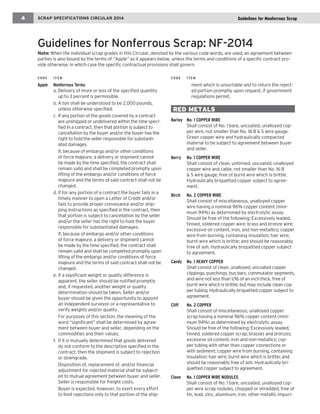
Apple Nonferrous Terms 
a. Delivery of more or less of the specified quantity 
up to 3 percent is permissible. 
b. A ton shall be understood to be 2,000 pounds, 
unless otherwise specified. 
c. If any portion of the goods covered by a contract 
are unshipped or undelivered within the time speci-fied 
in a contract, then that portion is subject to 
cancellation by the buyer and/or the buyer has the 
right to hold the seller responsible for substanti-ated 
damages. 
If, because of embargo and/or other conditions 
of force majeure, a delivery or shipment cannot 
be made by the time specified, the contract shall 
remain valid and shall be completed promptly upon 
lifting of the embargo and/or conditions of force 
majeure and the terms of said contract shall not be 
changed. 
d. If for any portion of a contract the buyer fails in a 
timely manner to open a Letter of Credit and/or 
fails to provide proper conveyance and/or ship-ping 
instructions as specified in the contract, then 
that portion is subject to cancellation by the seller 
and/or the seller has the right to hold the buyer 
responsible for substantiated damages. 
If, because of embargo and/or other conditions 
of force majeure, a delivery or shipment cannot 
be made by the time specified, the contract shall 
remain valid and shall be completed promptly upon 
lifting of the embargo and/or conditions of force 
majeure and the terms of said contract shall not be 
changed. 
e. If a significant weight or quality difference is 
apparent, the seller should be notified promptly 
and, if requested, another weight or quality 
determination should be taken. Seller and/or 
buyer should be given the opportunity to appoint 
an independent surveyor or a representative to 
verify weights and/or quality. 
For purposes of this section, the meaning of the 
word “significant” shall be determined by agree-ment 
between buyer and seller, depending on the 
commodities and their values. 
f. If it is mutually determined that goods delivered 
do not conform to the description specified in the 
contract, then the shipment is subject to rejection 
or downgrade. 
Disposition of, replacement of, and/or financial 
adjustment for rejected material shall be subject-ed 
to mutual agreement between buyer and seller. 
Seller is responsible for freight costs. 
Buyer is expected, however, to exert every effort 
to limit rejections only to that portion of the ship-ment 
which is unsortable and to return the reject-ed 
portion promptly upon request, if government 
regulations permit. 
Barley No. 1 COPPER WIRE 
Shall consist of No. 1 bare, uncoated, unalloyed cop-per 
wire, not smaller than No. 16 B & S wire gauge. 
Green copper wire and hydraulically compacted 
material to be subject to agreement between buyer 
and seller. 
Berry No. 1 COPPER WIRE 
Shall consist of clean, untinned, uncoated, unalloyed 
copper wire and cable, not smaller than No. 16 B 
& S wire gauge, free of burnt wire which is brittle. 
Hydraulically briquetted copper subject to agree-ment. 
Birch No. 2 COPPER WIRE 
Shall consist of miscellaneous, unalloyed copper 
wire having a nominal 96% copper content (mini-mum 
94%) as determined by electrolytic assay. 
Should be free of the following: Excessively leaded, 
tinned, soldered copper wire; brass and bronze wire; 
excessive oil content, iron, and non-metallics; copper 
wire from burning, containing insulation; hair wire; 
burnt wire which is brittle; and should be reasonably 
free of ash. Hydraulically briquetted copper subject 
to agreement. 
Candy No. 1 HEAVY COPPER 
Shall consist of clean, unalloyed, uncoated copper 
clippings, punchings, bus bars, commutator segments, 
and wire not less than 1/16 of an inch thick, free of 
burnt wire which is brittle; but may include clean cop-per 
tubing. Hydraulically briquetted copper subject to 
agreement. 
Cliff No. 2 COPPER 
Shall consist of miscellaneous, unalloyed copper 
scrap having a nominal 96% copper content (mini-mum 
94%) as determined by electrolytic assay. 
Should be free of the following: Excessively leaded, 
tinned, soldered copper scrap; brasses and bronzes; 
excessive oil content, iron and non-metallics; cop-per 
tubing with other than copper connections or 
with sediment; copper wire from burning, containing 
insulation; hair wire; burnt wire which is brittle; and 
should be reasonably free of ash. Hydraulically bri-quetted 
copper subject to agreement. 
Clove No. 1 COPPER WIRE NODULES 
Shall consist of No. 1 bare, uncoated, unalloyed cop-per 
wire scrap nodules, chopped or shredded, free of 
tin, lead, zinc, aluminum, iron, other metallic impuri- 
2014 
Guidelines for Nonferrous Scrap: NF-2014 
Note: When the individual scrap grades in this Circular, denoted by the various code words, are used, an agreement between 
parties is also bound by the terms of “Apple” as it appears below, unless the terms and conditions of a specific contract pro-vide 
otherwise, in which case the specific contractual provisions shall govern. 
CODE ITEM CODE ITEM 
RED METALS 
Guidelines for Nonferrous Scrap
running chapter head INSTITUTE OF SCRAP RECYCLING INDUSTRIES, INC. 5 
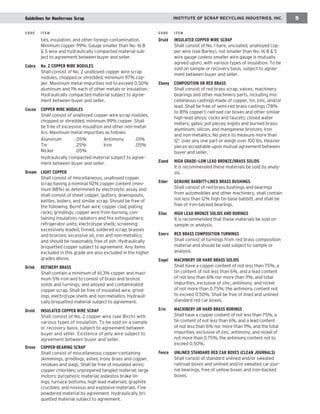
ties, insulation, and other foreign contamination. 
Minimum copper 99%. Gauge smaller than No. 16 B 
& S wire and hydraulically compacted material sub-ject 
to agreement between buyer and seller. 
Cobra No. 2 COPPER WIRE NODULES 
Shall consist of No. 2 unalloyed copper wire scrap 
nodules, chopped or shredded, minimum 97% cop-per. 
Maximum metal impurities not to exceed 0.50% 
aluminum and 1% each of other metals or insulation. 
Hydraulically compacted material subject to agree-ment 
between buyer and seller. 
Cocoa COPPER WIRE NODULES 
Shall consist of unalloyed copper wire scrap nodules, 
chopped or shredded, minimum 99% copper. Shall 
be free of excessive insulation 
and other non-metal-lics. 
Maximum metal impurities as follows: 
Aluminum .05% Antimony .01% 
Tin .25% Iron .05% 
Nickel .05% 
Hydraulically compacted material subject to agree-ment 
between buyer and seller. 
Dream LIGHT COPPER 
Shall consist of miscellaneous, unalloyed copper 
scrap having a nominal 92% copper content (mini-mum 
88%) as determined by electrolytic assay and 
shall consist of sheet copper, gutters, downspouts, 
kettles, boilers, and similar scrap. Should be free of 
the following: Burnt hair wire; copper clad; plating 
racks; grindings; copper wire from burning, con-taining 
insulation; radiators and fire extinguishers; 
refrigerator units; electrotype shells; screening; 
excessively leaded, tinned, soldered scrap; brasses 
and bronzes; excessive oil, iron and non-metallics; 
and should be reasonably free of ash. Hydraulically 
briquetted copper subject to agreement. Any items 
excluded in this grade are also excluded in the higher 
grades above. 
Drink REFINERY BRASS 
Shall contain a minimum of 61.3% copper and maxi-mum 
5% iron and to consist of brass and bronze 
solids and turnings, and alloyed and contaminated 
copper scrap. Shall be free of insulated wire, grind-ings, 
electrotype shells and non-metallics. Hydrauli-cally 
briquetted material subject to agreement. 
Droid INSULATED COPPER WIRE SCRAP 
Shall consist of No. 2 copper wire (see Birch) with 
various types of insulation. To be sold on a sample 
or recovery basis, subject to agreement between 
buyer and seller. Existence of jelly wire subject to 
agreement between buyer and seller. 
Drove COPPER-BEARING SCRAP 
Shall consist of miscellaneous copper-containing 
skimmings, grindings, ashes, irony brass and copper, 
residues and slags. Shall be free of insulated wires; 
copper chlorides; unprepared tangled material; large 
motors; pyrophoric material; asbestos brake lin-ings; 
furnace bottoms; high lead materials; graphite 
crucibles; and noxious and explosive materials. Fine 
powdered material by agreement. Hydraulically bri-quetted 
material subject to agreement. 
Druid INSULATED COPPER WIRE SCRAP 
Shall consist of No. 1 bare, uncoated, unalloyed cop-per 
wire (see Barley), not smaller than No. 16 B & S 
wire gauge (unless smaller wire gauge is mutually 
agreed upon), with various types of insulation. To be 
sold on sample or recovery basis, subject to agree-ment 
between buyer and seller. 
Ebony COMPOSITION OR RED BRASS 
Shall consist of red brass scrap, valves, machinery 
bearings and other machinery parts, including mis-cellaneous 
castings made of copper, tin, zinc, and/or 
lead. Shall be free of semi-red brass castings (78% 
to 81% copper); railroad car boxes and other similar 
high-lead alloys; cocks and faucets; closed water 
meters; gates; pot pieces; ingots and burned brass; 
aluminum, silicon, and manganese bronzes; iron 
and non-metallics. No piece to measure more than 
12” over any one part or weigh over 100 lbs. Heavier 
pieces acceptable upon mutual agreement between 
buyer and seller. 
Eland HIGH GRADE—LOW LEAD BRONZE/BRASS SOLIDS 
It is recommended these materials be sold by analy-sis. 
Elder GENUINE BABBITT-LINED BRASS BUSHINGS 
Shall consist of red brass bushings and bearings 
from automobiles and other machinery, shall contain 
not less than 12% high tin-base babbitt, and shall be 
free of iron-backed bearings. 
Elias HIGH LEAD BRONZE SOLIDS AND BORINGS 
It is recommended that these materials be sold on 
sample or analysis. 
Enerv RED BRASS COMPOSITION TURNINGS 
Shall consist of turnings from red brass composition 
material and should be sold subject to sample or 
analysis. 
Engel MACHINERY OR HARD BRASS SOLIDS 
Shall have a copper content of not less than 75%, a 
tin content of not less than 6%, and a lead content 
of not less than 6% nor more than 11%, and total 
impurities, exclusive of zinc, antimony, and nickel 
of not more than 0.75%; the antimony content not 
to exceed 0.50%. Shall be free of lined and unlined 
standard red car boxes. 
Erin MACHINERY OR HARD BRASS BORINGS 
Shall have a copper content of not less than 75%, a 
tin content of not less than 6%, and a lead content 
of not less than 6% nor more than 11%, and the total 
impurities, exclusive of zinc, antimony, and nickel of 
not more than 0.75%; the antimony content not to 
exceed 0.50%. 
Fence UNLINED STANDARD RED CAR BOXES (CLEAN JOURNALS) 
Shall consist of standard unlined and/or sweated 
railroad boxes and unlined and/or sweated car jour-nal 
bearings, free of yellow boxes and iron-backed 
boxes. 
Guidelines for Nonferrous Scrap CODE ITEM CODE ITEM
6 SCRAP SPECIFICATIONS CIRCULAR 2008 running chapter head 
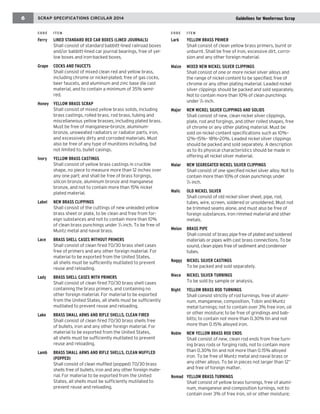
Ferry LINED STANDARD RED CAR BOXES (LINED JOURNALS) 
Shall consist of standard babbitt-lined railroad boxes 
and/or babbitt-lined car journal bearings, free of yel-low 
boxes and iron-backed boxes. 
Grape COCKS AND FAUCETS 
Shall consist of mixed clean red and yellow brass, 
including chrome or nickel-plated, free of gas cocks, 
beer faucets, and aluminum and zinc base die cast 
material, and to contain a minimum of 35% semi-red. 
Honey YELLOW BRASS SCRAP 
Shall consist of mixed yellow brass solids, including 
brass castings, rolled brass, rod brass, tubing and 
miscellaneous yellow brasses, including plated brass. 
Must be free of manganese-bronze, aluminum-bronze, 
unsweated radiators or radiator parts, iron, 
and excessively dirty and corroded materials. Must 
also be free of any type of munitions including, but 
not limited to, bullet casings. 
Ivory YELLOW BRASS CASTINGS 
Shall consist of yellow brass castings in crucible 
shape, no piece to measure more than 12 inches over 
any one part; and shall be free of brass forgings, 
silicon bronze, aluminum bronze and manganese 
bronze, and not to contain more than 15% nickel 
plated material. 
Label NEW BRASS CLIPPINGS 
Shall consist of the cuttings of new unleaded yellow 
brass sheet or plate, to be clean and free from for-eign 
substances and not to contain more than 10% 
of clean brass punchings under 1/4 inch. To be free of 
Muntz metal and naval brass. 
Lace BRASS SHELL CASES WITHOUT PRIMERS 
Shall consist of clean fired 70/30 brass shell cases 
free of primers and any other foreign material. For 
material to be exported from the United States, 
all shells must be sufficiently mutilated to prevent 
reuse and reloading. 
Lady BRASS SHELL CASES WITH PRIMERS 
Shall consist of clean fired 70/30 brass shell cases 
containing the brass primers, and containing no 
other foreign material. For material to be exported 
from the United States, all shells must be sufficiently 
mutilated to prevent reuse and reloading. 
Lake BRASS SMALL ARMS AND RIFLE SHELLS, CLEAN FIRED 
Shall consist of clean fired 70/30 brass shells free 
of bullets, iron and any other foreign material. For 
material to be exported from the United States, 
all shells must be sufficiently mutilated to prevent 
reuse and reloading. 
Lamb BRASS SMALL ARMS AND RIFLE SHELLS, CLEAN MUFFLED 
(POPPED) 
Shall consist of clean muffled (popped) 70/30 brass 
shells free of bullets, iron and any other foreign mate-rial. 
For material to be exported from the United 
States, all shells must be sufficiently mutilated to 
prevent reuse and reloading. 
Lark YELLOW BRASS PRIMER 
Shall consist of clean yellow brass primers, burnt or 
unburnt. Shall be free of iron, excessive dirt, corro-sion 
and any other foreign material. 
Maize MIXED NEW NICKEL SILVER CLIPPINGS 
Shall consist of one or more nickel silver alloys and 
the range of nickel content to be specified, free of 
chrome or any other plating material. Leaded nickel 
silver clippings should be packed and sold separately. 
Not to contain more than 10% of clean punchings 
under 1/4 inch. 
Major NEW NICKEL SILVER CLIPPINGS AND SOLIDS 
Shall consist of new, clean nickel silver clippings, 
plate, rod and forgings, and other rolled shapes, free 
of chrome or any other plating material. Must be 
sold on nickel content specifications such as 10%– 
12%–15%– 18%–20%. Leaded nickel silver clippings 
should be packed and sold separately. A description 
as to its physical characteristics should be made in 
offering all nickel silver material. 
Malar NEW SEGREGATED NICKEL SILVER CLIPPINGS 
Shall consist of one specified nickel silver alloy. Not to 
contain more than 10% of clean punchings under 
1/4 inch. 
Malic OLD NICKEL SILVER 
Shall consist of old nickel silver sheet, pipe, rod, 
tubes, wire, screen, soldered or unsoldered. Must not 
be trimmed seams alone, and must also be free of 
foreign substances, iron rimmed material and other 
metals. 
Melon BRASS PIPE 
Shall consist of brass pipe free of plated and soldered 
materials or pipes with cast brass connections. To be 
sound, clean pipes free of sediment and condenser 
tubes. 
Naggy NICKEL SILVER CASTINGS 
To be packed and sold separately. 
Niece NICKEL SILVER TURNINGS 
To be sold by sample or analysis. 
Night YELLOW BRASS ROD TURNINGS 
Shall consist strictly of rod turnings, free of alumi-num, 
manganese, composition, Tobin and Muntz 
metal turnings; not to contain over 3% free iron, oil 
or other moisture; to be free of grindings and bab-bitts; 
to contain not more than 0.30% tin and not 
more than 0.15% alloyed iron. 
Noble NEW YELLOW BRASS ROD ENDS 
Shall consist of new, clean rod ends from free turn-ing 
brass rods or forging rods, not to contain more 
than 0.30% tin and not more than 0.15% alloyed 
iron. To be free of Muntz metal and naval brass or 
any other alloys. To be in pieces not larger than 12” 
and free of foreign matter. 
Nomad YELLOW BRASS TURNINGS 
Shall consist of yellow brass turnings, free of alumi-num, 
manganese and composition turnings, not to 
contain over 3% of free iron, oil or other moisture; 
2014 Guidelines for Nonferrous Scrap 
CODE ITEM CODE ITEM
running chapter head INSTITUTE OF SCRAP RECYCLING INDUSTRIES, INC. 7 
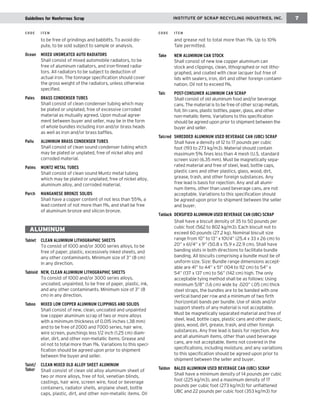
to be free of grindings and babbitts. To avoid dis-pute, 
to be sold subject to sample or analysis. 
Ocean MIXED UNSWEATED AUTO RADIATORS 
Shall consist of mixed automobile radiators, to be 
free of aluminum radiators, and iron-finned radia-tors. 
All radiators to be subject to deduction of 
actual iron. The tonnage specification should cover 
the gross weight of the radiators, unless otherwise 
specified. 
Pales BRASS CONDENSER TUBES 
Shall consist of clean condenser tubing which may 
be plated or unplated, free of excessive corroded 
material as mutually agreed. Upon mutual agree-ment 
between buyer and seller, may be in the form 
of whole bundles including iron and/or brass heads 
as well as iron and/or brass baffles. 
Pallu ALUMINUM BRASS CONDENSER TUBES 
Shall consist of clean sound condenser tubing which 
may be plated or unplated, free of nickel alloy and 
corroded material. 
Palms MUNTZ METAL TUBES 
Shall consist of clean sound Muntz metal tubing 
which may be plated or unplated, free of nickel alloy, 
aluminum alloy, and corroded material. 
Parch MANGANESE BRONZE SOLIDS 
Shall have a copper content of not less than 55%, a 
lead content of not more than 1%, and shall be free 
of aluminum bronze and silicon bronze. 
ALUMINUM 
Tablet CLEAN ALUMINUM LITHOGRAPHIC SHEETS 
To consist of 1000 and/or 3000 series alloys, to be 
free of paper, plastic, excessively inked sheets, and 
any other contaminants. Minimum size of 3” (8 cm) 
in any direction. 
Tabloid NEW, CLEAN ALUMINUM LITHOGRAPHIC SHEETS 
To consist of 1000 and/or 3000 series alloys, 
uncoated, unpainted, to be free of paper, plastic, ink, 
and any other contaminants. Minimum size of 3” (8 
cm) in any direction. 
Taboo MIXED LOW COPPER ALUMINUM CLIPPINGS AND SOLIDS 
Shall consist of new, clean, uncoated and unpainted 
low copper aluminum scrap of two or more alloys 
with a minimum thickness of 0.015 inches (.38 mm) 
and to be free of 2000 and 7000 series, hair wire, 
wire screen, punchings less 1/2 inch (1.25 cm) diam-eter, 
dirt, and other non-metallic items. Grease and 
oil not to total more than 1%. Variations to this speci-fication 
should be agreed upon prior to shipment 
between the buyer and seller. 
Taint/ CLEAN MIXED OLD ALLOY SHEET ALUMINUM 
Tabor Shall consist of clean old alloy aluminum sheet of 
two or more alloys, free of foil, venetian blinds, 
castings, hair wire, screen wire, food or beverage 
containers, radiator shells, airplane sheet, bottle 
caps, plastic, dirt, and other non-metallic items. Oil 
and grease not to total more than 1%. Up to 10% 
Tale permitted. 
Take NEW ALUMINUM CAN STOCK 
Shall consist of new low copper aluminum can 
stock and clippings, clean, lithographed or not litho-graphed, 
and coated with clear lacquer but free of 
lids with sealers, iron, dirt and other foreign contami-nation. 
Oil not to exceed 1%. 
Talc POST-CONSUMER ALUMINUM CAN SCRAP 
Shall consist of old aluminum food and/or beverage 
cans. The material is to be free of other scrap metals, 
foil, tin cans, plastic bottles, paper, glass, and other 
non-metallic items. Variations to this specification 
should be agreed upon prior to shipment between the 
buyer and seller. 
Talcred SHREDDED ALUMINUM USED BEVERAGE CAN (UBC) SCRAP 
Shall have a density of 12 to 17 pounds per cubic 
foot (193 to 273 kg/m3). Material should contain 
maximum 5% fines less than 4 mesh (U.S. standard 
screen size) (6.35 mm). Must be magnetically sepa-rated 
material and free of steel, lead, bottle caps, 
plastic cans and other plastics, glass, wood, dirt, 
grease, trash, and other foreign substances. Any 
free lead is basis for rejection. Any and all alumi-num 
items, other than used beverage cans, are not 
acceptable. Variations to this specification should 
be agreed upon prior to shipment between the seller 
and buyer. 
Taldack DENSIFIED ALUMINUM USED BEVERAGE CAN (UBC) SCRAP 
Shall have a biscuit density of 35 to 50 pounds per 
cubic foot (562 to 802 kg/m3). Each biscuit not to 
exceed 60 pounds (27.2 kg). Nominal biscuit size 
range from 10” to 13” x 101/4” (25.4 x 33 x 26 cm) to 
20” x 61/4” x 9” (50.8 x 15.9 x 22.9 cm). Shall have 
banding slots in both directions to facilitate bundle 
banding. All biscuits comprising a bundle must be of 
uniform size. Size: Bundle range dimensions accept-able 
are 41” to 44” x 51” (104 to 112 cm) to 54” x 
54” (137 x 137 cm) to 56” (142 cm) high. The only 
acceptable tying method shall be as follows: Using 
minimum 5/8” (1.6 cm) wide by .020” (.05 cm) thick 
steel straps, the bundles are to be banded with one 
vertical band per row and a minimum of two firth 
(horizontal) bands per bundle. Use of skids and/or 
support sheets of any material is not acceptable. 
Must be magnetically separated material and free of 
steel, lead, bottle caps, plastic cans and other plastic, 
glass, wood, dirt, grease, trash, and other foreign 
substances. Any free lead is basis for rejection. Any 
and all aluminum items, other than used beverage 
cans, are not acceptable. Items not covered in the 
specifications, including moisture, and any variations 
to this specification should be agreed upon prior to 
shipment between the seller and buyer. 
Taldon BALED ALUMINUM USED BEVERAGE CAN (UBC) SCRAP 
Shall have a minimum density of 14 pounds per cubic 
foot (225 kg/m3), and a maximum density of 17 
pounds per cubic foot (273 kg/m3) for unflattened 
UBC and 22 pounds per cubic foot (353 kg/m3) for 
Guidelines for Nonferrous Scrap CODE ITEM CODE ITEM
flattened UBC. Size: Minimum 30 cubic feet (.85 m3), with bale range dimensions of 24” to 40” (61 to 132 cm) by 30” to 52” (76 to 132 cm) by 40” to 84”(102 to 213 cm). The only acceptable tying method shall be as follows: four to six 5/8” (1.6 cm) x .020” (5 mm) steel bands, or six to ten #13 gauge steel wires (aluminum bands or wires are acceptable in equivalent strength and number). Use of skids and/ or support sheets of any material is not acceptable. Must be magnetically separated material and free of steel, lead, bottle caps, plastic cans and other plastic, glass, wood, dirt, grease, trash, and other foreign substances. Any free lead is basis for rejection. Any and all aluminum items, other than used beverage cans, are not acceptable. Variations to this specification should be agreed upon prior to shipment between the buyer and seller. 
Taldork BRIQUETUED ALUMINUM USED BEVERAGE CAN (UBC) SCRAP 
Shall have a briquette density of 50 pounds per cubic foot (800 kg/m3) minimum. Nominal briquette size shall range from 12” to 24” (30.5 x 61 cm) x 12” to 24” (30.5 x 61 cm) in uniform profile with a variable length of 8” (20.3 cm) minimum and 48” (122 cm) maximum. Briquettes shall be bundled or stacked on skids and secured with a minimum of one vertical band per row and a minimum of one girth band per horizontal layer. Briquettes not to overhang pallet. Total package height shall be 48 (122 cm) maximum. Banding shall be at least 5/8” (1.6 cm) wide by .020” (5 mm) thick steel strapping or equivalent strength. The weight of any bundle shall not exceed 4,000 pounds (1.814 mt). Material must be magnetically separated and free of steel, plastic, glass, dirt and all other foreign substances. Any and all aluminum items other than UBC are unacceptable. Any free lead is basis for rejection. Items not covered in the specification, including moisture, and any variations to this specification should be agreed upon prior to shipment between the buyer and seller. 
Tale PAINTED SIDING 
Shall consist of clean, low copper aluminum siding scrap, painted one or two sides, free of plastic coating, iron, dirt, corrosion, fiber, foam, or fiberglass backing or other non-metallic items. 
Talk ALUMINUM COPPER RADIATORS 
Shall consist of clean aluminum and copper radiators, and/or aluminum fins on copper tubing, free of brass tubing, iron and other foreign contamination. 
Tall E.C. ALUMINUM NODULES 
Shall consist of clean E.C. aluminum, chopped or shredded, free of screening, hair-wire, iron, copper, insulation and other non-metallic items. Must be free of minus 20 mesh material. Must contain 99.45% aluminum content. 
Tally ALL ALUMINUM RADIATORS FROM AUTOMOBILES 
Shall consist of clean aluminum radiators and/or condensers. Should be free of all other types of radiators. All contaminants including iron, plastic, and foam not to exceed 1% of weight. Any deviation to this specification, including oxidation and aluminum content, to be negotiated between buyer and seller. 
Talon NEW PURE ALUMINUM WIRE AND CABLE 
Shall consist of new, clean, unalloyed aluminum wire or cable free from hair wire, ACSR, wire screen, iron, insulation and other non-metallic items. 
Tann NEW MIXED ALUMINUM WIRE AND CABLE 
Shall consist of new, clean, unalloyed aluminum wire or cable which may contain up to 10% 6000 series wire and cable free from hair wire, wire screen, iron, insulation and other non-metallic items. 
Tarry A CLEAN ALUMINUM PISTONS 
Shall consist of clean aluminum pistons to be free from struts, bushings, shafts, iron rings and non- metallic items. Oil and grease not to exceed 2%. 
Tarry B CLEAN ALUMINUM PISTONS WITH STRUTS 
Shall consist of clean whole aluminum pistons with struts. Material is to be free from bushings, shafts, iron and non-metallic items . Oil and grease not to exceed 2%. 
Tarry C IRONY ALUMINUM PISTONS 
Shall consist of aluminum pistons with non-aluminum attachments to be sold on a recovery basis or by special arrangement between buyer and seller. 
Tassel OLD MIXED ALUMINUM WIRE AND CABLE 
Shall consist of old, unalloyed aluminum wire and cable which may contain up to 10% 6000 series wire and cable with not over 1% free oxide or dirt and free from hair wire, wire screen, iron, insulation and other non-metallic items. 
Taste OLD PURE ALUMINUM WIRE AND CABLE 
Shall consist of old, unalloyed aluminum wire and cable containing not over 1% free oxide or dirt and free from hair wire, wire screen, iron, insulation and other non-metallic items. 
Tata NEW PRODUCTION ALUMINUM EXTRUSIONS 
Shall consist of one alloy (typically 6063). Material may contain “butt ends” from the extrusion process but must be free of any foreign contamination. Anodized material is acceptable. Painted material or alloys other than 6063 must be agreed upon by buyer and seller. 
Toto ALUMINUM EXTRUSIONS “10/10” 
Material to consist of new production and old/used 6063 extrusions that may contain up to (but not exceed) 10 percent painted extrusions and 10 percent 6061 alloy extrusions. Must not contain other alloys of aluminum. Material should be free of zinc corners, iron attachments, felt, plastic, paper, cardboard, thermo break, and dirt and other contaminants. 
Tutu ALUMINUM EXTRUSION DEALER GRADE 
Shall consist of old extruded aluminum of one alloy, typically alloy 6063, 6061, or 7075. Material must be free of iron, thermo break, saw chips, zinc corners, dirt, paper, cardboard, and other foreign 
SCRAP SPECIFICATIONS CIRCULAR 2014 
8 
Guidelines for Nonferrous Scrap 
CODE ITEM 
CODE ITEM
contamination. Percentages of paint or other alloys to be agreed upon by buyer and seller. 
Teens SEGREGATED ALUMINUM BORINGS AND TURNINGS 
Shall consist of aluminum borings and turnings of one specified alloy. Material should be free of oxidation, dirt, free iron, stainless steel, magnesium, oil, flammable liquids, moisture and other non-metallic items. Fines should not exceed 3% through a 20 mesh (U.S. standard) screen. 
Telic MIXED ALUMINUM BORINGS AND TURNINGS 
Shall consist of clean, uncorroded aluminum borings and turnings of two or more alloys and subject to deductions for fines in excess of 3% through a 20 mesh screen and dirt, free iron, oil, moisture and all other non-metallic items. Material containing iron in excess of 10% and/or free magnesium or stainless steel or containing highly flammable cutting compounds will not constitute good delivery. To avoid dispute, material should be sold on basis of definite maximum zinc, tin and magnesium content. 
Tense MIXED ALUMINUM CASTINGS 
Shall consist of all clean aluminum castings which may contain auto and airplane castings but no ingots, and to be free of iron, brass, dirt and other non-metallic items. Oil and grease not to total more than 2%. 
Tepid AIRCRAFT SHEET ALUMINUM 
Should be sold on recovery basis or by special arrangements with purchaser. 
Terse NEW ALUMINUM FOIL 
Shall consist of clean, new, pure, uncoated 1000 and/or 3000 and/or 8000 series alloy aluminum foil, free from anodized foil, radar foil and chaff, paper, plastics, or any other non-metallic items. Hydraulically briquetted material and other alloys by agreement between buyer and seller. 
Tesla POST CONSUMER ALUMINUM FOIL 
Shall consist of baled old household aluminum foil and formed foil containers of uncoated 1000, 3000 and 8000 series aluminum alloy. Material may be anodized and contain a maximum of 5% organic residue. Material must be free from radar chaff foil, chemically etched foil, laminated foils, iron, paper, plastic and other non-metallic contaminants. 
Tetra NEW COATED ALUMINUM FOIL 
Shall consist of new aluminum foil coated or laminated with ink, lacquers, paper, or plastic. Material shall be clean, dry, free of loose plastic, PVC and other non-metallic items. This foil is sold on a metal content basis or by sample as agreed between buyer and seller. 
Thigh ALUMINUM GRINDINGS 
Should be sold on recovery basis or by special arrangements with purchaser. 
Thirl ALUMINUM DROSSES, SPATTERS, SPILLINGS, SKIMMINGS AND SWEEPINGS 
Should be sold on recovery basis or by special arrangements with purchaser. 
Thorn ALUMINUM BREAKAGE 
Shall consist of aluminum with miscellaneous contaminants like iron, dirt, plastic and other types of contaminants. Material can either be sold based on aluminum recovery or content as agreed upon by buyer and seller. Must contain a minimum of 33% aluminum unless otherwise agreed upon by buyer and seller. 
Throb SWEATED ALUMINUM 
Shall consist of aluminum scrap which has been sweated or melted into a form or shape such as an ingot, sow or slab for convenience in shipping; to be 
free from corrosion, dross or any non-aluminum inclusions. Should be sold subject to sample or analysis. 
Tooth SEGREGATED NEW ALUMINUM ALLOY CLIPPINGS AND SOLIDS 
Shall consist of new, clean, uncoated and unpainted aluminum scrap of one specified aluminum alloy with a minimum thickness of .015” (.38 mm) and to be free of hair wire, wire screen, dirt and other non- metallic items. Oil and grease not to total more than 1%. Also free from punchings less than 1/2” (1.27 cm) in size. 
Tough MIXED NEW ALUMINUM ALLOY CLIPPINGS AND SOLIDS 
Shall consist of new, clean, uncoated and unpainted aluminum scrap of two or more alloys with a minimum thickness of .015” (.38 mm) and to be free of hair wire, wire screen, dirt and other non-metallic items. Oil and grease not to total more than 1%. Also free from punchings less than 1/2” (1.27 cm) in size. 
Tread SEGREGATED NEW ALUMINUM CASTINGS, FORGINGS AND EXTRUSIONS 
Shall consist of new, clean, uncoated aluminum castings, forgings, and extrusions of one specified alloy only and to be free from sawings, stainless steel, zinc, iron, dirt, oil, grease and other non-metallic items. 
Troma Aluminum Auto or Truck Wheels 
Shall consist of clean, single-piece, unplated aluminum wheels of a single specified alloy, free of all inserts, steel, wheel weights, valve stems, tires, grease and oil and other non-metallic items. Variations to this specification should be agreed upon prior to shipment between the buyer and seller. 
Trump ALUMINUM AUTO CASTINGS 
Shall consist of all clean automobile aluminum castings of sufficient size to be readily identified and to be free from iron, dirt, brass, bushings, and non-metallic items. Oil and grease not to total more than 2%. 
Twang INSULATED ALUMINUM WIRE SCRAP 
Shall consist of aluminum wire scrap with various types of insulation. To be sold on a sample or recovery basis, subject to arrangement between buyer and seller. 
Twirl FRAGMENTIZER AIRCRAFT ALUMINUM SCRAP (2000 and 7000 series) 
The material as received must be dry and not to contain more than 2% free zinc, 1% maximum free magnesium, and 1.5% maximum free iron and stainless with a maximum of 2% analytical iron. Not to contain 
INSTITUTE OF SCRAP RECYCLING INDUSTRIES, INC. 
9 
Guidelines for Nonferrous Scrap 
CODE ITEM 
CODE ITEM
more than a total 5% maximum of non-metallics, of which no more than 1% shall be rubber and plastics. To be free of excessively oxidized material. Any variations to be sold by special arrangement between buyer and seller. 
Twist ALUMINUM AIRPLANE CASTINGS 
Shall consist of clean aluminum castings from airplanes and to be free from iron, dirt, brass, bushings, and non-metallic items. Oil and grease not to total more than 2%. 
Twitch FLOATED FRAGMENTIZER ALUMINUM SCRAP (from Automobile Shredders) 
Derived from wet or dry media separation device, the material must be dry and not contain more than 1% maximum free zinc, 1% maximum free magnesium, and 1% maximum of analytical iron. Not to contain more than a total 2% maximum of non-metallics, of which no more than 1% shall be rubber and plastics. To be free of excessively oxidized material, air bag canisters, or any sealed or pressurized items. Any variation to be sold by special arrangement between buyer and seller. 
Tweak FRAGMENTIZER ALUMINUM SCRAP (from Automobile Shredders) 
Derived from either mechanical or hand separation, the material must be dry and not contain more than 4% maximum free zinc, 1% maximum free magnesium, and 1.5% maximum of analytical iron. Not to contain more than a total 5% maximum of non- metallics, of which no more than 1% shall be rubber and plastics. To be free of excessively oxidized material, air bag canisters, or any sealed or pressurized items. Any variation to be sold by special arrangement between buyer and seller. 
Twire BURNT FRAGMENTIZER ALUMINUM SCRAP (from Automobile Shredders) 
Incinerated or burned material must be dry and not contain more than X% (% to be agreed upon by buyer and seller) ash from incineration, 4% maximum free zinc, 1% maximum free magnesium, and 1.5% maximum of analytical iron. Not to contain more than a total 5% maximum of non-metallics, of which no more than 1% shall be rubber and plastics. To be free of excessively oxidized material, air bag canisters, or any sealed pressurized items. Any variation to be sold by special arrangement between buyer and seller. 
Zorba SHREDDED NONFERROUS SCRAP (predominantly aluminum) 
Shall be made up of a combination of the nonferrous metals: aluminum, copper, lead, magnesium, stainless steel, nickel, tin, and zinc, in elemental or alloyed (solid) form. The percentage of each metal within the nonferrous concentrate shall be subject to agreement between buyer and seller. Material generated by eddy current, air separation, flotation, screening, other segregation technique(s), or a combination thereof. Shall have passed one or more magnets to reduce or eliminate free iron and/or large iron attachments. Shall be free of radioactive material, dross, or ash. Material to be bought/sold under this guideline shall be identified as “Zorba” with a number to follow indicating the estimated percentage nonferrous metal content of the material (e.g., “Zorba 90” means the material contains approximately 90% nonferrous metal content). May also be screened to permit description by specific size ranges. (Refer also to Zorba under Mixed Metals.) 
ZINC 
Saves OLD ZINC DIE CAST SCRAP 
Shall consist of miscellaneous old zinc base die castings, with or without iron and other foreign attachments. Must be free of borings, turnings, dross pieces, chunks, melted pieces and skimmings. All unmeltables, dirt, foreign attachments, and volatile substances (such as rubber, cork, plastic, grease, etc.) are deductible. Material containing in excess of 30% iron will not constitute good delivery. 
Scabs NEW ZINC DIE CAST SCRAP 
Shall consist of new or unused, clean, zinc base die castings. Castings to be unplated, unpainted, and free from corrosion. 
Scoot ZINC DIE CAST AUTOMOTIVE GRILLES 
Shall consist of clean, old or used zinc base die cast automotive grilles, free from soldered material. All foreign attachments and extraneous materials are deductible. 
Scope NEW PLATED ZINC DIE CAST SCRAP 
Shall consist of new or unused clean, plated zinc base die castings, free from corrosion. 
Score OLD SCRAP ZINC 
Shall consist of clean dry scrap zinc, such as sheets, jar lids, clean unalloyed castings and anti-corrosion plates. Borings and turnings are not acceptable. Material must not be excessively corroded or oxidized. All foreign attachments and extraneous materials are deductible. 
Screen NEW ZINC CLIPPINGS 
Shall consist of any new pure zinc sheets or stampings free from corrosion. To contain no foreign material or attachments. Printers zinc, such as engravers zinc, lithograph sheets and addressograph plates subject to special arrangements. Printers zinc to be free of routings. 
Scribe CRUSHED CLEAN SORTED FRAGMENTIZERS DIE CAST SCRAP, AS PRODUCED FROM AUTOMOBILE FRAGMENTIZERS 
To be clean, free of dirt, oil, glass, rubber, and trash. To contain a maximum of 5% unmeltables such as free iron, copper, aluminum and other metals. 
Scroll UNSORTED ZINC DIE CAST SCRAP 
Produced from automobile fragmentizers. Material to contain about 55% zinc-bearing scrap. Other nonferrous metals such as aluminum, stainless steel, red metal, etc., to be about 40%. Insulated copper wire about 1%. Trash, dirt, glass, rubber, oil, iron, not to exceed 5%. Any variations to be sold by special arrangement between buyer and seller. 
SCRAP SPECIFICATIONS CIRCULAR 2014 
10 
Guidelines for Nonferrous Scrap 
CODE ITEM 
CODE ITEM
Scrub HOT DIP GALVANIZERS SLAB ZINC DROSS (Batch Process) 
Shall consist only of galvanizers unsweated zinc dross in slab form from hot dip galvanizing (Batch Process) with a minimum zinc content of 92% and shall be free of skimmings and tramp iron. Broken pieces under 2” in diameter shall not exceed 10% of the weight of each shipment. Slabs shall not weigh over 100 pounds each. Heavier pieces acceptable upon mutual agreement between buyer and seller. Material from continuous galvanizing operation is not acceptable. Blocks are acceptable upon mutual agreement. 
Scull ZINC DIE CAST SLABS OR PIGS 
Shall consist of melted zinc base die cast materials, in smooth clean solid slabs or pigs. Material to be free from drosses and to contain a minimum zinc content of 90%. To contain a maximum of 0.1% nickel and maximum of 1% lead. Blocks are acceptable upon mutual agreement. 
Seal CONTINUOUS LINE GALVANIZING SLAB ZINC TOP DROSS 
Shall consist of unsweated zinc dross removed from the top of a continuous line galvanizing bath, in slab form not weighing in excess of 100 pounds each, with a minimum zinc content of 90%. Heavier pieces acceptable upon mutual agreement between buyer and seller. Shall be free of skimmings. Broken pieces under 2” in diameter shall not exceed 10% of the 
weight of each shipment. 
Seam CONTINUOUS LINE GALVANIZING SLAB ZINC BOTTOM DROSS 
Shall consist of unsweated zinc dross removed from the bottom of a continuous line galvanizing bath, in slab form not weighing in excess of 100 pounds each, with a minimum zinc content of 92%. Heavier pieces acceptable upon mutual agreement between buyer and seller. Shall be free of skimmings. Broken pieces under 2” in diameter shall not exceed 10% of the weight of each shipment. 
Shelf PRIME ZINC DIE CAST DROSS 
Shall consist of metal skimmed from the top of pot of molten zinc die cast metal. Must be unsweated, unfluxed, shiny, smooth, metallic and free from corrosion or oxidation. Should be poured in molds or in small mounds weighing not over 75 pounds each. 
Zinc content shall be minimum of 85%. 
MAGNESIUM 
Wafer MAGNESIUM CLIPS 
Shall consist of clean magnesium clips in crucible size, free of copper, aluminum, and zinc flashings and excessive oil and grease. To be free of all foreign attachments. 
Walnut MAGNESIUM SCRAP 
Shall consist of magnesium castings, magnesium engine blocks and transmission casings, bomber and car wheels, extrusions, and sheet. Material to be free from brass and copper inserts and all foreign attachments. To be free of anodes, hollow castings and explosives. Percentages of and penalties for dirt, oil, grease, and iron to be subject to agreement between buyer and seller. Excessively large pieces to be negotiated between buyer and seller. 
Wine MAGNESIUM ENGRAVER PLATES 
To be free of copper, aluminum, zinc, and electrotype plates. To be clean and free of all foreign attachments. Magnesium plates shipped loose by agreement between buyer and seller. 
Wood MAGNESIUM DOCKBOARDS 
Shall consist of clean magnesium dockboard cut or broken to size agreed upon by buyer and seller. To be free of all foreign attachments. 
World MAGNESIUM TURNINGS 
It is recommended that these materials be sold by 
special arrangement between buyer and seller. 
LEAD 
Racks SCRAP LEAD—SOFT 
Shall consist of clean soft scrap lead, free of other materials such as drosses, battery plates, lead covered cable, hard lead, collapsible tubes, foil, type metals, aluminum, zinc, iron and brass fittings, dirty chemical lead and radioactive materials. Review packaging specifications and regulatory status pertaining to shipping with buyer prior to sale. 
Radio MIXED HARD/SOFT SCRAP LEAD 
Shall consist of clean lead solids, free of other materials, such as drosses, battery plates, lead covered cable, collapsible tubes, type metals, aluminum, zinc, iron and brass fittings, dirty chemical lead and radioactive materials. Review packaging specifications and regulatory status pertaining to shipping with buyer prior to sale. 
Rails LEAD BATTERY PLATES 
Specify whether automotive, industrial or mixed. Also whether they are groups or loose. The only other metallic that might be included could be lead connectors. To be free of non-metallics, i.e., plastic or rubber, with the exception that separators may be included. Material to be dry. May be bought on an assay basis or a flat price. Submarine plates subject to negotiation. Review packaging specifications and regulatory status pertaining to shipping with buyer prior to sale. 
Rains SCRAP DRAINED/DRY WHOLE INTACT LEAD 
To be free of any liquid. Cases to be either plastic or rubber and be complete including caps. Non-lead (nicad, ni-fe, carbonaire, etc.) not acceptable. Industrial, steel cased, aircraft (aluminum cased) and partial, cracked or broken batteries and batteries without caps subject to special agreement. Review packaging specifications and regulatory status pertaining to shipping with buyer prior to sale. 
INSTITUTE OF SCRAP RECYCLING INDUSTRIES, INC. 
11 
Guidelines for Nonferrous Scrap 
CODE ITEM 
CODE ITEM
Rakes BATTERY LUGS 
To be free of scrap lead, wheel weights, battery plates, rubber and/or plastic case material and other foreign material. A minimum of 97% metallic content is required. Review packaging specifications and regulatory status pertaining to shipping with buyer prior to sale. 
Relay LEAD COVERED COPPER CABLE 
Free of armored covered cable, and foreign material. 
Rents LEAD DROSS 
Should be clean and reasonably free of other materials such as iron, dirt, harmful chemicals or other metals. To be free of radioactive materials, aluminum and zinc. May be bought on an assay basis or as agreed to by buyer and seller. Other metals present such as antimony, tin, etc., to be accounted for as agreed between buyer and seller. Material to be readily dumped from drums. An extra charge may be assessed if material has to be mechanically removed. Review packaging specification and regulatory status pertaining to shipping with buyer prior to sale. 
Rink SCRAP WET WHOLE INTACT LEAD BATTERIES 
Consisting of SLI (starting, lighting & ignition), automotive, truck, 8-D and commercial golf cart and marine-type batteries. Cases to be either plastic or rubber and to be complete. Non-lead (i.e., ni-cad, ni-fe, carbonaire, etc.) not acceptable. Other types i.e. aircraft (aluminum) gel-cel, lawnmower, etc., and partial, cracked or broken batteries or batteries without caps and the amount of liquid content and any variations to the specification subject to special agreement. Review packaging specifications and regulatory status pertaining to shipping with buyer prior to sale. 
Rono SCRAP INDUSTRIAL INTACT LEAD CELLS 
Consisting of plates enclosed by some form of complete plastic case. Partial, cracked or broken cells, cells without caps and the amount of liquid content and any variations to the specification subject to special agreement. Review packaging specifications and regulatory status pertaining to shipping with buyer prior to sale. 
Roper SCRAP WHOLE INTACT INDUSTRIAL LEAD BATTERIES 
Consisting of bus, diesel, locomotive, telephone and/ or steel cased batteries. Submarine batteries subject to negotiation. Partial, cracked, broken batteries or batteries without caps and the amount of liquid content and any variations to the specification subject to special agreement. Review packaging specifications and regulatory status pertaining to shipping with buyer prior to sale. 
Ropes WHEEL WEIGHTS 
To consist of lead tire balances with or without iron clips. Not to include scrap lead, lugs or plates unless specifically agreed to. To be free of foreign material. Review packaging specifications and regulatory status pertaining to shipping with buyer prior to sale. 
NICKEL/STAINLESS/HI TEMP 
Aroma NEW NICKEL SCRAP 
Shall consist of clean new sheet, plate, bar, tube, and any other wrought nickel scrap solids. Nickel minimum 99%; Cobalt maximum 0.25%; Copper maximum 0.50%. Free of castings, as well as any foreign attachments or other contamination. 
Burly OLD NICKEL SCRAP 
Shall consist of old and/or new sheet, plate, bar, tube, and any other wrought nickel scrap solids. Material to contain a minimum of 98% nickel; Copper maximum 0.50%. This grade to be free of castings, soldered, brazed, sweated, or painted material, other metallic coating, foreign attachments, or any other contamination. 
Dandy NEW CUPRO NICKEL CLIPS AND SOLIDS 
Shall consist of clean, new, segregated (normally accepted analysis grades) either 70/30, 80/20, or 90/10 cupro nickel tube, pipe, sheet, plate, or other wrought solid forms. Must be free of foreign attachments or any other contamination. 
Daunt CUPRO NICKEL SOLIDS 
Shall consist of old, and/or new, segregated (normally accepted analysis grades) either 70/30, 80/20, 90/10 cupro nickel tube, pipe, sheet, plate, or other wrought solid forms. Maximum 2% sediment allowable. Any other forms of cupro nickel solids such as castings, gates, risers, spills, etc., packaged separately, may or may not be included, only upon agreement between buyer and seller. Must be free of foreign attachments and all other contamination. Other particulars concerning physical description, analysis and packaging to be agreed upon between buyer and seller. 
Decoy CURPO NICKEL SPINNINGS, TURNINGS, BORINGS 
Shall consist of clean, segregated (normally accepted analysis grades) either 70/30, 80/20, 90/10 cupro nickel spinnings, turnings, or borings. Particulars concerning physical description, analysis, and packaging, to be agreed upon between buyer and seller. 
Delta SOLDERED CUPRO NICKEL SOLIDS 
Shall consist of segregated (normally accepted analysis grades) either 70/30, 80/20, 90/10 cupro nickel solids, soldered, brazed, or sweated material. Must be free of trimmed seams and edges and all other contamination. 
Depth MISCELLANEOUS NICKEL-COPPER AND NICKEL-COPPER IRON 
Shall consist of miscellaneous scrap in which the basic elements, by weight, are nickel and copper, such as copper nickel peelings, plating racks, and hangers, and all nickel and copper in attached or combined form. In all cases, miscellaneous nickel copper scrap should be sold by description and analysis. 
SCRAP SPECIFICATIONS CIRCULAR 2014 
12 
Guidelines for Nonferrous Scrap 
CODE ITEM 
CODE ITEM
Hitch NEW R-MONEL CLIPPINGS AND SOLIDS 
Shall consist of clean, new, R-Monel sheet, plate, bar, rod, tube, pipe, or any other wrought scrap. Must be free of any foreign attachments or all other contamination. 
House NEW MIXED MONEL SOLIDS AND CLIPPINGS 
Shall consist of new, clean R and K-Monel solids and clippings. Free of cast material, foreign attachments and all other contamination. 
Ideal OLD MONEL SHEET AND SOLIDS 
Shall consist of clean R and K-Monel solids such as sheet, plate, pipe, rods, forgings, screen and wire cloth. Must be free of soldered, brazed, welded, or sweated material, cast material, foreign attachments, and all other contamination. 
Indian K-MONEL SOLIDS 
Shall consist of clean K-Monel solids. 
Junto SOLDERED MONEL SHEET AND SOLIDS 
Shall consist of soldered and/or brazed miscellaneous grades of Monel alloys in either wrought or cast form. Must be free of trimmed seams and edges, non-metallic filling, foreign attachments, and all other contamination. Particulars concerning physical description, assay, and packaging to be agreed upon between buyer and seller. 
Lemon MONEL CASTINGS 
Shall consist of various types of clean Monel castings, assaying minimum 60% nickel. Must be free of foreign attachments or any other contamination. 
Lemur MONEL TURNINGS 
Shall consist of mixed Monel turnings and borings containing a minimum of 60% nickel content, on a dry basis. 
Pekoe 200 SERIES STAINLESS STEEL SCRAP SOLIDS 
Shall consist of all types of clean AISI Series Stainless Steel Scrap Solids, which contain a maximum of .5% copper, free of foreign attachments and other contamination. 
Sabot STAINLESS STEEL SCRAP 
Shall consist of clean 18-8 type stainless steel clips and solids containing a minimum 7% nickel, 16% chrome, and have a maximum of .50% molybdenum, .50% copper, .045% phosphorous, and .03% sulfur, and otherwise free of harmful contaminants. Particulars concerning physical description, grading, additional analysis, and preparation to be agreed upon between buyer and seller. 
Ultra STAINLESS STEEL TURNINGS 
Shall consist of clean 18-8 type stainless steel turnings containing a minimum 7% nickel and 16% chrome, and to be free of nonferrous metals, nonmetallics, excessive iron, oil and other contaminants. Particulars concerning physical description, assay, and packaging to be agreed upon between buyer and seller. 
INSTITUTE OF SCRAP RECYCLING INDUSTRIES, INC. 
13 
Guidelines for Nonferrous Scrap 
Vaunt EDISON BATTERIES 
Nickel-iron batteries to be sold free of crates, copper terminal connectors, and excess liquid. Must be free of nickel cadmium batteries. 
Zurik SHREDDED NONFERROUS SENSOR SORTED SCRAP (predominantly stainless steel) 
Shall be made up of a combination of the nonferrous metals: stainless steel, insulated copper wire, aluminum, copper, lead, magnesium, nickel, tin, and zinc, in elemental or alloyed (solid) form. The percentage of each metal within the nonferrous concentrate shall be subject to agreement between buyer and seller. Material generated by computer sensing equipment (e.g., induction sensor sorting or X-ray) technique(s). Shall have passed one or more magnets to reduce or eliminate free iron and/or large iron attachments. Shall be free of radioactive material, dross, or ash. Material to be bought/sold under this guideline shall be identified as “Zurik” with a number to follow indicating the estimated percentage nonferrous content of the material (e.g., “Zurik 90” means the material contains approximately 90% nonferrous metal content). May also be screened to permit description by specific size ranges. (Refer also to Zurik under Mixed Metals.) 
MIXED METALS 
Elmo MIXED ELECTRIC MOTORS 
Shall consist of whole electric motors and/or dismantled electric motor parts that are primarily copper- wound. May contain aluminum-wound material, subject to agreement between buyer and seller. No excessive steel attachments such as gear reducers, iron bases, and pumps, or loose free iron allowed. Specification not to include sealed units or cast iron compressors. 
Shelmo SHREDDED ELECTRIC MOTORS (also called “shredder pickings” or “meatballs”) 
Shall consist of mixed copper-bearing material from ferrous shredding, comprised of motors without cases. May contain aluminum-wound material and insulated copper harness wire, subject to agreement between buyer and seller. Trace percentages of other contaminants and fines may be present. No free iron or sealed units. 
Zebra (High Density) 
Shall consist of high-density nonferrous metals produced by media separation technology containing brass, copper, zinc, nonmagnetic stainless steel, and copper wire. Material to be dry and free from excess oxidation. The percentage and types of metals other than these, as well as the percentage and types of nonmetallic contamination, are to be agreed upon between the buyer and seller. 
Zeppelin (Light Density) 
Shall consist of light-density nonferrous metals produced by media separation technology and contain thin-gauge aluminum and magnesium. Material to 
CODE ITEM 
CODE ITEM
tops to be accounted for separately. Material must be free of brass, zinc, and other foreign metals. 
Raves HIGH TIN BASE BABBITT 
Shall contain a minimum of 78% tin and be free of brassy or zincy metals. 
Roses MIXED COMMON BABBITT 
Shall consist of lead base bearing metal containing not less than 8% tin, free from Allens metal, ornamental, antimonial and type metal. Must be free from all zinc and excessive copper in the alloy. 
Identification Checklist 
for Precious Metals 
This Identification Check List for Precious Metals sets up a general basis for identifying types and grades of precious metals scrap by the scrap processor who will be familiar both to the precious metals refiner and to the plants generating precious metals scrap. 
By checking this identification list, the scrap processor gives the refiner a fairly accurate conception of the material the processor has on hand and offers a basis for the refiner to quote an estimated price for the material. 
Due to the high values and the constantly changing character of precious metal scrap, it is often the practice in the industry to require a sample to be submitted before giving refining schedules. 
I. Scrap Sources 
REFINED SILVER METAL — 99.9 MIN. PERCENT 
Silver-bearing materials: 
Anodes 
Assemblies—Electrical 
Batteries 
Silver/Copper Plated 
Silver/Cadmium 
Silver/Zinc Silver/Magnesium 
Blanking Scrap—Punchings 
Brazing Alloys 
Brushes—Electric Motors 
Bullion 
Chemical Salts 
Clad Bi-Metal Parts 
Coin Silver 
Contacts 
Dental Amalgam 
Films 
Industrial X-Ray 
Medical X-Ray 
Lithographic 
Photographic Negatives 
Filters—Plating 
Flake—From Hypo Solution Recovery Systems 
Hooks—Plating—Nodules 
Jewelry Sweeps 
Paints—Paste 
Paper–Reproduction 
Plated Parts—Electrical—Electronic 
Plated Serving Pieces 
Plated Utensils 
SCRAP SPECIFICATIONS CIRCULAR 2014 
14 
Guidelines for Nonferrous Scrap 
be dry and free from excess oxidation. The percentage and types of metals other than aluminum and magnesium, as well as the percentage and types of nonmetallic contamination, are to be agreed upon between the buyer and seller. 
Zorba SHREDDED NONFERROUS SCRAP (predominantly aluminum) 
Shall be made up of a combination of the nonferrous metals: aluminum, copper, lead, magnesium, stainless steel, nickel, tin, and zinc, in elemental or alloyed (solid) form. The percentage of each metal within the nonferrous concentrate shall be subject to agreement between buyer and seller. Material generated by eddy current, air separation, flotation, screening, other segregation technique(s), or a combination thereof. Shall have passed one or more magnets to reduce or eliminate free iron and/or large iron attachments. Shall be free of radioactive material, dross, or ash. Material to be bought/sold under this guideline shall be identified as “Zorba” with a number to follow indicating the estimated percentage nonferrous metal content of the material (e.g., “Zorba 90” means the material contains approximately 90% nonferrous metal content). May also be screened to permit description by specific size ranges. (Refer also to Zorba under Aluminum.) 
Zurik SHREDDED NONFERROUS SENSOR SORTED SCRAP (predominantly stainless steel) 
Shall be made up of a combination of the nonferrous metals: stainless steel, insulated copper wire, aluminum, copper, lead, magnesium, nickel, tin, and zinc, in elemental or alloyed (solid) form. The percentage of each metal within the nonferrous concentrate shall be subject to agreement between buyer and seller. Material generated by computer sensing equipment (e.g., induction sensor sorting or X-ray) technique(s). Shall have passed one or more magnets to reduce or eliminate free iron and/or large iron attachments. Shall be free of radioactive material, dross, or ash. Material to be bought/sold under this guideline shall be identified as “Zurik” with a number to follow indicating the estimated percentage nonferrous content of the material (e.g., “Zurik 90” means the material contains approximately 90% nonferrous metal content). May also be screened to permit description by specific size ranges. (Refer also to Zurik under Nickel/Stainless/ Hi Temp.) 
OTHER 
Ranch BLOCK TIN 
Block tin must assay minimum of 98% tin, and to be free of liquids, solder, and brass connections, pewter, pumps, pot pieces, and dirt. 
Ranks PEWTER 
Shall consist of tableware and soda-fountain boxes but should contain a minimum of 84% tin. Siphon
INSTITUTE OF SCRAP RECYCLING INDUSTRIES, INC. 15 
Jewelry Scrap (Sweeps) 
Paste 
Plated Parts 
Powders 
Relays—Electrical 
Sludges 
Solutions 
Wire 
REFINED PLATINUM METAL—99.9 MIN. PERCENT 
REFINED PALLADIUM SPONGE—99.9 MIN. PERCENT 
Platinum-bearing materials: 
Catalysts 
Chemicals 
Clad Materials 
Contacts 
Dental Alloys 
Dental Scrap 
Dental Sweeps, Grindings 
Jewelry Scrap 
Jewelry Sweeps 
Laboratory Ware 
Magneto Points 
Powders and Paste 
Solutions—Plating 
Spark Plugs—Aircraft 
Thermocouple Wire 
Scrap containing combinations of precious metals 
(gold, silver, platinum and palladium): 
Assemblies—Components 
Bullion 
Carbon 
Catalysts 
Chemicals 
Chips 
Drillings 
Electronic Scrap 
High Temperature Resistant Alloys 
Paints 
Paste 
Powders 
Relays—Electrical 
Resins 
Ribbons 
Rings 
Salts 
Solutions 
Sweeps 
Telephone Switching Scrap 
Thick Film 
Wire 
II. SCRAP CATEGORIES 
A. Solution 
1. Acid 
2. Basic 
3. Matrix if known 
B. Resin 
C. Sludges 
D. Burnable Material 
Plated Wire 
Powders—Granulated 
Punchouts 
Relays—Electrical 
Resins 
Silver Lined Bearings—Diesel Locomotives and Aircraft 
Sludges—Plating and Precipitates 
Solutions—Plating 
Sterling Silver 
Tin Lead Alloys—Contaminated 
Turnings 
Wave Guides 
Wiping Rags 
REFINED GOLD METAL — 99.5 MIN. PERCENT 
REFINED GOLD SPONGE — 99.5 MIN. PERCENT 
Gold-bearing materials: 
Brazing Alloys 
Clad Metal Parts 
Contacts 
Dental Alloys 
Dental Scrap 
Dental Sweeps and Grindings 
Diodes 
Filled Scrap 
Filters–Plating 
Flakes 
Flashings 
Foil 
Hooks—Plating—Nodules 
Jewelry Scrap 
Jewelry Sweeps and 
Grindings 
Paints and Paste 
Peelings 
Placer Gold 
Plated Parts—Electrical 
Plated Wire 
Powders 
Printed Circuit Boards 
Printed Circuit Boards with Components 
Punchouts 
Resins—Plating 
Salts—Chemical 
Sludges—Plating 
Solutions 
Sponge 
Tin Lead Alloys— 
Contaminated 
Transistors 
Wiping Rags 
Wire 
REFINED PALLADIUM METAL—99.9 MIN. PERCENT 
REFINED PALLADIUM SPONGE—99.9 MIN. 
Palladium-bearing materials: 
Catalysts 
Chemical Salts 
Clad Materials 
Contact Points 
Dental Alloys 
Dental Scraps 
Dental Sweeps 
Guidelines for Nonferrous Scrap
SCRAP SPECIFICATIONS CIRCULAR 2014 
16 
Guidelines for Nonferrous Scrap 
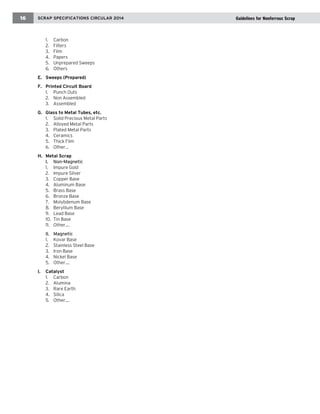
1. Carbon 
2. Filters 
3. Film 
4. Papers 
5. Unprepared Sweeps 
6. Others 
E. Sweeps (Prepared) 
F. Printed Circuit Board 
1. Punch Outs 
2. Non Assembled 
3. Assembled 
G. Glass to Metal Tubes, etc. 
1. 
Solid Precious Metal Parts 
2. Alloyed Metal Parts 
3. Plated Metal Parts 
4. Ceramics 
5. Thick Film 
6. Other... 
H. Metal Scrap 
I. Non-Magnetic 
1. Impure Gold 
2. Impure Silver 
3. Copper Base 
4. Aluminum Base 
5. Brass Base 
6. Bronze Base 
7. Molybdenum Base 
8. Beryllium Base 
9. Lead Base 
10. Tin Base 
11. Other.... 
II. Magnetic 
1. Kovar Base 
2. Stainless Steel Base 
3. Iron Base 
4. Nickel Base 
5. Other.... 
I. Catalyst 
1. Carbon 
2. Alumina 
3. Rare Earth 
4. Silica 
5. Other....
INSTITUTE OF SCRAP RECYCLING INDUSTRIES, INC. 
17 
Guidelines for Ferrous Scrap 
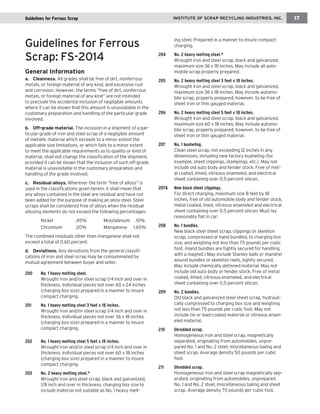
Guidelines for Ferrous Scrap: FS-2014 
General Information 
a. Cleanness. All grades shall be free of dirt, nonferrous metals, or foreign material of any kind, and excessive rust and corrosion. However, the terms “free of dirt, nonferrous metals, or foreign material of any kind” are not intended to preclude the accidental inclusion of negligible amounts where it can be shown that this amount is unavoidable in the customary preparation and handling of the particular grade involved. 
b. Off-grade material. The inclusion in a shipment of a particular grade of iron and steel scrap of a negligible amount of metallic material which exceeds to a minor extent the applicable size limitations, or which fails to a minor extent to meet the applicable requirements as to quality or kind of material, shall not change the classification of the shipment, provided it can be shown that the inclusion of such off-grade material is unavoidable in the customary preparation and handling of the grade involved. 
c. Residual alloys. Wherever the term “free of alloys” is used in the classifications given herein, it shall mean that any alloys contained in the steel are residual and have not been added for the purpose of making an alloy steel. Steel scraps shall be considered free of alloys when the residual alloying elements do not exceed the following percentages: 
Nickel .45% Molybdenum .10% 
Chromium .20% Manganese 1.65% 
The combined residuals other than manganese shall not exceed a total of 0.60 percent. 
d. Deviations. Any deviations from the general classifications of iron and steel scrap may be consummated by mutual agreement between buyer and seller. 
200 No. 1 heavy melting steel. 
Wrought iron and/or steel scrap 1/4 inch and over in thickness. Individual pieces not over 60 x 24 inches (charging box size) prepared in a manner to insure compact charging. 
201 No. 1 heavy melting steel 3 feet x 18 inches. 
Wrought iron and/or steel scrap 1/4 inch and over in thickness. Individual pieces not over 36 x 18 inches (charging box size) prepared in a manner to insure compact charging. 
202 No. 1 heavy melting steel 5 feet x 18 inches. 
Wrought iron and/or steel scrap 1/4 inch and over in thickness. Individual pieces not over 60 x 18 inches (charging box size) prepared in a manner to insure compact charging. 
203 No. 2 heavy melting steel.* 
Wrought iron and steel scrap, black and galvanized, 1/8 inch and over in thickness, charging box size to include material not suitable as No. 1 heavy melting steel. Prepared in a manner to insure compact charging. 
204 No. 2 heavy melting steel.* 
Wrought iron and steel scrap, black and galvanized, maximum size 36 x 18 inches. May include all automobile scrap properly prepared. 
205 No. 2 heavy melting steel 3 feet x 18 inches. 
Wrought iron and steel scrap, black and galvanized, maximum size 36 x 18 inches. May include automobile scrap, properly prepared; however, to be free of sheet iron or thin gauged material. 
206 No. 2 heavy melting steel 5 feet x 18 inches. 
Wrought iron and steel scrap, black and galvanized, maximum size 60 x 18 inches. May include automobile scrap, properly prepared; however, to be free of sheet iron or thin gauged material. 
207 No. 1 busheling. 
Clean steel scrap, not exceeding 12 inches in any dimensions, including new factory busheling (for example, sheet clippings, stampings, etc.). May not include old auto body and fender stock. Free of metal coated, limed, vitreous enameled, and electrical sheet containing over 0.5 percent silicon. 
207A New black sheet clippings. 
For direct charging, maximum size 8 feet by 18 inches, free of old automobile body and fender stock, metal coated, lined, vitreous enameled and electrical sheet containing over 0.5 percent silicon. Must lay reasonably flat in car. 
208 No. 1 bundles. 
New black steel sheet scrap, clippings or skeleton scrap, compressed or hand bundled, to charging box size, and weighing not less than 75 pounds per cubic foot. (Hand bundles are tightly secured for handling with a magnet.) May include Stanley balls or mandrel wound bundles or skeleton reels, tightly secured. May include chemically detinned material. May not include old auto body or fender stock. Free of metal coated, limed, vitreous enameled, and electrical sheet containing over 0.5 percent silicon. 
209 No. 2 bundles. 
Old black and galvanized steel sheet scrap, hydraulically compressed to charging box size and weighing not less than 75 pounds per cubic foot. May not include tin or lead-coated material or vitreous enameled material. 
210 Shredded scrap. 
Homogeneous iron and steel scrap, magnetically separated, originating from automobiles, unprepared No. 1 and No. 2 steel, miscellaneous baling and sheet scrap. Average density 50 pounds per cubic foot. 
211 Shredded scrap. 
Homogeneous iron and steel scrap magnetically separated, originating from automobiles, unprepared No. 1 and No. 2 steel, miscellaneous baling and sheet scrap. Average density 70 pounds per cubic foot.
212 Shredded clippings. 
Shredded 1000 series carbon steel clippings or sheets. Material should have an average density of 60 pounds per cubic foot. 
213 Steel can bundles. 
Steel can scrap compressed to charging box size and weighing not less than 75 pounds per cubic foot. Cans may be baled without removal of paper labels, but free of other non-metallics. May include up to 5 gallon tin coated containers. 
214 No. 3 bundles. 
Old sheet steel, compressed to charging box size and weighing not less than 75 pounds per cubic foot. May include all coated ferrous scrap not suitable for inclusion in No. 2 bundles. 
215 Incinerator bundles. 
Tin can scrap, compressed to charging box size and weighing not less than 75 pounds per cubic foot. Processed through a recognized garbage incinerator. 
216 Terne plate bundles. 
New terne plate sheet scrap, clippings or skeleton scrap, compressed or hand bundled, to charging box size, and weighing not less than 75 pounds per cubic foot. (Hand bundles are tightly secured for handling with a magnet.) May include Stanley balls or mandrel wound bundles or skeleton reels, tightly secured. 
217 Bundled No. 1 steel. 
Wrought iron and/or steel scrap 1/8 inch or over in thickness, compressed to charging box size and weighing not less than 75 pounds per cubic foot. Free of all metal-coated material. 
218 Bundled No. 2 steel. 
Wrought iron or steel scrap, black or galvanized, 1/8 inch and over in thickness, compressed to charging box size and weighing not less than 75 pounds per cubic foot. Auto body and fender stock, burnt or hand stripped, may constitute a maximum of 60 percent by weight. (This percent based on makeup of auto body, chassis, driveshafts, and bumpers.) Free of all coated material, except as found on automobiles. 
219 Machine shop turnings. 
Clean steel or wrought iron turnings, free of iron borings, nonferrous metals in a free state, scale, or excessive oil. May not include badly rusted or corroded stock. 
220 Machine shop turnings and iron borings. 
Same as machine shop turnings but including iron borings. 
221 Shoveling turnings. 
Clean short steel or wrought iron turnings, drillings, or screw cuttings. May include any such material whether resulting from crushing, raking, or other processes. Free of springy, bushy, tangled or matted material, lumps, iron borings, nonferrous metals in a free state, grindings, or excessive oil. 
222 Shoveling turnings and iron borings. 
Same as shoveling turnings, but including iron borings. 
223 Iron borings. 
Clean cast iron or malleable iron borings and drillings, free of steel turnings, scale, lumps or excessive oil. 
224 Auto slabs. 
Clean automobile slabs, cut 3 feet x 18 inches and under. 
225 Auto slabs. 
Clean automobile slabs, cut 2 feet x 18 inches and under. 
226 Briquetted iron borings. 
Analysis and density to consumer’s specifications. 
227 Briquetted steel turnings. 
Analysis and density to consumer’s specifications. 
228 Mill scale. 
Dark colored, ranging from blue to black, ferro- magnetic iron oxide forming on the surface of steel articles during heating and working. 
*The identical designations given for these two classifications are in accordance with established industry practices in specifying the materials desired. 
Electric Furnace Casting and Foundry Grades 
229 Billet, bloom and forge crops. 
Billet, bloom, axle, slab, heavy plate and heavy forge crops, containing not over 0.05 percent phosphorus or sulphur and not over 0.5 percent silicon, free from alloys. Dimensions not less than 2 inches in thickness, not over 18 inches in width, and not over 36 inches in length. 
230 Bar crops and plate scrap. 
Bar crops, plate scrap, forgings, bits, jars, and tool joints, containing not over 0.05 percent phosphorus or sulphur, not over 0.5 percent silicon, free from alloys. Dimensions not less than 1/2 inch in thickness, not over 18 inches in width, and not over 36 inches in length. 
231 Plate and structural steel, 5 feet and under. 
Cut structural and plate scrap, 5 feet and under. Clean open hearth steel plates, structural shapes, crop ends, shearings, or broken steel tires. Dimensions not less than 1/4 inch thickness, not over 5 feet in length and 18 inches in width. Phosphorus or sulphur not over 0.05 percent. 
232 Plate and structural steel, 5 feet and under. 
Cut structural and plate scrap, 5 feet and under. Clean open hearth steel plates, structural shapes, crop ends, shearings, or broken steel tires. Dimensions not less than 1/4 inch thickness, not over 5 feet in length and 24 inches in width. Phosphorus or sulphur not over 0.05 percent. 
233 Cast steel. 
Steel castings not over 48 inches long or 18 inches wide, and 1/4 inch and over in thickness, containing 
SCRAP SPECIFICATIONS CIRCULAR 2014 
18 
Guidelines for Ferrous Scrap 
CODE ITEM 
CODE ITEM
not over 0.05 percent phosphorus or sulphur, free from alloys and attachments. May include heads, gates, and risers. 
234 Punchings and plate scrap. 
Punchings or stampings, plate scrap, and bar crops containing not over 0.05 percent phosphorous or sulphur and not over 0.5 percent silicon, free from alloys. All materials cut 12 inches and under, and with the exception of punchings or stampings, at least 1/8 inch in thickness. Punchings or stampings under 6 inches in diameter may be any gauge. 
235 Electric furnace bundles. 
New black steel sheet scrap hydraulically compressed into bundles of size and weight as specified by consumer. 
236 Cut structural and plate scrap, 3 feet and under. 
Clean open hearth steel plates, structural shapes, crop ends, shearings, or broken steel tires. Dimensions not less than 1/4 inch in thickness, not over 3 feet in length and 18 inches in width. Phosphorus or sulphur not over 0.05 percent. 
237 Cut structural and plate scrap, 2 feet and under. 
Same as cut structural and plate scrap, 3 feet and under, except for length. 
238 Cut structural and plate scrap, 1 foot and under. 
Same as cut structural and plate scrap, 3 feet and under, except for length. 
239 Silicon busheling. 
Clean silicon bearing steel scrap, not exceeding 12 inches in any dimension, including new factory busheling (for example, sheet clippings, stampings, etc.), having a silicon content of 0.05 percent to 5.0 percent. 
240 Silicon Clippings. 
Clean steel scrap, including new factory busheling (for example, sheet clippings, stampings, etc.), may not include old auto body and fender stock. Free of metal coated, limed, vitreous enameled, and electrical sheet containing minimum 1 percent silicon. 
241 Chargeable ingots and ingot butts. 
Chargeable ingots and ingot butts for material to be suitable and acceptable to the consumer containing not over 0.05 percent phosphorus or sulphur and not over 0.05 percent silicon free of alloys. 
242 Foundry steel, 2 feet and under. 
Steel scrap 1/8 inch and over in thickness, not over 2 feet in length or 18 inches in width. Individual pieces free from attachments. May not include nonferrous metals, cast or malleable iron, cable, vitreous enameled, or metal coated material. 
243 Foundry steel, 1 foot and under. 
Same specifications as 2-foot material, except for length. 
243A Low residual, black foundry busheling. 
1000 series black carbon steel scrap, 1/8 inch and over in thickness, not more than 12 inch x 24 inch, manganese content not more than 0.50 percent. Other parameters subject to agreement between supplier and consumer. 
243B Low residual, ductile quality shredded clips. 
Shredded black 1000 series carbon steel scrap, 1/8 inch and over in thickness, minimum average density of 75 PCF, manganese content not more than 0.50 percent. Other parameters subject to agreement between supplier and consumer. 
244 Springs and crankshafts. 
Clean automotive springs and crankshafts, either new or used. 
245 Alloy free turnings. 
Clean shoveling steel turnings free from lumps, tangled or matted material, iron borings, or excessive oil containing not more than 0.05 percent phosphorus or sulphur, and free of alloys. 
246 Alloy free short shoveling steel turnings. 
Clean shoveling steel turnings, free of lumps, tangled or matted material, iron borings, or excessive oil, containing not more than 0.05 percent phosphorus or sulphur, and free of alloys. 
247 Alloy free machine shop turnings. 
Clean steel turnings, free of iron borings or excessive oil, containing not more than 0.05 percent phosphorus or sulphur, and free of alloys. May not include badly rusted or corroded stock. 
248 Hard steel cut 30 inches and under. 
Automotive steel consisting of rear ends, crankshafts, driveshafts, front axles, springs, and gears prepared 30 inches and under. May not include miscellaneous small shoveling steel or any pieces too bulky for gray iron foundry use. 
249 Chargeable slab crops. 
Chargeable slab crops for material to be suitable and acceptable to the consumer containing not over 0.05 percent phosphorus and 0.05 percent sulphur and not over 0.05 percent silicon and free of alloys. 
250 Silicon bundles. 
Silicon sheet scrap, clippings or skeleton scrap, compressed or hand bundled, to charging box size, and weighing not less than 75 pounds per cubic foot, having a silicon content of 0.50 percent to 5.0 percent. 
251 Heavy turnings. 
Short, heavy steel turnings, containing not over 0.05 percent phosphorus or sulphur and free of alloys. May include rail chips. May not include machine shop or other light turnings and must weigh not less than 75 pounds per cubic foot in the original state of production. 
INSTITUTE OF SCRAP RECYCLING INDUSTRIES, INC. 
19 
Guidelines for Ferrous Scrap 
CODE ITEM 
CODE ITEM
Specially Processed Grades to 
Meet Consumer Requirements 
Grades of scrap prepared especially to meet with steel mill or foundry requirements, individual specifications to be agreed on between consumer and supplier. 
Cast Iron Grades 
252 Cupola cast. 
Clean cast iron scrap such as columns, pipes, plates, and castings of a miscellaneous nature, including automobile blocks and cast iron parts of agricultural and other machinery. Free from stove plate, burnt iron, brake shoes or foreign material. Cupola size, not over 24 inches x 30 inches, and no piece over 150 pounds in weight. 
253 Charging box cast. 
Clean cast iron scrap in sizes not over 60 inches in length or 30 inches in width, suitable for charging into an open hearth furnace without further preparation. Free from burnt iron, brake shoes, or stove plate. 
254 Heavy breakable cast. 
Cast iron scrap over charging box size or weighing more than 500 pounds. May include cylinders and driving wheel centers. May include steel which does not exceed 10 percent of the casting by weight. 
255 Hammer block or bases. 
Cast iron hammer blocks or bases. 
256 Burnt iron. 
Burnt cast iron scrap, such as stove parts, grate bars, and miscellaneous burnt iron. May include sash weights or window weights. 
257 Mixed cast. 
May include all grades of cast iron except burnt iron. Dimensions not over 24 inches x 30 inches and no piece over 150 pounds in weight. 
258 Stove plate, clean cast iron stove. 
Free from malleable and steel parts, window weights, plow points, or burnt cast iron. 
259 Clean auto cast. 
Clean auto blocks; free of all steel parts except camshafts, valves, valve springs, and studs. Free of nonferrous and non-metallic parts. 
260 Unstripped motor blocks. 
Automobile or truck motors from which steel and nonferrous fittings may or may not have been removed. Free from driveshafts and all parts of frames. 
261 Drop broken machinery cast. 
Clean heavy cast iron machinery scrap that has been broken under a drop. All pieces must be of cupola size, not over 24 inches x 30 inches, and no piece over 150 pounds in weight. 
262 Clean auto cast, broken, not degreased. 
Clean auto blocks, free of all steel parts except camshafts, valves, valve springs and studs. Free of nonferrous and non-metallic parts, and must be broken to cupola size, 150 pounds or less. 
263 Clean auto cast, degreased. 
Free of all steel parts except camshafts, valves, valve springs, and studs. Free of nonferrous and non-metallic parts, and must be broken into cupola size, 150 pounds or less. 
264 Malleable. 
Malleable parts of automobiles, railroad cars, locomotives, or miscellaneous malleable iron castings. Free from cast iron and steel parts and other foreign material. 
265 Broken ingot molds and stools. 
Broken ingot molds and stools, cast iron, maximum size 2 feet x 3 feet x 5 feet. 
266 Unbroken ingot molds and stools. 
Unbroken ingot molds and stools, cast iron. 
Special Boring Grades 
267 No. 1 chemical borings. 
New clean cast or malleable iron borings and drillings containing not more than 1 percent oil, free from steel turnings, or chips, lumps, scale, corroded or rusty material. 
268 Briquetted cast iron borings, hot process. 
Cast iron borings, heated, briquetted, to a density of approximately 85 percent, oil and water content under 1 percent. 
269 Briquetted cast iron borings, cold process. 
Cast iron boring briquettes, free of steel and nonferrous material, hydraulically compressed into a cohesive solid, reasonably free of oil, and having a density of not less than 60 percent. 
270 Malleable borings. 
Clean malleable iron borings and drillings, free of steel turnings, scale, lumps and excessive oil. 
271 No. 2 chemical borings. 
New clean cast or malleable iron borings and drillings, containing not more than 1.5 percent oil, free from steel turnings, or chips, lumps, scale, corroded or rusty material. 
Steel From Scrap Tires 
General Guidelines 
Items not covered in the specifications, and any variations in the specification, are subject to special arrangement between buyer and seller. Percentages listed below are by weight. 
Preparation 
Consumer and supplier to agree upon preparation for transport, such as the following: 
Loose—Whole. 
Loose—Chopped. If wire is chopped or shredded, parties may wish to specify the means of processing and/or characteristics of the final product (density, length of pieces, etc.). 
SCRAP SPECIFICATIONS CIRCULAR 2014 
20 
Guidelines for Ferrous Scrap 
CODE ITEM 
CODE ITEM
Baled. Bales of wire should maintain their form during loading, shipment, unloading, storage, and handling typical of that done at a consuming facility, unless otherwise specified. 
Baled—High Density. Hydraulically compressed, no dimension larger than 24”, density of at least 75 pounds per square foot. 
Baled—HRB/Low Density. Density of less than 75 pounds per square foot. Each bale secured with sufficient number of bale ties drawn tight to insure a satisfactory delivery. 
Other Means of Preparation. Individual specifications to be agreed upon between consumer and supplier. 
272 Pulled bead wire (Truck)—Grade 1. 
Not chopped; made up of loops of wire. Less than five percent (<5%) rubber/fiber. 
273 Pulled bead wire (Truck)—Grade 2. 
Not chopped; made up of loops of wire. Five to ten percent (5-10%) rubber/fiber. 
274 Pulled bead wire (Truck)—Grade 3. 
Not chopped; made up of loops of wire. Greater than ten percent (>10%) rubber/fiber. 
275 Pulled bead wire (Passenger)—Grade 1. 
Not chopped; made up of loops of wire. Less than five percent (<5%) rubber/fiber. 
276 Pulled bead wire (Passenger)—Grade 2. 
Not chopped; made up of loops of wire. Five to ten percent (5-10%) rubber/fiber. 
277 Pulled bead wire (Passenger)—Grade 3. 
Not chopped; made up of loops of wire. Greater than ten percent (>10%) rubber/fiber. 
278 Processed tire wire (Ferrous)—Grade 1. 
Chopped. Less than two percent (<2%) rubber/fiber. 
279 Processed tire wire (Ferrous)—Grade 2. 
Chopped. Less than five percent (<5%) rubber/fiber. 
280 Processed tire wire (Ferrous)—Grade 3. 
Chopped. Five to ten percent (5-10%) rubber/fiber. 
281 Processed tire wire (Ferrous)—Grade 4. 
Chopped. Ten to twenty percent (10-20%) rubber/ fiber. 
282 Processed tire wire (Ferrous)—Grade 5. 
Chopped. Greater than twenty percent (>20%) rubber/ fiber. 
Railroad Ferrous Scrap* 
Specifications of Association of American Railroads promulgated by its Purchases and Materials Management Division (Revised 1973) 
(2) Axles, Steel. 
Solid car and/or locomotive friction bearing, 8 inch diameter and under (free of axles with key-way between wheel seats, no axles of shorter lengths than distance between wheel seats to be included). 
(2A) Axles, Steel. 
Solid car and/or locomotive friction bearing over 8 inch diameter (free of axles with key-way between wheel seats, no axles of shorter length than distance between wheel seats to be included). 
(3) Axles, Steel. 
Roller bearing 8 inch diameter and under (no axles of shorter lengths than distance between wheel seats to be included). 
(3A) Axles, Steel. 
Roller bearing over 8 inch diameter (no axles of shorter length than distance between wheel seats to be included). 
(4) Spikes, Track Bolts and Nuts, and Lock Washers, may include Rail Anchors. 
(5) Tie Plates. 
Steel. 
(6) Rail Joints, Angle and/or Splice Bars. 
Steel. 
(9) Bolsters and/or Truck Sides, Frames: Uncut. 
Cast steel. 
(11) Cast Steel, No. 2. 
Steel castings, over 18 inches wide and/or over 5 feet long. 
(11A) Cast Steel, No. 1. 
Steel castings, 18 inches and under, not over 5 feet long, including cut truck side frames and bolsters. 
(12) Cast Iron, No. 1. 
Cast iron scrap, such as columns, pipes, plates, and/ or castings of miscellaneous nature, but free from stove plates, brake shoes, and burnt scrap. Must be cupola size, not over 24 x 30 inches in dimension and no piece to weigh over 150 pounds. Must be free from foreign material. 
(13) Cast Iron, No. 2. 
Pieces weighing over 150 pounds, but not more than 500 pounds. Free from burnt cast. 
(14) Cast Iron, No. 3. 
Pieces weighing over 500 pounds; includes cylinders, driving wheel centers and/or all other castings. (Free from hammer blocks or bases.) 
(15) Cast Iron, No. 4. 
Burnt cast iron scrap, such as grate bars, stove parts and/or miscellaneous burnt scrap. 
(16) Cast Iron Brake Shoes. 
Brakes shoes of all types except composition-filled shoes. 
(17) Couplers and/or Knuckles. 
Railroad car and/or locomotive steel couplers, knuckles and/or locks stripped clean of all other attachments. 
(18) Frogs and/or Switches, uncut. 
Steel frogs and switches that have not been cut apart, exclusive of manganese. 
INSTITUTE OF SCRAP RECYCLING INDUSTRIES, INC. 
21 
Guidelines for Ferrous Scrap 
CODE ITEM 
CODE ITEM
(18A) Railbound Manganese Frogs and Switch Points with manganese inserts that have not been cut apart. 
(23) Malleable. 
Malleable parts of automobiles, railroad cars, locomotive and/or miscellaneous malleable castings. 
(24) Melting Steel, Railroad No. 1. 
Clean wrought iron or steel scrap, 1/4 inch and over in thickness, not over 18 inches in width, and not over 5 feet in length. May include pipe ends and material 1/8 inch to 1/4 inch in thickness, not over 15 inches x 15 inches. Individual pieces cut so as to lie reasonably flat in charging box. 
(27) Rail, Steel No. 1. 
Standard section tee rails, original weight 50 pounds per yard or heavier, 10 feet long and over. Suitable for rerolling into bars and shapes. Free from bent and twisted rails, frog, switch, and guard rails, or rails with split heads and broken flanges. Continuous welded rail may be included provided no weld is over 9 inches from the end of the piece of rail. 
(28A) Rail, Steel No. 2 Cropped Rail Ends. 
Standard section, original weight of 50 pounds per yard and over, 18 inches long and under. 
(28B) Rail, Steel No. 2 Cropped Rail Ends. 
Standard section, original weight of 50 pounds per yard and over, 2 feet long and under. 
(28C) Rail, Steel No. 2 Cropped Rail Ends. 
Standard section, original weight 50 pounds per yard and over, 3 feet long and under. 
(29) Rail, Steel No. 3. 
Standard section tee, girder, and/or guard rails, to be free from frog and switch rails not cut apart, and contain no manganese, cast, welds, or attachments of any kind except angle bars. Free from concrete, dirt, and foreign material of any kind. 
(30) Sheet Scrap, No. 1. 
Under 3/16 inch thick, may include hoops, band iron and/or steel, scoops and/or shovels (free of wood). Must be free from burnt or metal coated material, cushion, or other similar springs. 
(31) Sheet Scrap, No. 2. 
Galvanized or tinned material and/or gas retorts, and/or any other iron or steel material not otherwise classified. 
(32) Steel, Tool. 
(Specify kind in offering.) 
(33) Steel, Manganese. 
All kinds of manganese, rail, guard rails, frogs and/or switch points, cut or uncut. 
(34) Steel, Spring. 
Coil and/or elliptical, minimum thickness 1/4 inch, may be assembled or cut apart. 
(34A) Steel, Spring. 
Coil only. 
(35) Structural, Wrought Iron and/or Steel Uncut. 
All steel or steel mixed with iron from bridges, structures and/or equipment that has not been cut apart, may include uncut bolsters, brakebeams, steel trucks, underframes, channel bars, steel bridge plates, frog and/or crossing plates and/or other steel of similar character. 
(36) Tires. 
All locomotive, not cut to specified lengths. 
(38) Turnings. No. 1. 
Heavy turnings from wrought iron and/or steel railroad axles or heavy forgings and/or rail chips, to weigh not less than 75 pounds per cubic foot. Free from dirt or other foreign material of any kind. Alloy steel scrap may be excluded from these specifications by mutual agreement between buyer and seller. 
(38A) Turnings, Drillings and/or Borings. No. 2. 
Cast, wrought, steel and/or malleable iron borings, turnings and/or drillings mixed with other metals. 
(40) Wheels, No. 1. 
Cast iron car wheels. 
(42) Wheels, No. 3. 
Solid cast steel, forged, pressed and/or rolled steel car and/or locomotive wheels, not over 42 inches diameter. (Specify kind in offering.) 
(45) Destroyed Steel Cars. 
Bodies of steel cars cut apart sufficiently to load. (Specify kind.) 
(45A) Destroyed Steel Car Sides and Box Car Roofs. 
Cut to a maximum length of... and a maximum width of... suitable for use in super presses and shears without additional preparation. 
*Specifications in force as of publication date. 
SCRAP SPECIFICATIONS CIRCULAR 2014 
22 
Guidelines for Ferrous Scrap 
CODE ITEM 
CODE ITEM
Guidelines for Glass Scrap IINNSSTTIITTUUTTEE OOFF SSCCRRAAPP RREECCYYCCLLIINNGG IINNDDUUSSTTRRIIEESS,, IINNCC.. 23 
Guidelines for Glass 
Cullet: GC-2014 
Container Glass Cullet 
Specifications 
Preamble 
These standards and practices apply to container glass cul-let 
for purchase or sale in the United States and Canada. 
Transactions covering shipments to or from other countries 
may also be in accordance with these standards and prac-tices 
and may be modified by mutual agreement between 
buyer and seller. These specifications are guidelines for buy-ing 
and selling container glass cullet and always subject to 
the buyer and seller’s agreement. 
Scrap Glass Definitions 
Container Glass Cullet: crushed or whole scrap soda-lime-silica 
container glass. 
Unprocessed Container Glass Cullet: broken or whole scrap 
glass containers that comply with the proper ISRI glass specifi-cations. 
Processed (Furnace Ready) Container Glass Cullet: 
crushed and whole contaminate-free scrap container glass 
that complies with the proper ISRI glass specifications. 
Organic Matter: consists of organic materials that are non-container 
glass items; for example, paper labels should not 
exceed 0.2%. 
Ferrous Materials: are magnetic metals, i.e. steel, iron, etc., 
and therefore must be removed during scrap glass process-ing. 
Non-ferrous Materials: are non-magnetic metals, i.e. alu-minum, 
lead, copper, etc., and therefore must be removed 
during glass processing. 
The Purchase Agreement 
Each transaction covering the purchase or sale of container 
glass cullet should be confirmed in writing and include 
agreement on the following items: 
1. Product 
Where possible, each container glass cullet grade shall be 
specified in accordance with the grade as defined. 
2. Quantity 
Where possible, the quantity shall always be specified in 
terms of a definite number of tons of 2,000 pounds each. 
A. If the quantity is specified in tons, the order shall be con-sidered 
completed when aggregate shipments are 5% under 
or over the quantity ordered. 
B. If the quantity is specified in carloads or truckloads, a 
“load” shall be defined as a truck, trailer, or railroad car 
loaded to full visible capacity not to exceed established legal 
weight limits. 
3. Packaging 
It should be stated whether shipped units are to be in boxes, 
or in bulk by railroad car, truck, or trailer. Where possible, 
approximate weights should be specified. 
4. Price Units 
The price agreed upon shall be clearly stated in US dollars 
and cents per 2,000 pounds or in US dollars and cents per 
hundred weight. 
5. Terms 
Terms shall be “net cash 30 days after date of shipment” 
unless otherwise agreed upon. 
Arbitration 
In the event of a total disagreement between buyer and 
seller, the dispute should be submitted to ISRI arbitration. 
In all cases, the cost of arbitration shall be borne by the par-ty 
found to be at fault, or split in the event of compromise, 
as determined by the arbitrators. 
UNPROCESSED FLINT CONTAINER GLASS CULLET 
SPECIFICATIONS 
Composition: Soda-lime-silica beverage or food container 
glass. 
Cullet Colors Segregation: Flint Cullet 
Flint 95-100% 
Amber 0-5% 
Green 0-5% 
Other Colors 0-5% 
Size: Cullet may be broken but not pulverized. 
Moisture: Cullet should be free of excess moisture. 
Contaminant Listings: 
Outthrow Materials: Normal container labels; ring and metal 
closures where processing capabilities permit. 
Prohibitive Materials: Non-acceptable items include non-container 
glass (vision ware, light bulbs, crystal, windows, 
mirrors, drinking glasses, ceramic, milk glass, etc.) metals, 
ores, minerals, bricks, clay, grinding and refractory materi-als, 
rocks, clay and ceramic closures. 
General: The quality of the unprocessed flint container glass 
cullet must be such that after beneficiation with a conven-tional 
container glass cullet processor it will be suitable for 
the production of glass containers. 
UNPROCESSED AMBER CONTAINER GLASS CULLET 
SPECIFICATIONS 
Composition: Soda-lime-silica beverage or food container 
glass. 
Cullet Colors Segregation: Amber Cullet 
Amber 90-100% 
Flint 0-5% 
Green 0-5% 
Other Colors 0-5% 
Size: Cullet may be broken but not pulverized. 
Moisture: Cullet should be free of excess moisture. 
Contaminant Listings:
Outthrow Materials: Normal container labels; ring and metal closures where processing capabilities permit. 
Prohibitive Materials: Non-acceptable items include non- container glass (vision ware, light bulbs, crystal, windows, mirrors, drinking glasses, ceramic, milk glass, etc.) metals, ores, minerals, bricks, clay, grinding and refractory materials, rocks, clay and ceramic closures. 
General: The quality of the unprocessed amber container glass cullet must be such that after beneficiation with a conventional container glass cullet processor it will be suitable for the production of glass containers. 
UNPROCESSED GREEN CONTAINER GLASS CULLET SPECIFICATIONS 
Composition: soda-lime-silica beverage or food container glass. 
Cullet Colors Segregation: Green Cullet 
Green 90-100% 
Flint 0-10% 
Amber 0-10% 
Other Colors 0-5% 
Size: Cullet may be broken but not pulverized. 
Moisture: Cullet should be free of excess moisture. 
Contaminant Listings: 
Outthrow Materials: Normal container labels; ring and metal closures where processing capabilities permit. 
Prohibitive Materials: Non-acceptable items include non- container glass (vision ware, light bulbs, crystal, windows, mirrors, drinking glasses, ceramic, milk glass, etc:) metals, ores, minerals, bricks, clay, grinding and refractory materials, rocks, clay and ceramic closures. 
General: The quality of the unprocessed green container glass cullet must be such that after beneficiation with a conventional container glass cullet processor it will be suitable for the production of glass containers. 
PROCESSED (FURNACE READY) FLINT CONTAINER GLASS CULLET SPECIFICATIONS 
Composition: Soda-lime-silica container glass. 
Container Glass Cullet Colors Segregation: Flint Cullet 
Flint 95-100% 
Amber 0-5% 
Green 0-1% 
Other Colors 0-.5% 
Total NON-Flint Cullet = <5% 
Size: Various sizes from whole glass containers to -100 Mesh. However, the ideal material size is 3/8” to 3/4” with a 10% minimum of fine particles. Material size is based upon buyer and seller’s agreement. 
Contaminant Listings: 
Outthrow Materials: Organic Matter, allowable percentage based upon buyer and seller’s agreement. 
Prohibitive Materials: 
Ferrous Metals 
Nonferrous Metals 
Ceramics (such as cups, saucers, dinnerware, pottery, etc.) 
Other Glass (for example, plate window glass, heat- resistant glass—such as Pyrex—and lead-based glass— such as crystal ware, television tubes, vision ware, etc.) 
Other Materials (such as bricks, rocks, etc.) 
PROCESSED (FURNACE READY) AMBER CONTAINER GLASS CULLET SPECIFICATIONS 
Composition: Soda-lime-silica container glass 
Container Glass Cullet Colors Segregation: Amber Cullet 
Amber 90-100% 
Flint 0-10% 
Green 0-10% 
Other Colors 0-5% 
Total NON-Amber Cullet = <10% 
Size: Various sizes from whole glass containers to -100 Mesh. However, the ideal material size is 3/8” to 3/4” with a 10% minimum of fine particles. Material size is based upon buyer and seller’s agreement. 
Contaminant Listings: 
Outthrow Materials: Organic Matter, allowable percentage based upon buyer and seller’s agreement. 
Prohibitive Materials: 
Ferrous Metals 
Nonferrous Metals 
Ceramics (such as cups, saucers, dinnerware, pottery, etc.) 
Other Glass (for example, plate window glass, heat- resistant glass—such as Pyrex—and lead-based glass— such as crystal ware, television tubes, vision ware, etc.) 
Other Materials (such as bricks, rocks, etc.) 
PROCESSED (FURNACE READY) GREEN CONTAINER GLASS CULLET SPECIFICATIONS 
Composition: Soda-lime-silica container glass 
Container Glass Cullet Colors Segregation: Green Cullet 
Green 70-100% 
Flint 0-15% 
Amber 0-15% 
Other Colors 0-10% 
Total NON-Green Cullet = <30% 
The color green typically consists of a variety of shades, for example: emerald green or lime green. 
Size: Various sizes from whole glass containers to -100 Mesh. However, the ideal material size is 3/8” to 3/4” with a 10% minimum of fine particles. Material size is based upon buyer and seller’s agreement. 
Contaminant Listings: 
Outthrow Materials: Organic Matter, allowable percentage based upon buyer and seller’s agreement. 
Prohibitive Materials: 
Ferrous Metals 
Nonferrous Metals 
Ceramics (such as cups, saucers, dinnerware, pottery, etc.) 
SCRAP SPECIFICATIONS CIRCULAR 2014 
24 
Guidelines for Glass Cullet
IINNSSTTIITTUUTTEE OOFF SSCCRRAAPP RREECCYYCCLLIINNGG IINNDDUUSSTTRRIIEESS,, IINNCC.. 25 
Other Glass (for example, plate window glass, heat-resistant 
glass—such as Pyrex—and lead based glass— 
such as crystal ware, television tubes, vision ware, etc.) 
Other Materials (such as bricks, rocks, etc.) 
Guidelines for Glass Cullet
Guidelines for Paper Stock: PS-2014—Domestic 
Transactions 
Paper Stock: Domestic Transactions 
Preamble 
These standards and practices apply to paper stock for repulping only and are for use in the United States, Canada, and Mexico. Transactions may be modified by mutual agreement between Buyer and Seller. 
Basic to the Success of any Buyer-Seller 
Relationship is an Atmosphere of “Good Faith.” 
In keeping with this, the following principles have been established: 
1. Seller must use due diligence to ascertain that shipments consist of properly packed paper stock and that shipments are made during the period specified. 
2. Arbitrary deductions, cancellations and/or rejections by the Buyer are counter to acceptable good trade practices. 
3. Seller shall provide the quality of paper stock agreed upon but shall not be responsible for the use of the paper stock or of the manufactured product. 
I. The Purchase Agreement 
Each transaction covering the purchase or sale of paper stock shall be confirmed in writing and include agreement on the following items: 
1. Quantity 
Where possible, the quantity shall always be specified 
in terms of a definite number of short tons of 2,000 lbs. each or metric tonnes of 2,204.6 pounds each. 
a. When the quantity is specified in tons or tonnes, the order shall be considered completed when aggregate shipments are 5% under or over the quantity ordered. 
b. When the quantity is specified in carloads or truckloads, a “load” shall be defined as a truck, trailer, or railcar loaded in accordance with the ISRI/AF&PA Shipping Guide. 
c. The Buyer and Seller may establish minimum carload and/or truckload weights. 
2. Grades 
Where possible, each grade purchased shall be specified 
in accordance with the grade as defined in SECTION VI herein. 
3. Packing 
Unit type, i.e.: bales, skids, rolls, pallets, boxes, securely 
tied bundles or loose should be specified. 
4. Pricing and Terms 
The agreed price and payment terms shall be clearly 
stated. 
5. Shipping Terms 
Shipping terms shall be indicated with the use of phrases 
such as “f.o.b. shipping point” or “f.o.b. delivered.” 
6. Shipping Instructions 
Shipping instructions should clearly specify shipping 
schedule, route, carrier and destination. 
7. Shipping Period 
The shipping period shall be understood to be within the 
same calendar month of the date of the order unless otherwise specified. 
II. Fulfillment by the Seller 
The practice of the Seller shall be in accordance with the following: 
1. Acceptance 
All orders shall be confirmed in writing. 
2. Grading 
Paper stock sold under the grade names appearing in 
SECTION VI shall conform to those grading definitions. 
3. Baling 
Each bale must be secured with a sufficient number of bale ties drawn tight to ensure a satisfactory delivery. 
4. Tare 
If agreed to by the Buyer, sides and headers may be used to make a satisfactory delivery of the bales but must not be excessive. The weight of skids, Gaylord boxes and other similar materials shall be deducted from the gross invoice weight. 
5. Loading 
Paper stock shall be loaded as follows: 
a. Before they are loaded, railcars and trucks shall be free from objectionable materials and odors, and shall have sound floors and doors. 
b. All loads should consist entirely of one grade of paper stock unless otherwise agreed to. When two or more grades are included in the same load, units of each grade should be kept together in a separate part of the railcar or truck. 
c. Paper stock must be loaded in a manner that will minimize shifting and breakage. Excessive breakage due to improper loading can be cause for rejection. 
d. Paper stock shall be loaded in accordance with industry safety best practices. 
Please refer to the following guide for valuable safety information: http://www.isri.org/safeshipping 
6. Shipping Notice/Bill of Lading 
Shipping by Truck 
A bill of lading or shipping notice shall accompany each shipment to the Buyer and should include the following: 
a. Date of shipment 
b. Release number (if applicable) 
SCRAP SPECIFICATIONS CIRCULAR 2014 
26 
Paper Stock Domestic Transactions
c. Number of bales/rolls 
d. Grade of paper 
e. Name of trucking company, trailer number and driver’s signature 
f. Shipper’s signature 
Shipping by Rail 
When shipping by railcar, a bill of lading with shipping instructions shall be provided to the railroad and to the Buyer immediately upon release of the railcar and these documents should include the following: 
a. Date of shipment 
b. Release number (if applicable) 
c. Number of bales/rolls 
d. Grade of paper 
e. Car number 
f. Weighing instructions 
g. Routing 
h. Destination 
i. Shipper’s signature 
7. Invoicing 
Invoices, if required, should conform to instructions on the order and include the following data: 
a. Date of shipment 
b. Railcar or truck number 
c. Customer’s order number 
d. Release Number (if applicable) 
e. Shipper’s invoice number 
f. FOB point 
g. Number of units (bales, rolls, skids etc.) 
h. Weight and grade 
i. Price and extension 
j. Payment terms 
8. Rejection 
When notified of a rejection, the Seller must, within two business days, advise the Buyer as to which of the following procedures the Seller has decided upon: 
a. Agree with the Buyer to a compromise acceptance and settlement. 
b. Inspect the quality of the rejected material. The inspection and final disposition by the Seller shall take place within three business days of the notification. By mutual agreement, this time limit may be exceeded. 
c. Order reshipment of the material. 
d. Request that the Buyer agree to submit the rejected shipment to arbitration. 
Ill. Fulfillment by the Buyer 
The practice of the Buyer shall be in accordance with the following: 
Upon receipt of the shipment, the Buyer is to make all possible effort to inspect the contents while it is still loaded. 
a. Acceptable Loads (i.e. quality of paper stock, weight, bale integrity, moisture, order quantity, etc.) 
ä if the shipment appears to be in accordance with the order, the shipping notice and other parameters as established between the Buyer and the Seller, the Buyer shall proceed with the unloading and shall provide the Seller with the receiving weights within three business days of unloading. 
b. Unacceptable Loads (i.e. quality of paper stock, weight, bale integrity, moisture, order quantity, etc.) 
ä if the shipment does not appear to be in accordance with the order, the shipping notice or any other parameters as established between the Buyer and the Seller, the Buyer shall immediately notify the Seller. 
ä the Buyer shall set aside any portion of the shipment that is controversial and take reasonable care to protect that paper stock from any external deterioration or contamination until the final disposition of that shipment is determined. 
B 
uyer has 21 days to downgrade or reject 
ä if the Buyer, at any time with 21 calendar days after receipt of a shipment, finds objectionable materials heretofore not visible, the Buyer shall have the right to downgrade or reject the paper stock and shall immediately notify the Seller. The Seller will then determine the final disposition of the shipment. 
ä in the event of a rejection, the Buyer shall be responsible for any paper stock used by the Buyer, and the attendant freight, other than such quantity as may be considered reasonable for laboratory sampling or testing purposes. 
IV. Miscellaneous Practices 
1. Ownership 
a. When the shipment is purchased “f.o.b. shipping point” and is in accordance with the agreement covering the transaction, it becomes the property of the Buyer when loaded. 
b. When the shipment is purchased on a “delivered” basis and is in accordance with the agreement covering the transaction, it remains the property of the Seller until it is delivered to the Buyer. 
c. If the shipment is purchased on an “f.o.b. shipping point-specified freight allowed” basis and is in accordance with the agreement covering the transaction, it becomes the property of the Buyer when loaded on the transportation vehicle. 
2. Carrier Selection 
a. F.O.B. Shipping Point. Selection of the carrier is at the discretion of the Buyer unless otherwise agreed. 
b. F.O.B. Delivered. Selection of the carrier is at the discretion of the Seller unless otherwise agreed. 
INSTITUTE OF SCRAP RECYCLING INDUSTRIES, INC. 
27 
Paper Stock Domestic Transactions
c. Any excess freight charges accruing on a shipment due to the failure to the Seller to adhere to the purchase agreement is the liability of the Seller. 
d. Any excess freight charges accruing on a shipment due to the failure of the Buyer to adhere to the purchase agreement is the liability of the Buyer. 
3. Weight Discrepancies 
No adjustments shall be made on any shipment of paper 
stock when the weight variation is 1% or less. 
If the variation exceeds 1% the Seller may initiate a Weight Review by submitting a certified scale weight (showing the gross, tare and net of the load) and/or a loading tally showing individual bale weights. The Buyer shall then review the data and either: 
a. adjust the received weight, or 
b. decline the appeal, in which case the Buyer’s weight shall prevail. 
4. Moisture content 
All paper must be packed air dry. 
Where excess moisture is present in the shipment, the Buyer has the right to request an adjustment and if a settlement cannot be reached, the Buyer has the right to reject the shipment. 
V. Arbitration 
In the event of a dispute where agreement cannot be 
reached between Buyer and Seller, the dispute may be submitted to ISRI arbitration as long as one of the parties is a member of the association. Refer to ISRI Arbitration Services section of this document for further information. 
VI. Grade Definitions 
The definitions which follow describe grades as they should be sorted and packed. CONSIDERATION SHOULD BE GIVEN TO THE FACT THAT PAPER STOCK AS SUCH IS A SECONDARY MATERIAL PRODUCED MANUALLY AND MAY NOT BE TECHNICALLY PERFECT. Definitions may not specifically address all types of processes used in the manufacture or recycling of paper products. Specific requirements should be discussed between Buyer and Seller during negotiations. 
Outthrows 
The term “Outthrows” as used throughout this section is defined as “all papers that are so manufactured or treated or are in such a form as to be unsuitable for consumption as the grade specified.” 
Prohibitive Materials 
The term “Prohibitive Materials” as used throughout this section is defined as: 
a. Any materials which by their presence in a packing of paper stock, in excess of the amount allowed, will make the packaging unusable as the grade specified. 
b. Any materials that may be damaging to equipment. 
c. All sorted recovered paper stock must be free of food debris, medical or hazardous wastes and poisonous or 
other harmful substances or liquids. 
d. Wax is a Prohibitive unless accepted and pre-approved by the Buyer. 
A material can be classified as an “Outthrow” in one grade and as a “Prohibitive Material” in another grade. Carbon paper, for instance, is “UNSUITABLE” in Mixed Paper and is, therefore, classified as an “Outthrow;” whereas it is “UNUSABLE” in White Ledger and in this case is classified as a “Prohibitive Material.” 
Other Acceptable Papers 
The term “Other Acceptable Papers” as used throughout this section is defined as “all other papers that are deemed acceptable by the buyer and allowed in that buyer’s pack up to the percentage allowed.” 
Glossary of Terms 
A supplemental glossary of paper stock terms is located at the end of the Domestic Transactions section. The purpose of this limited list of terms is to help the user better understand specific grade definitions contained within this Circular. 
(1) Residential Mixed Paper 
Consists of a mixture of various qualities of paper not limited as to type of fiber content, normally generated from residential, multi-material collection programs. 
Prohibitive Materials may not exceed 2% 
Outthrows plus prohibitives may not exceed 5% 
(2) Soft Mixed Paper 
Consists of a clean, sorted mixture of various qualities of paper not limited as to type of fiber content. 
Prohibitive Materials may not exceed 1% 
Outthrows plus prohibitives may not exceed 5% 
(3) Hard Mixed Paper (HMP) 
Consists of a clean, sorted mixture of various qualities of paper containing less than 10% groundwood content. 
Prohibitive Materials may not exceed 1/2 of 1% 
Outthrows plus prohibitives may not exceed 3% 
(4) Boxboard Cuttings 
Consists of new cuttings of paperboard used in the manufacture of folding cartons, set-up boxes and similar boxboard products. 
Prohibitive Materials may not exceed 1/2 of 1% 
Outthrows plus prohibitives may not exceed 2% 
(5) Mill Wrappers 
Consists of paper used as outside wrap for rolls, bundles, or skids of finished paper. 
Prohibitive Materials may not exceed 1/2 of 1% 
Outthrows plus prohibitives may not exceed 3% 
(6) Old Newspaper 
Consists of sorted newspapers and other acceptable papers as typically generated by voluntary collection and curbside collection programs. 
Prohibitive Materials may not exceed 2% 
Outthrows plus prohibitives may not exceed 4% 
Other acceptable papers may not exceed 30% 
SCRAP SPECIFICATIONS CIRCULAR 2014 
28 
Paper Stock Domestic Transactions
(7) Regular News, De-ink Quality (#7 ONP) 
Consists of sorted, fresh newspapers, not sunburned, and other acceptable papers. This grade may contain magazines. 
Prohibitive Materials may not exceed 1% 
Outthrows plus prohibitives may not exceed 3% 
Other acceptable papers may not exceed 20% 
(8) Special News, De-ink Quality (#8 ONP) 
Consists of sorted, fresh newspapers, not sunburned, and other acceptable papers. This grade is to be relatively free from magazines and contain not more than the normal percentage of rotogravure and colored sections. 
Prohibitive Materials may not exceed 1% 
Outthrows plus prohibitives may not exceed 2% 
Other acceptable papers may not exceed 10% 
(9) Over-Issue News (OI or OIN) 
Consists of unused, overrun newspapers printed on newsprint, containing not more than the normal percentage of rotogravure and colored sections. 
Prohibitive Materials None permitted 
Outthrows plus prohibitives None permitted 
(10) Magazines (OMG) 
Consists of coated magazines, catalogues, and similar printed materials. May contain a small percentage of uncoated news-type paper. 
Prohibitive Materials may not exceed 1% 
Outthrows plus prohibitives may not exceed 3% 
(11) Old Corrugated Containers (OCC) 
Consists of corrugated containers having liners of either test liner or kraft. 
Prohibitive Materials may not exceed 1% 
Outthrows plus prohibitives may not exceed 5% 
(12) Double-Sorted Old Corrugated (DS OCC) 
Consists of double-sorted corrugated containers, generated from supermarkets and/or industrial or commercial facilities, having liners of test liner or kraft. Material has been specially sorted to be free of boxboard, off-shore corrugated, plastic, and wax. 
Prohibitive Materials may not exceed 1/2 of 1% 
Outthrows plus prohibitives may not exceed 2% 
(13) New Double-Lined Kraft Corrugated Cuttings (DLK) 
Consists of new corrugated cuttings having liners of either test liner or kraft. Treated medium or liners, insoluble adhesives, butt rolls, slabbed or hogged medium, are not acceptable in this grade. 
Prohibitive Materials None permitted 
Outthrows plus prohibitives may not exceed 2% 
(14) Fiber Cores 
Consists of paper cores made from either recycled paperboard and/or linerboard, single or multiple plies. Metal or plastic end caps, wood plugs, and textile residues are not acceptable in this grade. 
Prohibitive Materials may not exceed 1% 
Outthrows plus prohibitives may not exceed 5% 
(15) Used Brown Kraft 
Consists of brown kraft bags free of objectionable liners and original contents. 
Prohibitive Materials None permitted 
Outthrows plus prohibitives may not exceed 1/2 of 1% 
(16) Mixed Kraft Cuttings 
Consists of new brown kraft cuttings, sheets and bag scrap free of stitched paper. 
Prohibitive Materials None permitted 
Outthrows plus prohibitives may not exceed .1% 
(17) Carrier Stock 
Consists of printed or unprinted, unbleached new beverage carrier sheets and cuttings. May contain wet strength additives. 
Prohibitive Materials None permitted 
Outthrows plus prohibitives may not exceed 1% 
(18) New Colored Kraft 
Consists of new colored kraft cuttings, sheets and bag scrap, free of stitched papers. 
Prohibitive Materials None permitted 
Outthrows plus prohibitives may not exceed 1% 
(19) Kraft Grocery Bag (KGB) 
Consists of new brown kraft bag cuttings, sheets and misprint bags. 
Prohibitive Materials None permitted 
Outthrows plus prohibitives may not exceed 1% 
(20) New Kraft Multi-Wall Bag 
Consists of new brown kraft multi-wall bag cuttings, sheets, and misprint bags, free of stitched papers. 
Prohibitive Materials None permitted 
Outthrows plus prohibitives may not exceed 1% 
(21) New Brown Kraft Envelope Cuttings 
Consists of new unprinted brown kraft envelopes, cuttings or sheets. 
Prohibitive Materials None permitted 
Outthrows plus prohibitives may not exceed 1% 
(22) Mixed Flyleaf Shavings 
Consists of trim of magazines, catalogs, inserts and similar printed matter, not limited with respect to groundwood, uncoated or coated stock, and may contain the bleed of cover and insert stock as well as beater-dyed paper and solid color printing. 
Prohibitive Materials None permitted 
Outthrows plus prohibitives may not exceed 2% 
(23) Telephone Directories 
Consists of clean telephone directories printed for or by telephone directory publishers. 
Prohibitive Materials None permitted 
Outthrows plus prohibitives may not exceed 1/2 of 1% 
(24) White Blank News (WBN) 
Consists of unprinted cuttings and sheets of white newsprint or other uncoated white groundwood paper of similar quality. 
Prohibitive Materials None permitted 
Outthrows plus prohibitives may not exceed 1% 
(25) Groundwood Computer Printout (GW CPO) 
Consists of groundwood papers which are used in forms manufactured for use in data processing machines. This grade may contain colored stripes and impact or nonimpact (e.g., laser) computer printing. 
Prohibitive Materials None permitted 
Outthrows plus prohibitives may not exceed 2% 
INSTITUTE OF SCRAP RECYCLING INDUSTRIES, INC. 
29 
Paper Stock Domestic Transactions
(26) Publication Blanks (CPB) 
Consists of unprinted cuttings or sheets of white coated or filled groundwood content paper. 
Prohibitive Materials None permitted 
Outthrows plus prohibitives may not exceed 1% 
(27) Coated Flyleaf Shavings 
Consists of lightly printed trim from magazines, catalogs and similar printed matter, not limited with respect to groundwood, uncoated or coated stock. The bleed of cover, insert card stock, and beater-dyed paper may not exceed 2%. 
Prohibitive Materials None permitted 
Outthrows plus prohibitives may not exceed 1% 
(28) Coated Soft White Shavings (SWS) 
Consists of unprinted, coated, and uncoated shavings and sheets of white groundwood-free printing paper. May contain a small percentage of groundwood. 
Prohibitive Materials None permitted 
Outthrows plus prohibitives may not exceed 1% 
(29) (Grade not currently in use) 
(30) Hard White Shavings (HWS) 
Consists of shavings or sheets of unprinted, untreated white groundwood-free paper. 
Prohibitive Materials None permitted 
Outthrows plus prohibitives may not exceed 1/2 of 1% 
(31) Hard White Envelope Cuttings (HWEC) 
Consists of groundwood-free cuttings, shavings, or sheets of unprinted, untreated, and uncoated white envelope paper. 
Prohibitive Materials None permitted 
Outthrows plus prohibitives may not exceed 1/2 of 1% 
(32) (Grade not currently in use) 
(33) New Colored Envelope Cuttings 
Consists of groundwood-free cuttings, shavings, or sheets of untreated, uncoated bleachable colored envelope paper. 
Prohibitive Materials None permitted 
Outthrows plus prohibitives may not exceed 2% 
(34) (Grade not currently in use) 
(35) Semi Bleached Cuttings 
Consists of sheets and cuttings of unprinted, untreated, groundwood-free paper such as file folder stock, untreated milk carton stock, or manila tag. 
Prohibitive Materials None permitted 
Outthrows plus prohibitives may not exceed 2% 
(36) Unsorted Office Paper (UOP) 
Consists of printed or unprinted paper typically generated in an office environment that may include a document destruction process. This grade may contain white, colored, coated and uncoated papers, manila and pastel colored file folders. 
Prohibitive Materials may not exceed 2% 
Outthrows plus prohibitives may not exceed 10% 
(37) Sorted Office Paper (SOP) 
Consists of paper, as typically generated by offices, containing primarily white and colored groundwood-free paper, free of unbleached fiber. May include a small percentage of groundwood computer printout and facsimile paper. 
Prohibitive Materials may not exceed 1% 
Outthrows plus prohibitives may not exceed 5% 
(38) (Grade not currently in use) 
(39) Manifold Colored Ledger (MCL) 
Consists of sheets, shavings, and cuttings of industrially- 
generated printed or unprinted colored or white groundwood- free paper. All stock must be uncoated and free of nonimpact printing. A percentage of carbonless paper is allowable. 
Prohibitive Materials may not exceed 1/2 of 1% 
Outthrows plus prohibitives may not exceed 2% 
(40) Sorted White Ledger (SWL) 
Consists of uncoated, printed or unprinted sheets, shavings, guillotined books, and cuttings of white groundwood-free ledger, bond, writing, and other paper which has similar fiber and filler content. 
Prohibitive Materials may not exceed 1/2 of 1% 
Outthrows plus prohibitives may not exceed 2% 
(41) Manifold White Ledger (MWL) 
Consists of sheets, shavings, and cuttings of industrially- 
generated printed or unprinted white groundwood-free paper. All stock must be uncoated. 
Prohibitive Materials may not exceed 1/2 of 1% 
Outthrows plus prohibitives may not exceed 2% 
(42) (Grade no longer in use) 
(43) Coated Book Stock (CBS) 
Consists of coated groundwood-free paper, printed or unprinted in sheets, shavings, guillotined books and cuttings. A reasonable percentage of paper containing fine groundwood may be included. 
Prohibitive Materials None permitted 
Outthrows plus prohibitives may not exceed 2% 
(44) Coated Groundwood Sections (CGS) 
Consists of printed, coated groundwood paper in sheets, sections, shavings or guillotined books. This grade may not include news quality groundwood paper. 
Prohibitive Materials None permitted 
Outthrows plus prohibitives may not exceed 2% 
(45) Lightly Printed Bleached Board Cuttings 
Consists of groundwood-free printed bleached board cuttings, free from misprint sheets, cartons, wax, greaseproof lamination, metallic, and inks, adhesives or coatings that are insoluble. 
Prohibitive Materials may not exceed 1/2 of 1% 
Outthrows plus prohibitives may not exceed 2% 
(46) Printed Bleached Board 
Consists of groundwood-free misprint sheets, cartons and cuttings of bleached board, free from wax, greaseproof lamination, metallic, and inks, adhesives or coatings that are insoluble. 
Prohibitive Materials may not exceed 1% 
Outthrows plus prohibitives may not exceed 2% 
(47) Unprinted Bleached Board 
Consists of groundwood-free unprinted, untreated bleached board cuttings, sheets or rolls, free from wax, greaseproof lamination and adhesives or coatings that are insoluble. 
Prohibitive Materials None permitted 
Outthrows plus prohibitives may not exceed 1% 
SCRAP SPECIFICATIONS CIRCULAR 2014 
30 
Paper Stock Domestic Transactions
(48) #1 Bleached Cup Stock (#1 Cup) 
Consists of untreated cuttings or sheets of coated or uncoated cup base stock. Cuttings with slight bleed may be included. Must be free of wax, poly, and other coatings that are insoluble. 
Prohibitive Materials None permitted 
Outthrows plus prohibitives may not exceed 1/2 of 1% 
(49) #2 Printed Bleached Cup Stock (#2 Cup) 
Consists of printed, untreated formed cups, cup die cuts, and misprint sheets of coated or uncoated cup base stock. Glues must be water soluble. Must be free of wax, poly, and other coatings that are insoluble. 
Prohibitive Materials None permitted 
Outthrows plus prohibitives may not exceed 1% 
(50) Unprinted Bleached Plate Stock 
Consists of groundwood-free bleached coated or uncoated, untreated and unprinted plate cuttings and sheets. 
Prohibitive Materials None permitted 
Outthrows plus prohibitives may not exceed 1/2 of 1% 
(51) Printed Bleached Plate Stock 
Consists of groundwood-free bleached coated or uncoated, untreated printed plates and sheets. Must be free of coatings or inks that are insoluble. 
Prohibitive Materials None permitted 
Outthrows plus prohibitives may not exceed 1% 
(52) Aseptic Packaging and Gable-Top Cartons 
Consists of liquid packaging board containers including empty, used, polyethylene (PE)-coated, printed one-side aseptic and gable-top cartons containing no less than 70% bleached chemical fiber and may contain up to 6% aluminum foil and 24% PE film. 
Prohibitive Materials may not exceed 2% 
Outthrows plus prohibitives may not exceed 5% 
Specialty Grades 
The grades listed below are produced and traded in carload and truckload quantities throughout the United States, and because of certain characteristics (i.e., the presence of wet strength, polycoatings, plastic, foil, carbon paper, hot melt glue), are not included in the regular grades of paper stock. However, it is recognized that many mills have special equipment and are able to utilize large quantities of these grades. Since many paper mills around the world do use these specialty grades, they are being listed with appropriate grade numbers for easy reference. 
The Paper Stock Industries Chapter of ISRI is not establishing specific specifications, which would refer to such factors as the type of wet strength agent used, the percentage of wax, the amount of polycoating, whether it is on top of or under the printing, etc. The specification for each grade should be determined between Buyer and Seller, and it is recommended that purchase be made based on sample. 
These specialty grades are as follows: 
1—S White Waxed Cup Cuttings 
2—S Printed Waxed Cup Cuttings 
3—S Poly Coated Cup Stock 
4—S Polycoated Bleached Kraft—Unprinted 
5—S Polycoated Bleached Kraft—Printed 
6—S Polycoated Milk Carton Stock 
7—S Polycoated Diaper Stock 
8—S Polycoated Boxboard Cuttings 
9—S (This Grade No Longer in Use) 
10—S Printed and/or Unprinted Bleached 
Sulphate Containing Foil 
11—S Waxed Corrugated Cuttings 
12—S Wet Strength Corrugated Cuttings 
13—S (This Number Not Currently in Use) 
14—S Beer Carton Scrap 
15—S Contaminated Bag Scrap 
16—S Insoluble Glued Free Sheet Paper and/or Board (IGS) 
17—S White Wet Strength Scrap 
18—S Brown Wet Strength Scrap 
19—S Printed and/or Colored Wet Strength Scrap 
20—S File Stock 
21—S (This Number Not Currently in Use) 
22—S Ruled White 
23—S Flyleaf Shavings Containing Hot Melt Glue 
24—S (This Number Not Currently in Use) 
25—S Books with Covers 
26—S (This Number Not Currently in Use) 
27—S (This Number Not Currently in Use) 
28—S (This Number Not Currently in Use) 
29—S (This Number Not Currently in Use) 
30—S Plastic Windowed Envelopes 
31—S Textile Boxes 
32—S Printed TMP 
33—S Unprinted TMP 
34—S Manila Tabulating Cards 
35—S Sorted Colored Ledger 
36—S Computer Printout (CPO) 
INSTITUTE OF SCRAP RECYCLING INDUSTRIES, INC. 
31 
Paper Stock Domestic Transactions
32 SCRAP SPECIFICATIONS CIRCULAR 2008 
ADHESIVES: Bonding substances that are non-water solu-ble 
are considered contaminants in pulp subs, groundwood 
and deinking grades. 
BEATER-DYED: Paper dyed or colored during the paper 
manufacturing process. 
BLEACHED: Paper that has been whitened by chemicals. 
BOARDS: Paperboard 0.006 inch or thicker. 
BOGUS: Paper of inferior quality to a standard grade. 
BOXBOARD: Paperboard made from a variety of recovered 
fibers having sufficient folding properties and thickness to 
be used to manufacture folding or set-up boxes. 
CHEMICAL WOOD-FIBER PULP: Generic for cellulose fiber 
isolated and purified by a chemical digestive process. 
CHIPBOARD: Uncoated, non-folding paperboard made from 
a variety of recovered papers, having sufficient strength 
and structural properties to be used to manufacture game 
boards, book covers, notebook backing and similar products. 
COATINGS: A layer of adhesives, clays, varnish or any bar-rier 
applied to paper. 
CONTAINERBOARD: Linerboard and corrugated medium 
used to manufacture shipping containers. 
CORES: Paper tubes on which rolls of paper may be wound 
for shipment. 
CORRUGATED CONTAINERS: Shipping containers made 
with kraft paper linerboard and corrugated medium. 
CUTTINGS: Paper stock by-product of paper converting 
operations. 
FILLER/FILLED: Denotes papers that have minerals (clays 
or other pigments) added for improving quality or color. 
FLYLEAF/SHAVINGS: Trim scrap from printing opera-tions. 
FREESHEET: Paper that contains less than 10% ground-wood 
fiber (synonym: groundwood-free). 
GROUNDWOOD: Paper made with fibers produced without 
chemical pulping. 
GILT: Metallic (gold or silver) inks used in printing. 
HOGGED: Paper that has been mechanically torn or ripped 
to reduce its original size. 
HOT-MELT: A type of glue or adhesive applied while hot/ 
warm. Considered a contaminant in some grades. 
IMPACT (PRINTING): A paper printing process that physi-cally 
applies ink to the paper surface. 
INSOLUABLE GLUES: Glues that won’t dissolve (break 
down) in water. 
JUTE: Strong, long-fibered pulp made from hemp. 
KRAFT: Paper made from sulfate pulp (synonyms: brown 
and strong). 
LAMINATED: Paper manufactured by fusing one or more 
layers of paper together. 
LINERBOARD: Outside layers of a combination board used 
to manufacture corrugated shipping containers. 
MANIFOLD: May denote continuous forms or business 
forms with several parts (may be interleaved with carbon 
paper or be carbonless papers). 
MEDIUM: The inner corrugated fluted material used to 
manufacture corrugated shipping containers. 
NON-IMPACT: Papers having printing images formed with-out 
impact. 
OFF-SHORE/ASIAN: Denotes corrugated shipping contain-ers 
manufactured overseas and containing bogus liners or 
medium. (Color is somewhat lighter/more yellow than North 
American produced materials). 
PAPERBOARD: Denotes paper products used for packag-ing 
(corrugated boxes, folding cartons, set-up boxes, etc.). 
ROTOGRAVURE: A paper printing (intaglio) process typi-cally 
used to create the highest quality of smoothness on 
coated and uncoated papers. Excess quantities are consid-ered 
an outthrow in grades #7, #8, and #9. 
SECTIONS: Unbound, unused printed material with full ink 
coverage. 
SHAVINGS: Trim from converting and bindery operations. 
SIGNATURES: A section of book obtained by folding a 
single sheet of printing paper. 
SLABBED: Type of paper stock normally generated by cut-ting 
rolls. 
SULFITE: Papers and boards made from pulps made from 
an acid process. 
SULPHATE: Papers and boards made from alkaline pro-cessed 
pulps. 
TEST LINER: Liners, which are the outer ply of any kind of 
paperboard, containing 100% recycled material. 
TMP: Thermomechanical pulp. 
TREATED: Paper manufactured with additives. 
TRIM: Cuttings of paper stock generated at converting or 
bindery operations which normally have little or no printing. 
ULTRA-VIOLET (UV) INKS/COATINGS: Papers having 
inks or coatings dried by utilizing an ultraviolet radiation 
method. Considered a contaminant in deinking grades. 
WET STRENGTH: Papers that have been treated with a 
moisture-resistant chemical that inhibits pulping. 
2014 
Glossary of Paper Stock Terms for Both Domestic and Export Transactions 
The following is a glossary of paper stock terms used within section VI, Grade Definitions, of the Guidelines for Paper Stock 
for both Domestic and Export Transactions. These terms are not intended as a dictionary, but as a guide to help the Circular 
user better understand specific grade definitions as used in the recovered paper industry. 
Paper Stock Domestic Transactions
Guidelines for Paper Stock: PS-2014—Export Transactions 
Paper Stock: Export 
Transactions 
Preamble 
These standards and practices apply to paper stock for repulping only and are for use in export transactions from the United States, Canada and Mexico. Transactions may be modified by mutual agreement between Buyer and Seller. 
Basic to the success of any Buyer-Seller relationship is an atmosphere of “good faith.” 
In keeping with this, the following principles have been 
established: 
1. Seller must use due diligence to ascertain that shipments consist of properly packed paper stock and that shipments are made during the period specified. 
2. Arbitrary deductions, cancellations and rejections by the Buyer are counter to acceptable good trade practice. 
3. Seller shall deliver the quality of paper stock agreed upon but shall not be responsible for the use of the paper or for the manufactured product. 
I. The Purchase Agreement 
Each transaction covering the purchase or sale of paper stock should be confirmed in writing and include agreement on the following items: 
1. Quantity 
Where possible, the quantity shall always be specified in terms of a definite number of metric tons of 2,204.6 pounds each, or short tons of 2,000 pounds each. 
a. When the quantity is specified in tons or tonnes, the order shall be considered completed when aggregate shipments are 5% under or over the quantity ordered. 
b. The Buyer and Seller shall establish minimum container- load weights. 
2. Grades 
Where possible, each grade purchased shall be specified in accordance with the grade as defined in the latest Paper Stock Industries Chapter Standards and Practices Circular. Any deviation from the grades listed in the simplified Circular should be specified and agreed to by both parties. 
3. Packing 
Unit type, i.e. bales, skids, rolls, pallets, boxes, or bundles should be specified. 
4. Pricing and Terms 
The agreed price and payment terms shall be clearly stated. 
5. Shipping Terms 
Shipping terms shall be indicated with the use of acronyms such as: “F.A.S.,” “C&F,” “C.I.F.” or “CY.” 
6. Shipping Instructions 
Shipping instructions should be provided by the Buyer at the time of the order. Information should include: consignee, notify party, documentation, and inspection requirements. Insurance and freight payment information should be mutually agreed upon. 
7. Shipping Period 
The shipping period shall be mutually agreed upon by the Buyer and the Seller. 
8. Method of Invoicing 
Invoicing instructions shall be clearly stated. 
II. Fulfillment by the Seller 
Practices of the Seller shall be in accordance with the following: 
1. Acceptance 
All orders shall be confirmed in writing. 
2. Grading 
Paper stock which is sold under the grade names appearing in the PSI Standards and Practices Circular shall conform to those grading definitions. 
3. Packing 
Each unit must be sufficiently secured to ensure a satisfactory delivery. 
4. Tare 
If agreed to by the Buyer, sides and headers may be used to make a satisfactory delivery of the bales but must not be excessive. The weight of the skids and other similar materials shall be deducted from a gross invoice weight. 
5. Loading 
Paper stock shall be loaded as follows: 
a. All loads shall consist entirely of one grade of paper stock unless otherwise agreed to. When two or more grades are included in the same shipment, units of each grade shall be kept together in a separate part of the container. 
b. Paper stock must be loaded in a manner that will minimize shifting and breakage. Excessive breakage prior to unloading may be cause for a claim. 
6. Shipping Notice 
A packing list, shipping advice and/or an invoice shall be sent to the Buyer within 72 hours of the vessel sailing. 
7. Invoicing 
Invoicing should conform to the instructions on the order and include the following data: 
a. Date of Shipment 
b. Container Number 
c. Steamship Line, Vessel, Voyage Number 
INSTITUTE OF SCRAP RECYCLING INDUSTRIES, INC. 
33 
Paper Stock Export Transactions
34 SCRAP SPECIFICATIONS CIRCULAR 2008 running chapter head 
d. Bill of Lading Number 
e. Customer’s Order Number 
f. Shipper’s Invoice Number 
g. Number of Units etc. 
h. Weight and Grade 
i. Price and Extension 
j. Payment Terms 
8. Claims 
When notified of a claim, the Seller must, within five 
business days, advise the Buyer as to which of the fol-lowing 
procedures the Seller has decided upon: 
a. Agree with the Buyer to a compromise acceptance 
and settlement. 
b. Require the opportunity to inspect the quality of the 
material in question. 
c. Request that the Buyer agree to submit the claim to 
arbitration. 
Ill. Fulfillment by the Buyer 
The practice of the Buyer shall be in accordance with the 
following: 
1. Unloading 
After arrival of the shipment, the Buyer is to inspect the 
contents so far as possible while it is still loaded. 
If the shipment appears to be in accordance with the 
order and shipping notice, the Buyer shall proceed with 
the unloading. 
If the shipment does not appear to be in accordance 
with the order and shipping notices, or if the quality of 
the stock is not in accordance with specifications agreed 
to, the Buyer shall immediately notify the Seller before 
unloading. 
If during the process of unloading, any portion of the 
shipment not visible in the original inspection is not in 
accordance with specifications, shipping notice and order, 
that portion shall be set aside and the Seller immediately 
notified. 
If at any time within 21 days after receipt of shipment, the 
Buyer, upon opening the bales finds objectionable mate-rials 
heretofore not visible, he shall immediately notify 
the Seller 
In the event of any claim, the Buyer shall use due dili-gence 
to protect all controversial paper stock from 
external deterioration or contamination. 
2. Claims Other Than Quality 
The Buyer shall within 10 days of unloading notify 
the Seller of any necessary changes and shall furnish 
detailed information with regard to these changes. 
3. Rejection 
In the event of a rejection, the Buyer shall be responsible 
for any paper stock used by the Buyer and the freight 
thereon, other than such quantity as may be considered 
reasonable for laboratory sampling or testing purposes. 
The Buyer must protect the shipment from weather or 
any other elements until the claim is settled. 
IV. Miscellaneous Practices 
1. Ownership 
If the shipment is purchased on a “delivered destination” 
basis, and is in accordance with the agreement cover-ing 
the transaction, it remains the property of the Seller 
until it is delivered to the Buyer by carrier. 
2. Demurrage Charges 
a. Any demurrage accrued on a shipment due to the 
failure of the Seller to ship in accordance with the 
order, except with respect to quality, is the liability of 
the Seller. 
b. In the event that a rejection for quality stands, any 
demurrage accruing on the shipment prior to notifi-cation 
to the Seller shall be the Buyer’s liability. 
c. In the event that negotiation of substantiated rejec-tion 
for quality results in agreement by the Buyer to 
accept the shipment, then only the demurrage, fol-lowing 
notification of the rejection—and including 24 
hours after the agreement—becomes the liability of 
the Seller. Demurrage accruing prior to and includ-ing 
the day of notification becomes the liability of 
the Buyer. 
3. Switching and Freight charges 
Any extra switching or excess freight charges accruing 
on a shipment due to the failure of the Seller to protect 
the agreed upon minimum rate or to ship in accordance 
with the agreement is the liability of the Seller. 
4. Weight Discrepancies 
No debits, credits or adjustments shall be issued on any 
shipment of paper stock when the weight variation is 2% 
or less. 
In the event that a discrepancy exceeds those men-tioned 
above as “allowable;” the Buyer and Seller shall 
exchange copies of certified weight in containers. In the 
event that both parties have such records, and errors 
cannot be determined, it is recommended that the 
weight closest to the public carrier’s scale weight shall 
be assumed to be correct, Buyer and Seller should agree 
on the location of the public carrier’s scale prior to ship-ment. 
In the absence of such records on the part of one 
of the parties, the records of the other party shall gov-ern. 
5. Moisture Content 
All paper stock must be packed air dry. A moisture con-tent 
of 12% is deemed to be air dry. 
Where excess moisture is present in the shipment, the 
Buyer has the right to request an adjustment. Whenever 
possible, such adjustment shall be made on an average 
air dry basis. 
6. Replacement of Shipment 
In the event that any shipment is rejected due to quality: 
Whether or not the shipment is to be replaced is to be 
decided by mutual agreement between Buyer and Seller. 
2014 Paper Stock Export Transactions
running chapter head INSTITUTE OF SCRAP RECYCLING INDUSTRIES, INC. 35 
7. Promptness of Shipment 
a. In the event that Buyer causes shipment to be 
postponed: 
On instructions of the Buyer, the Seller shall have 
the option of extending the time limit of the order by 
the same number of days of the postponement, or 
of canceling that portion of the order on which ship-ment 
was postponed. Seller shall promptly notify 
Buyer of option selected. 
b. In the event that Buyer causes shipment to be 
postponed: 
On instructions of the Seller, the Buyer shall have 
the option of extending the time limit of the order by 
the same number of days of the postponement, or 
of canceling that portion of the order on which ship-ment 
was postponed. Buyer shall promptly notify 
Seller of option selected. 
8. Outthrows 
Outthrows shall be understood to be all papers that are 
so manufactured or treated or are in such form as to be 
unsuitable for consumption as the grade specified. 
9. Prohibitive Materials 
a. Any materials which, by their presence in a pack-ing 
of paper stock, in excess of the amount allowed, 
make the packing unusable as the grade specified. 
b. Any materials which, by their presence in a package 
of paper stock, pose a risk of damage to the equip-ment. 
Note: In connection with Items 8 and 9, a material 
can be classified as an “Outthrow” in one grade and 
as a “Prohibitive Material” in another grade. Carbon 
paper, for instance, is “UNSUITABLE” in Mixed Paper 
and is, therefore, classified as an “Outthrow”; where-as 
it is “UNUSABLE” in White Ledger and in this case 
classified as a “Prohibitive Material.” 
V. Arbitration 
In the event of a total disagreement between Buyer and 
Seller, the dispute should be submitted to ISRI arbitration. 
In all cases, the cost of arbitration shall be borne by the par-ty 
found to be at fault, or split in the event of compromise, 
as determined by the arbitrators. 
VI. Grade Definitions 
The definitions which follow describe grades as they should 
be sorted and packed. CONSIDERATION SHOULD BE GIVEN 
TO THE FACT THAT PAPER STOCK AS SUCH IS A SECOND-ARY 
MATERIAL PRODUCED MANUALLY AND MAY NOT BE 
TECHNICALLY PERFECT. Definitions may not specifically 
address all types of processes used in the manufacture or 
recycling of paper products. Specific requirements should 
be discussed between Buyer and Seller during negotiations. 
Outthrows 
The term “Outthrows” as used throughout this section is 
defined as “all papers that are so manufactured or treated 
or are in such a form as to be unsuitable for consumption as 
the grade specified.” 
Prohibitive Materials 
The term “Prohibitive Materials” as used throughout this 
section is defined as: 
a. Any materials which by their presence in a packing of 
paper stock, in excess of the amount allowed, will make 
the packaging unusable as the grade specified. 
b. Any materials that may be damaging to equipment. 
A material can be classified as an “Outthrow” in one 
grade and as a “Prohibitive Material” in another grade. 
Carbon paper, for instance, is “UNSUITABLE” in Mixed 
Paper and is, therefore, classified as an “Outthrow”; 
whereas it is “UNUSABLE” in White Ledger and in this 
case is classified as a “Prohibitive Material.” 
Other Acceptable Papers 
The term “Other Acceptable Papers” as used throughout 
this section is defined as “all other papers that are deemed 
acceptable by the buyer and allowed in that buyer’s pack up 
to the percentage allowed.” 
Glossary of Terms 
A supplemental glossary of paper stock terms is located 
at the end of the Domestic Transactions section. The pur-pose 
of this limited list of terms is to help the user better 
understand specific grade definitions contained within this 
Circular. 
(1) Residential Mixed Paper 
Consists of a mixture of various qualities of paper not lim-ited 
as to type of fiber content, normally generated from 
residential, multi-material collection programs. 
Prohibitive Materials may not exceed 2% 
Outthrows plus prohibitives may not exceed 5% 
(2) Soft Mixed Paper 
Consists of a clean, sorted mixture of various qualities of 
paper not limited as to type of fiber content. 
Prohibitive Materials may not exceed 1% 
Outthrows plus prohibitives may not exceed 5% 
(3) Hard Mixed Paper (HMP) 
Consists of a clean, sorted mixture of various qualities of 
paper containing less than 10% groundwood content. 
Prohibitive Materials may not exceed 1/2 of 1% 
Outthrows plus prohibitives may not exceed 3% 
(4) Boxboard Cuttings 
Consists of new cuttings of paperboard used in the manu-facture 
of folding cartons, set-up boxes, and similar box-board 
products. 
Prohibitive Materials may not exceed 1/2 of 1% 
Outthrows plus prohibitives may not exceed 2% 
(5) Mill Wrappers 
Consists of paper used as outside wrap for rolls, bundles, or 
skids of finished paper. 
Prohibitive Materials may not exceed 1/2 of 1% 
Outthrows plus prohibitives may not exceed 3% 
Paper Stock Export Transactions
(6) Old Newspaper 
Consists of sorted newspapers and other acceptable papers as typically generated by voluntary collection and curbside collection programs. 
Prohibitive Materials may not exceed 2% 
Outthrows plus prohibitives may not exceed 4% 
Other acceptable papers may not exceed 30% 
(7) Regular News, De-ink Quality (#7 ONP) 
Consists of sorted, fresh newspapers, not sunburned, and other acceptable papers. This grade may contain magazines. 
Prohibitive Materials may not exceed 1% 
Outthrows plus prohibitives may not exceed 3% 
Other acceptable papers may not exceed 20% 
(8) Special News, De-ink Quality (#8 ONP) 
Consists of sorted, fresh newspapers, not sunburned, and other acceptable papers. This grade is to be relatively free from magazines and contain not more than the normal percentage of rotogravure and colored sections. 
Prohibitive Materials may not exceed 1% 
Outthrows plus prohibitives may not exceed 2% 
Other acceptable papers may not exceed 10% 
(9) Over-Issue News (OI or OIN) 
Consists of unused, overrun newspapers printed on newsprint, or securely tied in bundles, containing not more than the normal percentage of rotogravure and colored sections. 
Prohibitive Materials None permitted 
Outthrows plus prohibitives None permitted 
(10) Magazines (OMG) 
Consists of coated magazines, catalogues, and similar printed materials. May contain a small percentage of uncoated news-type paper. 
Prohibitive Materials may not exceed 1% 
Outthrows plus prohibitives may not exceed 3% 
(11) Old Corrugated Containers (OCC) 
Consists of corrugated containers having liners of either test liner or kraft. 
Prohibitive Materials may not exceed 1% 
Outthrows plus prohibitives may not exceed 5% 
(12) Double-Sorted Old Corrugated (DS OCC) 
Consists of double-sorted corrugated containers, generated from supermarkets and/or industrial or commercial facilities, having liners of test liner or kraft. Material has been specially sorted to be free of boxboard, off-shore corrugated, plastic, and wax. 
Prohibitive Materials may not exceed 1/2 of 1% 
Outthrows plus prohibitives may not exceed 2% 
(13) New Double-Lined Kraft Corrugated Cuttings (DLK) 
Consists of new corrugated cuttings having liners of either test liner or kraft. Treated medium or liners, insoluble adhesives, butt rolls, slabbed or hogged medium, are not acceptable in this grade. 
Prohibitive Materials None permitted 
Outthrows plus prohibitives may not exceed 2% 
(14) Fiber Cores 
Consists of paper cores made from either recycled paperboard and/or linerboard, single or multiple plies. Metal or plastic end caps, wood plugs, and textile residues are not acceptable in this grade. 
Prohibitive Materials may not exceed 1% 
Outthrows plus prohibitives may not exceed 5% 
(15) Used Brown Kraft 
Consists of used brown kraft bags free of objectionable liners and original contents. 
Prohibitive Materials None permitted 
Outthrows plus prohibitives may not exceed 1/2 of 1% 
(16) Mixed Kraft Cuttings 
Consists of new brown kraft cuttings, sheets and bag scrap free of stitched paper. 
Prohibitive Materials None permitted 
Outthrows plus prohibitives may not exceed 1% 
(17) Carrier Stock 
Consists of printed or unprinted, unbleached new beverage carrier sheets and cuttings. May contain wet strength additives. 
Prohibitive Materials None permitted 
Outthrows plus prohibitives may not exceed 1% 
(18) New Colored Kraft 
Consists of new colored kraft cuttings, sheets and bag scrap, free of stitched papers. 
Prohibitive Materials None permitted 
Outthrows plus prohibitives may not exceed 1% 
(19) Kraft Grocery Bag (KGB) 
Consists of new brown kraft bag cuttings, sheets and misprint bags. 
Prohibitive Materials None permitted 
Outthrows plus prohibitives may not exceed 1% 
(20) New Kraft Multi-Wall Bag 
Consists of new brown kraft multi-wall bag cuttings, sheets, and misprint bags, free of stitched papers. 
Prohibitive Materials None permitted 
Outthrows plus prohibitives may not exceed 1% 
(21) New Brown Kraft Envelope Cuttings 
Consists of new unprinted brown kraft envelopes, cuttings or sheets. 
Prohibitive Materials None permitted 
Outthrows plus prohibitives may not exceed 1% 
(22) Mixed Flyleaf Shavings 
Consists of trim of magazines, catalogs, inserts and similar printed matter, not limited with respect to groundwood, uncoated or coated stock, and may contain the bleed of cover and insert stock as well as beater-dyed paper and solid color printing. 
Prohibitive Materials None permitted 
Outthrows plus prohibitives may not exceed 2% 
(23) Telephone Directories 
Consists of clean telephone directories printed for or by telephone directory publishers. 
Prohibitive Materials None permitted 
Outthrows plus prohibitives may not exceed 1/2 of 1% 
SCRAP SPECIFICATIONS CIRCULAR 2014 
36 
Paper Stock Export Transactions
(24) White Blank News (WBN) 
Consists of unprinted cuttings and sheets of white newsprint or other uncoated white groundwood paper of similar quality. 
Prohibitive Materials None permitted 
Outthrows plus prohibitives may not exceed 1% 
(25) Groundwood Computer Printout (GW CPO) 
Consists of groundwood papers which are used in forms manufactured for use in data processing machines. This grade may contain colored stripes and impact or nonimpact (e.g., laser) computer printing. 
Prohibitive Materials None permitted 
Outthrows plus prohibitives may not exceed 2% 
(26) Publication Blanks (CPB) 
Consists of unprinted cuttings or sheets of white coated or filled groundwood content paper. 
Prohibitive Materials None permitted 
Outthrows plus prohibitives may not exceed 1% 
(27) Coated Flyleaf Shavings 
Consists of lightly printed trim from magazines, catalogs and similar printed matter, not limited with respect to groundwood, uncoated or coated stock. The bleed of cover, insert card stock, and beater-dyed paper may not exceed 2%. 
Prohibitive Materials None permitted 
Outthrows plus prohibitives may not exceed 1% 
(28) Coated Soft White Shavings (SWS) 
Consists of unprinted, coated, and uncoated, shavings and sheets of white groundwood-free printing paper. May contain a small percentage of groundwood. 
Prohibitive Materials None permitted 
Outthrows plus prohibitives may not exceed 1% 
(29) (Grade not currently in use) 
(30) Hard White Shavings (HWS) 
Consists of shavings or sheets of unprinted, untreated white groundwood-free paper. 
Prohibitive Materials None permitted 
Outthrows plus prohibitives may not exceed 1/2 of 1% 
(31) Hard White Envelope Cuttings (HWEC) 
Consists of groundwood-free cuttings, shavings or sheets of unprinted, untreated and uncoated white envelope paper. 
Prohibitive Materials None permitted 
Outthrows plus prohibitives may not exceed 1/2 of 1% 
(32) (Grade not currently in use) 
(33) New Colored Envelope Cuttings 
Consists of groundwood-free cuttings, shavings, or sheets of untreated, uncoated bleachable colored envelope paper. 
Prohibitive Materials None permitted 
Outthrows plus prohibitives may not exceed 2% 
(34) (Grade not currently in use) 
(35) Semi Bleached Cuttings 
Consists of sheets and cuttings of unprinted, untreated, groundwood-free paper such as file folder stock, untreated milk carton stock, or manila tag. 
Prohibitive Materials None permitted 
Outthrows plus prohibitives may not exceed 2% 
(36) Unsorted Office Paper (UOP) 
Consists of printed or unprinted paper typically generated in an office environment that may include a document destruction process. This grade may contain white, colored, coated and uncoated papers, manila and pastel colored file folders. 
Prohibitive Materials may not exceed 2% 
Outthrows plus prohibitives may not exceed 10% 
(37) Sorted Office Paper (SOP) 
Consists of paper, as typically generated by offices, containing primarily white and colored groundwood-free paper, free of unbleached fiber. May include a small percentage of groundwood computer printout and facsimile paper. 
Prohibitive Materials may not exceed 1% 
Outthrows plus prohibitives may not exceed 5% 
(38) (Grade not currently in use) 
(39) Manifold Colored Ledger (MCL) 
Consists of sheets, shavings, and cuttings of industrially- generated printed or unprinted colored or white groundwood- free paper. All stock must be uncoated and free of nonimpact printing. A percentage of carbonless paper is allowable. 
Prohibitive Materials may not exceed 1/2 of 1% 
Outthrows plus prohibitives may not exceed 2% 
(40) Sorted White Ledger (SWL) 
Consists of uncoated, printed or unprinted sheets, shavings, guillotined books, and cuttings of white groundwood-free ledger, bond, writing, and other paper which has similar fiber and filler content. 
Prohibitive Materials may not exceed 1/2 of 1% 
Outthrows plus prohibitives may not exceed 2% 
(41) Manifold White Ledger (MWL) 
Consists of sheets, shavings, and cuttings of industrially- 
generated printed or unprinted white groundwood-free paper. All stock must be uncoated. 
Prohibitive Materials may not exceed 1/2 of 1% 
Outthrows plus prohibitives may not exceed 2% 
(42) (Grade no longer in use) 
(43) Coated Book Stock (CBS) 
Consists of coated groundwood-free paper, printed or unprinted in sheets, shavings, guillotined books and cuttings. A reasonable percentage of paper containing fine groundwood may be included. 
Prohibitive Materials None permitted 
Outthrows plus prohibitives may not exceed 2% 
(44) Coated Groundwood Sections (CGS) 
Consists of printed, coated groundwood paper in sheets, sections, shavings or guillotined books. This grade may not include news quality groundwood paper. 
Prohibitive Materials None permitted 
Outthrows plus prohibitives may not exceed 2% 
(45) Lightly Printed Bleached Board Cuttings 
Consists of groundwood-free printed bleached board cuttings, free from misprint sheets, cartons, wax, greaseproof lamination, metallic, and inks, adhesives or coatings that are insoluble. 
Prohibitive Materials may not exceed 1/2 of 1% 
Outthrows plus prohibitives may not exceed 2% 
INSTITUTE OF SCRAP RECYCLING INDUSTRIES, INC. 
37 
Paper Stock Export Transactions
38 SCRAP SPECIFICATIONS CIRCULAR 2008 
Specialty Grades 
The grades listed below are produced and traded in carload 
and truckload quantities throughout the United States, and 
because of certain characteristics (i.e., the presence of wet 
strength, polycoatings, plastic, foil, carbon paper, hot melt 
glue), are not included in the regular grades of paper stock. 
However, it is recognized that many mills have special equip-ment 
and are able to utilize large quantities of these grades. 
Since many paper mills around the world do use these spe-cialty 
grades, they are being listed with appropriate grade 
numbers for easy reference. 
The Paper Stock Industries Chapter of ISRI is not establish-ing 
specific specifications, which would refer to such factors 
as the type of wet strength agent used, the percentage of 
wax, the amount of polycoating, whether it is on top of or 
under the printing, etc. The specification for each grade 
should be determined between Buyer and Seller, and it is 
recommended that purchase be made based on sample. 
These specialty grades are as follows: 
1—S White Waxed Cup Cuttings 
2—S Printed Waxed Cup Cuttings 
3—S Poly Coated Cup Stock 
4—S Polycoated Bleached Kraft—Unprinted 
5—S Polycoated Bleached Kraft—Printed 
6—S Polycoated Milk Carton Stock 
7—S Polycoated Diaper Stock 
8—S Polycoated Boxboard Cuttings 
9—S (This Grade No Longer in Use) 
10—S Printed and/or Unprinted Bleached Sulphate 
Containing Foil 
11—S Waxed Corrugated Cuttings 
12—S Wet Strength Corrugated Cuttings 
13—S (This Number Not Currently in Use) 
14—S Beer Carton Scrap 
15—S Contaminated Bag Scrap 
16—S Insoluble Glued Free Sheet Paper and/or Board (IGS) 
17—S White Wet Strength Scrap 
18—S Brown Wet Strength Scrap 
19—S Printed and/or Colored Wet Strength Scrap 
20—S File Stock 
21—S (This Number Not Currently in Use) 
22—S Ruled White 
23—S Flyleaf Shavings Containing Hot Melt Glue 
24—S (This Number Not Currently in Use) 
25—S Books with Covers 
26—S (This Number Not Currently in Use) 
27—S (This Number Not Currently in Use) 
28—S (This Number Not Currently in Use) 
29—S (Not currently in use) 
30—S Plastic Windowed Envelopes 
31—S Textile Boxes 
32—S Printed TMP 
33—S Unprinted TMP 
34—S Manila Tabulating Cards 
35—S Sorted Colored Ledger 
36—S Computer Printout (CPO) 
2014 
(46) Printed Bleached Board 
Consists of groundwood-free misprint sheets, cartons and 
cuttings of bleached board, free from wax, greaseproof 
lamination, metallic, and inks, adhesives or coatings that are 
insoluble. 
Prohibitive Materials may not exceed 1% 
Outthrows plus prohibitives may not exceed 2% 
(47) Unprinted Bleached Board 
Consists of groundwood-free unprinted, untreated bleached 
board cuttings, sheets or rolls, free from wax, greaseproof 
lamination and adhesives or coatings that are insoluble. 
Prohibitive Materials None permitted 
Outthrows plus prohibitives may not exceed 1% 
(48) #1 Bleached Cup Stock (#1 Cup) 
Consists of untreated cuttings or sheets of coated or 
uncoated cup base stock. Cuttings with slight bleed may be 
included. Must be free of wax, poly, and other coatings that 
are insoluble. 
Prohibitive Materials None permitted 
Outthrows plus prohibitives may not exceed 1/2 of 1% 
(49) #2 Printed Bleached Cup Stock (#2 Cup) 
Consists of printed, untreated formed cups, cup die cuts, 
and misprint sheets of coated or uncoated cup base stock. 
Glues must be water soluble. Must be free of wax, poly, and 
other coatings that are insoluble. 
Prohibitive Materials None permitted 
Outthrows plus prohibitives may not exceed 1% 
(50) Unprinted Bleached Plate Stock 
Consists of groundwood-free bleached coated or uncoated, 
untreated and unprinted plate cuttings and sheets. 
Prohibitive Materials None permitted 
Outthrows plus prohibitives may not exceed 1/2 of 1% 
(51) Printed Bleached Plate Stock 
Consists of groundwood-free bleached coated or uncoated, 
untreated printed plates and sheets. Must be free of coat-ings 
or inks that are insoluble. 
Prohibitive Materials None permitted 
Outthrows plus prohibitives may not exceed 1% 
(52) Aseptic Packaging and Gable-Top Cartons 
Consists of liquid packaging board containers including emp-ty, 
used, polyethylene (PE)-coated, printed one-side aseptic 
and gable-top cartons containing no less than 70% bleached 
chemical fiber and may contain up to 6% aluminum foil and 
24% PE film. 
Prohibitive Materials may not exceed 2% 
Outthrows plus prohibitives may not exceed 5% 
Paper Stock Export Transactions
INSTITUTE OF SCRAP RECYCLING INDUSTRIES, INC. 39 
Guidelines for Plastic 
Scrap: P-2014 
Baled Recycled Plastic Scrap 
Commercial Guidelines 
General Information 
Commercial Guidelines for Baled Recycled Plastic Scrap 
were developed to provide industry-wide quality standards. 
These standards will facilitate commodity trading of these 
materials. They will also focus suppliers of such material on 
the quality requirements of their customers. 
Product 
These guidelines are designed with the potential for dealing 
with all recycled plastic in bale form. Initial specifications 
refer only to bottles. The code framework allows for genera-tion 
of guidelines for all types of plastic packaging materials 
(including rigids and flexibles) with room for expansion to 
other plastic products and resins including those which are 
used to produce durable goods. Guidelines for those prod-ucts 
may be added at a later date. 
Bale Density 
Bales shall be compressed to a minimum density of 10 
pounds per cubic foot and a maximum density to be deter-mined 
by individual contract between Buyer and Seller. 
Increased density may improve transportation efficiency, 
but over-compression may adversely affect the ability of a 
Buyer to separate, sort, and reprocess the material. 
Bale Tying Material 
Bale wires, ties, or straps shall be made of non-rusting or 
corroding material. 
Bale Integrity 
Bale integrity must be maintained through loading, shipping, 
handling, and storage. Distorted or broken bales are difficult 
to handle. They are unacceptable and may result in down-grading, 
rejection, or charge back. 
Allowable Contamination 
Unspecified materials must not exceed 2% of total bale 
weight. Bales which contain over 2% will be subjected to 
reduction in the contracted price of the material as well 
as charges for disposal of the contaminants. The reduced 
percentage will vary depending upon the amount and type 
of contamination. Quality of the baled plastic is the primary 
factor which determines the value. 
Prohibited Material 
Certain materials are understood to be specified as “prohib-ited.” 
Such materials will render the bale “non-specification” 
and may cause some customers to reject the entire ship-ment. 
These may include plastic materials which have a 
deleterious effect on each other when reprocessed, and 
materials such as agricultural chemicals, hazardous materi-als, 
flammable liquids and/or their containers, and medical 
waste. 
Liquids 
Plastic containers/materials should be empty and dry when 
baled. The bale should be free of any free flowing liquid of 
any type. 
General 
Shipments should be essentially free of dirt, mud, stones, 
grease, glass, and paper. The plastic must not have been 
damaged by ultraviolet exposure. Every effort should be 
made to store the material above ground and under cover. A 
good faith effort on the part of the supplier will be made to 
include only rinsed bottles which have closures removed. 
Definitions for Plastic Materials 
Baled 
Loose material that is compressed and bound together. 
Densified 
Material that is compressed through mechanical means. 
Typically applies to foam (purged) and film (turned into 
“popcorn”). Densified material is typically sent on for addi-tional 
processing. 
Durable Goods 
Electrical and electronic equipment, appliances, automo-biles 
(called “transportation equipment” in ISO 15270), 
construction products (included in ISO 15270) and indus-trial 
equipment (included in ISO 15270) 
Flake 
A generic term that refers to size and shape. Typically con-sists 
of plastic bottles or plastic film typically ground into 
a chip. 
Mixed Load Plastic 
Shredded plastic that contains various types of resins 
and requires mechanical sorting to reach final specifica-tion. 
Typically baled and not granulated. Types and grades 
included in the bale to be agreed to by buyer and seller. 
Plastic Bottle 
A rigid container which is designed with a neck that is small-er 
than the body. Normally used to hold liquids and emptied 
by pouring. 
Plastic Film 
A thin flexible sheet which does not hold a particular shape 
when unsupported. 
Postconsumer 
Products generated by a business or consumer that have 
served their intended end use and have been separated or 
diverted from the solid waste stream for the purpose of recy-cling. 
Purge 
Plastic that has been melted and has hardened. This mate-rial 
has no set shape or form. 
Guidelines for Plastic Scrap
40 SSCCRRAAPP SSPPEECCIIFFIICCAATTIIOONNSS CCIIRRCCUULLAARR 22001048 Guidelirnuensn finogr Pchlaaspttice rS hceradp 
Recovered Plastic 
Plastic materials which have been recovered or diverted 
from the solid waste stream. Does not include materials 
generated from and commonly reused within an original 
manufacturing process. 
Recycled Plastic 
Plastics composed of either post-consumer or recovered 
material or both. 
Regrind 
A generic term that refers to hard rigid plastic typically 
ground into a chip. Typically consists of material that is the 
same grade, color and type. It can be used in extrusion or 
molding processes. 
Rigid Plastic Container 
A package (formed or molded container) which maintains its 
shape when empty and unsupported. 
Shred 
Size reduced material. The typical upper size can be between 
3” to 12”, although in some cases the upper size can be as 
small as about 1”. Size range, characteristics should be agreed 
to between buyer and seller. 
Shredded Plastic 
Generic term. Material that contains a high plastic content. 
Typically contains 90% plastic content. 
Shredder Residue 
The remaining mixture after the majority of metals have 
been recovered from durable goods “shred.” The mixture 
can contain plastics, rubber, wood, glass, rocks, dirt, paper, 
film, textiles, wires and other metals missed during the 
metal recovery process. The predominant single material 
is often plastic, which can vary from about 15% to about 
90% depending on the type of durable goods and the 
steps taken in the metal separation process. Size range, 
characteristics should be agreed to between buyer and 
seller. 
Common issues for this category: 
The following list applies to all materials listed in this category. 
n Caps, enclosures, and labels are acceptable. 
n Product need not be washed, but preferred. 
PET Mixed Bottles 
Consists of mixed, postconsumer PET food and beverage bottles and jars 
from curbside collection programs. May include up to 30% green tinted 
bottles. Thermoform container content subject to agreement between 
buyer and seller. 
Product: Bottles only 
Source: Postconsumer material 
Contamination: Total allowed—2% listed below 
—Non-specified plastic or non-plastic material 
—Injection grade (examples include buckets, drums, 
or crates) 
General: Refer to the General Information section for more information. 
HDPE Mixed Color Bottles 
Consists of mixed colored, postconsumer #2 HDPE containers from 
household products typically collected in residential recycling programs. 
Examples include detergent, orange juice, and shampoo bottles. Should 
be free of wide-mouth containers such as margarine or whipped cream 
tubs. Motor oil and herbicide/insecticide bottles are not allowed. 
Product: Bottles only 
Source: Postconsumer material 
Contamination: Total allowed—2% listed below 
—Non-specified plastic or non-plastic material 
—Injection grade (examples include butter tubs, 
buckets, drums, or crates) 
General: Refer to the General Information section for more information. 
HDPE Natural Bottles 
Consists of uncolored, postconsumer #2 HDPE containers from household 
products typically collected in residential recycling programs. Examples 
include milk, vinegar, or ammonia bottles. Should be free of colored 
containers (including white) as well as any wide-mouth containers. 
Herbicide/insecticide bottles are not allowed. 
Product: Bottles only 
Source: Postconsumer material 
Contamination: Total allowed—2% listed below 
—Non-specified plastic or non-plastic material 
—Injection grade (examples include Tupperware) 
—Colored material 
General: Refer to the General Information section for more information. 
Mixed Unsorted 1-7 Bottles and Containers 
This grade primarily consists of PET bottles and HDPE bottles from 
residential recycling programs in which no positive sorting of any 
bottles has occurred and only the Mixed Bulky Rigid Plastics have been 
removed. Acceptable materials include soda bottles, milk jugs, shampoo 
bottles, yogurt cups, and other food and beverage containers. Non-bottle 
containers may consist of items such as cups, trays, clamshells, and tubs. 
Glass bottles and tin or aluminum cans are not allowed in this grade. 
Product: Mixed household items 
Source: Postconsumer material 
Contamination: Total allowed—2% listed below 
—Bulky rigid plastics such as crates, buckets, pails, toys, 
furniture, etc.l 
—Non-specified plastic or non-plastic material 
General: Refer to the General Information section for more information. 
Mixed Sorted 3-7 Bottles and Containers 
This grade primarily consists of mixed bottles and containers from 
residential recycling programs in which most of the PET bottles, HDPE 
bottles, and Mixed Bulky Rigid Plastics have been positively sorted out. 
This grade may include some PET and HDPE but primarily consists of 
all leftover plastics materials remaining after they have been picked 
out. Non-bottle containers may consist of items such as cups, trays, 
clamshells, and tubs. Glass bottles and tin or aluminum cans are not 
allowed. 
Product: Mixed household items 
Source: Postconsumer material 
Contamination: Total allowed—2% listed below 
—Bulky rigid plastic such as crates, buckets, pails, toys, 
furniture, etc. 
—Non-specified plastic or non-plastic material 
General: Refer to the General Information section for more information.
rGuunidneinlign ecsh afpotre Pr lahsetaidc Scrap IINNSSTTIITTUUTTEE OOFF SSCCRRAAPP RREECCYYCCLLIINNGG IINNDDUUSSTTRRIIEESS,, IINNCC.. 41 
Mixed Bulky Rigid Plastics 
This grade primarily consists of non-bottle PE and PP bulky rigid plastic 
items such as plastic drums, crates, buckets, baskets, toys, refuse totes, 
and lawn furniture typically collected ina residential recycling MRF. This 
grade should not contain any mixed 1-7 bottles and containers. 
Product: Mixed household items 
Source: Postconsumer material 
Contamination: Total allowed—2% listed below 
—Non-specified plastic or non-plastic material 
General: Refer to the General Information section for more information. 
Mixed Color HDPE Buckets 
Shall consist of HDPE buckets and “pail-grade” 5-8 melt-injection-grade 
HDPE recovered from any residential, construction, or commercial 
application. Original product such as paint or food must be emptied from 
unit, but dry surface residue is allowed. Metal handles are acceptable. 
Standard bale will include white or other colored 5-gallon buckets. 
Product: Buckets recovered from a sorting facility 
Source: Residential and commercial materials 
Contamination: Total allowed—5% listed below 
—Other types of HDPE containers or bottles 
—Large rigid plastics such as crates, drums, toys, lawn 
furniture, etc. 
—Nonspecified plastic or nonplastic material such as 
metal, paper, or glass. 
General: Refer to the General Information section for more information. 
Mixed Color HMW HDPE Drums 
Shall consist of high-molecular-weight HDPE drums or barrels recovered 
from any commercial application. Original product such as solvents or 
chemicals must be emptied from the unit, and the unit must be rinsed in 
accordance with federal and state regulations prior to baling. Plastic lids 
and spouts are acceptable. Standard bale will include blue, white, or other 
colored 55-gallon drums. 
Source: Commercial materials 
Contamination: Total allowed—2% listed below 
—Other types of HDPE containers or bottles 
—Large rigid plastics such as crates, buckets, pails, toys, 
lawn furniture, etc. 
—Nonspecified plastic or nonplastic material such as 
metal, paper, or glass. 
—Metal lids and spouts 
General: Refer to the General Information section for more information. 
Bulky Rigids 
Description: Any large rigid #2 HDPE and/or #5 PP plastic bulky item, 
created through a positive-sort from curbside, drop-off, or other public 
or private recycling collection program. Examples include crates, buckets, 
baskets, totes, and lawn furniture. Buckets/pails with metal handles can 
be included. This bale should not contain mixed #1-7 bottles or containers, 
toys with metal, drums, jugs (either HMW or 55 gallons), or PVC/vinyl. 
Product: Bulky rigid plastic. 
Source: Postconsumer material created from a positive sort from a 
curbside, drop-off, or other public or private recycling collection program. 
Contamination: Total allowed—10% by weight. 
—Any plastic items or packaging including #1 PET, #3 
PVC, #6 PS, #7 Other (4% maximum acceptable); 
—Metal (2% maximum acceptable); 
—Paper (2% maximum acceptable); 
—Liquid/other residues (2% maximum acceptable). 
The following items are not allowed: HMW drums or 55 gallon drums; 
metal on toys; pallets with metal; film and bags; wood; glass; or electronic 
scrap. 
Refer to the “Prohibited Material” section for more information. 
General: Refer to the General Information section for more information. 
Tubs and Lids Without Bulky 
Description: Any whole container with a #2 HDPE, #5 PP, and/or #4 LDPE 
resin code generated from a positive-sort curbside, drop‐off, or other 
public or private recycling collection program. Tubs are containers that 
have a neck or mouth similar in size to its base. Lids are caps for tubs 
that have a fastening feature other than threads. Examples include yogurt 
cups, margarine tubs, ice cream tubs, and cold drink cups (transparent, 
cold serve). Nursery pots are not acceptable. 
Bulky rigid plastics are not allowed. 
Product: Tubs and lids. 
Source: Postconsumer material generated from a curbside, drop‐off, or 
other public or private recycling collection program. 
Contamination: Total allowed—10% by weight. 
—#1 PET bottles; 
—#1 PET or #3 PVC thermoform packaging; 
—#2 HDPE pails and buckets; 
—#3 PVC (polyvinyl chloride); 
—#6 PS (polystyrene); 
—#7 Other; 
—Paper; 
—Liquids. 
The following items are not allowed (0% allowed): Film and bags; metal 
handles; wood; glass; or electronic scrap. 
Refer to the “Prohibited Material” section for more information. 
General: Refer to the “General Information” section for more information. 
Tubs and Lids With Bulky 
Description: Any whole container, with a #2 HDPE, #5 PP, and/or #4 LDPE 
resin code generated from a positive-sort curbside, drop‐off, or other 
public or private recycling collection program. Tubs are containers that 
have a neck or mouth similar in size to its base. Lids are caps for tubs 
that have a fastening feature other than threads. Examples include yogurt 
cups, margarine tubs, ice cream tubs, and cold drink cups (transparent, 
cold serve). Nursery pots are not acceptable. 
Bulky rigid plastics are allowed. 
Product: Tubs and lids. 
Source: Postconsumer material generated from a curbside, 
drop-off, or other public or private recycling collection program. 
Contamination: Total allowed—10% by weight. 
—#1 PET bottles; 
—#1 PET or #3 PVC thermoform packaging; 
—#2 HDPE pails and buckets; 
—#3 PVC (polyvinyl chloride); 
—#6 PS (polystyrene); 
—#7 Other; 
—Paper; 
—Liquids. 
The following items are not allowed: Film and bags; metal handles; wood; 
glass; or electronic scrap. 
Refer to the “Prohibited Material” section for more information. 
General: Refer to the “General Information” section for more information.
Guidelines for 
Electronics Scrap: ES-2014 
Electronics Scrap 
Commercial Guidelines for Electronics Scrap were developed to provide industry-wide quality standards. These standards will facilitate commodity transactions domestically and internationally. Transactions covering shipments to or from other countries may be in accordance with these standards and may be modified by mutual agreement between Buyer and Seller. 
Electronic Scrap Definitions 
The following E-Recycling definitions will facilitate a more consistent language for both domestic as well as international transactions. 
“END-OF-LIFE ELECTRONIC PRODUCTS” 
EOL Electronic Products are either obsolete for their intended purpose or no longer useful by the current user and lack any significant market value as an operational unit. These products are represented by any of the following categories of electronic products: 
IT and telecommunications electronic equipment including: 
Centralized data processing: 
Mainframes 
Minicomputers 
Printer units 
Personal computing: 
Personal computers (CPU. mouse, screen and keyboard included) 
Laptop computers (CPU, mouse, screen and keyboard included) 
Notebook computers 
Notepad computers 
Printers 
Copying equipment 
Electrical and electronic typewriters 
Pocket and desk calculators 
Other products and equipment for the collection, storage, processing, presentation or communication of information by electronic means 
User terminals and systems 
Facsimile 
Telex 
Telephones 
Pay telephones 
Cordless telephones 
Cellular telephones 
Answering systems 
Other products or equipment for transmitting sound, images or other information by telecommunications 
Consumer electronic equipment including: 
Radio sets 
Television sets 
Video cameras 
Video recorders 
Eli-h recorders 
Audio amplifiers 
Musical instruments and other products or equipment for the purpose of recording or reproducing sound or images, including signals or other technologies for the distribution of sound and image by telecommunications 
Toys, leisure and sports electronic equipment including: 
Electric trains or car racing sets 
Hand-held video game consoles 
Video games 
Computers for biking, diving, running, rowing, etc. 
Sports equipment with electric or electronic components 
Coin slot machines 
Medical devices (except all implanted and infected products and radioactive components) including: 
Radiotherapy equipment 
Cardiology 
Dialysis 
Pulmonary ventilators 
Nuclear medicine 
Laboratory equipment or in-vitro diagnostics 
Analyzers 
Freezers 
Fertilization tests 
Other appliances for detecting, preventing, monitoring, treating, or alleviating illness, injury or disability 
Monitoring and control instruments including: 
Smoke detectors 
Heating regulators 
Thermostats 
Measuring, weighing or adjusting appliances for household or as laboratory equipment 
Other monitoring and control instruments used in industrial installations (e.g. Ira control panels) 
“E-Recycling” 
E-Recycling is any process by which End-of-Life (EOL) electronic products which would otherwise become solid waste are collected, separated, reused or processed and returned to use in the form of raw materials or products. 
“E-Demanufacturing” 
Demanufacturing is the process of separating EOL electronic products (electronic materials) into metallic and non- metallic parts that can be reused or recycled. 
“E-Dismantler” 
Dismantler is a person who engages in the manual demanufacturing of EOL electronic products (electronic materials) to reuse or recycle components and commodities contained within. 
SCRAP SPECIFICATIONS CIRCULAR 2014 
42 
Guidelines for Electronics Scrap
INSTITUTE OF SCRAP RECYCLING INDUSTRIES, INC. 
43 
Guidelines for Electronics Scrap 
“E-Dismantling” 
Dismantling is the manual demanufacturing of EOL electronic products (electronic materials) to reuse or recycle components and commodities contained within. 
“E-Processor” 
Processor is a person who engages in the mechanical demanufacturing of EOL electronic products (electronic materials) to reuse or recycle various commodities contained within. 
“E-Processing” 
Processing is the mechanical demanufacturing of EOL electronic products (electronic materials) to recover various commodities contained within. 
“E-Broker” 
Broker is a person who engages in the buying, selling, and trading of electronic products (electronic materials) without demanufacturing. 
“E-Brokering” 
Brokering is the buying, selling, and trading of electronic products (electronic materials) without demanufacturing. 
ELECTRONICS SCRAP METALS—EM 
Preface: The following metals specifications are directed to processing plants generating value-added commodities for consumers producing metal products. All the specifications below are subject to final terms and conditions as agreed between buyer and seller. 
EM1—Eddy-Current (EC) Aluminum 
Shall consist of the shredded aluminum fraction generated by EC separation of electronic products being predominately aluminum. Bulk density to be a minimum of 30 pounds per cubic foot (subject to terms between buyer and seller). Material may contain agreed-upon amounts of zinc and copper but shall not contain more than a total 5% maximum of nonmetallics, of which no more than 1% shall be rubber and plastics. To be free of excessively oxidized material and any sealed or pressurized items. Any variation to be sold by special arrangement between buyer and seller. Note: Refer to ISRI nonferrous specifications for Tweak or Twitch. 
EM2—Eddy-Current (EC) Scrap 
Shall consist of a combination of nonferrous metals that should be predominately aluminum but may contain statistically significant percentages of zinc or other nonferrous metals. Bulk density to be a minimum of 30 pounds per cubic foot and subject to terms between buyer and seller. Material to be bought/sold under this guideline shall be identified as EM2 with a number to follow indicating the estimated percentage of nonferrous metal (e.g., EM2-90 means the material contains approximately 90% nonferrous metal content). May also be screened to permit description by specific size ranges. Note: Refer to ISRI nonferrous specification for Zorba. 
Note: Specifications for clean aluminum scrap produced by demanufacturing or pretreating EOL scrap prior to shredding can be found under ISRI Guidelines for Nonferrous Scrap. For aluminum streams that contain less than 85% aluminum, consult the general aluminum scrap specifications. 
EM3—Circuitboards and Shredded Circuitboards From the Processing of End-of-Life Electronics 
Shall consist of whole or shredded copper/precious metal- bearing populated or unpopulated circuitboards from the manual dismantling of electronic products. May also consist of shredded circuitboards from end-of-life electronic product processing systems with a maximum piece size of 2 inches. Maximum acceptable metal contamination: aluminum, 5%; ferrous, 2%; zinc, 2%; magnesium, 1%; and beryllium, 200 ppm. Other elements subject to agreement between buyer and seller. Maximum plastic content: 40%. Typically sold on an assay basis and classified into different categories denominated by the gold levels contained in the material. Major classifications are: 
1) <50 grams per mt 
2) <200 g/mt 
3) >200 g/mt 
EM4—Light Iron 
Shall consist of whole No. 1 and whole No. 2 wrought iron and/or steel scrap and No.1 busheling from the manual dismantling of electronic products. Refer also to 200, 204, and 207 Guidelines for Ferrous Scrap. 
EM5—Iron Frag 
Shall consist of shredded No. 1 and No. 2 whole wrought iron and/or steel scrap and No. 1 busheling from end-of-life electronic product processing systems. Refer also to 210 and 211 Guidelines for Ferrous Scrap. 
Electronics Scrap Glass and 
CRT Cullet Specifications 
Shipping/Packaging/Labeling—All shipments shall be packaged, labeled, and transported in accordance with all applicable transportation laws and packed in a manner that prevents releases to the environment and protects the health and safety of workers handling the material at generating or receiving facilities. 
Whole Monitors/TVs with or with cords. The equipment is intact with housing. Minimal to no disassembly has occurred. 
Whole Intact Tubes with gun and vacuum intact or released and with or without the band. 
Whole Tubes without gun and with or without the band. 
Processed Tubes to include both funnel and panel glass. Particle size will be determined by contract between shipper and smelter or treatment facility. Material should be free of all loose metals, bands, and shadow masks. May or may not be cleaned prior to shipping. 
Leaded Funnel Glass and Frit for smelting or other recovery/ treatment. This material may include up to 10% panel glass. May or may not be cleaned prior to shipment. Particle
size will be determined by contract between shipper and smelter or treatment facility. 
Panel Glass (minimal or lead free) for multiple uses including construction, sand blasting, art glass, etc. May or may not be cleaned prior to shipment. Particle size will be determined by contract between shipper and receiving facility. 
Clean Panel Glass with metal oxide concentrations of less than 5 ppm, free of coatings. 
SCRAP SPECIFICATIONS CIRCULAR 2014 
44 
Guidelines for Electronics Scrap 
Electronics Scrap Plastics—ESP 
Loose Plastics—Postconsumer Sources 
ESP—1 ESP—2 ESP—3 ESP—4 
Loose Mixed Plastics Loose TV Plastics Loose Computer Plastics Loose Single-Resin Plastics 
Material Plastic parts from electrical Plastic parts from electrical Plastic parts from electrical Plastic parts from electrical 
and electronic products and electronic products and electronic products and electronic products 
Source Residential or commercial Residential or commercial Residential or commercial Residential or commercial 
Material origin All > 90% by weight from > 90% by weight from > 90% by weight single target 
disassembled TV sets disassembled PC monitors, resin type 
CPUs, printers, & keyboards 
Plastic resin type All All All ABS, PC, PC/ABS, HIPS, PPE, PVC 
Bulk density Varies Varies Varies Varies 
Size N/a N/a N/a N/a 
Shipping Gaylords/ or larger bulk Gaylords/ or larger bulk Gaylords/ or larger bulk Gaylords/ or larger bulk 
Quality 
Color All All Light or mixed Light or mixed 
Haz mat No haz mat or med waste No haz mat or med waste No haz mat or med waste No haz mat or med waste 
Moisture No free-flowing liquid No free-flowing liquid No free-flowing liquid No free-flowing liquid 
Flame retardant Fr or non-fr Fr or non-fr Fr or non-fr Fr or non-fr 
Contamination: 
Painted/coated < 2% of mat’ls by weight < 2% of mat’ls by weight < 2% of mat’ls by weight < 2% of mat’ls by weight 
Laminated < 2% of mat’ls by weight < 2% of mat’ls by weight < 2% of mat’ls by weight < 2% of mat’ls by weight 
Metals < 10% of mat’ls by weight < 10% of mat’ls by weight < 10% of mat’ls by weight < 10% of mat’ls by weight 
Dirt < 2% of mat’ls by weight < 2% of mat’ls by weight < 2% of mat’ls by weight < 2% of mat’ls by weight 
Total non-plastics < 10% cumulative by weight < 10% cumulative by weight < 10% cumulative by weight < 10% cumulative by weight
INSTITUTE OF SCRAP RECYCLING INDUSTRIES, INC. 
45 
Loose Plastics—Postindustrial Sources 
ESP—5 ESP—6 ESP—7 ESP—8 
Loose Mixed Plastics Loose TV Plastics Loose Computer Plastics Loose Single-Resin Plastics 
Material Plastic parts from electrical Plastic parts from electrical Plastic parts from electrical Plastic parts from electrical 
and electronic products and electronic products and electronic products and electronic products 
Source Manufacturers, suppliers Manufacturers, suppliers Manufacturers, suppliers Manufacturers, suppliers and/or molders and/or molders serving and/or molders serving PC & and/or molders 
TV manufacturers peripherals manufacturers 
Material origin Rejected parts, excess Rejected parts, excess Rejected parts, excess Rejected parts, excess 
inventory, or other inventory, or other inventory, or other inventory, or other 
plastic scrap plastic scrap plastic scrap plastic scrap 
Plastic resin type All All All Minimum 95% by weight one of 
the following target resins: ABS, 
PC, PC/ABS, HIPS, PPE, or PVC 
Bulk density Varies Varies Varies Varies 
Size N/a N/a N/a N/a 
Shipping Gaylords/ or larger bulk Gaylords/ or larger bulk Gaylords/ or larger bulk Gaylords/ or larger bulk 
Quality 
Color All All Light or mixed Light or mixed 
Haz mat No haz mat or med waste No haz mat or med waste No haz mat or med waste No haz mat or med waste 
Moisture No free-flowing liquid No free-flowing liquid No free-flowing liquid No free-flowing liquid 
Flame retardant Fr or non-fr Fr or non-fr Fr or non-fr Fr or non-fr 
Contamination: 
Painted/coated 0% of mat’ls by weight 0% of mat’ls by weight 0% of mat’ls by weight 0% of mat’ls by weight 
Laminated 0% of mat’ls by weight 0% of mat’ls by weight 0% of mat’ls by weight 0% of mat’ls by weight 
Metals < 2% of mat’ls by weight < 2% of mat’ls by weight < 2% of mat’ls by weight < 2% of mat’ls by weight 
Dirt < 2% of mat’ls by weight < 2% of mat’ls by weight < 2% of mat’ls by weight < 2% of mat’ls by weight 
Total non-plastics < 2% cumulative by weight < 2% cumulative by weight < 2% cumulative by weight < 2% cumulative by weight 
Baled Plastics—Postconsumer Sources 
ESP—9 ESP—10 ESP—11 ESP—12 
Baled Mixed Plastics Baled TV Plastics Baled Computer Plastics Baled Single-Resin Plastics 
Material Plastic parts from electrical Plastic parts from electrical Plastic parts from electrical Plastic parts from electrical and electronic products and electronic products and electronic products and electronic products 
Source Residential or commercial Residential or commercial Residential or commercial Residential or commercial 
Material origin All > 90% by weight from > 90% by weight from > 90% by weight single target 
dissembled TV sets dissembled PC monitors, resin type 
CPUs, printers, & keyboards 
Plastic resin type All All All ABS, PC, PC/ABS, HIPS, PPE, PVC 
Bulk density Minimum 20 lbs/cu ft Minimum 20 lbs/cu ft Minimum 20 lbs/cu ft Minimum 20 lbs/cu ft 
Size Maximum dimension 72” Maximum dimension 72” Maximum dimension 72” Maximum dimension 72” 
Shipping Strapped Strapped Strapped Strapped 
Quality 
Color Light or mixed Light or mixed Light or mixed Light or mixed 
Haz mat No haz mat or med waste No haz mat or med waste No haz mat or med waste No haz mat or med waste 
Moisture No free-flowing liquid No free-flowing liquid No free-flowing liquid No free-flowing liquid 
Flame retardant Fr or non-fr Fr or non-fr Fr or non-fr Fr or non-fr 
Contamination: 
Painted/coated < 2% of mat’ls by weight < 2% of mat’ls by weight < 2% of mat’ls by weight < 2% of mat’ls by weight 
Laminated < 2% of mat’ls by weight < 2% of mat’ls by weight < 2% of mat’ls by weight < 2% of mat’ls by weight 
Metals < 10% of mat’ls by weight < 10% of mat’ls by weight < 10% of mat’ls by weight < 10% of mat’ls by weight 
Dirt < 2% of mat’ls by weight < 2% of mat’ls by weight < 2% of mat’ls by weight < 2% of mat’ls by weight 
Total non-plastics < 10% cumulative by weight < 10% cumulative by weight < 10% cumulative by weight < 10% cumulative by weight 
Guidelines for Electronics Scrap
46 SSCCRRAAPP SSPPEECCIIFFIICCAATTIIOONNSS CCIIRRCCUULLAARR 22001048 Guidelines for Electronics Scrap 
Shredded Plastics—Postconsumer Sources 
ESP—17 ESP—18 ESP—19 ESP—20 
Shredded Mixed Plastics Shredded TV Plastics Shredded Computer Plastics Shredded Sorted Plastics 
Material Plastic parts from electrical Plastic parts from electrical Plastic parts from electrical Plastic parts from electrical 
and electronic products and electronic products and electronic products and electronic products 
Source Residential or commercial Residential or commercial Residential or commercial Residential or commercial 
Material origin All > 90% by weight from > 90% by weight from > 90% by weight single target 
dissembled TV sets dissembled PC monitors, resin type 
CPUs, printers, & keyboards 
Plastic resin type All All All Minimum 95% by weight one of 
the following target resins: ABS, 
PC, PC/ABS, HIPS, PPE, or PVC 
Bulk density Minimum 15 lbs/cu ft Minimum 15 lbs/cu ft Minimum 15 lbs/cu ft Minimum 15 lbs/cu ft 
Size 4” minus 4” minus 4” minus 4” minus 
Shipping Gaylords or bulk Gaylords or bulk Gaylords or bulk Gaylords or bulk 
Quality 
Color Light or mixed Light or mixed Light or mixed Light or mixed 
Haz mat No haz mat or med waste No haz mat or med waste No haz mat or med waste No haz mat or med waste 
Moisture No free-flowing liquid No free-flowing liquid No free-flowing liquid No free-flowing liquid 
Flame retardant Fr or non-fr Fr or non-fr Fr or non-fr Fr or non-fr 
Contamination: 
Painted/coated < 2% of mat’ls by weight < 2% of mat’ls by weight < 2% of mat’ls by weight < 2% of mat’ls by weight 
Laminated < 2% of mat’ls by weight < 2% of mat’ls by weight < 2% of mat’ls by weight < 2% of mat’ls by weight 
Metals < 2% of mat’ls by weight < 2% of mat’ls by weight < 2% of mat’ls by weight < 2% of mat’ls by weight 
Dirt < 2% of mat’ls by weight < 2% of mat’ls by weight < 2% of mat’ls by weight < 2% of mat’ls by weight 
Total Non-plastics < 10% cumulative by weight < 10% cumulative by weight < 10% cumulative by weight < 10% cumulative by weightBaled 
Plastics—Postindustrial Sources 
ESP—13 ESP—14 ESP—15 ESP—16 
Baled Mixed Plastics Baled TV Plastics Baled Computer Plastics Baled Single-Resin Plastics 
Material Plastic parts from electrical Plastic parts from electrical Plastic parts from electrical Plastic parts from electrical 
and electronic products and electronic products and electronic products and electronic products 
Source Manufacturers, suppliers Manufacturers, suppliers Manufacturers, suppliers Manufacturers, suppliers 
and/or molders and/or molders serving TV and/or molders serving PC & and/or molders 
manufacturers peripherals manufacturers 
Material origin Rejected parts, excess Rejected parts, excess Rejected parts, excess Rejected parts, excess 
inventory or other plastic inventory or other plastic inventory or other plastic inventory, or other plastic 
scrap scrap scrap scrap 
Plastic resin type All All All Minimum 95% by weight one of 
the following target resins: ABS, 
PC, PC/ABS, HIPS, PPE, or PVC 
Bulk density Minimum 8 lbs/cu ft Minimum 8 lbs/cu ft Minimum 8 lbs/cu ft Minimum 8 lbs/cu ft 
Size Maximum dimension 72” Maximum dimension 72” Maximum dimension 72” Maximum dimension 72” 
Shipping Strapped Strapped Strapped Strapped 
Quality 
Color Light or mixed Light or mixed Light or mixed Light or mixed 
Haz mat No haz mat or med waste No haz mat or med waste No haz mat or med waste No haz mat or med waste 
Moisture No free-flowing liquid No free-flowing liquid No free-flowing liquid No free-flowing liquid 
Flame retardant Fr or non-fr Fr or non-fr Fr or non-fr Fr or non-fr 
Contamination: 
Painted/coated 0% of mat’ls by weight 0% of mat’ls by weight 0% of mat’ls by weight 0% of mat’ls by weight 
Laminated 0% of mat’ls by weight 0% of mat’ls by weight 0% of mat’ls by weight 0% of mat’ls by weight 
Metals < 2% of mat’ls by weight < 2% of mat’ls by weight < 2% of mat’ls by weight < 2% of mat’ls by weight 
Dirt < 2% of mat’ls by weight < 2% of mat’ls by weight < 2% of mat’ls by weight < 2% of mat’ls by weight 
Total non-plastics < 2% cumulative by weight < 2% cumulative by weight < 2% cumulative by weight < 2% cumulative by weight
INSTITUTE OF SCRAP RECYCLING INDUSTRIES, INC. 
47 
Guidelines for Electronics Scrap 
Shredded Plastics—Postindustrial Sources 
ESP—21 ESP—22 ESP—23 ESP—24 
Shredded Mixed Plastics Shredded TV Plastics Shredded Computer Plastics Shredded Sorted Plastics 
Material Plastic parts from electrical Plastic parts from electrical Plastic parts from electrical Plastic parts from electrical 
and electronic products and electronic products and electronic products and electronic products 
Source Manufacturers, suppliers Manufacturers, suppliers Manufacturers, suppliers Manufacturers, suppliers 
and/or moulders and/or moulders serving and/or moulders serving PC and/or moulders 
TV manufacturers & peripherals manufacturers 
Material origin Rejected parts, excess Rejected parts, excess Rejected parts, excess Rejected parts, excess 
inventory, or other inventory, or other inventory, or other inventory, or other 
plastic scrap plastic scrap plastic scrap plastic scrap 
Plastic resin type All All All Minimum 95% by weight one of the following target resins: ABS, 
PC, PC/ABS, HIPS, PPE, or PVC 
Bulk density Minimum 10 lbs/cu ft Minimum 10 lbs/cu ft Minimum 10 lbs/cu ft Minimum 10 lbs/cu ft 
Size 4” minus 4” minus 4” minus 4” minus 
Shipping Gaylords or bulk Gaylords or bulk Gaylords or bulk Gaylords or bulk 
Quality 
Color Light or mixed Light or mixed Light or mixed Light or mixed 
Haz mat No haz mat or med waste No haz mat or med waste No haz mat or med waste No haz mat or med waste 
Moisture No free-flowing liquid No free-flowing liquid No free-flowing liquid No free-flowing liquid 
Flame retardant Fr or non-fr Fr or non-fr Fr or non-fr Fr or non-fr 
Contamination: 
Painted/coated 0% of mat’ls by weight 0% of mat’ls by weight 0% of mat’ls by weight 0% of mat’ls by weight 
Laminated 0% of mat’ls by weight 0% of mat’ls by weight 0% of mat’ls by weight 0% of mat’ls by weight 
Metals < 2% of mat’ls by weight < 2% of mat’ls by weight < 2% of mat’ls by weight < 2% of mat’ls by weight 
Dirt < 2% of mat’ls by weight < 2% of mat’ls by weight < 2% of mat’ls by weight < 2% of mat’ls by weight 
Total non-plastics < 2% cumulative by weight < 2% cumulative by weight < 2% cumulative by weight < 2% cumulative by weightGranulated 
Plastics—Postconsumer Sources 
ESP—25 ESP—26 ESP—27 ESP—28 
Granulated Mixed Plastics Granulated TV Plastic Granulated Computer Plastic Granulated Sorted Plastic 
Material Plastic parts from electrical Plastic parts from electrical Plastic parts from electrical Plastic parts from electrical 
and electronic products and electronic products and electronic products and electronic products 
Source Residential or commercial Residential or commercial Residential or commercial Residential or commercial 
Material origin All > 90 % by wt from > 90 % by wt from > 90% by weight single 
disassembled TV sets disassembled PC monitors, target resin type 
CPUs, printers,& keyboards 
Plastic resin type All All All ABS, PC, PC/ABS, HIPS, PPE, PVC 
Bulk density Minimum 25 lbs/cu ft Minimum 25 lbs/cu ft Minimum 25 lbs/cu ft Minimum 25 lbs/cu ft 
Size 3/8” minus 3/8” minus 3/8” minus 3/8” minus 
Shipping Gaylords or bulk Gaylords or bulk Gaylords or bulk Gaylords or bulk 
Quality 
Color Light or mixed Light or mixed Light or mixed Light or mixed 
Haz mat No haz mat or med waste No haz mat or med waste No haz mat or med waste No haz mat or med waste 
Moisture No free-flowing liquid No free-flowing liquid No free-flowing liquid No free-flowing liquid 
Flame retardant Fr or non-fr Fr or non-fr Fr or non-fr Fr or non-fr 
Contamination: 
Painted/coated < 2% of mat’ls by weight < 2% of mat’ls by weight < 2% of mat’ls by weight < 2% of mat’ls by weight 
Laminated < 2% of mat’ls by weight < 2% of mat’ls by weight < 2% of mat’ls by weight < 2% of mat’ls by weight 
Metals < 0.5% of mat’ls by weight < 0.5% of mat’ls by weight < 0.5% of mat’ls by weight < 0.5% of mat’ls by weight 
Dirt < 0.5% of mat’ls by weight < 0.5% of mat’ls by weight < 0.5% of mat’ls by weight < 0.5% of mat’ls by weight 
Total non-plastics < 1% cumulative by weight < 1% cumulative by weight < 1% cumulative by weight < 1% cumulative by weight
48 SSCCRRAAPP SSPPEECCIIFFIICCAATTIIOONNSS CCIIRRCCUULLAARR 22001048 Guidelines rfuorn nEilnegc tcrhoanpictse rS hceradp 
Cleaned Granulated Plastics with Density Separation— 
Postconsumer Sources 
ESP—33 
Cleaned Granulate w/Density Separation 
Material Plastic parts from electrical 
and electronic products 
Source Residential or commercial Sources 
Material origin > 99% by weight single target resin type 
Plastic resin type ABS, PC, PC/ABS, HIPS, PPE, or PVC 
Bulk density Minimum 25 lbs/cu ft 
Size 3/8” minus 
Shipping Gaylords or bulk 
Quality 
Color Light or mixed 
Haz mat No haz mat or med waste 
Moisture No free-flowing liquid 
Flame retardant Fr or non-fr 
Contamination: 
Painted/coated 0% of mat’ls by weight 
Laminated 0% of mat’ls by weight 
Metals < 0.1% of mat’ls by weight 
Dirt < 0.1% of mat’ls by weight 
Total non-plastics < 0.1% cumulative by weight 
Cleaned Granulated Plastics with Density Separation— 
Postindustrial Sources 
ESP—34 
Cleaned Granulate w/Density Separation 
Material Plastic parts from electrical 
and electronic products 
Source Manufacturers, suppliers and/or molders 
Material origin Rejected parts, excess inventory, or other 
plastic scrap 
Plastic resin type Minimum 99% by weight one of the 
following target resins: ABS, PC, PC/ABS, 
HIPS, PPE, or PVC 
Bulk density Minimum 12 lbs/cu ft 
Size 3/8” minus 
Shipping Gaylords or bulk 
Quality 
Color Light or mixed 
Haz mat No haz mat or med waste 
Moisture No free-flowing liquid 
Flame retardant Fr or non-fr 
Contamination: 
Painted/coated 0% of mat’ls by weight 
Laminated 0% of mat’ls by weight 
Metals < 0.1% of mat’ls by weight 
Dirt < 0.1% of mat’ls by weight 
Total non-plastics < 0.1% cumulative by weight 
Granulated Plastics—Postindustrial Sources 
ESP—29 ESP—30 ESP—31 ESP—32 
Granulated Mixed Plastics Granulated TV Plastic Granulated Computer Plastic Granulated Sorted Plastic 
Material Plastic parts from electrical Plastic parts from electrical Plastic parts from electrical Plastic parts from electrical 
and electronic products and electronic products and electronic products and electronic products 
Source Manufacturers, suppliers Manufacturers, suppliers Manufacturers, suppliers Manufacturers, suppliers 
and/or molders and/or molders serving TV and/or molders serving PC & and/or molders 
manufacturers peripherals manufacturers 
Material origin Rejected parts, excess Rejected parts, excess Rejected parts, excess Rejected parts, excess 
inventory or other plastic inventory or other plastic inventory or other plastic inventory or other plastic 
scrap scrap scrap scrap 
Plastic resin type All All All Minimum 95% by weight one of 
the following target resins: ABS, 
PC, PC/ABS, HIPS, PPE, or PVC 
Bulk density Minimum 12 lbs/cu ft Minimum 12 lbs/cu ft Minimum 12 lbs/cu ft Minimum 12 lbs/cu ft 
Size 3/8” minus 3/8” minus 3/8” minus 3/8” minus 
Shipping Gaylords or bulk Gaylords or bulk Gaylords or bulk Gaylords or bulk 
Quality 
Color Light or mixed Light or mixed Light or mixed Light or mixed 
Haz mat No haz mat or med waste No haz mat or med waste No haz mat or med waste No haz mat or med waste 
Moisture No free-flowing liquid No free-flowing liquid No free-flowing liquid No free-flowing liquid 
Flame retardant Fr or non-fr Fr or non-fr Fr or non-fr Fr or non-fr 
Contamination: 
Painted/coated < 0% of mat’ls by weight < 0% of mat’ls by weight < 0% of mat’ls by weight < 0% of mat’ls by weight 
Laminated < 0% of mat’ls by weight < 0% of mat’ls by weight < 0% of mat’ls by weight < 0% of mat’ls by weight 
Metals < 0.5% of mat’ls by weight < 0.5% of mat’ls by weight < 0.5% of mat’ls by weight < 0.5% of mat’ls by weight 
Dirt < 0.5% of mat’ls by weight < 0.5% of mat’ls by weight < 0.5% of mat’ls by weight < 0.5% of mat’ls by weight 
Total non-plastics < 1% cumulative by weight < 1% cumulative by weight < 1% cumulative by weight < 1% cumulative by weight
running chapter head IINNSSTTIITTUUTTEE OOFF SSCCRRAAPP RREECCYYCCLLIINNGG IINNDDUUSSTTRRIIEESS,, IINNCC.. 49 
This page 
intentionally 
left blank
50 SSCCRRAAPP SSPPEECCIIFFIICCAATTIIOONNSS CCIIRRCCUULLAARR 22001048 Guidreulninneinsg f ocrh aTpirte rS hceradp 
TDM 3–C 
ä At least 90% must be smaller than 4”; 
ä at least 75% must be larger than 11/2”; 
ä at least 90% must be larger than 1/2”; and 
ä maximum of 5% fines. 
TDM 5–A 
ä All material must be smaller than 8”; 
ä at least 90% must be smaller than 6”; 
ä at least 50% must be larger than 3”; 
ä at least 90% must be larger than 1/2”; 
ä maximum of 1” protrusion of steel; and 
ä maximum of 1% fines. 
TDM 5–B 
ä All material must be smaller than 8”; 
ä at least 90% must be smaller than 6”; 
ä at least 50% must be larger than 3”; 
ä at least 90% must be larger than 1/2”; 
ä at least 90% must not exceed 2” protrusion of steel; 
and maximum of 5% fines. 
TDM 5–C 
ä All material must be smaller than 8”; 
ä at least 90% must be smaller than 6”; 
ä at least 50% must be larger than 3”; 
ä at least 90% must be larger than 1/2”; and 
ä maximum of 5% fines. 
TDM 8–A 
ä At least 90% must be smaller than 12”; 
ä at least 75% must be smaller than 8”; 
ä at least 50% must be larger than 3”; 
ä at least 75% must be larger than 11/2”; 
ä maximum of 2” protrusion of steel; and 
ä maximum of 1% fines. 
TDM 8–B 
ä At least 90% must be smaller than 12”; 
ä at least 75% must be smaller than 8”; 
ä at least 50% must be larger than 3”; 
ä at least 75% must be larger than 11/2”; 
ä at least 90% must not exceed 2” protrusion of steel; 
and maximum of 5% fines. 
TDM 8–C 
ä At least 90% must be smaller than 12”; 
ä at least 75% must be smaller than 8”; 
ä at least 50% must be larger than 3”; 
ä at least 75% must be larger than 11/2”; and 
ä maximum of 5% fines. 
TDM 12–A 
ä At least 90% must be smaller than 18”; 
ä at least 50% must be larger than 6”; 
ä at least 75% must be larger than 11/2”; 
ä maximum of 2” protrusion of steel; and 
ä maximum of 1% fines. 
TDM 12–B 
ä At least 90% must be smaller than 18”; 
ä at least 50% must be larger than 6”; 
ä at least 75% must be larger than 11/2”; 
ä at least 90% must not exceed 2” protrusion of steel; 
and maximum of 5% fines. 
TDM 12–C 
ä At least 90% must be smaller than 18”; 
ä at least 50% must be larger than 6”; 
ä at least 75% must be larger than 11/2”; and 
ä maximum of 5% fines. 
Guidelines for Tire 
Scrap: TS-2014 
Rubber From Scrap Tires 
General Guidelines 
Items not covered in the specifications, and any variations 
in the specification are subject to special arrangement 
between Buyer and Seller. Percentages listed below are by 
weight. 
Definitions 
Fines consist of materials that pass a 4.75 mm sieve. These 
materials may include rubber, fiber, inorganic and organic 
matter, dirt, and other non-tire materials. 
Sizes will be determined by sieving. Suitable sieve sizes will 
be selected. Nest the sieves in order of decreasing size of 
opening from top to bottom and place the sample on the top 
sieve. Agitate the sieves by hand or by mechanical appara-tus 
for a sufficient period so that additional sieving does not 
result in substantial additional material passing through the 
sieves. 
TDM refers to tire-derived material. 
Rubber Primarily Used for Civil 
Engineering 
TDM 2–A 
ä All material must be smaller than 4”; 
ä at least 90% must be smaller than 21/2”; 
ä at least 50% must be larger than 11/2”; 
ä at least 90% must be larger than 1/2”; 
ä maximum of 1/2” protrusion of steel; and 
ä maximum of 1% fines. 
TDM 2–B 
ä All material must be smaller than 4”; 
ä at least 90% must be smaller than 21/2”; 
ä at least 50% must be larger than 11/2”; 
ä at least 90% must be larger than 1/2”; 
ä at least 90% must not exceed 1” protrusion of steel; and 
ä maximum of 5% fines. 
TDM 2–C 
ä All material must be smaller than 4”; 
ä at least 90% must be smaller than 21/2”; 
ä at least 50% must be larger than 11/2”; 
ä at least 90% must be larger than 1/2”; and 
ä maximum of 5% fines. 
TDM 3–A 
ä At least 90% must be smaller than 4”; 
ä at least 75% must be larger than 11/2”; 
ä at least 90% must be larger than 1/2”; 
ä maximum of ½” protrusion of steel; and 
ä maximum of 1% fines. 
TDM 3–B 
ä At least 90% must be smaller than 4”; 
ä at least 75% must be larger than 11/2”; 
ä at least 90% must be larger than 1/2”; 
ä at least 90% must not exceed 1” protrusion of steel; 
and maximum of 5% fines.
rGuunidneinlign ecsh afpotre Mr ehteaalsd Transactions IINNSSTTIITTUUTTEE OOFF SSCCRRAAPP RREECCYYCCLLIINNGG IINNDDUUSSTTRRIIEESS,, IINNCC.. 51 
These Guidelines are intended as a reference to assist 
members in carrying out their business obligations in a 
manner consistent with accepted industry practices. While 
the Guidelines are not obligatory, it is suggested that 
potential problems and misunderstandings may often be 
avoided by following these recommended procedures, in 
conjunction with ISRI’s scrap descriptions. 
At times, the respective parties to a transaction may be 
unaware of the differences in trading practices of the other 
party. This diversity of interpretation often leads to misun-derstandings, 
disputes, and in some instances expensive 
lawsuits. It is with the objective of providing members the 
means of avoiding such friction that ISRI has published 
these Guidelines, which are based on those practices most 
common and current in the industry. 
On those points where it is impractical to provide recom-mendations, 
it is advised that the points be mutually agreed 
upon by the parties involved. 
Part I: Guidelines for Contracts 
A contract is an agreement between two or more parties to 
perform a legally enforceable act. 
Therefore, all contracts should be in writing and set forth in 
specific terms. Before signing a contract, one should care-fully 
read and understand all terms of it. No discrepancies 
or ambiguities should exist at the time the contract is exe-cuted. 
If you receive a contract with terms that are objec-tionable, 
you should immediately notify the other party in 
writing of your objections. An attorney should be consulted 
when legal advice is needed. 
It should be kept in mind that if a dispute arises under a 
contract, and a court is called in to interpret its terms, 
certain general rules will be applied. First, contracts will be 
construed as a “whole,” and specific clauses will be subor-dinated 
to the contract’s general intent. Second, the courts 
will construe words according to their “ordinary” meaning 
unless it is clearly shown that they were meant to be used 
in a technical sense. Also, where provisions appear to be 
inconsistent, the courts will determine whether some of the 
provisions are printed (indicating a form contract), as com-pared 
to others which are written or typed. The latter kinds 
of provisions will prevail. 
It should be remembered that where you and a Buyer (or 
Seller) have reached verbal agreement on a transaction, 
your failure to sign and return a contract which is sent 
to you in confirmation of that verbal agreement may not 
relieve you of the obligations of the terms and conditions 
enumerated in that contract. 
These Guidelines were developed to cover routine trans-actions. 
It is essential that any unusual arrangements must 
be completely spelled out in a contract. With these factors in 
mind, the following list of items is enumerated as a Check-list 
for you to follow, either in the construction of a contract, 
or for the review of another party’s contract proposal. We 
cannot overemphasize the need for accuracy and specific-ity. 
Checklist Items 
(BE SPECIFIC AT ALL TIMES) 
I. Parties to Agreement: 
Indicate full name and address of Buyer and Seller. Include 
name of individual person or persons involved. Buyer’s and 
Seller’s signatures are fundamental. 
II. Date of Contract: 
(a) Give date the initial agreement was reached 
(b) Give Contract Number. 
Ill. Description of Material: 
Use NF code names or clearly describe what is being traded. 
Any allowable quality variation to be so stated. Ex: “X per-cent 
moisture allowed” or “Minimum CU content to be X 
percent” or “X percent painted material allowed.” 
IV. Quantity: 
State exact quantity expected and indicate allowable toler-ances 
or minimum/maximum limitations. Ex. “40,000 lbs. 
(5% More/Less allowed)” or “38,000 to 42,000 lbs.” 
V. Packing: 
State type of packing allowable and restrictions if such are 
required. Ex: “Bales not to exceed 60 inches”; “Bales not to 
exceed 3,500 lbs.” 
VI. Delivery: 
Show complete address of shipping or delivery point, includ-ing 
where applicable, specific rail siding or junction, forward-ing 
warehouse, and party to be notified. Ex: “FOB (Actual 
Point of Shipment) Chicago, Ill.”; “FOB (Actual Point of Deliv-ery) 
St. Louis. Mo.”; “FAS Baltimore Container Yard”; “C&F 
Tokyo. Japan.” If these details cannot be furnished at the 
time of writing of contract, it should state “shipping/delivery 
instructions to follow.” State means of conveyance to be 
employed. State size and type of truck, rail car, container or 
number of shipments expected or permitted. 
VII. Shipment: 
Time allowed for shipment or delivery should be clearly stat-ed. 
Ex: “Shipment by Jan. 15, 2008 LATEST”; or “Delivery by 
Jan. 15, 2008.” Indicate at whose option, Buyer’s or Seller’s, 
shipment shall be made in time period stated. 
VIII. Price: 
State price per unit. Ex: “$20.00/CWT”; “20.00 Cents/ 
Pound”; “$400.00/Net Ton”; “$440.92/Metric Ton.” and 
indicate where appropriate “Clean and Dry”; “Full Copper 
Content.” If applicable, state exact processing, smelting, 
refining charge, or unit deductions for impurities. (Avoid the 
use of the word “penalties.”) 
Scrap Specifications Circular 2014 
Guidelines for Metals Transactions
SCRAP SPECIFICATIONS CIRCULAR 2014 
52 
IX. Payment: 
Terms of payment should be explicit. Ex: “Net 30 days after shipment”; “Net 15 days after mill receipt.” Avoid phrases such as “usual;” “Net 30;” “Net Cash.” Documents required to effect paymet to be clearly stated. Ex: “Bill of Lading”;” Invoice”; “Weight Certificate.” State how payment shall be made. If there is discussion of compensation for delayed payments, it should be included in the contract. If Letter of Credit is called for as a means of payment, it is advisable that the terms to be included in the Letter of Credit also be stated in the contract. When applicable, contract should state whether Buyer or Seller is responsible for payment of taxes, duties, or any other levies to which a shipment could be subjected. Contract should state whether the Seller’s or Buyer’s weights shall govern the basis of settlement. 
X. Assignment: 
The contract may state whether the Buyer and/or the Seller has the right to assign the contract. If it does, it should emphasize that the obligation arising under the contract shall be equally binding on his assignee. 
XI. Notice: 
The Seller should specify how notice to be given under the contract should be received—i.e. by hand, by telegram, by certified or registered mail. One should also specify when notice is deemed to be received by the party to whom it is given. 
XII. Disclaimer of Warranties: 
Depending on the type of transaction, or the metal involved, the Seller may want to limit his liability by disclaiming any warranties of merchantability or of fitness for a particular purpose. 
XIII. Default: 
The contract should contain a provision setting forth the events which would result in a default of the contract. This provision might also contain a clause stipulating damages and/or setting forth available remedies (i.e. specific performance) in the event a default does, in fact, occur. 
XIV. Force Majeure: 
This item is related to the item of default, as indicated in paragraph XIII. Seller or Buyer may enumerate, either generally or specifically, what events (i.e. strikes, fires, accidents) constitute circumstances beyond its control and thereby absolve him/her of any liability for damages or delay. 
XV. Non-Waiver: 
The Seller or Buyer should state in the contract that his/ her failure to insist upon strict performance in any given instance shall not be construed as a waiver or relinquishment for the future of any of the terms, covenants and conditions contained therein. 
XVI. Claims: 
The Seller may specify that any claims involved in a metals transaction for contaminated materials, weight shortage, or for any other cause is waived by the Buyer unless brought to the Seller’s attention within a certain number of days after delivery. 
XVII. Arbitration and Applicable Law: 
The contract should set forth which state’s or country’s law will apply in the event of a legal dispute under the contract. It should also provide for arbitration procedure. (If ISRI Arbitration is desired, the contract should so stipulate.) 
XVIII. Benefit: 
The contract should stipulate on whom it is binding. For instance, the Seller or Buyer may want to specify that the contract inures to the benefit of the parties, their legal representatives, successors and assignees. 
XIX. Entire Agreement: 
This provision is especially important in the area of metals transactions, which frequently involve extensive preliminary negotiations. A clause may be inserted into the contract stating that the contract constitutes the parties’ entire agreement and supersedes all prior agreements and understandings with respect to the subject matter of the contract. 
XX. Modification: 
A clause may be included in the contract stating that the contract’s requirements can only be modified by a written instrument signed by the parties or their respective agents. This insures that the parties’ informal discussions will not later be construed as affecting an alteration of the contract. 
Part II: Packing, Weighing, Shipping 
and Receiving 
It is recommended that strict adherence to contract terms will minimize many of the potential problems in this area. If there is a question about any item, one should communicate with his/her Buyer/Seller and clarify the situation prior to shipping. Listed below are some specific guidelines to be used in avoiding the most frequently reported problems. 
Packing (All Shipments) 
Seller’s Responsibility: 
a. Pack in the manner and form agreed. Example: In sound bales, briquettes, boxes, pallets, drums, loose, etc. 
b. Be sure that Buyer agrees with your definition of words and phrases, i.e. Bale, Briquette, Coil, etc. as well as allowed dimensions and weights of such. 
c. Material and packages should be securely tied or supported so that packages will hold in transit and normal handling. 
Buyer’s Responsibility: 
a. Advise Seller of any specific prohibitions, i.e. type or method of packing, size or weight of pieces, units or packages, etc. 
b. Be sure that Seller agrees with your definition of words and phrases, i.e. Bale, Briquette, Coil, etc., as well as allowed dimensions and weights of such. 
Weighing, Shipping and Receiving 
(Truck Shipment) 
Seller’s Responsibility: 
a. Each package should be individually weighed and the entire truckload should be checkweighted for comparison. Reconcile or explain any differences. If truck is 
Guidelines for Metals Transactions
Guidelines for Metals Transactions IINNSSTTIITTUUTTEE OOFF SSCCRRAAPP RREECCYYCCLLIINNGG IINNDDUUSSTTRRIIEESS,, IINNCC.. 53 
weighed during inclement weather or wind, make note 
of this on weight ticket. 
b. Trailers should be drop-weighed (both empty and load-ed). 
c. All equipment should be inspected before loading, and 
cleaned or repaired where necessary to avoid loss or 
spillage. 
d. Open top trucks or trailers should be tarped or covered. 
e. Vans and closed trailers should be sealed and seal num-bers 
indicated on all documents. 
f. If your customer requires appointments, make one in 
advance. Otherwise, as a courtesy, advise the Buyer of 
your anticipated delivery schedules. 
g. A complete manifest and packing list should accompany 
each shipment. This should clearly indicate the order 
number, items shipped, number and type of packages 
of each commodity, as well as the gross, tare and net 
weights of each package. This detailed information 
should be put into an envelope and attached to the 
inside wall of the truck or van. If this cannot be done, 
give a complete set of papers to the driver to deliver 
with the original Bill of Lading covering the shipment. At 
the very least, notify Buyer by telephone, telex or wire of 
these details on the day shipment leaves. 
h. Different lots should always be properly segregated and 
bulkheaded to avoid comingling. Each package should 
be tagged or marked to aid in proper identification and 
segregation at the receiving point. 
i. Be aware that someone at the delivery point will have 
to unload the shipment. Pay particular attention to door 
areas to assure that material is loaded safely. Proper 
care should be taken to insure that the material can be 
unloaded in a safe and expedient manner. 
Buyer’s Responsibility: 
a. If Seller requires appointment prior to pickup, make one 
in advance. Otherwise, as a courtesy, advise the Seller of 
your anticipated pickup schedule. 
b. Trailers should be drop-weighed (both empty and load-ed). 
c. Carefully check shipment advices and compare package 
count, seal numbers, weights. 
d. Prior to unloading, if a significant* weight difference is 
apparent, the Seller should be notified promptly and, if 
requested, another weight should be taken to determine 
if spillage or theft might have occurred. 
e. After unloading, promptly advise Seller of any signifi-cant* 
differences between advised and actual weights, 
segregation, classification or quality. (Note: Refer to 
Part IV of the circular for recommended procedures in 
handling quality problems.) 
f. Truck or trailer should be completely unloaded including 
any spilled material which should be picked up, weighed 
and identified as spilled from original containers. Buyers 
should cooperate in every way to help minimize losses. 
Weighing, Shipping and Receiving (Rail Shipment) 
Seller’s Responsibility: 
a. Each package should be individually weighed and the 
entire rail car should be checkweighted for compari-son. 
Reconcile or explain any differences. If rail car is 
weighed during inclement weather or wind, make note 
of this on weight ticket. 
b. Railroad cars should be uncoupled and at rest (if pos-sible) 
before weighing. 
c. All equipment should be inspected before loading, and 
cleaned or repaired where necessary to avoid loss or 
spillage. 
d. Railroad cars should be sealed and seal numbers indi-cated 
on all documents. 
e. A complete manifest and packing list should accompany 
each shipment. This should clearly indicate the order 
number, items shipped, number and type of packages 
of each commodity, as well as the gross, tare and net 
weights of each package. This detailed information 
should be put into an envelope and attached to the 
inside wall of the railroad car. If this cannot be done, mail 
a complete set of papers to the Buyer on the day ship-ment 
leaves. 
f. Different lots should always be properly segregated and 
bulkheaded to avoid comingling. Each package should 
be tagged or marked to aid in proper identification and 
segregation at the receiving point. 
g. Be aware that someone at the delivery point will have 
to unload the shipment. Pay particular attention to door 
areas to assure that material can be unloaded in a safe 
and expedient manner. 
Buyer’s Responsibility: 
a. Railroad cars should be uncoupled and at rest (if pos-sible) 
before weighing. 
b. Carefully check shipment advices and compare package 
count, seal numbers, weights. 
c. Prior to unloading, if a significant* weight difference is 
apparent, the Seller should be notified promptly and, if 
requested, another weight should be taken to determine 
if spillage or theft might have occurred. 
d. After unloading, promptly advise Seller of any signifi-cant* 
differences between advised and actual weights, 
segregation, classification or quality. (Note: Refer to 
Part IV of the circular for recommended procedures in 
handling quality problems.) 
e. Rail car should be completely unloaded including any 
spilled material which should be picked up, weighed 
and identified as spilled from original containers. Buyer 
should cooperate in every way to help minimize losses. 
Weighing, Shipping and Receiving (Export/ 
Import Shipment) 
Seller’s Responsibility: 
a. Each package should be individually weighed and the 
entire container load should be check-weighed for 
comparison. If container is weighed during inclement 
weather or wind, make note of this on weight ticket.
54 SSCCRRAAPP SSPPEECCIIFFIICCAATTIIOONNSS CCIIRRCCUULLAARR 22001048 running chapter head 
b. Container and chassis should be drop-weighed, if pos-sible, 
both empty and loaded. 
c. Prepare and send to Buyer a complete manifest and 
packing list indicating the order number, items shipped, 
number and type of packages of each commodity, as 
well as the gross, tare and net weights of each package 
and the seal numbers. 
d. If shipment is against a Letter of Credit, pay strict atten-tion 
to all terms. 
e. Place seals on all container doors and indicate seal num-bers 
on documentation. 
f. Material and packages should be properly stowed and 
braced to prevent movement during shipment. 
g. Be aware that someone at the delivery point will have 
to unload the shipment. Pay particular attention to door 
areas to assure that material is loaded safely. Proper 
care should be taken to insure that the material can be 
unloaded in a safe and expedient manner. 
Buyer’s Responsibility: 
a. Container and chassis should be drop-weighed, if pos-sible, 
both empty and loaded. 
b. Carefully check shipment advices and compare package 
count, seal numbers, weights. 
c. Prior to unloading, if a significant* weight difference is 
apparent, the Seller should be notified promptly and, if 
requested, another weight should be taken to determine 
if spillage or theft might have occurred. Seller should be 
given opportunity to appoint surveyor or representative 
to verify weights. 
d. After unloading, promptly advise Seller of any signifi-cant* 
differences between advised and actual weights, 
segregation, classification or quality. (Note: Refer to 
Part IV of the circular for recommended procedures in 
handling quality problems.) 
e. Container should be completely unloaded including any 
spilled material which should be picked up, weighed 
and identified as spilled from original containers. Buyer 
should cooperate in every way to help minimize losses. 
*For purposes of this section, the meaning of the word “sig-nificant” 
shall be determined by agreement between Buyer 
and Seller, depending on the commodities and their values. 
Part III: Transportation Guide 
The mode and type of conveyance should be specified in the 
contract. If it has not been, then it is important that Buyer 
and Seller agree upon the mode and type to be used. These 
guidelines will assist in determining the appropriate means 
of transportation to employ. 
A. Mode—Truck/Trailer 
1. Type: 
a. Dump 
b. Removable sides 
c. Van—open or closed 
d. Dimensions of unit (20 ft., 40 ft., etc.) 
e. Determine if truck/trailer capacity meets mini-mum 
weight specified on contract. 
B. Mode—Rail Car 
1. Type: 
a. Box car or gondola 
b. Size of door opening, i.e. single or double door 
c. Special type D.F., Hi-Cube, etc. 
d. Dimensions of car (40 ft., 50 ft., 60 ft., etc.) 
e. Determine if rail car capacity meets minimum 
weight specified on contract. 
C. Export Shipments 
1. Container: 
a. Type of container, i.e. closed, open-top, flat rack, 
Hi-cube, etc. 
b. Size of container (20 ft., 35 ft., 40 ft., 45 ft., etc.) 
c. Determine if container capacity meets minimum 
weight specified on contract. 
2. Breakbulk 
Part IV: Rejections—Downgrades—Claims 
A brief explanation of these items will help one understand 
and implement the procedures recommended in this sec-tion. 
Rejections: Rejections can occur when a Buyer refuses to 
accept a shipment of material that does not conform to the 
description specified in the contract. Usually in such cases, 
the Buyer cannot utilize the material and the Seller is asked 
to remove the material from the Buyer’s place of delivery. A 
rejection can occur prior to unloading, but often the cause 
of the problem cannot be determined until the material has 
been off loaded and graded. Any part, or all, of the shipment 
may be subject to rejection. 
Downgrades: Downgrades can occur when all, or part, of the 
material in a shipment is not in conformity with the descrip-tion 
specified in the contract. Often, in such cases, the Buyer 
can utilize the material and is willing to accept delivery of 
the material, subject to a price commensurate with its value. 
Claims: This term is used mostly in export-import move-ments, 
and is used generically to encompass both rejections 
and downgrades, as well as weight shortages. 
Strict adherence to contract terms can minimize the common 
causes of these difficulties. However, if a problem arises, it 
should be given prompt attention and settlement should be 
attempted as quickly as is practical. It is essential that both 
parties cooperate and keep communications open to mini-mize 
expenses and to preserve the relationship. Negotiations 
should not be conflicting but mutually beneficial and fair. 
Listed below are some recommended steps to be taken when 
a problem arises. 
Domestic Shipments 
Buyer’s Responsibilities: 
a. In the event of a rejection Buyer must notify Seller 
immediately by telephone or telex. If Seller fails to 
Guidelines for Metals Transactions
Guidelines for Metals Transactions/ISRI Arbitration Service IINNSSTTIITTUUTTEE OOFF SSCCRRAAPP RREECCYYCCLLIINNGG IINNDDUUSSTTRRIIEESS,, IINNCC.. 55 
respond within two business days, Buyer may return 
material in most prudent manner. Subject to contract 
provisions, Buyer should promptly advise Seller con-cerning 
replacement of rejected material. 
b. In the event of a downgrade Buyer must notify Seller 
immediately by telephone or telex and afford Seller an 
opportunity to inspect the material prior to its use. If 
material is to be inspected by Seller or his/her represen-tative, 
Buyer should agree to a mutually convenient time 
to do so. 
c. Buyer must give Seller option of removing material 
if he/she does not agree to downgrade. (All costs of 
unloading and reloading are for Seller’s account.) 
Seller’s Responsibilities: 
a. In the event of a rejection Seller should respond prompt-ly 
and advise Buyer of his/her intentions. Seller must 
reply within two business days. Subject to contract pro-visions, 
he/she must advise Buyer promptly concerning 
replacement of rejected material. 
b. In the event of an unacceptable downgrade Seller must 
advise Buyer within two business days if he/she wishes 
to inspect material and agree upon a mutually conve-nient 
time to do so. 
c. If Seller wishes to remove downgraded material from 
Buyer’s delivery point, he/she must advise Buyer 
promptly. (All costs of unloading and reloading are for 
Seller’s account.) 
Export-Import Shipments 
Buyer’s Responsibility: 
a. In the event of a claim, time is of the essence and noti-fication 
should be given to Seller within a reasonable 
period of time after arrival of vessel in receiving port. 
b. In the event of a claim, the material should be held intact 
until agreement has been reached. The acceptable por-tion 
of the material may be consumed and/or arrange-ments 
may be made to sample a portion of material, i.e., 
10-25% with balance held intact pending resolution of 
claim. 
Seller’s Responsibility: 
a. In the event of a claim, Seller should respond to Buyer’s 
notification promptly by telephone, telex, wire, or cable. 
b. When a claim settlement has been agreed upon, terms 
of settlement must be followed promptly. 
ISRI Arbitration Service 
I ISRI established an arbitration service as a means to enable 
members to use arbitration to resolve disputes. 
ISRI arbitration is a voluntary procedure and must be agreed 
upon by both parties in the dispute. It is not required that 
both parties to the dispute be ISRI members. 
The complete procedure for arbitration is set forth in ISRI’s 
“Rules for Arbitration,” which are available from Association 
headquarters in Washington, D.C. The rules contain the nec-essary 
form that must be completed to initiate arbitration. 
ISRI treats all filings, awards, and proceedings as confiden-tial. 
The rules are highlighted below: 
1. Anyone may propose arbitration in a dispute, though at 
least one party must be a member of the association. 
Both parties must agree to the arbitration by signing a 
“Submission to Arbitrate” form and agreeing to abide by 
the applicable Arbitration Rules. 
2. A panel of arbitrators has been established by the asso-ciation. 
The arbitrators serve without compensation, 
except for reasonable expenses. The arbitration parties 
must draw their arbitrators from the panel. A maximum 
of three arbitrators can be issued in any proceeding; the 
parties are encouraged to use a single arbitrator. 
3. There is a specific schedule of fees listed in the “Rules 
for Arbitration.” Each party must deposit with the asso-ciation 
in advance $500 plus $500 for each arbitrator. 
The total deposit for each party thus is either $1,000 or 
$2,000, depending on whether one arbitrator is to be 
used or three. A portion of the fee is refundable if not 
required to defray arbitrators’ costs. The arbitrators 
may require the losing party to reimburse the prevailing 
party for its share of these costs. 
4. The arbitration procedure usually includes a hearing, at 
which time the parties involved are required to appear, 
present their respective cases, and be available for 
questioning by the arbitrator(s). All physical evidence 
(contracts, correspondence, relevant comments, etc.) 
may be required to be submitted in advance to the arbi-trators. 
A party in the arbitration may be accompanied 
by counsel but must inform the other party in advance 
and receive permission from the arbitrators. Witnesses 
may also be called to an arbitration hearing. There is 
also an optional procedure for conducting the arbitra-tion 
without an oral hearing. 
5. An award by the arbitrator(s) will be made promptly, 
within 20 days after hearings have been completed or 
final briefs submitted. The award is made in writing. 
6. The rules state that the parties to the dispute shall be 
deemed to have consented that a judgment upon the 
award be entered in any court having jurisdiction over 
an action to enforce the award. 
Members who wish to provide an automatic basis for the 
settlement of any disputes arising from a transaction are 
encouraged to provide in their contracts that the ISRI Arbi-tration 
Procedure shall prevail in the event of any ensuing 
controversy and that each party will take all necessary steps 
to initiate such arbitration. Members are urged to obtain and 
carefully read the “Rules for Arbitration” before proceeding. 
For more information, contact Eric Harris, 202/662-8514 or 
ericharris@isri.org.

Isri scrap circular

  • 1.
    1615 L St.N.W., Suite 600 Washington, DC 20036-5664 Tel. 202/662-8500 Fax 202/626-0900 www.isri.org Scrap Specifications Circular 2014 Guidelines for Nonferrous Scrap Ferrous Scrap Glass Cullet Paper Stock Plastic Scrap Electronics Scrap Tire Scrap EFFECTIVE 1/16/2014 Rules Governing the Procedures for the Addition, Amendment, or Withdrawal of Specifications.................................3 Nonferrous Scrap: NF-2014..................................................................4 Red Metals........................................................................................4 Aluminum..........................................................................................7 Zinc...................................................................................................10 Magnesium......................................................................................11 Lead...................................................................................................11 Nickel/Stainless/Hi Temp...........................................................12 Mixed Metals..................................................................................13 Other................................................................................................14 Ferrous Scrap: FS-2014....................................................................... 17 Electric Furnace Casting and Foundry Grades...........................18 Specially Processed Grades............................................................20 Cast Iron Grades..........................................................................20 Special Boring Grades................................................................20 Steel From Scrap Tires...............................................................20 Railroad Ferrous Scrap...............................................................21 Glass Cullet: GC-2014...........................................................................23 Paper Stock: PS-2014 Domestic Transactions..........................26 Glossary of Paper Stock Terms......................................................32 Paper Stock: PS-2014 Export Transactions................................33 Plastic Scrap: P-2014...........................................................................39 Guidelines for Electronics Scrap: ES-2014.................................. 42 Guidelines for Tire Scrap TS-2014.................................................. 50 Guidelines for Metals Transactions................................................. 51 ISRI Arbitration Service ..................................................................... 55
  • 2.
    PREFACE The standardspecifications included in this Circular are intended to assist members in the buying and selling of their materials and products. These specifications are derived from many sectors of the metals, paper stock, plastics, glass, and electronics industries and are constructed to represent the quality or composition of the materials bought and sold in the industry. The specifications are internationally accepted and are used throughout the world to trade the various commodities. Parties to a transaction may specify particular variations or additions to these specifications as are suited for their specific transactions and for their individual convenience. Any deviation from the standard specifications, however, should be mutually agreed to and so stipulated in writing by the parties to the transactions. ISRI maintains an Arbitration Service as a means of enabling members to settle differences between themselves or between one of them and a non- member. In addition, the “Guidelines for Metals Transactions” contain supplementary information that will aid members in completing their business transactions. It is recommended that these Guidelines be reviewed and that members use them in conjunction with the actual specifications in the conduct of their business. ISRI’s Scrap Specifications Circular is posted in PDF format at least once per year on the ISRI web site. To ensure you have the most up-to-date version, visit www.isri.org/specs. Issued by: Copyright © 2014 Institute of Scrap Recycling Industries, Inc. This document may not be reprinted in whole or in part without the prior written permission of the Institute of Scrap Recycling Industries, Inc. CIRCULAR 2014 BECAME EFFECTIVE January 16, 2014, AND PREVAILS UNTIL SUPERSEDED.
  • 3.
    running chapter headIINNSSTTIITTUUTTEE OOFF SSCCRRAAPP RREECCYYCCLLIINNGG IINNDDUUSSTTRRIIEESS,, IINNCC.. 3 1.0 Initiation of Request. Any person may file a request to add, amend or withdraw a specification by submitting such request in writing to the ISRI President. 2.0 The President shall refer such request to the Chairman of ISRI’s Specifications Committee (the “Committee”), with copies to: A. ISRI’s Officers; B. The chairman of any ISRI Division and/or Committee that might be affected by the specification. 3.0 Notice. Following its receipt, notice of the request shall be inserted in the ISRI Focus and a daily national trade publication such as American Metal Market. Such notice shall state: A. The date, time and place at which the request will be considered by the Committee; B. That the proceeding at which the request will be con-sidered shall be open to the public; C. That interested parties may participate in the pro-ceeding by personal appearance or by submitting written comments; D. A summary of the specification and the matter to be considered at the hearing. 4.0 Committee Action. Following presentation by all inter-ested parties, the Committee shall review the request and: A. Act upon it immediately, as set forth in Section 4.1; or B. Refer it to a subcommittee for review and recom-mendation for action by the full Committee at its next meeting. 4.1 The Committee shall summarize the positions advocated by the various parties interested in the request and rec-ommend to ISRI’s Board of Directors what action should be taken. 5.0 Board of Directors Action. The Board of Directors, at its quarterly meeting at which the report and recommen-dation of the Committee has been made, shall adopt, amend, or reject the recommendation or table it pending further review and recommendation by the Committee. 5.1 Notice of the action taken by the Board shall be given to all interested parties who actively participated in the Committee proceeding and any other persons who have requested in writing notice of the Board’s action. Notice of said action also shall be inserted in the ISRI Focus fol-lowing the Board meeting at which said action was tak-en. 6.0 Appeal. On or before thirty days after the date of the notice required in Section 5.1, any party may appeal the decision of the Board by written notice to the Presi-dent. Said appeal shall state the reasons thereof and the requested action to be taken. Notice of said appeal shall be given in accordance with Section 3.0. 6.1 The appeal shall be heard by the Board at its next quar-terly meeting following receipt thereof. 6.2 The appellant and all interested parties shall be given at least twenty days notice of the date, time and place of the hearing, and like notice shall be inserted in the ISRI Focus at least twenty days prior to the hearing. 6.3 At the hearing, the appellant and any other interested party may appear either in person or by written presen-tation and state their reasons for the appeal. 6.4 The Board, following said hearing, shall review and act upon the appeal request. Notice of the Board’s action shall be given in accordance with Section 5.1. 7.0 Records. ISRI shall maintain for not less than five years following the date of termination of the proceedings, records of the original request, summaries of the delib-erations and recommendations of the Committee, action of the Board, summaries of the appeal and final decision, if any, of the Board, together with the positions of inter-ested parties, copies of notices sent to interested parties and inserted in the ISRI Focus and national trade publi-cations, written statements, and the reasons for recom-mendation and final action by the Committee and the Board. 7.1 Said records shall be available for review by the public upon reasonable notice. Rules Governing the Procedures for the Addition, Amendment, or Withdrawal of Specifications
  • 4.
    4 SCRAP SPECIFICATIONSCIRCULAR 2008 Apple Nonferrous Terms a. Delivery of more or less of the specified quantity up to 3 percent is permissible. b. A ton shall be understood to be 2,000 pounds, unless otherwise specified. c. If any portion of the goods covered by a contract are unshipped or undelivered within the time speci-fied in a contract, then that portion is subject to cancellation by the buyer and/or the buyer has the right to hold the seller responsible for substanti-ated damages. If, because of embargo and/or other conditions of force majeure, a delivery or shipment cannot be made by the time specified, the contract shall remain valid and shall be completed promptly upon lifting of the embargo and/or conditions of force majeure and the terms of said contract shall not be changed. d. If for any portion of a contract the buyer fails in a timely manner to open a Letter of Credit and/or fails to provide proper conveyance and/or ship-ping instructions as specified in the contract, then that portion is subject to cancellation by the seller and/or the seller has the right to hold the buyer responsible for substantiated damages. If, because of embargo and/or other conditions of force majeure, a delivery or shipment cannot be made by the time specified, the contract shall remain valid and shall be completed promptly upon lifting of the embargo and/or conditions of force majeure and the terms of said contract shall not be changed. e. If a significant weight or quality difference is apparent, the seller should be notified promptly and, if requested, another weight or quality determination should be taken. Seller and/or buyer should be given the opportunity to appoint an independent surveyor or a representative to verify weights and/or quality. For purposes of this section, the meaning of the word “significant” shall be determined by agree-ment between buyer and seller, depending on the commodities and their values. f. If it is mutually determined that goods delivered do not conform to the description specified in the contract, then the shipment is subject to rejection or downgrade. Disposition of, replacement of, and/or financial adjustment for rejected material shall be subject-ed to mutual agreement between buyer and seller. Seller is responsible for freight costs. Buyer is expected, however, to exert every effort to limit rejections only to that portion of the ship-ment which is unsortable and to return the reject-ed portion promptly upon request, if government regulations permit. Barley No. 1 COPPER WIRE Shall consist of No. 1 bare, uncoated, unalloyed cop-per wire, not smaller than No. 16 B & S wire gauge. Green copper wire and hydraulically compacted material to be subject to agreement between buyer and seller. Berry No. 1 COPPER WIRE Shall consist of clean, untinned, uncoated, unalloyed copper wire and cable, not smaller than No. 16 B & S wire gauge, free of burnt wire which is brittle. Hydraulically briquetted copper subject to agree-ment. Birch No. 2 COPPER WIRE Shall consist of miscellaneous, unalloyed copper wire having a nominal 96% copper content (mini-mum 94%) as determined by electrolytic assay. Should be free of the following: Excessively leaded, tinned, soldered copper wire; brass and bronze wire; excessive oil content, iron, and non-metallics; copper wire from burning, containing insulation; hair wire; burnt wire which is brittle; and should be reasonably free of ash. Hydraulically briquetted copper subject to agreement. Candy No. 1 HEAVY COPPER Shall consist of clean, unalloyed, uncoated copper clippings, punchings, bus bars, commutator segments, and wire not less than 1/16 of an inch thick, free of burnt wire which is brittle; but may include clean cop-per tubing. Hydraulically briquetted copper subject to agreement. Cliff No. 2 COPPER Shall consist of miscellaneous, unalloyed copper scrap having a nominal 96% copper content (mini-mum 94%) as determined by electrolytic assay. Should be free of the following: Excessively leaded, tinned, soldered copper scrap; brasses and bronzes; excessive oil content, iron and non-metallics; cop-per tubing with other than copper connections or with sediment; copper wire from burning, containing insulation; hair wire; burnt wire which is brittle; and should be reasonably free of ash. Hydraulically bri-quetted copper subject to agreement. Clove No. 1 COPPER WIRE NODULES Shall consist of No. 1 bare, uncoated, unalloyed cop-per wire scrap nodules, chopped or shredded, free of tin, lead, zinc, aluminum, iron, other metallic impuri- 2014 Guidelines for Nonferrous Scrap: NF-2014 Note: When the individual scrap grades in this Circular, denoted by the various code words, are used, an agreement between parties is also bound by the terms of “Apple” as it appears below, unless the terms and conditions of a specific contract pro-vide otherwise, in which case the specific contractual provisions shall govern. CODE ITEM CODE ITEM RED METALS Guidelines for Nonferrous Scrap
  • 5.
    running chapter headINSTITUTE OF SCRAP RECYCLING INDUSTRIES, INC. 5 ties, insulation, and other foreign contamination. Minimum copper 99%. Gauge smaller than No. 16 B & S wire and hydraulically compacted material sub-ject to agreement between buyer and seller. Cobra No. 2 COPPER WIRE NODULES Shall consist of No. 2 unalloyed copper wire scrap nodules, chopped or shredded, minimum 97% cop-per. Maximum metal impurities not to exceed 0.50% aluminum and 1% each of other metals or insulation. Hydraulically compacted material subject to agree-ment between buyer and seller. Cocoa COPPER WIRE NODULES Shall consist of unalloyed copper wire scrap nodules, chopped or shredded, minimum 99% copper. Shall be free of excessive insulation and other non-metal-lics. Maximum metal impurities as follows: Aluminum .05% Antimony .01% Tin .25% Iron .05% Nickel .05% Hydraulically compacted material subject to agree-ment between buyer and seller. Dream LIGHT COPPER Shall consist of miscellaneous, unalloyed copper scrap having a nominal 92% copper content (mini-mum 88%) as determined by electrolytic assay and shall consist of sheet copper, gutters, downspouts, kettles, boilers, and similar scrap. Should be free of the following: Burnt hair wire; copper clad; plating racks; grindings; copper wire from burning, con-taining insulation; radiators and fire extinguishers; refrigerator units; electrotype shells; screening; excessively leaded, tinned, soldered scrap; brasses and bronzes; excessive oil, iron and non-metallics; and should be reasonably free of ash. Hydraulically briquetted copper subject to agreement. Any items excluded in this grade are also excluded in the higher grades above. Drink REFINERY BRASS Shall contain a minimum of 61.3% copper and maxi-mum 5% iron and to consist of brass and bronze solids and turnings, and alloyed and contaminated copper scrap. Shall be free of insulated wire, grind-ings, electrotype shells and non-metallics. Hydrauli-cally briquetted material subject to agreement. Droid INSULATED COPPER WIRE SCRAP Shall consist of No. 2 copper wire (see Birch) with various types of insulation. To be sold on a sample or recovery basis, subject to agreement between buyer and seller. Existence of jelly wire subject to agreement between buyer and seller. Drove COPPER-BEARING SCRAP Shall consist of miscellaneous copper-containing skimmings, grindings, ashes, irony brass and copper, residues and slags. Shall be free of insulated wires; copper chlorides; unprepared tangled material; large motors; pyrophoric material; asbestos brake lin-ings; furnace bottoms; high lead materials; graphite crucibles; and noxious and explosive materials. Fine powdered material by agreement. Hydraulically bri-quetted material subject to agreement. Druid INSULATED COPPER WIRE SCRAP Shall consist of No. 1 bare, uncoated, unalloyed cop-per wire (see Barley), not smaller than No. 16 B & S wire gauge (unless smaller wire gauge is mutually agreed upon), with various types of insulation. To be sold on sample or recovery basis, subject to agree-ment between buyer and seller. Ebony COMPOSITION OR RED BRASS Shall consist of red brass scrap, valves, machinery bearings and other machinery parts, including mis-cellaneous castings made of copper, tin, zinc, and/or lead. Shall be free of semi-red brass castings (78% to 81% copper); railroad car boxes and other similar high-lead alloys; cocks and faucets; closed water meters; gates; pot pieces; ingots and burned brass; aluminum, silicon, and manganese bronzes; iron and non-metallics. No piece to measure more than 12” over any one part or weigh over 100 lbs. Heavier pieces acceptable upon mutual agreement between buyer and seller. Eland HIGH GRADE—LOW LEAD BRONZE/BRASS SOLIDS It is recommended these materials be sold by analy-sis. Elder GENUINE BABBITT-LINED BRASS BUSHINGS Shall consist of red brass bushings and bearings from automobiles and other machinery, shall contain not less than 12% high tin-base babbitt, and shall be free of iron-backed bearings. Elias HIGH LEAD BRONZE SOLIDS AND BORINGS It is recommended that these materials be sold on sample or analysis. Enerv RED BRASS COMPOSITION TURNINGS Shall consist of turnings from red brass composition material and should be sold subject to sample or analysis. Engel MACHINERY OR HARD BRASS SOLIDS Shall have a copper content of not less than 75%, a tin content of not less than 6%, and a lead content of not less than 6% nor more than 11%, and total impurities, exclusive of zinc, antimony, and nickel of not more than 0.75%; the antimony content not to exceed 0.50%. Shall be free of lined and unlined standard red car boxes. Erin MACHINERY OR HARD BRASS BORINGS Shall have a copper content of not less than 75%, a tin content of not less than 6%, and a lead content of not less than 6% nor more than 11%, and the total impurities, exclusive of zinc, antimony, and nickel of not more than 0.75%; the antimony content not to exceed 0.50%. Fence UNLINED STANDARD RED CAR BOXES (CLEAN JOURNALS) Shall consist of standard unlined and/or sweated railroad boxes and unlined and/or sweated car jour-nal bearings, free of yellow boxes and iron-backed boxes. Guidelines for Nonferrous Scrap CODE ITEM CODE ITEM
  • 6.
    6 SCRAP SPECIFICATIONSCIRCULAR 2008 running chapter head Ferry LINED STANDARD RED CAR BOXES (LINED JOURNALS) Shall consist of standard babbitt-lined railroad boxes and/or babbitt-lined car journal bearings, free of yel-low boxes and iron-backed boxes. Grape COCKS AND FAUCETS Shall consist of mixed clean red and yellow brass, including chrome or nickel-plated, free of gas cocks, beer faucets, and aluminum and zinc base die cast material, and to contain a minimum of 35% semi-red. Honey YELLOW BRASS SCRAP Shall consist of mixed yellow brass solids, including brass castings, rolled brass, rod brass, tubing and miscellaneous yellow brasses, including plated brass. Must be free of manganese-bronze, aluminum-bronze, unsweated radiators or radiator parts, iron, and excessively dirty and corroded materials. Must also be free of any type of munitions including, but not limited to, bullet casings. Ivory YELLOW BRASS CASTINGS Shall consist of yellow brass castings in crucible shape, no piece to measure more than 12 inches over any one part; and shall be free of brass forgings, silicon bronze, aluminum bronze and manganese bronze, and not to contain more than 15% nickel plated material. Label NEW BRASS CLIPPINGS Shall consist of the cuttings of new unleaded yellow brass sheet or plate, to be clean and free from for-eign substances and not to contain more than 10% of clean brass punchings under 1/4 inch. To be free of Muntz metal and naval brass. Lace BRASS SHELL CASES WITHOUT PRIMERS Shall consist of clean fired 70/30 brass shell cases free of primers and any other foreign material. For material to be exported from the United States, all shells must be sufficiently mutilated to prevent reuse and reloading. Lady BRASS SHELL CASES WITH PRIMERS Shall consist of clean fired 70/30 brass shell cases containing the brass primers, and containing no other foreign material. For material to be exported from the United States, all shells must be sufficiently mutilated to prevent reuse and reloading. Lake BRASS SMALL ARMS AND RIFLE SHELLS, CLEAN FIRED Shall consist of clean fired 70/30 brass shells free of bullets, iron and any other foreign material. For material to be exported from the United States, all shells must be sufficiently mutilated to prevent reuse and reloading. Lamb BRASS SMALL ARMS AND RIFLE SHELLS, CLEAN MUFFLED (POPPED) Shall consist of clean muffled (popped) 70/30 brass shells free of bullets, iron and any other foreign mate-rial. For material to be exported from the United States, all shells must be sufficiently mutilated to prevent reuse and reloading. Lark YELLOW BRASS PRIMER Shall consist of clean yellow brass primers, burnt or unburnt. Shall be free of iron, excessive dirt, corro-sion and any other foreign material. Maize MIXED NEW NICKEL SILVER CLIPPINGS Shall consist of one or more nickel silver alloys and the range of nickel content to be specified, free of chrome or any other plating material. Leaded nickel silver clippings should be packed and sold separately. Not to contain more than 10% of clean punchings under 1/4 inch. Major NEW NICKEL SILVER CLIPPINGS AND SOLIDS Shall consist of new, clean nickel silver clippings, plate, rod and forgings, and other rolled shapes, free of chrome or any other plating material. Must be sold on nickel content specifications such as 10%– 12%–15%– 18%–20%. Leaded nickel silver clippings should be packed and sold separately. A description as to its physical characteristics should be made in offering all nickel silver material. Malar NEW SEGREGATED NICKEL SILVER CLIPPINGS Shall consist of one specified nickel silver alloy. Not to contain more than 10% of clean punchings under 1/4 inch. Malic OLD NICKEL SILVER Shall consist of old nickel silver sheet, pipe, rod, tubes, wire, screen, soldered or unsoldered. Must not be trimmed seams alone, and must also be free of foreign substances, iron rimmed material and other metals. Melon BRASS PIPE Shall consist of brass pipe free of plated and soldered materials or pipes with cast brass connections. To be sound, clean pipes free of sediment and condenser tubes. Naggy NICKEL SILVER CASTINGS To be packed and sold separately. Niece NICKEL SILVER TURNINGS To be sold by sample or analysis. Night YELLOW BRASS ROD TURNINGS Shall consist strictly of rod turnings, free of alumi-num, manganese, composition, Tobin and Muntz metal turnings; not to contain over 3% free iron, oil or other moisture; to be free of grindings and bab-bitts; to contain not more than 0.30% tin and not more than 0.15% alloyed iron. Noble NEW YELLOW BRASS ROD ENDS Shall consist of new, clean rod ends from free turn-ing brass rods or forging rods, not to contain more than 0.30% tin and not more than 0.15% alloyed iron. To be free of Muntz metal and naval brass or any other alloys. To be in pieces not larger than 12” and free of foreign matter. Nomad YELLOW BRASS TURNINGS Shall consist of yellow brass turnings, free of alumi-num, manganese and composition turnings, not to contain over 3% of free iron, oil or other moisture; 2014 Guidelines for Nonferrous Scrap CODE ITEM CODE ITEM
  • 7.
    running chapter headINSTITUTE OF SCRAP RECYCLING INDUSTRIES, INC. 7 to be free of grindings and babbitts. To avoid dis-pute, to be sold subject to sample or analysis. Ocean MIXED UNSWEATED AUTO RADIATORS Shall consist of mixed automobile radiators, to be free of aluminum radiators, and iron-finned radia-tors. All radiators to be subject to deduction of actual iron. The tonnage specification should cover the gross weight of the radiators, unless otherwise specified. Pales BRASS CONDENSER TUBES Shall consist of clean condenser tubing which may be plated or unplated, free of excessive corroded material as mutually agreed. Upon mutual agree-ment between buyer and seller, may be in the form of whole bundles including iron and/or brass heads as well as iron and/or brass baffles. Pallu ALUMINUM BRASS CONDENSER TUBES Shall consist of clean sound condenser tubing which may be plated or unplated, free of nickel alloy and corroded material. Palms MUNTZ METAL TUBES Shall consist of clean sound Muntz metal tubing which may be plated or unplated, free of nickel alloy, aluminum alloy, and corroded material. Parch MANGANESE BRONZE SOLIDS Shall have a copper content of not less than 55%, a lead content of not more than 1%, and shall be free of aluminum bronze and silicon bronze. ALUMINUM Tablet CLEAN ALUMINUM LITHOGRAPHIC SHEETS To consist of 1000 and/or 3000 series alloys, to be free of paper, plastic, excessively inked sheets, and any other contaminants. Minimum size of 3” (8 cm) in any direction. Tabloid NEW, CLEAN ALUMINUM LITHOGRAPHIC SHEETS To consist of 1000 and/or 3000 series alloys, uncoated, unpainted, to be free of paper, plastic, ink, and any other contaminants. Minimum size of 3” (8 cm) in any direction. Taboo MIXED LOW COPPER ALUMINUM CLIPPINGS AND SOLIDS Shall consist of new, clean, uncoated and unpainted low copper aluminum scrap of two or more alloys with a minimum thickness of 0.015 inches (.38 mm) and to be free of 2000 and 7000 series, hair wire, wire screen, punchings less 1/2 inch (1.25 cm) diam-eter, dirt, and other non-metallic items. Grease and oil not to total more than 1%. Variations to this speci-fication should be agreed upon prior to shipment between the buyer and seller. Taint/ CLEAN MIXED OLD ALLOY SHEET ALUMINUM Tabor Shall consist of clean old alloy aluminum sheet of two or more alloys, free of foil, venetian blinds, castings, hair wire, screen wire, food or beverage containers, radiator shells, airplane sheet, bottle caps, plastic, dirt, and other non-metallic items. Oil and grease not to total more than 1%. Up to 10% Tale permitted. Take NEW ALUMINUM CAN STOCK Shall consist of new low copper aluminum can stock and clippings, clean, lithographed or not litho-graphed, and coated with clear lacquer but free of lids with sealers, iron, dirt and other foreign contami-nation. Oil not to exceed 1%. Talc POST-CONSUMER ALUMINUM CAN SCRAP Shall consist of old aluminum food and/or beverage cans. The material is to be free of other scrap metals, foil, tin cans, plastic bottles, paper, glass, and other non-metallic items. Variations to this specification should be agreed upon prior to shipment between the buyer and seller. Talcred SHREDDED ALUMINUM USED BEVERAGE CAN (UBC) SCRAP Shall have a density of 12 to 17 pounds per cubic foot (193 to 273 kg/m3). Material should contain maximum 5% fines less than 4 mesh (U.S. standard screen size) (6.35 mm). Must be magnetically sepa-rated material and free of steel, lead, bottle caps, plastic cans and other plastics, glass, wood, dirt, grease, trash, and other foreign substances. Any free lead is basis for rejection. Any and all alumi-num items, other than used beverage cans, are not acceptable. Variations to this specification should be agreed upon prior to shipment between the seller and buyer. Taldack DENSIFIED ALUMINUM USED BEVERAGE CAN (UBC) SCRAP Shall have a biscuit density of 35 to 50 pounds per cubic foot (562 to 802 kg/m3). Each biscuit not to exceed 60 pounds (27.2 kg). Nominal biscuit size range from 10” to 13” x 101/4” (25.4 x 33 x 26 cm) to 20” x 61/4” x 9” (50.8 x 15.9 x 22.9 cm). Shall have banding slots in both directions to facilitate bundle banding. All biscuits comprising a bundle must be of uniform size. Size: Bundle range dimensions accept-able are 41” to 44” x 51” (104 to 112 cm) to 54” x 54” (137 x 137 cm) to 56” (142 cm) high. The only acceptable tying method shall be as follows: Using minimum 5/8” (1.6 cm) wide by .020” (.05 cm) thick steel straps, the bundles are to be banded with one vertical band per row and a minimum of two firth (horizontal) bands per bundle. Use of skids and/or support sheets of any material is not acceptable. Must be magnetically separated material and free of steel, lead, bottle caps, plastic cans and other plastic, glass, wood, dirt, grease, trash, and other foreign substances. Any free lead is basis for rejection. Any and all aluminum items, other than used beverage cans, are not acceptable. Items not covered in the specifications, including moisture, and any variations to this specification should be agreed upon prior to shipment between the seller and buyer. Taldon BALED ALUMINUM USED BEVERAGE CAN (UBC) SCRAP Shall have a minimum density of 14 pounds per cubic foot (225 kg/m3), and a maximum density of 17 pounds per cubic foot (273 kg/m3) for unflattened UBC and 22 pounds per cubic foot (353 kg/m3) for Guidelines for Nonferrous Scrap CODE ITEM CODE ITEM
  • 8.
    flattened UBC. Size:Minimum 30 cubic feet (.85 m3), with bale range dimensions of 24” to 40” (61 to 132 cm) by 30” to 52” (76 to 132 cm) by 40” to 84”(102 to 213 cm). The only acceptable tying method shall be as follows: four to six 5/8” (1.6 cm) x .020” (5 mm) steel bands, or six to ten #13 gauge steel wires (aluminum bands or wires are acceptable in equivalent strength and number). Use of skids and/ or support sheets of any material is not acceptable. Must be magnetically separated material and free of steel, lead, bottle caps, plastic cans and other plastic, glass, wood, dirt, grease, trash, and other foreign substances. Any free lead is basis for rejection. Any and all aluminum items, other than used beverage cans, are not acceptable. Variations to this specification should be agreed upon prior to shipment between the buyer and seller. Taldork BRIQUETUED ALUMINUM USED BEVERAGE CAN (UBC) SCRAP Shall have a briquette density of 50 pounds per cubic foot (800 kg/m3) minimum. Nominal briquette size shall range from 12” to 24” (30.5 x 61 cm) x 12” to 24” (30.5 x 61 cm) in uniform profile with a variable length of 8” (20.3 cm) minimum and 48” (122 cm) maximum. Briquettes shall be bundled or stacked on skids and secured with a minimum of one vertical band per row and a minimum of one girth band per horizontal layer. Briquettes not to overhang pallet. Total package height shall be 48 (122 cm) maximum. Banding shall be at least 5/8” (1.6 cm) wide by .020” (5 mm) thick steel strapping or equivalent strength. The weight of any bundle shall not exceed 4,000 pounds (1.814 mt). Material must be magnetically separated and free of steel, plastic, glass, dirt and all other foreign substances. Any and all aluminum items other than UBC are unacceptable. Any free lead is basis for rejection. Items not covered in the specification, including moisture, and any variations to this specification should be agreed upon prior to shipment between the buyer and seller. Tale PAINTED SIDING Shall consist of clean, low copper aluminum siding scrap, painted one or two sides, free of plastic coating, iron, dirt, corrosion, fiber, foam, or fiberglass backing or other non-metallic items. Talk ALUMINUM COPPER RADIATORS Shall consist of clean aluminum and copper radiators, and/or aluminum fins on copper tubing, free of brass tubing, iron and other foreign contamination. Tall E.C. ALUMINUM NODULES Shall consist of clean E.C. aluminum, chopped or shredded, free of screening, hair-wire, iron, copper, insulation and other non-metallic items. Must be free of minus 20 mesh material. Must contain 99.45% aluminum content. Tally ALL ALUMINUM RADIATORS FROM AUTOMOBILES Shall consist of clean aluminum radiators and/or condensers. Should be free of all other types of radiators. All contaminants including iron, plastic, and foam not to exceed 1% of weight. Any deviation to this specification, including oxidation and aluminum content, to be negotiated between buyer and seller. Talon NEW PURE ALUMINUM WIRE AND CABLE Shall consist of new, clean, unalloyed aluminum wire or cable free from hair wire, ACSR, wire screen, iron, insulation and other non-metallic items. Tann NEW MIXED ALUMINUM WIRE AND CABLE Shall consist of new, clean, unalloyed aluminum wire or cable which may contain up to 10% 6000 series wire and cable free from hair wire, wire screen, iron, insulation and other non-metallic items. Tarry A CLEAN ALUMINUM PISTONS Shall consist of clean aluminum pistons to be free from struts, bushings, shafts, iron rings and non- metallic items. Oil and grease not to exceed 2%. Tarry B CLEAN ALUMINUM PISTONS WITH STRUTS Shall consist of clean whole aluminum pistons with struts. Material is to be free from bushings, shafts, iron and non-metallic items . Oil and grease not to exceed 2%. Tarry C IRONY ALUMINUM PISTONS Shall consist of aluminum pistons with non-aluminum attachments to be sold on a recovery basis or by special arrangement between buyer and seller. Tassel OLD MIXED ALUMINUM WIRE AND CABLE Shall consist of old, unalloyed aluminum wire and cable which may contain up to 10% 6000 series wire and cable with not over 1% free oxide or dirt and free from hair wire, wire screen, iron, insulation and other non-metallic items. Taste OLD PURE ALUMINUM WIRE AND CABLE Shall consist of old, unalloyed aluminum wire and cable containing not over 1% free oxide or dirt and free from hair wire, wire screen, iron, insulation and other non-metallic items. Tata NEW PRODUCTION ALUMINUM EXTRUSIONS Shall consist of one alloy (typically 6063). Material may contain “butt ends” from the extrusion process but must be free of any foreign contamination. Anodized material is acceptable. Painted material or alloys other than 6063 must be agreed upon by buyer and seller. Toto ALUMINUM EXTRUSIONS “10/10” Material to consist of new production and old/used 6063 extrusions that may contain up to (but not exceed) 10 percent painted extrusions and 10 percent 6061 alloy extrusions. Must not contain other alloys of aluminum. Material should be free of zinc corners, iron attachments, felt, plastic, paper, cardboard, thermo break, and dirt and other contaminants. Tutu ALUMINUM EXTRUSION DEALER GRADE Shall consist of old extruded aluminum of one alloy, typically alloy 6063, 6061, or 7075. Material must be free of iron, thermo break, saw chips, zinc corners, dirt, paper, cardboard, and other foreign SCRAP SPECIFICATIONS CIRCULAR 2014 8 Guidelines for Nonferrous Scrap CODE ITEM CODE ITEM
  • 9.
    contamination. Percentages ofpaint or other alloys to be agreed upon by buyer and seller. Teens SEGREGATED ALUMINUM BORINGS AND TURNINGS Shall consist of aluminum borings and turnings of one specified alloy. Material should be free of oxidation, dirt, free iron, stainless steel, magnesium, oil, flammable liquids, moisture and other non-metallic items. Fines should not exceed 3% through a 20 mesh (U.S. standard) screen. Telic MIXED ALUMINUM BORINGS AND TURNINGS Shall consist of clean, uncorroded aluminum borings and turnings of two or more alloys and subject to deductions for fines in excess of 3% through a 20 mesh screen and dirt, free iron, oil, moisture and all other non-metallic items. Material containing iron in excess of 10% and/or free magnesium or stainless steel or containing highly flammable cutting compounds will not constitute good delivery. To avoid dispute, material should be sold on basis of definite maximum zinc, tin and magnesium content. Tense MIXED ALUMINUM CASTINGS Shall consist of all clean aluminum castings which may contain auto and airplane castings but no ingots, and to be free of iron, brass, dirt and other non-metallic items. Oil and grease not to total more than 2%. Tepid AIRCRAFT SHEET ALUMINUM Should be sold on recovery basis or by special arrangements with purchaser. Terse NEW ALUMINUM FOIL Shall consist of clean, new, pure, uncoated 1000 and/or 3000 and/or 8000 series alloy aluminum foil, free from anodized foil, radar foil and chaff, paper, plastics, or any other non-metallic items. Hydraulically briquetted material and other alloys by agreement between buyer and seller. Tesla POST CONSUMER ALUMINUM FOIL Shall consist of baled old household aluminum foil and formed foil containers of uncoated 1000, 3000 and 8000 series aluminum alloy. Material may be anodized and contain a maximum of 5% organic residue. Material must be free from radar chaff foil, chemically etched foil, laminated foils, iron, paper, plastic and other non-metallic contaminants. Tetra NEW COATED ALUMINUM FOIL Shall consist of new aluminum foil coated or laminated with ink, lacquers, paper, or plastic. Material shall be clean, dry, free of loose plastic, PVC and other non-metallic items. This foil is sold on a metal content basis or by sample as agreed between buyer and seller. Thigh ALUMINUM GRINDINGS Should be sold on recovery basis or by special arrangements with purchaser. Thirl ALUMINUM DROSSES, SPATTERS, SPILLINGS, SKIMMINGS AND SWEEPINGS Should be sold on recovery basis or by special arrangements with purchaser. Thorn ALUMINUM BREAKAGE Shall consist of aluminum with miscellaneous contaminants like iron, dirt, plastic and other types of contaminants. Material can either be sold based on aluminum recovery or content as agreed upon by buyer and seller. Must contain a minimum of 33% aluminum unless otherwise agreed upon by buyer and seller. Throb SWEATED ALUMINUM Shall consist of aluminum scrap which has been sweated or melted into a form or shape such as an ingot, sow or slab for convenience in shipping; to be free from corrosion, dross or any non-aluminum inclusions. Should be sold subject to sample or analysis. Tooth SEGREGATED NEW ALUMINUM ALLOY CLIPPINGS AND SOLIDS Shall consist of new, clean, uncoated and unpainted aluminum scrap of one specified aluminum alloy with a minimum thickness of .015” (.38 mm) and to be free of hair wire, wire screen, dirt and other non- metallic items. Oil and grease not to total more than 1%. Also free from punchings less than 1/2” (1.27 cm) in size. Tough MIXED NEW ALUMINUM ALLOY CLIPPINGS AND SOLIDS Shall consist of new, clean, uncoated and unpainted aluminum scrap of two or more alloys with a minimum thickness of .015” (.38 mm) and to be free of hair wire, wire screen, dirt and other non-metallic items. Oil and grease not to total more than 1%. Also free from punchings less than 1/2” (1.27 cm) in size. Tread SEGREGATED NEW ALUMINUM CASTINGS, FORGINGS AND EXTRUSIONS Shall consist of new, clean, uncoated aluminum castings, forgings, and extrusions of one specified alloy only and to be free from sawings, stainless steel, zinc, iron, dirt, oil, grease and other non-metallic items. Troma Aluminum Auto or Truck Wheels Shall consist of clean, single-piece, unplated aluminum wheels of a single specified alloy, free of all inserts, steel, wheel weights, valve stems, tires, grease and oil and other non-metallic items. Variations to this specification should be agreed upon prior to shipment between the buyer and seller. Trump ALUMINUM AUTO CASTINGS Shall consist of all clean automobile aluminum castings of sufficient size to be readily identified and to be free from iron, dirt, brass, bushings, and non-metallic items. Oil and grease not to total more than 2%. Twang INSULATED ALUMINUM WIRE SCRAP Shall consist of aluminum wire scrap with various types of insulation. To be sold on a sample or recovery basis, subject to arrangement between buyer and seller. Twirl FRAGMENTIZER AIRCRAFT ALUMINUM SCRAP (2000 and 7000 series) The material as received must be dry and not to contain more than 2% free zinc, 1% maximum free magnesium, and 1.5% maximum free iron and stainless with a maximum of 2% analytical iron. Not to contain INSTITUTE OF SCRAP RECYCLING INDUSTRIES, INC. 9 Guidelines for Nonferrous Scrap CODE ITEM CODE ITEM
  • 10.
    more than atotal 5% maximum of non-metallics, of which no more than 1% shall be rubber and plastics. To be free of excessively oxidized material. Any variations to be sold by special arrangement between buyer and seller. Twist ALUMINUM AIRPLANE CASTINGS Shall consist of clean aluminum castings from airplanes and to be free from iron, dirt, brass, bushings, and non-metallic items. Oil and grease not to total more than 2%. Twitch FLOATED FRAGMENTIZER ALUMINUM SCRAP (from Automobile Shredders) Derived from wet or dry media separation device, the material must be dry and not contain more than 1% maximum free zinc, 1% maximum free magnesium, and 1% maximum of analytical iron. Not to contain more than a total 2% maximum of non-metallics, of which no more than 1% shall be rubber and plastics. To be free of excessively oxidized material, air bag canisters, or any sealed or pressurized items. Any variation to be sold by special arrangement between buyer and seller. Tweak FRAGMENTIZER ALUMINUM SCRAP (from Automobile Shredders) Derived from either mechanical or hand separation, the material must be dry and not contain more than 4% maximum free zinc, 1% maximum free magnesium, and 1.5% maximum of analytical iron. Not to contain more than a total 5% maximum of non- metallics, of which no more than 1% shall be rubber and plastics. To be free of excessively oxidized material, air bag canisters, or any sealed or pressurized items. Any variation to be sold by special arrangement between buyer and seller. Twire BURNT FRAGMENTIZER ALUMINUM SCRAP (from Automobile Shredders) Incinerated or burned material must be dry and not contain more than X% (% to be agreed upon by buyer and seller) ash from incineration, 4% maximum free zinc, 1% maximum free magnesium, and 1.5% maximum of analytical iron. Not to contain more than a total 5% maximum of non-metallics, of which no more than 1% shall be rubber and plastics. To be free of excessively oxidized material, air bag canisters, or any sealed pressurized items. Any variation to be sold by special arrangement between buyer and seller. Zorba SHREDDED NONFERROUS SCRAP (predominantly aluminum) Shall be made up of a combination of the nonferrous metals: aluminum, copper, lead, magnesium, stainless steel, nickel, tin, and zinc, in elemental or alloyed (solid) form. The percentage of each metal within the nonferrous concentrate shall be subject to agreement between buyer and seller. Material generated by eddy current, air separation, flotation, screening, other segregation technique(s), or a combination thereof. Shall have passed one or more magnets to reduce or eliminate free iron and/or large iron attachments. Shall be free of radioactive material, dross, or ash. Material to be bought/sold under this guideline shall be identified as “Zorba” with a number to follow indicating the estimated percentage nonferrous metal content of the material (e.g., “Zorba 90” means the material contains approximately 90% nonferrous metal content). May also be screened to permit description by specific size ranges. (Refer also to Zorba under Mixed Metals.) ZINC Saves OLD ZINC DIE CAST SCRAP Shall consist of miscellaneous old zinc base die castings, with or without iron and other foreign attachments. Must be free of borings, turnings, dross pieces, chunks, melted pieces and skimmings. All unmeltables, dirt, foreign attachments, and volatile substances (such as rubber, cork, plastic, grease, etc.) are deductible. Material containing in excess of 30% iron will not constitute good delivery. Scabs NEW ZINC DIE CAST SCRAP Shall consist of new or unused, clean, zinc base die castings. Castings to be unplated, unpainted, and free from corrosion. Scoot ZINC DIE CAST AUTOMOTIVE GRILLES Shall consist of clean, old or used zinc base die cast automotive grilles, free from soldered material. All foreign attachments and extraneous materials are deductible. Scope NEW PLATED ZINC DIE CAST SCRAP Shall consist of new or unused clean, plated zinc base die castings, free from corrosion. Score OLD SCRAP ZINC Shall consist of clean dry scrap zinc, such as sheets, jar lids, clean unalloyed castings and anti-corrosion plates. Borings and turnings are not acceptable. Material must not be excessively corroded or oxidized. All foreign attachments and extraneous materials are deductible. Screen NEW ZINC CLIPPINGS Shall consist of any new pure zinc sheets or stampings free from corrosion. To contain no foreign material or attachments. Printers zinc, such as engravers zinc, lithograph sheets and addressograph plates subject to special arrangements. Printers zinc to be free of routings. Scribe CRUSHED CLEAN SORTED FRAGMENTIZERS DIE CAST SCRAP, AS PRODUCED FROM AUTOMOBILE FRAGMENTIZERS To be clean, free of dirt, oil, glass, rubber, and trash. To contain a maximum of 5% unmeltables such as free iron, copper, aluminum and other metals. Scroll UNSORTED ZINC DIE CAST SCRAP Produced from automobile fragmentizers. Material to contain about 55% zinc-bearing scrap. Other nonferrous metals such as aluminum, stainless steel, red metal, etc., to be about 40%. Insulated copper wire about 1%. Trash, dirt, glass, rubber, oil, iron, not to exceed 5%. Any variations to be sold by special arrangement between buyer and seller. SCRAP SPECIFICATIONS CIRCULAR 2014 10 Guidelines for Nonferrous Scrap CODE ITEM CODE ITEM
  • 11.
    Scrub HOT DIPGALVANIZERS SLAB ZINC DROSS (Batch Process) Shall consist only of galvanizers unsweated zinc dross in slab form from hot dip galvanizing (Batch Process) with a minimum zinc content of 92% and shall be free of skimmings and tramp iron. Broken pieces under 2” in diameter shall not exceed 10% of the weight of each shipment. Slabs shall not weigh over 100 pounds each. Heavier pieces acceptable upon mutual agreement between buyer and seller. Material from continuous galvanizing operation is not acceptable. Blocks are acceptable upon mutual agreement. Scull ZINC DIE CAST SLABS OR PIGS Shall consist of melted zinc base die cast materials, in smooth clean solid slabs or pigs. Material to be free from drosses and to contain a minimum zinc content of 90%. To contain a maximum of 0.1% nickel and maximum of 1% lead. Blocks are acceptable upon mutual agreement. Seal CONTINUOUS LINE GALVANIZING SLAB ZINC TOP DROSS Shall consist of unsweated zinc dross removed from the top of a continuous line galvanizing bath, in slab form not weighing in excess of 100 pounds each, with a minimum zinc content of 90%. Heavier pieces acceptable upon mutual agreement between buyer and seller. Shall be free of skimmings. Broken pieces under 2” in diameter shall not exceed 10% of the weight of each shipment. Seam CONTINUOUS LINE GALVANIZING SLAB ZINC BOTTOM DROSS Shall consist of unsweated zinc dross removed from the bottom of a continuous line galvanizing bath, in slab form not weighing in excess of 100 pounds each, with a minimum zinc content of 92%. Heavier pieces acceptable upon mutual agreement between buyer and seller. Shall be free of skimmings. Broken pieces under 2” in diameter shall not exceed 10% of the weight of each shipment. Shelf PRIME ZINC DIE CAST DROSS Shall consist of metal skimmed from the top of pot of molten zinc die cast metal. Must be unsweated, unfluxed, shiny, smooth, metallic and free from corrosion or oxidation. Should be poured in molds or in small mounds weighing not over 75 pounds each. Zinc content shall be minimum of 85%. MAGNESIUM Wafer MAGNESIUM CLIPS Shall consist of clean magnesium clips in crucible size, free of copper, aluminum, and zinc flashings and excessive oil and grease. To be free of all foreign attachments. Walnut MAGNESIUM SCRAP Shall consist of magnesium castings, magnesium engine blocks and transmission casings, bomber and car wheels, extrusions, and sheet. Material to be free from brass and copper inserts and all foreign attachments. To be free of anodes, hollow castings and explosives. Percentages of and penalties for dirt, oil, grease, and iron to be subject to agreement between buyer and seller. Excessively large pieces to be negotiated between buyer and seller. Wine MAGNESIUM ENGRAVER PLATES To be free of copper, aluminum, zinc, and electrotype plates. To be clean and free of all foreign attachments. Magnesium plates shipped loose by agreement between buyer and seller. Wood MAGNESIUM DOCKBOARDS Shall consist of clean magnesium dockboard cut or broken to size agreed upon by buyer and seller. To be free of all foreign attachments. World MAGNESIUM TURNINGS It is recommended that these materials be sold by special arrangement between buyer and seller. LEAD Racks SCRAP LEAD—SOFT Shall consist of clean soft scrap lead, free of other materials such as drosses, battery plates, lead covered cable, hard lead, collapsible tubes, foil, type metals, aluminum, zinc, iron and brass fittings, dirty chemical lead and radioactive materials. Review packaging specifications and regulatory status pertaining to shipping with buyer prior to sale. Radio MIXED HARD/SOFT SCRAP LEAD Shall consist of clean lead solids, free of other materials, such as drosses, battery plates, lead covered cable, collapsible tubes, type metals, aluminum, zinc, iron and brass fittings, dirty chemical lead and radioactive materials. Review packaging specifications and regulatory status pertaining to shipping with buyer prior to sale. Rails LEAD BATTERY PLATES Specify whether automotive, industrial or mixed. Also whether they are groups or loose. The only other metallic that might be included could be lead connectors. To be free of non-metallics, i.e., plastic or rubber, with the exception that separators may be included. Material to be dry. May be bought on an assay basis or a flat price. Submarine plates subject to negotiation. Review packaging specifications and regulatory status pertaining to shipping with buyer prior to sale. Rains SCRAP DRAINED/DRY WHOLE INTACT LEAD To be free of any liquid. Cases to be either plastic or rubber and be complete including caps. Non-lead (nicad, ni-fe, carbonaire, etc.) not acceptable. Industrial, steel cased, aircraft (aluminum cased) and partial, cracked or broken batteries and batteries without caps subject to special agreement. Review packaging specifications and regulatory status pertaining to shipping with buyer prior to sale. INSTITUTE OF SCRAP RECYCLING INDUSTRIES, INC. 11 Guidelines for Nonferrous Scrap CODE ITEM CODE ITEM
  • 12.
    Rakes BATTERY LUGS To be free of scrap lead, wheel weights, battery plates, rubber and/or plastic case material and other foreign material. A minimum of 97% metallic content is required. Review packaging specifications and regulatory status pertaining to shipping with buyer prior to sale. Relay LEAD COVERED COPPER CABLE Free of armored covered cable, and foreign material. Rents LEAD DROSS Should be clean and reasonably free of other materials such as iron, dirt, harmful chemicals or other metals. To be free of radioactive materials, aluminum and zinc. May be bought on an assay basis or as agreed to by buyer and seller. Other metals present such as antimony, tin, etc., to be accounted for as agreed between buyer and seller. Material to be readily dumped from drums. An extra charge may be assessed if material has to be mechanically removed. Review packaging specification and regulatory status pertaining to shipping with buyer prior to sale. Rink SCRAP WET WHOLE INTACT LEAD BATTERIES Consisting of SLI (starting, lighting & ignition), automotive, truck, 8-D and commercial golf cart and marine-type batteries. Cases to be either plastic or rubber and to be complete. Non-lead (i.e., ni-cad, ni-fe, carbonaire, etc.) not acceptable. Other types i.e. aircraft (aluminum) gel-cel, lawnmower, etc., and partial, cracked or broken batteries or batteries without caps and the amount of liquid content and any variations to the specification subject to special agreement. Review packaging specifications and regulatory status pertaining to shipping with buyer prior to sale. Rono SCRAP INDUSTRIAL INTACT LEAD CELLS Consisting of plates enclosed by some form of complete plastic case. Partial, cracked or broken cells, cells without caps and the amount of liquid content and any variations to the specification subject to special agreement. Review packaging specifications and regulatory status pertaining to shipping with buyer prior to sale. Roper SCRAP WHOLE INTACT INDUSTRIAL LEAD BATTERIES Consisting of bus, diesel, locomotive, telephone and/ or steel cased batteries. Submarine batteries subject to negotiation. Partial, cracked, broken batteries or batteries without caps and the amount of liquid content and any variations to the specification subject to special agreement. Review packaging specifications and regulatory status pertaining to shipping with buyer prior to sale. Ropes WHEEL WEIGHTS To consist of lead tire balances with or without iron clips. Not to include scrap lead, lugs or plates unless specifically agreed to. To be free of foreign material. Review packaging specifications and regulatory status pertaining to shipping with buyer prior to sale. NICKEL/STAINLESS/HI TEMP Aroma NEW NICKEL SCRAP Shall consist of clean new sheet, plate, bar, tube, and any other wrought nickel scrap solids. Nickel minimum 99%; Cobalt maximum 0.25%; Copper maximum 0.50%. Free of castings, as well as any foreign attachments or other contamination. Burly OLD NICKEL SCRAP Shall consist of old and/or new sheet, plate, bar, tube, and any other wrought nickel scrap solids. Material to contain a minimum of 98% nickel; Copper maximum 0.50%. This grade to be free of castings, soldered, brazed, sweated, or painted material, other metallic coating, foreign attachments, or any other contamination. Dandy NEW CUPRO NICKEL CLIPS AND SOLIDS Shall consist of clean, new, segregated (normally accepted analysis grades) either 70/30, 80/20, or 90/10 cupro nickel tube, pipe, sheet, plate, or other wrought solid forms. Must be free of foreign attachments or any other contamination. Daunt CUPRO NICKEL SOLIDS Shall consist of old, and/or new, segregated (normally accepted analysis grades) either 70/30, 80/20, 90/10 cupro nickel tube, pipe, sheet, plate, or other wrought solid forms. Maximum 2% sediment allowable. Any other forms of cupro nickel solids such as castings, gates, risers, spills, etc., packaged separately, may or may not be included, only upon agreement between buyer and seller. Must be free of foreign attachments and all other contamination. Other particulars concerning physical description, analysis and packaging to be agreed upon between buyer and seller. Decoy CURPO NICKEL SPINNINGS, TURNINGS, BORINGS Shall consist of clean, segregated (normally accepted analysis grades) either 70/30, 80/20, 90/10 cupro nickel spinnings, turnings, or borings. Particulars concerning physical description, analysis, and packaging, to be agreed upon between buyer and seller. Delta SOLDERED CUPRO NICKEL SOLIDS Shall consist of segregated (normally accepted analysis grades) either 70/30, 80/20, 90/10 cupro nickel solids, soldered, brazed, or sweated material. Must be free of trimmed seams and edges and all other contamination. Depth MISCELLANEOUS NICKEL-COPPER AND NICKEL-COPPER IRON Shall consist of miscellaneous scrap in which the basic elements, by weight, are nickel and copper, such as copper nickel peelings, plating racks, and hangers, and all nickel and copper in attached or combined form. In all cases, miscellaneous nickel copper scrap should be sold by description and analysis. SCRAP SPECIFICATIONS CIRCULAR 2014 12 Guidelines for Nonferrous Scrap CODE ITEM CODE ITEM
  • 13.
    Hitch NEW R-MONELCLIPPINGS AND SOLIDS Shall consist of clean, new, R-Monel sheet, plate, bar, rod, tube, pipe, or any other wrought scrap. Must be free of any foreign attachments or all other contamination. House NEW MIXED MONEL SOLIDS AND CLIPPINGS Shall consist of new, clean R and K-Monel solids and clippings. Free of cast material, foreign attachments and all other contamination. Ideal OLD MONEL SHEET AND SOLIDS Shall consist of clean R and K-Monel solids such as sheet, plate, pipe, rods, forgings, screen and wire cloth. Must be free of soldered, brazed, welded, or sweated material, cast material, foreign attachments, and all other contamination. Indian K-MONEL SOLIDS Shall consist of clean K-Monel solids. Junto SOLDERED MONEL SHEET AND SOLIDS Shall consist of soldered and/or brazed miscellaneous grades of Monel alloys in either wrought or cast form. Must be free of trimmed seams and edges, non-metallic filling, foreign attachments, and all other contamination. Particulars concerning physical description, assay, and packaging to be agreed upon between buyer and seller. Lemon MONEL CASTINGS Shall consist of various types of clean Monel castings, assaying minimum 60% nickel. Must be free of foreign attachments or any other contamination. Lemur MONEL TURNINGS Shall consist of mixed Monel turnings and borings containing a minimum of 60% nickel content, on a dry basis. Pekoe 200 SERIES STAINLESS STEEL SCRAP SOLIDS Shall consist of all types of clean AISI Series Stainless Steel Scrap Solids, which contain a maximum of .5% copper, free of foreign attachments and other contamination. Sabot STAINLESS STEEL SCRAP Shall consist of clean 18-8 type stainless steel clips and solids containing a minimum 7% nickel, 16% chrome, and have a maximum of .50% molybdenum, .50% copper, .045% phosphorous, and .03% sulfur, and otherwise free of harmful contaminants. Particulars concerning physical description, grading, additional analysis, and preparation to be agreed upon between buyer and seller. Ultra STAINLESS STEEL TURNINGS Shall consist of clean 18-8 type stainless steel turnings containing a minimum 7% nickel and 16% chrome, and to be free of nonferrous metals, nonmetallics, excessive iron, oil and other contaminants. Particulars concerning physical description, assay, and packaging to be agreed upon between buyer and seller. INSTITUTE OF SCRAP RECYCLING INDUSTRIES, INC. 13 Guidelines for Nonferrous Scrap Vaunt EDISON BATTERIES Nickel-iron batteries to be sold free of crates, copper terminal connectors, and excess liquid. Must be free of nickel cadmium batteries. Zurik SHREDDED NONFERROUS SENSOR SORTED SCRAP (predominantly stainless steel) Shall be made up of a combination of the nonferrous metals: stainless steel, insulated copper wire, aluminum, copper, lead, magnesium, nickel, tin, and zinc, in elemental or alloyed (solid) form. The percentage of each metal within the nonferrous concentrate shall be subject to agreement between buyer and seller. Material generated by computer sensing equipment (e.g., induction sensor sorting or X-ray) technique(s). Shall have passed one or more magnets to reduce or eliminate free iron and/or large iron attachments. Shall be free of radioactive material, dross, or ash. Material to be bought/sold under this guideline shall be identified as “Zurik” with a number to follow indicating the estimated percentage nonferrous content of the material (e.g., “Zurik 90” means the material contains approximately 90% nonferrous metal content). May also be screened to permit description by specific size ranges. (Refer also to Zurik under Mixed Metals.) MIXED METALS Elmo MIXED ELECTRIC MOTORS Shall consist of whole electric motors and/or dismantled electric motor parts that are primarily copper- wound. May contain aluminum-wound material, subject to agreement between buyer and seller. No excessive steel attachments such as gear reducers, iron bases, and pumps, or loose free iron allowed. Specification not to include sealed units or cast iron compressors. Shelmo SHREDDED ELECTRIC MOTORS (also called “shredder pickings” or “meatballs”) Shall consist of mixed copper-bearing material from ferrous shredding, comprised of motors without cases. May contain aluminum-wound material and insulated copper harness wire, subject to agreement between buyer and seller. Trace percentages of other contaminants and fines may be present. No free iron or sealed units. Zebra (High Density) Shall consist of high-density nonferrous metals produced by media separation technology containing brass, copper, zinc, nonmagnetic stainless steel, and copper wire. Material to be dry and free from excess oxidation. The percentage and types of metals other than these, as well as the percentage and types of nonmetallic contamination, are to be agreed upon between the buyer and seller. Zeppelin (Light Density) Shall consist of light-density nonferrous metals produced by media separation technology and contain thin-gauge aluminum and magnesium. Material to CODE ITEM CODE ITEM
  • 14.
    tops to beaccounted for separately. Material must be free of brass, zinc, and other foreign metals. Raves HIGH TIN BASE BABBITT Shall contain a minimum of 78% tin and be free of brassy or zincy metals. Roses MIXED COMMON BABBITT Shall consist of lead base bearing metal containing not less than 8% tin, free from Allens metal, ornamental, antimonial and type metal. Must be free from all zinc and excessive copper in the alloy. Identification Checklist for Precious Metals This Identification Check List for Precious Metals sets up a general basis for identifying types and grades of precious metals scrap by the scrap processor who will be familiar both to the precious metals refiner and to the plants generating precious metals scrap. By checking this identification list, the scrap processor gives the refiner a fairly accurate conception of the material the processor has on hand and offers a basis for the refiner to quote an estimated price for the material. Due to the high values and the constantly changing character of precious metal scrap, it is often the practice in the industry to require a sample to be submitted before giving refining schedules. I. Scrap Sources REFINED SILVER METAL — 99.9 MIN. PERCENT Silver-bearing materials: Anodes Assemblies—Electrical Batteries Silver/Copper Plated Silver/Cadmium Silver/Zinc Silver/Magnesium Blanking Scrap—Punchings Brazing Alloys Brushes—Electric Motors Bullion Chemical Salts Clad Bi-Metal Parts Coin Silver Contacts Dental Amalgam Films Industrial X-Ray Medical X-Ray Lithographic Photographic Negatives Filters—Plating Flake—From Hypo Solution Recovery Systems Hooks—Plating—Nodules Jewelry Sweeps Paints—Paste Paper–Reproduction Plated Parts—Electrical—Electronic Plated Serving Pieces Plated Utensils SCRAP SPECIFICATIONS CIRCULAR 2014 14 Guidelines for Nonferrous Scrap be dry and free from excess oxidation. The percentage and types of metals other than aluminum and magnesium, as well as the percentage and types of nonmetallic contamination, are to be agreed upon between the buyer and seller. Zorba SHREDDED NONFERROUS SCRAP (predominantly aluminum) Shall be made up of a combination of the nonferrous metals: aluminum, copper, lead, magnesium, stainless steel, nickel, tin, and zinc, in elemental or alloyed (solid) form. The percentage of each metal within the nonferrous concentrate shall be subject to agreement between buyer and seller. Material generated by eddy current, air separation, flotation, screening, other segregation technique(s), or a combination thereof. Shall have passed one or more magnets to reduce or eliminate free iron and/or large iron attachments. Shall be free of radioactive material, dross, or ash. Material to be bought/sold under this guideline shall be identified as “Zorba” with a number to follow indicating the estimated percentage nonferrous metal content of the material (e.g., “Zorba 90” means the material contains approximately 90% nonferrous metal content). May also be screened to permit description by specific size ranges. (Refer also to Zorba under Aluminum.) Zurik SHREDDED NONFERROUS SENSOR SORTED SCRAP (predominantly stainless steel) Shall be made up of a combination of the nonferrous metals: stainless steel, insulated copper wire, aluminum, copper, lead, magnesium, nickel, tin, and zinc, in elemental or alloyed (solid) form. The percentage of each metal within the nonferrous concentrate shall be subject to agreement between buyer and seller. Material generated by computer sensing equipment (e.g., induction sensor sorting or X-ray) technique(s). Shall have passed one or more magnets to reduce or eliminate free iron and/or large iron attachments. Shall be free of radioactive material, dross, or ash. Material to be bought/sold under this guideline shall be identified as “Zurik” with a number to follow indicating the estimated percentage nonferrous content of the material (e.g., “Zurik 90” means the material contains approximately 90% nonferrous metal content). May also be screened to permit description by specific size ranges. (Refer also to Zurik under Nickel/Stainless/ Hi Temp.) OTHER Ranch BLOCK TIN Block tin must assay minimum of 98% tin, and to be free of liquids, solder, and brass connections, pewter, pumps, pot pieces, and dirt. Ranks PEWTER Shall consist of tableware and soda-fountain boxes but should contain a minimum of 84% tin. Siphon
  • 15.
    INSTITUTE OF SCRAPRECYCLING INDUSTRIES, INC. 15 Jewelry Scrap (Sweeps) Paste Plated Parts Powders Relays—Electrical Sludges Solutions Wire REFINED PLATINUM METAL—99.9 MIN. PERCENT REFINED PALLADIUM SPONGE—99.9 MIN. PERCENT Platinum-bearing materials: Catalysts Chemicals Clad Materials Contacts Dental Alloys Dental Scrap Dental Sweeps, Grindings Jewelry Scrap Jewelry Sweeps Laboratory Ware Magneto Points Powders and Paste Solutions—Plating Spark Plugs—Aircraft Thermocouple Wire Scrap containing combinations of precious metals (gold, silver, platinum and palladium): Assemblies—Components Bullion Carbon Catalysts Chemicals Chips Drillings Electronic Scrap High Temperature Resistant Alloys Paints Paste Powders Relays—Electrical Resins Ribbons Rings Salts Solutions Sweeps Telephone Switching Scrap Thick Film Wire II. SCRAP CATEGORIES A. Solution 1. Acid 2. Basic 3. Matrix if known B. Resin C. Sludges D. Burnable Material Plated Wire Powders—Granulated Punchouts Relays—Electrical Resins Silver Lined Bearings—Diesel Locomotives and Aircraft Sludges—Plating and Precipitates Solutions—Plating Sterling Silver Tin Lead Alloys—Contaminated Turnings Wave Guides Wiping Rags REFINED GOLD METAL — 99.5 MIN. PERCENT REFINED GOLD SPONGE — 99.5 MIN. PERCENT Gold-bearing materials: Brazing Alloys Clad Metal Parts Contacts Dental Alloys Dental Scrap Dental Sweeps and Grindings Diodes Filled Scrap Filters–Plating Flakes Flashings Foil Hooks—Plating—Nodules Jewelry Scrap Jewelry Sweeps and Grindings Paints and Paste Peelings Placer Gold Plated Parts—Electrical Plated Wire Powders Printed Circuit Boards Printed Circuit Boards with Components Punchouts Resins—Plating Salts—Chemical Sludges—Plating Solutions Sponge Tin Lead Alloys— Contaminated Transistors Wiping Rags Wire REFINED PALLADIUM METAL—99.9 MIN. PERCENT REFINED PALLADIUM SPONGE—99.9 MIN. Palladium-bearing materials: Catalysts Chemical Salts Clad Materials Contact Points Dental Alloys Dental Scraps Dental Sweeps Guidelines for Nonferrous Scrap
  • 16.
    SCRAP SPECIFICATIONS CIRCULAR2014 16 Guidelines for Nonferrous Scrap 1. Carbon 2. Filters 3. Film 4. Papers 5. Unprepared Sweeps 6. Others E. Sweeps (Prepared) F. Printed Circuit Board 1. Punch Outs 2. Non Assembled 3. Assembled G. Glass to Metal Tubes, etc. 1. Solid Precious Metal Parts 2. Alloyed Metal Parts 3. Plated Metal Parts 4. Ceramics 5. Thick Film 6. Other... H. Metal Scrap I. Non-Magnetic 1. Impure Gold 2. Impure Silver 3. Copper Base 4. Aluminum Base 5. Brass Base 6. Bronze Base 7. Molybdenum Base 8. Beryllium Base 9. Lead Base 10. Tin Base 11. Other.... II. Magnetic 1. Kovar Base 2. Stainless Steel Base 3. Iron Base 4. Nickel Base 5. Other.... I. Catalyst 1. Carbon 2. Alumina 3. Rare Earth 4. Silica 5. Other....
  • 17.
    INSTITUTE OF SCRAPRECYCLING INDUSTRIES, INC. 17 Guidelines for Ferrous Scrap Guidelines for Ferrous Scrap: FS-2014 General Information a. Cleanness. All grades shall be free of dirt, nonferrous metals, or foreign material of any kind, and excessive rust and corrosion. However, the terms “free of dirt, nonferrous metals, or foreign material of any kind” are not intended to preclude the accidental inclusion of negligible amounts where it can be shown that this amount is unavoidable in the customary preparation and handling of the particular grade involved. b. Off-grade material. The inclusion in a shipment of a particular grade of iron and steel scrap of a negligible amount of metallic material which exceeds to a minor extent the applicable size limitations, or which fails to a minor extent to meet the applicable requirements as to quality or kind of material, shall not change the classification of the shipment, provided it can be shown that the inclusion of such off-grade material is unavoidable in the customary preparation and handling of the grade involved. c. Residual alloys. Wherever the term “free of alloys” is used in the classifications given herein, it shall mean that any alloys contained in the steel are residual and have not been added for the purpose of making an alloy steel. Steel scraps shall be considered free of alloys when the residual alloying elements do not exceed the following percentages: Nickel .45% Molybdenum .10% Chromium .20% Manganese 1.65% The combined residuals other than manganese shall not exceed a total of 0.60 percent. d. Deviations. Any deviations from the general classifications of iron and steel scrap may be consummated by mutual agreement between buyer and seller. 200 No. 1 heavy melting steel. Wrought iron and/or steel scrap 1/4 inch and over in thickness. Individual pieces not over 60 x 24 inches (charging box size) prepared in a manner to insure compact charging. 201 No. 1 heavy melting steel 3 feet x 18 inches. Wrought iron and/or steel scrap 1/4 inch and over in thickness. Individual pieces not over 36 x 18 inches (charging box size) prepared in a manner to insure compact charging. 202 No. 1 heavy melting steel 5 feet x 18 inches. Wrought iron and/or steel scrap 1/4 inch and over in thickness. Individual pieces not over 60 x 18 inches (charging box size) prepared in a manner to insure compact charging. 203 No. 2 heavy melting steel.* Wrought iron and steel scrap, black and galvanized, 1/8 inch and over in thickness, charging box size to include material not suitable as No. 1 heavy melting steel. Prepared in a manner to insure compact charging. 204 No. 2 heavy melting steel.* Wrought iron and steel scrap, black and galvanized, maximum size 36 x 18 inches. May include all automobile scrap properly prepared. 205 No. 2 heavy melting steel 3 feet x 18 inches. Wrought iron and steel scrap, black and galvanized, maximum size 36 x 18 inches. May include automobile scrap, properly prepared; however, to be free of sheet iron or thin gauged material. 206 No. 2 heavy melting steel 5 feet x 18 inches. Wrought iron and steel scrap, black and galvanized, maximum size 60 x 18 inches. May include automobile scrap, properly prepared; however, to be free of sheet iron or thin gauged material. 207 No. 1 busheling. Clean steel scrap, not exceeding 12 inches in any dimensions, including new factory busheling (for example, sheet clippings, stampings, etc.). May not include old auto body and fender stock. Free of metal coated, limed, vitreous enameled, and electrical sheet containing over 0.5 percent silicon. 207A New black sheet clippings. For direct charging, maximum size 8 feet by 18 inches, free of old automobile body and fender stock, metal coated, lined, vitreous enameled and electrical sheet containing over 0.5 percent silicon. Must lay reasonably flat in car. 208 No. 1 bundles. New black steel sheet scrap, clippings or skeleton scrap, compressed or hand bundled, to charging box size, and weighing not less than 75 pounds per cubic foot. (Hand bundles are tightly secured for handling with a magnet.) May include Stanley balls or mandrel wound bundles or skeleton reels, tightly secured. May include chemically detinned material. May not include old auto body or fender stock. Free of metal coated, limed, vitreous enameled, and electrical sheet containing over 0.5 percent silicon. 209 No. 2 bundles. Old black and galvanized steel sheet scrap, hydraulically compressed to charging box size and weighing not less than 75 pounds per cubic foot. May not include tin or lead-coated material or vitreous enameled material. 210 Shredded scrap. Homogeneous iron and steel scrap, magnetically separated, originating from automobiles, unprepared No. 1 and No. 2 steel, miscellaneous baling and sheet scrap. Average density 50 pounds per cubic foot. 211 Shredded scrap. Homogeneous iron and steel scrap magnetically separated, originating from automobiles, unprepared No. 1 and No. 2 steel, miscellaneous baling and sheet scrap. Average density 70 pounds per cubic foot.
  • 18.
    212 Shredded clippings. Shredded 1000 series carbon steel clippings or sheets. Material should have an average density of 60 pounds per cubic foot. 213 Steel can bundles. Steel can scrap compressed to charging box size and weighing not less than 75 pounds per cubic foot. Cans may be baled without removal of paper labels, but free of other non-metallics. May include up to 5 gallon tin coated containers. 214 No. 3 bundles. Old sheet steel, compressed to charging box size and weighing not less than 75 pounds per cubic foot. May include all coated ferrous scrap not suitable for inclusion in No. 2 bundles. 215 Incinerator bundles. Tin can scrap, compressed to charging box size and weighing not less than 75 pounds per cubic foot. Processed through a recognized garbage incinerator. 216 Terne plate bundles. New terne plate sheet scrap, clippings or skeleton scrap, compressed or hand bundled, to charging box size, and weighing not less than 75 pounds per cubic foot. (Hand bundles are tightly secured for handling with a magnet.) May include Stanley balls or mandrel wound bundles or skeleton reels, tightly secured. 217 Bundled No. 1 steel. Wrought iron and/or steel scrap 1/8 inch or over in thickness, compressed to charging box size and weighing not less than 75 pounds per cubic foot. Free of all metal-coated material. 218 Bundled No. 2 steel. Wrought iron or steel scrap, black or galvanized, 1/8 inch and over in thickness, compressed to charging box size and weighing not less than 75 pounds per cubic foot. Auto body and fender stock, burnt or hand stripped, may constitute a maximum of 60 percent by weight. (This percent based on makeup of auto body, chassis, driveshafts, and bumpers.) Free of all coated material, except as found on automobiles. 219 Machine shop turnings. Clean steel or wrought iron turnings, free of iron borings, nonferrous metals in a free state, scale, or excessive oil. May not include badly rusted or corroded stock. 220 Machine shop turnings and iron borings. Same as machine shop turnings but including iron borings. 221 Shoveling turnings. Clean short steel or wrought iron turnings, drillings, or screw cuttings. May include any such material whether resulting from crushing, raking, or other processes. Free of springy, bushy, tangled or matted material, lumps, iron borings, nonferrous metals in a free state, grindings, or excessive oil. 222 Shoveling turnings and iron borings. Same as shoveling turnings, but including iron borings. 223 Iron borings. Clean cast iron or malleable iron borings and drillings, free of steel turnings, scale, lumps or excessive oil. 224 Auto slabs. Clean automobile slabs, cut 3 feet x 18 inches and under. 225 Auto slabs. Clean automobile slabs, cut 2 feet x 18 inches and under. 226 Briquetted iron borings. Analysis and density to consumer’s specifications. 227 Briquetted steel turnings. Analysis and density to consumer’s specifications. 228 Mill scale. Dark colored, ranging from blue to black, ferro- magnetic iron oxide forming on the surface of steel articles during heating and working. *The identical designations given for these two classifications are in accordance with established industry practices in specifying the materials desired. Electric Furnace Casting and Foundry Grades 229 Billet, bloom and forge crops. Billet, bloom, axle, slab, heavy plate and heavy forge crops, containing not over 0.05 percent phosphorus or sulphur and not over 0.5 percent silicon, free from alloys. Dimensions not less than 2 inches in thickness, not over 18 inches in width, and not over 36 inches in length. 230 Bar crops and plate scrap. Bar crops, plate scrap, forgings, bits, jars, and tool joints, containing not over 0.05 percent phosphorus or sulphur, not over 0.5 percent silicon, free from alloys. Dimensions not less than 1/2 inch in thickness, not over 18 inches in width, and not over 36 inches in length. 231 Plate and structural steel, 5 feet and under. Cut structural and plate scrap, 5 feet and under. Clean open hearth steel plates, structural shapes, crop ends, shearings, or broken steel tires. Dimensions not less than 1/4 inch thickness, not over 5 feet in length and 18 inches in width. Phosphorus or sulphur not over 0.05 percent. 232 Plate and structural steel, 5 feet and under. Cut structural and plate scrap, 5 feet and under. Clean open hearth steel plates, structural shapes, crop ends, shearings, or broken steel tires. Dimensions not less than 1/4 inch thickness, not over 5 feet in length and 24 inches in width. Phosphorus or sulphur not over 0.05 percent. 233 Cast steel. Steel castings not over 48 inches long or 18 inches wide, and 1/4 inch and over in thickness, containing SCRAP SPECIFICATIONS CIRCULAR 2014 18 Guidelines for Ferrous Scrap CODE ITEM CODE ITEM
  • 19.
    not over 0.05percent phosphorus or sulphur, free from alloys and attachments. May include heads, gates, and risers. 234 Punchings and plate scrap. Punchings or stampings, plate scrap, and bar crops containing not over 0.05 percent phosphorous or sulphur and not over 0.5 percent silicon, free from alloys. All materials cut 12 inches and under, and with the exception of punchings or stampings, at least 1/8 inch in thickness. Punchings or stampings under 6 inches in diameter may be any gauge. 235 Electric furnace bundles. New black steel sheet scrap hydraulically compressed into bundles of size and weight as specified by consumer. 236 Cut structural and plate scrap, 3 feet and under. Clean open hearth steel plates, structural shapes, crop ends, shearings, or broken steel tires. Dimensions not less than 1/4 inch in thickness, not over 3 feet in length and 18 inches in width. Phosphorus or sulphur not over 0.05 percent. 237 Cut structural and plate scrap, 2 feet and under. Same as cut structural and plate scrap, 3 feet and under, except for length. 238 Cut structural and plate scrap, 1 foot and under. Same as cut structural and plate scrap, 3 feet and under, except for length. 239 Silicon busheling. Clean silicon bearing steel scrap, not exceeding 12 inches in any dimension, including new factory busheling (for example, sheet clippings, stampings, etc.), having a silicon content of 0.05 percent to 5.0 percent. 240 Silicon Clippings. Clean steel scrap, including new factory busheling (for example, sheet clippings, stampings, etc.), may not include old auto body and fender stock. Free of metal coated, limed, vitreous enameled, and electrical sheet containing minimum 1 percent silicon. 241 Chargeable ingots and ingot butts. Chargeable ingots and ingot butts for material to be suitable and acceptable to the consumer containing not over 0.05 percent phosphorus or sulphur and not over 0.05 percent silicon free of alloys. 242 Foundry steel, 2 feet and under. Steel scrap 1/8 inch and over in thickness, not over 2 feet in length or 18 inches in width. Individual pieces free from attachments. May not include nonferrous metals, cast or malleable iron, cable, vitreous enameled, or metal coated material. 243 Foundry steel, 1 foot and under. Same specifications as 2-foot material, except for length. 243A Low residual, black foundry busheling. 1000 series black carbon steel scrap, 1/8 inch and over in thickness, not more than 12 inch x 24 inch, manganese content not more than 0.50 percent. Other parameters subject to agreement between supplier and consumer. 243B Low residual, ductile quality shredded clips. Shredded black 1000 series carbon steel scrap, 1/8 inch and over in thickness, minimum average density of 75 PCF, manganese content not more than 0.50 percent. Other parameters subject to agreement between supplier and consumer. 244 Springs and crankshafts. Clean automotive springs and crankshafts, either new or used. 245 Alloy free turnings. Clean shoveling steel turnings free from lumps, tangled or matted material, iron borings, or excessive oil containing not more than 0.05 percent phosphorus or sulphur, and free of alloys. 246 Alloy free short shoveling steel turnings. Clean shoveling steel turnings, free of lumps, tangled or matted material, iron borings, or excessive oil, containing not more than 0.05 percent phosphorus or sulphur, and free of alloys. 247 Alloy free machine shop turnings. Clean steel turnings, free of iron borings or excessive oil, containing not more than 0.05 percent phosphorus or sulphur, and free of alloys. May not include badly rusted or corroded stock. 248 Hard steel cut 30 inches and under. Automotive steel consisting of rear ends, crankshafts, driveshafts, front axles, springs, and gears prepared 30 inches and under. May not include miscellaneous small shoveling steel or any pieces too bulky for gray iron foundry use. 249 Chargeable slab crops. Chargeable slab crops for material to be suitable and acceptable to the consumer containing not over 0.05 percent phosphorus and 0.05 percent sulphur and not over 0.05 percent silicon and free of alloys. 250 Silicon bundles. Silicon sheet scrap, clippings or skeleton scrap, compressed or hand bundled, to charging box size, and weighing not less than 75 pounds per cubic foot, having a silicon content of 0.50 percent to 5.0 percent. 251 Heavy turnings. Short, heavy steel turnings, containing not over 0.05 percent phosphorus or sulphur and free of alloys. May include rail chips. May not include machine shop or other light turnings and must weigh not less than 75 pounds per cubic foot in the original state of production. INSTITUTE OF SCRAP RECYCLING INDUSTRIES, INC. 19 Guidelines for Ferrous Scrap CODE ITEM CODE ITEM
  • 20.
    Specially Processed Gradesto Meet Consumer Requirements Grades of scrap prepared especially to meet with steel mill or foundry requirements, individual specifications to be agreed on between consumer and supplier. Cast Iron Grades 252 Cupola cast. Clean cast iron scrap such as columns, pipes, plates, and castings of a miscellaneous nature, including automobile blocks and cast iron parts of agricultural and other machinery. Free from stove plate, burnt iron, brake shoes or foreign material. Cupola size, not over 24 inches x 30 inches, and no piece over 150 pounds in weight. 253 Charging box cast. Clean cast iron scrap in sizes not over 60 inches in length or 30 inches in width, suitable for charging into an open hearth furnace without further preparation. Free from burnt iron, brake shoes, or stove plate. 254 Heavy breakable cast. Cast iron scrap over charging box size or weighing more than 500 pounds. May include cylinders and driving wheel centers. May include steel which does not exceed 10 percent of the casting by weight. 255 Hammer block or bases. Cast iron hammer blocks or bases. 256 Burnt iron. Burnt cast iron scrap, such as stove parts, grate bars, and miscellaneous burnt iron. May include sash weights or window weights. 257 Mixed cast. May include all grades of cast iron except burnt iron. Dimensions not over 24 inches x 30 inches and no piece over 150 pounds in weight. 258 Stove plate, clean cast iron stove. Free from malleable and steel parts, window weights, plow points, or burnt cast iron. 259 Clean auto cast. Clean auto blocks; free of all steel parts except camshafts, valves, valve springs, and studs. Free of nonferrous and non-metallic parts. 260 Unstripped motor blocks. Automobile or truck motors from which steel and nonferrous fittings may or may not have been removed. Free from driveshafts and all parts of frames. 261 Drop broken machinery cast. Clean heavy cast iron machinery scrap that has been broken under a drop. All pieces must be of cupola size, not over 24 inches x 30 inches, and no piece over 150 pounds in weight. 262 Clean auto cast, broken, not degreased. Clean auto blocks, free of all steel parts except camshafts, valves, valve springs and studs. Free of nonferrous and non-metallic parts, and must be broken to cupola size, 150 pounds or less. 263 Clean auto cast, degreased. Free of all steel parts except camshafts, valves, valve springs, and studs. Free of nonferrous and non-metallic parts, and must be broken into cupola size, 150 pounds or less. 264 Malleable. Malleable parts of automobiles, railroad cars, locomotives, or miscellaneous malleable iron castings. Free from cast iron and steel parts and other foreign material. 265 Broken ingot molds and stools. Broken ingot molds and stools, cast iron, maximum size 2 feet x 3 feet x 5 feet. 266 Unbroken ingot molds and stools. Unbroken ingot molds and stools, cast iron. Special Boring Grades 267 No. 1 chemical borings. New clean cast or malleable iron borings and drillings containing not more than 1 percent oil, free from steel turnings, or chips, lumps, scale, corroded or rusty material. 268 Briquetted cast iron borings, hot process. Cast iron borings, heated, briquetted, to a density of approximately 85 percent, oil and water content under 1 percent. 269 Briquetted cast iron borings, cold process. Cast iron boring briquettes, free of steel and nonferrous material, hydraulically compressed into a cohesive solid, reasonably free of oil, and having a density of not less than 60 percent. 270 Malleable borings. Clean malleable iron borings and drillings, free of steel turnings, scale, lumps and excessive oil. 271 No. 2 chemical borings. New clean cast or malleable iron borings and drillings, containing not more than 1.5 percent oil, free from steel turnings, or chips, lumps, scale, corroded or rusty material. Steel From Scrap Tires General Guidelines Items not covered in the specifications, and any variations in the specification, are subject to special arrangement between buyer and seller. Percentages listed below are by weight. Preparation Consumer and supplier to agree upon preparation for transport, such as the following: Loose—Whole. Loose—Chopped. If wire is chopped or shredded, parties may wish to specify the means of processing and/or characteristics of the final product (density, length of pieces, etc.). SCRAP SPECIFICATIONS CIRCULAR 2014 20 Guidelines for Ferrous Scrap CODE ITEM CODE ITEM
  • 21.
    Baled. Bales ofwire should maintain their form during loading, shipment, unloading, storage, and handling typical of that done at a consuming facility, unless otherwise specified. Baled—High Density. Hydraulically compressed, no dimension larger than 24”, density of at least 75 pounds per square foot. Baled—HRB/Low Density. Density of less than 75 pounds per square foot. Each bale secured with sufficient number of bale ties drawn tight to insure a satisfactory delivery. Other Means of Preparation. Individual specifications to be agreed upon between consumer and supplier. 272 Pulled bead wire (Truck)—Grade 1. Not chopped; made up of loops of wire. Less than five percent (<5%) rubber/fiber. 273 Pulled bead wire (Truck)—Grade 2. Not chopped; made up of loops of wire. Five to ten percent (5-10%) rubber/fiber. 274 Pulled bead wire (Truck)—Grade 3. Not chopped; made up of loops of wire. Greater than ten percent (>10%) rubber/fiber. 275 Pulled bead wire (Passenger)—Grade 1. Not chopped; made up of loops of wire. Less than five percent (<5%) rubber/fiber. 276 Pulled bead wire (Passenger)—Grade 2. Not chopped; made up of loops of wire. Five to ten percent (5-10%) rubber/fiber. 277 Pulled bead wire (Passenger)—Grade 3. Not chopped; made up of loops of wire. Greater than ten percent (>10%) rubber/fiber. 278 Processed tire wire (Ferrous)—Grade 1. Chopped. Less than two percent (<2%) rubber/fiber. 279 Processed tire wire (Ferrous)—Grade 2. Chopped. Less than five percent (<5%) rubber/fiber. 280 Processed tire wire (Ferrous)—Grade 3. Chopped. Five to ten percent (5-10%) rubber/fiber. 281 Processed tire wire (Ferrous)—Grade 4. Chopped. Ten to twenty percent (10-20%) rubber/ fiber. 282 Processed tire wire (Ferrous)—Grade 5. Chopped. Greater than twenty percent (>20%) rubber/ fiber. Railroad Ferrous Scrap* Specifications of Association of American Railroads promulgated by its Purchases and Materials Management Division (Revised 1973) (2) Axles, Steel. Solid car and/or locomotive friction bearing, 8 inch diameter and under (free of axles with key-way between wheel seats, no axles of shorter lengths than distance between wheel seats to be included). (2A) Axles, Steel. Solid car and/or locomotive friction bearing over 8 inch diameter (free of axles with key-way between wheel seats, no axles of shorter length than distance between wheel seats to be included). (3) Axles, Steel. Roller bearing 8 inch diameter and under (no axles of shorter lengths than distance between wheel seats to be included). (3A) Axles, Steel. Roller bearing over 8 inch diameter (no axles of shorter length than distance between wheel seats to be included). (4) Spikes, Track Bolts and Nuts, and Lock Washers, may include Rail Anchors. (5) Tie Plates. Steel. (6) Rail Joints, Angle and/or Splice Bars. Steel. (9) Bolsters and/or Truck Sides, Frames: Uncut. Cast steel. (11) Cast Steel, No. 2. Steel castings, over 18 inches wide and/or over 5 feet long. (11A) Cast Steel, No. 1. Steel castings, 18 inches and under, not over 5 feet long, including cut truck side frames and bolsters. (12) Cast Iron, No. 1. Cast iron scrap, such as columns, pipes, plates, and/ or castings of miscellaneous nature, but free from stove plates, brake shoes, and burnt scrap. Must be cupola size, not over 24 x 30 inches in dimension and no piece to weigh over 150 pounds. Must be free from foreign material. (13) Cast Iron, No. 2. Pieces weighing over 150 pounds, but not more than 500 pounds. Free from burnt cast. (14) Cast Iron, No. 3. Pieces weighing over 500 pounds; includes cylinders, driving wheel centers and/or all other castings. (Free from hammer blocks or bases.) (15) Cast Iron, No. 4. Burnt cast iron scrap, such as grate bars, stove parts and/or miscellaneous burnt scrap. (16) Cast Iron Brake Shoes. Brakes shoes of all types except composition-filled shoes. (17) Couplers and/or Knuckles. Railroad car and/or locomotive steel couplers, knuckles and/or locks stripped clean of all other attachments. (18) Frogs and/or Switches, uncut. Steel frogs and switches that have not been cut apart, exclusive of manganese. INSTITUTE OF SCRAP RECYCLING INDUSTRIES, INC. 21 Guidelines for Ferrous Scrap CODE ITEM CODE ITEM
  • 22.
    (18A) Railbound ManganeseFrogs and Switch Points with manganese inserts that have not been cut apart. (23) Malleable. Malleable parts of automobiles, railroad cars, locomotive and/or miscellaneous malleable castings. (24) Melting Steel, Railroad No. 1. Clean wrought iron or steel scrap, 1/4 inch and over in thickness, not over 18 inches in width, and not over 5 feet in length. May include pipe ends and material 1/8 inch to 1/4 inch in thickness, not over 15 inches x 15 inches. Individual pieces cut so as to lie reasonably flat in charging box. (27) Rail, Steel No. 1. Standard section tee rails, original weight 50 pounds per yard or heavier, 10 feet long and over. Suitable for rerolling into bars and shapes. Free from bent and twisted rails, frog, switch, and guard rails, or rails with split heads and broken flanges. Continuous welded rail may be included provided no weld is over 9 inches from the end of the piece of rail. (28A) Rail, Steel No. 2 Cropped Rail Ends. Standard section, original weight of 50 pounds per yard and over, 18 inches long and under. (28B) Rail, Steel No. 2 Cropped Rail Ends. Standard section, original weight of 50 pounds per yard and over, 2 feet long and under. (28C) Rail, Steel No. 2 Cropped Rail Ends. Standard section, original weight 50 pounds per yard and over, 3 feet long and under. (29) Rail, Steel No. 3. Standard section tee, girder, and/or guard rails, to be free from frog and switch rails not cut apart, and contain no manganese, cast, welds, or attachments of any kind except angle bars. Free from concrete, dirt, and foreign material of any kind. (30) Sheet Scrap, No. 1. Under 3/16 inch thick, may include hoops, band iron and/or steel, scoops and/or shovels (free of wood). Must be free from burnt or metal coated material, cushion, or other similar springs. (31) Sheet Scrap, No. 2. Galvanized or tinned material and/or gas retorts, and/or any other iron or steel material not otherwise classified. (32) Steel, Tool. (Specify kind in offering.) (33) Steel, Manganese. All kinds of manganese, rail, guard rails, frogs and/or switch points, cut or uncut. (34) Steel, Spring. Coil and/or elliptical, minimum thickness 1/4 inch, may be assembled or cut apart. (34A) Steel, Spring. Coil only. (35) Structural, Wrought Iron and/or Steel Uncut. All steel or steel mixed with iron from bridges, structures and/or equipment that has not been cut apart, may include uncut bolsters, brakebeams, steel trucks, underframes, channel bars, steel bridge plates, frog and/or crossing plates and/or other steel of similar character. (36) Tires. All locomotive, not cut to specified lengths. (38) Turnings. No. 1. Heavy turnings from wrought iron and/or steel railroad axles or heavy forgings and/or rail chips, to weigh not less than 75 pounds per cubic foot. Free from dirt or other foreign material of any kind. Alloy steel scrap may be excluded from these specifications by mutual agreement between buyer and seller. (38A) Turnings, Drillings and/or Borings. No. 2. Cast, wrought, steel and/or malleable iron borings, turnings and/or drillings mixed with other metals. (40) Wheels, No. 1. Cast iron car wheels. (42) Wheels, No. 3. Solid cast steel, forged, pressed and/or rolled steel car and/or locomotive wheels, not over 42 inches diameter. (Specify kind in offering.) (45) Destroyed Steel Cars. Bodies of steel cars cut apart sufficiently to load. (Specify kind.) (45A) Destroyed Steel Car Sides and Box Car Roofs. Cut to a maximum length of... and a maximum width of... suitable for use in super presses and shears without additional preparation. *Specifications in force as of publication date. SCRAP SPECIFICATIONS CIRCULAR 2014 22 Guidelines for Ferrous Scrap CODE ITEM CODE ITEM
  • 23.
    Guidelines for GlassScrap IINNSSTTIITTUUTTEE OOFF SSCCRRAAPP RREECCYYCCLLIINNGG IINNDDUUSSTTRRIIEESS,, IINNCC.. 23 Guidelines for Glass Cullet: GC-2014 Container Glass Cullet Specifications Preamble These standards and practices apply to container glass cul-let for purchase or sale in the United States and Canada. Transactions covering shipments to or from other countries may also be in accordance with these standards and prac-tices and may be modified by mutual agreement between buyer and seller. These specifications are guidelines for buy-ing and selling container glass cullet and always subject to the buyer and seller’s agreement. Scrap Glass Definitions Container Glass Cullet: crushed or whole scrap soda-lime-silica container glass. Unprocessed Container Glass Cullet: broken or whole scrap glass containers that comply with the proper ISRI glass specifi-cations. Processed (Furnace Ready) Container Glass Cullet: crushed and whole contaminate-free scrap container glass that complies with the proper ISRI glass specifications. Organic Matter: consists of organic materials that are non-container glass items; for example, paper labels should not exceed 0.2%. Ferrous Materials: are magnetic metals, i.e. steel, iron, etc., and therefore must be removed during scrap glass process-ing. Non-ferrous Materials: are non-magnetic metals, i.e. alu-minum, lead, copper, etc., and therefore must be removed during glass processing. The Purchase Agreement Each transaction covering the purchase or sale of container glass cullet should be confirmed in writing and include agreement on the following items: 1. Product Where possible, each container glass cullet grade shall be specified in accordance with the grade as defined. 2. Quantity Where possible, the quantity shall always be specified in terms of a definite number of tons of 2,000 pounds each. A. If the quantity is specified in tons, the order shall be con-sidered completed when aggregate shipments are 5% under or over the quantity ordered. B. If the quantity is specified in carloads or truckloads, a “load” shall be defined as a truck, trailer, or railroad car loaded to full visible capacity not to exceed established legal weight limits. 3. Packaging It should be stated whether shipped units are to be in boxes, or in bulk by railroad car, truck, or trailer. Where possible, approximate weights should be specified. 4. Price Units The price agreed upon shall be clearly stated in US dollars and cents per 2,000 pounds or in US dollars and cents per hundred weight. 5. Terms Terms shall be “net cash 30 days after date of shipment” unless otherwise agreed upon. Arbitration In the event of a total disagreement between buyer and seller, the dispute should be submitted to ISRI arbitration. In all cases, the cost of arbitration shall be borne by the par-ty found to be at fault, or split in the event of compromise, as determined by the arbitrators. UNPROCESSED FLINT CONTAINER GLASS CULLET SPECIFICATIONS Composition: Soda-lime-silica beverage or food container glass. Cullet Colors Segregation: Flint Cullet Flint 95-100% Amber 0-5% Green 0-5% Other Colors 0-5% Size: Cullet may be broken but not pulverized. Moisture: Cullet should be free of excess moisture. Contaminant Listings: Outthrow Materials: Normal container labels; ring and metal closures where processing capabilities permit. Prohibitive Materials: Non-acceptable items include non-container glass (vision ware, light bulbs, crystal, windows, mirrors, drinking glasses, ceramic, milk glass, etc.) metals, ores, minerals, bricks, clay, grinding and refractory materi-als, rocks, clay and ceramic closures. General: The quality of the unprocessed flint container glass cullet must be such that after beneficiation with a conven-tional container glass cullet processor it will be suitable for the production of glass containers. UNPROCESSED AMBER CONTAINER GLASS CULLET SPECIFICATIONS Composition: Soda-lime-silica beverage or food container glass. Cullet Colors Segregation: Amber Cullet Amber 90-100% Flint 0-5% Green 0-5% Other Colors 0-5% Size: Cullet may be broken but not pulverized. Moisture: Cullet should be free of excess moisture. Contaminant Listings:
  • 24.
    Outthrow Materials: Normalcontainer labels; ring and metal closures where processing capabilities permit. Prohibitive Materials: Non-acceptable items include non- container glass (vision ware, light bulbs, crystal, windows, mirrors, drinking glasses, ceramic, milk glass, etc.) metals, ores, minerals, bricks, clay, grinding and refractory materials, rocks, clay and ceramic closures. General: The quality of the unprocessed amber container glass cullet must be such that after beneficiation with a conventional container glass cullet processor it will be suitable for the production of glass containers. UNPROCESSED GREEN CONTAINER GLASS CULLET SPECIFICATIONS Composition: soda-lime-silica beverage or food container glass. Cullet Colors Segregation: Green Cullet Green 90-100% Flint 0-10% Amber 0-10% Other Colors 0-5% Size: Cullet may be broken but not pulverized. Moisture: Cullet should be free of excess moisture. Contaminant Listings: Outthrow Materials: Normal container labels; ring and metal closures where processing capabilities permit. Prohibitive Materials: Non-acceptable items include non- container glass (vision ware, light bulbs, crystal, windows, mirrors, drinking glasses, ceramic, milk glass, etc:) metals, ores, minerals, bricks, clay, grinding and refractory materials, rocks, clay and ceramic closures. General: The quality of the unprocessed green container glass cullet must be such that after beneficiation with a conventional container glass cullet processor it will be suitable for the production of glass containers. PROCESSED (FURNACE READY) FLINT CONTAINER GLASS CULLET SPECIFICATIONS Composition: Soda-lime-silica container glass. Container Glass Cullet Colors Segregation: Flint Cullet Flint 95-100% Amber 0-5% Green 0-1% Other Colors 0-.5% Total NON-Flint Cullet = <5% Size: Various sizes from whole glass containers to -100 Mesh. However, the ideal material size is 3/8” to 3/4” with a 10% minimum of fine particles. Material size is based upon buyer and seller’s agreement. Contaminant Listings: Outthrow Materials: Organic Matter, allowable percentage based upon buyer and seller’s agreement. Prohibitive Materials: Ferrous Metals Nonferrous Metals Ceramics (such as cups, saucers, dinnerware, pottery, etc.) Other Glass (for example, plate window glass, heat- resistant glass—such as Pyrex—and lead-based glass— such as crystal ware, television tubes, vision ware, etc.) Other Materials (such as bricks, rocks, etc.) PROCESSED (FURNACE READY) AMBER CONTAINER GLASS CULLET SPECIFICATIONS Composition: Soda-lime-silica container glass Container Glass Cullet Colors Segregation: Amber Cullet Amber 90-100% Flint 0-10% Green 0-10% Other Colors 0-5% Total NON-Amber Cullet = <10% Size: Various sizes from whole glass containers to -100 Mesh. However, the ideal material size is 3/8” to 3/4” with a 10% minimum of fine particles. Material size is based upon buyer and seller’s agreement. Contaminant Listings: Outthrow Materials: Organic Matter, allowable percentage based upon buyer and seller’s agreement. Prohibitive Materials: Ferrous Metals Nonferrous Metals Ceramics (such as cups, saucers, dinnerware, pottery, etc.) Other Glass (for example, plate window glass, heat- resistant glass—such as Pyrex—and lead-based glass— such as crystal ware, television tubes, vision ware, etc.) Other Materials (such as bricks, rocks, etc.) PROCESSED (FURNACE READY) GREEN CONTAINER GLASS CULLET SPECIFICATIONS Composition: Soda-lime-silica container glass Container Glass Cullet Colors Segregation: Green Cullet Green 70-100% Flint 0-15% Amber 0-15% Other Colors 0-10% Total NON-Green Cullet = <30% The color green typically consists of a variety of shades, for example: emerald green or lime green. Size: Various sizes from whole glass containers to -100 Mesh. However, the ideal material size is 3/8” to 3/4” with a 10% minimum of fine particles. Material size is based upon buyer and seller’s agreement. Contaminant Listings: Outthrow Materials: Organic Matter, allowable percentage based upon buyer and seller’s agreement. Prohibitive Materials: Ferrous Metals Nonferrous Metals Ceramics (such as cups, saucers, dinnerware, pottery, etc.) SCRAP SPECIFICATIONS CIRCULAR 2014 24 Guidelines for Glass Cullet
  • 25.
    IINNSSTTIITTUUTTEE OOFF SSCCRRAAPPRREECCYYCCLLIINNGG IINNDDUUSSTTRRIIEESS,, IINNCC.. 25 Other Glass (for example, plate window glass, heat-resistant glass—such as Pyrex—and lead based glass— such as crystal ware, television tubes, vision ware, etc.) Other Materials (such as bricks, rocks, etc.) Guidelines for Glass Cullet
  • 26.
    Guidelines for PaperStock: PS-2014—Domestic Transactions Paper Stock: Domestic Transactions Preamble These standards and practices apply to paper stock for repulping only and are for use in the United States, Canada, and Mexico. Transactions may be modified by mutual agreement between Buyer and Seller. Basic to the Success of any Buyer-Seller Relationship is an Atmosphere of “Good Faith.” In keeping with this, the following principles have been established: 1. Seller must use due diligence to ascertain that shipments consist of properly packed paper stock and that shipments are made during the period specified. 2. Arbitrary deductions, cancellations and/or rejections by the Buyer are counter to acceptable good trade practices. 3. Seller shall provide the quality of paper stock agreed upon but shall not be responsible for the use of the paper stock or of the manufactured product. I. The Purchase Agreement Each transaction covering the purchase or sale of paper stock shall be confirmed in writing and include agreement on the following items: 1. Quantity Where possible, the quantity shall always be specified in terms of a definite number of short tons of 2,000 lbs. each or metric tonnes of 2,204.6 pounds each. a. When the quantity is specified in tons or tonnes, the order shall be considered completed when aggregate shipments are 5% under or over the quantity ordered. b. When the quantity is specified in carloads or truckloads, a “load” shall be defined as a truck, trailer, or railcar loaded in accordance with the ISRI/AF&PA Shipping Guide. c. The Buyer and Seller may establish minimum carload and/or truckload weights. 2. Grades Where possible, each grade purchased shall be specified in accordance with the grade as defined in SECTION VI herein. 3. Packing Unit type, i.e.: bales, skids, rolls, pallets, boxes, securely tied bundles or loose should be specified. 4. Pricing and Terms The agreed price and payment terms shall be clearly stated. 5. Shipping Terms Shipping terms shall be indicated with the use of phrases such as “f.o.b. shipping point” or “f.o.b. delivered.” 6. Shipping Instructions Shipping instructions should clearly specify shipping schedule, route, carrier and destination. 7. Shipping Period The shipping period shall be understood to be within the same calendar month of the date of the order unless otherwise specified. II. Fulfillment by the Seller The practice of the Seller shall be in accordance with the following: 1. Acceptance All orders shall be confirmed in writing. 2. Grading Paper stock sold under the grade names appearing in SECTION VI shall conform to those grading definitions. 3. Baling Each bale must be secured with a sufficient number of bale ties drawn tight to ensure a satisfactory delivery. 4. Tare If agreed to by the Buyer, sides and headers may be used to make a satisfactory delivery of the bales but must not be excessive. The weight of skids, Gaylord boxes and other similar materials shall be deducted from the gross invoice weight. 5. Loading Paper stock shall be loaded as follows: a. Before they are loaded, railcars and trucks shall be free from objectionable materials and odors, and shall have sound floors and doors. b. All loads should consist entirely of one grade of paper stock unless otherwise agreed to. When two or more grades are included in the same load, units of each grade should be kept together in a separate part of the railcar or truck. c. Paper stock must be loaded in a manner that will minimize shifting and breakage. Excessive breakage due to improper loading can be cause for rejection. d. Paper stock shall be loaded in accordance with industry safety best practices. Please refer to the following guide for valuable safety information: http://www.isri.org/safeshipping 6. Shipping Notice/Bill of Lading Shipping by Truck A bill of lading or shipping notice shall accompany each shipment to the Buyer and should include the following: a. Date of shipment b. Release number (if applicable) SCRAP SPECIFICATIONS CIRCULAR 2014 26 Paper Stock Domestic Transactions
  • 27.
    c. Number ofbales/rolls d. Grade of paper e. Name of trucking company, trailer number and driver’s signature f. Shipper’s signature Shipping by Rail When shipping by railcar, a bill of lading with shipping instructions shall be provided to the railroad and to the Buyer immediately upon release of the railcar and these documents should include the following: a. Date of shipment b. Release number (if applicable) c. Number of bales/rolls d. Grade of paper e. Car number f. Weighing instructions g. Routing h. Destination i. Shipper’s signature 7. Invoicing Invoices, if required, should conform to instructions on the order and include the following data: a. Date of shipment b. Railcar or truck number c. Customer’s order number d. Release Number (if applicable) e. Shipper’s invoice number f. FOB point g. Number of units (bales, rolls, skids etc.) h. Weight and grade i. Price and extension j. Payment terms 8. Rejection When notified of a rejection, the Seller must, within two business days, advise the Buyer as to which of the following procedures the Seller has decided upon: a. Agree with the Buyer to a compromise acceptance and settlement. b. Inspect the quality of the rejected material. The inspection and final disposition by the Seller shall take place within three business days of the notification. By mutual agreement, this time limit may be exceeded. c. Order reshipment of the material. d. Request that the Buyer agree to submit the rejected shipment to arbitration. Ill. Fulfillment by the Buyer The practice of the Buyer shall be in accordance with the following: Upon receipt of the shipment, the Buyer is to make all possible effort to inspect the contents while it is still loaded. a. Acceptable Loads (i.e. quality of paper stock, weight, bale integrity, moisture, order quantity, etc.) ä if the shipment appears to be in accordance with the order, the shipping notice and other parameters as established between the Buyer and the Seller, the Buyer shall proceed with the unloading and shall provide the Seller with the receiving weights within three business days of unloading. b. Unacceptable Loads (i.e. quality of paper stock, weight, bale integrity, moisture, order quantity, etc.) ä if the shipment does not appear to be in accordance with the order, the shipping notice or any other parameters as established between the Buyer and the Seller, the Buyer shall immediately notify the Seller. ä the Buyer shall set aside any portion of the shipment that is controversial and take reasonable care to protect that paper stock from any external deterioration or contamination until the final disposition of that shipment is determined. B uyer has 21 days to downgrade or reject ä if the Buyer, at any time with 21 calendar days after receipt of a shipment, finds objectionable materials heretofore not visible, the Buyer shall have the right to downgrade or reject the paper stock and shall immediately notify the Seller. The Seller will then determine the final disposition of the shipment. ä in the event of a rejection, the Buyer shall be responsible for any paper stock used by the Buyer, and the attendant freight, other than such quantity as may be considered reasonable for laboratory sampling or testing purposes. IV. Miscellaneous Practices 1. Ownership a. When the shipment is purchased “f.o.b. shipping point” and is in accordance with the agreement covering the transaction, it becomes the property of the Buyer when loaded. b. When the shipment is purchased on a “delivered” basis and is in accordance with the agreement covering the transaction, it remains the property of the Seller until it is delivered to the Buyer. c. If the shipment is purchased on an “f.o.b. shipping point-specified freight allowed” basis and is in accordance with the agreement covering the transaction, it becomes the property of the Buyer when loaded on the transportation vehicle. 2. Carrier Selection a. F.O.B. Shipping Point. Selection of the carrier is at the discretion of the Buyer unless otherwise agreed. b. F.O.B. Delivered. Selection of the carrier is at the discretion of the Seller unless otherwise agreed. INSTITUTE OF SCRAP RECYCLING INDUSTRIES, INC. 27 Paper Stock Domestic Transactions
  • 28.
    c. Any excessfreight charges accruing on a shipment due to the failure to the Seller to adhere to the purchase agreement is the liability of the Seller. d. Any excess freight charges accruing on a shipment due to the failure of the Buyer to adhere to the purchase agreement is the liability of the Buyer. 3. Weight Discrepancies No adjustments shall be made on any shipment of paper stock when the weight variation is 1% or less. If the variation exceeds 1% the Seller may initiate a Weight Review by submitting a certified scale weight (showing the gross, tare and net of the load) and/or a loading tally showing individual bale weights. The Buyer shall then review the data and either: a. adjust the received weight, or b. decline the appeal, in which case the Buyer’s weight shall prevail. 4. Moisture content All paper must be packed air dry. Where excess moisture is present in the shipment, the Buyer has the right to request an adjustment and if a settlement cannot be reached, the Buyer has the right to reject the shipment. V. Arbitration In the event of a dispute where agreement cannot be reached between Buyer and Seller, the dispute may be submitted to ISRI arbitration as long as one of the parties is a member of the association. Refer to ISRI Arbitration Services section of this document for further information. VI. Grade Definitions The definitions which follow describe grades as they should be sorted and packed. CONSIDERATION SHOULD BE GIVEN TO THE FACT THAT PAPER STOCK AS SUCH IS A SECONDARY MATERIAL PRODUCED MANUALLY AND MAY NOT BE TECHNICALLY PERFECT. Definitions may not specifically address all types of processes used in the manufacture or recycling of paper products. Specific requirements should be discussed between Buyer and Seller during negotiations. Outthrows The term “Outthrows” as used throughout this section is defined as “all papers that are so manufactured or treated or are in such a form as to be unsuitable for consumption as the grade specified.” Prohibitive Materials The term “Prohibitive Materials” as used throughout this section is defined as: a. Any materials which by their presence in a packing of paper stock, in excess of the amount allowed, will make the packaging unusable as the grade specified. b. Any materials that may be damaging to equipment. c. All sorted recovered paper stock must be free of food debris, medical or hazardous wastes and poisonous or other harmful substances or liquids. d. Wax is a Prohibitive unless accepted and pre-approved by the Buyer. A material can be classified as an “Outthrow” in one grade and as a “Prohibitive Material” in another grade. Carbon paper, for instance, is “UNSUITABLE” in Mixed Paper and is, therefore, classified as an “Outthrow;” whereas it is “UNUSABLE” in White Ledger and in this case is classified as a “Prohibitive Material.” Other Acceptable Papers The term “Other Acceptable Papers” as used throughout this section is defined as “all other papers that are deemed acceptable by the buyer and allowed in that buyer’s pack up to the percentage allowed.” Glossary of Terms A supplemental glossary of paper stock terms is located at the end of the Domestic Transactions section. The purpose of this limited list of terms is to help the user better understand specific grade definitions contained within this Circular. (1) Residential Mixed Paper Consists of a mixture of various qualities of paper not limited as to type of fiber content, normally generated from residential, multi-material collection programs. Prohibitive Materials may not exceed 2% Outthrows plus prohibitives may not exceed 5% (2) Soft Mixed Paper Consists of a clean, sorted mixture of various qualities of paper not limited as to type of fiber content. Prohibitive Materials may not exceed 1% Outthrows plus prohibitives may not exceed 5% (3) Hard Mixed Paper (HMP) Consists of a clean, sorted mixture of various qualities of paper containing less than 10% groundwood content. Prohibitive Materials may not exceed 1/2 of 1% Outthrows plus prohibitives may not exceed 3% (4) Boxboard Cuttings Consists of new cuttings of paperboard used in the manufacture of folding cartons, set-up boxes and similar boxboard products. Prohibitive Materials may not exceed 1/2 of 1% Outthrows plus prohibitives may not exceed 2% (5) Mill Wrappers Consists of paper used as outside wrap for rolls, bundles, or skids of finished paper. Prohibitive Materials may not exceed 1/2 of 1% Outthrows plus prohibitives may not exceed 3% (6) Old Newspaper Consists of sorted newspapers and other acceptable papers as typically generated by voluntary collection and curbside collection programs. Prohibitive Materials may not exceed 2% Outthrows plus prohibitives may not exceed 4% Other acceptable papers may not exceed 30% SCRAP SPECIFICATIONS CIRCULAR 2014 28 Paper Stock Domestic Transactions
  • 29.
    (7) Regular News,De-ink Quality (#7 ONP) Consists of sorted, fresh newspapers, not sunburned, and other acceptable papers. This grade may contain magazines. Prohibitive Materials may not exceed 1% Outthrows plus prohibitives may not exceed 3% Other acceptable papers may not exceed 20% (8) Special News, De-ink Quality (#8 ONP) Consists of sorted, fresh newspapers, not sunburned, and other acceptable papers. This grade is to be relatively free from magazines and contain not more than the normal percentage of rotogravure and colored sections. Prohibitive Materials may not exceed 1% Outthrows plus prohibitives may not exceed 2% Other acceptable papers may not exceed 10% (9) Over-Issue News (OI or OIN) Consists of unused, overrun newspapers printed on newsprint, containing not more than the normal percentage of rotogravure and colored sections. Prohibitive Materials None permitted Outthrows plus prohibitives None permitted (10) Magazines (OMG) Consists of coated magazines, catalogues, and similar printed materials. May contain a small percentage of uncoated news-type paper. Prohibitive Materials may not exceed 1% Outthrows plus prohibitives may not exceed 3% (11) Old Corrugated Containers (OCC) Consists of corrugated containers having liners of either test liner or kraft. Prohibitive Materials may not exceed 1% Outthrows plus prohibitives may not exceed 5% (12) Double-Sorted Old Corrugated (DS OCC) Consists of double-sorted corrugated containers, generated from supermarkets and/or industrial or commercial facilities, having liners of test liner or kraft. Material has been specially sorted to be free of boxboard, off-shore corrugated, plastic, and wax. Prohibitive Materials may not exceed 1/2 of 1% Outthrows plus prohibitives may not exceed 2% (13) New Double-Lined Kraft Corrugated Cuttings (DLK) Consists of new corrugated cuttings having liners of either test liner or kraft. Treated medium or liners, insoluble adhesives, butt rolls, slabbed or hogged medium, are not acceptable in this grade. Prohibitive Materials None permitted Outthrows plus prohibitives may not exceed 2% (14) Fiber Cores Consists of paper cores made from either recycled paperboard and/or linerboard, single or multiple plies. Metal or plastic end caps, wood plugs, and textile residues are not acceptable in this grade. Prohibitive Materials may not exceed 1% Outthrows plus prohibitives may not exceed 5% (15) Used Brown Kraft Consists of brown kraft bags free of objectionable liners and original contents. Prohibitive Materials None permitted Outthrows plus prohibitives may not exceed 1/2 of 1% (16) Mixed Kraft Cuttings Consists of new brown kraft cuttings, sheets and bag scrap free of stitched paper. Prohibitive Materials None permitted Outthrows plus prohibitives may not exceed .1% (17) Carrier Stock Consists of printed or unprinted, unbleached new beverage carrier sheets and cuttings. May contain wet strength additives. Prohibitive Materials None permitted Outthrows plus prohibitives may not exceed 1% (18) New Colored Kraft Consists of new colored kraft cuttings, sheets and bag scrap, free of stitched papers. Prohibitive Materials None permitted Outthrows plus prohibitives may not exceed 1% (19) Kraft Grocery Bag (KGB) Consists of new brown kraft bag cuttings, sheets and misprint bags. Prohibitive Materials None permitted Outthrows plus prohibitives may not exceed 1% (20) New Kraft Multi-Wall Bag Consists of new brown kraft multi-wall bag cuttings, sheets, and misprint bags, free of stitched papers. Prohibitive Materials None permitted Outthrows plus prohibitives may not exceed 1% (21) New Brown Kraft Envelope Cuttings Consists of new unprinted brown kraft envelopes, cuttings or sheets. Prohibitive Materials None permitted Outthrows plus prohibitives may not exceed 1% (22) Mixed Flyleaf Shavings Consists of trim of magazines, catalogs, inserts and similar printed matter, not limited with respect to groundwood, uncoated or coated stock, and may contain the bleed of cover and insert stock as well as beater-dyed paper and solid color printing. Prohibitive Materials None permitted Outthrows plus prohibitives may not exceed 2% (23) Telephone Directories Consists of clean telephone directories printed for or by telephone directory publishers. Prohibitive Materials None permitted Outthrows plus prohibitives may not exceed 1/2 of 1% (24) White Blank News (WBN) Consists of unprinted cuttings and sheets of white newsprint or other uncoated white groundwood paper of similar quality. Prohibitive Materials None permitted Outthrows plus prohibitives may not exceed 1% (25) Groundwood Computer Printout (GW CPO) Consists of groundwood papers which are used in forms manufactured for use in data processing machines. This grade may contain colored stripes and impact or nonimpact (e.g., laser) computer printing. Prohibitive Materials None permitted Outthrows plus prohibitives may not exceed 2% INSTITUTE OF SCRAP RECYCLING INDUSTRIES, INC. 29 Paper Stock Domestic Transactions
  • 30.
    (26) Publication Blanks(CPB) Consists of unprinted cuttings or sheets of white coated or filled groundwood content paper. Prohibitive Materials None permitted Outthrows plus prohibitives may not exceed 1% (27) Coated Flyleaf Shavings Consists of lightly printed trim from magazines, catalogs and similar printed matter, not limited with respect to groundwood, uncoated or coated stock. The bleed of cover, insert card stock, and beater-dyed paper may not exceed 2%. Prohibitive Materials None permitted Outthrows plus prohibitives may not exceed 1% (28) Coated Soft White Shavings (SWS) Consists of unprinted, coated, and uncoated shavings and sheets of white groundwood-free printing paper. May contain a small percentage of groundwood. Prohibitive Materials None permitted Outthrows plus prohibitives may not exceed 1% (29) (Grade not currently in use) (30) Hard White Shavings (HWS) Consists of shavings or sheets of unprinted, untreated white groundwood-free paper. Prohibitive Materials None permitted Outthrows plus prohibitives may not exceed 1/2 of 1% (31) Hard White Envelope Cuttings (HWEC) Consists of groundwood-free cuttings, shavings, or sheets of unprinted, untreated, and uncoated white envelope paper. Prohibitive Materials None permitted Outthrows plus prohibitives may not exceed 1/2 of 1% (32) (Grade not currently in use) (33) New Colored Envelope Cuttings Consists of groundwood-free cuttings, shavings, or sheets of untreated, uncoated bleachable colored envelope paper. Prohibitive Materials None permitted Outthrows plus prohibitives may not exceed 2% (34) (Grade not currently in use) (35) Semi Bleached Cuttings Consists of sheets and cuttings of unprinted, untreated, groundwood-free paper such as file folder stock, untreated milk carton stock, or manila tag. Prohibitive Materials None permitted Outthrows plus prohibitives may not exceed 2% (36) Unsorted Office Paper (UOP) Consists of printed or unprinted paper typically generated in an office environment that may include a document destruction process. This grade may contain white, colored, coated and uncoated papers, manila and pastel colored file folders. Prohibitive Materials may not exceed 2% Outthrows plus prohibitives may not exceed 10% (37) Sorted Office Paper (SOP) Consists of paper, as typically generated by offices, containing primarily white and colored groundwood-free paper, free of unbleached fiber. May include a small percentage of groundwood computer printout and facsimile paper. Prohibitive Materials may not exceed 1% Outthrows plus prohibitives may not exceed 5% (38) (Grade not currently in use) (39) Manifold Colored Ledger (MCL) Consists of sheets, shavings, and cuttings of industrially- generated printed or unprinted colored or white groundwood- free paper. All stock must be uncoated and free of nonimpact printing. A percentage of carbonless paper is allowable. Prohibitive Materials may not exceed 1/2 of 1% Outthrows plus prohibitives may not exceed 2% (40) Sorted White Ledger (SWL) Consists of uncoated, printed or unprinted sheets, shavings, guillotined books, and cuttings of white groundwood-free ledger, bond, writing, and other paper which has similar fiber and filler content. Prohibitive Materials may not exceed 1/2 of 1% Outthrows plus prohibitives may not exceed 2% (41) Manifold White Ledger (MWL) Consists of sheets, shavings, and cuttings of industrially- generated printed or unprinted white groundwood-free paper. All stock must be uncoated. Prohibitive Materials may not exceed 1/2 of 1% Outthrows plus prohibitives may not exceed 2% (42) (Grade no longer in use) (43) Coated Book Stock (CBS) Consists of coated groundwood-free paper, printed or unprinted in sheets, shavings, guillotined books and cuttings. A reasonable percentage of paper containing fine groundwood may be included. Prohibitive Materials None permitted Outthrows plus prohibitives may not exceed 2% (44) Coated Groundwood Sections (CGS) Consists of printed, coated groundwood paper in sheets, sections, shavings or guillotined books. This grade may not include news quality groundwood paper. Prohibitive Materials None permitted Outthrows plus prohibitives may not exceed 2% (45) Lightly Printed Bleached Board Cuttings Consists of groundwood-free printed bleached board cuttings, free from misprint sheets, cartons, wax, greaseproof lamination, metallic, and inks, adhesives or coatings that are insoluble. Prohibitive Materials may not exceed 1/2 of 1% Outthrows plus prohibitives may not exceed 2% (46) Printed Bleached Board Consists of groundwood-free misprint sheets, cartons and cuttings of bleached board, free from wax, greaseproof lamination, metallic, and inks, adhesives or coatings that are insoluble. Prohibitive Materials may not exceed 1% Outthrows plus prohibitives may not exceed 2% (47) Unprinted Bleached Board Consists of groundwood-free unprinted, untreated bleached board cuttings, sheets or rolls, free from wax, greaseproof lamination and adhesives or coatings that are insoluble. Prohibitive Materials None permitted Outthrows plus prohibitives may not exceed 1% SCRAP SPECIFICATIONS CIRCULAR 2014 30 Paper Stock Domestic Transactions
  • 31.
    (48) #1 BleachedCup Stock (#1 Cup) Consists of untreated cuttings or sheets of coated or uncoated cup base stock. Cuttings with slight bleed may be included. Must be free of wax, poly, and other coatings that are insoluble. Prohibitive Materials None permitted Outthrows plus prohibitives may not exceed 1/2 of 1% (49) #2 Printed Bleached Cup Stock (#2 Cup) Consists of printed, untreated formed cups, cup die cuts, and misprint sheets of coated or uncoated cup base stock. Glues must be water soluble. Must be free of wax, poly, and other coatings that are insoluble. Prohibitive Materials None permitted Outthrows plus prohibitives may not exceed 1% (50) Unprinted Bleached Plate Stock Consists of groundwood-free bleached coated or uncoated, untreated and unprinted plate cuttings and sheets. Prohibitive Materials None permitted Outthrows plus prohibitives may not exceed 1/2 of 1% (51) Printed Bleached Plate Stock Consists of groundwood-free bleached coated or uncoated, untreated printed plates and sheets. Must be free of coatings or inks that are insoluble. Prohibitive Materials None permitted Outthrows plus prohibitives may not exceed 1% (52) Aseptic Packaging and Gable-Top Cartons Consists of liquid packaging board containers including empty, used, polyethylene (PE)-coated, printed one-side aseptic and gable-top cartons containing no less than 70% bleached chemical fiber and may contain up to 6% aluminum foil and 24% PE film. Prohibitive Materials may not exceed 2% Outthrows plus prohibitives may not exceed 5% Specialty Grades The grades listed below are produced and traded in carload and truckload quantities throughout the United States, and because of certain characteristics (i.e., the presence of wet strength, polycoatings, plastic, foil, carbon paper, hot melt glue), are not included in the regular grades of paper stock. However, it is recognized that many mills have special equipment and are able to utilize large quantities of these grades. Since many paper mills around the world do use these specialty grades, they are being listed with appropriate grade numbers for easy reference. The Paper Stock Industries Chapter of ISRI is not establishing specific specifications, which would refer to such factors as the type of wet strength agent used, the percentage of wax, the amount of polycoating, whether it is on top of or under the printing, etc. The specification for each grade should be determined between Buyer and Seller, and it is recommended that purchase be made based on sample. These specialty grades are as follows: 1—S White Waxed Cup Cuttings 2—S Printed Waxed Cup Cuttings 3—S Poly Coated Cup Stock 4—S Polycoated Bleached Kraft—Unprinted 5—S Polycoated Bleached Kraft—Printed 6—S Polycoated Milk Carton Stock 7—S Polycoated Diaper Stock 8—S Polycoated Boxboard Cuttings 9—S (This Grade No Longer in Use) 10—S Printed and/or Unprinted Bleached Sulphate Containing Foil 11—S Waxed Corrugated Cuttings 12—S Wet Strength Corrugated Cuttings 13—S (This Number Not Currently in Use) 14—S Beer Carton Scrap 15—S Contaminated Bag Scrap 16—S Insoluble Glued Free Sheet Paper and/or Board (IGS) 17—S White Wet Strength Scrap 18—S Brown Wet Strength Scrap 19—S Printed and/or Colored Wet Strength Scrap 20—S File Stock 21—S (This Number Not Currently in Use) 22—S Ruled White 23—S Flyleaf Shavings Containing Hot Melt Glue 24—S (This Number Not Currently in Use) 25—S Books with Covers 26—S (This Number Not Currently in Use) 27—S (This Number Not Currently in Use) 28—S (This Number Not Currently in Use) 29—S (This Number Not Currently in Use) 30—S Plastic Windowed Envelopes 31—S Textile Boxes 32—S Printed TMP 33—S Unprinted TMP 34—S Manila Tabulating Cards 35—S Sorted Colored Ledger 36—S Computer Printout (CPO) INSTITUTE OF SCRAP RECYCLING INDUSTRIES, INC. 31 Paper Stock Domestic Transactions
  • 32.
    32 SCRAP SPECIFICATIONSCIRCULAR 2008 ADHESIVES: Bonding substances that are non-water solu-ble are considered contaminants in pulp subs, groundwood and deinking grades. BEATER-DYED: Paper dyed or colored during the paper manufacturing process. BLEACHED: Paper that has been whitened by chemicals. BOARDS: Paperboard 0.006 inch or thicker. BOGUS: Paper of inferior quality to a standard grade. BOXBOARD: Paperboard made from a variety of recovered fibers having sufficient folding properties and thickness to be used to manufacture folding or set-up boxes. CHEMICAL WOOD-FIBER PULP: Generic for cellulose fiber isolated and purified by a chemical digestive process. CHIPBOARD: Uncoated, non-folding paperboard made from a variety of recovered papers, having sufficient strength and structural properties to be used to manufacture game boards, book covers, notebook backing and similar products. COATINGS: A layer of adhesives, clays, varnish or any bar-rier applied to paper. CONTAINERBOARD: Linerboard and corrugated medium used to manufacture shipping containers. CORES: Paper tubes on which rolls of paper may be wound for shipment. CORRUGATED CONTAINERS: Shipping containers made with kraft paper linerboard and corrugated medium. CUTTINGS: Paper stock by-product of paper converting operations. FILLER/FILLED: Denotes papers that have minerals (clays or other pigments) added for improving quality or color. FLYLEAF/SHAVINGS: Trim scrap from printing opera-tions. FREESHEET: Paper that contains less than 10% ground-wood fiber (synonym: groundwood-free). GROUNDWOOD: Paper made with fibers produced without chemical pulping. GILT: Metallic (gold or silver) inks used in printing. HOGGED: Paper that has been mechanically torn or ripped to reduce its original size. HOT-MELT: A type of glue or adhesive applied while hot/ warm. Considered a contaminant in some grades. IMPACT (PRINTING): A paper printing process that physi-cally applies ink to the paper surface. INSOLUABLE GLUES: Glues that won’t dissolve (break down) in water. JUTE: Strong, long-fibered pulp made from hemp. KRAFT: Paper made from sulfate pulp (synonyms: brown and strong). LAMINATED: Paper manufactured by fusing one or more layers of paper together. LINERBOARD: Outside layers of a combination board used to manufacture corrugated shipping containers. MANIFOLD: May denote continuous forms or business forms with several parts (may be interleaved with carbon paper or be carbonless papers). MEDIUM: The inner corrugated fluted material used to manufacture corrugated shipping containers. NON-IMPACT: Papers having printing images formed with-out impact. OFF-SHORE/ASIAN: Denotes corrugated shipping contain-ers manufactured overseas and containing bogus liners or medium. (Color is somewhat lighter/more yellow than North American produced materials). PAPERBOARD: Denotes paper products used for packag-ing (corrugated boxes, folding cartons, set-up boxes, etc.). ROTOGRAVURE: A paper printing (intaglio) process typi-cally used to create the highest quality of smoothness on coated and uncoated papers. Excess quantities are consid-ered an outthrow in grades #7, #8, and #9. SECTIONS: Unbound, unused printed material with full ink coverage. SHAVINGS: Trim from converting and bindery operations. SIGNATURES: A section of book obtained by folding a single sheet of printing paper. SLABBED: Type of paper stock normally generated by cut-ting rolls. SULFITE: Papers and boards made from pulps made from an acid process. SULPHATE: Papers and boards made from alkaline pro-cessed pulps. TEST LINER: Liners, which are the outer ply of any kind of paperboard, containing 100% recycled material. TMP: Thermomechanical pulp. TREATED: Paper manufactured with additives. TRIM: Cuttings of paper stock generated at converting or bindery operations which normally have little or no printing. ULTRA-VIOLET (UV) INKS/COATINGS: Papers having inks or coatings dried by utilizing an ultraviolet radiation method. Considered a contaminant in deinking grades. WET STRENGTH: Papers that have been treated with a moisture-resistant chemical that inhibits pulping. 2014 Glossary of Paper Stock Terms for Both Domestic and Export Transactions The following is a glossary of paper stock terms used within section VI, Grade Definitions, of the Guidelines for Paper Stock for both Domestic and Export Transactions. These terms are not intended as a dictionary, but as a guide to help the Circular user better understand specific grade definitions as used in the recovered paper industry. Paper Stock Domestic Transactions
  • 33.
    Guidelines for PaperStock: PS-2014—Export Transactions Paper Stock: Export Transactions Preamble These standards and practices apply to paper stock for repulping only and are for use in export transactions from the United States, Canada and Mexico. Transactions may be modified by mutual agreement between Buyer and Seller. Basic to the success of any Buyer-Seller relationship is an atmosphere of “good faith.” In keeping with this, the following principles have been established: 1. Seller must use due diligence to ascertain that shipments consist of properly packed paper stock and that shipments are made during the period specified. 2. Arbitrary deductions, cancellations and rejections by the Buyer are counter to acceptable good trade practice. 3. Seller shall deliver the quality of paper stock agreed upon but shall not be responsible for the use of the paper or for the manufactured product. I. The Purchase Agreement Each transaction covering the purchase or sale of paper stock should be confirmed in writing and include agreement on the following items: 1. Quantity Where possible, the quantity shall always be specified in terms of a definite number of metric tons of 2,204.6 pounds each, or short tons of 2,000 pounds each. a. When the quantity is specified in tons or tonnes, the order shall be considered completed when aggregate shipments are 5% under or over the quantity ordered. b. The Buyer and Seller shall establish minimum container- load weights. 2. Grades Where possible, each grade purchased shall be specified in accordance with the grade as defined in the latest Paper Stock Industries Chapter Standards and Practices Circular. Any deviation from the grades listed in the simplified Circular should be specified and agreed to by both parties. 3. Packing Unit type, i.e. bales, skids, rolls, pallets, boxes, or bundles should be specified. 4. Pricing and Terms The agreed price and payment terms shall be clearly stated. 5. Shipping Terms Shipping terms shall be indicated with the use of acronyms such as: “F.A.S.,” “C&F,” “C.I.F.” or “CY.” 6. Shipping Instructions Shipping instructions should be provided by the Buyer at the time of the order. Information should include: consignee, notify party, documentation, and inspection requirements. Insurance and freight payment information should be mutually agreed upon. 7. Shipping Period The shipping period shall be mutually agreed upon by the Buyer and the Seller. 8. Method of Invoicing Invoicing instructions shall be clearly stated. II. Fulfillment by the Seller Practices of the Seller shall be in accordance with the following: 1. Acceptance All orders shall be confirmed in writing. 2. Grading Paper stock which is sold under the grade names appearing in the PSI Standards and Practices Circular shall conform to those grading definitions. 3. Packing Each unit must be sufficiently secured to ensure a satisfactory delivery. 4. Tare If agreed to by the Buyer, sides and headers may be used to make a satisfactory delivery of the bales but must not be excessive. The weight of the skids and other similar materials shall be deducted from a gross invoice weight. 5. Loading Paper stock shall be loaded as follows: a. All loads shall consist entirely of one grade of paper stock unless otherwise agreed to. When two or more grades are included in the same shipment, units of each grade shall be kept together in a separate part of the container. b. Paper stock must be loaded in a manner that will minimize shifting and breakage. Excessive breakage prior to unloading may be cause for a claim. 6. Shipping Notice A packing list, shipping advice and/or an invoice shall be sent to the Buyer within 72 hours of the vessel sailing. 7. Invoicing Invoicing should conform to the instructions on the order and include the following data: a. Date of Shipment b. Container Number c. Steamship Line, Vessel, Voyage Number INSTITUTE OF SCRAP RECYCLING INDUSTRIES, INC. 33 Paper Stock Export Transactions
  • 34.
    34 SCRAP SPECIFICATIONSCIRCULAR 2008 running chapter head d. Bill of Lading Number e. Customer’s Order Number f. Shipper’s Invoice Number g. Number of Units etc. h. Weight and Grade i. Price and Extension j. Payment Terms 8. Claims When notified of a claim, the Seller must, within five business days, advise the Buyer as to which of the fol-lowing procedures the Seller has decided upon: a. Agree with the Buyer to a compromise acceptance and settlement. b. Require the opportunity to inspect the quality of the material in question. c. Request that the Buyer agree to submit the claim to arbitration. Ill. Fulfillment by the Buyer The practice of the Buyer shall be in accordance with the following: 1. Unloading After arrival of the shipment, the Buyer is to inspect the contents so far as possible while it is still loaded. If the shipment appears to be in accordance with the order and shipping notice, the Buyer shall proceed with the unloading. If the shipment does not appear to be in accordance with the order and shipping notices, or if the quality of the stock is not in accordance with specifications agreed to, the Buyer shall immediately notify the Seller before unloading. If during the process of unloading, any portion of the shipment not visible in the original inspection is not in accordance with specifications, shipping notice and order, that portion shall be set aside and the Seller immediately notified. If at any time within 21 days after receipt of shipment, the Buyer, upon opening the bales finds objectionable mate-rials heretofore not visible, he shall immediately notify the Seller In the event of any claim, the Buyer shall use due dili-gence to protect all controversial paper stock from external deterioration or contamination. 2. Claims Other Than Quality The Buyer shall within 10 days of unloading notify the Seller of any necessary changes and shall furnish detailed information with regard to these changes. 3. Rejection In the event of a rejection, the Buyer shall be responsible for any paper stock used by the Buyer and the freight thereon, other than such quantity as may be considered reasonable for laboratory sampling or testing purposes. The Buyer must protect the shipment from weather or any other elements until the claim is settled. IV. Miscellaneous Practices 1. Ownership If the shipment is purchased on a “delivered destination” basis, and is in accordance with the agreement cover-ing the transaction, it remains the property of the Seller until it is delivered to the Buyer by carrier. 2. Demurrage Charges a. Any demurrage accrued on a shipment due to the failure of the Seller to ship in accordance with the order, except with respect to quality, is the liability of the Seller. b. In the event that a rejection for quality stands, any demurrage accruing on the shipment prior to notifi-cation to the Seller shall be the Buyer’s liability. c. In the event that negotiation of substantiated rejec-tion for quality results in agreement by the Buyer to accept the shipment, then only the demurrage, fol-lowing notification of the rejection—and including 24 hours after the agreement—becomes the liability of the Seller. Demurrage accruing prior to and includ-ing the day of notification becomes the liability of the Buyer. 3. Switching and Freight charges Any extra switching or excess freight charges accruing on a shipment due to the failure of the Seller to protect the agreed upon minimum rate or to ship in accordance with the agreement is the liability of the Seller. 4. Weight Discrepancies No debits, credits or adjustments shall be issued on any shipment of paper stock when the weight variation is 2% or less. In the event that a discrepancy exceeds those men-tioned above as “allowable;” the Buyer and Seller shall exchange copies of certified weight in containers. In the event that both parties have such records, and errors cannot be determined, it is recommended that the weight closest to the public carrier’s scale weight shall be assumed to be correct, Buyer and Seller should agree on the location of the public carrier’s scale prior to ship-ment. In the absence of such records on the part of one of the parties, the records of the other party shall gov-ern. 5. Moisture Content All paper stock must be packed air dry. A moisture con-tent of 12% is deemed to be air dry. Where excess moisture is present in the shipment, the Buyer has the right to request an adjustment. Whenever possible, such adjustment shall be made on an average air dry basis. 6. Replacement of Shipment In the event that any shipment is rejected due to quality: Whether or not the shipment is to be replaced is to be decided by mutual agreement between Buyer and Seller. 2014 Paper Stock Export Transactions
  • 35.
    running chapter headINSTITUTE OF SCRAP RECYCLING INDUSTRIES, INC. 35 7. Promptness of Shipment a. In the event that Buyer causes shipment to be postponed: On instructions of the Buyer, the Seller shall have the option of extending the time limit of the order by the same number of days of the postponement, or of canceling that portion of the order on which ship-ment was postponed. Seller shall promptly notify Buyer of option selected. b. In the event that Buyer causes shipment to be postponed: On instructions of the Seller, the Buyer shall have the option of extending the time limit of the order by the same number of days of the postponement, or of canceling that portion of the order on which ship-ment was postponed. Buyer shall promptly notify Seller of option selected. 8. Outthrows Outthrows shall be understood to be all papers that are so manufactured or treated or are in such form as to be unsuitable for consumption as the grade specified. 9. Prohibitive Materials a. Any materials which, by their presence in a pack-ing of paper stock, in excess of the amount allowed, make the packing unusable as the grade specified. b. Any materials which, by their presence in a package of paper stock, pose a risk of damage to the equip-ment. Note: In connection with Items 8 and 9, a material can be classified as an “Outthrow” in one grade and as a “Prohibitive Material” in another grade. Carbon paper, for instance, is “UNSUITABLE” in Mixed Paper and is, therefore, classified as an “Outthrow”; where-as it is “UNUSABLE” in White Ledger and in this case classified as a “Prohibitive Material.” V. Arbitration In the event of a total disagreement between Buyer and Seller, the dispute should be submitted to ISRI arbitration. In all cases, the cost of arbitration shall be borne by the par-ty found to be at fault, or split in the event of compromise, as determined by the arbitrators. VI. Grade Definitions The definitions which follow describe grades as they should be sorted and packed. CONSIDERATION SHOULD BE GIVEN TO THE FACT THAT PAPER STOCK AS SUCH IS A SECOND-ARY MATERIAL PRODUCED MANUALLY AND MAY NOT BE TECHNICALLY PERFECT. Definitions may not specifically address all types of processes used in the manufacture or recycling of paper products. Specific requirements should be discussed between Buyer and Seller during negotiations. Outthrows The term “Outthrows” as used throughout this section is defined as “all papers that are so manufactured or treated or are in such a form as to be unsuitable for consumption as the grade specified.” Prohibitive Materials The term “Prohibitive Materials” as used throughout this section is defined as: a. Any materials which by their presence in a packing of paper stock, in excess of the amount allowed, will make the packaging unusable as the grade specified. b. Any materials that may be damaging to equipment. A material can be classified as an “Outthrow” in one grade and as a “Prohibitive Material” in another grade. Carbon paper, for instance, is “UNSUITABLE” in Mixed Paper and is, therefore, classified as an “Outthrow”; whereas it is “UNUSABLE” in White Ledger and in this case is classified as a “Prohibitive Material.” Other Acceptable Papers The term “Other Acceptable Papers” as used throughout this section is defined as “all other papers that are deemed acceptable by the buyer and allowed in that buyer’s pack up to the percentage allowed.” Glossary of Terms A supplemental glossary of paper stock terms is located at the end of the Domestic Transactions section. The pur-pose of this limited list of terms is to help the user better understand specific grade definitions contained within this Circular. (1) Residential Mixed Paper Consists of a mixture of various qualities of paper not lim-ited as to type of fiber content, normally generated from residential, multi-material collection programs. Prohibitive Materials may not exceed 2% Outthrows plus prohibitives may not exceed 5% (2) Soft Mixed Paper Consists of a clean, sorted mixture of various qualities of paper not limited as to type of fiber content. Prohibitive Materials may not exceed 1% Outthrows plus prohibitives may not exceed 5% (3) Hard Mixed Paper (HMP) Consists of a clean, sorted mixture of various qualities of paper containing less than 10% groundwood content. Prohibitive Materials may not exceed 1/2 of 1% Outthrows plus prohibitives may not exceed 3% (4) Boxboard Cuttings Consists of new cuttings of paperboard used in the manu-facture of folding cartons, set-up boxes, and similar box-board products. Prohibitive Materials may not exceed 1/2 of 1% Outthrows plus prohibitives may not exceed 2% (5) Mill Wrappers Consists of paper used as outside wrap for rolls, bundles, or skids of finished paper. Prohibitive Materials may not exceed 1/2 of 1% Outthrows plus prohibitives may not exceed 3% Paper Stock Export Transactions
  • 36.
    (6) Old Newspaper Consists of sorted newspapers and other acceptable papers as typically generated by voluntary collection and curbside collection programs. Prohibitive Materials may not exceed 2% Outthrows plus prohibitives may not exceed 4% Other acceptable papers may not exceed 30% (7) Regular News, De-ink Quality (#7 ONP) Consists of sorted, fresh newspapers, not sunburned, and other acceptable papers. This grade may contain magazines. Prohibitive Materials may not exceed 1% Outthrows plus prohibitives may not exceed 3% Other acceptable papers may not exceed 20% (8) Special News, De-ink Quality (#8 ONP) Consists of sorted, fresh newspapers, not sunburned, and other acceptable papers. This grade is to be relatively free from magazines and contain not more than the normal percentage of rotogravure and colored sections. Prohibitive Materials may not exceed 1% Outthrows plus prohibitives may not exceed 2% Other acceptable papers may not exceed 10% (9) Over-Issue News (OI or OIN) Consists of unused, overrun newspapers printed on newsprint, or securely tied in bundles, containing not more than the normal percentage of rotogravure and colored sections. Prohibitive Materials None permitted Outthrows plus prohibitives None permitted (10) Magazines (OMG) Consists of coated magazines, catalogues, and similar printed materials. May contain a small percentage of uncoated news-type paper. Prohibitive Materials may not exceed 1% Outthrows plus prohibitives may not exceed 3% (11) Old Corrugated Containers (OCC) Consists of corrugated containers having liners of either test liner or kraft. Prohibitive Materials may not exceed 1% Outthrows plus prohibitives may not exceed 5% (12) Double-Sorted Old Corrugated (DS OCC) Consists of double-sorted corrugated containers, generated from supermarkets and/or industrial or commercial facilities, having liners of test liner or kraft. Material has been specially sorted to be free of boxboard, off-shore corrugated, plastic, and wax. Prohibitive Materials may not exceed 1/2 of 1% Outthrows plus prohibitives may not exceed 2% (13) New Double-Lined Kraft Corrugated Cuttings (DLK) Consists of new corrugated cuttings having liners of either test liner or kraft. Treated medium or liners, insoluble adhesives, butt rolls, slabbed or hogged medium, are not acceptable in this grade. Prohibitive Materials None permitted Outthrows plus prohibitives may not exceed 2% (14) Fiber Cores Consists of paper cores made from either recycled paperboard and/or linerboard, single or multiple plies. Metal or plastic end caps, wood plugs, and textile residues are not acceptable in this grade. Prohibitive Materials may not exceed 1% Outthrows plus prohibitives may not exceed 5% (15) Used Brown Kraft Consists of used brown kraft bags free of objectionable liners and original contents. Prohibitive Materials None permitted Outthrows plus prohibitives may not exceed 1/2 of 1% (16) Mixed Kraft Cuttings Consists of new brown kraft cuttings, sheets and bag scrap free of stitched paper. Prohibitive Materials None permitted Outthrows plus prohibitives may not exceed 1% (17) Carrier Stock Consists of printed or unprinted, unbleached new beverage carrier sheets and cuttings. May contain wet strength additives. Prohibitive Materials None permitted Outthrows plus prohibitives may not exceed 1% (18) New Colored Kraft Consists of new colored kraft cuttings, sheets and bag scrap, free of stitched papers. Prohibitive Materials None permitted Outthrows plus prohibitives may not exceed 1% (19) Kraft Grocery Bag (KGB) Consists of new brown kraft bag cuttings, sheets and misprint bags. Prohibitive Materials None permitted Outthrows plus prohibitives may not exceed 1% (20) New Kraft Multi-Wall Bag Consists of new brown kraft multi-wall bag cuttings, sheets, and misprint bags, free of stitched papers. Prohibitive Materials None permitted Outthrows plus prohibitives may not exceed 1% (21) New Brown Kraft Envelope Cuttings Consists of new unprinted brown kraft envelopes, cuttings or sheets. Prohibitive Materials None permitted Outthrows plus prohibitives may not exceed 1% (22) Mixed Flyleaf Shavings Consists of trim of magazines, catalogs, inserts and similar printed matter, not limited with respect to groundwood, uncoated or coated stock, and may contain the bleed of cover and insert stock as well as beater-dyed paper and solid color printing. Prohibitive Materials None permitted Outthrows plus prohibitives may not exceed 2% (23) Telephone Directories Consists of clean telephone directories printed for or by telephone directory publishers. Prohibitive Materials None permitted Outthrows plus prohibitives may not exceed 1/2 of 1% SCRAP SPECIFICATIONS CIRCULAR 2014 36 Paper Stock Export Transactions
  • 37.
    (24) White BlankNews (WBN) Consists of unprinted cuttings and sheets of white newsprint or other uncoated white groundwood paper of similar quality. Prohibitive Materials None permitted Outthrows plus prohibitives may not exceed 1% (25) Groundwood Computer Printout (GW CPO) Consists of groundwood papers which are used in forms manufactured for use in data processing machines. This grade may contain colored stripes and impact or nonimpact (e.g., laser) computer printing. Prohibitive Materials None permitted Outthrows plus prohibitives may not exceed 2% (26) Publication Blanks (CPB) Consists of unprinted cuttings or sheets of white coated or filled groundwood content paper. Prohibitive Materials None permitted Outthrows plus prohibitives may not exceed 1% (27) Coated Flyleaf Shavings Consists of lightly printed trim from magazines, catalogs and similar printed matter, not limited with respect to groundwood, uncoated or coated stock. The bleed of cover, insert card stock, and beater-dyed paper may not exceed 2%. Prohibitive Materials None permitted Outthrows plus prohibitives may not exceed 1% (28) Coated Soft White Shavings (SWS) Consists of unprinted, coated, and uncoated, shavings and sheets of white groundwood-free printing paper. May contain a small percentage of groundwood. Prohibitive Materials None permitted Outthrows plus prohibitives may not exceed 1% (29) (Grade not currently in use) (30) Hard White Shavings (HWS) Consists of shavings or sheets of unprinted, untreated white groundwood-free paper. Prohibitive Materials None permitted Outthrows plus prohibitives may not exceed 1/2 of 1% (31) Hard White Envelope Cuttings (HWEC) Consists of groundwood-free cuttings, shavings or sheets of unprinted, untreated and uncoated white envelope paper. Prohibitive Materials None permitted Outthrows plus prohibitives may not exceed 1/2 of 1% (32) (Grade not currently in use) (33) New Colored Envelope Cuttings Consists of groundwood-free cuttings, shavings, or sheets of untreated, uncoated bleachable colored envelope paper. Prohibitive Materials None permitted Outthrows plus prohibitives may not exceed 2% (34) (Grade not currently in use) (35) Semi Bleached Cuttings Consists of sheets and cuttings of unprinted, untreated, groundwood-free paper such as file folder stock, untreated milk carton stock, or manila tag. Prohibitive Materials None permitted Outthrows plus prohibitives may not exceed 2% (36) Unsorted Office Paper (UOP) Consists of printed or unprinted paper typically generated in an office environment that may include a document destruction process. This grade may contain white, colored, coated and uncoated papers, manila and pastel colored file folders. Prohibitive Materials may not exceed 2% Outthrows plus prohibitives may not exceed 10% (37) Sorted Office Paper (SOP) Consists of paper, as typically generated by offices, containing primarily white and colored groundwood-free paper, free of unbleached fiber. May include a small percentage of groundwood computer printout and facsimile paper. Prohibitive Materials may not exceed 1% Outthrows plus prohibitives may not exceed 5% (38) (Grade not currently in use) (39) Manifold Colored Ledger (MCL) Consists of sheets, shavings, and cuttings of industrially- generated printed or unprinted colored or white groundwood- free paper. All stock must be uncoated and free of nonimpact printing. A percentage of carbonless paper is allowable. Prohibitive Materials may not exceed 1/2 of 1% Outthrows plus prohibitives may not exceed 2% (40) Sorted White Ledger (SWL) Consists of uncoated, printed or unprinted sheets, shavings, guillotined books, and cuttings of white groundwood-free ledger, bond, writing, and other paper which has similar fiber and filler content. Prohibitive Materials may not exceed 1/2 of 1% Outthrows plus prohibitives may not exceed 2% (41) Manifold White Ledger (MWL) Consists of sheets, shavings, and cuttings of industrially- generated printed or unprinted white groundwood-free paper. All stock must be uncoated. Prohibitive Materials may not exceed 1/2 of 1% Outthrows plus prohibitives may not exceed 2% (42) (Grade no longer in use) (43) Coated Book Stock (CBS) Consists of coated groundwood-free paper, printed or unprinted in sheets, shavings, guillotined books and cuttings. A reasonable percentage of paper containing fine groundwood may be included. Prohibitive Materials None permitted Outthrows plus prohibitives may not exceed 2% (44) Coated Groundwood Sections (CGS) Consists of printed, coated groundwood paper in sheets, sections, shavings or guillotined books. This grade may not include news quality groundwood paper. Prohibitive Materials None permitted Outthrows plus prohibitives may not exceed 2% (45) Lightly Printed Bleached Board Cuttings Consists of groundwood-free printed bleached board cuttings, free from misprint sheets, cartons, wax, greaseproof lamination, metallic, and inks, adhesives or coatings that are insoluble. Prohibitive Materials may not exceed 1/2 of 1% Outthrows plus prohibitives may not exceed 2% INSTITUTE OF SCRAP RECYCLING INDUSTRIES, INC. 37 Paper Stock Export Transactions
  • 38.
    38 SCRAP SPECIFICATIONSCIRCULAR 2008 Specialty Grades The grades listed below are produced and traded in carload and truckload quantities throughout the United States, and because of certain characteristics (i.e., the presence of wet strength, polycoatings, plastic, foil, carbon paper, hot melt glue), are not included in the regular grades of paper stock. However, it is recognized that many mills have special equip-ment and are able to utilize large quantities of these grades. Since many paper mills around the world do use these spe-cialty grades, they are being listed with appropriate grade numbers for easy reference. The Paper Stock Industries Chapter of ISRI is not establish-ing specific specifications, which would refer to such factors as the type of wet strength agent used, the percentage of wax, the amount of polycoating, whether it is on top of or under the printing, etc. The specification for each grade should be determined between Buyer and Seller, and it is recommended that purchase be made based on sample. These specialty grades are as follows: 1—S White Waxed Cup Cuttings 2—S Printed Waxed Cup Cuttings 3—S Poly Coated Cup Stock 4—S Polycoated Bleached Kraft—Unprinted 5—S Polycoated Bleached Kraft—Printed 6—S Polycoated Milk Carton Stock 7—S Polycoated Diaper Stock 8—S Polycoated Boxboard Cuttings 9—S (This Grade No Longer in Use) 10—S Printed and/or Unprinted Bleached Sulphate Containing Foil 11—S Waxed Corrugated Cuttings 12—S Wet Strength Corrugated Cuttings 13—S (This Number Not Currently in Use) 14—S Beer Carton Scrap 15—S Contaminated Bag Scrap 16—S Insoluble Glued Free Sheet Paper and/or Board (IGS) 17—S White Wet Strength Scrap 18—S Brown Wet Strength Scrap 19—S Printed and/or Colored Wet Strength Scrap 20—S File Stock 21—S (This Number Not Currently in Use) 22—S Ruled White 23—S Flyleaf Shavings Containing Hot Melt Glue 24—S (This Number Not Currently in Use) 25—S Books with Covers 26—S (This Number Not Currently in Use) 27—S (This Number Not Currently in Use) 28—S (This Number Not Currently in Use) 29—S (Not currently in use) 30—S Plastic Windowed Envelopes 31—S Textile Boxes 32—S Printed TMP 33—S Unprinted TMP 34—S Manila Tabulating Cards 35—S Sorted Colored Ledger 36—S Computer Printout (CPO) 2014 (46) Printed Bleached Board Consists of groundwood-free misprint sheets, cartons and cuttings of bleached board, free from wax, greaseproof lamination, metallic, and inks, adhesives or coatings that are insoluble. Prohibitive Materials may not exceed 1% Outthrows plus prohibitives may not exceed 2% (47) Unprinted Bleached Board Consists of groundwood-free unprinted, untreated bleached board cuttings, sheets or rolls, free from wax, greaseproof lamination and adhesives or coatings that are insoluble. Prohibitive Materials None permitted Outthrows plus prohibitives may not exceed 1% (48) #1 Bleached Cup Stock (#1 Cup) Consists of untreated cuttings or sheets of coated or uncoated cup base stock. Cuttings with slight bleed may be included. Must be free of wax, poly, and other coatings that are insoluble. Prohibitive Materials None permitted Outthrows plus prohibitives may not exceed 1/2 of 1% (49) #2 Printed Bleached Cup Stock (#2 Cup) Consists of printed, untreated formed cups, cup die cuts, and misprint sheets of coated or uncoated cup base stock. Glues must be water soluble. Must be free of wax, poly, and other coatings that are insoluble. Prohibitive Materials None permitted Outthrows plus prohibitives may not exceed 1% (50) Unprinted Bleached Plate Stock Consists of groundwood-free bleached coated or uncoated, untreated and unprinted plate cuttings and sheets. Prohibitive Materials None permitted Outthrows plus prohibitives may not exceed 1/2 of 1% (51) Printed Bleached Plate Stock Consists of groundwood-free bleached coated or uncoated, untreated printed plates and sheets. Must be free of coat-ings or inks that are insoluble. Prohibitive Materials None permitted Outthrows plus prohibitives may not exceed 1% (52) Aseptic Packaging and Gable-Top Cartons Consists of liquid packaging board containers including emp-ty, used, polyethylene (PE)-coated, printed one-side aseptic and gable-top cartons containing no less than 70% bleached chemical fiber and may contain up to 6% aluminum foil and 24% PE film. Prohibitive Materials may not exceed 2% Outthrows plus prohibitives may not exceed 5% Paper Stock Export Transactions
  • 39.
    INSTITUTE OF SCRAPRECYCLING INDUSTRIES, INC. 39 Guidelines for Plastic Scrap: P-2014 Baled Recycled Plastic Scrap Commercial Guidelines General Information Commercial Guidelines for Baled Recycled Plastic Scrap were developed to provide industry-wide quality standards. These standards will facilitate commodity trading of these materials. They will also focus suppliers of such material on the quality requirements of their customers. Product These guidelines are designed with the potential for dealing with all recycled plastic in bale form. Initial specifications refer only to bottles. The code framework allows for genera-tion of guidelines for all types of plastic packaging materials (including rigids and flexibles) with room for expansion to other plastic products and resins including those which are used to produce durable goods. Guidelines for those prod-ucts may be added at a later date. Bale Density Bales shall be compressed to a minimum density of 10 pounds per cubic foot and a maximum density to be deter-mined by individual contract between Buyer and Seller. Increased density may improve transportation efficiency, but over-compression may adversely affect the ability of a Buyer to separate, sort, and reprocess the material. Bale Tying Material Bale wires, ties, or straps shall be made of non-rusting or corroding material. Bale Integrity Bale integrity must be maintained through loading, shipping, handling, and storage. Distorted or broken bales are difficult to handle. They are unacceptable and may result in down-grading, rejection, or charge back. Allowable Contamination Unspecified materials must not exceed 2% of total bale weight. Bales which contain over 2% will be subjected to reduction in the contracted price of the material as well as charges for disposal of the contaminants. The reduced percentage will vary depending upon the amount and type of contamination. Quality of the baled plastic is the primary factor which determines the value. Prohibited Material Certain materials are understood to be specified as “prohib-ited.” Such materials will render the bale “non-specification” and may cause some customers to reject the entire ship-ment. These may include plastic materials which have a deleterious effect on each other when reprocessed, and materials such as agricultural chemicals, hazardous materi-als, flammable liquids and/or their containers, and medical waste. Liquids Plastic containers/materials should be empty and dry when baled. The bale should be free of any free flowing liquid of any type. General Shipments should be essentially free of dirt, mud, stones, grease, glass, and paper. The plastic must not have been damaged by ultraviolet exposure. Every effort should be made to store the material above ground and under cover. A good faith effort on the part of the supplier will be made to include only rinsed bottles which have closures removed. Definitions for Plastic Materials Baled Loose material that is compressed and bound together. Densified Material that is compressed through mechanical means. Typically applies to foam (purged) and film (turned into “popcorn”). Densified material is typically sent on for addi-tional processing. Durable Goods Electrical and electronic equipment, appliances, automo-biles (called “transportation equipment” in ISO 15270), construction products (included in ISO 15270) and indus-trial equipment (included in ISO 15270) Flake A generic term that refers to size and shape. Typically con-sists of plastic bottles or plastic film typically ground into a chip. Mixed Load Plastic Shredded plastic that contains various types of resins and requires mechanical sorting to reach final specifica-tion. Typically baled and not granulated. Types and grades included in the bale to be agreed to by buyer and seller. Plastic Bottle A rigid container which is designed with a neck that is small-er than the body. Normally used to hold liquids and emptied by pouring. Plastic Film A thin flexible sheet which does not hold a particular shape when unsupported. Postconsumer Products generated by a business or consumer that have served their intended end use and have been separated or diverted from the solid waste stream for the purpose of recy-cling. Purge Plastic that has been melted and has hardened. This mate-rial has no set shape or form. Guidelines for Plastic Scrap
  • 40.
    40 SSCCRRAAPP SSPPEECCIIFFIICCAATTIIOONNSSCCIIRRCCUULLAARR 22001048 Guidelirnuensn finogr Pchlaaspttice rS hceradp Recovered Plastic Plastic materials which have been recovered or diverted from the solid waste stream. Does not include materials generated from and commonly reused within an original manufacturing process. Recycled Plastic Plastics composed of either post-consumer or recovered material or both. Regrind A generic term that refers to hard rigid plastic typically ground into a chip. Typically consists of material that is the same grade, color and type. It can be used in extrusion or molding processes. Rigid Plastic Container A package (formed or molded container) which maintains its shape when empty and unsupported. Shred Size reduced material. The typical upper size can be between 3” to 12”, although in some cases the upper size can be as small as about 1”. Size range, characteristics should be agreed to between buyer and seller. Shredded Plastic Generic term. Material that contains a high plastic content. Typically contains 90% plastic content. Shredder Residue The remaining mixture after the majority of metals have been recovered from durable goods “shred.” The mixture can contain plastics, rubber, wood, glass, rocks, dirt, paper, film, textiles, wires and other metals missed during the metal recovery process. The predominant single material is often plastic, which can vary from about 15% to about 90% depending on the type of durable goods and the steps taken in the metal separation process. Size range, characteristics should be agreed to between buyer and seller. Common issues for this category: The following list applies to all materials listed in this category. n Caps, enclosures, and labels are acceptable. n Product need not be washed, but preferred. PET Mixed Bottles Consists of mixed, postconsumer PET food and beverage bottles and jars from curbside collection programs. May include up to 30% green tinted bottles. Thermoform container content subject to agreement between buyer and seller. Product: Bottles only Source: Postconsumer material Contamination: Total allowed—2% listed below —Non-specified plastic or non-plastic material —Injection grade (examples include buckets, drums, or crates) General: Refer to the General Information section for more information. HDPE Mixed Color Bottles Consists of mixed colored, postconsumer #2 HDPE containers from household products typically collected in residential recycling programs. Examples include detergent, orange juice, and shampoo bottles. Should be free of wide-mouth containers such as margarine or whipped cream tubs. Motor oil and herbicide/insecticide bottles are not allowed. Product: Bottles only Source: Postconsumer material Contamination: Total allowed—2% listed below —Non-specified plastic or non-plastic material —Injection grade (examples include butter tubs, buckets, drums, or crates) General: Refer to the General Information section for more information. HDPE Natural Bottles Consists of uncolored, postconsumer #2 HDPE containers from household products typically collected in residential recycling programs. Examples include milk, vinegar, or ammonia bottles. Should be free of colored containers (including white) as well as any wide-mouth containers. Herbicide/insecticide bottles are not allowed. Product: Bottles only Source: Postconsumer material Contamination: Total allowed—2% listed below —Non-specified plastic or non-plastic material —Injection grade (examples include Tupperware) —Colored material General: Refer to the General Information section for more information. Mixed Unsorted 1-7 Bottles and Containers This grade primarily consists of PET bottles and HDPE bottles from residential recycling programs in which no positive sorting of any bottles has occurred and only the Mixed Bulky Rigid Plastics have been removed. Acceptable materials include soda bottles, milk jugs, shampoo bottles, yogurt cups, and other food and beverage containers. Non-bottle containers may consist of items such as cups, trays, clamshells, and tubs. Glass bottles and tin or aluminum cans are not allowed in this grade. Product: Mixed household items Source: Postconsumer material Contamination: Total allowed—2% listed below —Bulky rigid plastics such as crates, buckets, pails, toys, furniture, etc.l —Non-specified plastic or non-plastic material General: Refer to the General Information section for more information. Mixed Sorted 3-7 Bottles and Containers This grade primarily consists of mixed bottles and containers from residential recycling programs in which most of the PET bottles, HDPE bottles, and Mixed Bulky Rigid Plastics have been positively sorted out. This grade may include some PET and HDPE but primarily consists of all leftover plastics materials remaining after they have been picked out. Non-bottle containers may consist of items such as cups, trays, clamshells, and tubs. Glass bottles and tin or aluminum cans are not allowed. Product: Mixed household items Source: Postconsumer material Contamination: Total allowed—2% listed below —Bulky rigid plastic such as crates, buckets, pails, toys, furniture, etc. —Non-specified plastic or non-plastic material General: Refer to the General Information section for more information.
  • 41.
    rGuunidneinlign ecsh afpotrePr lahsetaidc Scrap IINNSSTTIITTUUTTEE OOFF SSCCRRAAPP RREECCYYCCLLIINNGG IINNDDUUSSTTRRIIEESS,, IINNCC.. 41 Mixed Bulky Rigid Plastics This grade primarily consists of non-bottle PE and PP bulky rigid plastic items such as plastic drums, crates, buckets, baskets, toys, refuse totes, and lawn furniture typically collected ina residential recycling MRF. This grade should not contain any mixed 1-7 bottles and containers. Product: Mixed household items Source: Postconsumer material Contamination: Total allowed—2% listed below —Non-specified plastic or non-plastic material General: Refer to the General Information section for more information. Mixed Color HDPE Buckets Shall consist of HDPE buckets and “pail-grade” 5-8 melt-injection-grade HDPE recovered from any residential, construction, or commercial application. Original product such as paint or food must be emptied from unit, but dry surface residue is allowed. Metal handles are acceptable. Standard bale will include white or other colored 5-gallon buckets. Product: Buckets recovered from a sorting facility Source: Residential and commercial materials Contamination: Total allowed—5% listed below —Other types of HDPE containers or bottles —Large rigid plastics such as crates, drums, toys, lawn furniture, etc. —Nonspecified plastic or nonplastic material such as metal, paper, or glass. General: Refer to the General Information section for more information. Mixed Color HMW HDPE Drums Shall consist of high-molecular-weight HDPE drums or barrels recovered from any commercial application. Original product such as solvents or chemicals must be emptied from the unit, and the unit must be rinsed in accordance with federal and state regulations prior to baling. Plastic lids and spouts are acceptable. Standard bale will include blue, white, or other colored 55-gallon drums. Source: Commercial materials Contamination: Total allowed—2% listed below —Other types of HDPE containers or bottles —Large rigid plastics such as crates, buckets, pails, toys, lawn furniture, etc. —Nonspecified plastic or nonplastic material such as metal, paper, or glass. —Metal lids and spouts General: Refer to the General Information section for more information. Bulky Rigids Description: Any large rigid #2 HDPE and/or #5 PP plastic bulky item, created through a positive-sort from curbside, drop-off, or other public or private recycling collection program. Examples include crates, buckets, baskets, totes, and lawn furniture. Buckets/pails with metal handles can be included. This bale should not contain mixed #1-7 bottles or containers, toys with metal, drums, jugs (either HMW or 55 gallons), or PVC/vinyl. Product: Bulky rigid plastic. Source: Postconsumer material created from a positive sort from a curbside, drop-off, or other public or private recycling collection program. Contamination: Total allowed—10% by weight. —Any plastic items or packaging including #1 PET, #3 PVC, #6 PS, #7 Other (4% maximum acceptable); —Metal (2% maximum acceptable); —Paper (2% maximum acceptable); —Liquid/other residues (2% maximum acceptable). The following items are not allowed: HMW drums or 55 gallon drums; metal on toys; pallets with metal; film and bags; wood; glass; or electronic scrap. Refer to the “Prohibited Material” section for more information. General: Refer to the General Information section for more information. Tubs and Lids Without Bulky Description: Any whole container with a #2 HDPE, #5 PP, and/or #4 LDPE resin code generated from a positive-sort curbside, drop‐off, or other public or private recycling collection program. Tubs are containers that have a neck or mouth similar in size to its base. Lids are caps for tubs that have a fastening feature other than threads. Examples include yogurt cups, margarine tubs, ice cream tubs, and cold drink cups (transparent, cold serve). Nursery pots are not acceptable. Bulky rigid plastics are not allowed. Product: Tubs and lids. Source: Postconsumer material generated from a curbside, drop‐off, or other public or private recycling collection program. Contamination: Total allowed—10% by weight. —#1 PET bottles; —#1 PET or #3 PVC thermoform packaging; —#2 HDPE pails and buckets; —#3 PVC (polyvinyl chloride); —#6 PS (polystyrene); —#7 Other; —Paper; —Liquids. The following items are not allowed (0% allowed): Film and bags; metal handles; wood; glass; or electronic scrap. Refer to the “Prohibited Material” section for more information. General: Refer to the “General Information” section for more information. Tubs and Lids With Bulky Description: Any whole container, with a #2 HDPE, #5 PP, and/or #4 LDPE resin code generated from a positive-sort curbside, drop‐off, or other public or private recycling collection program. Tubs are containers that have a neck or mouth similar in size to its base. Lids are caps for tubs that have a fastening feature other than threads. Examples include yogurt cups, margarine tubs, ice cream tubs, and cold drink cups (transparent, cold serve). Nursery pots are not acceptable. Bulky rigid plastics are allowed. Product: Tubs and lids. Source: Postconsumer material generated from a curbside, drop-off, or other public or private recycling collection program. Contamination: Total allowed—10% by weight. —#1 PET bottles; —#1 PET or #3 PVC thermoform packaging; —#2 HDPE pails and buckets; —#3 PVC (polyvinyl chloride); —#6 PS (polystyrene); —#7 Other; —Paper; —Liquids. The following items are not allowed: Film and bags; metal handles; wood; glass; or electronic scrap. Refer to the “Prohibited Material” section for more information. General: Refer to the “General Information” section for more information.
  • 42.
    Guidelines for ElectronicsScrap: ES-2014 Electronics Scrap Commercial Guidelines for Electronics Scrap were developed to provide industry-wide quality standards. These standards will facilitate commodity transactions domestically and internationally. Transactions covering shipments to or from other countries may be in accordance with these standards and may be modified by mutual agreement between Buyer and Seller. Electronic Scrap Definitions The following E-Recycling definitions will facilitate a more consistent language for both domestic as well as international transactions. “END-OF-LIFE ELECTRONIC PRODUCTS” EOL Electronic Products are either obsolete for their intended purpose or no longer useful by the current user and lack any significant market value as an operational unit. These products are represented by any of the following categories of electronic products: IT and telecommunications electronic equipment including: Centralized data processing: Mainframes Minicomputers Printer units Personal computing: Personal computers (CPU. mouse, screen and keyboard included) Laptop computers (CPU, mouse, screen and keyboard included) Notebook computers Notepad computers Printers Copying equipment Electrical and electronic typewriters Pocket and desk calculators Other products and equipment for the collection, storage, processing, presentation or communication of information by electronic means User terminals and systems Facsimile Telex Telephones Pay telephones Cordless telephones Cellular telephones Answering systems Other products or equipment for transmitting sound, images or other information by telecommunications Consumer electronic equipment including: Radio sets Television sets Video cameras Video recorders Eli-h recorders Audio amplifiers Musical instruments and other products or equipment for the purpose of recording or reproducing sound or images, including signals or other technologies for the distribution of sound and image by telecommunications Toys, leisure and sports electronic equipment including: Electric trains or car racing sets Hand-held video game consoles Video games Computers for biking, diving, running, rowing, etc. Sports equipment with electric or electronic components Coin slot machines Medical devices (except all implanted and infected products and radioactive components) including: Radiotherapy equipment Cardiology Dialysis Pulmonary ventilators Nuclear medicine Laboratory equipment or in-vitro diagnostics Analyzers Freezers Fertilization tests Other appliances for detecting, preventing, monitoring, treating, or alleviating illness, injury or disability Monitoring and control instruments including: Smoke detectors Heating regulators Thermostats Measuring, weighing or adjusting appliances for household or as laboratory equipment Other monitoring and control instruments used in industrial installations (e.g. Ira control panels) “E-Recycling” E-Recycling is any process by which End-of-Life (EOL) electronic products which would otherwise become solid waste are collected, separated, reused or processed and returned to use in the form of raw materials or products. “E-Demanufacturing” Demanufacturing is the process of separating EOL electronic products (electronic materials) into metallic and non- metallic parts that can be reused or recycled. “E-Dismantler” Dismantler is a person who engages in the manual demanufacturing of EOL electronic products (electronic materials) to reuse or recycle components and commodities contained within. SCRAP SPECIFICATIONS CIRCULAR 2014 42 Guidelines for Electronics Scrap
  • 43.
    INSTITUTE OF SCRAPRECYCLING INDUSTRIES, INC. 43 Guidelines for Electronics Scrap “E-Dismantling” Dismantling is the manual demanufacturing of EOL electronic products (electronic materials) to reuse or recycle components and commodities contained within. “E-Processor” Processor is a person who engages in the mechanical demanufacturing of EOL electronic products (electronic materials) to reuse or recycle various commodities contained within. “E-Processing” Processing is the mechanical demanufacturing of EOL electronic products (electronic materials) to recover various commodities contained within. “E-Broker” Broker is a person who engages in the buying, selling, and trading of electronic products (electronic materials) without demanufacturing. “E-Brokering” Brokering is the buying, selling, and trading of electronic products (electronic materials) without demanufacturing. ELECTRONICS SCRAP METALS—EM Preface: The following metals specifications are directed to processing plants generating value-added commodities for consumers producing metal products. All the specifications below are subject to final terms and conditions as agreed between buyer and seller. EM1—Eddy-Current (EC) Aluminum Shall consist of the shredded aluminum fraction generated by EC separation of electronic products being predominately aluminum. Bulk density to be a minimum of 30 pounds per cubic foot (subject to terms between buyer and seller). Material may contain agreed-upon amounts of zinc and copper but shall not contain more than a total 5% maximum of nonmetallics, of which no more than 1% shall be rubber and plastics. To be free of excessively oxidized material and any sealed or pressurized items. Any variation to be sold by special arrangement between buyer and seller. Note: Refer to ISRI nonferrous specifications for Tweak or Twitch. EM2—Eddy-Current (EC) Scrap Shall consist of a combination of nonferrous metals that should be predominately aluminum but may contain statistically significant percentages of zinc or other nonferrous metals. Bulk density to be a minimum of 30 pounds per cubic foot and subject to terms between buyer and seller. Material to be bought/sold under this guideline shall be identified as EM2 with a number to follow indicating the estimated percentage of nonferrous metal (e.g., EM2-90 means the material contains approximately 90% nonferrous metal content). May also be screened to permit description by specific size ranges. Note: Refer to ISRI nonferrous specification for Zorba. Note: Specifications for clean aluminum scrap produced by demanufacturing or pretreating EOL scrap prior to shredding can be found under ISRI Guidelines for Nonferrous Scrap. For aluminum streams that contain less than 85% aluminum, consult the general aluminum scrap specifications. EM3—Circuitboards and Shredded Circuitboards From the Processing of End-of-Life Electronics Shall consist of whole or shredded copper/precious metal- bearing populated or unpopulated circuitboards from the manual dismantling of electronic products. May also consist of shredded circuitboards from end-of-life electronic product processing systems with a maximum piece size of 2 inches. Maximum acceptable metal contamination: aluminum, 5%; ferrous, 2%; zinc, 2%; magnesium, 1%; and beryllium, 200 ppm. Other elements subject to agreement between buyer and seller. Maximum plastic content: 40%. Typically sold on an assay basis and classified into different categories denominated by the gold levels contained in the material. Major classifications are: 1) <50 grams per mt 2) <200 g/mt 3) >200 g/mt EM4—Light Iron Shall consist of whole No. 1 and whole No. 2 wrought iron and/or steel scrap and No.1 busheling from the manual dismantling of electronic products. Refer also to 200, 204, and 207 Guidelines for Ferrous Scrap. EM5—Iron Frag Shall consist of shredded No. 1 and No. 2 whole wrought iron and/or steel scrap and No. 1 busheling from end-of-life electronic product processing systems. Refer also to 210 and 211 Guidelines for Ferrous Scrap. Electronics Scrap Glass and CRT Cullet Specifications Shipping/Packaging/Labeling—All shipments shall be packaged, labeled, and transported in accordance with all applicable transportation laws and packed in a manner that prevents releases to the environment and protects the health and safety of workers handling the material at generating or receiving facilities. Whole Monitors/TVs with or with cords. The equipment is intact with housing. Minimal to no disassembly has occurred. Whole Intact Tubes with gun and vacuum intact or released and with or without the band. Whole Tubes without gun and with or without the band. Processed Tubes to include both funnel and panel glass. Particle size will be determined by contract between shipper and smelter or treatment facility. Material should be free of all loose metals, bands, and shadow masks. May or may not be cleaned prior to shipping. Leaded Funnel Glass and Frit for smelting or other recovery/ treatment. This material may include up to 10% panel glass. May or may not be cleaned prior to shipment. Particle
  • 44.
    size will bedetermined by contract between shipper and smelter or treatment facility. Panel Glass (minimal or lead free) for multiple uses including construction, sand blasting, art glass, etc. May or may not be cleaned prior to shipment. Particle size will be determined by contract between shipper and receiving facility. Clean Panel Glass with metal oxide concentrations of less than 5 ppm, free of coatings. SCRAP SPECIFICATIONS CIRCULAR 2014 44 Guidelines for Electronics Scrap Electronics Scrap Plastics—ESP Loose Plastics—Postconsumer Sources ESP—1 ESP—2 ESP—3 ESP—4 Loose Mixed Plastics Loose TV Plastics Loose Computer Plastics Loose Single-Resin Plastics Material Plastic parts from electrical Plastic parts from electrical Plastic parts from electrical Plastic parts from electrical and electronic products and electronic products and electronic products and electronic products Source Residential or commercial Residential or commercial Residential or commercial Residential or commercial Material origin All > 90% by weight from > 90% by weight from > 90% by weight single target disassembled TV sets disassembled PC monitors, resin type CPUs, printers, & keyboards Plastic resin type All All All ABS, PC, PC/ABS, HIPS, PPE, PVC Bulk density Varies Varies Varies Varies Size N/a N/a N/a N/a Shipping Gaylords/ or larger bulk Gaylords/ or larger bulk Gaylords/ or larger bulk Gaylords/ or larger bulk Quality Color All All Light or mixed Light or mixed Haz mat No haz mat or med waste No haz mat or med waste No haz mat or med waste No haz mat or med waste Moisture No free-flowing liquid No free-flowing liquid No free-flowing liquid No free-flowing liquid Flame retardant Fr or non-fr Fr or non-fr Fr or non-fr Fr or non-fr Contamination: Painted/coated < 2% of mat’ls by weight < 2% of mat’ls by weight < 2% of mat’ls by weight < 2% of mat’ls by weight Laminated < 2% of mat’ls by weight < 2% of mat’ls by weight < 2% of mat’ls by weight < 2% of mat’ls by weight Metals < 10% of mat’ls by weight < 10% of mat’ls by weight < 10% of mat’ls by weight < 10% of mat’ls by weight Dirt < 2% of mat’ls by weight < 2% of mat’ls by weight < 2% of mat’ls by weight < 2% of mat’ls by weight Total non-plastics < 10% cumulative by weight < 10% cumulative by weight < 10% cumulative by weight < 10% cumulative by weight
  • 45.
    INSTITUTE OF SCRAPRECYCLING INDUSTRIES, INC. 45 Loose Plastics—Postindustrial Sources ESP—5 ESP—6 ESP—7 ESP—8 Loose Mixed Plastics Loose TV Plastics Loose Computer Plastics Loose Single-Resin Plastics Material Plastic parts from electrical Plastic parts from electrical Plastic parts from electrical Plastic parts from electrical and electronic products and electronic products and electronic products and electronic products Source Manufacturers, suppliers Manufacturers, suppliers Manufacturers, suppliers Manufacturers, suppliers and/or molders and/or molders serving and/or molders serving PC & and/or molders TV manufacturers peripherals manufacturers Material origin Rejected parts, excess Rejected parts, excess Rejected parts, excess Rejected parts, excess inventory, or other inventory, or other inventory, or other inventory, or other plastic scrap plastic scrap plastic scrap plastic scrap Plastic resin type All All All Minimum 95% by weight one of the following target resins: ABS, PC, PC/ABS, HIPS, PPE, or PVC Bulk density Varies Varies Varies Varies Size N/a N/a N/a N/a Shipping Gaylords/ or larger bulk Gaylords/ or larger bulk Gaylords/ or larger bulk Gaylords/ or larger bulk Quality Color All All Light or mixed Light or mixed Haz mat No haz mat or med waste No haz mat or med waste No haz mat or med waste No haz mat or med waste Moisture No free-flowing liquid No free-flowing liquid No free-flowing liquid No free-flowing liquid Flame retardant Fr or non-fr Fr or non-fr Fr or non-fr Fr or non-fr Contamination: Painted/coated 0% of mat’ls by weight 0% of mat’ls by weight 0% of mat’ls by weight 0% of mat’ls by weight Laminated 0% of mat’ls by weight 0% of mat’ls by weight 0% of mat’ls by weight 0% of mat’ls by weight Metals < 2% of mat’ls by weight < 2% of mat’ls by weight < 2% of mat’ls by weight < 2% of mat’ls by weight Dirt < 2% of mat’ls by weight < 2% of mat’ls by weight < 2% of mat’ls by weight < 2% of mat’ls by weight Total non-plastics < 2% cumulative by weight < 2% cumulative by weight < 2% cumulative by weight < 2% cumulative by weight Baled Plastics—Postconsumer Sources ESP—9 ESP—10 ESP—11 ESP—12 Baled Mixed Plastics Baled TV Plastics Baled Computer Plastics Baled Single-Resin Plastics Material Plastic parts from electrical Plastic parts from electrical Plastic parts from electrical Plastic parts from electrical and electronic products and electronic products and electronic products and electronic products Source Residential or commercial Residential or commercial Residential or commercial Residential or commercial Material origin All > 90% by weight from > 90% by weight from > 90% by weight single target dissembled TV sets dissembled PC monitors, resin type CPUs, printers, & keyboards Plastic resin type All All All ABS, PC, PC/ABS, HIPS, PPE, PVC Bulk density Minimum 20 lbs/cu ft Minimum 20 lbs/cu ft Minimum 20 lbs/cu ft Minimum 20 lbs/cu ft Size Maximum dimension 72” Maximum dimension 72” Maximum dimension 72” Maximum dimension 72” Shipping Strapped Strapped Strapped Strapped Quality Color Light or mixed Light or mixed Light or mixed Light or mixed Haz mat No haz mat or med waste No haz mat or med waste No haz mat or med waste No haz mat or med waste Moisture No free-flowing liquid No free-flowing liquid No free-flowing liquid No free-flowing liquid Flame retardant Fr or non-fr Fr or non-fr Fr or non-fr Fr or non-fr Contamination: Painted/coated < 2% of mat’ls by weight < 2% of mat’ls by weight < 2% of mat’ls by weight < 2% of mat’ls by weight Laminated < 2% of mat’ls by weight < 2% of mat’ls by weight < 2% of mat’ls by weight < 2% of mat’ls by weight Metals < 10% of mat’ls by weight < 10% of mat’ls by weight < 10% of mat’ls by weight < 10% of mat’ls by weight Dirt < 2% of mat’ls by weight < 2% of mat’ls by weight < 2% of mat’ls by weight < 2% of mat’ls by weight Total non-plastics < 10% cumulative by weight < 10% cumulative by weight < 10% cumulative by weight < 10% cumulative by weight Guidelines for Electronics Scrap
  • 46.
    46 SSCCRRAAPP SSPPEECCIIFFIICCAATTIIOONNSSCCIIRRCCUULLAARR 22001048 Guidelines for Electronics Scrap Shredded Plastics—Postconsumer Sources ESP—17 ESP—18 ESP—19 ESP—20 Shredded Mixed Plastics Shredded TV Plastics Shredded Computer Plastics Shredded Sorted Plastics Material Plastic parts from electrical Plastic parts from electrical Plastic parts from electrical Plastic parts from electrical and electronic products and electronic products and electronic products and electronic products Source Residential or commercial Residential or commercial Residential or commercial Residential or commercial Material origin All > 90% by weight from > 90% by weight from > 90% by weight single target dissembled TV sets dissembled PC monitors, resin type CPUs, printers, & keyboards Plastic resin type All All All Minimum 95% by weight one of the following target resins: ABS, PC, PC/ABS, HIPS, PPE, or PVC Bulk density Minimum 15 lbs/cu ft Minimum 15 lbs/cu ft Minimum 15 lbs/cu ft Minimum 15 lbs/cu ft Size 4” minus 4” minus 4” minus 4” minus Shipping Gaylords or bulk Gaylords or bulk Gaylords or bulk Gaylords or bulk Quality Color Light or mixed Light or mixed Light or mixed Light or mixed Haz mat No haz mat or med waste No haz mat or med waste No haz mat or med waste No haz mat or med waste Moisture No free-flowing liquid No free-flowing liquid No free-flowing liquid No free-flowing liquid Flame retardant Fr or non-fr Fr or non-fr Fr or non-fr Fr or non-fr Contamination: Painted/coated < 2% of mat’ls by weight < 2% of mat’ls by weight < 2% of mat’ls by weight < 2% of mat’ls by weight Laminated < 2% of mat’ls by weight < 2% of mat’ls by weight < 2% of mat’ls by weight < 2% of mat’ls by weight Metals < 2% of mat’ls by weight < 2% of mat’ls by weight < 2% of mat’ls by weight < 2% of mat’ls by weight Dirt < 2% of mat’ls by weight < 2% of mat’ls by weight < 2% of mat’ls by weight < 2% of mat’ls by weight Total Non-plastics < 10% cumulative by weight < 10% cumulative by weight < 10% cumulative by weight < 10% cumulative by weightBaled Plastics—Postindustrial Sources ESP—13 ESP—14 ESP—15 ESP—16 Baled Mixed Plastics Baled TV Plastics Baled Computer Plastics Baled Single-Resin Plastics Material Plastic parts from electrical Plastic parts from electrical Plastic parts from electrical Plastic parts from electrical and electronic products and electronic products and electronic products and electronic products Source Manufacturers, suppliers Manufacturers, suppliers Manufacturers, suppliers Manufacturers, suppliers and/or molders and/or molders serving TV and/or molders serving PC & and/or molders manufacturers peripherals manufacturers Material origin Rejected parts, excess Rejected parts, excess Rejected parts, excess Rejected parts, excess inventory or other plastic inventory or other plastic inventory or other plastic inventory, or other plastic scrap scrap scrap scrap Plastic resin type All All All Minimum 95% by weight one of the following target resins: ABS, PC, PC/ABS, HIPS, PPE, or PVC Bulk density Minimum 8 lbs/cu ft Minimum 8 lbs/cu ft Minimum 8 lbs/cu ft Minimum 8 lbs/cu ft Size Maximum dimension 72” Maximum dimension 72” Maximum dimension 72” Maximum dimension 72” Shipping Strapped Strapped Strapped Strapped Quality Color Light or mixed Light or mixed Light or mixed Light or mixed Haz mat No haz mat or med waste No haz mat or med waste No haz mat or med waste No haz mat or med waste Moisture No free-flowing liquid No free-flowing liquid No free-flowing liquid No free-flowing liquid Flame retardant Fr or non-fr Fr or non-fr Fr or non-fr Fr or non-fr Contamination: Painted/coated 0% of mat’ls by weight 0% of mat’ls by weight 0% of mat’ls by weight 0% of mat’ls by weight Laminated 0% of mat’ls by weight 0% of mat’ls by weight 0% of mat’ls by weight 0% of mat’ls by weight Metals < 2% of mat’ls by weight < 2% of mat’ls by weight < 2% of mat’ls by weight < 2% of mat’ls by weight Dirt < 2% of mat’ls by weight < 2% of mat’ls by weight < 2% of mat’ls by weight < 2% of mat’ls by weight Total non-plastics < 2% cumulative by weight < 2% cumulative by weight < 2% cumulative by weight < 2% cumulative by weight
  • 47.
    INSTITUTE OF SCRAPRECYCLING INDUSTRIES, INC. 47 Guidelines for Electronics Scrap Shredded Plastics—Postindustrial Sources ESP—21 ESP—22 ESP—23 ESP—24 Shredded Mixed Plastics Shredded TV Plastics Shredded Computer Plastics Shredded Sorted Plastics Material Plastic parts from electrical Plastic parts from electrical Plastic parts from electrical Plastic parts from electrical and electronic products and electronic products and electronic products and electronic products Source Manufacturers, suppliers Manufacturers, suppliers Manufacturers, suppliers Manufacturers, suppliers and/or moulders and/or moulders serving and/or moulders serving PC and/or moulders TV manufacturers & peripherals manufacturers Material origin Rejected parts, excess Rejected parts, excess Rejected parts, excess Rejected parts, excess inventory, or other inventory, or other inventory, or other inventory, or other plastic scrap plastic scrap plastic scrap plastic scrap Plastic resin type All All All Minimum 95% by weight one of the following target resins: ABS, PC, PC/ABS, HIPS, PPE, or PVC Bulk density Minimum 10 lbs/cu ft Minimum 10 lbs/cu ft Minimum 10 lbs/cu ft Minimum 10 lbs/cu ft Size 4” minus 4” minus 4” minus 4” minus Shipping Gaylords or bulk Gaylords or bulk Gaylords or bulk Gaylords or bulk Quality Color Light or mixed Light or mixed Light or mixed Light or mixed Haz mat No haz mat or med waste No haz mat or med waste No haz mat or med waste No haz mat or med waste Moisture No free-flowing liquid No free-flowing liquid No free-flowing liquid No free-flowing liquid Flame retardant Fr or non-fr Fr or non-fr Fr or non-fr Fr or non-fr Contamination: Painted/coated 0% of mat’ls by weight 0% of mat’ls by weight 0% of mat’ls by weight 0% of mat’ls by weight Laminated 0% of mat’ls by weight 0% of mat’ls by weight 0% of mat’ls by weight 0% of mat’ls by weight Metals < 2% of mat’ls by weight < 2% of mat’ls by weight < 2% of mat’ls by weight < 2% of mat’ls by weight Dirt < 2% of mat’ls by weight < 2% of mat’ls by weight < 2% of mat’ls by weight < 2% of mat’ls by weight Total non-plastics < 2% cumulative by weight < 2% cumulative by weight < 2% cumulative by weight < 2% cumulative by weightGranulated Plastics—Postconsumer Sources ESP—25 ESP—26 ESP—27 ESP—28 Granulated Mixed Plastics Granulated TV Plastic Granulated Computer Plastic Granulated Sorted Plastic Material Plastic parts from electrical Plastic parts from electrical Plastic parts from electrical Plastic parts from electrical and electronic products and electronic products and electronic products and electronic products Source Residential or commercial Residential or commercial Residential or commercial Residential or commercial Material origin All > 90 % by wt from > 90 % by wt from > 90% by weight single disassembled TV sets disassembled PC monitors, target resin type CPUs, printers,& keyboards Plastic resin type All All All ABS, PC, PC/ABS, HIPS, PPE, PVC Bulk density Minimum 25 lbs/cu ft Minimum 25 lbs/cu ft Minimum 25 lbs/cu ft Minimum 25 lbs/cu ft Size 3/8” minus 3/8” minus 3/8” minus 3/8” minus Shipping Gaylords or bulk Gaylords or bulk Gaylords or bulk Gaylords or bulk Quality Color Light or mixed Light or mixed Light or mixed Light or mixed Haz mat No haz mat or med waste No haz mat or med waste No haz mat or med waste No haz mat or med waste Moisture No free-flowing liquid No free-flowing liquid No free-flowing liquid No free-flowing liquid Flame retardant Fr or non-fr Fr or non-fr Fr or non-fr Fr or non-fr Contamination: Painted/coated < 2% of mat’ls by weight < 2% of mat’ls by weight < 2% of mat’ls by weight < 2% of mat’ls by weight Laminated < 2% of mat’ls by weight < 2% of mat’ls by weight < 2% of mat’ls by weight < 2% of mat’ls by weight Metals < 0.5% of mat’ls by weight < 0.5% of mat’ls by weight < 0.5% of mat’ls by weight < 0.5% of mat’ls by weight Dirt < 0.5% of mat’ls by weight < 0.5% of mat’ls by weight < 0.5% of mat’ls by weight < 0.5% of mat’ls by weight Total non-plastics < 1% cumulative by weight < 1% cumulative by weight < 1% cumulative by weight < 1% cumulative by weight
  • 48.
    48 SSCCRRAAPP SSPPEECCIIFFIICCAATTIIOONNSSCCIIRRCCUULLAARR 22001048 Guidelines rfuorn nEilnegc tcrhoanpictse rS hceradp Cleaned Granulated Plastics with Density Separation— Postconsumer Sources ESP—33 Cleaned Granulate w/Density Separation Material Plastic parts from electrical and electronic products Source Residential or commercial Sources Material origin > 99% by weight single target resin type Plastic resin type ABS, PC, PC/ABS, HIPS, PPE, or PVC Bulk density Minimum 25 lbs/cu ft Size 3/8” minus Shipping Gaylords or bulk Quality Color Light or mixed Haz mat No haz mat or med waste Moisture No free-flowing liquid Flame retardant Fr or non-fr Contamination: Painted/coated 0% of mat’ls by weight Laminated 0% of mat’ls by weight Metals < 0.1% of mat’ls by weight Dirt < 0.1% of mat’ls by weight Total non-plastics < 0.1% cumulative by weight Cleaned Granulated Plastics with Density Separation— Postindustrial Sources ESP—34 Cleaned Granulate w/Density Separation Material Plastic parts from electrical and electronic products Source Manufacturers, suppliers and/or molders Material origin Rejected parts, excess inventory, or other plastic scrap Plastic resin type Minimum 99% by weight one of the following target resins: ABS, PC, PC/ABS, HIPS, PPE, or PVC Bulk density Minimum 12 lbs/cu ft Size 3/8” minus Shipping Gaylords or bulk Quality Color Light or mixed Haz mat No haz mat or med waste Moisture No free-flowing liquid Flame retardant Fr or non-fr Contamination: Painted/coated 0% of mat’ls by weight Laminated 0% of mat’ls by weight Metals < 0.1% of mat’ls by weight Dirt < 0.1% of mat’ls by weight Total non-plastics < 0.1% cumulative by weight Granulated Plastics—Postindustrial Sources ESP—29 ESP—30 ESP—31 ESP—32 Granulated Mixed Plastics Granulated TV Plastic Granulated Computer Plastic Granulated Sorted Plastic Material Plastic parts from electrical Plastic parts from electrical Plastic parts from electrical Plastic parts from electrical and electronic products and electronic products and electronic products and electronic products Source Manufacturers, suppliers Manufacturers, suppliers Manufacturers, suppliers Manufacturers, suppliers and/or molders and/or molders serving TV and/or molders serving PC & and/or molders manufacturers peripherals manufacturers Material origin Rejected parts, excess Rejected parts, excess Rejected parts, excess Rejected parts, excess inventory or other plastic inventory or other plastic inventory or other plastic inventory or other plastic scrap scrap scrap scrap Plastic resin type All All All Minimum 95% by weight one of the following target resins: ABS, PC, PC/ABS, HIPS, PPE, or PVC Bulk density Minimum 12 lbs/cu ft Minimum 12 lbs/cu ft Minimum 12 lbs/cu ft Minimum 12 lbs/cu ft Size 3/8” minus 3/8” minus 3/8” minus 3/8” minus Shipping Gaylords or bulk Gaylords or bulk Gaylords or bulk Gaylords or bulk Quality Color Light or mixed Light or mixed Light or mixed Light or mixed Haz mat No haz mat or med waste No haz mat or med waste No haz mat or med waste No haz mat or med waste Moisture No free-flowing liquid No free-flowing liquid No free-flowing liquid No free-flowing liquid Flame retardant Fr or non-fr Fr or non-fr Fr or non-fr Fr or non-fr Contamination: Painted/coated < 0% of mat’ls by weight < 0% of mat’ls by weight < 0% of mat’ls by weight < 0% of mat’ls by weight Laminated < 0% of mat’ls by weight < 0% of mat’ls by weight < 0% of mat’ls by weight < 0% of mat’ls by weight Metals < 0.5% of mat’ls by weight < 0.5% of mat’ls by weight < 0.5% of mat’ls by weight < 0.5% of mat’ls by weight Dirt < 0.5% of mat’ls by weight < 0.5% of mat’ls by weight < 0.5% of mat’ls by weight < 0.5% of mat’ls by weight Total non-plastics < 1% cumulative by weight < 1% cumulative by weight < 1% cumulative by weight < 1% cumulative by weight
  • 49.
    running chapter headIINNSSTTIITTUUTTEE OOFF SSCCRRAAPP RREECCYYCCLLIINNGG IINNDDUUSSTTRRIIEESS,, IINNCC.. 49 This page intentionally left blank
  • 50.
    50 SSCCRRAAPP SSPPEECCIIFFIICCAATTIIOONNSSCCIIRRCCUULLAARR 22001048 Guidreulninneinsg f ocrh aTpirte rS hceradp TDM 3–C ä At least 90% must be smaller than 4”; ä at least 75% must be larger than 11/2”; ä at least 90% must be larger than 1/2”; and ä maximum of 5% fines. TDM 5–A ä All material must be smaller than 8”; ä at least 90% must be smaller than 6”; ä at least 50% must be larger than 3”; ä at least 90% must be larger than 1/2”; ä maximum of 1” protrusion of steel; and ä maximum of 1% fines. TDM 5–B ä All material must be smaller than 8”; ä at least 90% must be smaller than 6”; ä at least 50% must be larger than 3”; ä at least 90% must be larger than 1/2”; ä at least 90% must not exceed 2” protrusion of steel; and maximum of 5% fines. TDM 5–C ä All material must be smaller than 8”; ä at least 90% must be smaller than 6”; ä at least 50% must be larger than 3”; ä at least 90% must be larger than 1/2”; and ä maximum of 5% fines. TDM 8–A ä At least 90% must be smaller than 12”; ä at least 75% must be smaller than 8”; ä at least 50% must be larger than 3”; ä at least 75% must be larger than 11/2”; ä maximum of 2” protrusion of steel; and ä maximum of 1% fines. TDM 8–B ä At least 90% must be smaller than 12”; ä at least 75% must be smaller than 8”; ä at least 50% must be larger than 3”; ä at least 75% must be larger than 11/2”; ä at least 90% must not exceed 2” protrusion of steel; and maximum of 5% fines. TDM 8–C ä At least 90% must be smaller than 12”; ä at least 75% must be smaller than 8”; ä at least 50% must be larger than 3”; ä at least 75% must be larger than 11/2”; and ä maximum of 5% fines. TDM 12–A ä At least 90% must be smaller than 18”; ä at least 50% must be larger than 6”; ä at least 75% must be larger than 11/2”; ä maximum of 2” protrusion of steel; and ä maximum of 1% fines. TDM 12–B ä At least 90% must be smaller than 18”; ä at least 50% must be larger than 6”; ä at least 75% must be larger than 11/2”; ä at least 90% must not exceed 2” protrusion of steel; and maximum of 5% fines. TDM 12–C ä At least 90% must be smaller than 18”; ä at least 50% must be larger than 6”; ä at least 75% must be larger than 11/2”; and ä maximum of 5% fines. Guidelines for Tire Scrap: TS-2014 Rubber From Scrap Tires General Guidelines Items not covered in the specifications, and any variations in the specification are subject to special arrangement between Buyer and Seller. Percentages listed below are by weight. Definitions Fines consist of materials that pass a 4.75 mm sieve. These materials may include rubber, fiber, inorganic and organic matter, dirt, and other non-tire materials. Sizes will be determined by sieving. Suitable sieve sizes will be selected. Nest the sieves in order of decreasing size of opening from top to bottom and place the sample on the top sieve. Agitate the sieves by hand or by mechanical appara-tus for a sufficient period so that additional sieving does not result in substantial additional material passing through the sieves. TDM refers to tire-derived material. Rubber Primarily Used for Civil Engineering TDM 2–A ä All material must be smaller than 4”; ä at least 90% must be smaller than 21/2”; ä at least 50% must be larger than 11/2”; ä at least 90% must be larger than 1/2”; ä maximum of 1/2” protrusion of steel; and ä maximum of 1% fines. TDM 2–B ä All material must be smaller than 4”; ä at least 90% must be smaller than 21/2”; ä at least 50% must be larger than 11/2”; ä at least 90% must be larger than 1/2”; ä at least 90% must not exceed 1” protrusion of steel; and ä maximum of 5% fines. TDM 2–C ä All material must be smaller than 4”; ä at least 90% must be smaller than 21/2”; ä at least 50% must be larger than 11/2”; ä at least 90% must be larger than 1/2”; and ä maximum of 5% fines. TDM 3–A ä At least 90% must be smaller than 4”; ä at least 75% must be larger than 11/2”; ä at least 90% must be larger than 1/2”; ä maximum of ½” protrusion of steel; and ä maximum of 1% fines. TDM 3–B ä At least 90% must be smaller than 4”; ä at least 75% must be larger than 11/2”; ä at least 90% must be larger than 1/2”; ä at least 90% must not exceed 1” protrusion of steel; and maximum of 5% fines.
  • 51.
    rGuunidneinlign ecsh afpotreMr ehteaalsd Transactions IINNSSTTIITTUUTTEE OOFF SSCCRRAAPP RREECCYYCCLLIINNGG IINNDDUUSSTTRRIIEESS,, IINNCC.. 51 These Guidelines are intended as a reference to assist members in carrying out their business obligations in a manner consistent with accepted industry practices. While the Guidelines are not obligatory, it is suggested that potential problems and misunderstandings may often be avoided by following these recommended procedures, in conjunction with ISRI’s scrap descriptions. At times, the respective parties to a transaction may be unaware of the differences in trading practices of the other party. This diversity of interpretation often leads to misun-derstandings, disputes, and in some instances expensive lawsuits. It is with the objective of providing members the means of avoiding such friction that ISRI has published these Guidelines, which are based on those practices most common and current in the industry. On those points where it is impractical to provide recom-mendations, it is advised that the points be mutually agreed upon by the parties involved. Part I: Guidelines for Contracts A contract is an agreement between two or more parties to perform a legally enforceable act. Therefore, all contracts should be in writing and set forth in specific terms. Before signing a contract, one should care-fully read and understand all terms of it. No discrepancies or ambiguities should exist at the time the contract is exe-cuted. If you receive a contract with terms that are objec-tionable, you should immediately notify the other party in writing of your objections. An attorney should be consulted when legal advice is needed. It should be kept in mind that if a dispute arises under a contract, and a court is called in to interpret its terms, certain general rules will be applied. First, contracts will be construed as a “whole,” and specific clauses will be subor-dinated to the contract’s general intent. Second, the courts will construe words according to their “ordinary” meaning unless it is clearly shown that they were meant to be used in a technical sense. Also, where provisions appear to be inconsistent, the courts will determine whether some of the provisions are printed (indicating a form contract), as com-pared to others which are written or typed. The latter kinds of provisions will prevail. It should be remembered that where you and a Buyer (or Seller) have reached verbal agreement on a transaction, your failure to sign and return a contract which is sent to you in confirmation of that verbal agreement may not relieve you of the obligations of the terms and conditions enumerated in that contract. These Guidelines were developed to cover routine trans-actions. It is essential that any unusual arrangements must be completely spelled out in a contract. With these factors in mind, the following list of items is enumerated as a Check-list for you to follow, either in the construction of a contract, or for the review of another party’s contract proposal. We cannot overemphasize the need for accuracy and specific-ity. Checklist Items (BE SPECIFIC AT ALL TIMES) I. Parties to Agreement: Indicate full name and address of Buyer and Seller. Include name of individual person or persons involved. Buyer’s and Seller’s signatures are fundamental. II. Date of Contract: (a) Give date the initial agreement was reached (b) Give Contract Number. Ill. Description of Material: Use NF code names or clearly describe what is being traded. Any allowable quality variation to be so stated. Ex: “X per-cent moisture allowed” or “Minimum CU content to be X percent” or “X percent painted material allowed.” IV. Quantity: State exact quantity expected and indicate allowable toler-ances or minimum/maximum limitations. Ex. “40,000 lbs. (5% More/Less allowed)” or “38,000 to 42,000 lbs.” V. Packing: State type of packing allowable and restrictions if such are required. Ex: “Bales not to exceed 60 inches”; “Bales not to exceed 3,500 lbs.” VI. Delivery: Show complete address of shipping or delivery point, includ-ing where applicable, specific rail siding or junction, forward-ing warehouse, and party to be notified. Ex: “FOB (Actual Point of Shipment) Chicago, Ill.”; “FOB (Actual Point of Deliv-ery) St. Louis. Mo.”; “FAS Baltimore Container Yard”; “C&F Tokyo. Japan.” If these details cannot be furnished at the time of writing of contract, it should state “shipping/delivery instructions to follow.” State means of conveyance to be employed. State size and type of truck, rail car, container or number of shipments expected or permitted. VII. Shipment: Time allowed for shipment or delivery should be clearly stat-ed. Ex: “Shipment by Jan. 15, 2008 LATEST”; or “Delivery by Jan. 15, 2008.” Indicate at whose option, Buyer’s or Seller’s, shipment shall be made in time period stated. VIII. Price: State price per unit. Ex: “$20.00/CWT”; “20.00 Cents/ Pound”; “$400.00/Net Ton”; “$440.92/Metric Ton.” and indicate where appropriate “Clean and Dry”; “Full Copper Content.” If applicable, state exact processing, smelting, refining charge, or unit deductions for impurities. (Avoid the use of the word “penalties.”) Scrap Specifications Circular 2014 Guidelines for Metals Transactions
  • 52.
    SCRAP SPECIFICATIONS CIRCULAR2014 52 IX. Payment: Terms of payment should be explicit. Ex: “Net 30 days after shipment”; “Net 15 days after mill receipt.” Avoid phrases such as “usual;” “Net 30;” “Net Cash.” Documents required to effect paymet to be clearly stated. Ex: “Bill of Lading”;” Invoice”; “Weight Certificate.” State how payment shall be made. If there is discussion of compensation for delayed payments, it should be included in the contract. If Letter of Credit is called for as a means of payment, it is advisable that the terms to be included in the Letter of Credit also be stated in the contract. When applicable, contract should state whether Buyer or Seller is responsible for payment of taxes, duties, or any other levies to which a shipment could be subjected. Contract should state whether the Seller’s or Buyer’s weights shall govern the basis of settlement. X. Assignment: The contract may state whether the Buyer and/or the Seller has the right to assign the contract. If it does, it should emphasize that the obligation arising under the contract shall be equally binding on his assignee. XI. Notice: The Seller should specify how notice to be given under the contract should be received—i.e. by hand, by telegram, by certified or registered mail. One should also specify when notice is deemed to be received by the party to whom it is given. XII. Disclaimer of Warranties: Depending on the type of transaction, or the metal involved, the Seller may want to limit his liability by disclaiming any warranties of merchantability or of fitness for a particular purpose. XIII. Default: The contract should contain a provision setting forth the events which would result in a default of the contract. This provision might also contain a clause stipulating damages and/or setting forth available remedies (i.e. specific performance) in the event a default does, in fact, occur. XIV. Force Majeure: This item is related to the item of default, as indicated in paragraph XIII. Seller or Buyer may enumerate, either generally or specifically, what events (i.e. strikes, fires, accidents) constitute circumstances beyond its control and thereby absolve him/her of any liability for damages or delay. XV. Non-Waiver: The Seller or Buyer should state in the contract that his/ her failure to insist upon strict performance in any given instance shall not be construed as a waiver or relinquishment for the future of any of the terms, covenants and conditions contained therein. XVI. Claims: The Seller may specify that any claims involved in a metals transaction for contaminated materials, weight shortage, or for any other cause is waived by the Buyer unless brought to the Seller’s attention within a certain number of days after delivery. XVII. Arbitration and Applicable Law: The contract should set forth which state’s or country’s law will apply in the event of a legal dispute under the contract. It should also provide for arbitration procedure. (If ISRI Arbitration is desired, the contract should so stipulate.) XVIII. Benefit: The contract should stipulate on whom it is binding. For instance, the Seller or Buyer may want to specify that the contract inures to the benefit of the parties, their legal representatives, successors and assignees. XIX. Entire Agreement: This provision is especially important in the area of metals transactions, which frequently involve extensive preliminary negotiations. A clause may be inserted into the contract stating that the contract constitutes the parties’ entire agreement and supersedes all prior agreements and understandings with respect to the subject matter of the contract. XX. Modification: A clause may be included in the contract stating that the contract’s requirements can only be modified by a written instrument signed by the parties or their respective agents. This insures that the parties’ informal discussions will not later be construed as affecting an alteration of the contract. Part II: Packing, Weighing, Shipping and Receiving It is recommended that strict adherence to contract terms will minimize many of the potential problems in this area. If there is a question about any item, one should communicate with his/her Buyer/Seller and clarify the situation prior to shipping. Listed below are some specific guidelines to be used in avoiding the most frequently reported problems. Packing (All Shipments) Seller’s Responsibility: a. Pack in the manner and form agreed. Example: In sound bales, briquettes, boxes, pallets, drums, loose, etc. b. Be sure that Buyer agrees with your definition of words and phrases, i.e. Bale, Briquette, Coil, etc. as well as allowed dimensions and weights of such. c. Material and packages should be securely tied or supported so that packages will hold in transit and normal handling. Buyer’s Responsibility: a. Advise Seller of any specific prohibitions, i.e. type or method of packing, size or weight of pieces, units or packages, etc. b. Be sure that Seller agrees with your definition of words and phrases, i.e. Bale, Briquette, Coil, etc., as well as allowed dimensions and weights of such. Weighing, Shipping and Receiving (Truck Shipment) Seller’s Responsibility: a. Each package should be individually weighed and the entire truckload should be checkweighted for comparison. Reconcile or explain any differences. If truck is Guidelines for Metals Transactions
  • 53.
    Guidelines for MetalsTransactions IINNSSTTIITTUUTTEE OOFF SSCCRRAAPP RREECCYYCCLLIINNGG IINNDDUUSSTTRRIIEESS,, IINNCC.. 53 weighed during inclement weather or wind, make note of this on weight ticket. b. Trailers should be drop-weighed (both empty and load-ed). c. All equipment should be inspected before loading, and cleaned or repaired where necessary to avoid loss or spillage. d. Open top trucks or trailers should be tarped or covered. e. Vans and closed trailers should be sealed and seal num-bers indicated on all documents. f. If your customer requires appointments, make one in advance. Otherwise, as a courtesy, advise the Buyer of your anticipated delivery schedules. g. A complete manifest and packing list should accompany each shipment. This should clearly indicate the order number, items shipped, number and type of packages of each commodity, as well as the gross, tare and net weights of each package. This detailed information should be put into an envelope and attached to the inside wall of the truck or van. If this cannot be done, give a complete set of papers to the driver to deliver with the original Bill of Lading covering the shipment. At the very least, notify Buyer by telephone, telex or wire of these details on the day shipment leaves. h. Different lots should always be properly segregated and bulkheaded to avoid comingling. Each package should be tagged or marked to aid in proper identification and segregation at the receiving point. i. Be aware that someone at the delivery point will have to unload the shipment. Pay particular attention to door areas to assure that material is loaded safely. Proper care should be taken to insure that the material can be unloaded in a safe and expedient manner. Buyer’s Responsibility: a. If Seller requires appointment prior to pickup, make one in advance. Otherwise, as a courtesy, advise the Seller of your anticipated pickup schedule. b. Trailers should be drop-weighed (both empty and load-ed). c. Carefully check shipment advices and compare package count, seal numbers, weights. d. Prior to unloading, if a significant* weight difference is apparent, the Seller should be notified promptly and, if requested, another weight should be taken to determine if spillage or theft might have occurred. e. After unloading, promptly advise Seller of any signifi-cant* differences between advised and actual weights, segregation, classification or quality. (Note: Refer to Part IV of the circular for recommended procedures in handling quality problems.) f. Truck or trailer should be completely unloaded including any spilled material which should be picked up, weighed and identified as spilled from original containers. Buyers should cooperate in every way to help minimize losses. Weighing, Shipping and Receiving (Rail Shipment) Seller’s Responsibility: a. Each package should be individually weighed and the entire rail car should be checkweighted for compari-son. Reconcile or explain any differences. If rail car is weighed during inclement weather or wind, make note of this on weight ticket. b. Railroad cars should be uncoupled and at rest (if pos-sible) before weighing. c. All equipment should be inspected before loading, and cleaned or repaired where necessary to avoid loss or spillage. d. Railroad cars should be sealed and seal numbers indi-cated on all documents. e. A complete manifest and packing list should accompany each shipment. This should clearly indicate the order number, items shipped, number and type of packages of each commodity, as well as the gross, tare and net weights of each package. This detailed information should be put into an envelope and attached to the inside wall of the railroad car. If this cannot be done, mail a complete set of papers to the Buyer on the day ship-ment leaves. f. Different lots should always be properly segregated and bulkheaded to avoid comingling. Each package should be tagged or marked to aid in proper identification and segregation at the receiving point. g. Be aware that someone at the delivery point will have to unload the shipment. Pay particular attention to door areas to assure that material can be unloaded in a safe and expedient manner. Buyer’s Responsibility: a. Railroad cars should be uncoupled and at rest (if pos-sible) before weighing. b. Carefully check shipment advices and compare package count, seal numbers, weights. c. Prior to unloading, if a significant* weight difference is apparent, the Seller should be notified promptly and, if requested, another weight should be taken to determine if spillage or theft might have occurred. d. After unloading, promptly advise Seller of any signifi-cant* differences between advised and actual weights, segregation, classification or quality. (Note: Refer to Part IV of the circular for recommended procedures in handling quality problems.) e. Rail car should be completely unloaded including any spilled material which should be picked up, weighed and identified as spilled from original containers. Buyer should cooperate in every way to help minimize losses. Weighing, Shipping and Receiving (Export/ Import Shipment) Seller’s Responsibility: a. Each package should be individually weighed and the entire container load should be check-weighed for comparison. If container is weighed during inclement weather or wind, make note of this on weight ticket.
  • 54.
    54 SSCCRRAAPP SSPPEECCIIFFIICCAATTIIOONNSSCCIIRRCCUULLAARR 22001048 running chapter head b. Container and chassis should be drop-weighed, if pos-sible, both empty and loaded. c. Prepare and send to Buyer a complete manifest and packing list indicating the order number, items shipped, number and type of packages of each commodity, as well as the gross, tare and net weights of each package and the seal numbers. d. If shipment is against a Letter of Credit, pay strict atten-tion to all terms. e. Place seals on all container doors and indicate seal num-bers on documentation. f. Material and packages should be properly stowed and braced to prevent movement during shipment. g. Be aware that someone at the delivery point will have to unload the shipment. Pay particular attention to door areas to assure that material is loaded safely. Proper care should be taken to insure that the material can be unloaded in a safe and expedient manner. Buyer’s Responsibility: a. Container and chassis should be drop-weighed, if pos-sible, both empty and loaded. b. Carefully check shipment advices and compare package count, seal numbers, weights. c. Prior to unloading, if a significant* weight difference is apparent, the Seller should be notified promptly and, if requested, another weight should be taken to determine if spillage or theft might have occurred. Seller should be given opportunity to appoint surveyor or representative to verify weights. d. After unloading, promptly advise Seller of any signifi-cant* differences between advised and actual weights, segregation, classification or quality. (Note: Refer to Part IV of the circular for recommended procedures in handling quality problems.) e. Container should be completely unloaded including any spilled material which should be picked up, weighed and identified as spilled from original containers. Buyer should cooperate in every way to help minimize losses. *For purposes of this section, the meaning of the word “sig-nificant” shall be determined by agreement between Buyer and Seller, depending on the commodities and their values. Part III: Transportation Guide The mode and type of conveyance should be specified in the contract. If it has not been, then it is important that Buyer and Seller agree upon the mode and type to be used. These guidelines will assist in determining the appropriate means of transportation to employ. A. Mode—Truck/Trailer 1. Type: a. Dump b. Removable sides c. Van—open or closed d. Dimensions of unit (20 ft., 40 ft., etc.) e. Determine if truck/trailer capacity meets mini-mum weight specified on contract. B. Mode—Rail Car 1. Type: a. Box car or gondola b. Size of door opening, i.e. single or double door c. Special type D.F., Hi-Cube, etc. d. Dimensions of car (40 ft., 50 ft., 60 ft., etc.) e. Determine if rail car capacity meets minimum weight specified on contract. C. Export Shipments 1. Container: a. Type of container, i.e. closed, open-top, flat rack, Hi-cube, etc. b. Size of container (20 ft., 35 ft., 40 ft., 45 ft., etc.) c. Determine if container capacity meets minimum weight specified on contract. 2. Breakbulk Part IV: Rejections—Downgrades—Claims A brief explanation of these items will help one understand and implement the procedures recommended in this sec-tion. Rejections: Rejections can occur when a Buyer refuses to accept a shipment of material that does not conform to the description specified in the contract. Usually in such cases, the Buyer cannot utilize the material and the Seller is asked to remove the material from the Buyer’s place of delivery. A rejection can occur prior to unloading, but often the cause of the problem cannot be determined until the material has been off loaded and graded. Any part, or all, of the shipment may be subject to rejection. Downgrades: Downgrades can occur when all, or part, of the material in a shipment is not in conformity with the descrip-tion specified in the contract. Often, in such cases, the Buyer can utilize the material and is willing to accept delivery of the material, subject to a price commensurate with its value. Claims: This term is used mostly in export-import move-ments, and is used generically to encompass both rejections and downgrades, as well as weight shortages. Strict adherence to contract terms can minimize the common causes of these difficulties. However, if a problem arises, it should be given prompt attention and settlement should be attempted as quickly as is practical. It is essential that both parties cooperate and keep communications open to mini-mize expenses and to preserve the relationship. Negotiations should not be conflicting but mutually beneficial and fair. Listed below are some recommended steps to be taken when a problem arises. Domestic Shipments Buyer’s Responsibilities: a. In the event of a rejection Buyer must notify Seller immediately by telephone or telex. If Seller fails to Guidelines for Metals Transactions
  • 55.
    Guidelines for MetalsTransactions/ISRI Arbitration Service IINNSSTTIITTUUTTEE OOFF SSCCRRAAPP RREECCYYCCLLIINNGG IINNDDUUSSTTRRIIEESS,, IINNCC.. 55 respond within two business days, Buyer may return material in most prudent manner. Subject to contract provisions, Buyer should promptly advise Seller con-cerning replacement of rejected material. b. In the event of a downgrade Buyer must notify Seller immediately by telephone or telex and afford Seller an opportunity to inspect the material prior to its use. If material is to be inspected by Seller or his/her represen-tative, Buyer should agree to a mutually convenient time to do so. c. Buyer must give Seller option of removing material if he/she does not agree to downgrade. (All costs of unloading and reloading are for Seller’s account.) Seller’s Responsibilities: a. In the event of a rejection Seller should respond prompt-ly and advise Buyer of his/her intentions. Seller must reply within two business days. Subject to contract pro-visions, he/she must advise Buyer promptly concerning replacement of rejected material. b. In the event of an unacceptable downgrade Seller must advise Buyer within two business days if he/she wishes to inspect material and agree upon a mutually conve-nient time to do so. c. If Seller wishes to remove downgraded material from Buyer’s delivery point, he/she must advise Buyer promptly. (All costs of unloading and reloading are for Seller’s account.) Export-Import Shipments Buyer’s Responsibility: a. In the event of a claim, time is of the essence and noti-fication should be given to Seller within a reasonable period of time after arrival of vessel in receiving port. b. In the event of a claim, the material should be held intact until agreement has been reached. The acceptable por-tion of the material may be consumed and/or arrange-ments may be made to sample a portion of material, i.e., 10-25% with balance held intact pending resolution of claim. Seller’s Responsibility: a. In the event of a claim, Seller should respond to Buyer’s notification promptly by telephone, telex, wire, or cable. b. When a claim settlement has been agreed upon, terms of settlement must be followed promptly. ISRI Arbitration Service I ISRI established an arbitration service as a means to enable members to use arbitration to resolve disputes. ISRI arbitration is a voluntary procedure and must be agreed upon by both parties in the dispute. It is not required that both parties to the dispute be ISRI members. The complete procedure for arbitration is set forth in ISRI’s “Rules for Arbitration,” which are available from Association headquarters in Washington, D.C. The rules contain the nec-essary form that must be completed to initiate arbitration. ISRI treats all filings, awards, and proceedings as confiden-tial. The rules are highlighted below: 1. Anyone may propose arbitration in a dispute, though at least one party must be a member of the association. Both parties must agree to the arbitration by signing a “Submission to Arbitrate” form and agreeing to abide by the applicable Arbitration Rules. 2. A panel of arbitrators has been established by the asso-ciation. The arbitrators serve without compensation, except for reasonable expenses. The arbitration parties must draw their arbitrators from the panel. A maximum of three arbitrators can be issued in any proceeding; the parties are encouraged to use a single arbitrator. 3. There is a specific schedule of fees listed in the “Rules for Arbitration.” Each party must deposit with the asso-ciation in advance $500 plus $500 for each arbitrator. The total deposit for each party thus is either $1,000 or $2,000, depending on whether one arbitrator is to be used or three. A portion of the fee is refundable if not required to defray arbitrators’ costs. The arbitrators may require the losing party to reimburse the prevailing party for its share of these costs. 4. The arbitration procedure usually includes a hearing, at which time the parties involved are required to appear, present their respective cases, and be available for questioning by the arbitrator(s). All physical evidence (contracts, correspondence, relevant comments, etc.) may be required to be submitted in advance to the arbi-trators. A party in the arbitration may be accompanied by counsel but must inform the other party in advance and receive permission from the arbitrators. Witnesses may also be called to an arbitration hearing. There is also an optional procedure for conducting the arbitra-tion without an oral hearing. 5. An award by the arbitrator(s) will be made promptly, within 20 days after hearings have been completed or final briefs submitted. The award is made in writing. 6. The rules state that the parties to the dispute shall be deemed to have consented that a judgment upon the award be entered in any court having jurisdiction over an action to enforce the award. Members who wish to provide an automatic basis for the settlement of any disputes arising from a transaction are encouraged to provide in their contracts that the ISRI Arbi-tration Procedure shall prevail in the event of any ensuing controversy and that each party will take all necessary steps to initiate such arbitration. Members are urged to obtain and carefully read the “Rules for Arbitration” before proceeding. For more information, contact Eric Harris, 202/662-8514 or ericharris@isri.org.