Tennessee 3-Star Industrial Assessment Center
ISO 50001: Energy Management
Standard
Kenneth Currie, PhD, PE, CP EnMS
Director
Center for Manufacturing Research
Chattanooga Regional Manufacturers Association
Energy Summit
May 8, 2013
Workshop Objectives
• An understanding of the ISO 50001 energy
management system
• What are the benefits of an energy management
system
• Understanding the PDCA cycle for energy
management
• Practical applications for developing Energy
Performance Indicators
Energy Management Benefits
• Why do we want to manage energy?
• Low hanging fruit always grow back!
• As a risk management strategy
• Interdisciplinary energy management team
ensures cooperative atmosphere
ISO 50001 – Energy Management Standard
• Requires an organization to establish, implement, maintain, and improve an energy
management system, enabling systematic achievement of continual improvement in
energy performance, energy efficiency, and energy conservation.
• Imposes requirements on energy supply and consumption:
– Measurement
– Documentation and reporting
– Design and procurement practices
for energy-using equipment and systems
– Processes and personnel
• Applies to all factors that can be monitored and influenced by the organization to
affect energy use.
• Does not prescribe specific performance criteria with respect to energy.
• Designed to be used independently, yet can be aligned or integrated with other
management systems (e.g., ISO 9001 and ISO 14001). Applicable to all
organizations that use energy.
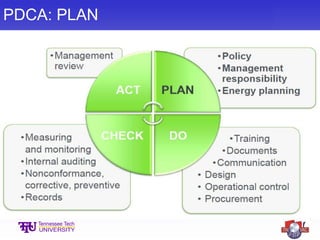
PDCA: PLAN
Energy Policy
What does the Standard say?
• Approved by top management
• Appropriate for the organization
• Provides framework for setting and reviewing objectives
and targets
• Supports the purchase of energy efficient products and
services
• Documented, communicated, and understood
• Regularly reviewed and updated
Energy Policy
Example:
Capsa Corp is committed to:
Continually improving energy performance
Achieving 25% energy intensity reduction in 10 years
Providing available information and resources to meet
objectives and targets
Supporting the purchase of energy efficient equipment and
systems as appropriate for the organization
Abiding by legal and other requirements
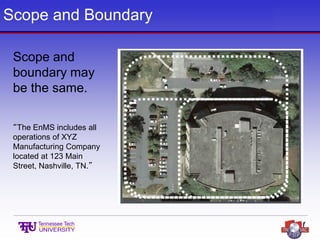
Scope and Boundary
Scope and
boundary may
be the same.
“The EnMS includes all
operations of XYZ
Manufacturing Company
located at 123 Main
Street, Nashville, TN.”
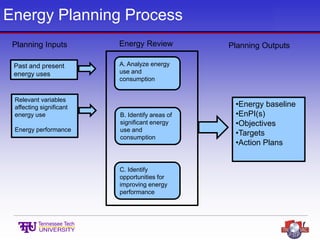
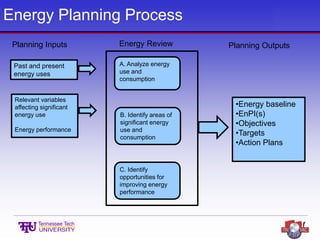
Energy Planning Process
Planning Inputs
Past and present
energy uses
Relevant variables
affecting significant
energy use
Energy performance
Energy Review
A. Analyze energy
use and
consumption
B. Identify areas of
significant energy
use and
consumption
C. Identify
opportunities for
improving energy
performance
Planning Outputs
•Energy baseline
•EnPI(s)
•Objectives
•Targets
•Action Plans
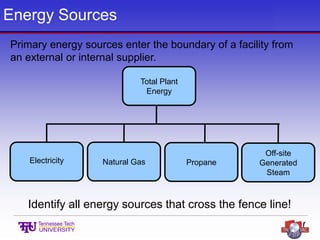
Energy Sources
Total Plant
Energy
Electricity Natural Gas Propane
Off-site
Generated
Steam
Identify all energy sources that cross the fence line!
Primary energy sources enter the boundary of a facility from
an external or internal supplier.
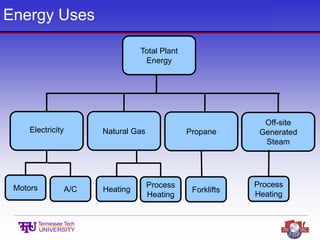
Energy Uses
Total Plant
Energy
Electricity Natural Gas Propane
Off-site
Generated
Steam
Motors A/C Heating
Process
Heating
Forklifts
Process
Heating
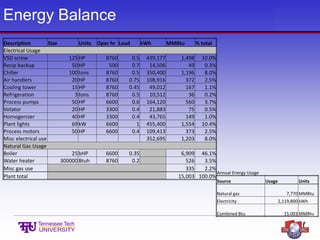
Energy Balance
An energy balance takes the total of all energy
sources and attributes it to specific equipment
and systems.
Looks at energy consumption on a smaller scale
for each energy use (air compressors, lights,
process motors, boilers, dryers, etc.)
Can be determined through submeters, load
analysis, or DOE software – PEP (Plant Energy
Profiler).
Energy Balance
Description Size Units Oper hr Load kWh MMBtu % total
Electrical Usage
VSD screw 125 HP 8760 0.5 439,177 1,498 10.0%
Recip backup 50 HP 500 0.7 14,506 49 0.3%
Chiller 100 tons 8760 0.5 350,400 1,196 8.0%
Air handlers 20 HP 8760 0.75 108,916 372 2.5%
Cooling tower 15 HP 8760 0.45 49,012 167 1.1%
Refrigeration 3 tons 8760 0.5 10,512 36 0.2%
Process pumps 50 HP 6600 0.6 164,120 560 3.7%
Votator 20 HP 3300 0.4 21,883 75 0.5%
Homogenizer 40HP 3300 0.4 43,765 149 1.0%
Plant lights 69 kW 6600 1 455,400 1,554 10.4%
Process motors 50 HP 6600 0.4 109,413 373 2.5%
Misc electrical use 352,695 1,203 8.0%
Natural Gas Usage
Boiler 25bHP 6600 0.35 6,909 46.1%
Water heater 300000 Btuh 8760 0.2 526 3.5%
Misc gas use 335 2.2%
Plant total 15,003 100.0%
Annual Energy Usage
Source Usage Units
Natural gas 7,770 MMBtu
Electricity 2,119,800 kWh
Combined Btu 15,003 MMBtu
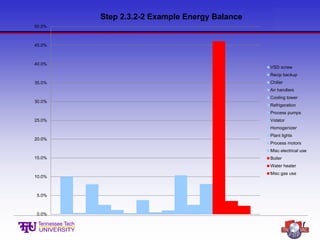
0.0%
5.0%
10.0%
15.0%
20.0%
25.0%
30.0%
35.0%
40.0%
45.0%
50.0%
Step 2.3.2-2 Example Energy Balance
VSD screw
Recip backup
Chiller
Air handlers
Cooling tower
Refrigeration
Process pumps
Votator
Homogenizer
Plant lights
Process motors
Misc electrical use
Boiler
Water heater
Misc gas use
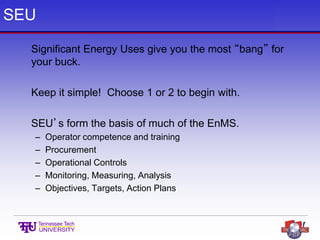
SEU
Significant Energy Uses give you the most “bang” for
your buck.
Keep it simple! Choose 1 or 2 to begin with.
SEU’s form the basis of much of the EnMS.
– Operator competence and training
– Procurement
– Operational Controls
– Monitoring, Measuring, Analysis
– Objectives, Targets, Action Plans
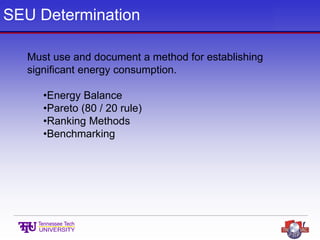
SEU Determination
Must use and document a method for establishing
significant energy consumption.
•Energy Balance
•Pareto (80 / 20 rule)
•Ranking Methods
•Benchmarking
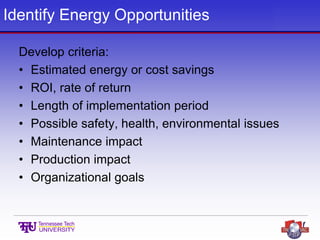
Identify Energy Opportunities
Develop criteria:
• Estimated energy or cost savings
• ROI, rate of return
• Length of implementation period
• Possible safety, health, environmental issues
• Maintenance impact
• Production impact
• Organizational goals
Energy Planning Process
Planning Inputs
Past and present
energy uses
Relevant variables
affecting significant
energy use
Energy performance
Energy Review
A. Analyze energy
use and
consumption
B. Identify areas of
significant energy
use and
consumption
C. Identify
opportunities for
improving energy
performance
Planning Outputs
•Energy baseline
•EnPI(s)
•Objectives
•Targets
•Action Plans
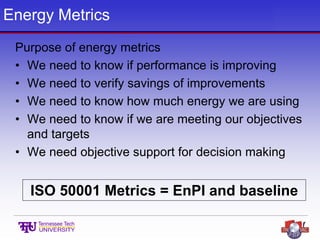
Energy Metrics
Purpose of energy metrics
• We need to know if performance is improving
• We need to verify savings of improvements
• We need to know how much energy we are using
• We need to know if we are meeting our objectives
and targets
• We need objective support for decision making
ISO 50001 Metrics = EnPI and baseline
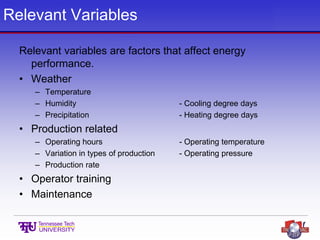
Relevant Variables
Relevant variables are factors that affect energy
performance.
• Weather
– Temperature
– Humidity - Cooling degree days
– Precipitation - Heating degree days
• Production related
– Operating hours - Operating temperature
– Variation in types of production - Operating pressure
– Production rate
• Operator training
• Maintenance
Simple EnPI
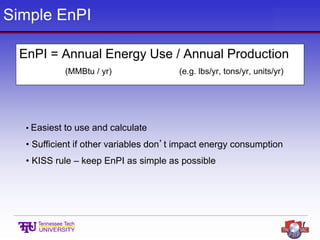
EnPI = Annual Energy Use / Annual Production
(MMBtu / yr) (e.g. lbs/yr, tons/yr, units/yr)
• Easiest to use and calculate
• Sufficient if other variables don’t impact energy consumption
• KISS rule – keep EnPI as simple as possible
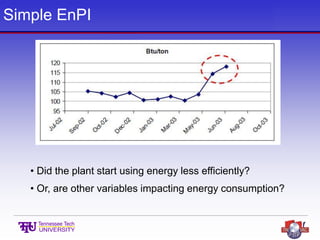
Simple EnPI
• Did the plant start using energy less efficiently?
• Or, are other variables impacting energy consumption?
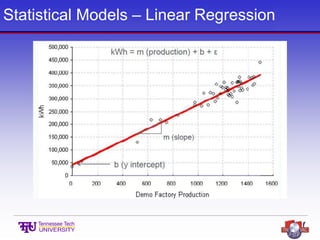
Statistical Models – Linear Regression
Energy Baseline
• Basis of comparison for evaluating energy
performance.
• Use information in initial energy review
• Facility determines the time period
• Apply data from initial time period and model to
develop energy baseline
• Measure future energy consumption against
baseline to determine energy performance
improvement
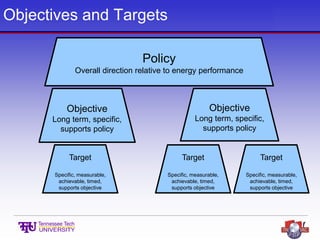
Objectives and Targets
Policy
Overall direction relative to energy performance
Objective
Long term, specific,
supports policy
Objective
Long term, specific,
supports policy
Target
Specific, measurable,
achievable, timed,
supports objective
Target
Specific, measurable,
achievable, timed,
supports objective
Target
Specific, measurable,
achievable, timed,
supports objective
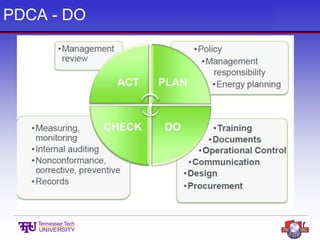
PDCA - DO
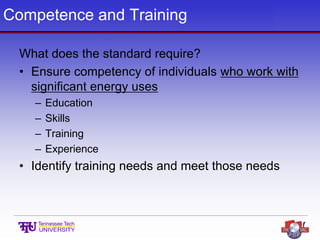
Competence and Training
What does the standard require?
• Ensure competency of individuals who work with
significant energy uses
– Education
– Skills
– Training
– Experience
• Identify training needs and meet those needs
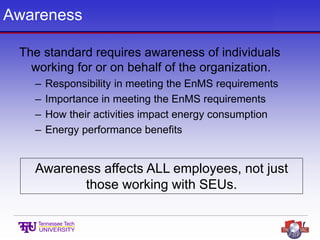
Awareness
The standard requires awareness of individuals
working for or on behalf of the organization.
– Responsibility in meeting the EnMS requirements
– Importance in meeting the EnMS requirements
– How their activities impact energy consumption
– Energy performance benefits
Awareness affects ALL employees, not just
those working with SEUs.
Communication
The standard requires:
Internal communication of energy performance
and EnMS
Establish process for comments and suggestions
External communication decision – Do we
communicate externally or not?
Procurement
Organizations must make the connection between
purchasing and the impact on its energy
performance. Will a purchase significantly affect
energy performance?
Purchasing Services
• Energy service providers who will affect SEUs
need to be evaluated
– Maintenance service contractors for SEUs
– Project engineers/managers/architects
– Energy consultants
• Informed that procurement is partly based on
energy performance
• Major component of assessment is competency
Design
The standard requires:
Consider:
• Energy performance in improvements in design;
• Operational control in design
For:
• New or modified facilities, equipment, systems, and processes
• That have a significant impact on the organization’s energy performance
• Where appropriate, incorporate energy performance into design activities
(such as procurement, specifications, and design).
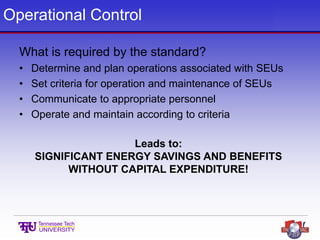
Operational Control
What is required by the standard?
• Determine and plan operations associated with SEUs
• Set criteria for operation and maintenance of SEUs
• Communicate to appropriate personnel
• Operate and maintain according to criteria
Leads to:
SIGNIFICANT ENERGY SAVINGS AND BENEFITS
WITHOUT CAPITAL EXPENDITURE!
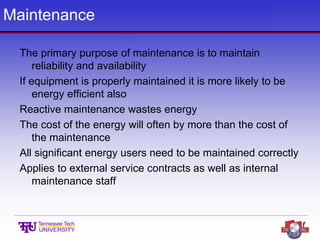
Maintenance
The primary purpose of maintenance is to maintain
reliability and availability
If equipment is properly maintained it is more likely to be
energy efficient also
Reactive maintenance wastes energy
The cost of the energy will often by more than the cost of
the maintenance
All significant energy users need to be maintained correctly
Applies to external service contracts as well as internal
maintenance staff
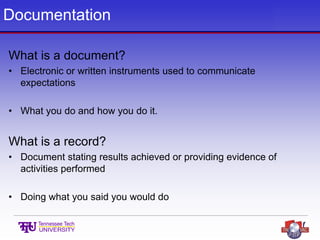
Documentation
What is a document?
• Electronic or written instruments used to communicate
expectations
• What you do and how you do it.
What is a record?
• Document stating results achieved or providing evidence of
activities performed
• Doing what you said you would do
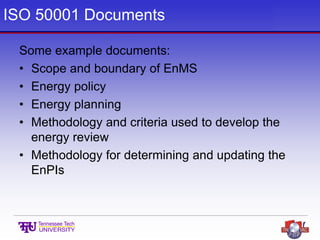
ISO 50001 Documents
Some example documents:
• Scope and boundary of EnMS
• Energy policy
• Energy planning
• Methodology and criteria used to develop the
energy review
• Methodology for determining and updating the
EnPIs
ISO 50001 Records
Some example records:
• Energy baseline
• Training records
• Decision regarding external communication of
EnMS
• Results of design activity
• Measurement – calibration, energy review, etc
• Audit results
• Management review records
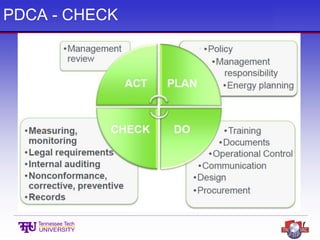
PDCA - CHECK
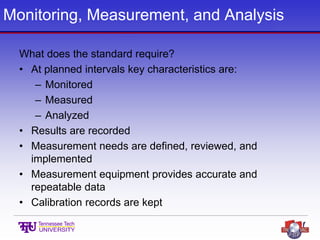
Monitoring, Measurement, and Analysis
What does the standard require?
• At planned intervals key characteristics are:
– Monitored
– Measured
– Analyzed
• Results are recorded
• Measurement needs are defined, reviewed, and
implemented
• Measurement equipment provides accurate and
repeatable data
• Calibration records are kept
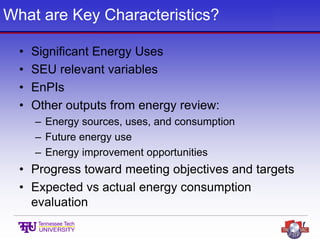
What are Key Characteristics?
• Significant Energy Uses
• SEU relevant variables
• EnPIs
• Other outputs from energy review:
– Energy sources, uses, and consumption
– Future energy use
– Energy improvement opportunities
• Progress toward meeting objectives and targets
• Expected vs actual energy consumption
evaluation
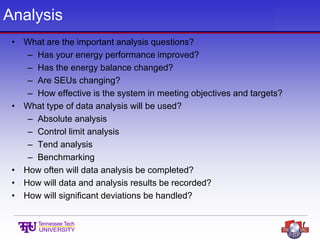
Analysis
• What are the important analysis questions?
– Has your energy performance improved?
– Has the energy balance changed?
– Are SEUs changing?
– How effective is the system in meeting objectives and targets?
• What type of data analysis will be used?
– Absolute analysis
– Control limit analysis
– Tend analysis
– Benchmarking
• How often will data analysis be completed?
• How will data and analysis results be recorded?
• How will significant deviations be handled?
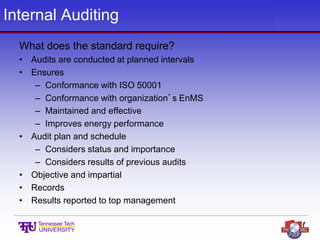
Internal Auditing
What does the standard require?
• Audits are conducted at planned intervals
• Ensures
– Conformance with ISO 50001
– Conformance with organization’s EnMS
– Maintained and effective
– Improves energy performance
• Audit plan and schedule
– Considers status and importance
– Considers results of previous audits
• Objective and impartial
• Records
• Results reported to top management
Continual Improvement
Internal audits lead to continual improvement
• Identify what the organization is doing well and where they need to
improve
• Nonconformities lead to actions which ensure continual
improvement of energy performance and the EnMS
• Internal audit results and the status of corrective/preventive actions
are reviewed at management review
• The organization determines actions to be taken and ensures the
actions are effective
• This process effectively starts the Plan-Do-Check-Act continual
improvement cycle over
Nonconformances
Definition: Non-Fulfillment of a requirement
• The organization is not doing what it said it would do
• What is being done is not working
• Requirement are not being met
• The intended energy performance improvement is not
being obtained.
Corrective and Preventive Action
Addresses actual and potential nonconformances
What does the standard require?
• Make corrections
• Identify the root cause
• Determine actions appropriate to the magnitude
and consequences
• Record
• Review for effectiveness
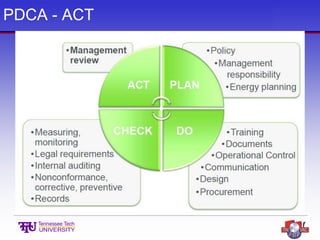
PDCA - ACT
Management Review
Involves fact based decision making by top management.
What does the standard say?
Top management shall review the EnMS
At planned intervals to ensure
Suitability
Adequacy
Effectiveness
Maintain records
Typical Decisions
• What is the status of the EnMS?
• What strategic changes are needed?
• What changes are needed, expected, or have resulted in
terms of energy performance?
• Are there any external requirements that will affect the
EnMS?
• Are there any changes internally that will affect the EnMS?
• Is there a need to change current improvement objectives?
• What resources are needed?
• Is the EnMS suitable and effective and achieving continual
improvement in energy performance?
Inputs
• Energy policy
• Objectives, targets, action plans
• EnPIs and past, current, and projected energy
performance data
• SEUs and their performance and changes
• Internal audits
• Planned changes in design and procurement
• Status of corrective and preventive actions
• Recommendations and opportunities for improvement
• Action items from previous mgmt review
Outputs
Decisions or Actions related to:
• Energy Performance
• Energy Policy
• EnPIs
• Objectives and Targets
• Resource Allocation
• Other EnMS components
More information
DOE eGuide for ISO 50001
https://save-energy-now.org/EM/SPM/Pages/Home.aspx
http://www1.eere.energy.gov/energymanagement/
Acknowledgement: This project is funded under agreement with the
State of Tennessee. This material is based upon work supported by
the Department of Energy under Award Number DE-EE0000160.
CDFA 81.041.

ISO 50001 Energy Management Standard

  • 1.
    Tennessee 3-Star IndustrialAssessment Center ISO 50001: Energy Management Standard Kenneth Currie, PhD, PE, CP EnMS Director Center for Manufacturing Research Chattanooga Regional Manufacturers Association Energy Summit May 8, 2013
  • 2.
    Workshop Objectives • Anunderstanding of the ISO 50001 energy management system • What are the benefits of an energy management system • Understanding the PDCA cycle for energy management • Practical applications for developing Energy Performance Indicators
  • 3.
    Energy Management Benefits •Why do we want to manage energy? • Low hanging fruit always grow back! • As a risk management strategy • Interdisciplinary energy management team ensures cooperative atmosphere
  • 4.
    ISO 50001 –Energy Management Standard • Requires an organization to establish, implement, maintain, and improve an energy management system, enabling systematic achievement of continual improvement in energy performance, energy efficiency, and energy conservation. • Imposes requirements on energy supply and consumption: – Measurement – Documentation and reporting – Design and procurement practices for energy-using equipment and systems – Processes and personnel • Applies to all factors that can be monitored and influenced by the organization to affect energy use. • Does not prescribe specific performance criteria with respect to energy. • Designed to be used independently, yet can be aligned or integrated with other management systems (e.g., ISO 9001 and ISO 14001). Applicable to all organizations that use energy.
  • 5.
  • 6.
    Energy Policy What doesthe Standard say? • Approved by top management • Appropriate for the organization • Provides framework for setting and reviewing objectives and targets • Supports the purchase of energy efficient products and services • Documented, communicated, and understood • Regularly reviewed and updated
  • 7.
    Energy Policy Example: Capsa Corpis committed to: Continually improving energy performance Achieving 25% energy intensity reduction in 10 years Providing available information and resources to meet objectives and targets Supporting the purchase of energy efficient equipment and systems as appropriate for the organization Abiding by legal and other requirements
  • 8.
    Scope and Boundary Scopeand boundary may be the same. “The EnMS includes all operations of XYZ Manufacturing Company located at 123 Main Street, Nashville, TN.”
  • 9.
    Energy Planning Process PlanningInputs Past and present energy uses Relevant variables affecting significant energy use Energy performance Energy Review A. Analyze energy use and consumption B. Identify areas of significant energy use and consumption C. Identify opportunities for improving energy performance Planning Outputs •Energy baseline •EnPI(s) •Objectives •Targets •Action Plans
  • 10.
    Energy Sources Total Plant Energy ElectricityNatural Gas Propane Off-site Generated Steam Identify all energy sources that cross the fence line! Primary energy sources enter the boundary of a facility from an external or internal supplier.
  • 11.
    Energy Uses Total Plant Energy ElectricityNatural Gas Propane Off-site Generated Steam Motors A/C Heating Process Heating Forklifts Process Heating
  • 12.
    Energy Balance An energybalance takes the total of all energy sources and attributes it to specific equipment and systems. Looks at energy consumption on a smaller scale for each energy use (air compressors, lights, process motors, boilers, dryers, etc.) Can be determined through submeters, load analysis, or DOE software – PEP (Plant Energy Profiler).
  • 13.
    Energy Balance Description SizeUnits Oper hr Load kWh MMBtu % total Electrical Usage VSD screw 125 HP 8760 0.5 439,177 1,498 10.0% Recip backup 50 HP 500 0.7 14,506 49 0.3% Chiller 100 tons 8760 0.5 350,400 1,196 8.0% Air handlers 20 HP 8760 0.75 108,916 372 2.5% Cooling tower 15 HP 8760 0.45 49,012 167 1.1% Refrigeration 3 tons 8760 0.5 10,512 36 0.2% Process pumps 50 HP 6600 0.6 164,120 560 3.7% Votator 20 HP 3300 0.4 21,883 75 0.5% Homogenizer 40HP 3300 0.4 43,765 149 1.0% Plant lights 69 kW 6600 1 455,400 1,554 10.4% Process motors 50 HP 6600 0.4 109,413 373 2.5% Misc electrical use 352,695 1,203 8.0% Natural Gas Usage Boiler 25bHP 6600 0.35 6,909 46.1% Water heater 300000 Btuh 8760 0.2 526 3.5% Misc gas use 335 2.2% Plant total 15,003 100.0% Annual Energy Usage Source Usage Units Natural gas 7,770 MMBtu Electricity 2,119,800 kWh Combined Btu 15,003 MMBtu
  • 14.
    0.0% 5.0% 10.0% 15.0% 20.0% 25.0% 30.0% 35.0% 40.0% 45.0% 50.0% Step 2.3.2-2 ExampleEnergy Balance VSD screw Recip backup Chiller Air handlers Cooling tower Refrigeration Process pumps Votator Homogenizer Plant lights Process motors Misc electrical use Boiler Water heater Misc gas use
  • 15.
    SEU Significant Energy Usesgive you the most “bang” for your buck. Keep it simple! Choose 1 or 2 to begin with. SEU’s form the basis of much of the EnMS. – Operator competence and training – Procurement – Operational Controls – Monitoring, Measuring, Analysis – Objectives, Targets, Action Plans
  • 16.
    SEU Determination Must useand document a method for establishing significant energy consumption. •Energy Balance •Pareto (80 / 20 rule) •Ranking Methods •Benchmarking
  • 17.
    Identify Energy Opportunities Developcriteria: • Estimated energy or cost savings • ROI, rate of return • Length of implementation period • Possible safety, health, environmental issues • Maintenance impact • Production impact • Organizational goals
  • 18.
    Energy Planning Process PlanningInputs Past and present energy uses Relevant variables affecting significant energy use Energy performance Energy Review A. Analyze energy use and consumption B. Identify areas of significant energy use and consumption C. Identify opportunities for improving energy performance Planning Outputs •Energy baseline •EnPI(s) •Objectives •Targets •Action Plans
  • 19.
    Energy Metrics Purpose ofenergy metrics • We need to know if performance is improving • We need to verify savings of improvements • We need to know how much energy we are using • We need to know if we are meeting our objectives and targets • We need objective support for decision making ISO 50001 Metrics = EnPI and baseline
  • 20.
    Relevant Variables Relevant variablesare factors that affect energy performance. • Weather – Temperature – Humidity - Cooling degree days – Precipitation - Heating degree days • Production related – Operating hours - Operating temperature – Variation in types of production - Operating pressure – Production rate • Operator training • Maintenance
  • 21.
    Simple EnPI EnPI =Annual Energy Use / Annual Production (MMBtu / yr) (e.g. lbs/yr, tons/yr, units/yr) • Easiest to use and calculate • Sufficient if other variables don’t impact energy consumption • KISS rule – keep EnPI as simple as possible
  • 22.
    Simple EnPI • Didthe plant start using energy less efficiently? • Or, are other variables impacting energy consumption?
  • 23.
    Statistical Models –Linear Regression
  • 24.
    Energy Baseline • Basisof comparison for evaluating energy performance. • Use information in initial energy review • Facility determines the time period • Apply data from initial time period and model to develop energy baseline • Measure future energy consumption against baseline to determine energy performance improvement
  • 25.
    Objectives and Targets Policy Overalldirection relative to energy performance Objective Long term, specific, supports policy Objective Long term, specific, supports policy Target Specific, measurable, achievable, timed, supports objective Target Specific, measurable, achievable, timed, supports objective Target Specific, measurable, achievable, timed, supports objective
  • 26.
  • 27.
    Competence and Training Whatdoes the standard require? • Ensure competency of individuals who work with significant energy uses – Education – Skills – Training – Experience • Identify training needs and meet those needs
  • 28.
    Awareness The standard requiresawareness of individuals working for or on behalf of the organization. – Responsibility in meeting the EnMS requirements – Importance in meeting the EnMS requirements – How their activities impact energy consumption – Energy performance benefits Awareness affects ALL employees, not just those working with SEUs.
  • 29.
    Communication The standard requires: Internalcommunication of energy performance and EnMS Establish process for comments and suggestions External communication decision – Do we communicate externally or not?
  • 30.
    Procurement Organizations must makethe connection between purchasing and the impact on its energy performance. Will a purchase significantly affect energy performance?
  • 31.
    Purchasing Services • Energyservice providers who will affect SEUs need to be evaluated – Maintenance service contractors for SEUs – Project engineers/managers/architects – Energy consultants • Informed that procurement is partly based on energy performance • Major component of assessment is competency
  • 32.
    Design The standard requires: Consider: •Energy performance in improvements in design; • Operational control in design For: • New or modified facilities, equipment, systems, and processes • That have a significant impact on the organization’s energy performance • Where appropriate, incorporate energy performance into design activities (such as procurement, specifications, and design).
  • 33.
    Operational Control What isrequired by the standard? • Determine and plan operations associated with SEUs • Set criteria for operation and maintenance of SEUs • Communicate to appropriate personnel • Operate and maintain according to criteria Leads to: SIGNIFICANT ENERGY SAVINGS AND BENEFITS WITHOUT CAPITAL EXPENDITURE!
  • 34.
    Maintenance The primary purposeof maintenance is to maintain reliability and availability If equipment is properly maintained it is more likely to be energy efficient also Reactive maintenance wastes energy The cost of the energy will often by more than the cost of the maintenance All significant energy users need to be maintained correctly Applies to external service contracts as well as internal maintenance staff
  • 35.
    Documentation What is adocument? • Electronic or written instruments used to communicate expectations • What you do and how you do it. What is a record? • Document stating results achieved or providing evidence of activities performed • Doing what you said you would do
  • 36.
    ISO 50001 Documents Someexample documents: • Scope and boundary of EnMS • Energy policy • Energy planning • Methodology and criteria used to develop the energy review • Methodology for determining and updating the EnPIs
  • 37.
    ISO 50001 Records Someexample records: • Energy baseline • Training records • Decision regarding external communication of EnMS • Results of design activity • Measurement – calibration, energy review, etc • Audit results • Management review records
  • 38.
  • 39.
    Monitoring, Measurement, andAnalysis What does the standard require? • At planned intervals key characteristics are: – Monitored – Measured – Analyzed • Results are recorded • Measurement needs are defined, reviewed, and implemented • Measurement equipment provides accurate and repeatable data • Calibration records are kept
  • 40.
    What are KeyCharacteristics? • Significant Energy Uses • SEU relevant variables • EnPIs • Other outputs from energy review: – Energy sources, uses, and consumption – Future energy use – Energy improvement opportunities • Progress toward meeting objectives and targets • Expected vs actual energy consumption evaluation
  • 41.
    Analysis • What arethe important analysis questions? – Has your energy performance improved? – Has the energy balance changed? – Are SEUs changing? – How effective is the system in meeting objectives and targets? • What type of data analysis will be used? – Absolute analysis – Control limit analysis – Tend analysis – Benchmarking • How often will data analysis be completed? • How will data and analysis results be recorded? • How will significant deviations be handled?
  • 42.
    Internal Auditing What doesthe standard require? • Audits are conducted at planned intervals • Ensures – Conformance with ISO 50001 – Conformance with organization’s EnMS – Maintained and effective – Improves energy performance • Audit plan and schedule – Considers status and importance – Considers results of previous audits • Objective and impartial • Records • Results reported to top management
  • 43.
    Continual Improvement Internal auditslead to continual improvement • Identify what the organization is doing well and where they need to improve • Nonconformities lead to actions which ensure continual improvement of energy performance and the EnMS • Internal audit results and the status of corrective/preventive actions are reviewed at management review • The organization determines actions to be taken and ensures the actions are effective • This process effectively starts the Plan-Do-Check-Act continual improvement cycle over
  • 44.
    Nonconformances Definition: Non-Fulfillment ofa requirement • The organization is not doing what it said it would do • What is being done is not working • Requirement are not being met • The intended energy performance improvement is not being obtained.
  • 45.
    Corrective and PreventiveAction Addresses actual and potential nonconformances What does the standard require? • Make corrections • Identify the root cause • Determine actions appropriate to the magnitude and consequences • Record • Review for effectiveness
  • 46.
  • 47.
    Management Review Involves factbased decision making by top management. What does the standard say? Top management shall review the EnMS At planned intervals to ensure Suitability Adequacy Effectiveness Maintain records
  • 48.
    Typical Decisions • Whatis the status of the EnMS? • What strategic changes are needed? • What changes are needed, expected, or have resulted in terms of energy performance? • Are there any external requirements that will affect the EnMS? • Are there any changes internally that will affect the EnMS? • Is there a need to change current improvement objectives? • What resources are needed? • Is the EnMS suitable and effective and achieving continual improvement in energy performance?
  • 49.
    Inputs • Energy policy •Objectives, targets, action plans • EnPIs and past, current, and projected energy performance data • SEUs and their performance and changes • Internal audits • Planned changes in design and procurement • Status of corrective and preventive actions • Recommendations and opportunities for improvement • Action items from previous mgmt review
  • 50.
    Outputs Decisions or Actionsrelated to: • Energy Performance • Energy Policy • EnPIs • Objectives and Targets • Resource Allocation • Other EnMS components
  • 51.
    More information DOE eGuidefor ISO 50001 https://save-energy-now.org/EM/SPM/Pages/Home.aspx http://www1.eere.energy.gov/energymanagement/ Acknowledgement: This project is funded under agreement with the State of Tennessee. This material is based upon work supported by the Department of Energy under Award Number DE-EE0000160. CDFA 81.041.