The ISO STANDARD 22000
ISO 22000
State of affairs
International Food Safety Conference –
“Managing the Food Safety Cycle”
Rome February 2, 2005
By:
Chair ISO TC34/WG-8
Jacob Færgemand (BVQI Denmark A/S )
Anne-Marie Crowley (NSA Irland)
•Introduction
•Work of TC 34 WG 8
•Developement of ISO 22000
•Deliverables of ISO 22000
•Intended use the standard
•GFSI coments to DIS 22000
•Questions - Discussion
Jacob Færgemand - background
(1990) M.Sc. Food Technology
(1993) Ph.D. Fish Quality Design
Sales Director - Food Sector Manager - Bureau Veritas (BVQI Denmark A/S)
(1994 ) Lead Assessor ISO 9000
(1997) Lead Assessor HACCP DS DS 3027
(1998) Inspector BRC Food and BRC trainer WW
Resp. for BVQI WW Activity BRC/DS 3027
(2000) Chairman Danish Food Mirror Group
(2001) Chairman ISO TC 34/ WG8
(2003) IFS to Denmark
What is ISO ?
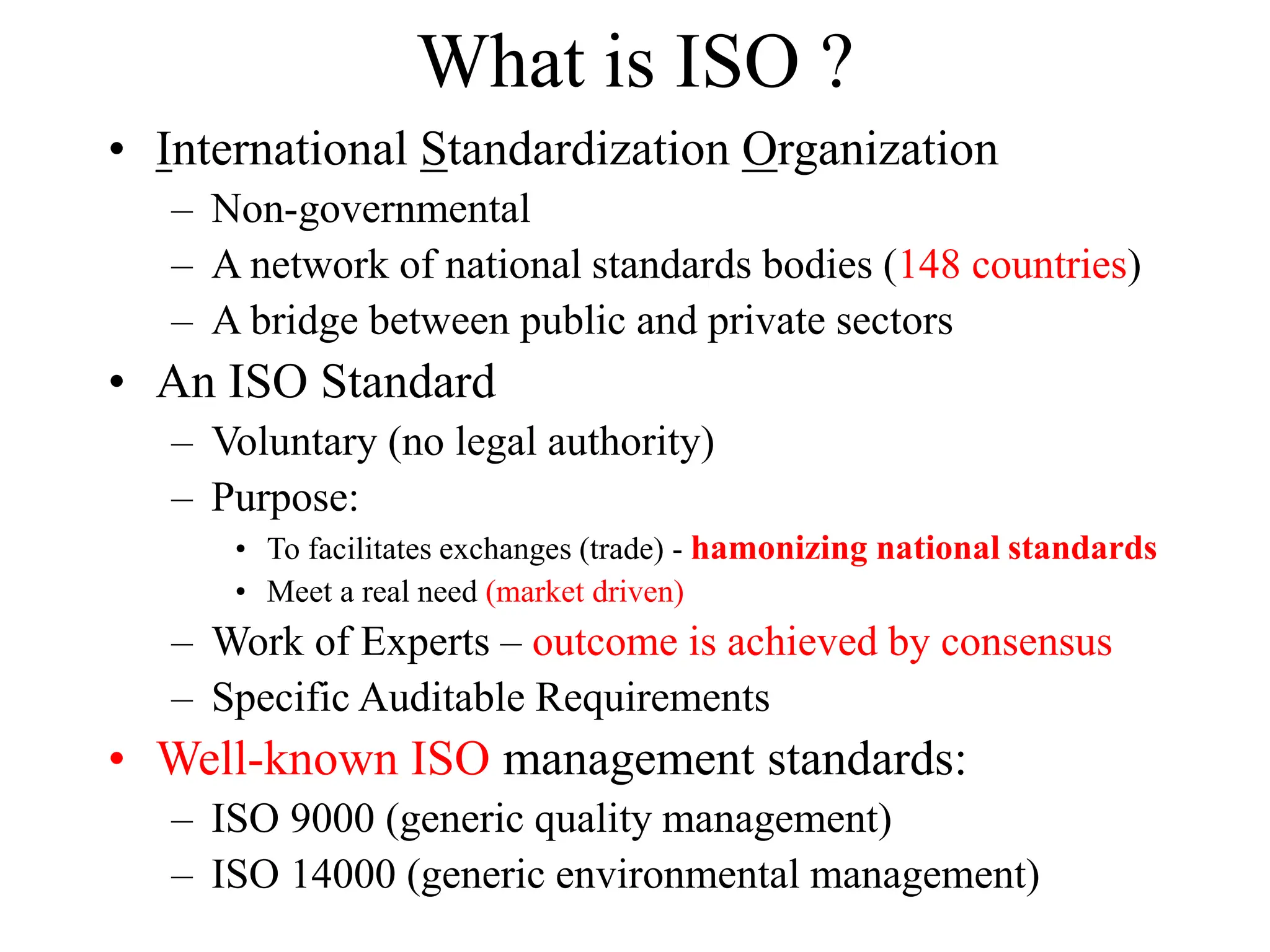
• International Standardization Organization
– Non-governmental
– A network of national standards bodies (148 countries)
– A bridge between public and private sectors
• An ISO Standard
– Voluntary (no legal authority)
– Purpose:
• To facilitates exchanges (trade) - hamonizing national standards
• Meet a real need (market driven)
– Work of Experts – outcome is achieved by consensus
– Specific Auditable Requirements
• Well-known ISO management standards:
– ISO 9000 (generic quality management)
– ISO 14000 (generic environmental management)
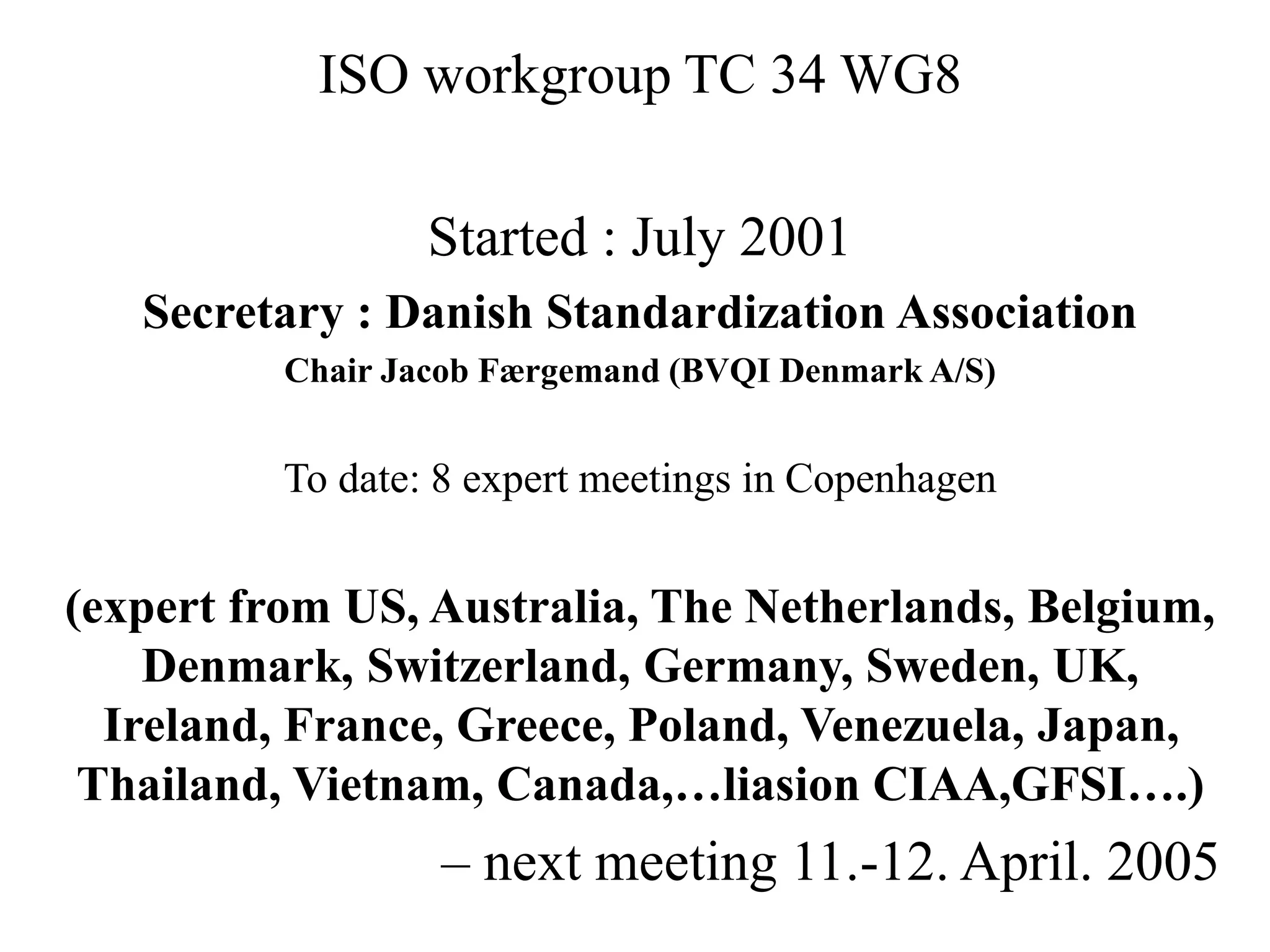
ISO workgroup TC 34 WG8
Started : July 2001
Secretary : Danish Standardization Association
Chair Jacob Færgemand (BVQI Denmark A/S)
To date: 8 expert meetings in Copenhagen
(expert from US, Australia, The Netherlands, Belgium,
Denmark, Switzerland, Germany, Sweden, UK,
Ireland, France, Greece, Poland, Venezuela, Japan,
Thailand, Vietnam, Canada,…liasion CIAA,GFSI….)
– next meeting 11.-12. April. 2005
Result of DIS 22000 vote
38 YES
3 NO (Japan, Australia, France)
Vote closed 18. November 2004
Parallel voting occured in CEN and the document has been accepted - -which
means that it will be published as an EN/ISO standard.
The document is available in English, French and German.
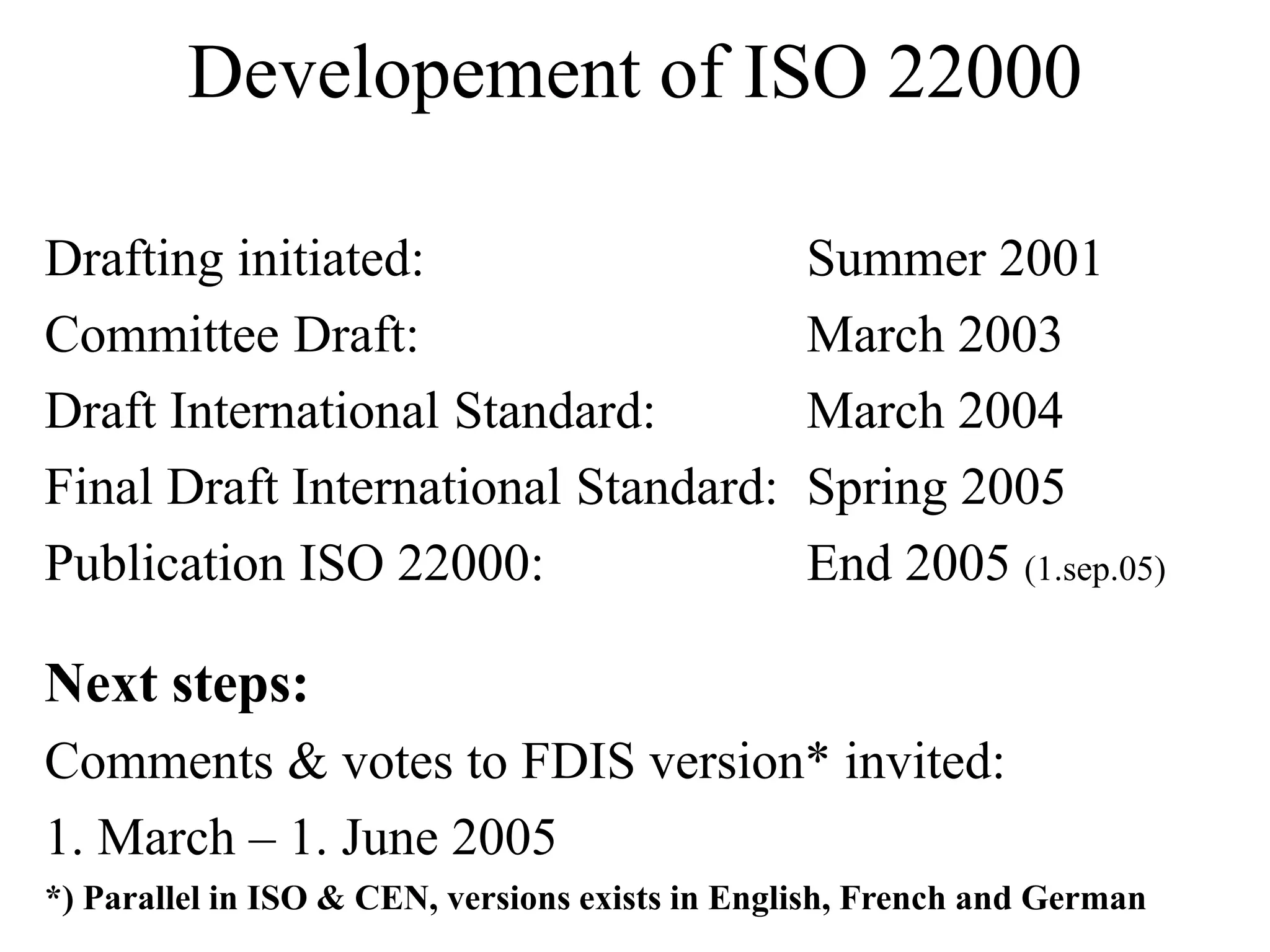
Developement of ISO 22000
Drafting initiated: Summer 2001
Committee Draft: March 2003
Draft International Standard: March 2004
Final Draft International Standard: Spring 2005
Publication ISO 22000: End 2005 (1.sep.05)
Next steps:
Comments & votes to FDIS version* invited:
1. March – 1. June 2005
*) Parallel in ISO & CEN, versions exists in English, French and German
Deliverables of ISO 22000(1)
• Can be used as the basis of any food safety
management system, with or without 3rd party
certification
• Requirements for addressing (assessing and
implementing) food safety concerns of
customers (e.g. retailers) and regulators
Deliverables of ISO 22000 (2)
Combines recognized key food safety
elements:
– System management (ISO 9000 approach)
– Interactive communication along the food chains
– Prerequisite programmes
Delivers a Hazard control system that can be Validated and
Verified through the combination of control measures, managed
and implemented by
•A HACCP plan and/or
•Operational prerequisite programs
Regulatory
authorities
Consumers
Food service
operators/caterers
Service providers
Producers of cleaning and
sanitizing agents
Producers of equipment
Producers of packaging
materials
Producers of pesticides,
fertilizers, and veterinary
drugs
Food chain for the
production of ingredients
and additives
Transport and storage operators
Crop producers
Feed producers
Primary food producers
Food producers
2nd food processors
Retailers
Wholesalers
Scope – the whole food chain
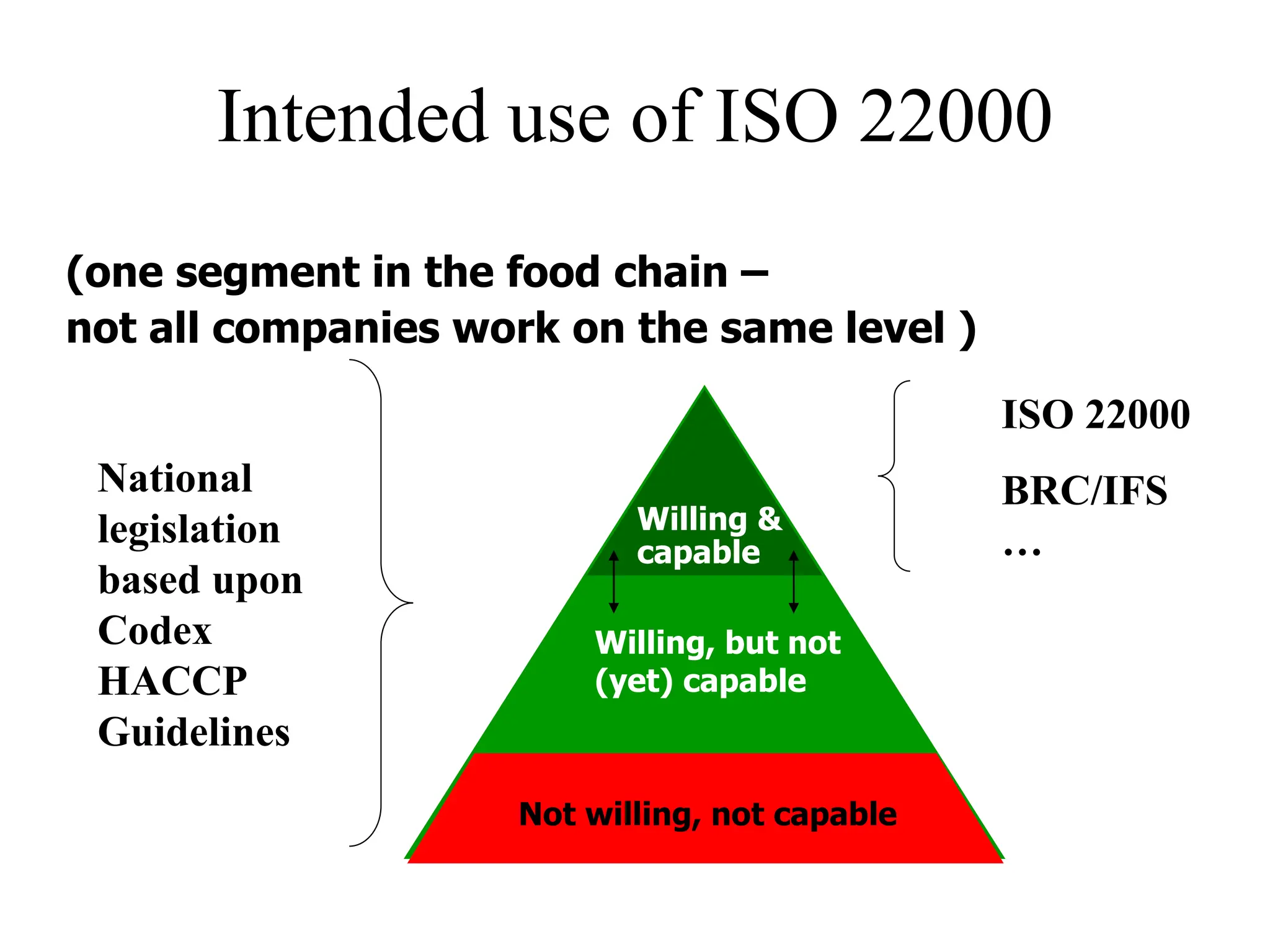
Intended use of ISO 22000
National
legislation
based upon
Codex
HACCP
Guidelines
ISO 22000
BRC/IFS
…
Willing, but not
(yet) capable
Not willing, not capable
Willing &
capable
(one segment in the food chain –
not all companies work on the same level )
CIES comments on DIS 22000 January 2005 (1)
•The ISO 22000 standard as it is today, combines very well an ISO
9000 type approach to a management system with HACCP.
•However, if the ISO 22000 standard would be benchmarked against
the GFSI Guidance Document, it wouldn’t pass the preliminary
screening, for missing one of the three ‘key elements’ Good
Manufacturing (or Agricultural) Standards.
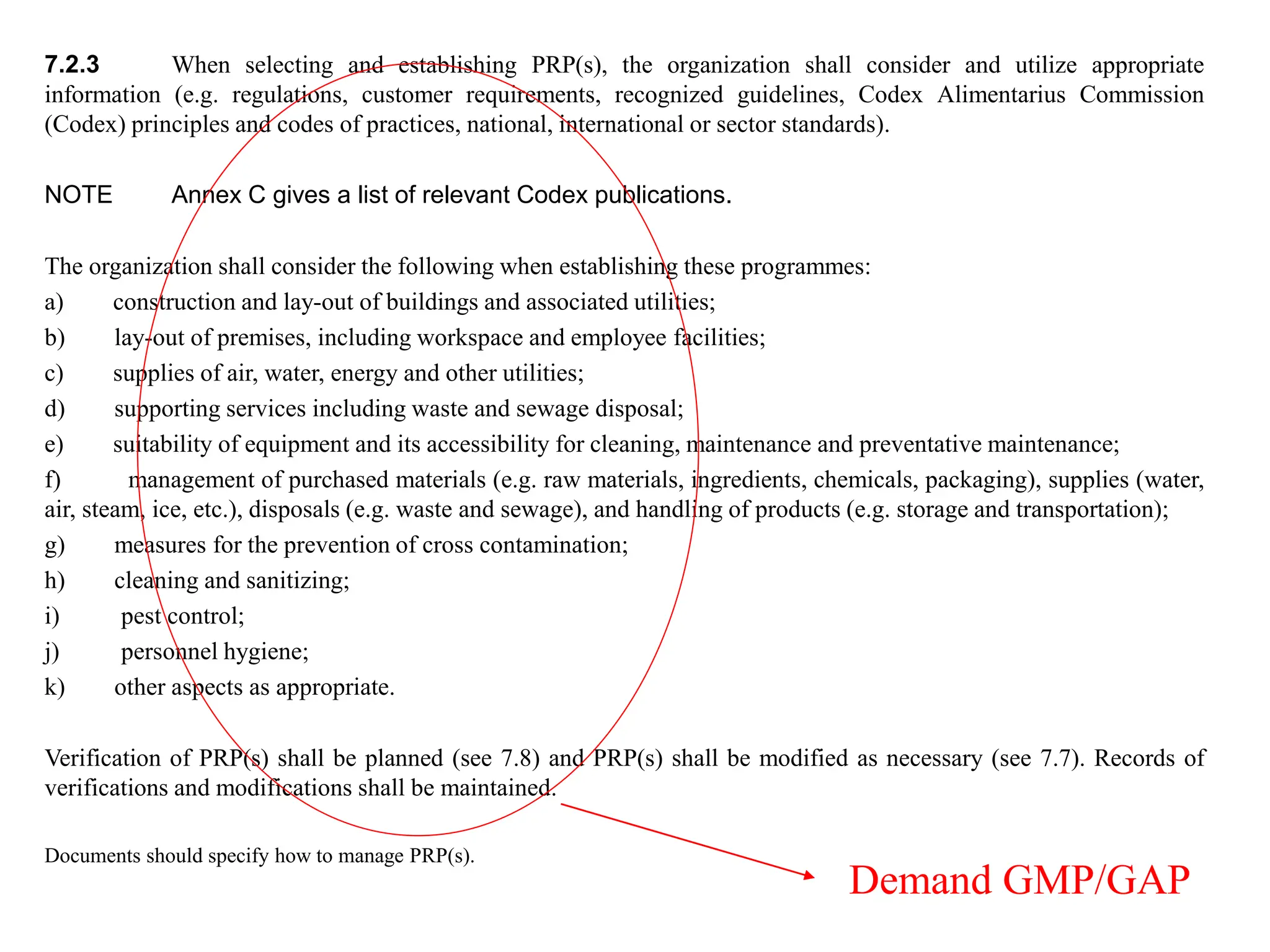
7.2.3 When selecting and establishing PRP(s), the organization shall consider and utilize appropriate
information (e.g. regulations, customer requirements, recognized guidelines, Codex Alimentarius Commission
(Codex) principles and codes of practices, national, international or sector standards).
NOTE Annex C gives a list of relevant Codex publications.
The organization shall consider the following when establishing these programmes:
a) construction and lay-out of buildings and associated utilities;
b) lay-out of premises, including workspace and employee facilities;
c) supplies of air, water, energy and other utilities;
d) supporting services including waste and sewage disposal;
e) suitability of equipment and its accessibility for cleaning, maintenance and preventative maintenance;
f) management of purchased materials (e.g. raw materials, ingredients, chemicals, packaging), supplies (water,
air, steam, ice, etc.), disposals (e.g. waste and sewage), and handling of products (e.g. storage and transportation);
g) measures for the prevention of cross contamination;
h) cleaning and sanitizing;
i) pest control;
j) personnel hygiene;
k) other aspects as appropriate.
Verification of PRP(s) shall be planned (see 7.8) and PRP(s) shall be modified as necessary (see 7.7). Records of
verifications and modifications shall be maintained.
Documents should specify how to manage PRP(s).
Demand GMP/GAP
CIES comments on DIS 22000 January 2005 (2)
•ISO 22000 refers to ‘customer requirements’, which in the case
of private label manufacturers effectively refers to the GFSI
Benchmarked Standards, so why use ISO 22000 in the first
place?
•ISO 22000 comes without a protocol and retailers cannot have
control over it. Retailers need a protocol to answer liability
issues.
2
FAMI-QS
GMO
ISO 9001
GMP standard for Corrugated
& Solid Board
EFSIS
IFS
GFSI
Guide
SQF
AG 9000
ISO 14001
McDonalds system
Kraft food system
Nestlé NQS
Eurepgap
Potential of ISO 22000
hamonization - perhaps not all – but some .
Friesland Coberco FSS
DS 3027
BRC-IoP
BRC-Food
Ducth HACCP
Irish HACCP
M&S system
Aldi system
Waiterose
system
GMP GTP
ISO 22000 will be a series of
documents
ISO 22000 - Requirements
ISO 2200x - Guidance.
ISO 2200x - Handbook for SME’s
ISO 2200x - Traceability
Agenda item for WG8 in April 2005
ISO 2200x – Guidelines for certification
Input from CIES ? (Guide 4 version)
CIES comments on DIS - ISO 22000 January 2005 (3)
•On a more general note, ISO 22000 is rather extensive and it
remains to be seen whether smaller manufacturers and farmers
could adopt it.
CIES have stated publicaly:
”Draft of ISO 22000 does not meet retailers’ requirements”.
This statement has been a great cause of concern to the International Standards
Organisation as they mandated the developemnet of this standard and invited CIES
to participate.
For information – Contact:
ISO Central Secretariat - Pauline Jones
jones@iso.org
Secretary ISO TC 34 - Martha Pretro-Turza
o.petro@mszt.hu
Chair TC 34/WG 8 - Jacob Færgemand
jacob.faergemand@bureauveritas.com

State of play for food me and apples.ppt

  • 1.
    The ISO STANDARD22000 ISO 22000 State of affairs International Food Safety Conference – “Managing the Food Safety Cycle” Rome February 2, 2005 By: Chair ISO TC34/WG-8 Jacob Færgemand (BVQI Denmark A/S ) Anne-Marie Crowley (NSA Irland)
  • 2.
    •Introduction •Work of TC34 WG 8 •Developement of ISO 22000 •Deliverables of ISO 22000 •Intended use the standard •GFSI coments to DIS 22000 •Questions - Discussion
  • 3.
    Jacob Færgemand -background (1990) M.Sc. Food Technology (1993) Ph.D. Fish Quality Design Sales Director - Food Sector Manager - Bureau Veritas (BVQI Denmark A/S) (1994 ) Lead Assessor ISO 9000 (1997) Lead Assessor HACCP DS DS 3027 (1998) Inspector BRC Food and BRC trainer WW Resp. for BVQI WW Activity BRC/DS 3027 (2000) Chairman Danish Food Mirror Group (2001) Chairman ISO TC 34/ WG8 (2003) IFS to Denmark
  • 4.
    What is ISO? • International Standardization Organization – Non-governmental – A network of national standards bodies (148 countries) – A bridge between public and private sectors • An ISO Standard – Voluntary (no legal authority) – Purpose: • To facilitates exchanges (trade) - hamonizing national standards • Meet a real need (market driven) – Work of Experts – outcome is achieved by consensus – Specific Auditable Requirements • Well-known ISO management standards: – ISO 9000 (generic quality management) – ISO 14000 (generic environmental management)
  • 5.
    ISO workgroup TC34 WG8 Started : July 2001 Secretary : Danish Standardization Association Chair Jacob Færgemand (BVQI Denmark A/S) To date: 8 expert meetings in Copenhagen (expert from US, Australia, The Netherlands, Belgium, Denmark, Switzerland, Germany, Sweden, UK, Ireland, France, Greece, Poland, Venezuela, Japan, Thailand, Vietnam, Canada,…liasion CIAA,GFSI….) – next meeting 11.-12. April. 2005
  • 6.
    Result of DIS22000 vote 38 YES 3 NO (Japan, Australia, France) Vote closed 18. November 2004 Parallel voting occured in CEN and the document has been accepted - -which means that it will be published as an EN/ISO standard. The document is available in English, French and German.
  • 7.
    Developement of ISO22000 Drafting initiated: Summer 2001 Committee Draft: March 2003 Draft International Standard: March 2004 Final Draft International Standard: Spring 2005 Publication ISO 22000: End 2005 (1.sep.05) Next steps: Comments & votes to FDIS version* invited: 1. March – 1. June 2005 *) Parallel in ISO & CEN, versions exists in English, French and German
  • 8.
    Deliverables of ISO22000(1) • Can be used as the basis of any food safety management system, with or without 3rd party certification • Requirements for addressing (assessing and implementing) food safety concerns of customers (e.g. retailers) and regulators
  • 9.
    Deliverables of ISO22000 (2) Combines recognized key food safety elements: – System management (ISO 9000 approach) – Interactive communication along the food chains – Prerequisite programmes Delivers a Hazard control system that can be Validated and Verified through the combination of control measures, managed and implemented by •A HACCP plan and/or •Operational prerequisite programs
  • 10.
    Regulatory authorities Consumers Food service operators/caterers Service providers Producersof cleaning and sanitizing agents Producers of equipment Producers of packaging materials Producers of pesticides, fertilizers, and veterinary drugs Food chain for the production of ingredients and additives Transport and storage operators Crop producers Feed producers Primary food producers Food producers 2nd food processors Retailers Wholesalers Scope – the whole food chain
  • 11.
    Intended use ofISO 22000 National legislation based upon Codex HACCP Guidelines ISO 22000 BRC/IFS … Willing, but not (yet) capable Not willing, not capable Willing & capable (one segment in the food chain – not all companies work on the same level )
  • 12.
    CIES comments onDIS 22000 January 2005 (1) •The ISO 22000 standard as it is today, combines very well an ISO 9000 type approach to a management system with HACCP. •However, if the ISO 22000 standard would be benchmarked against the GFSI Guidance Document, it wouldn’t pass the preliminary screening, for missing one of the three ‘key elements’ Good Manufacturing (or Agricultural) Standards.
  • 13.
    7.2.3 When selectingand establishing PRP(s), the organization shall consider and utilize appropriate information (e.g. regulations, customer requirements, recognized guidelines, Codex Alimentarius Commission (Codex) principles and codes of practices, national, international or sector standards). NOTE Annex C gives a list of relevant Codex publications. The organization shall consider the following when establishing these programmes: a) construction and lay-out of buildings and associated utilities; b) lay-out of premises, including workspace and employee facilities; c) supplies of air, water, energy and other utilities; d) supporting services including waste and sewage disposal; e) suitability of equipment and its accessibility for cleaning, maintenance and preventative maintenance; f) management of purchased materials (e.g. raw materials, ingredients, chemicals, packaging), supplies (water, air, steam, ice, etc.), disposals (e.g. waste and sewage), and handling of products (e.g. storage and transportation); g) measures for the prevention of cross contamination; h) cleaning and sanitizing; i) pest control; j) personnel hygiene; k) other aspects as appropriate. Verification of PRP(s) shall be planned (see 7.8) and PRP(s) shall be modified as necessary (see 7.7). Records of verifications and modifications shall be maintained. Documents should specify how to manage PRP(s). Demand GMP/GAP
  • 14.
    CIES comments onDIS 22000 January 2005 (2) •ISO 22000 refers to ‘customer requirements’, which in the case of private label manufacturers effectively refers to the GFSI Benchmarked Standards, so why use ISO 22000 in the first place? •ISO 22000 comes without a protocol and retailers cannot have control over it. Retailers need a protocol to answer liability issues.
  • 15.
    2 FAMI-QS GMO ISO 9001 GMP standardfor Corrugated & Solid Board EFSIS IFS GFSI Guide SQF AG 9000 ISO 14001 McDonalds system Kraft food system Nestlé NQS Eurepgap Potential of ISO 22000 hamonization - perhaps not all – but some . Friesland Coberco FSS DS 3027 BRC-IoP BRC-Food Ducth HACCP Irish HACCP M&S system Aldi system Waiterose system GMP GTP
  • 16.
    ISO 22000 willbe a series of documents ISO 22000 - Requirements ISO 2200x - Guidance. ISO 2200x - Handbook for SME’s ISO 2200x - Traceability Agenda item for WG8 in April 2005 ISO 2200x – Guidelines for certification Input from CIES ? (Guide 4 version)
  • 17.
    CIES comments onDIS - ISO 22000 January 2005 (3) •On a more general note, ISO 22000 is rather extensive and it remains to be seen whether smaller manufacturers and farmers could adopt it. CIES have stated publicaly: ”Draft of ISO 22000 does not meet retailers’ requirements”. This statement has been a great cause of concern to the International Standards Organisation as they mandated the developemnet of this standard and invited CIES to participate.
  • 18.
    For information –Contact: ISO Central Secretariat - Pauline Jones jones@iso.org Secretary ISO TC 34 - Martha Pretro-Turza o.petro@mszt.hu Chair TC 34/WG 8 - Jacob Færgemand jacob.faergemand@bureauveritas.com