Overview of Work
•   Qualitative Research Experience
•   URL Shortener
•   Simulating Technology Dispersion
•   Filming and Editing video
•   Information Law and Policy
•   Information Organization and Retrieval
Qualitative Research Experience
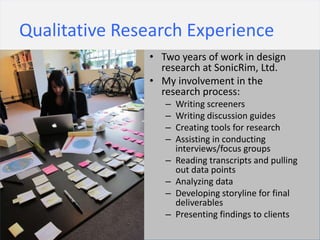
               • Two years of work in design
                 research at SonicRim, Ltd.
               • My involvement in the
                 research process:
                  –   Writing screeners
                  –   Writing discussion guides
                  –   Creating tools for research
                  –   Assisting in conducting
                      interviews/focus groups
                  –   Reading transcripts and pulling
                      out data points
                  –   Analyzing data
                  –   Developing storyline for final
                      deliverables
                  –   Presenting findings to clients
Qualitative Research Experience
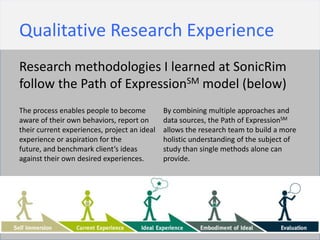
Research methodologies I learned at SonicRim
follow the Path of ExpressionSM model (below)
The process enables people to become          By combining multiple approaches and
aware of their own behaviors, report on       data sources, the Path of ExpressionSM
their current experiences, project an ideal   allows the research team to build a more
experience or aspiration for the              holistic understanding of the subject of
future, and benchmark client’s ideas          study than single methods alone can
against their own desired experiences.        provide.
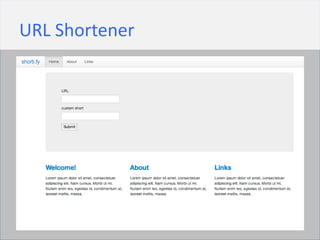
URL Shortener
URL Shortener
• Partner Project for Web Architecture course
• The project involved:
   – Designing and coding a web page (HTML5, CSS3, JavaScript)
   – Making the webpage responsive using media queries (CSS3)
   – Writing code that would assign user-entered long URLs to a
     short URL and store these in a database (Python)
   – Writing code to log data about each action taken on the
     website and assign cookies to track users (Python, Flask
     libraries)
   – Analyzing the data generated after a period of use (Python,
     MRJobs)
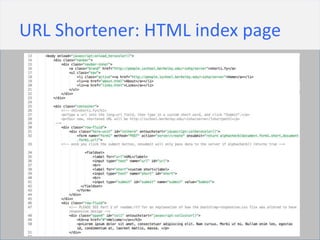
URL Shortener: HTML index page
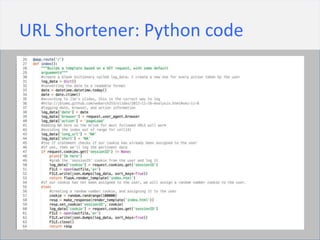
URL Shortener: Python code
Simulating Technology Dispersion
• Group project for Computing Applications course
• Project included writing code to…
   – Create a network of users
   – Create a given number of connections between users
   – Assign a given number of “early adopters” to be first given
     the technology
      • Involved creating an algorithm that would assess the
        “connectedness” of each user and then choose the n most
        connected users
      • My group developed an algorithm that borrowed from the basic
        concept of Google Page Rank
   – Track the number of time steps required before technology
     has been assimilated throughout the entire network
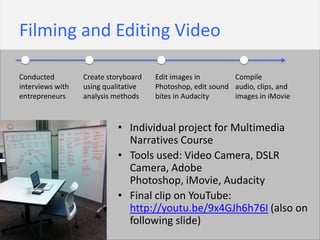
Filming and Editing Video

Conducted         Create storyboard   Edit images in        Compile
interviews with   using qualitative   Photoshop, edit sound audio, clips, and
entrepreneurs     analysis methods    bites in Audacity     images in iMovie


                            • Individual project for Multimedia
                              Narratives Course
                            • Tools used: Video Camera, DSLR
                              Camera, Adobe
                              Photoshop, iMovie, Audacity
                            • Final clip on YouTube:
                              http://youtu.be/9x4GJh6h76I (also on
                              following slide)
Information Law and Policy
• Studied basic cases and statutes that impact technology
  products and service design:
   –   Freedom of Expression
   –   Privacy Law
   –   Copyright and Patent Laws
   –   Consumer Protection and Security
   –   Information Licensing and Consumer Protection
   –   Contracts and Terms of Service
   –   Liability and Secondary Liability
   –   Access and Authorization
   –   Trade Secrets
• Sample essay: http://tinyurl.com/205Paper
• Currently enrolled in another information policy course
  focused on the implications of policy on technological
  specifications.
Information Organization & Retrieval
• This course taught us the process of organizing
  resources in a way to optimize for later use.
• The theories learned in class:
   – Decisions to consider in the design of an organization
     system
   – Organizing digital vs. physical resources
   – Using XML to mark up digital resources
   – Methods of classification
   – Describing Resources
   – Understanding gaps in how computers interact with
     resources
   – Creating interoperability between models
   – Theories of designing search user interfaces

Isha's Sample Work

  • 1.
    Overview of Work • Qualitative Research Experience • URL Shortener • Simulating Technology Dispersion • Filming and Editing video • Information Law and Policy • Information Organization and Retrieval
  • 2.
    Qualitative Research Experience • Two years of work in design research at SonicRim, Ltd. • My involvement in the research process: – Writing screeners – Writing discussion guides – Creating tools for research – Assisting in conducting interviews/focus groups – Reading transcripts and pulling out data points – Analyzing data – Developing storyline for final deliverables – Presenting findings to clients
  • 3.
    Qualitative Research Experience Researchmethodologies I learned at SonicRim follow the Path of ExpressionSM model (below) The process enables people to become By combining multiple approaches and aware of their own behaviors, report on data sources, the Path of ExpressionSM their current experiences, project an ideal allows the research team to build a more experience or aspiration for the holistic understanding of the subject of future, and benchmark client’s ideas study than single methods alone can against their own desired experiences. provide.
  • 4.
  • 5.
    URL Shortener • PartnerProject for Web Architecture course • The project involved: – Designing and coding a web page (HTML5, CSS3, JavaScript) – Making the webpage responsive using media queries (CSS3) – Writing code that would assign user-entered long URLs to a short URL and store these in a database (Python) – Writing code to log data about each action taken on the website and assign cookies to track users (Python, Flask libraries) – Analyzing the data generated after a period of use (Python, MRJobs)
  • 6.
  • 7.
  • 8.
    Simulating Technology Dispersion •Group project for Computing Applications course • Project included writing code to… – Create a network of users – Create a given number of connections between users – Assign a given number of “early adopters” to be first given the technology • Involved creating an algorithm that would assess the “connectedness” of each user and then choose the n most connected users • My group developed an algorithm that borrowed from the basic concept of Google Page Rank – Track the number of time steps required before technology has been assimilated throughout the entire network
  • 9.
    Filming and EditingVideo Conducted Create storyboard Edit images in Compile interviews with using qualitative Photoshop, edit sound audio, clips, and entrepreneurs analysis methods bites in Audacity images in iMovie • Individual project for Multimedia Narratives Course • Tools used: Video Camera, DSLR Camera, Adobe Photoshop, iMovie, Audacity • Final clip on YouTube: http://youtu.be/9x4GJh6h76I (also on following slide)
  • 11.
    Information Law andPolicy • Studied basic cases and statutes that impact technology products and service design: – Freedom of Expression – Privacy Law – Copyright and Patent Laws – Consumer Protection and Security – Information Licensing and Consumer Protection – Contracts and Terms of Service – Liability and Secondary Liability – Access and Authorization – Trade Secrets • Sample essay: http://tinyurl.com/205Paper • Currently enrolled in another information policy course focused on the implications of policy on technological specifications.
  • 12.
    Information Organization &Retrieval • This course taught us the process of organizing resources in a way to optimize for later use. • The theories learned in class: – Decisions to consider in the design of an organization system – Organizing digital vs. physical resources – Using XML to mark up digital resources – Methods of classification – Describing Resources – Understanding gaps in how computers interact with resources – Creating interoperability between models – Theories of designing search user interfaces

Editor's Notes

  • #7 Sample of HTML: used classes that employed Bootstrap CSS, called JavaScript to enable touch events
  • #8 The code that runs when someone accesses the home page- logs data about the user, checks for and/or assigns a cookie to the user, renders the HTML page