1
ITSM Frameworks
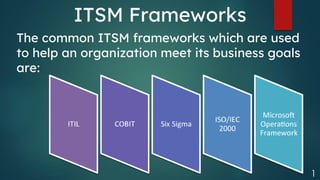
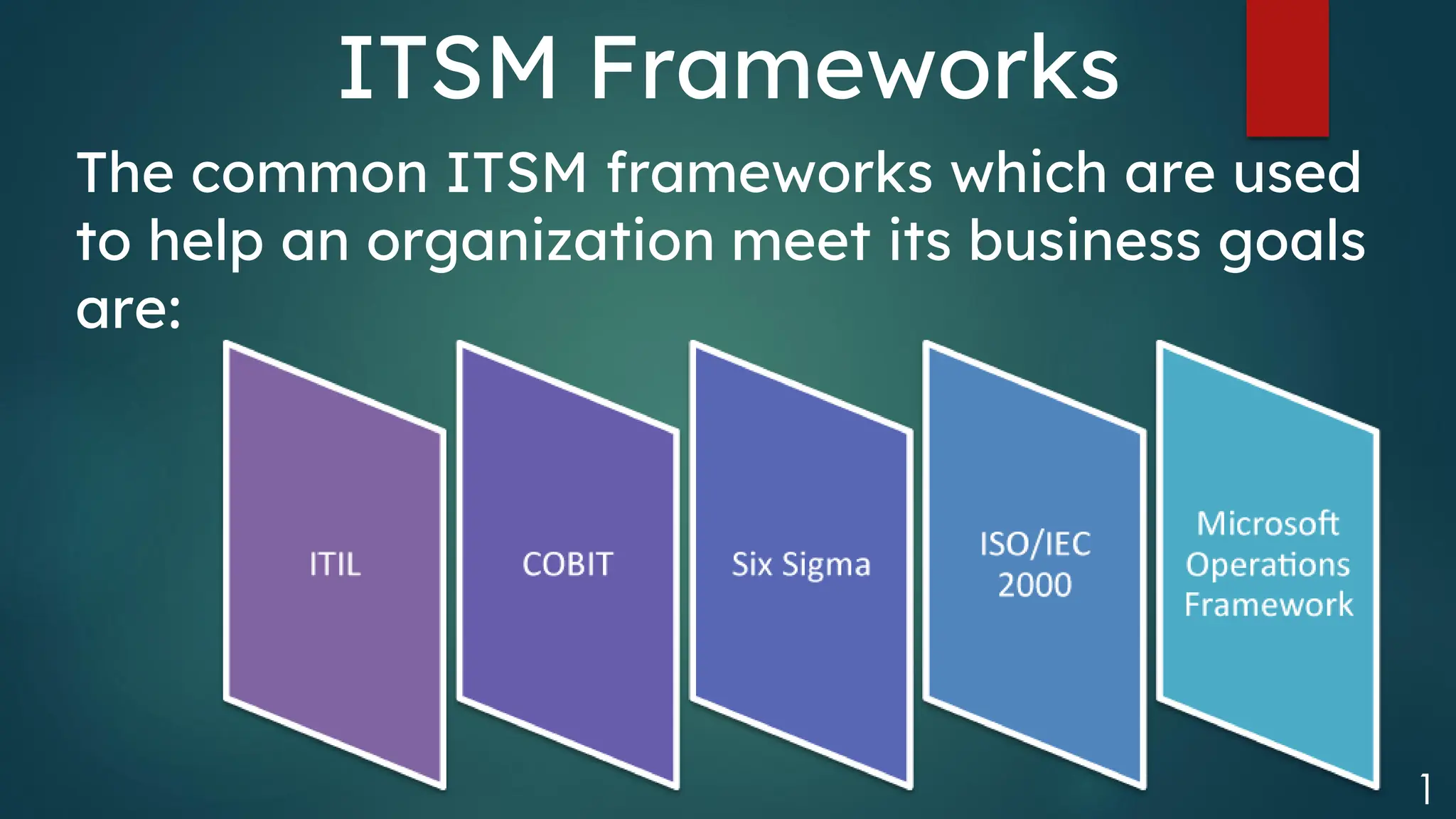
The common ITSM frameworks which are used
to help an organization meet its business goals
are:
2
is a set of detailed practices
for IT service management
(ITSM) that focuses on
aligning IT services with the
needs of business.
3
❑ The Information Technology
Infrastructure Library (ITIL)
is a vital component of the ITSM
framework, and the two terms
are often used interchangeably.
4
ITSM is the actual practice, or
professional discipline, of
managing IT operations as a
service,
ITIL is a set of best practices
that provide guidance for ITSM—
but that just covers the basics.
5
❑ COBIT
is a framework for IT
governance which is used for
developing, implementing,
monitoring and improving the
practices related to IT
governance and management.
6
Why is COBIT important?
The goal of the COBIT framework is to
provide a common language for IT
professionals, business executives
and compliance auditors to communicate
with each other about IT controls, goals,
objectives and outcomes.
7
It is a framework created by
the ISACA (Information Systems
Audit and Control Association) for
IT governance and
management.
8
What is ISACA?
ISACA sets and develops guidance and controls
for information governance, control, security and
audit professionals.
The global organization sponsors and drives the
COBIT framework. ISACA originally stood for
"Information Systems Audit and Control
Association," but the organization now simply
goes by ISACA.
9
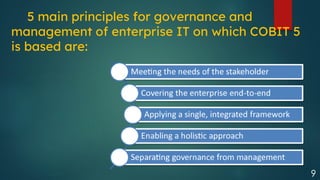
5 main principles for governance and
management of enterprise IT on which COBIT 5
is based are:
10
measuring the defects and
systematically eliminating them
until there are nearly zero
defects.
SIX SIGMA
11
While some managers use Six
Sigma to increase efficiency, the
most successful companies rely on
the system to reduce customer
complaints and product malfunctions.
13
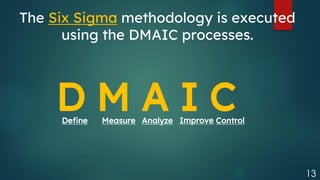
The Six Sigma methodology is executed
using the DMAIC processes.
D M A I C
Define Measure Analyze Improve Control
14
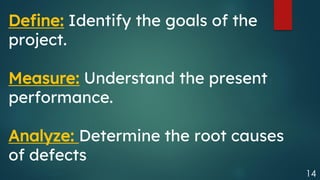
Define: Identify the goals of the
project.
Measure: Understand the present
performance.
Analyze: Determine the root causes
of defects
15
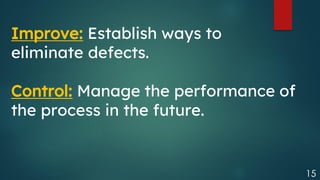
Improve: Establish ways to
eliminate defects.
Control: Manage the performance of
the process in the future.
16
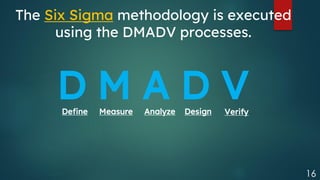
The Six Sigma methodology is executed
using the DMADV processes.
D M A D V
Define Measure Analyze Design Verify
17
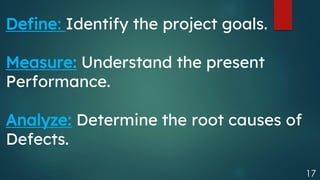
Define: Identify the project goals.
Measure: Understand the present
Performance.
Analyze: Determine the root causes of
Defects.
18
Design: Create a process that
satisfies the needs and expectations
of the customers.
Verify: Make sure that the process
satisfies the customer’s needs and
performs adequately.
19
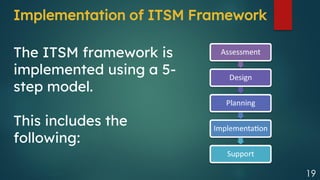
Implementation of ITSM Framework
The ITSM framework is
implemented using a 5-
step model.
This includes the
following:
20
The present state of the IT
infrastructure in the organization
is determined. Based on this,
metrics for improvement are
formulated.
• Assessment
21
Advanced designs are
formulated for the organization
based on the requirements .
▪ Design
22
• Planning
It is important to create
appropriate plans which will help
the business to evolve and grow.
23
• Implementation
The newly developed
frameworks are implemented in
order to ensure future growth.
24
• Support
After the frameworks have been
implemented, it is essential to
provide maintenance, management
and improvement services to all the
IT plans across the organization.
25
Benefits of ITSM
Benefits for both the IT
infrastructure and business are
provided by the implementation
of IT service management in an
organization.
26
Benefits of ITSM for IT
• It provides a better understanding
of the needs of the business and
the reason they are required.
• It is a repeatable and scalable
process
27
• It provides a set of well-defined
roles and responsibilities.
• Implementation of ITSM results in
increased productivity.
• The end users are satisfied as it
provides them with realistic
expectations.
28
• It can prevent IT issues before they
can arise.
• It has the ability to identify the
problems which are repeating
and address them.
• The analytics helps to measure
and improve the performance of
the IT department.
29
Benefits of ITSM for Business
• The IT department can quickly
react to changes and innovations
in the market.
• The availability of IT services and
their performance is better which
allows employees to be more
productive.
30
• Issues relating to IT are not very
common which translates into
lower costs.
• The employees are aware of
the availability of the services
and the procedure to use them.
31

ISE 204 IT Service Management Frameworks.pdf

  • 1.
    1 ITSM Frameworks The commonITSM frameworks which are used to help an organization meet its business goals are:
  • 2.
    2 is a setof detailed practices for IT service management (ITSM) that focuses on aligning IT services with the needs of business.

  • 3.
    3 ❑ The InformationTechnology Infrastructure Library (ITIL) is a vital component of the ITSM framework, and the two terms are often used interchangeably.
  • 4.
    4 ITSM is theactual practice, or professional discipline, of managing IT operations as a service, ITIL is a set of best practices that provide guidance for ITSM— but that just covers the basics.
  • 5.
    5 ❑ COBIT is aframework for IT governance which is used for developing, implementing, monitoring and improving the practices related to IT governance and management.
  • 6.
    6 Why is COBITimportant? The goal of the COBIT framework is to provide a common language for IT professionals, business executives and compliance auditors to communicate with each other about IT controls, goals, objectives and outcomes.
  • 7.
    7 It is aframework created by the ISACA (Information Systems Audit and Control Association) for IT governance and management.
  • 8.
    8 What is ISACA? ISACAsets and develops guidance and controls for information governance, control, security and audit professionals. The global organization sponsors and drives the COBIT framework. ISACA originally stood for "Information Systems Audit and Control Association," but the organization now simply goes by ISACA.
  • 9.
    9 5 main principlesfor governance and management of enterprise IT on which COBIT 5 is based are:
  • 10.
    10 measuring the defectsand systematically eliminating them until there are nearly zero defects. SIX SIGMA
  • 11.
    11 While some managersuse Six Sigma to increase efficiency, the most successful companies rely on the system to reduce customer complaints and product malfunctions.
  • 12.
    13 The Six Sigmamethodology is executed using the DMAIC processes. D M A I C Define Measure Analyze Improve Control
  • 13.
    14 Define: Identify thegoals of the project. Measure: Understand the present performance. Analyze: Determine the root causes of defects
  • 14.
    15 Improve: Establish waysto eliminate defects. Control: Manage the performance of the process in the future.
  • 15.
    16 The Six Sigmamethodology is executed using the DMADV processes. D M A D V Define Measure Analyze Design Verify
  • 16.
    17 Define: Identify theproject goals. Measure: Understand the present Performance. Analyze: Determine the root causes of Defects.
  • 17.
    18 Design: Create aprocess that satisfies the needs and expectations of the customers. Verify: Make sure that the process satisfies the customer’s needs and performs adequately.
  • 18.
    19 Implementation of ITSMFramework The ITSM framework is implemented using a 5- step model. This includes the following:
  • 19.
    20 The present stateof the IT infrastructure in the organization is determined. Based on this, metrics for improvement are formulated. • Assessment
  • 20.
    21 Advanced designs are formulatedfor the organization based on the requirements . ▪ Design
  • 21.
    22 • Planning It isimportant to create appropriate plans which will help the business to evolve and grow.
  • 22.
    23 • Implementation The newlydeveloped frameworks are implemented in order to ensure future growth.
  • 23.
    24 • Support After theframeworks have been implemented, it is essential to provide maintenance, management and improvement services to all the IT plans across the organization.
  • 24.
    25 Benefits of ITSM Benefitsfor both the IT infrastructure and business are provided by the implementation of IT service management in an organization.
  • 25.
    26 Benefits of ITSMfor IT • It provides a better understanding of the needs of the business and the reason they are required. • It is a repeatable and scalable process
  • 26.
    27 • It providesa set of well-defined roles and responsibilities. • Implementation of ITSM results in increased productivity. • The end users are satisfied as it provides them with realistic expectations.
  • 27.
    28 • It canprevent IT issues before they can arise. • It has the ability to identify the problems which are repeating and address them. • The analytics helps to measure and improve the performance of the IT department.
  • 28.
    29 Benefits of ITSMfor Business • The IT department can quickly react to changes and innovations in the market. • The availability of IT services and their performance is better which allows employees to be more productive.
  • 29.
    30 • Issues relatingto IT are not very common which translates into lower costs. • The employees are aware of the availability of the services and the procedure to use them.
  • 30.