Chapter 4
Data and Databases
Learning Objectives
Upon successful completion of this chapter, you will
be able to:
• Describe the differences between data,
information, and technology
• Define the term database and identify the steps
to creating one
• Describe the role of a database management
system
• Describe the characteristics of a
data warehouse
• Define data mining and describe its
role in an organization
Data, Information, and Knowledge
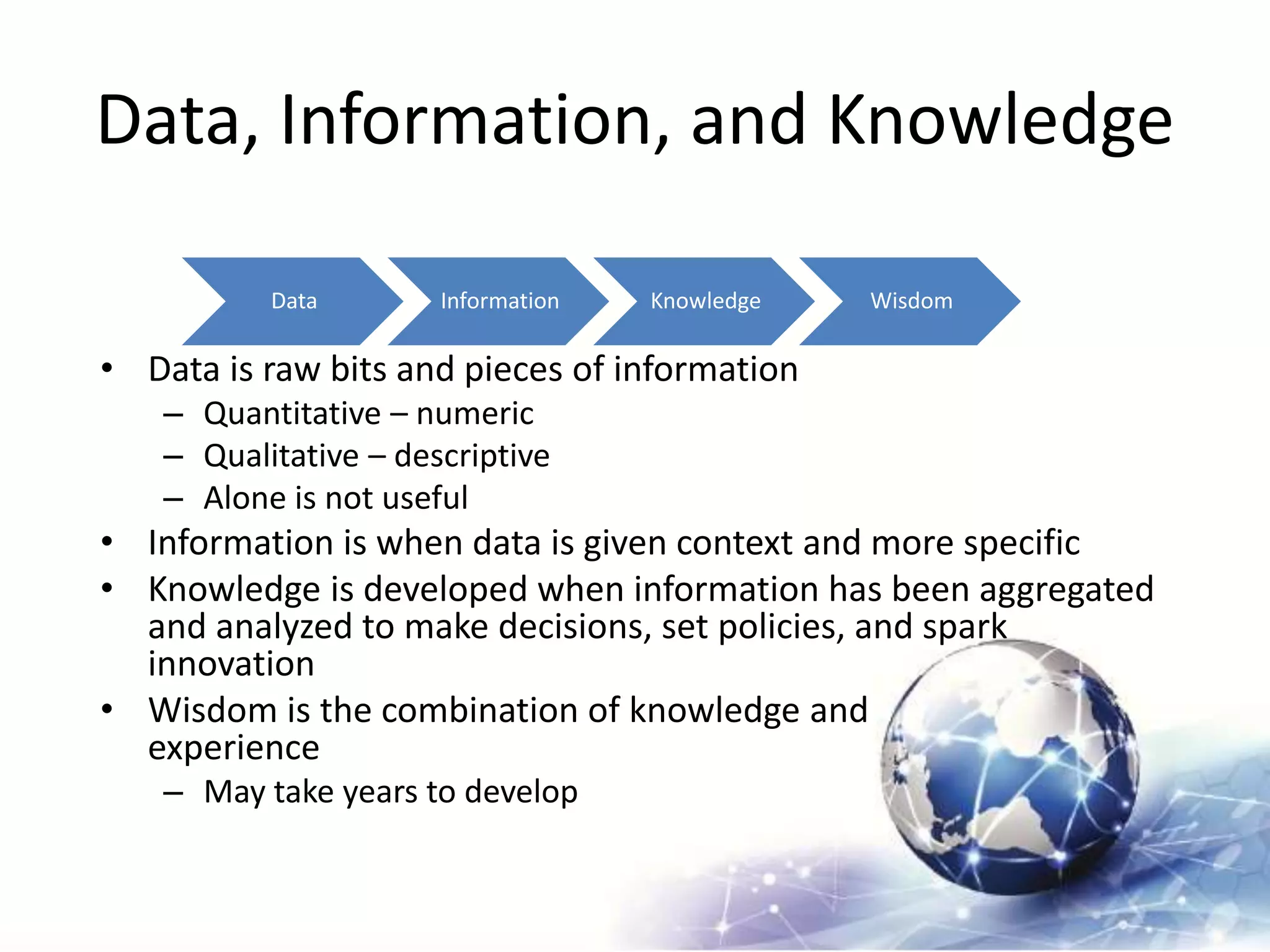
• Data is raw bits and pieces of information
– Quantitative – numeric
– Qualitative – descriptive
– Alone is not useful
• Information is when data is given context and more specific
• Knowledge is developed when information has been aggregated
and analyzed to make decisions, set policies, and spark
innovation
• Wisdom is the combination of knowledge and
experience
– May take years to develop
Data Information Knowledge Wisdom
Databases
• Organized collection of related information to generate
knowledge for decision making purposes
– For example, a university transcript database may contain
information on students, classes taken, and grades
received
• A separate university database would be created to
maintain your financial information
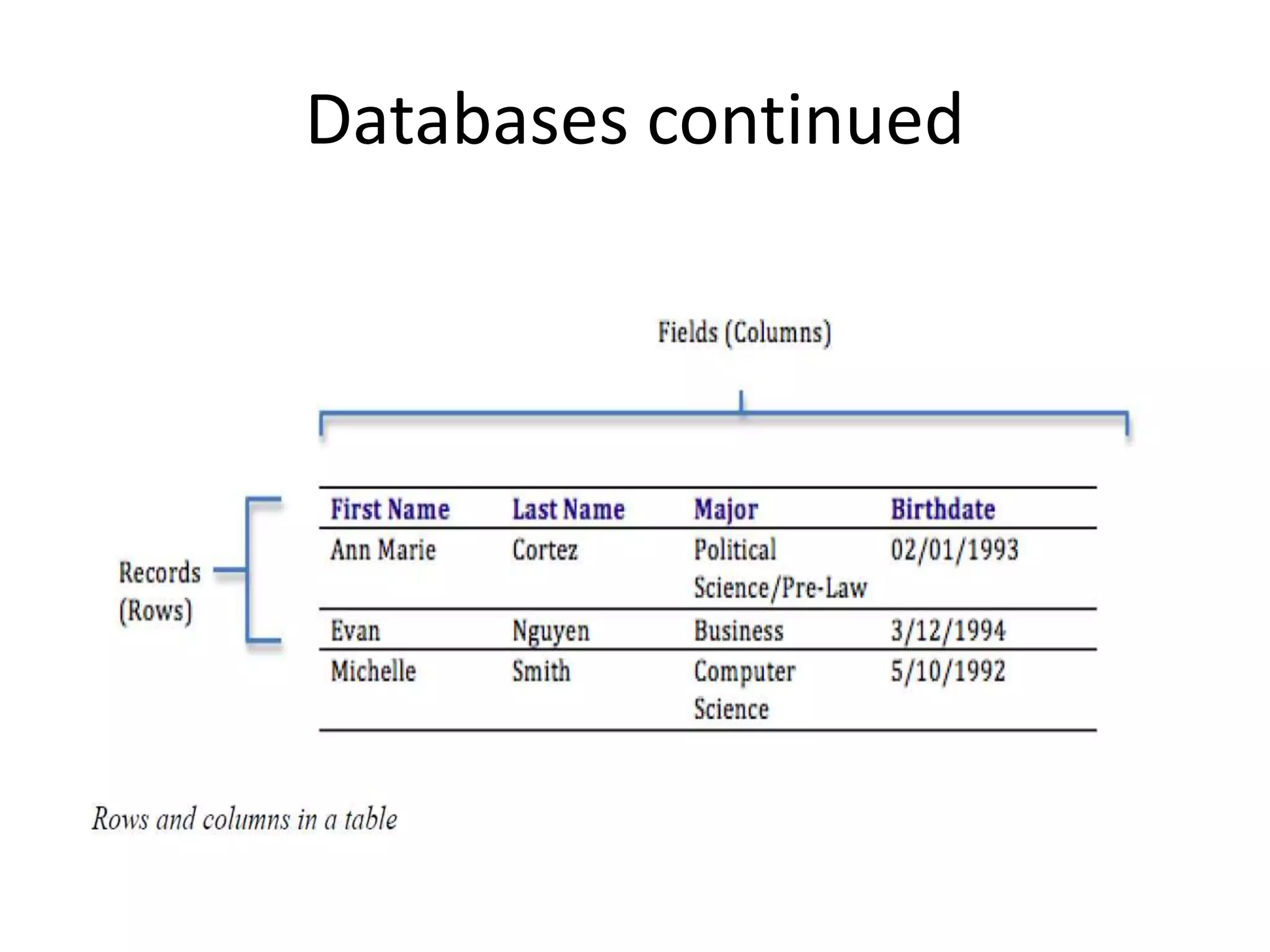
• Relational databases (such as Microsoft Access) where
data in organized into one or more tables
– Tables are a collection of fields
• E.g., Student ID, Course ID, Grade Earned
– Record is an instance in the table
• E.g., your specific information in the table
Databases continued
Database Design
• Design is a critical first step in creating a database
– Understand the goal of how the database will be used
– Identify the data needed as part of accomplishing this
goal
– Identify how the data is related to each other
– Identify tables and fields to organize the data
• Each table needs a primary key of which
field(s) is unique to each record and
will not change
– For example, our Bronco ID
• Normalization is performed to eliminate
duplicated data
Database Design
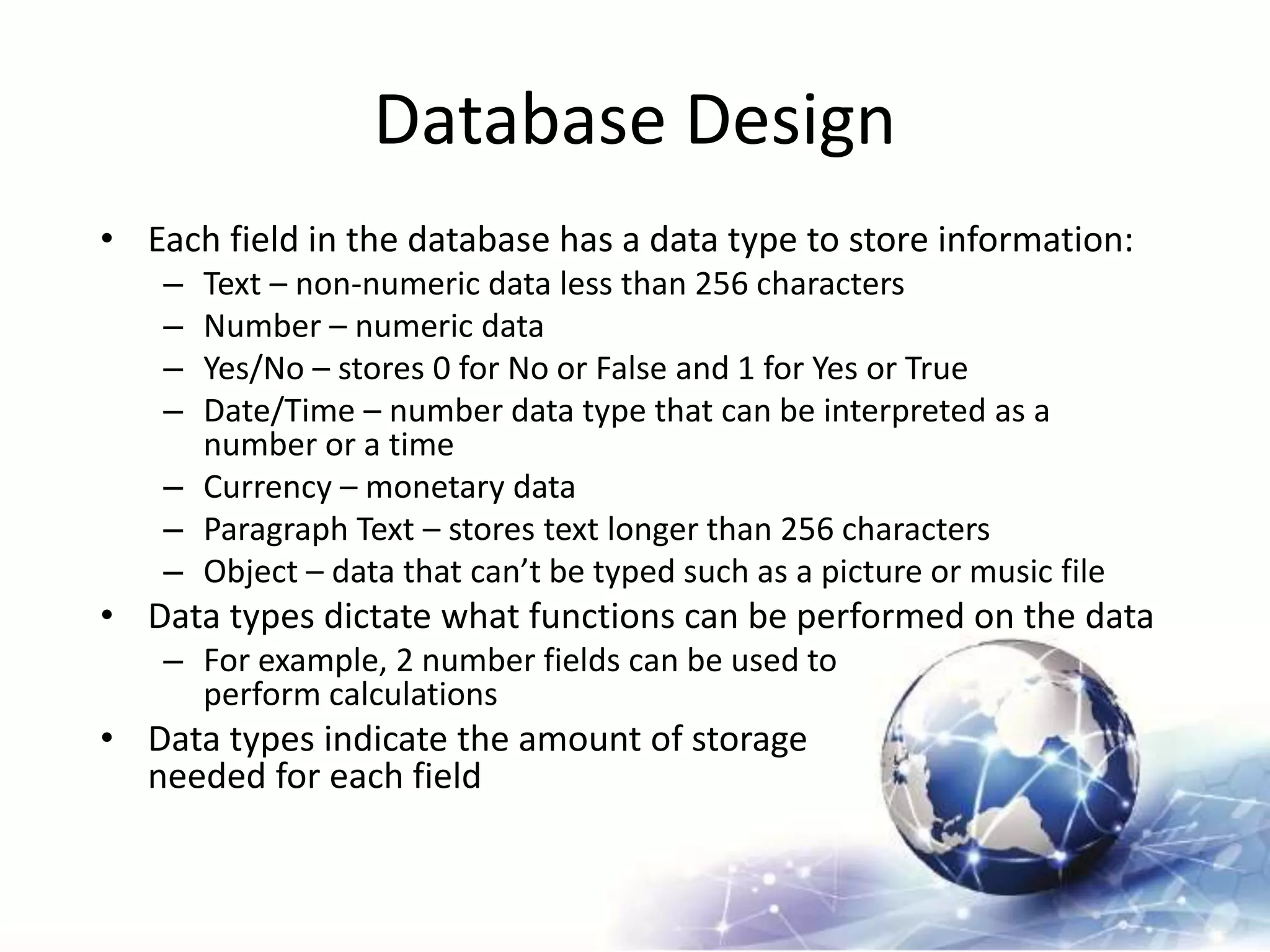
• Each field in the database has a data type to store information:
– Text – non-numeric data less than 256 characters
– Number – numeric data
– Yes/No – stores 0 for No or False and 1 for Yes or True
– Date/Time – number data type that can be interpreted as a
number or a time
– Currency – monetary data
– Paragraph Text – stores text longer than 256 characters
– Object – data that can’t be typed such as a picture or music file
• Data types dictate what functions can be performed on the data
– For example, 2 number fields can be used to
perform calculations
• Data types indicate the amount of storage
needed for each field
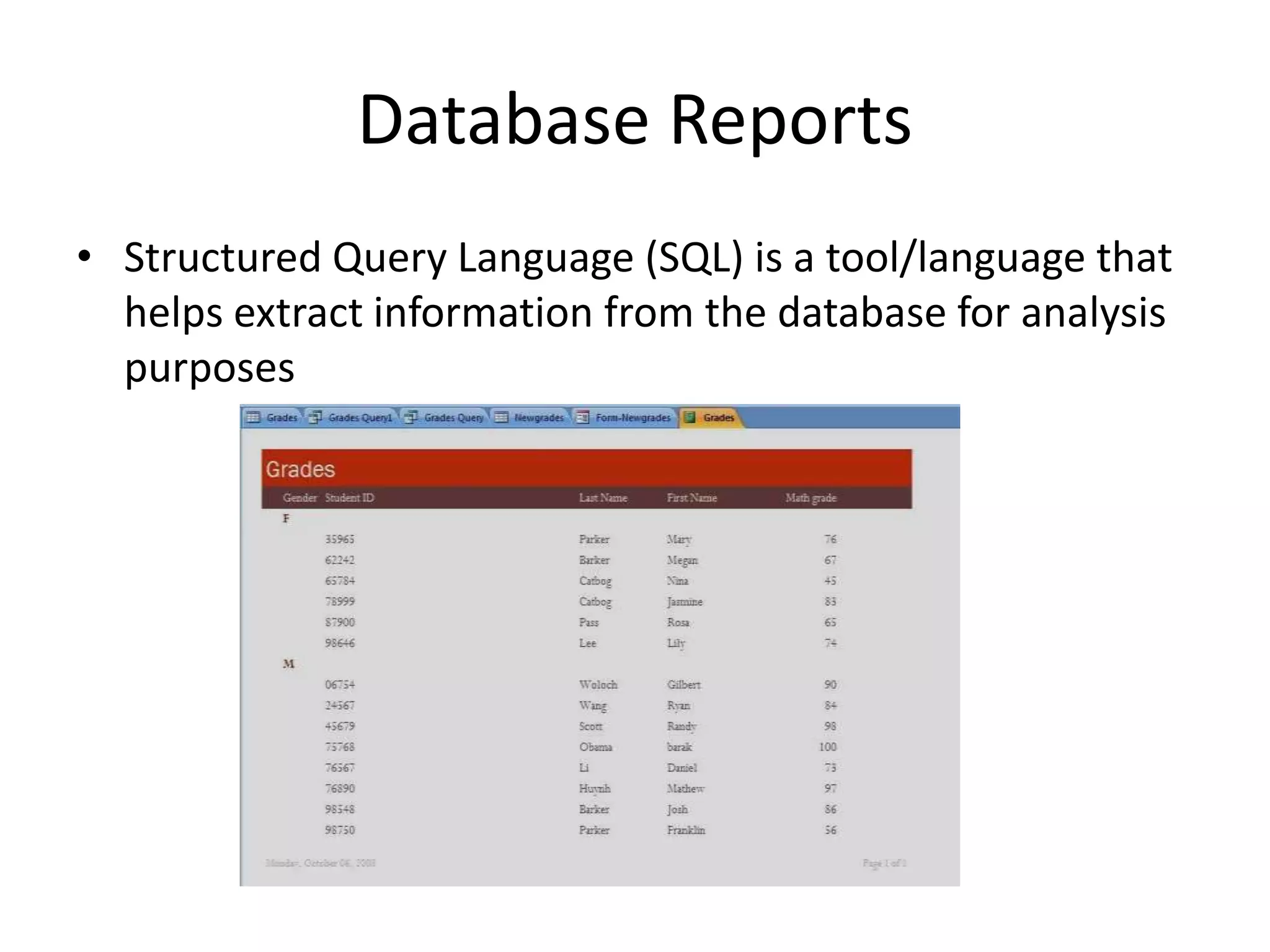
Database Reports
• Structured Query Language (SQL) is a tool/language that
helps extract information from the database for analysis
purposes
Other Database Types
• Hierarchical - parent/child relationship between data
• Document-centric – places data into documents that
can be manipulated
• NoSQL – usually on multiple machines
and, in some cases, machines in
multiple data centers
Business
Classes
Accounting
ACC207 ACC208
Computer
Information
Systems
CIS101 CIS310
Finance
FRL300 FRL 301
Database Management Systems
• Database Management Systems (DBMS) is an
application that allows data to be:
– Entered, Modified, and Deleted
– Read
– Reported
• Has a user friendly interface to design the database
• Relational databases use Microsoft Access installed on
one machine with one user access at a time
• Enterprise Databases serve the entire
organization
Data Warehouse
• Consists of extracts from one or more of the
organization’s databases
• Allows the data to be copied and stored for analysis
– Needs to be refreshed as the data changes
• Data is time-stamped when extracted
– Allows comparisons between different time periods
• Data is standardized
– All similar fields (e.g., calendar dates) are structured the
same
• Date is MM/DD/YYYY
• Data marts are smaller subsets of
data warehouses for specific business
problems
Data Warehouse Benefits
• Forces organizations to better understand the
data
• Centralized view of data to identify inconsistent
data
• Once inconsistencies are resolved, higher quality
data is used to make better business decisions
• Data can be analyzed over multiple
time periods
• Tools are available to combine
data and gain more insight into
business operations
Data Mining
• Automated process of analyzing data
– To find previously unknown trends, patterns, and
associations
– To make better business decisions
• Starts with a hypothetical result in mind
• Privacy concerns
– Easier to combine disparate sources of information and when
aggregated tell you much more about the individual
– Data brokers now to sell this information
• Business intelligence – collecting and
analyzing information to increase their
competitive advantage
• Business analytics – uses internal
company data to improve business
processes and practices
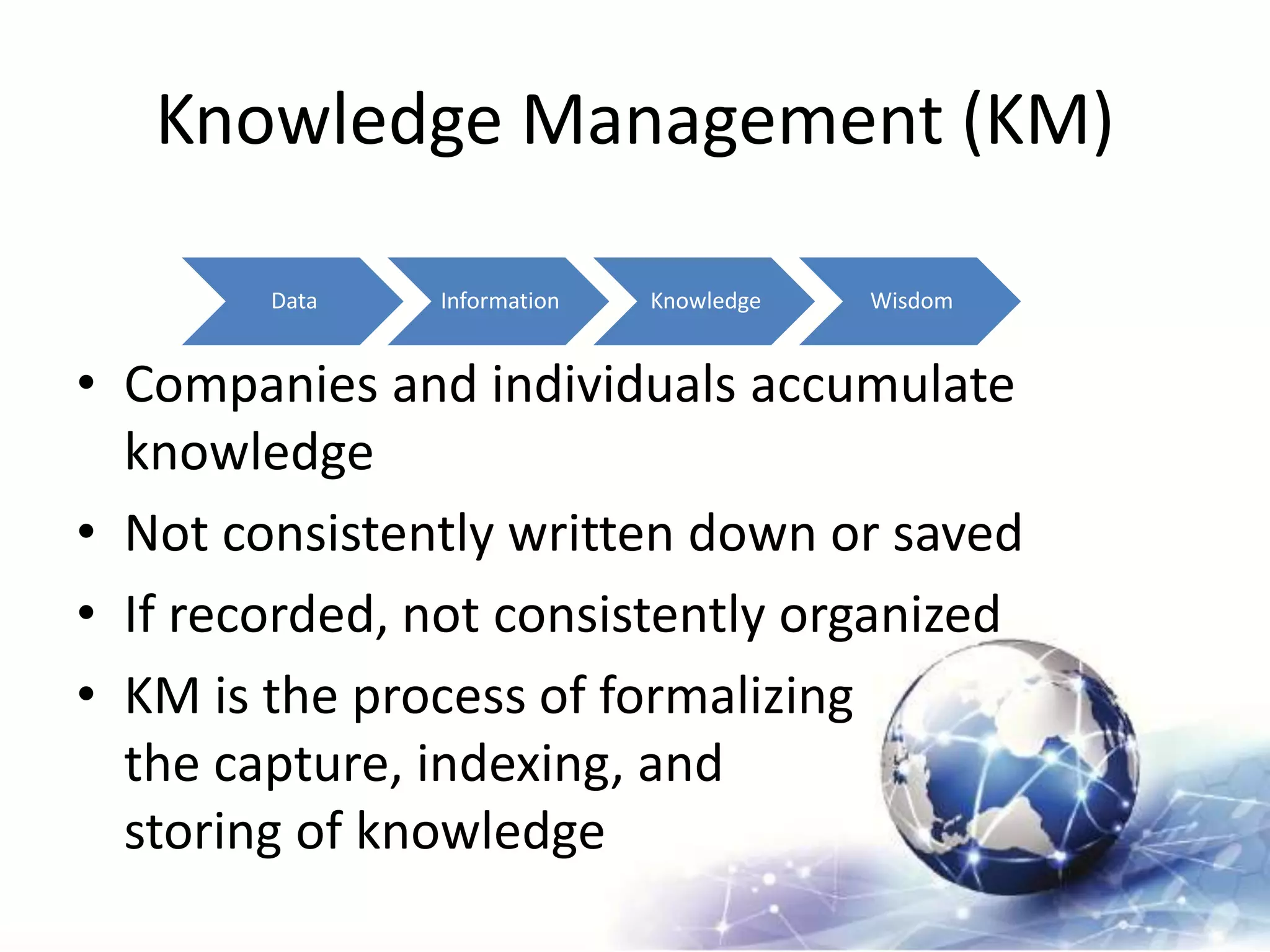
Knowledge Management (KM)
• Companies and individuals accumulate
knowledge
• Not consistently written down or saved
• If recorded, not consistently organized
• KM is the process of formalizing
the capture, indexing, and
storing of knowledge
Data Information Knowledge Wisdom
Summary
• Described the differences between data,
information, and technology
• Defined the term database and identify the steps
to creating one
• Described the role of a database management
system
• Described the characteristics of a data warehouse
• Defined data mining and describe
its role in an organization

ISBB_Chapter4.pptx

  • 1.
  • 2.
    Learning Objectives Upon successfulcompletion of this chapter, you will be able to: • Describe the differences between data, information, and technology • Define the term database and identify the steps to creating one • Describe the role of a database management system • Describe the characteristics of a data warehouse • Define data mining and describe its role in an organization
  • 3.
    Data, Information, andKnowledge • Data is raw bits and pieces of information – Quantitative – numeric – Qualitative – descriptive – Alone is not useful • Information is when data is given context and more specific • Knowledge is developed when information has been aggregated and analyzed to make decisions, set policies, and spark innovation • Wisdom is the combination of knowledge and experience – May take years to develop Data Information Knowledge Wisdom
  • 4.
    Databases • Organized collectionof related information to generate knowledge for decision making purposes – For example, a university transcript database may contain information on students, classes taken, and grades received • A separate university database would be created to maintain your financial information • Relational databases (such as Microsoft Access) where data in organized into one or more tables – Tables are a collection of fields • E.g., Student ID, Course ID, Grade Earned – Record is an instance in the table • E.g., your specific information in the table
  • 5.
  • 6.
    Database Design • Designis a critical first step in creating a database – Understand the goal of how the database will be used – Identify the data needed as part of accomplishing this goal – Identify how the data is related to each other – Identify tables and fields to organize the data • Each table needs a primary key of which field(s) is unique to each record and will not change – For example, our Bronco ID • Normalization is performed to eliminate duplicated data
  • 7.
    Database Design • Eachfield in the database has a data type to store information: – Text – non-numeric data less than 256 characters – Number – numeric data – Yes/No – stores 0 for No or False and 1 for Yes or True – Date/Time – number data type that can be interpreted as a number or a time – Currency – monetary data – Paragraph Text – stores text longer than 256 characters – Object – data that can’t be typed such as a picture or music file • Data types dictate what functions can be performed on the data – For example, 2 number fields can be used to perform calculations • Data types indicate the amount of storage needed for each field
  • 8.
    Database Reports • StructuredQuery Language (SQL) is a tool/language that helps extract information from the database for analysis purposes
  • 9.
    Other Database Types •Hierarchical - parent/child relationship between data • Document-centric – places data into documents that can be manipulated • NoSQL – usually on multiple machines and, in some cases, machines in multiple data centers Business Classes Accounting ACC207 ACC208 Computer Information Systems CIS101 CIS310 Finance FRL300 FRL 301
  • 10.
    Database Management Systems •Database Management Systems (DBMS) is an application that allows data to be: – Entered, Modified, and Deleted – Read – Reported • Has a user friendly interface to design the database • Relational databases use Microsoft Access installed on one machine with one user access at a time • Enterprise Databases serve the entire organization
  • 11.
    Data Warehouse • Consistsof extracts from one or more of the organization’s databases • Allows the data to be copied and stored for analysis – Needs to be refreshed as the data changes • Data is time-stamped when extracted – Allows comparisons between different time periods • Data is standardized – All similar fields (e.g., calendar dates) are structured the same • Date is MM/DD/YYYY • Data marts are smaller subsets of data warehouses for specific business problems
  • 12.
    Data Warehouse Benefits •Forces organizations to better understand the data • Centralized view of data to identify inconsistent data • Once inconsistencies are resolved, higher quality data is used to make better business decisions • Data can be analyzed over multiple time periods • Tools are available to combine data and gain more insight into business operations
  • 13.
    Data Mining • Automatedprocess of analyzing data – To find previously unknown trends, patterns, and associations – To make better business decisions • Starts with a hypothetical result in mind • Privacy concerns – Easier to combine disparate sources of information and when aggregated tell you much more about the individual – Data brokers now to sell this information • Business intelligence – collecting and analyzing information to increase their competitive advantage • Business analytics – uses internal company data to improve business processes and practices
  • 14.
    Knowledge Management (KM) •Companies and individuals accumulate knowledge • Not consistently written down or saved • If recorded, not consistently organized • KM is the process of formalizing the capture, indexing, and storing of knowledge Data Information Knowledge Wisdom
  • 15.
    Summary • Described thedifferences between data, information, and technology • Defined the term database and identify the steps to creating one • Described the role of a database management system • Described the characteristics of a data warehouse • Defined data mining and describe its role in an organization