COMMITTED TO EQUITY AND EXCELLENCE IN EDUCATION
Pathways to Thinking
1
Session 1
01
COMMITTED TO EQUITY AND EXCELLENCE IN EDUCATION
Thinking as a Skill
Phase 1
2
02
COMMITTED TO EQUITY AND EXCELLENCE IN EDUCATION
Four Corners
3
03
COMMITTED TO EQUITY AND EXCELLENCE IN EDUCATION
A person’s IQ or intelligence is
fixed at birth so teaching thinking
as a skill is not very effective
4
04
COMMITTED TO EQUITY AND EXCELLENCE IN EDUCATION
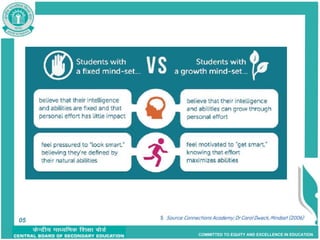
5
05
COMMITTED TO EQUITY AND EXCELLENCE IN EDUCATION
In order to develop thinking
skills, we must increase the
difficulty level of the syllabus
6
06
COMMITTED TO EQUITY AND EXCELLENCE IN EDUCATION
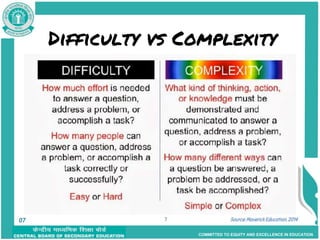
Difficulty vs Complexity
7
07
COMMITTED TO EQUITY AND EXCELLENCE IN EDUCATION
Critical thinking skills and creative
thinking skills are completely
different from each other
8
08
COMMITTED TO EQUITY AND EXCELLENCE IN EDUCATION
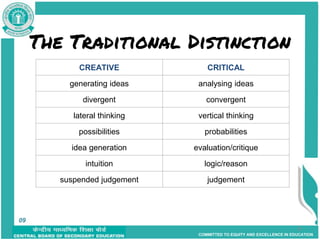
The Traditional Distinction
9
09
CREATIVE CRITICAL
generating ideas analysing ideas
divergent convergent
lateral thinking vertical thinking
possibilities probabilities
idea generation evaluation/critique
intuition logic/reason
suspended judgement judgement
COMMITTED TO EQUITY AND EXCELLENCE IN EDUCATION
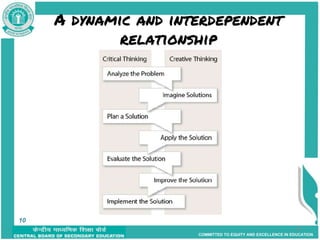
A dynamic and interdependent
relationship
10
10
COMMITTED TO EQUITY AND EXCELLENCE IN EDUCATION
11
Critical thinking is more important
than creative thinking in the
classroom
11
COMMITTED TO EQUITY AND EXCELLENCE IN EDUCATION
The Significance
of Thinking
Phase 2
12
12
COMMITTED TO EQUITY AND EXCELLENCE IN EDUCATION
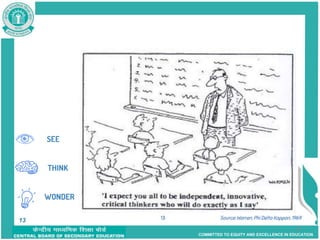
13
13
COMMITTED TO EQUITY AND EXCELLENCE IN EDUCATION
14
Why do we need critical
thinking in classrooms?
14
COMMITTED TO EQUITY AND EXCELLENCE IN EDUCATION
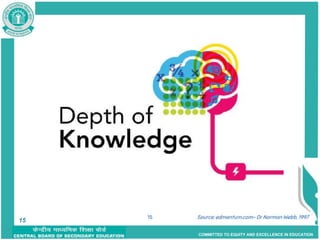
15
15
COMMITTED TO EQUITY AND EXCELLENCE IN EDUCATION
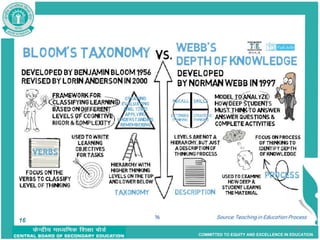
16
16
COMMITTED TO EQUITY AND EXCELLENCE IN EDUCATION
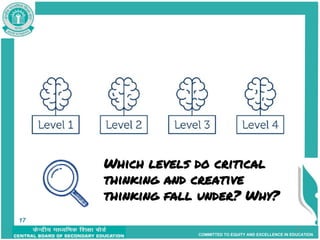
17
Which levels do critical
thinking and creative
thinking fall under? Why?
17
COMMITTED TO EQUITY AND EXCELLENCE IN EDUCATION
The Building Blocks of
Logical Reasoning
18
Session 2
18
COMMITTED TO EQUITY AND EXCELLENCE IN EDUCATION
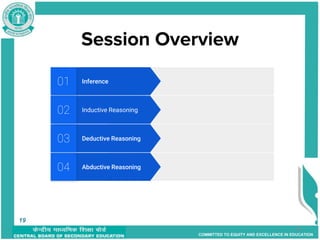
Session Overview
19
19
Deductive Reasoning
03
Inductive Reasoning
02
Inference
01
04 Abductive Reasoning
COMMITTED TO EQUITY AND EXCELLENCE IN EDUCATION
Inference
20
Knowing the unknown from the known
20
COMMITTED TO EQUITY AND EXCELLENCE IN EDUCATION
21
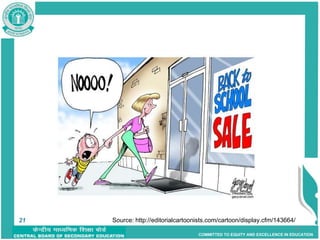
Source: http://editorialcartoonists.com/cartoon/display.cfm/143664/
21
COMMITTED TO EQUITY AND EXCELLENCE IN EDUCATION
Inference refers to the logical process in
which new conclusions are arrived at from
the given premises.
It is a method of creating new knowledge
from prior or given knowledge.
22
22
COMMITTED TO EQUITY AND EXCELLENCE IN EDUCATION
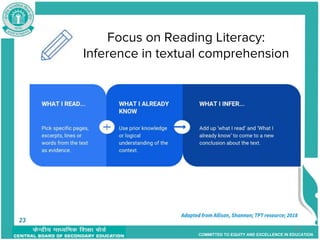
Focus on Reading Literacy:
Inference in textual comprehension
23
23
COMMITTED TO EQUITY AND EXCELLENCE IN EDUCATION
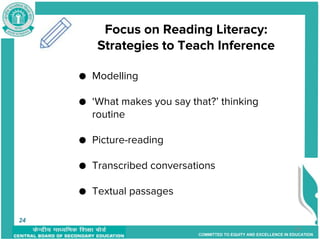
Focus on Reading Literacy:
Strategies to Teach Inference
24
● Modelling
● ‘What makes you say that?’ thinking
routine
● Picture-reading
● Transcribed conversations
● Textual passages
24
COMMITTED TO EQUITY AND EXCELLENCE IN EDUCATION
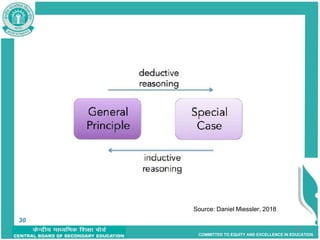
Inductive Reasoning
From specific to general...
25
25
COMMITTED TO EQUITY AND EXCELLENCE IN EDUCATION
26
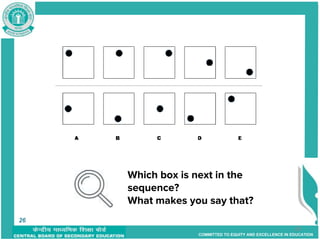
Which box is next in the
sequence?
What makes you say that?
26
COMMITTED TO EQUITY AND EXCELLENCE IN EDUCATION
27
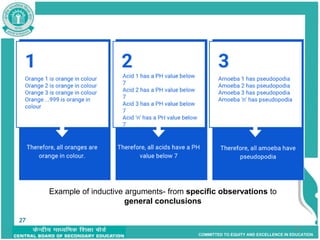
Example of inductive arguments- from specific observations to
general conclusions
27
COMMITTED TO EQUITY AND EXCELLENCE IN EDUCATION
28
Focus on scientific literacy:
Inductive arguments in scientific
generalizations
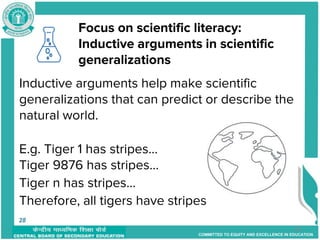
Inductive arguments help make scientific
generalizations that can predict or describe the
natural world.
E.g. Tiger 1 has stripes...
Tiger 9876 has stripes...
Tiger n has stripes...
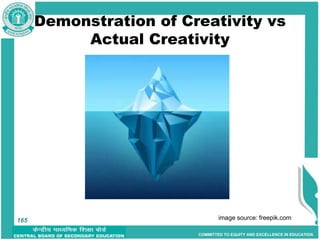
Therefore, all tigers have stripes
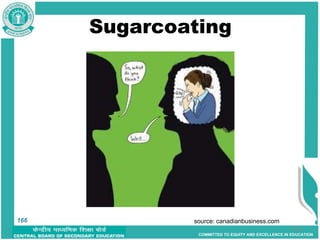
28
COMMITTED TO EQUITY AND EXCELLENCE IN EDUCATION
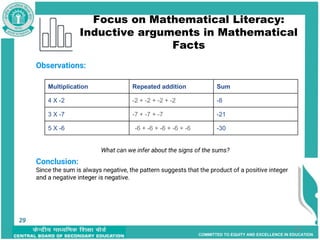
Focus on Mathematical Literacy:
Inductive arguments in Mathematical
Facts
29
Multiplication Repeated addition Sum
4 X -2 -2 + -2 + -2 + -2 -8
3 X -7 -7 + -7 + -7 -21
5 X -6 -6 + -6 + -6 + -6 + -6 -30
29
COMMITTED TO EQUITY AND EXCELLENCE IN EDUCATION
30
Source: Daniel Miessler, 2018
30
COMMITTED TO EQUITY AND EXCELLENCE IN EDUCATION
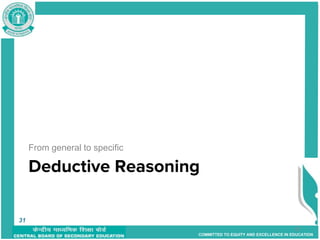
Deductive Reasoning
From general to specific
31
31
COMMITTED TO EQUITY AND EXCELLENCE IN EDUCATION
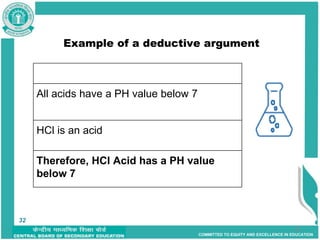
Example of a deductive argument
32
All acids have a PH value below 7
HCl is an acid
Therefore, HCl Acid has a PH value
below 7
32
COMMITTED TO EQUITY AND EXCELLENCE IN EDUCATION
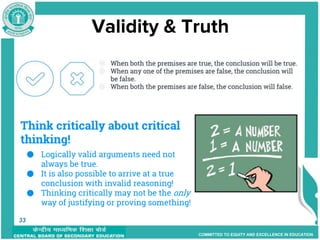
Validity & Truth
33
33
COMMITTED TO EQUITY AND EXCELLENCE IN EDUCATION
Focus on Scientific, Mathematical & Reading
Literacy
34
34
COMMITTED TO EQUITY AND EXCELLENCE IN EDUCATION
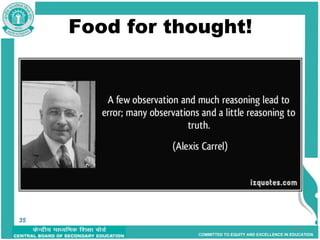
Food for thought!
35
35
COMMITTED TO EQUITY AND EXCELLENCE IN EDUCATION
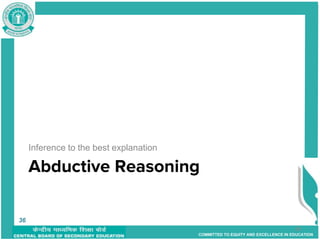
Abductive Reasoning
36
Inference to the best explanation
36
COMMITTED TO EQUITY AND EXCELLENCE IN EDUCATION
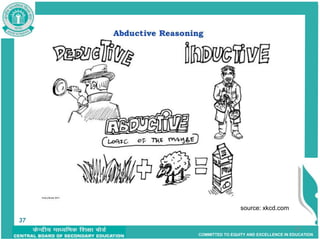
37
source: xkcd.com
37
COMMITTED TO EQUITY AND EXCELLENCE IN EDUCATION
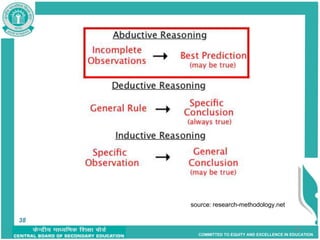
38
source: research-methodology.net
38
COMMITTED TO EQUITY AND EXCELLENCE IN EDUCATION
39
Session 3
Fun with
Fallacies!
39
COMMITTED TO EQUITY AND EXCELLENCE IN EDUCATION
A belief about a premise that is held to be true and certain
although there is no evidence to support it
40
ASSUMPTIONS
A belief about a premise that is held to be true and
certain although there is no evidence to support it
40
COMMITTED TO EQUITY AND EXCELLENCE IN EDUCATION
41
Types of Assumptions
Necessary Assumption
An assumption that is necessary for a
conclusion to be true.
In the following argument the
necessary assumption is that Socrates
was born once, because only those are
born can die.
Eg. Socrates is a man
All men are mortal
Therefore, Socrates is mortal
Sufficient Assumption
An assumption that would prove the
conclusion to be true but is not
necessary.
In the same argument the sufficient
assumption is that a man is a type of
human being- it is sufficient to prove
the conclusion, because all human
beings die, but not necessary because
there are other mortals besides human
beings.
41
COMMITTED TO EQUITY AND EXCELLENCE IN EDUCATION
42
The Devil’s Advocate!
42
COMMITTED TO EQUITY AND EXCELLENCE IN EDUCATION
43
It is a hot August afternoon. The location is the living room in
an old bungalow in Bomba. The 7 foot window is open and the
curtains are blowing in the breeze generated by the
thunderstorm that just passed through the area. On the floor
are the bodies of Bill and Mary. They are surrounded by
puddles of water and broken glass. Neither Bill nor Mary has
clothing on. How did they die?
43 Source: Mike Fellows, ENS Institute
43
COMMITTED TO EQUITY AND EXCELLENCE IN EDUCATION
44
A man is walking down the street, sees a
restaurant and enters. He asks the waiter
for a glass of water. The waiter pulls out a
gun and points it at him. The man says
thank you and leaves the restaurant. What
happened?
44 Source: Mike Fellows, ENS Institute
44
COMMITTED TO EQUITY AND EXCELLENCE IN EDUCATION
45
There is a cabin on the side of a
mountain. Three people are inside;
they are dead. How did they die?
45 Source: Mike Fellows, ENS Institute
45
COMMITTED TO EQUITY AND EXCELLENCE IN EDUCATION
46
46
COMMITTED TO EQUITY AND EXCELLENCE IN EDUCATION
47
Focus on Scientific Literacy:
The Assumptions of Science
▪ Nature is orderly, and the laws of nature describe
its order
▪ Nature is intelligible and understandable by us
▪ All phenomena have natural causes
47
COMMITTED TO EQUITY AND EXCELLENCE IN EDUCATION
48
Focus on Mathematical Literacy:
The Assumptions of Mathematics
▪ Euclid’s axioms
▪ First Axiom: Things which are equal to the same thing are also
equal to one another.
▪ Second Axiom: If equals are added to equals, the whole are equal.
▪ Third Axiom: If equals be subtracted from equals, the remainders
are equal.
▪ Fourth Axiom: Things which coincide with one another are equal
to one another.
▪ Fifth Axiom: The whole is greater than the part.
48
COMMITTED TO EQUITY AND EXCELLENCE IN EDUCATION
49
The Parallel Postulate
A Case Study
49
COMMITTED TO EQUITY AND EXCELLENCE IN EDUCATION
50
Rocket-Writing
Why is it important to check
assumptions?
50
COMMITTED TO EQUITY AND EXCELLENCE IN EDUCATION
51
FALLACIES
Fallacies are errors or wrong moves in reasoning.
Fallacies may made deliberately made to mislead
others, or can be made out of ignorance.
51
COMMITTED TO EQUITY AND EXCELLENCE IN EDUCATION
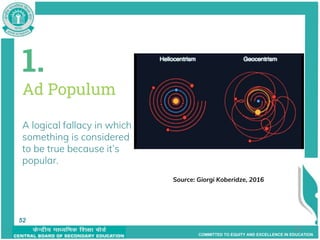
52
1.
Ad Populum
A logical fallacy in which
something is considered
to be true because it’s
popular.
Source: Giorgi Koberidze, 2016
52
COMMITTED TO EQUITY AND EXCELLENCE IN EDUCATION
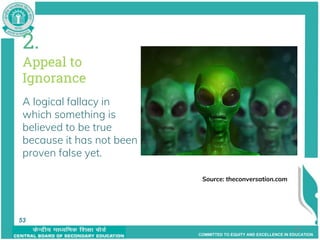
53
2.
Appeal to
Ignorance
A logical fallacy in
which something is
believed to be true
because it has not been
proven false yet.
Source: theconversation.com
53
COMMITTED TO EQUITY AND EXCELLENCE IN EDUCATION
54
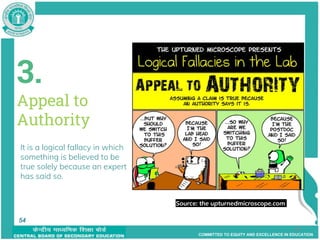
3.
Appeal to
Authority
It is a logical fallacy in which
something is believed to be
true solely because an expert
has said so.
Source: the upturnedmicroscope.com
54
COMMITTED TO EQUITY AND EXCELLENCE IN EDUCATION
55
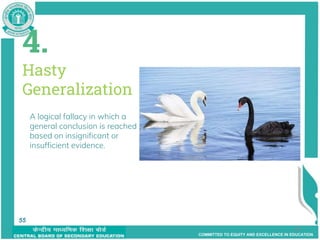
4.
Hasty
Generalization
A logical fallacy in which a
general conclusion is reached
based on insignificant or
insufficient evidence.
55
COMMITTED TO EQUITY AND EXCELLENCE IN EDUCATION
56
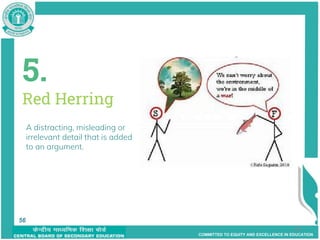
5.
Red Herring
A distracting, misleading or
irrelevant detail that is added
to an argument.
56
COMMITTED TO EQUITY AND EXCELLENCE IN EDUCATION
57
57
COMMITTED TO EQUITY AND EXCELLENCE IN EDUCATION
58
THE CREATIVE
BUILDING BLOCKS OF
Problem-Solving 58
Session 4
58
COMMITTED TO EQUITY AND EXCELLENCE IN EDUCATION
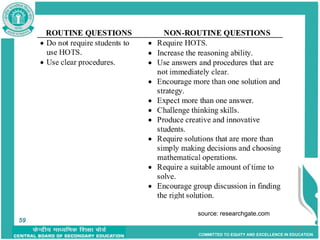
59
source: researchgate.com
59
COMMITTED TO EQUITY AND EXCELLENCE IN EDUCATION
60
Explanations
A reason or justification given for a claim or belief 1
60
COMMITTED TO EQUITY AND EXCELLENCE IN EDUCATION
61
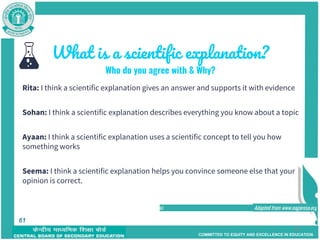
What is a scientific explanation?
Who do you agree with & Why?
Rita: I think a scientific explanation gives an answer and supports it with evidence
Sohan: I think a scientific explanation describes everything you know about a topic
Ayaan: I think a scientific explanation uses a scientific concept to tell you how
something works
Seema: I think a scientific explanation helps you convince someone else that your
opinion is correct.
61 Adapted from www.nagaresa.org
61
COMMITTED TO EQUITY AND EXCELLENCE IN EDUCATION
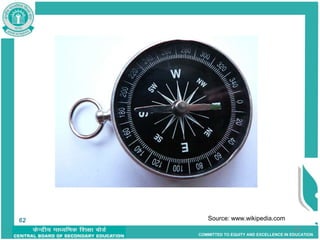
62
Source: www.wikipedia.com
62
COMMITTED TO EQUITY AND EXCELLENCE IN EDUCATION
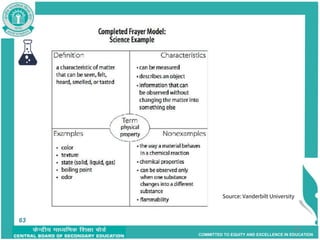
63
63
COMMITTED TO EQUITY AND EXCELLENCE IN EDUCATION
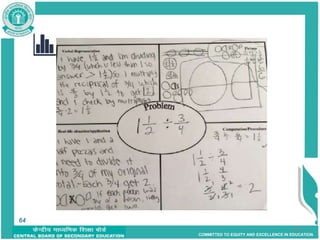
64
64
COMMITTED TO EQUITY AND EXCELLENCE IN EDUCATION
65
65
COMMITTED TO EQUITY AND EXCELLENCE IN EDUCATION
66
66
COMMITTED TO EQUITY AND EXCELLENCE IN EDUCATION
67
67
COMMITTED TO EQUITY AND EXCELLENCE IN EDUCATION
68
68
COMMITTED TO EQUITY AND EXCELLENCE IN EDUCATION
69
69
COMMITTED TO EQUITY AND EXCELLENCE IN EDUCATION
70
70
COMMITTED TO EQUITY AND EXCELLENCE IN EDUCATION
71
71
COMMITTED TO EQUITY AND EXCELLENCE IN EDUCATION
72
72
COMMITTED TO EQUITY AND EXCELLENCE IN EDUCATION
73
73
COMMITTED TO EQUITY AND EXCELLENCE IN EDUCATION
74
74
COMMITTED TO EQUITY AND EXCELLENCE IN EDUCATION
75
75
COMMITTED TO EQUITY AND EXCELLENCE IN EDUCATION
76
76
COMMITTED TO EQUITY AND EXCELLENCE IN EDUCATION
77
77
COMMITTED TO EQUITY AND EXCELLENCE IN EDUCATION
78
Session 5
78
COMMITTED TO EQUITY AND EXCELLENCE IN EDUCATION
79
79
COMMITTED TO EQUITY AND EXCELLENCE IN EDUCATION
80
80
COMMITTED TO EQUITY AND EXCELLENCE IN EDUCATION
81
81
COMMITTED TO EQUITY AND EXCELLENCE IN EDUCATION
82
82
COMMITTED TO EQUITY AND EXCELLENCE IN EDUCATION
83
83
COMMITTED TO EQUITY AND EXCELLENCE IN EDUCATION
84
84
COMMITTED TO EQUITY AND EXCELLENCE IN EDUCATION
85
85
COMMITTED TO EQUITY AND EXCELLENCE IN EDUCATION
86
86
COMMITTED TO EQUITY AND EXCELLENCE IN EDUCATION
87
87
COMMITTED TO EQUITY AND EXCELLENCE IN EDUCATION
88
88
COMMITTED TO EQUITY AND EXCELLENCE IN EDUCATION
89
89
COMMITTED TO EQUITY AND EXCELLENCE IN EDUCATION
90
90
COMMITTED TO EQUITY AND EXCELLENCE IN EDUCATION
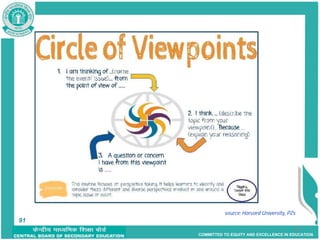
91
91
COMMITTED TO EQUITY AND EXCELLENCE IN EDUCATION
92
Session 6
92
COMMITTED TO EQUITY AND EXCELLENCE IN EDUCATION
93
93
COMMITTED TO EQUITY AND EXCELLENCE IN EDUCATION
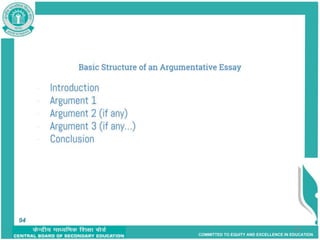
94
94
COMMITTED TO EQUITY AND EXCELLENCE IN EDUCATION
95
95
COMMITTED TO EQUITY AND EXCELLENCE IN EDUCATION
96
96
COMMITTED TO EQUITY AND EXCELLENCE IN EDUCATION
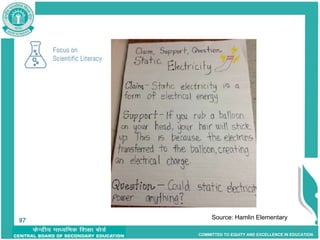
97
Source: Hamlin Elementary
97
COMMITTED TO EQUITY AND EXCELLENCE IN EDUCATION
98
98
COMMITTED TO EQUITY AND EXCELLENCE IN EDUCATION
99
99
Argumentation
Challenge
for reading, scientific and
mathematical literacy
COMMITTED TO EQUITY AND EXCELLENCE IN EDUCATION
100
100
COMMITTED TO EQUITY AND EXCELLENCE IN EDUCATION
101
101
COMMITTED TO EQUITY AND EXCELLENCE IN EDUCATION
102
102
COMMITTED TO EQUITY AND EXCELLENCE IN EDUCATION
103
Creative Thinking Skills
Day 2
103
COMMITTED TO EQUITY AND EXCELLENCE IN EDUCATION
104
Session 1
The Creative
Learner
104
COMMITTED TO EQUITY AND EXCELLENCE IN EDUCATION
105
How we think...
Section 1
105
COMMITTED TO EQUITY AND EXCELLENCE IN EDUCATION
106
source: winchestercpd.com
106
COMMITTED TO EQUITY AND EXCELLENCE IN EDUCATION
What we believe now...
107
source:vectorguru/depositphotos
107
COMMITTED TO EQUITY AND EXCELLENCE IN EDUCATION
What the research states...
108
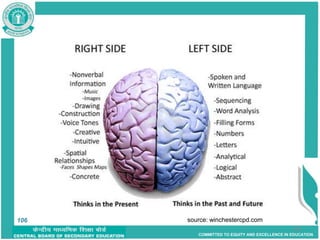
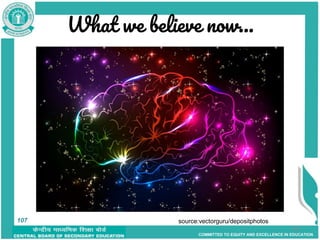
· Both hemispheres of the brain have to work together in
tandem for generating new ideas (both critical and creative
thinking)
· Contrary to popular belief, both sides of the brain are used
across the subjects.
· Brain-imaging studies reveal that innovators tend to
synchronically use neural networks located in both
hemispheres of the brain while engaged in ‘creative’ tasks.
108
COMMITTED TO EQUITY AND EXCELLENCE IN EDUCATION
109
Types of Creative Thinking...
Section 2
109
COMMITTED TO EQUITY AND EXCELLENCE IN EDUCATION
110
110
COMMITTED TO EQUITY AND EXCELLENCE IN EDUCATION
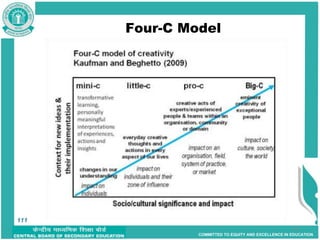
Four-C Model
111
111
COMMITTED TO EQUITY AND EXCELLENCE IN EDUCATION
Questions to Ponder
112
● Do you these categories of creative
thinking have to be used in this order?
● Do you think these boundaries can be
blurred? If so, provide examples.
● Which two categories of creative thinking
do you think are most relevant to schools?
Why?
● Can you think of some examples of Big-C
creativity specific to the subject you
teach?
112
COMMITTED TO EQUITY AND EXCELLENCE IN EDUCATION
113
Blocks to Creativity...
Section 3
113
COMMITTED TO EQUITY AND EXCELLENCE IN EDUCATION
We may fear...
• making mistakes
• looking foolish
• being criticised
• being alone
• being outcast
• disturbing tradition
• being associated with taboos
114
114
COMMITTED TO EQUITY AND EXCELLENCE IN EDUCATION
115
Misconceptions about
Creativity...
Section 4
115
COMMITTED TO EQUITY AND EXCELLENCE IN EDUCATION
116
116
COMMITTED TO EQUITY AND EXCELLENCE IN EDUCATION
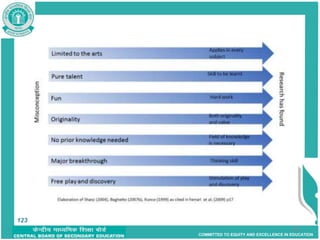
Creativity is limited to the Arts
117
117
COMMITTED TO EQUITY AND EXCELLENCE IN EDUCATION
A person’s creativity is pure
inborn talent
118
118
COMMITTED TO EQUITY AND EXCELLENCE IN EDUCATION
Creativity is naturally fun, it
doesn’t require conscious effort
119
119
COMMITTED TO EQUITY AND EXCELLENCE IN EDUCATION
Only originality matters in
creativity
120
120
COMMITTED TO EQUITY AND EXCELLENCE IN EDUCATION
Prior Knowledge is not
required to think creatively
121
121
COMMITTED TO EQUITY AND EXCELLENCE IN EDUCATION
Creativity consists mainly of
‘Aha!’ moments and random,
lucky breakthroughs...
122
122
COMMITTED TO EQUITY AND EXCELLENCE IN EDUCATION
123
123
COMMITTED TO EQUITY AND EXCELLENCE IN EDUCATION
Lateral Thinking:
Thinking Creatively with Structures
Session 2
124
124
COMMITTED TO EQUITY AND EXCELLENCE IN EDUCATION
Beyond Brainstorming-
Creativity & Constraints
Section 1
125
125
COMMITTED TO EQUITY AND EXCELLENCE IN EDUCATION
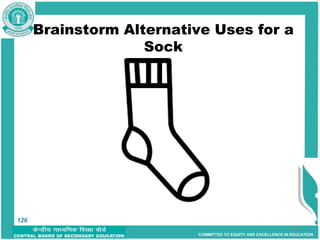
Brainstorm Alternative Uses for a
Sock
126
126
COMMITTED TO EQUITY AND EXCELLENCE IN EDUCATION
Image 1
127
127
COMMITTED TO EQUITY AND EXCELLENCE IN EDUCATION
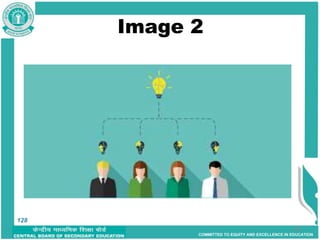
Image 2
128
128
COMMITTED TO EQUITY AND EXCELLENCE IN EDUCATION
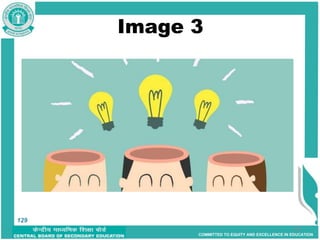
Image 3
129
129
COMMITTED TO EQUITY AND EXCELLENCE IN EDUCATION
130
130
Which image best
represents the kind of
thinking demonstrated by
your group?
COMMITTED TO EQUITY AND EXCELLENCE IN EDUCATION
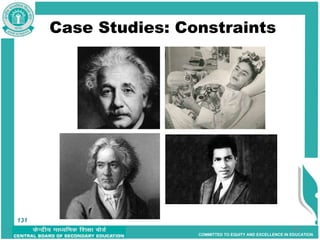
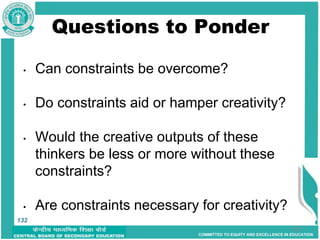
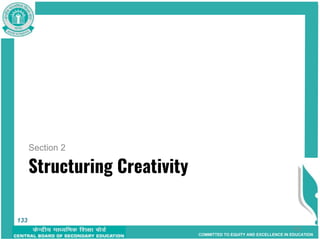
Case Studies: Constraints
131
131
COMMITTED TO EQUITY AND EXCELLENCE IN EDUCATION
Questions to Ponder
• Can constraints be overcome?
• Do constraints aid or hamper creativity?
• Would the creative outputs of these
thinkers be less or more without these
constraints?
• Are constraints necessary for creativity?
132
132
COMMITTED TO EQUITY AND EXCELLENCE IN EDUCATION
Structuring Creativity
Section 2
133
133
COMMITTED TO EQUITY AND EXCELLENCE IN EDUCATION
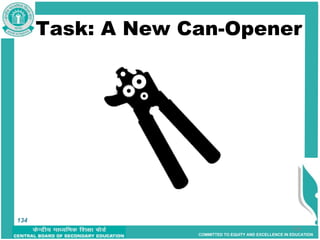
Task: A New Can-Opener
134
134
COMMITTED TO EQUITY AND EXCELLENCE IN EDUCATION
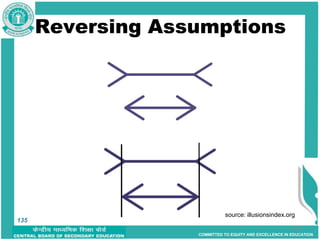
Reversing Assumptions
135
source: illusionsindex.org
135
COMMITTED TO EQUITY AND EXCELLENCE IN EDUCATION
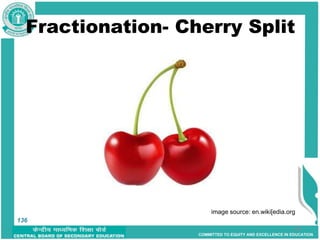
Fractionation- Cherry Split
136
image source: en.wiki[edia.org
136
COMMITTED TO EQUITY AND EXCELLENCE IN EDUCATION
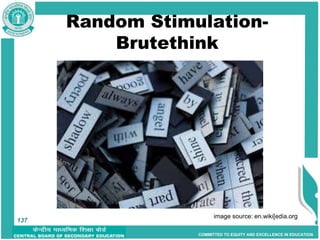
Random Stimulation-
Brutethink
137
image source: en.wiki[edia.org
137
COMMITTED TO EQUITY AND EXCELLENCE IN EDUCATION
138
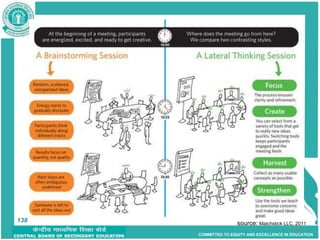
source: Matchstick LLC, 2011
138
COMMITTED TO EQUITY AND EXCELLENCE IN EDUCATION
139
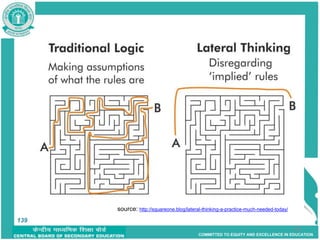
source: http://squareone.blog/lateral-thinking-a-practice-much-needed-today/
139
COMMITTED TO EQUITY AND EXCELLENCE IN EDUCATION
140
Approaches to Foster
Creative Thinking- I
Session 3
140
COMMITTED TO EQUITY AND EXCELLENCE IN EDUCATION
Collaborative Learning
Section-1
141
141
COMMITTED TO EQUITY AND EXCELLENCE IN EDUCATION
142
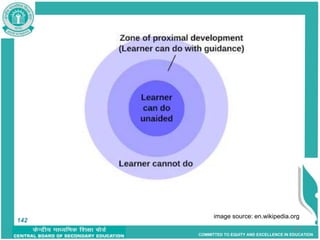
image source: en.wikipedia.org
142
COMMITTED TO EQUITY AND EXCELLENCE IN EDUCATION
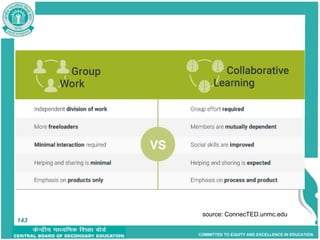
143
source: ConnecTED.unmc.edu
143
COMMITTED TO EQUITY AND EXCELLENCE IN EDUCATION
Video: Collaborative Learning
Builds Deeper Understanding
144
144
COMMITTED TO EQUITY AND EXCELLENCE IN EDUCATION
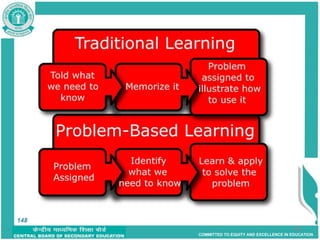
Problem-based learning
Section 2
145
145
COMMITTED TO EQUITY AND EXCELLENCE IN EDUCATION
Video: 7 steps of PBL
146
146
COMMITTED TO EQUITY AND EXCELLENCE IN EDUCATION
147
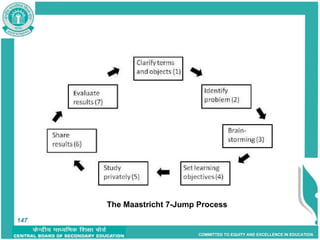
The Maastricht 7-Jump Process
147
COMMITTED TO EQUITY AND EXCELLENCE IN EDUCATION
148
148
COMMITTED TO EQUITY AND EXCELLENCE IN EDUCATION
Possibility Thinking
Section 3
149
149
COMMITTED TO EQUITY AND EXCELLENCE IN EDUCATION
150
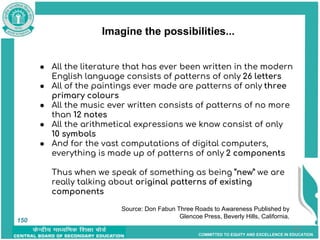
● All the literature that has ever been written in the modern
English language consists of patterns of only 26 letters
● All of the paintings ever made are patterns of only three
primary colours
● All the music ever written consists of patterns of no more
than 12 notes
● All the arithmetical expressions we know consist of only
10 symbols
● And for the vast computations of digital computers,
everything is made up of patterns of only 2 components
Thus when we speak of something as being “new” we are
really talking about original patterns of existing
components
Imagine the possibilities...
Source: Don Fabun Three Roads to Awareness Published by
Glencoe Press, Beverly Hills, California.
150
COMMITTED TO EQUITY AND EXCELLENCE IN EDUCATION
151
Colour Questioning
151
COMMITTED TO EQUITY AND EXCELLENCE IN EDUCATION
152
Design Thinking
Session 4
152
COMMITTED TO EQUITY AND EXCELLENCE IN EDUCATION
The Design Thinking
Approach & Process
Section 1
153
153
COMMITTED TO EQUITY AND EXCELLENCE IN EDUCATION
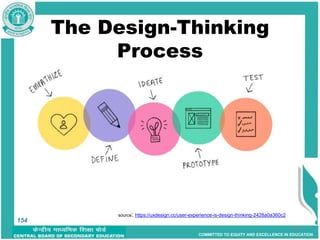
154
The Design-Thinking
Process
source: https://uxdesign.cc/user-experience-is-design-thinking-2428a0a360c2
154
COMMITTED TO EQUITY AND EXCELLENCE IN EDUCATION
Applications of
Design Thinking
Section 2
155
155
COMMITTED TO EQUITY AND EXCELLENCE IN EDUCATION
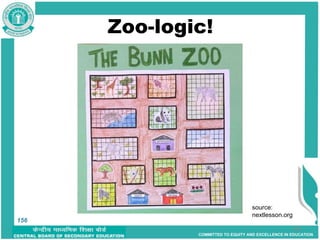
156
Zoo-logic!
source:
nextlesson.org
156
COMMITTED TO EQUITY AND EXCELLENCE IN EDUCATION
Water Conservation
Challenge
157
source:
calcademy.org
157
COMMITTED TO EQUITY AND EXCELLENCE IN EDUCATION
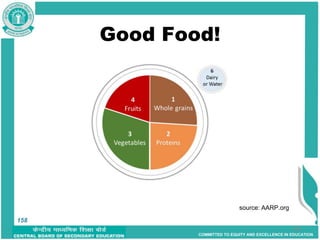
Good Food!
158
source: AARP.org
158
COMMITTED TO EQUITY AND EXCELLENCE IN EDUCATION
Fighting Fire!
159
image source: vexels.com
159
COMMITTED TO EQUITY AND EXCELLENCE IN EDUCATION
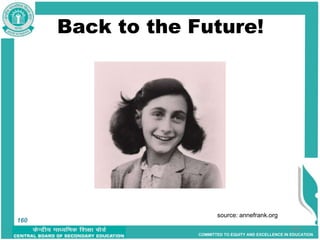
Back to the Future!
160
source: annefrank.org
160
COMMITTED TO EQUITY AND EXCELLENCE IN EDUCATION
161
Assessing Creativity
Session 6
161
COMMITTED TO EQUITY AND EXCELLENCE IN EDUCATION
Too much, too soon:
When assessing creativity
goes wrong!
Section 1
162
162
COMMITTED TO EQUITY AND EXCELLENCE IN EDUCATION
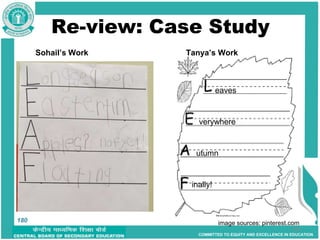
163
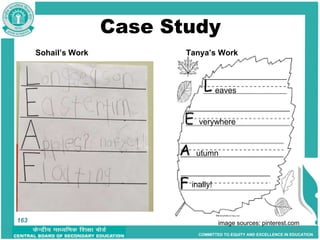
Case Study
eaves
verywhere
utumn
inally!
Sohail’s Work Tanya’s Work
image sources: pinterest.com
163
COMMITTED TO EQUITY AND EXCELLENCE IN EDUCATION
Questions to Ponder...
· On what criteria did Mrs Kher assess students’
work?
· On what criteria should she have assessed
students’ work?
· How could Mrs Kher have given feedback
differently?
· What is the relationship between negative
criticism and creativity?
· What is the relationship between blind praise
and creativity?
164
164
COMMITTED TO EQUITY AND EXCELLENCE IN EDUCATION
Demonstration of Creativity vs
Actual Creativity
165
image source: freepik.com
165
COMMITTED TO EQUITY AND EXCELLENCE IN EDUCATION
Sugarcoating
166
source: canadianbusiness.com
166
COMMITTED TO EQUITY AND EXCELLENCE IN EDUCATION
Cross your arms!
167
167
COMMITTED TO EQUITY AND EXCELLENCE IN EDUCATION
The Feedforward
Technique
Section 2
168
168
COMMITTED TO EQUITY AND EXCELLENCE IN EDUCATION
169
169
COMMITTED TO EQUITY AND EXCELLENCE IN EDUCATION
170
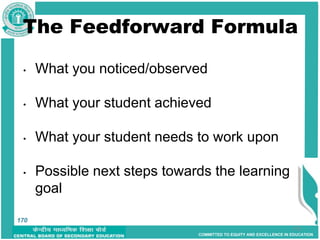
The Feedforward Formula
• What you noticed/observed
• What your student achieved
• What your student needs to work upon
• Possible next steps towards the learning
goal
170
COMMITTED TO EQUITY AND EXCELLENCE IN EDUCATION
Using Exemplars & Rubrics
for Assessment
Section 3
171
171
COMMITTED TO EQUITY AND EXCELLENCE IN EDUCATION
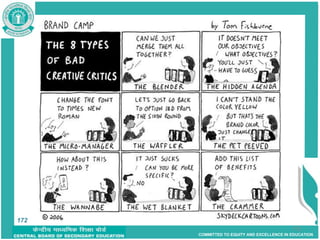
172
172
COMMITTED TO EQUITY AND EXCELLENCE IN EDUCATION
173
What is an exemplar?
An exemplar is a tangible sample of a learning
outcome. Usually student work from previous batches
or other classes, an exemplar is a demonstration of
quality standards.
Before asking students to begin solving a problem,
teachers can present the exemplar, encourage
students to closely observe it and facilitate a
discussion of its strengths and weaknesses.
The advantage exemplars offer is that they generate
discussion about what are the standards to be
achieved and exceeded.
173
COMMITTED TO EQUITY AND EXCELLENCE IN EDUCATION
174
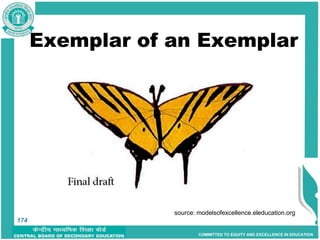
Exemplar of an Exemplar
source: modelsofexcellence.eleducation.org
174
COMMITTED TO EQUITY AND EXCELLENCE IN EDUCATION
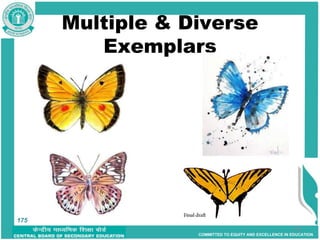
Multiple & Diverse
Exemplars
175
175
COMMITTED TO EQUITY AND EXCELLENCE IN EDUCATION
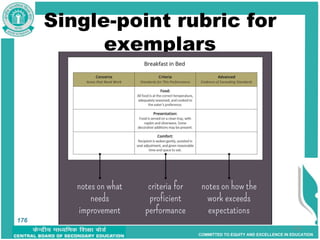
Single-point rubric for
exemplars
176
176
COMMITTED TO EQUITY AND EXCELLENCE IN EDUCATION
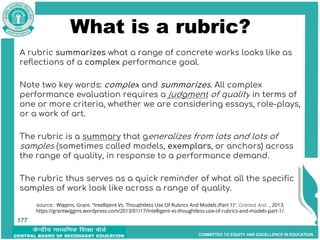
What is a rubric?
A rubric summarizes what a range of concrete works looks like as
reflections of a complex performance goal.
Note two key words: complex and summarizes. All complex
performance evaluation requires a judgment of quality in terms of
one or more criteria, whether we are considering essays, role-plays,
or a work of art.
The rubric is a summary that generalizes from lots and lots of
samples (sometimes called models, exemplars, or anchors) across
the range of quality, in response to a performance demand.
The rubric thus serves as a quick reminder of what all the specific
samples of work look like across a range of quality.
source: Wiggins, Grant. "Intelligent Vs. Thoughtless Use Of Rubrics And Models (Part 1)". Granted, And..., 2013,
https://grantwiggins.wordpress.com/2013/01/17/intelligent-vs-thoughtless-use-of-rubrics-and-models-part-1/.
177
177
COMMITTED TO EQUITY AND EXCELLENCE IN EDUCATION
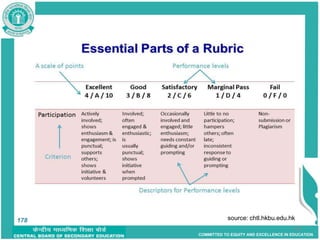
178
source: chtl.hkbu.edu.hk
178
COMMITTED TO EQUITY AND EXCELLENCE IN EDUCATION
179
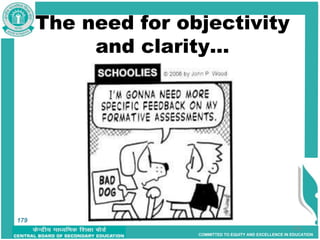
The need for objectivity
and clarity...
179
COMMITTED TO EQUITY AND EXCELLENCE IN EDUCATION
180
Re-view: Case Study
eaves
verywhere
utumn
inally!
Sohail’s Work Tanya’s Work
image sources: pinterest.com
180

Critical & Creative Thinking for comming generations to be creative and tecahers as well

  • 1.
    COMMITTED TO EQUITYAND EXCELLENCE IN EDUCATION Pathways to Thinking 1 Session 1 01
  • 2.
    COMMITTED TO EQUITYAND EXCELLENCE IN EDUCATION Thinking as a Skill Phase 1 2 02
  • 3.
    COMMITTED TO EQUITYAND EXCELLENCE IN EDUCATION Four Corners 3 03
  • 4.
    COMMITTED TO EQUITYAND EXCELLENCE IN EDUCATION A person’s IQ or intelligence is fixed at birth so teaching thinking as a skill is not very effective 4 04
  • 5.
    COMMITTED TO EQUITYAND EXCELLENCE IN EDUCATION 5 05
  • 6.
    COMMITTED TO EQUITYAND EXCELLENCE IN EDUCATION In order to develop thinking skills, we must increase the difficulty level of the syllabus 6 06
  • 7.
    COMMITTED TO EQUITYAND EXCELLENCE IN EDUCATION Difficulty vs Complexity 7 07
  • 8.
    COMMITTED TO EQUITYAND EXCELLENCE IN EDUCATION Critical thinking skills and creative thinking skills are completely different from each other 8 08
  • 9.
    COMMITTED TO EQUITYAND EXCELLENCE IN EDUCATION The Traditional Distinction 9 09 CREATIVE CRITICAL generating ideas analysing ideas divergent convergent lateral thinking vertical thinking possibilities probabilities idea generation evaluation/critique intuition logic/reason suspended judgement judgement
  • 10.
    COMMITTED TO EQUITYAND EXCELLENCE IN EDUCATION A dynamic and interdependent relationship 10 10
  • 11.
    COMMITTED TO EQUITYAND EXCELLENCE IN EDUCATION 11 Critical thinking is more important than creative thinking in the classroom 11
  • 12.
    COMMITTED TO EQUITYAND EXCELLENCE IN EDUCATION The Significance of Thinking Phase 2 12 12
  • 13.
    COMMITTED TO EQUITYAND EXCELLENCE IN EDUCATION 13 13
  • 14.
    COMMITTED TO EQUITYAND EXCELLENCE IN EDUCATION 14 Why do we need critical thinking in classrooms? 14
  • 15.
    COMMITTED TO EQUITYAND EXCELLENCE IN EDUCATION 15 15
  • 16.
    COMMITTED TO EQUITYAND EXCELLENCE IN EDUCATION 16 16
  • 17.
    COMMITTED TO EQUITYAND EXCELLENCE IN EDUCATION 17 Which levels do critical thinking and creative thinking fall under? Why? 17
  • 18.
    COMMITTED TO EQUITYAND EXCELLENCE IN EDUCATION The Building Blocks of Logical Reasoning 18 Session 2 18
  • 19.
    COMMITTED TO EQUITYAND EXCELLENCE IN EDUCATION Session Overview 19 19 Deductive Reasoning 03 Inductive Reasoning 02 Inference 01 04 Abductive Reasoning
  • 20.
    COMMITTED TO EQUITYAND EXCELLENCE IN EDUCATION Inference 20 Knowing the unknown from the known 20
  • 21.
    COMMITTED TO EQUITYAND EXCELLENCE IN EDUCATION 21 Source: http://editorialcartoonists.com/cartoon/display.cfm/143664/ 21
  • 22.
    COMMITTED TO EQUITYAND EXCELLENCE IN EDUCATION Inference refers to the logical process in which new conclusions are arrived at from the given premises. It is a method of creating new knowledge from prior or given knowledge. 22 22
  • 23.
    COMMITTED TO EQUITYAND EXCELLENCE IN EDUCATION Focus on Reading Literacy: Inference in textual comprehension 23 23
  • 24.
    COMMITTED TO EQUITYAND EXCELLENCE IN EDUCATION Focus on Reading Literacy: Strategies to Teach Inference 24 ● Modelling ● ‘What makes you say that?’ thinking routine ● Picture-reading ● Transcribed conversations ● Textual passages 24
  • 25.
    COMMITTED TO EQUITYAND EXCELLENCE IN EDUCATION Inductive Reasoning From specific to general... 25 25
  • 26.
    COMMITTED TO EQUITYAND EXCELLENCE IN EDUCATION 26 Which box is next in the sequence? What makes you say that? 26
  • 27.
    COMMITTED TO EQUITYAND EXCELLENCE IN EDUCATION 27 Example of inductive arguments- from specific observations to general conclusions 27
  • 28.
    COMMITTED TO EQUITYAND EXCELLENCE IN EDUCATION 28 Focus on scientific literacy: Inductive arguments in scientific generalizations Inductive arguments help make scientific generalizations that can predict or describe the natural world. E.g. Tiger 1 has stripes... Tiger 9876 has stripes... Tiger n has stripes... Therefore, all tigers have stripes 28
  • 29.
    COMMITTED TO EQUITYAND EXCELLENCE IN EDUCATION Focus on Mathematical Literacy: Inductive arguments in Mathematical Facts 29 Multiplication Repeated addition Sum 4 X -2 -2 + -2 + -2 + -2 -8 3 X -7 -7 + -7 + -7 -21 5 X -6 -6 + -6 + -6 + -6 + -6 -30 29
  • 30.
    COMMITTED TO EQUITYAND EXCELLENCE IN EDUCATION 30 Source: Daniel Miessler, 2018 30
  • 31.
    COMMITTED TO EQUITYAND EXCELLENCE IN EDUCATION Deductive Reasoning From general to specific 31 31
  • 32.
    COMMITTED TO EQUITYAND EXCELLENCE IN EDUCATION Example of a deductive argument 32 All acids have a PH value below 7 HCl is an acid Therefore, HCl Acid has a PH value below 7 32
  • 33.
    COMMITTED TO EQUITYAND EXCELLENCE IN EDUCATION Validity & Truth 33 33
  • 34.
    COMMITTED TO EQUITYAND EXCELLENCE IN EDUCATION Focus on Scientific, Mathematical & Reading Literacy 34 34
  • 35.
    COMMITTED TO EQUITYAND EXCELLENCE IN EDUCATION Food for thought! 35 35
  • 36.
    COMMITTED TO EQUITYAND EXCELLENCE IN EDUCATION Abductive Reasoning 36 Inference to the best explanation 36
  • 37.
    COMMITTED TO EQUITYAND EXCELLENCE IN EDUCATION 37 source: xkcd.com 37
  • 38.
    COMMITTED TO EQUITYAND EXCELLENCE IN EDUCATION 38 source: research-methodology.net 38
  • 39.
    COMMITTED TO EQUITYAND EXCELLENCE IN EDUCATION 39 Session 3 Fun with Fallacies! 39
  • 40.
    COMMITTED TO EQUITYAND EXCELLENCE IN EDUCATION A belief about a premise that is held to be true and certain although there is no evidence to support it 40 ASSUMPTIONS A belief about a premise that is held to be true and certain although there is no evidence to support it 40
  • 41.
    COMMITTED TO EQUITYAND EXCELLENCE IN EDUCATION 41 Types of Assumptions Necessary Assumption An assumption that is necessary for a conclusion to be true. In the following argument the necessary assumption is that Socrates was born once, because only those are born can die. Eg. Socrates is a man All men are mortal Therefore, Socrates is mortal Sufficient Assumption An assumption that would prove the conclusion to be true but is not necessary. In the same argument the sufficient assumption is that a man is a type of human being- it is sufficient to prove the conclusion, because all human beings die, but not necessary because there are other mortals besides human beings. 41
  • 42.
    COMMITTED TO EQUITYAND EXCELLENCE IN EDUCATION 42 The Devil’s Advocate! 42
  • 43.
    COMMITTED TO EQUITYAND EXCELLENCE IN EDUCATION 43 It is a hot August afternoon. The location is the living room in an old bungalow in Bomba. The 7 foot window is open and the curtains are blowing in the breeze generated by the thunderstorm that just passed through the area. On the floor are the bodies of Bill and Mary. They are surrounded by puddles of water and broken glass. Neither Bill nor Mary has clothing on. How did they die? 43 Source: Mike Fellows, ENS Institute 43
  • 44.
    COMMITTED TO EQUITYAND EXCELLENCE IN EDUCATION 44 A man is walking down the street, sees a restaurant and enters. He asks the waiter for a glass of water. The waiter pulls out a gun and points it at him. The man says thank you and leaves the restaurant. What happened? 44 Source: Mike Fellows, ENS Institute 44
  • 45.
    COMMITTED TO EQUITYAND EXCELLENCE IN EDUCATION 45 There is a cabin on the side of a mountain. Three people are inside; they are dead. How did they die? 45 Source: Mike Fellows, ENS Institute 45
  • 46.
    COMMITTED TO EQUITYAND EXCELLENCE IN EDUCATION 46 46
  • 47.
    COMMITTED TO EQUITYAND EXCELLENCE IN EDUCATION 47 Focus on Scientific Literacy: The Assumptions of Science ▪ Nature is orderly, and the laws of nature describe its order ▪ Nature is intelligible and understandable by us ▪ All phenomena have natural causes 47
  • 48.
    COMMITTED TO EQUITYAND EXCELLENCE IN EDUCATION 48 Focus on Mathematical Literacy: The Assumptions of Mathematics ▪ Euclid’s axioms ▪ First Axiom: Things which are equal to the same thing are also equal to one another. ▪ Second Axiom: If equals are added to equals, the whole are equal. ▪ Third Axiom: If equals be subtracted from equals, the remainders are equal. ▪ Fourth Axiom: Things which coincide with one another are equal to one another. ▪ Fifth Axiom: The whole is greater than the part. 48
  • 49.
    COMMITTED TO EQUITYAND EXCELLENCE IN EDUCATION 49 The Parallel Postulate A Case Study 49
  • 50.
    COMMITTED TO EQUITYAND EXCELLENCE IN EDUCATION 50 Rocket-Writing Why is it important to check assumptions? 50
  • 51.
    COMMITTED TO EQUITYAND EXCELLENCE IN EDUCATION 51 FALLACIES Fallacies are errors or wrong moves in reasoning. Fallacies may made deliberately made to mislead others, or can be made out of ignorance. 51
  • 52.
    COMMITTED TO EQUITYAND EXCELLENCE IN EDUCATION 52 1. Ad Populum A logical fallacy in which something is considered to be true because it’s popular. Source: Giorgi Koberidze, 2016 Source: Giorgi Koberidze, 2016 52
  • 53.
    COMMITTED TO EQUITYAND EXCELLENCE IN EDUCATION 53 2. Appeal to Ignorance A logical fallacy in which something is believed to be true because it has not been proven false yet. Source: theconversation.com 53
  • 54.
    COMMITTED TO EQUITYAND EXCELLENCE IN EDUCATION 54 3. Appeal to Authority It is a logical fallacy in which something is believed to be true solely because an expert has said so. Source: the upturnedmicroscope.com 54
  • 55.
    COMMITTED TO EQUITYAND EXCELLENCE IN EDUCATION 55 4. Hasty Generalization A logical fallacy in which a general conclusion is reached based on insignificant or insufficient evidence. 55
  • 56.
    COMMITTED TO EQUITYAND EXCELLENCE IN EDUCATION 56 5. Red Herring A distracting, misleading or irrelevant detail that is added to an argument. 56
  • 57.
    COMMITTED TO EQUITYAND EXCELLENCE IN EDUCATION 57 57
  • 58.
    COMMITTED TO EQUITYAND EXCELLENCE IN EDUCATION 58 THE CREATIVE BUILDING BLOCKS OF Problem-Solving 58 Session 4 58
  • 59.
    COMMITTED TO EQUITYAND EXCELLENCE IN EDUCATION 59 source: researchgate.com 59
  • 60.
    COMMITTED TO EQUITYAND EXCELLENCE IN EDUCATION 60 Explanations A reason or justification given for a claim or belief 1 60
  • 61.
    COMMITTED TO EQUITYAND EXCELLENCE IN EDUCATION 61 What is a scientific explanation? Who do you agree with & Why? Rita: I think a scientific explanation gives an answer and supports it with evidence Sohan: I think a scientific explanation describes everything you know about a topic Ayaan: I think a scientific explanation uses a scientific concept to tell you how something works Seema: I think a scientific explanation helps you convince someone else that your opinion is correct. 61 Adapted from www.nagaresa.org 61
  • 62.
    COMMITTED TO EQUITYAND EXCELLENCE IN EDUCATION 62 Source: www.wikipedia.com 62
  • 63.
    COMMITTED TO EQUITYAND EXCELLENCE IN EDUCATION 63 63
  • 64.
    COMMITTED TO EQUITYAND EXCELLENCE IN EDUCATION 64 64
  • 65.
    COMMITTED TO EQUITYAND EXCELLENCE IN EDUCATION 65 65
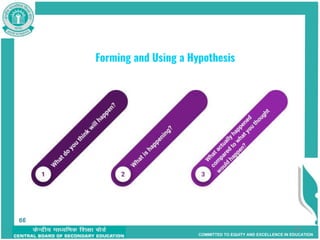
  • 66.
    COMMITTED TO EQUITYAND EXCELLENCE IN EDUCATION 66 66
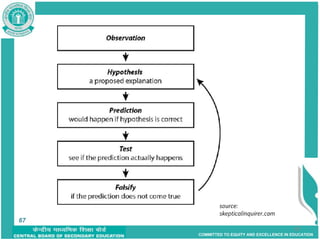
  • 67.
    COMMITTED TO EQUITYAND EXCELLENCE IN EDUCATION 67 67
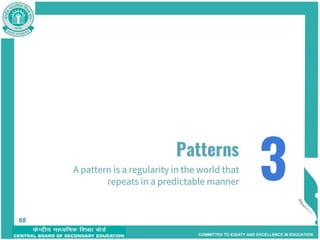
  • 68.
    COMMITTED TO EQUITYAND EXCELLENCE IN EDUCATION 68 68
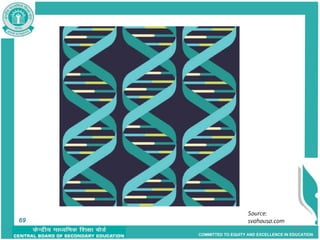
  • 69.
    COMMITTED TO EQUITYAND EXCELLENCE IN EDUCATION 69 69
  • 70.
    COMMITTED TO EQUITYAND EXCELLENCE IN EDUCATION 70 70
  • 71.
    COMMITTED TO EQUITYAND EXCELLENCE IN EDUCATION 71 71
  • 72.
    COMMITTED TO EQUITYAND EXCELLENCE IN EDUCATION 72 72
  • 73.
    COMMITTED TO EQUITYAND EXCELLENCE IN EDUCATION 73 73
  • 74.
    COMMITTED TO EQUITYAND EXCELLENCE IN EDUCATION 74 74
  • 75.
    COMMITTED TO EQUITYAND EXCELLENCE IN EDUCATION 75 75
  • 76.
    COMMITTED TO EQUITYAND EXCELLENCE IN EDUCATION 76 76
  • 77.
    COMMITTED TO EQUITYAND EXCELLENCE IN EDUCATION 77 77
  • 78.
    COMMITTED TO EQUITYAND EXCELLENCE IN EDUCATION 78 Session 5 78
  • 79.
    COMMITTED TO EQUITYAND EXCELLENCE IN EDUCATION 79 79
  • 80.
    COMMITTED TO EQUITYAND EXCELLENCE IN EDUCATION 80 80
  • 81.
    COMMITTED TO EQUITYAND EXCELLENCE IN EDUCATION 81 81
  • 82.
    COMMITTED TO EQUITYAND EXCELLENCE IN EDUCATION 82 82
  • 83.
    COMMITTED TO EQUITYAND EXCELLENCE IN EDUCATION 83 83
  • 84.
    COMMITTED TO EQUITYAND EXCELLENCE IN EDUCATION 84 84
  • 85.
    COMMITTED TO EQUITYAND EXCELLENCE IN EDUCATION 85 85
  • 86.
    COMMITTED TO EQUITYAND EXCELLENCE IN EDUCATION 86 86
  • 87.
    COMMITTED TO EQUITYAND EXCELLENCE IN EDUCATION 87 87
  • 88.
    COMMITTED TO EQUITYAND EXCELLENCE IN EDUCATION 88 88
  • 89.
    COMMITTED TO EQUITYAND EXCELLENCE IN EDUCATION 89 89
  • 90.
    COMMITTED TO EQUITYAND EXCELLENCE IN EDUCATION 90 90
  • 91.
    COMMITTED TO EQUITYAND EXCELLENCE IN EDUCATION 91 91
  • 92.
    COMMITTED TO EQUITYAND EXCELLENCE IN EDUCATION 92 Session 6 92
  • 93.
    COMMITTED TO EQUITYAND EXCELLENCE IN EDUCATION 93 93
  • 94.
    COMMITTED TO EQUITYAND EXCELLENCE IN EDUCATION 94 94
  • 95.
    COMMITTED TO EQUITYAND EXCELLENCE IN EDUCATION 95 95
  • 96.
    COMMITTED TO EQUITYAND EXCELLENCE IN EDUCATION 96 96
  • 97.
    COMMITTED TO EQUITYAND EXCELLENCE IN EDUCATION 97 Source: Hamlin Elementary 97
  • 98.
    COMMITTED TO EQUITYAND EXCELLENCE IN EDUCATION 98 98
  • 99.
    COMMITTED TO EQUITYAND EXCELLENCE IN EDUCATION 99 99 Argumentation Challenge for reading, scientific and mathematical literacy
  • 100.
    COMMITTED TO EQUITYAND EXCELLENCE IN EDUCATION 100 100
  • 101.
    COMMITTED TO EQUITYAND EXCELLENCE IN EDUCATION 101 101
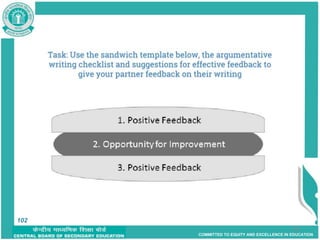
  • 102.
    COMMITTED TO EQUITYAND EXCELLENCE IN EDUCATION 102 102
  • 103.
    COMMITTED TO EQUITYAND EXCELLENCE IN EDUCATION 103 Creative Thinking Skills Day 2 103
  • 104.
    COMMITTED TO EQUITYAND EXCELLENCE IN EDUCATION 104 Session 1 The Creative Learner 104
  • 105.
    COMMITTED TO EQUITYAND EXCELLENCE IN EDUCATION 105 How we think... Section 1 105
  • 106.
    COMMITTED TO EQUITYAND EXCELLENCE IN EDUCATION 106 source: winchestercpd.com 106
  • 107.
    COMMITTED TO EQUITYAND EXCELLENCE IN EDUCATION What we believe now... 107 source:vectorguru/depositphotos 107
  • 108.
    COMMITTED TO EQUITYAND EXCELLENCE IN EDUCATION What the research states... 108 · Both hemispheres of the brain have to work together in tandem for generating new ideas (both critical and creative thinking) · Contrary to popular belief, both sides of the brain are used across the subjects. · Brain-imaging studies reveal that innovators tend to synchronically use neural networks located in both hemispheres of the brain while engaged in ‘creative’ tasks. 108
  • 109.
    COMMITTED TO EQUITYAND EXCELLENCE IN EDUCATION 109 Types of Creative Thinking... Section 2 109
  • 110.
    COMMITTED TO EQUITYAND EXCELLENCE IN EDUCATION 110 110
  • 111.
    COMMITTED TO EQUITYAND EXCELLENCE IN EDUCATION Four-C Model 111 111
  • 112.
    COMMITTED TO EQUITYAND EXCELLENCE IN EDUCATION Questions to Ponder 112 ● Do you these categories of creative thinking have to be used in this order? ● Do you think these boundaries can be blurred? If so, provide examples. ● Which two categories of creative thinking do you think are most relevant to schools? Why? ● Can you think of some examples of Big-C creativity specific to the subject you teach? 112
  • 113.
    COMMITTED TO EQUITYAND EXCELLENCE IN EDUCATION 113 Blocks to Creativity... Section 3 113
  • 114.
    COMMITTED TO EQUITYAND EXCELLENCE IN EDUCATION We may fear... • making mistakes • looking foolish • being criticised • being alone • being outcast • disturbing tradition • being associated with taboos 114 114
  • 115.
    COMMITTED TO EQUITYAND EXCELLENCE IN EDUCATION 115 Misconceptions about Creativity... Section 4 115
  • 116.
    COMMITTED TO EQUITYAND EXCELLENCE IN EDUCATION 116 116
  • 117.
    COMMITTED TO EQUITYAND EXCELLENCE IN EDUCATION Creativity is limited to the Arts 117 117
  • 118.
    COMMITTED TO EQUITYAND EXCELLENCE IN EDUCATION A person’s creativity is pure inborn talent 118 118
  • 119.
    COMMITTED TO EQUITYAND EXCELLENCE IN EDUCATION Creativity is naturally fun, it doesn’t require conscious effort 119 119
  • 120.
    COMMITTED TO EQUITYAND EXCELLENCE IN EDUCATION Only originality matters in creativity 120 120
  • 121.
    COMMITTED TO EQUITYAND EXCELLENCE IN EDUCATION Prior Knowledge is not required to think creatively 121 121
  • 122.
    COMMITTED TO EQUITYAND EXCELLENCE IN EDUCATION Creativity consists mainly of ‘Aha!’ moments and random, lucky breakthroughs... 122 122
  • 123.
    COMMITTED TO EQUITYAND EXCELLENCE IN EDUCATION 123 123
  • 124.
    COMMITTED TO EQUITYAND EXCELLENCE IN EDUCATION Lateral Thinking: Thinking Creatively with Structures Session 2 124 124
  • 125.
    COMMITTED TO EQUITYAND EXCELLENCE IN EDUCATION Beyond Brainstorming- Creativity & Constraints Section 1 125 125
  • 126.
    COMMITTED TO EQUITYAND EXCELLENCE IN EDUCATION Brainstorm Alternative Uses for a Sock 126 126
  • 127.
    COMMITTED TO EQUITYAND EXCELLENCE IN EDUCATION Image 1 127 127
  • 128.
    COMMITTED TO EQUITYAND EXCELLENCE IN EDUCATION Image 2 128 128
  • 129.
    COMMITTED TO EQUITYAND EXCELLENCE IN EDUCATION Image 3 129 129
  • 130.
    COMMITTED TO EQUITYAND EXCELLENCE IN EDUCATION 130 130 Which image best represents the kind of thinking demonstrated by your group?
  • 131.
    COMMITTED TO EQUITYAND EXCELLENCE IN EDUCATION Case Studies: Constraints 131 131
  • 132.
    COMMITTED TO EQUITYAND EXCELLENCE IN EDUCATION Questions to Ponder • Can constraints be overcome? • Do constraints aid or hamper creativity? • Would the creative outputs of these thinkers be less or more without these constraints? • Are constraints necessary for creativity? 132 132
  • 133.
    COMMITTED TO EQUITYAND EXCELLENCE IN EDUCATION Structuring Creativity Section 2 133 133
  • 134.
    COMMITTED TO EQUITYAND EXCELLENCE IN EDUCATION Task: A New Can-Opener 134 134
  • 135.
    COMMITTED TO EQUITYAND EXCELLENCE IN EDUCATION Reversing Assumptions 135 source: illusionsindex.org 135
  • 136.
    COMMITTED TO EQUITYAND EXCELLENCE IN EDUCATION Fractionation- Cherry Split 136 image source: en.wiki[edia.org 136
  • 137.
    COMMITTED TO EQUITYAND EXCELLENCE IN EDUCATION Random Stimulation- Brutethink 137 image source: en.wiki[edia.org 137
  • 138.
    COMMITTED TO EQUITYAND EXCELLENCE IN EDUCATION 138 source: Matchstick LLC, 2011 138
  • 139.
    COMMITTED TO EQUITYAND EXCELLENCE IN EDUCATION 139 source: http://squareone.blog/lateral-thinking-a-practice-much-needed-today/ 139
  • 140.
    COMMITTED TO EQUITYAND EXCELLENCE IN EDUCATION 140 Approaches to Foster Creative Thinking- I Session 3 140
  • 141.
    COMMITTED TO EQUITYAND EXCELLENCE IN EDUCATION Collaborative Learning Section-1 141 141
  • 142.
    COMMITTED TO EQUITYAND EXCELLENCE IN EDUCATION 142 image source: en.wikipedia.org 142
  • 143.
    COMMITTED TO EQUITYAND EXCELLENCE IN EDUCATION 143 source: ConnecTED.unmc.edu 143
  • 144.
    COMMITTED TO EQUITYAND EXCELLENCE IN EDUCATION Video: Collaborative Learning Builds Deeper Understanding 144 144
  • 145.
    COMMITTED TO EQUITYAND EXCELLENCE IN EDUCATION Problem-based learning Section 2 145 145
  • 146.
    COMMITTED TO EQUITYAND EXCELLENCE IN EDUCATION Video: 7 steps of PBL 146 146
  • 147.
    COMMITTED TO EQUITYAND EXCELLENCE IN EDUCATION 147 The Maastricht 7-Jump Process 147
  • 148.
    COMMITTED TO EQUITYAND EXCELLENCE IN EDUCATION 148 148
  • 149.
    COMMITTED TO EQUITYAND EXCELLENCE IN EDUCATION Possibility Thinking Section 3 149 149
  • 150.
    COMMITTED TO EQUITYAND EXCELLENCE IN EDUCATION 150 ● All the literature that has ever been written in the modern English language consists of patterns of only 26 letters ● All of the paintings ever made are patterns of only three primary colours ● All the music ever written consists of patterns of no more than 12 notes ● All the arithmetical expressions we know consist of only 10 symbols ● And for the vast computations of digital computers, everything is made up of patterns of only 2 components Thus when we speak of something as being “new” we are really talking about original patterns of existing components Imagine the possibilities... Source: Don Fabun Three Roads to Awareness Published by Glencoe Press, Beverly Hills, California. 150
  • 151.
    COMMITTED TO EQUITYAND EXCELLENCE IN EDUCATION 151 Colour Questioning 151
  • 152.
    COMMITTED TO EQUITYAND EXCELLENCE IN EDUCATION 152 Design Thinking Session 4 152
  • 153.
    COMMITTED TO EQUITYAND EXCELLENCE IN EDUCATION The Design Thinking Approach & Process Section 1 153 153
  • 154.
    COMMITTED TO EQUITYAND EXCELLENCE IN EDUCATION 154 The Design-Thinking Process source: https://uxdesign.cc/user-experience-is-design-thinking-2428a0a360c2 154
  • 155.
    COMMITTED TO EQUITYAND EXCELLENCE IN EDUCATION Applications of Design Thinking Section 2 155 155
  • 156.
    COMMITTED TO EQUITYAND EXCELLENCE IN EDUCATION 156 Zoo-logic! source: nextlesson.org 156
  • 157.
    COMMITTED TO EQUITYAND EXCELLENCE IN EDUCATION Water Conservation Challenge 157 source: calcademy.org 157
  • 158.
    COMMITTED TO EQUITYAND EXCELLENCE IN EDUCATION Good Food! 158 source: AARP.org 158
  • 159.
    COMMITTED TO EQUITYAND EXCELLENCE IN EDUCATION Fighting Fire! 159 image source: vexels.com 159
  • 160.
    COMMITTED TO EQUITYAND EXCELLENCE IN EDUCATION Back to the Future! 160 source: annefrank.org 160
  • 161.
    COMMITTED TO EQUITYAND EXCELLENCE IN EDUCATION 161 Assessing Creativity Session 6 161
  • 162.
    COMMITTED TO EQUITYAND EXCELLENCE IN EDUCATION Too much, too soon: When assessing creativity goes wrong! Section 1 162 162
  • 163.
    COMMITTED TO EQUITYAND EXCELLENCE IN EDUCATION 163 Case Study eaves verywhere utumn inally! Sohail’s Work Tanya’s Work image sources: pinterest.com 163
  • 164.
    COMMITTED TO EQUITYAND EXCELLENCE IN EDUCATION Questions to Ponder... · On what criteria did Mrs Kher assess students’ work? · On what criteria should she have assessed students’ work? · How could Mrs Kher have given feedback differently? · What is the relationship between negative criticism and creativity? · What is the relationship between blind praise and creativity? 164 164
  • 165.
    COMMITTED TO EQUITYAND EXCELLENCE IN EDUCATION Demonstration of Creativity vs Actual Creativity 165 image source: freepik.com 165
  • 166.
    COMMITTED TO EQUITYAND EXCELLENCE IN EDUCATION Sugarcoating 166 source: canadianbusiness.com 166
  • 167.
    COMMITTED TO EQUITYAND EXCELLENCE IN EDUCATION Cross your arms! 167 167
  • 168.
    COMMITTED TO EQUITYAND EXCELLENCE IN EDUCATION The Feedforward Technique Section 2 168 168
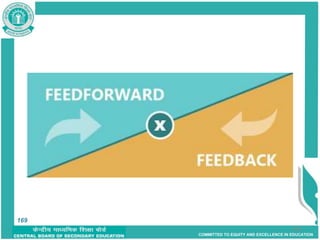
  • 169.
    COMMITTED TO EQUITYAND EXCELLENCE IN EDUCATION 169 169
  • 170.
    COMMITTED TO EQUITYAND EXCELLENCE IN EDUCATION 170 The Feedforward Formula • What you noticed/observed • What your student achieved • What your student needs to work upon • Possible next steps towards the learning goal 170
  • 171.
    COMMITTED TO EQUITYAND EXCELLENCE IN EDUCATION Using Exemplars & Rubrics for Assessment Section 3 171 171
  • 172.
    COMMITTED TO EQUITYAND EXCELLENCE IN EDUCATION 172 172
  • 173.
    COMMITTED TO EQUITYAND EXCELLENCE IN EDUCATION 173 What is an exemplar? An exemplar is a tangible sample of a learning outcome. Usually student work from previous batches or other classes, an exemplar is a demonstration of quality standards. Before asking students to begin solving a problem, teachers can present the exemplar, encourage students to closely observe it and facilitate a discussion of its strengths and weaknesses. The advantage exemplars offer is that they generate discussion about what are the standards to be achieved and exceeded. 173

  • 174.
    COMMITTED TO EQUITYAND EXCELLENCE IN EDUCATION 174 Exemplar of an Exemplar source: modelsofexcellence.eleducation.org 174
  • 175.
    COMMITTED TO EQUITYAND EXCELLENCE IN EDUCATION Multiple & Diverse Exemplars 175 175
  • 176.
    COMMITTED TO EQUITYAND EXCELLENCE IN EDUCATION Single-point rubric for exemplars 176 176
  • 177.
    COMMITTED TO EQUITYAND EXCELLENCE IN EDUCATION What is a rubric? A rubric summarizes what a range of concrete works looks like as reflections of a complex performance goal. Note two key words: complex and summarizes. All complex performance evaluation requires a judgment of quality in terms of one or more criteria, whether we are considering essays, role-plays, or a work of art. The rubric is a summary that generalizes from lots and lots of samples (sometimes called models, exemplars, or anchors) across the range of quality, in response to a performance demand. The rubric thus serves as a quick reminder of what all the specific samples of work look like across a range of quality. source: Wiggins, Grant. "Intelligent Vs. Thoughtless Use Of Rubrics And Models (Part 1)". Granted, And..., 2013, https://grantwiggins.wordpress.com/2013/01/17/intelligent-vs-thoughtless-use-of-rubrics-and-models-part-1/. 177 177
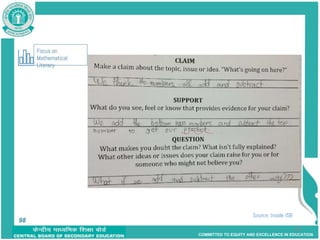
  • 178.
    COMMITTED TO EQUITYAND EXCELLENCE IN EDUCATION 178 source: chtl.hkbu.edu.hk 178
  • 179.
    COMMITTED TO EQUITYAND EXCELLENCE IN EDUCATION 179 The need for objectivity and clarity... 179
  • 180.
    COMMITTED TO EQUITYAND EXCELLENCE IN EDUCATION 180 Re-view: Case Study eaves verywhere utumn inally! Sohail’s Work Tanya’s Work image sources: pinterest.com 180