+
Is Quality the new
Fremium?
Tathagat Varma
http://managewell.net
+
Why this topic?
n  This is meant to be a provocative talk!
n  The idea is to explore how agile thinking could be applied to
such an idea.
n  This is also a work in progress…don’t construe as a fixed and
final position.
n  It is possible that the whole idea might be a false start after
all…or maybe not J
+
Freemium?
n  Free + Premium = Freemium
n  A business model in which you give away a core product
free to a large group of users and sell premium products
to a smaller fraction of this user base. 
n  All industries in which a quality, free product can be
duplicated with virtually no marginal cost can
successfully utilize a freemium business model.
n  Examples:
n  B2C: Skype, LinkedIn, DropBox, Google Drive, SurveyMonkey
n  B2B: Box, Splunk,Yammer
http://www.freemium.org/what-is-freemium-2/
+
Origins of Freemium
n  Popular since 80s by distributing shareware through floppy disks, but really took off in
the internet-era due to very low marginal cost of production and distribution.
n  In 1983, the Economist Carl Shapiro wrote a fascinating paper about this subject. His
conclusion was that since customers tend to underestimate the value of a product, the
optimal pricing for an experience good is a low introductory price which is then
increased when the customer realizes the value of the product.
n  Ester Dyson in 1994 envisioned a world where intellectual property would cost nearly
nothing to distribute in the paper Intellectual Property on the Net.
n  “Give your service away for free,possibly ad supported but maybe not,acquire a lot of
customers very efficiently through word of mouth,referral networks,organic search
marketing,etc.,then offer premium priced value added services or an enhanced version
of your service to your customer base.” --- Jarid Lukin,“My Favorite Business Model”,
2006
n   Fred Wilson coined the term “Freemium” in response to Jarid’s blog post.
+
Freemium ≠ Free Trial
n  A common misconception is that freemium consists of a free
trial, especially when it comes to software.This is not correct. 
n  A free trial allows users to try out a product or service for
limited time, after which the user must pay to continue using
the product or service.
n  A freemium model, on the other hand, provides a free
product that is always free, generating value in itself. Some
users may purchase one or more premium products, but
typically only a small percentage will do so.
http://www.freemium.org/what-is-freemium-2/
+
Free is Not Always Freemium
n  Another common misconception is that all business models
that involve the use of free products are freemium models.
n  freemium is not the same as advertising (even though the two
business models are often combined)
n  freemium is not the same as cross subsidizing (e.g., getting a
phone for a dollar and then paying for it through a subscription)
n  freemium is not the same as a gift economy
http://www.freemium.org/what-is-freemium-2/
+
Does it work?
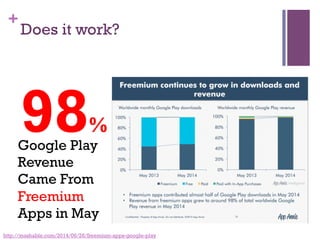
http://mashable.com/2014/06/26/freemium-apps-google-play
Google Play
Revenue
Came From
Freemium
Apps in May
98%
+
Why it works?
n  “Free” = “Nothing to Lo$e” in a customer’s mind
n  Though “time” invested it often ignored!
n  Free features are a great marketing tool
n  Network effect, e.g. Skype or Facebook, etc.
n  Reciprocity Principle
+
Where it works?
n  Markets that already exist with
n  paying customers (as opposed to unpaid hobby or passion)
n  but yet there are gaps in existing service
n  Compelling reason to upgrade, i.e. where
n  Value provided by free product isn’t considered too much or too
little
n  Exceptional value in the paid version compared to the free
n  Cost of servicing free users < Dollar value they provide
http://www.forbes.com/sites/brettnelson/2013/07/23/the-freemium-model-top-flaws-and-potent-fixes/
+
Challenges
n  The Penny Gap:
n  How to get users to sign-up for the paid services, especially when
they don’t perceive any difference in CX?
n  Which feature to give away free and which to price?
+
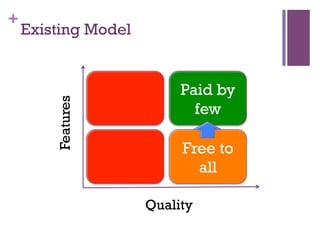
Existing Model
Quality
Features
Paid by
few
Free to
all
+
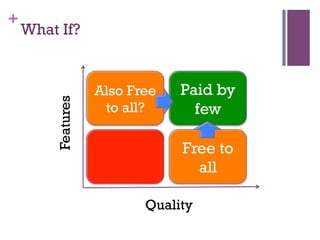
What If?
Quality
Features
Also Free
to all?
Paid by
few
Free to
all
+
Why (if at all) would that make
sense?
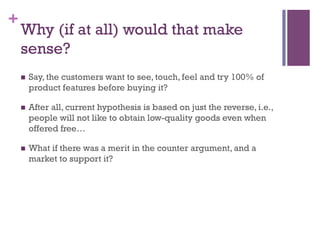
n  Say, the customers want to see, touch, feel and try 100% of
product features before buying it?
n  After all, current hypothesis is based on just the reverse, i.e.,
people will not like to obtain low-quality goods even when
offered free…
n  What if there was a merit in the counter argument, and a
market to support it?
+
What would it mean?
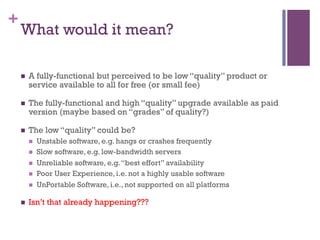
n  A fully-functional but perceived to be low “quality” product or
service available to all for free (or small fee)
n  The fully-functional and high “quality” upgrade available as paid
version (maybe based on “grades” of quality?)
n  The low “quality” could be?
n  Unstable software, e.g. hangs or crashes frequently
n  Slow software, e.g. low-bandwidth servers
n  Unreliable software, e.g.“best effort” availability
n  Poor User Experience, i.e. not a highly usable software
n  UnPortable Software, i.e., not supported on all platforms
n  Isn’t that already happening???
+
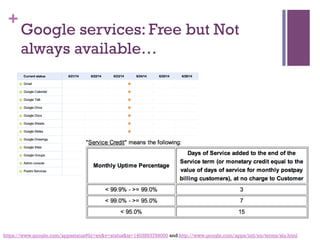
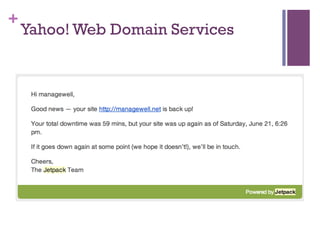
Google services: Free but Not
always available…
https://www.google.com/appsstatus#hl=en&v=status&ts=1403893799000 and http://www.google.com/apps/intl/en/terms/sla.html
+
Yahoo! Web Domain Services
+
Open source model?
n  All features free to install and use (DIY)
n  Pay companies for better support (not mandatory)
+
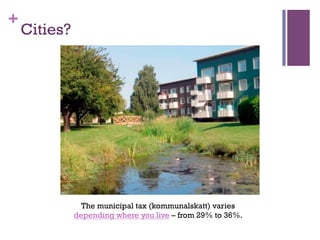
Cities?
The municipal tax (kommunalskatt) varies 
depending where you live – from 29% to 36%.
+
And perhaps many many more…
n  Free water – Tap Water – Bottled Water
n  Free Healthcare – Paid Healthcare
n  Free Primary Education – Private School – Elite Schools
+
What does it mean to design,
deploy and deliver?
n  Understand what people want
n  Give them the features they want
n  In shortest time and cheapest manner
n  Without worrying about a lot of “quality”
n  Perhaps MVQ – “Minimum Viable Quality”?
n  …in short, treat everyone as your “earlyvangalist”?
n  And involve them in your product evolution process J
n  Those who want a better user experience / quality, pay for it!
+
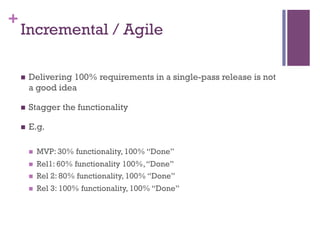
Incremental / Agile
n  Delivering 100% requirements in a single-pass release is not
a good idea
n  Stagger the functionality
n  E.g.
n  MVP: 30% functionality, 100% “Done”
n  Rel1: 60% functionality 100%,“Done”
n  Rel 2: 80% functionality, 100% “Done”
n  Rel 3: 100% functionality, 100% “Done”
+
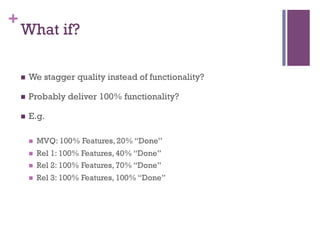
What if?
n  We stagger quality instead of functionality?
n  Probably deliver 100% functionality?
n  E.g.
n  MVQ: 100% Features, 20% “Done”
n  Rel 1: 100% Features, 40% “Done”
n  Rel 2: 100% Features, 70% “Done”
n  Rel 3: 100% Features, 100% “Done”
+
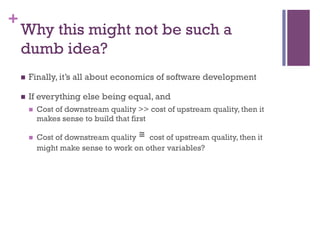
Why this might not be such a
dumb idea?
n  Finally, it’s all about economics of software development
n  If everything else being equal, and
n  Cost of downstream quality >> cost of upstream quality, then it
makes sense to build that first
n  Cost of downstream quality ≅	
 cost of upstream quality, then it
might make sense to work on other variables?
+
Recap…
n  Current freemium is a smart trade-off of features over time
with the quality being non-negotiable
n  What if quality was traded over time with the features being
non-negotiable
n  In many walks of life, there are examples. Certainly for the
Bottom of the Pyramid segments.
n  In software development, there *might* be an opportunity to
create a true level-playing field among all users
n  Can you think of some examples?
+
References
n  What is freemium?,
http://www.freemium.org/what-is-freemium-2/
n  Makin “Freemium”Work,
http://hbr.org/2014/05/making-freemium-work/ar/1
n  The ‘Freemium’ Model:Top Flaws and Potent Fixes,
http://www.forbes.com/sites/brettnelson/2013/07/23/the-
freemium-model-top-flaws-and-potent-fixes/
n  The Complete Guide to Freemium Business Models,
http://techcrunch.com/2011/09/04/complete-guide-
freemium/

Is Quality the new Freemium?

  • 1.
    + Is Quality thenew Fremium? Tathagat Varma http://managewell.net
  • 2.
    + Why this topic? n This is meant to be a provocative talk! n  The idea is to explore how agile thinking could be applied to such an idea. n  This is also a work in progress…don’t construe as a fixed and final position. n  It is possible that the whole idea might be a false start after all…or maybe not J
  • 3.
    + Freemium? n  Free +Premium = Freemium n  A business model in which you give away a core product free to a large group of users and sell premium products to a smaller fraction of this user base.  n  All industries in which a quality, free product can be duplicated with virtually no marginal cost can successfully utilize a freemium business model. n  Examples: n  B2C: Skype, LinkedIn, DropBox, Google Drive, SurveyMonkey n  B2B: Box, Splunk,Yammer http://www.freemium.org/what-is-freemium-2/
  • 4.
    + Origins of Freemium n Popular since 80s by distributing shareware through floppy disks, but really took off in the internet-era due to very low marginal cost of production and distribution. n  In 1983, the Economist Carl Shapiro wrote a fascinating paper about this subject. His conclusion was that since customers tend to underestimate the value of a product, the optimal pricing for an experience good is a low introductory price which is then increased when the customer realizes the value of the product. n  Ester Dyson in 1994 envisioned a world where intellectual property would cost nearly nothing to distribute in the paper Intellectual Property on the Net. n  “Give your service away for free,possibly ad supported but maybe not,acquire a lot of customers very efficiently through word of mouth,referral networks,organic search marketing,etc.,then offer premium priced value added services or an enhanced version of your service to your customer base.” --- Jarid Lukin,“My Favorite Business Model”, 2006 n   Fred Wilson coined the term “Freemium” in response to Jarid’s blog post.
  • 5.
    + Freemium ≠ FreeTrial n  A common misconception is that freemium consists of a free trial, especially when it comes to software.This is not correct.  n  A free trial allows users to try out a product or service for limited time, after which the user must pay to continue using the product or service. n  A freemium model, on the other hand, provides a free product that is always free, generating value in itself. Some users may purchase one or more premium products, but typically only a small percentage will do so. http://www.freemium.org/what-is-freemium-2/
  • 6.
    + Free is NotAlways Freemium n  Another common misconception is that all business models that involve the use of free products are freemium models. n  freemium is not the same as advertising (even though the two business models are often combined) n  freemium is not the same as cross subsidizing (e.g., getting a phone for a dollar and then paying for it through a subscription) n  freemium is not the same as a gift economy http://www.freemium.org/what-is-freemium-2/
  • 7.
  • 8.
    + Why it works? n “Free” = “Nothing to Lo$e” in a customer’s mind n  Though “time” invested it often ignored! n  Free features are a great marketing tool n  Network effect, e.g. Skype or Facebook, etc. n  Reciprocity Principle
  • 9.
    + Where it works? n Markets that already exist with n  paying customers (as opposed to unpaid hobby or passion) n  but yet there are gaps in existing service n  Compelling reason to upgrade, i.e. where n  Value provided by free product isn’t considered too much or too little n  Exceptional value in the paid version compared to the free n  Cost of servicing free users < Dollar value they provide http://www.forbes.com/sites/brettnelson/2013/07/23/the-freemium-model-top-flaws-and-potent-fixes/
  • 10.
    + Challenges n  The PennyGap: n  How to get users to sign-up for the paid services, especially when they don’t perceive any difference in CX? n  Which feature to give away free and which to price?
  • 11.
  • 12.
    + What If? Quality Features Also Free toall? Paid by few Free to all
  • 13.
    + Why (if atall) would that make sense? n  Say, the customers want to see, touch, feel and try 100% of product features before buying it? n  After all, current hypothesis is based on just the reverse, i.e., people will not like to obtain low-quality goods even when offered free… n  What if there was a merit in the counter argument, and a market to support it?
  • 14.
    + What would itmean? n  A fully-functional but perceived to be low “quality” product or service available to all for free (or small fee) n  The fully-functional and high “quality” upgrade available as paid version (maybe based on “grades” of quality?) n  The low “quality” could be? n  Unstable software, e.g. hangs or crashes frequently n  Slow software, e.g. low-bandwidth servers n  Unreliable software, e.g.“best effort” availability n  Poor User Experience, i.e. not a highly usable software n  UnPortable Software, i.e., not supported on all platforms n  Isn’t that already happening???
  • 15.
    + Google services: Freebut Not always available… https://www.google.com/appsstatus#hl=en&v=status&ts=1403893799000 and http://www.google.com/apps/intl/en/terms/sla.html
  • 16.
  • 17.
    + Open source model? n All features free to install and use (DIY) n  Pay companies for better support (not mandatory)
  • 18.
    + Cities? The municipal tax(kommunalskatt) varies  depending where you live – from 29% to 36%.
  • 19.
    + And perhaps manymany more… n  Free water – Tap Water – Bottled Water n  Free Healthcare – Paid Healthcare n  Free Primary Education – Private School – Elite Schools
  • 20.
    + What does itmean to design, deploy and deliver? n  Understand what people want n  Give them the features they want n  In shortest time and cheapest manner n  Without worrying about a lot of “quality” n  Perhaps MVQ – “Minimum Viable Quality”? n  …in short, treat everyone as your “earlyvangalist”? n  And involve them in your product evolution process J n  Those who want a better user experience / quality, pay for it!
  • 21.
    + Incremental / Agile n Delivering 100% requirements in a single-pass release is not a good idea n  Stagger the functionality n  E.g. n  MVP: 30% functionality, 100% “Done” n  Rel1: 60% functionality 100%,“Done” n  Rel 2: 80% functionality, 100% “Done” n  Rel 3: 100% functionality, 100% “Done”
  • 22.
    + What if? n  Westagger quality instead of functionality? n  Probably deliver 100% functionality? n  E.g. n  MVQ: 100% Features, 20% “Done” n  Rel 1: 100% Features, 40% “Done” n  Rel 2: 100% Features, 70% “Done” n  Rel 3: 100% Features, 100% “Done”
  • 23.
    + Why this mightnot be such a dumb idea? n  Finally, it’s all about economics of software development n  If everything else being equal, and n  Cost of downstream quality >> cost of upstream quality, then it makes sense to build that first n  Cost of downstream quality ≅ cost of upstream quality, then it might make sense to work on other variables?
  • 24.
    + Recap… n  Current freemiumis a smart trade-off of features over time with the quality being non-negotiable n  What if quality was traded over time with the features being non-negotiable n  In many walks of life, there are examples. Certainly for the Bottom of the Pyramid segments. n  In software development, there *might* be an opportunity to create a true level-playing field among all users n  Can you think of some examples?
  • 25.
    + References n  What isfreemium?, http://www.freemium.org/what-is-freemium-2/ n  Makin “Freemium”Work, http://hbr.org/2014/05/making-freemium-work/ar/1 n  The ‘Freemium’ Model:Top Flaws and Potent Fixes, http://www.forbes.com/sites/brettnelson/2013/07/23/the- freemium-model-top-flaws-and-potent-fixes/ n  The Complete Guide to Freemium Business Models, http://techcrunch.com/2011/09/04/complete-guide- freemium/