International Research Journal of Engineering and Technology (IRJET) e-ISSN: 2395-0056
Volume: 06 Issue: 04 | Apr 2019 www.irjet.net p-ISSN: 2395-0072
© 2019, IRJET | Impact Factor value: 7.211 | ISO 9001:2008 Certified Journal | Page 1106
Sentimental Analysis for Students’ Feedback using Machine Learning
Approach
Kousalya. L1, Subhashini. R2
1Sathyabama Institute of Science and technology, Dept. of Information Technology, Chennai, India.
2Sathyabama Institute of Science and technology, Dept. of Information Technology, Chennai, India
---------------------------------------------------------------------***----------------------------------------------------------------------
Abstract - As World Wide Web is growing at higher rate,
this has resulted in enormous increase in online
communications. The online communication data consist of
feedbacks that are posted by students. Sentiment analysis
system classifies text data into their respective sentiments of
positive polarity, negative polarity or neutral. There are some
other robust classifiers which have ability to provide
comparable or better results. In this project, we try to focus
our task of sentimental analysis for students’ feedback
collected through online. We examine the sentiments present
in the text document for classification of students’ feedback
based on polarity (positive/ negative/ neutral) usingmachine
learning and lexicon based approach. Also we have used the
Random Forest classifier for the evaluation of performance
and for finding the accuracy. By using Random Forest
classification technique we have achieved the bestaccuracy of
90%.
Key Words: Sentimental Analysis, NLP, Feature Extraction,
Polarity.
1. INTRODUCTION
In the existing system students used to give feedbacks
manually on paper feedback forms. It was a time consuming
and very inefficient process. Then the forms are collected
and the HOD’s views the feedbacks of students and analyze
the performance of that teacher of that particular
department. Then to overcome the limitationsofthatsystem
came the online feedback systems which takes the feedback
of students online and automatically analyzes the feedback
to analyze the performance of teachers. But the existing
online feedback systems only analyzes the objective type
questions it doesn’t analyzes the descriptive type questions.
In this project a sentiment analyzer is implemented to
analyze the descriptive type questions so to increase the
accuracy of the feedback system[1]. Thesentimentanalyzer
is build using machine learning algorithms. There’s an
algorithm whichanalyzesthedescriptivetypequestions.The
algorithm is trained using the training data set which
contains positive and negative words. And then the model is
created using the trained algorithm. Then the test data is
given to the algorithm to see the accuracy of the system. If it
lacks in accuracy, then more training data and features are
added to the analyser to increase the accuracy of the system
and in such manner the machine learning is implemented to
build the sentiment analyser. The taking of feedback plays a
very significant role in the life of students as well as the
teachers. The students givethefeedback sotoconveywhatis
the difference betweentheactual teachingwhichiscurrently
taking place in colleges and what type of teaching students
really desire for. And these feedbacks show the teachers
their overall performance in their particular subjects. They
can improve their teaching accordingly. This system is a
secured system. The identity of the students givingfeedback
is not disclosed to anyone not even the admin. And a single
student can give only a single feedback to a particular
teacher. The accounts of students are created by the admin
so no one other than the students can give the feedback.
Sentiment analysis has received much attention from
research andindustrycommunitiesrecently.Inthisfeedback
system, a database is created which contains negative and
positive words. Then it contains a java API which is used to
parse and check the words present in the student’s
descriptive type answers if there positive or negative word
by comparing it with the words present in the database.
Then there’s an API to set the database information. Such as
which driver is used, which port number isdatabasepresent
in and the username and password for accessing the
database. These API’s are transformed into jar files and
added to the libraries of the project.
1.1 RELATED WORK
Sentiment Analysis has been extensively studied during the
past few years. The reported work can be broadly classified
into three main approaches: (a) machine learning based, (b)
lexicon-based and (c) hybrid.
1.2 MACHINE LEARNING BASED
Machine learning based approaches of sentiment analysis
learn a predictive model using the provided training dataset
and evaluate the performance of the learned model on the
test dataset. It can be further classified into supervised
learning and unsupervised learning methods.
1.3 LEXICON BASED
Lexicon basedapproach of sentiment analysis makesuseofa
sentiment lexicon to determine the polarity of agiventextual
content. A lexicon or dictionary represents a list of words
with associated sentiment polarity. The lexicon can be
International Research Journal of Engineering and Technology (IRJET) e-ISSN: 2395-0056
Volume: 06 Issue: 04 | Apr 2019 www.irjet.net p-ISSN: 2395-0072
© 2019, IRJET | Impact Factor value: 7.211 | ISO 9001:2008 Certified Journal | Page 1107
constructed either manually or automatically. They utilized
an online lexical resource WordNet to predict the semantic
orientation of an opinion word. Taboada et al. He proposed
anotherlexicon-basedapproach thatdeterminesthepolarity
of a word by using the dictionaries constructed.
1.4 HYBRID APPROACH
Hybrid Approaches use sentiment lexicon in machine
learning methods. Zhang et al. [10] proposed a hybrid
approach for sentiment analysis of Twitter data. An opinion
lexicon was used to label training dataset with sentiment
polarities. The labeled dataset was thenusedtotrainabinary
classifier to predict sentiment polarity on the evaluation
dataset. Appel et al. [11] performed sentiment analysisatthe
sentence level using a hybrid approach. Their approach was
based on a sentiment lexicon extended using SentiWordNet
and fuzzy sets to determine sentiment polarity of a sentence.
This paper alsopresentsahybridapproachthatcombinesthe
use of sentiment dictionaryandmachinelearningmethodsto
determine the semantic orientationofatextualfeedprovided
by students.
2. PROPOSED SYSTEM
In this system, we are using machine learning based
approach for sentiment classification. For this, we are
constructing dataset of feedbacksgotfromstudentsrealtime.
After obtaining the feedbacks, they are pre-processed to
remove the noise. The feedbacks are labelled as either
positive, negative or neutral.After pre-processing,usefuland
significant features are extracted from tweets. The machine
learning classifiers are applied on the training dataset. The
model obtained from training, is applied on unseen test
dataset tocheck the accuracy of the model.Awebapplication
will be created which will display the results of the
classification. The results are visualized and displayed on
website for user convenience.
2.1 DATA COLLECTION
The real-time students’ feedback is collected through an
online student portal. Where a student has a separate login.
Then a student can give single comment for per login id.
2.2 DATA PREPROCESSING
The text pre-processing techniques are divided into three
subcategories:
Tokenization: The data present in the text document
contains block of characters called tokens. These text
documents are separated as tokens and used for further
processing of data.
Removal of Stop Words: A web search tool or other natural
language processing system may contain collection of
stoprecords, or it may contain a solitary stop-list. Most of the
more frequently used stop words in English are“an”,“a”,“of”,
“the”, “you”, “and” these are some words which do not carry
any meaning. Hence, thosewordswhichappeartoooftenthat
support no information for the task are removed.
Part of Speech Tagging: POS tagger parses a sentence or
document and tags each term with its part of speech. For
part-of-speech tagging we used the Stanford partof-speech
tagger. This tagger used by splitting text data into sentences
and to produce the POS tag for each word (whether the word
is a noun, verb, adjective). Consider following example
“Staffs are amazing”.
In part-of-speech (POS tagging), each word in review is
tagged with POS (such as noun NN, adjective JJ, verb RB). In
taggedsentence, amazingistaggedwithtagJJwhichindicates
‘amazing’ is an adjective where as a ‘movie’ is tagged as NN
which indicates noun.
Fig -1: Work flow diagram
2.3. FEATURE EXTRACTION
In the process of feature extraction, movie features are
extracted from every sentence. For finding the polarity of
text document, it is necessary to understand the sentiment
score with its usage as well as their relationship with all the
nearby words. Following are some features that affect the
polarity of the document.
1) Positive Sentiment Words: These are the wordswhichare
having a positive sentiment score according to
International Research Journal of Engineering and Technology (IRJET) e-ISSN: 2395-0056
Volume: 06 Issue: 04 | Apr 2019 www.irjet.net p-ISSN: 2395-0072
© 2019, IRJET | Impact Factor value: 7.211 | ISO 9001:2008 Certified Journal | Page 1108
SentiWordNet. For example: Nice, Good, Fantastic, Pretty,
Outstanding etc.
2) Negative Sentiment Words: These are the words which
are having negative sentiment score according to
SentiWordNet. For example: Bad,Awful,Disgusting,Pathetic
etc.
2.4. FEATURE REDUCTION
One of the biggest problems of sentimental analysis is
dealing with text data which are available in very high
dimensions which may affect the performance of classifier.
So, there is a need for such technique which will eliminate
those features that are not relevant and keeping only those
features which are much important and the techniques
which will help to differentiate the sentences into class
labels such as positive and negative. The Information Gain
and Gain Ratio are the most popular techniques among
number of feature reduction techniques.
2.5. MODEL TRAINING
Model Training After the extraction of features from the
train and test dataset, learning algorithms were applied for
training model. The hybrid model forsentimentanalysiswas
trained using unigrams, bigrams, TF-IDF and lexicon-based
features. A brief description of the learning algorithms is
given below:
1) Random Forest: Random Forest Algorithm was proposed
by. In this study, scikit-learn implementation of Random
Forest algorithm was used. The hyper parameters were
tuned using three fold cross validation.
2) Support Vector Machines (SVM): The scikit-learn
implementation of SVM with linear kernel was used to train
model.
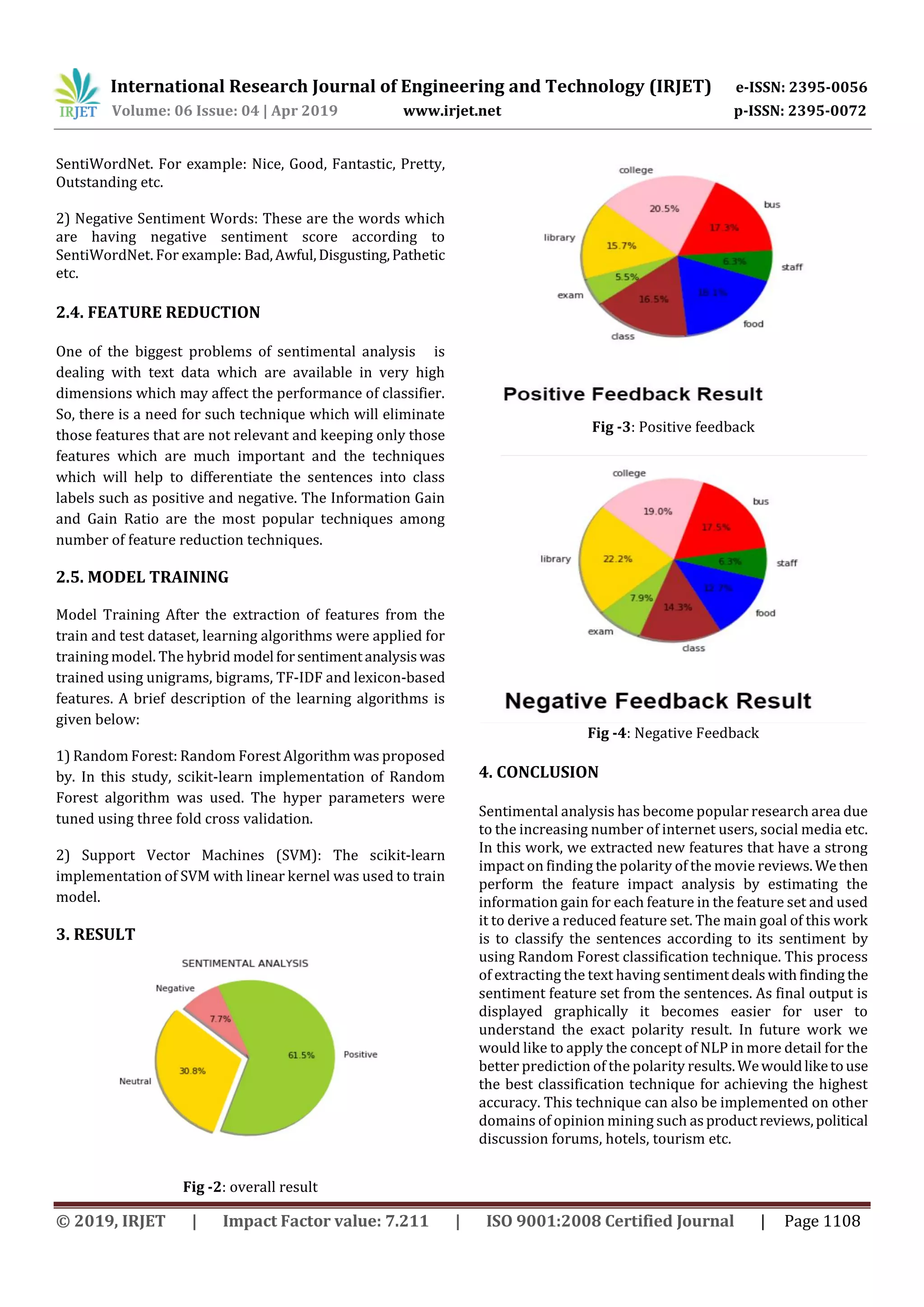
3. RESULT
Fig -2: overall result
Fig -3: Positive feedback
Fig -4: Negative Feedback
4. CONCLUSION
Sentimental analysis has become popular research area due
to the increasing number of internet users, social media etc.
In this work, we extracted new features that have a strong
impact on finding the polarity of the movie reviews. Wethen
perform the feature impact analysis by estimating the
information gain for each feature in the feature set and used
it to derive a reduced feature set. The main goal of this work
is to classify the sentences according to its sentiment by
using Random Forest classification technique. This process
of extracting the text having sentimentdealswithfinding the
sentiment feature set from the sentences. As final output is
displayed graphically it becomes easier for user to
understand the exact polarity result. In future work we
would like to apply the concept of NLP in more detail for the
better prediction of the polarity results.Wewouldliketouse
the best classification technique for achieving the highest
accuracy. This technique can also be implemented on other
domains of opinion mining such asproductreviews,political
discussion forums, hotels, tourism etc.
International Research Journal of Engineering and Technology (IRJET) e-ISSN: 2395-0056
Volume: 06 Issue: 04 | Apr 2019 www.irjet.net p-ISSN: 2395-0072
© 2019, IRJET | Impact Factor value: 7.211 | ISO 9001:2008 Certified Journal | Page 1109
REFERENCES
[1] P.Nagamma, Pruthvi H.R, Nisha K.K, Carlos Soares,” An
ImprovedSentimentAnalysisofOnlineMovieReviews”,IEEE
2015, International conference on Computer and
Inforamation Technology.
[2] B. Pang, L. Lee, and S. Vaithyanathan, “Thumbs
up?:sentiment classification using machine learning
techniques,” in Proceedings of the ACL-02 conference on
Empirical methods in natural language processing-Volume
10. Association for Computational Linguistics, 2002, pp. 79–
86.
[3] J. Erman, M. Arlitt, and A. Mahanti, “Traffic classification
using clustering algorithms,” in Proceedings of the 2006
SIGCOMM workshop on Mining network data. ACM, 2006,
pp. 281–286 A. Baloglu, Mehmat A. Aktas, "An Automated
Framework for Mining Reviews from Blogosphere,"
International Journal on Advances in Internet Technology,
vol. 3, 2010.
[4] Turney, Peter, and Michael L. Littman. "Unsupervised
learning of semanticorientationfroma hundred-billionword
corpus." (2002).
[5] Baccianella, Stefano, Andrea Esuli, and Fabrizio
Sebastiani. “SentiWordNet 3.0: An Enhanced Lexical
Resource for Sentiment Analysis andOpinionMining.“LREC.
Vol. 10. 2010.

IRJET- Sentimental Analysis for Students’ Feedback using Machine Learning Approach

  • 1.
    International Research Journalof Engineering and Technology (IRJET) e-ISSN: 2395-0056 Volume: 06 Issue: 04 | Apr 2019 www.irjet.net p-ISSN: 2395-0072 © 2019, IRJET | Impact Factor value: 7.211 | ISO 9001:2008 Certified Journal | Page 1106 Sentimental Analysis for Students’ Feedback using Machine Learning Approach Kousalya. L1, Subhashini. R2 1Sathyabama Institute of Science and technology, Dept. of Information Technology, Chennai, India. 2Sathyabama Institute of Science and technology, Dept. of Information Technology, Chennai, India ---------------------------------------------------------------------***---------------------------------------------------------------------- Abstract - As World Wide Web is growing at higher rate, this has resulted in enormous increase in online communications. The online communication data consist of feedbacks that are posted by students. Sentiment analysis system classifies text data into their respective sentiments of positive polarity, negative polarity or neutral. There are some other robust classifiers which have ability to provide comparable or better results. In this project, we try to focus our task of sentimental analysis for students’ feedback collected through online. We examine the sentiments present in the text document for classification of students’ feedback based on polarity (positive/ negative/ neutral) usingmachine learning and lexicon based approach. Also we have used the Random Forest classifier for the evaluation of performance and for finding the accuracy. By using Random Forest classification technique we have achieved the bestaccuracy of 90%. Key Words: Sentimental Analysis, NLP, Feature Extraction, Polarity. 1. INTRODUCTION In the existing system students used to give feedbacks manually on paper feedback forms. It was a time consuming and very inefficient process. Then the forms are collected and the HOD’s views the feedbacks of students and analyze the performance of that teacher of that particular department. Then to overcome the limitationsofthatsystem came the online feedback systems which takes the feedback of students online and automatically analyzes the feedback to analyze the performance of teachers. But the existing online feedback systems only analyzes the objective type questions it doesn’t analyzes the descriptive type questions. In this project a sentiment analyzer is implemented to analyze the descriptive type questions so to increase the accuracy of the feedback system[1]. Thesentimentanalyzer is build using machine learning algorithms. There’s an algorithm whichanalyzesthedescriptivetypequestions.The algorithm is trained using the training data set which contains positive and negative words. And then the model is created using the trained algorithm. Then the test data is given to the algorithm to see the accuracy of the system. If it lacks in accuracy, then more training data and features are added to the analyser to increase the accuracy of the system and in such manner the machine learning is implemented to build the sentiment analyser. The taking of feedback plays a very significant role in the life of students as well as the teachers. The students givethefeedback sotoconveywhatis the difference betweentheactual teachingwhichiscurrently taking place in colleges and what type of teaching students really desire for. And these feedbacks show the teachers their overall performance in their particular subjects. They can improve their teaching accordingly. This system is a secured system. The identity of the students givingfeedback is not disclosed to anyone not even the admin. And a single student can give only a single feedback to a particular teacher. The accounts of students are created by the admin so no one other than the students can give the feedback. Sentiment analysis has received much attention from research andindustrycommunitiesrecently.Inthisfeedback system, a database is created which contains negative and positive words. Then it contains a java API which is used to parse and check the words present in the student’s descriptive type answers if there positive or negative word by comparing it with the words present in the database. Then there’s an API to set the database information. Such as which driver is used, which port number isdatabasepresent in and the username and password for accessing the database. These API’s are transformed into jar files and added to the libraries of the project. 1.1 RELATED WORK Sentiment Analysis has been extensively studied during the past few years. The reported work can be broadly classified into three main approaches: (a) machine learning based, (b) lexicon-based and (c) hybrid. 1.2 MACHINE LEARNING BASED Machine learning based approaches of sentiment analysis learn a predictive model using the provided training dataset and evaluate the performance of the learned model on the test dataset. It can be further classified into supervised learning and unsupervised learning methods. 1.3 LEXICON BASED Lexicon basedapproach of sentiment analysis makesuseofa sentiment lexicon to determine the polarity of agiventextual content. A lexicon or dictionary represents a list of words with associated sentiment polarity. The lexicon can be
  • 2.
    International Research Journalof Engineering and Technology (IRJET) e-ISSN: 2395-0056 Volume: 06 Issue: 04 | Apr 2019 www.irjet.net p-ISSN: 2395-0072 © 2019, IRJET | Impact Factor value: 7.211 | ISO 9001:2008 Certified Journal | Page 1107 constructed either manually or automatically. They utilized an online lexical resource WordNet to predict the semantic orientation of an opinion word. Taboada et al. He proposed anotherlexicon-basedapproach thatdeterminesthepolarity of a word by using the dictionaries constructed. 1.4 HYBRID APPROACH Hybrid Approaches use sentiment lexicon in machine learning methods. Zhang et al. [10] proposed a hybrid approach for sentiment analysis of Twitter data. An opinion lexicon was used to label training dataset with sentiment polarities. The labeled dataset was thenusedtotrainabinary classifier to predict sentiment polarity on the evaluation dataset. Appel et al. [11] performed sentiment analysisatthe sentence level using a hybrid approach. Their approach was based on a sentiment lexicon extended using SentiWordNet and fuzzy sets to determine sentiment polarity of a sentence. This paper alsopresentsahybridapproachthatcombinesthe use of sentiment dictionaryandmachinelearningmethodsto determine the semantic orientationofatextualfeedprovided by students. 2. PROPOSED SYSTEM In this system, we are using machine learning based approach for sentiment classification. For this, we are constructing dataset of feedbacksgotfromstudentsrealtime. After obtaining the feedbacks, they are pre-processed to remove the noise. The feedbacks are labelled as either positive, negative or neutral.After pre-processing,usefuland significant features are extracted from tweets. The machine learning classifiers are applied on the training dataset. The model obtained from training, is applied on unseen test dataset tocheck the accuracy of the model.Awebapplication will be created which will display the results of the classification. The results are visualized and displayed on website for user convenience. 2.1 DATA COLLECTION The real-time students’ feedback is collected through an online student portal. Where a student has a separate login. Then a student can give single comment for per login id. 2.2 DATA PREPROCESSING The text pre-processing techniques are divided into three subcategories: Tokenization: The data present in the text document contains block of characters called tokens. These text documents are separated as tokens and used for further processing of data. Removal of Stop Words: A web search tool or other natural language processing system may contain collection of stoprecords, or it may contain a solitary stop-list. Most of the more frequently used stop words in English are“an”,“a”,“of”, “the”, “you”, “and” these are some words which do not carry any meaning. Hence, thosewordswhichappeartoooftenthat support no information for the task are removed. Part of Speech Tagging: POS tagger parses a sentence or document and tags each term with its part of speech. For part-of-speech tagging we used the Stanford partof-speech tagger. This tagger used by splitting text data into sentences and to produce the POS tag for each word (whether the word is a noun, verb, adjective). Consider following example “Staffs are amazing”. In part-of-speech (POS tagging), each word in review is tagged with POS (such as noun NN, adjective JJ, verb RB). In taggedsentence, amazingistaggedwithtagJJwhichindicates ‘amazing’ is an adjective where as a ‘movie’ is tagged as NN which indicates noun. Fig -1: Work flow diagram 2.3. FEATURE EXTRACTION In the process of feature extraction, movie features are extracted from every sentence. For finding the polarity of text document, it is necessary to understand the sentiment score with its usage as well as their relationship with all the nearby words. Following are some features that affect the polarity of the document. 1) Positive Sentiment Words: These are the wordswhichare having a positive sentiment score according to
  • 3.
    International Research Journalof Engineering and Technology (IRJET) e-ISSN: 2395-0056 Volume: 06 Issue: 04 | Apr 2019 www.irjet.net p-ISSN: 2395-0072 © 2019, IRJET | Impact Factor value: 7.211 | ISO 9001:2008 Certified Journal | Page 1108 SentiWordNet. For example: Nice, Good, Fantastic, Pretty, Outstanding etc. 2) Negative Sentiment Words: These are the words which are having negative sentiment score according to SentiWordNet. For example: Bad,Awful,Disgusting,Pathetic etc. 2.4. FEATURE REDUCTION One of the biggest problems of sentimental analysis is dealing with text data which are available in very high dimensions which may affect the performance of classifier. So, there is a need for such technique which will eliminate those features that are not relevant and keeping only those features which are much important and the techniques which will help to differentiate the sentences into class labels such as positive and negative. The Information Gain and Gain Ratio are the most popular techniques among number of feature reduction techniques. 2.5. MODEL TRAINING Model Training After the extraction of features from the train and test dataset, learning algorithms were applied for training model. The hybrid model forsentimentanalysiswas trained using unigrams, bigrams, TF-IDF and lexicon-based features. A brief description of the learning algorithms is given below: 1) Random Forest: Random Forest Algorithm was proposed by. In this study, scikit-learn implementation of Random Forest algorithm was used. The hyper parameters were tuned using three fold cross validation. 2) Support Vector Machines (SVM): The scikit-learn implementation of SVM with linear kernel was used to train model. 3. RESULT Fig -2: overall result Fig -3: Positive feedback Fig -4: Negative Feedback 4. CONCLUSION Sentimental analysis has become popular research area due to the increasing number of internet users, social media etc. In this work, we extracted new features that have a strong impact on finding the polarity of the movie reviews. Wethen perform the feature impact analysis by estimating the information gain for each feature in the feature set and used it to derive a reduced feature set. The main goal of this work is to classify the sentences according to its sentiment by using Random Forest classification technique. This process of extracting the text having sentimentdealswithfinding the sentiment feature set from the sentences. As final output is displayed graphically it becomes easier for user to understand the exact polarity result. In future work we would like to apply the concept of NLP in more detail for the better prediction of the polarity results.Wewouldliketouse the best classification technique for achieving the highest accuracy. This technique can also be implemented on other domains of opinion mining such asproductreviews,political discussion forums, hotels, tourism etc.
  • 4.
    International Research Journalof Engineering and Technology (IRJET) e-ISSN: 2395-0056 Volume: 06 Issue: 04 | Apr 2019 www.irjet.net p-ISSN: 2395-0072 © 2019, IRJET | Impact Factor value: 7.211 | ISO 9001:2008 Certified Journal | Page 1109 REFERENCES [1] P.Nagamma, Pruthvi H.R, Nisha K.K, Carlos Soares,” An ImprovedSentimentAnalysisofOnlineMovieReviews”,IEEE 2015, International conference on Computer and Inforamation Technology. [2] B. Pang, L. Lee, and S. Vaithyanathan, “Thumbs up?:sentiment classification using machine learning techniques,” in Proceedings of the ACL-02 conference on Empirical methods in natural language processing-Volume 10. Association for Computational Linguistics, 2002, pp. 79– 86. [3] J. Erman, M. Arlitt, and A. Mahanti, “Traffic classification using clustering algorithms,” in Proceedings of the 2006 SIGCOMM workshop on Mining network data. ACM, 2006, pp. 281–286 A. Baloglu, Mehmat A. Aktas, "An Automated Framework for Mining Reviews from Blogosphere," International Journal on Advances in Internet Technology, vol. 3, 2010. [4] Turney, Peter, and Michael L. Littman. "Unsupervised learning of semanticorientationfroma hundred-billionword corpus." (2002). [5] Baccianella, Stefano, Andrea Esuli, and Fabrizio Sebastiani. “SentiWordNet 3.0: An Enhanced Lexical Resource for Sentiment Analysis andOpinionMining.“LREC. Vol. 10. 2010.