International Research Journal of Engineering and Technology (IRJET) e-ISSN: 2395-0056
Volume: 06 Issue: 06 | June 2019 www.irjet.net p-ISSN: 2395-0072
© 2019, IRJET | Impact Factor value: 7.211 | ISO 9001:2008 Certified Journal | Page 930
Metal Crack Detection Using Image Processing
M Kalaiarasi1, Yashvir Indolia2, Seema N3 and Bhupender Kumar4
1M Kalaiarasi, Assistance Professor, SIR MVIT, BANGALORE
2Yashvir Indolia, SIR MVIT, BANGALORE
3Seema N, SIR MVIT, BANGALORE
4Bhupender Kumar, SIR MVIT, BANGALORE
----------------------------------------------------------------***-------------------------------------------------------------------
Abstract: Production levels across all industries are rising
at a very rapid pace. Industries are producing more goods
than ever before. Therefore it is very important to integrate
the best technological improvements so as to produce the
best quality of product. This paper presents a system which
detects cracks and holes on a metal piece using image
processing. Raspberry pi is being used along with sensors
such as infrared sensor and proximity sensor and a
separator which helps to detect a defective metal piece and
hence separate it from the good quality metal piece. Since
manual separation is very time consuming and heavily
dependent on individual’s ability to work continuously for
long hours, thus it is not the best way forward. This project
will not only help in reducing dependence on manual labor
on one side, but also a increase the efficiency and monitoring
of production line. Internet of things is being used to transfer
the relevant data from the raspberry pi to the cloud which
can be accessed from anywhere, anytime.
Keywords: Crack detection, infrared sensor, proximity
sensor, raspberry pi, production line and image
processing.
II. INTRODUCTION
Quality inspection at the end of a production line is an
important stage in industry, especially for high-
performance components. Parts undergoing strong
mechanical and thermal stress should be carefully
checked, since small defects can affect performance and
reliability of a component. Crack detection is one of the
most common checks to be performed, because cracks are
a common source of failure, and they affect a high number
of different productions.
Machine vision using image processing algorithms is one
of the fastest growing and widely used technologies in the
area of manufacturing and quality control due to the
increasing quality demands of manufacturers and
customers. Machine vision utilizes industrial image
processing by the use of cameras mounted on production
lines and cells in order to visually inspect products in the
real-time without operator intervention.
The issue of Quality Control in metal object is an important
aspect of today’s highly competitive Industry. The quality
of the end product can be improved by inspecting the
product at each manufacturing stage in production line.
However, manual inspection of end products slows down
the entire process as it becomes costly, difficult, time-
consuming and also may impact the effectiveness of
human labor due to the hazardous atmosphere of the
industry. Therefore, the process of inspection is also to be
automated and inspection results should be fed back to the
upstream manufacturing process for improvement of
product quality. However, the Inspection system should be
designed to be an efficient composition of human
intelligence and experience along with the fastness of a
machine. Machine Vision can be used very effectively to
find out the faults in the metal object in the real-time
industrial manufacturing process.
III. CLASSIFICATION AND FEATURES OF A
DEFECTIVE CRACK METAL
The edge algorithm is used which helps the edges of the
metal piece to be detected. This concept is used to detect
the cracks in a metal object where the cracks are
considered as the edges. Canny algorithm is used which is
also capable to give the output as the threshold levels.
International Research Journal of Engineering and Technology (IRJET) e-ISSN: 2395-0056
Volume: 06 Issue: 06 | June 2019 www.irjet.net p-ISSN: 2395-0072
© 2019, IRJET | Impact Factor value: 7.211 | ISO 9001:2008 Certified Journal | Page 931
IV. TYPES OF THE DEFECTS IN METAL
1.1Surface defects
Surface defects are any abnormality present on the metal
surface. The table 1.1 gives the types of surface the defects
in metal.
The defect Description
Crack Unwanted discontinuity on the
metal surface
Pinhole Small pinpoint slots
Spot Discontinuity of color on surface
Edge Edge discontinuity
Scratch Scratch on surface
Fig 4.1: Different types of cracks
1.2 Shape defects
These defects include any shape abnormality if present in
the metal object. Shape Changes can occur in production
line because of temperature difference, corner or edge
breakdown etc.
V.THE ISSUES IN THE DEFECT INSPECTION
At present, there are commercially available products
which can detect the presence or absence of surface
defects at reasonable costs. However, this problem still
remains an open research issue due to the difficulties faced
during the real-time defect Detection, Identification and
Localization as well. The major obstacles in this area are
mainly due to the computational costs, lack of expert
knowledge in the defect feature selection or modeling,
availability of proper the defect samples and so on.
VI. CRACK DETECTION ALGOITHM
Canny edge detection algorithm is used. It significantly
reduces the amount of data that needs to be processed by
extracting only the relevant information. Canny edge
detection is also widely used in various computer vision
based systems. Canny used the calculus of variations – a
technique which finds the function which optimizes a
given functional. The Canny edge detection algorithm is
composed of five steps. Noise reduction, gradient,
calculation, non-maximum, suppression, double threshold,
and edge tracking by hysteresis. Since all the edges
detection contain noises, thus it is important to first
remove them before starting to derive the information. To
smooth the image, Gaussian filter is used to convolve the
image. This step will slightly smooth the image to reduce
the effects of obvious noise on the edge detector. An edge
in an image may point in a variety of directions, so the
Canny algorithm uses four filters to detect horizontal,
vertical and diagonal edges in the blurred image.
Fig 6.1: Canny edge detection algorithm
VII. PROCEDURE APPLIED AND CLACULATIONS
1.Smooth the image with a Gaussian filter to reduce noise
and unwanted details and textures.
International Research Journal of Engineering and Technology (IRJET) e-ISSN: 2395-0056
Volume: 06 Issue: 06 | June 2019 www.irjet.net p-ISSN: 2395-0072
© 2019, IRJET | Impact Factor value: 7.211 | ISO 9001:2008 Certified Journal | Page 932
where
2. Compute gradient of g(m,n) using any of the gradient
operatiors (Roberts, Sobel, Prewitt, etc) to get:
and
3. Threshold M:
where T is so chosen that all edge elements are kept while
most of the noise is suppressed.
4. Suppress non-maxima pixels in the edges in Mt obtained
above to thin the edge ridges (as the edges might have
been broadened in step 1). To do so, check to see whether
each non-zero Mt(m,n) is greater than its two neighbors
along the gradient direction theta(m,n)$. If so, keep
Mt(m,n) unchanged, otherwise, set it to 0.
5. Threshold the previous result by two different
thresholds T1 and T2 (where T1<T2 to obtain two binary
images T1 and T2. T12with greater T2 has less noise and
fewer false edges but greater gaps between edge segments,
when compared to T1 with smaller T1.
6. Link edge segments in T2 to form continuous edges. To
do so, trace each segment in T2 to its end and then search
its neighbors in T1 to find any edge segment in T1 to
bridge the gap until reaching another edge segment in T2.
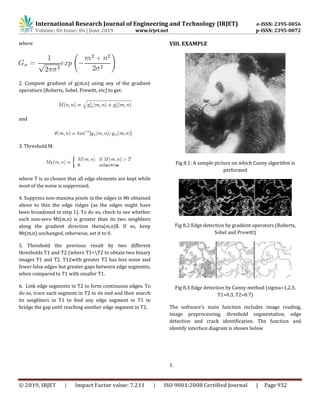
VIII. EXAMPLE
Fig 8.1: A sample picture on which Canny algorithm is
performed
Fig 8.2:Edge detection by gradient operators (Roberts,
Sobel and Prewitt)
Fig 8.3:Edge detection by Canny method (sigma=1,2,3,
T1=0.3, T2=0.7)
The software’s main function includes image reading,
image preprocessing, threshold segmentation, edge
detection and crack identification. The function and
identify interface diagram is shown below
1.
International Research Journal of Engineering and Technology (IRJET) e-ISSN: 2395-0056
Volume: 06 Issue: 06 | June 2019 www.irjet.net p-ISSN: 2395-0072
© 2019, IRJET | Impact Factor value: 7.211 | ISO 9001:2008 Certified Journal | Page 933
2.
Fig 8.4: Before and after edge detection
IX. CONCLUSION
In this project, efficient surface defect detection is
presented based on different thresholding techniques. The
real-time defected metal surface image is used in this
approach. In order to identify the defects, the input image
is transferred to grayscale. Then the binarization is done
using different thresholding, in which the defect region is
differentiated from the non-the defect region.
Experimental results prove that the presented defect
detection approach using thresholding provides promising
performance for the real-time metal surface images.
Automotive defect detection will help the industry to
maintain the quality of product with less false detection
and increased speed also the updated information about
the quality of metal or the object under inspection is sent
through raspberry pi to the IoT such as mobile
automatically, even when the user is not using it. This will
completely eliminate the need for the human expert from
quality inspection.
X. REFERENCES
[1] Chaitali Tikhe, J.S.Chitode “Metal Surface Inspection for
The defect Detection and Classification using Gabor Filter”,
International Journal of Innovative Research in Science,
Engineering and Technology
[2] M.Senthikumar, Dr.V.Palanisamy, Dr.J.Jaya, “Metal
Surface The defect Detection using Iterative Thresholding
Technique”, 2nd International Conference on Current
Trends in Engineering and Technology, ICCTET’14
[3] Hui-Fuang Ng, “Automatic thresholding for the defect
detection”, Science Direct-Pattern Recognition Letters 27
(2006) 1644–1649
[4] T.Aarthi, M.Karthi, M.Abinesh, “Detection and Analysis
of Surface The defects in Metals Using Wavelet Transform”
International Journal of Scientific and Research
Publications, Volume 3, Issue 6, June 2013, ISSN 2250-
3153
[5] Aswini.E, Divya.S, Kardheepan.S and Manikandan.T,
“Mathematical Morphology and bottom-hat filtering
approach for Crack Detection on Relay Surfaces” 2013
International Conference on Smart Structures & Systems
(JCSSS-20 13), March 28 - 29,2013, Chennai, INDIA
International Research Journal of Engineering and Technology (IRJET) e-ISSN: 2395-0056
Volume: 06 Issue: 06 | June 2019 www.irjet.net p-ISSN: 2395-0072
© 2019, IRJET | Impact Factor value: 7.211 | ISO 9001:2008 Certified Journal | Page 934
[6] Jijina K P, Sreeja S S, Vinod P R, “The real-time
Detection and Classification of Metal The defects Using
Image Processing”, International Research Journal of
Computer Science Engineering and Applications Vol 2
Issue 4 April 2013 ISSN 23198672
[7] Er. Harjit Kaur “Crack Detection and Parameters
Estimation on Road Images: Review” International Journal
of Advanced Research in Computer Science volume 8, no 4,
may 2017
[8] Gang Shen “Road Crack Detection Based on Video
Image Processing”.

IRJET- Metal Crack Detection using Image Processing

  • 1.
    International Research Journalof Engineering and Technology (IRJET) e-ISSN: 2395-0056 Volume: 06 Issue: 06 | June 2019 www.irjet.net p-ISSN: 2395-0072 © 2019, IRJET | Impact Factor value: 7.211 | ISO 9001:2008 Certified Journal | Page 930 Metal Crack Detection Using Image Processing M Kalaiarasi1, Yashvir Indolia2, Seema N3 and Bhupender Kumar4 1M Kalaiarasi, Assistance Professor, SIR MVIT, BANGALORE 2Yashvir Indolia, SIR MVIT, BANGALORE 3Seema N, SIR MVIT, BANGALORE 4Bhupender Kumar, SIR MVIT, BANGALORE ----------------------------------------------------------------***------------------------------------------------------------------- Abstract: Production levels across all industries are rising at a very rapid pace. Industries are producing more goods than ever before. Therefore it is very important to integrate the best technological improvements so as to produce the best quality of product. This paper presents a system which detects cracks and holes on a metal piece using image processing. Raspberry pi is being used along with sensors such as infrared sensor and proximity sensor and a separator which helps to detect a defective metal piece and hence separate it from the good quality metal piece. Since manual separation is very time consuming and heavily dependent on individual’s ability to work continuously for long hours, thus it is not the best way forward. This project will not only help in reducing dependence on manual labor on one side, but also a increase the efficiency and monitoring of production line. Internet of things is being used to transfer the relevant data from the raspberry pi to the cloud which can be accessed from anywhere, anytime. Keywords: Crack detection, infrared sensor, proximity sensor, raspberry pi, production line and image processing. II. INTRODUCTION Quality inspection at the end of a production line is an important stage in industry, especially for high- performance components. Parts undergoing strong mechanical and thermal stress should be carefully checked, since small defects can affect performance and reliability of a component. Crack detection is one of the most common checks to be performed, because cracks are a common source of failure, and they affect a high number of different productions. Machine vision using image processing algorithms is one of the fastest growing and widely used technologies in the area of manufacturing and quality control due to the increasing quality demands of manufacturers and customers. Machine vision utilizes industrial image processing by the use of cameras mounted on production lines and cells in order to visually inspect products in the real-time without operator intervention. The issue of Quality Control in metal object is an important aspect of today’s highly competitive Industry. The quality of the end product can be improved by inspecting the product at each manufacturing stage in production line. However, manual inspection of end products slows down the entire process as it becomes costly, difficult, time- consuming and also may impact the effectiveness of human labor due to the hazardous atmosphere of the industry. Therefore, the process of inspection is also to be automated and inspection results should be fed back to the upstream manufacturing process for improvement of product quality. However, the Inspection system should be designed to be an efficient composition of human intelligence and experience along with the fastness of a machine. Machine Vision can be used very effectively to find out the faults in the metal object in the real-time industrial manufacturing process. III. CLASSIFICATION AND FEATURES OF A DEFECTIVE CRACK METAL The edge algorithm is used which helps the edges of the metal piece to be detected. This concept is used to detect the cracks in a metal object where the cracks are considered as the edges. Canny algorithm is used which is also capable to give the output as the threshold levels.
  • 2.
    International Research Journalof Engineering and Technology (IRJET) e-ISSN: 2395-0056 Volume: 06 Issue: 06 | June 2019 www.irjet.net p-ISSN: 2395-0072 © 2019, IRJET | Impact Factor value: 7.211 | ISO 9001:2008 Certified Journal | Page 931 IV. TYPES OF THE DEFECTS IN METAL 1.1Surface defects Surface defects are any abnormality present on the metal surface. The table 1.1 gives the types of surface the defects in metal. The defect Description Crack Unwanted discontinuity on the metal surface Pinhole Small pinpoint slots Spot Discontinuity of color on surface Edge Edge discontinuity Scratch Scratch on surface Fig 4.1: Different types of cracks 1.2 Shape defects These defects include any shape abnormality if present in the metal object. Shape Changes can occur in production line because of temperature difference, corner or edge breakdown etc. V.THE ISSUES IN THE DEFECT INSPECTION At present, there are commercially available products which can detect the presence or absence of surface defects at reasonable costs. However, this problem still remains an open research issue due to the difficulties faced during the real-time defect Detection, Identification and Localization as well. The major obstacles in this area are mainly due to the computational costs, lack of expert knowledge in the defect feature selection or modeling, availability of proper the defect samples and so on. VI. CRACK DETECTION ALGOITHM Canny edge detection algorithm is used. It significantly reduces the amount of data that needs to be processed by extracting only the relevant information. Canny edge detection is also widely used in various computer vision based systems. Canny used the calculus of variations – a technique which finds the function which optimizes a given functional. The Canny edge detection algorithm is composed of five steps. Noise reduction, gradient, calculation, non-maximum, suppression, double threshold, and edge tracking by hysteresis. Since all the edges detection contain noises, thus it is important to first remove them before starting to derive the information. To smooth the image, Gaussian filter is used to convolve the image. This step will slightly smooth the image to reduce the effects of obvious noise on the edge detector. An edge in an image may point in a variety of directions, so the Canny algorithm uses four filters to detect horizontal, vertical and diagonal edges in the blurred image. Fig 6.1: Canny edge detection algorithm VII. PROCEDURE APPLIED AND CLACULATIONS 1.Smooth the image with a Gaussian filter to reduce noise and unwanted details and textures.
  • 3.
    International Research Journalof Engineering and Technology (IRJET) e-ISSN: 2395-0056 Volume: 06 Issue: 06 | June 2019 www.irjet.net p-ISSN: 2395-0072 © 2019, IRJET | Impact Factor value: 7.211 | ISO 9001:2008 Certified Journal | Page 932 where 2. Compute gradient of g(m,n) using any of the gradient operatiors (Roberts, Sobel, Prewitt, etc) to get: and 3. Threshold M: where T is so chosen that all edge elements are kept while most of the noise is suppressed. 4. Suppress non-maxima pixels in the edges in Mt obtained above to thin the edge ridges (as the edges might have been broadened in step 1). To do so, check to see whether each non-zero Mt(m,n) is greater than its two neighbors along the gradient direction theta(m,n)$. If so, keep Mt(m,n) unchanged, otherwise, set it to 0. 5. Threshold the previous result by two different thresholds T1 and T2 (where T1<T2 to obtain two binary images T1 and T2. T12with greater T2 has less noise and fewer false edges but greater gaps between edge segments, when compared to T1 with smaller T1. 6. Link edge segments in T2 to form continuous edges. To do so, trace each segment in T2 to its end and then search its neighbors in T1 to find any edge segment in T1 to bridge the gap until reaching another edge segment in T2. VIII. EXAMPLE Fig 8.1: A sample picture on which Canny algorithm is performed Fig 8.2:Edge detection by gradient operators (Roberts, Sobel and Prewitt) Fig 8.3:Edge detection by Canny method (sigma=1,2,3, T1=0.3, T2=0.7) The software’s main function includes image reading, image preprocessing, threshold segmentation, edge detection and crack identification. The function and identify interface diagram is shown below 1.
  • 4.
    International Research Journalof Engineering and Technology (IRJET) e-ISSN: 2395-0056 Volume: 06 Issue: 06 | June 2019 www.irjet.net p-ISSN: 2395-0072 © 2019, IRJET | Impact Factor value: 7.211 | ISO 9001:2008 Certified Journal | Page 933 2. Fig 8.4: Before and after edge detection IX. CONCLUSION In this project, efficient surface defect detection is presented based on different thresholding techniques. The real-time defected metal surface image is used in this approach. In order to identify the defects, the input image is transferred to grayscale. Then the binarization is done using different thresholding, in which the defect region is differentiated from the non-the defect region. Experimental results prove that the presented defect detection approach using thresholding provides promising performance for the real-time metal surface images. Automotive defect detection will help the industry to maintain the quality of product with less false detection and increased speed also the updated information about the quality of metal or the object under inspection is sent through raspberry pi to the IoT such as mobile automatically, even when the user is not using it. This will completely eliminate the need for the human expert from quality inspection. X. REFERENCES [1] Chaitali Tikhe, J.S.Chitode “Metal Surface Inspection for The defect Detection and Classification using Gabor Filter”, International Journal of Innovative Research in Science, Engineering and Technology [2] M.Senthikumar, Dr.V.Palanisamy, Dr.J.Jaya, “Metal Surface The defect Detection using Iterative Thresholding Technique”, 2nd International Conference on Current Trends in Engineering and Technology, ICCTET’14 [3] Hui-Fuang Ng, “Automatic thresholding for the defect detection”, Science Direct-Pattern Recognition Letters 27 (2006) 1644–1649 [4] T.Aarthi, M.Karthi, M.Abinesh, “Detection and Analysis of Surface The defects in Metals Using Wavelet Transform” International Journal of Scientific and Research Publications, Volume 3, Issue 6, June 2013, ISSN 2250- 3153 [5] Aswini.E, Divya.S, Kardheepan.S and Manikandan.T, “Mathematical Morphology and bottom-hat filtering approach for Crack Detection on Relay Surfaces” 2013 International Conference on Smart Structures & Systems (JCSSS-20 13), March 28 - 29,2013, Chennai, INDIA
  • 5.
    International Research Journalof Engineering and Technology (IRJET) e-ISSN: 2395-0056 Volume: 06 Issue: 06 | June 2019 www.irjet.net p-ISSN: 2395-0072 © 2019, IRJET | Impact Factor value: 7.211 | ISO 9001:2008 Certified Journal | Page 934 [6] Jijina K P, Sreeja S S, Vinod P R, “The real-time Detection and Classification of Metal The defects Using Image Processing”, International Research Journal of Computer Science Engineering and Applications Vol 2 Issue 4 April 2013 ISSN 23198672 [7] Er. Harjit Kaur “Crack Detection and Parameters Estimation on Road Images: Review” International Journal of Advanced Research in Computer Science volume 8, no 4, may 2017 [8] Gang Shen “Road Crack Detection Based on Video Image Processing”.