International Research Journal of Engineering and Technology (IRJET) e-ISSN: 2395-0056
Volume: 06 Issue: 04 | Apr 2019 www.irjet.net p-ISSN: 2395-0072
© 2019, IRJET | Impact Factor value: 7.211 | ISO 9001:2008 Certified Journal | Page 3934
Homomorphic Image Encryption
Sachin Rana1, Om Jadhav1 , Shivam Rajput1, Pranjal Bhansali1, Varshapriya Jyotinagar2
1B.Tech, Dept. of Computer Engineering, Veermata Jijabai Technological Institute, Mumbai, India.
2Faculty of Computer Engineering, Veermata Jijabai Technological Institute, Mumbai, India.
---------------------------------------------------------------------***---------------------------------------------------------------------
Abstract - In cloud computing , user’s privacy is of utmost
importance when operating on user’s data, which isprotected
using Homomorphic Encryption.[1] But it is not practical for
wide usage as the types of data and services available incloud
computing are diverse. If you consider all these several data
types, digital image is an important personal data for users.
Many image processing services are also readily available in
Cloud Computing. To safeguard user’sprivacy intheseservices
we propose a scheme based on homomorphicencryptionwhile
processing the image. There are several steps in this process.
First being, construction of a secret key homomorphic
encryption (SKHE) for encrypting the image. Once the first
step is done, it's followed by SKHE working on encrypted
floating numbers, since they are used in image processing. Its
then followed by converting the already present traditional
encryption techniques so as to facilitate them working on
encrypted pixels. The image which had undergone encryption
is then processed homomorphically. Therefore services can
now process the encrypted image directly (without the need
for decrypting it first), andtheresultobtainedafterdecryption
is the same as processing the plain image itself. To explain our
scheme, three common image processing instances are
proposed in our paper. The experiments will show that our
scheme is secure, correct, and efficient enough to be used in
practical image processing applications.
Key Words: Homomorphic encryption, Image Processing,
Paillier cryptosystem
1.INTRODUCTION
Along with the arrival of cloud computing fever, there
emerge a lot of services outsourcing applications based on
cloud computing platform (such as SaaS).Userswhorequest
the service just need to upload their data to the service and
wait for the result. This benefits the users greatly, but also
risks breach of privacy, because the service provider (SP)
can access user’s plain sensitive information at will. To
maintain the essential balancebetweentheprivacyissueand
usability of data in cloud computing, many computable
encryption technologies are proposed, one of them being
homomorphic encryptions.
The central theme of how this process works can be
explained as follows:
“Enc” represents the encryption process, and “Dec”
represents the decryption process.Fora function ƒ(x)taking
the plaintexts as input, there exists a function
ƒ’(y) (where y = Enc(x))
taking the cipher texts as input, such that Dec (ƒ’(y)) = ƒ (x)
When the user uploads the encrypted image, it is worked
upon rather than the plain image. This input of encrypted
image generates an output of encrypted result image which
upon decryption gives us the required image. Its thesameas
working on plain image, but only we are not. And this is how
the user's privacy is maintained.
Homomorphic encryption is indeed a very good way to
protect privacy in service outsourcing applications,
especially when handling the integer data type. But as we all
very well know that the data types in cloud computing are
diverse, the usage of homomorphic encryption for other
types is still a challenging problem for the entire world. For
example, with the popularization of photograph equipment,
a large amount of digital images are generated every day. It
has become one of the most popular forms of data for the
users. Consequently, the online image processing services
are widely used for users to edit their images. But the image
may also contain privacy that the user does not want SP to
see. To ensure that privacy which is of utmost importance
nowadays, is maintained in this data type,wehaveproposed
a scheme using homomorphic encryption in image
processing services.
In broad terms, image processing includes all kinds of
operations on the image. Handling of privacy issues is hard
for all kinds of image processing techniques using one
scheme. So in our paper basically, image processing mainly
refers to the processes based on the concept and usage of
pixels. That is, the new color of pixel is computed with the
help of the old ones. The various operations on plain pixels
can be seen as a function ƒ. Operating on the old pixels and
some other parameters (ifnecessary)asinputs, ƒ outputs the
new pixel that’s required. When using the traditional image
encryption techniques, one observes that operating on the
encrypted pixels is meaningless since no traditional
technique can process the encrypted image without
decrypting it first. However, encrypting each pixel and then
working on it generates pretty good results.
But unfortunately there are no such readymade encryption
techniques available in the market that makes our work
easy. So we'll just have to make one.
International Research Journal of Engineering and Technology (IRJET) e-ISSN: 2395-0056
Volume: 06 Issue: 04 | Apr 2019 www.irjet.net p-ISSN: 2395-0072
© 2019, IRJET | Impact Factor value: 7.211 | ISO 9001:2008 Certified Journal | Page 3935
All the homomorphic techniques known as of todaywork on
textual data. Image encryption using homomorphic
encryption is a long way yet. Unpadded-RSA and ElGamal
cryptosystems both give satisfactory results only when ƒ
consists of pure multiplication operations [10]. But both
addition and multiplication operations are necessary in
image processing. Neither do Goldwasser and Micali nor
Paillier cryptosystems fit image encryption, since ƒ consists
of only pure addition operations. Gentry’s fully
homomorphic encryption too is too complex to apply in
image processing, because it encrypts one bit at a time, with
the runtime more than 30 seconds even in “toy” security
level.
The traditional Homomorphic Encryption techniques are
developed for integers, but floating numbers are involved in
operations in image processing which is all together a
different daemon in itself, thesecryptosystemshencecannot
be used directly either[11]. Some changes need to be made
to them before applying them on floating numbers. Besides
are all public key encryptions which need a large key size to
ensure the security, so it’s a waste of time. Thus, the sizes of
cipher texts are too large to store or transmit online.
The above analysis reflects the strong need for an efficient
homomorphic encryptiontechnique,whichcansupport both
addition and multiplication operations on floating numbers,
since images work on floating numbers. Then it can be used
for image encryption and thereby processing the encrypted
image directly without decrypting it first. Upon research it
seems that no existing work has ever proposed any solution
for this aforementioned problem.
Our contributions to solve these problems stated above are
as follows:
(1)We make changes to the Paillier homomorphic
encryption to propose an efficient secret key homomorphic
encryption which can support addition and multiplication
operations on floating numbers.
(2)We use the above stated method in image encryption
which gives the instances of processing encrypted image.
(3)We propose an encrypted image processing model based
on homomorphic encryption.
2. Homomorphic Encryption Implementation in
Image Processing:
2.1 Background Study:
2.1.1Encrypted Image Processing Model:
First of all, a model is constructed for processing an image
which is in encrypted format with the central idea being
homomorphic encryption; see Figure A.
Figure A: The encrypted image processing model.
Figure A (a) is a common online image processing service
model. The service hasasetofimageprocessingfunctionsas .
When image data owner uploads the imageforaspecifickind
of process request, cloud service provider (CSP) will choose
the corresponding function to process the image.AsCSPcan
access the original image, privacy is breached.
Secondly, see Figure A (b),
Data owner first has to encrypt the image using a
homomorphic encryption prior to uploading it on the cloud .
Thanks to the owners encryption efforts, CSP can operate on
the encrypted image using a corresponding function and
return to the Data Owner the encrypted result image. After
decryption of the encrypted resultimage,DataOwnercanget
the correct processed image.It's sameas the CSP working on
a plain image, but only he's not.
The result is the same as Figure A(a). But as the image in
server is always stored in encrypted form, the privacy is
maintained.
2.1.2 RGB image representation
Any given RGB image can be seen as a collection of three
different images(a red scale image, a green scale image and a
blue scale image) placed on top of each other like a stack,and
when these set of images are fed into the red, green and blue
inputs of a color monitor, it produces a color image on the
screen[2].
An RGB image is often referred to as a “true colorimage”only
because of the precision with which a real-life image can be
replicated.
International Research Journal of Engineering and Technology (IRJET) e-ISSN: 2395-0056
Volume: 06 Issue: 04 | Apr 2019 www.irjet.net p-ISSN: 2395-0072
© 2019, IRJET | Impact Factor value: 7.211 | ISO 9001:2008 Certified Journal | Page 3936
If you study MATLAB, anyRGBimageisbasicallyrepresented
as a M*N*3 array of color pixels, where each color pixel is
represented with three values which correspond to red, blue
and green color component of RGB image at a specified
spatial location at a particular point of time.
So, the color of any given pixel is calculated by the
combination of the red, green, and blue intensities stored in
each color plane at the pixel’s location [3].
Here each color plane is an array of dimensions M*N which
store the values of the particular color in them.
As can be observed in the image above, Pixel (A) has a value
of (255, 0, 255) which is calculated by the combination of
intensities stored in the red color plane,thegreencolorplane
and the blue color plane respectively and is stored in an
array format.
Likewise, pixel (B) has valueof (127, 255,0)andiscalculated
in a manner similar to as used for thecalculationforpixel(A).
Color planes of RGB image:
Consider an RGB image array ‘Img’ then, Img(:, :, 1)
represents the Red color plane of the RGB image selected
Img(:, :, 2) represents the Green color plane of the RGBimage
selected Img(:, :, 3) representstheBluecolorplaneoftheRGB
image under study.
RGB image array range:
In MATLAB term, any RGB image array can belong to any of
the 3 classes. They are ‘double’, ‘uint8’, or ‘uint16’ data type
classes. The data type class of color component determines
the range of values it can accept [7].
For example, if an RGB image is of class ‘double’ then each
color component is a value between 0 and 1 only. No other
values beyond this range are acceptable.
Likewise, if an RGB image belongs to the class ‘uint8’, the
range of values that each color component can have is
restricted to [0 – 255] . [0 – 65535] is the range of values
acceptable if the RGB image is of class ‘uint16’.
Bit depth:
The number of bits that are used to store a pixel value of the
component image under study determines the bit depth of
any given RGB image.
For example, if each color component image is an 10-bit
image, the RGB image will be said to have a bit depth of 30.
Possible number of colors in RGB image:
Let an RGB image belong to class ‘uint16’, i.e. the range of
values a color component plane can have is [0 – 65535] ( a
total of 65536 shades of that color). So, each individual color
plane of any given RGB image under study is capable of
showing 65536 shade of that color. So the total number of
combination of color that can be represented in any given
RGB image is 65536 X 65536 X 65536 = 2.814 E14. That’s a
lot of combinations.
2.2 Design:
2.2.1 Paillier cryptosystem Algorithm:
The working of the scheme is as follows:
Key generation:
1. Choose two very large prime numbers p and q at
random, and independently of each other, such
that g.c.d of (pq, (p-1)(q-1)) = 1. This property is
assured if both primes are of equal length.
2. Compute n (by using the formula n=pq) and λ=l.c.m
(p-1, q-1) which means Least Common Multiple.
3. Select a integer randomly as g where g ∈ Z*n2
4. Ensurethat the n calculatedabove dividestheorder
of g by checking the existence of the
following modular multiplicative inverse: μ =(L(g λ
mod n2))^(-1)mod n, where function L is defined
as L(x) = (x-1)/n .
● The public (encryption) key used here is (n,g)
● The private (decryption) key used here is ( λ, μ)
If using p,q of equivalent length, a simpler variant of the
above key generation steps would be to set g=n+1 and λ =
Ø(n), μ= Ø(n)^-1 mod n , where Ø(n) = (p-1)(q-1) .
Encryption
1. Let m be a message to be encrypted where 0<=m<n.
2. Select at random an integer r where 0<r<n and r∈
Z*n2 (i.e., ensure g.c.d (r, n)=1)
3. Compute cipher text as: c= gm rn mod n2
Decryption
1. Let c be the cipher text to decrypt, where c ∈ Z*n2
International Research Journal of Engineering and Technology (IRJET) e-ISSN: 2395-0056
Volume: 06 Issue: 04 | Apr 2019 www.irjet.net p-ISSN: 2395-0072
© 2019, IRJET | Impact Factor value: 7.211 | ISO 9001:2008 Certified Journal | Page 3937
2. Compute the plaintextmessageas: m=L(cλ modn2).
μ mod n
2.2.2 Homomorphic properties:
One of the main feature of the Paillier cryptosystem is that it
supports homomorphic properties. Moreover it undergoes
non-deterministic encryption. The encryption function used
in this system follows additive homomorphic scheme. The
two properties can be described as follows:
● Homomorphic addition of two numbers
If we take the product of two ciphertexts,itwilldecrypttothe
sum of their corresponding original numbers[8],
Dec (Enc (A, r1). Enc (B, r2) mod n2) = (A+B) mod n,
where A and B are real numbers
.
The product of a ciphertext with another number with the
power g on decryption will result in the sum of the
corresponding numbers,
Dec (Enc (A, r1). gB mod n2) = (A+B) mod n.
● Homomorphic multiplication of numbers
If we take an encrypted number raised to the power of
another number, it will decrypt to the product of the two
numbers,
Dec (Enc (A, r1)B mod n2) = A.B mod n.
Dec (Enc (B, r2)A mod n2) = A.B mod n.
If we consider a general approach, we can say that any
encrypted numberwhichisraisedtoaconstant x willdecrypt
to the product of the number and the constant,
Dec (Enc (A, r1)x mod n2) = x. A mod n.
However, when we use Paillier encryptions where two
numbers are provided, there is no known way to exactly
compute an encryption of the product of these numbers
unless you know the private key whichisonlyknowntothe
user himself.
2.2.3 Technologies Used:
1)Python Imaging Library (abbreviated as PIL) (Pillow
according to newer versions) is a free library for the Python
programming language that strongly supports for
manipulating, saving or opening many different image file
formats. It’s a must use library for any image related
processing [4].
PIL or Pillow offers several standard image manipulation
procedures. These include the following important ones:
1. Masking and transparency handling,
2. Per-pixel manipulations,
3. Image enhancing, such as sharpening, adjusting
brightness, contrast or color,
4. Image filtering, such as blurring, contouring,
smoothing, or edge finding,
5. Adding text to images and much more.
Some of the file formats that are supported are PPM, PNG,
JPEG, GIF, TIFF,and BMP. It is also possible to createnew file
decoders to expand the library of file formats accessible.
2) NumPy is a generic array-processing package. It provides
us with a very much needed high-performance
multidimensional array object, and tools for being able to
work on these arrays [5].
It is the fundamental packageforscientific computationwith
Python. It’s a must use library when any type of scientific
computations are involved. It contains various features
including these important ones:
1. Sophisticated (broadcasting) functions
2. Useful linear algebra, Fourier transform, and
random number capabilities
3. A powerful N-dimensional array object
4. Tools for integrating C/C++ and Fortran code[9]
Other than theseimportantscientificuses,NumPycanalsobe
used as an efficient container with multi-dimensionalfeature
to store generic data.Besidesthis,Numpyalsodefinesasetof
arbitrary data-types which can be used to perform speedy
integration with wide variety of databases.
3) SciPy is a free and open-source Python library used
for scientificcomputation andtechnicalcomputing.It'salsoa
must use library for scientific computation and it builds on
NumPy library[6].
SciPy contains modules for special functions integration ,
optimization, linear algebra, interpolation, FFT, signal and
image processing, ODE solvers and other tasks common in
science and engineering.
SciPy is a part of the NumPy stack which includes tools
like Pandas, Matplotlib and SymPy, Pand an expanding setof
scientific computing libraries. This NumPy stack has similar
users to other applications such as Scilab,MATLAB, and GNU
Octave.
3. Implementation:
The project aims at deploying our code on two nodes, one
acting as client and the other one as sever machine. The
client is responsible for generating keys, encrypting the
image and sending the (key , image) pair to the server.Along
with that the client has the choice to select a frame to be
applied on the processed image. The serverinturnsperform
homomorphic operation and provides the final image with
applied frame.
International Research Journal of Engineering and Technology (IRJET) e-ISSN: 2395-0056
Volume: 06 Issue: 04 | Apr 2019 www.irjet.net p-ISSN: 2395-0072
© 2019, IRJET | Impact Factor value: 7.211 | ISO 9001:2008 Certified Journal | Page 3938
JPG to RGB Conversion
The first step is the conversion of the image into its RGB
pairs. The image is transformed intoa 3-Darrayrepresented
by a 2-D matrix where row and column number specifiesthe
pixel coordinates in the image. In each elementofthismatrix
we have three pairs of RGB values which range from 0-255.
Hence we have transformed a complex image into simple
numbers which can be operated easily by the proposed
model.
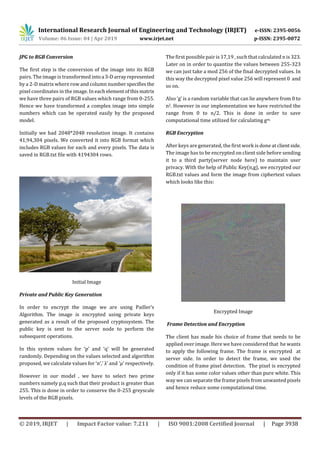
Initially we had 2048*2048 resolution image. It contains
41,94,304 pixels. We converted it into RGB format which
includes RGB values for each and every pixels. The data is
saved in RGB.txt file with 4194304 rows.
Initial Image
Private and Public Key Generation
In order to encrypt the image we are using Pailler’s
Algorithm. The image is encrypted using private keys
generated as a result of the proposed cryptosystem. The
public key is sent to the server node to perform the
subsequent operations.
In this system values for ‘p’ and ‘q’ will be generated
randomly. Depending on the values selected and algorithm
proposed, we calculate values for ‘n’,’ λ’ and ‘μ’ respectively.
However in our model , we have to select two prime
numbers namely p,q such that their product is greater than
255. This is done in order to conserve the 0-255 greyscale
levels of the RGB pixels.
The first possible pair is 17,19 , such that calculated n is 323.
Later on in order to quantize the values between 255-323
we can just take a mod 256 of the final decrypted values. In
this way the decrypted pixel value 256 will represent 0 and
so on.
Also ‘g’ is a random variable that can lie anywhere from 0 to
n2. However in our implementation we have restricted the
range from 0 to n/2. This is done in order to save
computational time utilized for calculating gm.
RGB Encryption
After keys are generated, the first work is done at clientside.
The image has to be encrypted on client side before sending
it to a third party(server node here) to maintain user
privacy. With the help of Public Key(n,g), we encrypted our
RGB.txt values and form the image from ciphertext values
which looks like this:
Encrypted Image
Frame Detection and Encryption
The client has made his choice of frame that needs to be
applied over image. Here we have considered that he wants
to apply the following frame. The frame is encrypted at
server side. In order to detect the frame, we used the
condition of frame pixel detection. The pixel is encrypted
only if it has some color values other than pure white. This
way we can separate the frame pixels from unwanted pixels
and hence reduce some computational time.
International Research Journal of Engineering and Technology (IRJET) e-ISSN: 2395-0056
Volume: 06 Issue: 04 | Apr 2019 www.irjet.net p-ISSN: 2395-0072
© 2019, IRJET | Impact Factor value: 7.211 | ISO 9001:2008 Certified Journal | Page 3939
Original frame
Operation on Encrypted Image
With the help of homomorphic encryption property
mentioned earlier, our image will getfilteredinanencrypted
format i.e. frame will get applied.
This can be done in various ways. Firstly we can just replace
the pixels in matrix by the frame pixels. This works fine for
any image , however if we want to use complex filters like
changing the grayscale level of an image, replacementpolicy
is not an option.
The other approach is to get acknowledgement from client
after every additive homomorphic operation for each and
every pixel. However this design isnot anoptimal solutionto
the problem. The time and space complexity will increase
exponentially with higher resolution images.
Paillier cryptosystem provides an easy solution to this
problem. The solution is explained here in short and kept as
the future scope of this project. The image can also be
represented by CMYK encoding. Hence reducing the value
range from 0-255 to 0-63. Then color addition by 1 unit can
be done on each pixel until desired frame value is achieved
by using the homomorphic additionpropertyasstatedin the
paper. Using this way, iterations at each pixel are greatly
reduced and become more feasible asanapproach.However
a more optimal solution can still be out thereandneedstobe
introduced.
The image with applied frame will look as following
Decrypting the Final Image
The encrypted image is sent to user as either .JPG or .txt
format. With the help of private key (λ,μ), client can easily
decrypt the input received and develop the final filtered
image as shown in the figure below:
Final Image
4. Conclusion:
In the proposed model we have successfully studied about
image processing and wereabletoimplementhomomorphic
encryption techniques in order to provide a secure and
consistent means of data security.
The pre-existing Image Encryption techniquesaimedatpeer
to peer sharing, and one has to take the risk of trusting the
other entity usually third party apps. We find that most
schemes aim at achieving a tradeoff between time
complexity and efficiency. However using homomorphic
technique the security is improved and the total control lies
within the user. It provides total peer to peer security.
The domain is still new and developing and a lot needs to be
introduced before it can be practically introduced in the
society. The problem lies within extractingfeaturesfrom the
encrypted images which plays a vital role in Machine
learning using image processing and can be considered as a
part of future scope.
Furthermore, we proposed a few open issues in some
categories that need future research. We hopeourstudy will
help to shape future research directions in this promising
area of security and privacy preservation of the data shared.
International Research Journal of Engineering and Technology (IRJET) e-ISSN: 2395-0056
Volume: 06 Issue: 04 | Apr 2019 www.irjet.net p-ISSN: 2395-0072
© 2019, IRJET | Impact Factor value: 7.211 | ISO 9001:2008 Certified Journal | Page 3940
5. References:
1. An Efficient Secret Key Homomorphic Encryption
Used in Image Processing Service by Pan Yang,
Xiaolin Gui, Jian An and Feng Tian.
2. Face Detection and Face Recognition in Python
Programming Language by Primoˇz Podrˇzaj
and Boris Kuster
3. https://www.geeksforgeeks.org/matlab-rgb-image-
representation/ (online)
4. https://en.wikipedia.org/wiki/Python_Imaging_Library
(online)
5. https://www.geeksforgeeks.org/numpy-in-python-set-
1-introduction/ (online)
6. https://en.wikipedia.org/wiki/SciPy (online)
7. https://www.ece.ucsb.edu/Faculty/Manjunath/course
s/ece178W03/matlabip.htm (online)
8. http://npm.taobao.org/package/paillier-js (online)
9. https://indianpythonista.wordpress.com/2017/01/31/
introduction-to-numpy/ (online)
10. Homomorphic Encryption: Theory&Applicationby
Jaydip Sen
11. A Comprehensive Study of Fully Homomorphic
Encryption Schemes by Majedah Alkharji, HangLiu,
Mayyada Al Hammoshi

IRJET- Homomorphic Image Encryption

  • 1.
    International Research Journalof Engineering and Technology (IRJET) e-ISSN: 2395-0056 Volume: 06 Issue: 04 | Apr 2019 www.irjet.net p-ISSN: 2395-0072 © 2019, IRJET | Impact Factor value: 7.211 | ISO 9001:2008 Certified Journal | Page 3934 Homomorphic Image Encryption Sachin Rana1, Om Jadhav1 , Shivam Rajput1, Pranjal Bhansali1, Varshapriya Jyotinagar2 1B.Tech, Dept. of Computer Engineering, Veermata Jijabai Technological Institute, Mumbai, India. 2Faculty of Computer Engineering, Veermata Jijabai Technological Institute, Mumbai, India. ---------------------------------------------------------------------***--------------------------------------------------------------------- Abstract - In cloud computing , user’s privacy is of utmost importance when operating on user’s data, which isprotected using Homomorphic Encryption.[1] But it is not practical for wide usage as the types of data and services available incloud computing are diverse. If you consider all these several data types, digital image is an important personal data for users. Many image processing services are also readily available in Cloud Computing. To safeguard user’sprivacy intheseservices we propose a scheme based on homomorphicencryptionwhile processing the image. There are several steps in this process. First being, construction of a secret key homomorphic encryption (SKHE) for encrypting the image. Once the first step is done, it's followed by SKHE working on encrypted floating numbers, since they are used in image processing. Its then followed by converting the already present traditional encryption techniques so as to facilitate them working on encrypted pixels. The image which had undergone encryption is then processed homomorphically. Therefore services can now process the encrypted image directly (without the need for decrypting it first), andtheresultobtainedafterdecryption is the same as processing the plain image itself. To explain our scheme, three common image processing instances are proposed in our paper. The experiments will show that our scheme is secure, correct, and efficient enough to be used in practical image processing applications. Key Words: Homomorphic encryption, Image Processing, Paillier cryptosystem 1.INTRODUCTION Along with the arrival of cloud computing fever, there emerge a lot of services outsourcing applications based on cloud computing platform (such as SaaS).Userswhorequest the service just need to upload their data to the service and wait for the result. This benefits the users greatly, but also risks breach of privacy, because the service provider (SP) can access user’s plain sensitive information at will. To maintain the essential balancebetweentheprivacyissueand usability of data in cloud computing, many computable encryption technologies are proposed, one of them being homomorphic encryptions. The central theme of how this process works can be explained as follows: “Enc” represents the encryption process, and “Dec” represents the decryption process.Fora function ƒ(x)taking the plaintexts as input, there exists a function ƒ’(y) (where y = Enc(x)) taking the cipher texts as input, such that Dec (ƒ’(y)) = ƒ (x) When the user uploads the encrypted image, it is worked upon rather than the plain image. This input of encrypted image generates an output of encrypted result image which upon decryption gives us the required image. Its thesameas working on plain image, but only we are not. And this is how the user's privacy is maintained. Homomorphic encryption is indeed a very good way to protect privacy in service outsourcing applications, especially when handling the integer data type. But as we all very well know that the data types in cloud computing are diverse, the usage of homomorphic encryption for other types is still a challenging problem for the entire world. For example, with the popularization of photograph equipment, a large amount of digital images are generated every day. It has become one of the most popular forms of data for the users. Consequently, the online image processing services are widely used for users to edit their images. But the image may also contain privacy that the user does not want SP to see. To ensure that privacy which is of utmost importance nowadays, is maintained in this data type,wehaveproposed a scheme using homomorphic encryption in image processing services. In broad terms, image processing includes all kinds of operations on the image. Handling of privacy issues is hard for all kinds of image processing techniques using one scheme. So in our paper basically, image processing mainly refers to the processes based on the concept and usage of pixels. That is, the new color of pixel is computed with the help of the old ones. The various operations on plain pixels can be seen as a function ƒ. Operating on the old pixels and some other parameters (ifnecessary)asinputs, ƒ outputs the new pixel that’s required. When using the traditional image encryption techniques, one observes that operating on the encrypted pixels is meaningless since no traditional technique can process the encrypted image without decrypting it first. However, encrypting each pixel and then working on it generates pretty good results. But unfortunately there are no such readymade encryption techniques available in the market that makes our work easy. So we'll just have to make one.
  • 2.
    International Research Journalof Engineering and Technology (IRJET) e-ISSN: 2395-0056 Volume: 06 Issue: 04 | Apr 2019 www.irjet.net p-ISSN: 2395-0072 © 2019, IRJET | Impact Factor value: 7.211 | ISO 9001:2008 Certified Journal | Page 3935 All the homomorphic techniques known as of todaywork on textual data. Image encryption using homomorphic encryption is a long way yet. Unpadded-RSA and ElGamal cryptosystems both give satisfactory results only when ƒ consists of pure multiplication operations [10]. But both addition and multiplication operations are necessary in image processing. Neither do Goldwasser and Micali nor Paillier cryptosystems fit image encryption, since ƒ consists of only pure addition operations. Gentry’s fully homomorphic encryption too is too complex to apply in image processing, because it encrypts one bit at a time, with the runtime more than 30 seconds even in “toy” security level. The traditional Homomorphic Encryption techniques are developed for integers, but floating numbers are involved in operations in image processing which is all together a different daemon in itself, thesecryptosystemshencecannot be used directly either[11]. Some changes need to be made to them before applying them on floating numbers. Besides are all public key encryptions which need a large key size to ensure the security, so it’s a waste of time. Thus, the sizes of cipher texts are too large to store or transmit online. The above analysis reflects the strong need for an efficient homomorphic encryptiontechnique,whichcansupport both addition and multiplication operations on floating numbers, since images work on floating numbers. Then it can be used for image encryption and thereby processing the encrypted image directly without decrypting it first. Upon research it seems that no existing work has ever proposed any solution for this aforementioned problem. Our contributions to solve these problems stated above are as follows: (1)We make changes to the Paillier homomorphic encryption to propose an efficient secret key homomorphic encryption which can support addition and multiplication operations on floating numbers. (2)We use the above stated method in image encryption which gives the instances of processing encrypted image. (3)We propose an encrypted image processing model based on homomorphic encryption. 2. Homomorphic Encryption Implementation in Image Processing: 2.1 Background Study: 2.1.1Encrypted Image Processing Model: First of all, a model is constructed for processing an image which is in encrypted format with the central idea being homomorphic encryption; see Figure A. Figure A: The encrypted image processing model. Figure A (a) is a common online image processing service model. The service hasasetofimageprocessingfunctionsas . When image data owner uploads the imageforaspecifickind of process request, cloud service provider (CSP) will choose the corresponding function to process the image.AsCSPcan access the original image, privacy is breached. Secondly, see Figure A (b), Data owner first has to encrypt the image using a homomorphic encryption prior to uploading it on the cloud . Thanks to the owners encryption efforts, CSP can operate on the encrypted image using a corresponding function and return to the Data Owner the encrypted result image. After decryption of the encrypted resultimage,DataOwnercanget the correct processed image.It's sameas the CSP working on a plain image, but only he's not. The result is the same as Figure A(a). But as the image in server is always stored in encrypted form, the privacy is maintained. 2.1.2 RGB image representation Any given RGB image can be seen as a collection of three different images(a red scale image, a green scale image and a blue scale image) placed on top of each other like a stack,and when these set of images are fed into the red, green and blue inputs of a color monitor, it produces a color image on the screen[2]. An RGB image is often referred to as a “true colorimage”only because of the precision with which a real-life image can be replicated.
  • 3.
    International Research Journalof Engineering and Technology (IRJET) e-ISSN: 2395-0056 Volume: 06 Issue: 04 | Apr 2019 www.irjet.net p-ISSN: 2395-0072 © 2019, IRJET | Impact Factor value: 7.211 | ISO 9001:2008 Certified Journal | Page 3936 If you study MATLAB, anyRGBimageisbasicallyrepresented as a M*N*3 array of color pixels, where each color pixel is represented with three values which correspond to red, blue and green color component of RGB image at a specified spatial location at a particular point of time. So, the color of any given pixel is calculated by the combination of the red, green, and blue intensities stored in each color plane at the pixel’s location [3]. Here each color plane is an array of dimensions M*N which store the values of the particular color in them. As can be observed in the image above, Pixel (A) has a value of (255, 0, 255) which is calculated by the combination of intensities stored in the red color plane,thegreencolorplane and the blue color plane respectively and is stored in an array format. Likewise, pixel (B) has valueof (127, 255,0)andiscalculated in a manner similar to as used for thecalculationforpixel(A). Color planes of RGB image: Consider an RGB image array ‘Img’ then, Img(:, :, 1) represents the Red color plane of the RGB image selected Img(:, :, 2) represents the Green color plane of the RGBimage selected Img(:, :, 3) representstheBluecolorplaneoftheRGB image under study. RGB image array range: In MATLAB term, any RGB image array can belong to any of the 3 classes. They are ‘double’, ‘uint8’, or ‘uint16’ data type classes. The data type class of color component determines the range of values it can accept [7]. For example, if an RGB image is of class ‘double’ then each color component is a value between 0 and 1 only. No other values beyond this range are acceptable. Likewise, if an RGB image belongs to the class ‘uint8’, the range of values that each color component can have is restricted to [0 – 255] . [0 – 65535] is the range of values acceptable if the RGB image is of class ‘uint16’. Bit depth: The number of bits that are used to store a pixel value of the component image under study determines the bit depth of any given RGB image. For example, if each color component image is an 10-bit image, the RGB image will be said to have a bit depth of 30. Possible number of colors in RGB image: Let an RGB image belong to class ‘uint16’, i.e. the range of values a color component plane can have is [0 – 65535] ( a total of 65536 shades of that color). So, each individual color plane of any given RGB image under study is capable of showing 65536 shade of that color. So the total number of combination of color that can be represented in any given RGB image is 65536 X 65536 X 65536 = 2.814 E14. That’s a lot of combinations. 2.2 Design: 2.2.1 Paillier cryptosystem Algorithm: The working of the scheme is as follows: Key generation: 1. Choose two very large prime numbers p and q at random, and independently of each other, such that g.c.d of (pq, (p-1)(q-1)) = 1. This property is assured if both primes are of equal length. 2. Compute n (by using the formula n=pq) and λ=l.c.m (p-1, q-1) which means Least Common Multiple. 3. Select a integer randomly as g where g ∈ Z*n2 4. Ensurethat the n calculatedabove dividestheorder of g by checking the existence of the following modular multiplicative inverse: μ =(L(g λ mod n2))^(-1)mod n, where function L is defined as L(x) = (x-1)/n . ● The public (encryption) key used here is (n,g) ● The private (decryption) key used here is ( λ, μ) If using p,q of equivalent length, a simpler variant of the above key generation steps would be to set g=n+1 and λ = Ø(n), μ= Ø(n)^-1 mod n , where Ø(n) = (p-1)(q-1) . Encryption 1. Let m be a message to be encrypted where 0<=m<n. 2. Select at random an integer r where 0<r<n and r∈ Z*n2 (i.e., ensure g.c.d (r, n)=1) 3. Compute cipher text as: c= gm rn mod n2 Decryption 1. Let c be the cipher text to decrypt, where c ∈ Z*n2
  • 4.
    International Research Journalof Engineering and Technology (IRJET) e-ISSN: 2395-0056 Volume: 06 Issue: 04 | Apr 2019 www.irjet.net p-ISSN: 2395-0072 © 2019, IRJET | Impact Factor value: 7.211 | ISO 9001:2008 Certified Journal | Page 3937 2. Compute the plaintextmessageas: m=L(cλ modn2). μ mod n 2.2.2 Homomorphic properties: One of the main feature of the Paillier cryptosystem is that it supports homomorphic properties. Moreover it undergoes non-deterministic encryption. The encryption function used in this system follows additive homomorphic scheme. The two properties can be described as follows: ● Homomorphic addition of two numbers If we take the product of two ciphertexts,itwilldecrypttothe sum of their corresponding original numbers[8], Dec (Enc (A, r1). Enc (B, r2) mod n2) = (A+B) mod n, where A and B are real numbers . The product of a ciphertext with another number with the power g on decryption will result in the sum of the corresponding numbers, Dec (Enc (A, r1). gB mod n2) = (A+B) mod n. ● Homomorphic multiplication of numbers If we take an encrypted number raised to the power of another number, it will decrypt to the product of the two numbers, Dec (Enc (A, r1)B mod n2) = A.B mod n. Dec (Enc (B, r2)A mod n2) = A.B mod n. If we consider a general approach, we can say that any encrypted numberwhichisraisedtoaconstant x willdecrypt to the product of the number and the constant, Dec (Enc (A, r1)x mod n2) = x. A mod n. However, when we use Paillier encryptions where two numbers are provided, there is no known way to exactly compute an encryption of the product of these numbers unless you know the private key whichisonlyknowntothe user himself. 2.2.3 Technologies Used: 1)Python Imaging Library (abbreviated as PIL) (Pillow according to newer versions) is a free library for the Python programming language that strongly supports for manipulating, saving or opening many different image file formats. It’s a must use library for any image related processing [4]. PIL or Pillow offers several standard image manipulation procedures. These include the following important ones: 1. Masking and transparency handling, 2. Per-pixel manipulations, 3. Image enhancing, such as sharpening, adjusting brightness, contrast or color, 4. Image filtering, such as blurring, contouring, smoothing, or edge finding, 5. Adding text to images and much more. Some of the file formats that are supported are PPM, PNG, JPEG, GIF, TIFF,and BMP. It is also possible to createnew file decoders to expand the library of file formats accessible. 2) NumPy is a generic array-processing package. It provides us with a very much needed high-performance multidimensional array object, and tools for being able to work on these arrays [5]. It is the fundamental packageforscientific computationwith Python. It’s a must use library when any type of scientific computations are involved. It contains various features including these important ones: 1. Sophisticated (broadcasting) functions 2. Useful linear algebra, Fourier transform, and random number capabilities 3. A powerful N-dimensional array object 4. Tools for integrating C/C++ and Fortran code[9] Other than theseimportantscientificuses,NumPycanalsobe used as an efficient container with multi-dimensionalfeature to store generic data.Besidesthis,Numpyalsodefinesasetof arbitrary data-types which can be used to perform speedy integration with wide variety of databases. 3) SciPy is a free and open-source Python library used for scientificcomputation andtechnicalcomputing.It'salsoa must use library for scientific computation and it builds on NumPy library[6]. SciPy contains modules for special functions integration , optimization, linear algebra, interpolation, FFT, signal and image processing, ODE solvers and other tasks common in science and engineering. SciPy is a part of the NumPy stack which includes tools like Pandas, Matplotlib and SymPy, Pand an expanding setof scientific computing libraries. This NumPy stack has similar users to other applications such as Scilab,MATLAB, and GNU Octave. 3. Implementation: The project aims at deploying our code on two nodes, one acting as client and the other one as sever machine. The client is responsible for generating keys, encrypting the image and sending the (key , image) pair to the server.Along with that the client has the choice to select a frame to be applied on the processed image. The serverinturnsperform homomorphic operation and provides the final image with applied frame.
  • 5.
    International Research Journalof Engineering and Technology (IRJET) e-ISSN: 2395-0056 Volume: 06 Issue: 04 | Apr 2019 www.irjet.net p-ISSN: 2395-0072 © 2019, IRJET | Impact Factor value: 7.211 | ISO 9001:2008 Certified Journal | Page 3938 JPG to RGB Conversion The first step is the conversion of the image into its RGB pairs. The image is transformed intoa 3-Darrayrepresented by a 2-D matrix where row and column number specifiesthe pixel coordinates in the image. In each elementofthismatrix we have three pairs of RGB values which range from 0-255. Hence we have transformed a complex image into simple numbers which can be operated easily by the proposed model. Initially we had 2048*2048 resolution image. It contains 41,94,304 pixels. We converted it into RGB format which includes RGB values for each and every pixels. The data is saved in RGB.txt file with 4194304 rows. Initial Image Private and Public Key Generation In order to encrypt the image we are using Pailler’s Algorithm. The image is encrypted using private keys generated as a result of the proposed cryptosystem. The public key is sent to the server node to perform the subsequent operations. In this system values for ‘p’ and ‘q’ will be generated randomly. Depending on the values selected and algorithm proposed, we calculate values for ‘n’,’ λ’ and ‘μ’ respectively. However in our model , we have to select two prime numbers namely p,q such that their product is greater than 255. This is done in order to conserve the 0-255 greyscale levels of the RGB pixels. The first possible pair is 17,19 , such that calculated n is 323. Later on in order to quantize the values between 255-323 we can just take a mod 256 of the final decrypted values. In this way the decrypted pixel value 256 will represent 0 and so on. Also ‘g’ is a random variable that can lie anywhere from 0 to n2. However in our implementation we have restricted the range from 0 to n/2. This is done in order to save computational time utilized for calculating gm. RGB Encryption After keys are generated, the first work is done at clientside. The image has to be encrypted on client side before sending it to a third party(server node here) to maintain user privacy. With the help of Public Key(n,g), we encrypted our RGB.txt values and form the image from ciphertext values which looks like this: Encrypted Image Frame Detection and Encryption The client has made his choice of frame that needs to be applied over image. Here we have considered that he wants to apply the following frame. The frame is encrypted at server side. In order to detect the frame, we used the condition of frame pixel detection. The pixel is encrypted only if it has some color values other than pure white. This way we can separate the frame pixels from unwanted pixels and hence reduce some computational time.
  • 6.
    International Research Journalof Engineering and Technology (IRJET) e-ISSN: 2395-0056 Volume: 06 Issue: 04 | Apr 2019 www.irjet.net p-ISSN: 2395-0072 © 2019, IRJET | Impact Factor value: 7.211 | ISO 9001:2008 Certified Journal | Page 3939 Original frame Operation on Encrypted Image With the help of homomorphic encryption property mentioned earlier, our image will getfilteredinanencrypted format i.e. frame will get applied. This can be done in various ways. Firstly we can just replace the pixels in matrix by the frame pixels. This works fine for any image , however if we want to use complex filters like changing the grayscale level of an image, replacementpolicy is not an option. The other approach is to get acknowledgement from client after every additive homomorphic operation for each and every pixel. However this design isnot anoptimal solutionto the problem. The time and space complexity will increase exponentially with higher resolution images. Paillier cryptosystem provides an easy solution to this problem. The solution is explained here in short and kept as the future scope of this project. The image can also be represented by CMYK encoding. Hence reducing the value range from 0-255 to 0-63. Then color addition by 1 unit can be done on each pixel until desired frame value is achieved by using the homomorphic additionpropertyasstatedin the paper. Using this way, iterations at each pixel are greatly reduced and become more feasible asanapproach.However a more optimal solution can still be out thereandneedstobe introduced. The image with applied frame will look as following Decrypting the Final Image The encrypted image is sent to user as either .JPG or .txt format. With the help of private key (λ,μ), client can easily decrypt the input received and develop the final filtered image as shown in the figure below: Final Image 4. Conclusion: In the proposed model we have successfully studied about image processing and wereabletoimplementhomomorphic encryption techniques in order to provide a secure and consistent means of data security. The pre-existing Image Encryption techniquesaimedatpeer to peer sharing, and one has to take the risk of trusting the other entity usually third party apps. We find that most schemes aim at achieving a tradeoff between time complexity and efficiency. However using homomorphic technique the security is improved and the total control lies within the user. It provides total peer to peer security. The domain is still new and developing and a lot needs to be introduced before it can be practically introduced in the society. The problem lies within extractingfeaturesfrom the encrypted images which plays a vital role in Machine learning using image processing and can be considered as a part of future scope. Furthermore, we proposed a few open issues in some categories that need future research. We hopeourstudy will help to shape future research directions in this promising area of security and privacy preservation of the data shared.
  • 7.
    International Research Journalof Engineering and Technology (IRJET) e-ISSN: 2395-0056 Volume: 06 Issue: 04 | Apr 2019 www.irjet.net p-ISSN: 2395-0072 © 2019, IRJET | Impact Factor value: 7.211 | ISO 9001:2008 Certified Journal | Page 3940 5. References: 1. An Efficient Secret Key Homomorphic Encryption Used in Image Processing Service by Pan Yang, Xiaolin Gui, Jian An and Feng Tian. 2. Face Detection and Face Recognition in Python Programming Language by Primoˇz Podrˇzaj and Boris Kuster 3. https://www.geeksforgeeks.org/matlab-rgb-image- representation/ (online) 4. https://en.wikipedia.org/wiki/Python_Imaging_Library (online) 5. https://www.geeksforgeeks.org/numpy-in-python-set- 1-introduction/ (online) 6. https://en.wikipedia.org/wiki/SciPy (online) 7. https://www.ece.ucsb.edu/Faculty/Manjunath/course s/ece178W03/matlabip.htm (online) 8. http://npm.taobao.org/package/paillier-js (online) 9. https://indianpythonista.wordpress.com/2017/01/31/ introduction-to-numpy/ (online) 10. Homomorphic Encryption: Theory&Applicationby Jaydip Sen 11. A Comprehensive Study of Fully Homomorphic Encryption Schemes by Majedah Alkharji, HangLiu, Mayyada Al Hammoshi