International Research Journal of Engineering and Technology (IRJET) e-ISSN: 2395-0056
Volume: 05 Issue: 03 | Mar-2018 www.irjet.net p-ISSN: 2395-0072
© 2018, IRJET | Impact Factor value: 6.171 | ISO 9001:2008 Certified Journal | Page 3308
Efficient Geo-tagging of images using LASOM
Priya Singh1, Ajinkya Sawant2, ShobhaPatil3, Asst. Prof Kashmeera Safaya4
1,2,3 Student, Computer Engineering, PHCET Rasayani, Maharashtra, India
4Professor, Dept. of Computer Engineering, PHCET Rasayani, Maharashtra, India
---------------------------------------------------------------------***---------------------------------------------------------------------
Abstract -Automated identification of the geographical
coordinates based on image content is of particular
importance to data mining systems, because geo-location
provides a large source of context for other useful features of
an image. In this paper we propose an on-line, unsupervised,
clustering algorithm called Location Aware Self-Organizing
Map (LASOM), for learning the similarity graph between
different regions. The goal of LASOM is to select keyfeaturesin
specific locations so as to increase the accuracyingeo-tagging
untagged images, while also reducing computational and
storage requirements. We demonstrate that the generated
output not only preserves important visual information, but
provides additional context in the form of visual similarity
relationships between different geographical areas. We
further show that the learned representation results in
minimal information loss as compared to using k-Nearest
Neighbor method. The noise reduction property of LASOM
allows for superior performance when combining multiple
features.
Key Words: Geo-tagging, Geo-location, Self Organizing
Map, Clustering, k-Nearest Neighbor.
1. INTRODUCTION
We live in an information age touched by technology in all
aspects of our existence, be it work, entertainment,travel,or
communication. The extent to which information pervades
our lives today is evident in the growing size of personaland
community footprints on the web, ever improving modes of
communication, and fast evolving internet communities
(such as Flickr, Twitter, and Facebook) promoting virtual
interactions. In some aspects, man has transformed from a
social being into an e-social being. Images and video
constitute a huge proportion of the Web information that is
being added or exchanged every second. The popularity of
digital cameras and camera phones has contributed to this
explosion of personal and Web multimedia data.
The geographical origin of an image is important contextual
information that can help in many applications,includingbut
not limited to tourism recommendation and landmark
identification. It can also provide important semantic
information for articles, while surveillance systems could
use geo-tags to locate missing people. Knowledge about
geographical regions can also inform about the objects and
buildings that should be expected in the image or in the case
of densely populated areas, whether people detection
algorithms should be used. Therefore, it is desirable to
augment any image that might lack geographical location
(e.g. GPS coordinates) with our estimate of where the image
was taken. Geo-tagging of images however, is a very difficult
task due to the variability of visual data across the globe.
Taking two photographs at the same location, but at
different angles, may yield two images with vastly different
pixel values. Modeling such data is not an easy task. To
capture this variability, a large dataset is required.
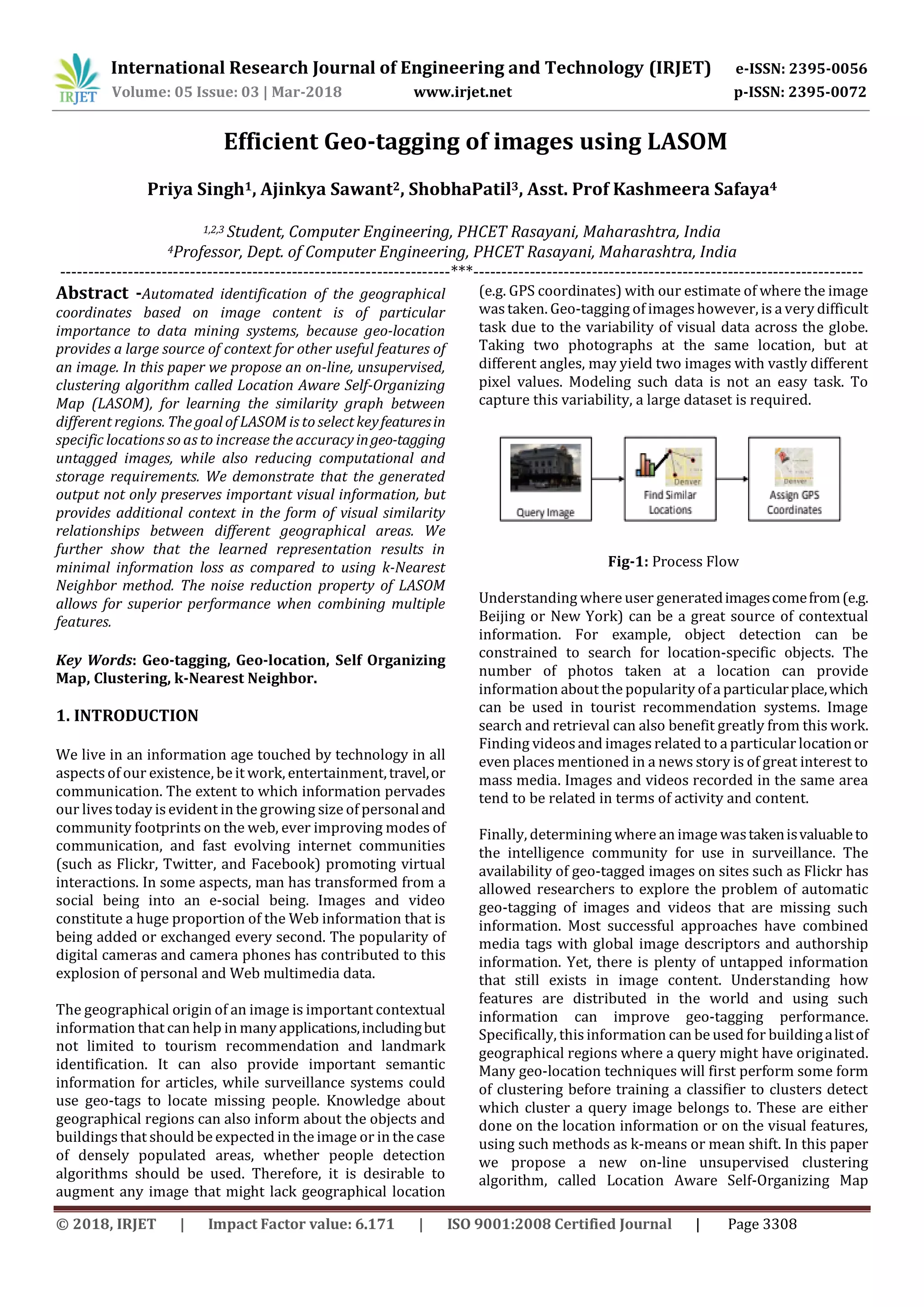
Fig-1: Process Flow
Understanding where user generatedimagescomefrom(e.g.
Beijing or New York) can be a great source of contextual
information. For example, object detection can be
constrained to search for location-specific objects. The
number of photos taken at a location can provide
information about the popularity of a particularplace,which
can be used in tourist recommendation systems. Image
search and retrieval can also benefit greatly from this work.
Finding videos and images related to a particular locationor
even places mentioned in a news story is of great interest to
mass media. Images and videos recorded in the same area
tend to be related in terms of activity and content.
Finally, determining where an image wastakenisvaluableto
the intelligence community for use in surveillance. The
availability of geo-tagged images on sites such as Flickr has
allowed researchers to explore the problem of automatic
geo-tagging of images and videos that are missing such
information. Most successful approaches have combined
media tags with global image descriptors and authorship
information. Yet, there is plenty of untapped information
that still exists in image content. Understanding how
features are distributed in the world and using such
information can improve geo-tagging performance.
Specifically, this information can be used for buildingalistof
geographical regions where a query might have originated.
Many geo-location techniques will first perform some form
of clustering before training a classifier to clusters detect
which cluster a query image belongs to. These are either
done on the location information or on the visual features,
using such methods as k-means or mean shift. In this paper
we propose a new on-line unsupervised clustering
algorithm, called Location Aware Self-Organizing Map
International Research Journal of Engineering and Technology (IRJET) e-ISSN: 2395-0056
Volume: 05 Issue: 03 | Mar-2018 www.irjet.net p-ISSN: 2395-0072
© 2018, IRJET | Impact Factor value: 6.171 | ISO 9001:2008 Certified Journal | Page 3309
(LASOM) that can be used for estimating the density
distribution of one variable conditioned on another. LASOM
is able to compress the large amounts of data by not storing
commonly occurring images and by storing onlythefeatures
that are required for discriminating one geographicalregion
from another. It removes noise by removing features that
occur very rarely and it gives us the ability to discover the
similarities and differences between different regions.
1.1 Goals and Objectives
 Geo-tagging allows user to visualize and manage photo
collection in many ways.
 Using a collection of over a million geo-tagged pictures,
we build location.
 Probability maps for commonly used images tags over
the entire globe.
 It is easy to find out location, where the photo is taken.
2. LITERATURE SURVEY
The Self-Organizing Map (SOM) algorithm [1] is a well-
known method, which provides both data reduction and
projection in an integrated framework. Using regular 2D
grids asneural structures for the SOM training ,visualization
form of the maps, component planes, and distance
distributions comprise basic methods visual for exploration
of data using SOM processing [2]. SOM-based VisualAnalysis
to date has considered different application domains,
including financial data analysis based on multivariate data
models [3], analysis of web click stream data using Markov
Chain models [4], trajectory oriented data [5], or time-
oriented data [6].Image Sorter [7] proposed to visually
analyze collections of images by training a SOM over color
features extracted from the images. We herefollowthatidea,
in that we analyze geo-spatial heat maps of sentimentscores
using SOM of respective color features as well. When
considering geo-referenced data with SOM, basically two
approaches exist. First, in the joint data model, one single
data representation is formed by combining spatial and
other multivariate data into a single vector representation
which is input to the SOM method. Examples include [10],
where a joint vector representation for both geo-location
and demo graphic data was formed for census data analysis.
More methods can be found in [11].
3. EXISTING SYSTEM
In the earliest system the problem was to identify the actual
location of an image means they were not provide the
accurate result of location only produced the predicted
result. Content understanding in imageshasbeenstudiedfor
decades in the vision research community.Recently, the
research community increasingly turns to metadata and
picture taking context solve the semantic understanding
problem. Important metadata can be collected also as a
result of user participation.
Photo sharing websites such as Flickr have witnessed as
urge of collaborative tagging from users. When an image is
manually tagged, the user associates annotations with the
image that are descriptive and maycarryinformationrelated
to the locationof the image. In some cases, therelationshipis
direct: An image tagged “Chicago” isquite probablycaptured
in the Illinois city. However, in other cases the relationshipis
more subtle but still informative. For example, an image
tagged “snow” is not likely to have been captured near the
equator. Other tags, such as “smile”, contain little
information regarding the locationof the image capture.The
benefit of user tags is clear from Fig. 1. Even if you think you
know the location of an image from the content, the tags
collectively can provide valuable information. If we jumped
to the conclusion that this statue is in NYC, we would be
drawing a reasonable but incorrect conclusion. While
location hasbeen used for image understanding; the inverse
problem of inferring location from image content is still
novel and difficult.
4. IMPLEMENTED SYSTEM
In this paper the user will provide the images for finding the
location in the maps. The Geo-tagging phenomenon used
here the images in a particular location in the maps. More
specifically we want to find arg max. Calculating thisdirectly
is very difficult, due to the large variability of visual data at
each possible location. We discuss the details of a new on-
line, unsupervised clustering algorithm that compresses
large databases by only keeping the information requiredto
identify a specific location. Location Aware Self-Organizing
Map LASOM is a specialized algorithm for learning the
distribution of one feature conditioned on another one.
Spatial constraints will be used to learn the distribution of
visual features at particular geographical locations. To
evaluate LASOM dataset and features. The spatial
distribution of images, while the training set is noisy and
contains a number of distant training samples(Best viewed
zoomed in and in color).Intuitively, this process can be seen
as moving a codebook vector in feature space until the
center (i.e. average) of that space isfound. This movementis
constrained by neighboring nodes. In this entire processcan
be seen as spatial binning of visual information, where the
bin centers do not have to be determined a-priori, and are
based on the visual variability in a particular region (i.e.
more codebooks are dedicated to highly variable
areas).Querying LASOM in this process assign a location to
an untagged image. The code vector represents a region in
feature space. To provide better estimates, the queryfeature
is once again compared to code vector and all its immediate
neighboring nodes and the weight are normalized for
calculating the location. Experiments showed that using an
exponential with a base of resulted in superior performance.
International Research Journal of Engineering and Technology (IRJET) e-ISSN: 2395-0056
Volume: 05 Issue: 03 | Mar-2018 www.irjet.net p-ISSN: 2395-0072
© 2018, IRJET | Impact Factor value: 6.171 | ISO 9001:2008 Certified Journal | Page 3310
Fig-2: System Architecture
4. FUTURE SCOPE
Other applications consolidate large scale dataset of geo-
tagged information to produce map that indicate where
things are in the world taken asimage. We expectfuturegeo-
tagging driven research and applications to develop in
several directions, including dealing with large scale data,
fusion of multi-modality information.
5. CONCLUSIONS
We have proposed geo-tagging in large no. of data with the
use of LASOM. The goal of LASOM is to select key features in
specific locations so as to increase the accuracy in geo-
tagging untagged images, while also reducingcomputational
and storage requirements. We demonstrate that the
generated map not only preserves important visual
information, but provides additional context in the form of
visual similarity relationships between different
geographical areas. We show how this information can be
used to improve geo-tagging results when using large
databases. We further show that the learned representation
results in minimal Information loss as compared to using k
Nearest Neighbor method. The noise reduction property of
LASOM allows for superior performance when combining
multiple features.
6. REFERENCES
[1] T. Kohonen, Self-Organizing Maps.Springer-Verlag,2001.
[2] J. Vesanto, “SOM-based data visualization methods,”
Intelligent Data Analysis, vol. 3, no. 2, pp. 111–126, 1999.
[3] G. J. Deboeck and T. K. Kohonen, Eds., Visual Explorations
in Finance: with Self-Organizing Maps. Springer, 1998.
[4] J. Wei, Z. Shen, N. Sundaresan, and K.-L.Ma,“Visualcluster
exploration of web clickstream data,” in IEEE VAST, 2012,
pp. 3–12.
[5] T. Schreck, J. Bernard, T. von Landesberger, and J.
Kohlhammer, “Visual cluster analysis of trajectory datawith
interactive kohonenmaps,” Information Visualization,vol.8,
no. 1, pp. 14–29, 2009. [Online]. Available:
http://dx.doi.org/10.1057/ivs.2008.29
[6] J. Bernard, J. Brase, D. Fellner, O. Koepler, J. Kohlhammer,
T. Ruppert, T. Schreck, and I. Sens, “A visual digital library
approach for timeorientedscientific primary data,” Springer
International Journal of Digital Libraries, ECDL 2010 Special
Issue, pp. 111–123, 2011.
[7] K. U. Barthel, “Improved image retrieval using automatic
image sorting and semi-automatic generation of image
semantics,” Image Analysis for Multimedia Interactive
Services, International Workshop on, vol. 0, pp. 227–230,
2008.
[8] N. Andrienko and G. Andrienko, Exploratory Analysis of
Spatial and Temporal Data: A Systematic Approach.
Springer-Verlag, 2005.
[9] A. M. MacEachren, How Maps Work - Representation,
Visualization, and Design.Guilford Press, 2004.
[10] F. Bao, V. Lobo, and M. Painho, “The self-organizingmap,
the geosom, and relevant variants for geosciences,”
Computers & Geosciences, vol. 31, no. 2, pp. 155 – 163,2005,
geospatial Research in Europe: AGILE 2003.
[11] P. Agarwal and A. Skupin, Eds., Self-Organising Maps:
Applications in Geographic InformationScience.Wiley,2008.
[12] D. Guo, J. Chen, A. M. MacEachren, and K. Liao, “A
visualization system for space-time and multivariate
patterns (VIS-STAMP),” IEEE Transactions on Visualization
and Computer Graphics, vol. 12, no. 6, pp. 1461–1474, 2006.
[13] A. R. Zamir and M. Shah. Image geo-localization based
onmultiplenearest neighbor feature matching using
generalizedgraphs. TPAMI, 2014.
[14] C. Zhang, J. Gao, O. Wang, P. Georgel, R. Yang, J. Davis, J.
Frahm, and M. Pollefeys. Personal photograph enhancement
using internet photo collections.TVCG, 2014.

IRJET- Efficient Geo-tagging of images using LASOM

  • 1.
    International Research Journalof Engineering and Technology (IRJET) e-ISSN: 2395-0056 Volume: 05 Issue: 03 | Mar-2018 www.irjet.net p-ISSN: 2395-0072 © 2018, IRJET | Impact Factor value: 6.171 | ISO 9001:2008 Certified Journal | Page 3308 Efficient Geo-tagging of images using LASOM Priya Singh1, Ajinkya Sawant2, ShobhaPatil3, Asst. Prof Kashmeera Safaya4 1,2,3 Student, Computer Engineering, PHCET Rasayani, Maharashtra, India 4Professor, Dept. of Computer Engineering, PHCET Rasayani, Maharashtra, India ---------------------------------------------------------------------***--------------------------------------------------------------------- Abstract -Automated identification of the geographical coordinates based on image content is of particular importance to data mining systems, because geo-location provides a large source of context for other useful features of an image. In this paper we propose an on-line, unsupervised, clustering algorithm called Location Aware Self-Organizing Map (LASOM), for learning the similarity graph between different regions. The goal of LASOM is to select keyfeaturesin specific locations so as to increase the accuracyingeo-tagging untagged images, while also reducing computational and storage requirements. We demonstrate that the generated output not only preserves important visual information, but provides additional context in the form of visual similarity relationships between different geographical areas. We further show that the learned representation results in minimal information loss as compared to using k-Nearest Neighbor method. The noise reduction property of LASOM allows for superior performance when combining multiple features. Key Words: Geo-tagging, Geo-location, Self Organizing Map, Clustering, k-Nearest Neighbor. 1. INTRODUCTION We live in an information age touched by technology in all aspects of our existence, be it work, entertainment,travel,or communication. The extent to which information pervades our lives today is evident in the growing size of personaland community footprints on the web, ever improving modes of communication, and fast evolving internet communities (such as Flickr, Twitter, and Facebook) promoting virtual interactions. In some aspects, man has transformed from a social being into an e-social being. Images and video constitute a huge proportion of the Web information that is being added or exchanged every second. The popularity of digital cameras and camera phones has contributed to this explosion of personal and Web multimedia data. The geographical origin of an image is important contextual information that can help in many applications,includingbut not limited to tourism recommendation and landmark identification. It can also provide important semantic information for articles, while surveillance systems could use geo-tags to locate missing people. Knowledge about geographical regions can also inform about the objects and buildings that should be expected in the image or in the case of densely populated areas, whether people detection algorithms should be used. Therefore, it is desirable to augment any image that might lack geographical location (e.g. GPS coordinates) with our estimate of where the image was taken. Geo-tagging of images however, is a very difficult task due to the variability of visual data across the globe. Taking two photographs at the same location, but at different angles, may yield two images with vastly different pixel values. Modeling such data is not an easy task. To capture this variability, a large dataset is required. Fig-1: Process Flow Understanding where user generatedimagescomefrom(e.g. Beijing or New York) can be a great source of contextual information. For example, object detection can be constrained to search for location-specific objects. The number of photos taken at a location can provide information about the popularity of a particularplace,which can be used in tourist recommendation systems. Image search and retrieval can also benefit greatly from this work. Finding videos and images related to a particular locationor even places mentioned in a news story is of great interest to mass media. Images and videos recorded in the same area tend to be related in terms of activity and content. Finally, determining where an image wastakenisvaluableto the intelligence community for use in surveillance. The availability of geo-tagged images on sites such as Flickr has allowed researchers to explore the problem of automatic geo-tagging of images and videos that are missing such information. Most successful approaches have combined media tags with global image descriptors and authorship information. Yet, there is plenty of untapped information that still exists in image content. Understanding how features are distributed in the world and using such information can improve geo-tagging performance. Specifically, this information can be used for buildingalistof geographical regions where a query might have originated. Many geo-location techniques will first perform some form of clustering before training a classifier to clusters detect which cluster a query image belongs to. These are either done on the location information or on the visual features, using such methods as k-means or mean shift. In this paper we propose a new on-line unsupervised clustering algorithm, called Location Aware Self-Organizing Map
  • 2.
    International Research Journalof Engineering and Technology (IRJET) e-ISSN: 2395-0056 Volume: 05 Issue: 03 | Mar-2018 www.irjet.net p-ISSN: 2395-0072 © 2018, IRJET | Impact Factor value: 6.171 | ISO 9001:2008 Certified Journal | Page 3309 (LASOM) that can be used for estimating the density distribution of one variable conditioned on another. LASOM is able to compress the large amounts of data by not storing commonly occurring images and by storing onlythefeatures that are required for discriminating one geographicalregion from another. It removes noise by removing features that occur very rarely and it gives us the ability to discover the similarities and differences between different regions. 1.1 Goals and Objectives  Geo-tagging allows user to visualize and manage photo collection in many ways.  Using a collection of over a million geo-tagged pictures, we build location.  Probability maps for commonly used images tags over the entire globe.  It is easy to find out location, where the photo is taken. 2. LITERATURE SURVEY The Self-Organizing Map (SOM) algorithm [1] is a well- known method, which provides both data reduction and projection in an integrated framework. Using regular 2D grids asneural structures for the SOM training ,visualization form of the maps, component planes, and distance distributions comprise basic methods visual for exploration of data using SOM processing [2]. SOM-based VisualAnalysis to date has considered different application domains, including financial data analysis based on multivariate data models [3], analysis of web click stream data using Markov Chain models [4], trajectory oriented data [5], or time- oriented data [6].Image Sorter [7] proposed to visually analyze collections of images by training a SOM over color features extracted from the images. We herefollowthatidea, in that we analyze geo-spatial heat maps of sentimentscores using SOM of respective color features as well. When considering geo-referenced data with SOM, basically two approaches exist. First, in the joint data model, one single data representation is formed by combining spatial and other multivariate data into a single vector representation which is input to the SOM method. Examples include [10], where a joint vector representation for both geo-location and demo graphic data was formed for census data analysis. More methods can be found in [11]. 3. EXISTING SYSTEM In the earliest system the problem was to identify the actual location of an image means they were not provide the accurate result of location only produced the predicted result. Content understanding in imageshasbeenstudiedfor decades in the vision research community.Recently, the research community increasingly turns to metadata and picture taking context solve the semantic understanding problem. Important metadata can be collected also as a result of user participation. Photo sharing websites such as Flickr have witnessed as urge of collaborative tagging from users. When an image is manually tagged, the user associates annotations with the image that are descriptive and maycarryinformationrelated to the locationof the image. In some cases, therelationshipis direct: An image tagged “Chicago” isquite probablycaptured in the Illinois city. However, in other cases the relationshipis more subtle but still informative. For example, an image tagged “snow” is not likely to have been captured near the equator. Other tags, such as “smile”, contain little information regarding the locationof the image capture.The benefit of user tags is clear from Fig. 1. Even if you think you know the location of an image from the content, the tags collectively can provide valuable information. If we jumped to the conclusion that this statue is in NYC, we would be drawing a reasonable but incorrect conclusion. While location hasbeen used for image understanding; the inverse problem of inferring location from image content is still novel and difficult. 4. IMPLEMENTED SYSTEM In this paper the user will provide the images for finding the location in the maps. The Geo-tagging phenomenon used here the images in a particular location in the maps. More specifically we want to find arg max. Calculating thisdirectly is very difficult, due to the large variability of visual data at each possible location. We discuss the details of a new on- line, unsupervised clustering algorithm that compresses large databases by only keeping the information requiredto identify a specific location. Location Aware Self-Organizing Map LASOM is a specialized algorithm for learning the distribution of one feature conditioned on another one. Spatial constraints will be used to learn the distribution of visual features at particular geographical locations. To evaluate LASOM dataset and features. The spatial distribution of images, while the training set is noisy and contains a number of distant training samples(Best viewed zoomed in and in color).Intuitively, this process can be seen as moving a codebook vector in feature space until the center (i.e. average) of that space isfound. This movementis constrained by neighboring nodes. In this entire processcan be seen as spatial binning of visual information, where the bin centers do not have to be determined a-priori, and are based on the visual variability in a particular region (i.e. more codebooks are dedicated to highly variable areas).Querying LASOM in this process assign a location to an untagged image. The code vector represents a region in feature space. To provide better estimates, the queryfeature is once again compared to code vector and all its immediate neighboring nodes and the weight are normalized for calculating the location. Experiments showed that using an exponential with a base of resulted in superior performance.
  • 3.
    International Research Journalof Engineering and Technology (IRJET) e-ISSN: 2395-0056 Volume: 05 Issue: 03 | Mar-2018 www.irjet.net p-ISSN: 2395-0072 © 2018, IRJET | Impact Factor value: 6.171 | ISO 9001:2008 Certified Journal | Page 3310 Fig-2: System Architecture 4. FUTURE SCOPE Other applications consolidate large scale dataset of geo- tagged information to produce map that indicate where things are in the world taken asimage. We expectfuturegeo- tagging driven research and applications to develop in several directions, including dealing with large scale data, fusion of multi-modality information. 5. CONCLUSIONS We have proposed geo-tagging in large no. of data with the use of LASOM. The goal of LASOM is to select key features in specific locations so as to increase the accuracy in geo- tagging untagged images, while also reducingcomputational and storage requirements. We demonstrate that the generated map not only preserves important visual information, but provides additional context in the form of visual similarity relationships between different geographical areas. We show how this information can be used to improve geo-tagging results when using large databases. We further show that the learned representation results in minimal Information loss as compared to using k Nearest Neighbor method. The noise reduction property of LASOM allows for superior performance when combining multiple features. 6. REFERENCES [1] T. Kohonen, Self-Organizing Maps.Springer-Verlag,2001. [2] J. Vesanto, “SOM-based data visualization methods,” Intelligent Data Analysis, vol. 3, no. 2, pp. 111–126, 1999. [3] G. J. Deboeck and T. K. Kohonen, Eds., Visual Explorations in Finance: with Self-Organizing Maps. Springer, 1998. [4] J. Wei, Z. Shen, N. Sundaresan, and K.-L.Ma,“Visualcluster exploration of web clickstream data,” in IEEE VAST, 2012, pp. 3–12. [5] T. Schreck, J. Bernard, T. von Landesberger, and J. Kohlhammer, “Visual cluster analysis of trajectory datawith interactive kohonenmaps,” Information Visualization,vol.8, no. 1, pp. 14–29, 2009. [Online]. Available: http://dx.doi.org/10.1057/ivs.2008.29 [6] J. Bernard, J. Brase, D. Fellner, O. Koepler, J. Kohlhammer, T. Ruppert, T. Schreck, and I. Sens, “A visual digital library approach for timeorientedscientific primary data,” Springer International Journal of Digital Libraries, ECDL 2010 Special Issue, pp. 111–123, 2011. [7] K. U. Barthel, “Improved image retrieval using automatic image sorting and semi-automatic generation of image semantics,” Image Analysis for Multimedia Interactive Services, International Workshop on, vol. 0, pp. 227–230, 2008. [8] N. Andrienko and G. Andrienko, Exploratory Analysis of Spatial and Temporal Data: A Systematic Approach. Springer-Verlag, 2005. [9] A. M. MacEachren, How Maps Work - Representation, Visualization, and Design.Guilford Press, 2004. [10] F. Bao, V. Lobo, and M. Painho, “The self-organizingmap, the geosom, and relevant variants for geosciences,” Computers & Geosciences, vol. 31, no. 2, pp. 155 – 163,2005, geospatial Research in Europe: AGILE 2003. [11] P. Agarwal and A. Skupin, Eds., Self-Organising Maps: Applications in Geographic InformationScience.Wiley,2008. [12] D. Guo, J. Chen, A. M. MacEachren, and K. Liao, “A visualization system for space-time and multivariate patterns (VIS-STAMP),” IEEE Transactions on Visualization and Computer Graphics, vol. 12, no. 6, pp. 1461–1474, 2006. [13] A. R. Zamir and M. Shah. Image geo-localization based onmultiplenearest neighbor feature matching using generalizedgraphs. TPAMI, 2014. [14] C. Zhang, J. Gao, O. Wang, P. Georgel, R. Yang, J. Davis, J. Frahm, and M. Pollefeys. Personal photograph enhancement using internet photo collections.TVCG, 2014.