International Journal of Electrical and Computer Engineering (IJECE)
Vol. 12, No. 4, August 2022, pp. 4430~4438
ISSN: 2088-8708, DOI: 10.11591/ijece.v12i4.pp4430-4438  4430
Journal homepage: http://ijece.iaescore.com
Accelerometer-based elderly fall detection system using edge
artificial intelligence architecture
Osama Zaid Salah, Sathish Kumar Selvaperumal, Raed Abdulla
Faculty of Computing, Engineering and Technology, Asia Pacific University of Technology and Innovation, Kuala Lumpur, Malaysia
Article Info ABSTRACT
Article history:
Received Mar 18, 2021
Revised Dec 17, 2021
Accepted Jan 11, 2022
Falls have long been one of the most serious threats to elderly people's
health. Detecting falls in real-time can reduce the time the elderly remains
on the floor after a fall, hence avoiding fall-related medical conditions.
Recently, the fall detection problem has been extensively researched.
However, the fall detection systems that use a traditional internet of things
(IoT) architecture have some limitations such as latency, high power
consumption, and poor performance in areas with unstable internet. This
paper intends to show the efficacy of detecting falls in a resource-
constrained microcontroller at the edge of the network using a wearable
accelerometer. Since the hardware resources of microcontrollers are limited,
a lightweight fall detection deep learning model was developed to be
deployed on a microcontroller with only a few kilobytes of memory. The
microcontroller was installed in a low-power wide-area network based on
long range (LoRa) communication technology. Through comparative testing
of different lightweight neural networks and traditional machine learning
algorithms, the convolutional neural network (CNN) has been shown to be
the most suited, with 95.55% accuracy. The CNN model reached inference
times lower than 37.84 ms with 61.084 kilobytes storage requirements,
which implies the capability to detect fall event in real-time in low-power
microcontrollers.
Keywords:
Accelerometer
Deep learning
Edge artificial intelligence
Fall detection
LoRa
This is an open access article under the CC BY-SA license.
Corresponding Author:
Raed Abdulla
Faculty of Computing, Engineering and Technology, School of Engineering, Asia Pacific University of
Technology and Innovation
Technology Park Malaysia, Bukit Jalil, Kuala Lumpur 57000, Malaysia
Email: raed@staffemail.apu.edu.my
1. INTRODUCTION
Since 2000, the medical field has significant advances leading to an increase in life expectancy by a
rate of 5 years [1]. According to the National Institutes of Health (NIH), the current elderly population is
8.5% of the world’s population, and by 2050, the percentage will be increased to 20% [2]. Hence in that
sense, providing healthcare services to the elder to reduce their daily life risks becomes increasingly
demanding. The fall is one of the most common risk factors for elders that frequently occur in hospitals,
nursing homes, or homes, with approximately 30% of falls causing injury [3]. According to the World Health
Organization (WHO), about 30% of the elderly over 65 years get fell one time or more annually, and for the
elderly over 80 years, this rate increased to 50% [4].
In such a scenario, automated fall detection can reduce the impact and consequences of falls among
the elderly by detecting and reporting their occurrence [5]–[8]. Over the last decade, fall detection has
become a hot topic of research where many researches have been carried on fall detection systems fall
detection system (FDS) [9]–[15]. Based on the different sensors used in the detection, fall detection systems
Int J Elec & Comp Eng ISSN: 2088-8708 
Accelerometer-based elderly fall detection system using edge artificial … (Osama Zaid Salah)
4431
can be classified into two major classes context-aware and wearable systems [16]. However, context-aware
systems are restricted to the deployment area, which usually implies installing devices in the different places
where the user being monitored. Recently, interest in wearable sensor-based systems has increased rapidly
due to the emergence of low-cost physical sensors [17]–[20]. The wearable-based devices provide real-time
monitoring without the use of environment-based devices. Therefore, only user-related data are acquired. In
such systems, simple and low-power devices are used, commonly microcontroller equipped with inertial
measurement unit leading to minimize the device's size and increasing the battery life. Wearable devices also
usually imply lower economic costs compared to context-aware systems [21].
For wearable-based fall detection devices, there are two main types of algorithm can be found which
are threshold-based and machine learning-based approach. Although the threshold-based approach shows
very low computational complexity, many difficulties are presented when adapted to new fall types. Machine
and deep learning approaches are considered more advanced techniques where the possibility of fall prevention
and damage mitigation is available. However, deep learning algorithms required high computational power due
to the large performed algebraic operations. Therefore, running such models on limited resources
microcontrollers can lead to high-power consumption and long response times. Consequently, develop a
real-time wearable fall detection system based on deep learning is an open research problem.
Every day, the internet of thins (IoT) is the most creative resource in manufacturing, industrial, and
residential systems, and it plays a critical role [22]–[24]. The research described in this paper aims to develop
an IoT-based fall detection system to alleviate the elderly fear of not being discovered after a fall which can
help them to live an active, normal life. Most of the previous works in the literature and existing systems
utilize conventional IoT architectures where the raw data are collected from the sensing unit and sent to the
cloud or local server to perform the fall prediction and detection. This type of IoT architecture causes latency,
power wastage, and not allowing the use of a low-power wide-area network (LPWAN) as they have a low
data rate. Also, most of the previous works in the literature utilizes conventional machine learning techniques
such as support vector machine (SVM) and k-nearest neighbors (K-NN) which are not robust and could
produce many false alarms and have a low detection rate. While the robust fall detection system should have
fast inference time and long-range to reduce the time that elderly people remain lying on the floor following a
fall that could have significant consequences. Also, the low-power operation should be ensured to reduce
cost.
Torti et al. [25] proposed an embedded fall detection system based on deep learning. In the proposed
system, long short-term memory (LSTM) (a special type of recurrent neural networks (RNN)) was trained on
a public fall detection dataset called SisFall. SensorTile board was used in the system for fall detection. An
accelerometer data was analyzed with the trained LSTM model. The proposed system had a fall detection
accuracy of 98%. In terms of power consumption, the proposed device could run continuously for about
20 hours without recharging.
Yacchirema et al. [26] proposed an IoT-based fall detection system based on the ensemble machine
learning algorithm. In the proposed methodology, simple moving average (SMA) and sliding-windows
techniques were used to extract the features from the raw signal of a publicly accessible dataset "SisFall".
The extracted features were used to train and test four machine learning classifiers, including decision trees,
ensemble, logistic regression, and deepNet, to find the best model. Then, the IoT fall architecture consists of
four main stages a wearable device, a wireless communication network, an IoT gateway, and cloud services
were used. The results revealed that ensemble-random forest (RF) had the best performance with an average
areas under the curve (AUC) of 0.995, 5.75s training time, 3.48s testing time, accuracy (98.72%).
Luna-Perejón et al. [27] proposed a wearable fall detector using recurrent neural networks (RNNs).
In the proposed system, two RNN models were trained using the SisFall dataset. For the performance
analysis and integration of the trained models, two STM32 32-bit microcontrollers were used. The achieved
results in terms of accuracy and specificity are 96.3% and 96.4%, respectively. Besides, less than 40ms
execution times were obtained.
The major contributions of the project were driven by the limitations of the previous works in the
literature. The proposed system was based on edge artificial intelligence (AI) IoT architectures where a deep
learning algorithm is used to process data acquired by a 3D accelerometer sensor at the local level
(microcontroller) which is new features as the microcontrollers typically are limited in resources. The used
edge AI architectures eliminate the privacy issue of transmitting millions of data and storing it in the cloud,
as well as the bandwidth and latency limitations that reduce data transmission capacity.
2. RESEARCH METHOD
2.1. Proposed method
Figure 1 shows the proposed system architecture for elderly fall detection. The system architecture
consists of three layers: edge layer, fog layer, and cloud layer. The edge layer is a wearable sensor node
 ISSN: 2088-8708
Int J Elec & Comp Eng, Vol. 12, No. 4, August 2022: 4430-4438
4432
equipped with an inertial measurement unit (IMU) and long range (LoRa) transceiver to collect, analyze, and
transmit the data to an IoT-gateway via LoRa communication technology. The Arduino Nano 33 Bluetooth
low energy (BLE) Sense microcontroller will be used to implement the edge device. Data from the inertial
measurement unit will be fed into a deep learning model deployed on the microcontroller to perform
inference. Then, only information about the elderly's status and instant notification in case of a fall is
transmitted to the IoT gateway over LoRa. The fog layer is a LoRa gateway, which will be implemented with
a Raspberry Pi 4 single-board computer and a LoRa transceiver, directly connected to the internet. The LoRa
gateway is responsible for receiving LoRa packets and hosting the cloud server. The last layer in the
architecture is the cloud layer used for global storage, cloud services, and web/mobile application servers.
The proposed architecture solved the research problem by moving the AI processing of the inference from
the cloud to the edge. Running the inference directly on the microcontroller at the edge allows the system to
function in poor or unstable internet areas. Also, reducing bandwidth which allows the use of communication
technologies with high range but limited in bandwidth such as LoRa. Therefore, a high range will be
achieved, which is essential for fall detection systems. Lastly, latency in conventional architecture is solved
as the proposed architecture will lower centralized computing power and give more real-time response.
Global Storage
Dashboards
End-User
Application Server
LoRa Wearable Sensor
Node Capture and
Analyses Bio-signals Fall
detection
LoRa based Gateway to
receive LoRa packets
Cloud Layer
Fog Layer
Edge Layer
Figure 1. Proposed fall detection system architecture
2.2. Sesing unit
The core of the proposed FDS system is the Arduino Nano 33 BLE Sense board which is a
completely new board. The board comes with a series of embedded sensors such as 9 axes inertial sensor
which makes this board ideal for wearable devices. The main feature of this board, besides the impressive
selection of sensors, is the possibility of running edge computing applications AI on it using tiny machine
learning (TinyML). The Nano 33 BLE Sense board also has a communications chipset that can be both a
BLE and Bluetooth client and host device which is something unique in the world of microcontroller
platforms. Since the Nano 33 BLE Sense board has both embedded IMU and BLE communications chip,
there is no external component needed to be connected to construct the BLE version of the sensing unit
except for the battery. While the LoRa version of the proposed FDS system consists of Nano 33 BLE Sense
board, NODEMCU ESP32 board, LoRa RFM95W transceiver module at 915 MHz band, two 18650 lithium
batteries, a 5 V voltage regulator, and a 10 uF capacitor. The NODEMCU ESP32 board is acting as interface
between Nano 33 BLE Sense board and LoRa RFM95W transceiver module as the LoRa Arduino library is
not yet supported by the Nano 33 BLE Sense board. The NODEMCU ESP32 board and Nano 33 BLE Sense
board are connected using UART serial communication protocol.
Figure 2 shows the detailed block diagram of the application deployed on the wearable sensing unit.
The block diagram of the sensing unit can be divided into six main parts. The first part is the main loop of the
system where the application runs in a continuous loop. The second part of the sensing unit application is the
accelerometer handler. It is connected directly to the onboard accelerometer of the wearable sensing unit.
This part of the application is responsible for managing the movement data capture from the accelerometer
Int J Elec & Comp Eng ISSN: 2088-8708 
Accelerometer-based elderly fall detection system using edge artificial … (Osama Zaid Salah)
4433
and writes them to the model’s input tensor. Also, it uses a buffer to hold data during the inference process to
avoid missing the movement data. The third part of the sensing unit application is the TensorFlow lite
interpreter. It is connected directly to a TensorFlow lite model. This part of the application is responsible for
running the inference based on the movement data being fed from the accelerometer handler. The
convolutional neural network (CNN) model was included in the system in form of a C byte array. The fourth
part of the sensing unit application is the activity predictor which takes the model’s output and decides
whether an activity has been detected, based on thresholds for both probability and the number of
consecutive positive predictions. The final part of the sending unit application is the output handler which
sends the data from the sensing units to the system gateway via either LoRa or BLE and prints output to the
serial port depending on the recognized activity.
Main loop of sensing unit
TF Lite interpreter
Runs the model
Output handler
Send which activity
was detected via
LoRa or BLE
Accelerometer
handler
Captures
accelerometer data
CNN Model
Trained to classify
three activity
FALL, ALERT and BKG
Activity predictor
Determines if an
activity has been
detected
Accelerometer
Communication Module
Either LoRa or BLE
Figure 2. Detailed application block diagram of the wearable sensing unit
2.3. IoT gateway
The IoT gateway is a solution for enabling IoT communication. In the proposed system the gateway
receives the data packets from the sensing unit and sends them to the cloud for global storage and displays
the data on the system dashboard. The gateways have been implemented using a Raspberry Pi 4 model B
running NOOBS software with a LoRa RFM95W transceiver module. The RFM95 LoRa transceiver module
communicates with the Raspberry Pi using the serial peripheral interface (SPI) communication protocol.
Figure 3 shows the detailed block diagram of the system IoT gateway. The block diagram of the IoT
gateway can be divided into three main parts. The first part is the communication initialization of the system
communication protocol. The second part of the IoT gateway application is the data handler. This part is
responsible for receiving the data packets that are sent by the edge device (sensing unit) and convert them
from byte to float format so it can be sent to the node-red to be displayed in the system dashboard. The last
part of the IoT gateway application is the nod red where the data is split and display in the system dashboard.
2.4. Machine learning for fall detection
The SisFall dataset [28] was used to train, test, and validate the proposed FDS, as it was deemed the
most complete. To train the deep learning model with the chosen dataset, some pre-processing steps must be
done. Firstly, the data was given in bits. In order to convert the acceleration data given in bits into gravity, the
equation (1) was used.
𝐴𝑐𝑐𝑒𝑙𝑒𝑟𝑎𝑡𝑖𝑜𝑛 [𝑔] =
2×𝑅𝑎𝑛𝑔𝑒
2𝑅𝑒𝑠𝑜𝑙𝑢𝑡𝑖𝑜𝑛 × 𝐴𝐷 (1)
Since the used accelerometer in the SisFall dataset was ADXL345, the values +-16g for Range and
13 bits for resolution will be substituted in (1). Then, sliding windows have been produced because the
Neural Network's inputs consist of a sequence of samples with a fixed length. Each window consists of three
signals corresponding to X, Y, and Z accelerometer axes. The sequence of samples with a fixed width is
referred to as a block. Therefore, to train the neural network's model, the block must be labeled according to
 ISSN: 2088-8708
Int J Elec & Comp Eng, Vol. 12, No. 4, August 2022: 4430-4438
4434
the event class that belongs to it. The proposal established in [25] was used, in which each block is classified
according to the appearance percentage of most the relevant class. The classes were labeled as FALL for the
fall event, ALERT for the risk of falling and BKG for other activities. The BKG class includes daily life
activities that not fall-related, such as walking and jumping. This process was applied for the whole dataset,
and each block contains 256 samples, equal to 1.28 seconds. The blocks were 50% overlapped.
Main loop of Gateway
Data handler
Receive data
packets and convert
it to proper format
Node red
Send Data to node
red to be displayed
in the system
dashboard
Node red Dashboard
Display received data
Communication
initialization
Initialize the
communication
parameter of either
LoRa or BLE
Communication Module
Receive data packets
via Either LoRa or BLE
Figure 3. Detailed application block diagram of the system IoT gateway
The requirement that drove the design of deep learning architecture is that it should be deployed on
a resource-constrained and relatively cheap device (a microcontroller equipped with an IMU sensor). As a
result, five machine and deep learning models were trained on a SisFall dataset for evaluating the fall
detection accuracy. Firstly, the dataset produced using the sliding window technique was split into training
(60%), validation (20%), and testing (20%) sets based on data for subjects, e.g. 6 subjects for training, 2 for
validation, and 2 for testing. For the training process, a graphic processor unit NVIDIA Tesla T4 provided by
Google Colab was used, implemented in the Keras library. The architecture of the machine and deep learning
models used is shown in Table 1.
Table 1. Architecture of the machine and deep learning models
Classifiers Architecture
K-NN 15 neighbors and 5 neighbors
SVM -
LSTM Two Stacked LSTM layers with 32 neurons each, batch normalization [29], [30]
CNN Two convolutional layers with 8 filters each, dropout [31]
3. RESULTS AND DISCUSSION
3.1. Fall detection performance of machine learning models
Performance comparative experiments were conducted between the developed lightweight neural
networks (CNN and LSTM) and traditional machine learning algorithms (SVM and K-NN) where the
experimental results are listed in Table 2. Among the traditional methods shown in Table 2, the SVM got the
best accuracy with 82.72%. k-nearest neighbors (K-NN) (5 neighbors) accuracy was 3.61 lower than SVM,
while the K-NN (15 neighbors) performs the worst with an accuracy of 78.64%. Much better performance
can be obtained using lightweight neural networks where the CNN neural network has achieved accuracy
higher than 95.5% which is even higher than the best traditional algorithms (82.27% of SVM). The LSTM
neural network has achieved the highest performance in detecting falls with an accuracy of 96.78%. This
significant improvement in accuracy shows the superiority of neural networks over traditional algorithms.
The extraordinary results of neural networks are partially attributable to their advanced capability of
modeling, but fundamentally to the high ability of neural networks to extract features and discover patterns.
Int J Elec & Comp Eng ISSN: 2088-8708 
Accelerometer-based elderly fall detection system using edge artificial … (Osama Zaid Salah)
4435
Table 2. The fall detection performance of machine learning models
Classifiers Conventional methods Neural networks
Metrics K-NN (15 neighbors) K-NN (5 neighbors) SVM CNN LSTM
SEN. (%) 81.07 80.06 87.21 95.1 97.87
SPE. (%) 76.57 78.21 78.48 94.86 95.21
ACC. (%) 78.64 79.11 82.27 95.55 96.78
The proposed solution for this problem was to deploy the deep learning model on a microcontroller
to run inference locally rather than transmitting the full sequences of raw data to the cloud. Thus, the
developed CNN model was deployed in the Arduino Nano 33 BLE Sense board using the TensorFlow lite
Arduino library because it is the only model supported by the board. Hence, further analysis was performed
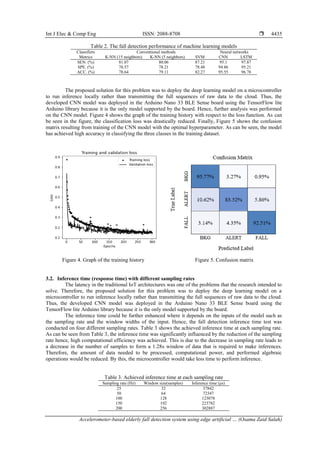
on the CNN model. Figure 4 shows the graph of the training history with respect to the loss function. As can
be seen in the figure, the classification loss was drastically reduced. Finally, Figure 5 shows the confusion
matrix resulting from training of the CNN model with the optimal hyperparameter. As can be seen, the model
has achieved high accuracy in classifying the three classes in the training dataset.
Figure 4. Graph of the training history Figure 5. Confusion matrix
3.2. Inference time (response time) with different sampling rates
The latency in the traditional IoT architectures was one of the problems that the research intended to
solve. Therefore, the proposed solution for this problem was to deploy the deep learning model on a
microcontroller to run inference locally rather than transmitting the full sequences of raw data to the cloud.
Thus, the developed CNN model was deployed in the Arduino Nano 33 BLE Sense board using the
TensorFlow lite Arduino library because it is the only model supported by the board.
The inference time could be further enhanced where it depends on the inputs of the model such as
the sampling rate and the window widths of the input. Hence, the fall detection inference time test was
conducted on four different sampling rates. Table 3 shows the achieved inference time at each sampling rate.
As can be seen from Table 3, the inference time was significantly influenced by the reduction of the sampling
rate hence, high computational efficiency was achieved. This is due to the decrease in sampling rate leads to
a decrease in the number of samples to form a 1.28s window of data that is required to make inferences.
Therefore, the amount of data needed to be processed, computational power, and performed algebraic
operations would be reduced. By this, the microcontroller would take less time to perform inference.
Table 3. Achieved inference time at each sampling rate
Sampling rate (Hz) Window size(samples) Inference time (μs)
25 32 37842
50 64 72347
100 128 123078
150 192 223782
200 256 302887
 ISSN: 2088-8708
Int J Elec & Comp Eng, Vol. 12, No. 4, August 2022: 4430-4438
4436
3.3. Power consumption of the different sensing unit versions
Figure 6 shows the graph which was plotted for the sensing unit power consumption test which was
conducted on three sensing unit versions. The x-axis on the graph is representing the battery life in an hour,
while the x-axis is representing the number of events being transmitted by the sensing unit. It can be noticed
that with considering a large number of events, up to 40 K, the sensing unit’s battery life is over 53 h when
implementing the CNN model on the LoRa version of the sensing unit, over 38 h if the model implemented
on the BLE version and only 8 h in the BLE sensing unit without embedded CNN model. This shows that the
proposed solution has shown a huge improvement in terms of battery life over the traditional fall detection
systems. This due to the fact that the proposed system only transmits information about the status of the
elderly and battery condition rather than continuously transmitting the full sequences of raw data to the
cloud.
Figure 6. Sensing unit battery life
3.4. Range of the different sensing unit versions
Table 4 shows the achieved communication range of the two technologies used for each scenario. It
can be observed that the LoRa technology has achieved a communication range sixty times larger compared
to BLE. For instance, in the line of sight (LOS) scenario, LoRa has achieved a communication range of
180 meters while only 2 meters has been achieved with BLE in the same scenario. This is mainly due to the
lower bandwidth and data rates used in LoRa, as well as the robustness of the LoRa-modulated signal. Also,
it can be observed that when moving from LOS to the non-line of sight (NLOS) scenario, the communication
range decreases. For example, the communication range decreased from 180 meters in the LoRa LOS
scenario to a 150 meter in the NLOS scenario. Thus, it can be concluded that as the number of obstacles or
barriers between the sensing unit and IoT gateway decreases, the communication range increases. This is due
to the fact that the link budget is deducted by all sorts of obstacles between the sender and receiver. Thus, if
the line budget is used up the receiver will only create some noise and no data will be received.
Table 4. Achieved range by each communication technology
Technology Scenario Achieved range (m)
BLE LOS 3
NLOS 2
LoRa LOS 180
NLOS 150
4. CONCLUSION
This work provides a study of the development of an enhanced accelerometer-based elderly fall
prediction and detection system using deep learning with edge AI architecture. The obtained results reveal
that the developed lightweight fall prediction and detection deep learning model was only 61.084 kilobytes,
allowing the model to be executed into a microcontroller with only a few kilobytes of memory in real-time.
0
10
20
30
40
50
60
0 10 20 30 40 50
Battery
life
(h)
Number of events(k)
2000mAh battery life vs. number of events
LoRa BLE BLE without embedded CNN
Int J Elec & Comp Eng ISSN: 2088-8708 
Accelerometer-based elderly fall detection system using edge artificial … (Osama Zaid Salah)
4437
The model architecture with two convolutional layers has achieved 95.55% accuracy. Additionally, the
testing of the inference time (response time) of the deep learning models with different sampling rates reveals
that the fastest response time was obtained with a CNN model at a 25 Hz sampling rate which was
(37.84 ms). The tested consumption and range with two versions of the sensing unit LoRa and the BLE
version indicate that it is possible to use small batteries where the LoRa version has achieved the best
performance. The LoRa version was able to achieve a range of 180 m, with only 37.72 mA current
consumption during transmission mode which meets the low-power wide-area network (LPWAN)
requirements.
REFERENCES
[1] WHO, “Life expectancy increased by 5 years since 2000, but health inequalities persist,” World Health Organization, 2016.
https://www.who.int/news/item/19-05-2016-life-expectancy-increased-by-5-years-since-2000-but-health-inequalities-persist
(accessed Mar. 04, 2021).
[2] National Institute on Aging, “World’s older population grows dramatically,” National Institutes of Health, 2016.
https://www.nia.nih.gov/news/worlds-older-population-grows-dramatically (accessed Mar. 09, 2021).
[3] R. L. Berg and J. S. Cassells, Falls in older persons: risk factors and prevention. National Academies Press, 1992.
[4] WHO, “WHO global report on falls prevention in older age,” World Health Organization, 2008.
https://apps.who.int/iris/handle/10665/43811 (accessed Mar. 10, 2021).
[5] D. Ajerla, S. Mahfuz, and F. Zulkernine, “A real-time patient monitoring framework for fall detection,” Wireless Communications
and Mobile Computing, vol. 2019, pp. 1–13, Sep. 2019, doi: 10.1155/2019/9507938.
[6] L. Martínez-Villaseñor, H. Ponce, J. Brieva, E. Moya-Albor, J. Núñez-Martínez, and C. Peñafort-Asturiano, “UP-fall detection
dataset: a multimodal approach,” Sensors, vol. 19, no. 9, Apr. 2019, doi: 10.3390/s19091988.
[7] G. Santos, P. Endo, K. Monteiro, E. Rocha, I. Silva, and T. Lynn, “Accelerometer-based human fall detection using convolutional
neural networks,” Sensors, vol. 19, no. 7, Apr. 2019, doi: 10.3390/s19071644.
[8] G. Wang, Q. Li, L. Wang, Y. Zhang, and Z. Liu, “Elderly fall detection with an accelerometer using lightweight neural networks,”
Electronics, vol. 8, no. 11, Nov. 2019, doi: 10.3390/electronics8111354.
[9] L. Liu, Y. Hou, J. He, J. Lungu, and R. Dong, “An energy-efficient fall detection method based on FD-DNN for elderly people,”
Sensors, vol. 20, no. 15, Jul. 2020, doi: 10.3390/s20154192.
[10] M. Panhwar, S. M. S. Shah, S. M. Z. S. Shah, S. M. Z. A. Shah, and B. S. Chowdhry, “Smart phone based fall detection using
auto regression modeling in a non-restrictive setting,” Indian Journal of Science and Technology, vol. 10, no. 5, pp. 1–6, Feb.
2017, doi: 10.17485/ijst/2017/v10i5/111274.
[11] A. Shahzad and K. Kim, “FallDroid: an automated smart-phone-based fall detection system using multiple kernel learning,” IEEE
Transactions on Industrial Informatics, vol. 15, no. 1, pp. 35–44, Jan. 2019, doi: 10.1109/TII.2018.2839749.
[12] G. Fortino and R. Gravina, “Fall-MobileGuard: a smart real-time fall detection system,” Proceedings of the 10th EAI
International Conference on Body Area Networks, 2015, doi: 10.4108/eai.28-9-2015.2261462.
[13] G. G. Torres, R. V. Bayan Henriques, C. E. Pereira, and I. Müller, “An EnOcean wearable device with fall detection algorithm
integrated with a smart home system,” IFAC-PapersOnLine, vol. 51, no. 10, pp. 9–14, 2018, doi: 10.1016/j.ifacol.2018.06.228.
[14] J. He, C. Hu, and X. Wang, “A smart device enabled system for autonomous fall detection and alert,” International Journal of
Distributed Sensor Networks, vol. 12, no. 2, Feb. 2016, doi: 10.1155/2016/2308183.
[15] S. Gharghan et al., “Accurate fall detection and localization for elderly people based on neural network and energy-efficient
wireless sensor network,” Energies, vol. 11, no. 11, Oct. 2018, doi: 10.3390/en11112866.
[16] X. Wang, J. Ellul, and G. Azzopardi, “Elderly fall detection systems: a literature survey,” Frontiers in Robotics and AI, vol. 7,
Jun. 2020, doi: 10.3389/frobt.2020.00071.
[17] A. Kamilaris and A. Pitsillides, “Mobile phone computing and the internet of things: a survey,” IEEE Internet of Things Journal,
vol. 3, no. 6, pp. 885–898, Dec. 2016, doi: 10.1109/JIOT.2016.2600569.
[18] Y. Zhang, L. Sun, H. Song, and X. Cao, “Ubiquitous WSN for healthcare: recent advances and future prospects,” IEEE Internet of
Things Journal, vol. 1, no. 4, pp. 311–318, Aug. 2014, doi: 10.1109/JIOT.2014.2329462.
[19] O. B. Sezer, E. Dogdu, and A. M. Ozbayoglu, “Context-aware computing, learning, and big data in internet of things: a survey,”
IEEE Internet of Things Journal, vol. 5, no. 1, pp. 1–27, Feb. 2018, doi: 10.1109/JIOT.2017.2773600.
[20] M. Chen, Y. Li, X. Luo, W. Wang, L. Wang, and W. Zhao, “A novel human activity recognition scheme for smart health using
multilayer extreme learning machine,” IEEE Internet of Things Journal, vol. 6, no. 2, pp. 1410–1418, Apr. 2019, doi:
10.1109/JIOT.2018.2856241.
[21] R. Igual, C. Medrano, and I. Plaza, “Challenges, issues and trends in fall detection systems,” BioMedical Engineering OnLine,
vol. 12, no. 1, 2013, doi: 10.1186/1475-925X-12-66.
[22] T. Eldemerdash, R. Abdulla, V. Jayapal, C. Nataraj, and M. K. Abbas, “IoT based smart helmet for mining industry application,”
International Journal of Advanced Science and Technology, vol. 29, no. 1, pp. 373–387, 2020.
[23] R. Abdulla, A. Abdillahi, and M. K. Abbas, “Electronic toll collection system based on radio frequency identification system,”
International Journal of Electrical and Computer Engineering (IJECE), vol. 8, no. 3, pp. 1602–1610, Jun. 2018, doi:
10.11591/ijece.v8i3.pp1602-1610.
[24] R. Lakshmanan, M. Djama, S. Perumal, and R. Abdulla, “Automated smart hydroponics system using internet of things,”
International Journal of Electrical and Computer Engineering (IJECE), vol. 10, no. 6, pp. 6389–6398, Dec. 2020, doi:
10.11591/ijece.v10i6.pp6389-6398.
[25] E. Torti et al., “Embedded real-time fall detection with deep learning on wearable devices,” in 2018 21st Euromicro Conference
on Digital System Design (DSD), Aug. 2018, pp. 405–412, doi: 10.1109/DSD.2018.00075.
[26] D. Yacchirema, J. S. de Puga, C. Palau, and M. Esteve, “Fall detection system for elderly people using IoT and ensemble machine
learning algorithm,” Personal and Ubiquitous Computing, vol. 23, no. 5–6, pp. 801–817, Nov. 2019, doi: 10.1007/s00779-018-
01196-8.
[27] F. Luna-Perejón, M. J. Domínguez-Morales, and A. Civit-Balcells, “Wearable fall detector using recurrent neural networks,”
Sensors, vol. 19, no. 22, Nov. 2019, doi: 10.3390/s19224885.
[28] A. Sucerquia, J. López, and J. Vargas-Bonilla, “SisFall: a fall and movement dataset,” Sensors, vol. 17, no. 12, Jan. 2017, doi:
10.3390/s17010198.
 ISSN: 2088-8708
Int J Elec & Comp Eng, Vol. 12, No. 4, August 2022: 4430-4438
4438
[29] F. Luna-Perejon et al., “An automated fall detection system using recurrent neural networks,” in Lecture Notes in Computer
Science (including subseries Lecture Notes in Artificial Intelligence and Lecture Notes in Bioinformatics), vol. 11526, Springer
International Publishing, 2019, pp. 36–41.
[30] S. Santurkar, D. Tsipras, A. Ilyas, and A. Madry, “How does batch normalization help optimization?,” Advances in Neural
Information Processing Systems, pp. 2483–2493, 2018.
[31] S. Nitish, H. Geoffrey, K. Alex, S. Ilya, and S. Ruslan, “Dropout: a simple way to prevent neural networks from overfitting,”
Journal of Machine Learning Research, vol. 15, pp. 1929–1958, 2014.
BIOGRAPHIES OF AUTHORS
Osama Zaid Salah received the B.Eng. degree in Mechatronics Engineering from
Asia Pacific University of Technology and Innovation (APU), Malaysia, in 2021, and now he
is studying Master of Science (Data Science and Analytics) at Universiti Kebangsaan
Malaysia. His research interests include artificial intelligence, robotic, and IoT. He can be
contacted at email: osama.z.a.salah7@gmail.com.
Sathish Kumar Selvaperumal received his Ph.D. from Saraswathi Viswa
Mahavidyalaya University, Chennai, India in the year 2014. He completed his B.E degree in
Electronics and Communication Engineering in the year 2001 and M.E Applied Electronics in
the year 2006, at Arulmigu Meenakshi Amman College of Engineering, Kanchipuram,
Chennai, India. He has 17 years of teaching experience, and he is currently working as
Associate Professor and Program leader for Telecommunication Engineering in Asia Pacific
University (APU) of Technology and Innovation, Technology Park of Malaysia, Kuala
Lumpur, Malaysia. He is the Final Year Project Manager in the school of Engineering, APU.
He is a charted Engineer (C.Eng, U.K) and member of the Institution of Engineering and
Technology (IET), Institute of Electrical and Electronics Engineers (IEEE). His research
interests are image enhancement, image compression, optical communication, internet of
things (IoT), antenna design, and artificial intelligence and robotics. He can be contacted at
email: sathish@staffemail.apu.edu.my.
Raed Abdulla received the bachelor’s degree in Electrical Engineering from
AL-Mustansiria University, Baghdad, Iraq in 1997, the master’s degree in Electronic Systems
Design Engineering from Universiti Sains Malaysia, Malaysia in 2008 and he received his
Ph.D. in Wireless and Mobile Systems from Universiti Sains Malaysia, Malaysia in 2012. He
served Universiti Sains Malaysia, Malaysia from 2008 until 2011 as Postgraduate Teaching
Assistant and in the year 2012 he works at School of Engineering, Asia Pacific University of
Technology and innovation (APU), Malaysia, as a Senior lecturer until now. He is a charted
Engineer (C.Eng, U.K) and member of the Institution of Engineering and Technology (IET),
He has contributed in research and in the areas of radio frequency identification (RFID) and
wireless sensor network (WSN) and internet of things (IoT). He can be contacted at email:
raed@staffemail.apu.edu.my.

Accelerometer-based elderly fall detection system using edge artificial intelligence architecture

  • 1.
    International Journal ofElectrical and Computer Engineering (IJECE) Vol. 12, No. 4, August 2022, pp. 4430~4438 ISSN: 2088-8708, DOI: 10.11591/ijece.v12i4.pp4430-4438  4430 Journal homepage: http://ijece.iaescore.com Accelerometer-based elderly fall detection system using edge artificial intelligence architecture Osama Zaid Salah, Sathish Kumar Selvaperumal, Raed Abdulla Faculty of Computing, Engineering and Technology, Asia Pacific University of Technology and Innovation, Kuala Lumpur, Malaysia Article Info ABSTRACT Article history: Received Mar 18, 2021 Revised Dec 17, 2021 Accepted Jan 11, 2022 Falls have long been one of the most serious threats to elderly people's health. Detecting falls in real-time can reduce the time the elderly remains on the floor after a fall, hence avoiding fall-related medical conditions. Recently, the fall detection problem has been extensively researched. However, the fall detection systems that use a traditional internet of things (IoT) architecture have some limitations such as latency, high power consumption, and poor performance in areas with unstable internet. This paper intends to show the efficacy of detecting falls in a resource- constrained microcontroller at the edge of the network using a wearable accelerometer. Since the hardware resources of microcontrollers are limited, a lightweight fall detection deep learning model was developed to be deployed on a microcontroller with only a few kilobytes of memory. The microcontroller was installed in a low-power wide-area network based on long range (LoRa) communication technology. Through comparative testing of different lightweight neural networks and traditional machine learning algorithms, the convolutional neural network (CNN) has been shown to be the most suited, with 95.55% accuracy. The CNN model reached inference times lower than 37.84 ms with 61.084 kilobytes storage requirements, which implies the capability to detect fall event in real-time in low-power microcontrollers. Keywords: Accelerometer Deep learning Edge artificial intelligence Fall detection LoRa This is an open access article under the CC BY-SA license. Corresponding Author: Raed Abdulla Faculty of Computing, Engineering and Technology, School of Engineering, Asia Pacific University of Technology and Innovation Technology Park Malaysia, Bukit Jalil, Kuala Lumpur 57000, Malaysia Email: raed@staffemail.apu.edu.my 1. INTRODUCTION Since 2000, the medical field has significant advances leading to an increase in life expectancy by a rate of 5 years [1]. According to the National Institutes of Health (NIH), the current elderly population is 8.5% of the world’s population, and by 2050, the percentage will be increased to 20% [2]. Hence in that sense, providing healthcare services to the elder to reduce their daily life risks becomes increasingly demanding. The fall is one of the most common risk factors for elders that frequently occur in hospitals, nursing homes, or homes, with approximately 30% of falls causing injury [3]. According to the World Health Organization (WHO), about 30% of the elderly over 65 years get fell one time or more annually, and for the elderly over 80 years, this rate increased to 50% [4]. In such a scenario, automated fall detection can reduce the impact and consequences of falls among the elderly by detecting and reporting their occurrence [5]–[8]. Over the last decade, fall detection has become a hot topic of research where many researches have been carried on fall detection systems fall detection system (FDS) [9]–[15]. Based on the different sensors used in the detection, fall detection systems
  • 2.
    Int J Elec& Comp Eng ISSN: 2088-8708  Accelerometer-based elderly fall detection system using edge artificial … (Osama Zaid Salah) 4431 can be classified into two major classes context-aware and wearable systems [16]. However, context-aware systems are restricted to the deployment area, which usually implies installing devices in the different places where the user being monitored. Recently, interest in wearable sensor-based systems has increased rapidly due to the emergence of low-cost physical sensors [17]–[20]. The wearable-based devices provide real-time monitoring without the use of environment-based devices. Therefore, only user-related data are acquired. In such systems, simple and low-power devices are used, commonly microcontroller equipped with inertial measurement unit leading to minimize the device's size and increasing the battery life. Wearable devices also usually imply lower economic costs compared to context-aware systems [21]. For wearable-based fall detection devices, there are two main types of algorithm can be found which are threshold-based and machine learning-based approach. Although the threshold-based approach shows very low computational complexity, many difficulties are presented when adapted to new fall types. Machine and deep learning approaches are considered more advanced techniques where the possibility of fall prevention and damage mitigation is available. However, deep learning algorithms required high computational power due to the large performed algebraic operations. Therefore, running such models on limited resources microcontrollers can lead to high-power consumption and long response times. Consequently, develop a real-time wearable fall detection system based on deep learning is an open research problem. Every day, the internet of thins (IoT) is the most creative resource in manufacturing, industrial, and residential systems, and it plays a critical role [22]–[24]. The research described in this paper aims to develop an IoT-based fall detection system to alleviate the elderly fear of not being discovered after a fall which can help them to live an active, normal life. Most of the previous works in the literature and existing systems utilize conventional IoT architectures where the raw data are collected from the sensing unit and sent to the cloud or local server to perform the fall prediction and detection. This type of IoT architecture causes latency, power wastage, and not allowing the use of a low-power wide-area network (LPWAN) as they have a low data rate. Also, most of the previous works in the literature utilizes conventional machine learning techniques such as support vector machine (SVM) and k-nearest neighbors (K-NN) which are not robust and could produce many false alarms and have a low detection rate. While the robust fall detection system should have fast inference time and long-range to reduce the time that elderly people remain lying on the floor following a fall that could have significant consequences. Also, the low-power operation should be ensured to reduce cost. Torti et al. [25] proposed an embedded fall detection system based on deep learning. In the proposed system, long short-term memory (LSTM) (a special type of recurrent neural networks (RNN)) was trained on a public fall detection dataset called SisFall. SensorTile board was used in the system for fall detection. An accelerometer data was analyzed with the trained LSTM model. The proposed system had a fall detection accuracy of 98%. In terms of power consumption, the proposed device could run continuously for about 20 hours without recharging. Yacchirema et al. [26] proposed an IoT-based fall detection system based on the ensemble machine learning algorithm. In the proposed methodology, simple moving average (SMA) and sliding-windows techniques were used to extract the features from the raw signal of a publicly accessible dataset "SisFall". The extracted features were used to train and test four machine learning classifiers, including decision trees, ensemble, logistic regression, and deepNet, to find the best model. Then, the IoT fall architecture consists of four main stages a wearable device, a wireless communication network, an IoT gateway, and cloud services were used. The results revealed that ensemble-random forest (RF) had the best performance with an average areas under the curve (AUC) of 0.995, 5.75s training time, 3.48s testing time, accuracy (98.72%). Luna-Perejón et al. [27] proposed a wearable fall detector using recurrent neural networks (RNNs). In the proposed system, two RNN models were trained using the SisFall dataset. For the performance analysis and integration of the trained models, two STM32 32-bit microcontrollers were used. The achieved results in terms of accuracy and specificity are 96.3% and 96.4%, respectively. Besides, less than 40ms execution times were obtained. The major contributions of the project were driven by the limitations of the previous works in the literature. The proposed system was based on edge artificial intelligence (AI) IoT architectures where a deep learning algorithm is used to process data acquired by a 3D accelerometer sensor at the local level (microcontroller) which is new features as the microcontrollers typically are limited in resources. The used edge AI architectures eliminate the privacy issue of transmitting millions of data and storing it in the cloud, as well as the bandwidth and latency limitations that reduce data transmission capacity. 2. RESEARCH METHOD 2.1. Proposed method Figure 1 shows the proposed system architecture for elderly fall detection. The system architecture consists of three layers: edge layer, fog layer, and cloud layer. The edge layer is a wearable sensor node
  • 3.
     ISSN: 2088-8708 IntJ Elec & Comp Eng, Vol. 12, No. 4, August 2022: 4430-4438 4432 equipped with an inertial measurement unit (IMU) and long range (LoRa) transceiver to collect, analyze, and transmit the data to an IoT-gateway via LoRa communication technology. The Arduino Nano 33 Bluetooth low energy (BLE) Sense microcontroller will be used to implement the edge device. Data from the inertial measurement unit will be fed into a deep learning model deployed on the microcontroller to perform inference. Then, only information about the elderly's status and instant notification in case of a fall is transmitted to the IoT gateway over LoRa. The fog layer is a LoRa gateway, which will be implemented with a Raspberry Pi 4 single-board computer and a LoRa transceiver, directly connected to the internet. The LoRa gateway is responsible for receiving LoRa packets and hosting the cloud server. The last layer in the architecture is the cloud layer used for global storage, cloud services, and web/mobile application servers. The proposed architecture solved the research problem by moving the AI processing of the inference from the cloud to the edge. Running the inference directly on the microcontroller at the edge allows the system to function in poor or unstable internet areas. Also, reducing bandwidth which allows the use of communication technologies with high range but limited in bandwidth such as LoRa. Therefore, a high range will be achieved, which is essential for fall detection systems. Lastly, latency in conventional architecture is solved as the proposed architecture will lower centralized computing power and give more real-time response. Global Storage Dashboards End-User Application Server LoRa Wearable Sensor Node Capture and Analyses Bio-signals Fall detection LoRa based Gateway to receive LoRa packets Cloud Layer Fog Layer Edge Layer Figure 1. Proposed fall detection system architecture 2.2. Sesing unit The core of the proposed FDS system is the Arduino Nano 33 BLE Sense board which is a completely new board. The board comes with a series of embedded sensors such as 9 axes inertial sensor which makes this board ideal for wearable devices. The main feature of this board, besides the impressive selection of sensors, is the possibility of running edge computing applications AI on it using tiny machine learning (TinyML). The Nano 33 BLE Sense board also has a communications chipset that can be both a BLE and Bluetooth client and host device which is something unique in the world of microcontroller platforms. Since the Nano 33 BLE Sense board has both embedded IMU and BLE communications chip, there is no external component needed to be connected to construct the BLE version of the sensing unit except for the battery. While the LoRa version of the proposed FDS system consists of Nano 33 BLE Sense board, NODEMCU ESP32 board, LoRa RFM95W transceiver module at 915 MHz band, two 18650 lithium batteries, a 5 V voltage regulator, and a 10 uF capacitor. The NODEMCU ESP32 board is acting as interface between Nano 33 BLE Sense board and LoRa RFM95W transceiver module as the LoRa Arduino library is not yet supported by the Nano 33 BLE Sense board. The NODEMCU ESP32 board and Nano 33 BLE Sense board are connected using UART serial communication protocol. Figure 2 shows the detailed block diagram of the application deployed on the wearable sensing unit. The block diagram of the sensing unit can be divided into six main parts. The first part is the main loop of the system where the application runs in a continuous loop. The second part of the sensing unit application is the accelerometer handler. It is connected directly to the onboard accelerometer of the wearable sensing unit. This part of the application is responsible for managing the movement data capture from the accelerometer
  • 4.
    Int J Elec& Comp Eng ISSN: 2088-8708  Accelerometer-based elderly fall detection system using edge artificial … (Osama Zaid Salah) 4433 and writes them to the model’s input tensor. Also, it uses a buffer to hold data during the inference process to avoid missing the movement data. The third part of the sensing unit application is the TensorFlow lite interpreter. It is connected directly to a TensorFlow lite model. This part of the application is responsible for running the inference based on the movement data being fed from the accelerometer handler. The convolutional neural network (CNN) model was included in the system in form of a C byte array. The fourth part of the sensing unit application is the activity predictor which takes the model’s output and decides whether an activity has been detected, based on thresholds for both probability and the number of consecutive positive predictions. The final part of the sending unit application is the output handler which sends the data from the sensing units to the system gateway via either LoRa or BLE and prints output to the serial port depending on the recognized activity. Main loop of sensing unit TF Lite interpreter Runs the model Output handler Send which activity was detected via LoRa or BLE Accelerometer handler Captures accelerometer data CNN Model Trained to classify three activity FALL, ALERT and BKG Activity predictor Determines if an activity has been detected Accelerometer Communication Module Either LoRa or BLE Figure 2. Detailed application block diagram of the wearable sensing unit 2.3. IoT gateway The IoT gateway is a solution for enabling IoT communication. In the proposed system the gateway receives the data packets from the sensing unit and sends them to the cloud for global storage and displays the data on the system dashboard. The gateways have been implemented using a Raspberry Pi 4 model B running NOOBS software with a LoRa RFM95W transceiver module. The RFM95 LoRa transceiver module communicates with the Raspberry Pi using the serial peripheral interface (SPI) communication protocol. Figure 3 shows the detailed block diagram of the system IoT gateway. The block diagram of the IoT gateway can be divided into three main parts. The first part is the communication initialization of the system communication protocol. The second part of the IoT gateway application is the data handler. This part is responsible for receiving the data packets that are sent by the edge device (sensing unit) and convert them from byte to float format so it can be sent to the node-red to be displayed in the system dashboard. The last part of the IoT gateway application is the nod red where the data is split and display in the system dashboard. 2.4. Machine learning for fall detection The SisFall dataset [28] was used to train, test, and validate the proposed FDS, as it was deemed the most complete. To train the deep learning model with the chosen dataset, some pre-processing steps must be done. Firstly, the data was given in bits. In order to convert the acceleration data given in bits into gravity, the equation (1) was used. 𝐴𝑐𝑐𝑒𝑙𝑒𝑟𝑎𝑡𝑖𝑜𝑛 [𝑔] = 2×𝑅𝑎𝑛𝑔𝑒 2𝑅𝑒𝑠𝑜𝑙𝑢𝑡𝑖𝑜𝑛 × 𝐴𝐷 (1) Since the used accelerometer in the SisFall dataset was ADXL345, the values +-16g for Range and 13 bits for resolution will be substituted in (1). Then, sliding windows have been produced because the Neural Network's inputs consist of a sequence of samples with a fixed length. Each window consists of three signals corresponding to X, Y, and Z accelerometer axes. The sequence of samples with a fixed width is referred to as a block. Therefore, to train the neural network's model, the block must be labeled according to
  • 5.
     ISSN: 2088-8708 IntJ Elec & Comp Eng, Vol. 12, No. 4, August 2022: 4430-4438 4434 the event class that belongs to it. The proposal established in [25] was used, in which each block is classified according to the appearance percentage of most the relevant class. The classes were labeled as FALL for the fall event, ALERT for the risk of falling and BKG for other activities. The BKG class includes daily life activities that not fall-related, such as walking and jumping. This process was applied for the whole dataset, and each block contains 256 samples, equal to 1.28 seconds. The blocks were 50% overlapped. Main loop of Gateway Data handler Receive data packets and convert it to proper format Node red Send Data to node red to be displayed in the system dashboard Node red Dashboard Display received data Communication initialization Initialize the communication parameter of either LoRa or BLE Communication Module Receive data packets via Either LoRa or BLE Figure 3. Detailed application block diagram of the system IoT gateway The requirement that drove the design of deep learning architecture is that it should be deployed on a resource-constrained and relatively cheap device (a microcontroller equipped with an IMU sensor). As a result, five machine and deep learning models were trained on a SisFall dataset for evaluating the fall detection accuracy. Firstly, the dataset produced using the sliding window technique was split into training (60%), validation (20%), and testing (20%) sets based on data for subjects, e.g. 6 subjects for training, 2 for validation, and 2 for testing. For the training process, a graphic processor unit NVIDIA Tesla T4 provided by Google Colab was used, implemented in the Keras library. The architecture of the machine and deep learning models used is shown in Table 1. Table 1. Architecture of the machine and deep learning models Classifiers Architecture K-NN 15 neighbors and 5 neighbors SVM - LSTM Two Stacked LSTM layers with 32 neurons each, batch normalization [29], [30] CNN Two convolutional layers with 8 filters each, dropout [31] 3. RESULTS AND DISCUSSION 3.1. Fall detection performance of machine learning models Performance comparative experiments were conducted between the developed lightweight neural networks (CNN and LSTM) and traditional machine learning algorithms (SVM and K-NN) where the experimental results are listed in Table 2. Among the traditional methods shown in Table 2, the SVM got the best accuracy with 82.72%. k-nearest neighbors (K-NN) (5 neighbors) accuracy was 3.61 lower than SVM, while the K-NN (15 neighbors) performs the worst with an accuracy of 78.64%. Much better performance can be obtained using lightweight neural networks where the CNN neural network has achieved accuracy higher than 95.5% which is even higher than the best traditional algorithms (82.27% of SVM). The LSTM neural network has achieved the highest performance in detecting falls with an accuracy of 96.78%. This significant improvement in accuracy shows the superiority of neural networks over traditional algorithms. The extraordinary results of neural networks are partially attributable to their advanced capability of modeling, but fundamentally to the high ability of neural networks to extract features and discover patterns.
  • 6.
    Int J Elec& Comp Eng ISSN: 2088-8708  Accelerometer-based elderly fall detection system using edge artificial … (Osama Zaid Salah) 4435 Table 2. The fall detection performance of machine learning models Classifiers Conventional methods Neural networks Metrics K-NN (15 neighbors) K-NN (5 neighbors) SVM CNN LSTM SEN. (%) 81.07 80.06 87.21 95.1 97.87 SPE. (%) 76.57 78.21 78.48 94.86 95.21 ACC. (%) 78.64 79.11 82.27 95.55 96.78 The proposed solution for this problem was to deploy the deep learning model on a microcontroller to run inference locally rather than transmitting the full sequences of raw data to the cloud. Thus, the developed CNN model was deployed in the Arduino Nano 33 BLE Sense board using the TensorFlow lite Arduino library because it is the only model supported by the board. Hence, further analysis was performed on the CNN model. Figure 4 shows the graph of the training history with respect to the loss function. As can be seen in the figure, the classification loss was drastically reduced. Finally, Figure 5 shows the confusion matrix resulting from training of the CNN model with the optimal hyperparameter. As can be seen, the model has achieved high accuracy in classifying the three classes in the training dataset. Figure 4. Graph of the training history Figure 5. Confusion matrix 3.2. Inference time (response time) with different sampling rates The latency in the traditional IoT architectures was one of the problems that the research intended to solve. Therefore, the proposed solution for this problem was to deploy the deep learning model on a microcontroller to run inference locally rather than transmitting the full sequences of raw data to the cloud. Thus, the developed CNN model was deployed in the Arduino Nano 33 BLE Sense board using the TensorFlow lite Arduino library because it is the only model supported by the board. The inference time could be further enhanced where it depends on the inputs of the model such as the sampling rate and the window widths of the input. Hence, the fall detection inference time test was conducted on four different sampling rates. Table 3 shows the achieved inference time at each sampling rate. As can be seen from Table 3, the inference time was significantly influenced by the reduction of the sampling rate hence, high computational efficiency was achieved. This is due to the decrease in sampling rate leads to a decrease in the number of samples to form a 1.28s window of data that is required to make inferences. Therefore, the amount of data needed to be processed, computational power, and performed algebraic operations would be reduced. By this, the microcontroller would take less time to perform inference. Table 3. Achieved inference time at each sampling rate Sampling rate (Hz) Window size(samples) Inference time (μs) 25 32 37842 50 64 72347 100 128 123078 150 192 223782 200 256 302887
  • 7.
     ISSN: 2088-8708 IntJ Elec & Comp Eng, Vol. 12, No. 4, August 2022: 4430-4438 4436 3.3. Power consumption of the different sensing unit versions Figure 6 shows the graph which was plotted for the sensing unit power consumption test which was conducted on three sensing unit versions. The x-axis on the graph is representing the battery life in an hour, while the x-axis is representing the number of events being transmitted by the sensing unit. It can be noticed that with considering a large number of events, up to 40 K, the sensing unit’s battery life is over 53 h when implementing the CNN model on the LoRa version of the sensing unit, over 38 h if the model implemented on the BLE version and only 8 h in the BLE sensing unit without embedded CNN model. This shows that the proposed solution has shown a huge improvement in terms of battery life over the traditional fall detection systems. This due to the fact that the proposed system only transmits information about the status of the elderly and battery condition rather than continuously transmitting the full sequences of raw data to the cloud. Figure 6. Sensing unit battery life 3.4. Range of the different sensing unit versions Table 4 shows the achieved communication range of the two technologies used for each scenario. It can be observed that the LoRa technology has achieved a communication range sixty times larger compared to BLE. For instance, in the line of sight (LOS) scenario, LoRa has achieved a communication range of 180 meters while only 2 meters has been achieved with BLE in the same scenario. This is mainly due to the lower bandwidth and data rates used in LoRa, as well as the robustness of the LoRa-modulated signal. Also, it can be observed that when moving from LOS to the non-line of sight (NLOS) scenario, the communication range decreases. For example, the communication range decreased from 180 meters in the LoRa LOS scenario to a 150 meter in the NLOS scenario. Thus, it can be concluded that as the number of obstacles or barriers between the sensing unit and IoT gateway decreases, the communication range increases. This is due to the fact that the link budget is deducted by all sorts of obstacles between the sender and receiver. Thus, if the line budget is used up the receiver will only create some noise and no data will be received. Table 4. Achieved range by each communication technology Technology Scenario Achieved range (m) BLE LOS 3 NLOS 2 LoRa LOS 180 NLOS 150 4. CONCLUSION This work provides a study of the development of an enhanced accelerometer-based elderly fall prediction and detection system using deep learning with edge AI architecture. The obtained results reveal that the developed lightweight fall prediction and detection deep learning model was only 61.084 kilobytes, allowing the model to be executed into a microcontroller with only a few kilobytes of memory in real-time. 0 10 20 30 40 50 60 0 10 20 30 40 50 Battery life (h) Number of events(k) 2000mAh battery life vs. number of events LoRa BLE BLE without embedded CNN
  • 8.
    Int J Elec& Comp Eng ISSN: 2088-8708  Accelerometer-based elderly fall detection system using edge artificial … (Osama Zaid Salah) 4437 The model architecture with two convolutional layers has achieved 95.55% accuracy. Additionally, the testing of the inference time (response time) of the deep learning models with different sampling rates reveals that the fastest response time was obtained with a CNN model at a 25 Hz sampling rate which was (37.84 ms). The tested consumption and range with two versions of the sensing unit LoRa and the BLE version indicate that it is possible to use small batteries where the LoRa version has achieved the best performance. The LoRa version was able to achieve a range of 180 m, with only 37.72 mA current consumption during transmission mode which meets the low-power wide-area network (LPWAN) requirements. REFERENCES [1] WHO, “Life expectancy increased by 5 years since 2000, but health inequalities persist,” World Health Organization, 2016. https://www.who.int/news/item/19-05-2016-life-expectancy-increased-by-5-years-since-2000-but-health-inequalities-persist (accessed Mar. 04, 2021). [2] National Institute on Aging, “World’s older population grows dramatically,” National Institutes of Health, 2016. https://www.nia.nih.gov/news/worlds-older-population-grows-dramatically (accessed Mar. 09, 2021). [3] R. L. Berg and J. S. Cassells, Falls in older persons: risk factors and prevention. National Academies Press, 1992. [4] WHO, “WHO global report on falls prevention in older age,” World Health Organization, 2008. https://apps.who.int/iris/handle/10665/43811 (accessed Mar. 10, 2021). [5] D. Ajerla, S. Mahfuz, and F. Zulkernine, “A real-time patient monitoring framework for fall detection,” Wireless Communications and Mobile Computing, vol. 2019, pp. 1–13, Sep. 2019, doi: 10.1155/2019/9507938. [6] L. Martínez-Villaseñor, H. Ponce, J. Brieva, E. Moya-Albor, J. Núñez-Martínez, and C. Peñafort-Asturiano, “UP-fall detection dataset: a multimodal approach,” Sensors, vol. 19, no. 9, Apr. 2019, doi: 10.3390/s19091988. [7] G. Santos, P. Endo, K. Monteiro, E. Rocha, I. Silva, and T. Lynn, “Accelerometer-based human fall detection using convolutional neural networks,” Sensors, vol. 19, no. 7, Apr. 2019, doi: 10.3390/s19071644. [8] G. Wang, Q. Li, L. Wang, Y. Zhang, and Z. Liu, “Elderly fall detection with an accelerometer using lightweight neural networks,” Electronics, vol. 8, no. 11, Nov. 2019, doi: 10.3390/electronics8111354. [9] L. Liu, Y. Hou, J. He, J. Lungu, and R. Dong, “An energy-efficient fall detection method based on FD-DNN for elderly people,” Sensors, vol. 20, no. 15, Jul. 2020, doi: 10.3390/s20154192. [10] M. Panhwar, S. M. S. Shah, S. M. Z. S. Shah, S. M. Z. A. Shah, and B. S. Chowdhry, “Smart phone based fall detection using auto regression modeling in a non-restrictive setting,” Indian Journal of Science and Technology, vol. 10, no. 5, pp. 1–6, Feb. 2017, doi: 10.17485/ijst/2017/v10i5/111274. [11] A. Shahzad and K. Kim, “FallDroid: an automated smart-phone-based fall detection system using multiple kernel learning,” IEEE Transactions on Industrial Informatics, vol. 15, no. 1, pp. 35–44, Jan. 2019, doi: 10.1109/TII.2018.2839749. [12] G. Fortino and R. Gravina, “Fall-MobileGuard: a smart real-time fall detection system,” Proceedings of the 10th EAI International Conference on Body Area Networks, 2015, doi: 10.4108/eai.28-9-2015.2261462. [13] G. G. Torres, R. V. Bayan Henriques, C. E. Pereira, and I. Müller, “An EnOcean wearable device with fall detection algorithm integrated with a smart home system,” IFAC-PapersOnLine, vol. 51, no. 10, pp. 9–14, 2018, doi: 10.1016/j.ifacol.2018.06.228. [14] J. He, C. Hu, and X. Wang, “A smart device enabled system for autonomous fall detection and alert,” International Journal of Distributed Sensor Networks, vol. 12, no. 2, Feb. 2016, doi: 10.1155/2016/2308183. [15] S. Gharghan et al., “Accurate fall detection and localization for elderly people based on neural network and energy-efficient wireless sensor network,” Energies, vol. 11, no. 11, Oct. 2018, doi: 10.3390/en11112866. [16] X. Wang, J. Ellul, and G. Azzopardi, “Elderly fall detection systems: a literature survey,” Frontiers in Robotics and AI, vol. 7, Jun. 2020, doi: 10.3389/frobt.2020.00071. [17] A. Kamilaris and A. Pitsillides, “Mobile phone computing and the internet of things: a survey,” IEEE Internet of Things Journal, vol. 3, no. 6, pp. 885–898, Dec. 2016, doi: 10.1109/JIOT.2016.2600569. [18] Y. Zhang, L. Sun, H. Song, and X. Cao, “Ubiquitous WSN for healthcare: recent advances and future prospects,” IEEE Internet of Things Journal, vol. 1, no. 4, pp. 311–318, Aug. 2014, doi: 10.1109/JIOT.2014.2329462. [19] O. B. Sezer, E. Dogdu, and A. M. Ozbayoglu, “Context-aware computing, learning, and big data in internet of things: a survey,” IEEE Internet of Things Journal, vol. 5, no. 1, pp. 1–27, Feb. 2018, doi: 10.1109/JIOT.2017.2773600. [20] M. Chen, Y. Li, X. Luo, W. Wang, L. Wang, and W. Zhao, “A novel human activity recognition scheme for smart health using multilayer extreme learning machine,” IEEE Internet of Things Journal, vol. 6, no. 2, pp. 1410–1418, Apr. 2019, doi: 10.1109/JIOT.2018.2856241. [21] R. Igual, C. Medrano, and I. Plaza, “Challenges, issues and trends in fall detection systems,” BioMedical Engineering OnLine, vol. 12, no. 1, 2013, doi: 10.1186/1475-925X-12-66. [22] T. Eldemerdash, R. Abdulla, V. Jayapal, C. Nataraj, and M. K. Abbas, “IoT based smart helmet for mining industry application,” International Journal of Advanced Science and Technology, vol. 29, no. 1, pp. 373–387, 2020. [23] R. Abdulla, A. Abdillahi, and M. K. Abbas, “Electronic toll collection system based on radio frequency identification system,” International Journal of Electrical and Computer Engineering (IJECE), vol. 8, no. 3, pp. 1602–1610, Jun. 2018, doi: 10.11591/ijece.v8i3.pp1602-1610. [24] R. Lakshmanan, M. Djama, S. Perumal, and R. Abdulla, “Automated smart hydroponics system using internet of things,” International Journal of Electrical and Computer Engineering (IJECE), vol. 10, no. 6, pp. 6389–6398, Dec. 2020, doi: 10.11591/ijece.v10i6.pp6389-6398. [25] E. Torti et al., “Embedded real-time fall detection with deep learning on wearable devices,” in 2018 21st Euromicro Conference on Digital System Design (DSD), Aug. 2018, pp. 405–412, doi: 10.1109/DSD.2018.00075. [26] D. Yacchirema, J. S. de Puga, C. Palau, and M. Esteve, “Fall detection system for elderly people using IoT and ensemble machine learning algorithm,” Personal and Ubiquitous Computing, vol. 23, no. 5–6, pp. 801–817, Nov. 2019, doi: 10.1007/s00779-018- 01196-8. [27] F. Luna-Perejón, M. J. Domínguez-Morales, and A. Civit-Balcells, “Wearable fall detector using recurrent neural networks,” Sensors, vol. 19, no. 22, Nov. 2019, doi: 10.3390/s19224885. [28] A. Sucerquia, J. López, and J. Vargas-Bonilla, “SisFall: a fall and movement dataset,” Sensors, vol. 17, no. 12, Jan. 2017, doi: 10.3390/s17010198.
  • 9.
     ISSN: 2088-8708 IntJ Elec & Comp Eng, Vol. 12, No. 4, August 2022: 4430-4438 4438 [29] F. Luna-Perejon et al., “An automated fall detection system using recurrent neural networks,” in Lecture Notes in Computer Science (including subseries Lecture Notes in Artificial Intelligence and Lecture Notes in Bioinformatics), vol. 11526, Springer International Publishing, 2019, pp. 36–41. [30] S. Santurkar, D. Tsipras, A. Ilyas, and A. Madry, “How does batch normalization help optimization?,” Advances in Neural Information Processing Systems, pp. 2483–2493, 2018. [31] S. Nitish, H. Geoffrey, K. Alex, S. Ilya, and S. Ruslan, “Dropout: a simple way to prevent neural networks from overfitting,” Journal of Machine Learning Research, vol. 15, pp. 1929–1958, 2014. BIOGRAPHIES OF AUTHORS Osama Zaid Salah received the B.Eng. degree in Mechatronics Engineering from Asia Pacific University of Technology and Innovation (APU), Malaysia, in 2021, and now he is studying Master of Science (Data Science and Analytics) at Universiti Kebangsaan Malaysia. His research interests include artificial intelligence, robotic, and IoT. He can be contacted at email: osama.z.a.salah7@gmail.com. Sathish Kumar Selvaperumal received his Ph.D. from Saraswathi Viswa Mahavidyalaya University, Chennai, India in the year 2014. He completed his B.E degree in Electronics and Communication Engineering in the year 2001 and M.E Applied Electronics in the year 2006, at Arulmigu Meenakshi Amman College of Engineering, Kanchipuram, Chennai, India. He has 17 years of teaching experience, and he is currently working as Associate Professor and Program leader for Telecommunication Engineering in Asia Pacific University (APU) of Technology and Innovation, Technology Park of Malaysia, Kuala Lumpur, Malaysia. He is the Final Year Project Manager in the school of Engineering, APU. He is a charted Engineer (C.Eng, U.K) and member of the Institution of Engineering and Technology (IET), Institute of Electrical and Electronics Engineers (IEEE). His research interests are image enhancement, image compression, optical communication, internet of things (IoT), antenna design, and artificial intelligence and robotics. He can be contacted at email: sathish@staffemail.apu.edu.my. Raed Abdulla received the bachelor’s degree in Electrical Engineering from AL-Mustansiria University, Baghdad, Iraq in 1997, the master’s degree in Electronic Systems Design Engineering from Universiti Sains Malaysia, Malaysia in 2008 and he received his Ph.D. in Wireless and Mobile Systems from Universiti Sains Malaysia, Malaysia in 2012. He served Universiti Sains Malaysia, Malaysia from 2008 until 2011 as Postgraduate Teaching Assistant and in the year 2012 he works at School of Engineering, Asia Pacific University of Technology and innovation (APU), Malaysia, as a Senior lecturer until now. He is a charted Engineer (C.Eng, U.K) and member of the Institution of Engineering and Technology (IET), He has contributed in research and in the areas of radio frequency identification (RFID) and wireless sensor network (WSN) and internet of things (IoT). He can be contacted at email: raed@staffemail.apu.edu.my.