International Research Journal of Engineering and Technology (IRJET) e-ISSN: 2395-0056
Volume: 06 Issue: 04 | Apr 2019 www.irjet.net p-ISSN: 2395-0072
© 201 IRJET | Impact Factor value: 7.211 | ISO 9001:2008 Certified Journal | Page 698
Design, Development & Fabrication of Automatic Flatbread Machine
Ankit Maurya
1
, Amol Karne
2
, Hariom Maurya
3
, D.B.Radkar
4
1,2,3B.E Student, Department of Mechanical Engineering, Bharati Vidyapeeth College of Engineering, Navimumbai
4Professor, Department of Mechanical Engineering, Bharati Vidyapeeth College of Engineering, Navimumbai
-------------------------------------------------------------------------------------------***------------------------------------------------------------------------------------------
Abstract - The objective of the paper was ‘Design and Development of Automatic Flatbread Machine for Indian
Households’ byconsideringcost, usability, care, easy handling andhygiene.Flatbreadisaninevitablefooditeminmostofthe
Indian families. Throughout the study some simple traditional flatbread making procedures were examined and
implemented for conceptselectionandmechanism.Marketstudywasdirected to understand the existing flatbread
making methods, and numerous flatbread making machines were studied in this market study.
Key Words: Automatic, Flatbread, Households, Concept, Machine, Market, Safety.
1. INTRODUCTION
In the fast-moving world when everything is automated, even our kitchen is turned to an unmanned atmosphere.
Employed peoplefindittough tocookaftera tedious work culture.
An automatic flatbread baking machine wherein, at a programmed period preceding to a pre-set time, oil is supplied into a
vessel, in which the constituents of flat bread are mixed by revolving a rotary vane provided in the vessel, making dough. A
moving base is provided in the container spaced from the rotary vane, and the dough is twisted by the rotary vane & moving
base plate and kneaded at relatively moderate speed by the assistance of the rotary vane and the base plate. The dough
making process occurs for programmed time, and when the it has reached a programmed time, the dough kneading
operation is concluded. The paper relates to an automatic flat bread baking machineforautomaticallybakingasmallamount
of flat bread, primarily for homeuse.
Effortshavebeenmadetomakethedesigncompact&user friendly.
1.1 FLATBREAD MAKING
Compact Flatbread making machine developed can make 15 to 20 roti’s in one hour, saving a lot of time and labor. The flatbread
made by this machine are totally home like and 100% hygienic. You can use normal wheat flour with this Flatbread Making
Machine for making soft and high in qualitychapattisinmassnumbers.TheFlatbreadmadewill surely remain fresh and soft
even after few hours. This Flatbread Maker Machine is specially designed togive out the best performance at domesticlevel.
Features:
• Portable machinein domestic segment.
• Simple rugged and verycompact
• Requires no special skills to operate.
• Uniformly baked finalproduct.
• Robust Construction.
• Versatile.
• Eco friendly.
• Hygienic production.
• Fully automatic.
• Aesthetically Attractive.
International Research Journal of Engineering and Technology (IRJET) e-ISSN: 2395-0056
Volume: 06 Issue: 04 | Apr 2019 www.irjet.net p-ISSN: 2395-0072
© 201 IRJET | Impact Factor value: 7.211 | ISO 9001:2008 Certified Journal | Page 699
2. COMPONENTS
Theflatbreadmakerisdividedintothreeunitsi.e.,Storing unit, Mixing Unit & Pressing Unit.
2.1 STORING UNIT
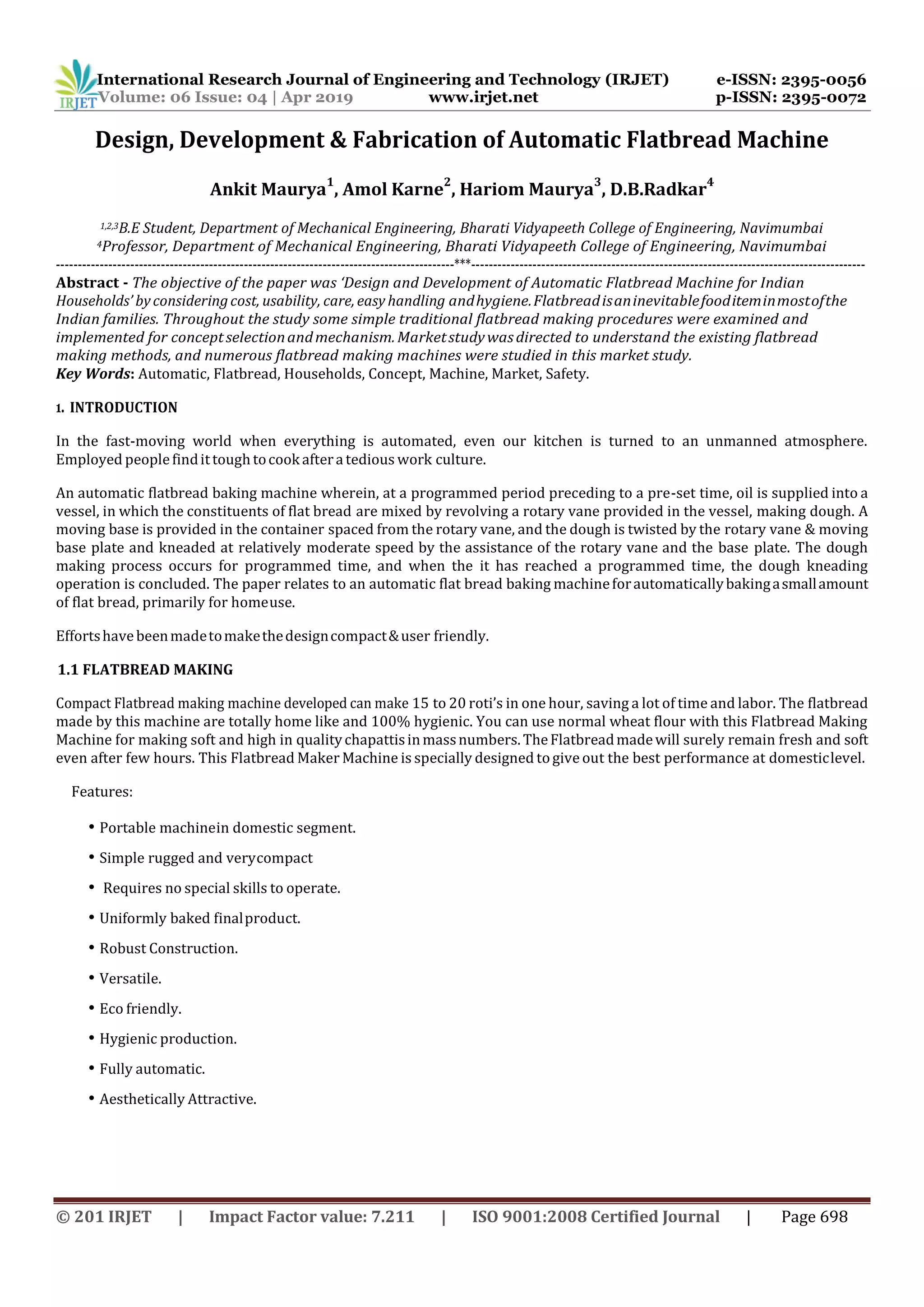
A storage container used to collect flour & is designed to easily dispense these materials through the use of Archimedes
screw. The storage is a small, conical shaped container used to store oil in the lower section here. The quantities of oil &
flourarecontrolledbypump&Archimedes
Fig.2.1 Storing Unit
screw respectively, as shown in Fig 2.1
2.2 MIXING
The Mixing unit comprises of a cylindrical chamber. The upper portion of the cylinder, a blade is fixed & it is the one mainly
responsible for kneading & dough making. The lower portion consists of a bed which is attached to lifting mechanism as
shown isFig.2.2
Fig 2.2 Mixing Unit
2.3 PRESSING&BAKINGMECHANISM
The dough is flattened & heated with the help of the mechanism shown in Fig.1.3. The flattened dough is heated with the
help of induction cooking method.
Fig. 2.3 Pressing Unit
International Research Journal of Engineering and Technology (IRJET) e-ISSN: 2395-0056
Volume: 06 Issue: 04 | Apr 2019 www.irjet.net p-ISSN: 2395-0072
© 201 IRJET | Impact Factor value: 7.211 | ISO 9001:2008 Certified Journal | Page 700
3. WORKING
The constituents of flat bread are put in the flask in advance, and by a regulator, water in the water tank is provided into the
vessel and the rotary vane is rotated to mix the constituents with the water to obtain dough. Under the control of the
regulator, the dough is kneaded in the vessel and the rotary vane is driven for a short period of time to process the dough,
afterwhichthedoughiskneadedagain, and the molded dough is baked by the coil in the press.
In the container, a moving bed is provided to extend in the vertical path & placed at a distance to the circle of rotation of the
rotary vane in parallel relation thereto. When kneaded, the dough is twisted around and hard-pressed around it by therotary
vane;namely,thedoughissufficientlykneadedby theassistanceofthe moving bed and the rotary vane. In this case, even if the
rotary vane is driven at, for example, only 200-400 rpm or so, exceptional kneading can be achieved. Upon noticing that, as a
result of the kneading, the dough formation time has risen to a programmed time value, for example, 1.5 minutes., the
kneading step is proximately finished. For perceiving the dough roundness, a camera module is predisposed in the
bottommost portion of containerandtheperceivedyieldfromthecameramoduleis used.
The drive of bed in the container is causeddue to scissor jack mechanism. The motor drives the scissor jack shaft to produce
vertical motion.
Afterinspectionofroundnessofdough,thebedconveysthe doughtothebottomwherefurtherpressingofdoughtakes placein
ordertoachieveflatness.Simultaneouspressing& baking of flatbread takesplace.
Attheendofthisprocess,theflatbreadiscastoutfromthe press to make way for next flat bread.
4. METHODOLOGY
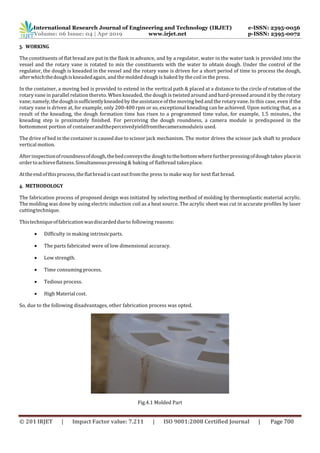
The fabrication process of proposed design was initiated by selecting method of molding by thermoplastic material acrylic.
The molding was done by using electric induction coil as a heat source. The acrylic sheet was cut in accurate profiles by laser
cuttingtechnique.
Thistechniqueoffabricationwasdiscardeddueto following reasons:
 Difficulty in making intrinsicparts.
 The parts fabricated were of low dimensional accuracy.
 Low strength.
 Time consuming process.
 Tedious process.
 High Material cost.
So, due to the following disadvantages, other fabrication process was opted.
Fig.4.1 Molded Part
International Research Journal of Engineering and Technology (IRJET) e-ISSN: 2395-0056
Volume: 06 Issue: 04 | Apr 2019 www.irjet.net p-ISSN: 2395-0072
© 201 IRJET | Impact Factor value: 7.211 | ISO 9001:2008 Certified Journal | Page 701
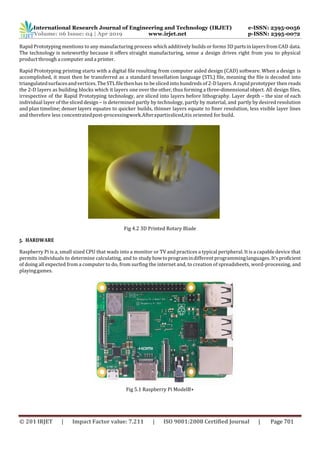
Rapid Prototyping mentions to any manufacturing process which additively builds or forms 3D partsin layersfrom CAD data.
The technology is noteworthy because it offers straight manufacturing, sense a design drives right from you to physical
product through a computer and a printer.
Rapid Prototyping printing starts with a digital file resulting from computer aided design (CAD) software. When a design is
accomplished, it must then be transferred as a standard tessellation language (STL) file, meaning the file is decoded into
triangulatedsurfacesandvertices.TheSTLfilethenhas to be sliced into hundreds of 2-D layers. A rapid prototyper then reads
the 2-D layers as building blocks which it layers one over the other, thus forming a three-dimensional object. All design files,
irrespective of the Rapid Prototyping technology, are sliced into layers before lithography. Layer depth – the size of each
individual layer of the sliced design– is determined partly by technology, partly by material, and partly by desired resolution
and plan timeline; denser layers equates to quicker builds, thinner layers equate to finer resolution, less visible layer lines
and therefore less concentratedpost-processingwork.Afterapartissliced,itis oriented for build.
Fig 4.2 3D Printed Rotary Blade
5. HARDWARE
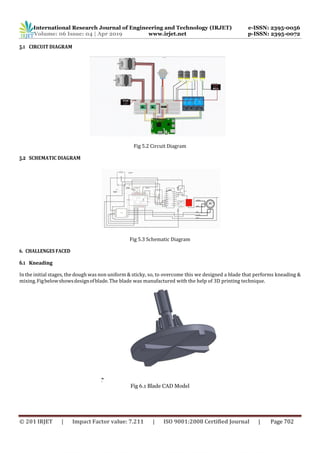
Raspberry Pi is a, small sized CPU that wads into a monitor or TV and practices a typical peripheral. It is a capable device that
permits individuals to determine calculating, and to studyhowtoprogramindifferentprogramminglanguages. It’sproficient
of doing all expected from a computer to do, from surfing the internet and, to creation of spreadsheets, word-processing, and
playinggames.
Fig 5.1 Raspberry Pi ModelB+
International Research Journal of Engineering and Technology (IRJET) e-ISSN: 2395-0056
Volume: 06 Issue: 04 | Apr 2019 www.irjet.net p-ISSN: 2395-0072
© 201 IRJET | Impact Factor value: 7.211 | ISO 9001:2008 Certified Journal | Page 702
5.1 CIRCUIT DIAGRAM
Fig 5.2 Circuit Diagram
5.2 SCHEMATIC DIAGRAM
Fig 5.3 Schematic Diagram
6. CHALLENGES FACED
6.1 Kneading
In the initial stages, the dough was non uniform & sticky, so, to overcome this we designed a blade that performs kneading &
mixing.Figbelowshowsdesignofblade.The blade was manufactured with the help of 3D printing technique.
Fig 6.1 Blade CAD Model
International Research Journal of Engineering and Technology (IRJET) e-ISSN: 2395-0056
Volume: 06 Issue: 04 | Apr 2019 www.irjet.net p-ISSN: 2395-0072
© 201 IRJET | Impact Factor value: 7.211 | ISO 9001:2008 Certified Journal | Page 703
6.2 Cleaning
To make this machine, more user friendly for cleaningthepartsweredesignedkeepingthatintent in mind.
6.3 Modularization
The parts are made easyto remove so as to ensure efficient maintenance &service.
7. CONCLUDING REMARKS
Thequalityofdough made wastestedwiththehelpof3D printed blades.
The following results were obtained.
1. Texture :
The texture obtained was closed to home made roti.
2. Kneading time :
Itwas observethatthekneading time wasnearly50 seconds & varies with the quality of flour used.
3. Mixingtime:
Itwasobservedthatforuniformmixing,theaveragetime required was about 30seconds.
4. Quantity of Ingredients:
The quantity of flour required for making 1 roti: 63g. The quantity of water required for making 1 roti: 30ml The quantity of
oil required for making 1 roti: 5ml
REFERENCES
[1] Fannin, Rebecca A. "Startup Asia: Top Strategies for Cashing in on Asia's Innovation Boom".
[2] https://rotimatic.com/technology/
[3] BreadScience:TheChemistryandCraftofMakingBread by Emily Buehler
[4] http://www.cookingscienceguy.com/pages/wpcontent/u ploads/2012/07/Explainin g-Gluten.pdf
[5] ProductDesign&development,KarlT.Ulrich&StevenD.
[6] https://www.3dhubs.com/knowledge-base/advantages- 3d-printing
[7] https://www.stratasysdirect.com/resources/tutorials/w hat-is-3d-printing
[8] https://www.martins-rubber.co.uk/blog/advantages- and-disadvantages-of-injection- moulding/
[9] https://en.wikipedia.org/wiki/Raspbian
[10] https://www.adafruit.com/product/324
[11] https://www.raspberrypi.org/products/camera-module- v2/
[12] https://patents.google.com/patent/US4538509A/en
[13] Arpita Mondal, A.K Datta, 2007, “Bread Baking- A Review”, Elsevier, IIT Kharagpur, India.

IRJET- Design, Development & Fabrication of Automatic Flatbread Machine

  • 1.
    International Research Journalof Engineering and Technology (IRJET) e-ISSN: 2395-0056 Volume: 06 Issue: 04 | Apr 2019 www.irjet.net p-ISSN: 2395-0072 © 201 IRJET | Impact Factor value: 7.211 | ISO 9001:2008 Certified Journal | Page 698 Design, Development & Fabrication of Automatic Flatbread Machine Ankit Maurya 1 , Amol Karne 2 , Hariom Maurya 3 , D.B.Radkar 4 1,2,3B.E Student, Department of Mechanical Engineering, Bharati Vidyapeeth College of Engineering, Navimumbai 4Professor, Department of Mechanical Engineering, Bharati Vidyapeeth College of Engineering, Navimumbai -------------------------------------------------------------------------------------------***------------------------------------------------------------------------------------------ Abstract - The objective of the paper was ‘Design and Development of Automatic Flatbread Machine for Indian Households’ byconsideringcost, usability, care, easy handling andhygiene.Flatbreadisaninevitablefooditeminmostofthe Indian families. Throughout the study some simple traditional flatbread making procedures were examined and implemented for conceptselectionandmechanism.Marketstudywasdirected to understand the existing flatbread making methods, and numerous flatbread making machines were studied in this market study. Key Words: Automatic, Flatbread, Households, Concept, Machine, Market, Safety. 1. INTRODUCTION In the fast-moving world when everything is automated, even our kitchen is turned to an unmanned atmosphere. Employed peoplefindittough tocookaftera tedious work culture. An automatic flatbread baking machine wherein, at a programmed period preceding to a pre-set time, oil is supplied into a vessel, in which the constituents of flat bread are mixed by revolving a rotary vane provided in the vessel, making dough. A moving base is provided in the container spaced from the rotary vane, and the dough is twisted by the rotary vane & moving base plate and kneaded at relatively moderate speed by the assistance of the rotary vane and the base plate. The dough making process occurs for programmed time, and when the it has reached a programmed time, the dough kneading operation is concluded. The paper relates to an automatic flat bread baking machineforautomaticallybakingasmallamount of flat bread, primarily for homeuse. Effortshavebeenmadetomakethedesigncompact&user friendly. 1.1 FLATBREAD MAKING Compact Flatbread making machine developed can make 15 to 20 roti’s in one hour, saving a lot of time and labor. The flatbread made by this machine are totally home like and 100% hygienic. You can use normal wheat flour with this Flatbread Making Machine for making soft and high in qualitychapattisinmassnumbers.TheFlatbreadmadewill surely remain fresh and soft even after few hours. This Flatbread Maker Machine is specially designed togive out the best performance at domesticlevel. Features: • Portable machinein domestic segment. • Simple rugged and verycompact • Requires no special skills to operate. • Uniformly baked finalproduct. • Robust Construction. • Versatile. • Eco friendly. • Hygienic production. • Fully automatic. • Aesthetically Attractive.
  • 2.
    International Research Journalof Engineering and Technology (IRJET) e-ISSN: 2395-0056 Volume: 06 Issue: 04 | Apr 2019 www.irjet.net p-ISSN: 2395-0072 © 201 IRJET | Impact Factor value: 7.211 | ISO 9001:2008 Certified Journal | Page 699 2. COMPONENTS Theflatbreadmakerisdividedintothreeunitsi.e.,Storing unit, Mixing Unit & Pressing Unit. 2.1 STORING UNIT A storage container used to collect flour & is designed to easily dispense these materials through the use of Archimedes screw. The storage is a small, conical shaped container used to store oil in the lower section here. The quantities of oil & flourarecontrolledbypump&Archimedes Fig.2.1 Storing Unit screw respectively, as shown in Fig 2.1 2.2 MIXING The Mixing unit comprises of a cylindrical chamber. The upper portion of the cylinder, a blade is fixed & it is the one mainly responsible for kneading & dough making. The lower portion consists of a bed which is attached to lifting mechanism as shown isFig.2.2 Fig 2.2 Mixing Unit 2.3 PRESSING&BAKINGMECHANISM The dough is flattened & heated with the help of the mechanism shown in Fig.1.3. The flattened dough is heated with the help of induction cooking method. Fig. 2.3 Pressing Unit
  • 3.
    International Research Journalof Engineering and Technology (IRJET) e-ISSN: 2395-0056 Volume: 06 Issue: 04 | Apr 2019 www.irjet.net p-ISSN: 2395-0072 © 201 IRJET | Impact Factor value: 7.211 | ISO 9001:2008 Certified Journal | Page 700 3. WORKING The constituents of flat bread are put in the flask in advance, and by a regulator, water in the water tank is provided into the vessel and the rotary vane is rotated to mix the constituents with the water to obtain dough. Under the control of the regulator, the dough is kneaded in the vessel and the rotary vane is driven for a short period of time to process the dough, afterwhichthedoughiskneadedagain, and the molded dough is baked by the coil in the press. In the container, a moving bed is provided to extend in the vertical path & placed at a distance to the circle of rotation of the rotary vane in parallel relation thereto. When kneaded, the dough is twisted around and hard-pressed around it by therotary vane;namely,thedoughissufficientlykneadedby theassistanceofthe moving bed and the rotary vane. In this case, even if the rotary vane is driven at, for example, only 200-400 rpm or so, exceptional kneading can be achieved. Upon noticing that, as a result of the kneading, the dough formation time has risen to a programmed time value, for example, 1.5 minutes., the kneading step is proximately finished. For perceiving the dough roundness, a camera module is predisposed in the bottommost portion of containerandtheperceivedyieldfromthecameramoduleis used. The drive of bed in the container is causeddue to scissor jack mechanism. The motor drives the scissor jack shaft to produce vertical motion. Afterinspectionofroundnessofdough,thebedconveysthe doughtothebottomwherefurtherpressingofdoughtakes placein ordertoachieveflatness.Simultaneouspressing& baking of flatbread takesplace. Attheendofthisprocess,theflatbreadiscastoutfromthe press to make way for next flat bread. 4. METHODOLOGY The fabrication process of proposed design was initiated by selecting method of molding by thermoplastic material acrylic. The molding was done by using electric induction coil as a heat source. The acrylic sheet was cut in accurate profiles by laser cuttingtechnique. Thistechniqueoffabricationwasdiscardeddueto following reasons:  Difficulty in making intrinsicparts.  The parts fabricated were of low dimensional accuracy.  Low strength.  Time consuming process.  Tedious process.  High Material cost. So, due to the following disadvantages, other fabrication process was opted. Fig.4.1 Molded Part
  • 4.
    International Research Journalof Engineering and Technology (IRJET) e-ISSN: 2395-0056 Volume: 06 Issue: 04 | Apr 2019 www.irjet.net p-ISSN: 2395-0072 © 201 IRJET | Impact Factor value: 7.211 | ISO 9001:2008 Certified Journal | Page 701 Rapid Prototyping mentions to any manufacturing process which additively builds or forms 3D partsin layersfrom CAD data. The technology is noteworthy because it offers straight manufacturing, sense a design drives right from you to physical product through a computer and a printer. Rapid Prototyping printing starts with a digital file resulting from computer aided design (CAD) software. When a design is accomplished, it must then be transferred as a standard tessellation language (STL) file, meaning the file is decoded into triangulatedsurfacesandvertices.TheSTLfilethenhas to be sliced into hundreds of 2-D layers. A rapid prototyper then reads the 2-D layers as building blocks which it layers one over the other, thus forming a three-dimensional object. All design files, irrespective of the Rapid Prototyping technology, are sliced into layers before lithography. Layer depth – the size of each individual layer of the sliced design– is determined partly by technology, partly by material, and partly by desired resolution and plan timeline; denser layers equates to quicker builds, thinner layers equate to finer resolution, less visible layer lines and therefore less concentratedpost-processingwork.Afterapartissliced,itis oriented for build. Fig 4.2 3D Printed Rotary Blade 5. HARDWARE Raspberry Pi is a, small sized CPU that wads into a monitor or TV and practices a typical peripheral. It is a capable device that permits individuals to determine calculating, and to studyhowtoprogramindifferentprogramminglanguages. It’sproficient of doing all expected from a computer to do, from surfing the internet and, to creation of spreadsheets, word-processing, and playinggames. Fig 5.1 Raspberry Pi ModelB+
  • 5.
    International Research Journalof Engineering and Technology (IRJET) e-ISSN: 2395-0056 Volume: 06 Issue: 04 | Apr 2019 www.irjet.net p-ISSN: 2395-0072 © 201 IRJET | Impact Factor value: 7.211 | ISO 9001:2008 Certified Journal | Page 702 5.1 CIRCUIT DIAGRAM Fig 5.2 Circuit Diagram 5.2 SCHEMATIC DIAGRAM Fig 5.3 Schematic Diagram 6. CHALLENGES FACED 6.1 Kneading In the initial stages, the dough was non uniform & sticky, so, to overcome this we designed a blade that performs kneading & mixing.Figbelowshowsdesignofblade.The blade was manufactured with the help of 3D printing technique. Fig 6.1 Blade CAD Model
  • 6.
    International Research Journalof Engineering and Technology (IRJET) e-ISSN: 2395-0056 Volume: 06 Issue: 04 | Apr 2019 www.irjet.net p-ISSN: 2395-0072 © 201 IRJET | Impact Factor value: 7.211 | ISO 9001:2008 Certified Journal | Page 703 6.2 Cleaning To make this machine, more user friendly for cleaningthepartsweredesignedkeepingthatintent in mind. 6.3 Modularization The parts are made easyto remove so as to ensure efficient maintenance &service. 7. CONCLUDING REMARKS Thequalityofdough made wastestedwiththehelpof3D printed blades. The following results were obtained. 1. Texture : The texture obtained was closed to home made roti. 2. Kneading time : Itwas observethatthekneading time wasnearly50 seconds & varies with the quality of flour used. 3. Mixingtime: Itwasobservedthatforuniformmixing,theaveragetime required was about 30seconds. 4. Quantity of Ingredients: The quantity of flour required for making 1 roti: 63g. The quantity of water required for making 1 roti: 30ml The quantity of oil required for making 1 roti: 5ml REFERENCES [1] Fannin, Rebecca A. "Startup Asia: Top Strategies for Cashing in on Asia's Innovation Boom". [2] https://rotimatic.com/technology/ [3] BreadScience:TheChemistryandCraftofMakingBread by Emily Buehler [4] http://www.cookingscienceguy.com/pages/wpcontent/u ploads/2012/07/Explainin g-Gluten.pdf [5] ProductDesign&development,KarlT.Ulrich&StevenD. [6] https://www.3dhubs.com/knowledge-base/advantages- 3d-printing [7] https://www.stratasysdirect.com/resources/tutorials/w hat-is-3d-printing [8] https://www.martins-rubber.co.uk/blog/advantages- and-disadvantages-of-injection- moulding/ [9] https://en.wikipedia.org/wiki/Raspbian [10] https://www.adafruit.com/product/324 [11] https://www.raspberrypi.org/products/camera-module- v2/ [12] https://patents.google.com/patent/US4538509A/en [13] Arpita Mondal, A.K Datta, 2007, “Bread Baking- A Review”, Elsevier, IIT Kharagpur, India.