International Research Journal of Engineering and Technology (IRJET) e-ISSN: 2395-0056
Volume: 06 Issue: 04 | Apr 2019 www.irjet.net p-ISSN: 2395-0072
© 2019, IRJET | Impact Factor value: 7.211 | ISO 9001:2008 Certified Journal | Page 4477
Comparison of Building in Sloped Area with and without Outrigger
Aathira Sundaresan1, Abhirami Suresh2
1MTech student, Dept .of Civil Engineering, Sree Narayana Institute of Technology, Adoor Kerala
2Assistant Professor, Dept. of Civil Engineering, Sree Narayana Institute of Technology, Adoor Kerala
---------------------------------------------------------------------***---------------------------------------------------------------------
Abstract - In this study, G+ 30 storey RCC building at slope
with and without outrigger have been considered for the
analysis. Outrigger is a lateral load resisting system, in which
the external columns are tied to the central core at one or
more levels. The outrigger system is commonly used as one of
the structural system to effectively control the excessive drift
due to lateral load, so that lateral load due to either wind or
earthquake load, the risk of structural and non-structural
damage can be minimized.
The research aims to determine the effect of outrigger in a
building. From the acquired results the effective performance
of building with outrigger is evaluated. The modelling and
analysis of the building has been done by using structure
analysis tool ETAB 2015.
Key Words: - Outrigger, Response spectrum method, Storey
drift, Storey shear, Lateral displacement, Overturning
moments
1.INTRODUCTION
Nowadays there is an increase in construction of tall and
slender structures both in residential and commercial area.
The effect of lateral loads like wind loads, earthquake loads
and blast forces are more on these type of structures. So it is
very important to design tall and slender building with
adequate strength and stability against lateral loads. But as
the height of the building increases tall buildings with only
shear wall is not capable of withstandinglargeseismicforces
when it go to top levels. So it is necessary to provide an extra
structural element in accordance with the shear wall which
reduces the total seismic effect on the structure. Outrigger
system is best suited for reducing seismic effects in tall and
slender buildings. This study aims to understand the
influence of outrigger in seismic resistance of a G+30storied
building. The main objective of this study is the comparison
of building in sloped area with and without outrigger. The
main objective of this study is as follows
• To find the effect of outrigger in a building.
• To make a comparison between with and without
outrigger in a building.
• To analyze the building with and without outrigger
using ETABS 2015
2.SOFTWARE UESD
ETabs(Extended three dimensional analysis of building
systems).ETabs is a program for linear, nonlinear, static and
dynamic analysis, and the design of building systems. ETabs
is the most effective software for doing seismic analysis.
3.MODELLING OF BUILDING
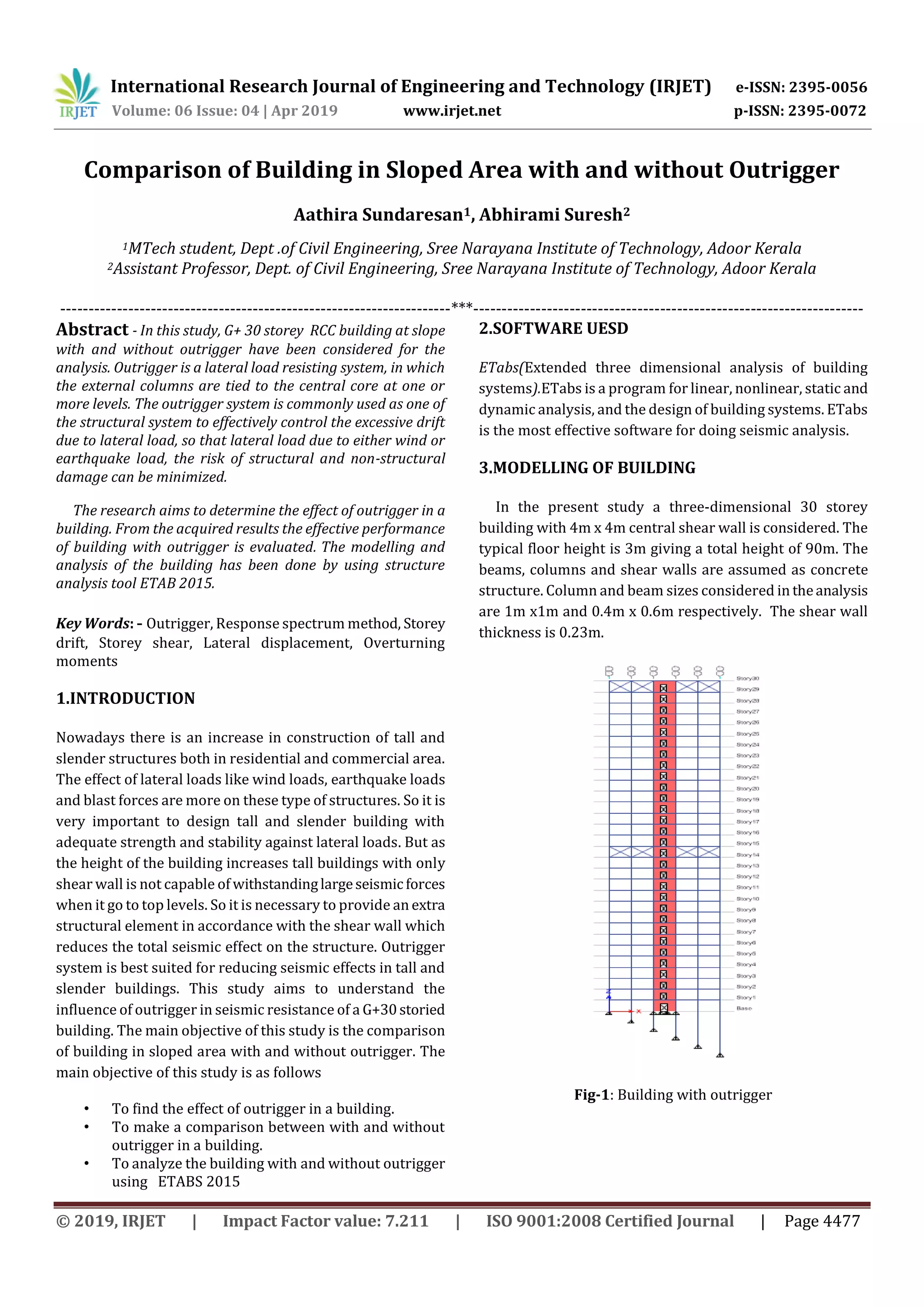
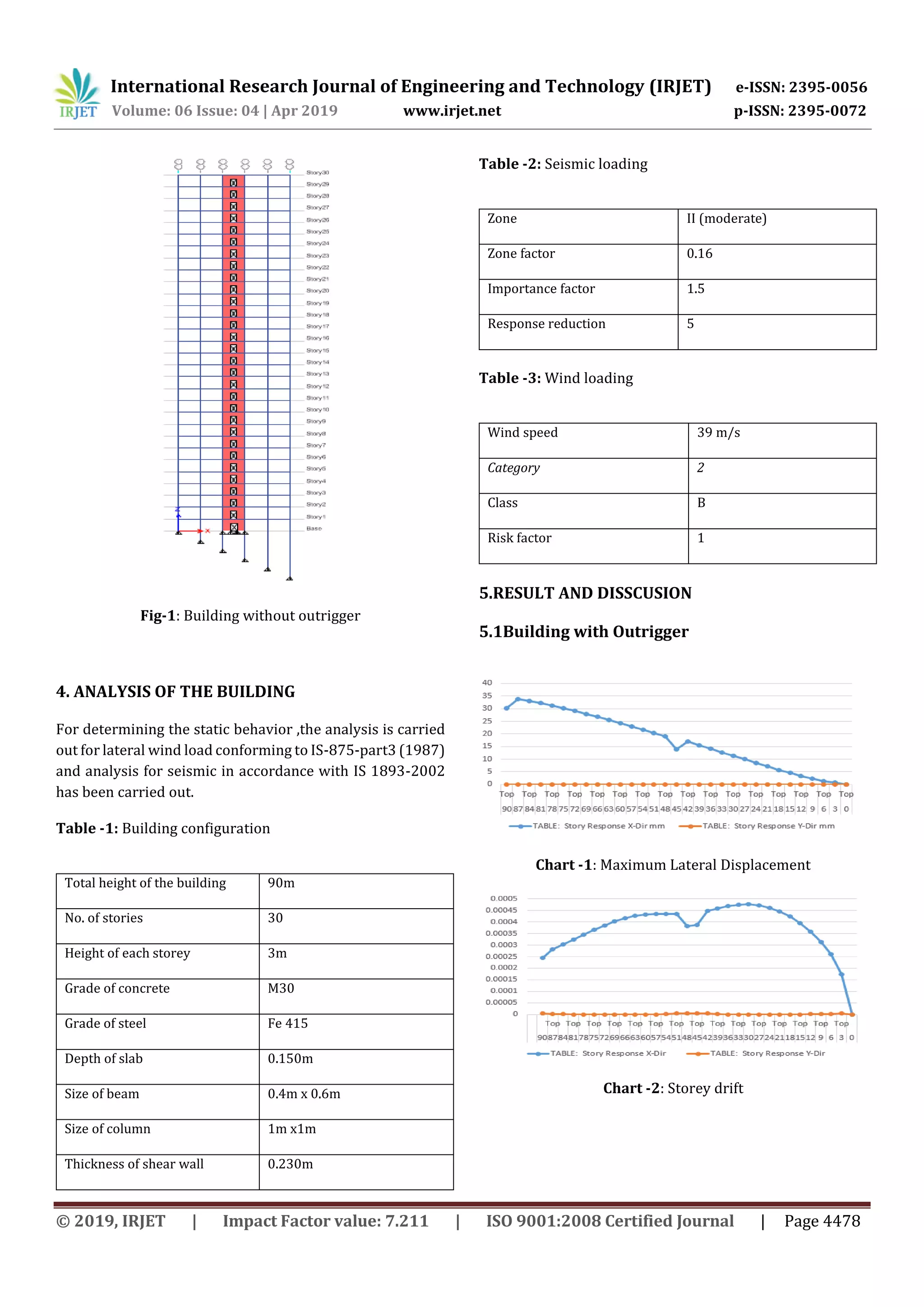
In the present study a three-dimensional 30 storey
building with 4m x 4m central shear wall is considered. The
typical floor height is 3m giving a total height of 90m. The
beams, columns and shear walls are assumed as concrete
structure. Column and beam sizes considered in theanalysis
are 1m x1m and 0.4m x 0.6m respectively. The shear wall
thickness is 0.23m.
Fig-1: Building with outrigger
International Research Journal of Engineering and Technology (IRJET) e-ISSN: 2395-0056
Volume: 06 Issue: 04 | Apr 2019 www.irjet.net p-ISSN: 2395-0072
© 2019, IRJET | Impact Factor value: 7.211 | ISO 9001:2008 Certified Journal | Page 4478
Fig-1: Building without outrigger
4. ANALYSIS OF THE BUILDING
For determining the static behavior ,the analysis is carried
out for lateral wind load conforming to IS-875-part3 (1987)
and analysis for seismic in accordance with IS 1893-2002
has been carried out.
Table -1: Building configuration
Total height of the building 90m
No. of stories 30
Height of each storey 3m
Grade of concrete M30
Grade of steel Fe 415
Depth of slab 0.150m
Size of beam 0.4m x 0.6m
Size of column 1m x1m
Thickness of shear wall 0.230m
Table -2: Seismic loading
Zone II (moderate)
Zone factor 0.16
Importance factor 1.5
Response reduction 5
Table -3: Wind loading
Wind speed 39 m/s
Category 2
Class B
Risk factor 1
5.RESULT AND DISSCUSION
5.1Building with Outrigger
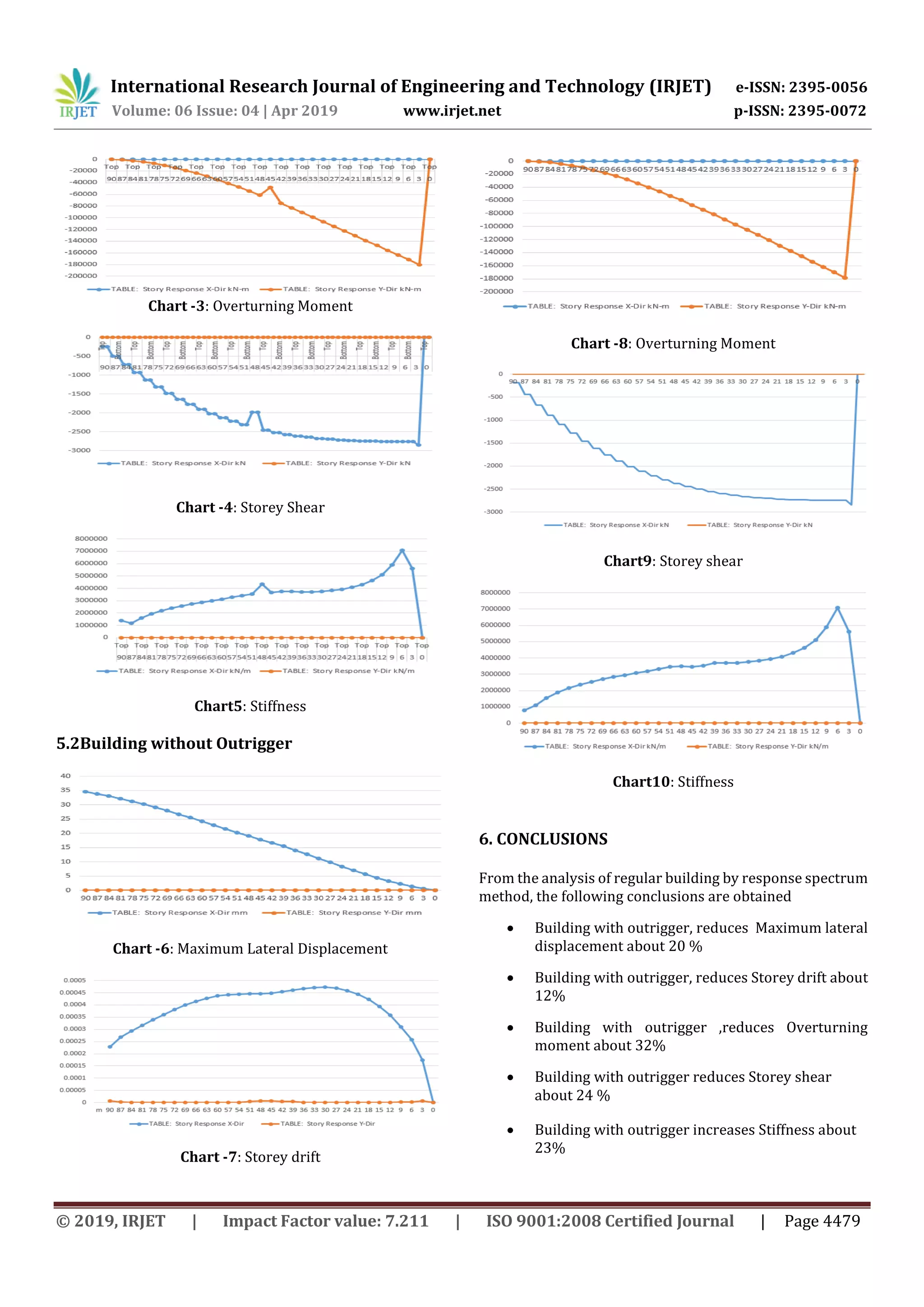
Chart -1: Maximum Lateral Displacement
Chart -2: Storey drift
International Research Journal of Engineering and Technology (IRJET) e-ISSN: 2395-0056
Volume: 06 Issue: 04 | Apr 2019 www.irjet.net p-ISSN: 2395-0072
© 2019, IRJET | Impact Factor value: 7.211 | ISO 9001:2008 Certified Journal | Page 4479
Chart -3: Overturning Moment
Chart -4: Storey Shear
Chart5: Stiffness
5.2Building without Outrigger
Chart -6: Maximum Lateral Displacement
Chart -7: Storey drift
Chart -8: Overturning Moment
Chart9: Storey shear
Chart10: Stiffness
6. CONCLUSIONS
From the analysis of regular building by response spectrum
method, the following conclusions are obtained
 Building with outrigger, reduces Maximum lateral
displacement about 20 %
 Building with outrigger, reduces Storey drift about
12%
 Building with outrigger ,reduces Overturning
moment about 32%
 Building with outrigger reduces Storey shear
about 24 %
 Building with outrigger increases Stiffness about
23%
International Research Journal of Engineering and Technology (IRJET) e-ISSN: 2395-0056
Volume: 06 Issue: 04 | Apr 2019 www.irjet.net p-ISSN: 2395-0072
© 2019, IRJET | Impact Factor value: 7.211 | ISO 9001:2008 Certified Journal | Page 4480
ACKNOWLEDGEMENT
The Author(s) wish to express their special gratitude to
Dr.P G Bhaskaran Nair , PG Dean ,Sree Narayana Institute
Of Technology, Above all the author(s) thank GOD almighty
for his grace throughout the work.
REFERENCES
[1]Goman W.M.Ho et al ,“The evolution of outrigger system
in tall building” International Journal of Highrise building
ISSN:2278-0181,Vol.2 Issue 12, December-2016
[2]Sreelekshmi. S et al, “Study of Outrigger Systems for High
Rise Buildings”, International Journal ofInnovativeResearch
in Science, Engineering and Technology vol.5 December-
2016
[3]Mahesh N. Patil et al ,“ Seismic Analysis of Multistoried
Building ” International Journal of Engineering and
Innovative Technology Vol.4 june-2015
[4]Shivakumar B. Patil, “Lateral Stability Of Multistorey
Building On SlopingGround ”International ResearchJournal
of Engineering and Technology Vol: 2 July-2015
[5]Nishit Kirit Shah et al,“Review on Behavior of Outrigger
System in High Rise Building”International ResearchJournal
of Engineering and Technology Vol.3 , July-2015
[6]P.M.B. Raj Kiran et al, “Optimum Position of Outrigger
System for High-Rise Reinforced Concrete Buildings Under
Wind And Earthquake Loadings” American Journal of
Engineering Research Vol:02 December-2013
[7] IS 456:2000 Indian Standard- “Plain and Reinforced
concrete-code of practice”, Bureau of Indian standards
[8] IS 1893(Part-1):2002 Indian Standard- “Criteria for
Earthquake Resistant Design of Structures” , Bureau of
Indian standards
[9] IS 875(Part-1):1987“IndianStandardcodeofpractice for
design loads (other than Earthquake) for building and
structures” , Bureau of Indian standards
[10] IS 875(Part-II):1987 “Indian Standard code of practice
for Design loads (other than Earthquake) for building and
structures” , Bureau of Indian standards

IRJET- Comparison of Building in Sloped Area with and Without Outrigger

  • 1.
    International Research Journalof Engineering and Technology (IRJET) e-ISSN: 2395-0056 Volume: 06 Issue: 04 | Apr 2019 www.irjet.net p-ISSN: 2395-0072 © 2019, IRJET | Impact Factor value: 7.211 | ISO 9001:2008 Certified Journal | Page 4477 Comparison of Building in Sloped Area with and without Outrigger Aathira Sundaresan1, Abhirami Suresh2 1MTech student, Dept .of Civil Engineering, Sree Narayana Institute of Technology, Adoor Kerala 2Assistant Professor, Dept. of Civil Engineering, Sree Narayana Institute of Technology, Adoor Kerala ---------------------------------------------------------------------***--------------------------------------------------------------------- Abstract - In this study, G+ 30 storey RCC building at slope with and without outrigger have been considered for the analysis. Outrigger is a lateral load resisting system, in which the external columns are tied to the central core at one or more levels. The outrigger system is commonly used as one of the structural system to effectively control the excessive drift due to lateral load, so that lateral load due to either wind or earthquake load, the risk of structural and non-structural damage can be minimized. The research aims to determine the effect of outrigger in a building. From the acquired results the effective performance of building with outrigger is evaluated. The modelling and analysis of the building has been done by using structure analysis tool ETAB 2015. Key Words: - Outrigger, Response spectrum method, Storey drift, Storey shear, Lateral displacement, Overturning moments 1.INTRODUCTION Nowadays there is an increase in construction of tall and slender structures both in residential and commercial area. The effect of lateral loads like wind loads, earthquake loads and blast forces are more on these type of structures. So it is very important to design tall and slender building with adequate strength and stability against lateral loads. But as the height of the building increases tall buildings with only shear wall is not capable of withstandinglargeseismicforces when it go to top levels. So it is necessary to provide an extra structural element in accordance with the shear wall which reduces the total seismic effect on the structure. Outrigger system is best suited for reducing seismic effects in tall and slender buildings. This study aims to understand the influence of outrigger in seismic resistance of a G+30storied building. The main objective of this study is the comparison of building in sloped area with and without outrigger. The main objective of this study is as follows • To find the effect of outrigger in a building. • To make a comparison between with and without outrigger in a building. • To analyze the building with and without outrigger using ETABS 2015 2.SOFTWARE UESD ETabs(Extended three dimensional analysis of building systems).ETabs is a program for linear, nonlinear, static and dynamic analysis, and the design of building systems. ETabs is the most effective software for doing seismic analysis. 3.MODELLING OF BUILDING In the present study a three-dimensional 30 storey building with 4m x 4m central shear wall is considered. The typical floor height is 3m giving a total height of 90m. The beams, columns and shear walls are assumed as concrete structure. Column and beam sizes considered in theanalysis are 1m x1m and 0.4m x 0.6m respectively. The shear wall thickness is 0.23m. Fig-1: Building with outrigger
  • 2.
    International Research Journalof Engineering and Technology (IRJET) e-ISSN: 2395-0056 Volume: 06 Issue: 04 | Apr 2019 www.irjet.net p-ISSN: 2395-0072 © 2019, IRJET | Impact Factor value: 7.211 | ISO 9001:2008 Certified Journal | Page 4478 Fig-1: Building without outrigger 4. ANALYSIS OF THE BUILDING For determining the static behavior ,the analysis is carried out for lateral wind load conforming to IS-875-part3 (1987) and analysis for seismic in accordance with IS 1893-2002 has been carried out. Table -1: Building configuration Total height of the building 90m No. of stories 30 Height of each storey 3m Grade of concrete M30 Grade of steel Fe 415 Depth of slab 0.150m Size of beam 0.4m x 0.6m Size of column 1m x1m Thickness of shear wall 0.230m Table -2: Seismic loading Zone II (moderate) Zone factor 0.16 Importance factor 1.5 Response reduction 5 Table -3: Wind loading Wind speed 39 m/s Category 2 Class B Risk factor 1 5.RESULT AND DISSCUSION 5.1Building with Outrigger Chart -1: Maximum Lateral Displacement Chart -2: Storey drift
  • 3.
    International Research Journalof Engineering and Technology (IRJET) e-ISSN: 2395-0056 Volume: 06 Issue: 04 | Apr 2019 www.irjet.net p-ISSN: 2395-0072 © 2019, IRJET | Impact Factor value: 7.211 | ISO 9001:2008 Certified Journal | Page 4479 Chart -3: Overturning Moment Chart -4: Storey Shear Chart5: Stiffness 5.2Building without Outrigger Chart -6: Maximum Lateral Displacement Chart -7: Storey drift Chart -8: Overturning Moment Chart9: Storey shear Chart10: Stiffness 6. CONCLUSIONS From the analysis of regular building by response spectrum method, the following conclusions are obtained  Building with outrigger, reduces Maximum lateral displacement about 20 %  Building with outrigger, reduces Storey drift about 12%  Building with outrigger ,reduces Overturning moment about 32%  Building with outrigger reduces Storey shear about 24 %  Building with outrigger increases Stiffness about 23%
  • 4.
    International Research Journalof Engineering and Technology (IRJET) e-ISSN: 2395-0056 Volume: 06 Issue: 04 | Apr 2019 www.irjet.net p-ISSN: 2395-0072 © 2019, IRJET | Impact Factor value: 7.211 | ISO 9001:2008 Certified Journal | Page 4480 ACKNOWLEDGEMENT The Author(s) wish to express their special gratitude to Dr.P G Bhaskaran Nair , PG Dean ,Sree Narayana Institute Of Technology, Above all the author(s) thank GOD almighty for his grace throughout the work. REFERENCES [1]Goman W.M.Ho et al ,“The evolution of outrigger system in tall building” International Journal of Highrise building ISSN:2278-0181,Vol.2 Issue 12, December-2016 [2]Sreelekshmi. S et al, “Study of Outrigger Systems for High Rise Buildings”, International Journal ofInnovativeResearch in Science, Engineering and Technology vol.5 December- 2016 [3]Mahesh N. Patil et al ,“ Seismic Analysis of Multistoried Building ” International Journal of Engineering and Innovative Technology Vol.4 june-2015 [4]Shivakumar B. Patil, “Lateral Stability Of Multistorey Building On SlopingGround ”International ResearchJournal of Engineering and Technology Vol: 2 July-2015 [5]Nishit Kirit Shah et al,“Review on Behavior of Outrigger System in High Rise Building”International ResearchJournal of Engineering and Technology Vol.3 , July-2015 [6]P.M.B. Raj Kiran et al, “Optimum Position of Outrigger System for High-Rise Reinforced Concrete Buildings Under Wind And Earthquake Loadings” American Journal of Engineering Research Vol:02 December-2013 [7] IS 456:2000 Indian Standard- “Plain and Reinforced concrete-code of practice”, Bureau of Indian standards [8] IS 1893(Part-1):2002 Indian Standard- “Criteria for Earthquake Resistant Design of Structures” , Bureau of Indian standards [9] IS 875(Part-1):1987“IndianStandardcodeofpractice for design loads (other than Earthquake) for building and structures” , Bureau of Indian standards [10] IS 875(Part-II):1987 “Indian Standard code of practice for Design loads (other than Earthquake) for building and structures” , Bureau of Indian standards