401(k) & IRA
Rollover Options
STRATEGIES FOR JOB
CHANGERS AND RETIREES.
►
FOR INVESTORS
Not FDIC Insured  May Lose Value  No Bank Guarantee
Your Advisor
and Fidelity
Insight
Diversification
Dedicated Support
Smart move.SM
• Why people take their money out of
retirement plans before retirement
• Understanding your distribution options
• Next steps you can take
Agenda
• The median tenure with a current employer for
employed wage and salary workers is 4.9 years.1
• The average person born in the later years of the
baby boom held 10 jobs from ages 18 to 38.2
• The average age for retirement has dropped from
65 to 62.3
• An estimated 25 million Americans will retire
between 1998–2008.4
YOU’RE NOT ALONE
Changing jobs? Retiring early? Close to retirement?
1. EBRI Employee Tenure: Stable Overall, but Male & Female Trends Differ, March 2005, Vol. 26. No. 3.
2. Bureau of Labor Statistics, Employee tenure: September 21, 2004. The baby boom covers those individuals born between 1946 and 1964.
3. National Bureau of Economic Research, “The Economics of Aging,” June 22, 2003.
4. Employers underestimate Retirement Effect, AICPA July 20, 2006.
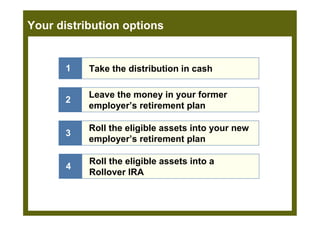
Leave the money in your former
employer’s retirement plan
2
Roll the eligible assets into your new
employer’s retirement plan
3
Take the distribution in cash1
Your distribution options
Roll the eligible assets into a
Rollover IRA
4
Pretax contributions and any earnings in a tax-deferred retirement plan are taxable as ordinary income in the year they are
distributed and may also be subject to a 10% early distribution penalty if taken before age 59½.
TAKE THE DISTRIBUTION IN CASH
Distribution option 1
A – 10% B – 25% C – 35% D – 43%
of participants in 2004 cashed out when they
changed jobs, even though they had to pay a 10%
penalty on their personal income tax.1
If you took your distribution in cash, how much
could you potentially lose to taxes and penalties?
45%
1. “401(k) Plans are still coming up short,” Number 43, by Alicia H. Munnell and Annika Sunden, March 2006.
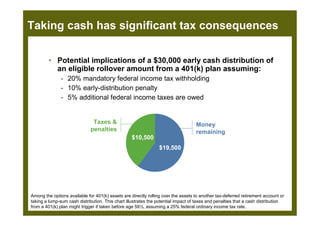
Among the options available for 401(k) assets are directly rolling over the assets to another tax-deferred retirement account or
taking a lump-sum cash distribution. This chart illustrates the potential impact of taxes and penalties that a cash distribution
from a 401(k) plan might trigger if taken before age 59½, assuming a 25% federal ordinary income tax rate.
Taking cash has significant tax consequences
Taxes &
penalties
Money
remaining
• Potential implications of a $30,000 early cash distribution of
an eligible rollover amount from a 401(k) plan assuming:
⁃ 20% mandatory federal income tax withholding
⁃ 10% early-distribution penalty
⁃ 5% additional federal income taxes are owed
$10,500
$19,500
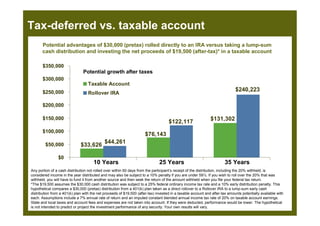
Tax-deferred vs. taxable account
Any portion of a cash distribution not rolled over within 60 days from the participant’s receipt of the distribution, including the 20% withheld, is
considered income in the year distributed and may also be subject to a 10% penalty if you are under 59½. If you wish to roll over the 20% that was
withheld, you will have to fund it from another source and then seek the return of the amount withheld when you file your federal tax return.
*The $19,500 assumes the $30,000 cash distribution was subject to a 25% federal ordinary income tax rate and a 10% early distribution penalty. This
hypothetical compares a $30,000 (pretax) distribution from a 401(k) plan taken as a direct rollover to a Rollover IRA to a lump-sum early cash
distribution from a 401(k) plan with the net proceeds of $19,500 (after-tax) invested in a taxable account and after-tax amounts potentially available with
each. Assumptions include a 7% annual rate of return and an imputed constant blended annual income tax rate of 20% on taxable account earnings.
State and local taxes and account fees and expenses are not taken into account. If they were deducted, performance would be lower. The hypothetical
is not intended to predict or project the investment performance of any security. Your own results will vary.
$131,302
$76,143
$33,626
$240,223
$122,117
$44,261
$0
$50,000
$100,000
$150,000
$200,000
$250,000
$300,000
$350,000
Taxable Account
Rollover IRA
Potential advantages of $30,000 (pretax) rolled directly to an IRA versus taking a lump-sum
cash distribution and investing the net proceeds of $19,500 (after-tax)* in a taxable account
10 Years 25 Years 35 Years
Potential growth after taxes
$104,000 total invested
Investor A
$40,000 total invested $343,414
Total account
value
Investor B
$293,935
Investor A Investor B
Hypothetical investment of
$4,000 per year from ages 30 to 39
Total amount invested = $40,000
Total investment value = $343,414
(pretax) after 36 years
Hypothetical investment of
$4,000 per year from ages 40 to 65
Total amount invested = $104,000
Total investment value = $293,935
(pretax) after 26 years
30 31 33 36 38 40 43 45 47 49 51 53 55 58 61 63 65 68
This hypothetical is not intended to predict or project investment performance. Your own results will vary. It assumes systematic $4,000 pretax, annual
investment to a SIMPLE IRA on 1/1 for the years indicated above and a 7% annual rate of return. No distributions are taken during the entire period. Taxes,
fees, and expenses are not taken into account. If account fees and expenses were deducted, performance would be lower. Pretax contributions and any
earnings will be taxed at the time of distribution and may also be subject to an early withdrawal penalty if distributed before age 59½. Systematic investing
does not ensure a profit and does not protect against loss in a declining market.
A Hypothetical Example
The cost of waiting
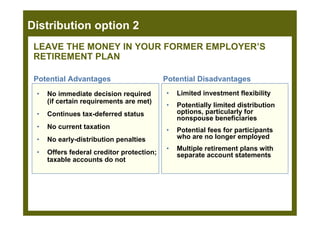
LEAVE THE MONEY IN YOUR FORMER EMPLOYER’S
RETIREMENT PLAN
Distribution option 2
Potential Advantages Potential Disadvantages
• No immediate decision required
(if certain requirements are met)
• Continues tax-deferred status
• No current taxation
• No early-distribution penalties
• Offers federal creditor protection;
taxable accounts do not
• Limited investment flexibility
• Potentially limited distribution
options, particularly for
nonspouse beneficiaries
• Potential fees for participants
who are no longer employed
• Multiple retirement plans with
separate account statements
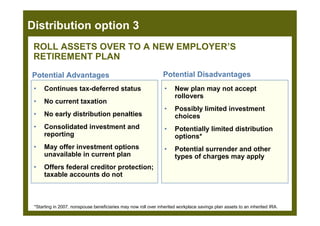
ROLL ASSETS OVER TO A NEW EMPLOYER’S
RETIREMENT PLAN
Distribution option 3
Potential Advantages Potential Disadvantages
• Continues tax-deferred status
• No current taxation
• No early distribution penalties
• Consolidated investment and
reporting
• May offer investment options
unavailable in current plan
• Offers federal creditor protection;
taxable accounts do not
• New plan may not accept
rollovers
• Possibly limited investment
choices
• Potentially limited distribution
options*
• Potential surrender and other
types of charges may apply
*Starting in 2007, nonspouse beneficiaries may now roll over inherited workplace savings plan assets to an inherited IRA.
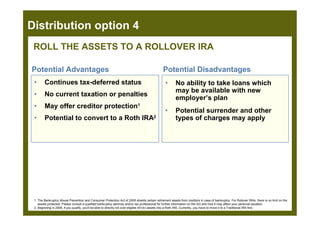
ROLL THE ASSETS TO A ROLLOVER IRA
Distribution option 4
Potential Advantages Potential Disadvantages
• Continues tax-deferred status
• No current taxation or penalties
• May offer creditor protection1
• Potential to convert to a Roth IRA2
• No ability to take loans which
may be available with new
employer’s plan
• Potential surrender and other
types of charges may apply
1. The Bankruptcy Abuse Prevention and Consumer Protection Act of 2005 shields certain retirement assets from creditors in case of bankruptcy. For Rollover IRAs, there is no limit on the
assets protected. Please consult a qualified bankruptcy attorney and/or tax professional for further information on the Act and how it may affect your personal situation.
2. Beginning in 2008, if you qualify, you'll be able to directly roll over eligible 401(k) assets into a Roth IRA. Currently, you have to move it to a Traditional IRA first.
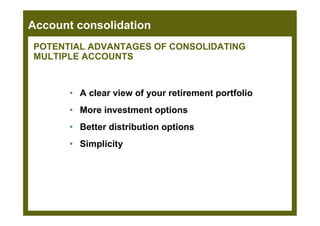
Account consolidation
• A clear view of your retirement portfolio
• More investment options
• Better distribution options
• Simplicity
POTENTIAL ADVANTAGES OF CONSOLIDATING
MULTIPLE ACCOUNTS
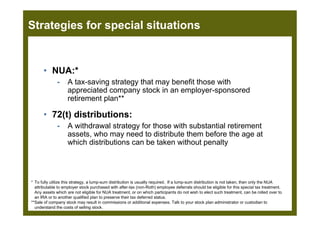
Strategies for special situations
• NUA:*
⁃ A tax-saving strategy that may benefit those with
appreciated company stock in an employer-sponsored
retirement plan**
• 72(t) distributions:
⁃ A withdrawal strategy for those with substantial retirement
assets, who may need to distribute them before the age at
which distributions can be taken without penalty
* To fully utilize this strategy, a lump-sum distribution is usually required. If a lump-sum distribution is not taken, then only the NUA
attributable to employer stock purchased with after-tax (non-Roth) employee deferrals should be eligible for this special tax treatment.
Any assets which are not eligible for NUA treatment, or on which participants do not wish to elect such treatment, can be rolled over to
an IRA or to another qualified plan to preserve their tax deferred status.
**Sale of company stock may result in commissions or additional expenses. Talk to your stock plan administrator or custodian to
understand the costs of selling stock.
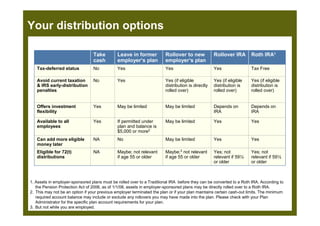
Your distribution options
1. Assets in employer-sponsored plans must be rolled over to a Traditional IRA before they can be converted to a Roth IRA. According to
the Pension Protection Act of 2006, as of 1/1/08, assets in employer-sponsored plans may be directly rolled over to a Roth IRA.
2. This may not be an option if your previous employer terminated the plan or if your plan maintains certain cash-out limits. The minimum
required account balance may include or exclude any rollovers you may have made into the plan. Please check with your Plan
Administrator for the specific plan account requirements for your plan.
3. But not while you are employed.
Yes; not
relevant if 59½
or older
Yes
Yes
Depends on
IRA
Yes (if eligible
distribution is
rolled over)
Yes
Rollover IRA
Yes; not
relevant if 59½
or older
Maybe;3 not relevant
if age 55 or older
Maybe; not relevant
if age 55 or older
NAEligible for 72(t)
distributions
Yes
Yes
Depends on
IRA
Yes (if eligible
distribution is
rolled over)
Tax Free
Roth IRA1
May be limitedMay be limitedYesOffers investment
flexibility
Yes (if eligible
distribution is directly
rolled over)
YesNoAvoid current taxation
& IRS early-distribution
penalties
May be limitedNoNACan add more eligible
money later
May be limitedIf permitted under
plan and balance is
$5,000 or more2
YesAvailable to all
employees
YesYesNoTax-deferred status
Rollover to new
employer’s plan
Leave in former
employer’s plan
Take
cash
TO HELP YOU BETTER PREPARE FOR RETIREMENT:
1. Reevaluate your goals
• Reassess your goals and current financial
situation
• Develop a plan for pursuing your retirement
goals
• Understand your distribution options
• Review your overall financial planning
strategy
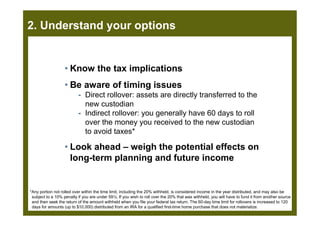
• Know the tax implications
• Be aware of timing issues
⁃ Direct rollover: assets are directly transferred to the
new custodian
⁃ Indirect rollover: you generally have 60 days to roll
over the money you received to the new custodian
to avoid taxes*
• Look ahead – weigh the potential effects on
long-term planning and future income
2. Understand your options
*Any portion not rolled over within the time limit, including the 20% withheld, is considered income in the year distributed, and may also be
subject to a 10% penalty if you are under 59½. If you wish to roll over the 20% that was withheld, you will have to fund it from another source
and then seek the return of the amount withheld when you file your federal tax return. The 60-day time limit for rollovers is increased to 120
days for amounts (up to $10,000) distributed from an IRA for a qualified first-time home purchase that does not materialize.
• Ensure your investment strategy is in tune
with your risk tolerance and time horizon
• Rebalance your investments – moving and
consolidating assets is an ideal time to
revisit your asset allocation
• Take advantage of new investment
products that may fit your needs
• Keep current regarding regulation changes
that may affect your savings strategy
3. Review your investments
4. Work with a retirement expert
Call us today to help you with your rollover
options and completing your rollover forms.
500
Before investing, consider the funds' investment objectives, risks, charges,
and expenses. Contact your investment professional for a prospectus or
visit advisor.fidelity.com for a Fidelity Advisor fund prospectus containing
this information. Read it carefully.
Not NCUA or NCUSIF insured. May lose value. No credit union guarantee.
The tax and estate planning information contained herein is general in nature, is provided for informational purposes only,
and should not be construed as legal or tax advice. Fidelity does not provide legal or tax advice. Fidelity cannot guarantee
that such information is accurate, complete, or timely. Laws of a particular state or laws which may be applicable to a
particular situation may have an impact on the applicability, accuracy, or completeness of such information. Federal and
state laws and regulations are complex and are subject to change. Changes in such laws and regulations may have a
material impact on pre- and/or after-tax investment results. Fidelity makes no warranties with regard to such information or
results obtained by its use. Fidelity disclaims any liability arising out of your use of, or any tax position taken in reliance on,
such information. Always consult an attorney or tax professional regarding your specific legal or tax situation.
Fidelity Investments & Pyramid Design, Fidelity Advisor Funds, and Fidelity Advisor Freedom Funds are registered service
marks of FMR Corp.
Fidelity Investments Institutional Services Company, Inc., 82 Devonshire Street, Boston, MA 02109
Your Advisor
and Fidelity
Insight
Diversification
Dedicated Support
Smart move.SM
Legal
437427.1 1.770755.107
1206

401(k) / IRA Rollover Options

  • 1.
    401(k) & IRA RolloverOptions STRATEGIES FOR JOB CHANGERS AND RETIREES. ► FOR INVESTORS Not FDIC Insured  May Lose Value  No Bank Guarantee Your Advisor and Fidelity Insight Diversification Dedicated Support Smart move.SM
  • 2.
    • Why peopletake their money out of retirement plans before retirement • Understanding your distribution options • Next steps you can take Agenda
  • 3.
    • The mediantenure with a current employer for employed wage and salary workers is 4.9 years.1 • The average person born in the later years of the baby boom held 10 jobs from ages 18 to 38.2 • The average age for retirement has dropped from 65 to 62.3 • An estimated 25 million Americans will retire between 1998–2008.4 YOU’RE NOT ALONE Changing jobs? Retiring early? Close to retirement? 1. EBRI Employee Tenure: Stable Overall, but Male & Female Trends Differ, March 2005, Vol. 26. No. 3. 2. Bureau of Labor Statistics, Employee tenure: September 21, 2004. The baby boom covers those individuals born between 1946 and 1964. 3. National Bureau of Economic Research, “The Economics of Aging,” June 22, 2003. 4. Employers underestimate Retirement Effect, AICPA July 20, 2006.
  • 4.
    Leave the moneyin your former employer’s retirement plan 2 Roll the eligible assets into your new employer’s retirement plan 3 Take the distribution in cash1 Your distribution options Roll the eligible assets into a Rollover IRA 4
  • 5.
    Pretax contributions andany earnings in a tax-deferred retirement plan are taxable as ordinary income in the year they are distributed and may also be subject to a 10% early distribution penalty if taken before age 59½. TAKE THE DISTRIBUTION IN CASH Distribution option 1 A – 10% B – 25% C – 35% D – 43% of participants in 2004 cashed out when they changed jobs, even though they had to pay a 10% penalty on their personal income tax.1 If you took your distribution in cash, how much could you potentially lose to taxes and penalties? 45% 1. “401(k) Plans are still coming up short,” Number 43, by Alicia H. Munnell and Annika Sunden, March 2006.
  • 6.
    Among the optionsavailable for 401(k) assets are directly rolling over the assets to another tax-deferred retirement account or taking a lump-sum cash distribution. This chart illustrates the potential impact of taxes and penalties that a cash distribution from a 401(k) plan might trigger if taken before age 59½, assuming a 25% federal ordinary income tax rate. Taking cash has significant tax consequences Taxes & penalties Money remaining • Potential implications of a $30,000 early cash distribution of an eligible rollover amount from a 401(k) plan assuming: ⁃ 20% mandatory federal income tax withholding ⁃ 10% early-distribution penalty ⁃ 5% additional federal income taxes are owed $10,500 $19,500
  • 7.
    Tax-deferred vs. taxableaccount Any portion of a cash distribution not rolled over within 60 days from the participant’s receipt of the distribution, including the 20% withheld, is considered income in the year distributed and may also be subject to a 10% penalty if you are under 59½. If you wish to roll over the 20% that was withheld, you will have to fund it from another source and then seek the return of the amount withheld when you file your federal tax return. *The $19,500 assumes the $30,000 cash distribution was subject to a 25% federal ordinary income tax rate and a 10% early distribution penalty. This hypothetical compares a $30,000 (pretax) distribution from a 401(k) plan taken as a direct rollover to a Rollover IRA to a lump-sum early cash distribution from a 401(k) plan with the net proceeds of $19,500 (after-tax) invested in a taxable account and after-tax amounts potentially available with each. Assumptions include a 7% annual rate of return and an imputed constant blended annual income tax rate of 20% on taxable account earnings. State and local taxes and account fees and expenses are not taken into account. If they were deducted, performance would be lower. The hypothetical is not intended to predict or project the investment performance of any security. Your own results will vary. $131,302 $76,143 $33,626 $240,223 $122,117 $44,261 $0 $50,000 $100,000 $150,000 $200,000 $250,000 $300,000 $350,000 Taxable Account Rollover IRA Potential advantages of $30,000 (pretax) rolled directly to an IRA versus taking a lump-sum cash distribution and investing the net proceeds of $19,500 (after-tax)* in a taxable account 10 Years 25 Years 35 Years Potential growth after taxes
  • 8.
    $104,000 total invested InvestorA $40,000 total invested $343,414 Total account value Investor B $293,935 Investor A Investor B Hypothetical investment of $4,000 per year from ages 30 to 39 Total amount invested = $40,000 Total investment value = $343,414 (pretax) after 36 years Hypothetical investment of $4,000 per year from ages 40 to 65 Total amount invested = $104,000 Total investment value = $293,935 (pretax) after 26 years 30 31 33 36 38 40 43 45 47 49 51 53 55 58 61 63 65 68 This hypothetical is not intended to predict or project investment performance. Your own results will vary. It assumes systematic $4,000 pretax, annual investment to a SIMPLE IRA on 1/1 for the years indicated above and a 7% annual rate of return. No distributions are taken during the entire period. Taxes, fees, and expenses are not taken into account. If account fees and expenses were deducted, performance would be lower. Pretax contributions and any earnings will be taxed at the time of distribution and may also be subject to an early withdrawal penalty if distributed before age 59½. Systematic investing does not ensure a profit and does not protect against loss in a declining market. A Hypothetical Example The cost of waiting
  • 9.
    LEAVE THE MONEYIN YOUR FORMER EMPLOYER’S RETIREMENT PLAN Distribution option 2 Potential Advantages Potential Disadvantages • No immediate decision required (if certain requirements are met) • Continues tax-deferred status • No current taxation • No early-distribution penalties • Offers federal creditor protection; taxable accounts do not • Limited investment flexibility • Potentially limited distribution options, particularly for nonspouse beneficiaries • Potential fees for participants who are no longer employed • Multiple retirement plans with separate account statements
  • 10.
    ROLL ASSETS OVERTO A NEW EMPLOYER’S RETIREMENT PLAN Distribution option 3 Potential Advantages Potential Disadvantages • Continues tax-deferred status • No current taxation • No early distribution penalties • Consolidated investment and reporting • May offer investment options unavailable in current plan • Offers federal creditor protection; taxable accounts do not • New plan may not accept rollovers • Possibly limited investment choices • Potentially limited distribution options* • Potential surrender and other types of charges may apply *Starting in 2007, nonspouse beneficiaries may now roll over inherited workplace savings plan assets to an inherited IRA.
  • 11.
    ROLL THE ASSETSTO A ROLLOVER IRA Distribution option 4 Potential Advantages Potential Disadvantages • Continues tax-deferred status • No current taxation or penalties • May offer creditor protection1 • Potential to convert to a Roth IRA2 • No ability to take loans which may be available with new employer’s plan • Potential surrender and other types of charges may apply 1. The Bankruptcy Abuse Prevention and Consumer Protection Act of 2005 shields certain retirement assets from creditors in case of bankruptcy. For Rollover IRAs, there is no limit on the assets protected. Please consult a qualified bankruptcy attorney and/or tax professional for further information on the Act and how it may affect your personal situation. 2. Beginning in 2008, if you qualify, you'll be able to directly roll over eligible 401(k) assets into a Roth IRA. Currently, you have to move it to a Traditional IRA first.
  • 12.
    Account consolidation • Aclear view of your retirement portfolio • More investment options • Better distribution options • Simplicity POTENTIAL ADVANTAGES OF CONSOLIDATING MULTIPLE ACCOUNTS
  • 13.
    Strategies for specialsituations • NUA:* ⁃ A tax-saving strategy that may benefit those with appreciated company stock in an employer-sponsored retirement plan** • 72(t) distributions: ⁃ A withdrawal strategy for those with substantial retirement assets, who may need to distribute them before the age at which distributions can be taken without penalty * To fully utilize this strategy, a lump-sum distribution is usually required. If a lump-sum distribution is not taken, then only the NUA attributable to employer stock purchased with after-tax (non-Roth) employee deferrals should be eligible for this special tax treatment. Any assets which are not eligible for NUA treatment, or on which participants do not wish to elect such treatment, can be rolled over to an IRA or to another qualified plan to preserve their tax deferred status. **Sale of company stock may result in commissions or additional expenses. Talk to your stock plan administrator or custodian to understand the costs of selling stock.
  • 14.
    Your distribution options 1.Assets in employer-sponsored plans must be rolled over to a Traditional IRA before they can be converted to a Roth IRA. According to the Pension Protection Act of 2006, as of 1/1/08, assets in employer-sponsored plans may be directly rolled over to a Roth IRA. 2. This may not be an option if your previous employer terminated the plan or if your plan maintains certain cash-out limits. The minimum required account balance may include or exclude any rollovers you may have made into the plan. Please check with your Plan Administrator for the specific plan account requirements for your plan. 3. But not while you are employed. Yes; not relevant if 59½ or older Yes Yes Depends on IRA Yes (if eligible distribution is rolled over) Yes Rollover IRA Yes; not relevant if 59½ or older Maybe;3 not relevant if age 55 or older Maybe; not relevant if age 55 or older NAEligible for 72(t) distributions Yes Yes Depends on IRA Yes (if eligible distribution is rolled over) Tax Free Roth IRA1 May be limitedMay be limitedYesOffers investment flexibility Yes (if eligible distribution is directly rolled over) YesNoAvoid current taxation & IRS early-distribution penalties May be limitedNoNACan add more eligible money later May be limitedIf permitted under plan and balance is $5,000 or more2 YesAvailable to all employees YesYesNoTax-deferred status Rollover to new employer’s plan Leave in former employer’s plan Take cash
  • 15.
    TO HELP YOUBETTER PREPARE FOR RETIREMENT: 1. Reevaluate your goals • Reassess your goals and current financial situation • Develop a plan for pursuing your retirement goals • Understand your distribution options • Review your overall financial planning strategy
  • 16.
    • Know thetax implications • Be aware of timing issues ⁃ Direct rollover: assets are directly transferred to the new custodian ⁃ Indirect rollover: you generally have 60 days to roll over the money you received to the new custodian to avoid taxes* • Look ahead – weigh the potential effects on long-term planning and future income 2. Understand your options *Any portion not rolled over within the time limit, including the 20% withheld, is considered income in the year distributed, and may also be subject to a 10% penalty if you are under 59½. If you wish to roll over the 20% that was withheld, you will have to fund it from another source and then seek the return of the amount withheld when you file your federal tax return. The 60-day time limit for rollovers is increased to 120 days for amounts (up to $10,000) distributed from an IRA for a qualified first-time home purchase that does not materialize.
  • 17.
    • Ensure yourinvestment strategy is in tune with your risk tolerance and time horizon • Rebalance your investments – moving and consolidating assets is an ideal time to revisit your asset allocation • Take advantage of new investment products that may fit your needs • Keep current regarding regulation changes that may affect your savings strategy 3. Review your investments
  • 18.
    4. Work witha retirement expert Call us today to help you with your rollover options and completing your rollover forms. 500
  • 19.
    Before investing, considerthe funds' investment objectives, risks, charges, and expenses. Contact your investment professional for a prospectus or visit advisor.fidelity.com for a Fidelity Advisor fund prospectus containing this information. Read it carefully. Not NCUA or NCUSIF insured. May lose value. No credit union guarantee. The tax and estate planning information contained herein is general in nature, is provided for informational purposes only, and should not be construed as legal or tax advice. Fidelity does not provide legal or tax advice. Fidelity cannot guarantee that such information is accurate, complete, or timely. Laws of a particular state or laws which may be applicable to a particular situation may have an impact on the applicability, accuracy, or completeness of such information. Federal and state laws and regulations are complex and are subject to change. Changes in such laws and regulations may have a material impact on pre- and/or after-tax investment results. Fidelity makes no warranties with regard to such information or results obtained by its use. Fidelity disclaims any liability arising out of your use of, or any tax position taken in reliance on, such information. Always consult an attorney or tax professional regarding your specific legal or tax situation. Fidelity Investments & Pyramid Design, Fidelity Advisor Funds, and Fidelity Advisor Freedom Funds are registered service marks of FMR Corp. Fidelity Investments Institutional Services Company, Inc., 82 Devonshire Street, Boston, MA 02109 Your Advisor and Fidelity Insight Diversification Dedicated Support Smart move.SM Legal 437427.1 1.770755.107 1206