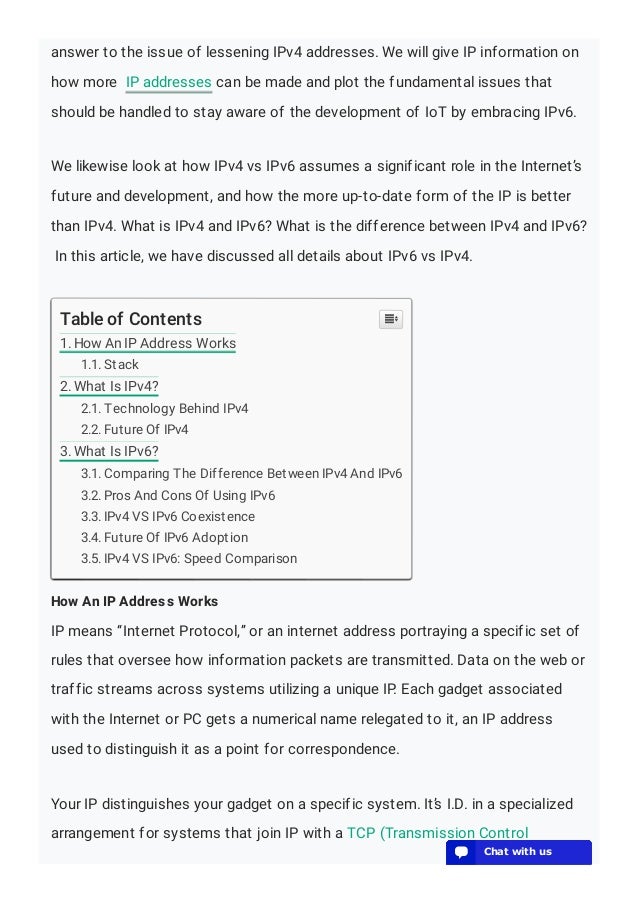
The Internet of Things (IoT) keeps on developing exponentially, and more
gadgets associate online day by day. There has been dread that, sooner or later,
IP locations would simply run out. This guess is beginning to work out as
expected. Don’t have any fear; the Internet isn’t reaching an end. There is an
Oleg Kaluger
Posted on April 8, 2022 11 min read
•
IPv4 vs IPv6 | Know the Difference
Between Two IP Versions
💬 Chat with us
💬 Chat with us
💬 Chat with us
💬 Chat with us
💬 Chat with us
💬 Chat with us
💬 Chat with us
💬 Chat with us
💬 Chat with us
💬 Chat with us
💬 Chat with us
💬 Chat with us
💬 Chat with us
💬 Chat with us
💬 Chat with us
💬 Chat with us
💬 Chat with us
💬 Chat with us
💬 Chat with us
💬 Chat with us
💬 Chat with us
answer to the issue of lessening IPv4 addresses. We will give IP information on
how more IP addresses can be made and plot the fundamental issues that
should be handled to stay aware of the development of IoT by embracing IPv6.
We likewise look at how IPv4 vs IPv6 assumes a significant role in the Internet’s
future and development, and how the more up-to-date form of the IP is better
than IPv4. What is IPv4 and IPv6? What is the difference between IPv4 and IPv6?
In this article, we have discussed all details about IPv6 vs IPv4.
How An IP Address Works
IP means “Internet Protocol,” or an internet address portraying a specific set of
rules that oversee how information packets are transmitted. Data on the web or
traffic streams across systems utilizing a unique IP. Each gadget associated
with the Internet or PC gets a numerical name relegated to it, an IP address
used to distinguish it as a point for correspondence.
Your IP distinguishes your gadget on a specific system. It’s I.D. in a specialized
arrangement for systems that join IP with a TCP (Transmission Control
Table of Contents
1. How An IP Address Works
1.1. Stack
2. What Is IPv4?
2.1. Technology Behind IPv4
2.2. Future Of IPv4
3. What Is IPv6?
3.1. Comparing The Difference Between IPv4 And IPv6
3.2. Pros And Cons Of Using IPv6
3.3. IPv4 VS IPv6 Coexistence
3.4. Future Of IPv6 Adoption
3.5. IPv4 VS IPv6: Speed Comparison

💬 Chat with us
💬 Chat with us
💬 Chat with us
💬 Chat with us
💬 Chat with us
💬 Chat with us
💬 Chat with us
💬 Chat with us
💬 Chat with us
💬 Chat with us
💬 Chat with us
💬 Chat with us
💬 Chat with us
💬 Chat with us
💬 Chat with us
💬 Chat with us
💬 Chat with us
💬 Chat with us
💬 Chat with us
💬 Chat with us
Protocol) and empowers virtual associations between a destination and
a source. Without a unique IP address, your gadget couldn’t endeavor
correspondence.
IP addresses organize how various machines communicate with one another.
They exchange information, which refers to exemplified bits of information that
significantly impact stacking website pages, messages, emailing, and different
applications, including information exchange.
Some of the components enable traffic to stream over the Internet. The
purpose of the beginning is information is bundled into an envelope when the
traffic begins. This procedure is stated as a “datagram.” It is a parcel of
information and part of the Internet Protocol or IP. A complete system stack is
required to move data over the Internet. The IP is only one piece of that stack.
The stack can be separated into four layers, with the Application part at the top
and the Datalink at the base.
Stack
Application – FTP, HTTP, SMTP, POP3
Transport – UDP, TCP
Networking – ICMP, IP
Datalink – ARP, Ethernet
As an Internet client, you’re most likely acquainted with the application layer. It’s
one that you collaborate with every day. Whenever you need to visit a site, you
💬 Chat with us
💬 Chat with us
💬 Chat with us
💬 Chat with us
💬 Chat with us
💬 Chat with us
💬 Chat with us
💬 Chat with us
💬 Chat with us
💬 Chat with us
💬 Chat with us
💬 Chat with us
💬 Chat with us
💬 Chat with us
💬 Chat with us
💬 Chat with us
💬 Chat with us
💬 Chat with us
💬 Chat with us
💬 Chat with us
type in https://[ temok.com], the Application.
Is it true that you are utilizing an email application? Eventually, at that point, you
would have set up an email account in that application and likely went over
POP3 or SMTP during the design procedure. POP3 represents Post Office
Protocol 3 and is a standard strategy for accepting an email. It gathers and
holds an email for you until got.
The above stack shows that the IP is a piece of the systems administration
layer. IPs returned to reality in 1982. IPv1 through IPv3 were trial renditions. IPv4
is the primary form of IP utilized the world freely over.
What Is IPv4?
💬 Chat with us
💬 Chat with us
💬 Chat with us
💬 Chat with us
💬 Chat with us
💬 Chat with us
💬 Chat with us
💬 Chat with us
💬 Chat with us
💬 Chat with us
💬 Chat with us
💬 Chat with us
💬 Chat with us
💬 Chat with us
💬 Chat with us
💬 Chat with us
💬 Chat with us
💬 Chat with us
💬 Chat with us
💬 Chat with us
IPv4, or Internet Protocol Version 4, is a widely utilized convention in
information correspondence in more than a few systems. It is the fourth
modification of the Internet convention. It was created as a connectionless
convention for utilizing bundle exchanged layer systems like Ethernet. Its
essential duty is to give intelligent associations to arrange gadgets, which
incorporates giving ID to each device.
What is IPv4 address? Internet Protocol version 4 (IPv4) is the fourth Internet
Protocol (IP) version. It is one of the core protocols of standards-based
internetworking methods on the Internet and other packet-switched networks.
IPv4 depends on the best-exertion model, which ensures neither conveyance nor
shirking of a copy conveyance and is procured by the upper layer transport
convention, for example, the Transmission Control Protocol (TCP). IPv4 is
adaptable and can naturally or physically be designed with a scope of various
gadgets relying upon the sort of system.
Technology Behind IPv4
IPv4 is determined and characterized in the Internet Engineering Task Force’s
(IETF) distribution RFC 791, utilized in the bundle exchanged connection layer in
OSI models. It uses an aggregate of five classes of 32-piece addresses for
Ethernet correspondence: A, B, C, D, and E. Classes A, B, and C have an alternate
piece length for managing the system has, while Class D is utilized for multi-
throwing. The rest of Class E is held for some time later.
Class A Subnet Mask– 255.0.0.0 or/8
Class B Subnet Mask– 255.255.0.0 or/16
💬 Chat with us
💬 Chat with us
💬 Chat with us
💬 Chat with us
💬 Chat with us
💬 Chat with us
💬 Chat with us
💬 Chat with us
💬 Chat with us
💬 Chat with us
💬 Chat with us
💬 Chat with us
💬 Chat with us
💬 Chat with us
💬 Chat with us
💬 Chat with us
💬 Chat with us
💬 Chat with us
💬 Chat with us
💬 Chat with us
Class C Subnet Mask– 255.255.255.0 or/24
For Example, The Network 192.168.0.0 with a/16 subnet cover can utilize
addresses from 192.168.0.0 to 192.168.255.255. It’s imperative to note that the
location 192.168.255.255 is held uniquely for broadcasting inside the clients.
Here, the IPv4 can dole out host delivers to a limit of 232 end clients. Moreover,
the IP addresses keep a standard decimal documentation group:
171.30.2.5
The number mentioned above arrangement is an exceptional 32-piece IP
location. This arrangement implies there can be up to 4.3 billion exceptional
locations. Every one of the four gatherings of numbers is 8 bits. Every 8 bits are
called an octet. Each number can run from 0 to 255. At 0, all bits are set to 0. At
255, all bits are set to 1. The binary type of the above IP address is
10101011.00011110.00000010.00000101.
💬 Chat with us
💬 Chat with us
💬 Chat with us
💬 Chat with us
💬 Chat with us
💬 Chat with us
💬 Chat with us
💬 Chat with us
💬 Chat with us
💬 Chat with us
💬 Chat with us
💬 Chat with us
💬 Chat with us
💬 Chat with us
💬 Chat with us
💬 Chat with us
💬 Chat with us
💬 Chat with us
💬 Chat with us
💬 Chat with us
Device types are far more than just desktops. There are smartphones,
hotspots, IoT, smart speakers, cameras, etc. The list keeps increasing as
technology progresses, and in turn, so does the number of devices. Thus the
need for unique and many IP addresses is increasing day by day.
Future Of IPv4
IPv4 addresses are now running out of use, making IPv6 sending the feasible
central arrangement left for the long-haul development of the Internet. In
October 2019, RIPE NCC, one of five Regional Internet Registries, which is
answerable for appointing IP delivered to Internet Service Providers (ISPs) in
more than 80 countries, reported a single million IPv4 addresses were left.
Because of these impediments, IPv6 has been presented as a standardized
arrangement offering a 128-piece address length that can characterize up to
2128 hubs.
💬 Chat with us
💬 Chat with us
💬 Chat with us
💬 Chat with us
💬 Chat with us
💬 Chat with us
💬 Chat with us
💬 Chat with us
💬 Chat with us
💬 Chat with us
💬 Chat with us
💬 Chat with us
💬 Chat with us
💬 Chat with us
💬 Chat with us
💬 Chat with us
💬 Chat with us
💬 Chat with us
💬 Chat with us
💬 Chat with us
Recovered IPs might be doled out using a holding up list. That implies just a few
hundred thousand IPs can be apportioned every year, which isn’t almost enough
to cover the few million that worldwide systems require today. The results are
that system instruments will be compelled to depend on costly and convoluted
answers to work around the issue of less accessible locations. The
commencement to zero implies endeavors worldwide need to check out IP
assets, discover between time arrangements, and plan for IPv6 sending to
defeat the unavoidable blackout.
In the meantime, one well-known answer for connecting over to IPv6
organizations is Carrier-Grade Network Address Translation (CGNAT). This
innovation takes into consideration the prolonged utilization of IPv4 addresses.
It does so by permitting a solitary IP address to be conveyed across a vast
number of gadgets. It plugs the gap, as CGNAT can’t scale inconclusively. Each
additional device makes another layer on NAT that expands its significant
burden and multifaceted nature and raises the odds of a CGNAT fizzling. When
this occurs, a great many clients are affected and can’t be immediately returned
on the web.
Another generally utilized workaround is IPv4 address exchanging. This is a
business opportunity for selling and purchasing IPv4 addresses that are never
again required or used. It’s an unsafe play since costs are directed by market
interest, and it can turn into a confounded and costly procedure to keep up with
the state of affairs.
💬 Chat with us
💬 Chat with us
💬 Chat with us
💬 Chat with us
💬 Chat with us
💬 Chat with us
💬 Chat with us
💬 Chat with us
💬 Chat with us
💬 Chat with us
💬 Chat with us
💬 Chat with us
💬 Chat with us
💬 Chat with us
💬 Chat with us
💬 Chat with us
💬 Chat with us
💬 Chat with us
💬 Chat with us
💬 Chat with us
Know that the Internet will not break ever. However, it is at a limit since systems
will just think it’s an increasingly complex proportional framework for
development. IPv4 depletion returns to 2012 when the Internet Assigned
Numbers Authority (IANA) apportioned the last IPv4 addresses to RIPE NCC.
Since quite a while ago, the specialized network has anticipated foreseen run-
out, where IPv6 comes in.
What Is IPv6?
What is the IPv6 address? Web Protocol Version 6 or IPv6 is the most current
adaptation of Internet Protocol utilized for conveying information in bundles
from one source to a goal through different systems. IPv6 is considered an
upgraded adaptation of the more seasoned IPv4 convention, as it bolsters an
altogether more significant number of hubs than the last mentioned.
💬 Chat with us
💬 Chat with us
💬 Chat with us
💬 Chat with us
💬 Chat with us
💬 Chat with us
💬 Chat with us
💬 Chat with us
💬 Chat with us
💬 Chat with us
💬 Chat with us
💬 Chat with us
💬 Chat with us
💬 Chat with us
💬 Chat with us
💬 Chat with us
💬 Chat with us
💬 Chat with us
💬 Chat with us
💬 Chat with us
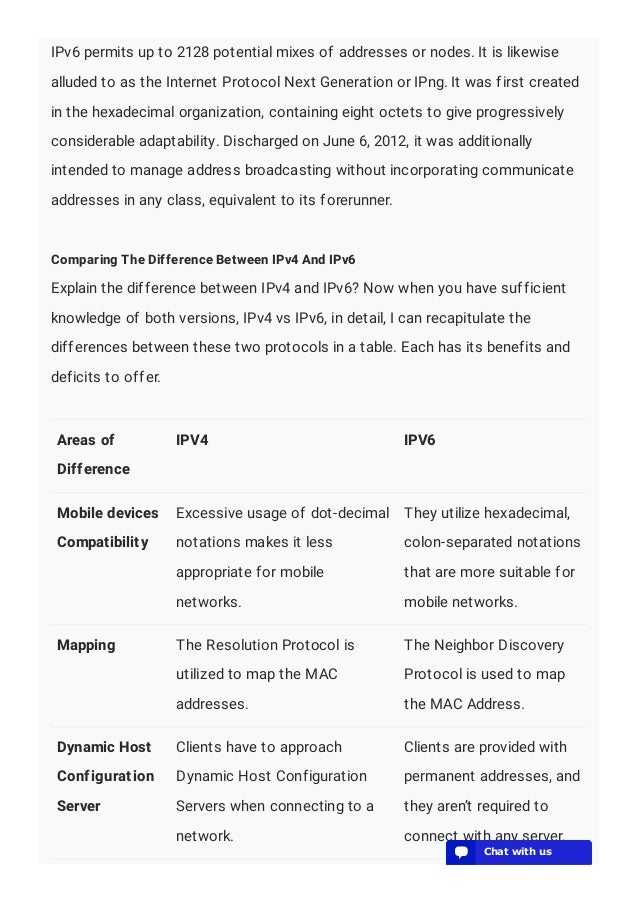
IPv6 permits up to 2128 potential mixes of addresses or nodes. It is likewise
alluded to as the Internet Protocol Next Generation or IPng. It was first created
in the hexadecimal organization, containing eight octets to give progressively
considerable adaptability. Discharged on June 6, 2012, it was additionally
intended to manage address broadcasting without incorporating communicate
addresses in any class, equivalent to its forerunner.
Comparing The Difference Between IPv4 And IPv6
Explain the difference between IPv4 and IPv6? Now when you have sufficient
knowledge of both versions, IPv4 vs IPv6, in detail, I can recapitulate the
differences between these two protocols in a table. Each has its benefits and
deficits to offer.
Areas of
Difference
IPV4 IPV6
Mobile devices
Compatibility
Excessive usage of dot-decimal
notations makes it less
appropriate for mobile
networks.
They utilize hexadecimal,
colon-separated notations
that are more suitable for
mobile networks.
Mapping The Resolution Protocol is
utilized to map the MAC
addresses.
The Neighbor Discovery
Protocol is used to map
the MAC Address.
Dynamic Host
Configuration
Server
Clients have to approach
Dynamic Host Configuration
Servers when connecting to a
network.
Clients are provided with
permanent addresses, and
they aren’t required to
connect with any server.
💬 Chat with us
💬 Chat with us
💬 Chat with us
💬 Chat with us
💬 Chat with us
💬 Chat with us
💬 Chat with us
💬 Chat with us
💬 Chat with us
💬 Chat with us
💬 Chat with us
💬 Chat with us
💬 Chat with us
💬 Chat with us
💬 Chat with us
💬 Chat with us
💬 Chat with us
💬 Chat with us
💬 Chat with us
💬 Chat with us
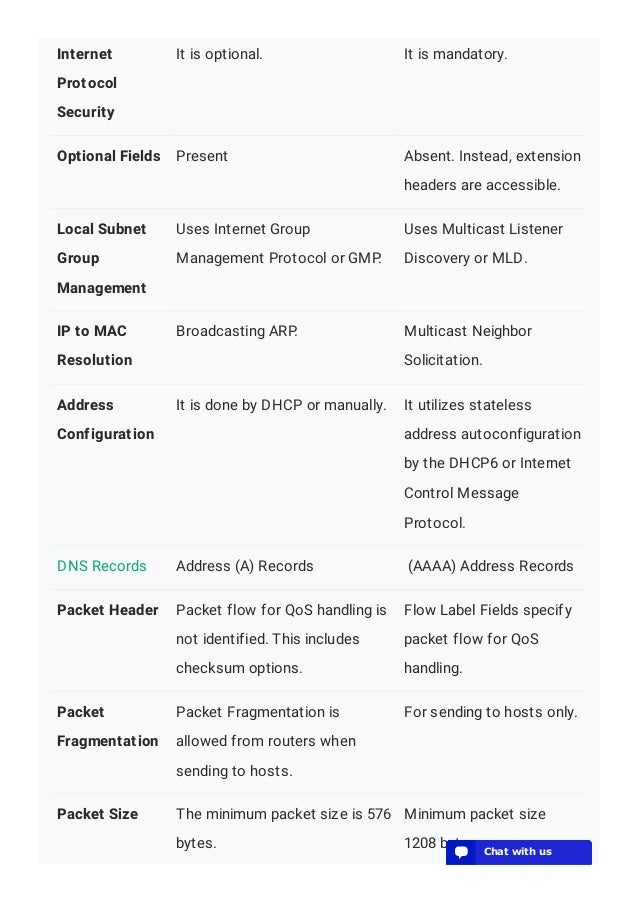
Internet
Protocol
Security
It is optional. It is mandatory.
Optional Fields Present Absent. Instead, extension
headers are accessible.
Local Subnet
Group
Management
Uses Internet Group
Management Protocol or GMP.
Uses Multicast Listener
Discovery or MLD.
IP to MAC
Resolution
Broadcasting ARP. Multicast Neighbor
Solicitation.
Address
Configuration
It is done by DHCP or manually. It utilizes stateless
address autoconfiguration
by the DHCP6 or Internet
Control Message
Protocol.
DNS Records Address (A) Records (AAAA) Address Records
Packet Header Packet flow for QoS handling is
not identified. This includes
checksum options.
Flow Label Fields specify
packet flow for QoS
handling.
Packet
Fragmentation
Packet Fragmentation is
allowed from routers when
sending to hosts.
For sending to hosts only.
Packet Size The minimum packet size is 576
bytes.
Minimum packet size
1208 bytes.
💬 Chat with us
💬 Chat with us
💬 Chat with us
💬 Chat with us
💬 Chat with us
💬 Chat with us
💬 Chat with us
💬 Chat with us
💬 Chat with us
💬 Chat with us
💬 Chat with us
💬 Chat with us
💬 Chat with us
💬 Chat with us
💬 Chat with us
💬 Chat with us
💬 Chat with us
💬 Chat with us
💬 Chat with us
💬 Chat with us
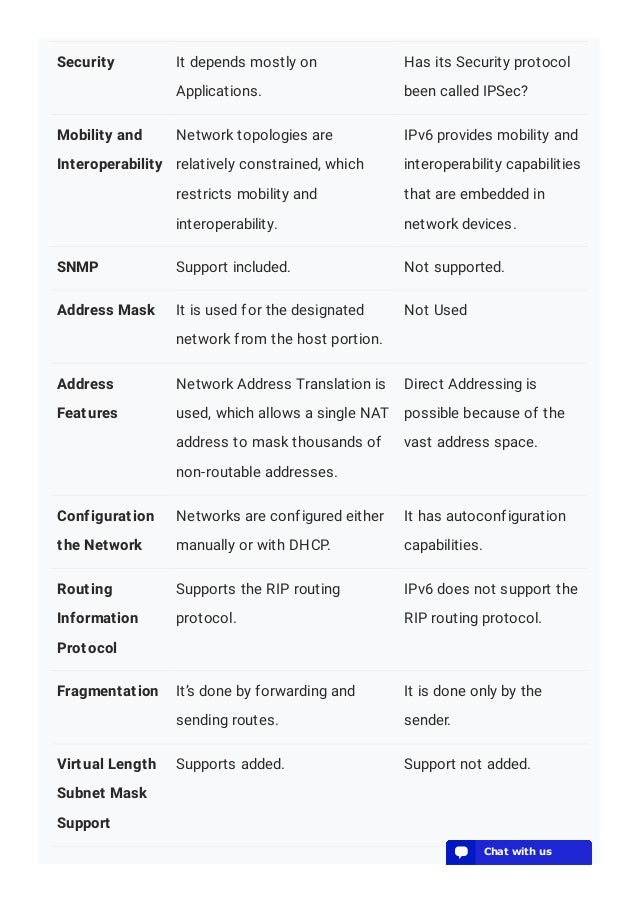
Security It depends mostly on
Applications.
Has its Security protocol
been called IPSec?
Mobility and
Interoperability
Network topologies are
relatively constrained, which
restricts mobility and
interoperability.
IPv6 provides mobility and
interoperability capabilities
that are embedded in
network devices.
SNMP Support included. Not supported.
Address Mask It is used for the designated
network from the host portion.
Not Used
Address
Features
Network Address Translation is
used, which allows a single NAT
address to mask thousands of
non-routable addresses.
Direct Addressing is
possible because of the
vast address space.
Configuration
the Network
Networks are configured either
manually or with DHCP.
It has autoconfiguration
capabilities.
Routing
Information
Protocol
Supports the RIP routing
protocol.
IPv6 does not support the
RIP routing protocol.
Fragmentation It’s done by forwarding and
sending routes.
It is done only by the
sender.
Virtual Length
Subnet Mask
Support
Supports added. Support not added.
💬 Chat with us
💬 Chat with us
💬 Chat with us
💬 Chat with us
💬 Chat with us
💬 Chat with us
💬 Chat with us
💬 Chat with us
💬 Chat with us
💬 Chat with us
💬 Chat with us
💬 Chat with us
💬 Chat with us
💬 Chat with us
💬 Chat with us
💬 Chat with us
💬 Chat with us
💬 Chat with us
💬 Chat with us
💬 Chat with us
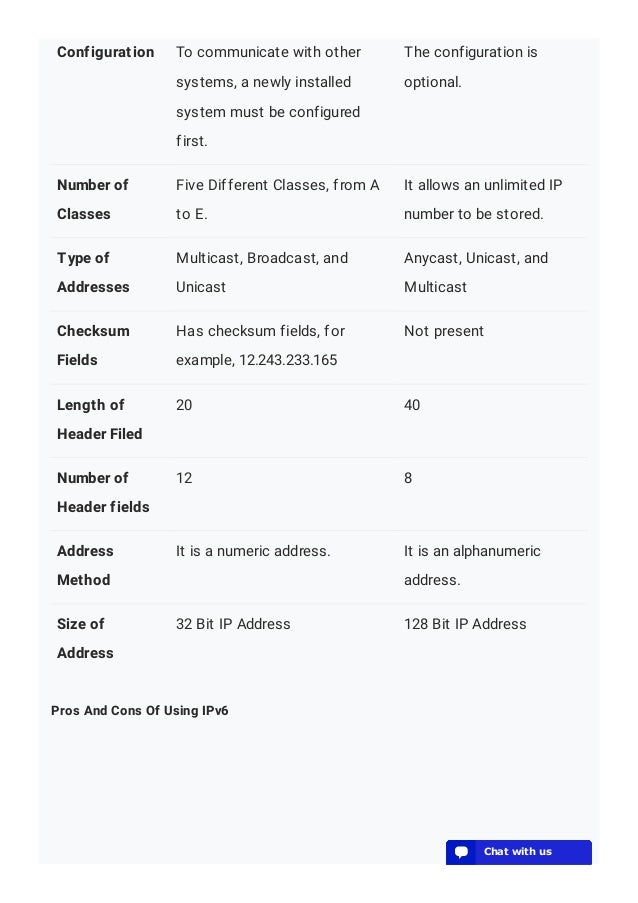
Configuration To communicate with other
systems, a newly installed
system must be configured
first.
The configuration is
optional.
Number of
Classes
Five Different Classes, from A
to E.
It allows an unlimited IP
number to be stored.
Type of
Addresses
Multicast, Broadcast, and
Unicast
Anycast, Unicast, and
Multicast
Checksum
Fields
Has checksum fields, for
example, 12.243.233.165
Not present
Length of
Header Filed
20 40
Number of
Header fields
12 8
Address
Method
It is a numeric address. It is an alphanumeric
address.
Size of
Address
32 Bit IP Address 128 Bit IP Address
Pros And Cons Of Using IPv6
💬 Chat with us
💬 Chat with us
💬 Chat with us
💬 Chat with us
💬 Chat with us
💬 Chat with us
💬 Chat with us
💬 Chat with us
💬 Chat with us
💬 Chat with us
💬 Chat with us
💬 Chat with us
💬 Chat with us
💬 Chat with us
💬 Chat with us
💬 Chat with us
💬 Chat with us
💬 Chat with us
💬 Chat with us
💬 Chat with us
What is IPv6 used for? IPv6 addresses have all the specialized weaknesses
present in IPv4. The thing that matters is that it offers a 128 piece or 16-byte
address, making the location pool around 340 trillion (undecillion).
It’s essentially more significant than the location size given by IPv4 since it
comprises eight gatherings of characters, which are 16 bits in length. The sheer
size underlines why systems should receive IPv6 shortly. However, making a
move so far has been an intense sell. System administrators discover working
with IPv4 is natural and are likely utilizing a ‘sit back and watch’ way to conclude
how to deal with their IP circumstances. They may think they have enough IPv4
addresses for the not-so-distant future. Be that as it may, staying with IPv4 will
get dynamically harder to do as such.
💬 Chat with us
💬 Chat with us
💬 Chat with us
💬 Chat with us
💬 Chat with us
💬 Chat with us
💬 Chat with us
💬 Chat with us
💬 Chat with us
💬 Chat with us
💬 Chat with us
💬 Chat with us
💬 Chat with us
💬 Chat with us
💬 Chat with us
💬 Chat with us
💬 Chat with us
💬 Chat with us
💬 Chat with us
💬 Chat with us
A case of the benefit of IPv6 vs IPv4 isn’t sharing an IP and getting a committed
location for your gadgets. Utilizing IPv4 implies a gathering of PCs that need to
share a solitary open IP should use a NAT. To get to one of these PCs
legitimately, you should set up complex arrangements, for example, port sending
and firewall modifications. In contrast with IPv4 vs IPv6 address, which has a lot
of lessons to go around, IPv6 PCs can be gotten to openly without extra setups,
sparing assets.
IPv4 VS IPv6 Coexistence
IPv4 vs IPv6 subnets comprise and will keep existing together even as the
general Internet moves from IPv4 to IPv6. There are various mechanisms set up
that encourage this. These incorporate Stateless IP/ICMP Translation (SIIT),
6rd, NAT, burrowing, and intermediary server support. Many of the strategies
can be conveyed in firewalls and switches somewhere in the range of IPv4 vs
IPv6 subnets.
SIIT utilizes::/96 location and maps the 32-piece IPv4 to IPv6 address. This
permits direct access to IPv4 has by IPv6 hubs. The 6th (IPv6 rapid
organization) utilizes IPv6 to connect IPv4 subnets. It burrows the IPv4 bundle
over IPv6. It is here, and ISPs gave their assistance. Intermediary servers with
double stacks can work in either course giving IPv4 access to an IPv6 server and
the other way around. Proxy servers will, in general, be a stopgap measure since
every proxy must be explicitly arranged.
💬 Chat with us
💬 Chat with us
💬 Chat with us
💬 Chat with us
💬 Chat with us
💬 Chat with us
💬 Chat with us
💬 Chat with us
💬 Chat with us
💬 Chat with us
💬 Chat with us
💬 Chat with us
💬 Chat with us
💬 Chat with us
💬 Chat with us
💬 Chat with us
💬 Chat with us
💬 Chat with us
💬 Chat with us
💬 Chat with us
This portrays that the entryway can interface with an IPv6 version. Many of the
most recent business and buyer gadgets can do this. However, many old
devices are IPv4, as it were. An extra entryway is required, so the IPv4 to IPv6
interpretation happens outside a client’s premises.
Double stack has probably going to be essential too. A system can convey IPv4
and IPv6 traffic simultaneously. A dual-stack host can speak with either gadget
just as having its traffic steered to the outside world if proper. Double stack
switches can be entryways also.
Blended IPv4 vs IPv6 conditions are often delicate, and a significant number of
the strategies won’t function admirably together. Join this with IPv4 expansions,
for example, IPsec and different conventions, and there is the likelihood that
💬 Chat with us
💬 Chat with us
💬 Chat with us
💬 Chat with us
💬 Chat with us
💬 Chat with us
💬 Chat with us
💬 Chat with us
💬 Chat with us
💬 Chat with us
💬 Chat with us
💬 Chat with us
💬 Chat with us
💬 Chat with us
💬 Chat with us
💬 Chat with us
💬 Chat with us
💬 Chat with us
💬 Chat with us
💬 Chat with us
associations may be made; however, applications won’t work. The likely main
blends that will function admirably will be IPv4-to-IPv4 and IPv6-to-IPv6.
One issue that should sit tight for another article is IPv6 security. Given the
distinctions and highlights of IPv6, firewalls and security programming need to
address extra protection that IPv4 didn’t. For instance, prior burrowing
arrangements can bring the more open IPv6 into an IPv4 organization. It is
conceivable to forestall or relieve assaults like this yet if legitimate security
arrangements are utilized and if the equipment bolsters this.
All in all, what happened to IPv5? IPv5 is an assignment for a variation of the
Internet Stream Protocol (ST) that began in 1979, however, relinquished. A
considerable lot of the highlights of ST are found in Multiprotocol Label
Switching (MPLS) standard. IPv6 depended on IPng (IP people to come) work,
and IPv6 was first called IPng from 7.
Future Of IPv6 Adoption
The future appropriation of IPv6 generally relies upon the number of ISPs and
versatile transporters, alongside enormous undertakings, cloud suppliers, and
server farms ready to move, and how they will relocate their information. IPv4
and IPv6 can coincide with parallel systems. Along these lines, there are no
critical impetuses for elements. For example, ISPs energetically seek after IPv6
choices rather than IPv4, mainly since redesign costs a lot of time and cash.
💬 Chat with us
💬 Chat with us
💬 Chat with us
💬 Chat with us
💬 Chat with us
💬 Chat with us
💬 Chat with us
💬 Chat with us
💬 Chat with us
💬 Chat with us
💬 Chat with us
💬 Chat with us
💬 Chat with us
💬 Chat with us
💬 Chat with us
💬 Chat with us
💬 Chat with us
💬 Chat with us
💬 Chat with us
💬 Chat with us
Despite the sticker price, the computerized world gradually moves ceaselessly
from the more seasoned IPv4 model into the more productive IPv6. The long-
haul benefits illustrated in this article IPv6 give merit to the speculation.
Selection still has far to go; however, it considers new potential outcomes for
organizing setups on an enormous scale. It’s proficient and inventive; not to
overlook it diminishes reliance on the inexorably testing and costly IPv4
showcase. Not getting ready for the move is shallow and dangerous for
systems. Savvy organizations are grasping the proficiency, development, and
adaptability of IPv6 at this moment. Be prepared for exponential Internet
development and cutting edge out of this world on the web and improve your
business. IPv4 depletion will prod IPv6 appropriation forward, so what are you
sitting tight for? To discover how to embrace IPv6 for your business, call us
today.
💬 Chat with us
💬 Chat with us
💬 Chat with us
💬 Chat with us
💬 Chat with us
💬 Chat with us
💬 Chat with us
💬 Chat with us
💬 Chat with us
💬 Chat with us
💬 Chat with us
💬 Chat with us
💬 Chat with us
💬 Chat with us
💬 Chat with us
💬 Chat with us
💬 Chat with us
💬 Chat with us
💬 Chat with us
💬 Chat with us
IPv4 VS IPv6: Speed Comparison
Might you be thinking, is IPv6 faster than IPv4?
Well, the answer is no. After testing the response time of multiple
domains within different locations, we found out that IPv6 is a bit slower than
its predecessor, version 4. Although, this difference is the only fraction of a sec
that would not be noticeable by an ordinary user browsing through the web.
When we conducted the speed test, it was also revealed that the response time
of these IPs might have been affected by their locations.
Show Comments
Oleg Kaluger • April 8, 2022
 
Choose one of your required Web Hosting Plan at market competitive prices
Make your Website Live Today
0
💬 Chat with us
💬 Chat with us
💬 Chat with us
💬 Chat with us
💬 Chat with us
💬 Chat with us
💬 Chat with us
💬 Chat with us
💬 Chat with us
💬 Chat with us
💬 Chat with us
💬 Chat with us
💬 Chat with us
💬 Chat with us
💬 Chat with us
💬 Chat with us
💬 Chat with us
💬 Chat with us
💬 Chat with us
💬 Chat with us
Web Hosting Plans
Managed Cloud Services
Managed Dedicated Servers
Managed DigitalOcean Cloud
Managed Magento Cloud
Managed Amazon Cloud (AWS)
Managed PHP Cloud
Managed Laravel Cloud
Managed Drupal Cloud
Managed Joomla Cloud
Managed Prestashop Cloud
Managed WooCommerce Cloud
Managed Wordpress Cloud
Managed Hosting
Linux Shared Hosting
Windows Shared Hosting
Linux Reseller Hosting
Linux SEO Hosting
Domains
Linux Virtual Private Server (VPS)
Windows Virtual Private Server (VPS)
SEO RDP/VPS
Proxies
VPN
SSL
Company
💬 Chat with us
💬 Chat with us
💬 Chat with us
💬 Chat with us
💬 Chat with us
💬 Chat with us
💬 Chat with us
💬 Chat with us
💬 Chat with us
💬 Chat with us
💬 Chat with us
💬 Chat with us
💬 Chat with us
💬 Chat with us
💬 Chat with us
💬 Chat with us
💬 Chat with us
💬 Chat with us
💬 Chat with us
💬 Chat with us
About Us
Contact Us
Privacy Policy
Terms & Conditions
Service Level Agreement
DMCA
Acceptable Use Policy
Blog
Affiliates
Subscribe
Newsletter
Sign up for special offers:
© Copyright TEMOK 2022. All Rights Reserved.
💬 Chat with us
💬 Chat with us
💬 Chat with us
💬 Chat with us
💬 Chat with us
💬 Chat with us
💬 Chat with us
💬 Chat with us
💬 Chat with us
💬 Chat with us
💬 Chat with us
💬 Chat with us
💬 Chat with us
💬 Chat with us
💬 Chat with us
💬 Chat with us
💬 Chat with us
💬 Chat with us
💬 Chat with us
💬 Chat with us

IPv4 vs IPv6 Know the Difference Between Two IP Versions.pdf

  • 1.
    The Internet ofThings (IoT) keeps on developing exponentially, and more gadgets associate online day by day. There has been dread that, sooner or later, IP locations would simply run out. This guess is beginning to work out as expected. Don’t have any fear; the Internet isn’t reaching an end. There is an Oleg Kaluger Posted on April 8, 2022 11 min read • IPv4 vs IPv6 | Know the Difference Between Two IP Versions 💬 Chat with us 💬 Chat with us 💬 Chat with us 💬 Chat with us 💬 Chat with us 💬 Chat with us 💬 Chat with us 💬 Chat with us 💬 Chat with us 💬 Chat with us 💬 Chat with us 💬 Chat with us 💬 Chat with us 💬 Chat with us 💬 Chat with us 💬 Chat with us 💬 Chat with us 💬 Chat with us 💬 Chat with us 💬 Chat with us 💬 Chat with us
  • 2.
    answer to theissue of lessening IPv4 addresses. We will give IP information on how more IP addresses can be made and plot the fundamental issues that should be handled to stay aware of the development of IoT by embracing IPv6. We likewise look at how IPv4 vs IPv6 assumes a significant role in the Internet’s future and development, and how the more up-to-date form of the IP is better than IPv4. What is IPv4 and IPv6? What is the difference between IPv4 and IPv6? In this article, we have discussed all details about IPv6 vs IPv4. How An IP Address Works IP means “Internet Protocol,” or an internet address portraying a specific set of rules that oversee how information packets are transmitted. Data on the web or traffic streams across systems utilizing a unique IP. Each gadget associated with the Internet or PC gets a numerical name relegated to it, an IP address used to distinguish it as a point for correspondence. Your IP distinguishes your gadget on a specific system. It’s I.D. in a specialized arrangement for systems that join IP with a TCP (Transmission Control Table of Contents 1. How An IP Address Works 1.1. Stack 2. What Is IPv4? 2.1. Technology Behind IPv4 2.2. Future Of IPv4 3. What Is IPv6? 3.1. Comparing The Difference Between IPv4 And IPv6 3.2. Pros And Cons Of Using IPv6 3.3. IPv4 VS IPv6 Coexistence 3.4. Future Of IPv6 Adoption 3.5. IPv4 VS IPv6: Speed Comparison  💬 Chat with us 💬 Chat with us 💬 Chat with us 💬 Chat with us 💬 Chat with us 💬 Chat with us 💬 Chat with us 💬 Chat with us 💬 Chat with us 💬 Chat with us 💬 Chat with us 💬 Chat with us 💬 Chat with us 💬 Chat with us 💬 Chat with us 💬 Chat with us 💬 Chat with us 💬 Chat with us 💬 Chat with us 💬 Chat with us
  • 3.
    Protocol) and empowersvirtual associations between a destination and a source. Without a unique IP address, your gadget couldn’t endeavor correspondence. IP addresses organize how various machines communicate with one another. They exchange information, which refers to exemplified bits of information that significantly impact stacking website pages, messages, emailing, and different applications, including information exchange. Some of the components enable traffic to stream over the Internet. The purpose of the beginning is information is bundled into an envelope when the traffic begins. This procedure is stated as a “datagram.” It is a parcel of information and part of the Internet Protocol or IP. A complete system stack is required to move data over the Internet. The IP is only one piece of that stack. The stack can be separated into four layers, with the Application part at the top and the Datalink at the base. Stack Application – FTP, HTTP, SMTP, POP3 Transport – UDP, TCP Networking – ICMP, IP Datalink – ARP, Ethernet As an Internet client, you’re most likely acquainted with the application layer. It’s one that you collaborate with every day. Whenever you need to visit a site, you 💬 Chat with us 💬 Chat with us 💬 Chat with us 💬 Chat with us 💬 Chat with us 💬 Chat with us 💬 Chat with us 💬 Chat with us 💬 Chat with us 💬 Chat with us 💬 Chat with us 💬 Chat with us 💬 Chat with us 💬 Chat with us 💬 Chat with us 💬 Chat with us 💬 Chat with us 💬 Chat with us 💬 Chat with us 💬 Chat with us
  • 4.
    type in https://[temok.com], the Application. Is it true that you are utilizing an email application? Eventually, at that point, you would have set up an email account in that application and likely went over POP3 or SMTP during the design procedure. POP3 represents Post Office Protocol 3 and is a standard strategy for accepting an email. It gathers and holds an email for you until got. The above stack shows that the IP is a piece of the systems administration layer. IPs returned to reality in 1982. IPv1 through IPv3 were trial renditions. IPv4 is the primary form of IP utilized the world freely over. What Is IPv4? 💬 Chat with us 💬 Chat with us 💬 Chat with us 💬 Chat with us 💬 Chat with us 💬 Chat with us 💬 Chat with us 💬 Chat with us 💬 Chat with us 💬 Chat with us 💬 Chat with us 💬 Chat with us 💬 Chat with us 💬 Chat with us 💬 Chat with us 💬 Chat with us 💬 Chat with us 💬 Chat with us 💬 Chat with us 💬 Chat with us
  • 5.
    IPv4, or InternetProtocol Version 4, is a widely utilized convention in information correspondence in more than a few systems. It is the fourth modification of the Internet convention. It was created as a connectionless convention for utilizing bundle exchanged layer systems like Ethernet. Its essential duty is to give intelligent associations to arrange gadgets, which incorporates giving ID to each device. What is IPv4 address? Internet Protocol version 4 (IPv4) is the fourth Internet Protocol (IP) version. It is one of the core protocols of standards-based internetworking methods on the Internet and other packet-switched networks. IPv4 depends on the best-exertion model, which ensures neither conveyance nor shirking of a copy conveyance and is procured by the upper layer transport convention, for example, the Transmission Control Protocol (TCP). IPv4 is adaptable and can naturally or physically be designed with a scope of various gadgets relying upon the sort of system. Technology Behind IPv4 IPv4 is determined and characterized in the Internet Engineering Task Force’s (IETF) distribution RFC 791, utilized in the bundle exchanged connection layer in OSI models. It uses an aggregate of five classes of 32-piece addresses for Ethernet correspondence: A, B, C, D, and E. Classes A, B, and C have an alternate piece length for managing the system has, while Class D is utilized for multi- throwing. The rest of Class E is held for some time later. Class A Subnet Mask– 255.0.0.0 or/8 Class B Subnet Mask– 255.255.0.0 or/16 💬 Chat with us 💬 Chat with us 💬 Chat with us 💬 Chat with us 💬 Chat with us 💬 Chat with us 💬 Chat with us 💬 Chat with us 💬 Chat with us 💬 Chat with us 💬 Chat with us 💬 Chat with us 💬 Chat with us 💬 Chat with us 💬 Chat with us 💬 Chat with us 💬 Chat with us 💬 Chat with us 💬 Chat with us 💬 Chat with us
  • 6.
    Class C SubnetMask– 255.255.255.0 or/24 For Example, The Network 192.168.0.0 with a/16 subnet cover can utilize addresses from 192.168.0.0 to 192.168.255.255. It’s imperative to note that the location 192.168.255.255 is held uniquely for broadcasting inside the clients. Here, the IPv4 can dole out host delivers to a limit of 232 end clients. Moreover, the IP addresses keep a standard decimal documentation group: 171.30.2.5 The number mentioned above arrangement is an exceptional 32-piece IP location. This arrangement implies there can be up to 4.3 billion exceptional locations. Every one of the four gatherings of numbers is 8 bits. Every 8 bits are called an octet. Each number can run from 0 to 255. At 0, all bits are set to 0. At 255, all bits are set to 1. The binary type of the above IP address is 10101011.00011110.00000010.00000101. 💬 Chat with us 💬 Chat with us 💬 Chat with us 💬 Chat with us 💬 Chat with us 💬 Chat with us 💬 Chat with us 💬 Chat with us 💬 Chat with us 💬 Chat with us 💬 Chat with us 💬 Chat with us 💬 Chat with us 💬 Chat with us 💬 Chat with us 💬 Chat with us 💬 Chat with us 💬 Chat with us 💬 Chat with us 💬 Chat with us
  • 7.
    Device types arefar more than just desktops. There are smartphones, hotspots, IoT, smart speakers, cameras, etc. The list keeps increasing as technology progresses, and in turn, so does the number of devices. Thus the need for unique and many IP addresses is increasing day by day. Future Of IPv4 IPv4 addresses are now running out of use, making IPv6 sending the feasible central arrangement left for the long-haul development of the Internet. In October 2019, RIPE NCC, one of five Regional Internet Registries, which is answerable for appointing IP delivered to Internet Service Providers (ISPs) in more than 80 countries, reported a single million IPv4 addresses were left. Because of these impediments, IPv6 has been presented as a standardized arrangement offering a 128-piece address length that can characterize up to 2128 hubs. 💬 Chat with us 💬 Chat with us 💬 Chat with us 💬 Chat with us 💬 Chat with us 💬 Chat with us 💬 Chat with us 💬 Chat with us 💬 Chat with us 💬 Chat with us 💬 Chat with us 💬 Chat with us 💬 Chat with us 💬 Chat with us 💬 Chat with us 💬 Chat with us 💬 Chat with us 💬 Chat with us 💬 Chat with us 💬 Chat with us
  • 8.
    Recovered IPs mightbe doled out using a holding up list. That implies just a few hundred thousand IPs can be apportioned every year, which isn’t almost enough to cover the few million that worldwide systems require today. The results are that system instruments will be compelled to depend on costly and convoluted answers to work around the issue of less accessible locations. The commencement to zero implies endeavors worldwide need to check out IP assets, discover between time arrangements, and plan for IPv6 sending to defeat the unavoidable blackout. In the meantime, one well-known answer for connecting over to IPv6 organizations is Carrier-Grade Network Address Translation (CGNAT). This innovation takes into consideration the prolonged utilization of IPv4 addresses. It does so by permitting a solitary IP address to be conveyed across a vast number of gadgets. It plugs the gap, as CGNAT can’t scale inconclusively. Each additional device makes another layer on NAT that expands its significant burden and multifaceted nature and raises the odds of a CGNAT fizzling. When this occurs, a great many clients are affected and can’t be immediately returned on the web. Another generally utilized workaround is IPv4 address exchanging. This is a business opportunity for selling and purchasing IPv4 addresses that are never again required or used. It’s an unsafe play since costs are directed by market interest, and it can turn into a confounded and costly procedure to keep up with the state of affairs. 💬 Chat with us 💬 Chat with us 💬 Chat with us 💬 Chat with us 💬 Chat with us 💬 Chat with us 💬 Chat with us 💬 Chat with us 💬 Chat with us 💬 Chat with us 💬 Chat with us 💬 Chat with us 💬 Chat with us 💬 Chat with us 💬 Chat with us 💬 Chat with us 💬 Chat with us 💬 Chat with us 💬 Chat with us 💬 Chat with us
  • 9.
    Know that theInternet will not break ever. However, it is at a limit since systems will just think it’s an increasingly complex proportional framework for development. IPv4 depletion returns to 2012 when the Internet Assigned Numbers Authority (IANA) apportioned the last IPv4 addresses to RIPE NCC. Since quite a while ago, the specialized network has anticipated foreseen run- out, where IPv6 comes in. What Is IPv6? What is the IPv6 address? Web Protocol Version 6 or IPv6 is the most current adaptation of Internet Protocol utilized for conveying information in bundles from one source to a goal through different systems. IPv6 is considered an upgraded adaptation of the more seasoned IPv4 convention, as it bolsters an altogether more significant number of hubs than the last mentioned. 💬 Chat with us 💬 Chat with us 💬 Chat with us 💬 Chat with us 💬 Chat with us 💬 Chat with us 💬 Chat with us 💬 Chat with us 💬 Chat with us 💬 Chat with us 💬 Chat with us 💬 Chat with us 💬 Chat with us 💬 Chat with us 💬 Chat with us 💬 Chat with us 💬 Chat with us 💬 Chat with us 💬 Chat with us 💬 Chat with us
  • 10.
    IPv6 permits upto 2128 potential mixes of addresses or nodes. It is likewise alluded to as the Internet Protocol Next Generation or IPng. It was first created in the hexadecimal organization, containing eight octets to give progressively considerable adaptability. Discharged on June 6, 2012, it was additionally intended to manage address broadcasting without incorporating communicate addresses in any class, equivalent to its forerunner. Comparing The Difference Between IPv4 And IPv6 Explain the difference between IPv4 and IPv6? Now when you have sufficient knowledge of both versions, IPv4 vs IPv6, in detail, I can recapitulate the differences between these two protocols in a table. Each has its benefits and deficits to offer. Areas of Difference IPV4 IPV6 Mobile devices Compatibility Excessive usage of dot-decimal notations makes it less appropriate for mobile networks. They utilize hexadecimal, colon-separated notations that are more suitable for mobile networks. Mapping The Resolution Protocol is utilized to map the MAC addresses. The Neighbor Discovery Protocol is used to map the MAC Address. Dynamic Host Configuration Server Clients have to approach Dynamic Host Configuration Servers when connecting to a network. Clients are provided with permanent addresses, and they aren’t required to connect with any server. 💬 Chat with us 💬 Chat with us 💬 Chat with us 💬 Chat with us 💬 Chat with us 💬 Chat with us 💬 Chat with us 💬 Chat with us 💬 Chat with us 💬 Chat with us 💬 Chat with us 💬 Chat with us 💬 Chat with us 💬 Chat with us 💬 Chat with us 💬 Chat with us 💬 Chat with us 💬 Chat with us 💬 Chat with us 💬 Chat with us
  • 11.
    Internet Protocol Security It is optional.It is mandatory. Optional Fields Present Absent. Instead, extension headers are accessible. Local Subnet Group Management Uses Internet Group Management Protocol or GMP. Uses Multicast Listener Discovery or MLD. IP to MAC Resolution Broadcasting ARP. Multicast Neighbor Solicitation. Address Configuration It is done by DHCP or manually. It utilizes stateless address autoconfiguration by the DHCP6 or Internet Control Message Protocol. DNS Records Address (A) Records (AAAA) Address Records Packet Header Packet flow for QoS handling is not identified. This includes checksum options. Flow Label Fields specify packet flow for QoS handling. Packet Fragmentation Packet Fragmentation is allowed from routers when sending to hosts. For sending to hosts only. Packet Size The minimum packet size is 576 bytes. Minimum packet size 1208 bytes. 💬 Chat with us 💬 Chat with us 💬 Chat with us 💬 Chat with us 💬 Chat with us 💬 Chat with us 💬 Chat with us 💬 Chat with us 💬 Chat with us 💬 Chat with us 💬 Chat with us 💬 Chat with us 💬 Chat with us 💬 Chat with us 💬 Chat with us 💬 Chat with us 💬 Chat with us 💬 Chat with us 💬 Chat with us 💬 Chat with us
  • 12.
    Security It dependsmostly on Applications. Has its Security protocol been called IPSec? Mobility and Interoperability Network topologies are relatively constrained, which restricts mobility and interoperability. IPv6 provides mobility and interoperability capabilities that are embedded in network devices. SNMP Support included. Not supported. Address Mask It is used for the designated network from the host portion. Not Used Address Features Network Address Translation is used, which allows a single NAT address to mask thousands of non-routable addresses. Direct Addressing is possible because of the vast address space. Configuration the Network Networks are configured either manually or with DHCP. It has autoconfiguration capabilities. Routing Information Protocol Supports the RIP routing protocol. IPv6 does not support the RIP routing protocol. Fragmentation It’s done by forwarding and sending routes. It is done only by the sender. Virtual Length Subnet Mask Support Supports added. Support not added. 💬 Chat with us 💬 Chat with us 💬 Chat with us 💬 Chat with us 💬 Chat with us 💬 Chat with us 💬 Chat with us 💬 Chat with us 💬 Chat with us 💬 Chat with us 💬 Chat with us 💬 Chat with us 💬 Chat with us 💬 Chat with us 💬 Chat with us 💬 Chat with us 💬 Chat with us 💬 Chat with us 💬 Chat with us 💬 Chat with us
  • 13.
    Configuration To communicatewith other systems, a newly installed system must be configured first. The configuration is optional. Number of Classes Five Different Classes, from A to E. It allows an unlimited IP number to be stored. Type of Addresses Multicast, Broadcast, and Unicast Anycast, Unicast, and Multicast Checksum Fields Has checksum fields, for example, 12.243.233.165 Not present Length of Header Filed 20 40 Number of Header fields 12 8 Address Method It is a numeric address. It is an alphanumeric address. Size of Address 32 Bit IP Address 128 Bit IP Address Pros And Cons Of Using IPv6 💬 Chat with us 💬 Chat with us 💬 Chat with us 💬 Chat with us 💬 Chat with us 💬 Chat with us 💬 Chat with us 💬 Chat with us 💬 Chat with us 💬 Chat with us 💬 Chat with us 💬 Chat with us 💬 Chat with us 💬 Chat with us 💬 Chat with us 💬 Chat with us 💬 Chat with us 💬 Chat with us 💬 Chat with us 💬 Chat with us
  • 14.
    What is IPv6used for? IPv6 addresses have all the specialized weaknesses present in IPv4. The thing that matters is that it offers a 128 piece or 16-byte address, making the location pool around 340 trillion (undecillion). It’s essentially more significant than the location size given by IPv4 since it comprises eight gatherings of characters, which are 16 bits in length. The sheer size underlines why systems should receive IPv6 shortly. However, making a move so far has been an intense sell. System administrators discover working with IPv4 is natural and are likely utilizing a ‘sit back and watch’ way to conclude how to deal with their IP circumstances. They may think they have enough IPv4 addresses for the not-so-distant future. Be that as it may, staying with IPv4 will get dynamically harder to do as such. 💬 Chat with us 💬 Chat with us 💬 Chat with us 💬 Chat with us 💬 Chat with us 💬 Chat with us 💬 Chat with us 💬 Chat with us 💬 Chat with us 💬 Chat with us 💬 Chat with us 💬 Chat with us 💬 Chat with us 💬 Chat with us 💬 Chat with us 💬 Chat with us 💬 Chat with us 💬 Chat with us 💬 Chat with us 💬 Chat with us
  • 15.
    A case ofthe benefit of IPv6 vs IPv4 isn’t sharing an IP and getting a committed location for your gadgets. Utilizing IPv4 implies a gathering of PCs that need to share a solitary open IP should use a NAT. To get to one of these PCs legitimately, you should set up complex arrangements, for example, port sending and firewall modifications. In contrast with IPv4 vs IPv6 address, which has a lot of lessons to go around, IPv6 PCs can be gotten to openly without extra setups, sparing assets. IPv4 VS IPv6 Coexistence IPv4 vs IPv6 subnets comprise and will keep existing together even as the general Internet moves from IPv4 to IPv6. There are various mechanisms set up that encourage this. These incorporate Stateless IP/ICMP Translation (SIIT), 6rd, NAT, burrowing, and intermediary server support. Many of the strategies can be conveyed in firewalls and switches somewhere in the range of IPv4 vs IPv6 subnets. SIIT utilizes::/96 location and maps the 32-piece IPv4 to IPv6 address. This permits direct access to IPv4 has by IPv6 hubs. The 6th (IPv6 rapid organization) utilizes IPv6 to connect IPv4 subnets. It burrows the IPv4 bundle over IPv6. It is here, and ISPs gave their assistance. Intermediary servers with double stacks can work in either course giving IPv4 access to an IPv6 server and the other way around. Proxy servers will, in general, be a stopgap measure since every proxy must be explicitly arranged. 💬 Chat with us 💬 Chat with us 💬 Chat with us 💬 Chat with us 💬 Chat with us 💬 Chat with us 💬 Chat with us 💬 Chat with us 💬 Chat with us 💬 Chat with us 💬 Chat with us 💬 Chat with us 💬 Chat with us 💬 Chat with us 💬 Chat with us 💬 Chat with us 💬 Chat with us 💬 Chat with us 💬 Chat with us 💬 Chat with us
  • 16.
    This portrays thatthe entryway can interface with an IPv6 version. Many of the most recent business and buyer gadgets can do this. However, many old devices are IPv4, as it were. An extra entryway is required, so the IPv4 to IPv6 interpretation happens outside a client’s premises. Double stack has probably going to be essential too. A system can convey IPv4 and IPv6 traffic simultaneously. A dual-stack host can speak with either gadget just as having its traffic steered to the outside world if proper. Double stack switches can be entryways also. Blended IPv4 vs IPv6 conditions are often delicate, and a significant number of the strategies won’t function admirably together. Join this with IPv4 expansions, for example, IPsec and different conventions, and there is the likelihood that 💬 Chat with us 💬 Chat with us 💬 Chat with us 💬 Chat with us 💬 Chat with us 💬 Chat with us 💬 Chat with us 💬 Chat with us 💬 Chat with us 💬 Chat with us 💬 Chat with us 💬 Chat with us 💬 Chat with us 💬 Chat with us 💬 Chat with us 💬 Chat with us 💬 Chat with us 💬 Chat with us 💬 Chat with us 💬 Chat with us
  • 17.
    associations may bemade; however, applications won’t work. The likely main blends that will function admirably will be IPv4-to-IPv4 and IPv6-to-IPv6. One issue that should sit tight for another article is IPv6 security. Given the distinctions and highlights of IPv6, firewalls and security programming need to address extra protection that IPv4 didn’t. For instance, prior burrowing arrangements can bring the more open IPv6 into an IPv4 organization. It is conceivable to forestall or relieve assaults like this yet if legitimate security arrangements are utilized and if the equipment bolsters this. All in all, what happened to IPv5? IPv5 is an assignment for a variation of the Internet Stream Protocol (ST) that began in 1979, however, relinquished. A considerable lot of the highlights of ST are found in Multiprotocol Label Switching (MPLS) standard. IPv6 depended on IPng (IP people to come) work, and IPv6 was first called IPng from 7. Future Of IPv6 Adoption The future appropriation of IPv6 generally relies upon the number of ISPs and versatile transporters, alongside enormous undertakings, cloud suppliers, and server farms ready to move, and how they will relocate their information. IPv4 and IPv6 can coincide with parallel systems. Along these lines, there are no critical impetuses for elements. For example, ISPs energetically seek after IPv6 choices rather than IPv4, mainly since redesign costs a lot of time and cash. 💬 Chat with us 💬 Chat with us 💬 Chat with us 💬 Chat with us 💬 Chat with us 💬 Chat with us 💬 Chat with us 💬 Chat with us 💬 Chat with us 💬 Chat with us 💬 Chat with us 💬 Chat with us 💬 Chat with us 💬 Chat with us 💬 Chat with us 💬 Chat with us 💬 Chat with us 💬 Chat with us 💬 Chat with us 💬 Chat with us
  • 18.
    Despite the stickerprice, the computerized world gradually moves ceaselessly from the more seasoned IPv4 model into the more productive IPv6. The long- haul benefits illustrated in this article IPv6 give merit to the speculation. Selection still has far to go; however, it considers new potential outcomes for organizing setups on an enormous scale. It’s proficient and inventive; not to overlook it diminishes reliance on the inexorably testing and costly IPv4 showcase. Not getting ready for the move is shallow and dangerous for systems. Savvy organizations are grasping the proficiency, development, and adaptability of IPv6 at this moment. Be prepared for exponential Internet development and cutting edge out of this world on the web and improve your business. IPv4 depletion will prod IPv6 appropriation forward, so what are you sitting tight for? To discover how to embrace IPv6 for your business, call us today. 💬 Chat with us 💬 Chat with us 💬 Chat with us 💬 Chat with us 💬 Chat with us 💬 Chat with us 💬 Chat with us 💬 Chat with us 💬 Chat with us 💬 Chat with us 💬 Chat with us 💬 Chat with us 💬 Chat with us 💬 Chat with us 💬 Chat with us 💬 Chat with us 💬 Chat with us 💬 Chat with us 💬 Chat with us 💬 Chat with us
  • 19.
    IPv4 VS IPv6:Speed Comparison Might you be thinking, is IPv6 faster than IPv4? Well, the answer is no. After testing the response time of multiple domains within different locations, we found out that IPv6 is a bit slower than its predecessor, version 4. Although, this difference is the only fraction of a sec that would not be noticeable by an ordinary user browsing through the web. When we conducted the speed test, it was also revealed that the response time of these IPs might have been affected by their locations. Show Comments Oleg Kaluger • April 8, 2022   Choose one of your required Web Hosting Plan at market competitive prices Make your Website Live Today 0 💬 Chat with us 💬 Chat with us 💬 Chat with us 💬 Chat with us 💬 Chat with us 💬 Chat with us 💬 Chat with us 💬 Chat with us 💬 Chat with us 💬 Chat with us 💬 Chat with us 💬 Chat with us 💬 Chat with us 💬 Chat with us 💬 Chat with us 💬 Chat with us 💬 Chat with us 💬 Chat with us 💬 Chat with us 💬 Chat with us
  • 20.
    Web Hosting Plans ManagedCloud Services Managed Dedicated Servers Managed DigitalOcean Cloud Managed Magento Cloud Managed Amazon Cloud (AWS) Managed PHP Cloud Managed Laravel Cloud Managed Drupal Cloud Managed Joomla Cloud Managed Prestashop Cloud Managed WooCommerce Cloud Managed Wordpress Cloud Managed Hosting Linux Shared Hosting Windows Shared Hosting Linux Reseller Hosting Linux SEO Hosting Domains Linux Virtual Private Server (VPS) Windows Virtual Private Server (VPS) SEO RDP/VPS Proxies VPN SSL Company 💬 Chat with us 💬 Chat with us 💬 Chat with us 💬 Chat with us 💬 Chat with us 💬 Chat with us 💬 Chat with us 💬 Chat with us 💬 Chat with us 💬 Chat with us 💬 Chat with us 💬 Chat with us 💬 Chat with us 💬 Chat with us 💬 Chat with us 💬 Chat with us 💬 Chat with us 💬 Chat with us 💬 Chat with us 💬 Chat with us
  • 21.
    About Us Contact Us PrivacyPolicy Terms & Conditions Service Level Agreement DMCA Acceptable Use Policy Blog Affiliates Subscribe Newsletter Sign up for special offers: © Copyright TEMOK 2022. All Rights Reserved. 💬 Chat with us 💬 Chat with us 💬 Chat with us 💬 Chat with us 💬 Chat with us 💬 Chat with us 💬 Chat with us 💬 Chat with us 💬 Chat with us 💬 Chat with us 💬 Chat with us 💬 Chat with us 💬 Chat with us 💬 Chat with us 💬 Chat with us 💬 Chat with us 💬 Chat with us 💬 Chat with us 💬 Chat with us 💬 Chat with us