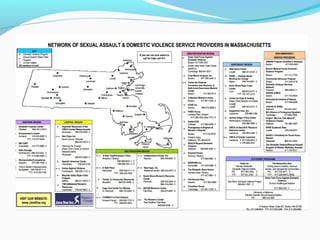
DOVE, Inc. is committed to serving communities,
families and individuals impacted by domestic violence.
We seek to empower our clients and the community by
providing safety, shelter, education and support services.
By promoting an environment free from abuse, we strive to see
DOmestic Violence Ended.
Shelter Program
Founded 34 years ago
18 beds
families, singles, children
men/women/transgender
 Victims are accepted regardless of gender or sexual orientation
Visiting Nurse and Counselor
Support Groups
24 hour Hotline
Individual Advocate Meetings
Community Advocacy
Serving clients in the community
Support groups
Individual advocacy & counseling
Legal Advocates
Court Outreach Program
Civilian DV Advocate
Sexual Assault counselor
Outreach
Teen Dating Violence Prevention
Educational Workshops
U.S. Preventive Services Task Force
 The USPSTF recommends that clinicians screen women of childbearing
age for intimate partner violence, such as domestic violence, and provide
or refer women who screen positive to intervention services. This
recommendation applies to women who do not have signs or symptoms of
abuse.
Affordable Care Act
 Screening and counseling for interpersonal and domestic violence will be
covered for all adolescent and adult women. An estimated 25% of women
in the United States report being targets of intimate partner violence
during their lifetimes. Screening is effective in the early detection and
effectiveness of interventions to increase the safety of abused women.
Patient Satisfaction increased when asked about
DV
Why are we here?
Impact on Health
In addition to injuries sustained during violent
episodes, physical and psychological abuse are linked
to a number of adverse physical health effects
including arthritis, chronic neck or back pain,
migraine and other frequent headaches, stammering,
problems seeing, sexually transmitted infections,
chronic pelvic pain, and stomach ulcers.
Coker, A., Smith, P., Bethea, L., King, M., McKeown, R. 2000. “Physical Health Consequences of Physical and
Psychological Intimate Partner Violence.” Archives of Family Medicine. 9
Definition of Domestic Violence
Domestic Violence also known as battering, is a pattern of behavior used
to establish power and control over a partner, friend or any other person
through fear and intimidation, often including the threat or use of
violence. While the violence may cause injury, it does not have to be
physical. Domestic Violence also takes the form of emotional verbal
sexual and economic abuse.
Domestic Violence affects people of all ethnic, racial and economic
backgrounds. It affects women, men, and transgendered people. It takes
place in same sex relationships as well as heterosexual relationships.
Battering happens when one person believes that they are entitled to
control another. Assault, battering, and domestic violence are crimes”.
 Definition taken from the National Coalition Against Domestic Violence and Jane Doe Inc.
Statistics
Girls and women between the ages of 16 and 24 experience
the highest rates of DV and sexual assault
Relationship violence is the number one cause of injury to
women ages 15-44: more than rapes, muggings, and car
accidents combined.
Every day at least 3 women are murdered by their husbands
or boyfriends in this country.
1 in 4 GLBT people are battered by a partner at some point
in their lives.
*Statistics from the US dept of justice, Center for disease control and
Prevention, Center for Community Solutions, American Psychological
Association, and the Bureau of Justice Statistics Special Report
Health Care Costs
The Centers for Disease Control and Prevention
estimates that the cost of intimate partner rape,
physical assault and stalking totaled $5.8 billion each
year for direct medical and mental health care
services and lost productivity from paid work and
household chores.
Costs of Intimate Partner Violence Against Women in the United States. Centers for Disease Control and
Prevention, National Center for Injury Prevention and Control. 2003. Available at
http://www.cdc.gov/violenceprevention/pdf/IPVBook-a.pdf.
Max, W, Rice, DP, Finkelstein, E, Bardwell, R, Leadbetter, S. 2004. The Economic Toll of Intimate Partner
Violence Against Women in the United States. Violence and Victims, 19(3) 259-272.
Health Care Costs
Of this total, nearly $4.1 billion are for direct medical
and mental health care services and productivity
losses account for nearly $1.8 billion in the United
States in 1995. When updated to 2003 dollars, the cost
is more than $8.3 billion.
Costs of Intimate Partner Violence Against Women in the United States. Centers for Disease Control and
Prevention, National Center for Injury Prevention and Control. 2003. Available at
http://www.cdc.gov/violenceprevention/pdf/IPVBook-a.pdf.
Max, W, Rice, DP, Finkelstein, E, Bardwell, R, Leadbetter, S. 2004. The Economic Toll of Intimate Partner
Violence Against Women in the United States. Violence and Victims, 19(3) 259-272.
In One Day
2011 National Census of Domestic Violence
Services
1,799 Victims of DV accessed an array of services in MA
 788 found shelter
 1,011 benefitted from individual counseling, legal advocacy and
support groups
 596 hotline calls
 25 calls every hour
 479 unmet needs due to shortage of funds and staff for housing,
mental health counseling and legal representation
(national Network to End Domestic Violence, 2011)
5 Types of Abuse
Physical
Financial
Emotional/Mental/Psychological
Verbal
Sexual
Physical Abuse
Slapping/ Punching
Kicking
Spitting
Pinching
Pushing/Shoving
Biting
Use of weapons
Throwing objects
Throwing person down stairs
Choking/ strangulation
Denial of physical needs; sleep, food, medical attention
Financial
Refusing partner access to money for food, clothing
and basic needs
Controlling all assets (car & house)
Putting all the bills in the partners name
Running up charges
Ruining credit
Verbal
Threats such as ‘You’ll be sorry’, ‘I’m going to let you
have it’
Threats to disclose information about partner that is
confidential (such as past abuse)
Yelling, screaming
Swearing, name calling
Sexual
Manipulation
Guilt tripping
Coercing
Forcing degrading sexual acts
Comments like whore or slut
Exposing self
Penetration
Jokes or insults
Unwanted touching or groping
Emotional/ Mental/ Psychological
Continued attacks on self esteem
Repeated harassing
Interrogating
Degradation
Threats to withhold money
Take children
Have an affair
Insults
Controlling
Forcing to stay awake
Blaming for all the goes wrong
Isolation
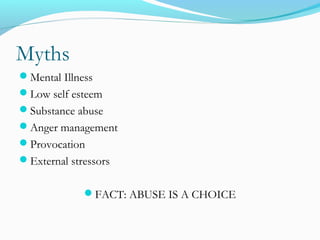
Myths
Mental Illness
Low self esteem
Substance abuse
Anger management
Provocation
External stressors
FACT: ABUSE IS A CHOICE
Screening for DV
Old screening question :
Do you feel safe at home?
New screening questions: open ended, behavioral
How are things at home?
Has your partner ever hit, kicked, shoved or
punched you?
Does your partner put you down?
Have you ever felt afraid of your partner?
How to Ask
Screen the patient for IPV alone
Use your own words, ask questions in a supportive
and non judgmental manner
Ask direct, simple and behaviorally specific questions
Ask about their ‘partners’ as opposed to ‘husband’ or
‘spouse’
Don’t use terms like ‘battered’ or ‘abused’
Show compassion and understanding for people’s
choices
Normalizing the Question
“Because abuse and violence are so common in
people's lives, I have begun to routinely ask about
abuse.”
“I do not know if this has ever been a problem for
you, but because so many women I see are dealing
with abusive relationships I've started asking about it
routinely.”
Normalizing the Question
“We now know that violence affects many families.
Violence in the home may result in physical and
emotional problems for you and your child. We are
offering services to anyone who may be concerned
about violence in their home.”
“Because there is help available for women who are
being abused, I now ask every woman about DV.”
Time Concerns
It takes 6-10 seconds to frame the issue and ask a
screening question
Approximately 85% of patients will screen
negative for IPV
 You have let the patient know that this is an important
health issue and your office is willing to help if needed
Taliaferro, E., Surprenant, Z. Medical Directions, 2006. Respond to Intimate Partner Violence; 10 Action Steps you can take to help your
patients and your practice.
Time Concerns
It takes 2-3 minutes to deal with most patients
who screen positively for IPV
About 14% will give a positive response
 Most will be in ‘stable IPV’ (non urgent)
Provide rapid assessment of immediate safety
Will take longer to help the > 1% that respond
positively and have urgent needs
Taliaferro, E., Surprenant, Z. Medical Directions, 2006. Respond to Intimate Partner Violence; 10 Action Steps you can take to help your patients and your
practice.
Follow up Questions
At minimum, ask some of the following:
Are you afraid your life may be in danger?
Do you feel safe at home with your partner?
Do you have somewhere safe to go?
Has there been an escalation in the violence?
Have weapons or threats been used?
Has your partner choked or strangled you?
Do you know what to do if the situation becomes
dangerous (call 911, have safety plan)
Responding to Disclosures
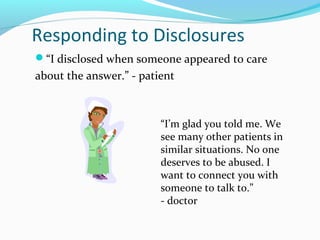
“I disclosed when someone appeared to care
about the answer.” - patient
“I’m glad you told me. We
see many other patients in
similar situations. No one
deserves to be abused. I
want to connect you with
someone to talk to.”
- doctor
Red Flags
An injury/event that is inconsistent with the client’s
history (I fell playing a sport)
A changing, inconsistent history or vague description
of the cause of an injury/event
Minimization of the injury/event
A delay in seeking care for significant medical
conditions
Red Flags
Missed or canceled appointments
Partner canceling
Unusual behavior between patient and partner
Suggestive trauma patterns
Multiple visits to ER, injuries in various states of
healing, defensive wounds
If a Patient does not Engage
Use indirect statements and questions when a patient
has denied IPV, but you feel it is a possibility
I am asking you this because I am concerned about
your safety
Are you having problems with your partner? Do your
arguments ever become physical? Are you ever afraid?
Have you ever gotten hurt?
You seem concerned about your partner. Can you tell
me more about that?
You mentioned your partner uses alcohol. How do they
act when they become intoxicated? Does their behavior
frighten you?
If a Patient does not Engage
Goal is NOT disclosure
Goal is to create a culture of SUPPORT
When should screening occur
During new patient exams
Annually
During episodic visits, if indicators are present
When patient enters new intimate relationship
If patient is pregnant, once a trimester and during
postpartum
Family planning visits, STI visits, abortion clinics,
fertility clinic visits
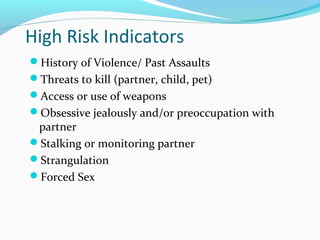
High Risk Indicators
History of Violence/ Past Assaults
Threats to kill (partner, child, pet)
Access or use of weapons
Obsessive jealously and/or preoccupation with
partner
Stalking or monitoring partner
Strangulation
Forced Sex
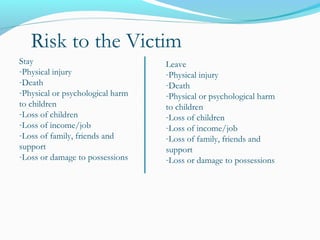
Risk to the Victim
Stay
-Physical injury
-Death
-Physical or psychological harm
to children
-Loss of children
-Loss of income/job
-Loss of family, friends and
support
-Loss or damage to possessions
Leave
-Physical injury
-Death
-Physical or psychological harm
to children
-Loss of children
-Loss of income/job
-Loss of family, friends and
support
-Loss or damage to possessions
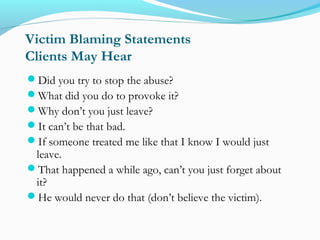
Victim Blaming Statements
Clients May Hear
Did you try to stop the abuse?
What did you do to provoke it?
Why don’t you just leave?
It can’t be that bad.
If someone treated me like that I know I would just
leave.
That happened a while ago, can’t you just forget about
it?
He would never do that (don’t believe the victim).
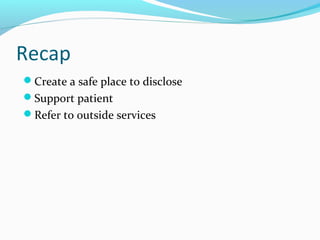
Recap
Create a safe place to disclose
Support patient
Refer to outside services
Awareness
Information
 Posters “ Let us know, we can help”
Restrooms
Exam room
Online
Health Ed Classes
Engaged and informed workforce
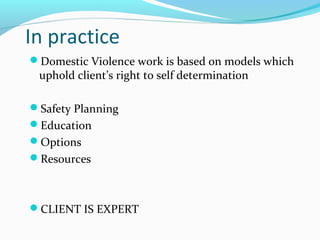
In practice
Domestic Violence work is based on models which
uphold client’s right to self determination
Safety Planning
Education
Options
Resources
CLIENT IS EXPERT
Contact Information
Crisis Hotline 617 471 1234
Community Office 617 770 4065
Safelink 1 877 785 2020
All services are free and confidential
www.dovema.org
www.janedoe.org

Hv medical

  • 1.
    DOVE, Inc. iscommitted to serving communities, families and individuals impacted by domestic violence. We seek to empower our clients and the community by providing safety, shelter, education and support services. By promoting an environment free from abuse, we strive to see DOmestic Violence Ended.
  • 2.
    Shelter Program Founded 34years ago 18 beds families, singles, children men/women/transgender  Victims are accepted regardless of gender or sexual orientation Visiting Nurse and Counselor Support Groups 24 hour Hotline Individual Advocate Meetings
  • 3.
    Community Advocacy Serving clientsin the community Support groups Individual advocacy & counseling Legal Advocates Court Outreach Program Civilian DV Advocate Sexual Assault counselor Outreach Teen Dating Violence Prevention Educational Workshops
  • 4.
    U.S. Preventive ServicesTask Force  The USPSTF recommends that clinicians screen women of childbearing age for intimate partner violence, such as domestic violence, and provide or refer women who screen positive to intervention services. This recommendation applies to women who do not have signs or symptoms of abuse. Affordable Care Act  Screening and counseling for interpersonal and domestic violence will be covered for all adolescent and adult women. An estimated 25% of women in the United States report being targets of intimate partner violence during their lifetimes. Screening is effective in the early detection and effectiveness of interventions to increase the safety of abused women. Patient Satisfaction increased when asked about DV Why are we here?
  • 5.
    Impact on Health Inaddition to injuries sustained during violent episodes, physical and psychological abuse are linked to a number of adverse physical health effects including arthritis, chronic neck or back pain, migraine and other frequent headaches, stammering, problems seeing, sexually transmitted infections, chronic pelvic pain, and stomach ulcers. Coker, A., Smith, P., Bethea, L., King, M., McKeown, R. 2000. “Physical Health Consequences of Physical and Psychological Intimate Partner Violence.” Archives of Family Medicine. 9
  • 6.
    Definition of DomesticViolence Domestic Violence also known as battering, is a pattern of behavior used to establish power and control over a partner, friend or any other person through fear and intimidation, often including the threat or use of violence. While the violence may cause injury, it does not have to be physical. Domestic Violence also takes the form of emotional verbal sexual and economic abuse. Domestic Violence affects people of all ethnic, racial and economic backgrounds. It affects women, men, and transgendered people. It takes place in same sex relationships as well as heterosexual relationships. Battering happens when one person believes that they are entitled to control another. Assault, battering, and domestic violence are crimes”.  Definition taken from the National Coalition Against Domestic Violence and Jane Doe Inc.
  • 7.
    Statistics Girls and womenbetween the ages of 16 and 24 experience the highest rates of DV and sexual assault Relationship violence is the number one cause of injury to women ages 15-44: more than rapes, muggings, and car accidents combined. Every day at least 3 women are murdered by their husbands or boyfriends in this country. 1 in 4 GLBT people are battered by a partner at some point in their lives. *Statistics from the US dept of justice, Center for disease control and Prevention, Center for Community Solutions, American Psychological Association, and the Bureau of Justice Statistics Special Report
  • 8.
    Health Care Costs TheCenters for Disease Control and Prevention estimates that the cost of intimate partner rape, physical assault and stalking totaled $5.8 billion each year for direct medical and mental health care services and lost productivity from paid work and household chores. Costs of Intimate Partner Violence Against Women in the United States. Centers for Disease Control and Prevention, National Center for Injury Prevention and Control. 2003. Available at http://www.cdc.gov/violenceprevention/pdf/IPVBook-a.pdf. Max, W, Rice, DP, Finkelstein, E, Bardwell, R, Leadbetter, S. 2004. The Economic Toll of Intimate Partner Violence Against Women in the United States. Violence and Victims, 19(3) 259-272.
  • 9.
    Health Care Costs Ofthis total, nearly $4.1 billion are for direct medical and mental health care services and productivity losses account for nearly $1.8 billion in the United States in 1995. When updated to 2003 dollars, the cost is more than $8.3 billion. Costs of Intimate Partner Violence Against Women in the United States. Centers for Disease Control and Prevention, National Center for Injury Prevention and Control. 2003. Available at http://www.cdc.gov/violenceprevention/pdf/IPVBook-a.pdf. Max, W, Rice, DP, Finkelstein, E, Bardwell, R, Leadbetter, S. 2004. The Economic Toll of Intimate Partner Violence Against Women in the United States. Violence and Victims, 19(3) 259-272.
  • 10.
    In One Day 2011National Census of Domestic Violence Services 1,799 Victims of DV accessed an array of services in MA  788 found shelter  1,011 benefitted from individual counseling, legal advocacy and support groups  596 hotline calls  25 calls every hour  479 unmet needs due to shortage of funds and staff for housing, mental health counseling and legal representation (national Network to End Domestic Violence, 2011)
  • 11.
    5 Types ofAbuse Physical Financial Emotional/Mental/Psychological Verbal Sexual
  • 12.
    Physical Abuse Slapping/ Punching Kicking Spitting Pinching Pushing/Shoving Biting Useof weapons Throwing objects Throwing person down stairs Choking/ strangulation Denial of physical needs; sleep, food, medical attention
  • 13.
    Financial Refusing partner accessto money for food, clothing and basic needs Controlling all assets (car & house) Putting all the bills in the partners name Running up charges Ruining credit
  • 14.
    Verbal Threats such as‘You’ll be sorry’, ‘I’m going to let you have it’ Threats to disclose information about partner that is confidential (such as past abuse) Yelling, screaming Swearing, name calling
  • 15.
    Sexual Manipulation Guilt tripping Coercing Forcing degradingsexual acts Comments like whore or slut Exposing self Penetration Jokes or insults Unwanted touching or groping
  • 16.
    Emotional/ Mental/ Psychological Continuedattacks on self esteem Repeated harassing Interrogating Degradation Threats to withhold money Take children Have an affair Insults Controlling Forcing to stay awake Blaming for all the goes wrong Isolation
  • 18.
    Myths Mental Illness Low selfesteem Substance abuse Anger management Provocation External stressors FACT: ABUSE IS A CHOICE
  • 19.
    Screening for DV Oldscreening question : Do you feel safe at home? New screening questions: open ended, behavioral How are things at home? Has your partner ever hit, kicked, shoved or punched you? Does your partner put you down? Have you ever felt afraid of your partner?
  • 20.
    How to Ask Screenthe patient for IPV alone Use your own words, ask questions in a supportive and non judgmental manner Ask direct, simple and behaviorally specific questions Ask about their ‘partners’ as opposed to ‘husband’ or ‘spouse’ Don’t use terms like ‘battered’ or ‘abused’ Show compassion and understanding for people’s choices
  • 21.
    Normalizing the Question “Becauseabuse and violence are so common in people's lives, I have begun to routinely ask about abuse.” “I do not know if this has ever been a problem for you, but because so many women I see are dealing with abusive relationships I've started asking about it routinely.”
  • 22.
    Normalizing the Question “Wenow know that violence affects many families. Violence in the home may result in physical and emotional problems for you and your child. We are offering services to anyone who may be concerned about violence in their home.” “Because there is help available for women who are being abused, I now ask every woman about DV.”
  • 23.
    Time Concerns It takes6-10 seconds to frame the issue and ask a screening question Approximately 85% of patients will screen negative for IPV  You have let the patient know that this is an important health issue and your office is willing to help if needed Taliaferro, E., Surprenant, Z. Medical Directions, 2006. Respond to Intimate Partner Violence; 10 Action Steps you can take to help your patients and your practice.
  • 24.
    Time Concerns It takes2-3 minutes to deal with most patients who screen positively for IPV About 14% will give a positive response  Most will be in ‘stable IPV’ (non urgent) Provide rapid assessment of immediate safety Will take longer to help the > 1% that respond positively and have urgent needs Taliaferro, E., Surprenant, Z. Medical Directions, 2006. Respond to Intimate Partner Violence; 10 Action Steps you can take to help your patients and your practice.
  • 25.
    Follow up Questions Atminimum, ask some of the following: Are you afraid your life may be in danger? Do you feel safe at home with your partner? Do you have somewhere safe to go? Has there been an escalation in the violence? Have weapons or threats been used? Has your partner choked or strangled you? Do you know what to do if the situation becomes dangerous (call 911, have safety plan)
  • 26.
    Responding to Disclosures “Idisclosed when someone appeared to care about the answer.” - patient “I’m glad you told me. We see many other patients in similar situations. No one deserves to be abused. I want to connect you with someone to talk to.” - doctor
  • 27.
    Red Flags An injury/eventthat is inconsistent with the client’s history (I fell playing a sport) A changing, inconsistent history or vague description of the cause of an injury/event Minimization of the injury/event A delay in seeking care for significant medical conditions
  • 28.
    Red Flags Missed orcanceled appointments Partner canceling Unusual behavior between patient and partner Suggestive trauma patterns Multiple visits to ER, injuries in various states of healing, defensive wounds
  • 29.
    If a Patientdoes not Engage Use indirect statements and questions when a patient has denied IPV, but you feel it is a possibility I am asking you this because I am concerned about your safety Are you having problems with your partner? Do your arguments ever become physical? Are you ever afraid? Have you ever gotten hurt? You seem concerned about your partner. Can you tell me more about that? You mentioned your partner uses alcohol. How do they act when they become intoxicated? Does their behavior frighten you?
  • 30.
    If a Patientdoes not Engage Goal is NOT disclosure Goal is to create a culture of SUPPORT
  • 31.
    When should screeningoccur During new patient exams Annually During episodic visits, if indicators are present When patient enters new intimate relationship If patient is pregnant, once a trimester and during postpartum Family planning visits, STI visits, abortion clinics, fertility clinic visits
  • 32.
    High Risk Indicators Historyof Violence/ Past Assaults Threats to kill (partner, child, pet) Access or use of weapons Obsessive jealously and/or preoccupation with partner Stalking or monitoring partner Strangulation Forced Sex
  • 33.
    Risk to theVictim Stay -Physical injury -Death -Physical or psychological harm to children -Loss of children -Loss of income/job -Loss of family, friends and support -Loss or damage to possessions Leave -Physical injury -Death -Physical or psychological harm to children -Loss of children -Loss of income/job -Loss of family, friends and support -Loss or damage to possessions
  • 34.
    Victim Blaming Statements ClientsMay Hear Did you try to stop the abuse? What did you do to provoke it? Why don’t you just leave? It can’t be that bad. If someone treated me like that I know I would just leave. That happened a while ago, can’t you just forget about it? He would never do that (don’t believe the victim).
  • 35.
    Recap Create a safeplace to disclose Support patient Refer to outside services
  • 36.
    Awareness Information  Posters “Let us know, we can help” Restrooms Exam room Online Health Ed Classes Engaged and informed workforce
  • 38.
    In practice Domestic Violencework is based on models which uphold client’s right to self determination Safety Planning Education Options Resources CLIENT IS EXPERT
  • 40.
    Contact Information Crisis Hotline617 471 1234 Community Office 617 770 4065 Safelink 1 877 785 2020 All services are free and confidential www.dovema.org www.janedoe.org

Editor's Notes

  • #34 There are many risks associated with leaving and staying in an abusive relationship. After reading the list of risks to a victim if he or she stays, what are some potential risks that someone might face if they leave an abusive partner?