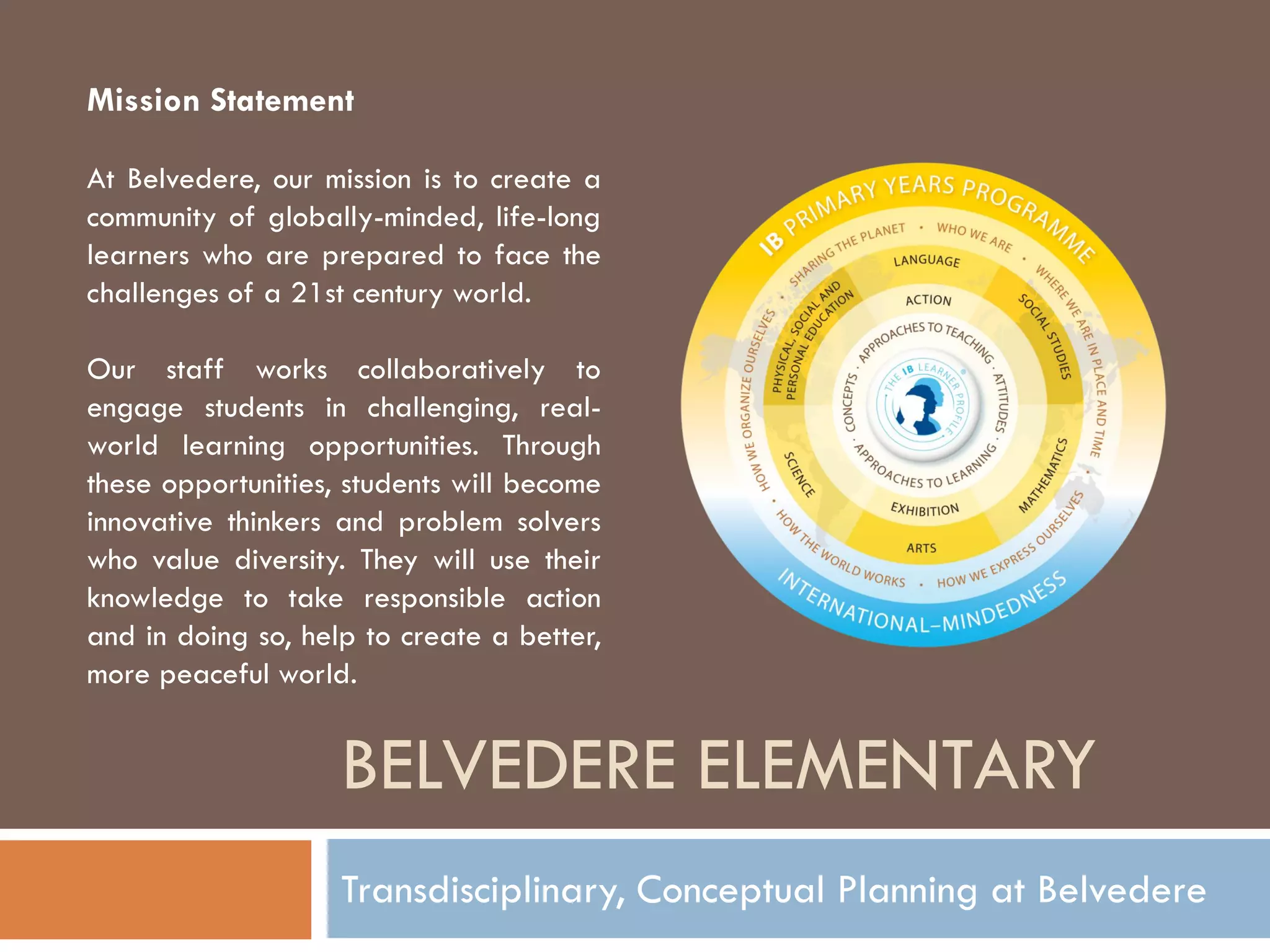
BELVEDERE ELEMENTARY
Transdisciplinary, Conceptual Planning at Belvedere
Mission Statement
At Belvedere, our mission is to create a
community of globally-minded, life-long
learners who are prepared to face the
challenges of a 21st century world.
Our staff works collaboratively to
engage students in challenging, real-
world learning opportunities. Through
these opportunities, students will become
innovative thinkers and problem solvers
who value diversity. They will use their
knowledge to take responsible action
and in doing so, help to create a better,
more peaceful world.
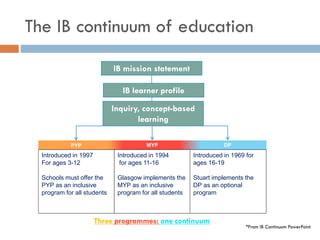
The IB continuum of education
IB mission statement
MYP DP
Introduced in 1997
For ages 3-12
Schools must offer the
PYP as an inclusive
program for all students
Introduced in 1994
for ages 11-16
Glasgow implements the
MYP as an inclusive
program for all students
Introduced in 1969 for
ages 16-19
Stuart implements the
DP as an optional
program
PYP MYP DP
Inquiry, concept-based
learning
IB learner profile
*From IB Continuum PowerPoint
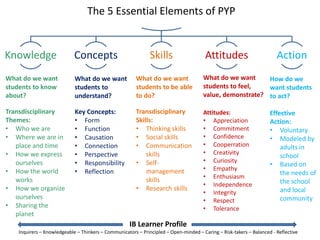
The 5 Essential Elements of PYP
Knowledge Concepts Skills Attitudes Action
What do we want
students to
understand?
Key Concepts:
• Form
• Function
• Causation
• Connection
• Perspective
• Responsibility
• Reflection
What do we want
students to know
about?
Transdisciplinary
Themes:
• Who we are
• Where we are in
place and time
• How we express
ourselves
• How the world
works
• How we organize
ourselves
• Sharing the
planet
What do we want
students to be able
to do?
Transdisciplinary
Skills:
• Thinking skills
• Social skills
• Communication
skills
• Self-
management
skills
• Research skills
What do we want
students to feel,
value, demonstrate?
Attitudes:
• Appreciation
• Commitment
• Confidence
• Cooperration
• Creativity
• Curiosity
• Empathy
• Enthusiasm
• Independence
• Integrity
• Respect
• Tolerance
How do we
want students
to act?
Effective
Action:
• Voluntary
• Modeled by
adults in
school
• Based on
the needs of
the school
and local
community
IB Learner Profile
Inquirers – Knowledgeable – Thinkers – Communicators – Principled – Open-minded – Caring – Risk-takers – Balanced - Reflective
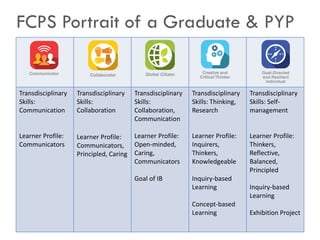
FCPS Portrait of a Graduate & PYP
Transdisciplinary
Skills:
Communication
Learner Profile:
Communicators
Transdisciplinary
Skills:
Collaboration
Learner Profile:
Communicators,
Principled, Caring
Transdisciplinary
Skills:
Collaboration,
Communication
Learner Profile:
Open-minded,
Caring,
Communicators
Goal of IB
Transdisciplinary
Skills: Thinking,
Research
Learner Profile:
Inquirers,
Thinkers,
Knowledgeable
Inquiry-based
Learning
Concept-based
Learning
Transdisciplinary
Skills: Self-
management
Learner Profile:
Thinkers,
Reflective,
Balanced,
Principled
Inquiry-based
Learning
Exhibition Project
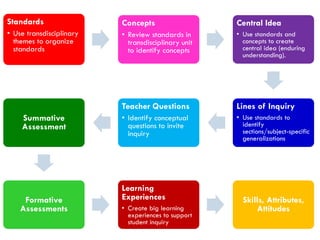
Standards
• Use transdisciplinary
themes to organize
standards
Concepts
• Review standards in
transdisciplinary unit
to identify concepts
Central Idea
• Use standards and
concepts to create
central idea (enduring
understanding).
Lines of Inquiry
• Use standards to
identify
sections/subject-specific
generalizations
Teacher Questions
• Identify conceptual
questions to invite
inquiry
Summative
Assessment
Formative
Assessments
Learning
Experiences
• Create big learning
experiences to support
student inquiry
Skills, Attributes,
Attitudes
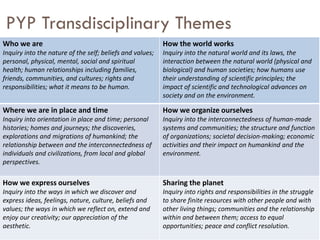
PYP Transdisciplinary Themes
Who we are
Inquiry into the nature of the self; beliefs and values;
personal, physical, mental, social and spiritual
health; human relationships including families,
friends, communities, and cultures; rights and
responsibilities; what it means to be human.
How the world works
Inquiry into the natural world and its laws, the
interaction between the natural world (physical and
biological) and human societies; how humans use
their understanding of scientific principles; the
impact of scientific and technological advances on
society and on the environment.
Where we are in place and time
Inquiry into orientation in place and time; personal
histories; homes and journeys; the discoveries,
explorations and migrations of humankind; the
relationship between and the interconnectedness of
individuals and civilizations, from local and global
perspectives.
How we organize ourselves
Inquiry into the interconnectedness of human-made
systems and communities; the structure and function
of organizations; societal decision-making; economic
activities and their impact on humankind and the
environment.
How we express ourselves
Inquiry into the ways in which we discover and
express ideas, feelings, nature, culture, beliefs and
values; the ways in which we reflect on, extend and
enjoy our creativity; our appreciation of the
aesthetic.
Sharing the planet
Inquiry into rights and responsibilities in the struggle
to share finite resources with other people and with
other living things; communities and the relationship
within and between them; access to equal
opportunities; peace and conflict resolution.
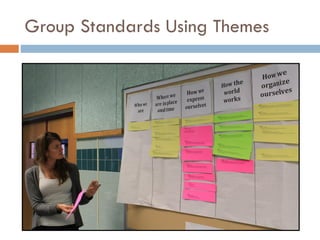
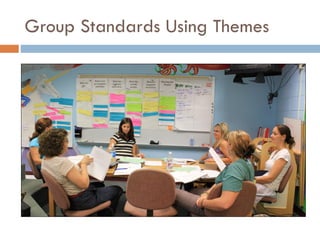
Group Standards Using Themes
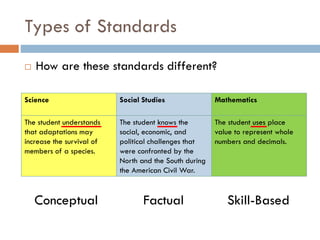
Types of Standards
Science Social Studies Mathematics
The student understands
that adaptations may
increase the survival of
members of a species.
The student knows the
social, economic, and
political challenges that
were confronted by the
North and the South during
the American Civil War.
The student uses place
value to represent whole
numbers and decimals.
 How are these standards different?
Conceptual Factual Skill-Based
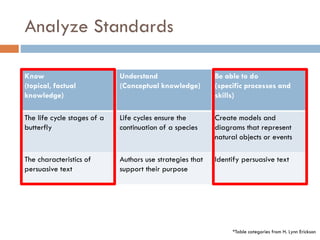
Analyze Standards
Know
(topical, factual
knowledge)
Understand
(Conceptual knowledge)
Be able to do
(specific processes and
skills)
The life cycle stages of a
butterfly
Life cycles ensure the
continuation of a species
Create models and
diagrams that represent
natural objects or events
The characteristics of
persuasive text
Authors use strategies that
support their purpose
Identify persuasive text
*Table categories from H. Lynn Erickson
Science Social Studies Mathematics
The student understands
that adaptations may
increase the survival of
members of a species.
The student knows the
social, economic, and
political challenges that
were confronted by the
North and the South during
the American Civil War.
The student uses place
value to represent whole
numbers and decimals.
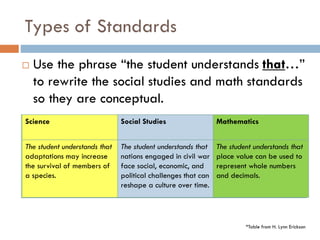
Types of Standards
Science Social Studies Mathematics
The student understands that
adaptations may increase
the survival of members of
a species.
The student understands that
nations engaged in civil war
face social, economic, and
political challenges that can
reshape a culture over time.
The student understands that
place value can be used to
represent whole numbers
and decimals.
 Use the phrase “the student understands that…”
to rewrite the social studies and math standards
so they are conceptual.
*Table from H. Lynn Erickson
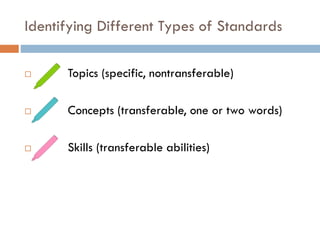
Identifying Different Types of Standards
 Topics (specific, nontransferable)
 Concepts (transferable, one or two words)
 Skills (transferable abilities)
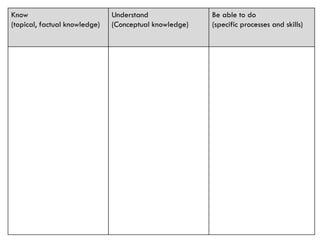
Know
(topical, factual knowledge)
Understand
(Conceptual knowledge)
Be able to do
(specific processes and skills)
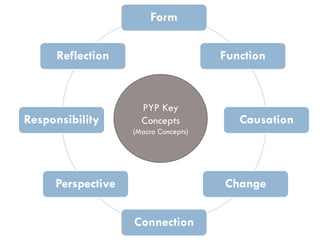
Form
Function
Causation
Change
Connection
Perspective
Responsibility
Reflection
PYP Key
Concepts
(Macro Concepts)
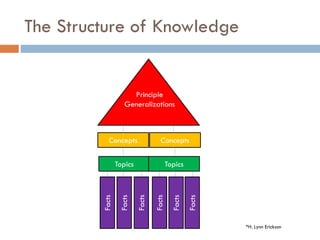
The Structure of Knowledge
Concepts Concepts
Facts
Facts
Facts
Facts
Facts
Facts
Topics Topics
Principle
Generalizations
*H. Lynn Erickson
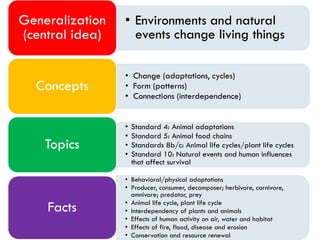
• Environments and natural
events change living things
Generalization
(central idea)
• Change (adaptations, cycles)
• Form (patterns)
• Connections (interdependence)
Concepts
• Standard 4: Animal adaptations
• Standard 5: Animal food chains
• Standards 8b/c: Animal life cycles/plant life cycles
• Standard 10: Natural events and human influences
that affect survival
Topics
• Behavioral/physical adaptations
• Producer, consumer, decomposer; herbivore, carnivore,
omnivore; predator, prey
• Animal life cycle, plant life cycle
• Interdependency of plants and animals
• Effects of human activity on air, water and habitat
• Effects of fire, flood, disease and erosion
• Conservation and resource renewal
Facts
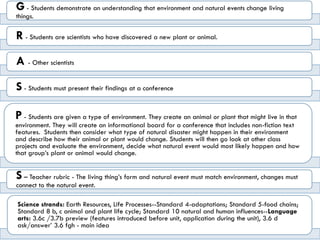
G - Students demonstrate an understanding that environment and natural events change living
things.
R - Students are scientists who have discovered a new plant or animal.
A - Other scientists
S - Students must present their findings at a conference
P - Students are given a type of environment. They create an animal or plant that might live in that
environment. They will create an informational board for a conference that includes non-fiction text
features. Students then consider what type of natural disaster might happen in their environment
and describe how their animal or plant would change. Students will then go look at other class
projects and evaluate the environment, decide what natural event would most likely happen and how
that group’s plant or animal would change.
S – Teacher rubric - The living thing’s form and natural event must match environment, changes must
connect to the natural event.
Science strands: Earth Resources, Life Processes--Standard 4-adaptations; Standard 5-food chains;
Standard 8 b, c animal and plant life cycle; Standard 10 natural and human influences--Language
arts: 3.6c /3.7b preview (features introduced before unit, application during the unit), 3.6 d
ask/answer’ 3.6 fgh - main idea
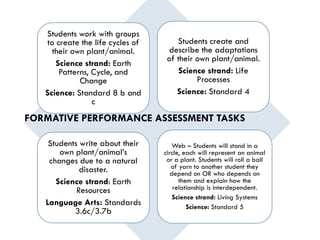
Students work with groups
to create the life cycles of
their own plant/animal.
Science strand: Earth
Patterns, Cycle, and
Change
Science: Standard 8 b and
c
Students create and
describe the adaptations
of their own plant/animal.
Science strand: Life
Processes
Science: Standard 4
Students write about their
own plant/animal’s
changes due to a natural
disaster.
Science strand: Earth
Resources
Language Arts: Standards
3.6c/3.7b
Web – Students will stand in a
circle, each will represent an animal
or a plant. Students will roll a ball
of yarn to another student they
depend on OR who depends on
them and explain how the
relationship is interdependent.
Science strand: Living Systems
Science: Standard 5
FORMATIVE PERFORMANCE ASSESSMENT TASKS
Meeting Standards & Teaching Conceptually
 How can we make this a three-dimensional
performance?
 Example:
 Research primary and secondary source documents
related to the causes of the American Revolution. Write
a three-page summary of the causes. Include
information on the significant historical figures, dates,
and events.
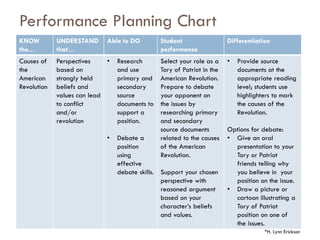
Performance Planning Chart
KNOW
the…
UNDERSTAND
that…
Able to DO Student
performance
Differentiation
Causes of
the
American
Revolution
Perspectives
based on
strongly held
beliefs and
values can lead
to conflict
and/or
revolution
• Research
and use
primary and
secondary
source
documents to
support a
position.
• Debate a
position
using
effective
debate skills.
Select your role as a
Tory of Patriot in the
American Revolution.
Prepare to debate
your opponent on
the issues by
researching primary
and secondary
source documents
related to the causes
of the American
Revolution.
Support your chosen
perspective with
reasoned argument
based on your
character’s beliefs
and values.
• Provide source
documents at the
appropriate reading
level; students use
highlighters to mark
the causes of the
Revolution.
Options for debate:
• Give an oral
presentation to your
Tory or Patriot
friends telling why
you believe in your
position on the issue.
• Draw a picture or
cartoon illustrating a
Tory of Patriot
position on one of
the issues.
*H. Lynn Erickson
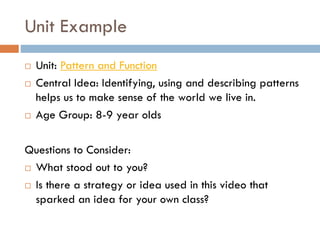
Unit Example
 Unit: Pattern and Function
 Central Idea: Identifying, using and describing patterns
helps us to make sense of the world we live in.
 Age Group: 8-9 year olds
Questions to Consider:
 What stood out to you?
 Is there a strategy or idea used in this video that
sparked an idea for your own class?

Identifying Concepts and Teaching Conceptually

  • 1.
    BELVEDERE ELEMENTARY Transdisciplinary, ConceptualPlanning at Belvedere Mission Statement At Belvedere, our mission is to create a community of globally-minded, life-long learners who are prepared to face the challenges of a 21st century world. Our staff works collaboratively to engage students in challenging, real- world learning opportunities. Through these opportunities, students will become innovative thinkers and problem solvers who value diversity. They will use their knowledge to take responsible action and in doing so, help to create a better, more peaceful world.
  • 2.
    The IB continuumof education IB mission statement MYP DP Introduced in 1997 For ages 3-12 Schools must offer the PYP as an inclusive program for all students Introduced in 1994 for ages 11-16 Glasgow implements the MYP as an inclusive program for all students Introduced in 1969 for ages 16-19 Stuart implements the DP as an optional program PYP MYP DP Inquiry, concept-based learning IB learner profile *From IB Continuum PowerPoint
  • 3.
    The 5 EssentialElements of PYP Knowledge Concepts Skills Attitudes Action What do we want students to understand? Key Concepts: • Form • Function • Causation • Connection • Perspective • Responsibility • Reflection What do we want students to know about? Transdisciplinary Themes: • Who we are • Where we are in place and time • How we express ourselves • How the world works • How we organize ourselves • Sharing the planet What do we want students to be able to do? Transdisciplinary Skills: • Thinking skills • Social skills • Communication skills • Self- management skills • Research skills What do we want students to feel, value, demonstrate? Attitudes: • Appreciation • Commitment • Confidence • Cooperration • Creativity • Curiosity • Empathy • Enthusiasm • Independence • Integrity • Respect • Tolerance How do we want students to act? Effective Action: • Voluntary • Modeled by adults in school • Based on the needs of the school and local community IB Learner Profile Inquirers – Knowledgeable – Thinkers – Communicators – Principled – Open-minded – Caring – Risk-takers – Balanced - Reflective
  • 4.
    FCPS Portrait ofa Graduate & PYP Transdisciplinary Skills: Communication Learner Profile: Communicators Transdisciplinary Skills: Collaboration Learner Profile: Communicators, Principled, Caring Transdisciplinary Skills: Collaboration, Communication Learner Profile: Open-minded, Caring, Communicators Goal of IB Transdisciplinary Skills: Thinking, Research Learner Profile: Inquirers, Thinkers, Knowledgeable Inquiry-based Learning Concept-based Learning Transdisciplinary Skills: Self- management Learner Profile: Thinkers, Reflective, Balanced, Principled Inquiry-based Learning Exhibition Project
  • 5.
    Standards • Use transdisciplinary themesto organize standards Concepts • Review standards in transdisciplinary unit to identify concepts Central Idea • Use standards and concepts to create central idea (enduring understanding). Lines of Inquiry • Use standards to identify sections/subject-specific generalizations Teacher Questions • Identify conceptual questions to invite inquiry Summative Assessment Formative Assessments Learning Experiences • Create big learning experiences to support student inquiry Skills, Attributes, Attitudes
  • 6.
    PYP Transdisciplinary Themes Whowe are Inquiry into the nature of the self; beliefs and values; personal, physical, mental, social and spiritual health; human relationships including families, friends, communities, and cultures; rights and responsibilities; what it means to be human. How the world works Inquiry into the natural world and its laws, the interaction between the natural world (physical and biological) and human societies; how humans use their understanding of scientific principles; the impact of scientific and technological advances on society and on the environment. Where we are in place and time Inquiry into orientation in place and time; personal histories; homes and journeys; the discoveries, explorations and migrations of humankind; the relationship between and the interconnectedness of individuals and civilizations, from local and global perspectives. How we organize ourselves Inquiry into the interconnectedness of human-made systems and communities; the structure and function of organizations; societal decision-making; economic activities and their impact on humankind and the environment. How we express ourselves Inquiry into the ways in which we discover and express ideas, feelings, nature, culture, beliefs and values; the ways in which we reflect on, extend and enjoy our creativity; our appreciation of the aesthetic. Sharing the planet Inquiry into rights and responsibilities in the struggle to share finite resources with other people and with other living things; communities and the relationship within and between them; access to equal opportunities; peace and conflict resolution.
  • 7.
  • 8.
  • 9.
    Types of Standards ScienceSocial Studies Mathematics The student understands that adaptations may increase the survival of members of a species. The student knows the social, economic, and political challenges that were confronted by the North and the South during the American Civil War. The student uses place value to represent whole numbers and decimals.  How are these standards different? Conceptual Factual Skill-Based
  • 10.
    Analyze Standards Know (topical, factual knowledge) Understand (Conceptualknowledge) Be able to do (specific processes and skills) The life cycle stages of a butterfly Life cycles ensure the continuation of a species Create models and diagrams that represent natural objects or events The characteristics of persuasive text Authors use strategies that support their purpose Identify persuasive text *Table categories from H. Lynn Erickson
  • 11.
    Science Social StudiesMathematics The student understands that adaptations may increase the survival of members of a species. The student knows the social, economic, and political challenges that were confronted by the North and the South during the American Civil War. The student uses place value to represent whole numbers and decimals. Types of Standards Science Social Studies Mathematics The student understands that adaptations may increase the survival of members of a species. The student understands that nations engaged in civil war face social, economic, and political challenges that can reshape a culture over time. The student understands that place value can be used to represent whole numbers and decimals.  Use the phrase “the student understands that…” to rewrite the social studies and math standards so they are conceptual. *Table from H. Lynn Erickson
  • 12.
    Identifying Different Typesof Standards  Topics (specific, nontransferable)  Concepts (transferable, one or two words)  Skills (transferable abilities)
  • 13.
    Know (topical, factual knowledge) Understand (Conceptualknowledge) Be able to do (specific processes and skills)
  • 14.
  • 15.
    The Structure ofKnowledge Concepts Concepts Facts Facts Facts Facts Facts Facts Topics Topics Principle Generalizations *H. Lynn Erickson
  • 16.
    • Environments andnatural events change living things Generalization (central idea) • Change (adaptations, cycles) • Form (patterns) • Connections (interdependence) Concepts • Standard 4: Animal adaptations • Standard 5: Animal food chains • Standards 8b/c: Animal life cycles/plant life cycles • Standard 10: Natural events and human influences that affect survival Topics • Behavioral/physical adaptations • Producer, consumer, decomposer; herbivore, carnivore, omnivore; predator, prey • Animal life cycle, plant life cycle • Interdependency of plants and animals • Effects of human activity on air, water and habitat • Effects of fire, flood, disease and erosion • Conservation and resource renewal Facts
  • 17.
    G - Studentsdemonstrate an understanding that environment and natural events change living things. R - Students are scientists who have discovered a new plant or animal. A - Other scientists S - Students must present their findings at a conference P - Students are given a type of environment. They create an animal or plant that might live in that environment. They will create an informational board for a conference that includes non-fiction text features. Students then consider what type of natural disaster might happen in their environment and describe how their animal or plant would change. Students will then go look at other class projects and evaluate the environment, decide what natural event would most likely happen and how that group’s plant or animal would change. S – Teacher rubric - The living thing’s form and natural event must match environment, changes must connect to the natural event. Science strands: Earth Resources, Life Processes--Standard 4-adaptations; Standard 5-food chains; Standard 8 b, c animal and plant life cycle; Standard 10 natural and human influences--Language arts: 3.6c /3.7b preview (features introduced before unit, application during the unit), 3.6 d ask/answer’ 3.6 fgh - main idea
  • 18.
    Students work withgroups to create the life cycles of their own plant/animal. Science strand: Earth Patterns, Cycle, and Change Science: Standard 8 b and c Students create and describe the adaptations of their own plant/animal. Science strand: Life Processes Science: Standard 4 Students write about their own plant/animal’s changes due to a natural disaster. Science strand: Earth Resources Language Arts: Standards 3.6c/3.7b Web – Students will stand in a circle, each will represent an animal or a plant. Students will roll a ball of yarn to another student they depend on OR who depends on them and explain how the relationship is interdependent. Science strand: Living Systems Science: Standard 5 FORMATIVE PERFORMANCE ASSESSMENT TASKS
  • 19.
    Meeting Standards &Teaching Conceptually  How can we make this a three-dimensional performance?  Example:  Research primary and secondary source documents related to the causes of the American Revolution. Write a three-page summary of the causes. Include information on the significant historical figures, dates, and events.
  • 20.
    Performance Planning Chart KNOW the… UNDERSTAND that… Ableto DO Student performance Differentiation Causes of the American Revolution Perspectives based on strongly held beliefs and values can lead to conflict and/or revolution • Research and use primary and secondary source documents to support a position. • Debate a position using effective debate skills. Select your role as a Tory of Patriot in the American Revolution. Prepare to debate your opponent on the issues by researching primary and secondary source documents related to the causes of the American Revolution. Support your chosen perspective with reasoned argument based on your character’s beliefs and values. • Provide source documents at the appropriate reading level; students use highlighters to mark the causes of the Revolution. Options for debate: • Give an oral presentation to your Tory or Patriot friends telling why you believe in your position on the issue. • Draw a picture or cartoon illustrating a Tory of Patriot position on one of the issues. *H. Lynn Erickson
  • 21.
    Unit Example  Unit:Pattern and Function  Central Idea: Identifying, using and describing patterns helps us to make sense of the world we live in.  Age Group: 8-9 year olds Questions to Consider:  What stood out to you?  Is there a strategy or idea used in this video that sparked an idea for your own class?