Arguments for and against this position
Carolina Gonzalez Rodríguez
BASES Foundation / University of BuenosAires, School of Law
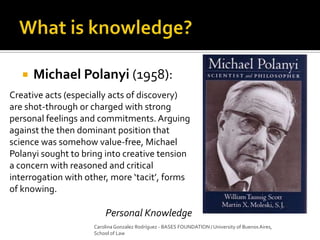
 Michael Polanyi (1958):
Creative acts (especially acts of discovery)
are shot-through or charged with strong
personal feelings and commitments. Arguing
against the then dominant position that
science was somehow value-free, Michael
Polanyi sought to bring into creative tension
a concern with reasoned and critical
interrogation with other, more ‘tacit’, forms
of knowing.
Personal Knowledge
Carolina Gonzalez Rodríguez - BASES FOUNDATION / University of Buenos Aires,
School of Law
 Bertrand Russell (1976)
“The question how knowledge should be defined
is perhaps the most important and difficult of the
three with which we shall deal.This may seem
surprising: at first sight it might be thought that
knowledge might be defined as belief which is in
agreement with the facts.The trouble is that no
one knows what a belief is, no one knows what a
fact is, and no one knows what sort of agreement
between them would make a belief true”
Theory of KnowledgeCarolina Gonzalez Rodríguez - BASES FOUNDATION / University of Buenos Aires,
School of Law
Carolina Gonzalez Rodríguez - BASES FOUNDATION / University of Buenos Aires,
School of Law
 World 1: the world of physical objects and
events, including biological entities
 World 2: the world of mental objects and events
 World 3: objective knowledge.
 ScientificTheory
 Myths
 Stories
 Social Institutions
Three worlds.TheTanner Lecture on HumanValues
Carolina Gonzalez Rodríguez - BASES FOUNDATION / University of Buenos Aires,
School of Law
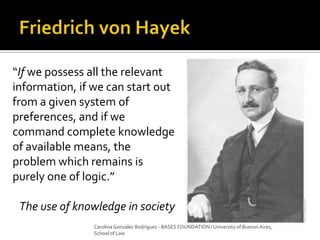
“If we possess all the relevant
information, if we can start out
from a given system of
preferences, and if we
command complete knowledge
of available means, the
problem which remains is
purely one of logic.”
The use of knowledge in society
Carolina Gonzalez Rodríguez - BASES FOUNDATION / University of Buenos Aires,
School of Law
Article 27 of the Universal Declaration
of Human Rights
the right to benefit from the protection of
moral and material interests resulting from
authorship of scientific, literary or artistic
productions.
Carolina Gonzalez Rodríguez - BASES FOUNDATION / University of Buenos Aires,
School of Law
 “First, the progress and well-being of humanity rest
on its capacity to create and invent new works in the
areas of technology and culture.
 Second, the legal protection of new creations
encourages the commitment of additional
resources for further innovation.
 Third, the promotion and protection of intellectual
property spurs economic growth, creates new jobs
and industries, and enhances the quality and
enjoyment of life”.
World Intellectual Property Organization
Carolina Gonzalez Rodríguez - BASES FOUNDATION / University of Buenos Aires,
School of Law
“The cry for copyright is the cry of men who are
not satisfied with being paid for their work once,
but insist upon being paid twice, thrice, and a
dozen times over.”
George Bernard Shaw
Carolina Gonzalez Rodríguez - BASES FOUNDATION / University of Buenos Aires,
School of Law
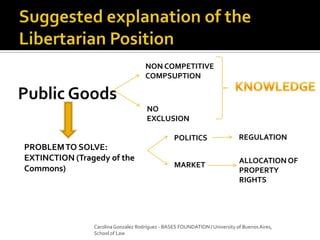
Public Goods
NON COMPETITIVE
COMPSUPTION
NO
EXCLUSION
PROBLEMTO SOLVE:
EXTINCTION (Tragedy of the
Commons)
POLITICS
MARKET
REGULATION
ALLOCATION OF
PROPERTY
RIGHTS
Carolina Gonzalez Rodríguez - BASES FOUNDATION / University of Buenos Aires,
School of Law
 Given that kowledge is a public good, wich
doesn’t extinct, there is no need to allocate
property rights to give incentives for
preservation and enlargement.
 On the contrary, patents and IP rights would
imposse artificial monopolies which would make
an abundant good scarce, and therefore increase
the price of the goods and services produced as
a consequence of the IP discoveries.
Carolina Gonzalez Rodríguez - BASES FOUNDATION / University of Buenos Aires,
School of Law
FROMTHE PRODUCER’S PERSPECTIVE
 INCENTIVES : if the outcome of the intellectual
effort and innovation is not allocated to the
inventor, he/she wouldn’t have the drive to invest
resources in the production of a public good such
as knowledge is
 INTERNALIZATION of costs and benefits of
producing IP
 How to assess efficiency of the ip system?
▪ «Patent paradox»
Carolina Gonzalez Rodríguez - BASES FOUNDATION / University of Buenos Aires,
School of Law
Carolina Gonzalez Rodríguez - BASES FOUNDATION / University of Buenos Aires,
School of Law
 IN FAVOR OF IPR:
 Producer’s perspective
 Incentives for innovation
 Allocation of private property rights
 AGAINST IPR
 Consumer’s perspective
 Artificial Monopoly
 Prices increased
 It is not proved that free system would discourage
innovation.
Carolina Gonzalez Rodríguez - BASES FOUNDATION / University of Buenos Aires,
School of Law
 Polanyi, Michael. Personal Knowledge:Towards
a Post-Critical Philosophy. Routledge & Kegan
Paul. London 1958.
 Pollock, John and Cruz, Joseph. Contemporary
Theories of Knowledge. Rowan and Littlefield
Publishers. Oxford 1999.
 Popper, Karl: ThreeWorlds.TheTanner lecture on
HumanValues. Delivered at the University of
Michigan. April 7, 1978
 Hayek, Friedrich. The use of knowledge in
society. American Economic Review. XXXV, No. 4.
American Economic Association, 1945
Carolina Gonzalez Rodríguez - BASES FOUNDATION / University of Buenos Aires,
School of Law
Thank you very much!!
cgonzalezr@derecho.uba.ar
Carolina Gonzalez Rodríguez - BASES FOUNDATION / University of Buenos Aires,
School of Law

IPR - Knowledge is a worthless asset without it. True or false?

  • 1.
    Arguments for andagainst this position Carolina Gonzalez Rodríguez BASES Foundation / University of BuenosAires, School of Law
  • 2.
     Michael Polanyi(1958): Creative acts (especially acts of discovery) are shot-through or charged with strong personal feelings and commitments. Arguing against the then dominant position that science was somehow value-free, Michael Polanyi sought to bring into creative tension a concern with reasoned and critical interrogation with other, more ‘tacit’, forms of knowing. Personal Knowledge Carolina Gonzalez Rodríguez - BASES FOUNDATION / University of Buenos Aires, School of Law
  • 3.
     Bertrand Russell(1976) “The question how knowledge should be defined is perhaps the most important and difficult of the three with which we shall deal.This may seem surprising: at first sight it might be thought that knowledge might be defined as belief which is in agreement with the facts.The trouble is that no one knows what a belief is, no one knows what a fact is, and no one knows what sort of agreement between them would make a belief true” Theory of KnowledgeCarolina Gonzalez Rodríguez - BASES FOUNDATION / University of Buenos Aires, School of Law
  • 4.
    Carolina Gonzalez Rodríguez- BASES FOUNDATION / University of Buenos Aires, School of Law
  • 5.
     World 1:the world of physical objects and events, including biological entities  World 2: the world of mental objects and events  World 3: objective knowledge.  ScientificTheory  Myths  Stories  Social Institutions Three worlds.TheTanner Lecture on HumanValues Carolina Gonzalez Rodríguez - BASES FOUNDATION / University of Buenos Aires, School of Law
  • 6.
    “If we possessall the relevant information, if we can start out from a given system of preferences, and if we command complete knowledge of available means, the problem which remains is purely one of logic.” The use of knowledge in society Carolina Gonzalez Rodríguez - BASES FOUNDATION / University of Buenos Aires, School of Law
  • 7.
    Article 27 ofthe Universal Declaration of Human Rights the right to benefit from the protection of moral and material interests resulting from authorship of scientific, literary or artistic productions. Carolina Gonzalez Rodríguez - BASES FOUNDATION / University of Buenos Aires, School of Law
  • 8.
     “First, theprogress and well-being of humanity rest on its capacity to create and invent new works in the areas of technology and culture.  Second, the legal protection of new creations encourages the commitment of additional resources for further innovation.  Third, the promotion and protection of intellectual property spurs economic growth, creates new jobs and industries, and enhances the quality and enjoyment of life”. World Intellectual Property Organization Carolina Gonzalez Rodríguez - BASES FOUNDATION / University of Buenos Aires, School of Law
  • 9.
    “The cry forcopyright is the cry of men who are not satisfied with being paid for their work once, but insist upon being paid twice, thrice, and a dozen times over.” George Bernard Shaw Carolina Gonzalez Rodríguez - BASES FOUNDATION / University of Buenos Aires, School of Law
  • 10.
    Public Goods NON COMPETITIVE COMPSUPTION NO EXCLUSION PROBLEMTOSOLVE: EXTINCTION (Tragedy of the Commons) POLITICS MARKET REGULATION ALLOCATION OF PROPERTY RIGHTS Carolina Gonzalez Rodríguez - BASES FOUNDATION / University of Buenos Aires, School of Law
  • 11.
     Given thatkowledge is a public good, wich doesn’t extinct, there is no need to allocate property rights to give incentives for preservation and enlargement.  On the contrary, patents and IP rights would imposse artificial monopolies which would make an abundant good scarce, and therefore increase the price of the goods and services produced as a consequence of the IP discoveries. Carolina Gonzalez Rodríguez - BASES FOUNDATION / University of Buenos Aires, School of Law
  • 12.
    FROMTHE PRODUCER’S PERSPECTIVE INCENTIVES : if the outcome of the intellectual effort and innovation is not allocated to the inventor, he/she wouldn’t have the drive to invest resources in the production of a public good such as knowledge is  INTERNALIZATION of costs and benefits of producing IP  How to assess efficiency of the ip system? ▪ «Patent paradox» Carolina Gonzalez Rodríguez - BASES FOUNDATION / University of Buenos Aires, School of Law
  • 13.
    Carolina Gonzalez Rodríguez- BASES FOUNDATION / University of Buenos Aires, School of Law
  • 14.
     IN FAVOROF IPR:  Producer’s perspective  Incentives for innovation  Allocation of private property rights  AGAINST IPR  Consumer’s perspective  Artificial Monopoly  Prices increased  It is not proved that free system would discourage innovation. Carolina Gonzalez Rodríguez - BASES FOUNDATION / University of Buenos Aires, School of Law
  • 15.
     Polanyi, Michael.Personal Knowledge:Towards a Post-Critical Philosophy. Routledge & Kegan Paul. London 1958.  Pollock, John and Cruz, Joseph. Contemporary Theories of Knowledge. Rowan and Littlefield Publishers. Oxford 1999.  Popper, Karl: ThreeWorlds.TheTanner lecture on HumanValues. Delivered at the University of Michigan. April 7, 1978  Hayek, Friedrich. The use of knowledge in society. American Economic Review. XXXV, No. 4. American Economic Association, 1945 Carolina Gonzalez Rodríguez - BASES FOUNDATION / University of Buenos Aires, School of Law
  • 16.
    Thank you verymuch!! cgonzalezr@derecho.uba.ar Carolina Gonzalez Rodríguez - BASES FOUNDATION / University of Buenos Aires, School of Law