A Presentation on Trademarks and Patent :
Internship at Singhania and Singhania Co
By : Shruti Sngh
10th sem
B.A.LL.B
TRADEMARKS IN INDIA
 Regulatory Laws : Trademarks in India is regulated through
Trademarks Act 1999.
 Marks that Can be adopted as Trademarks :
• Names
• Letters or numerals or any such combination
• Monograms
• Devices
• 3-D Signs
• Combination of colors and words
 Types of Trademark that can be Registered :
• Product Trademark
• Service Trademark
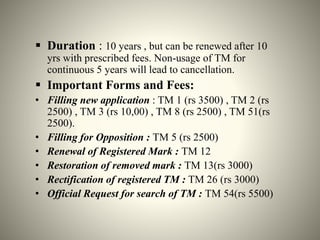
 Duration : 10 years , but can be renewed after 10
yrs with prescribed fees. Non-usage of TM for
continuous 5 years will lead to cancellation.
 Important Forms and Fees:
• Filling new application : TM 1 (rs 3500) , TM 2 (rs
2500) , TM 3 (rs 10,00) , TM 8 (rs 2500) , TM 51(rs
2500).
• Filling for Opposition : TM 5 (rs 2500)
• Renewal of Registered Mark : TM 12
• Restoration of removed mark : TM 13(rs 3000)
• Rectification of registered TM : TM 26 (rs 3000)
• Official Request for search of TM : TM 54(rs 5500)
Recent Development in Trademarks
Case of INSTITUTE FOR INNER STUDIES VS. CHARLOTTE
ANDERSON & ORS. , Delhi H.C:
Held : the trademark registered which is not having any distinctive
character or lack novelty or having roots embedded in ancient
knowledge of the country such as yoga, is invalid and cannot be
protected.
Judgement : Justice Manmohan Singh clarifies the stand of copyrights
in case of this issue and provides that no one can be given copyright
over performing techniques in yoga asanas i.e. Pranic Healings and
other yoga techniques, as they are neither original literary works nor
dramatic works. However, it is open for legal protection which
relates to the production or reproduction or copying of literary work
.
PATENTS IN INDIA
 Regulatory Laws : Regulated by Patents Act 1970
 What can be patented : The invention to get
patented must be ‘Useful , Non-Obvious , Novel’.
 Who can apply for Patent : Patent can be made by any
person , whether citizen of India or not , claiming to be
true or first inventor , bi his Assignee or Legal
representative. Application can be made jointly or alone
or with any other person. A company or a firm cannot be
named as first inventors. Person includes Government.
 Term of Patent : 20 years from date of filling of patent
application
 Types of patent : Product and Process patent.
 Office of Patent : Indian patent and trade mark
office , New Delhi.
 India and International Cooperation's :
• Cooperation with WIPO
• Bilateral agreements with :
 UK Patent office
 USPTO
 European Patent Office
 Japan Patent Office
 Switzerland
 Germany
IMPORTANT FORMS
 Form 1 : Application for Grant of Patent
 Form 2 : Application for provisional/ Complete
specification
 Form 3 : Application for statement of Undertaking
 Form 5 : Application as to declaration to Inventor ship
 Form 13 : Amendment in patent application/complete
specification
 Form 18 : Application for request for examination of
application for patent.
 Form 26 : Form for authorization of Patent Agent.
THANK YOU!!

IPR

  • 1.
    A Presentation onTrademarks and Patent : Internship at Singhania and Singhania Co By : Shruti Sngh 10th sem B.A.LL.B
  • 2.
    TRADEMARKS IN INDIA Regulatory Laws : Trademarks in India is regulated through Trademarks Act 1999.  Marks that Can be adopted as Trademarks : • Names • Letters or numerals or any such combination • Monograms • Devices • 3-D Signs • Combination of colors and words  Types of Trademark that can be Registered : • Product Trademark • Service Trademark
  • 3.
     Duration :10 years , but can be renewed after 10 yrs with prescribed fees. Non-usage of TM for continuous 5 years will lead to cancellation.  Important Forms and Fees: • Filling new application : TM 1 (rs 3500) , TM 2 (rs 2500) , TM 3 (rs 10,00) , TM 8 (rs 2500) , TM 51(rs 2500). • Filling for Opposition : TM 5 (rs 2500) • Renewal of Registered Mark : TM 12 • Restoration of removed mark : TM 13(rs 3000) • Rectification of registered TM : TM 26 (rs 3000) • Official Request for search of TM : TM 54(rs 5500)
  • 4.
    Recent Development inTrademarks Case of INSTITUTE FOR INNER STUDIES VS. CHARLOTTE ANDERSON & ORS. , Delhi H.C: Held : the trademark registered which is not having any distinctive character or lack novelty or having roots embedded in ancient knowledge of the country such as yoga, is invalid and cannot be protected. Judgement : Justice Manmohan Singh clarifies the stand of copyrights in case of this issue and provides that no one can be given copyright over performing techniques in yoga asanas i.e. Pranic Healings and other yoga techniques, as they are neither original literary works nor dramatic works. However, it is open for legal protection which relates to the production or reproduction or copying of literary work .
  • 5.
    PATENTS IN INDIA Regulatory Laws : Regulated by Patents Act 1970  What can be patented : The invention to get patented must be ‘Useful , Non-Obvious , Novel’.  Who can apply for Patent : Patent can be made by any person , whether citizen of India or not , claiming to be true or first inventor , bi his Assignee or Legal representative. Application can be made jointly or alone or with any other person. A company or a firm cannot be named as first inventors. Person includes Government.  Term of Patent : 20 years from date of filling of patent application
  • 6.
     Types ofpatent : Product and Process patent.  Office of Patent : Indian patent and trade mark office , New Delhi.  India and International Cooperation's : • Cooperation with WIPO • Bilateral agreements with :  UK Patent office  USPTO  European Patent Office  Japan Patent Office  Switzerland  Germany
  • 7.
    IMPORTANT FORMS  Form1 : Application for Grant of Patent  Form 2 : Application for provisional/ Complete specification  Form 3 : Application for statement of Undertaking  Form 5 : Application as to declaration to Inventor ship  Form 13 : Amendment in patent application/complete specification  Form 18 : Application for request for examination of application for patent.  Form 26 : Form for authorization of Patent Agent.
  • 8.