1
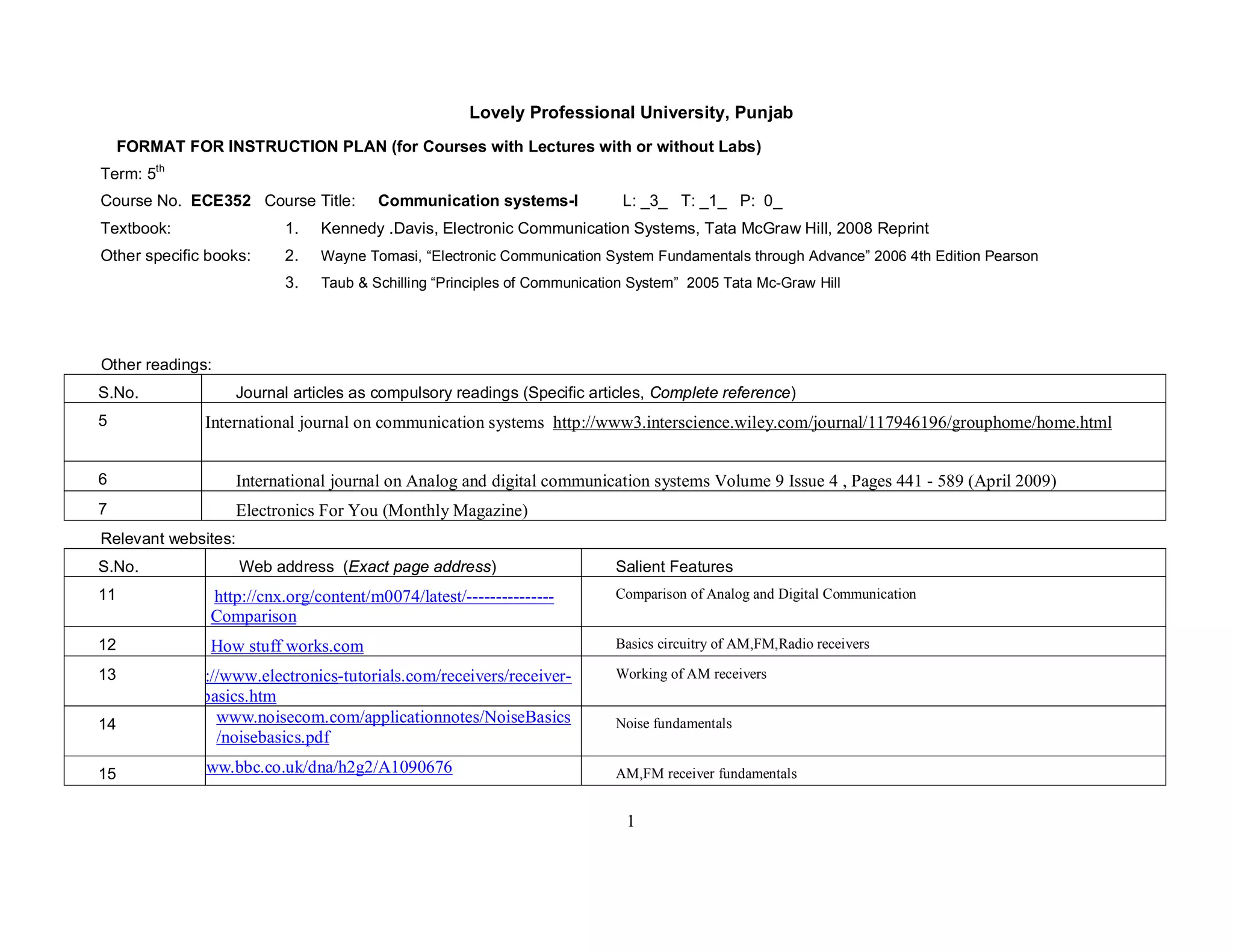
Lovely Professional University, Punjab
FORMAT FOR INSTRUCTION PLAN (for Courses with Lectures with or without Labs)
Term: 5th
Course No. ECE352 Course Title: Communication systems-I L: _3_ T: _1_ P: 0_
Textbook: 1. Kennedy .Davis, Electronic Communication Systems, Tata McGraw Hill, 2008 Reprint
Other specific books: 2. Wayne Tomasi, “Electronic Communication System Fundamentals through Advance” 2006 4th Edition Pearson
3. Taub & Schilling “Principles of Communication System” 2005 Tata Mc-Graw Hill
Other readings:
S.No. Journal articles as compulsory readings (Specific articles, Complete reference)
5 International journal on communication systems http://www3.interscience.wiley.com/journal/117946196/grouphome/home.html
6 International journal on Analog and digital communication systems Volume 9 Issue 4 , Pages 441 - 589 (April 2009)
7 Electronics For You (Monthly Magazine)
Relevant websites:
S.No. Web address (Exact page address) Salient Features
11 http://cnx.org/content/m0074/latest/---------------
Comparison
Comparison of Analog and Digital Communication
12 How stuff works.com Basics circuitry of AM,FM,Radio receivers
13 http://www.electronics-tutorials.com/receivers/receiver-
basics.htm
Working of AM receivers
14 www.noisecom.com/applicationnotes/NoiseBasics
/noisebasics.pdf
Noise fundamentals
15 www.bbc.co.uk/dna/h2g2/A1090676 AM,FM receiver fundamentals
2
Note : Serial no. of text book , other specific books , other readings and websites should be in continuity and can go to any number, as illustrated in
the format.
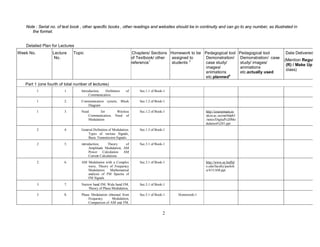
Detailed Plan for Lectures
Week No. Lecture
No.
Topic Chapters/ Sections
of Textbook/ other
reference1
Homework to be
assigned to
students 3
Pedagogical tool
Demonstration/
case study/
images/
animations
etc.planned4
Pedagogical tool
Demonstration/ case
study/ images/
animations
etc.actually used
Date Delivered
(Mention Regular
(R) / Make Up (M)
class)
Part 1 (one fourth of total number of lectures)
1 1. Introduction, Definition of
Communication
Sec.1.1 of Book-1
1 2. Communication system, Block
Diagram
Sec.1.2 of Book-1
1 3. Need for Wireless
Communication, Need of
Modulation
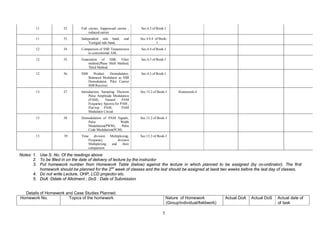
Sec.1.2 of Book-1 http://coursemain.ee.
ukzn.ac.za/enel4dph1
/notes/Digital%20Mo
dulation%201.ppt
2 4. General Definition of Modulation.
Types of various Signals,
Basic Transmission Signals.
Sec.1.3 of Book-1
2 5. introduction, Theory of
Amplitude Modulation, AM
Power Calculation AM
Current Calculations
Sec.3.1 of Book-1
2 6. AM Modulation with a Complex
wave, Theory of Frequency
Modulation: Mathematical
analysis of FM Spectra of
FM Signals
Sec.3.1 of Book-1 http://www.ee.buffal
o.edu/faculty/paololi
u/413/AM.ppt
3 7. Narrow band FM, Wide band FM,
Theory of Phase Modulation,
Sec.5.1 of Book-1
3 8. Phase Modulation obtained from
Frequency Modulation,
Comparison of AM and FM,
Sec.5.1 of Book-1 Homework-1
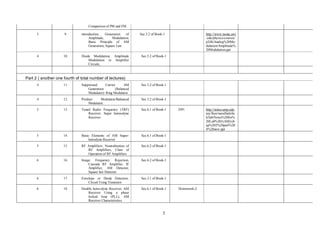
3
Comparison of PM and FM.
3 9. introduction, Generation of
Amplitude, Modulation,
Basic Principle of AM
Generation; Square Law
Sec.3.2 of Book-1 http://www.mona.uwi
.edu/physics/courses/
p24h/Analog%20Mo
dulation/Amplitude%
20Modulation.ppt
4 10. Diode Modulation, Amplitude
Modulation in Amplifier
Circuits,
Sec.3.2 of Book-1
Part 2 ( another one fourth of total number of lectures)
4 11. Suppressed Carrier AM
Generation (Balanced
Modulator): Ring Modulator
Sec 3.2 of Book-1
4 12. Product Modulator/Balanced
Modulator.
Sec 3.2 of Book-1
5 13. Tuned Radio Frequency (TRF)
Receiver, Super heterodyne
Receiver
Sec.6.1 of Book-1 DP1 http://notes.ump.edu.
my/fkee/nurulfadzila
h/lab/Notes%20for%
20Lab%201(AM)/ch
ap%202%20part%20
4%20new.ppt
5 14. Basic Elements of AM Super-
hetrodyne Receiver
Sec.6.1 of Book-1
5 15. RF Amplifiers, Neutralization of
RF Amplifiers, Class of
Operation of RF Amplifiers
Sec.6.2 of Book-1
6 16. Image Frequency Rejection,
Cascade RF Amplifier, IF
Amplifier, AM Detector,
Square law Detector
Sec.6.2 of Book-1
6 17. Envelope or Diode Detectors.
Circuit Using Transistor
Sec.3.1 of Book-1
6 18. Double hetro-dyne Receiver, AM
Receiver Using a phase
locked loop (PLL), AM
Receiver Characteristics.
Sec.6.1 of Book-1 Homework-2
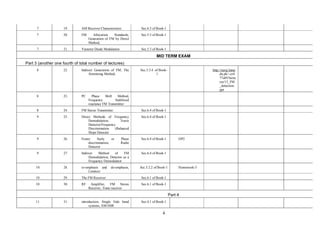
4
7 19. AM Receiver Characteristics. Sec.6.3 of Book-1
7 20. FM Allocation Standards,
Generation of FM by Direct
Method,
Sec.5.3 of Book-1
7 21. Varactor Diode Modulation Sec.5.3 of Book-1
MID TERM EXAM
Part 3 (another one fourth of total number of lectures)
8 22. Indirect Generation of FM; The
Armstrong Method,
Sec.5.3.4 of Book-
1
http://suraj.lume
du.pk/~cs4
77a05/lectu
res/15_FM
_detection.
ppt
8 23. PC Phase Shift Method,
Frequency Stabilized
reactance FM Transmitter
8 24. FM Stereo Transmitter. Sec.6.4 of Book-1
9 25. Direct Methods of Frequency
Demodulation, Travis
Detector/Frequency
Discrimination (Balanced
Slope Detector
Sec.6.4 of Book-1
9 26. Foster Seely or Phase
discrimination, Radio
Detector
Sec.6.4 of Book-1 DP2
9 27. Indirect Method of FM
Demodulation, Detector as a
Frequency Demodulator
Sec.6.4 of Book-1
10 28. re-emphasis and de-emphasis,
Limiters
Sec.5.2.2 of Book-1 Homework-3
10 29. The FM Receiver Sec.6.1 of Book-1
10 30. RF Amplifier, FM Stereo
Receiver, Trans receiver
Sec.6.1 of Book-1
Part 4
11 31. introduction, Single Side band
systems, AM-SSB
Sec.4.1 of Book-1
5
11 32. Full carrier, Suppressed carrier ,
reduced carrier
Sec.4.3 of Book-1
11 33. Independent side band, and
Vestigial side band,
Sec.4.4.4 of Book-
1
12 34. Comparison of SSB Transmission
to conventional AM,
Sec.4.4 of Book-1
12 35. Generation of SSB; Filter
method,Phase Shift Method,
Third Method
Sec.4.3 of Book-1
12 36. SSB Product Demodulator,
Balanced Modulator as SSB
Demodulator, Pilot Carrier
SSB Receiver.
Sec.4.3 of Book-1
13 37. Introduction, Sampling Theorem
Pulse Amplitude Modulation
(PAM), Natural PAM
Frequency Spectra for PAM ,
Flat-top PAM, PAM
Modulator Circuit
Sec.13.2 of Book-1 Homework-4
13 38. Demodulation of PAM Signals,
Pulse Width
Modulation(PWM), Pulse
Code Modulation(PCM)
Sec.13.2 of Book-1
13 39 Time division Multiplexing,
Frequency division
Multiplexing and their
comparison
Sec.13.2 of Book-1
Notes: 1. Use S. No. Of the readings above
2. To be filled in on the date of delivery of lecture by the instructor
3. Put homework number from Homework Table (below) against the lecture in which planned to be assigned (by co-ordinator). The first
homework should be planned for the 2nd
week of classes and the last should be assigned at least two weeks before the last day of classes.
4. Do not write Lecture, OHP, LCD projector etc.
5. DoA :Ddate of Allotment ; DoS : Date of Submission
Details of Homework and Case Studies Planned:
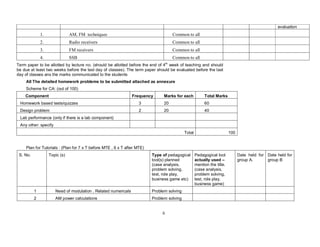
Homework No. Topics of the homework Nature of Homework
(Group/individual/fieldwork)
Actual DoA Actual DoS Actual date of
of task
6
evaluation
1. AM, FM techniques Common to all
2. Radio receivers Common to all
3. FM receivers Common to all
4. SSB Common to all
Term paper to be allotted by lecture no. (should be allotted before the end of 4th
week of teaching and should
be due at least two weeks before the last day of classes). The term paper should be evaluated before the last
day of classes ans the marks communicated to the students
All The detailed homework problems to be submitted attached as annexure
Scheme for CA: (out of 100)
Component Frequency Marks for each Total Marks
Homework based tests/quizzes 3 20 60
Design problem 2 20 40
Lab performance (only if there is a lab component)
Any other: specify
Total 100
Plan for Tutorials : (Plan for 7 x T before MTE , 6 x T after MTE)
S. No. Topic (s) Type of pedagogical
tool(s) planned
(case analysis,
problem solving,
test, role play,
business game etc)
Pedagogical tool
actually used –
mention the title.
(case analysis,
problem solving,
test, role play,
business game)
Date held for
group A.
Date held for
group B
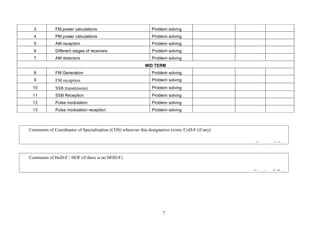
1 Need of modulation , Related numericals Problem solving
2 AM power calculations Problem solving
7
3 FM,power calculations Problem solving
4 PM power calculations Problem solving
5 AM reception Problem solving
6 Different stages of receivers Problem solving
7 AM detectors Problem solving
MID TERM
8 FM Generation Problem solving
9 FM reception Problem solving
10 SSB transmission Problem solving
11 SSB Reception Problem solving
12 Pulse modulation Problem solving
13 Pulse modulation reception Problem solving
Comments of HoD-F / HOF (if there is no HOD-F)
Signature & Date
Comments of Coordinator of Specialisation (COS) wherever this designation exists/ CoD-F (if any)
Signature & Date
8
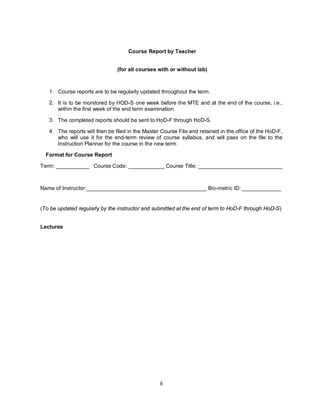
Course Report by Teacher
(for all courses with or without lab)
1. Course reports are to be regularly updated throughout the term.
2. It is to be monitored by HOD-S one week before the MTE and at the end of the course, i.e.,
within the first week of the end term examination
3. The completed reports should be sent to HoD-F through HoD-S.
4. The reports will then be filed in the Master Course File and retained in the office of the HoD-F,
who will use it for the end-term review of course syllabus, and will pass on the file to the
Instruction Planner for the course in the new term.
Format for Course Report
Term: ___________ Course Code: ____________ Course Title: ____________________________
Name of Instructor:________________________________________ Bio-metric ID: _____________
(To be updated regularly by the instructor and submitted at the end of term to HoD-F through HoD-S)
Lectures
9
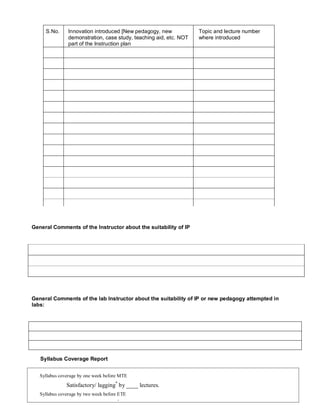
General Comments of the Instructor about the suitability of IP
General Comments of the lab Instructor about the suitability of IP or new pedagogy attempted in
labs:
Syllabus Coverage Report
S.No. Innovation introduced [New pedagogy, new
demonstration, case study, teaching aid, etc. NOT
part of the Instruction plan
Topic and lecture number
where introduced
Syllabus coverage by one week before MTE
Satisfactory/ lagging*
by ____ lectures.
Syllabus coverage by two week before ETE
Satisfactory/ Lagging*
by ____ lectures.
10
________________________________ __________________________________
Signature of Instructor & Date Signature of HoD-S & Date
*
HoD-S will submit to HoS a consolidated list of all lagging cases.

Ipece352

  • 1.
    1 Lovely Professional University,Punjab FORMAT FOR INSTRUCTION PLAN (for Courses with Lectures with or without Labs) Term: 5th Course No. ECE352 Course Title: Communication systems-I L: _3_ T: _1_ P: 0_ Textbook: 1. Kennedy .Davis, Electronic Communication Systems, Tata McGraw Hill, 2008 Reprint Other specific books: 2. Wayne Tomasi, “Electronic Communication System Fundamentals through Advance” 2006 4th Edition Pearson 3. Taub & Schilling “Principles of Communication System” 2005 Tata Mc-Graw Hill Other readings: S.No. Journal articles as compulsory readings (Specific articles, Complete reference) 5 International journal on communication systems http://www3.interscience.wiley.com/journal/117946196/grouphome/home.html 6 International journal on Analog and digital communication systems Volume 9 Issue 4 , Pages 441 - 589 (April 2009) 7 Electronics For You (Monthly Magazine) Relevant websites: S.No. Web address (Exact page address) Salient Features 11 http://cnx.org/content/m0074/latest/--------------- Comparison Comparison of Analog and Digital Communication 12 How stuff works.com Basics circuitry of AM,FM,Radio receivers 13 http://www.electronics-tutorials.com/receivers/receiver- basics.htm Working of AM receivers 14 www.noisecom.com/applicationnotes/NoiseBasics /noisebasics.pdf Noise fundamentals 15 www.bbc.co.uk/dna/h2g2/A1090676 AM,FM receiver fundamentals
  • 2.
    2 Note : Serialno. of text book , other specific books , other readings and websites should be in continuity and can go to any number, as illustrated in the format. Detailed Plan for Lectures Week No. Lecture No. Topic Chapters/ Sections of Textbook/ other reference1 Homework to be assigned to students 3 Pedagogical tool Demonstration/ case study/ images/ animations etc.planned4 Pedagogical tool Demonstration/ case study/ images/ animations etc.actually used Date Delivered (Mention Regular (R) / Make Up (M) class) Part 1 (one fourth of total number of lectures) 1 1. Introduction, Definition of Communication Sec.1.1 of Book-1 1 2. Communication system, Block Diagram Sec.1.2 of Book-1 1 3. Need for Wireless Communication, Need of Modulation Sec.1.2 of Book-1 http://coursemain.ee. ukzn.ac.za/enel4dph1 /notes/Digital%20Mo dulation%201.ppt 2 4. General Definition of Modulation. Types of various Signals, Basic Transmission Signals. Sec.1.3 of Book-1 2 5. introduction, Theory of Amplitude Modulation, AM Power Calculation AM Current Calculations Sec.3.1 of Book-1 2 6. AM Modulation with a Complex wave, Theory of Frequency Modulation: Mathematical analysis of FM Spectra of FM Signals Sec.3.1 of Book-1 http://www.ee.buffal o.edu/faculty/paololi u/413/AM.ppt 3 7. Narrow band FM, Wide band FM, Theory of Phase Modulation, Sec.5.1 of Book-1 3 8. Phase Modulation obtained from Frequency Modulation, Comparison of AM and FM, Sec.5.1 of Book-1 Homework-1
  • 3.
    3 Comparison of PMand FM. 3 9. introduction, Generation of Amplitude, Modulation, Basic Principle of AM Generation; Square Law Sec.3.2 of Book-1 http://www.mona.uwi .edu/physics/courses/ p24h/Analog%20Mo dulation/Amplitude% 20Modulation.ppt 4 10. Diode Modulation, Amplitude Modulation in Amplifier Circuits, Sec.3.2 of Book-1 Part 2 ( another one fourth of total number of lectures) 4 11. Suppressed Carrier AM Generation (Balanced Modulator): Ring Modulator Sec 3.2 of Book-1 4 12. Product Modulator/Balanced Modulator. Sec 3.2 of Book-1 5 13. Tuned Radio Frequency (TRF) Receiver, Super heterodyne Receiver Sec.6.1 of Book-1 DP1 http://notes.ump.edu. my/fkee/nurulfadzila h/lab/Notes%20for% 20Lab%201(AM)/ch ap%202%20part%20 4%20new.ppt 5 14. Basic Elements of AM Super- hetrodyne Receiver Sec.6.1 of Book-1 5 15. RF Amplifiers, Neutralization of RF Amplifiers, Class of Operation of RF Amplifiers Sec.6.2 of Book-1 6 16. Image Frequency Rejection, Cascade RF Amplifier, IF Amplifier, AM Detector, Square law Detector Sec.6.2 of Book-1 6 17. Envelope or Diode Detectors. Circuit Using Transistor Sec.3.1 of Book-1 6 18. Double hetro-dyne Receiver, AM Receiver Using a phase locked loop (PLL), AM Receiver Characteristics. Sec.6.1 of Book-1 Homework-2
  • 4.
    4 7 19. AMReceiver Characteristics. Sec.6.3 of Book-1 7 20. FM Allocation Standards, Generation of FM by Direct Method, Sec.5.3 of Book-1 7 21. Varactor Diode Modulation Sec.5.3 of Book-1 MID TERM EXAM Part 3 (another one fourth of total number of lectures) 8 22. Indirect Generation of FM; The Armstrong Method, Sec.5.3.4 of Book- 1 http://suraj.lume du.pk/~cs4 77a05/lectu res/15_FM _detection. ppt 8 23. PC Phase Shift Method, Frequency Stabilized reactance FM Transmitter 8 24. FM Stereo Transmitter. Sec.6.4 of Book-1 9 25. Direct Methods of Frequency Demodulation, Travis Detector/Frequency Discrimination (Balanced Slope Detector Sec.6.4 of Book-1 9 26. Foster Seely or Phase discrimination, Radio Detector Sec.6.4 of Book-1 DP2 9 27. Indirect Method of FM Demodulation, Detector as a Frequency Demodulator Sec.6.4 of Book-1 10 28. re-emphasis and de-emphasis, Limiters Sec.5.2.2 of Book-1 Homework-3 10 29. The FM Receiver Sec.6.1 of Book-1 10 30. RF Amplifier, FM Stereo Receiver, Trans receiver Sec.6.1 of Book-1 Part 4 11 31. introduction, Single Side band systems, AM-SSB Sec.4.1 of Book-1
  • 5.
    5 11 32. Fullcarrier, Suppressed carrier , reduced carrier Sec.4.3 of Book-1 11 33. Independent side band, and Vestigial side band, Sec.4.4.4 of Book- 1 12 34. Comparison of SSB Transmission to conventional AM, Sec.4.4 of Book-1 12 35. Generation of SSB; Filter method,Phase Shift Method, Third Method Sec.4.3 of Book-1 12 36. SSB Product Demodulator, Balanced Modulator as SSB Demodulator, Pilot Carrier SSB Receiver. Sec.4.3 of Book-1 13 37. Introduction, Sampling Theorem Pulse Amplitude Modulation (PAM), Natural PAM Frequency Spectra for PAM , Flat-top PAM, PAM Modulator Circuit Sec.13.2 of Book-1 Homework-4 13 38. Demodulation of PAM Signals, Pulse Width Modulation(PWM), Pulse Code Modulation(PCM) Sec.13.2 of Book-1 13 39 Time division Multiplexing, Frequency division Multiplexing and their comparison Sec.13.2 of Book-1 Notes: 1. Use S. No. Of the readings above 2. To be filled in on the date of delivery of lecture by the instructor 3. Put homework number from Homework Table (below) against the lecture in which planned to be assigned (by co-ordinator). The first homework should be planned for the 2nd week of classes and the last should be assigned at least two weeks before the last day of classes. 4. Do not write Lecture, OHP, LCD projector etc. 5. DoA :Ddate of Allotment ; DoS : Date of Submission Details of Homework and Case Studies Planned: Homework No. Topics of the homework Nature of Homework (Group/individual/fieldwork) Actual DoA Actual DoS Actual date of of task
  • 6.
    6 evaluation 1. AM, FMtechniques Common to all 2. Radio receivers Common to all 3. FM receivers Common to all 4. SSB Common to all Term paper to be allotted by lecture no. (should be allotted before the end of 4th week of teaching and should be due at least two weeks before the last day of classes). The term paper should be evaluated before the last day of classes ans the marks communicated to the students All The detailed homework problems to be submitted attached as annexure Scheme for CA: (out of 100) Component Frequency Marks for each Total Marks Homework based tests/quizzes 3 20 60 Design problem 2 20 40 Lab performance (only if there is a lab component) Any other: specify Total 100 Plan for Tutorials : (Plan for 7 x T before MTE , 6 x T after MTE) S. No. Topic (s) Type of pedagogical tool(s) planned (case analysis, problem solving, test, role play, business game etc) Pedagogical tool actually used – mention the title. (case analysis, problem solving, test, role play, business game) Date held for group A. Date held for group B 1 Need of modulation , Related numericals Problem solving 2 AM power calculations Problem solving
  • 7.
    7 3 FM,power calculationsProblem solving 4 PM power calculations Problem solving 5 AM reception Problem solving 6 Different stages of receivers Problem solving 7 AM detectors Problem solving MID TERM 8 FM Generation Problem solving 9 FM reception Problem solving 10 SSB transmission Problem solving 11 SSB Reception Problem solving 12 Pulse modulation Problem solving 13 Pulse modulation reception Problem solving Comments of HoD-F / HOF (if there is no HOD-F) Signature & Date Comments of Coordinator of Specialisation (COS) wherever this designation exists/ CoD-F (if any) Signature & Date
  • 8.
    8 Course Report byTeacher (for all courses with or without lab) 1. Course reports are to be regularly updated throughout the term. 2. It is to be monitored by HOD-S one week before the MTE and at the end of the course, i.e., within the first week of the end term examination 3. The completed reports should be sent to HoD-F through HoD-S. 4. The reports will then be filed in the Master Course File and retained in the office of the HoD-F, who will use it for the end-term review of course syllabus, and will pass on the file to the Instruction Planner for the course in the new term. Format for Course Report Term: ___________ Course Code: ____________ Course Title: ____________________________ Name of Instructor:________________________________________ Bio-metric ID: _____________ (To be updated regularly by the instructor and submitted at the end of term to HoD-F through HoD-S) Lectures
  • 9.
    9 General Comments ofthe Instructor about the suitability of IP General Comments of the lab Instructor about the suitability of IP or new pedagogy attempted in labs: Syllabus Coverage Report S.No. Innovation introduced [New pedagogy, new demonstration, case study, teaching aid, etc. NOT part of the Instruction plan Topic and lecture number where introduced Syllabus coverage by one week before MTE Satisfactory/ lagging* by ____ lectures. Syllabus coverage by two week before ETE Satisfactory/ Lagging* by ____ lectures.
  • 10.
    10 ________________________________ __________________________________ Signature ofInstructor & Date Signature of HoD-S & Date * HoD-S will submit to HoS a consolidated list of all lagging cases.