International Journal of Engineering Science Invention
ISSN (Online): 2319 – 6734, ISSN (Print): 2319 – 6726
www.ijesi.org Volume 2 Issue 7 ǁ July. 2013 ǁ PP.14-19
www.ijesi.org 14 | Page
Design of Monitoring System for Coal Mine Safety Based on
MSP430
Mr. Kumarsagar. M. Dange 1
, Prof. R. T. Patil.2
1
Master of Technology. Department of Electronics & Telecommunication Rajarambapu Institute of Technology,
Sakharale, M.S., India
2
Asso. Prof. Department of Electronics & Telecommunication Rajarambapu Institute of Technology,
Sakharale, M.S., India
ABSTRACT: Now a day’s due to global warming and climate changes there are challenging situations in field
of coal mine. To reduce the cost and improve the productivity along with product quality the automisation in the
field of coal mine is indeed necessary, which will also reduce the mine workers efforts. This paper proposes a
design of a wireless sensor network (WSN) with the help of MSP430xx controller which is able to monitor the
temperature, humidity, gas and status of smoke in anunder ground mine. This system also controls the
ventelation demand to mine workers depending upon present climate conditions within the mine field. This
system utilizes low power, cost effective microcontroller MSP430, a temperature sensor LM35, humidity sensor
SYSH220, smoke detector, gas sensor for sensing the mine climate parameters and a wireless Zigbee
transceiver for remote logging of data at central location to control the climate state with the help of motor and
valve control circuitry.
KEYWORDS: wireless sensor network, MSP430 controller, Zigbee, LM35, SYSH220.
I. INTRODUCTION
India is a large country with rich coals. However, the current safe production level of coal mine is still
low, especially in recent years, disasters in coal mine occur frequently, which lead to great loss of possession
and life. The safety problems of coal mine has gradually become to the focus that the nation and society concern
on. The disasters happening in coal mine are due to the complexity of mine environment and the variety of work
condition of coal mine, so it is very necessary to monitor mine working environment. Traditional coal mine
monitoring systems tend to be wired network systems, which play an important role in coal mine safe
production. With continuous enlarging of exploiting areas and extension of depth in coal mine, many laneways
become blind areas, where in there are lots of hidden dangers. Moreover, it is inconvenient to lay cables which
are expensive and consume time. In order to solve the problems, we will design a coal mine safety monitoring
system based on wireless sensor network, which can improve the level of monitoring production safety and
reduce accident in the coal mines Wireless sensor networks is composed of a large number of micro-sensor
nodes which have small volume and low cost. It possesses self-organized capability by wireless
Communication. In recent years, it is widely used in the fields of our lives, scientific research, military,
intelligent traffic, environmental monitoring, intelligent weapon, and so on. Compared to the traditional mine
monitoring, we use wireless sensor networks in coal mine safety monitoring. It has three significant advantages:
(1) It is unnecessary to lay cables, and can be installed in monitoring blind areas to reduce the costs of extending
the system. More number of nodes can be arranged to eliminate blind areas. Wireless sensor nodes can make
general communication and allocate the goal; (2) The nodes are dense, which can ensure data acquisition high
accuracy and efficiency of data transmission, and realize the real-time monitoring of coal mine working
environment; (3) Sensor nodes with a certain computing ability, storage capacity, data fusion are ideal for
remote monitoring. Therefore we can make use of the wireless sensor network to monitor Production safety of
coal mine.
II. SYSTEM ARCHITECTURE
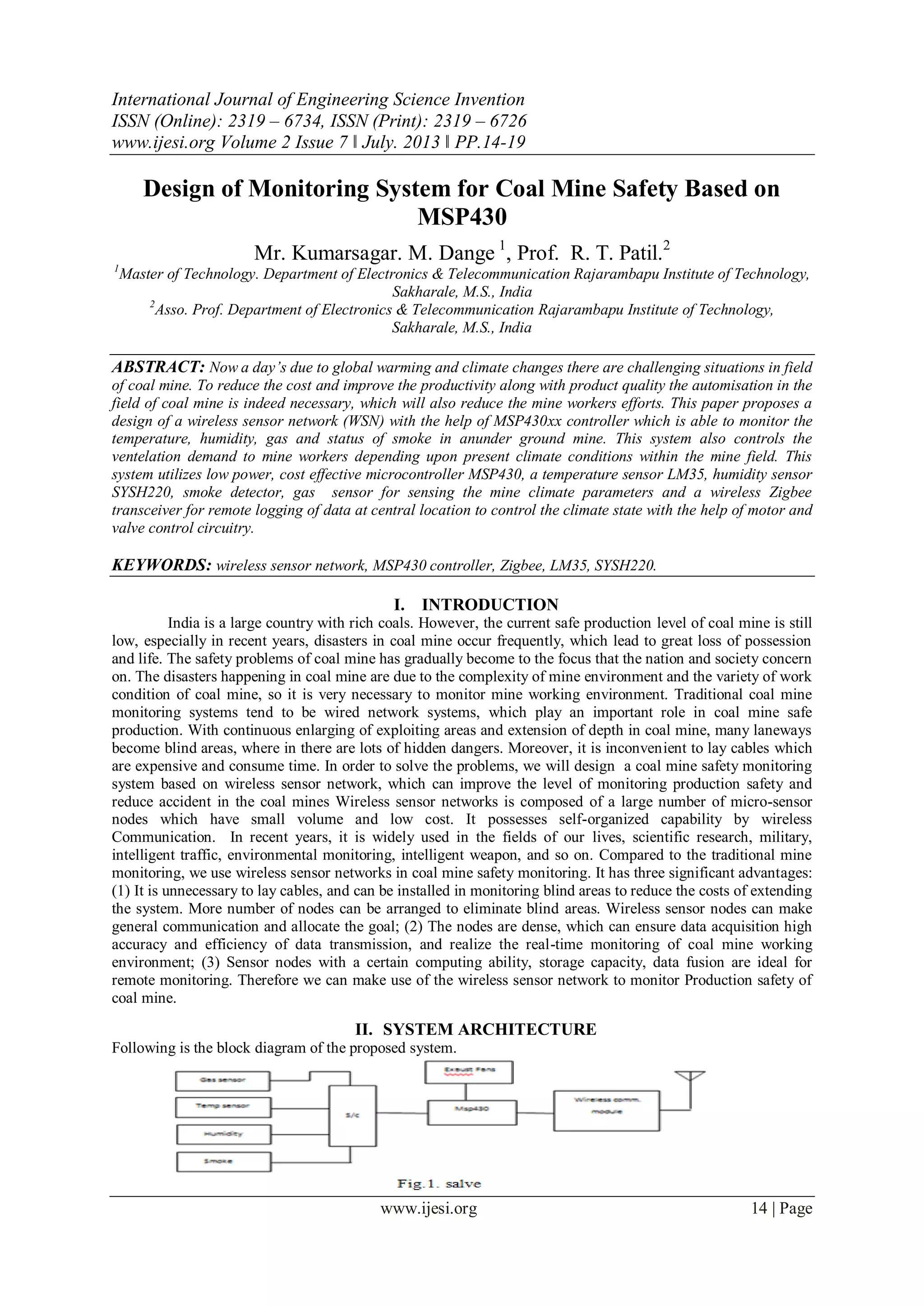
Following is the block diagram of the proposed system.
Design of Monitoring System for Coal…
www.ijesi.org 15 | Page
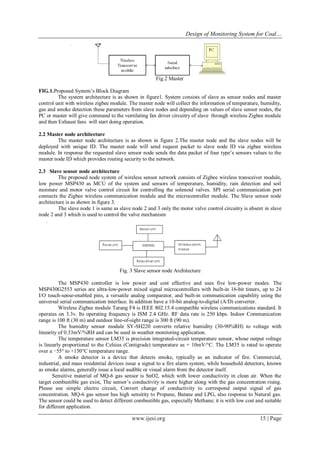
Fig.2 Master
FIG.1.Proposed System’s Block Diagram
The system architecture is as shown in figure1. System consists of slave as sensor nodes and master
control unit with wireless zigbee module. The master node will collect the information of temperature, humidity,
gas and smoke detection these parameters from slave nodes and depending on values of slave sensor nodes, the
PC or master will give command to the ventilating fan driver circuitry of slave through wireless Zigbee module
and then Exhaust fans will start doing operation.
2.2 Master node architecture
The master node architecture is as shown in figure 2.The master node and the slave nodes will be
deployed with unique ID. The master node will send request packet to slave node ID via zigbee wireless
module. In response the requested slave sensor node sends the data packet of four type’s sensors values to the
master node ID which provides routing security to the network.
2.3 Slave sensor node architecture
The proposed node system of wireless sensor network consists of Zigbee wireless transceiver module,
low power MSP430 as MCU of the system and sensors of temperature, humidity, rain detection and soil
moisture and motor valve control circuit for controlling the solenoid valves. SPI serial communication port
connects the Zigbee wireless communication module and the microcontroller module. The Slave sensor node
architecture is as shown in figure 3.
The slave node 1 is same as slave node 2 and 3 only the motor valve control circuitry is absent in slave
node 2 and 3 which is used to control the valve mechanism
.
Fig. 3 Slave sensor node Architecture
The MSP430 controller is low power and cost effective and uses five low-power modes. The
MSP430G2553 series are ultra-low-power mixed signal microcontrollers with built-in 16-bit timers, up to 24
I/O touch-sense-enabled pins, a versatile analog comparator, and built-in communication capability using the
universal serial communication interface. In addition have a 10-bit analog-to-digital (A/D) converter.
Wireless Zigbee module Tarang F4 is IEEE 802.15.4 compatible wireless communications standard. It
operates on 3.3v. Its operating frequency is ISM 2.4 GHz. RF data rate is 250 kbps. Indoor Communication
range is 100 ft (30 m) and outdoor line-of-sight range is 300 ft (90 m).
The humidity sensor module SY-SH220 converts relative humidity (30-90%RH) to voltage with
linearity of 0.33mV/%RH and can be used in weather monitoring application.
The temperature sensor LM35 is precision integrated-circuit temperature sensor, whose output voltage
is linearly proportional to the Celsius (Centigrade) temperature as + 10mV/°C. The LM35 is rated to operate
over a −55° to +150°C temperature range.
A smoke detector is a device that detects smoke, typically as an indicator of fire. Commercial,
industrial, and mass residential devices issue a signal to a fire alarm system, while household detectors, known
as smoke alarms, generally issue a local audible or visual alarm from the detector itself.
Sensitive material of MQ-6 gas sensor is SnO2, which with lower conductivity in clean air. When the
target combustible gas exist, The sensor’s conductivity is more higher along with the gas concentration rising.
Please use simple electro circuit, Convert change of conductivity to correspond output signal of gas
concentration. MQ-6 gas sensor has high sensitity to Propane, Butane and LPG, also response to Natural gas.
The sensor could be used to detect different combustible gas, especially Methane; it is with low cost and suitable
for different application.
Design of Monitoring System for Coal…
www.ijesi.org 16 | Page
III. WIRELESS SENSOR NETWORK
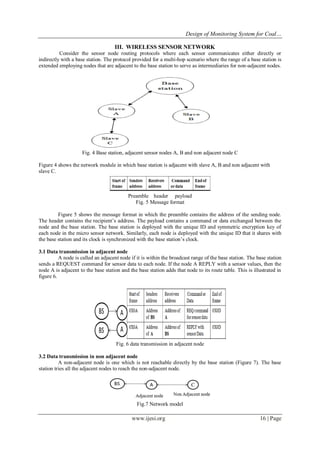
Consider the sensor node routing protocols where each sensor communicates either directly or
indirectly with a base station. The protocol provided for a multi-hop scenario where the range of a base station is
extended employing nodes that are adjacent to the base station to serve as intermediaries for non-adjacent nodes.
Fig. 4 Base station, adjacent sensor nodes A, B and non adjacent node C
Figure 4 shows the network module in which base station is adjacent with slave A, B and non adjacent with
slave C.
Preamble header payload
Fig. 5 Message format
Figure 5 shows the message format in which the preamble contains the address of the sending node.
The header contains the recipient’s address. The payload contains a command or data exchanged between the
node and the base station. The base station is deployed with the unique ID and symmetric encryption key of
each node in the micro sensor network. Similarly, each node is deployed with the unique ID that it shares with
the base station and its clock is synchronized with the base station’s clock.
3.1 Data transmission in adjacent node
A node is called an adjacent node if it is within the broadcast range of the base station. The base station
sends a REQUEST command for sensor data to each node. If the node A REPLY with a sensor values, then the
node A is adjacent to the base station and the base station adds that node to its route table. This is illustrated in
figure 6.
Fig. 6 data transmission in adjacent node
3.2 Data transmission in non adjacent node
A non-adjacent node is one which is not reachable directly by the base station (Figure 7). The base
station tries all the adjacent nodes to reach the non-adjacent node.
Fig.7 Network model
Design of Monitoring System for Coal…
www.ijesi.org 17 | Page
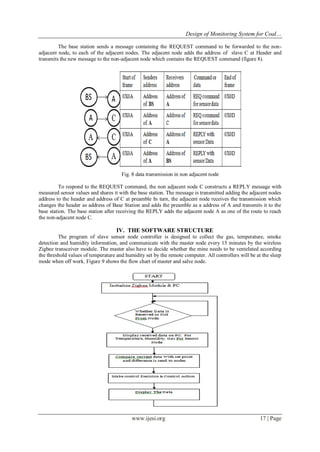
The base station sends a message containing the REQUEST command to be forwarded to the non-
adjacent node, to each of the adjacent nodes. The adjacent node adds the address of slave C at Header and
transmits the new message to the non-adjacent node which contains the REQUEST command (figure 8).
Fig. 8 data transmission in non adjacent node
To respond to the REQUEST command, the non adjacent node C constructs a REPLY message with
measured sensor values and shares it with the base station. The message is transmitted adding the adjacent nodes
address to the header and address of C at preamble In turn, the adjacent node receives the transmission which
changes the header as address of Base Station and adds the preamble as a address of A and transmits it to the
base station. The base station after receiving the REPLY adds the adjacent node A as one of the route to reach
the non-adjacent node C.
IV. THE SOFTWARE STRUCTURE
The program of slave sensor node controller is designed to collect the gas, temperature, smoke
detection and humidity information, and communicate with the master node every 15 minutes by the wireless
Zigbee transceiver module. The master also have to decide whether the mine needs to be ventelated according
the threshold values of temperature and humidity set by the remote computer. All controllers will be at the sleep
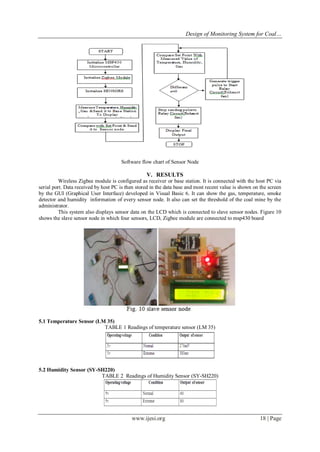
mode when off work. Figure 9 shows the flow chart of master and salve node.
Design of Monitoring System for Coal…
www.ijesi.org 18 | Page
Software flow chart of Sensor Node
V. RESULTS
Wireless Zigbee module is configured as receiver or base station. It is connected with the host PC via
serial port. Data received by host PC is then stored in the data base and most recent value is shown on the screen
by the GUI (Graphical User Interface) developed in Visual Basic 6. It can show the gas, temperature, smoke
detector and humidity information of every sensor node. It also can set the threshold of the coal mine by the
administrator.
This system also displays sensor data on the LCD which is connected to slave sensor nodes. Figure 10
shows the slave sensor node in which four sensors, LCD, Zigbee module are connected to msp430 board
5.1 Temperature Sensor (LM 35)
TABLE 1 Readings of temperature sensor (LM 35)
5.2 Humidity Sensor (SY-SH220)
TABLE 2 Readings of Humidity Sensor (SY-SH220)
Design of Monitoring System for Coal…
www.ijesi.org 19 | Page
5.3 Gas Sensor (MQ-6)
TABLE 3 Readings of Gas Sensor
5.4 Smoke dector
TABLE 4 Readings of Smoke Sensor
VI. CONCLUSION
Wireless sensor network has great impact on industry and our daily life, this Project presents a coal
mine safety monitoring system based on wireless sensor networks, and hardware and software design of
wireless sensor network are described in detail, this system can detect concentration of the gas, temperature,
humidity, Smoke and trace the location of miners in underground mine tunnels. Wireless sensor networks
applied in monitoring coal mine security breaks through the traditional methods and ideas, which improves the
practical ability and flexibility of monitoring system. This system not only can monitor all kinds of
parameters under the coal mine, but also can alarm automatically when environment parameters are
abnormal to exceed the limitation, which help improve the level of monitoring safety production and reduce
accident in the coal mine. Therefore, the coal mine Safety Monitoring system put forward in this article quite
meets the need of coal mine safety monitoring.
REFERENCES
[1]. Rong Yan. Design of Mine Safety Monitoring System Based on the Wireless Network [D]. Ji’nan: Shandong University, 2007
[2]. Yu Hai-bin, Zeng Peng. Intelligent Wireless Sensor Network Systems [M]. Beijing: Science Press, 2006
[3]. “AQ6209-2007 Digital methane detecting and alarm miner’s lamp”,Industry standards for Safety production of P.R. China,
January, 2007.
[4]. Qiao Ying-xu, Design of Wireless Sensor Networks Node Based OnTinyOS Operating System.The 3th International Conference
on Computer Science and Education[C] 2008.7 1201-1204
[5]. Tao Zhiyong, Li Xin. “Wireless Temperature System Design Based on nRF905”, Journal of Zhongguo Technology Imformation,
2007.22, p.53.
[6]. Nordic VLSL Single chip 433/868/9 15MHZ Transceiver nRF905,Reversion; l.1 July2004,1-3.
[7]. Zhanglin Guo, Chao Zhang, Jing Zhang,”The Study of Coal Mine Safety State Warning and Assistant Decision-making
Support Systems Construction ,”2008
[8]. Yang Zhou et al. “Wireless temperature & humidity monitor and control system” Hangzhou dianzi University
[9]. Electronic information institute,Hangzhou,China.2012 IEEE,pp. 2246-2250
AUTHORS:
Mr. Kumarsagar M. Dange received BE Electronics from Rajarambapu Institute of
Technology, Sakharale and now studying M.Tech (Electronics) in Rajarambapu
Institute of Technology, Sakharale.
Prof. R.T. Patil received the ME in Electronics and currently working as associate
professor in Rajarambapu Institute of Technology, Sakharale. His area of
specialization is VLSI, Embedded Systems, Microprocessor and Microcontroller.

International Journal of Engineering and Science Invention (IJESI)

  • 1.
    International Journal ofEngineering Science Invention ISSN (Online): 2319 – 6734, ISSN (Print): 2319 – 6726 www.ijesi.org Volume 2 Issue 7 ǁ July. 2013 ǁ PP.14-19 www.ijesi.org 14 | Page Design of Monitoring System for Coal Mine Safety Based on MSP430 Mr. Kumarsagar. M. Dange 1 , Prof. R. T. Patil.2 1 Master of Technology. Department of Electronics & Telecommunication Rajarambapu Institute of Technology, Sakharale, M.S., India 2 Asso. Prof. Department of Electronics & Telecommunication Rajarambapu Institute of Technology, Sakharale, M.S., India ABSTRACT: Now a day’s due to global warming and climate changes there are challenging situations in field of coal mine. To reduce the cost and improve the productivity along with product quality the automisation in the field of coal mine is indeed necessary, which will also reduce the mine workers efforts. This paper proposes a design of a wireless sensor network (WSN) with the help of MSP430xx controller which is able to monitor the temperature, humidity, gas and status of smoke in anunder ground mine. This system also controls the ventelation demand to mine workers depending upon present climate conditions within the mine field. This system utilizes low power, cost effective microcontroller MSP430, a temperature sensor LM35, humidity sensor SYSH220, smoke detector, gas sensor for sensing the mine climate parameters and a wireless Zigbee transceiver for remote logging of data at central location to control the climate state with the help of motor and valve control circuitry. KEYWORDS: wireless sensor network, MSP430 controller, Zigbee, LM35, SYSH220. I. INTRODUCTION India is a large country with rich coals. However, the current safe production level of coal mine is still low, especially in recent years, disasters in coal mine occur frequently, which lead to great loss of possession and life. The safety problems of coal mine has gradually become to the focus that the nation and society concern on. The disasters happening in coal mine are due to the complexity of mine environment and the variety of work condition of coal mine, so it is very necessary to monitor mine working environment. Traditional coal mine monitoring systems tend to be wired network systems, which play an important role in coal mine safe production. With continuous enlarging of exploiting areas and extension of depth in coal mine, many laneways become blind areas, where in there are lots of hidden dangers. Moreover, it is inconvenient to lay cables which are expensive and consume time. In order to solve the problems, we will design a coal mine safety monitoring system based on wireless sensor network, which can improve the level of monitoring production safety and reduce accident in the coal mines Wireless sensor networks is composed of a large number of micro-sensor nodes which have small volume and low cost. It possesses self-organized capability by wireless Communication. In recent years, it is widely used in the fields of our lives, scientific research, military, intelligent traffic, environmental monitoring, intelligent weapon, and so on. Compared to the traditional mine monitoring, we use wireless sensor networks in coal mine safety monitoring. It has three significant advantages: (1) It is unnecessary to lay cables, and can be installed in monitoring blind areas to reduce the costs of extending the system. More number of nodes can be arranged to eliminate blind areas. Wireless sensor nodes can make general communication and allocate the goal; (2) The nodes are dense, which can ensure data acquisition high accuracy and efficiency of data transmission, and realize the real-time monitoring of coal mine working environment; (3) Sensor nodes with a certain computing ability, storage capacity, data fusion are ideal for remote monitoring. Therefore we can make use of the wireless sensor network to monitor Production safety of coal mine. II. SYSTEM ARCHITECTURE Following is the block diagram of the proposed system.
  • 2.
    Design of MonitoringSystem for Coal… www.ijesi.org 15 | Page Fig.2 Master FIG.1.Proposed System’s Block Diagram The system architecture is as shown in figure1. System consists of slave as sensor nodes and master control unit with wireless zigbee module. The master node will collect the information of temperature, humidity, gas and smoke detection these parameters from slave nodes and depending on values of slave sensor nodes, the PC or master will give command to the ventilating fan driver circuitry of slave through wireless Zigbee module and then Exhaust fans will start doing operation. 2.2 Master node architecture The master node architecture is as shown in figure 2.The master node and the slave nodes will be deployed with unique ID. The master node will send request packet to slave node ID via zigbee wireless module. In response the requested slave sensor node sends the data packet of four type’s sensors values to the master node ID which provides routing security to the network. 2.3 Slave sensor node architecture The proposed node system of wireless sensor network consists of Zigbee wireless transceiver module, low power MSP430 as MCU of the system and sensors of temperature, humidity, rain detection and soil moisture and motor valve control circuit for controlling the solenoid valves. SPI serial communication port connects the Zigbee wireless communication module and the microcontroller module. The Slave sensor node architecture is as shown in figure 3. The slave node 1 is same as slave node 2 and 3 only the motor valve control circuitry is absent in slave node 2 and 3 which is used to control the valve mechanism . Fig. 3 Slave sensor node Architecture The MSP430 controller is low power and cost effective and uses five low-power modes. The MSP430G2553 series are ultra-low-power mixed signal microcontrollers with built-in 16-bit timers, up to 24 I/O touch-sense-enabled pins, a versatile analog comparator, and built-in communication capability using the universal serial communication interface. In addition have a 10-bit analog-to-digital (A/D) converter. Wireless Zigbee module Tarang F4 is IEEE 802.15.4 compatible wireless communications standard. It operates on 3.3v. Its operating frequency is ISM 2.4 GHz. RF data rate is 250 kbps. Indoor Communication range is 100 ft (30 m) and outdoor line-of-sight range is 300 ft (90 m). The humidity sensor module SY-SH220 converts relative humidity (30-90%RH) to voltage with linearity of 0.33mV/%RH and can be used in weather monitoring application. The temperature sensor LM35 is precision integrated-circuit temperature sensor, whose output voltage is linearly proportional to the Celsius (Centigrade) temperature as + 10mV/°C. The LM35 is rated to operate over a −55° to +150°C temperature range. A smoke detector is a device that detects smoke, typically as an indicator of fire. Commercial, industrial, and mass residential devices issue a signal to a fire alarm system, while household detectors, known as smoke alarms, generally issue a local audible or visual alarm from the detector itself. Sensitive material of MQ-6 gas sensor is SnO2, which with lower conductivity in clean air. When the target combustible gas exist, The sensor’s conductivity is more higher along with the gas concentration rising. Please use simple electro circuit, Convert change of conductivity to correspond output signal of gas concentration. MQ-6 gas sensor has high sensitity to Propane, Butane and LPG, also response to Natural gas. The sensor could be used to detect different combustible gas, especially Methane; it is with low cost and suitable for different application.
  • 3.
    Design of MonitoringSystem for Coal… www.ijesi.org 16 | Page III. WIRELESS SENSOR NETWORK Consider the sensor node routing protocols where each sensor communicates either directly or indirectly with a base station. The protocol provided for a multi-hop scenario where the range of a base station is extended employing nodes that are adjacent to the base station to serve as intermediaries for non-adjacent nodes. Fig. 4 Base station, adjacent sensor nodes A, B and non adjacent node C Figure 4 shows the network module in which base station is adjacent with slave A, B and non adjacent with slave C. Preamble header payload Fig. 5 Message format Figure 5 shows the message format in which the preamble contains the address of the sending node. The header contains the recipient’s address. The payload contains a command or data exchanged between the node and the base station. The base station is deployed with the unique ID and symmetric encryption key of each node in the micro sensor network. Similarly, each node is deployed with the unique ID that it shares with the base station and its clock is synchronized with the base station’s clock. 3.1 Data transmission in adjacent node A node is called an adjacent node if it is within the broadcast range of the base station. The base station sends a REQUEST command for sensor data to each node. If the node A REPLY with a sensor values, then the node A is adjacent to the base station and the base station adds that node to its route table. This is illustrated in figure 6. Fig. 6 data transmission in adjacent node 3.2 Data transmission in non adjacent node A non-adjacent node is one which is not reachable directly by the base station (Figure 7). The base station tries all the adjacent nodes to reach the non-adjacent node. Fig.7 Network model
  • 4.
    Design of MonitoringSystem for Coal… www.ijesi.org 17 | Page The base station sends a message containing the REQUEST command to be forwarded to the non- adjacent node, to each of the adjacent nodes. The adjacent node adds the address of slave C at Header and transmits the new message to the non-adjacent node which contains the REQUEST command (figure 8). Fig. 8 data transmission in non adjacent node To respond to the REQUEST command, the non adjacent node C constructs a REPLY message with measured sensor values and shares it with the base station. The message is transmitted adding the adjacent nodes address to the header and address of C at preamble In turn, the adjacent node receives the transmission which changes the header as address of Base Station and adds the preamble as a address of A and transmits it to the base station. The base station after receiving the REPLY adds the adjacent node A as one of the route to reach the non-adjacent node C. IV. THE SOFTWARE STRUCTURE The program of slave sensor node controller is designed to collect the gas, temperature, smoke detection and humidity information, and communicate with the master node every 15 minutes by the wireless Zigbee transceiver module. The master also have to decide whether the mine needs to be ventelated according the threshold values of temperature and humidity set by the remote computer. All controllers will be at the sleep mode when off work. Figure 9 shows the flow chart of master and salve node.
  • 5.
    Design of MonitoringSystem for Coal… www.ijesi.org 18 | Page Software flow chart of Sensor Node V. RESULTS Wireless Zigbee module is configured as receiver or base station. It is connected with the host PC via serial port. Data received by host PC is then stored in the data base and most recent value is shown on the screen by the GUI (Graphical User Interface) developed in Visual Basic 6. It can show the gas, temperature, smoke detector and humidity information of every sensor node. It also can set the threshold of the coal mine by the administrator. This system also displays sensor data on the LCD which is connected to slave sensor nodes. Figure 10 shows the slave sensor node in which four sensors, LCD, Zigbee module are connected to msp430 board 5.1 Temperature Sensor (LM 35) TABLE 1 Readings of temperature sensor (LM 35) 5.2 Humidity Sensor (SY-SH220) TABLE 2 Readings of Humidity Sensor (SY-SH220)
  • 6.
    Design of MonitoringSystem for Coal… www.ijesi.org 19 | Page 5.3 Gas Sensor (MQ-6) TABLE 3 Readings of Gas Sensor 5.4 Smoke dector TABLE 4 Readings of Smoke Sensor VI. CONCLUSION Wireless sensor network has great impact on industry and our daily life, this Project presents a coal mine safety monitoring system based on wireless sensor networks, and hardware and software design of wireless sensor network are described in detail, this system can detect concentration of the gas, temperature, humidity, Smoke and trace the location of miners in underground mine tunnels. Wireless sensor networks applied in monitoring coal mine security breaks through the traditional methods and ideas, which improves the practical ability and flexibility of monitoring system. This system not only can monitor all kinds of parameters under the coal mine, but also can alarm automatically when environment parameters are abnormal to exceed the limitation, which help improve the level of monitoring safety production and reduce accident in the coal mine. Therefore, the coal mine Safety Monitoring system put forward in this article quite meets the need of coal mine safety monitoring. REFERENCES [1]. Rong Yan. Design of Mine Safety Monitoring System Based on the Wireless Network [D]. Ji’nan: Shandong University, 2007 [2]. Yu Hai-bin, Zeng Peng. Intelligent Wireless Sensor Network Systems [M]. Beijing: Science Press, 2006 [3]. “AQ6209-2007 Digital methane detecting and alarm miner’s lamp”,Industry standards for Safety production of P.R. China, January, 2007. [4]. Qiao Ying-xu, Design of Wireless Sensor Networks Node Based OnTinyOS Operating System.The 3th International Conference on Computer Science and Education[C] 2008.7 1201-1204 [5]. Tao Zhiyong, Li Xin. “Wireless Temperature System Design Based on nRF905”, Journal of Zhongguo Technology Imformation, 2007.22, p.53. [6]. Nordic VLSL Single chip 433/868/9 15MHZ Transceiver nRF905,Reversion; l.1 July2004,1-3. [7]. Zhanglin Guo, Chao Zhang, Jing Zhang,”The Study of Coal Mine Safety State Warning and Assistant Decision-making Support Systems Construction ,”2008 [8]. Yang Zhou et al. “Wireless temperature & humidity monitor and control system” Hangzhou dianzi University [9]. Electronic information institute,Hangzhou,China.2012 IEEE,pp. 2246-2250 AUTHORS: Mr. Kumarsagar M. Dange received BE Electronics from Rajarambapu Institute of Technology, Sakharale and now studying M.Tech (Electronics) in Rajarambapu Institute of Technology, Sakharale. Prof. R.T. Patil received the ME in Electronics and currently working as associate professor in Rajarambapu Institute of Technology, Sakharale. His area of specialization is VLSI, Embedded Systems, Microprocessor and Microcontroller.