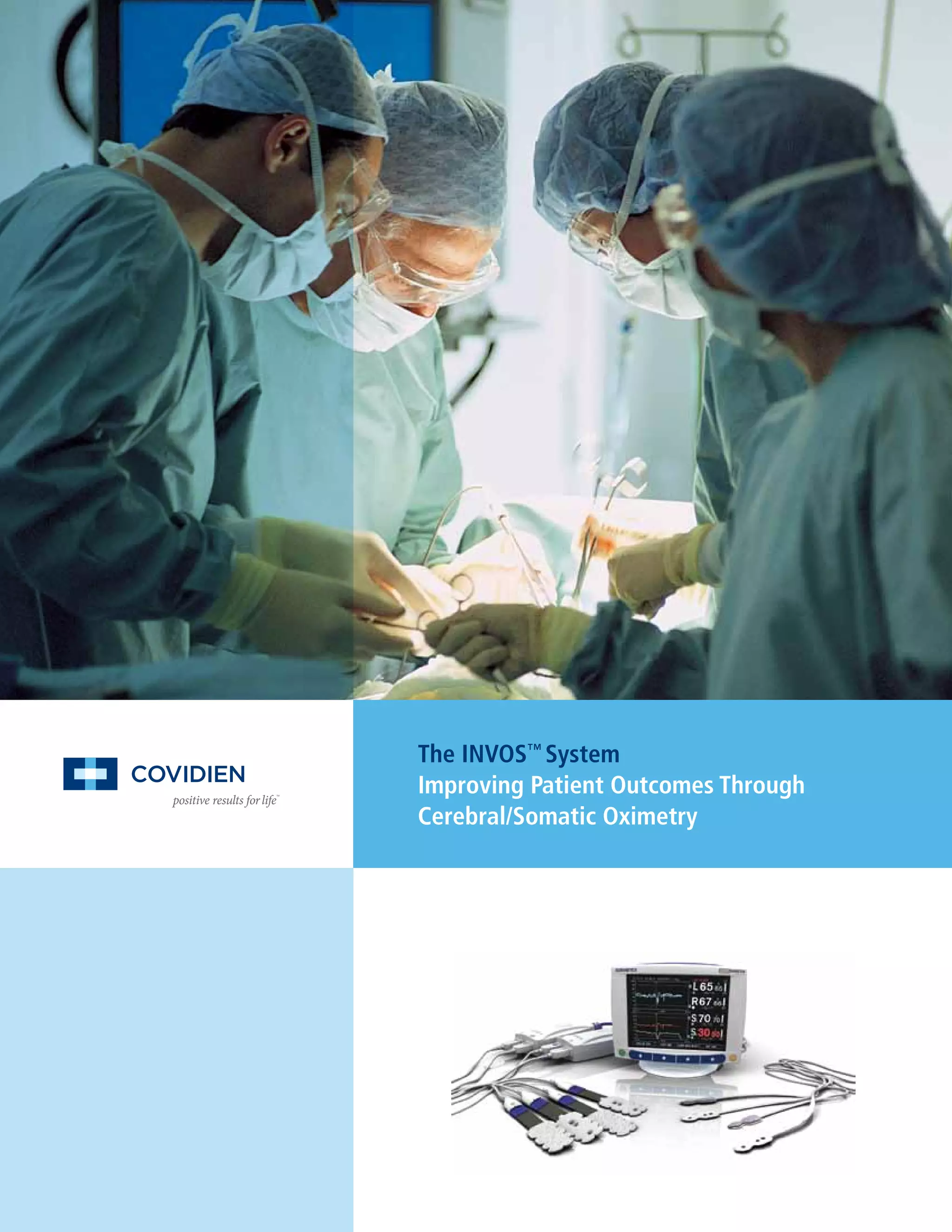
The INVOS™ System
Improving Patient Outcomes Through
Cerebral/Somatic Oximetry
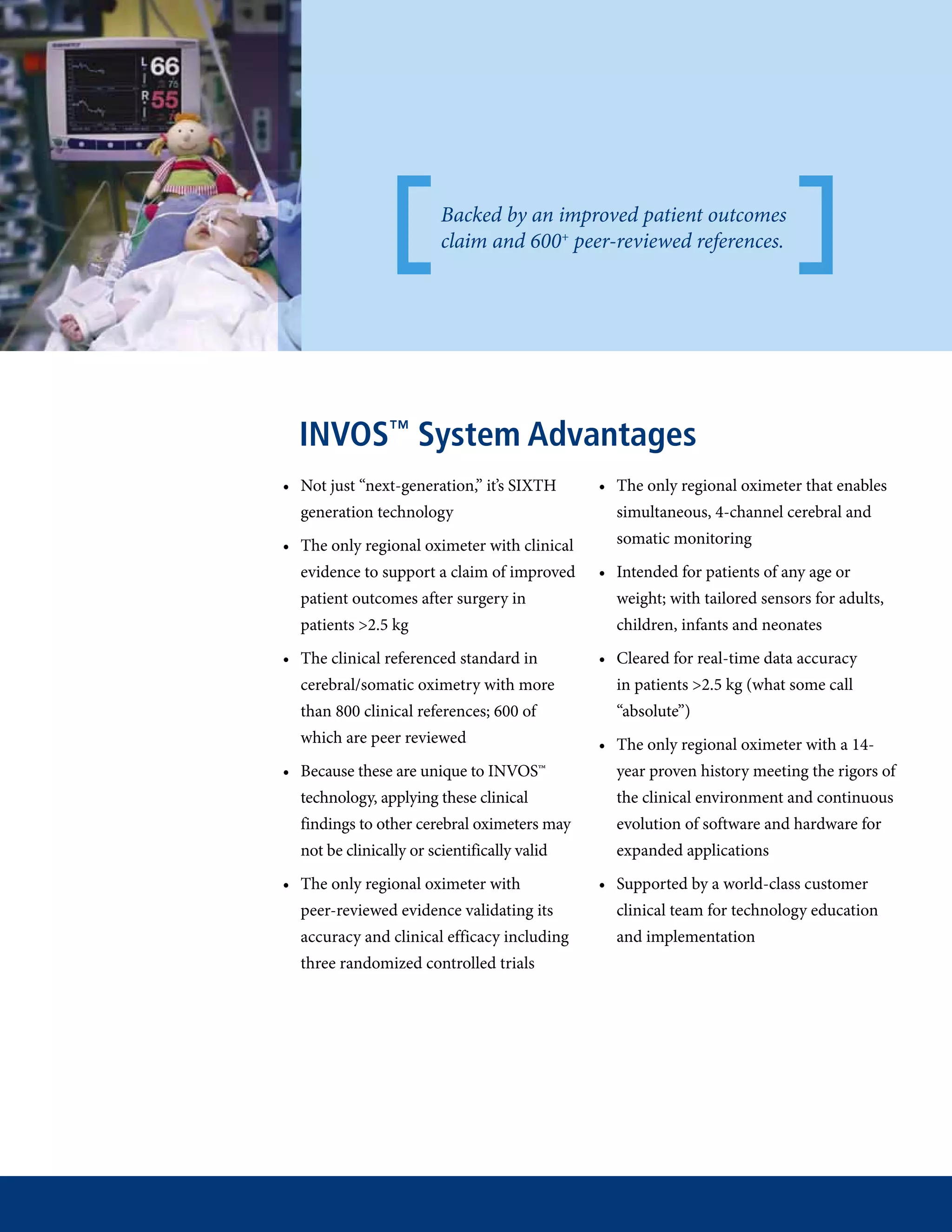
Backed by an improved patient outcomes
claim and 600+ peer-reviewed references.

INVOS™ System Advantages
•	 Not just “next-generation,” it’s SIXTH
generation technology
•	 The only regional oximeter with clinical
evidence to support a claim of improved

• 	 The only regional oximeter that enables
simultaneous, 4-channel cerebral and
somatic monitoring
•	 Intended for patients of any age or

patient outcomes after surgery in

weight; with tailored sensors for adults,

patients >2.5 kg

children, infants and neonates

•	 The clinical referenced standard in

•	 Cleared for real-time data accuracy

cerebral/somatic oximetry with more

in patients >2.5 kg (what some call

than 800 clinical references; 600 of

“absolute”)

which are peer reviewed

•	 The only regional oximeter with a 14-

•	 Because these are unique to INVOS™

year proven history meeting the rigors of

technology, applying these clinical

the clinical environment and continuous

findings to other cerebral oximeters may

evolution of software and hardware for

not be clinically or scientifically valid

expanded applications

•	 The only regional oximeter with

•	 Supported by a world-class customer

peer-reviewed evidence validating its

clinical team for technology education

accuracy and clinical efficacy including

and implementation

three randomized controlled trials
Not just “Next-Gen,”
it’s SIXTH generation technology
With new cerebral oximeters entering the market, you may be wondering which is the
best fit for your institution. In the INVOS™ System, you will find the only cerebral/
somatic oximeter backed by an improved patient outcomes claim.1-3 We attained this
through a commitment to clinical research and independent investigations that have led
to expanded clinical applications and foundations for patient care. It also resulted in 800+
clinical references unique to our product – of which 600 are peer reviewed – making the
INVOS™ System the referenced standard in clinical academia and the medical device
industry. In addition, we continually invest in innovating INVOS™ technology to further
increase its clinical utility and ability to improve patient care. When partnering with
us you’ll have the confidence that comes from a technology proven to make a positive
clinical impact and from the support of an expert sales and clinical education team.

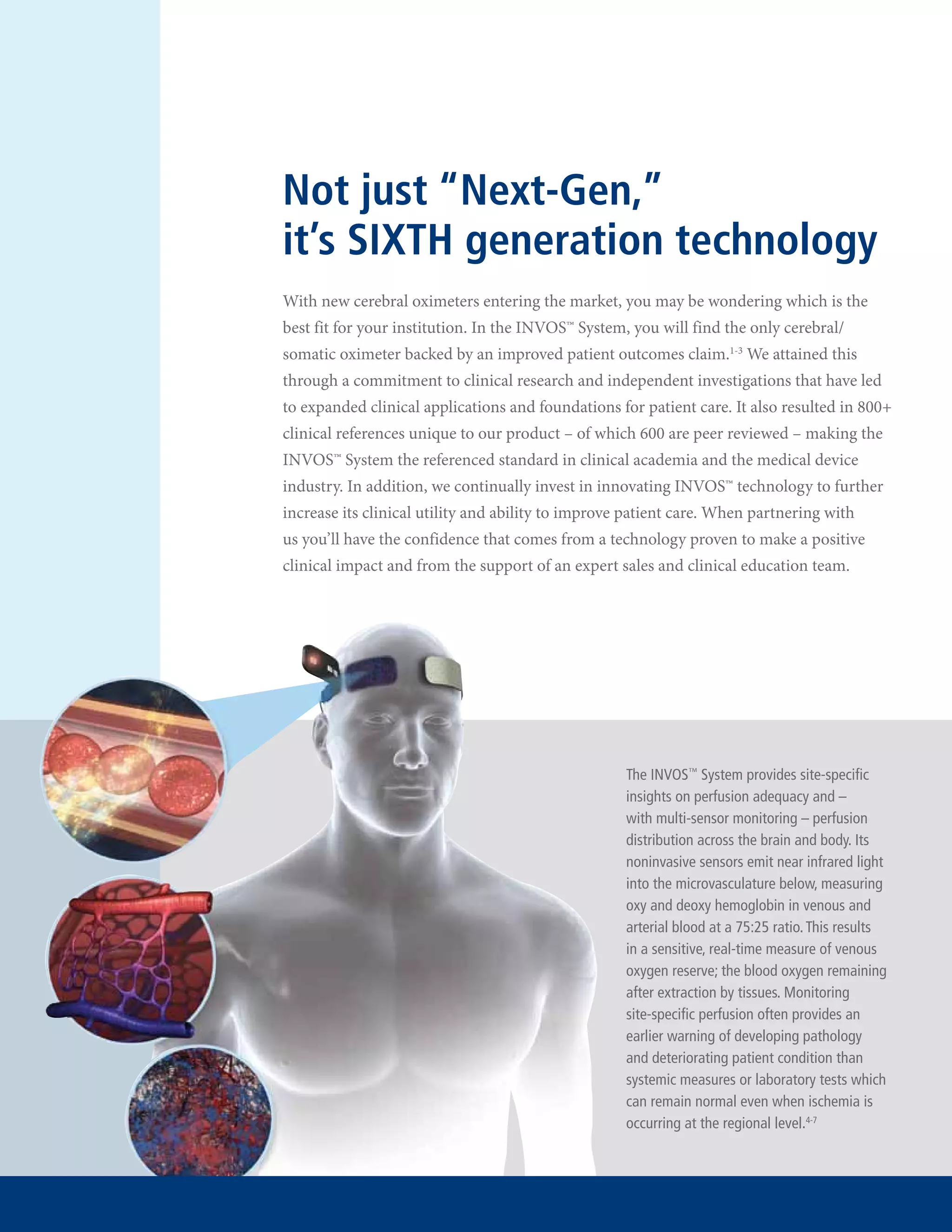
The INVOS™ System provides site-specific
insights on perfusion adequacy and –
with multi-sensor monitoring – perfusion
distribution across the brain and body. Its
noninvasive sensors emit near infrared light
into the microvasculature below, measuring
oxy and deoxy hemoglobin in venous and
arterial blood at a 75:25 ratio. This results
in a sensitive, real-time measure of venous
oxygen reserve; the blood oxygen remaining
after extraction by tissues. Monitoring
site-specific perfusion often provides an
earlier warning of developing pathology
and deteriorating patient condition than
systemic measures or laboratory tests which
can remain normal even when ischemia is
occurring at the regional level.4-7
What about baselines?
The INVOS™ System provides real-time measurement
and display of regional oxygen saturation (rSO2) in the
microvasculature beneath the sensor. This data provides
critical insight into site-specific hemodynamics and perfusion
status. The INVOS™ System features an optional baseline
setting which adds additional dimension and value to the rSO2
measurement. Continuous monitoring from a baseline provides
an early warning of developing pathology and deteriorating
patient condition.8-11 And, since there are natural variations in
patient “normals,” a baseline can help show where your patient
falls on this bell curve so you can customize care unique to
the individual. Patient baselines also enable compliance with
STS Adult Cardiac Surgery and Congenital Heart Database
collection. These databases collect patient baseline data as
well as cumulative saturation below threshold (an area-underthe-curve measure). With INVOS™ System software, baseline
settings can trigger the automatic collection and calculation of
area under the curve.
In fact, a 2010 query of The STS Adult Cardiac Surgery Database
showed a 23% incidence rate (8,406 of 36,548 procedures) for
cerebral oximetry providing the first indication of a technical
problem or physiological change in the patient that could
potentially lead to an adverse patient outcome.12-13  Without
baseline data, this clinical revelation may not have come to light.
As with EEG, TCD and BP monitoring, utilizing baseline data is
just good medicine.
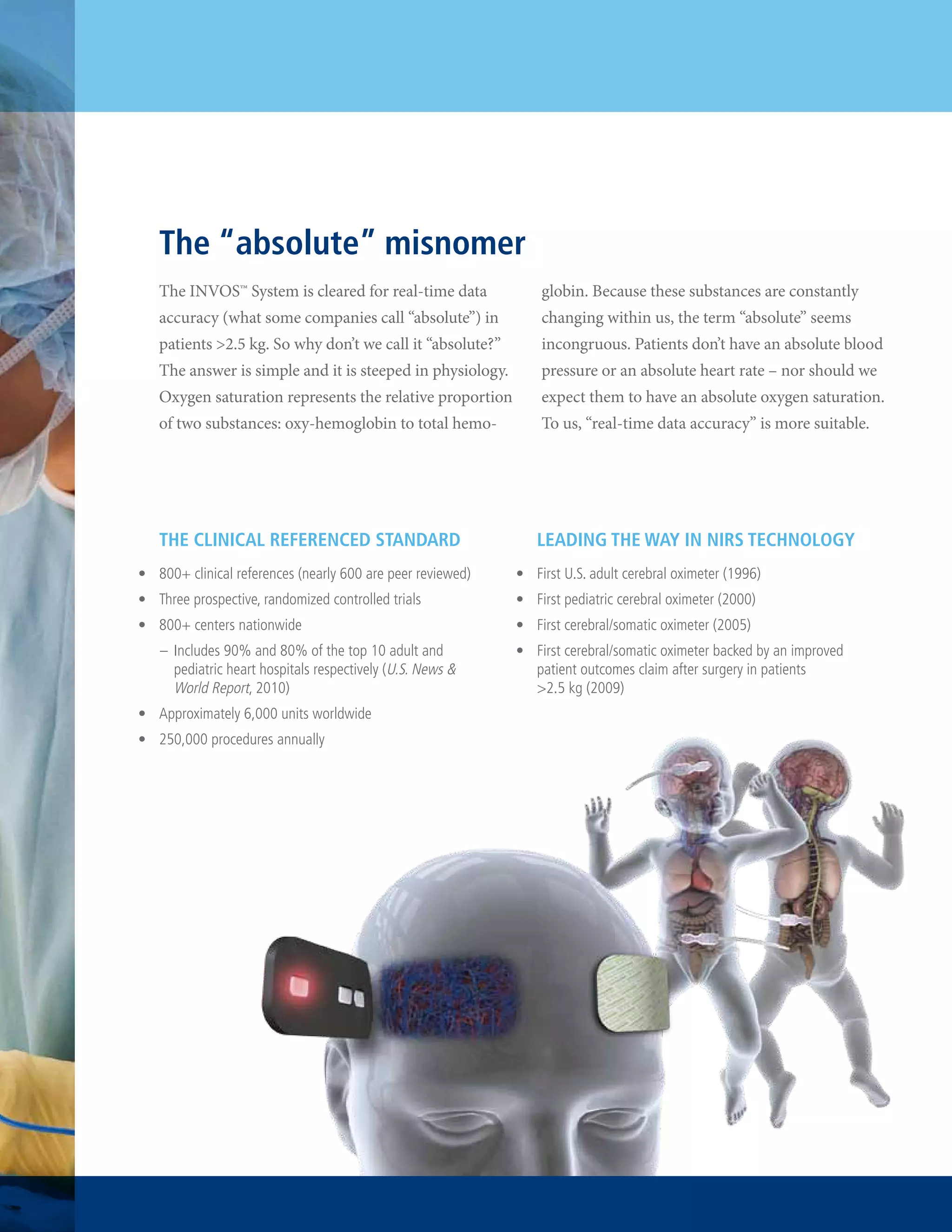
The “absolute” misnomer
The INVOS™ System is cleared for real-time data

globin. Because these substances are constantly

accuracy (what some companies call “absolute”) in

changing within us, the term “absolute” seems

patients >2.5 kg. So why don’t we call it “absolute?”

incongruous. Patients don’t have an absolute blood

The answer is simple and it is steeped in physiology.

pressure or an absolute heart rate – nor should we

Oxygen saturation represents the relative proportion

expect them to have an absolute oxygen saturation.

of two substances: oxy-hemoglobin to total hemo-

To us, “real-time data accuracy” is more suitable.

The Clinical Referenced Standard

Leading the Way in NIRS Technology

•	 800+ clinical references (nearly 600 are peer reviewed)

•	 First U.S. adult cerebral oximeter (1996)

•	 Three prospective, randomized controlled trials

•	 First pediatric cerebral oximeter (2000)

•	 800+ centers nationwide

•	 First cerebral/somatic oximeter (2005)

–	 Includes 90% and 80% of the top 10 adult and
pediatric heart hospitals respectively (U.S. News &
World Report, 2010)
•	 Approximately 6,000 units worldwide
•	 250,000 procedures annually

•	 First cerebral/somatic oximeter backed by an improved
patient outcomes claim after surgery in patients
>2.5 kg (2009)
References
1.	 Murkin JM, et al. Anesth Analg. 2007 Jan;104(1):51-8.
2.	 Casati A, et al. Anesth Analg. 2005 Sep;101(3):740-7.
3.	 http://www.accessdata.fda.gov/cdrh_docs/pdf8/K082327.pdf
4.	 Janelle GM, et al. Anesthesiology. 2002;96:1263-65.
5.	 Gottlieb EA, et al. Paediatr Anaesth. 2006;16(7):787-89.
6.	 Blas M, et al. J Cardiothorac Vasc Anesth. 1999;13:244-45.
7.	 Tobias JD. J Intensive Care Med. 2008;23:384-8.
8.	 Aron JH Anesth Analg. 2007;104:1034-6
9.	 Alie RF J Cardiothorac Vasc Anesth. 2010;24:300-2
10.	 Joshi RK Ped Anesth. 2006;16:178-81
11.	 Schwarz JM J Cardiothorac Vasc Anesth. 2007;22:95-7
12.	 Analysis based on cerebral oximetry data from 36,548 procedures submitted from January 1, 2008 to December 31, 2009. Adult
Cardiac Surgery Data Collection, STS Adult Cardiac Database, Version 2.61 Data Specifications (http://www.sts.org/documents/pdf
AdultCVDataSpecifications2.61.pdf)
13. Avery EG. INVOS Cerebral Oximeter Clinical White Paper Series. 2010;SMS1415(1).
COVIDIEN, COVIDIEN with logo, Covidien logo and positive results for life are U.S. and internationally registered trademarks of Covidien AG.
Other brands are trademarks of a Covidien company. ™* are trademarks of their respective owners. ©2011 Covidien. All rights reserved.
11-PM-0256 MN21010

6135 Gunbarrel Avenue
Boulder, CO
80301
800-635-5267

www.covidien.com
www.somanetics.com

Invos

  • 1.
    The INVOS™ System ImprovingPatient Outcomes Through Cerebral/Somatic Oximetry
  • 2.
    Backed by animproved patient outcomes claim and 600+ peer-reviewed references. INVOS™ System Advantages • Not just “next-generation,” it’s SIXTH generation technology • The only regional oximeter with clinical evidence to support a claim of improved • The only regional oximeter that enables simultaneous, 4-channel cerebral and somatic monitoring • Intended for patients of any age or patient outcomes after surgery in weight; with tailored sensors for adults, patients >2.5 kg children, infants and neonates • The clinical referenced standard in • Cleared for real-time data accuracy cerebral/somatic oximetry with more in patients >2.5 kg (what some call than 800 clinical references; 600 of “absolute”) which are peer reviewed • The only regional oximeter with a 14- • Because these are unique to INVOS™ year proven history meeting the rigors of technology, applying these clinical the clinical environment and continuous findings to other cerebral oximeters may evolution of software and hardware for not be clinically or scientifically valid expanded applications • The only regional oximeter with • Supported by a world-class customer peer-reviewed evidence validating its clinical team for technology education accuracy and clinical efficacy including and implementation three randomized controlled trials
  • 3.
    Not just “Next-Gen,” it’sSIXTH generation technology With new cerebral oximeters entering the market, you may be wondering which is the best fit for your institution. In the INVOS™ System, you will find the only cerebral/ somatic oximeter backed by an improved patient outcomes claim.1-3 We attained this through a commitment to clinical research and independent investigations that have led to expanded clinical applications and foundations for patient care. It also resulted in 800+ clinical references unique to our product – of which 600 are peer reviewed – making the INVOS™ System the referenced standard in clinical academia and the medical device industry. In addition, we continually invest in innovating INVOS™ technology to further increase its clinical utility and ability to improve patient care. When partnering with us you’ll have the confidence that comes from a technology proven to make a positive clinical impact and from the support of an expert sales and clinical education team. The INVOS™ System provides site-specific insights on perfusion adequacy and – with multi-sensor monitoring – perfusion distribution across the brain and body. Its noninvasive sensors emit near infrared light into the microvasculature below, measuring oxy and deoxy hemoglobin in venous and arterial blood at a 75:25 ratio. This results in a sensitive, real-time measure of venous oxygen reserve; the blood oxygen remaining after extraction by tissues. Monitoring site-specific perfusion often provides an earlier warning of developing pathology and deteriorating patient condition than systemic measures or laboratory tests which can remain normal even when ischemia is occurring at the regional level.4-7
  • 4.
    What about baselines? TheINVOS™ System provides real-time measurement and display of regional oxygen saturation (rSO2) in the microvasculature beneath the sensor. This data provides critical insight into site-specific hemodynamics and perfusion status. The INVOS™ System features an optional baseline setting which adds additional dimension and value to the rSO2 measurement. Continuous monitoring from a baseline provides an early warning of developing pathology and deteriorating patient condition.8-11 And, since there are natural variations in patient “normals,” a baseline can help show where your patient falls on this bell curve so you can customize care unique to the individual. Patient baselines also enable compliance with STS Adult Cardiac Surgery and Congenital Heart Database collection. These databases collect patient baseline data as well as cumulative saturation below threshold (an area-underthe-curve measure). With INVOS™ System software, baseline settings can trigger the automatic collection and calculation of area under the curve. In fact, a 2010 query of The STS Adult Cardiac Surgery Database showed a 23% incidence rate (8,406 of 36,548 procedures) for cerebral oximetry providing the first indication of a technical problem or physiological change in the patient that could potentially lead to an adverse patient outcome.12-13 Without baseline data, this clinical revelation may not have come to light. As with EEG, TCD and BP monitoring, utilizing baseline data is just good medicine.
  • 5.
    The “absolute” misnomer TheINVOS™ System is cleared for real-time data globin. Because these substances are constantly accuracy (what some companies call “absolute”) in changing within us, the term “absolute” seems patients >2.5 kg. So why don’t we call it “absolute?” incongruous. Patients don’t have an absolute blood The answer is simple and it is steeped in physiology. pressure or an absolute heart rate – nor should we Oxygen saturation represents the relative proportion expect them to have an absolute oxygen saturation. of two substances: oxy-hemoglobin to total hemo- To us, “real-time data accuracy” is more suitable. The Clinical Referenced Standard Leading the Way in NIRS Technology • 800+ clinical references (nearly 600 are peer reviewed) • First U.S. adult cerebral oximeter (1996) • Three prospective, randomized controlled trials • First pediatric cerebral oximeter (2000) • 800+ centers nationwide • First cerebral/somatic oximeter (2005) – Includes 90% and 80% of the top 10 adult and pediatric heart hospitals respectively (U.S. News & World Report, 2010) • Approximately 6,000 units worldwide • 250,000 procedures annually • First cerebral/somatic oximeter backed by an improved patient outcomes claim after surgery in patients >2.5 kg (2009)
  • 6.
    References 1. Murkin JM,et al. Anesth Analg. 2007 Jan;104(1):51-8. 2. Casati A, et al. Anesth Analg. 2005 Sep;101(3):740-7. 3. http://www.accessdata.fda.gov/cdrh_docs/pdf8/K082327.pdf 4. Janelle GM, et al. Anesthesiology. 2002;96:1263-65. 5. Gottlieb EA, et al. Paediatr Anaesth. 2006;16(7):787-89. 6. Blas M, et al. J Cardiothorac Vasc Anesth. 1999;13:244-45. 7. Tobias JD. J Intensive Care Med. 2008;23:384-8. 8. Aron JH Anesth Analg. 2007;104:1034-6 9. Alie RF J Cardiothorac Vasc Anesth. 2010;24:300-2 10. Joshi RK Ped Anesth. 2006;16:178-81 11. Schwarz JM J Cardiothorac Vasc Anesth. 2007;22:95-7 12. Analysis based on cerebral oximetry data from 36,548 procedures submitted from January 1, 2008 to December 31, 2009. Adult Cardiac Surgery Data Collection, STS Adult Cardiac Database, Version 2.61 Data Specifications (http://www.sts.org/documents/pdf AdultCVDataSpecifications2.61.pdf) 13. Avery EG. INVOS Cerebral Oximeter Clinical White Paper Series. 2010;SMS1415(1). COVIDIEN, COVIDIEN with logo, Covidien logo and positive results for life are U.S. and internationally registered trademarks of Covidien AG. Other brands are trademarks of a Covidien company. ™* are trademarks of their respective owners. ©2011 Covidien. All rights reserved. 11-PM-0256 MN21010 6135 Gunbarrel Avenue Boulder, CO 80301 800-635-5267 www.covidien.com www.somanetics.com