SEL Manufacturing Company Investor Presentation 8 TH   JUNE 2008 www.selmanufacturing.com
Disclaimer This presentation contains selected information regarding SEL Manufacturing Company Limited ( “Company”). It does not purport to be comprehensive or to contain all of the information that a prospective investor may desire in investigating the Company or in trading in the securities of the Company; hence each prospective investor should conduct its own independent due diligence in this regard and seek the advice of its own professional advisors. The information contained in this presentation has not been independently verified by the Company or it’s advisors. Neither the Company nor any of its affiliates, advisers, officers, representatives or agents make or will make any representation or warranty, express or implied, as to the accuracy or completeness of the information contained herein, and any and all legal liability or responsibility is expressly disclaimed based on or relating to: (i) information contained in, or errors in or omissions from this presentation, or (ii) the recipient’s use of this presentation, or (iii) any other written or oral communications transmitted to the recipient or its affiliates, advisers, officers, representatives or agents in the course of its evaluation of the Company or its securities. Accordingly, no information contained in this presentation or any written or oral communication transmitted or made available to a recipient of this presentation : (i) is, or shall be relied upon, as a promise or representation, whether as to the past or future performance; or (ii) will form the basis of any contract This presentation includes statements, which may constitute forward-looking statements. Although the Company believes that the expectations contained in such forward–looking statements are conservative and reasonable, they involve many subjective assumptions and are subject to risks and uncertainties, which could cause actual results to differ materially. Such statements are not guarantees of future performance. Accordingly, the Company and its respective affiliates, advisers, officers, representatives or agents give no (and will not give any) assurances, and no representation or warranties can be or will be made, as to the accuracy or attainability of such projections, estimates or other forward-looking statements No part of this  presentation  may be distributed, reproduced, taken or transmitted into the United States, Canada or Japan. This  presentation  is neither an offering memorandum nor an offer or an invitation for the sale or purchase of any securities of the Company nor a recommendation in relation to the foregoing. It is not intended to form, and should not be treated as, the basis of any investment decision
Textile Industry Outlook
Indian Textile Industry Size of Indian Textile Industry is expected to reach to $115 bn by FY 2012 from $ 52 bn in FY 2007. It accounts for about 14% of the Industrial production contributing 4% to the GDP Textile & Apparel export are expected to reach $ 50 bn, garmenting contributing ~ 50%., from $20 bn in FY 2007 Indian Government initiatives on Technology Upgradation Funds: 5 % Interest Rate re-imbursement for garmenting/processing & Power loom 4 % Interest Rate re-imbursement for Spinning India is 2 nd  largest producer of cotton yarn & cotton fabrics According to estimates made by United States Department of Agriculture, India’s cotton output is projected to touch a record 23.9 million bales during 2007-08, up by 9.33 % against 2006-07 Indian textile industry’s thrust on value addition sets it apart from the competitors and therefore enjoys better price realization and a larger market share in profitable segments   Indian textile companies’ backward integration and efforts to enter the branded home-textile space should cushion any pricing pressure
  SWOT ANALYSIS - INDIAN TEXTILE INDUSTRY STRENGTHS AVAILABLITY OF RAW MATERIAL LOW PRODUCTION COSTS TALENTED HUMAN RESOURCE POOL FINANCIAL STRENTHS WEAKNESS INFRASTRUCTURE BOLTTLENECKS COST OF FREIGHT  SMALL CAPACITY, NON COMPOSITE MANUFACTURING FACILITIES. OPPORTUNITIES WORLD MARKET LOOKS AT US – FUTURE MARKET SHARE REPUTATION /COMITTMENT ORGANISED RETAIL IN INDIA MORE DISPOSABLE INCOME – CHANGING LIFESTYLE THREATS RISING REAL ESTATE PRICES LONG DELIVERY TIMES
Indian Textile Industry: Competitiveness India has advantage as far as raw material and labour cost are concerned. This leads to overall cost advantage in favour of India where total cost per kg is only 1.52 USD as compared to 2.28 USD/kg in China and 1.75 USD/kg in USA The world market for technical textiles was estimated to be around 19.68 MMT with a value of US$ 107 billion during 2005 which is expected to increase to 23.77 MMT with a value of USD 127 billion by 2010 Global retailers are looking to diversify their sources of supply from predominantly China to other countries   India’s thrust on value addition is an attempt to differentiate itself from China, which focuses more on volumes and lower prices. Indian companies are striving to offer higher-value-added products, such as higher thread count bed linen, innovative products in terry towels and a wider product range in decorative bed-sets. This approach gives Indian textile companies higher realizations and profitability than those of regional peers
Non Woven & Technical Textile Industry Outlook
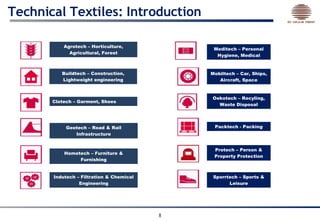
Agrotech – Horticulture, Agricultural, Forest Meditech – Personal Hygiene, Medical Mobiltech – Car, Ships, Aircraft, Space Buildtech – Construction, Lightweight engineering Oekotech – Recyling, Waste Disposal Clotech – Garment, Shoes Packtech - Packing Geotech – Road & Rail Infrastructure Protech – Person & Property Protection Hometech – Furniture & Furnishing Sporrtech – Sports & Leisure Indutech – Filtration & Chemical Engineering Technical Textiles: Introduction
Technical Textiles – World-wide Consumption World Market for technical textiles was estimated to be around 19.68 MT valued at USD 107 billion during 2005, which is expected to increase to 23.77 MT valued at USD 127 billion by 2010 Source: Tex-Summit 2007 held on 31 st  August- 1 st  September 2007, Organised by Ministry of textiles
SIZE OF BABY DIAPER MARKET If you count all of the babies of the world from the age of newborn to 30 months old, there are  321  million babies. If every baby in the world used a disposable diaper we would need 15,600 diapers/sec (490 billion per year). Today, only one in every 5 babies uses a disposable diaper. In year 2025 the world will have  328  million babies If diapers changes are reduced 5% due to better design… Total diaper requirement in 2025 will be reduced   2.9% For year 2025 I expect that more than one third of the babies in the world will use a disposable diaper, almost doubling current volume sales of 2005.
 
What can we learn from the table: China has the largest population of senior citizens and also the biggest growth in the next 20 years. India and the USA will also have significant growth. European countries have marginal growth, Europe is not the “old continent” only because of its buildings…today it is also old because of its people.
Market Share for Baby Diapers 9.0% Vietnam 22.2% Egypt 21.5% Philippines 58.6% Mexico 29.5% Brazil 95.5% United States 4.0% Pakistan 9.0% Indonesia 5.5% China 2.0% India Market Share 2005 Country  (* Nigeria, Bangladesh, Ethiopia and Congo excluded* )
Thank You !!! Contact Person: Mr. Navneet Gupta, Chief Financial Officer  SEL Manufacturing Company Limited, 274, G.T.Road, Dhandhari Khurd, Ludhiana 141 003, Punjab, India Telephone: +91 161 2510270 Fax: +91 161 2510268 Email:  [email_address]

Investor Presentation Textile Sector

  • 1.
    SEL Manufacturing CompanyInvestor Presentation 8 TH JUNE 2008 www.selmanufacturing.com
  • 2.
    Disclaimer This presentationcontains selected information regarding SEL Manufacturing Company Limited ( “Company”). It does not purport to be comprehensive or to contain all of the information that a prospective investor may desire in investigating the Company or in trading in the securities of the Company; hence each prospective investor should conduct its own independent due diligence in this regard and seek the advice of its own professional advisors. The information contained in this presentation has not been independently verified by the Company or it’s advisors. Neither the Company nor any of its affiliates, advisers, officers, representatives or agents make or will make any representation or warranty, express or implied, as to the accuracy or completeness of the information contained herein, and any and all legal liability or responsibility is expressly disclaimed based on or relating to: (i) information contained in, or errors in or omissions from this presentation, or (ii) the recipient’s use of this presentation, or (iii) any other written or oral communications transmitted to the recipient or its affiliates, advisers, officers, representatives or agents in the course of its evaluation of the Company or its securities. Accordingly, no information contained in this presentation or any written or oral communication transmitted or made available to a recipient of this presentation : (i) is, or shall be relied upon, as a promise or representation, whether as to the past or future performance; or (ii) will form the basis of any contract This presentation includes statements, which may constitute forward-looking statements. Although the Company believes that the expectations contained in such forward–looking statements are conservative and reasonable, they involve many subjective assumptions and are subject to risks and uncertainties, which could cause actual results to differ materially. Such statements are not guarantees of future performance. Accordingly, the Company and its respective affiliates, advisers, officers, representatives or agents give no (and will not give any) assurances, and no representation or warranties can be or will be made, as to the accuracy or attainability of such projections, estimates or other forward-looking statements No part of this presentation may be distributed, reproduced, taken or transmitted into the United States, Canada or Japan. This presentation is neither an offering memorandum nor an offer or an invitation for the sale or purchase of any securities of the Company nor a recommendation in relation to the foregoing. It is not intended to form, and should not be treated as, the basis of any investment decision
  • 3.
  • 4.
    Indian Textile IndustrySize of Indian Textile Industry is expected to reach to $115 bn by FY 2012 from $ 52 bn in FY 2007. It accounts for about 14% of the Industrial production contributing 4% to the GDP Textile & Apparel export are expected to reach $ 50 bn, garmenting contributing ~ 50%., from $20 bn in FY 2007 Indian Government initiatives on Technology Upgradation Funds: 5 % Interest Rate re-imbursement for garmenting/processing & Power loom 4 % Interest Rate re-imbursement for Spinning India is 2 nd largest producer of cotton yarn & cotton fabrics According to estimates made by United States Department of Agriculture, India’s cotton output is projected to touch a record 23.9 million bales during 2007-08, up by 9.33 % against 2006-07 Indian textile industry’s thrust on value addition sets it apart from the competitors and therefore enjoys better price realization and a larger market share in profitable segments   Indian textile companies’ backward integration and efforts to enter the branded home-textile space should cushion any pricing pressure
  • 5.
    SWOTANALYSIS - INDIAN TEXTILE INDUSTRY STRENGTHS AVAILABLITY OF RAW MATERIAL LOW PRODUCTION COSTS TALENTED HUMAN RESOURCE POOL FINANCIAL STRENTHS WEAKNESS INFRASTRUCTURE BOLTTLENECKS COST OF FREIGHT SMALL CAPACITY, NON COMPOSITE MANUFACTURING FACILITIES. OPPORTUNITIES WORLD MARKET LOOKS AT US – FUTURE MARKET SHARE REPUTATION /COMITTMENT ORGANISED RETAIL IN INDIA MORE DISPOSABLE INCOME – CHANGING LIFESTYLE THREATS RISING REAL ESTATE PRICES LONG DELIVERY TIMES
  • 6.
    Indian Textile Industry:Competitiveness India has advantage as far as raw material and labour cost are concerned. This leads to overall cost advantage in favour of India where total cost per kg is only 1.52 USD as compared to 2.28 USD/kg in China and 1.75 USD/kg in USA The world market for technical textiles was estimated to be around 19.68 MMT with a value of US$ 107 billion during 2005 which is expected to increase to 23.77 MMT with a value of USD 127 billion by 2010 Global retailers are looking to diversify their sources of supply from predominantly China to other countries   India’s thrust on value addition is an attempt to differentiate itself from China, which focuses more on volumes and lower prices. Indian companies are striving to offer higher-value-added products, such as higher thread count bed linen, innovative products in terry towels and a wider product range in decorative bed-sets. This approach gives Indian textile companies higher realizations and profitability than those of regional peers
  • 7.
    Non Woven &Technical Textile Industry Outlook
  • 8.
    Agrotech – Horticulture,Agricultural, Forest Meditech – Personal Hygiene, Medical Mobiltech – Car, Ships, Aircraft, Space Buildtech – Construction, Lightweight engineering Oekotech – Recyling, Waste Disposal Clotech – Garment, Shoes Packtech - Packing Geotech – Road & Rail Infrastructure Protech – Person & Property Protection Hometech – Furniture & Furnishing Sporrtech – Sports & Leisure Indutech – Filtration & Chemical Engineering Technical Textiles: Introduction
  • 9.
    Technical Textiles –World-wide Consumption World Market for technical textiles was estimated to be around 19.68 MT valued at USD 107 billion during 2005, which is expected to increase to 23.77 MT valued at USD 127 billion by 2010 Source: Tex-Summit 2007 held on 31 st August- 1 st September 2007, Organised by Ministry of textiles
  • 10.
    SIZE OF BABYDIAPER MARKET If you count all of the babies of the world from the age of newborn to 30 months old, there are 321 million babies. If every baby in the world used a disposable diaper we would need 15,600 diapers/sec (490 billion per year). Today, only one in every 5 babies uses a disposable diaper. In year 2025 the world will have 328 million babies If diapers changes are reduced 5% due to better design… Total diaper requirement in 2025 will be reduced 2.9% For year 2025 I expect that more than one third of the babies in the world will use a disposable diaper, almost doubling current volume sales of 2005.
  • 11.
  • 12.
    What can welearn from the table: China has the largest population of senior citizens and also the biggest growth in the next 20 years. India and the USA will also have significant growth. European countries have marginal growth, Europe is not the “old continent” only because of its buildings…today it is also old because of its people.
  • 13.
    Market Share forBaby Diapers 9.0% Vietnam 22.2% Egypt 21.5% Philippines 58.6% Mexico 29.5% Brazil 95.5% United States 4.0% Pakistan 9.0% Indonesia 5.5% China 2.0% India Market Share 2005 Country (* Nigeria, Bangladesh, Ethiopia and Congo excluded* )
  • 14.
    Thank You !!!Contact Person: Mr. Navneet Gupta, Chief Financial Officer SEL Manufacturing Company Limited, 274, G.T.Road, Dhandhari Khurd, Ludhiana 141 003, Punjab, India Telephone: +91 161 2510270 Fax: +91 161 2510268 Email: [email_address]