VOLUME 03BEACON
SEP 2015
i
ISSUE 09
VOLUME 03BEACON
ISSUE 09SEP 2015
Contents
ABOUT US
OUR TEAM
INDUSTRY ANALYSIS
COMPANY ANALYSIS
BRAND ANALYSIS
CONCEPT OF THE MONTH:
MARKET SHARE PARADOX
EVENT REPORT
VOLUME 03BEACON
SEP 2015
1
ISSUE 09
OUR PRESENCE
ABOUT US
VISION
The SIMCON - SIMSREE consulting club is an
initiative started in 2012 for those students in
pursuit of excellence in management consulting
and strategic management. Aimed at creating
awareness among the students about consultancy
as a discipline, the club strives to maintain strong
relations with top consultancy firms and provide
platform to craft highly skilled & competent
consultants from SIMSREE. The club is a resource
for information about consulting and a place for
students to obtain real-world consulting experience.
SIMCON provides an avenue of interaction among
faculty, students and alumni through competitions,
live projects, guest lectures, and conclaves. For
this purpose the club has also been publishing its
monthlynewsletter– BEACON (BE A CONSULTANT)
and maintains a FACEBOOK PAGE where latest
news and development in the consulting industry
are posted.
MISSION
To create awareness amongst the students
about consulting industry & its latest trends.
To maintain strong relations with top
consultancy firms.
To provide platform to craft highly skilled &
competent consultants from SIMSREE.
To provide exposure to students via
competitions, live projects, guest lectures &
conclaves.
Contributions invited:
To make this feature a successful effort, we seek continued involvement and contribution from our readers, that is YOU. We
invite articles, research papers, and trivia on themes related to consulting. Be it industry news, consulting trends, a joke, a
cartoon or feedback, we are eager to hear from you. So go ahead, do your research, pen down your thoughts and mail your
entries to simcon.simsree@gmail.com.
Best Regards,
SIMCON - SIMSREE CONSULTING CLUB
VOLUME 03BEACON
SEP 2015
2
ISSUE 09
OUR TEAM
SANANDANDESHPANDE
NIKHILRAO
AMEYAMAHABAL
CHITRAWANI
deepesh jethwani
prathamesh indani
Sushil Gurav
VOLUME 03BEACON
SEP 2015
3
ISSUE 09
OUR TEAM
ARPIT agrawal
ASHAYDHURI
HUZEFABODABHAIWALA
KARANCHOPRA
NAMANCHANDAK
praCHIKORE
SARANGKULKARNI
YOGESHMOHATA
VOLUME 03BEACON
SEP 2015
4
ISSUE 09
TEXTILE INDUSTRY
INDUSTRY ANALYSIS
VOLUME 03BEACON
SEP 2015
5
ISSUE 09
Industry Overview
India is second largest producer of textiles and
garments in the world. Abundant availability of textile
raw material such as cotton, wool, silk and jute as
well as skilled and cheap workforce have made India
a sourcing hub. The Indian textile industry which
is currently estimated at around US$ 108 billion is
expected to reach US $ 141 billion by 2021. The Indian
textiles industry accounts for about 24% of world’s
spindle capacity and 8% of global rotor capacity.
India’s textile industry plays a very substantive role in
national economy for net foreign exchange earnings.
Textile sector is also one of the largest contributing
sectors of India’s export it contributes around 11
percent of the country’s total exports. The textile
industry realized export earnings for the year 2013-14
was worth US$41.57 billion. India has overtaken Italy,
Germany and Bangladesh to emerge as world’s second
largest exporter of textile. Textile exports from India
are expected to touch US$ 300 billion by the year
2024-25 according to projections made by a report.
The tradition of country makes our textile unique in
comparison to the other countries this provides the
industry with capacity to produce a variety of products
catering the needs of different market segments both
in India as well as across the world.
Textile industry in India from many decades has also
made a major contribution to the national economy in
terms of direct and indirect employment generation.
The sector contributes about 14% to industrial
production, 4% to gross domestic product (GDP).
Textile sector provides direct employment to over 45
million people. The textile sector is the second largest
provider of employment after agriculture. Thus the
growth and development of this industry has a direct
impact on improvement of India’s economy.
Textile Categories
The textile industry encompasses a range of industries
which use a variety of natural and synthetic fibres to
produce fabrics. The textile industry can be broadly
classified into two major categories, the organized
mill sector and the unorganized mill sector. Various
initiative and efforts are being made to take urgent
and adequate steps to attract investment and
encourage wide spread development and growth in
the unorganized sector.
Indian textile industry can be divided into many
segments some of which are showcased below
•	Cotton – Second largest cotton and cellulosic
fibres producing country in the world. Cotton yarn
production increased by about by about 10% during
2013-14. It provides employment to huge population
but its production and employment is seasonal in
nature.
•	Silk – India is the second largest producer of silk and
contributes about 18% to the total world raw silk
production. Mulberry, Eri, Tasar and Muga are the
main types of silk produced in the country. It is a
labour-intensive sector.
•	Wool – India has 3rd largest sheep population in the
world, having about 6.15 crores sheep, producing
45 million kg of raw wool, and accounting for 3.1%
of total world wool production. India ranks 6th
amongst clean wool producer countries and 9th
amongst greasy wool producers.The market is expected to expand at a healthy CAGR
of 9.6 percent over 2014-20
0
50
100
150
200
250
2009 2010 2011 2014 2021E
70
78
89
108
223
India’s Textile Market Size (US $ Billion)
VOLUME 03BEACON
SEP 2015
6
ISSUE 09
•	Man-Made Fibres – the fourth largest in synthetic
fibres/yarn globally. Man-made fibres production
increased by about 4% during the period 2013-14.
Advent of man-made fibres has led to significant
change in the Indian textiles industry.
•	Jute – India is the largest producer and second largest
exporter of the eco-friendly jute goods.
Major Players In Indian Textile Industry
Domestic Players
Major Players Net Sales
Net
Profit
Market
Cap
Arvind Mills 5224.69 377.43 7336.69
Bombay Dyeing 2378.27 24.56 1284.65
Raymond Ltd 2645.32 100 2487.15
Welspun India Ltd 4407.56 510.14 8796.37
Alok Industries 22130.72 348.76 831.90
Digjam 132.47 14.56 62.23
)All values in INR Crores(
Foreign Players In Indian Textile Industry
•	Reiter (Switzerland)
•	Trurzschler (Germany)
•	Soktas (Turkey)
•	Zambiati (Italy)
•	Monti (Italy)
•	CMT (Mauritius)
•	E-land (S.Korea)
•	Nissinbo (Japan)
•	Skaps (USA)
•	Strata Geosystems (USA)
•	Marks & Spencer (UK)
•	Zara (Spain)
•	Mango (Spain)
•	Promod (France)
•	Benetton (Italy)
•	Esprit (USA)
•	Levi’s (USA)
•	Forever 21 (USA)
Current Domestic textile and apparel market is
estimated to be US$61bn. This market is estimated to
reach US$120bn by 2020 so there is huge opportunity
for foreign players to invest in India and reap benefits
in short span of time. 100% FDI is allowed under
automatic route in Textile Sector.
Porter’s Five Force Analysis
1. Threat Of New Entrants-LOW
With the increase in online fashion stores, the
currently established fashion brands might face
competition in the future. Local designers and
new smaller brands are trying to enter the market
through these online retail fashion stores.
Also, with 100% FDI allowed in the Indian textile
sector several international players like Marks and
Spencer, Zara, Guess and Next have made their
way into the Indian market posing threat to the
existing players.
2. Bargaining Power Of Suppliers-LOW
Because of the significant presence of small players
and international entrants.
3. Bargaining Power Of Buyers-MODERATE
Major clothing brands have better bargaining
power over textile manufacturers, as the product
differentiation is low and number of players are
high and fragmented
4. Threat Of Substitutes-MODERATE
No internal threat of substitution because there
are no alternatives present to the industry. Talking
about external threats, Pakistan and Bangladesh
also provide cheap labour costs thus their exports
are also competitive. Though unlike China and
Vietnam, India continues to retain a competitive
edge in terms of low labour costs, these countries
rule the textile export markets.
5. Intensity Of Rivalry-HIGH
Intense competition between established brands.
VOLUME 03BEACON
SEP 2015
7
ISSUE 09
Export Scenario
Exports have been a core feature of India’s textile and
India's textile trade (US$ billion) apparel sector. They
grew to US$ 35.4 billion in FY14 from US$ 17.6 billion
in FY06, implying a CAGR of 9.1%. During FY15
(between April-November) they touched US$14.6
billion.
Recent Developments And News
1.	 The government has allowed 100% FDI in the
Indian Textiles sector.
2.	 The setting up of integrated textile parks is one of
the flagship schemes of the Ministry of Textiles. 13
new textiles parks were approved by the Project
Approval Committee (PAC) chaired by the
Minister of State for Textiles, Mr. Santosh Kumar
Gangwar. While these 13 textile parks will receive
a grant of Rs. 520 crores from the Government for
infrastructure development, they are estimated
to bring in private sector investment of about
Rs.3,240 crores to generate direct employment for
about 35,000 persons over the next three years.
3.	 During April-August 2014, textile exports
registered a growth of 9.5 % against the
corresponding period of last year.
4.	 The proposal for imposing duty on branded items
was dropped providing relief to the entire value
chain.
5.	 The Ministry of Textiles, Government of India
plans to enter into an agreement with Flipkart to
provide an online platform to handloom weavers
to sell their products.
6.	 The foundation stone of the Trade Facilitation
CentreandCraftMuseumwaslaidbyMrNarendra
Modi, Prime Minister of India at Varanasi.
7.	 The government has proposed to extend 24/7
customs clearance facility at 13 airports and 14 sea
ports, resulting in faster clearance of import and
export cargo.
References
Textile Industry-IBEF, Textile Industry-Economic Times, Textile
Garments Sector-MakeInIndia, Citi India, Textile Industry in
India-CCI Survey Report
Readymade garment is the largest contributor to total
textile and apparel exports from India in FY15 the
segment had a share of 40 per cent. Cotton and man-
made textiles were the two other major contributors
with shares of 31 per cent and 16 per cent respectively.
Others(Silk,Wool,Jute)
Handicrafts
Manmade Textiles
Cotton Textiles
Readymade Garments
40%
3%
31%
16%
10%
Percentage of Share in India’s Textile Exports (FY15)
The major textile exporters to US and European
countries are China, Vietnam, India, Bangladesh,
Indonesia and Pakistan. Indian textile and apparel
exports have risen by nearly 7% during January-
August 2014, according to the US Department of
Commerce’s Office of Textiles and Apparel (OTEXA).
While the steady pick in US demand is a major factor,
larger domestic cotton supplies are also helping India
push textile and apparel exports.
VOLUME 03BEACON
SEP 2015
8
ISSUE 09
ARVIND MILLS
COMPANY ANALYSIS
VOLUME 03BEACON
SEP 2015
9
ISSUE 09
Company Overview
Arvind Limited  formerly  known as Arvind Mills
is a  textile manufacturer  and the  flagship  company
of the Arvind Group. Its  headquarters  is
in  Naroda,  Ahmedabad. Arvind limited started
in 1931 with the aim of manufacturing high-end
Superfine Fabrics. In addition to Spinning and weaving
facilities it also had dyeing, bleaching, finishing and
mercerizing facilities.
Now it manufactures cotton shirting, denim, knits and
bottomweights (Khakis) fabrics. In 2001 it started
Advanced Materials Division which marked its entry
into technical textiles business. It is India's largest
denim manufacturer apart from being world’s fourth-
largest producer and exporter of denim.
Sanjaybhai Lalbhai is the Chairman & Managing
Director of Arvind. In the early 1980s, Sanjay Lalbhai
led the 'Reno-vision' whereby the company brought
denim into the domestic market, thus starting the jeans
revolution in India. Today it retails its own brands like
Flying Machine, Newport and Excalibur and licensed
international brands like Arrow, Lee, Wrangler and
Tommy Hilfiger. It also runs a value retail chain called
MegaMart which stocks company brands.		
Evolution over the years
Bought 49 % stake in Calvin Klein Businesses in India. Launches JV with Goodhill
Corporation Limited of Japan. Forayed into the E-commerce segment with custom clothing
brand 'Creyate”.
2014
2012 Signs distribution agreement with Billabong. Arvind acquires India operations of
Debenhams, Next and Nautica.
The Arvind Store is launched bringing the company's best products at one place.2010
Arvind establishes MegaMart, One of India's largest value retail chains.2007
Arvind Mills witnesses 280% growth in the net profit for the fourth quarter. Arvind Mills Ltd
is assigned a `P1+` rating by CRISIL, which indicates a very strong rating for their
commercial paper.
2003
Arvind Mills emerges as the world's third largest manufacturer of denim.1998
`Newport` brand’s marketing and distribution network of was strengthened and Flying
Machine and Ruggers brand were also strengthened. Arvind Fashions doubled its capacity in
the manufacturing facility in Bangalore to produce Lee jeans.
1997
Brand Ruf & Tuf was launched.1995
Arvind reached 100 million meters of denim per year, becoming the fourth largest producer
of denim in the world.
1991
Arvind entered the denim export market.1987
‘Reno-vision’ modernization programme was undertaken along with implementation of a
new Denim plant.1985
Arvind Mills Ltd is incorporated with main focus on manufacturing products like dhoties,
sarees, mulls, dorias, crepes, shirtings etc.
1931
Management
Name Designation
Mr. Sanjay S. Lalbhai
Chairman & Managing
Director
Mr. Jayesh Shah
Director & Chief Financial
Officer
Mr. Punit Lalbhai
Executive Director &
Sustainability Champion
Mr. Kulin Lalbhai Executive Director
Dr. Bakul H. Dholakia
Non-Executive &
Independent Director
Ms. Renuka Ramnath
Non-Executive &
Independent Director
Mr. Dileep Choksi Independent Director
Mr. Vallabh Bhanshali Independent Director
Mr. Samir Mehta Independent Director
Mr. Nilesh Shah Independent Director
Shareholding Pattern
Key Financials
30% of total revenues of Arvind in FY15 came from
the Brand and Retail segment, of which brands
contributed around 70% while the remaining 30%
came from retail. Arvind’s brand portfolio comprises
of 31 brands, of which 11 are company owned, 12 are
licensed, two are joint ventures and six are exclusive
retail brands. Of these 31 brands, its top four brands
(power brands) like Arrow, Tommy Hilfiger, US Polo
and Flying Machine contribute around 80% of overall
brand revenue.
FY15
(in INR
Crore)
FY14
(in INR
Crore)
Growth
Sales Turnover 5224.69 4775.48 9.40%
Operating Profit 838.41 822.02 1.99%
Profit Before Tax 477.62 408.59 16.89%
Reported Net Profit 377.43 361.39 4.44%
Non-Institutions
Foreign Institutional Investors
Insurance Companies
Promoter and Promoter Group
25.74%
14.69%
6.04% 9.75%
43.78%
Mutual Funds and
Financial Institutions/Banks
% Shareholding as on Sep 15
VOLUME 03BEACON
SEP 2015
10
ISSUE 09
The Operating Profit Margin (%) has decreased from
16.63% to 15.83% compared to previous year and so
has the Net Profit Margin (%) from 7.56% to 7.22%.
SWOT Analysis
• Strong Portfolio of domestic
and international brands
• Efficient work force as training
programs are conducted on a
regular basis
• Increased use of technology
thereby increasing the produc-
tivity
• Global penetration is limited as
compared to other brands
• Reach of Arvind MegaMart
stores is limited to big cities
• Lack of efforts to build brand
equity. For Example: ‘Park
Avenue’ of ‘Raymond Limited’ is
more famous than ‘Flying Ma-
chine’ of ‘Arvind Limited’
• Increase the reach by increas-
ing mega mart stores in small
cities and rural area
• Global expansion to increase
sales
• Increase in the competition
from Indian as well as interna-
tional brands
• Pirated or fake products avail-
able at very cheap rate
• Due to both domestic and
international brands higher
brand switching is seen
Strengths Weaknesses
Opportunities Threats
The Return on Net Worth has decreased marginally
compared to previous year and Capital Employed has
increased slightly when compared to the previous year.
Both these parameters over the past few years barring
FY 12(for RONW) have been in more or less the same
range. These ratios have been improving mainly due
to an increase in revenues of asset light business like
brand & retail.
The Earning per share has increased marginally
compared to the previous year. Its current ratio is
quite below that of its sector which is at 1.76. The
Company needs to improve this ratio as it indicates
liquidity issues and it might face difficulty in paying its
creditors in the short term.
Overall the company is showing healthy financial
growth but is still short of achieving its own previous
highs of FY 12.
0
2
4
6
8
10
12
14
16
18
Net Profit Margin(%)
Operating Profit Margin(%)
Mar '15Mar '14Mar '13Mar '12Mar '11
14.38
5.02
14.34
12.42
15.51
6.91
16.63
7.56
15.83
7.22
Profit Margin (%)
0
5
10
15
20
25
30 ROCERONW
Mar '15Mar '14Mar '13Mar '12Mar '11
9.04
10.42
25.13
15.19
12.92
13.29
15.315.64
14.64
16.33
Profitability (%)
0
2
4
6
8
10
12
14
16
18
Mar' 15Mar' 14Mar' 13Mar' 12Mar' 11
5.3
17.05
10.12
14
14.62
EPS
0.0
0.1
0.2
0.3
0.4
0.5
0.6
0.7
0.8
0.9
Mar' 15Mar' 14Mar' 13Mar' 12Mar' 11
0.83 0.85
0.75
0.67
0.76
Current Ratio
VOLUME 03BEACON
SEP 2015
11
ISSUE 09
Competitor Analysis
Name
Market
Capital-
ization
Sales
Turn-
over
Net
Profit
Total
Assets
Arvind
Limited
6747.89 5224.69 377.43 5033.49
Raymond
Limited
2378.81 2645.32 100.00 2123.88
Bombay
Dyeing
1271.22 2378.27 24.56 1186.37
Siyaram
Silk Mills
933.89 1510.30 78.79 715.25
)All values are in INR Crore(
By looking at competitor analysis we can say that
Arvind Limited has managed to earn highest net profit
during the year 2014-2015. Three companies except
Siyaram Silk Mills were founded in early 90s (1879
for Bombay Dyeing), out of these Arvind Limited has
been a consistent performer. Total assets of Arvind
Limited are also highest this shows that, company has
undertaken a business strategy which changed over
the years and helped company to grow at a higher rate.
Competitor Profiles
1.Raymond Limited
•	Raymond Limited comprises of three divisions
namely Textiles, Engineering and Aviation.
•	Considering the textile sector, Raymond Limited
is largest non-segregated manufacturer of worsted
fabric, in the world.
2.Bombay Dyeing
•	Bombay Dyeing is the ’front runner’ company of
Wadia Group. This company is mainly into the
business of textiles.
•	Bombay Dyeing not only manufactures clothes for
people but also helps customers in furnishing their
homes.
3.Siyaram Silk Mills
•	Siyaram Silk Mills is the subsidiary of Siyaram
Poddar group. Siyaram Silk Mills is also known as
Siyaram’s or SSM.
•	Today, Siyaram’s is the largest manufacturer of
blended fabrics in India.
•	Siyaram’s has entered the Readymade Garment
sector in beginning of the year 2014.
New Developments
•	Arvind has recently forayed into the Rs 30,000Cr
footwear market and is about to launch its own
footwear brand. It will be offering a mix of its own,
acquired, licensed and Joint venture brands. 
•	Arvind Lifestyle Brands in partnership with GAP
will open its first GAP store in Delhi in May.
•	Arvind has now also entered into the beauty and
cosmetics market in partnership with Sephora.
•	Arvind has plans to scale up brands like Nautica,
Hanes, Calvin Klein, Gant, Children’s Place and
GAP to power brands over the next three to four
years.
•	It has also entered the E-Commerce business with
its brand called Creyate where it will provide its
customers with bespoke apparels which will be
delivered to their doorstep in 10 to 12 days. Along
with custom made apparels the site will also showcase
all of its different brands online.
•	Arvind’s lifestyle brands subsidiary will have to pay
up $3.2 million to Ralph Lauren to settle a lawsuit
the US-based luxury fashion house filed in 2013.The
Club Monaco and Polo Ralph Lauren maker had filed
a case in a US District Court against Arvind Lifestyle
and US Polo Association (USPA), alleging a breach
of agreement regarding disclaimers to be printed on
USPA products sold in India.
Conclusion
Arvind Limited is one of the leading players in the
textile sector in India. Looking at the number of
Arvindmegamartstores,thereisascopeforexpansion
in India and as well as internationally. In 2012-
2013, due to stagnancy in economy, high inflation
and higher interest rates consumer sentiments were
affected badly. This resulted decrease in the business
of the company during that year. After the change in
Government in 2014, economy is growing, interest
rates are lowered and inflation has eased. These
changes are helping company to get its business back
on track. Company has considerably increased the use
of technology in the manufacturing plants thereby
helping company to increase its productivity. Various
training and development programs for employees
would definitely increase the output desired by the
company. Exports of the company will increase in
near future as the competition from other countries
like China has decreased due to weak currency and
decreasing cost competitiveness of the country.
References
Aravind, Key Developments, Aravind-Reuters, Aravind Limited
Bets Big On E-Commerce-NDTV Profit
VOLUME 03BEACON
SEP 2015
12
ISSUE 09
MTV
BRAND ANALYSIS
VOLUME 03BEACON
SEP 2015
13
ISSUE 09
Introduction
It was after midnight on August1, 1981, MTV went
live on cable television.
John Lack (then the Executive Vice President of
Warner-Amex Satellite Entertainment) started
with, “Ladies and gentlemen, rock and roll.” The
first music video played on MTV was “Video Killed
the Radio Star” by The Buggles. It served as the perfect
song to bring in this new era of music and to begin the
MTV legacy. And thus began the journey of MTV to
become one of the most influential and widely watched
networks to be broadcasted all over the world. MTV
is one of the most popular and loved brands globally. 
When MTV first revolutionized television in 1981, it
was based on the idea of one network devoted entirely
to music, a destination where fans could watch music
videos, see interviews with their favorite recording
artists, and even get their news from a music fan’s
point of view. It became the best way for the music
industry to advertise itself and reach to the younger
audience. This again led to increase in MTV’s value
and creativity of videos. The inception of MTV led to
the decline of the radio networks. But, it revived the
music industry which was plunging.
In the year 1984, MTV presented the very first
MTV  Video  Music Awards (VMAs) and suddenly
the new generation had its very own awards show. In
1992, they started with the MTV Movie Awards which
was hosted by Dennis Miller.
In MTV’s early days, its programming consisted
of basic music videos that were introduced by VJs
(video  jockeys) and provided for free by record
companies.
First MTV VJs
MTV original broadcast: Original MTV Broadcast 1/8/1981
MTV started displaying music videos of popular
stars and at the same time created many new stars.
In the 1980s, MTV was instrumental in promoting
the careers of performers such as Madonna, Michael
Jackson, Prince and Duran Duran, whose videos
played in heavy rotation. MTV became an influential
source of pop culture and entertainment in the United
States and other parts of the world, including Europe,
Asia and Latin America. It currently has more than 340
million viewers worldwide, more than 100 channels
in 167 countries with which they have become the
favorite destination of youth over the world.
Few Famous MTV Slogans In U.S.
•	“You’ll never look at  music  the same way again”
(The first slogan)
•	“I want my MTV”
•	“Not on TV, on MTV”(for VMAs)
•	“MTV: We Don’t Play Music” (After removing Music
Television from its logo)
•	“MTV is no longer: It’s Metallica TeleVision” (Lars
Ulrich in 1996)
Value Of Innovation & MTV
Unique Programs
VOLUME 03BEACON
SEP 2015
14
ISSUE 09
MTV India
Viacom and TV18 Group have entered into a 50:50
joint venture in India and together they are called
Viacom 18. As part of the agreement, MTV Network’s
brands in India - MTV, Nick and VH1 - became part
of Viacom-18 and co-owned by both the companies.
Current MTV India slogan: Stay Raw
Present Well-known MTV India VJS
To promulgate their shift from pure music to a channel
which focuses on cultural shows targeting a specific
teen and young-adult audience, the MTV changed
its logo in 2010 and no longer contained the tag-line
“Music Television”. By doing this, they have managed
to maintain a strong brand. Today, MTV is a cultural
phenomenon that has changed the worlds of fashion,
movies, and music itself.
STP
Segmentation
•	Based on Geographies
It divides viewers across different regions, countries
and cities. As the audience has different interests
across geographies, it’s important that channels
tailor their content accordingly.
•	Based on Age
Young kids (2-12 years old), youth, middle aged
women, middle aged men and people above 60
are different segments usually targeted by the TV
channels.
•	Based on attitude
Channels have different content and genres for
people with different attitudes (e. g. crime thrillers
for matured or action and suspense loving viewers.)
•	Based on culture
Viewers are more inclined to the shows related to
their culture. Hence, it is important that TV channels
have content which is in tune and sensitive to the
local cultures.
Targeting
MTV has successfully targeted youth (here, people
aged from 12 to 34) through its content. Also, MTV
has separate channels for Asia, US, UK, Australia and
many other countries which allow it to better connect
with the audience over there. Targeting among these
segments has helped MTV to maintain the fan base
as youth spends more time on social media and
watching TV shows. Through its presence on different
social networking sites, it has ensured the support of
youth on social media. Though MTV viewership is
now getting divided due to its competitors, VMA’s still
attract highest number of viewers who love music. The
young generation following MTV has unconventional,
non-traditional attitude which is depicted through
the shows aired on MTV. Shows like Teen Mom are
targeted at audience in U.S. and their culture and MTV
Roadies which attracts youth in bike-loving India.
Positioning
In the beginning MTV had positioned itself as a
channel for the youngsters who like to be raw and who
love music. Though still the content is for youngsters, it
has forayed into cultural shows and reality TV shows.
It constantly keeps on rejuvenating to be on the top.
MTV continuously revamp brand logo
On Feb 8, 2010 – MTV removed music television
from its logo.
VOLUME 03BEACON
SEP 2015
15
ISSUE 09
Milestones o	Surveying watchers, creating marketing plans,
sales of copyright, sales of production capacity,
co-production and communication
•	MTV has been working on transforming itself for
the 21st Century by building or buying a collection
of digital brands across music, programming, virtual
worlds and gaming:
o	Using subsidiaries to expand its sales promotion
network.
MTV’s Marketing Campaigns
1.	 Rock The Vote
Launched in April 2014 by MTV, as part of its
‘Rock the Vote’ initiative to encourage Indian
youth to vote, has engaged in an on air, online
and on-ground campaign. The on-ground efforts
included discussion forums with college students
in attendance. MTV brought into focus the
changes in voting scenario in India and how not
voting has become ‘uncool’- “Not having a mark
on your finger is very embarrassing, Imagine not
to have a mark on your finger when you go to a
club or a party after voting day.”
2.	 Coca-Cola Launches Coke Studio In India, In
Collaboration With MTV
In 2011 Coca-Cola in partnership with MTV India
has announced Coke Studio - the Indian edition of
Coca-Cola’s international music property. Coke-
Studio @ MTV is said to be “a first of its kind music
project in India, which aims to bring together
different artists of different genres to create an
extraordinary series of medleys music experience,
giving music lovers across a unique opportunity
to enjoy Coke Studio’s signature fusion music”.
Coke-Studio @ MTV premiered in India on June
17, 2011, Friday 7pm on channel MTV. Apart
from India coke studio is also present in Pakistan,
Middle East & North Africa, & Brazil.
3.	 MTV Unveils New Philosophy, ‘Stay Raw’
In November 2010 MTV revealed new philosophy
which was communicated to its audiences with
a new identity and a new line up of shows. As
a promotional tool, the channel also chose to
remain advertisement free over the weekend. The
underlying theme of ‘Stay Raw’ philosophy stems
from the insight of today’s younger generation
which is more confident about themselves and are
very real with an ‘in your face’ attitude. It was an
idea that was based on what young people today
believe, expressed in an edgy yet tongue in cheek
manner which is trademark MTV. The content of
the channel was also changed, with a 50-50 split
between music and reality shows.
Advertising
•	A main advertising strategy of MTV is its core
philosophyofkeepingmusicattheheartofeverything
we do which connects us to the youth and thereby
connects us to everything that interests youth.
•	MTV’s unique advertising channel: it advertises
itself.
•	Online ads (Facebook, MySpace, YouTube, click
away ads, etc.).
o	 Advertising video-clips brings the image of
MTV (music television).
•	Mobile phones, MTV events and music events, Cable
television, Logo effect on audience and customers,
Magazines reviews.
•	MTV will provide advertising partners second-by-
second data on how the videos and ads on its site are
watched by users online.
Sales Promotion
•	MTV uses several sales channels:
o	Commercial airtime sales, promotions and
sponsorship agreements
VOLUME 03BEACON
SEP 2015
16
ISSUE 09
4.	 MTV- Show Teasers
MTV used Snapchat to promote its show Geordie
Shore during the summer of 2013 in UK. Fans that
had friended the show’s Snapchat account started
receivingexclusivevideosandphotographsleading
up to the UK reality show’s sixth season premiere.
5.	 Adidas- MTV King Of Cool
Adidas’sbriefwastocreateacampaignaroundtheir
Adidas defenders range with ambassador Snoop
Lion. MTV and Adidas launched a competition to
find the next ‘The King of Cool’.
MTV’s Social Media Presence
MTV believes in constant rebranding. So, it has moved
from its iconic “I want my MTV” to a new approach
dubbed “I am my MTV.”
MTV uses artists as a social media hosts and also
involve them in other activities on social media for the
publicity. Also, they entice people to the event through
engagement on artist’s websites or social media. MTV
keeps fans in loop by giving current updates to them
through images on Instagram, tweets and videos. They
have managed to establish themselves among the top
10 brands on Facebook with more than 9.4M followers
on MTV India and 48M on MTV (USA). On twitter
they have 1.84M followers and it is comparatively less.
But, considering their target group and demographics
of twitter, one can understand that it is due to the age
of population on twitter. It is slightly out of MTV’s
target group.
Travel And Fashion Site
MTV launched fashion site District MTV to encash its
connections with fashion and pop culture. Through its
shows MTV gives fashion advice to its viewers. So, the
fan base is more likely to follow this site. This site allows
MTV fans to understand global trends and gives latest
news in the fashion industry. At the same time, brands
can connect to potential customers through this site.
MTV travel Co. is a site for young people in Australia
and New Zealand. It guides tourists about different
places all across the world. The destinations suggested
are mainly for youth.
MTV PC
This range, targeted at American students living in
dormitories which was launched in the 1st half of
the last decade. This product replaced TV, PC, DVD
player and radio. MTV also launched tablet PC’s in
India along with partner Swipe in 2013 at an affordable
price.
Bags
MTV had a deal with designer Monica Bianco and
introduced limited editions of MTV branded MIA
bags. These bags promptly represent MTV’s culture
along with Bianco’s style. They showcased this range at
Milan fashion event.
MTV Brand Portfolio
Condoms
In 2003, MTV forayed into condoms’ market by
launching MTV condoms on World AIDS day in
Germany and Austria. Following that it launched the
product in UK. The aim behind launching condoms
was to make buying contraceptives less embarrassing
for young people. In US, MTV has built a relationship
with Trojan Brand condoms. In 2013, MTV launched
its condoms in India in a tie-up with JK Ansell, the
maker of KamaSutra.
MTV Channels
To target its market across the world MTV has
introduced channels for the specific region. MTV
Indies is a music channel which is dedicated to music,
arts and comedy shows. MTV Mandarin is a channel
for all mandarin speaking nations whereas MTV Latin
America is for all Latin American nations. MTV gives
platform for debut singers through these channels
who prefer singing in their native languages. Thus, it
can connect to the local audience through customized
channels. This allows channels to provide new and
live content. MTV has achieved sharper segmentation
through this.
References
MTV, Travel – MTV, MTV Rebrand “I am my MTV” –
Broadband TV News, MTV Leaps a Generation
VOLUME 03BEACON
SEP 2015
17
ISSUE 09
MARKET SHARE PARADOX
CONCEPT OF THE MONTH
VOLUME 03BEACON
SEP 2015
18
ISSUE 09
Introduction
Market Share is very important parameter for judging
the performance of a firm. Higher market share offers
the advantage of economies of scale, thus reducing
the overall cost and thereby increasing profits.
Unfortunately most efforts to improve market share
depress profits, at least in the short term.
Reasons For Shift In Market Share Between
Competitors
•	 Arrogance: The category leader starts believing
that it has built a strong position in market for
itselfwithsuperiorproductofferingandthereis
no need for it to worry about the consequences
of its actions.
•	 Complacency: Management and the sales
force feel that any significant changes to further
improve the market share are not possible.
Consequently, sales people lose momentum,
management takes customers for granted,
improvements and innovation slow down. 
•	 Willingness to Lose Market Share: Often
the low-cost company has the largest market
share and hence it expects high profits. But
sometimes a minor competitor offers products
at a lesser cost. In such a situation the market
leader may be willing to lose market share
rather than meeting the price concession, thus
maintaining near term margins.
Concept
The concept of Market Share Paradox was put forth by
Bruce Henderson, the founder of BCG, in 1970. The
market share paradox is that, if the low cost firm would
accept the high cost producer's return on assets, the
low cost firm would preempt all market growth. And
the resulting increase in his accumulated experience
would further improve his costs and steadily increase
thecostdifferentialbetweenthecompetitorsthereafter.
In short, if both the low cost and high cost producer
follow the same investment strategies, then only the
low cost producer would expand capacity and the high
cost producer would never be able to do so. But the
market share remains stable under normal conditions.
Thisprovesthatfirmsusedifferentinvestmentstrategy.
But, in presence of vigorous competition, market share
becomes highly unstable.
VOLUME 03BEACON
SEP 2015
19
ISSUE 09
The low cost producer can improve market share,
but only by sacrificing near term profit. The high
cost producer can obtain a significant market share
by reducing the prices of products as compared to its
low cost competitor. The tradeoff is inviting. Losing
a modest amount of market share may initially seem
attractive to the low cost producer, in order to maintain
price level. Unfortunately, the tradeoff is cumulative.
More and more share must be given up over time to
maintain price. Costs are a function of market share
because of the experience effect. Lost market share
leads to loss of cost advantage. Eventually there is no
way to maintain profitability.
Steps To Resolve Market Share Paradox At
Different Rates Of Growth Of Industry
•	No growth: In such a situation, it is almost impossible
to shift market share. It is not feasible to add further
capacity. Neither is it affordable to lose share at the
price of idle capacity. In such market conditions,
product prices remain very stable and the obvious
choice is to gain maximum profits within existing
market shares.
•	Very little growth: A higher near term profit will be
preferred over continued modest profit in such a
case. Since the anticipated growth rate is very less,
measures taken to increase market share would
generally lead to decrease in long term profits. 
•	Rapid growth: When such a condition is present,
market share becomes very valuable as well as very
easy to lose. Since there is rapid growth, any changes
made to improve market share will be compounded
by growth of the market itself. This will result in
improved margins due to economies of scale. But if
no efforts are taken to increase the capacity, some
other competitor will cease this opportunity, thus
ultimately resulting in loss of market share.
Conclusion
•	The most powerful competitive advantage a company
can have is a strong market share.
•	Maintaining market share is expensive, but it is even
more expensive to lose.
•	A single bad decision will not erode market share of
a company, but a series of bad decision taken over a
period of time will have a cumulative effect.
References
BCG Perspectives, Linkedin Pulse
VOLUME 03BEACON
SEP 2015
20
ISSUE 09
CONSULTING INDUCTION PROGRAM
EVENT REPORT
VOLUME 03BEACON
SEP 2015
21
ISSUE 09
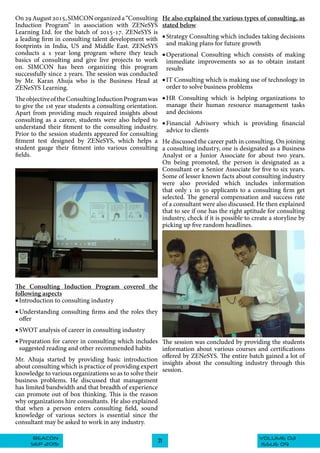
On 29 August 2015, SIMCON organized a “Consulting
Induction Program” in association with ZENeSYS
Learning Ltd. for the batch of 2015-17. ZENeSYS is
a leading firm in consulting talent development with
footprints in India, US and Middle East. ZENeSYS
conducts a 1 year long program where they teach
basics of consulting and give live projects to work
on. SIMCON has been organizing this program
successfully since 2 years. The session was conducted
by Mr. Karan Ahuja who is the Business Head at
ZENeSYS Learning.
TheobjectiveoftheConsultingInductionProgramwas
to give the 1st year students a consulting orientation.
Apart from providing much required insights about
consulting as a career, students were also helped to
understand their fitment to the consulting industry.
Prior to the session students appeared for consulting
fitment test designed by ZENeSYS, which helps a
student gauge their fitment into various consulting
fields.
He also explained the various types of consulting, as
stated below
•	Strategy Consulting which includes taking decisions
and making plans for future growth
•	Operational Consulting which consists of making
immediate improvements so as to obtain instant
results
•	IT Consulting which is making use of technology in
order to solve business problems
•	HR Consulting which is helping organizations to
manage their human resource management tasks
and decisions
•	Financial Advisory which is providing financial
advice to clients
He discussed the career path in consulting. On joining
a consulting industry, one is designated as a Business
Analyst or a Junior Associate for about two years.
On being promoted, the person is designated as a
Consultant or a Senior Associate for five to six years.
Some of lesser known facts about consulting industry
were also provided which includes information
that only 1 in 50 applicants to a consulting firm get
selected. The general compensation and success rate
of a consultant were also discussed. He then explained
that to see if one has the right aptitude for consulting
industry, check if it is possible to create a storyline by
picking up five random headlines.
The Consulting Induction Program covered the
following aspects
•	Introduction to consulting industry
•	Understanding consulting firms and the roles they
offer
•	SWOT analysis of career in consulting industry
•	Preparation for career in consulting which includes
suggested reading and other recommended habits
Mr. Ahuja started by providing basic introduction
about consulting which is practice of providing expert
knowledge to various organizations so as to solve their
business problems. He discussed that management
has limited bandwidth and that breadth of experience
can promote out of box thinking. This is the reason
why organizations hire consultants. He also explained
that when a person enters consulting field, sound
knowledge of various sectors is essential since the
consultant may be asked to work in any industry.
The session was concluded by providing the students
information about various courses and certifications
offered by ZENeSYS. The entire batch gained a lot of
insights about the consulting industry through this
session.

Beacon September 2015

  • 1.
  • 2.
    VOLUME 03BEACON ISSUE 09SEP2015 Contents ABOUT US OUR TEAM INDUSTRY ANALYSIS COMPANY ANALYSIS BRAND ANALYSIS CONCEPT OF THE MONTH: MARKET SHARE PARADOX EVENT REPORT
  • 3.
    VOLUME 03BEACON SEP 2015 1 ISSUE09 OUR PRESENCE ABOUT US VISION The SIMCON - SIMSREE consulting club is an initiative started in 2012 for those students in pursuit of excellence in management consulting and strategic management. Aimed at creating awareness among the students about consultancy as a discipline, the club strives to maintain strong relations with top consultancy firms and provide platform to craft highly skilled & competent consultants from SIMSREE. The club is a resource for information about consulting and a place for students to obtain real-world consulting experience. SIMCON provides an avenue of interaction among faculty, students and alumni through competitions, live projects, guest lectures, and conclaves. For this purpose the club has also been publishing its monthlynewsletter– BEACON (BE A CONSULTANT) and maintains a FACEBOOK PAGE where latest news and development in the consulting industry are posted. MISSION To create awareness amongst the students about consulting industry & its latest trends. To maintain strong relations with top consultancy firms. To provide platform to craft highly skilled & competent consultants from SIMSREE. To provide exposure to students via competitions, live projects, guest lectures & conclaves. Contributions invited: To make this feature a successful effort, we seek continued involvement and contribution from our readers, that is YOU. We invite articles, research papers, and trivia on themes related to consulting. Be it industry news, consulting trends, a joke, a cartoon or feedback, we are eager to hear from you. So go ahead, do your research, pen down your thoughts and mail your entries to simcon.simsree@gmail.com. Best Regards, SIMCON - SIMSREE CONSULTING CLUB
  • 4.
    VOLUME 03BEACON SEP 2015 2 ISSUE09 OUR TEAM SANANDANDESHPANDE NIKHILRAO AMEYAMAHABAL CHITRAWANI deepesh jethwani prathamesh indani Sushil Gurav
  • 5.
    VOLUME 03BEACON SEP 2015 3 ISSUE09 OUR TEAM ARPIT agrawal ASHAYDHURI HUZEFABODABHAIWALA KARANCHOPRA NAMANCHANDAK praCHIKORE SARANGKULKARNI YOGESHMOHATA
  • 6.
    VOLUME 03BEACON SEP 2015 4 ISSUE09 TEXTILE INDUSTRY INDUSTRY ANALYSIS
  • 7.
    VOLUME 03BEACON SEP 2015 5 ISSUE09 Industry Overview India is second largest producer of textiles and garments in the world. Abundant availability of textile raw material such as cotton, wool, silk and jute as well as skilled and cheap workforce have made India a sourcing hub. The Indian textile industry which is currently estimated at around US$ 108 billion is expected to reach US $ 141 billion by 2021. The Indian textiles industry accounts for about 24% of world’s spindle capacity and 8% of global rotor capacity. India’s textile industry plays a very substantive role in national economy for net foreign exchange earnings. Textile sector is also one of the largest contributing sectors of India’s export it contributes around 11 percent of the country’s total exports. The textile industry realized export earnings for the year 2013-14 was worth US$41.57 billion. India has overtaken Italy, Germany and Bangladesh to emerge as world’s second largest exporter of textile. Textile exports from India are expected to touch US$ 300 billion by the year 2024-25 according to projections made by a report. The tradition of country makes our textile unique in comparison to the other countries this provides the industry with capacity to produce a variety of products catering the needs of different market segments both in India as well as across the world. Textile industry in India from many decades has also made a major contribution to the national economy in terms of direct and indirect employment generation. The sector contributes about 14% to industrial production, 4% to gross domestic product (GDP). Textile sector provides direct employment to over 45 million people. The textile sector is the second largest provider of employment after agriculture. Thus the growth and development of this industry has a direct impact on improvement of India’s economy. Textile Categories The textile industry encompasses a range of industries which use a variety of natural and synthetic fibres to produce fabrics. The textile industry can be broadly classified into two major categories, the organized mill sector and the unorganized mill sector. Various initiative and efforts are being made to take urgent and adequate steps to attract investment and encourage wide spread development and growth in the unorganized sector. Indian textile industry can be divided into many segments some of which are showcased below • Cotton – Second largest cotton and cellulosic fibres producing country in the world. Cotton yarn production increased by about by about 10% during 2013-14. It provides employment to huge population but its production and employment is seasonal in nature. • Silk – India is the second largest producer of silk and contributes about 18% to the total world raw silk production. Mulberry, Eri, Tasar and Muga are the main types of silk produced in the country. It is a labour-intensive sector. • Wool – India has 3rd largest sheep population in the world, having about 6.15 crores sheep, producing 45 million kg of raw wool, and accounting for 3.1% of total world wool production. India ranks 6th amongst clean wool producer countries and 9th amongst greasy wool producers.The market is expected to expand at a healthy CAGR of 9.6 percent over 2014-20 0 50 100 150 200 250 2009 2010 2011 2014 2021E 70 78 89 108 223 India’s Textile Market Size (US $ Billion)
  • 8.
    VOLUME 03BEACON SEP 2015 6 ISSUE09 • Man-Made Fibres – the fourth largest in synthetic fibres/yarn globally. Man-made fibres production increased by about 4% during the period 2013-14. Advent of man-made fibres has led to significant change in the Indian textiles industry. • Jute – India is the largest producer and second largest exporter of the eco-friendly jute goods. Major Players In Indian Textile Industry Domestic Players Major Players Net Sales Net Profit Market Cap Arvind Mills 5224.69 377.43 7336.69 Bombay Dyeing 2378.27 24.56 1284.65 Raymond Ltd 2645.32 100 2487.15 Welspun India Ltd 4407.56 510.14 8796.37 Alok Industries 22130.72 348.76 831.90 Digjam 132.47 14.56 62.23 )All values in INR Crores( Foreign Players In Indian Textile Industry • Reiter (Switzerland) • Trurzschler (Germany) • Soktas (Turkey) • Zambiati (Italy) • Monti (Italy) • CMT (Mauritius) • E-land (S.Korea) • Nissinbo (Japan) • Skaps (USA) • Strata Geosystems (USA) • Marks & Spencer (UK) • Zara (Spain) • Mango (Spain) • Promod (France) • Benetton (Italy) • Esprit (USA) • Levi’s (USA) • Forever 21 (USA) Current Domestic textile and apparel market is estimated to be US$61bn. This market is estimated to reach US$120bn by 2020 so there is huge opportunity for foreign players to invest in India and reap benefits in short span of time. 100% FDI is allowed under automatic route in Textile Sector. Porter’s Five Force Analysis 1. Threat Of New Entrants-LOW With the increase in online fashion stores, the currently established fashion brands might face competition in the future. Local designers and new smaller brands are trying to enter the market through these online retail fashion stores. Also, with 100% FDI allowed in the Indian textile sector several international players like Marks and Spencer, Zara, Guess and Next have made their way into the Indian market posing threat to the existing players. 2. Bargaining Power Of Suppliers-LOW Because of the significant presence of small players and international entrants. 3. Bargaining Power Of Buyers-MODERATE Major clothing brands have better bargaining power over textile manufacturers, as the product differentiation is low and number of players are high and fragmented 4. Threat Of Substitutes-MODERATE No internal threat of substitution because there are no alternatives present to the industry. Talking about external threats, Pakistan and Bangladesh also provide cheap labour costs thus their exports are also competitive. Though unlike China and Vietnam, India continues to retain a competitive edge in terms of low labour costs, these countries rule the textile export markets. 5. Intensity Of Rivalry-HIGH Intense competition between established brands.
  • 9.
    VOLUME 03BEACON SEP 2015 7 ISSUE09 Export Scenario Exports have been a core feature of India’s textile and India's textile trade (US$ billion) apparel sector. They grew to US$ 35.4 billion in FY14 from US$ 17.6 billion in FY06, implying a CAGR of 9.1%. During FY15 (between April-November) they touched US$14.6 billion. Recent Developments And News 1. The government has allowed 100% FDI in the Indian Textiles sector. 2. The setting up of integrated textile parks is one of the flagship schemes of the Ministry of Textiles. 13 new textiles parks were approved by the Project Approval Committee (PAC) chaired by the Minister of State for Textiles, Mr. Santosh Kumar Gangwar. While these 13 textile parks will receive a grant of Rs. 520 crores from the Government for infrastructure development, they are estimated to bring in private sector investment of about Rs.3,240 crores to generate direct employment for about 35,000 persons over the next three years. 3. During April-August 2014, textile exports registered a growth of 9.5 % against the corresponding period of last year. 4. The proposal for imposing duty on branded items was dropped providing relief to the entire value chain. 5. The Ministry of Textiles, Government of India plans to enter into an agreement with Flipkart to provide an online platform to handloom weavers to sell their products. 6. The foundation stone of the Trade Facilitation CentreandCraftMuseumwaslaidbyMrNarendra Modi, Prime Minister of India at Varanasi. 7. The government has proposed to extend 24/7 customs clearance facility at 13 airports and 14 sea ports, resulting in faster clearance of import and export cargo. References Textile Industry-IBEF, Textile Industry-Economic Times, Textile Garments Sector-MakeInIndia, Citi India, Textile Industry in India-CCI Survey Report Readymade garment is the largest contributor to total textile and apparel exports from India in FY15 the segment had a share of 40 per cent. Cotton and man- made textiles were the two other major contributors with shares of 31 per cent and 16 per cent respectively. Others(Silk,Wool,Jute) Handicrafts Manmade Textiles Cotton Textiles Readymade Garments 40% 3% 31% 16% 10% Percentage of Share in India’s Textile Exports (FY15) The major textile exporters to US and European countries are China, Vietnam, India, Bangladesh, Indonesia and Pakistan. Indian textile and apparel exports have risen by nearly 7% during January- August 2014, according to the US Department of Commerce’s Office of Textiles and Apparel (OTEXA). While the steady pick in US demand is a major factor, larger domestic cotton supplies are also helping India push textile and apparel exports.
  • 10.
    VOLUME 03BEACON SEP 2015 8 ISSUE09 ARVIND MILLS COMPANY ANALYSIS
  • 11.
    VOLUME 03BEACON SEP 2015 9 ISSUE09 Company Overview Arvind Limited  formerly  known as Arvind Mills is a  textile manufacturer  and the  flagship  company of the Arvind Group. Its  headquarters  is in  Naroda,  Ahmedabad. Arvind limited started in 1931 with the aim of manufacturing high-end Superfine Fabrics. In addition to Spinning and weaving facilities it also had dyeing, bleaching, finishing and mercerizing facilities. Now it manufactures cotton shirting, denim, knits and bottomweights (Khakis) fabrics. In 2001 it started Advanced Materials Division which marked its entry into technical textiles business. It is India's largest denim manufacturer apart from being world’s fourth- largest producer and exporter of denim. Sanjaybhai Lalbhai is the Chairman & Managing Director of Arvind. In the early 1980s, Sanjay Lalbhai led the 'Reno-vision' whereby the company brought denim into the domestic market, thus starting the jeans revolution in India. Today it retails its own brands like Flying Machine, Newport and Excalibur and licensed international brands like Arrow, Lee, Wrangler and Tommy Hilfiger. It also runs a value retail chain called MegaMart which stocks company brands. Evolution over the years Bought 49 % stake in Calvin Klein Businesses in India. Launches JV with Goodhill Corporation Limited of Japan. Forayed into the E-commerce segment with custom clothing brand 'Creyate”. 2014 2012 Signs distribution agreement with Billabong. Arvind acquires India operations of Debenhams, Next and Nautica. The Arvind Store is launched bringing the company's best products at one place.2010 Arvind establishes MegaMart, One of India's largest value retail chains.2007 Arvind Mills witnesses 280% growth in the net profit for the fourth quarter. Arvind Mills Ltd is assigned a `P1+` rating by CRISIL, which indicates a very strong rating for their commercial paper. 2003 Arvind Mills emerges as the world's third largest manufacturer of denim.1998 `Newport` brand’s marketing and distribution network of was strengthened and Flying Machine and Ruggers brand were also strengthened. Arvind Fashions doubled its capacity in the manufacturing facility in Bangalore to produce Lee jeans. 1997 Brand Ruf & Tuf was launched.1995 Arvind reached 100 million meters of denim per year, becoming the fourth largest producer of denim in the world. 1991 Arvind entered the denim export market.1987 ‘Reno-vision’ modernization programme was undertaken along with implementation of a new Denim plant.1985 Arvind Mills Ltd is incorporated with main focus on manufacturing products like dhoties, sarees, mulls, dorias, crepes, shirtings etc. 1931 Management Name Designation Mr. Sanjay S. Lalbhai Chairman & Managing Director Mr. Jayesh Shah Director & Chief Financial Officer Mr. Punit Lalbhai Executive Director & Sustainability Champion Mr. Kulin Lalbhai Executive Director Dr. Bakul H. Dholakia Non-Executive & Independent Director Ms. Renuka Ramnath Non-Executive & Independent Director Mr. Dileep Choksi Independent Director Mr. Vallabh Bhanshali Independent Director Mr. Samir Mehta Independent Director Mr. Nilesh Shah Independent Director Shareholding Pattern Key Financials 30% of total revenues of Arvind in FY15 came from the Brand and Retail segment, of which brands contributed around 70% while the remaining 30% came from retail. Arvind’s brand portfolio comprises of 31 brands, of which 11 are company owned, 12 are licensed, two are joint ventures and six are exclusive retail brands. Of these 31 brands, its top four brands (power brands) like Arrow, Tommy Hilfiger, US Polo and Flying Machine contribute around 80% of overall brand revenue. FY15 (in INR Crore) FY14 (in INR Crore) Growth Sales Turnover 5224.69 4775.48 9.40% Operating Profit 838.41 822.02 1.99% Profit Before Tax 477.62 408.59 16.89% Reported Net Profit 377.43 361.39 4.44% Non-Institutions Foreign Institutional Investors Insurance Companies Promoter and Promoter Group 25.74% 14.69% 6.04% 9.75% 43.78% Mutual Funds and Financial Institutions/Banks % Shareholding as on Sep 15
  • 12.
    VOLUME 03BEACON SEP 2015 10 ISSUE09 The Operating Profit Margin (%) has decreased from 16.63% to 15.83% compared to previous year and so has the Net Profit Margin (%) from 7.56% to 7.22%. SWOT Analysis • Strong Portfolio of domestic and international brands • Efficient work force as training programs are conducted on a regular basis • Increased use of technology thereby increasing the produc- tivity • Global penetration is limited as compared to other brands • Reach of Arvind MegaMart stores is limited to big cities • Lack of efforts to build brand equity. For Example: ‘Park Avenue’ of ‘Raymond Limited’ is more famous than ‘Flying Ma- chine’ of ‘Arvind Limited’ • Increase the reach by increas- ing mega mart stores in small cities and rural area • Global expansion to increase sales • Increase in the competition from Indian as well as interna- tional brands • Pirated or fake products avail- able at very cheap rate • Due to both domestic and international brands higher brand switching is seen Strengths Weaknesses Opportunities Threats The Return on Net Worth has decreased marginally compared to previous year and Capital Employed has increased slightly when compared to the previous year. Both these parameters over the past few years barring FY 12(for RONW) have been in more or less the same range. These ratios have been improving mainly due to an increase in revenues of asset light business like brand & retail. The Earning per share has increased marginally compared to the previous year. Its current ratio is quite below that of its sector which is at 1.76. The Company needs to improve this ratio as it indicates liquidity issues and it might face difficulty in paying its creditors in the short term. Overall the company is showing healthy financial growth but is still short of achieving its own previous highs of FY 12. 0 2 4 6 8 10 12 14 16 18 Net Profit Margin(%) Operating Profit Margin(%) Mar '15Mar '14Mar '13Mar '12Mar '11 14.38 5.02 14.34 12.42 15.51 6.91 16.63 7.56 15.83 7.22 Profit Margin (%) 0 5 10 15 20 25 30 ROCERONW Mar '15Mar '14Mar '13Mar '12Mar '11 9.04 10.42 25.13 15.19 12.92 13.29 15.315.64 14.64 16.33 Profitability (%) 0 2 4 6 8 10 12 14 16 18 Mar' 15Mar' 14Mar' 13Mar' 12Mar' 11 5.3 17.05 10.12 14 14.62 EPS 0.0 0.1 0.2 0.3 0.4 0.5 0.6 0.7 0.8 0.9 Mar' 15Mar' 14Mar' 13Mar' 12Mar' 11 0.83 0.85 0.75 0.67 0.76 Current Ratio
  • 13.
    VOLUME 03BEACON SEP 2015 11 ISSUE09 Competitor Analysis Name Market Capital- ization Sales Turn- over Net Profit Total Assets Arvind Limited 6747.89 5224.69 377.43 5033.49 Raymond Limited 2378.81 2645.32 100.00 2123.88 Bombay Dyeing 1271.22 2378.27 24.56 1186.37 Siyaram Silk Mills 933.89 1510.30 78.79 715.25 )All values are in INR Crore( By looking at competitor analysis we can say that Arvind Limited has managed to earn highest net profit during the year 2014-2015. Three companies except Siyaram Silk Mills were founded in early 90s (1879 for Bombay Dyeing), out of these Arvind Limited has been a consistent performer. Total assets of Arvind Limited are also highest this shows that, company has undertaken a business strategy which changed over the years and helped company to grow at a higher rate. Competitor Profiles 1.Raymond Limited • Raymond Limited comprises of three divisions namely Textiles, Engineering and Aviation. • Considering the textile sector, Raymond Limited is largest non-segregated manufacturer of worsted fabric, in the world. 2.Bombay Dyeing • Bombay Dyeing is the ’front runner’ company of Wadia Group. This company is mainly into the business of textiles. • Bombay Dyeing not only manufactures clothes for people but also helps customers in furnishing their homes. 3.Siyaram Silk Mills • Siyaram Silk Mills is the subsidiary of Siyaram Poddar group. Siyaram Silk Mills is also known as Siyaram’s or SSM. • Today, Siyaram’s is the largest manufacturer of blended fabrics in India. • Siyaram’s has entered the Readymade Garment sector in beginning of the year 2014. New Developments • Arvind has recently forayed into the Rs 30,000Cr footwear market and is about to launch its own footwear brand. It will be offering a mix of its own, acquired, licensed and Joint venture brands.  • Arvind Lifestyle Brands in partnership with GAP will open its first GAP store in Delhi in May. • Arvind has now also entered into the beauty and cosmetics market in partnership with Sephora. • Arvind has plans to scale up brands like Nautica, Hanes, Calvin Klein, Gant, Children’s Place and GAP to power brands over the next three to four years. • It has also entered the E-Commerce business with its brand called Creyate where it will provide its customers with bespoke apparels which will be delivered to their doorstep in 10 to 12 days. Along with custom made apparels the site will also showcase all of its different brands online. • Arvind’s lifestyle brands subsidiary will have to pay up $3.2 million to Ralph Lauren to settle a lawsuit the US-based luxury fashion house filed in 2013.The Club Monaco and Polo Ralph Lauren maker had filed a case in a US District Court against Arvind Lifestyle and US Polo Association (USPA), alleging a breach of agreement regarding disclaimers to be printed on USPA products sold in India. Conclusion Arvind Limited is one of the leading players in the textile sector in India. Looking at the number of Arvindmegamartstores,thereisascopeforexpansion in India and as well as internationally. In 2012- 2013, due to stagnancy in economy, high inflation and higher interest rates consumer sentiments were affected badly. This resulted decrease in the business of the company during that year. After the change in Government in 2014, economy is growing, interest rates are lowered and inflation has eased. These changes are helping company to get its business back on track. Company has considerably increased the use of technology in the manufacturing plants thereby helping company to increase its productivity. Various training and development programs for employees would definitely increase the output desired by the company. Exports of the company will increase in near future as the competition from other countries like China has decreased due to weak currency and decreasing cost competitiveness of the country. References Aravind, Key Developments, Aravind-Reuters, Aravind Limited Bets Big On E-Commerce-NDTV Profit
  • 14.
    VOLUME 03BEACON SEP 2015 12 ISSUE09 MTV BRAND ANALYSIS
  • 15.
    VOLUME 03BEACON SEP 2015 13 ISSUE09 Introduction It was after midnight on August1, 1981, MTV went live on cable television. John Lack (then the Executive Vice President of Warner-Amex Satellite Entertainment) started with, “Ladies and gentlemen, rock and roll.” The first music video played on MTV was “Video Killed the Radio Star” by The Buggles. It served as the perfect song to bring in this new era of music and to begin the MTV legacy. And thus began the journey of MTV to become one of the most influential and widely watched networks to be broadcasted all over the world. MTV is one of the most popular and loved brands globally.  When MTV first revolutionized television in 1981, it was based on the idea of one network devoted entirely to music, a destination where fans could watch music videos, see interviews with their favorite recording artists, and even get their news from a music fan’s point of view. It became the best way for the music industry to advertise itself and reach to the younger audience. This again led to increase in MTV’s value and creativity of videos. The inception of MTV led to the decline of the radio networks. But, it revived the music industry which was plunging. In the year 1984, MTV presented the very first MTV  Video  Music Awards (VMAs) and suddenly the new generation had its very own awards show. In 1992, they started with the MTV Movie Awards which was hosted by Dennis Miller. In MTV’s early days, its programming consisted of basic music videos that were introduced by VJs (video  jockeys) and provided for free by record companies. First MTV VJs MTV original broadcast: Original MTV Broadcast 1/8/1981 MTV started displaying music videos of popular stars and at the same time created many new stars. In the 1980s, MTV was instrumental in promoting the careers of performers such as Madonna, Michael Jackson, Prince and Duran Duran, whose videos played in heavy rotation. MTV became an influential source of pop culture and entertainment in the United States and other parts of the world, including Europe, Asia and Latin America. It currently has more than 340 million viewers worldwide, more than 100 channels in 167 countries with which they have become the favorite destination of youth over the world. Few Famous MTV Slogans In U.S. • “You’ll never look at  music  the same way again” (The first slogan) • “I want my MTV” • “Not on TV, on MTV”(for VMAs) • “MTV: We Don’t Play Music” (After removing Music Television from its logo) • “MTV is no longer: It’s Metallica TeleVision” (Lars Ulrich in 1996) Value Of Innovation & MTV Unique Programs
  • 16.
    VOLUME 03BEACON SEP 2015 14 ISSUE09 MTV India Viacom and TV18 Group have entered into a 50:50 joint venture in India and together they are called Viacom 18. As part of the agreement, MTV Network’s brands in India - MTV, Nick and VH1 - became part of Viacom-18 and co-owned by both the companies. Current MTV India slogan: Stay Raw Present Well-known MTV India VJS To promulgate their shift from pure music to a channel which focuses on cultural shows targeting a specific teen and young-adult audience, the MTV changed its logo in 2010 and no longer contained the tag-line “Music Television”. By doing this, they have managed to maintain a strong brand. Today, MTV is a cultural phenomenon that has changed the worlds of fashion, movies, and music itself. STP Segmentation • Based on Geographies It divides viewers across different regions, countries and cities. As the audience has different interests across geographies, it’s important that channels tailor their content accordingly. • Based on Age Young kids (2-12 years old), youth, middle aged women, middle aged men and people above 60 are different segments usually targeted by the TV channels. • Based on attitude Channels have different content and genres for people with different attitudes (e. g. crime thrillers for matured or action and suspense loving viewers.) • Based on culture Viewers are more inclined to the shows related to their culture. Hence, it is important that TV channels have content which is in tune and sensitive to the local cultures. Targeting MTV has successfully targeted youth (here, people aged from 12 to 34) through its content. Also, MTV has separate channels for Asia, US, UK, Australia and many other countries which allow it to better connect with the audience over there. Targeting among these segments has helped MTV to maintain the fan base as youth spends more time on social media and watching TV shows. Through its presence on different social networking sites, it has ensured the support of youth on social media. Though MTV viewership is now getting divided due to its competitors, VMA’s still attract highest number of viewers who love music. The young generation following MTV has unconventional, non-traditional attitude which is depicted through the shows aired on MTV. Shows like Teen Mom are targeted at audience in U.S. and their culture and MTV Roadies which attracts youth in bike-loving India. Positioning In the beginning MTV had positioned itself as a channel for the youngsters who like to be raw and who love music. Though still the content is for youngsters, it has forayed into cultural shows and reality TV shows. It constantly keeps on rejuvenating to be on the top. MTV continuously revamp brand logo On Feb 8, 2010 – MTV removed music television from its logo.
  • 17.
    VOLUME 03BEACON SEP 2015 15 ISSUE09 Milestones o Surveying watchers, creating marketing plans, sales of copyright, sales of production capacity, co-production and communication • MTV has been working on transforming itself for the 21st Century by building or buying a collection of digital brands across music, programming, virtual worlds and gaming: o Using subsidiaries to expand its sales promotion network. MTV’s Marketing Campaigns 1. Rock The Vote Launched in April 2014 by MTV, as part of its ‘Rock the Vote’ initiative to encourage Indian youth to vote, has engaged in an on air, online and on-ground campaign. The on-ground efforts included discussion forums with college students in attendance. MTV brought into focus the changes in voting scenario in India and how not voting has become ‘uncool’- “Not having a mark on your finger is very embarrassing, Imagine not to have a mark on your finger when you go to a club or a party after voting day.” 2. Coca-Cola Launches Coke Studio In India, In Collaboration With MTV In 2011 Coca-Cola in partnership with MTV India has announced Coke Studio - the Indian edition of Coca-Cola’s international music property. Coke- Studio @ MTV is said to be “a first of its kind music project in India, which aims to bring together different artists of different genres to create an extraordinary series of medleys music experience, giving music lovers across a unique opportunity to enjoy Coke Studio’s signature fusion music”. Coke-Studio @ MTV premiered in India on June 17, 2011, Friday 7pm on channel MTV. Apart from India coke studio is also present in Pakistan, Middle East & North Africa, & Brazil. 3. MTV Unveils New Philosophy, ‘Stay Raw’ In November 2010 MTV revealed new philosophy which was communicated to its audiences with a new identity and a new line up of shows. As a promotional tool, the channel also chose to remain advertisement free over the weekend. The underlying theme of ‘Stay Raw’ philosophy stems from the insight of today’s younger generation which is more confident about themselves and are very real with an ‘in your face’ attitude. It was an idea that was based on what young people today believe, expressed in an edgy yet tongue in cheek manner which is trademark MTV. The content of the channel was also changed, with a 50-50 split between music and reality shows. Advertising • A main advertising strategy of MTV is its core philosophyofkeepingmusicattheheartofeverything we do which connects us to the youth and thereby connects us to everything that interests youth. • MTV’s unique advertising channel: it advertises itself. • Online ads (Facebook, MySpace, YouTube, click away ads, etc.). o Advertising video-clips brings the image of MTV (music television). • Mobile phones, MTV events and music events, Cable television, Logo effect on audience and customers, Magazines reviews. • MTV will provide advertising partners second-by- second data on how the videos and ads on its site are watched by users online. Sales Promotion • MTV uses several sales channels: o Commercial airtime sales, promotions and sponsorship agreements
  • 18.
    VOLUME 03BEACON SEP 2015 16 ISSUE09 4. MTV- Show Teasers MTV used Snapchat to promote its show Geordie Shore during the summer of 2013 in UK. Fans that had friended the show’s Snapchat account started receivingexclusivevideosandphotographsleading up to the UK reality show’s sixth season premiere. 5. Adidas- MTV King Of Cool Adidas’sbriefwastocreateacampaignaroundtheir Adidas defenders range with ambassador Snoop Lion. MTV and Adidas launched a competition to find the next ‘The King of Cool’. MTV’s Social Media Presence MTV believes in constant rebranding. So, it has moved from its iconic “I want my MTV” to a new approach dubbed “I am my MTV.” MTV uses artists as a social media hosts and also involve them in other activities on social media for the publicity. Also, they entice people to the event through engagement on artist’s websites or social media. MTV keeps fans in loop by giving current updates to them through images on Instagram, tweets and videos. They have managed to establish themselves among the top 10 brands on Facebook with more than 9.4M followers on MTV India and 48M on MTV (USA). On twitter they have 1.84M followers and it is comparatively less. But, considering their target group and demographics of twitter, one can understand that it is due to the age of population on twitter. It is slightly out of MTV’s target group. Travel And Fashion Site MTV launched fashion site District MTV to encash its connections with fashion and pop culture. Through its shows MTV gives fashion advice to its viewers. So, the fan base is more likely to follow this site. This site allows MTV fans to understand global trends and gives latest news in the fashion industry. At the same time, brands can connect to potential customers through this site. MTV travel Co. is a site for young people in Australia and New Zealand. It guides tourists about different places all across the world. The destinations suggested are mainly for youth. MTV PC This range, targeted at American students living in dormitories which was launched in the 1st half of the last decade. This product replaced TV, PC, DVD player and radio. MTV also launched tablet PC’s in India along with partner Swipe in 2013 at an affordable price. Bags MTV had a deal with designer Monica Bianco and introduced limited editions of MTV branded MIA bags. These bags promptly represent MTV’s culture along with Bianco’s style. They showcased this range at Milan fashion event. MTV Brand Portfolio Condoms In 2003, MTV forayed into condoms’ market by launching MTV condoms on World AIDS day in Germany and Austria. Following that it launched the product in UK. The aim behind launching condoms was to make buying contraceptives less embarrassing for young people. In US, MTV has built a relationship with Trojan Brand condoms. In 2013, MTV launched its condoms in India in a tie-up with JK Ansell, the maker of KamaSutra. MTV Channels To target its market across the world MTV has introduced channels for the specific region. MTV Indies is a music channel which is dedicated to music, arts and comedy shows. MTV Mandarin is a channel for all mandarin speaking nations whereas MTV Latin America is for all Latin American nations. MTV gives platform for debut singers through these channels who prefer singing in their native languages. Thus, it can connect to the local audience through customized channels. This allows channels to provide new and live content. MTV has achieved sharper segmentation through this. References MTV, Travel – MTV, MTV Rebrand “I am my MTV” – Broadband TV News, MTV Leaps a Generation
  • 19.
    VOLUME 03BEACON SEP 2015 17 ISSUE09 MARKET SHARE PARADOX CONCEPT OF THE MONTH
  • 20.
    VOLUME 03BEACON SEP 2015 18 ISSUE09 Introduction Market Share is very important parameter for judging the performance of a firm. Higher market share offers the advantage of economies of scale, thus reducing the overall cost and thereby increasing profits. Unfortunately most efforts to improve market share depress profits, at least in the short term. Reasons For Shift In Market Share Between Competitors • Arrogance: The category leader starts believing that it has built a strong position in market for itselfwithsuperiorproductofferingandthereis no need for it to worry about the consequences of its actions. • Complacency: Management and the sales force feel that any significant changes to further improve the market share are not possible. Consequently, sales people lose momentum, management takes customers for granted, improvements and innovation slow down.  • Willingness to Lose Market Share: Often the low-cost company has the largest market share and hence it expects high profits. But sometimes a minor competitor offers products at a lesser cost. In such a situation the market leader may be willing to lose market share rather than meeting the price concession, thus maintaining near term margins. Concept The concept of Market Share Paradox was put forth by Bruce Henderson, the founder of BCG, in 1970. The market share paradox is that, if the low cost firm would accept the high cost producer's return on assets, the low cost firm would preempt all market growth. And the resulting increase in his accumulated experience would further improve his costs and steadily increase thecostdifferentialbetweenthecompetitorsthereafter. In short, if both the low cost and high cost producer follow the same investment strategies, then only the low cost producer would expand capacity and the high cost producer would never be able to do so. But the market share remains stable under normal conditions. Thisprovesthatfirmsusedifferentinvestmentstrategy. But, in presence of vigorous competition, market share becomes highly unstable.
  • 21.
    VOLUME 03BEACON SEP 2015 19 ISSUE09 The low cost producer can improve market share, but only by sacrificing near term profit. The high cost producer can obtain a significant market share by reducing the prices of products as compared to its low cost competitor. The tradeoff is inviting. Losing a modest amount of market share may initially seem attractive to the low cost producer, in order to maintain price level. Unfortunately, the tradeoff is cumulative. More and more share must be given up over time to maintain price. Costs are a function of market share because of the experience effect. Lost market share leads to loss of cost advantage. Eventually there is no way to maintain profitability. Steps To Resolve Market Share Paradox At Different Rates Of Growth Of Industry • No growth: In such a situation, it is almost impossible to shift market share. It is not feasible to add further capacity. Neither is it affordable to lose share at the price of idle capacity. In such market conditions, product prices remain very stable and the obvious choice is to gain maximum profits within existing market shares. • Very little growth: A higher near term profit will be preferred over continued modest profit in such a case. Since the anticipated growth rate is very less, measures taken to increase market share would generally lead to decrease in long term profits.  • Rapid growth: When such a condition is present, market share becomes very valuable as well as very easy to lose. Since there is rapid growth, any changes made to improve market share will be compounded by growth of the market itself. This will result in improved margins due to economies of scale. But if no efforts are taken to increase the capacity, some other competitor will cease this opportunity, thus ultimately resulting in loss of market share. Conclusion • The most powerful competitive advantage a company can have is a strong market share. • Maintaining market share is expensive, but it is even more expensive to lose. • A single bad decision will not erode market share of a company, but a series of bad decision taken over a period of time will have a cumulative effect. References BCG Perspectives, Linkedin Pulse
  • 22.
    VOLUME 03BEACON SEP 2015 20 ISSUE09 CONSULTING INDUCTION PROGRAM EVENT REPORT
  • 23.
    VOLUME 03BEACON SEP 2015 21 ISSUE09 On 29 August 2015, SIMCON organized a “Consulting Induction Program” in association with ZENeSYS Learning Ltd. for the batch of 2015-17. ZENeSYS is a leading firm in consulting talent development with footprints in India, US and Middle East. ZENeSYS conducts a 1 year long program where they teach basics of consulting and give live projects to work on. SIMCON has been organizing this program successfully since 2 years. The session was conducted by Mr. Karan Ahuja who is the Business Head at ZENeSYS Learning. TheobjectiveoftheConsultingInductionProgramwas to give the 1st year students a consulting orientation. Apart from providing much required insights about consulting as a career, students were also helped to understand their fitment to the consulting industry. Prior to the session students appeared for consulting fitment test designed by ZENeSYS, which helps a student gauge their fitment into various consulting fields. He also explained the various types of consulting, as stated below • Strategy Consulting which includes taking decisions and making plans for future growth • Operational Consulting which consists of making immediate improvements so as to obtain instant results • IT Consulting which is making use of technology in order to solve business problems • HR Consulting which is helping organizations to manage their human resource management tasks and decisions • Financial Advisory which is providing financial advice to clients He discussed the career path in consulting. On joining a consulting industry, one is designated as a Business Analyst or a Junior Associate for about two years. On being promoted, the person is designated as a Consultant or a Senior Associate for five to six years. Some of lesser known facts about consulting industry were also provided which includes information that only 1 in 50 applicants to a consulting firm get selected. The general compensation and success rate of a consultant were also discussed. He then explained that to see if one has the right aptitude for consulting industry, check if it is possible to create a storyline by picking up five random headlines. The Consulting Induction Program covered the following aspects • Introduction to consulting industry • Understanding consulting firms and the roles they offer • SWOT analysis of career in consulting industry • Preparation for career in consulting which includes suggested reading and other recommended habits Mr. Ahuja started by providing basic introduction about consulting which is practice of providing expert knowledge to various organizations so as to solve their business problems. He discussed that management has limited bandwidth and that breadth of experience can promote out of box thinking. This is the reason why organizations hire consultants. He also explained that when a person enters consulting field, sound knowledge of various sectors is essential since the consultant may be asked to work in any industry. The session was concluded by providing the students information about various courses and certifications offered by ZENeSYS. The entire batch gained a lot of insights about the consulting industry through this session.