International Research Journal of Engineering and Technology (IRJET) e-ISSN: 2395-0056
Volume: 09 Issue: 01 | Jan 2022 www.irjet.net p-ISSN: 2395-0072
© 2022, IRJET | Impact Factor value: 7.529 | ISO 9001:2008 Certified Journal | Page 1466
Dhrubajyoti Bhattacharjee
Swami Vivekananda Institute of Science and Technology, Dept. of Mechanical Engineering, Kolkata.
-------------------------------------------------------------------------***------------------------------------------------------------------------
Abstract: - To examine the workers in the foundry industry’s subjective self-evaluation of musculoskeletal discomfort is the
major goal of this research article. Fifty workers between the age of 18 and 55 took part in this study. The highest and the
lowest percentage of the workers those are experiencing at least of one discomfort are 86 percent and 52 percent respectively
due to pain in different parts of the body such as physical exertion, lifting loads, posture, work space, job rotation, rest period,
and repetitive motion that has been revealed in the report of questionnaire survey. In addition, 17 of the 20 dissatisfaction
factors scored higher than the average musculoskeletal discomfort score of 2.5 on a 5-point scale. Additional research, have
been done according to the finding of this study that a relation between musculoskeletal pain and its impact on the employees
in the foundry environment is required in this study.
To give an ergonomic evaluation based on the postural analysis to reduce the risk of ergonomics this study has been proposed.
This document has given a description about the different postures, origins and discomfort related to work in foundry
industry. To determine the percentage of people who are suffering from such musculoskeletal disorder a special type of
questionnaire called as cornel musculoskeletal disorder questionnaire are used. To determine which tool may be utilized to
decrease this risk and establish a safe workplace that will increase the productivity an analysis techniques of ergonomics risk
factor are identified.
Key Words: - RULA Method, REBA Method, OWAZ Technique, NIOSH Survey, OSHA, Questionnaire and Interview
Techniques.
1. INTRODUCTION: -
In the Present Scenario, the companies in the manufacturing sectors are continuously improving the effectiveness. By
implementing world class strategies of manufacturing, the effectiveness in manufacturing industries can be achieved. The
process involved in the manufacturing was mainly focused by the world class manufacturing strategies. However, the
organizations are more focused on the workers’ safety and health and instead of depending on the organization process.
Workers in any industrial sector have faced problems such as repetitive physical actions, which causes discomfort in the
bodies of workers which are related to repeated actions of Load. Causing discomfort and suffering in their bodies may
happen when workers are expected to remain in a position for extended period of time. Due to the result of
musculoskeletal discomfort physical pains may cause among employees.
Foundry Industry also known as metallurgical industry which is one of the most important sectors in the manufacturing.
This paper is focused at studying the musculoskeletal level of discomfort among the workers employed in foundry
environment across the worldwide. This study aims to analyze the level of discomfort in the workers in foundry industry.
This research study shall be implemented to prevent the occurrence of ergonomics risk factors in foundry industry leading
to musculoskeletal discomfort among the employees and thereby improving the health and safety level of workers
working environment.
1.1. What is Ergonomics?
The study of how to build or arrange the workplaces, goods, and systems such that it should be comfortable for the people
who use them are known as ergonomics. Ergonomics is not only which deals with seats or with the design of car models,
control systems, and its instruments that many people assumed but it is also something more. All of the designs that are
made by the people are concerned by ergonomics such as sports and recreation, work place, health and safety.
Investigation of “Musculoskeletal Disorder in Different Foundry
Industry”
International Research Journal of Engineering and Technology (IRJET) e-ISSN: 2395-0056
Volume: 09 Issue: 01 | Jan 2022 www.irjet.net p-ISSN: 2395-0072
© 2022, IRJET | Impact Factor value: 7.529 | ISO 9001:2008 Certified Journal | Page 1467
1.1.1. How Does Ergonomic Work?
Ergonomics may be comparatively new branch of science, which depends on the analysis in several alternative
order, which are established by scientific areas, like engineering, physiology and scientific discipline.
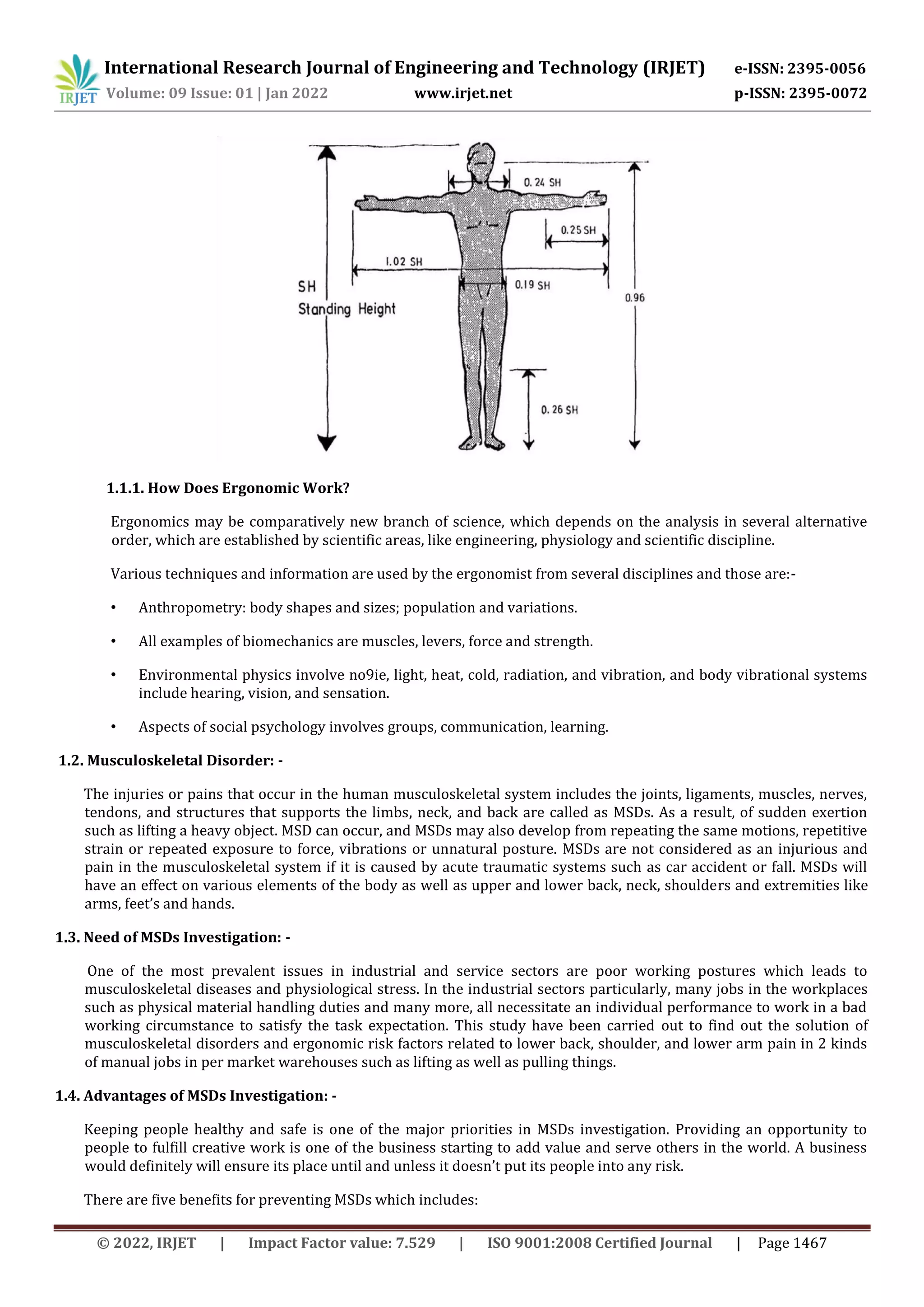
Various techniques and information are used by the ergonomist from several disciplines and those are:-
• Anthropometry: body shapes and sizes; population and variations.
• All examples of biomechanics are muscles, levers, force and strength.
• Environmental physics involve no9ie, light, heat, cold, radiation, and vibration, and body vibrational systems
include hearing, vision, and sensation.
• Aspects of social psychology involves groups, communication, learning.
1.2. Musculoskeletal Disorder: -
The injuries or pains that occur in the human musculoskeletal system includes the joints, ligaments, muscles, nerves,
tendons, and structures that supports the limbs, neck, and back are called as MSDs. As a result, of sudden exertion
such as lifting a heavy object. MSD can occur, and MSDs may also develop from repeating the same motions, repetitive
strain or repeated exposure to force, vibrations or unnatural posture. MSDs are not considered as an injurious and
pain in the musculoskeletal system if it is caused by acute traumatic systems such as car accident or fall. MSDs will
have an effect on various elements of the body as well as upper and lower back, neck, shoulders and extremities like
arms, feet’s and hands.
1.3. Need of MSDs Investigation: -
One of the most prevalent issues in industrial and service sectors are poor working postures which leads to
musculoskeletal diseases and physiological stress. In the industrial sectors particularly, many jobs in the workplaces
such as physical material handling duties and many more, all necessitate an individual performance to work in a bad
working circumstance to satisfy the task expectation. This study have been carried out to find out the solution of
musculoskeletal disorders and ergonomic risk factors related to lower back, shoulder, and lower arm pain in 2 kinds
of manual jobs in per market warehouses such as lifting as well as pulling things.
1.4. Advantages of MSDs Investigation: -
Keeping people healthy and safe is one of the major priorities in MSDs investigation. Providing an opportunity to
people to fulfill creative work is one of the business starting to add value and serve others in the world. A business
would definitely will ensure its place until and unless it doesn’t put its people into any risk.
There are five benefits for preventing MSDs which includes:
International Research Journal of Engineering and Technology (IRJET) e-ISSN: 2395-0056
Volume: 09 Issue: 01 | Jan 2022 www.irjet.net p-ISSN: 2395-0072
© 2022, IRJET | Impact Factor value: 7.529 | ISO 9001:2008 Certified Journal | Page 1468
• Lower Cost.
• Productivity Improvement.
• Improvement in Quality.
• Engagement within Employees.
• Better Prevention and Safety.
1.5. Prevention for MSDs: -
1.5.1. To Prevent MSDs in the Workplaces: -
The guidelines about MSDs prevention has outlined major activities of prevention for the occurrence of risk before
an injury. To avoid MSDs by modifying work practices this research study has presented a set of guidelines. A
guideline has been set in this study in order to reduce MSD hazards in small foundry industry. This research study
has presented an emphasis of workplace which is required to reduce the workplace dangers and an attention of
workers to work more safely in foundry industry. According to the central messages of ergonomics “if a job isn’t a
good match to the workers, then musculoskeletal discomfort, injuries, and lower product service could result
which may result to give bad product quality service”.
1.5.2. Identify the Risk of MSD and Elimination of Hazard: -
This study has been proposed as per the need for providing a methodology to identify, analyze and remove the dangers
of MSDs that will be very helpful in lowering the risk associated with MSDs hazards.
To minimize the acquiring risk of MSD hazard the procedure for the risk assessment in foundry workplace should be
considered.
RACE is one of the risk assessment procedure that is similar to other hazards in the workplace. According to RACE: -
• R- it stands for recognition of MSDs hazards.
• A- it means to access the workers risk.
• C- To reduce the Control of workers risk.
• E- The control to the risk of workers is evaluated.
The changes in the workplace can be induced once the MSDs hazards are identified in order to reduce the impact of
hazards caused by MSDs.
Four types of controls are usually employed in combination such as: -
• The best option is to completely remove the hazards.
• Accomplishing the task using different methods.
• Engineering controls have to be implemented in order to alter the workplace.
• Administrative control has to be implemented in order to change the way of the work.
• To reduce the risk of developing MSDs antivibration gloves, knee pads, are the only equipment which should be
used correctly.
1.6. Objective of Research: -
As per the need, products have to be purchased from local manufacturers. When failure of the products occurs
then as a result of feedback the product have to get improved. As because the large industries in rural sectors have
till now not started in producing those products so therefore till now no development regarding the rural product
designing have been done. So, due to this reason large sector industries manufacture products without the proper
availability of design. Having healthy working environment by designing proper procedure of working plays a
International Research Journal of Engineering and Technology (IRJET) e-ISSN: 2395-0056
Volume: 09 Issue: 01 | Jan 2022 www.irjet.net p-ISSN: 2395-0072
© 2022, IRJET | Impact Factor value: 7.529 | ISO 9001:2008 Certified Journal | Page 1469
major role in ergonomics. Unconsciousness about the ergonomics by the workers in various large and small
industries is a major problem faced among the workers in foundry work task. So, therefore in those industries
musculoskeletal disorder may result where workers work in bad posture. Therefore, health and safety issues is
one of the important which have to be taken by implementing proper methods for safe working. While, on the
other hand working in inadequate posture will affect productivity among large no. of workers in industries. To
properly determine the planning for ergonomic in small foundry industries analysis software’s such as RULA,
REBA, and OWAZ are used. If the score of RULA, REBA, and OWAS are high then it indicates that health and safety
of the workers are adversely affected as a result of it, efficiency, product quality, and internal fatigue will reduce.
By ensuring that the workers posture is well organized by the proper planning’s of ergonomics this score can be
reduced. As it has been outlined by the PhD’s, that within the field of ergonomics the plan of research which is
having the analysis of posture for workers during working in several SSI of west Bengal will improve the working
inequality, efficiency, safety and healthy working culture will establish which will help to reduce the fatigue by
taking correct measure of posture.
To analyze the workers way of working in various processes for small scale industries in west Bengal is the main
objective of this research work. In these research article, three postural analysis tools RULA, REBA, and OWAS are
used and recommends to made any changes in the posture of the body while working which will also increase the
working quality.
2. LITERATURE REVIEW: -
From recently published research work on ergonomics analysis in industry a literature review have been
presented to understand the issues involved in research.
1. Juan Luis Hernandez- Arellano et.al. 2015 has conferred a design proposal for extremes where ever men and
women perform similar task within the same workstations [6].
2. According to the study by P.N. Kale et.al. 2016 a review has been presented on the study which are carried to
analyze various tools used for ergonomics analysis [1].
3. According to N. Jaffar et.al. 2015 a summary of ergonomics risk factors in construction trade has been
mentioned in the study. The purpose of the study was to convey a basic and clear definition of ergonomic
[2].
4. A common occupational problem encountered by workers has been described in the study by Er. Girish joshi
et.al. 2015. How to access the musculoskeletal disorder (MSD) of workers in the small-scale casting
industries has been mentioned in this study [3].
5. Some of the material handling about musculoskeletal disorder and low back pain (LBP) has been explained
by Baba Md Derosa et. Al (2011) [5].
6. According to the study by Rajesh R et. Al 2016 that the most of the part has been supported for the task
analysis approach where ever the job are countermined into an easier task and study [7].
7. A study by Raemy Md. Zeina et. Al. 2015 has been proposed that industrial workers were injured frequently
at a work as a result of an incorrect working posture.
8. According to the study analyzed by Kailash Subramanian et. Al. (2017) that ergonomics hinders each health
and productivity of the employees in industrial sector [9].
9. According to an analysis by S.C. Mali et.al. 2015 that ergonomic problems are one the major concerns which
are faced by metal working manufacturers [13].
10. An important approach to investigate correctly was the human interaction with the workplace which have
been analyzed in the study by Enrico Del Fabbro et. Al. 2016 [15].
11. According to the study and analysis of L.P Singh et. Al. 2010, it has been found that throughout the world the
most common problem is Musculoskeletal Disorder MSDs.
12. According to the study by Mustafa Khan et. al. 2015, a manual assembly task in many production facilities
are have been widely spread [12].
International Research Journal of Engineering and Technology (IRJET) e-ISSN: 2395-0056
Volume: 09 Issue: 01 | Jan 2022 www.irjet.net p-ISSN: 2395-0072
© 2022, IRJET | Impact Factor value: 7.529 | ISO 9001:2008 Certified Journal | Page 1470
13. According to the investigation by N.A. Ansari et. al. 2014. Rapid Upper Limb Assessment (RULA) and Rapid
Entire Body Assessment (REBA) which are the postural analysis tools are used for assessment indicate that
the workers are working above the safe limit.
14. Maura Mengoni et. al. 2017, have been revealed that risk management is one of the foregone conclusions for
manufacturing companies, and a strategic component of their success [11].
15. According to the study and analysis by S.C. Mali et. al. 2015 that in India for most of the small-scale
industries the principles of ergonomics were not considered at the time of designing industrial workstations
[14].
2.1. Effects of Hazards to workers and environment in the Foundry Industry: A review paper -
The hazardous working environment in the foundry shops results from various chemical mixtures, physical and
mechanical hazardous gases which may result in juries to workers in the foundry industry. Also, workers may
pose health problems while working in foundry industry that includes molten metal face exposure, mists of heat
and spray. Respirable crystalline silica or commonly called as silica dust which may be produced by casting sand,
fettling, and kiln linings when workers work in the foundry shop. This research paper provides a brief outline
about the health effects and safety measures which have to be taken in the foundry industry to prevent hazards.
This information presently describes from completely different analysis work and it also outlines the effects on
workers which are mainly produced by hazards in the foundry shop and also it has been revealed that how it
effects the environment. Through the study from different research journals, it has been revealed that hazards
from foundry shops are very dangerous and it effects to both the workers health and environment. Workers in the
foundry industry works in various hazardous chemicals and also noise pollution, vibrations, all are the major
causes of injuries faced among the workers.
Hazardous effects of chemicals on Health Systems: - Hazardous chemicals are very dangerous and it can
adversely affect the body’s inhalation parts and also it can damage the body skin organs, and it may affect the body
by entering through an accidental ingestion. There are different types of hazards which may affect the specific
organs of the body by both short term as well as by the long term. The hazardous chemicals in the foundry
industry are one of the major problems among the workers which may also lead to headaches, bronchitis, asthma,
which affects in respiratory lungs in the employees in the foundry industry.
Effects of Airborne Contaminants on Health: -
There are also other irritating effects by which the presence of different gases may indicate such as respiratory
irritation, coughing, inhaling problem, acidic taste and eye irritation. Wood dust may result in the risk of cancer in
the nasal cavity, and may also causes a skin rash, and may result in asthma problem. Heavy metal dusts particles
when inhaled by the workers while working in the foundry industry may cause health problems which may result
in the damage of lungs and damage in siderosis; respiratory systems may get irritates when inhaling of aluminum
dust and also may lead to chronic non-specific respiratory diseases.
Vibrational Effects on Health: -
Problems in stomach, blood pressure, problem in the heart and disorders in the nervous systems, influence
problem on speech, having a chest pain, or having a breadthening problem are all the effects of whole-body
vibration for which the vibrational disease may caused.
This study has discussed the effects and measures to prevent hazardous effects on workers and environment in
the foundry industry. In the study, different types of hazards had been discussed and identified and then the
effects of hazards on the environment and their preventive measures has been carried out.
3. OVERVIEW OF MSDs IN FOUNDRY WORKERS: -
ROTARY FURNACE: -
A wider range of repetitive tasks are involved while working with a rotary furnace such as loading and carrying
raw material to a furnace, opening a tapping hole, and filling a ladle with molten metal daily for 22-24 hrs. these
furnaces are used. Oil are lifted manually by the workers into tanks placed at a height of 3m.
International Research Journal of Engineering and Technology (IRJET) e-ISSN: 2395-0056
Volume: 09 Issue: 01 | Jan 2022 www.irjet.net p-ISSN: 2395-0072
© 2022, IRJET | Impact Factor value: 7.529 | ISO 9001:2008 Certified Journal | Page 1471
CUPOLA FURNACE: -
According to end specification user, castings are made by molten metal in the cupola furnace. A wide range of task
are involved while working with a cupola furnace including pattern making, assembling and making a mould,
refining and melting metal, metal pouring into the mould, adherent sand and removing of superfluous metal from
a finished casting heat of molten metal and vibration of tools are exposed by workers and also carrying heavy
loads is a hard-physical job which are faced by the workers while working with a cupola furnace.
High concentration level of NO, SO and CO, high concentration of SIO, Pb, and total respirable dust are very
dangerous for the workers.
3.1. Survey and Methodology: -
The present research work has been done in different foundry industries (A) Postural Analysis and (B)
Questionnaire and Interview techniques are the two techniques and tools by which analysis of body and the level
of body discomfort are being calculated.
Generally, for postural analysis of workers working in different foundry industries RULA, REBA, NIOSH Survey
and OWAZ tools are applied.
(A) Postural Analysis: - ➢ RULA Method: -
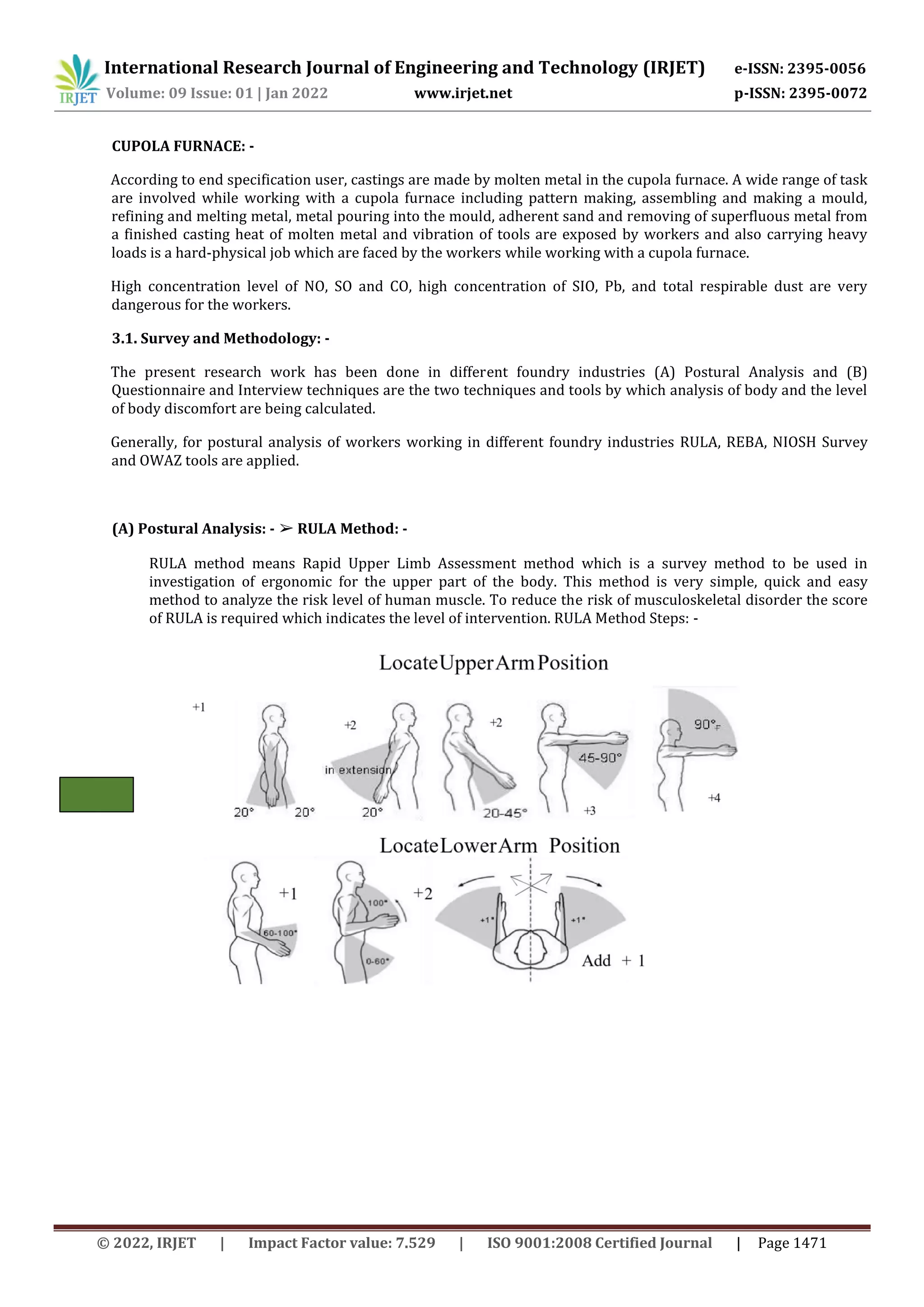
RULA method means Rapid Upper Limb Assessment method which is a survey method to be used in
investigation of ergonomic for the upper part of the body. This method is very simple, quick and easy
method to analyze the risk level of human muscle. To reduce the risk of musculoskeletal disorder the score
of RULA is required which indicates the level of intervention. RULA Method Steps: -
International Research Journal of Engineering and Technology (IRJET) e-ISSN: 2395-0056
Volume: 09 Issue: 01 | Jan 2022 www.irjet.net p-ISSN: 2395-0072
© 2022, IRJET | Impact Factor value: 7.529 | ISO 9001:2008 Certified Journal | Page 1472
Locate Trunk Position
➢ REBA Method: -
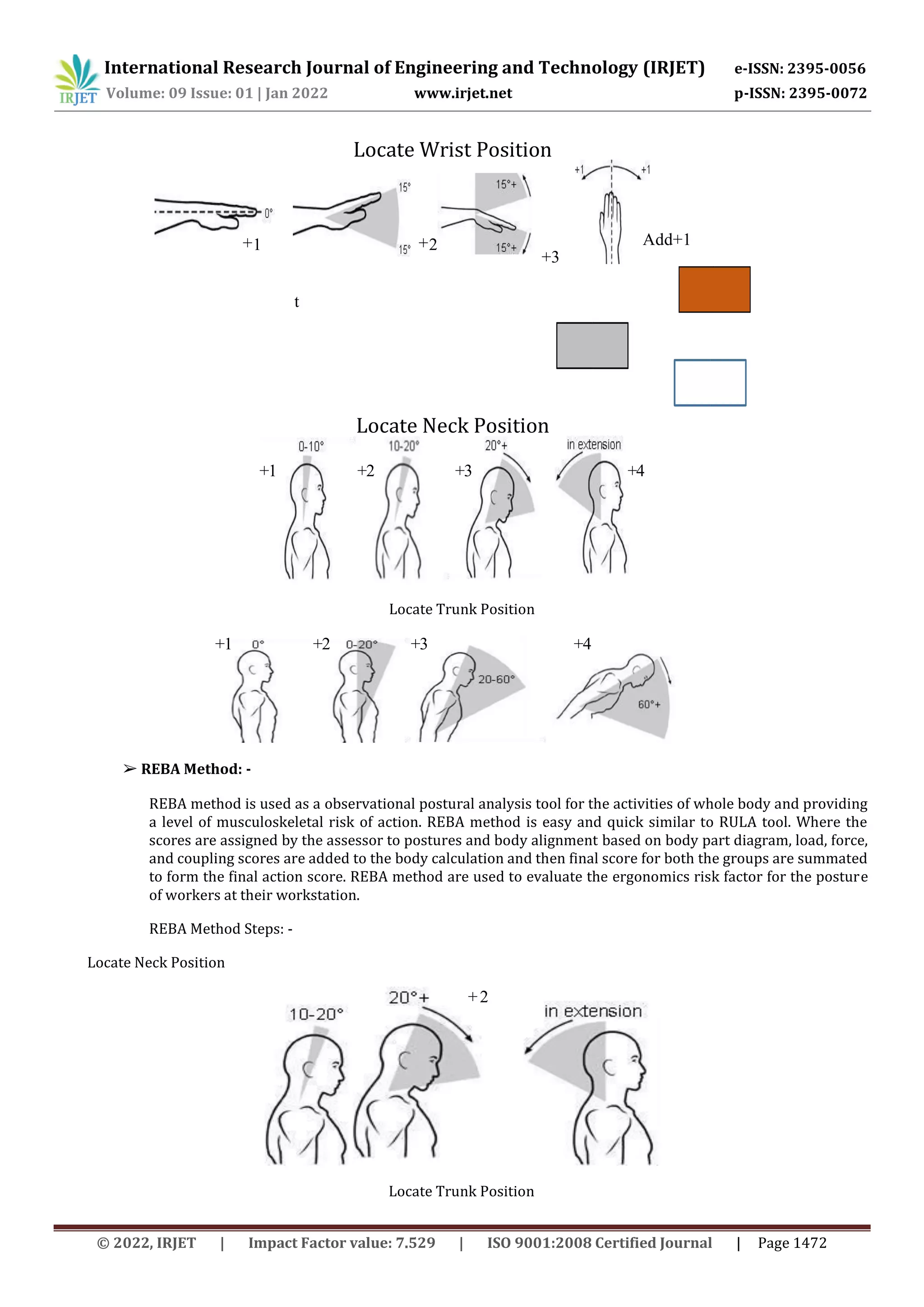
REBA method is used as a observational postural analysis tool for the activities of whole body and providing
a level of musculoskeletal risk of action. REBA method is easy and quick similar to RULA tool. Where the
scores are assigned by the assessor to postures and body alignment based on body part diagram, load, force,
and coupling scores are added to the body calculation and then final score for both the groups are summated
to form the final action score. REBA method are used to evaluate the ergonomics risk factor for the posture
of workers at their workstation.
REBA Method Steps: -
Locate Neck Position
Locate Trunk Position
Locate Wrist Position
Locate Neck Position
+1 +2
t
+3
Add+1
+1 +2 +3 +4
+1 +2 +3 +4
+2
International Research Journal of Engineering and Technology (IRJET) e-ISSN: 2395-0056
Volume: 09 Issue: 01 | Jan 2022 www.irjet.net p-ISSN: 2395-0072
© 2022, IRJET | Impact Factor value: 7.529 | ISO 9001:2008 Certified Journal | Page 1473
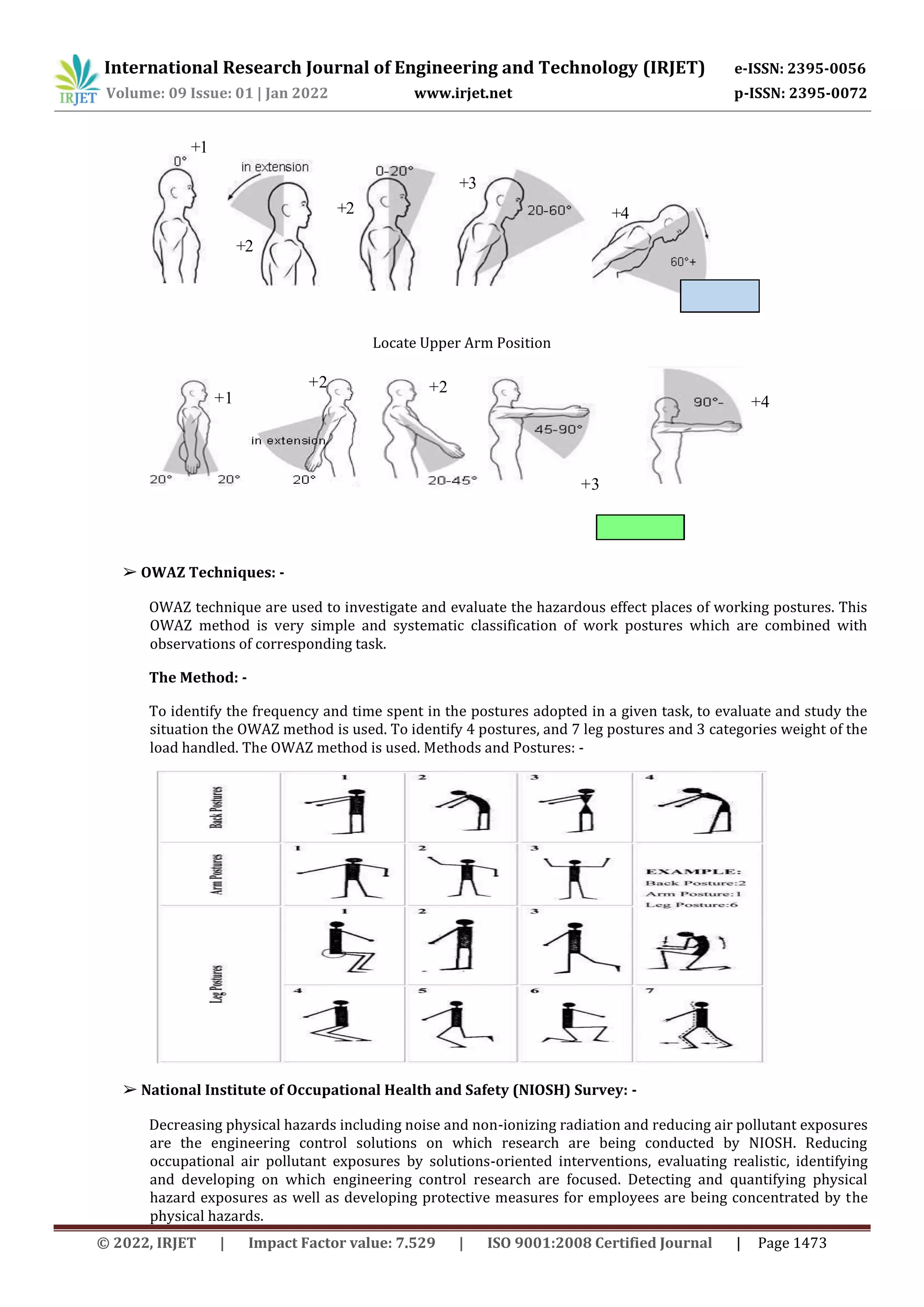
Locate Upper Arm Position
➢ OWAZ Techniques: -
OWAZ technique are used to investigate and evaluate the hazardous effect places of working postures. This
OWAZ method is very simple and systematic classification of work postures which are combined with
observations of corresponding task.
The Method: -
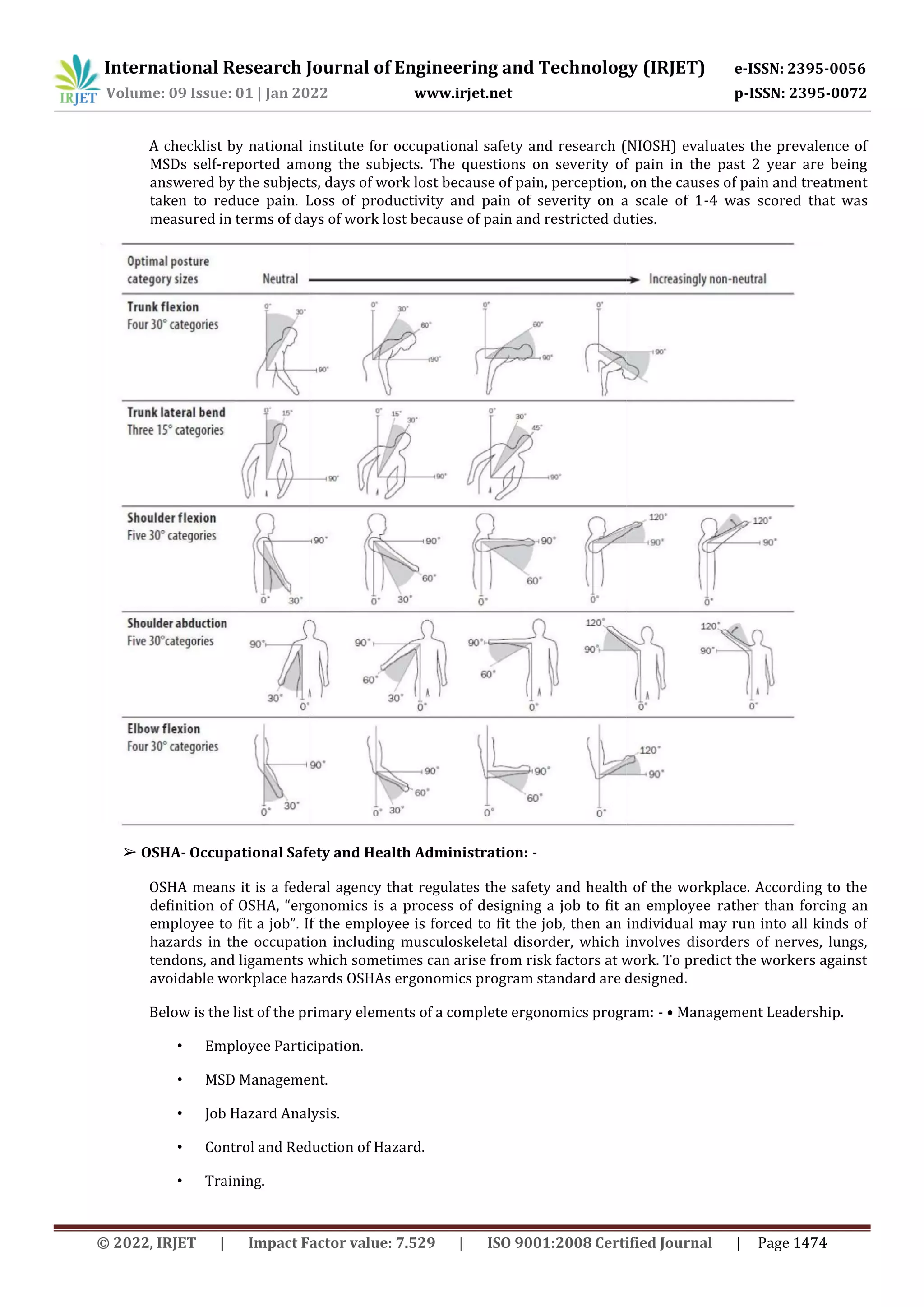
To identify the frequency and time spent in the postures adopted in a given task, to evaluate and study the
situation the OWAZ method is used. To identify 4 postures, and 7 leg postures and 3 categories weight of the
load handled. The OWAZ method is used. Methods and Postures: -
➢ National Institute of Occupational Health and Safety (NIOSH) Survey: -
Decreasing physical hazards including noise and non-ionizing radiation and reducing air pollutant exposures
are the engineering control solutions on which research are being conducted by NIOSH. Reducing
occupational air pollutant exposures by solutions-oriented interventions, evaluating realistic, identifying
and developing on which engineering control research are focused. Detecting and quantifying physical
hazard exposures as well as developing protective measures for employees are being concentrated by the
physical hazards.
+1
+2 +4
+2
+3
+2 +2
+1
+3
+4
International Research Journal of Engineering and Technology (IRJET) e-ISSN: 2395-0056
Volume: 09 Issue: 01 | Jan 2022 www.irjet.net p-ISSN: 2395-0072
© 2022, IRJET | Impact Factor value: 7.529 | ISO 9001:2008 Certified Journal | Page 1474
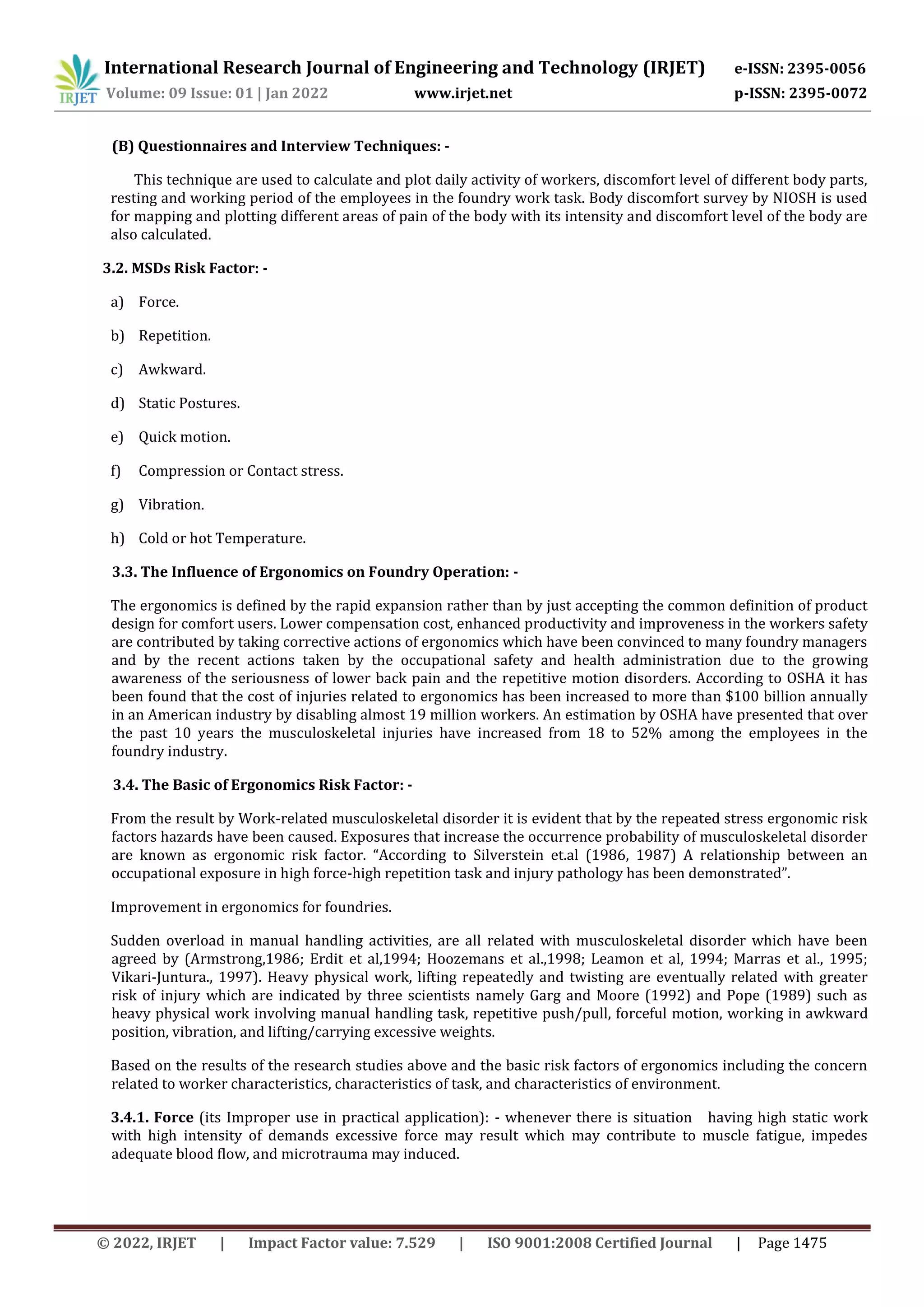
A checklist by national institute for occupational safety and research (NIOSH) evaluates the prevalence of
MSDs self-reported among the subjects. The questions on severity of pain in the past 2 year are being
answered by the subjects, days of work lost because of pain, perception, on the causes of pain and treatment
taken to reduce pain. Loss of productivity and pain of severity on a scale of 1-4 was scored that was
measured in terms of days of work lost because of pain and restricted duties.
➢ OSHA- Occupational Safety and Health Administration: -
OSHA means it is a federal agency that regulates the safety and health of the workplace. According to the
definition of OSHA, “ergonomics is a process of designing a job to fit an employee rather than forcing an
employee to fit a job”. If the employee is forced to fit the job, then an individual may run into all kinds of
hazards in the occupation including musculoskeletal disorder, which involves disorders of nerves, lungs,
tendons, and ligaments which sometimes can arise from risk factors at work. To predict the workers against
avoidable workplace hazards OSHAs ergonomics program standard are designed.
Below is the list of the primary elements of a complete ergonomics program: - • Management Leadership.
• Employee Participation.
• MSD Management.
• Job Hazard Analysis.
• Control and Reduction of Hazard.
• Training.
International Research Journal of Engineering and Technology (IRJET) e-ISSN: 2395-0056
Volume: 09 Issue: 01 | Jan 2022 www.irjet.net p-ISSN: 2395-0072
© 2022, IRJET | Impact Factor value: 7.529 | ISO 9001:2008 Certified Journal | Page 1475
(B) Questionnaires and Interview Techniques: -
This technique are used to calculate and plot daily activity of workers, discomfort level of different body parts,
resting and working period of the employees in the foundry work task. Body discomfort survey by NIOSH is used
for mapping and plotting different areas of pain of the body with its intensity and discomfort level of the body are
also calculated.
3.2. MSDs Risk Factor: -
a) Force.
b) Repetition.
c) Awkward.
d) Static Postures.
e) Quick motion.
f) Compression or Contact stress.
g) Vibration.
h) Cold or hot Temperature.
3.3. The Influence of Ergonomics on Foundry Operation: -
The ergonomics is defined by the rapid expansion rather than by just accepting the common definition of product
design for comfort users. Lower compensation cost, enhanced productivity and improveness in the workers safety
are contributed by taking corrective actions of ergonomics which have been convinced to many foundry managers
and by the recent actions taken by the occupational safety and health administration due to the growing
awareness of the seriousness of lower back pain and the repetitive motion disorders. According to OSHA it has
been found that the cost of injuries related to ergonomics has been increased to more than $100 billion annually
in an American industry by disabling almost 19 million workers. An estimation by OSHA have presented that over
the past 10 years the musculoskeletal injuries have increased from 18 to 52% among the employees in the
foundry industry.
3.4. The Basic of Ergonomics Risk Factor: -
From the result by Work-related musculoskeletal disorder it is evident that by the repeated stress ergonomic risk
factors hazards have been caused. Exposures that increase the occurrence probability of musculoskeletal disorder
are known as ergonomic risk factor. “According to Silverstein et.al (1986, 1987) A relationship between an
occupational exposure in high force-high repetition task and injury pathology has been demonstrated”.
Improvement in ergonomics for foundries.
Sudden overload in manual handling activities, are all related with musculoskeletal disorder which have been
agreed by (Armstrong,1986; Erdit et al,1994; Hoozemans et al.,1998; Leamon et al, 1994; Marras et al., 1995;
Vikari-Juntura., 1997). Heavy physical work, lifting repeatedly and twisting are eventually related with greater
risk of injury which are indicated by three scientists namely Garg and Moore (1992) and Pope (1989) such as
heavy physical work involving manual handling task, repetitive push/pull, forceful motion, working in awkward
position, vibration, and lifting/carrying excessive weights.
Based on the results of the research studies above and the basic risk factors of ergonomics including the concern
related to worker characteristics, characteristics of task, and characteristics of environment.
3.4.1. Force (its Improper use in practical application): - whenever there is situation having high static work
with high intensity of demands excessive force may result which may contribute to muscle fatigue, impedes
adequate blood flow, and microtrauma may induced.
International Research Journal of Engineering and Technology (IRJET) e-ISSN: 2395-0056
Volume: 09 Issue: 01 | Jan 2022 www.irjet.net p-ISSN: 2395-0072
© 2022, IRJET | Impact Factor value: 7.529 | ISO 9001:2008 Certified Journal | Page 1476
3.4.2. Duration (For how long an action may takes place): - Reducing the supply of nutrient to the muscle,
restricting the removal of waste product, and obstruction in the blood flow may cause muscle fatigue if
moderate/low level of contractions and short cycle contractions are sustained for a long period of time.
3.4.3. Posture (improper position or fit): - Inflammation may result when holding the body or extremities in
extreme positions and inflammation may also increase if this position is maintained for a long period of time.
3.4.4. Power (rate of doing work): - Both local and general fatigue may result when there is a high demand of
power in a task and also body’s reaction to work are triggered by power.
3.4.5. Repetition (too much of a bad thing): - Metabolic and circulatory changes may reduce the nutritional flow
in the muscle groups due to the use of muscles repeatedly and movements around the joints.
3.4.6. Environmental Factors (temperature, humidity, etc): - Decreased grasp, dexterity and causing loss of
textile sensitivity may result in the constriction of the blood vessels due to low temperatures in the limb and when
coupled with high humidity extreme temperatures can affect the performance.
3.4.7. Behaviour (information, errors, etc): - The most poorly designed system are errors, and mistakes in which
the most variable component in system is the human being.
3.4.8. Vibration (tool or equipment motion): - Finger dexterity and grip strength reduction are the effects of
performance. Numbers, tingling, episodic blanching, and pain in the figures may result due to having a direct effect
on the muscles of the upper extremity because of circulation decrease. Due to the use of vibrating tools spasm of
the small blood vessels of the hand, wrist and arm may cause.
3.4.9. Acceleration and Velocity (pace, smoothness of action, etc): - Upper extremity work related
musculoskeletal disorder are predicted by the actions of acceleration and velocity.
3.4.10. Contact Trauma (a body part press against an external object): - Too much mechanical stress on the
tissues may result due to contact stress in a sustained force which may also result in restricting the blood flow to
an area which further causes the occurrence of fatigue more quickly and also tissue trauma may result due to an
impact of shocks of an object against the body.
3.4.11. Combinations (more than one risk factor present in an activity): - To increase the risk of developing
WRMD is thoughtful due to the presence of more than one risk factor; for example- when using a grinder, a quick,
repetitive, and forceful actions of the motions are required. In a given set of circumstances other considerations
may also be essential such as;
• Age and Gender. Identifying and rectifying potentially hazardous operations for the creation of checklist
specific to industry and analysis tools specific to the job enables to understand the fundamental risk
variables.
3.5. Job Analysis for Prevention of MSDs: -
To discover the factors that are linked to an evaluated risk of work-related MSDs is the major goal of job analysis.
To identify the risk factors generally three approaches have been used which are: - i. To evaluate the
levels of risk factor associated with his or her work is asked by the worker in the workers self-report.
ii. Using a systematic methodology to classify the risk elements a job analyst watches the work in a real time
on the techniques-based observation.
iii. To take direct measurement of posture instrumentation are employed. In the figures how, disadvantages
and advantages of different techniques have been examined it has been shown [kilbon 1994; Winkel and
mathiassen 1994].
On the other hand, it may be easier by observation-based approaches to execute for the practioned field
and so therefore, it may be less expensive, more accessible, and also less knowledge is needed. Depending
on the objectives of the analysis and nature of task, the expensive and time involved with more extensive
might be significant which have been acknowledged. There are two examples of specific tools that are
Rapid Upper Limb Assessment (RULA) [ Mc Atammy and Corlett 1993] and Rapid Entire Body
Assessment (REBA) [Hignett and Mc Atammy 2000].
International Research Journal of Engineering and Technology (IRJET) e-ISSN: 2395-0056
Volume: 09 Issue: 01 | Jan 2022 www.irjet.net p-ISSN: 2395-0072
© 2022, IRJET | Impact Factor value: 7.529 | ISO 9001:2008 Certified Journal | Page 1477
3.6. Control in the Workplace: -
To correct ergonomic hazards in the workplace four types of remedies must be used that are recommended by
OSHA: -
Engineering Control-
To reduce the danger of damage engineering controls are used by adjusting high risk of occupation. The common
options are redesigned of workstation, labour practices, tool design and new procedures.
Work Practice Control-
New employee training, annual retraining, redistribution of job, modification of task, and the proper use of manual
techniques are the solution of work practice control in which both the risk jobs and risk workers are matched.
Administrative Control-
In case of administrative control, workers risk are excluded from problem jobs on time.
Personal Protective Equipment-
Personal protective equipment involves properly fit of gloves, devices of back injury, properly protection against
cold and heat.
4. CONCLUSION: -
To perform task at the foundry the repeated movement of different body parts are required which have been
confirmed in this study. These movements possess a big challenge to reduce the high rate of disorder related to
musculoskeletal. A number of important factors are identified in this study such as complaints related to safety
rules and legislation, ergonomics, repeated movements which have to be addressed to reduce complaints about
work-related musculoskeletal and among the workers in the foundry.
5. SCOPE OF FUTURE WORK: -
Since in the past, ergonomics is only a centric concept for a workplace that was centred upon injury, in terms of
both providing rehabilitation and preventing injury where necessary.
A more important approach of ergonomics is emerging in todays workplace. Where overall workers wellbeing is
about to concern. The expansion of the discipline has taken place by not only avoiding and treating injury, but also
by treating discomfort and avoiding bad working habits that may result into the injury and it also focusses
primarily on designing objects and environment that are more comfortable and easier to use than their
predecessors. As a science of work, ergonomics carries a definition of work.
6. REFERENCES: -
[1] P.N. Kale and R. T. Vyavahare,"Ergonomic Analysis Tools: A Review", International Journal of Current
Engineering and Technology, volume 6, pages 12711280 (2016).
[2] N. Jaffar, A. H. Abdul-Tharim, I. F. Mohd-Kamar, N. S. Lop "A Literature Review of Ergonomics Risk Factors in
Construction Industry", Procedia Engineering, volume 20, pages 8997 (2011).
[3] Er. Girish Joshi and Harvinder Lal,"REBA Technique on Small Scale Casting Industry" International Journal on
Emerging Technologies volume 5, pages 6165 (2014).
[4] Dima Al Madani and Awwad Dababneh "Rapid Entire Body Assessment: A Literature Review, American Journal
of Engineering and Applied Sciences volume.
[5] Baba Md Derosa, Dian Darina Indah Daruisb, Ishak Mohamed Basirc, "A Study on Ergonomic Awareness among
Workers Performing Manual Material Handling Activities "Procedia social and Behavioural Science.
International Research Journal of Engineering and Technology (IRJET) e-ISSN: 2395-0056
Volume: 09 Issue: 01 | Jan 2022 www.irjet.net p-ISSN: 2395-0072
© 2022, IRJET | Impact Factor value: 7.529 | ISO 9001:2008 Certified Journal | Page 1478
[6] Juan Luis Hernandez-Arellano, J Nieves Serratos-Perez, Ariel de la Torre, Aide Aracely Maldonado-Macias,
Jorge Luis Garcia-Alcaraz "Design proposal of an adjustable workstation for very short and very tall people",
volume 3, pages 56995706 (2015).
[7] Rajesh R "Manual material handling: A classification scheme", Procedia Technology volume 24, pages 568-575
(2016).
[8] Raemy Md. Zeina, Isa Halimb, Noorul Azreen Azisa, Adi Saptarib and Seri Rahayu Kamat "A Survey on Working
Postures among Malaysian Industrial Workers" Precedia Manufacturing, volume 2, pages 450459 (2015).
[9] Kailash Subramanian, Nagarajan N, Dr. Surianarayanan "Ergonomic Risk Assessment in An Aluminium Casting
Industry", Advances in Natural and Applied Sciences, volume 11(7) pages 71672.
[10] Sarah Moosavi, Rahul Desai, Shaygan Hallaj, K. K. Sundaram, Vivek S Hegde, "Ergonomic analysis to study
the intensity of MSDs among practicing Indian dentists" Procedia Manufacturing volume 3, pages 54195426
(2015).
[11] Maura Mengoni, Marco Matteucci, Damiano Raponi, "A multipath methodology to link ergonomics, safety
and efficiency in factories”, Procedia Manufacturing volume 11, pages.
[12] Mustafa Khan, Regina Pope-Ford Improving and modifying the design of workstations within a
manufacturing environment”, Procedia Manufacturing volume 3, pages 49274934 (2015).
[13] S. C. Mali, R. T. Vyavahare,"An Ergonomic Evaluation of an Industrial Workstation: A Review”,
International Journal of Current Engineering and Technology, volume 5 pages.
[14] S. C. Mali, R. T. Vyavahare, "RULA Analysis of Work-Related Disorders of Foundry Industry Worker Using
Digital Human Modelling (DHM)", International Research Journal of Engineering and Technology (IRJET),
volume 2, pages 13731378 (2015).
[15] Enrico Del Fabbro, Daria Santarossa, "Ergonomic analysis in manufacturing process: A real time approach
Procedia CIRP, volume 41. pages 957962 (2016).

Investigation of “Musculoskeletal Disorder in Different Foundry Industry”

  • 1.
    International Research Journalof Engineering and Technology (IRJET) e-ISSN: 2395-0056 Volume: 09 Issue: 01 | Jan 2022 www.irjet.net p-ISSN: 2395-0072 © 2022, IRJET | Impact Factor value: 7.529 | ISO 9001:2008 Certified Journal | Page 1466 Dhrubajyoti Bhattacharjee Swami Vivekananda Institute of Science and Technology, Dept. of Mechanical Engineering, Kolkata. -------------------------------------------------------------------------***------------------------------------------------------------------------ Abstract: - To examine the workers in the foundry industry’s subjective self-evaluation of musculoskeletal discomfort is the major goal of this research article. Fifty workers between the age of 18 and 55 took part in this study. The highest and the lowest percentage of the workers those are experiencing at least of one discomfort are 86 percent and 52 percent respectively due to pain in different parts of the body such as physical exertion, lifting loads, posture, work space, job rotation, rest period, and repetitive motion that has been revealed in the report of questionnaire survey. In addition, 17 of the 20 dissatisfaction factors scored higher than the average musculoskeletal discomfort score of 2.5 on a 5-point scale. Additional research, have been done according to the finding of this study that a relation between musculoskeletal pain and its impact on the employees in the foundry environment is required in this study. To give an ergonomic evaluation based on the postural analysis to reduce the risk of ergonomics this study has been proposed. This document has given a description about the different postures, origins and discomfort related to work in foundry industry. To determine the percentage of people who are suffering from such musculoskeletal disorder a special type of questionnaire called as cornel musculoskeletal disorder questionnaire are used. To determine which tool may be utilized to decrease this risk and establish a safe workplace that will increase the productivity an analysis techniques of ergonomics risk factor are identified. Key Words: - RULA Method, REBA Method, OWAZ Technique, NIOSH Survey, OSHA, Questionnaire and Interview Techniques. 1. INTRODUCTION: - In the Present Scenario, the companies in the manufacturing sectors are continuously improving the effectiveness. By implementing world class strategies of manufacturing, the effectiveness in manufacturing industries can be achieved. The process involved in the manufacturing was mainly focused by the world class manufacturing strategies. However, the organizations are more focused on the workers’ safety and health and instead of depending on the organization process. Workers in any industrial sector have faced problems such as repetitive physical actions, which causes discomfort in the bodies of workers which are related to repeated actions of Load. Causing discomfort and suffering in their bodies may happen when workers are expected to remain in a position for extended period of time. Due to the result of musculoskeletal discomfort physical pains may cause among employees. Foundry Industry also known as metallurgical industry which is one of the most important sectors in the manufacturing. This paper is focused at studying the musculoskeletal level of discomfort among the workers employed in foundry environment across the worldwide. This study aims to analyze the level of discomfort in the workers in foundry industry. This research study shall be implemented to prevent the occurrence of ergonomics risk factors in foundry industry leading to musculoskeletal discomfort among the employees and thereby improving the health and safety level of workers working environment. 1.1. What is Ergonomics? The study of how to build or arrange the workplaces, goods, and systems such that it should be comfortable for the people who use them are known as ergonomics. Ergonomics is not only which deals with seats or with the design of car models, control systems, and its instruments that many people assumed but it is also something more. All of the designs that are made by the people are concerned by ergonomics such as sports and recreation, work place, health and safety. Investigation of “Musculoskeletal Disorder in Different Foundry Industry”
  • 2.
    International Research Journalof Engineering and Technology (IRJET) e-ISSN: 2395-0056 Volume: 09 Issue: 01 | Jan 2022 www.irjet.net p-ISSN: 2395-0072 © 2022, IRJET | Impact Factor value: 7.529 | ISO 9001:2008 Certified Journal | Page 1467 1.1.1. How Does Ergonomic Work? Ergonomics may be comparatively new branch of science, which depends on the analysis in several alternative order, which are established by scientific areas, like engineering, physiology and scientific discipline. Various techniques and information are used by the ergonomist from several disciplines and those are:- • Anthropometry: body shapes and sizes; population and variations. • All examples of biomechanics are muscles, levers, force and strength. • Environmental physics involve no9ie, light, heat, cold, radiation, and vibration, and body vibrational systems include hearing, vision, and sensation. • Aspects of social psychology involves groups, communication, learning. 1.2. Musculoskeletal Disorder: - The injuries or pains that occur in the human musculoskeletal system includes the joints, ligaments, muscles, nerves, tendons, and structures that supports the limbs, neck, and back are called as MSDs. As a result, of sudden exertion such as lifting a heavy object. MSD can occur, and MSDs may also develop from repeating the same motions, repetitive strain or repeated exposure to force, vibrations or unnatural posture. MSDs are not considered as an injurious and pain in the musculoskeletal system if it is caused by acute traumatic systems such as car accident or fall. MSDs will have an effect on various elements of the body as well as upper and lower back, neck, shoulders and extremities like arms, feet’s and hands. 1.3. Need of MSDs Investigation: - One of the most prevalent issues in industrial and service sectors are poor working postures which leads to musculoskeletal diseases and physiological stress. In the industrial sectors particularly, many jobs in the workplaces such as physical material handling duties and many more, all necessitate an individual performance to work in a bad working circumstance to satisfy the task expectation. This study have been carried out to find out the solution of musculoskeletal disorders and ergonomic risk factors related to lower back, shoulder, and lower arm pain in 2 kinds of manual jobs in per market warehouses such as lifting as well as pulling things. 1.4. Advantages of MSDs Investigation: - Keeping people healthy and safe is one of the major priorities in MSDs investigation. Providing an opportunity to people to fulfill creative work is one of the business starting to add value and serve others in the world. A business would definitely will ensure its place until and unless it doesn’t put its people into any risk. There are five benefits for preventing MSDs which includes:
  • 3.
    International Research Journalof Engineering and Technology (IRJET) e-ISSN: 2395-0056 Volume: 09 Issue: 01 | Jan 2022 www.irjet.net p-ISSN: 2395-0072 © 2022, IRJET | Impact Factor value: 7.529 | ISO 9001:2008 Certified Journal | Page 1468 • Lower Cost. • Productivity Improvement. • Improvement in Quality. • Engagement within Employees. • Better Prevention and Safety. 1.5. Prevention for MSDs: - 1.5.1. To Prevent MSDs in the Workplaces: - The guidelines about MSDs prevention has outlined major activities of prevention for the occurrence of risk before an injury. To avoid MSDs by modifying work practices this research study has presented a set of guidelines. A guideline has been set in this study in order to reduce MSD hazards in small foundry industry. This research study has presented an emphasis of workplace which is required to reduce the workplace dangers and an attention of workers to work more safely in foundry industry. According to the central messages of ergonomics “if a job isn’t a good match to the workers, then musculoskeletal discomfort, injuries, and lower product service could result which may result to give bad product quality service”. 1.5.2. Identify the Risk of MSD and Elimination of Hazard: - This study has been proposed as per the need for providing a methodology to identify, analyze and remove the dangers of MSDs that will be very helpful in lowering the risk associated with MSDs hazards. To minimize the acquiring risk of MSD hazard the procedure for the risk assessment in foundry workplace should be considered. RACE is one of the risk assessment procedure that is similar to other hazards in the workplace. According to RACE: - • R- it stands for recognition of MSDs hazards. • A- it means to access the workers risk. • C- To reduce the Control of workers risk. • E- The control to the risk of workers is evaluated. The changes in the workplace can be induced once the MSDs hazards are identified in order to reduce the impact of hazards caused by MSDs. Four types of controls are usually employed in combination such as: - • The best option is to completely remove the hazards. • Accomplishing the task using different methods. • Engineering controls have to be implemented in order to alter the workplace. • Administrative control has to be implemented in order to change the way of the work. • To reduce the risk of developing MSDs antivibration gloves, knee pads, are the only equipment which should be used correctly. 1.6. Objective of Research: - As per the need, products have to be purchased from local manufacturers. When failure of the products occurs then as a result of feedback the product have to get improved. As because the large industries in rural sectors have till now not started in producing those products so therefore till now no development regarding the rural product designing have been done. So, due to this reason large sector industries manufacture products without the proper availability of design. Having healthy working environment by designing proper procedure of working plays a
  • 4.
    International Research Journalof Engineering and Technology (IRJET) e-ISSN: 2395-0056 Volume: 09 Issue: 01 | Jan 2022 www.irjet.net p-ISSN: 2395-0072 © 2022, IRJET | Impact Factor value: 7.529 | ISO 9001:2008 Certified Journal | Page 1469 major role in ergonomics. Unconsciousness about the ergonomics by the workers in various large and small industries is a major problem faced among the workers in foundry work task. So, therefore in those industries musculoskeletal disorder may result where workers work in bad posture. Therefore, health and safety issues is one of the important which have to be taken by implementing proper methods for safe working. While, on the other hand working in inadequate posture will affect productivity among large no. of workers in industries. To properly determine the planning for ergonomic in small foundry industries analysis software’s such as RULA, REBA, and OWAZ are used. If the score of RULA, REBA, and OWAS are high then it indicates that health and safety of the workers are adversely affected as a result of it, efficiency, product quality, and internal fatigue will reduce. By ensuring that the workers posture is well organized by the proper planning’s of ergonomics this score can be reduced. As it has been outlined by the PhD’s, that within the field of ergonomics the plan of research which is having the analysis of posture for workers during working in several SSI of west Bengal will improve the working inequality, efficiency, safety and healthy working culture will establish which will help to reduce the fatigue by taking correct measure of posture. To analyze the workers way of working in various processes for small scale industries in west Bengal is the main objective of this research work. In these research article, three postural analysis tools RULA, REBA, and OWAS are used and recommends to made any changes in the posture of the body while working which will also increase the working quality. 2. LITERATURE REVIEW: - From recently published research work on ergonomics analysis in industry a literature review have been presented to understand the issues involved in research. 1. Juan Luis Hernandez- Arellano et.al. 2015 has conferred a design proposal for extremes where ever men and women perform similar task within the same workstations [6]. 2. According to the study by P.N. Kale et.al. 2016 a review has been presented on the study which are carried to analyze various tools used for ergonomics analysis [1]. 3. According to N. Jaffar et.al. 2015 a summary of ergonomics risk factors in construction trade has been mentioned in the study. The purpose of the study was to convey a basic and clear definition of ergonomic [2]. 4. A common occupational problem encountered by workers has been described in the study by Er. Girish joshi et.al. 2015. How to access the musculoskeletal disorder (MSD) of workers in the small-scale casting industries has been mentioned in this study [3]. 5. Some of the material handling about musculoskeletal disorder and low back pain (LBP) has been explained by Baba Md Derosa et. Al (2011) [5]. 6. According to the study by Rajesh R et. Al 2016 that the most of the part has been supported for the task analysis approach where ever the job are countermined into an easier task and study [7]. 7. A study by Raemy Md. Zeina et. Al. 2015 has been proposed that industrial workers were injured frequently at a work as a result of an incorrect working posture. 8. According to the study analyzed by Kailash Subramanian et. Al. (2017) that ergonomics hinders each health and productivity of the employees in industrial sector [9]. 9. According to an analysis by S.C. Mali et.al. 2015 that ergonomic problems are one the major concerns which are faced by metal working manufacturers [13]. 10. An important approach to investigate correctly was the human interaction with the workplace which have been analyzed in the study by Enrico Del Fabbro et. Al. 2016 [15]. 11. According to the study and analysis of L.P Singh et. Al. 2010, it has been found that throughout the world the most common problem is Musculoskeletal Disorder MSDs. 12. According to the study by Mustafa Khan et. al. 2015, a manual assembly task in many production facilities are have been widely spread [12].
  • 5.
    International Research Journalof Engineering and Technology (IRJET) e-ISSN: 2395-0056 Volume: 09 Issue: 01 | Jan 2022 www.irjet.net p-ISSN: 2395-0072 © 2022, IRJET | Impact Factor value: 7.529 | ISO 9001:2008 Certified Journal | Page 1470 13. According to the investigation by N.A. Ansari et. al. 2014. Rapid Upper Limb Assessment (RULA) and Rapid Entire Body Assessment (REBA) which are the postural analysis tools are used for assessment indicate that the workers are working above the safe limit. 14. Maura Mengoni et. al. 2017, have been revealed that risk management is one of the foregone conclusions for manufacturing companies, and a strategic component of their success [11]. 15. According to the study and analysis by S.C. Mali et. al. 2015 that in India for most of the small-scale industries the principles of ergonomics were not considered at the time of designing industrial workstations [14]. 2.1. Effects of Hazards to workers and environment in the Foundry Industry: A review paper - The hazardous working environment in the foundry shops results from various chemical mixtures, physical and mechanical hazardous gases which may result in juries to workers in the foundry industry. Also, workers may pose health problems while working in foundry industry that includes molten metal face exposure, mists of heat and spray. Respirable crystalline silica or commonly called as silica dust which may be produced by casting sand, fettling, and kiln linings when workers work in the foundry shop. This research paper provides a brief outline about the health effects and safety measures which have to be taken in the foundry industry to prevent hazards. This information presently describes from completely different analysis work and it also outlines the effects on workers which are mainly produced by hazards in the foundry shop and also it has been revealed that how it effects the environment. Through the study from different research journals, it has been revealed that hazards from foundry shops are very dangerous and it effects to both the workers health and environment. Workers in the foundry industry works in various hazardous chemicals and also noise pollution, vibrations, all are the major causes of injuries faced among the workers. Hazardous effects of chemicals on Health Systems: - Hazardous chemicals are very dangerous and it can adversely affect the body’s inhalation parts and also it can damage the body skin organs, and it may affect the body by entering through an accidental ingestion. There are different types of hazards which may affect the specific organs of the body by both short term as well as by the long term. The hazardous chemicals in the foundry industry are one of the major problems among the workers which may also lead to headaches, bronchitis, asthma, which affects in respiratory lungs in the employees in the foundry industry. Effects of Airborne Contaminants on Health: - There are also other irritating effects by which the presence of different gases may indicate such as respiratory irritation, coughing, inhaling problem, acidic taste and eye irritation. Wood dust may result in the risk of cancer in the nasal cavity, and may also causes a skin rash, and may result in asthma problem. Heavy metal dusts particles when inhaled by the workers while working in the foundry industry may cause health problems which may result in the damage of lungs and damage in siderosis; respiratory systems may get irritates when inhaling of aluminum dust and also may lead to chronic non-specific respiratory diseases. Vibrational Effects on Health: - Problems in stomach, blood pressure, problem in the heart and disorders in the nervous systems, influence problem on speech, having a chest pain, or having a breadthening problem are all the effects of whole-body vibration for which the vibrational disease may caused. This study has discussed the effects and measures to prevent hazardous effects on workers and environment in the foundry industry. In the study, different types of hazards had been discussed and identified and then the effects of hazards on the environment and their preventive measures has been carried out. 3. OVERVIEW OF MSDs IN FOUNDRY WORKERS: - ROTARY FURNACE: - A wider range of repetitive tasks are involved while working with a rotary furnace such as loading and carrying raw material to a furnace, opening a tapping hole, and filling a ladle with molten metal daily for 22-24 hrs. these furnaces are used. Oil are lifted manually by the workers into tanks placed at a height of 3m.
  • 6.
    International Research Journalof Engineering and Technology (IRJET) e-ISSN: 2395-0056 Volume: 09 Issue: 01 | Jan 2022 www.irjet.net p-ISSN: 2395-0072 © 2022, IRJET | Impact Factor value: 7.529 | ISO 9001:2008 Certified Journal | Page 1471 CUPOLA FURNACE: - According to end specification user, castings are made by molten metal in the cupola furnace. A wide range of task are involved while working with a cupola furnace including pattern making, assembling and making a mould, refining and melting metal, metal pouring into the mould, adherent sand and removing of superfluous metal from a finished casting heat of molten metal and vibration of tools are exposed by workers and also carrying heavy loads is a hard-physical job which are faced by the workers while working with a cupola furnace. High concentration level of NO, SO and CO, high concentration of SIO, Pb, and total respirable dust are very dangerous for the workers. 3.1. Survey and Methodology: - The present research work has been done in different foundry industries (A) Postural Analysis and (B) Questionnaire and Interview techniques are the two techniques and tools by which analysis of body and the level of body discomfort are being calculated. Generally, for postural analysis of workers working in different foundry industries RULA, REBA, NIOSH Survey and OWAZ tools are applied. (A) Postural Analysis: - ➢ RULA Method: - RULA method means Rapid Upper Limb Assessment method which is a survey method to be used in investigation of ergonomic for the upper part of the body. This method is very simple, quick and easy method to analyze the risk level of human muscle. To reduce the risk of musculoskeletal disorder the score of RULA is required which indicates the level of intervention. RULA Method Steps: -
  • 7.
    International Research Journalof Engineering and Technology (IRJET) e-ISSN: 2395-0056 Volume: 09 Issue: 01 | Jan 2022 www.irjet.net p-ISSN: 2395-0072 © 2022, IRJET | Impact Factor value: 7.529 | ISO 9001:2008 Certified Journal | Page 1472 Locate Trunk Position ➢ REBA Method: - REBA method is used as a observational postural analysis tool for the activities of whole body and providing a level of musculoskeletal risk of action. REBA method is easy and quick similar to RULA tool. Where the scores are assigned by the assessor to postures and body alignment based on body part diagram, load, force, and coupling scores are added to the body calculation and then final score for both the groups are summated to form the final action score. REBA method are used to evaluate the ergonomics risk factor for the posture of workers at their workstation. REBA Method Steps: - Locate Neck Position Locate Trunk Position Locate Wrist Position Locate Neck Position +1 +2 t +3 Add+1 +1 +2 +3 +4 +1 +2 +3 +4 +2
  • 8.
    International Research Journalof Engineering and Technology (IRJET) e-ISSN: 2395-0056 Volume: 09 Issue: 01 | Jan 2022 www.irjet.net p-ISSN: 2395-0072 © 2022, IRJET | Impact Factor value: 7.529 | ISO 9001:2008 Certified Journal | Page 1473 Locate Upper Arm Position ➢ OWAZ Techniques: - OWAZ technique are used to investigate and evaluate the hazardous effect places of working postures. This OWAZ method is very simple and systematic classification of work postures which are combined with observations of corresponding task. The Method: - To identify the frequency and time spent in the postures adopted in a given task, to evaluate and study the situation the OWAZ method is used. To identify 4 postures, and 7 leg postures and 3 categories weight of the load handled. The OWAZ method is used. Methods and Postures: - ➢ National Institute of Occupational Health and Safety (NIOSH) Survey: - Decreasing physical hazards including noise and non-ionizing radiation and reducing air pollutant exposures are the engineering control solutions on which research are being conducted by NIOSH. Reducing occupational air pollutant exposures by solutions-oriented interventions, evaluating realistic, identifying and developing on which engineering control research are focused. Detecting and quantifying physical hazard exposures as well as developing protective measures for employees are being concentrated by the physical hazards. +1 +2 +4 +2 +3 +2 +2 +1 +3 +4
  • 9.
    International Research Journalof Engineering and Technology (IRJET) e-ISSN: 2395-0056 Volume: 09 Issue: 01 | Jan 2022 www.irjet.net p-ISSN: 2395-0072 © 2022, IRJET | Impact Factor value: 7.529 | ISO 9001:2008 Certified Journal | Page 1474 A checklist by national institute for occupational safety and research (NIOSH) evaluates the prevalence of MSDs self-reported among the subjects. The questions on severity of pain in the past 2 year are being answered by the subjects, days of work lost because of pain, perception, on the causes of pain and treatment taken to reduce pain. Loss of productivity and pain of severity on a scale of 1-4 was scored that was measured in terms of days of work lost because of pain and restricted duties. ➢ OSHA- Occupational Safety and Health Administration: - OSHA means it is a federal agency that regulates the safety and health of the workplace. According to the definition of OSHA, “ergonomics is a process of designing a job to fit an employee rather than forcing an employee to fit a job”. If the employee is forced to fit the job, then an individual may run into all kinds of hazards in the occupation including musculoskeletal disorder, which involves disorders of nerves, lungs, tendons, and ligaments which sometimes can arise from risk factors at work. To predict the workers against avoidable workplace hazards OSHAs ergonomics program standard are designed. Below is the list of the primary elements of a complete ergonomics program: - • Management Leadership. • Employee Participation. • MSD Management. • Job Hazard Analysis. • Control and Reduction of Hazard. • Training.
  • 10.
    International Research Journalof Engineering and Technology (IRJET) e-ISSN: 2395-0056 Volume: 09 Issue: 01 | Jan 2022 www.irjet.net p-ISSN: 2395-0072 © 2022, IRJET | Impact Factor value: 7.529 | ISO 9001:2008 Certified Journal | Page 1475 (B) Questionnaires and Interview Techniques: - This technique are used to calculate and plot daily activity of workers, discomfort level of different body parts, resting and working period of the employees in the foundry work task. Body discomfort survey by NIOSH is used for mapping and plotting different areas of pain of the body with its intensity and discomfort level of the body are also calculated. 3.2. MSDs Risk Factor: - a) Force. b) Repetition. c) Awkward. d) Static Postures. e) Quick motion. f) Compression or Contact stress. g) Vibration. h) Cold or hot Temperature. 3.3. The Influence of Ergonomics on Foundry Operation: - The ergonomics is defined by the rapid expansion rather than by just accepting the common definition of product design for comfort users. Lower compensation cost, enhanced productivity and improveness in the workers safety are contributed by taking corrective actions of ergonomics which have been convinced to many foundry managers and by the recent actions taken by the occupational safety and health administration due to the growing awareness of the seriousness of lower back pain and the repetitive motion disorders. According to OSHA it has been found that the cost of injuries related to ergonomics has been increased to more than $100 billion annually in an American industry by disabling almost 19 million workers. An estimation by OSHA have presented that over the past 10 years the musculoskeletal injuries have increased from 18 to 52% among the employees in the foundry industry. 3.4. The Basic of Ergonomics Risk Factor: - From the result by Work-related musculoskeletal disorder it is evident that by the repeated stress ergonomic risk factors hazards have been caused. Exposures that increase the occurrence probability of musculoskeletal disorder are known as ergonomic risk factor. “According to Silverstein et.al (1986, 1987) A relationship between an occupational exposure in high force-high repetition task and injury pathology has been demonstrated”. Improvement in ergonomics for foundries. Sudden overload in manual handling activities, are all related with musculoskeletal disorder which have been agreed by (Armstrong,1986; Erdit et al,1994; Hoozemans et al.,1998; Leamon et al, 1994; Marras et al., 1995; Vikari-Juntura., 1997). Heavy physical work, lifting repeatedly and twisting are eventually related with greater risk of injury which are indicated by three scientists namely Garg and Moore (1992) and Pope (1989) such as heavy physical work involving manual handling task, repetitive push/pull, forceful motion, working in awkward position, vibration, and lifting/carrying excessive weights. Based on the results of the research studies above and the basic risk factors of ergonomics including the concern related to worker characteristics, characteristics of task, and characteristics of environment. 3.4.1. Force (its Improper use in practical application): - whenever there is situation having high static work with high intensity of demands excessive force may result which may contribute to muscle fatigue, impedes adequate blood flow, and microtrauma may induced.
  • 11.
    International Research Journalof Engineering and Technology (IRJET) e-ISSN: 2395-0056 Volume: 09 Issue: 01 | Jan 2022 www.irjet.net p-ISSN: 2395-0072 © 2022, IRJET | Impact Factor value: 7.529 | ISO 9001:2008 Certified Journal | Page 1476 3.4.2. Duration (For how long an action may takes place): - Reducing the supply of nutrient to the muscle, restricting the removal of waste product, and obstruction in the blood flow may cause muscle fatigue if moderate/low level of contractions and short cycle contractions are sustained for a long period of time. 3.4.3. Posture (improper position or fit): - Inflammation may result when holding the body or extremities in extreme positions and inflammation may also increase if this position is maintained for a long period of time. 3.4.4. Power (rate of doing work): - Both local and general fatigue may result when there is a high demand of power in a task and also body’s reaction to work are triggered by power. 3.4.5. Repetition (too much of a bad thing): - Metabolic and circulatory changes may reduce the nutritional flow in the muscle groups due to the use of muscles repeatedly and movements around the joints. 3.4.6. Environmental Factors (temperature, humidity, etc): - Decreased grasp, dexterity and causing loss of textile sensitivity may result in the constriction of the blood vessels due to low temperatures in the limb and when coupled with high humidity extreme temperatures can affect the performance. 3.4.7. Behaviour (information, errors, etc): - The most poorly designed system are errors, and mistakes in which the most variable component in system is the human being. 3.4.8. Vibration (tool or equipment motion): - Finger dexterity and grip strength reduction are the effects of performance. Numbers, tingling, episodic blanching, and pain in the figures may result due to having a direct effect on the muscles of the upper extremity because of circulation decrease. Due to the use of vibrating tools spasm of the small blood vessels of the hand, wrist and arm may cause. 3.4.9. Acceleration and Velocity (pace, smoothness of action, etc): - Upper extremity work related musculoskeletal disorder are predicted by the actions of acceleration and velocity. 3.4.10. Contact Trauma (a body part press against an external object): - Too much mechanical stress on the tissues may result due to contact stress in a sustained force which may also result in restricting the blood flow to an area which further causes the occurrence of fatigue more quickly and also tissue trauma may result due to an impact of shocks of an object against the body. 3.4.11. Combinations (more than one risk factor present in an activity): - To increase the risk of developing WRMD is thoughtful due to the presence of more than one risk factor; for example- when using a grinder, a quick, repetitive, and forceful actions of the motions are required. In a given set of circumstances other considerations may also be essential such as; • Age and Gender. Identifying and rectifying potentially hazardous operations for the creation of checklist specific to industry and analysis tools specific to the job enables to understand the fundamental risk variables. 3.5. Job Analysis for Prevention of MSDs: - To discover the factors that are linked to an evaluated risk of work-related MSDs is the major goal of job analysis. To identify the risk factors generally three approaches have been used which are: - i. To evaluate the levels of risk factor associated with his or her work is asked by the worker in the workers self-report. ii. Using a systematic methodology to classify the risk elements a job analyst watches the work in a real time on the techniques-based observation. iii. To take direct measurement of posture instrumentation are employed. In the figures how, disadvantages and advantages of different techniques have been examined it has been shown [kilbon 1994; Winkel and mathiassen 1994]. On the other hand, it may be easier by observation-based approaches to execute for the practioned field and so therefore, it may be less expensive, more accessible, and also less knowledge is needed. Depending on the objectives of the analysis and nature of task, the expensive and time involved with more extensive might be significant which have been acknowledged. There are two examples of specific tools that are Rapid Upper Limb Assessment (RULA) [ Mc Atammy and Corlett 1993] and Rapid Entire Body Assessment (REBA) [Hignett and Mc Atammy 2000].
  • 12.
    International Research Journalof Engineering and Technology (IRJET) e-ISSN: 2395-0056 Volume: 09 Issue: 01 | Jan 2022 www.irjet.net p-ISSN: 2395-0072 © 2022, IRJET | Impact Factor value: 7.529 | ISO 9001:2008 Certified Journal | Page 1477 3.6. Control in the Workplace: - To correct ergonomic hazards in the workplace four types of remedies must be used that are recommended by OSHA: - Engineering Control- To reduce the danger of damage engineering controls are used by adjusting high risk of occupation. The common options are redesigned of workstation, labour practices, tool design and new procedures. Work Practice Control- New employee training, annual retraining, redistribution of job, modification of task, and the proper use of manual techniques are the solution of work practice control in which both the risk jobs and risk workers are matched. Administrative Control- In case of administrative control, workers risk are excluded from problem jobs on time. Personal Protective Equipment- Personal protective equipment involves properly fit of gloves, devices of back injury, properly protection against cold and heat. 4. CONCLUSION: - To perform task at the foundry the repeated movement of different body parts are required which have been confirmed in this study. These movements possess a big challenge to reduce the high rate of disorder related to musculoskeletal. A number of important factors are identified in this study such as complaints related to safety rules and legislation, ergonomics, repeated movements which have to be addressed to reduce complaints about work-related musculoskeletal and among the workers in the foundry. 5. SCOPE OF FUTURE WORK: - Since in the past, ergonomics is only a centric concept for a workplace that was centred upon injury, in terms of both providing rehabilitation and preventing injury where necessary. A more important approach of ergonomics is emerging in todays workplace. Where overall workers wellbeing is about to concern. The expansion of the discipline has taken place by not only avoiding and treating injury, but also by treating discomfort and avoiding bad working habits that may result into the injury and it also focusses primarily on designing objects and environment that are more comfortable and easier to use than their predecessors. As a science of work, ergonomics carries a definition of work. 6. REFERENCES: - [1] P.N. Kale and R. T. Vyavahare,"Ergonomic Analysis Tools: A Review", International Journal of Current Engineering and Technology, volume 6, pages 12711280 (2016). [2] N. Jaffar, A. H. Abdul-Tharim, I. F. Mohd-Kamar, N. S. Lop "A Literature Review of Ergonomics Risk Factors in Construction Industry", Procedia Engineering, volume 20, pages 8997 (2011). [3] Er. Girish Joshi and Harvinder Lal,"REBA Technique on Small Scale Casting Industry" International Journal on Emerging Technologies volume 5, pages 6165 (2014). [4] Dima Al Madani and Awwad Dababneh "Rapid Entire Body Assessment: A Literature Review, American Journal of Engineering and Applied Sciences volume. [5] Baba Md Derosa, Dian Darina Indah Daruisb, Ishak Mohamed Basirc, "A Study on Ergonomic Awareness among Workers Performing Manual Material Handling Activities "Procedia social and Behavioural Science.
  • 13.
    International Research Journalof Engineering and Technology (IRJET) e-ISSN: 2395-0056 Volume: 09 Issue: 01 | Jan 2022 www.irjet.net p-ISSN: 2395-0072 © 2022, IRJET | Impact Factor value: 7.529 | ISO 9001:2008 Certified Journal | Page 1478 [6] Juan Luis Hernandez-Arellano, J Nieves Serratos-Perez, Ariel de la Torre, Aide Aracely Maldonado-Macias, Jorge Luis Garcia-Alcaraz "Design proposal of an adjustable workstation for very short and very tall people", volume 3, pages 56995706 (2015). [7] Rajesh R "Manual material handling: A classification scheme", Procedia Technology volume 24, pages 568-575 (2016). [8] Raemy Md. Zeina, Isa Halimb, Noorul Azreen Azisa, Adi Saptarib and Seri Rahayu Kamat "A Survey on Working Postures among Malaysian Industrial Workers" Precedia Manufacturing, volume 2, pages 450459 (2015). [9] Kailash Subramanian, Nagarajan N, Dr. Surianarayanan "Ergonomic Risk Assessment in An Aluminium Casting Industry", Advances in Natural and Applied Sciences, volume 11(7) pages 71672. [10] Sarah Moosavi, Rahul Desai, Shaygan Hallaj, K. K. Sundaram, Vivek S Hegde, "Ergonomic analysis to study the intensity of MSDs among practicing Indian dentists" Procedia Manufacturing volume 3, pages 54195426 (2015). [11] Maura Mengoni, Marco Matteucci, Damiano Raponi, "A multipath methodology to link ergonomics, safety and efficiency in factories”, Procedia Manufacturing volume 11, pages. [12] Mustafa Khan, Regina Pope-Ford Improving and modifying the design of workstations within a manufacturing environment”, Procedia Manufacturing volume 3, pages 49274934 (2015). [13] S. C. Mali, R. T. Vyavahare,"An Ergonomic Evaluation of an Industrial Workstation: A Review”, International Journal of Current Engineering and Technology, volume 5 pages. [14] S. C. Mali, R. T. Vyavahare, "RULA Analysis of Work-Related Disorders of Foundry Industry Worker Using Digital Human Modelling (DHM)", International Research Journal of Engineering and Technology (IRJET), volume 2, pages 13731378 (2015). [15] Enrico Del Fabbro, Daria Santarossa, "Ergonomic analysis in manufacturing process: A real time approach Procedia CIRP, volume 41. pages 957962 (2016).