4.7 INVERSE TRIGONOMETRIC
FUNCTIONS
For an inverse to exist the function MUST
be one- to - one
• A function is one-to-
one if for every x there
is exactly one y and
for every y there is
exactly one x.
• So
• If x and/or y is raised
to an even power then
the inverse does not
exist unless the
domain is restricted.
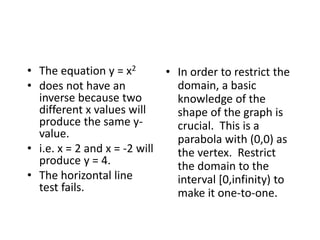
• The equation y = x2
• does not have an
inverse because two
different x values will
produce the same y-
value.
• i.e. x = 2 and x = -2 will
produce y = 4.
• The horizontal line
test fails.
• In order to restrict the
domain, a basic
knowledge of the
shape of the graph is
crucial. This is a
parabola with (0,0) as
the vertex. Restrict
the domain to the
interval [0,infinity) to
make it one-to-one.
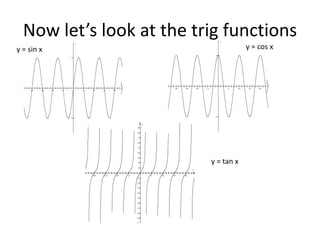
Now let’s look at the trig functions
       


x
y
       


x
y
       



















x
y
y = sin x y = cos x
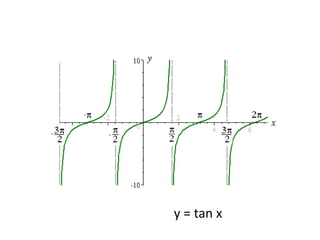
y = tan x
       


x
y
For the graph of y = sin x, the Domain is (-∞, ∞)
the Range is [-1, 1]
Not a 1-1 function
So it currently does
not have an inverse
       


x
y
However we can restrict the domain to [-/ , /]
Note the range will remain [-1, 1]
Now it’s 1-1!

 
    



x
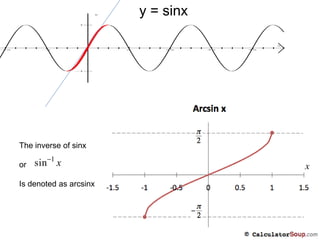
y y = sinx
The inverse of sinx
or
Is denoted as arcsinx
x
1
sin
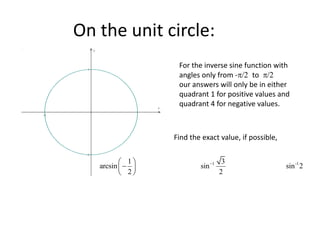
On the unit circle:
 


x
y
For the inverse sine function with
angles only from -/ to /
our answers will only be in either
quadrant 1 for positive values and
quadrant 4 for negative values.
Find the exact value, if possible,
1 -1
1 3
arcsin sin sin 2
2 2

 

 
 
       


x
y
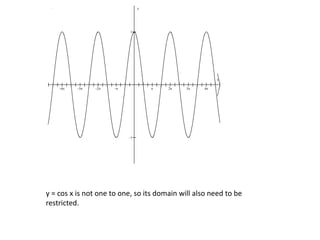
y = cos x is not one to one, so its domain will also need to be
restricted.
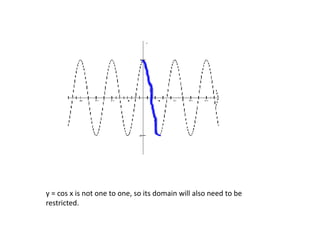
y = cos x is not one to one, so its domain will also need to be
restricted.
/ / / /  / / 


x
y
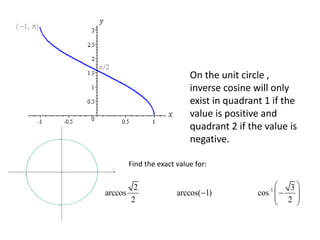
On this interval, [0, ] the
cosine function is one-to-
one and we can now
define the inverse cosine
function.
y = arccos x or y = cos-1 x
y = arccos x
y = cos x
On the unit circle ,
inverse cosine will only
exist in quadrant 1 if the
value is positive and
quadrant 2 if the value is
negative.
 


x
y
Find the exact value for:
-1
2 3
arccos arccos( 1) cos
2 2
 
 
 
 
 
y = tan x
/ / / / / / 



















x
y
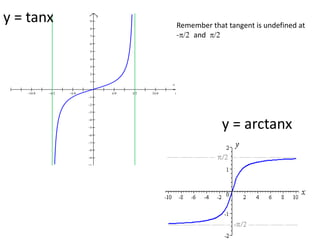
Remember that tangent is undefined at
-/ and /
y = tanx
y = arctanx
/ / / / / / 



















x
y
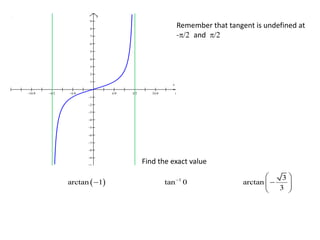
Remember that tangent is undefined at
-/ and /
Find the exact value
  1 3
arctan 1 tan 0 arctan
3

 
 
 
 
 
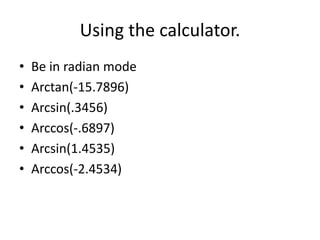
Using the calculator.
• Be in radian mode
• Arctan(-15.7896)
• Arcsin(.3456)
• Arccos(-.6897)
• Arcsin(1.4535)
• Arccos(-2.4534)
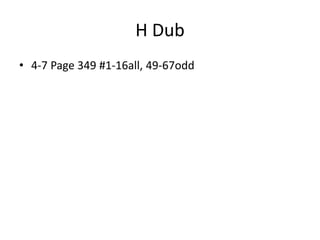
H Dub
• 4-7 Page 349 #1-16all, 49-67odd

4-7.ppt

  • 1.
  • 2.
    For an inverseto exist the function MUST be one- to - one • A function is one-to- one if for every x there is exactly one y and for every y there is exactly one x. • So • If x and/or y is raised to an even power then the inverse does not exist unless the domain is restricted.
  • 3.
    • The equationy = x2 • does not have an inverse because two different x values will produce the same y- value. • i.e. x = 2 and x = -2 will produce y = 4. • The horizontal line test fails. • In order to restrict the domain, a basic knowledge of the shape of the graph is crucial. This is a parabola with (0,0) as the vertex. Restrict the domain to the interval [0,infinity) to make it one-to-one.
  • 4.
    Now let’s lookat the trig functions           x y           x y                            x y y = sin x y = cos x y = tan x
  • 5.
             x y For the graph of y = sin x, the Domain is (-∞, ∞) the Range is [-1, 1] Not a 1-1 function So it currently does not have an inverse
  • 6.
             x y However we can restrict the domain to [-/ , /] Note the range will remain [-1, 1] Now it’s 1-1!
  • 7.
              x y y = sinx The inverse of sinx or Is denoted as arcsinx x 1 sin
  • 8.
    On the unitcircle:     x y For the inverse sine function with angles only from -/ to / our answers will only be in either quadrant 1 for positive values and quadrant 4 for negative values. Find the exact value, if possible, 1 -1 1 3 arcsin sin sin 2 2 2        
  • 9.
             x y y = cos x is not one to one, so its domain will also need to be restricted.
  • 10.
    y = cosx is not one to one, so its domain will also need to be restricted.
  • 11.
    / / //  / /    x y On this interval, [0, ] the cosine function is one-to- one and we can now define the inverse cosine function. y = arccos x or y = cos-1 x y = arccos x y = cos x
  • 12.
    On the unitcircle , inverse cosine will only exist in quadrant 1 if the value is positive and quadrant 2 if the value is negative.     x y Find the exact value for: -1 2 3 arccos arccos( 1) cos 2 2          
  • 13.
  • 14.
    / / // / /                     x y Remember that tangent is undefined at -/ and / y = tanx y = arctanx
  • 15.
    / / // / /                     x y Remember that tangent is undefined at -/ and / Find the exact value   1 3 arctan 1 tan 0 arctan 3           
  • 16.
    Using the calculator. •Be in radian mode • Arctan(-15.7896) • Arcsin(.3456) • Arccos(-.6897) • Arcsin(1.4535) • Arccos(-2.4534)
  • 17.
    H Dub • 4-7Page 349 #1-16all, 49-67odd

Editor's Notes

  • #5 Notice that none of these functions is one-to-one. They all fail the horizontal line test. We will need to restrict the domain before we can find the inverse.
  • #9 Show [-pi/2 to pi/2] When solving inverse sine rewrite in the form sin y = x
  • #10 Show the section for the restricted domain.
  • #11 Show the section for the restricted domain.
  • #12 Show the rewrite for evaluating.
  • #13 Show the rewrite for evaluating.
  • #14 Show the restriction at the same as for sine