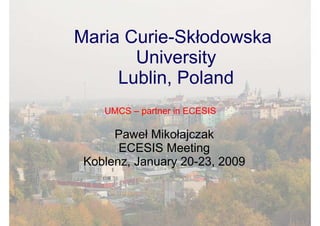
Maria Curie-Skłodowska
       University
     Lublin, Poland
    UMCS – partner in ECESIS

      Paweł Mikołajczak
       ECESIS Meeting
 Koblenz, January 20-23, 2009
Poland


Central Europe
Total area: 312,679 km²
Population: 38 518 241
Mountains...


               (CC) BiLK_Thorn
...Seaside...
...UNESCO World Heritage Sites...
...and Pearl of South-Eastern
       Poland - Lublin


                      (cc) Emmanuel Dyan
Lublin – city of inspirations
Lublin on the map
Lublin
Established: XII century
Location: 160 km south east of
Warsaw
Population: 354 272 (over 60 000
students)
5 universities
Many colleges
Universities of Lublin

UMCS - University of Maria Curie-
         Skłodowska
KUL - Catholic University of Lublin
Medical University
Technical University
University of Life Sciences
Lublin – City of Knowledge
              Cooperation of:
               −   Universities
               −   Science laboratories
               −   Local Industry
              Supported by:
               −   EFS
               −   ZPORR
University of M.Curie-Skłodowska
   Founded in 1944
   Ca. 34 500 students (at this moment)
   Ten faculties
   Academic Center of Culture
   Many activity groups
   Galleries
   Cinema
University of M. Curie-Skłodowska
We are a public institution of higher education,
established in 1944 to foster the development and
dissemination of knowledge. Since then, almost
137,000 students have graduated from the university;
we have also awarded 3,000 doctoral and 640
habilitated doctoral degrees. Our research in
numerous fields has contributed significantly to the
development of arts and sciences in Poland, with the
results consistently used in practice. Thanks to its
decade-long efforts UMCS has won recognition both
at home and abroad, and has become the workplace
of leading faculty and a school for highly qualified
specialists in many fields.
University of M. Curie-Skłodowska
The university currently employs 428 professors
and habilitated doctors as well as 1,286 faculty
members with doctoral and master’s degrees,
working in state-of-the-art laboratories, libraries
and modern lecture rooms. The university
enrolls over 34,000 undergraduate and master’s
level students as well as over 800 doctoral
students in full-time, extramural and evening
study programs, making MCSU the largest
university in the eastern part of Poland.
University of M. Curie-Skłodowska
Our ambition is to excel in academic research
and instruction. In order to meet these
challenges we participate in national and
international research programs and cooperate
with leading national and foreign academic and
research centers, while our students take part in
a number of international exchange programs.
We are also committed to building the system of
education based on the principles stipulated in
the Bologna Process documents. communities
of the European Union.
University of M. Curie-Skłodowska
The most significant task in the upcoming years
is the modernization of the campus
infrastructure and the implementation of the
integrated computer system streamlining the
management of the University.

We envision Maria Curie-Skłodowska
University as actively participating in building
the society of knowledge and making both
Poland and the Lublin region more competitive
among the countries and communities of the
European Union.
University of M. Curie-Skłodowska
   The Faculty of Biology and Earth Sciences
   The Faculty of Law and Administration
   The Faculty of Mathematics, Physics and Computer
   Science
   The Faculty of Humanities
   The Faculty of Economics
   The Faculty of Chemistry
   The Faculty of Pedagogy and Psychology
   The Faculty of Philosophy and Sociology
   The Faculty of Political Science
   The Faculty of Arts
University of M. Curie-Skłodowska
Academics and majors
 MCSU trains highly-qualified specialists using
 constantly evolving teaching methods reflecting the
 demands of present-day education and the changing
 job market. The university offers a range of
 undergraduate, graduate and doctoral
 programmes.
 Individual and interdisciplinary study programmes are
 also available. The ten faculties offer 32 programmes
 with 92 majors.
 A number of post-degree and continuing education
 programmes in all faculties are also available to graduates both
 our own and from other universities. Separate postgraduate
 programmes are financed by the European Social Fund; their
 goal is to foster professional qualifications of students, improve
 their knowledge of foreign languages, and train them in use of
 advanced information technologies.
University of M. Curie-Skłodowska
As part of its commitment to open education, MCSU also
  operates:
  European Graduate School of Polish and Ukrainian
  Universities,
  Interdisciplinary Individual Studies in the Humanities,
  University of Third Age,
  University Centre for E- learning and Open Courses,
  University Language School,
  Stock Exchange courses,
  preparatory courses,
  computer courses,
  Careers Office workshops.
University of M. Curie-Skłodowska
The University’s instruction and research are conducted within
ten faculties, twenty-five departments and five units with the
institute status. The development of academic specializations is
also fostered by the Research Centres : Nanotechnology
Centre, Biotechnology Centre, Centre for Eastern Studies, and
Centre for Environmental Protection.
The MCSU faculty cooperate directly with academic, economic
and administrative entities at home and abroad. The University
fosters research by supporting participation in large-scale,
specialized interdisciplinary research projects and research
grants. MCSU participates in international programmes and
organizes conferences and symposia, thus enabling specialists
in various fields to actively exchange views and information.
The results of a range of research activities are also published
as monographs, handbooks, dictionaries and encyclopedias,
conference proceedings, professional guides, and nationally
and internationally recognized textbooks.
University of M. Curie-Skłodowska
International cooperation
  MCSU maintains close relations with a number of universities
  and academic institutions all over the world, organizing joint
  conferences and seminars, and offering international exchange
  programmes. Among the latter are partnership programmes
  under bilateral agreements with universities in the United
  States, Brazil, Russia, Korea, Ukraine, and Belarus.
  Under the provisions of the Bologna Process, the EU academic
  programmes for universities in the member and candidate
  countries constitute special priority. Within their framework,
  MCSU is committed to creating conditions for the mobility of
  citizens, adjusting the educational systems to the market
  requirements, and enhancing the attractiveness and
  competitiveness of higher education in Europe. Some of the
  programmes in which MCSU participates are the EU Sixth
  Framework Programme, Socrates/ Erasmus, Gruntvig, Lingua,
  Jean Monnet for Poland, the Baltic University Programme, and
  Polish-American Fulbright Commission.
The Faculty of Mathematics,
 Physics and Computer Science
comprises three Institutes: Mathematics, Physics,
and Computer Science
academic staff conduct intense research studies
as part of individual grants, and statutory or
individual research
cooperates with many domestic and foreign
centres, interalia in Italy, the US, France, Germany,
Israel, Finland, and Spain
hosts the Lublin Regional CISCO Networking
Academy
participates in the Microsoft MSDN Academic
Alliance programme
The Faculty of Economics
offers two study programmes (economics, and
management and marketing)
staff members often work in the capacity of
experts for industrial and government
institutions
cooperates with universities in the USA, France,
Germany, Italy, the UK, the Czech Republic,
Ukraine, Belarus, Lithuania, and in Russia
The Faculty of Economics
The mission of the Faculty of Economics is to conduct
research and train students, whose knowledge and skills would
meet the requirements and expectations of a knowledge
society. The Faculty offers two study programmes (economics,
and management and marketing) taught at the Institutes of
Economics, Theory of Socio-economic Development, and
Marketing and Management. The staff members often work in
the capacity of experts for industrial and government
institutions. They conduct application research, at the same
time enriching theories in the field of economics, management
and marketing, and socio-economic development. The Faculty
has the right to confer doctor’s and habilitated doctor’s degrees
in economic sciences. It organizes cyclical international and
national conferences devoted to the problems of quality
management, banking and finances.
The Faculty of Law and Administration
For over 50 years since its inception, the Faculty of Law and
Administration has increased its academic potential, having
become one of the best law faculties in Poland. Two study
programmes are offered here. In 2002, the Faculty received a
Category 1 rating under the State Committee for Scientific
Research classification. It has the right to confer doctor’s and
habilitated doctor’s degrees in legal sciences. The faculty
members serve as judges on the supreme agencies of justice
system: the Supreme Court, the Supreme Administrative Court,
the Constitutional Tribunal, and the Tribunal of State. The
Faculty of Law and Administration comprises the Institute of
Administration and Public Law, Institute of History and Theory
of State and Law, Institute of Civil Law, Institute of Criminal
Law, Department of European Communities Law, and
Department of Civil Procedure.
The Faculty of Law and Administration
Scientific achievements contribute to the
development of legal disciplines represented by
particular Departments and Chairs. The Faculty
is one of Poland’s leading centres for the reform
of teaching syllabuses and implementation of
the European Credit Transfer System (ECTS).
The Faculty of Law and Administration has
concluded agreements on international
cooperation with universities in the Czech
Republic, France, Japan, Germany, the US,
and in Ukraine and Belarus.
The Faculty of Mathematics, Physics
      and Computer Science
The Faculty of Mathematics, Physics and Computer
Science belongs to the oldest faculties of our
university. It provides education on undergraduate and
graduate level in the main branches as well as offering
a four year postgraduate studies in mathematics and
physics leading to Doctor's degree. The staff is
composed of 45 senior scientists (professors and
readers) and 123 junior scientists and teachers.
As a rule, in each of Mathematics, Physics and
Computer Science branches the first year of studies is
common and from the second year students can
choose different specializations.
The Faculty of Mathematics, Physics
      and Computer Science
The main specializations offered in Mathematics are:
Mathematical Analysis, Numerical Analysis and Optimization,
Probability and Mathematical Statistics, Mathematical
Structures, Computer Graphics and Geometry. In addition to
the main specialization the students of Mathematics can choose
additional ones, for example Economic Mathematics, Insurance
Mathematics or Computer Science for Mathematicians.
Physics offers the following specializations: Applied Physics,
Astrophysics, Biophysics and Molecular Physics, Nuclear
Physics, Solid State Physics, Theoretical and Mathematical
Physics.
The study of Computer Science branches after the second year
into three specializations: Theoretical Computer Science and
Programming Systems, Computer Technologies and Artificial
Intelligence.
Institute of Computer Science

Study programmes in computer science,
computer science and physics.
Main research fields: intelligent e-learning
systems, database technologies, computer
graphics and vision, image processing,
modelling and simulations, digital signal
processing, artificial intelligence.
Main scientific activities of
Department of Information Technologies
Scientific activities
medical imaging
image processing
computer graphics and visualization
biomedical modelling
expert systems
optimization algorithms
hospital information systems (HIS, PACS, RIS)
computer network technologies, mobile technologies
Examples
INTEGRATED TELEMEDICAL NETWORK IN
LUBLIN PROVINCE – CURRENT STATUS AND
            FUTURE PLANS

         Maria Curie-Skłodowska University
                 Lublin, POLAND

         5th ICICTH Samos 2007
The first PACS in Lublin

• one of the first PACS (picture
  archiving and communication
  system) in Poland (1999),
• a medical network (fig.),
• thousands of examinations
  acquisitioned, processed,
  transmitted between
  cooperating health service
  centres, and archived on CDs,
• presented during ICICTH
  2003 (Samos),
• still operating, but modern
  systems are needed


                            CDs – a next generation
                            radiological archive
New telemedical projects (1)
teleradiological network for image transmission (CT,
MRI, PET, etc.) coordinated by a teleradiology centre,
telemetric electrocardiography transmission and
cardiologic teleconsultation (already implemented
independently in two hospitals),
videoterminals network for hospitals’ admission rooms
and emergency units,
application of telemedical techniques for breast cancer
detection,
New telemedical projects (2)
• telemedical systems for ambulance services,
• GIS (Geographic Information System) and GPS (Global
  Positioning System)-based solutions for first-aid
  services.
GIS/GPS-based system for first-aid
               services (1)

• an integrated
  management and
  monitoring system for
  emergency units, in
  order to provide
  required services to
  the desired location
  through the optimal
  route
GIS/GPS-based system for first-aid
                services (2)
An innovative system, making use of a
mixture of technologies:


GPS,
RTK-DGPS (Real Time Kinematic
Differential Global Positioning System)
based on EUPOS (European Position
Determination System) collocated
stations,                                  EUPOS (European
GIS,
                                           Position Determination
video monitoring of the area in order to
                                           System) collocated
provide optimal routes for rescue units,   stations
data transmission (WiFi, GPRS).
Information flow between telemedical
                    systems

• Some of the independently
  developed projects turned out to
  be complementary.
• A great part of technical
  infrastructure can be shared.
• Systems are expected to be
  interoperable and compatible
  with each other, to provide the
  desired information flow.
• A common central node (a
  telemedical centre) for all the
  telemedical projects should be
  created.
Conclusions
The first PACS in Lublin has been working unfailingly
for the last 8 years – a success.
Various telemedical projects need to be coordinated.
The planned regional telemedicine centre is expected
to perform this function.
There is no need to build new, dedicated network
infrastructure.
Modern technologie
      Examples
E-learning: Virtual Campus of
the University of Maria Curie-Skłodowska


   Many on-line courses
   Remote access
   Academics support
University of Maria Curie-Skłodowska on-line:
         Island in Second Life
University of Maria Curie-Skłodowska on-line:
Island in Second Life (cultural fusion events)


                                             Second Life of
                                             UMCS - movie
Introtounilublin

Introtounilublin

  • 1.
    Maria Curie-Skłodowska University Lublin, Poland UMCS – partner in ECESIS Paweł Mikołajczak ECESIS Meeting Koblenz, January 20-23, 2009
  • 2.
    Poland Central Europe Total area:312,679 km² Population: 38 518 241
  • 3.
    Mountains... (CC) BiLK_Thorn
  • 4.
  • 5.
  • 6.
    ...and Pearl ofSouth-Eastern Poland - Lublin (cc) Emmanuel Dyan
  • 7.
    Lublin – cityof inspirations
  • 8.
  • 9.
    Lublin Established: XII century Location:160 km south east of Warsaw Population: 354 272 (over 60 000 students) 5 universities Many colleges
  • 10.
    Universities of Lublin UMCS- University of Maria Curie- Skłodowska KUL - Catholic University of Lublin Medical University Technical University University of Life Sciences
  • 11.
    Lublin – Cityof Knowledge Cooperation of: − Universities − Science laboratories − Local Industry Supported by: − EFS − ZPORR
  • 12.
    University of M.Curie-Skłodowska Founded in 1944 Ca. 34 500 students (at this moment) Ten faculties Academic Center of Culture Many activity groups Galleries Cinema
  • 13.
    University of M.Curie-Skłodowska We are a public institution of higher education, established in 1944 to foster the development and dissemination of knowledge. Since then, almost 137,000 students have graduated from the university; we have also awarded 3,000 doctoral and 640 habilitated doctoral degrees. Our research in numerous fields has contributed significantly to the development of arts and sciences in Poland, with the results consistently used in practice. Thanks to its decade-long efforts UMCS has won recognition both at home and abroad, and has become the workplace of leading faculty and a school for highly qualified specialists in many fields.
  • 14.
    University of M.Curie-Skłodowska The university currently employs 428 professors and habilitated doctors as well as 1,286 faculty members with doctoral and master’s degrees, working in state-of-the-art laboratories, libraries and modern lecture rooms. The university enrolls over 34,000 undergraduate and master’s level students as well as over 800 doctoral students in full-time, extramural and evening study programs, making MCSU the largest university in the eastern part of Poland.
  • 15.
    University of M.Curie-Skłodowska Our ambition is to excel in academic research and instruction. In order to meet these challenges we participate in national and international research programs and cooperate with leading national and foreign academic and research centers, while our students take part in a number of international exchange programs. We are also committed to building the system of education based on the principles stipulated in the Bologna Process documents. communities of the European Union.
  • 16.
    University of M.Curie-Skłodowska The most significant task in the upcoming years is the modernization of the campus infrastructure and the implementation of the integrated computer system streamlining the management of the University. We envision Maria Curie-Skłodowska University as actively participating in building the society of knowledge and making both Poland and the Lublin region more competitive among the countries and communities of the European Union.
  • 17.
    University of M.Curie-Skłodowska The Faculty of Biology and Earth Sciences The Faculty of Law and Administration The Faculty of Mathematics, Physics and Computer Science The Faculty of Humanities The Faculty of Economics The Faculty of Chemistry The Faculty of Pedagogy and Psychology The Faculty of Philosophy and Sociology The Faculty of Political Science The Faculty of Arts
  • 18.
    University of M.Curie-Skłodowska Academics and majors MCSU trains highly-qualified specialists using constantly evolving teaching methods reflecting the demands of present-day education and the changing job market. The university offers a range of undergraduate, graduate and doctoral programmes. Individual and interdisciplinary study programmes are also available. The ten faculties offer 32 programmes with 92 majors. A number of post-degree and continuing education programmes in all faculties are also available to graduates both our own and from other universities. Separate postgraduate programmes are financed by the European Social Fund; their goal is to foster professional qualifications of students, improve their knowledge of foreign languages, and train them in use of advanced information technologies.
  • 19.
    University of M.Curie-Skłodowska As part of its commitment to open education, MCSU also operates: European Graduate School of Polish and Ukrainian Universities, Interdisciplinary Individual Studies in the Humanities, University of Third Age, University Centre for E- learning and Open Courses, University Language School, Stock Exchange courses, preparatory courses, computer courses, Careers Office workshops.
  • 20.
    University of M.Curie-Skłodowska The University’s instruction and research are conducted within ten faculties, twenty-five departments and five units with the institute status. The development of academic specializations is also fostered by the Research Centres : Nanotechnology Centre, Biotechnology Centre, Centre for Eastern Studies, and Centre for Environmental Protection. The MCSU faculty cooperate directly with academic, economic and administrative entities at home and abroad. The University fosters research by supporting participation in large-scale, specialized interdisciplinary research projects and research grants. MCSU participates in international programmes and organizes conferences and symposia, thus enabling specialists in various fields to actively exchange views and information. The results of a range of research activities are also published as monographs, handbooks, dictionaries and encyclopedias, conference proceedings, professional guides, and nationally and internationally recognized textbooks.
  • 21.
    University of M.Curie-Skłodowska International cooperation MCSU maintains close relations with a number of universities and academic institutions all over the world, organizing joint conferences and seminars, and offering international exchange programmes. Among the latter are partnership programmes under bilateral agreements with universities in the United States, Brazil, Russia, Korea, Ukraine, and Belarus. Under the provisions of the Bologna Process, the EU academic programmes for universities in the member and candidate countries constitute special priority. Within their framework, MCSU is committed to creating conditions for the mobility of citizens, adjusting the educational systems to the market requirements, and enhancing the attractiveness and competitiveness of higher education in Europe. Some of the programmes in which MCSU participates are the EU Sixth Framework Programme, Socrates/ Erasmus, Gruntvig, Lingua, Jean Monnet for Poland, the Baltic University Programme, and Polish-American Fulbright Commission.
  • 22.
    The Faculty ofMathematics, Physics and Computer Science comprises three Institutes: Mathematics, Physics, and Computer Science academic staff conduct intense research studies as part of individual grants, and statutory or individual research cooperates with many domestic and foreign centres, interalia in Italy, the US, France, Germany, Israel, Finland, and Spain hosts the Lublin Regional CISCO Networking Academy participates in the Microsoft MSDN Academic Alliance programme
  • 23.
    The Faculty ofEconomics offers two study programmes (economics, and management and marketing) staff members often work in the capacity of experts for industrial and government institutions cooperates with universities in the USA, France, Germany, Italy, the UK, the Czech Republic, Ukraine, Belarus, Lithuania, and in Russia
  • 24.
    The Faculty ofEconomics The mission of the Faculty of Economics is to conduct research and train students, whose knowledge and skills would meet the requirements and expectations of a knowledge society. The Faculty offers two study programmes (economics, and management and marketing) taught at the Institutes of Economics, Theory of Socio-economic Development, and Marketing and Management. The staff members often work in the capacity of experts for industrial and government institutions. They conduct application research, at the same time enriching theories in the field of economics, management and marketing, and socio-economic development. The Faculty has the right to confer doctor’s and habilitated doctor’s degrees in economic sciences. It organizes cyclical international and national conferences devoted to the problems of quality management, banking and finances.
  • 25.
    The Faculty ofLaw and Administration For over 50 years since its inception, the Faculty of Law and Administration has increased its academic potential, having become one of the best law faculties in Poland. Two study programmes are offered here. In 2002, the Faculty received a Category 1 rating under the State Committee for Scientific Research classification. It has the right to confer doctor’s and habilitated doctor’s degrees in legal sciences. The faculty members serve as judges on the supreme agencies of justice system: the Supreme Court, the Supreme Administrative Court, the Constitutional Tribunal, and the Tribunal of State. The Faculty of Law and Administration comprises the Institute of Administration and Public Law, Institute of History and Theory of State and Law, Institute of Civil Law, Institute of Criminal Law, Department of European Communities Law, and Department of Civil Procedure.
  • 26.
    The Faculty ofLaw and Administration Scientific achievements contribute to the development of legal disciplines represented by particular Departments and Chairs. The Faculty is one of Poland’s leading centres for the reform of teaching syllabuses and implementation of the European Credit Transfer System (ECTS). The Faculty of Law and Administration has concluded agreements on international cooperation with universities in the Czech Republic, France, Japan, Germany, the US, and in Ukraine and Belarus.
  • 27.
    The Faculty ofMathematics, Physics and Computer Science The Faculty of Mathematics, Physics and Computer Science belongs to the oldest faculties of our university. It provides education on undergraduate and graduate level in the main branches as well as offering a four year postgraduate studies in mathematics and physics leading to Doctor's degree. The staff is composed of 45 senior scientists (professors and readers) and 123 junior scientists and teachers. As a rule, in each of Mathematics, Physics and Computer Science branches the first year of studies is common and from the second year students can choose different specializations.
  • 28.
    The Faculty ofMathematics, Physics and Computer Science The main specializations offered in Mathematics are: Mathematical Analysis, Numerical Analysis and Optimization, Probability and Mathematical Statistics, Mathematical Structures, Computer Graphics and Geometry. In addition to the main specialization the students of Mathematics can choose additional ones, for example Economic Mathematics, Insurance Mathematics or Computer Science for Mathematicians. Physics offers the following specializations: Applied Physics, Astrophysics, Biophysics and Molecular Physics, Nuclear Physics, Solid State Physics, Theoretical and Mathematical Physics. The study of Computer Science branches after the second year into three specializations: Theoretical Computer Science and Programming Systems, Computer Technologies and Artificial Intelligence.
  • 29.
    Institute of ComputerScience Study programmes in computer science, computer science and physics. Main research fields: intelligent e-learning systems, database technologies, computer graphics and vision, image processing, modelling and simulations, digital signal processing, artificial intelligence.
  • 30.
    Main scientific activitiesof Department of Information Technologies
  • 31.
    Scientific activities medical imaging imageprocessing computer graphics and visualization biomedical modelling expert systems optimization algorithms hospital information systems (HIS, PACS, RIS) computer network technologies, mobile technologies
  • 32.
  • 33.
    INTEGRATED TELEMEDICAL NETWORKIN LUBLIN PROVINCE – CURRENT STATUS AND FUTURE PLANS Maria Curie-Skłodowska University Lublin, POLAND 5th ICICTH Samos 2007
  • 34.
    The first PACSin Lublin • one of the first PACS (picture archiving and communication system) in Poland (1999), • a medical network (fig.), • thousands of examinations acquisitioned, processed, transmitted between cooperating health service centres, and archived on CDs, • presented during ICICTH 2003 (Samos), • still operating, but modern systems are needed CDs – a next generation radiological archive
  • 35.
    New telemedical projects(1) teleradiological network for image transmission (CT, MRI, PET, etc.) coordinated by a teleradiology centre, telemetric electrocardiography transmission and cardiologic teleconsultation (already implemented independently in two hospitals), videoterminals network for hospitals’ admission rooms and emergency units, application of telemedical techniques for breast cancer detection,
  • 36.
    New telemedical projects(2) • telemedical systems for ambulance services, • GIS (Geographic Information System) and GPS (Global Positioning System)-based solutions for first-aid services.
  • 37.
    GIS/GPS-based system forfirst-aid services (1) • an integrated management and monitoring system for emergency units, in order to provide required services to the desired location through the optimal route
  • 38.
    GIS/GPS-based system forfirst-aid services (2) An innovative system, making use of a mixture of technologies: GPS, RTK-DGPS (Real Time Kinematic Differential Global Positioning System) based on EUPOS (European Position Determination System) collocated stations, EUPOS (European GIS, Position Determination video monitoring of the area in order to System) collocated provide optimal routes for rescue units, stations data transmission (WiFi, GPRS).
  • 39.
    Information flow betweentelemedical systems • Some of the independently developed projects turned out to be complementary. • A great part of technical infrastructure can be shared. • Systems are expected to be interoperable and compatible with each other, to provide the desired information flow. • A common central node (a telemedical centre) for all the telemedical projects should be created.
  • 40.
    Conclusions The first PACSin Lublin has been working unfailingly for the last 8 years – a success. Various telemedical projects need to be coordinated. The planned regional telemedicine centre is expected to perform this function. There is no need to build new, dedicated network infrastructure.
  • 41.
  • 42.
    E-learning: Virtual Campusof the University of Maria Curie-Skłodowska Many on-line courses Remote access Academics support
  • 43.
    University of MariaCurie-Skłodowska on-line: Island in Second Life
  • 44.
    University of MariaCurie-Skłodowska on-line: Island in Second Life (cultural fusion events) Second Life of UMCS - movie