Download free for 30 days
Sign in
Upload
Language (EN)
Support
Business
Mobile
Social Media
Marketing
Technology
Art & Photos
Career
Design
Education
Presentations & Public Speaking
Government & Nonprofit
Healthcare
Internet
Law
Leadership & Management
Automotive
Engineering
Software
Recruiting & HR
Retail
Sales
Services
Science
Small Business & Entrepreneurship
Food
Environment
Economy & Finance
Data & Analytics
Investor Relations
Sports
Spiritual
News & Politics
Travel
Self Improvement
Real Estate
Entertainment & Humor
Health & Medicine
Devices & Hardware
Lifestyle
Change Language
Language
English
Español
Português
Français
Deutsche
Cancel
Save
Submit search
EN
Uploaded by
AhmadMahbubulAlam3
PDF, PPTX
11 views
Introductory Discussions on Communication Process
Introductory Discussions on Communication Process
Education
◦
Read more
0
Save
Share
Embed
Embed presentation
Download
Download as PDF, PPTX
1
/ 1
More Related Content
PPS
Communication at workplace
by
ikcmclicks
PPTX
LESSON 2- THE COMMUNICATION PROCESS.pptx
by
korkyEthanPascual
PPTX
COMMUNICATION.Communication is the process of sending and receiving messages ...
by
NaeemaAnsari
PPTX
effective communication
by
HarshalPatil242
PDF
Lesson-1-Communication-Processes-Principles-Ethics.-MHRS-PPT-1.pptx (1).pdf
by
WendyVillarMape
PPTX
Communication Process
by
Peeyush Malhotra
PPTX
Process of communication skills
by
Jemi1998
PPTX
Elements of communication
by
KerbyJose
Communication at workplace
by
ikcmclicks
LESSON 2- THE COMMUNICATION PROCESS.pptx
by
korkyEthanPascual
COMMUNICATION.Communication is the process of sending and receiving messages ...
by
NaeemaAnsari
effective communication
by
HarshalPatil242
Lesson-1-Communication-Processes-Principles-Ethics.-MHRS-PPT-1.pptx (1).pdf
by
WendyVillarMape
Communication Process
by
Peeyush Malhotra
Process of communication skills
by
Jemi1998
Elements of communication
by
KerbyJose
Similar to Introductory Discussions on Communication Process
PPTX
COMMUNICATION PROCESS .pptx For the public health
by
DadaRobert
PPTX
Communication basics 2022.pptx
by
ChrisChimzimu1
PPTX
COMMUNICATION PROCESS BIOMED UNIT TWO.pptx
by
FranciKaySichu
PPTX
Lecture 1-2_Introduction To Communication_Design (1).pptx
by
MayankGupta17463
PPTX
COMMUNICATION PROCESS PHYSIO AND PHARMA-1.pptx
by
FranciKaySichu
PPTX
Communication basics 2022.pptx
by
ChrisChimzimu1
PPTX
communication skills
by
Ashvin Jogiya
PPTX
Nature-Process-and-Functions-of-Communication.pptx
by
Eliza Jeresano-Vibal
PPTX
what is communication and its functions?
by
ZeusOng2
PPT
Introduction-to-business-communication-ppt.ppt
by
DrArunVidyaK
PPT
commn,1.ppt
by
DevarajuBn
PPTX
Nature and Elements of Communication
by
Benjotomol
PDF
Basics of Communication in Nursing & Healthcare
by
Esraa Mohammed Soltan
PPTX
- Process of communication.pptx
by
AryanDubey50
PDF
Communicationskills 13413474998472-phpapp01-120703153434-phpapp01
by
Avinash Sharma
PPT
Communication process (1)
by
rashmi123vaish
PPT
Communication processppt
by
Nikita Ambre
PPTX
Lecture 1-2_Introduction To Communication_Design.pptx
by
PiyaliSamanta9
PDF
Communicationskills 13413474998472-phpapp01-120703153434-phpapp01
by
Avinash Sharma
PPTX
1_ch01communication_and_quality_of_care.pptx
by
DrMoathAbuejheisheh
COMMUNICATION PROCESS .pptx For the public health
by
DadaRobert
Communication basics 2022.pptx
by
ChrisChimzimu1
COMMUNICATION PROCESS BIOMED UNIT TWO.pptx
by
FranciKaySichu
Lecture 1-2_Introduction To Communication_Design (1).pptx
by
MayankGupta17463
COMMUNICATION PROCESS PHYSIO AND PHARMA-1.pptx
by
FranciKaySichu
Communication basics 2022.pptx
by
ChrisChimzimu1
communication skills
by
Ashvin Jogiya
Nature-Process-and-Functions-of-Communication.pptx
by
Eliza Jeresano-Vibal
what is communication and its functions?
by
ZeusOng2
Introduction-to-business-communication-ppt.ppt
by
DrArunVidyaK
commn,1.ppt
by
DevarajuBn
Nature and Elements of Communication
by
Benjotomol
Basics of Communication in Nursing & Healthcare
by
Esraa Mohammed Soltan
- Process of communication.pptx
by
AryanDubey50
Communicationskills 13413474998472-phpapp01-120703153434-phpapp01
by
Avinash Sharma
Communication process (1)
by
rashmi123vaish
Communication processppt
by
Nikita Ambre
Lecture 1-2_Introduction To Communication_Design.pptx
by
PiyaliSamanta9
Communicationskills 13413474998472-phpapp01-120703153434-phpapp01
by
Avinash Sharma
1_ch01communication_and_quality_of_care.pptx
by
DrMoathAbuejheisheh
More from AhmadMahbubulAlam3
PDF
Introductory Discussions on Effective Message
by
AhmadMahbubulAlam3
PDF
Introductory Discussions on Communication Barriers
by
AhmadMahbubulAlam3
PDF
Introductory Discussions on Listening Categories
by
AhmadMahbubulAlam3
PDF
Introductory Discussions on Listening Communication/Skill
by
AhmadMahbubulAlam3
PDF
Introductory Discussions on Soft Skills Development
by
AhmadMahbubulAlam3
PDF
Introductory Discussions on Team Management
by
AhmadMahbubulAlam3
Introductory Discussions on Effective Message
by
AhmadMahbubulAlam3
Introductory Discussions on Communication Barriers
by
AhmadMahbubulAlam3
Introductory Discussions on Listening Categories
by
AhmadMahbubulAlam3
Introductory Discussions on Listening Communication/Skill
by
AhmadMahbubulAlam3
Introductory Discussions on Soft Skills Development
by
AhmadMahbubulAlam3
Introductory Discussions on Team Management
by
AhmadMahbubulAlam3
Recently uploaded
PPTX
UNIT 1: COMMUNICATION SKILLS, BARRIERS TO COMMUNICATION, PERSPECTIVES IN COMM...
by
POOJA KARVANDE
PPTX
4 G8_Q3_L4 (Evaluating opinion editorials for textual evidence and quality).pptx
by
NorafeSahagun
PPTX
ATTENTION -PART 2.pptx Shilpa Hotakar for I semester BSc students
by
SHILPA HOTAKAR
PPTX
10-12-2025 Francois Staring How can Researchers and Initial Teacher Educators...
by
EduSkills OECD
PPTX
Details of Epithelial and Connective Tissue.pptx
by
Ashish Umale
PPTX
Introduction-to-Anatomy-and-Physiology.pptx
by
Ashish Umale
PPTX
Basics in Phytochemistry, Extraction, Isolation methods, Characterisation etc.
by
D. Y. Patil College of Pharmacy, Kolhapur.
PDF
Analyzing the data of your initial survey
by
Thelma Villaflores
PPTX
META-ANALYSIS INTERPRETATION, PUBLICATION BIAS AND GRADE ASSESSMENT.pptx
by
Systematic Reviews Network (SRN)
PDF
Micro Economics for class 12 and class 11
by
surajbajaj4116
PPTX
PURPOSIVE SAMPLING IN EDUCATIONAL RESEARCH RACHITHRA RK.pptx
by
ssuser047b711
PPTX
How to Create Lead_Opportunity From Odoo 18 Website
by
Celine George
PPTX
Steve Hale - Developing Elite Young Goalkeepers 2024.pptx
by
pjmfd
PDF
Risk management in Moroccan public hospitals_ a literature review
by
Man_Ebook
PDF
Multiple Myeloma , definition, etiology, PP, CM , DE and management
by
Nisha Borsa
PPTX
Access partner report in Odoo 18.2 _ Odoo 19
by
Celine George
PDF
Types of eggs and Egg membranes (Developmental Zoology)
by
SudhandraKarthi
PDF
International Men's Day Event: Breaking the Silence: Embracing Vulnerability ...
by
Association for Project Management
PPTX
Growth & Development MILESTONES (ADOLESCENTS ).pptx
by
AneetaSharma15
PPTX
Expected Revenue Report In Odoo 18 CRM
by
Celine George
UNIT 1: COMMUNICATION SKILLS, BARRIERS TO COMMUNICATION, PERSPECTIVES IN COMM...
by
POOJA KARVANDE
4 G8_Q3_L4 (Evaluating opinion editorials for textual evidence and quality).pptx
by
NorafeSahagun
ATTENTION -PART 2.pptx Shilpa Hotakar for I semester BSc students
by
SHILPA HOTAKAR
10-12-2025 Francois Staring How can Researchers and Initial Teacher Educators...
by
EduSkills OECD
Details of Epithelial and Connective Tissue.pptx
by
Ashish Umale
Introduction-to-Anatomy-and-Physiology.pptx
by
Ashish Umale
Basics in Phytochemistry, Extraction, Isolation methods, Characterisation etc.
by
D. Y. Patil College of Pharmacy, Kolhapur.
Analyzing the data of your initial survey
by
Thelma Villaflores
META-ANALYSIS INTERPRETATION, PUBLICATION BIAS AND GRADE ASSESSMENT.pptx
by
Systematic Reviews Network (SRN)
Micro Economics for class 12 and class 11
by
surajbajaj4116
PURPOSIVE SAMPLING IN EDUCATIONAL RESEARCH RACHITHRA RK.pptx
by
ssuser047b711
How to Create Lead_Opportunity From Odoo 18 Website
by
Celine George
Steve Hale - Developing Elite Young Goalkeepers 2024.pptx
by
pjmfd
Risk management in Moroccan public hospitals_ a literature review
by
Man_Ebook
Multiple Myeloma , definition, etiology, PP, CM , DE and management
by
Nisha Borsa
Access partner report in Odoo 18.2 _ Odoo 19
by
Celine George
Types of eggs and Egg membranes (Developmental Zoology)
by
SudhandraKarthi
International Men's Day Event: Breaking the Silence: Embracing Vulnerability ...
by
Association for Project Management
Growth & Development MILESTONES (ADOLESCENTS ).pptx
by
AneetaSharma15
Expected Revenue Report In Odoo 18 CRM
by
Celine George
Introductory Discussions on Communication Process
1.
AMA Thoughts –
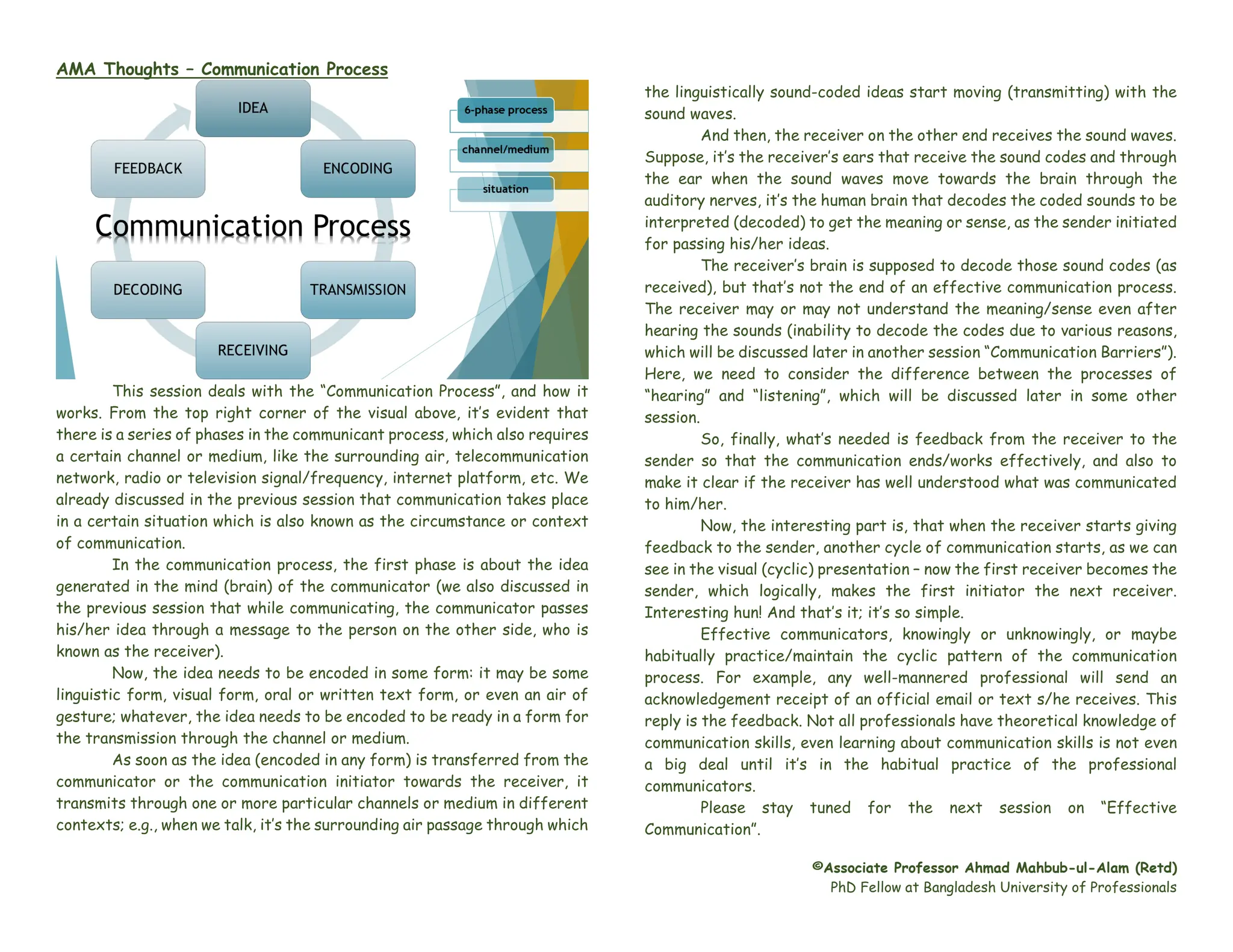
Communication Process ©Associate Professor Ahmad Mahbub-ul-Alam (Retd) PhD Fellow at Bangladesh University of Professionals This session deals with the “Communication Process”, and how it works. From the top right corner of the visual above, it‛s evident that there is a series of phases in the communicant process, which also requires a certain channel or medium, like the surrounding air, telecommunication network, radio or television signal/frequency, internet platform, etc. We already discussed in the previous session that communication takes place in a certain situation which is also known as the circumstance or context of communication. In the communication process, the first phase is about the idea generated in the mind (brain) of the communicator (we also discussed in the previous session that while communicating, the communicator passes his/her idea through a message to the person on the other side, who is known as the receiver). Now, the idea needs to be encoded in some form: it may be some linguistic form, visual form, oral or written text form, or even an air of gesture; whatever, the idea needs to be encoded to be ready in a form for the transmission through the channel or medium. As soon as the idea (encoded in any form) is transferred from the communicator or the communication initiator towards the receiver, it transmits through one or more particular channels or medium in different contexts; e.g., when we talk, it‛s the surrounding air passage through which the linguistically sound-coded ideas start moving (transmitting) with the sound waves. And then, the receiver on the other end receives the sound waves. Suppose, it‛s the receiver‛s ears that receive the sound codes and through the ear when the sound waves move towards the brain through the auditory nerves, it‛s the human brain that decodes the coded sounds to be interpreted (decoded) to get the meaning or sense, as the sender initiated for passing his/her ideas. The receiver‛s brain is supposed to decode those sound codes (as received), but that‛s not the end of an effective communication process. The receiver may or may not understand the meaning/sense even after hearing the sounds (inability to decode the codes due to various reasons, which will be discussed later in another session “Communication Barriers”). Here, we need to consider the difference between the processes of “hearing” and “listening”, which will be discussed later in some other session. So, finally, what‛s needed is feedback from the receiver to the sender so that the communication ends/works effectively, and also to make it clear if the receiver has well understood what was communicated to him/her. Now, the interesting part is, that when the receiver starts giving feedback to the sender, another cycle of communication starts, as we can see in the visual (cyclic) presentation – now the first receiver becomes the sender, which logically, makes the first initiator the next receiver. Interesting hun! And that‛s it; it‛s so simple. Effective communicators, knowingly or unknowingly, or maybe habitually practice/maintain the cyclic pattern of the communication process. For example, any well-mannered professional will send an acknowledgement receipt of an official email or text s/he receives. This reply is the feedback. Not all professionals have theoretical knowledge of communication skills, even learning about communication skills is not even a big deal until it‛s in the habitual practice of the professional communicators. Please stay tuned for the next session on “Effective Communication”.
Download