Time table of Toxicology course
6 September Informations
13 September Introduction to Toxicology
20 September Classes of Toxicants
27 Septembe Metals
4 October Remedation
11 Quiz
18 October Toxicology test with Sinapis alba1
25 October Toxicology test with Sinapis alba2
8 November Toxicity test with plants
15 November Toxicity test with animals
22 November Quiz
29 November Exam
INTRODUCTION TO
TOXICOLOGY,
ECOTOXICOLOGY
EDINA SIMON
DEPARTMENT OF ECOLOGY
UNIVERSITY OF DEBRECEN
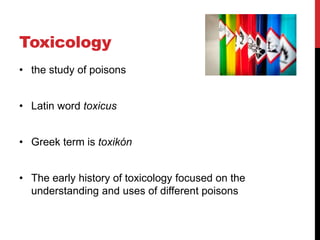
Toxicology
• the study of poisons
• Latin word toxicus
• Greek term is toxikón
• The early history of toxicology focused on the
understanding and uses of different poisons
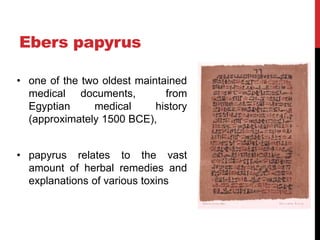
Ebers papyrus
• one of the two oldest maintained
medical documents, from
Egyptian medical history
(approximately 1500 BCE),
• papyrus relates to the vast
amount of herbal remedies and
explanations of various toxins
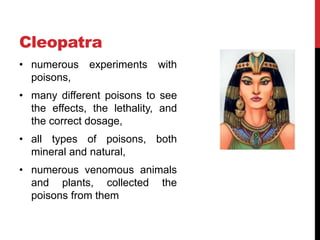
Cleopatra
• numerous experiments with
poisons,
• many different poisons to see
the effects, the lethality, and
the correct dosage,
• all types of poisons, both
mineral and natural,
• numerous venomous animals
and plants, collected the
poisons from them
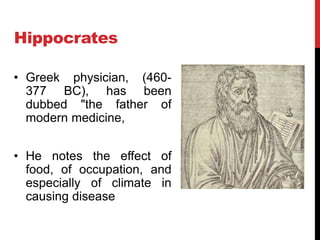
Hippocrates
• Greek physician, (460-
377 BC), has been
dubbed "the father of
modern medicine,
• He notes the effect of
food, of occupation, and
especially of climate in
causing disease
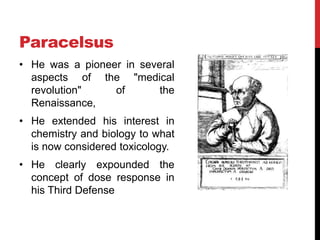
Paracelsus
• He was a pioneer in several
aspects of the "medical
revolution" of the
Renaissance,
• He extended his interest in
chemistry and biology to what
is now considered toxicology.
• He clearly expounded the
concept of dose response in
his Third Defense
Industry toxicology
Ulrich Ellborg
• Warned people who work with lead, mercury and
antimony.
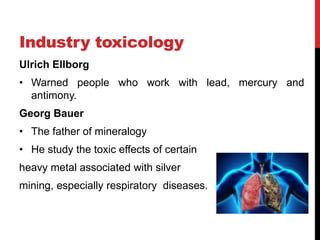
Georg Bauer
• The father of mineralogy
• He study the toxic effects of certain
heavy metal associated with silver
mining, especially respiratory diseases.
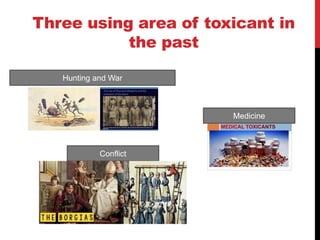
Three using area of toxicant in
the past
Hunting and War
Conflict
Medicine
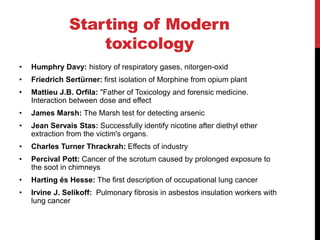
Starting of Modern
toxicology
• Humphry Davy: history of respiratory gases, nitorgen-oxid
• Friedrich Sertürner: first isolation of Morphine from opium plant
• Mattieu J.B. Orfila: "Father of Toxicology and forensic medicine.
Interaction between dose and effect
• James Marsh: The Marsh test for detecting arsenic
• Jean Servais Stas: Successfully identify nicotine after diethyl ether
extraction from the victim's organs.
• Charles Turner Thrackrah: Effects of industry
• Percival Pott: Cancer of the scrotum caused by prolonged exposure to
the soot in chimneys
• Harting és Hesse: The first description of occupational lung cancer
• Irvine J. Selikoff: Pulmonary fibrosis in asbestos insulation workers with
lung cancer
Modern toxicology
• branch of science
• deals with poisons
• poison can be defined as any substance that
causes a harmful effect when administered,
• either by accident or design, to a living
organism
TOXICOLOGISTS
STUDY
The professional activities of all toxicologists
fall into three main areas of endeavor:
• descriptive toxicology,
• research/mechanistic toxicology,
• applied toxicology
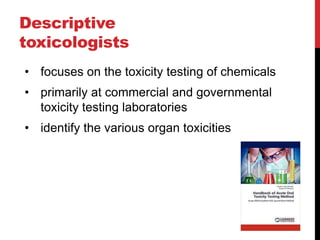
Descriptive
toxicologists
• focuses on the toxicity testing of chemicals
• primarily at commercial and governmental
toxicity testing laboratories
• identify the various organ toxicities
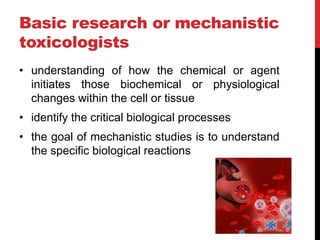
Basic research or mechanistic
toxicologists
• understanding of how the chemical or agent
initiates those biochemical or physiological
changes within the cell or tissue
• identify the critical biological processes
• the goal of mechanistic studies is to understand
the specific biological reactions
Applied toxicologists
• the use of chemicals in a “ real world” or
• nonlaboratory setting,
• forensic toxicology,
• clinical toxicology,
• environmental toxicology,
• occupational toxicology
Modes of Toxic Action
• Biochemical and molecular toxicology
• Behavioral toxicology
• Nutritional toxicology
• Carcinogenesis
• Teratogenesis
• Mutagenesis
• Organ toxicity
Measurement of Toxicants and
Toxicity
• Analytical toxicology
• Toxicity testing
• Toxicologic pathology
• Structure-activity
• Biomathematics and statistics
• Epidemiology
Chemical Use Classes
• Agricultural chemicals
• Clinical drugs
• Drugs of abuse
• Food additives
• Industrial chemicals
• Naturally occurring substances
• Combustion products
Regulatory Toxicology
• Legal aspects
• Environmental Protection Agency (EPA),
• Food and Drug Administration (FDA),
• Occupational Safety and Health Administration
(OSHA)
• Risk assessment
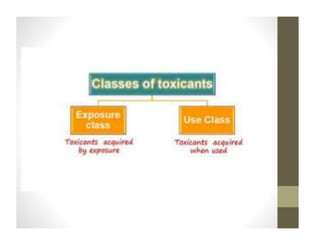
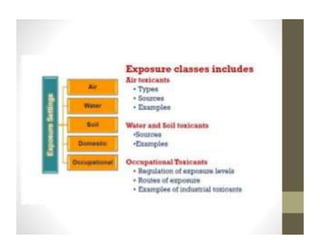
Classes of toxicants
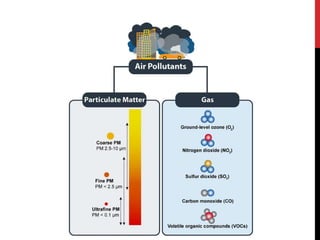
• Air pollutants
• Water and soil pollutants
• Occupational toxicants
History of Air
pollutants
• use wood fires for heat and cooking,
• domestic and industrial combustion of coal
• the rapid increase in the number of automobiles
Types of air pollutants-
Gaseous
• carbon monoxide (CO),
• hydrocarbons,
• hydrogen sulfide (H2S)
• nitrogen oxides (NxOy),
• ozone (O3)
• sulfur oxides (SxOy)
• Carbon dioxide CO2
Types of air pollutants-
Particulate
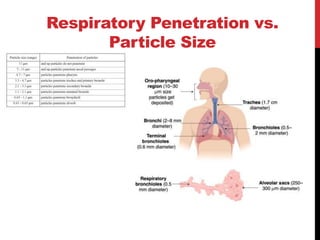
• Dust: 100 μm in diameter
• Fumes: Suspended solid (<1.0 μm)
• Mist: Liquid or solid particles (<2.0 μm)
• Smoke: Solid particles (0.05–1.0 μm)
• Aerosol: Liquid or solid particles ˙(<1.0
µm)
Respiratory Penetration vs.
Particle Size
Sources of Air
Pollutants
• Natural Pollutants
• Anthropogenic Pollutants
• Indoor Pollutants
WATER AND SOIL
POLLUTANTS
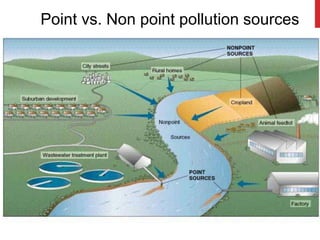
• Surface water can be contaminated by
point or nonpoint sources.
• point source: An effluent pipe from an
industrial plant or a sewage-treatment
plant.
• nonpoint source: a field from which
pesticides and fertilizers are carried by
rainwater into a river
Point vs. Non point pollution sources
OCCUPATIONAL
TOXICANTS
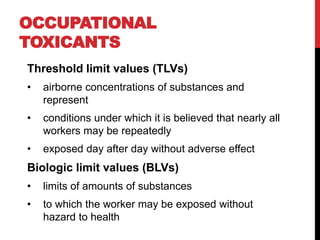
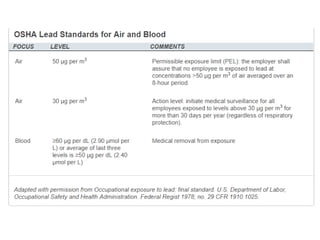
Threshold limit values (TLVs)
• airborne concentrations of substances and
represent
• conditions under which it is believed that nearly all
workers may be repeatedly
• exposed day after day without adverse effect
Biologic limit values (BLVs)
• limits of amounts of substances
• to which the worker may be exposed without
hazard to health
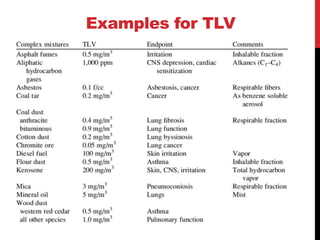
Examples for TLV
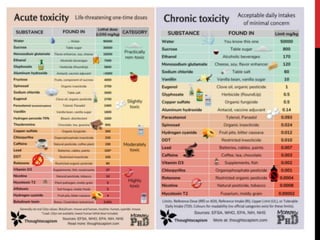
Acut vs chronic toxicity
Acute toxicity describes the adverse effects of a
substance that result either from a single exposure
or from multiple exposures in a short period of
time (usually less than 24 hours.
Chronic toxicity the development of adverse
effects as a result of long term exposure to a
contaminant or other stressor.
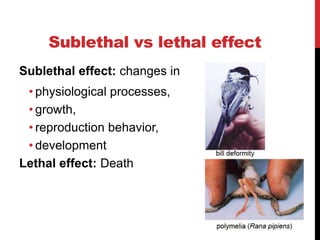
Sublethal vs lethal effect
Sublethal effect: changes in
• physiological processes,
• growth,
• reproduction behavior,
• development
Lethal effect: Death
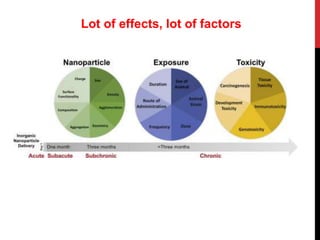
Lot of effects, lot of factors
References
Hodgson E (2004) A textbook of modern toxicology. John
Wiley and Sons.
Nikinmaa M (2014) An introduction to Aquatic Toxicology.
Elsevier.
Robinson L, Thorn I (2005) Toxicology and ecotoxicology in
chemical safety assessment. Blackwell Publishing.
Classes of Toxicants
Toxicology and Ecotoxicology
Edina Kundrát-Simon
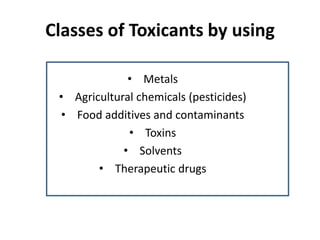
Classes of Toxicants by using
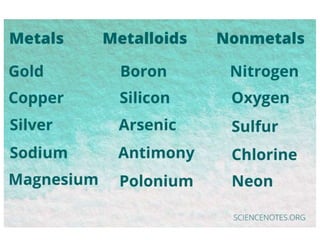
• Metals
• Agricultural chemicals (pesticides)
• Food additives and contaminants
• Toxins
• Solvents
• Therapeutic drugs
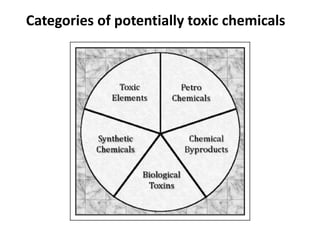
Categories of potentially toxic chemicals
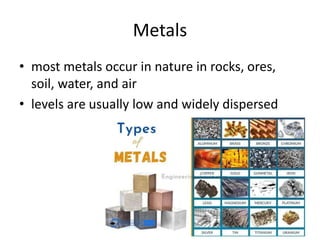
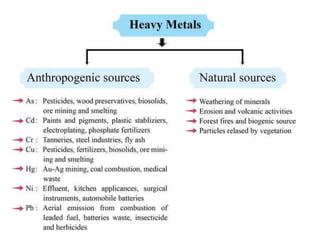
Metals
• most metals occur in nature in rocks, ores,
soil, water, and air
• levels are usually low and widely dispersed
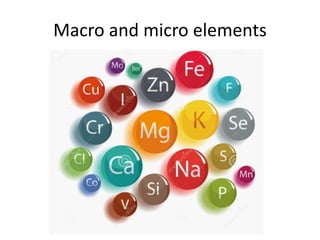
Macro and micro elements
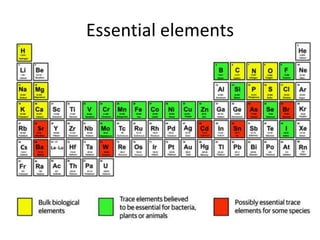
Essential elements
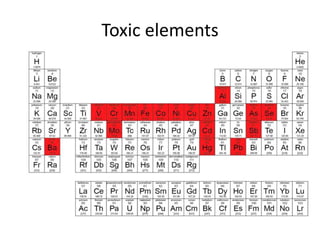
Toxic elements
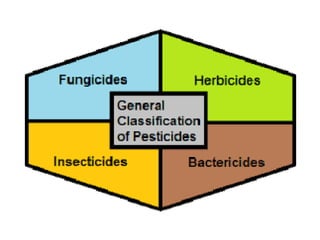
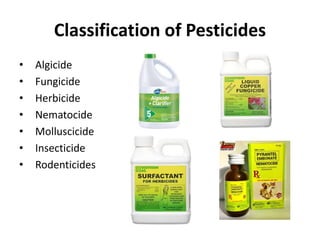
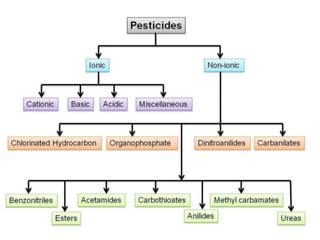
Classification of Pesticides
• Algicide
• Fungicide
• Herbicide
• Nematocide
• Molluscicide
• Insecticide
• Rodenticides
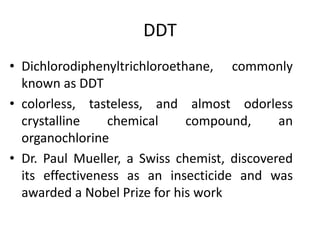
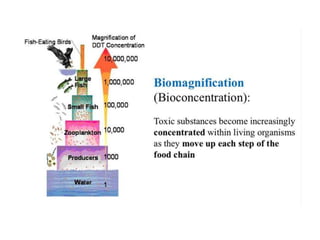
DDT
• Dichlorodiphenyltrichloroethane, commonly
known as DDT
• colorless, tasteless, and almost odorless
crystalline chemical compound, an
organochlorine
• Dr. Paul Mueller, a Swiss chemist, discovered
its effectiveness as an insecticide and was
awarded a Nobel Prize for his work
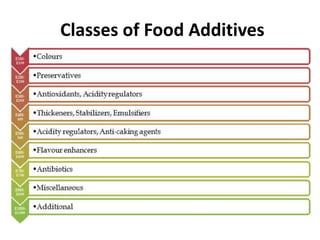
Classes of Food Additives
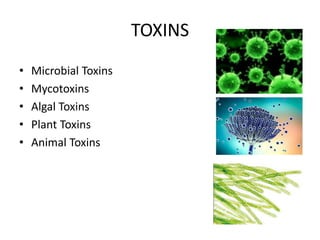
TOXINS
• Microbial Toxins
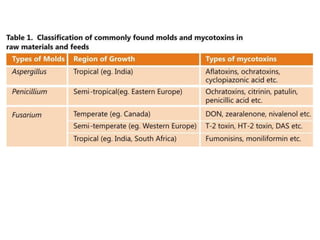
• Mycotoxins
• Algal Toxins
• Plant Toxins
• Animal Toxins
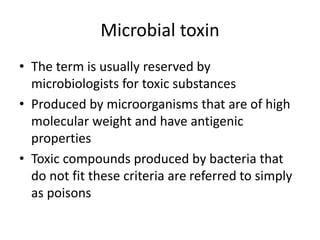
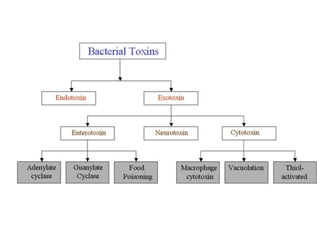
Microbial toxin
• The term is usually reserved by
microbiologists for toxic substances
• Produced by microorganisms that are of high
molecular weight and have antigenic
properties
• Toxic compounds produced by bacteria that
do not fit these criteria are referred to simply
as poisons
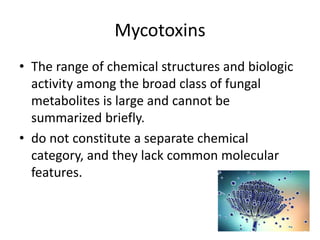
Mycotoxins
• The range of chemical structures and biologic
activity among the broad class of fungal
metabolites is large and cannot be
summarized briefly.
• do not constitute a separate chemical
category, and they lack common molecular
features.
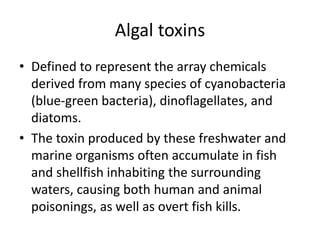
Algal toxins
• Defined to represent the array chemicals
derived from many species of cyanobacteria
(blue-green bacteria), dinoflagellates, and
diatoms.
• The toxin produced by these freshwater and
marine organisms often accumulate in fish
and shellfish inhabiting the surrounding
waters, causing both human and animal
poisonings, as well as overt fish kills.
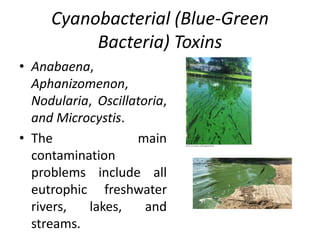
Cyanobacterial (Blue-Green
Bacteria) Toxins
• Anabaena,
Aphanizomenon,
Nodularia, Oscillatoria,
and Microcystis.
• The main
contamination
problems include all
eutrophic freshwater
rivers, lakes, and
streams.
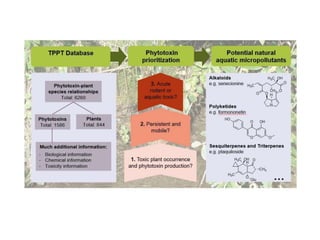
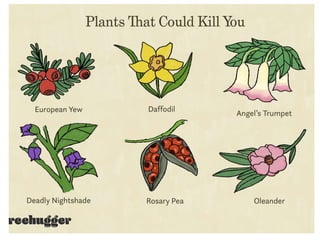
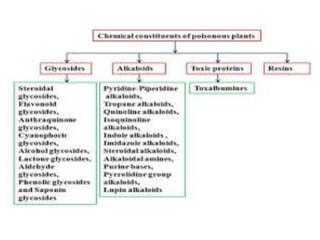
Phytotoxin
• as secondary plant compounds, are often held
to have evolved as defense mechanisms
against herbivorous animals, particularly
insects and mammals.
• These compounds may be repellent but not
particularly toxic, or they may be acutely toxic
to a wide range of organisms.
• They include sulfur compounds, lipids,
phenols, alkaloids, glycosides, and many other
types of chemicals.
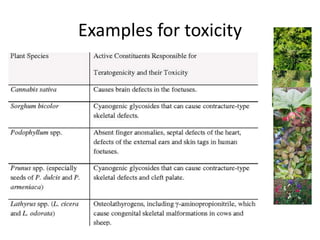
Examples for toxicity
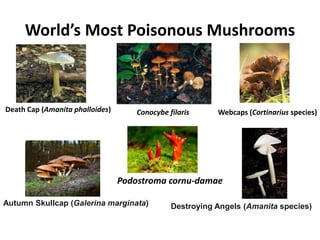
World’s Most Poisonous Mushrooms
Death Cap (Amanita phalloides) Conocybe filaris Webcaps (Cortinarius species)
Autumn Skullcap (Galerina marginata) Destroying Angels (Amanita species)
Podostroma cornu-damae
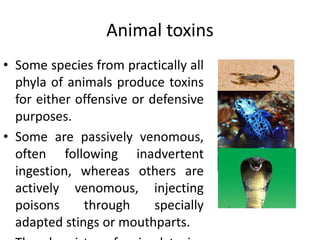
Animal toxins
• Some species from practically all
phyla of animals produce toxins
for either offensive or defensive
purposes.
• Some are passively venomous,
often following inadvertent
ingestion, whereas others are
actively venomous, injecting
poisons through specially
adapted stings or mouthparts.
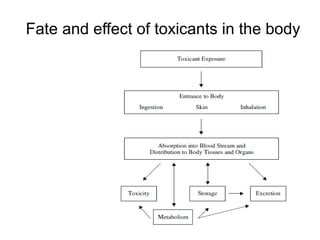
Fate and effect of toxicants in the body
MECHANISMS OF TRANSPORT
• 1. Passive diffusion. Diffusion occurs through the lipid
membrane.
• 2. Filtration. Diffusion occurs through aqueous pores.
• 3. Special transport. Transport is aided by a carrier
molecule, which act as a “ferryboat.”
• 4. Endocytosis. Transport takes the form of pinocytosis
for liquids and phagocytosis for solids.
PHYSICOCHEMICAL PROPERTIES
RELEVANT TO DIFFUSION
• Molecular size and shape
• Solubility at site of absorption
• Degree of ionization
• Relative lipid solubility of ionized and
unionized forms
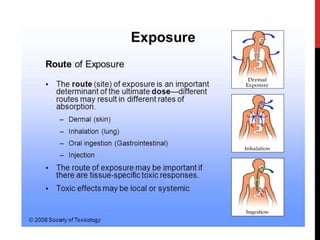
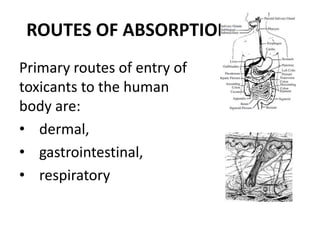
ROUTES OF ABSORPTION
Primary routes of entry of
toxicants to the human
body are:
• dermal,
• gastrointestinal,
• respiratory
Extent of Absorption
• It is often useful to determine how much of
the drug actually penetrates the membrane
barrier (e.g., skin or gastrointestinal tract) and
gets into the blood stream.
• This is usually determined experimentally for
oral and dermal routes of administration.
• The area under the curve (AUC) of the
concentration-time profiles for oral or dermal
routes
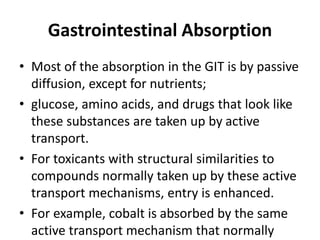
Gastrointestinal Absorption
• Most of the absorption in the GIT is by passive
diffusion, except for nutrients;
• glucose, amino acids, and drugs that look like
these substances are taken up by active
transport.
• For toxicants with structural similarities to
compounds normally taken up by these active
transport mechanisms, entry is enhanced.
• For example, cobalt is absorbed by the same
active transport mechanism that normally
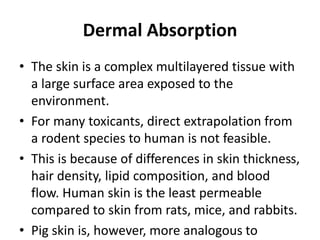
Dermal Absorption
• The skin is a complex multilayered tissue with
a large surface area exposed to the
environment.
• For many toxicants, direct extrapolation from
a rodent species to human is not feasible.
• This is because of differences in skin thickness,
hair density, lipid composition, and blood
flow. Human skin is the least permeable
compared to skin from rats, mice, and rabbits.
• Pig skin is, however, more analogous to
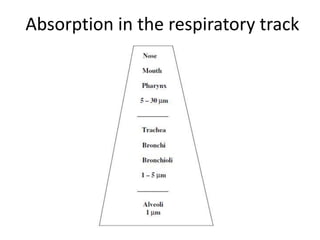
Absorption in the respiratory track
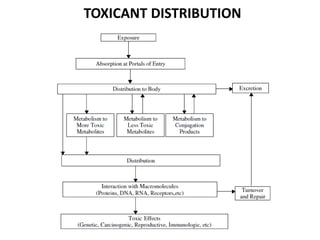
TOXICANT DISTRIBUTION
Elimination of toxicants
Passive diffusion of toxic chemicals:
• 1. They increased in size.
• 2. Their surface area to body mass decreased.
• 3. Their bodies compartmentalized (i.e., cells,
tissues, organs).
• 4. They generally increased in lipid content.
• 5. They developed barriers to the external
environment.
TOXICOKINETICS
• The explanation of the pharmacokinetics or
toxicokinetics involved in absorption,
distribution, and elimination processes is a
highly specialized branch of toxicology.
• Toxicokinetics is an extension of
pharmacokinetics in that these studies are
conducted at higher doses than
pharmacokinetic studies and the principles of
pharmacokinetics are applied to xenobiotics
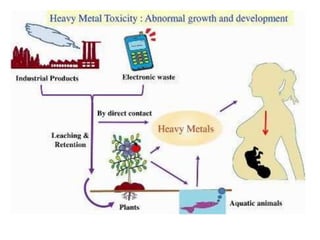
Toxicology of metals
General findings
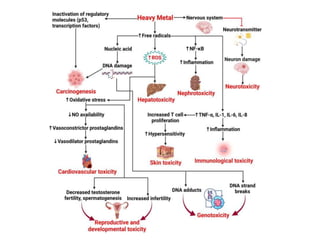
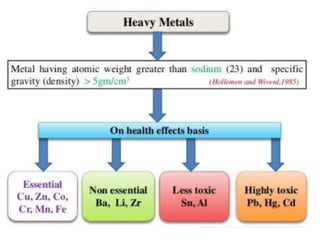
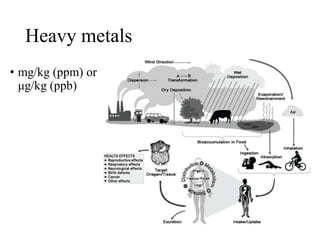
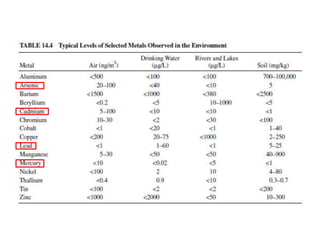
Heavy metals
• mg/kg (ppm) or
μg/kg (ppb)
Arsenic
Occurence of As
• Natural sources
• Organic (nontoxic) and inorganic forms (toxic)
• Accumulation in
• Soil
• Surface and groundwater
• Seawater
• Anthropogenic sources
• Fuel combustion
• Mining activities
• Metal smelting
• Glass industries
• Wood preservatives
• Pesticides
Organisms in arsenic-rich
environments
• Microbes
• Resistance and adaptability
• ars operon – As-detoxification (degradation)
• examples for detoxification (methylation) and production
of more harmful As forms (anaerobic)
• Higher plants and animals
• Food chain
• Role of aquatic environment – fish
Sources of As for humans
• Main sources are food and water
• No elimination of As3+ and As5+
• Accumulates in
• Muscles
• Skin
• Hair
• Nails
• Detoxified by
• Renal functions and liver
• Detoxified form via methylation
Toxicity of As
• Acute and chronic arsenic toxicities
• Toxic effects of inorganic arsenic include
denaturing of cellular enzymes through interaction
with sulfhydryl groups.
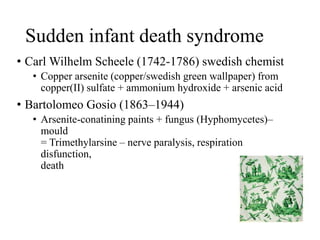
Sudden infant death syndrome
• Carl Wilhelm Scheele (1742-1786) swedish chemist
• Copper arsenite (copper/swedish green wallpaper) from
copper(II) sulfate + ammonium hydroxide + arsenic acid
• Bartolomeo Gosio (1863–1944)
• Arsenite-conatining paints + fungus (Hyphomycetes)–
mould
= Trimethylarsine – nerve paralysis, respiration
disfunction,
death
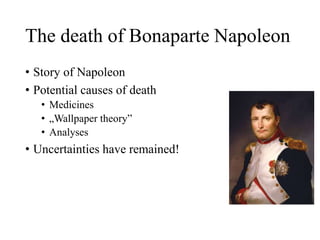
The death of Bonaparte Napoleon
• Story of Napoleon
• Potential causes of death
• Medicines
• „Wallpaper theory”
• Analyses
• Uncertainties have remained!
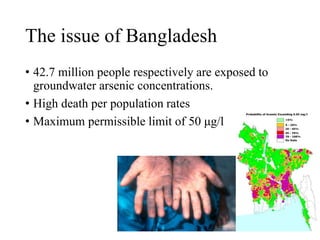
The issue of Bangladesh
• 42.7 million people respectively are exposed to
groundwater arsenic concentrations.
• High death per population rates
• Maximum permissible limit of 50 μg/l
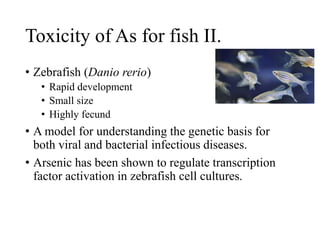
Toxicity of As for fish II.
• Zebrafish (Danio rerio)
• Rapid development
• Small size
• Highly fecund
• A model for understanding the genetic basis for
both viral and bacterial infectious diseases.
• Arsenic has been shown to regulate transcription
factor activation in zebrafish cell cultures.
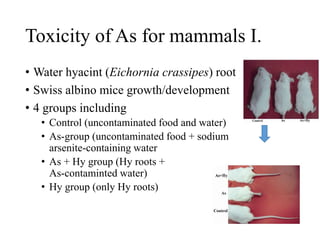
Toxicity of As for mammals I.
• Water hyacint (Eichornia crassipes) root powder
• Swiss albino mice growth/development
• 4 groups including
• Control (uncontaminated food and water)
• As-group (uncontaminated food + sodium
arsenite-containing water
• As + Hy group (Hy roots +
As-contaminted water)
• Hy group (only Hy roots)
Toxicity of As for mammals II.
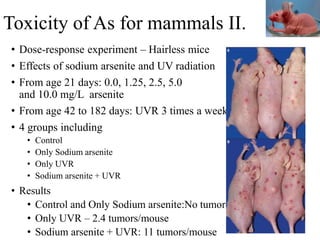
• Dose-response experiment – Hairless mice
• Effects of sodium arsenite and UV radiation
• From age 21 days: 0.0, 1.25, 2.5, 5.0
and 10.0 mg/L arsenite
• From age 42 to 182 days: UVR 3 times a week
• 4 groups including
• Control
• Only Sodium arsenite
• Only UVR
• Sodium arsenite + UVR
• Results
• Control and Only Sodium arsenite:No tumor
• Only UVR – 2.4 tumors/mouse
• Sodium arsenite + UVR: 11 tumors/mouse
Cadmium
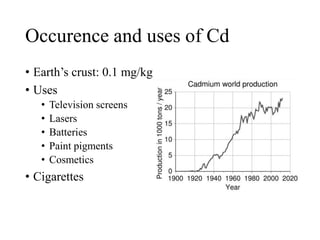
Occurence and uses of Cd
• Earth’s crust: 0.1 mg/kg
• Uses
• Television screens
• Lasers
• Batteries
• Paint pigments
• Cosmetics
• Cigarettes
Patways of contamination
• Sources of contaminated food
• Meats
• Leafy vegetables
• Rice
• Drinking water
• After entrance to body
• Bound to sulfhydryl
group-containing proteins
• 30 % kidney, 30 % liver
• Half life: 75 to 128 days
Mechanisms of Cd toxicity
• Oxidative stress
• DNA changes
• Inhibition of transport pathways
• Zn and Mg interactions
• Synergic (Pb and As) and antagonist (Zn and Se)
effects
Clinical toxicity of Cd I.
• Impairment of Vitamin D metabolism in the kidney
(bone)
• Cardiovascular system
• Hypertension
• Diabetes
• Glutathione depletion
• Accumulation in aorta
• Immune system
• Suppression of natural killer cell activity
Clinical toxicity of Cd II.
• Nervous system
• Membrane disturbances
• Apoptosis of cortical cells in the central nervous system
• Inhibition of influx in Ca channels
• Decreased attention and memory
• High urinary levels – significantly decreased low-
frequency hearing
• Breast cancer, prostate cancer, lung cancer (?)
Reduction of body Cd burden
• There is no agreement in the literature regarding
treatment of Cd toxicity
• Chelation therapy: EDTA, DMPS (based on animal
studies)
• Maximum of 1 g/hour, maximum of 3 g/session,
minimum of 5 days between sessions
• Sauna – which appears to be a moderately
successful modality for reducing body burden of Cd
without risk of tubular damage
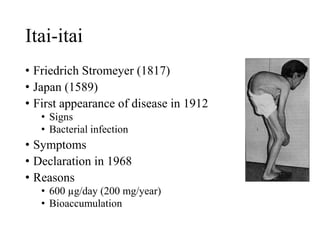
Itai-itai
• Friedrich Stromeyer (1817)
• Japan (1589)
• First appearance of disease in 1912
• Signs
• Bacterial infection
• Symptoms
• Declaration in 1968
• Reasons
• 600 µg/day (200 mg/year)
• Bioaccumulation
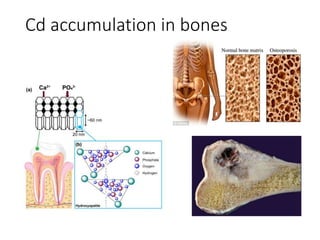
Cd accumulation in bones
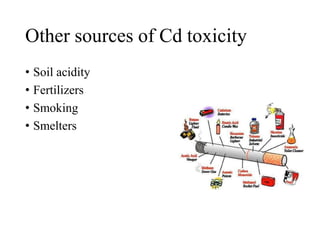
Other sources of Cd toxicity
• Soil acidity
• Fertilizers
• Smoking
• Smelters
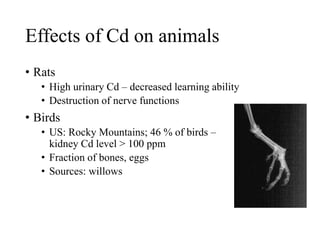
Effects of Cd on animals
• Rats
• High urinary Cd – decreased learning ability
• Destruction of nerve functions
• Birds
• US: Rocky Mountains; 46 % of birds –
kidney Cd level > 100 ppm
• Fraction of bones, eggs
• Sources: willows
Lead
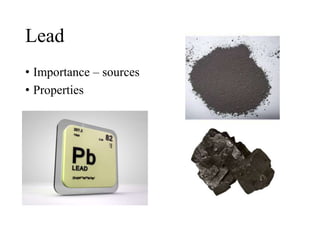
Lead
• Importance – sources
• Properties
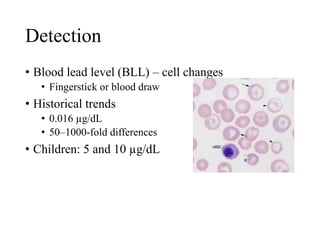
Detection
• Blood lead level (BLL) – cell changes
• Fingerstick or blood draw
• Historical trends
• 0.016 µg/dL
• 50–1000-fold differences
• Children: 5 and 10 µg/dL
Patways of poisoning and target
organs
• Inhalation, ingestion, skin contact
• Daily intake limits; no safety treshold values
(susceptibility)
• 35–40% in lungs, 95% in bloodstream
• Children: soft tissues; adults: hair and teeth
• Blood, nervous system, cardiovascular, immune
Beethoven
• Illnesses (liver cirrhosis, renal capillary necrosis,
pancreatitis, diabetes mellitus, syphilis, alcoholism,
..?..)
• Potential causes of death
• The Guevara Lock (Hiller family – Fremming –
American Beethoven Society – Ira Brilliant Center
for Beethoven Studies)
• Analysis
• Potential sources of Pb
Roman Empire
• Diet of 30 emperors from 30 B.C. to 220 A.D.
• Lead pots and lead-lined copper kettles
• 240–1000 mg/l
• + tap water
• Claudius
• Disturbed speech, weak limbs, ungainly gait, tremor, fits
of excessive and inappropriate laughter, unseemly anger
Counterfeit cigarettes
• Investigation of lead and cadmium in counterfeit
cigarettes seized in the United States.
• Methods
• Result
• Explanation
• Conclusions (children)
Occupational load
• Food, water, dust, paint
• More than 3 million workers in the USA
• Metalurgical equipment, developing dental X-ray
films prior to digital X-rays, fetal monitors,
plumbing, circuit boards, jet engines, and ceramic
glazes, battery manufacturing and recycling
• Working man brings dust home
Signs and symptoms
• A variety of signs and syptoms (time of exposure!)
• Different results in independent studies
• Headache, anaemia, seizures, increased skull
pressure
• Depression, nausea, abdominal pain, loos of
coordination, numbness, aggressive behaviour
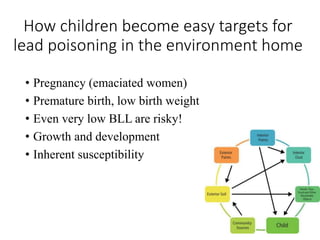
How children become easy targets for
lead poisoning in the environment home
• Pregnancy (emaciated women)
• Premature birth, low birth weight
• Even very low BLL are risky!
• Growth and development
• Inherent susceptibility
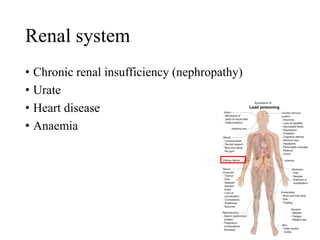
Renal system
• Chronic renal insufficiency (nephropathy)
• Urate
• Heart disease
• Anaemia
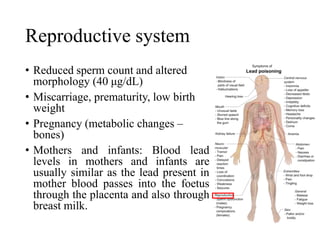
Reproductive system
• Reduced sperm count and altered
morphology (40 μg/dL)
• Miscarriage, prematurity, low birth
weight
• Pregnancy (metabolic changes –
bones)
• Mothers and infants: Blood lead
levels in mothers and infants are
usually similar as the lead present in
mother blood passes into the foetus
through the placenta and also through
breast milk.
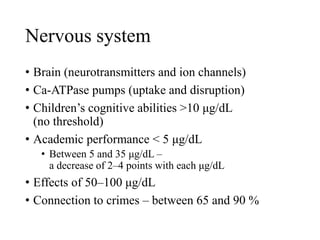
Nervous system
• Brain (neurotransmitters and ion channels)
• Ca-ATPase pumps (uptake and disruption)
• Children’s cognitive abilities >10 μg/dL
(no threshold)
• Academic performance < 5 μg/dL
• Between 5 and 35 μg/dL –
a decrease of 2–4 points with each μg/dL
• Effects of 50–100 μg/dL
• Connection to crimes – between 65 and 90 %
Prevention and treatment
• Handwash
• Ca and Fe (pregnancy)
• House pipe replacement
• Hot and cold water
• Ca salts
• Antioxidants
• Repeated chelation therapy
Animals
• Dogs and cattle
• Variable sources, but contaminated food is common
• Symptoms
• Ataxia, blindness, salivation, muscle tremors
• Rats
• Reproductive system (age-dependency)
• sperm
• plasma and testicular testosterone
• embriotoxicity
Mercury
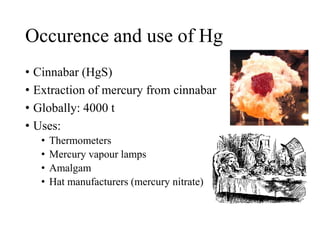
Occurence and use of Hg
• Cinnabar (HgS)
• Extraction of mercury from cinnabar
• Globally: 4000 t
• Uses:
• Thermometers
• Mercury vapour lamps
• Amalgam
• Hat manufacturers (mercury nitrate)
Forms of Hg in the environment
• Elemental Hg (0)
• Organic Hg
• Methyl. and ethyl Hg
• Broken thermometers
• Paints
• Wood preservatives
• Pesticides
Effect of Hg on humans I.
• Acute
• Strong salivation
• Inflammation of the stomach and guts
• Nephritis (inflammation of the kidney) – Hg is retained in
blood
• Chronic
• Amalgam – allergy
• Incubation – pressure in the skull, instabile circulation
(months)
• Stringing pain in muscles, arthralgia (pain in articulations),
sore throat, nausea, anaemia, cold extremities (limbs),
headache, hearing problems, depression etc.
Effect of Hg on humans II.
• Effects on foetus
• Impaired development, increased stimulus-treshold,
cramps
• Hg crosses placenta – bioaccumulation in foetus
• Children
• Acrodynia; „pink disease”
• Erethismus mercurialis
• Skittishness – blaze of anger
• Blubs, weekness
• Bad-tempered, ill-natured personality
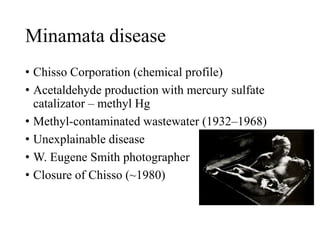
Minamata disease
• Chisso Corporation (chemical profile)
• Acetaldehyde production with mercury sulfate
catalizator – methyl Hg
• Methyl-contaminated wastewater (1932–1968)
• Unexplainable disease
• W. Eugene Smith photographer
• Closure of Chisso (~1980)
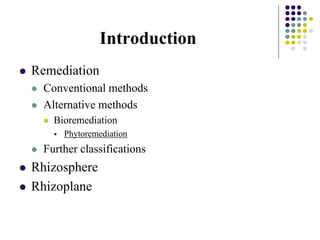
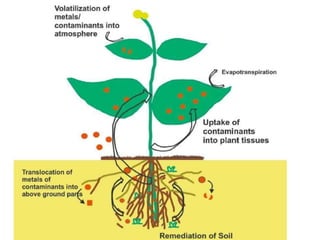
Phytoremediation
Introduction
 Remediation
 Conventional methods
 Alternative methods
 Bioremediation
 Phytoremediation
 Further classifications
 Rhizosphere
 Rhizoplane
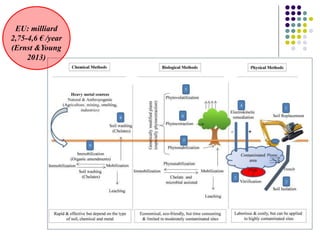
EU: milliard
2,75-4,6 € /year
(Ernst &Young
2013)
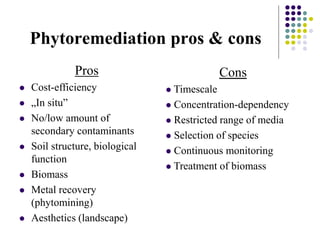
Phytoremediation pros & cons
Pros
 Cost-efficiency
 „In situ”
 No/low amount of
secondary contaminants
 Soil structure, biological
function
 Biomass
 Metal recovery
(phytomining)
 Aesthetics (landscape)
Cons
 Timescale
 Concentration-dependency
 Restricted range of media
 Selection of species
 Continuous monitoring
 Treatment of biomass
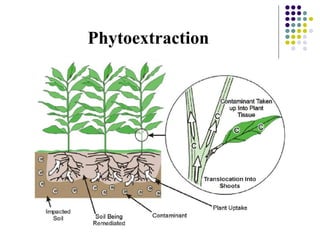
Phytoextraction
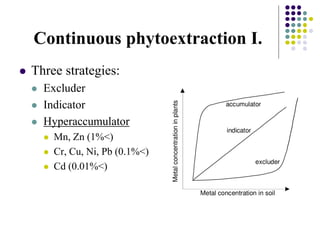
Continuous phytoextraction I.
 Three strategies:
 Excluder
 Indicator
 Hyperaccumulator
 Mn, Zn (1%<)
 Cr, Cu, Ni, Pb (0.1%<)
 Cd (0.01%<)
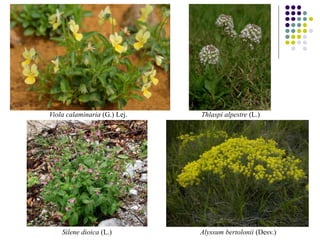
Viola calaminaria (G.) Lej. Thlaspi alpestre (L.)
Silene dioica (L.) Alyssum bertolonii (Desv.)
Continuous phytoextraction II.
 Characteristics of hyperaccumulators
 Metal tolerance
 Translocation
 Detoxification with specific ligands
 Growing towards contamination (solution)
 Symbiosis (helps/hinders)
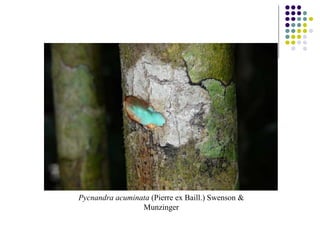
Pycnandra acuminata (Pierre ex Baill.) Swenson &
Munzinger
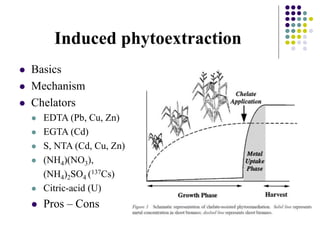
Induced phytoextraction
 Basics
 Mechanism
 Chelators
 EDTA (Pb, Cu, Zn)
 EGTA (Cd)
 S, NTA (Cd, Cu, Zn)
 (NH4)(NO3),
(NH4)2SO4 (137Cs)
 Citric-acid (U)
 Pros – Cons
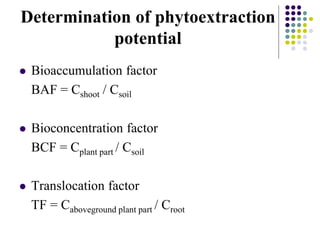
Determination of phytoextraction
potential
 Bioaccumulation factor
BAF = Cshoot / Csoil
 Bioconcentration factor
BCF = Cplant part / Csoil
 Translocation factor
TF = Caboveground plant part / Croot
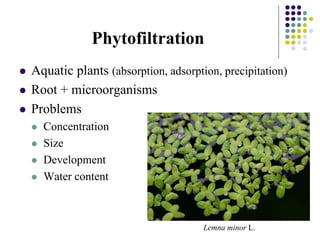
Phytofiltration
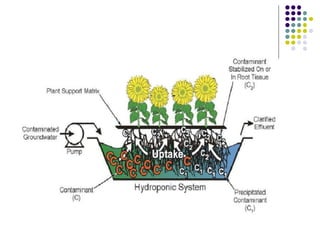
 Aquatic plants (absorption, adsorption, precipitation)
 Root + microorganisms
 Problems
 Concentration
 Size
 Development
 Water content
Lemna minor L.
Rhizofiltration
 Terrestrial plants
 Mechanism
 Root + microorganisms
 Precipitation (e.g. Pb – sunflower, Sarepta
mustard), adsorption, partitioning (Cd, U)
 Ideal species
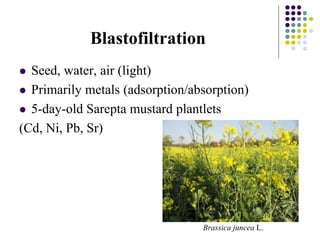
Blastofiltration
 Seed, water, air (light)
 Primarily metals (adsorption/absorption)
 5-day-old Sarepta mustard plantlets
(Cd, Ni, Pb, Sr)
Brassica juncea L.
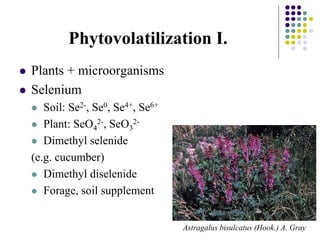
Phytovolatilization I.
 Plants + microorganisms
 Selenium
 Soil: Se2-, Se0, Se4+, Se6+
 Plant: SeO4
2-, SeO3
2-
 Dimethyl selenide
(e.g. cucumber)
 Dimethyl diselenide
 Forage, soil supplement
Astragalus bisulcatus (Hook.) A. Gray
Phytovolatilization II.
 Mercury (Hg)
 Mainly as Hg2+
 Hg0 (+), methylated (–)
 Members of Brassicaceae, tobacco
 Arsenic (As)
 Direct evidence (–)
 Bacteria and fungus
 Target: organic pollutants
 TCE - poplars
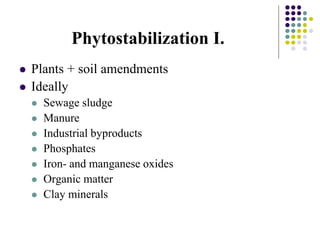
Phytostabilization I.
 Plants + soil amendments
 Ideally
 Sewage sludge
 Manure
 Industrial byproducts
 Phosphates
 Iron- and manganese oxides
 Organic matter
 Clay minerals
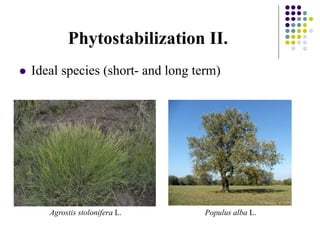
Phytostabilization II.
 Ideal species (short- and long term)
Agrostis stolonifera L. Populus alba L.
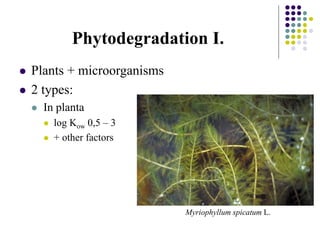
Phytodegradation I.
 Plants + microorganisms
 2 types:
 In planta
 log Kow 0,5 – 3
 + other factors
Myriophyllum spicatum L.
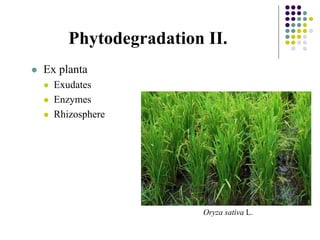
Phytodegradation II.
 Ex planta
 Exudates
 Enzymes
 Rhizosphere
Oryza sativa L.
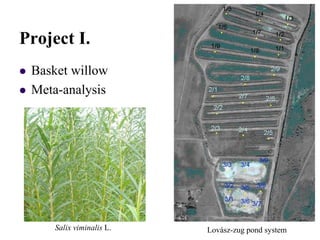
Project I.
 Basket willow
 Meta-analysis
Salix viminalis L. Lovász-zug pond system
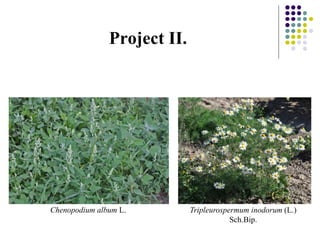
Project II.
Chenopodium album L. Tripleurospermum inodorum (L.)
Sch.Bip.
Laboratory work
 Soil
 pH
 Electrical conductivity
 Soil moisture
 Organic matter content
 CaCO3-content
 Liquid limit (soil plasticity
according to Arany)
 Elemental analyses (MP-
AES)
 Plant
 Cooling
 Drying
 Homogenizing
 Elemental analyses (MP-
AES)
Recommended literature
 Lone, ML., He, Z., Stoffella, PJ., Yang, X. (2008):
Phytoremediation of heavy metal polluted soils
and water: Progresses and perspectives. Journal
of Zheijang University Science B 9(3): 210–220.
 Pulford, ID., Watson, C. (2003):
Phytoremediation of heavy metal-contaminated
land by trees – a review. Environment
International 29(4): 529–540.

Introduction-to-Toxciology-SE-01.ppt

  • 1.
    Time table ofToxicology course 6 September Informations 13 September Introduction to Toxicology 20 September Classes of Toxicants 27 Septembe Metals 4 October Remedation 11 Quiz 18 October Toxicology test with Sinapis alba1 25 October Toxicology test with Sinapis alba2 8 November Toxicity test with plants 15 November Toxicity test with animals 22 November Quiz 29 November Exam
  • 2.
  • 3.
    Toxicology • the studyof poisons • Latin word toxicus • Greek term is toxikón • The early history of toxicology focused on the understanding and uses of different poisons
  • 4.
    Ebers papyrus • oneof the two oldest maintained medical documents, from Egyptian medical history (approximately 1500 BCE), • papyrus relates to the vast amount of herbal remedies and explanations of various toxins
  • 5.
    Cleopatra • numerous experimentswith poisons, • many different poisons to see the effects, the lethality, and the correct dosage, • all types of poisons, both mineral and natural, • numerous venomous animals and plants, collected the poisons from them
  • 6.
    Hippocrates • Greek physician,(460- 377 BC), has been dubbed "the father of modern medicine, • He notes the effect of food, of occupation, and especially of climate in causing disease
  • 7.
    Paracelsus • He wasa pioneer in several aspects of the "medical revolution" of the Renaissance, • He extended his interest in chemistry and biology to what is now considered toxicology. • He clearly expounded the concept of dose response in his Third Defense
  • 8.
    Industry toxicology Ulrich Ellborg •Warned people who work with lead, mercury and antimony. Georg Bauer • The father of mineralogy • He study the toxic effects of certain heavy metal associated with silver mining, especially respiratory diseases.
  • 9.
    Three using areaof toxicant in the past Hunting and War Conflict Medicine
  • 10.
    Starting of Modern toxicology •Humphry Davy: history of respiratory gases, nitorgen-oxid • Friedrich Sertürner: first isolation of Morphine from opium plant • Mattieu J.B. Orfila: "Father of Toxicology and forensic medicine. Interaction between dose and effect • James Marsh: The Marsh test for detecting arsenic • Jean Servais Stas: Successfully identify nicotine after diethyl ether extraction from the victim's organs. • Charles Turner Thrackrah: Effects of industry • Percival Pott: Cancer of the scrotum caused by prolonged exposure to the soot in chimneys • Harting és Hesse: The first description of occupational lung cancer • Irvine J. Selikoff: Pulmonary fibrosis in asbestos insulation workers with lung cancer
  • 11.
    Modern toxicology • branchof science • deals with poisons • poison can be defined as any substance that causes a harmful effect when administered, • either by accident or design, to a living organism
  • 12.
    TOXICOLOGISTS STUDY The professional activitiesof all toxicologists fall into three main areas of endeavor: • descriptive toxicology, • research/mechanistic toxicology, • applied toxicology
  • 13.
    Descriptive toxicologists • focuses onthe toxicity testing of chemicals • primarily at commercial and governmental toxicity testing laboratories • identify the various organ toxicities
  • 14.
    Basic research ormechanistic toxicologists • understanding of how the chemical or agent initiates those biochemical or physiological changes within the cell or tissue • identify the critical biological processes • the goal of mechanistic studies is to understand the specific biological reactions
  • 15.
    Applied toxicologists • theuse of chemicals in a “ real world” or • nonlaboratory setting, • forensic toxicology, • clinical toxicology, • environmental toxicology, • occupational toxicology
  • 16.
    Modes of ToxicAction • Biochemical and molecular toxicology • Behavioral toxicology • Nutritional toxicology • Carcinogenesis • Teratogenesis • Mutagenesis • Organ toxicity
  • 17.
    Measurement of Toxicantsand Toxicity • Analytical toxicology • Toxicity testing • Toxicologic pathology • Structure-activity • Biomathematics and statistics • Epidemiology
  • 18.
    Chemical Use Classes •Agricultural chemicals • Clinical drugs • Drugs of abuse • Food additives • Industrial chemicals • Naturally occurring substances • Combustion products
  • 19.
    Regulatory Toxicology • Legalaspects • Environmental Protection Agency (EPA), • Food and Drug Administration (FDA), • Occupational Safety and Health Administration (OSHA) • Risk assessment
  • 20.
    Classes of toxicants •Air pollutants • Water and soil pollutants • Occupational toxicants
  • 21.
    History of Air pollutants •use wood fires for heat and cooking, • domestic and industrial combustion of coal • the rapid increase in the number of automobiles
  • 22.
    Types of airpollutants- Gaseous • carbon monoxide (CO), • hydrocarbons, • hydrogen sulfide (H2S) • nitrogen oxides (NxOy), • ozone (O3) • sulfur oxides (SxOy) • Carbon dioxide CO2
  • 23.
    Types of airpollutants- Particulate • Dust: 100 μm in diameter • Fumes: Suspended solid (<1.0 μm) • Mist: Liquid or solid particles (<2.0 μm) • Smoke: Solid particles (0.05–1.0 μm) • Aerosol: Liquid or solid particles ˙(<1.0 µm)
  • 25.
  • 26.
    Sources of Air Pollutants •Natural Pollutants • Anthropogenic Pollutants • Indoor Pollutants
  • 27.
    WATER AND SOIL POLLUTANTS •Surface water can be contaminated by point or nonpoint sources. • point source: An effluent pipe from an industrial plant or a sewage-treatment plant. • nonpoint source: a field from which pesticides and fertilizers are carried by rainwater into a river
  • 28.
    Point vs. Nonpoint pollution sources
  • 29.
    OCCUPATIONAL TOXICANTS Threshold limit values(TLVs) • airborne concentrations of substances and represent • conditions under which it is believed that nearly all workers may be repeatedly • exposed day after day without adverse effect Biologic limit values (BLVs) • limits of amounts of substances • to which the worker may be exposed without hazard to health
  • 30.
  • 32.
    Acut vs chronictoxicity Acute toxicity describes the adverse effects of a substance that result either from a single exposure or from multiple exposures in a short period of time (usually less than 24 hours. Chronic toxicity the development of adverse effects as a result of long term exposure to a contaminant or other stressor.
  • 33.
    Sublethal vs lethaleffect Sublethal effect: changes in • physiological processes, • growth, • reproduction behavior, • development Lethal effect: Death
  • 35.
    Lot of effects,lot of factors
  • 36.
    References Hodgson E (2004)A textbook of modern toxicology. John Wiley and Sons. Nikinmaa M (2014) An introduction to Aquatic Toxicology. Elsevier. Robinson L, Thorn I (2005) Toxicology and ecotoxicology in chemical safety assessment. Blackwell Publishing.
  • 37.
    Classes of Toxicants Toxicologyand Ecotoxicology Edina Kundrát-Simon
  • 42.
    Classes of Toxicantsby using • Metals • Agricultural chemicals (pesticides) • Food additives and contaminants • Toxins • Solvents • Therapeutic drugs
  • 43.
  • 44.
    Metals • most metalsoccur in nature in rocks, ores, soil, water, and air • levels are usually low and widely dispersed
  • 47.
  • 48.
  • 49.
  • 53.
    Classification of Pesticides •Algicide • Fungicide • Herbicide • Nematocide • Molluscicide • Insecticide • Rodenticides
  • 55.
    DDT • Dichlorodiphenyltrichloroethane, commonly knownas DDT • colorless, tasteless, and almost odorless crystalline chemical compound, an organochlorine • Dr. Paul Mueller, a Swiss chemist, discovered its effectiveness as an insecticide and was awarded a Nobel Prize for his work
  • 57.
    Classes of FoodAdditives
  • 58.
    TOXINS • Microbial Toxins •Mycotoxins • Algal Toxins • Plant Toxins • Animal Toxins
  • 59.
    Microbial toxin • Theterm is usually reserved by microbiologists for toxic substances • Produced by microorganisms that are of high molecular weight and have antigenic properties • Toxic compounds produced by bacteria that do not fit these criteria are referred to simply as poisons
  • 61.
    Mycotoxins • The rangeof chemical structures and biologic activity among the broad class of fungal metabolites is large and cannot be summarized briefly. • do not constitute a separate chemical category, and they lack common molecular features.
  • 63.
    Algal toxins • Definedto represent the array chemicals derived from many species of cyanobacteria (blue-green bacteria), dinoflagellates, and diatoms. • The toxin produced by these freshwater and marine organisms often accumulate in fish and shellfish inhabiting the surrounding waters, causing both human and animal poisonings, as well as overt fish kills.
  • 64.
    Cyanobacterial (Blue-Green Bacteria) Toxins •Anabaena, Aphanizomenon, Nodularia, Oscillatoria, and Microcystis. • The main contamination problems include all eutrophic freshwater rivers, lakes, and streams.
  • 65.
    Phytotoxin • as secondaryplant compounds, are often held to have evolved as defense mechanisms against herbivorous animals, particularly insects and mammals. • These compounds may be repellent but not particularly toxic, or they may be acutely toxic to a wide range of organisms. • They include sulfur compounds, lipids, phenols, alkaloids, glycosides, and many other types of chemicals.
  • 69.
  • 70.
    World’s Most PoisonousMushrooms Death Cap (Amanita phalloides) Conocybe filaris Webcaps (Cortinarius species) Autumn Skullcap (Galerina marginata) Destroying Angels (Amanita species) Podostroma cornu-damae
  • 71.
    Animal toxins • Somespecies from practically all phyla of animals produce toxins for either offensive or defensive purposes. • Some are passively venomous, often following inadvertent ingestion, whereas others are actively venomous, injecting poisons through specially adapted stings or mouthparts.
  • 73.
    Fate and effectof toxicants in the body
  • 74.
    MECHANISMS OF TRANSPORT •1. Passive diffusion. Diffusion occurs through the lipid membrane. • 2. Filtration. Diffusion occurs through aqueous pores. • 3. Special transport. Transport is aided by a carrier molecule, which act as a “ferryboat.” • 4. Endocytosis. Transport takes the form of pinocytosis for liquids and phagocytosis for solids.
  • 75.
    PHYSICOCHEMICAL PROPERTIES RELEVANT TODIFFUSION • Molecular size and shape • Solubility at site of absorption • Degree of ionization • Relative lipid solubility of ionized and unionized forms
  • 76.
    ROUTES OF ABSORPTION Primaryroutes of entry of toxicants to the human body are: • dermal, • gastrointestinal, • respiratory
  • 77.
    Extent of Absorption •It is often useful to determine how much of the drug actually penetrates the membrane barrier (e.g., skin or gastrointestinal tract) and gets into the blood stream. • This is usually determined experimentally for oral and dermal routes of administration. • The area under the curve (AUC) of the concentration-time profiles for oral or dermal routes
  • 78.
    Gastrointestinal Absorption • Mostof the absorption in the GIT is by passive diffusion, except for nutrients; • glucose, amino acids, and drugs that look like these substances are taken up by active transport. • For toxicants with structural similarities to compounds normally taken up by these active transport mechanisms, entry is enhanced. • For example, cobalt is absorbed by the same active transport mechanism that normally
  • 79.
    Dermal Absorption • Theskin is a complex multilayered tissue with a large surface area exposed to the environment. • For many toxicants, direct extrapolation from a rodent species to human is not feasible. • This is because of differences in skin thickness, hair density, lipid composition, and blood flow. Human skin is the least permeable compared to skin from rats, mice, and rabbits. • Pig skin is, however, more analogous to
  • 80.
    Absorption in therespiratory track
  • 81.
  • 82.
    Elimination of toxicants Passivediffusion of toxic chemicals: • 1. They increased in size. • 2. Their surface area to body mass decreased. • 3. Their bodies compartmentalized (i.e., cells, tissues, organs). • 4. They generally increased in lipid content. • 5. They developed barriers to the external environment.
  • 83.
    TOXICOKINETICS • The explanationof the pharmacokinetics or toxicokinetics involved in absorption, distribution, and elimination processes is a highly specialized branch of toxicology. • Toxicokinetics is an extension of pharmacokinetics in that these studies are conducted at higher doses than pharmacokinetic studies and the principles of pharmacokinetics are applied to xenobiotics
  • 84.
  • 87.
    Heavy metals • mg/kg(ppm) or μg/kg (ppb)
  • 89.
  • 90.
    Occurence of As •Natural sources • Organic (nontoxic) and inorganic forms (toxic) • Accumulation in • Soil • Surface and groundwater • Seawater • Anthropogenic sources • Fuel combustion • Mining activities • Metal smelting • Glass industries • Wood preservatives • Pesticides
  • 91.
    Organisms in arsenic-rich environments •Microbes • Resistance and adaptability • ars operon – As-detoxification (degradation) • examples for detoxification (methylation) and production of more harmful As forms (anaerobic) • Higher plants and animals • Food chain • Role of aquatic environment – fish
  • 92.
    Sources of Asfor humans • Main sources are food and water • No elimination of As3+ and As5+ • Accumulates in • Muscles • Skin • Hair • Nails • Detoxified by • Renal functions and liver • Detoxified form via methylation
  • 93.
    Toxicity of As •Acute and chronic arsenic toxicities • Toxic effects of inorganic arsenic include denaturing of cellular enzymes through interaction with sulfhydryl groups.
  • 94.
    Sudden infant deathsyndrome • Carl Wilhelm Scheele (1742-1786) swedish chemist • Copper arsenite (copper/swedish green wallpaper) from copper(II) sulfate + ammonium hydroxide + arsenic acid • Bartolomeo Gosio (1863–1944) • Arsenite-conatining paints + fungus (Hyphomycetes)– mould = Trimethylarsine – nerve paralysis, respiration disfunction, death
  • 95.
    The death ofBonaparte Napoleon • Story of Napoleon • Potential causes of death • Medicines • „Wallpaper theory” • Analyses • Uncertainties have remained!
  • 96.
    The issue ofBangladesh • 42.7 million people respectively are exposed to groundwater arsenic concentrations. • High death per population rates • Maximum permissible limit of 50 μg/l
  • 97.
    Toxicity of Asfor fish II. • Zebrafish (Danio rerio) • Rapid development • Small size • Highly fecund • A model for understanding the genetic basis for both viral and bacterial infectious diseases. • Arsenic has been shown to regulate transcription factor activation in zebrafish cell cultures.
  • 98.
    Toxicity of Asfor mammals I. • Water hyacint (Eichornia crassipes) root powder • Swiss albino mice growth/development • 4 groups including • Control (uncontaminated food and water) • As-group (uncontaminated food + sodium arsenite-containing water • As + Hy group (Hy roots + As-contaminted water) • Hy group (only Hy roots)
  • 99.
    Toxicity of Asfor mammals II. • Dose-response experiment – Hairless mice • Effects of sodium arsenite and UV radiation • From age 21 days: 0.0, 1.25, 2.5, 5.0 and 10.0 mg/L arsenite • From age 42 to 182 days: UVR 3 times a week • 4 groups including • Control • Only Sodium arsenite • Only UVR • Sodium arsenite + UVR • Results • Control and Only Sodium arsenite:No tumor • Only UVR – 2.4 tumors/mouse • Sodium arsenite + UVR: 11 tumors/mouse
  • 100.
  • 101.
    Occurence and usesof Cd • Earth’s crust: 0.1 mg/kg • Uses • Television screens • Lasers • Batteries • Paint pigments • Cosmetics • Cigarettes
  • 102.
    Patways of contamination •Sources of contaminated food • Meats • Leafy vegetables • Rice • Drinking water • After entrance to body • Bound to sulfhydryl group-containing proteins • 30 % kidney, 30 % liver • Half life: 75 to 128 days
  • 103.
    Mechanisms of Cdtoxicity • Oxidative stress • DNA changes • Inhibition of transport pathways • Zn and Mg interactions • Synergic (Pb and As) and antagonist (Zn and Se) effects
  • 104.
    Clinical toxicity ofCd I. • Impairment of Vitamin D metabolism in the kidney (bone) • Cardiovascular system • Hypertension • Diabetes • Glutathione depletion • Accumulation in aorta • Immune system • Suppression of natural killer cell activity
  • 105.
    Clinical toxicity ofCd II. • Nervous system • Membrane disturbances • Apoptosis of cortical cells in the central nervous system • Inhibition of influx in Ca channels • Decreased attention and memory • High urinary levels – significantly decreased low- frequency hearing • Breast cancer, prostate cancer, lung cancer (?)
  • 106.
    Reduction of bodyCd burden • There is no agreement in the literature regarding treatment of Cd toxicity • Chelation therapy: EDTA, DMPS (based on animal studies) • Maximum of 1 g/hour, maximum of 3 g/session, minimum of 5 days between sessions • Sauna – which appears to be a moderately successful modality for reducing body burden of Cd without risk of tubular damage
  • 107.
    Itai-itai • Friedrich Stromeyer(1817) • Japan (1589) • First appearance of disease in 1912 • Signs • Bacterial infection • Symptoms • Declaration in 1968 • Reasons • 600 µg/day (200 mg/year) • Bioaccumulation
  • 108.
  • 109.
    Other sources ofCd toxicity • Soil acidity • Fertilizers • Smoking • Smelters
  • 110.
    Effects of Cdon animals • Rats • High urinary Cd – decreased learning ability • Destruction of nerve functions • Birds • US: Rocky Mountains; 46 % of birds – kidney Cd level > 100 ppm • Fraction of bones, eggs • Sources: willows
  • 111.
  • 112.
    Lead • Importance –sources • Properties
  • 113.
    Detection • Blood leadlevel (BLL) – cell changes • Fingerstick or blood draw • Historical trends • 0.016 µg/dL • 50–1000-fold differences • Children: 5 and 10 µg/dL
  • 115.
    Patways of poisoningand target organs • Inhalation, ingestion, skin contact • Daily intake limits; no safety treshold values (susceptibility) • 35–40% in lungs, 95% in bloodstream • Children: soft tissues; adults: hair and teeth • Blood, nervous system, cardiovascular, immune
  • 116.
    Beethoven • Illnesses (livercirrhosis, renal capillary necrosis, pancreatitis, diabetes mellitus, syphilis, alcoholism, ..?..) • Potential causes of death • The Guevara Lock (Hiller family – Fremming – American Beethoven Society – Ira Brilliant Center for Beethoven Studies) • Analysis • Potential sources of Pb
  • 117.
    Roman Empire • Dietof 30 emperors from 30 B.C. to 220 A.D. • Lead pots and lead-lined copper kettles • 240–1000 mg/l • + tap water • Claudius • Disturbed speech, weak limbs, ungainly gait, tremor, fits of excessive and inappropriate laughter, unseemly anger
  • 118.
    Counterfeit cigarettes • Investigationof lead and cadmium in counterfeit cigarettes seized in the United States. • Methods • Result • Explanation • Conclusions (children)
  • 119.
    Occupational load • Food,water, dust, paint • More than 3 million workers in the USA • Metalurgical equipment, developing dental X-ray films prior to digital X-rays, fetal monitors, plumbing, circuit boards, jet engines, and ceramic glazes, battery manufacturing and recycling • Working man brings dust home
  • 121.
    Signs and symptoms •A variety of signs and syptoms (time of exposure!) • Different results in independent studies • Headache, anaemia, seizures, increased skull pressure • Depression, nausea, abdominal pain, loos of coordination, numbness, aggressive behaviour
  • 122.
    How children becomeeasy targets for lead poisoning in the environment home • Pregnancy (emaciated women) • Premature birth, low birth weight • Even very low BLL are risky! • Growth and development • Inherent susceptibility
  • 123.
    Renal system • Chronicrenal insufficiency (nephropathy) • Urate • Heart disease • Anaemia
  • 124.
    Reproductive system • Reducedsperm count and altered morphology (40 μg/dL) • Miscarriage, prematurity, low birth weight • Pregnancy (metabolic changes – bones) • Mothers and infants: Blood lead levels in mothers and infants are usually similar as the lead present in mother blood passes into the foetus through the placenta and also through breast milk.
  • 125.
    Nervous system • Brain(neurotransmitters and ion channels) • Ca-ATPase pumps (uptake and disruption) • Children’s cognitive abilities >10 μg/dL (no threshold) • Academic performance < 5 μg/dL • Between 5 and 35 μg/dL – a decrease of 2–4 points with each μg/dL • Effects of 50–100 μg/dL • Connection to crimes – between 65 and 90 %
  • 126.
    Prevention and treatment •Handwash • Ca and Fe (pregnancy) • House pipe replacement • Hot and cold water • Ca salts • Antioxidants • Repeated chelation therapy
  • 127.
    Animals • Dogs andcattle • Variable sources, but contaminated food is common • Symptoms • Ataxia, blindness, salivation, muscle tremors • Rats • Reproductive system (age-dependency) • sperm • plasma and testicular testosterone • embriotoxicity
  • 128.
  • 129.
    Occurence and useof Hg • Cinnabar (HgS) • Extraction of mercury from cinnabar • Globally: 4000 t • Uses: • Thermometers • Mercury vapour lamps • Amalgam • Hat manufacturers (mercury nitrate)
  • 130.
    Forms of Hgin the environment • Elemental Hg (0) • Organic Hg • Methyl. and ethyl Hg • Broken thermometers • Paints • Wood preservatives • Pesticides
  • 131.
    Effect of Hgon humans I. • Acute • Strong salivation • Inflammation of the stomach and guts • Nephritis (inflammation of the kidney) – Hg is retained in blood • Chronic • Amalgam – allergy • Incubation – pressure in the skull, instabile circulation (months) • Stringing pain in muscles, arthralgia (pain in articulations), sore throat, nausea, anaemia, cold extremities (limbs), headache, hearing problems, depression etc.
  • 132.
    Effect of Hgon humans II. • Effects on foetus • Impaired development, increased stimulus-treshold, cramps • Hg crosses placenta – bioaccumulation in foetus • Children • Acrodynia; „pink disease” • Erethismus mercurialis • Skittishness – blaze of anger • Blubs, weekness • Bad-tempered, ill-natured personality
  • 133.
    Minamata disease • ChissoCorporation (chemical profile) • Acetaldehyde production with mercury sulfate catalizator – methyl Hg • Methyl-contaminated wastewater (1932–1968) • Unexplainable disease • W. Eugene Smith photographer • Closure of Chisso (~1980)
  • 134.
  • 135.
    Introduction  Remediation  Conventionalmethods  Alternative methods  Bioremediation  Phytoremediation  Further classifications  Rhizosphere  Rhizoplane
  • 136.
    EU: milliard 2,75-4,6 €/year (Ernst &Young 2013)
  • 137.
    Phytoremediation pros &cons Pros  Cost-efficiency  „In situ”  No/low amount of secondary contaminants  Soil structure, biological function  Biomass  Metal recovery (phytomining)  Aesthetics (landscape) Cons  Timescale  Concentration-dependency  Restricted range of media  Selection of species  Continuous monitoring  Treatment of biomass
  • 138.
  • 139.
    Continuous phytoextraction I. Three strategies:  Excluder  Indicator  Hyperaccumulator  Mn, Zn (1%<)  Cr, Cu, Ni, Pb (0.1%<)  Cd (0.01%<)
  • 140.
    Viola calaminaria (G.)Lej. Thlaspi alpestre (L.) Silene dioica (L.) Alyssum bertolonii (Desv.)
  • 141.
    Continuous phytoextraction II. Characteristics of hyperaccumulators  Metal tolerance  Translocation  Detoxification with specific ligands  Growing towards contamination (solution)  Symbiosis (helps/hinders)
  • 142.
    Pycnandra acuminata (Pierreex Baill.) Swenson & Munzinger
  • 143.
    Induced phytoextraction  Basics Mechanism  Chelators  EDTA (Pb, Cu, Zn)  EGTA (Cd)  S, NTA (Cd, Cu, Zn)  (NH4)(NO3), (NH4)2SO4 (137Cs)  Citric-acid (U)  Pros – Cons
  • 144.
    Determination of phytoextraction potential Bioaccumulation factor BAF = Cshoot / Csoil  Bioconcentration factor BCF = Cplant part / Csoil  Translocation factor TF = Caboveground plant part / Croot
  • 145.
    Phytofiltration  Aquatic plants(absorption, adsorption, precipitation)  Root + microorganisms  Problems  Concentration  Size  Development  Water content Lemna minor L.
  • 146.
    Rhizofiltration  Terrestrial plants Mechanism  Root + microorganisms  Precipitation (e.g. Pb – sunflower, Sarepta mustard), adsorption, partitioning (Cd, U)  Ideal species
  • 148.
    Blastofiltration  Seed, water,air (light)  Primarily metals (adsorption/absorption)  5-day-old Sarepta mustard plantlets (Cd, Ni, Pb, Sr) Brassica juncea L.
  • 149.
    Phytovolatilization I.  Plants+ microorganisms  Selenium  Soil: Se2-, Se0, Se4+, Se6+  Plant: SeO4 2-, SeO3 2-  Dimethyl selenide (e.g. cucumber)  Dimethyl diselenide  Forage, soil supplement Astragalus bisulcatus (Hook.) A. Gray
  • 150.
    Phytovolatilization II.  Mercury(Hg)  Mainly as Hg2+  Hg0 (+), methylated (–)  Members of Brassicaceae, tobacco  Arsenic (As)  Direct evidence (–)  Bacteria and fungus  Target: organic pollutants  TCE - poplars
  • 152.
    Phytostabilization I.  Plants+ soil amendments  Ideally  Sewage sludge  Manure  Industrial byproducts  Phosphates  Iron- and manganese oxides  Organic matter  Clay minerals
  • 153.
    Phytostabilization II.  Idealspecies (short- and long term) Agrostis stolonifera L. Populus alba L.
  • 154.
    Phytodegradation I.  Plants+ microorganisms  2 types:  In planta  log Kow 0,5 – 3  + other factors Myriophyllum spicatum L.
  • 155.
    Phytodegradation II.  Explanta  Exudates  Enzymes  Rhizosphere Oryza sativa L.
  • 156.
    Project I.  Basketwillow  Meta-analysis Salix viminalis L. Lovász-zug pond system
  • 157.
    Project II. Chenopodium albumL. Tripleurospermum inodorum (L.) Sch.Bip.
  • 158.
    Laboratory work  Soil pH  Electrical conductivity  Soil moisture  Organic matter content  CaCO3-content  Liquid limit (soil plasticity according to Arany)  Elemental analyses (MP- AES)  Plant  Cooling  Drying  Homogenizing  Elemental analyses (MP- AES)
  • 159.
    Recommended literature  Lone,ML., He, Z., Stoffella, PJ., Yang, X. (2008): Phytoremediation of heavy metal polluted soils and water: Progresses and perspectives. Journal of Zheijang University Science B 9(3): 210–220.  Pulford, ID., Watson, C. (2003): Phytoremediation of heavy metal-contaminated land by trees – a review. Environment International 29(4): 529–540.