淺談 物聯網
主講人 : 王景弘 / Barry Wang 日期 :
2016/04/25
和暘科技 Director / Vice President
美國俄亥俄州州立大學 MS EE
清華大學 MS ENE
簡介
 Heyangtek ( 和暘科技 ), Vice President of R&D
 > 10 years Management of R&D
 > 2 years RF Design R&D
 > 2 years Digital R&D
 > 3 years Process & Device R&D
 Personal Email:
barry_wang@globalheyong.com
Agenda
 Why “Internet of Things”
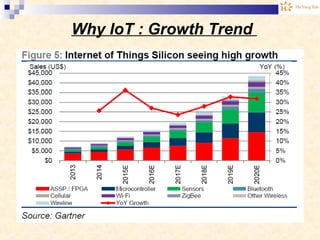
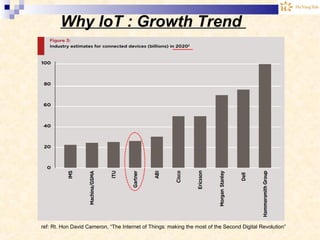
Why IoT : Growth Trend
ref: Rt. Hon David Cameron, “The Internet of Things: making the most of the Second Digital Revolution”
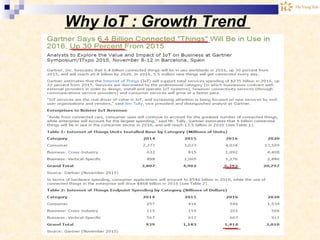
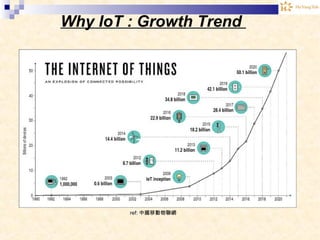
Why IoT : Growth Trend
ref: 中國移動物聯網
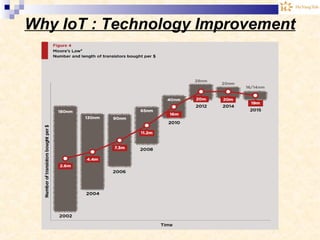
Why IoT : Technology Improvement
Agenda
 Why “Internet of Things”
 What “Internet of Things”
What “Internet of Things”
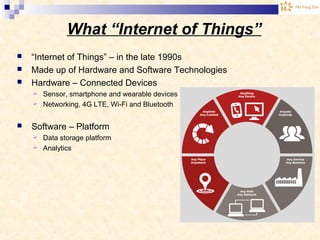
 “Internet of Things” – in the late 1990s
 Made up of Hardware and Software Technologies
 Hardware – Connected Devices
 Sensor, smartphone and wearable devices
 Networking, 4G LTE, Wi-Fi and Bluetooth
 Software – Platform
 Data storage platform
 Analytics
What “Internet of Things”
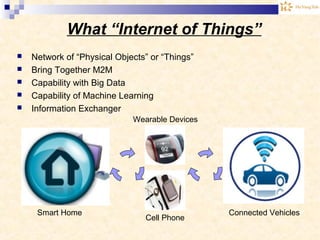
 Network of “Physical Objects” or “Things”
 Bring Together M2M
 Capability with Big Data
 Capability of Machine Learning
 Information Exchanger
Smart Home
Cell Phone
Wearable Devices
Connected Vehicles
Agenda
 Why “Internet of Things”
 What “Internet of Things”
 Internet of Things Architecture
IoT Architecture
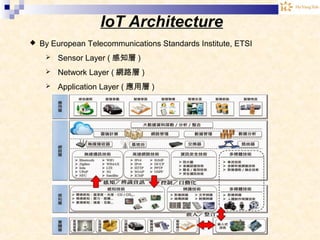
 By European Telecommunications Standards Institute, ETSI
 Sensor Layer ( 感知層 )
 Network Layer ( 網路層 )
 Application Layer ( 應用層 )
IoT Architecture
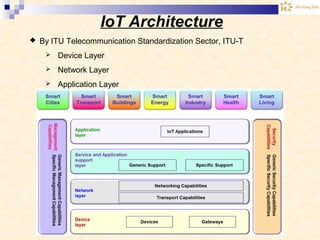
 By ITU Telecommunication Standardization Sector, ITU-T
 Device Layer
 Network Layer
 Application Layer
Agenda
 Why “Internet of Things”
 What “Internet of Things”
 Internet of Things Architecture
 Application of IoT – Wearable Devices
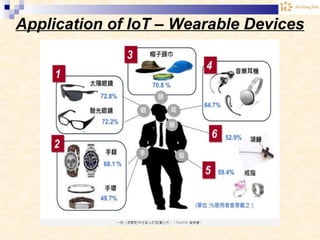
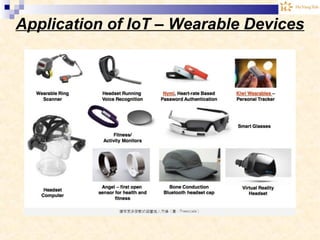
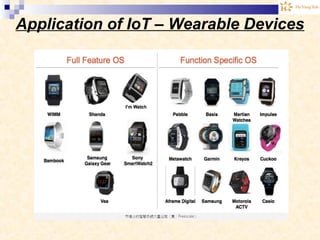
Application of IoT – Wearable Devices
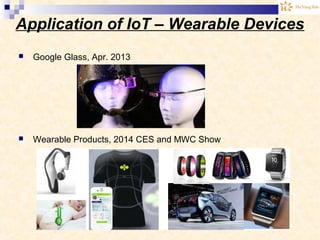
 Google Glass, Apr. 2013
 Wearable Products, 2014 CES and MWC Show
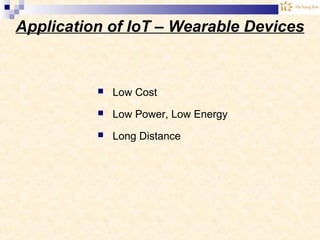
Application of IoT – Wearable Devices
 Low Cost
 Low Power, Low Energy
 Long Distance
Agenda
 Why “Internet of Things”
 What “Internet of Things”
 Internet of Things Architecture
 Application of IoT – Wearable Devices
 Application of IoT – Smart Home
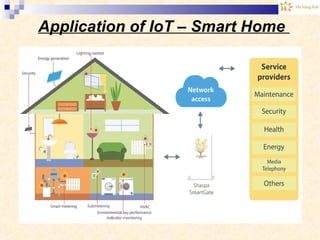
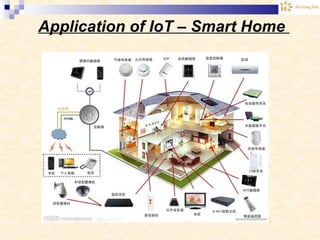
Application of IoT – Smart Home
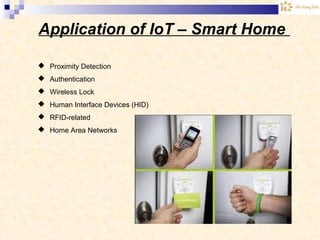
 Proximity Detection
 Authentication
 Wireless Lock
 Human Interface Devices (HID)
 RFID-related
 Home Area Networks
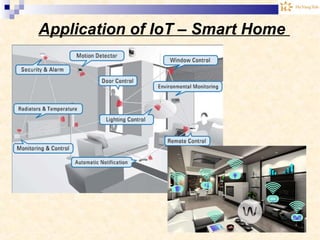
Application of IoT – Smart Home
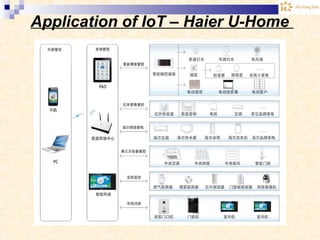
Application of IoT – Haier U-Home
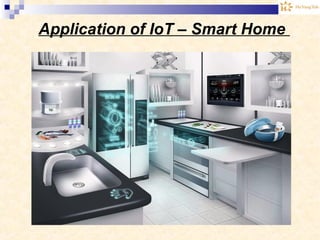
Application of IoT – Smart Home
Agenda
 Why “Internet of Things”
 What “Internet of Things”
 Internet of Things Architecture
 Application of IoT – Wearable Devices
 Application of IoT – Smart Home
 Application of IoT – Smart Vehicles
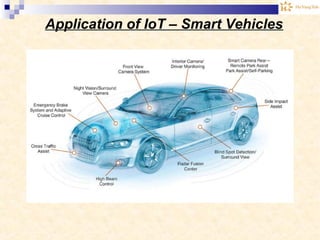
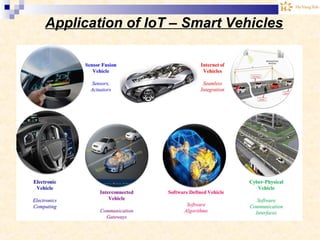
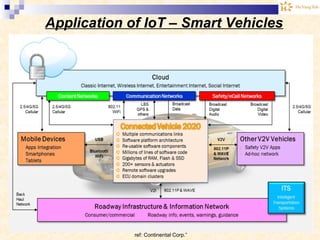
Application of IoT – Smart Vehicles
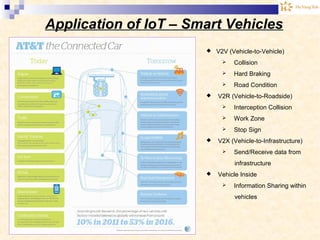
 V2V (Vehicle-to-Vehicle)
 Collision
 Hard Braking
 Road Condition
 V2R (Vehicle-to-Roadside)
 Interception Collision
 Work Zone
 Stop Sign
 V2X (Vehicle-to-Infrastructure)
 Send/Receive data from
infrastructure
 Vehicle Inside
 Information Sharing within
vehicles
Application of IoT – Smart Vehicles
ref: Continental Corp.”
Application of IoT – Smart Vehicles
~ Video ~
On The Way To Auto Driving
F015 Concept Car
Agenda
 Why “Internet of Things”
 What “Internet of Things”
 Internet of Things Architecture
 Application of IoT – Wearable Devices
 Application of IoT – Smart Home
 Application of IoT – Smart Vehicles
 Application of IoT – Clouds
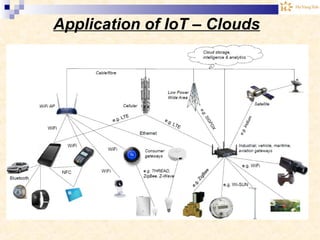
Application of IoT – Clouds
Agenda
 Why “Internet of Things”
 What “Internet of Things”
 Internet of Things Architecture
 Application of IoT – Wearable Devices
 Application of IoT – Smart Home
 Application of IoT – Smart Vehicles
 Application of IoT – Clouds
 IoT Market Prediction
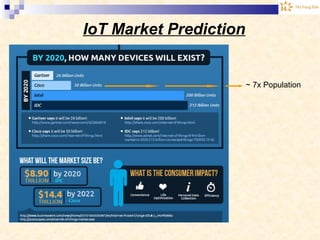
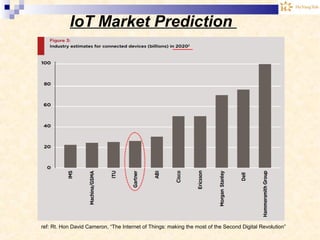
IoT Market Prediction
~ 7x Population
IoT Market Prediction
ref: Rt. Hon David Cameron, “The Internet of Things: making the most of the Second Digital Revolution”
Agenda
 Why “Internet of Things”
 What “Internet of Things”
 Internet of Things Architecture
 Application of IoT – Wearable Devices
 Application of IoT – Smart Home
 Application of IoT – Smart Vehicles
 Application of IoT – Clouds
 IoT Market Prediction
 IoT Key Technology of Telecomm.
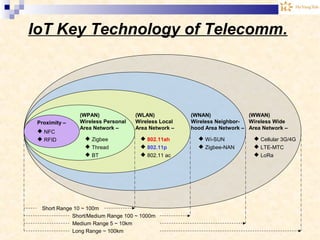
IoT Key Technology of Telecomm.
(WPAN)
Wireless Personal
Area Network –
 Zigbee
 Thread
 BT
(WLAN)
Wireless Local
Area Network –
 802.11ah
 802.11p
 802.11 ac
(WNAN)
Wireless Neighbor-
hood Area Network –
 Wi-SUN
 Zigbee-NAN
(WWAN)
Wireless Wide
Area Network –
 Cellular 3G/4G
 LTE-MTC
 LoRa
Proximity –
 NFC
 RFID
Short Range 10 ~ 100m
Short/Medium Range 100 ~ 1000m
Medium Range 5 ~ 10km
Long Range ~ 100km
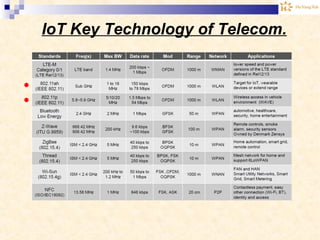
IoT Key Technology of Telecom.
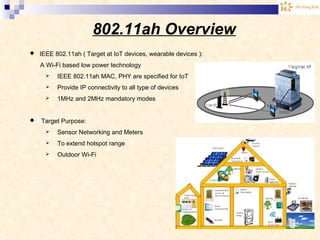
802.11ah Overview
 IEEE 802.11ah ( Target at IoT devices, wearable devices ):
A Wi-Fi based low power technology
 IEEE 802.11ah MAC, PHY are specified for IoT
 Provide IP connectivity to all type of devices
 1MHz and 2MHz mandatory modes
 Target Purpose:
 Sensor Networking and Meters
 To extend hotspot range
 Outdoor Wi-Fi
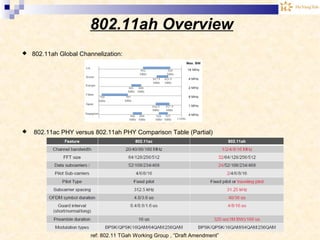
802.11ah Overview
 802.11ah Global Channelization:
 802.11ac PHY versus 802.11ah PHY Comparison Table (Partial)
ref: 802.11 TGah Working Group , “Draft Amendment”
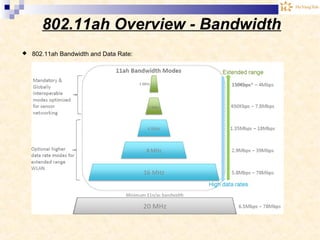
802.11ah Overview - Bandwidth
 802.11ah Bandwidth and Data Rate:
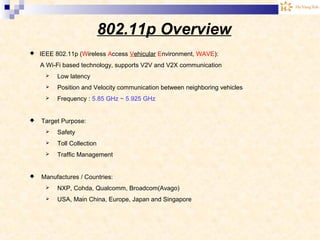
802.11p Overview
 IEEE 802.11p (Wireless Access Vehicular Environment, WAVE):
A Wi-Fi based technology, supports V2V and V2X communication
 Low latency
 Position and Velocity communication between neighboring vehicles
 Frequency : 5.85 GHz ~ 5.925 GHz
 Target Purpose:
 Safety
 Toll Collection
 Traffic Management
 Manufactures / Countries:
 NXP, Cohda, Qualcomm, Broadcom(Avago)
 USA, Main China, Europe, Japan and Singapore
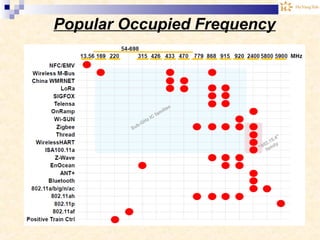
Popular Occupied Frequency
Agenda
 Why “Internet of Things”
 What “Internet of Things”
 Internet of Things Architecture
 Application of IoT – Wearable Devices
 Application of IoT – Smart Home
 Application of IoT – Smart Vehicles
 Application of IoT – Clouds
 IoT Market Prediction
 IoT Key Technology of Telecomm.
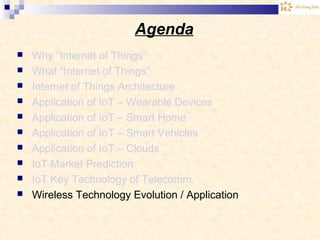
 Wireless Technology Evolution / Application
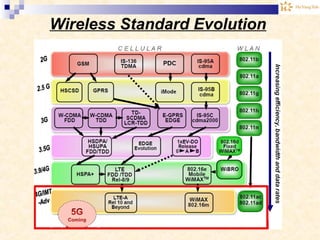
Wireless Standard Evolution
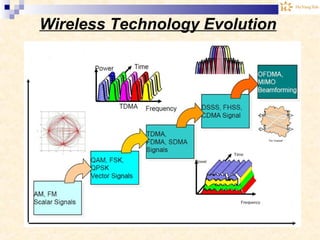
Wireless Technology Evolution
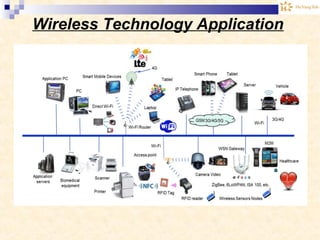
Wireless Technology Application
Agenda
 Why “Internet of Things”
 What “Internet of Things”
 Internet of Things Architecture
 Application of IoT – Wearable Devices
 Application of IoT – Smart Home
 Application of IoT – Smart Vehicles
 Application of IoT – Clouds
 IoT Market Prediction
 IoT Key Technology of Telecomm.
 Wireless Technology Evolution / Application
 Summary and Conclusion
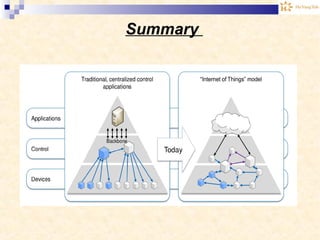
Summary
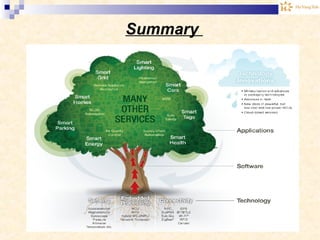
Summary
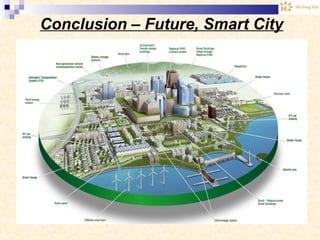
Conclusion – Future, Smart City
Introduction_To_IoT

Introduction_To_IoT

  • 1.
    淺談 物聯網 主講人 :王景弘 / Barry Wang 日期 : 2016/04/25 和暘科技 Director / Vice President 美國俄亥俄州州立大學 MS EE 清華大學 MS ENE
  • 2.
    簡介  Heyangtek (和暘科技 ), Vice President of R&D  > 10 years Management of R&D  > 2 years RF Design R&D  > 2 years Digital R&D  > 3 years Process & Device R&D  Personal Email: barry_wang@globalheyong.com
  • 3.
  • 4.
    Why IoT :Growth Trend
  • 5.
    Why IoT :Growth Trend
  • 6.
    Why IoT :Growth Trend ref: Rt. Hon David Cameron, “The Internet of Things: making the most of the Second Digital Revolution”
  • 7.
    Why IoT :Growth Trend ref: 中國移動物聯網
  • 8.
    Why IoT :Technology Improvement
  • 9.
    Agenda  Why “Internetof Things”  What “Internet of Things”
  • 10.
    What “Internet ofThings”  “Internet of Things” – in the late 1990s  Made up of Hardware and Software Technologies  Hardware – Connected Devices  Sensor, smartphone and wearable devices  Networking, 4G LTE, Wi-Fi and Bluetooth  Software – Platform  Data storage platform  Analytics
  • 11.
    What “Internet ofThings”  Network of “Physical Objects” or “Things”  Bring Together M2M  Capability with Big Data  Capability of Machine Learning  Information Exchanger Smart Home Cell Phone Wearable Devices Connected Vehicles
  • 12.
    Agenda  Why “Internetof Things”  What “Internet of Things”  Internet of Things Architecture
  • 13.
    IoT Architecture  ByEuropean Telecommunications Standards Institute, ETSI  Sensor Layer ( 感知層 )  Network Layer ( 網路層 )  Application Layer ( 應用層 )
  • 14.
    IoT Architecture  ByITU Telecommunication Standardization Sector, ITU-T  Device Layer  Network Layer  Application Layer
  • 15.
    Agenda  Why “Internetof Things”  What “Internet of Things”  Internet of Things Architecture  Application of IoT – Wearable Devices
  • 16.
    Application of IoT– Wearable Devices  Google Glass, Apr. 2013  Wearable Products, 2014 CES and MWC Show
  • 17.
    Application of IoT– Wearable Devices
  • 18.
    Application of IoT– Wearable Devices
  • 19.
    Application of IoT– Wearable Devices
  • 20.
    Application of IoT– Wearable Devices  Low Cost  Low Power, Low Energy  Long Distance
  • 21.
    Agenda  Why “Internetof Things”  What “Internet of Things”  Internet of Things Architecture  Application of IoT – Wearable Devices  Application of IoT – Smart Home
  • 22.
    Application of IoT– Smart Home  Proximity Detection  Authentication  Wireless Lock  Human Interface Devices (HID)  RFID-related  Home Area Networks
  • 23.
    Application of IoT– Smart Home
  • 24.
    Application of IoT– Smart Home
  • 25.
    Application of IoT– Smart Home
  • 26.
    Application of IoT– Haier U-Home
  • 27.
    Application of IoT– Smart Home
  • 28.
    Agenda  Why “Internetof Things”  What “Internet of Things”  Internet of Things Architecture  Application of IoT – Wearable Devices  Application of IoT – Smart Home  Application of IoT – Smart Vehicles
  • 29.
    Application of IoT– Smart Vehicles  V2V (Vehicle-to-Vehicle)  Collision  Hard Braking  Road Condition  V2R (Vehicle-to-Roadside)  Interception Collision  Work Zone  Stop Sign  V2X (Vehicle-to-Infrastructure)  Send/Receive data from infrastructure  Vehicle Inside  Information Sharing within vehicles
  • 30.
    Application of IoT– Smart Vehicles
  • 31.
    Application of IoT– Smart Vehicles
  • 32.
    Application of IoT– Smart Vehicles ref: Continental Corp.”
  • 33.
    Application of IoT– Smart Vehicles ~ Video ~
  • 34.
    On The WayTo Auto Driving
  • 35.
  • 36.
    Agenda  Why “Internetof Things”  What “Internet of Things”  Internet of Things Architecture  Application of IoT – Wearable Devices  Application of IoT – Smart Home  Application of IoT – Smart Vehicles  Application of IoT – Clouds
  • 37.
  • 38.
    Agenda  Why “Internetof Things”  What “Internet of Things”  Internet of Things Architecture  Application of IoT – Wearable Devices  Application of IoT – Smart Home  Application of IoT – Smart Vehicles  Application of IoT – Clouds  IoT Market Prediction
  • 39.
  • 40.
    IoT Market Prediction ref:Rt. Hon David Cameron, “The Internet of Things: making the most of the Second Digital Revolution”
  • 41.
    Agenda  Why “Internetof Things”  What “Internet of Things”  Internet of Things Architecture  Application of IoT – Wearable Devices  Application of IoT – Smart Home  Application of IoT – Smart Vehicles  Application of IoT – Clouds  IoT Market Prediction  IoT Key Technology of Telecomm.
  • 42.
    IoT Key Technologyof Telecomm. (WPAN) Wireless Personal Area Network –  Zigbee  Thread  BT (WLAN) Wireless Local Area Network –  802.11ah  802.11p  802.11 ac (WNAN) Wireless Neighbor- hood Area Network –  Wi-SUN  Zigbee-NAN (WWAN) Wireless Wide Area Network –  Cellular 3G/4G  LTE-MTC  LoRa Proximity –  NFC  RFID Short Range 10 ~ 100m Short/Medium Range 100 ~ 1000m Medium Range 5 ~ 10km Long Range ~ 100km
  • 43.
    IoT Key Technologyof Telecom.
  • 44.
    802.11ah Overview  IEEE802.11ah ( Target at IoT devices, wearable devices ): A Wi-Fi based low power technology  IEEE 802.11ah MAC, PHY are specified for IoT  Provide IP connectivity to all type of devices  1MHz and 2MHz mandatory modes  Target Purpose:  Sensor Networking and Meters  To extend hotspot range  Outdoor Wi-Fi
  • 45.
    802.11ah Overview  802.11ahGlobal Channelization:  802.11ac PHY versus 802.11ah PHY Comparison Table (Partial) ref: 802.11 TGah Working Group , “Draft Amendment”
  • 46.
    802.11ah Overview -Bandwidth  802.11ah Bandwidth and Data Rate:
  • 47.
    802.11p Overview  IEEE802.11p (Wireless Access Vehicular Environment, WAVE): A Wi-Fi based technology, supports V2V and V2X communication  Low latency  Position and Velocity communication between neighboring vehicles  Frequency : 5.85 GHz ~ 5.925 GHz  Target Purpose:  Safety  Toll Collection  Traffic Management  Manufactures / Countries:  NXP, Cohda, Qualcomm, Broadcom(Avago)  USA, Main China, Europe, Japan and Singapore
  • 48.
  • 49.
    Agenda  Why “Internetof Things”  What “Internet of Things”  Internet of Things Architecture  Application of IoT – Wearable Devices  Application of IoT – Smart Home  Application of IoT – Smart Vehicles  Application of IoT – Clouds  IoT Market Prediction  IoT Key Technology of Telecomm.  Wireless Technology Evolution / Application
  • 50.
  • 51.
  • 52.
  • 53.
    Agenda  Why “Internetof Things”  What “Internet of Things”  Internet of Things Architecture  Application of IoT – Wearable Devices  Application of IoT – Smart Home  Application of IoT – Smart Vehicles  Application of IoT – Clouds  IoT Market Prediction  IoT Key Technology of Telecomm.  Wireless Technology Evolution / Application  Summary and Conclusion
  • 54.
  • 55.
  • 56.