Introduction to Cleanrooms
Basic principles and protocols
Purpose of Clean Protocol
 Promote Successful Cleanroom
Promote Successful Cleanroom
Operations
Operations
 Ensure Safety in the Clean Environment
Ensure Safety in the Clean Environment
 Provide Operational Conditions that
Provide Operational Conditions that
Meet Process & User Needs
Perspective
Perspective
The protocol provides basic awareness and general
guidelines for cleanroom users.
Successful cleanroom operation relies on each user’s
understanding, participation and self discipline.
The success of each user relies on trust, understanding
and shared responsibility among all users .
What is a Cleanroom?
A clean environment designed to
reduce the contamination of processes
and materials. This is accomplished by
removing or reducing contamination
sources.
sources.
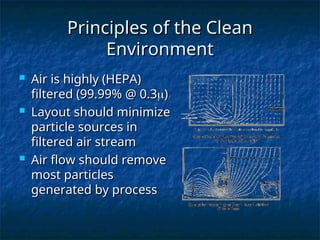
Principles of the Clean
Environment
Environment
 Air is highly (HEPA)
Air is highly (HEPA)
filtered (99.99% @ 0.3
filtered (99.99% @ 0.3
)
)
 Layout should minimize
Layout should minimize
particle sources in
particle sources in
filtered air stream
filtered air stream
 Air flow should remove
Air flow should remove
most particles
most particles
generated by process
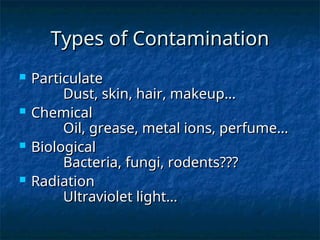
Types of Contamination
 Particulate
Particulate
Dust, skin, hair, makeup…
 Chemical
Chemical
Oil, grease, metal ions, perfume…
 Biological
Biological
Bacteria, fungi, rodents???
 Radiation
Radiation
Ultraviolet light…
Ultraviolet light…
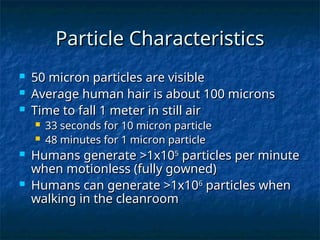
Particle Characteristics
 50 micron particles are visible
50 micron particles are visible
 Average human hair is about 100 microns
Average human hair is about 100 microns
 Time to fall 1 meter in still air
Time to fall 1 meter in still air
 33 seconds for 10 micron particle
33 seconds for 10 micron particle
 48 minutes for 1 micron particle
48 minutes for 1 micron particle
 Humans generate >1x10
Humans generate >1x10⁵
5
particles per minute
when motionless (fully gowned)
 Humans can generate >1x10
Humans can generate >1x10⁶
6
particles when
particles when
walking in the cleanroom
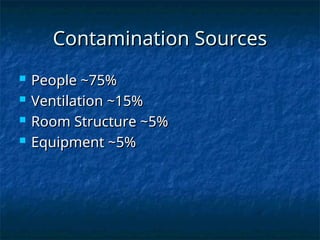
Contamination Sources
 People ~75%
People ~75%
 Ventilation ~15%
Ventilation ~15%
 Room Structure ~5%
Room Structure ~5%
 Equipment ~5%
Equipment ~5%
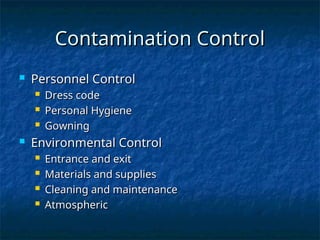
Contamination Control
 Personnel Control
Personnel Control
 Dress code
Dress code
 Personal Hygiene
Personal Hygiene
 Gowning
Gowning
 Environmental Control
Environmental Control
 Entrance and exit
Entrance and exit
 Materials and supplies
Materials and supplies
 Cleaning and maintenance
Cleaning and maintenance
 Atmospheric
Atmospheric
Dress code
Dress code
 No sleeveless shirts
No sleeveless shirts
 No shorts or skirts
No shorts or skirts
 No slippers or sandals
No slippers or sandals
 No jewelry that can puncture garments
No jewelry that can puncture garments
or gloves
or gloves
 Avoid clothing that sheds
Avoid clothing that sheds
Personal Hygiene
Personal Hygiene
 Shower each day before entry
Shower each day before entry
 Control Dermatitis & Dandruff
Control Dermatitis & Dandruff
 Do not smoke before entry
Do not smoke before entry
 No chewing gum or tobacco
No chewing gum or tobacco
 No Cosmetics should be worn
No Cosmetics should be worn
 Facial hair will need to be covered
Facial hair will need to be covered
Gowning
Gowning
 Proper gowning order
Proper gowning order
 Hair cover
Hair cover
 Hood
Hood
 Shoe covers
Shoe covers
 Coverall
Coverall
 Gloves
Gloves
 Face mask
Face mask
 Safety Glasses
Safety Glasses
Gowning Basics
Gowning Basics
 Garments should not be removed from
Garments should not be removed from
cleanroom unless in approved container
 Don’t walk out of the cleanroom with
Don’t walk out of the cleanroom with
your garments on
your garments on
 Change garments when soiled or
Change garments when soiled or
showing any visible signs of wear
 Don’t reach inside your garment while in
Don’t reach inside your garment while in
the cleanroom
the cleanroom
Garment Reuse and Storage
 Reusable – Store in Gown bin or zip lock bag
Reusable – Store in Gown bin or zip lock bag
 Coveralls
Coveralls
 Hood
Hood
 Knee-high Booties (not the blue disposables)
Knee-high Booties (not the blue disposables)
 Safety Glasses
Safety Glasses
 Not Reusable – Throw in trash
Not Reusable – Throw in trash
 Hair nets & Beard covers
Hair nets & Beard covers
 Blue disposable shoe covers
Blue disposable shoe covers
 Gloves
Gloves
 Face mask
Face mask
Entry & Exit
Entry & Exit
 Enter and exit quickly
Enter and exit quickly
 Only one person may enter at a time
Only one person may enter at a time
 Each user must use their own access
Each user must use their own access
card
card
 Pass from the gowning area to the
Pass from the gowning area to the
clean area slowly to reduce migration of
particles between areas
Materials and Supplies
 Do Not carry non-cleanroom items into the
Do Not carry non-cleanroom items into the
cleanroom
cleanroom
 Do not carry cleanroom items out of the
Do not carry cleanroom items out of the
cleanroom
cleanroom
 Do not use pencils or erasers
Do not use pencils or erasers
 Paper should be kept in a plastic sleeve
Paper should be kept in a plastic sleeve
 Do Not cut the cleanroom wipers
Do Not cut the cleanroom wipers
 Clean everything you carry into the cleanroom
Clean everything you carry into the cleanroom
Chemicals
Chemicals
 Do not take new chemicals into the cleanroom without
Do not take new chemicals into the cleanroom without
permission
permission
 Always read MSDS for every chemical you use
Always read MSDS for every chemical you use
 Large quantities of chemicals must be stored outside the
Large quantities of chemicals must be stored outside the
cleanroom
cleanroom
 Chemicals inside the cleanroom should be properly stored
Chemicals inside the cleanroom should be properly stored
 All chemical containers should be clearly labeled with their
All chemical containers should be clearly labeled with their
contents and Hazard Classification
 Unattended chemicals and experiments should be labeled
Unattended chemicals and experiments should be labeled
with the owners name, immediate contact number, list of
all chemicals involved, and estimated time of return or
completion.
completion.
Chemical Handling
Chemical Handling
 Always use safety carriers with glass bottles 2L
Always use safety carriers with glass bottles 2L
and larger
and larger
 Do not transport chemicals in open containers
Do not transport chemicals in open containers
 Chemicals should be used inside approved
Chemicals should be used inside approved
hoods or under properly positioned snorkel
extractors
extractors
 Full apron, Trionic gloves and full face shield
Full apron, Trionic gloves and full face shield
are required for using all acids
 Gloves, lab coat, and safety glasses are
Gloves, lab coat, and safety glasses are
considered minimum personal protective
equipment when handling ANY chemical
Chemical Handling
Chemical Handling
 In case of a small spill
In case of a small spill
 Inform all users in the cleanroom
Inform all users in the cleanroom
 Clearly mark the affected area
Clearly mark the affected area
 Use appropriate absorbent material to clean up
Use appropriate absorbent material to clean up
the spill
the spill
 In case of large spill
In case of large spill
 Inform all users in the cleanroom
Inform all users in the cleanroom
 Clearly mark the affected area and evacuate
Clearly mark the affected area and evacuate
 Contact VEH&S and cleanroom staff immediately
Contact VEH&S and cleanroom staff immediately
Chemical Handling
Chemical Handling
 Chemical waste should be properly disposed
Chemical waste should be properly disposed
of as outlined by VEH&S
 No chemicals may be poured down the drains
No chemicals may be poured down the drains
 Waste containers should be properly marked
Waste containers should be properly marked
as such and have a pink Hazardous Waste tag
tied to them at all times
 If you have questions about disposal contact
If you have questions about disposal contact
a staff member
a staff member
In Case of Emergency
 Always follow the rules set forth by
Always follow the rules set forth by
VEH&S
VEH&S
 If an emergency requires evacuation,
If an emergency requires evacuation,
leave the cleanroom immediately, do
not stop to un-gown
not stop to un-gown
 Inform other users before leaving
Inform other users before leaving
Equipment use
Equipment use
 All users must be trained before using any
All users must be trained before using any
equipment
equipment
 All equipment use should be scheduled
All equipment use should be scheduled
 If you are unable to use scheduled time
If you are unable to use scheduled time
please delete your reservation
 It is every users responsibility to report
It is every users responsibility to report
damaged or malfunctioning equipment
 It is every users responsibility to properly
It is every users responsibility to properly
operate and clean each piece of equipment
that they use
that they use
Housekeeping
Housekeeping
 Every user is responsible for keeping the
Every user is responsible for keeping the
cleanrooms clean
cleanrooms clean
 Always clean your workspace before leaving
Always clean your workspace before leaving
 Don’t leave or store items on or in equipment
Don’t leave or store items on or in equipment
 Do not set liquids on any equipment
Do not set liquids on any equipment
 Properly store all materials before leaving the
Properly store all materials before leaving the
cleanroom
cleanroom
 Last one out should make sure the room is in
Last one out should make sure the room is in
a safe idle mode
a safe idle mode
Violations of Rules
Violations of Rules
 First time
First time
 Warning
Warning
 Report to Advisor
Report to Advisor
 Second time
Second time
 Suspension of access
Suspension of access
 Report to Advisor
Report to Advisor
 Retraining may be required
Retraining may be required
 Third Offense
Third Offense
 Suspension of access
Suspension of access
 Report to Advisor
Report to Advisor
 Access will not be renewed until an acceptable resolution is
Access will not be renewed until an acceptable resolution is
reached between Advisor and Cleanroom Manager
 Cleanroom Protocol re-training will be required
Cleanroom Protocol re-training will be required
IntroductiontoCleanrooms.ppt..........................

  • 1.
    Introduction to Cleanrooms Introductionto Cleanrooms Basic principles and protocols Basic principles and protocols
  • 2.
    Purpose of CleanProtocol Purpose of Clean Protocol  Promote Successful Cleanroom Promote Successful Cleanroom Operations Operations  Ensure Safety in the Clean Environment Ensure Safety in the Clean Environment  Provide Operational Conditions that Provide Operational Conditions that Meet Process & User Needs Meet Process & User Needs
  • 3.
    Perspective Perspective The protocol providesbasic awareness and general The protocol provides basic awareness and general guidelines for cleanroom users. guidelines for cleanroom users. Successful cleanroom operation relies on each user’s Successful cleanroom operation relies on each user’s understanding, participation and self discipline. understanding, participation and self discipline. The success of each user relies on trust, understanding The success of each user relies on trust, understanding and shared responsibility among all users . and shared responsibility among all users .
  • 4.
    What is aCleanroom? What is a Cleanroom? A clean environment designed to A clean environment designed to reduce the contamination of processes reduce the contamination of processes and materials. This is accomplished by and materials. This is accomplished by removing or reducing contamination removing or reducing contamination sources. sources.
  • 5.
    Principles of theClean Principles of the Clean Environment Environment  Air is highly (HEPA) Air is highly (HEPA) filtered (99.99% @ 0.3 filtered (99.99% @ 0.3 ) )  Layout should minimize Layout should minimize particle sources in particle sources in filtered air stream filtered air stream  Air flow should remove Air flow should remove most particles most particles generated by process generated by process
  • 6.
    Types of Contamination Typesof Contamination  Particulate Particulate Dust, skin, hair, makeup… Dust, skin, hair, makeup…  Chemical Chemical Oil, grease, metal ions, perfume… Oil, grease, metal ions, perfume…  Biological Biological Bacteria, fungi, rodents??? Bacteria, fungi, rodents???  Radiation Radiation Ultraviolet light… Ultraviolet light…
  • 7.
    Particle Characteristics Particle Characteristics 50 micron particles are visible 50 micron particles are visible  Average human hair is about 100 microns Average human hair is about 100 microns  Time to fall 1 meter in still air Time to fall 1 meter in still air  33 seconds for 10 micron particle 33 seconds for 10 micron particle  48 minutes for 1 micron particle 48 minutes for 1 micron particle  Humans generate >1x10 Humans generate >1x10⁵ 5 particles per minute particles per minute when motionless (fully gowned) when motionless (fully gowned)  Humans can generate >1x10 Humans can generate >1x10⁶ 6 particles when particles when walking in the cleanroom walking in the cleanroom
  • 8.
    Contamination Sources Contamination Sources People ~75% People ~75%  Ventilation ~15% Ventilation ~15%  Room Structure ~5% Room Structure ~5%  Equipment ~5% Equipment ~5%
  • 9.
    Contamination Control Contamination Control Personnel Control Personnel Control  Dress code Dress code  Personal Hygiene Personal Hygiene  Gowning Gowning  Environmental Control Environmental Control  Entrance and exit Entrance and exit  Materials and supplies Materials and supplies  Cleaning and maintenance Cleaning and maintenance  Atmospheric Atmospheric
  • 10.
    Dress code Dress code No sleeveless shirts No sleeveless shirts  No shorts or skirts No shorts or skirts  No slippers or sandals No slippers or sandals  No jewelry that can puncture garments No jewelry that can puncture garments or gloves or gloves  Avoid clothing that sheds Avoid clothing that sheds
  • 11.
    Personal Hygiene Personal Hygiene Shower each day before entry Shower each day before entry  Control Dermatitis & Dandruff Control Dermatitis & Dandruff  Do not smoke before entry Do not smoke before entry  No chewing gum or tobacco No chewing gum or tobacco  No Cosmetics should be worn No Cosmetics should be worn  Facial hair will need to be covered Facial hair will need to be covered
  • 12.
    Gowning Gowning  Proper gowningorder Proper gowning order  Hair cover Hair cover  Hood Hood  Shoe covers Shoe covers  Coverall Coverall  Gloves Gloves  Face mask Face mask  Safety Glasses Safety Glasses
  • 13.
    Gowning Basics Gowning Basics Garments should not be removed from Garments should not be removed from cleanroom unless in approved container cleanroom unless in approved container  Don’t walk out of the cleanroom with Don’t walk out of the cleanroom with your garments on your garments on  Change garments when soiled or Change garments when soiled or showing any visible signs of wear showing any visible signs of wear  Don’t reach inside your garment while in Don’t reach inside your garment while in the cleanroom the cleanroom
  • 14.
    Garment Reuse andStorage Garment Reuse and Storage  Reusable – Store in Gown bin or zip lock bag Reusable – Store in Gown bin or zip lock bag  Coveralls Coveralls  Hood Hood  Knee-high Booties (not the blue disposables) Knee-high Booties (not the blue disposables)  Safety Glasses Safety Glasses  Not Reusable – Throw in trash Not Reusable – Throw in trash  Hair nets & Beard covers Hair nets & Beard covers  Blue disposable shoe covers Blue disposable shoe covers  Gloves Gloves  Face mask Face mask
  • 15.
    Entry & Exit Entry& Exit  Enter and exit quickly Enter and exit quickly  Only one person may enter at a time Only one person may enter at a time  Each user must use their own access Each user must use their own access card card  Pass from the gowning area to the Pass from the gowning area to the clean area slowly to reduce migration of clean area slowly to reduce migration of particles between areas particles between areas
  • 16.
    Materials and Supplies Materialsand Supplies  Do Not carry non-cleanroom items into the Do Not carry non-cleanroom items into the cleanroom cleanroom  Do not carry cleanroom items out of the Do not carry cleanroom items out of the cleanroom cleanroom  Do not use pencils or erasers Do not use pencils or erasers  Paper should be kept in a plastic sleeve Paper should be kept in a plastic sleeve  Do Not cut the cleanroom wipers Do Not cut the cleanroom wipers  Clean everything you carry into the cleanroom Clean everything you carry into the cleanroom
  • 17.
    Chemicals Chemicals  Do nottake new chemicals into the cleanroom without Do not take new chemicals into the cleanroom without permission permission  Always read MSDS for every chemical you use Always read MSDS for every chemical you use  Large quantities of chemicals must be stored outside the Large quantities of chemicals must be stored outside the cleanroom cleanroom  Chemicals inside the cleanroom should be properly stored Chemicals inside the cleanroom should be properly stored  All chemical containers should be clearly labeled with their All chemical containers should be clearly labeled with their contents and Hazard Classification contents and Hazard Classification  Unattended chemicals and experiments should be labeled Unattended chemicals and experiments should be labeled with the owners name, immediate contact number, list of with the owners name, immediate contact number, list of all chemicals involved, and estimated time of return or all chemicals involved, and estimated time of return or completion. completion.
  • 18.
    Chemical Handling Chemical Handling Always use safety carriers with glass bottles 2L Always use safety carriers with glass bottles 2L and larger and larger  Do not transport chemicals in open containers Do not transport chemicals in open containers  Chemicals should be used inside approved Chemicals should be used inside approved hoods or under properly positioned snorkel hoods or under properly positioned snorkel extractors extractors  Full apron, Trionic gloves and full face shield Full apron, Trionic gloves and full face shield are required for using all acids are required for using all acids  Gloves, lab coat, and safety glasses are Gloves, lab coat, and safety glasses are considered minimum personal protective considered minimum personal protective equipment when handling ANY chemical equipment when handling ANY chemical
  • 19.
    Chemical Handling Chemical Handling In case of a small spill In case of a small spill  Inform all users in the cleanroom Inform all users in the cleanroom  Clearly mark the affected area Clearly mark the affected area  Use appropriate absorbent material to clean up Use appropriate absorbent material to clean up the spill the spill  In case of large spill In case of large spill  Inform all users in the cleanroom Inform all users in the cleanroom  Clearly mark the affected area and evacuate Clearly mark the affected area and evacuate  Contact VEH&S and cleanroom staff immediately Contact VEH&S and cleanroom staff immediately
  • 20.
    Chemical Handling Chemical Handling Chemical waste should be properly disposed Chemical waste should be properly disposed of as outlined by VEH&S of as outlined by VEH&S  No chemicals may be poured down the drains No chemicals may be poured down the drains  Waste containers should be properly marked Waste containers should be properly marked as such and have a pink Hazardous Waste tag as such and have a pink Hazardous Waste tag tied to them at all times tied to them at all times  If you have questions about disposal contact If you have questions about disposal contact a staff member a staff member
  • 21.
    In Case ofEmergency In Case of Emergency  Always follow the rules set forth by Always follow the rules set forth by VEH&S VEH&S  If an emergency requires evacuation, If an emergency requires evacuation, leave the cleanroom immediately, do leave the cleanroom immediately, do not stop to un-gown not stop to un-gown  Inform other users before leaving Inform other users before leaving
  • 22.
    Equipment use Equipment use All users must be trained before using any All users must be trained before using any equipment equipment  All equipment use should be scheduled All equipment use should be scheduled  If you are unable to use scheduled time If you are unable to use scheduled time please delete your reservation please delete your reservation  It is every users responsibility to report It is every users responsibility to report damaged or malfunctioning equipment damaged or malfunctioning equipment  It is every users responsibility to properly It is every users responsibility to properly operate and clean each piece of equipment operate and clean each piece of equipment that they use that they use
  • 23.
    Housekeeping Housekeeping  Every useris responsible for keeping the Every user is responsible for keeping the cleanrooms clean cleanrooms clean  Always clean your workspace before leaving Always clean your workspace before leaving  Don’t leave or store items on or in equipment Don’t leave or store items on or in equipment  Do not set liquids on any equipment Do not set liquids on any equipment  Properly store all materials before leaving the Properly store all materials before leaving the cleanroom cleanroom  Last one out should make sure the room is in Last one out should make sure the room is in a safe idle mode a safe idle mode
  • 24.
    Violations of Rules Violationsof Rules  First time First time  Warning Warning  Report to Advisor Report to Advisor  Second time Second time  Suspension of access Suspension of access  Report to Advisor Report to Advisor  Retraining may be required Retraining may be required  Third Offense Third Offense  Suspension of access Suspension of access  Report to Advisor Report to Advisor  Access will not be renewed until an acceptable resolution is Access will not be renewed until an acceptable resolution is reached between Advisor and Cleanroom Manager reached between Advisor and Cleanroom Manager  Cleanroom Protocol re-training will be required Cleanroom Protocol re-training will be required