IntroductiIntroduction To WCF The approach to unified communicationson To WCF The approach to unified communicationsIntroduction To WCF The approach toIntroduction To WCF The approach to unified communications unified communicationsIntroduction To WCF The approach to unified communications
AgendaWhy WCFBasic WCF ElementsWCF HostingWCF And Asp.net AjaxWCF And SilverlightWhat’s new in WCF 4.0
Why WCF ?To many ways to create distributed applicationsWeb services(Supports HTTP)Enterprise Services, .NET Remoting(Supports both http and TCP)
Basic WCF Elements(WCF ABC)AddressBinding Contract
Basic WCF Elements(MEP)Message Exchange PatternOne wayRequest/ResponseDuplex(Use with caution)
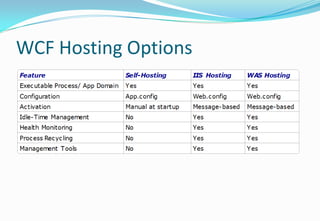
WCF Hosting Options
Demo
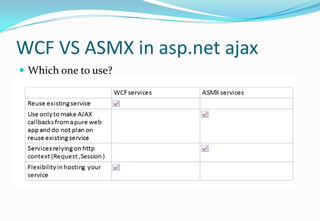
WCF VS ASMX in asp.net ajaxWhich one to use?
WCF And SilverlightDemo
WCF 4.0 new featuresSimple configurationDiscovery service(Dynamically locate the service)Routing service(Depending business rules ,different services will be served for different requests.)
Introduction to WCF

Introduction to WCF

  • 1.
    IntroductiIntroduction To WCFThe approach to unified communicationson To WCF The approach to unified communicationsIntroduction To WCF The approach toIntroduction To WCF The approach to unified communications unified communicationsIntroduction To WCF The approach to unified communications
  • 2.
    AgendaWhy WCFBasic WCFElementsWCF HostingWCF And Asp.net AjaxWCF And SilverlightWhat’s new in WCF 4.0
  • 3.
    Why WCF ?Tomany ways to create distributed applicationsWeb services(Supports HTTP)Enterprise Services, .NET Remoting(Supports both http and TCP)
  • 4.
    Basic WCF Elements(WCFABC)AddressBinding Contract
  • 5.
    Basic WCF Elements(MEP)MessageExchange PatternOne wayRequest/ResponseDuplex(Use with caution)
  • 6.
  • 7.
  • 8.
    WCF VS ASMXin asp.net ajaxWhich one to use?
  • 9.
  • 10.
    WCF 4.0 newfeaturesSimple configurationDiscovery service(Dynamically locate the service)Routing service(Depending business rules ,different services will be served for different requests.)

Editor's Notes

  • #3 Grammar mistake for PDF.
  • #4 From msdn http://msdn.microsoft.com/en-us/library/ms978420.aspxAlthough the SOAP specification does not mandate HTTP as the transport protocol, services are invoked via IIS and execute in the ASP.NET worker process, aspnet_wp.exthe client can access Web services implemented using ASP.NET Web services only over HTTP, because it is the only transport protocol ASP.NET supports. The e..NET Remoting gives you the flexibility to host remote objects in any type of application including a Windows Form, a managed Windows Service, a console application or the ASP.NET worker process. As previously noted, .NET Remoting provides two transport channels—TCP and HTTP. Both channels provide communication between arbitrary sending and receiving processes using sockets.
  • #6 Duplex(Use with caution, when working with WF you should use durable services) http://channel9.msdn.com/posts/jennmar/Durable-Services-in-NET-35/)
  • #7 http://www.code-magazine.com/Article.aspx?quickid=0701041Hosting a WCF Service in IIS 7.0http://kiranpatils.wordpress.com/2008/09/29/hosting-a-wcf-service-in-iis-70/
  • #9 From msdn http://msdn.microsoft.com/en-us/library/ms978420.aspxAlthough the SOAP specification does not mandate HTTP as the transport protocol, services are invoked via IIS and execute in the ASP.NET worker process, aspnet_wp.exthe client can access Web services implemented using ASP.NET Web services only over HTTP, because it is the only transport protocol ASP.NET supports. The e..NET Remoting gives you the flexibility to host remote objects in any type of application including a Windows Form, a managed Windows Service, a console application or the ASP.NET worker process. As previously noted, .NET Remoting provides two transport channels—TCP and HTTP. Both channels provide communication between arbitrary sending and receiving processes using sockets.