Nature and Scope of Law of
Torts
Nazmul Hasan Sarker
Lecturer, Department of Law, EBAUB
What is a Tort?
• The word tort originates from French, meaning “wrong” in
English and Romanian law’s term “delict”.
• It is derived from the Medieval Latin word “tortum” which means
“wrong” or “injury” which itself was further developed from the
Old Latin word “torquere” which means “to twist”.
• It is a breach of duty which amounts to a civil wrong. A tort
arises when a person’s duty towards others is affected.
• An individual who commits a tort is called a tortfeasor, or a
wrongdoer. And where there are multiple individuals involved,
then they are called joint tortfeasors.
What is a Tort?
• Salmond addresses tort as being only a civil wrong which has
unliquidated damages (those damages for which there is no
fixed amount) in the form of remedy and which is not just
exclusively the breach of contract or the breach of trust or
breach of merely fair and impartial obligation.
Objectives of Tort
• To determine rights between the parties to a dispute.
• To prevent the continuation or repetition of harm i.e., by
giving orders of injunction.
• To protect certain rights of every individual recognized by
law i.e., a person’s reputation.
• To restore one’s property to its rightful owner i.e., where the
property is wrongfully taken away from its rightful owner.
Elements of Tort
Three essential elements which constitute a tort are,
• A Wrongful act or omission.
• Duty imposed by the law.
• The act must give rise to legal or actual damage, and It
should be of such a nature that it should give rise to a legal
remedy in the form of an action for damages.
Wrongful Act or Omission
• A wrongful act can be either morally wrong or legally wrong and can also
be both at the same time.
• A legal wrongful act is one which affects one’s legal right, the wrongful
act must be one recognized by law, the act must be in violation of the
law to be a legal wrongful act.
• An act which seems Prima facie (based on the first impression) innocent
may also end up infringing somebody else’s legal right, (innuendo)
For example: if someone whose religion does not allow him/her to eat
non-vegetarian food, still eats it then he/she will be morally wrong but not
legally wrong. And if a person whose religion doesn’t allow him or her to
eat non-vegetarian and he or she follows that strictly is forcefully fed by
someone then it is a legal wrong.
Duty Imposed by Law
• A duty of care is one which is imposed on every individual
and requires a standard of reasonable care that he could see
as being harmful towards others.
• Hence, a duty imposed by law is a duty which is legally
enforceable in the courts.
Legal Damage
• Injuria sine damnum means injury without damage. It occurs
when a person suffers a legal damage instead of actual loss,
i.e., his legal right is infringed by some other individual. In
other words, this is an infringement of an absolute private
right of a person without having suffered any actual loss.
• An example of this can be the landmark case of, Ashby v.
White(1703) 92 ER 126, where Mr. Ashby, the plaintiff, was
prevented from voting by the constable Mr. White. This rule
is basically based on the old maxim “Ubi jus ibi remedium”
which translates to “where there is a right, there will be a
remedy.”
Legal Damage
• Damnum sine injuria: “damage without injury”, here the party
affected suffers damage which may also be physical but suffers
no infringement of their legal rights. In other words, it means the
occurrence of an actual and substantial loss to a party without
any infringement of a legal right.
• Here no action lies in the hands of the plaintiff as there is no
violation of a legal right.
• ‘A’ runs a successful school, after 5 months another school opens
up nearby due to which he suffered heavy losses in the business,
here he has suffered no legal damage but has only suffered
damage in terms of business value so he cannot sue the
competitor school for any kind of damages (Gloucester Grammar
School Case(1410) Y B 11 Hen IV 27).
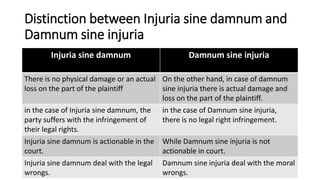
Distinction between Injuria sine damnum and
Damnum sine injuria
Injuria sine damnum Damnum sine injuria
There is no physical damage or an actual
loss on the part of the plaintiff
On the other hand, in case of damnum
sine injuria there is actual damage and
loss on the part of the plaintiff.
in the case of Injuria sine damnum, the
party suffers with the infringement of
their legal rights.
in the case of Damnum sine injuria,
there is no legal right infringement.
Injuria sine damnum is actionable in the
court.
While Damnum sine injuria is not
actionable in court.
Injuria sine damnum deal with the legal
wrongs.
Damnum sine injuria deal with the moral
wrongs.

Tort-01+2.pptx

  • 1.
    Nature and Scopeof Law of Torts Nazmul Hasan Sarker Lecturer, Department of Law, EBAUB
  • 2.
    What is aTort? • The word tort originates from French, meaning “wrong” in English and Romanian law’s term “delict”. • It is derived from the Medieval Latin word “tortum” which means “wrong” or “injury” which itself was further developed from the Old Latin word “torquere” which means “to twist”. • It is a breach of duty which amounts to a civil wrong. A tort arises when a person’s duty towards others is affected. • An individual who commits a tort is called a tortfeasor, or a wrongdoer. And where there are multiple individuals involved, then they are called joint tortfeasors.
  • 3.
    What is aTort? • Salmond addresses tort as being only a civil wrong which has unliquidated damages (those damages for which there is no fixed amount) in the form of remedy and which is not just exclusively the breach of contract or the breach of trust or breach of merely fair and impartial obligation.
  • 4.
    Objectives of Tort •To determine rights between the parties to a dispute. • To prevent the continuation or repetition of harm i.e., by giving orders of injunction. • To protect certain rights of every individual recognized by law i.e., a person’s reputation. • To restore one’s property to its rightful owner i.e., where the property is wrongfully taken away from its rightful owner.
  • 5.
    Elements of Tort Threeessential elements which constitute a tort are, • A Wrongful act or omission. • Duty imposed by the law. • The act must give rise to legal or actual damage, and It should be of such a nature that it should give rise to a legal remedy in the form of an action for damages.
  • 6.
    Wrongful Act orOmission • A wrongful act can be either morally wrong or legally wrong and can also be both at the same time. • A legal wrongful act is one which affects one’s legal right, the wrongful act must be one recognized by law, the act must be in violation of the law to be a legal wrongful act. • An act which seems Prima facie (based on the first impression) innocent may also end up infringing somebody else’s legal right, (innuendo) For example: if someone whose religion does not allow him/her to eat non-vegetarian food, still eats it then he/she will be morally wrong but not legally wrong. And if a person whose religion doesn’t allow him or her to eat non-vegetarian and he or she follows that strictly is forcefully fed by someone then it is a legal wrong.
  • 7.
    Duty Imposed byLaw • A duty of care is one which is imposed on every individual and requires a standard of reasonable care that he could see as being harmful towards others. • Hence, a duty imposed by law is a duty which is legally enforceable in the courts.
  • 8.
    Legal Damage • Injuriasine damnum means injury without damage. It occurs when a person suffers a legal damage instead of actual loss, i.e., his legal right is infringed by some other individual. In other words, this is an infringement of an absolute private right of a person without having suffered any actual loss. • An example of this can be the landmark case of, Ashby v. White(1703) 92 ER 126, where Mr. Ashby, the plaintiff, was prevented from voting by the constable Mr. White. This rule is basically based on the old maxim “Ubi jus ibi remedium” which translates to “where there is a right, there will be a remedy.”
  • 9.
    Legal Damage • Damnumsine injuria: “damage without injury”, here the party affected suffers damage which may also be physical but suffers no infringement of their legal rights. In other words, it means the occurrence of an actual and substantial loss to a party without any infringement of a legal right. • Here no action lies in the hands of the plaintiff as there is no violation of a legal right. • ‘A’ runs a successful school, after 5 months another school opens up nearby due to which he suffered heavy losses in the business, here he has suffered no legal damage but has only suffered damage in terms of business value so he cannot sue the competitor school for any kind of damages (Gloucester Grammar School Case(1410) Y B 11 Hen IV 27).
  • 10.
    Distinction between Injuriasine damnum and Damnum sine injuria Injuria sine damnum Damnum sine injuria There is no physical damage or an actual loss on the part of the plaintiff On the other hand, in case of damnum sine injuria there is actual damage and loss on the part of the plaintiff. in the case of Injuria sine damnum, the party suffers with the infringement of their legal rights. in the case of Damnum sine injuria, there is no legal right infringement. Injuria sine damnum is actionable in the court. While Damnum sine injuria is not actionable in court. Injuria sine damnum deal with the legal wrongs. Damnum sine injuria deal with the moral wrongs.