Introduction to the « Bondable Lease » Philipp Duffy March 23, 2010
What is a « Bondable Lease »,  «Credit Tenant Lease »  or « Hell or High Water Lease »
Introduction What is a « Bondable Lease »? Net net net typically longer term lease Granted to tenants with a superior credit rating Presenting a reduced risk/responsibility profile for the landlord: greater assumption of responsibility for tenant insurance Central document to a financing structure
Introduction What is a « Bondable Lease »   (2) Generates income stream necessary to repay loan evidenced by commercial paper or other securities Allows financing to benefit from tenant’s credit rating
Overview  Typical structure of the financing Advantages of the bondable lease financing model Particular attributes of the bondable lease
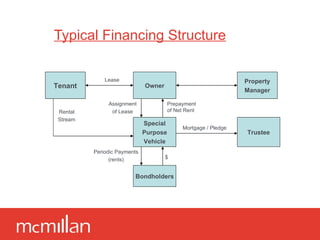
Typical Financing Structure Owner Property Manager Tenant Bondholders Special Purpose Vehicle Trustee Rental Stream Assignment of Lease Lease Mortgage / Pledge Periodic Payments (rents) Prepayment  of Net Rent $
Typical Financing Structure  (2) Owner is responsible for any landlord obligations (not the SPV) SPV must be bankruptcy remote from owner May or may not provide for real security or guarantee by the owner
Typical Financing Structure  (3) May include multiple tenants, but credit rating may be dependant on only selected tenant(s) Typically provides for full amortization of the paper within term of the lease
Typical Financing Structure  (4) Rentals under the lease must fully satisfy: scheduled payments to the bondholders opex, taxes, and all other costs relating to the property Rent payments should coincide with payments to bondholders Operating expenses are generally assumed by tenant
Typical Financing Structure  (5) Bonds created benefit from tenant ' s credit rating, without regard to landlord ' s solvency or value of the real property
Typical Financing Structure  (6) Who uses the bondable lease?: Landlords whose tenants have credit ratings of BBB-/Baa3 or better Highly rated owners seeking off–balance–sheet financing (through sale-leaseback) « Build to suit » developers
Typical Financing Structure  (7) Examples of bondable lease projects: Royal Bank/Symcor portfolio Bell Mobility Campus Mississauga 600 de la Gauchetière O. (National Bank) Much more common in the U.S.: Walgreens, CVS, Home Depot, Wal-Mart, Williams-Sonoma, Bed Bath et Beyond Even hospitals and university facilities
Typical Financing Structure  (8) Who are typical bondholders? Usually subscribed by way of private placement by: insurance companies pension funds institutional investors
Advantages of the Model Underwriting criteria are similar to those applicable to commercial paper, not real estate lending speed low DSCR, typically 1,00 to 1,05 high leverage: placements have reflected 100 % of the value of real estate
Advantages of the Model  (2) Lower cost of funds Lower fees Ability to create very long term (20 to 25 years) fixed rate debt
Particular Attributes Fundamental Principles: Reduction of landlord obligations Mitigation of risk through use of insurance and other techniques
Particular Attributes  (2) Triple net and carefree lease Absence of rights of early termination in favour of tenant
Particular Attributes  (3) Net Lease : Absence/exclusion of ongoing landlord obligations Expansive definition of operating expenses All repairs, including structural repairs, to be at tenant 's cost Possibility of assignment of warranties
Particular Attributes  (4) Net lease : Landlord may require certain controls (maintenance plan, approval of contractors, maintenance budget) Obligation to rebuild Limited rights of termination on damage or destruction typically only in waning years of the lease
Particular Attributes  (5) Insurance : Policies must include bondholder trustee as an insured Usual tenant insurance, including tenant property and leasehold improvements Rental insurance Casualty insurance for full replacement value and never less than outstanding loan amount Environmental insurance Builder's risk insurance
Particular Attributes  (6) No right of set-off No reduction in rent on damage/destruction except to the extent replaced by insurance Expropriation case where lease is terminated case where lease is not terminated
Particular Attributes  (7) Financial covenants (net worth, ratios) Reporting obligations Yield maintenance where lease is terminated as a result of tenant default?
Particular Attributes  (8) No novation on assignment Estoppel certificate Attornment to bondholder security, if applicable Limited recourse to landlord (i.e « REIT » style clause)
Conclusion
Questions?

Introduction to the Bondable Lease

  • 1.
    Introduction to the« Bondable Lease » Philipp Duffy March 23, 2010
  • 2.
    What is a« Bondable Lease », «Credit Tenant Lease » or « Hell or High Water Lease »
  • 3.
    Introduction What isa « Bondable Lease »? Net net net typically longer term lease Granted to tenants with a superior credit rating Presenting a reduced risk/responsibility profile for the landlord: greater assumption of responsibility for tenant insurance Central document to a financing structure
  • 4.
    Introduction What isa « Bondable Lease » (2) Generates income stream necessary to repay loan evidenced by commercial paper or other securities Allows financing to benefit from tenant’s credit rating
  • 5.
    Overview Typicalstructure of the financing Advantages of the bondable lease financing model Particular attributes of the bondable lease
  • 6.
    Typical Financing StructureOwner Property Manager Tenant Bondholders Special Purpose Vehicle Trustee Rental Stream Assignment of Lease Lease Mortgage / Pledge Periodic Payments (rents) Prepayment of Net Rent $
  • 7.
    Typical Financing Structure (2) Owner is responsible for any landlord obligations (not the SPV) SPV must be bankruptcy remote from owner May or may not provide for real security or guarantee by the owner
  • 8.
    Typical Financing Structure (3) May include multiple tenants, but credit rating may be dependant on only selected tenant(s) Typically provides for full amortization of the paper within term of the lease
  • 9.
    Typical Financing Structure (4) Rentals under the lease must fully satisfy: scheduled payments to the bondholders opex, taxes, and all other costs relating to the property Rent payments should coincide with payments to bondholders Operating expenses are generally assumed by tenant
  • 10.
    Typical Financing Structure (5) Bonds created benefit from tenant ' s credit rating, without regard to landlord ' s solvency or value of the real property
  • 11.
    Typical Financing Structure (6) Who uses the bondable lease?: Landlords whose tenants have credit ratings of BBB-/Baa3 or better Highly rated owners seeking off–balance–sheet financing (through sale-leaseback) « Build to suit » developers
  • 12.
    Typical Financing Structure (7) Examples of bondable lease projects: Royal Bank/Symcor portfolio Bell Mobility Campus Mississauga 600 de la Gauchetière O. (National Bank) Much more common in the U.S.: Walgreens, CVS, Home Depot, Wal-Mart, Williams-Sonoma, Bed Bath et Beyond Even hospitals and university facilities
  • 13.
    Typical Financing Structure (8) Who are typical bondholders? Usually subscribed by way of private placement by: insurance companies pension funds institutional investors
  • 14.
    Advantages of theModel Underwriting criteria are similar to those applicable to commercial paper, not real estate lending speed low DSCR, typically 1,00 to 1,05 high leverage: placements have reflected 100 % of the value of real estate
  • 15.
    Advantages of theModel (2) Lower cost of funds Lower fees Ability to create very long term (20 to 25 years) fixed rate debt
  • 16.
    Particular Attributes FundamentalPrinciples: Reduction of landlord obligations Mitigation of risk through use of insurance and other techniques
  • 17.
    Particular Attributes (2) Triple net and carefree lease Absence of rights of early termination in favour of tenant
  • 18.
    Particular Attributes (3) Net Lease : Absence/exclusion of ongoing landlord obligations Expansive definition of operating expenses All repairs, including structural repairs, to be at tenant 's cost Possibility of assignment of warranties
  • 19.
    Particular Attributes (4) Net lease : Landlord may require certain controls (maintenance plan, approval of contractors, maintenance budget) Obligation to rebuild Limited rights of termination on damage or destruction typically only in waning years of the lease
  • 20.
    Particular Attributes (5) Insurance : Policies must include bondholder trustee as an insured Usual tenant insurance, including tenant property and leasehold improvements Rental insurance Casualty insurance for full replacement value and never less than outstanding loan amount Environmental insurance Builder's risk insurance
  • 21.
    Particular Attributes (6) No right of set-off No reduction in rent on damage/destruction except to the extent replaced by insurance Expropriation case where lease is terminated case where lease is not terminated
  • 22.
    Particular Attributes (7) Financial covenants (net worth, ratios) Reporting obligations Yield maintenance where lease is terminated as a result of tenant default?
  • 23.
    Particular Attributes (8) No novation on assignment Estoppel certificate Attornment to bondholder security, if applicable Limited recourse to landlord (i.e « REIT » style clause)
  • 24.
  • 25.