09/20/15 109/20/15 109/20/15 109/20/15 1
Spinal cord injury
Assessment &
Rehabilitation.
Chief physical therapist
Prince Sultan Military
Medical city (PSMMC).
Done By
Abdul Karim S. Al-Humaid
BSc, Msc.
09/20/15 209/20/15 209/20/15 209/20/15 2
•Objective (s):
 Introduction.
 Understanding the anatomy of Spinal Cord (S.C)
 Understanding the cause of S.C lesions.
 Understanding the signs and symptoms.
 The different type of injury.
 Assessment (ASIA, Functional format)
09/20/15 309/20/15 3
 Introduction
09/20/15 409/20/15 409/20/15 409/20/15 4
09/20/15 509/20/15 509/20/15 5
09/20/15 609/20/15 609/20/15 609/20/15 6
09/20/15 709/20/15 709/20/15 709/20/15 7
•Why I am here?
09/20/15 809/20/15 809/20/15 809/20/15 8
09/20/15 909/20/15 909/20/15 909/20/15 9
09/20/15 1009/20/15 1009/20/15 1009/20/15 10
09/20/15 1109/20/15 1109/20/15 1109/20/15 11
09/20/15 1209/20/15 1209/20/15 12
09/20/15 1309/20/15 1309/20/15 1309/20/15 13
09/20/15 1409/20/15 1409/20/15 14
• Introduction
 The anatomy of spinal cord??
 The function of spinal cord??
 Stretch reflex anatomical structure??
 Afferent &efferent component?
09/20/15 14
09/20/15 16
09/20/15 1709/20/15 17
•Spinal Cord Level Numbering
System
 There are 31 pairs of spinal nerves which branch off
from the spinal cord.
 In the cervical region of the spinal cord, the spinal
nerves exit above the vertebrae.
 A change occurs with the C7 vertebra however,
where the C8 spinal nerve exits the vertebra below
the C7 vertebra.
09/20/15 1809/20/15 18
•Spinal Cord Level Numbering
System
 Therefore, there is an 8th cervical spinal nerve even
though there is no 8th cervical vertebra.
 From the 1st thoracic vertebra downwards, all spinal
nerves exit below their equivalent numbered vertebrae.
 and the spinal cord ends around the L1/L2 vertebral
level, forming a structure known as the conus medullaris
09/20/15 1909/20/15 19
09/20/15 2009/20/15 2009/20/15 20
• Spinal Structure.
09/20/15 20
09/20/15 2109/20/15 2109/20/15 21
• Spinal cord function.
09/20/15 21
09/20/15 2209/20/15 2209/20/15 22
• Spinal cord function
09/20/15 22
09/20/15 2309/20/15 23
09/20/15 2409/20/15 2409/20/15 2409/20/15 24
1) Complete1) Complete: complete
transection of motor and
sensory tracts.
 Total absence of sensory
and motor function from
the level of the lesion and
below .
09/20/15 2509/20/15 2509/20/15 2509/20/15 25
Complete and IncompleteComplete and Incomplete
 Spinal Cord Syndromes can be classified
into either complete or incomplete categories
 Complete – characterized as complete loss
of motor and sensory function below the
level of the traumatic lesion
 Incomplete – characterized by variable
neurological findings with partial loss of
sensory and/or motor function below the
lesion
09/20/15 2609/20/15 26
• why????
 Spinal cord injury can occur at any level of
the spinal cord or at multiple levels; however,
the most common area of injury is at the
lower part of the neck at the C-4, C-5 and C-6
levels.
 The second most common area of injury is at
the bottom of the rib cage at T-12. C-7 is the
third most common area of spinal cord injury.
09/20/15 27
09/20/15 2809/20/15 2809/20/15 2809/20/15 28
• Complete Cord
 No Sensation
 Flaccid paralysis
 Initially areflexia
 Hyperreflexia, Spasticity, positive
planter reflex (days to months)
 <5% chance of functional recovery if
no improvement within 24 hours
09/20/15 2909/20/15 2909/20/15 2909/20/15 29
•LESION’S TYPE:
 Tetraplegia (quadriplegia)
 Impairment or loss of motor and or
sensory function due to damage in the
cervical area.
 Paraplegia :
 Impairment or loss of motor and or
sensory function due damage of the
thoracic or sacral segments.
09/20/15 3009/20/15 3009/20/15 3009/20/15 30
• Systems affected by SCI
 Cardiovascular
 Integumentary
 Gastrointestinal
 Metabolic
 Neurologic
 Musculoskeletal
 Urologic
 Psychosocial
 Sexuality
 Respiratory
09/20/15 3109/20/15 3109/20/15 3109/20/15 31
•Incidence of Traumatic SCI
 Average age 38
 About 53% between 16 – 30 years old
 78% male
 Greatest frequency on weekends
 19.3% Saturdays
 17.2% Sundays
 Seasonal variation: greatest frequency during
summer.
09/20/15 3209/20/15 3209/20/15 32
•Typical SCI Patient
 Unmarried
 Males
 Less than 36 y/o
 Majority 15-30
 19 most common age
09/20/15 3309/20/15 3309/20/15 3309/20/15 33
•Etiology of Traumatic SCI
 Vehicular (car, motorcycle, ATV) 47%
 Leading cause until age of 45 yo
 Falls 24%
 Leading cause after age of 45 yo
 Violence 14%
 Sports 9% (diving #1 > 50%)
Variability by region from USA.
09/20/15 3409/20/15 34
09/20/15 3509/20/15 3509/20/15 3509/20/15 35
09/20/15 3609/20/15 3609/20/15 3609/20/15 36
•Etiology of
Non-traumatic SCI/dysfunction
 Degenerative: spinal stenosis , herniated disc
 Tumors
 Infections
 Vascular
 Multiple Sclerosis
More common in patients over 40 years old
09/20/15 3709/20/15 3709/20/15 3709/20/15 37
•Acute medical treatment
 Pharmacological management to
prevent neurological trauma and
enhance neural recovery
 Anatomical realignment and
stabilization intervention
 Prevention of secondary complication .
09/20/15 3809/20/15 38
•Spinal shock
 Spinal shock is a state of transient
physiologic (rather than anatomic)
reflex depression of cord function
below the level of injury, with
associated loss of all sensorimotor
functions
09/20/15 3909/20/15 3909/20/15 3909/20/15 39
• Spinal ShockSpinal Shock
 An immediate loss of reflex function, called
areflexia, below the level of injury
 Signs:
 Slow heart rate
 Low blood pressure
 Flaccid paralysis of skeletal muscles
 Loss of somatic sensations
 Urinary bladder dysfunction
 Spinal shock may begin within an hour after
injury and last from several minutes to
several months, after which reflex activity
gradually returns
09/20/15 4009/20/15 4009/20/15 4009/20/15 40
Acute Secondary
Complications After SCI
 Cardiovascular
 Hypotension
 Bradycardia
 Autonomic Dysreflexia
 DVT/PE
 Pulmonary
 Restrictive > Obstructive dysfunction
 Impaired cough
 Atalectasis
09/20/15 4109/20/15 4109/20/15 4109/20/15 41
•Acute Secondary
Complications After SCI
 Bladder
 Inability to void and/or store
 Bowel
 Neurogenic bowel
 Constipation
 Ileus
 Skin – decubitus ulcers
09/20/15 4209/20/15 4209/20/15 4209/20/15 42
•Acute Secondary
Complications After SCI
 Osteoporosis
 Hypercalcemia
 Diabetes
 Cardiovascular disease
 Changes in body composition
09/20/15 4309/20/15 4309/20/15 4309/20/15 43
• Causes of Death
1. Pneumonia?
2. Non-ischemic heart disease.
3. Septicemia.
4. Ill-defined Conditions.
5. Pulmonary embolus.
6. Ischemic heart disease.
7. Suicide??
09/20/15 4409/20/15 4409/20/15 4409/20/15 44
•Life Expectancy
 Has Improved greatly, from certain
death to approximately 10-11 years
short of a normal lifespan.
 20 year old person with C5-8 complete
injury

77% of total life expectancy

69% of expected years after injury
Devivo MJ. SCI:Clinical Outcomes of Model System. 1995.
09/20/15 45
 Clearly there is no single correct
way to write physical therapy
documentation.
 Documentation must be adapted to
the context in which it written.
09/20/15 4609/20/15 4609/20/15 4609/20/15 46
•Definition of spinal cord injury.
2(Incomplete:
 Central Cord
Syndrome
 Anterior Cord
Syndrome
 Posterior Cord
Syndrome
 Brown Sequard
Syndrome
2(Incomplete:
 Based on detection of
sacral sparing, either
motor or sensory.
 There is partial
preservation of sensory
and or motor function
meets needs correlated to
the level of injury .
09/20/15 4709/20/15 4709/20/15 4709/20/15 47
• SCI: SubtypesSCI: Subtypes
 CompleteComplete: complete transection of motor
and sensory tracts
 Incomplete:
 Central Cord Syndrome
 Brown Sequard Syndrome
 Anterior Cord Syndrome
 Posterior Cord Syndrome
09/20/15 4809/20/15 4809/20/15 4809/20/15 48
Central Cord SyndromeCentral Cord Syndrome
 Greater weakness in the upper
limbs than in the lower limbs,
occurs in cervical region
 The most common of the
incomplete syndromes
 Frequently seen in elderly
patients with cervical stenosis
 Good prognosis for recovery
but age a predictor:
<50 yo >50 yo
Ambulation 97% 41%
ADLs 77% 12%
Bowel 63% 24%
Bladder 83% 29%
09/20/15 4909/20/15 4909/20/15 4909/20/15 49
•Brown-SequardBrown-Sequard
SyndromeSyndrome
 Hemi-section injury of the spinal
cord producing greater ipsilateral
proprioceptive & motor loss with
contralateral loss of pin &
temperature sensation
 Often caused by spinal cord
tumours, trauma, or inflammation
 Bowel and bladder functions are
usually normal
 Overall best prognosis for
recovery
Ambulation 75%(40% if >50 yo)
ADLs 70%
Bowel 82%
Bladder 89%
2 - 4 % of all traumatic SCI
09/20/15 5009/20/15 5009/20/15 5009/20/15 50
Anterior Cord SyndromeAnterior Cord Syndrome
 Injury involving anterior 2/3
of spinal cord with variable
loss of motor function, pain &
temperature, with preserved
proprioception and light
touch
 Poor prognosis for recovery
only 10 – 20% have any
motor recovery and it’s
almost always non-functional
09/20/15 5109/20/15 5109/20/15 5109/20/15 51
Posterior Cord SyndromePosterior Cord Syndrome
 Least frequent
 Preserves pain,
temperature, and light
touch with varying
degrees of motor
preservation and loss of
proprioception
 Prognosis for
ambulation is poor
09/20/15 5209/20/15 5209/20/15 5209/20/15 52
09/20/15 5309/20/15 5309/20/15 5309/20/15 53
Recovery PrognosticationRecovery Prognostication
DeterminantsDeterminants
 Complete vs. Incomplete injury
 Initial level of injury
 Initial strength of muscles
 Age
* Primary determinant of motor recovery is
completeness of injury at one month
09/20/15 5409/20/15 5409/20/15 5409/20/15 54
Complete Tetraplegia
 Most patients regain 1 motor level during
1st
year after injury
 Most upper extremity recovery occurs in
1st
6 months, greatest rate in 1st
3 months
09/20/15 5509/20/15 5509/20/15 5509/20/15 55
Incomplete TetraplegiaIncomplete Tetraplegia
 Poor prognosis for community ambulation if
no lower extremity motor strength at 1 month
 Poor prognosis for ambulation if >50 years
old
09/20/15 5609/20/15 5609/20/15 5609/20/15 56
Complete ParaplegiaComplete Paraplegia
 Most recovery in 1st
6 months
 Poor prognosis for community ambulation
 <5% overall
09/20/15 5709/20/15 5709/20/15 5709/20/15 57
Incomplete ParaplegiaIncomplete Paraplegia
 Greatest rate of recovery in 1st
3 months
 50% recover community ambulation
09/20/15 5809/20/15 5809/20/15 5809/20/15 58Figure 15.6
Sensory Pathways and Ascending
Tracts in the Spinal Cord
09/20/15 5909/20/15 5909/20/15 5909/20/15 59
 ASSESSMENT FORM (s):
 ASIA FORM
 GENERAL NEUROLOGY
FORM. BASED ON SOAP
FORMAT.
09/20/15 6009/20/15 6009/20/15 6009/20/15 60
Part (1(
09/20/15 6109/20/15 6109/20/15 6109/20/15 61
• Definition

NEUROLOGIC LEVEL OF INJURY: the most
distal level where both motor & sensory are
intact
09/20/15 6209/20/15 6209/20/15 6209/20/15 62
09/20/15 6309/20/15 6309/20/15 6309/20/15 63
09/20/15 6409/20/15 6409/20/15 6409/20/15 64
•Motor Examination
 10 “key” muscles (5 upper & 5 lower ext)
 C5-elbow flexion L2-hip flexion
 C6-wrist extension L3-knee extension
 C7-elbow extension L4-ankle dorsiflexion
 C8-finger flexion L5-toe extension
 T1-finger abduction S1-ankle PF
 Sacral exam: voluntary anal contraction
(present/absent)
09/20/15 6509/20/15 6509/20/15 6509/20/15 65
09/20/15 6609/20/15 6609/20/15 6609/20/15 66
•ASIA Sensory Exam
 28 sensory “points” (within derm’s)
 Test light touch & pin/pain
 **Importance of sacral pin testing
 3 point scale (0,1,2)
 “optional”: proprioception & deep pressure
to index and great toe (“present vs.
absent”)
 deep anal sensation recorded “present vs
absent”
09/20/15 6709/20/15 6709/20/15 6709/20/15 67
09/20/15 6809/20/15 6809/20/15 6809/20/15 68
09/20/15 6909/20/15 6909/20/15 6909/20/15 69
09/20/15 7009/20/15 7009/20/15 7009/20/15 70
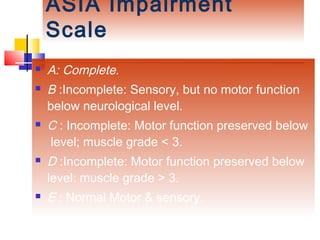
ASIA Impairment
Scale
 A: Complete.
 B :Incomplete: Sensory, but no motor function
below neurological level.
 C : Incomplete: Motor function preserved below
level; muscle grade < 3.
 D :Incomplete: Motor function preserved below
level: muscle grade > 3.
 E : Normal Motor & sensory.
09/20/15 7109/20/15 7109/20/15 7109/20/15 71
Part (2(
09/20/15 7209/20/15 7209/20/15 7209/20/15 72
•Neurologic ExaminationNeurologic Examination
 Sensation: light touch and pinprick
Position sense.
 Motor strength and ROM.
 Reflexes: DTRs, plantar reflexes, sacral
reflexes.
 MUSCLE TONE: location and grade.
 Functional activities based on ADL.
 Other finding related indirect to his case.
 HOW TO ASSESS?
09/20/15 73
•NAGI MODEL:
09/20/15 74
•NAGI MODEL:
09/20/15 7509/20/15 7509/20/15 7509/20/15 75
Map of Dermatomes –posterior-
Anterior View
Figure 14.17a
09/20/15 7609/20/15 76
•Classification Of The
Sensory System (Spinal
Pathway(
 Anterolateral spinothalamic
system:
 Initiates self-protective reaction and responds to
harmful stimuli.
 Contain: slow-conducting fibers of small diameter,
some fibers are unmylinated.
 Activated by: mechanoreceptors,
thermoreceptors, nocioceptors.
 Responsible for: pain, temperature, crudely
localized touch, tickle, itch, and sexual sensation.
09/20/15 7709/20/15 77
09/20/15 7809/20/15 78
•Classification Of The Sensory
System (Spinal Pathway(
2. DORSAL COLUMN-MEDIAL LEMNISCAL
SYSTEM:
 Respond to: more discriminative sensations.
 Contain: fast-conducting fibers of large diameter with
greater myelination.
 Activated by: specialized Mechanoreceptors.
 Responsible for: stereognosis, tactile pressure,
vibration, barognosis, graphesthesia, recognition of
texture, kinesthesia, and proprioception.
09/20/15 7909/20/15 79
09/20/15 8009/20/15 8009/20/15 80
•HOW TO ASSESS??
09/20/15 8109/20/15 8109/20/15 81
•PHYSIOLOGICAL
EXPLENATION
09/20/15 8209/20/15 8209/20/15 82
THE ASHWORTH SCALE
ASHWORTH SCALE
(1964)
Score MODIFIED ASHWORTH SCALE
Bohannon and Smith (1987)
No increase in tone. 0 0 No increase in muscle tone.
Slight increase in tone giving a catch when the
limb is moved in flexion or extension. 1 1
Slight increase in muscle tone, manifested by
a catch and release or by minimal resistance
at the end of the range of motion when the
affected part(s) is moved in flexion or
extension.
2 1+
Slight increase in muscle tone, manifested by
a catch, followed by minimal resistance
throughout the reminder (less than half) of the
ROM (range of movement).
More marked increase in tone but limb easily
flexed. 3 2
More marked increase in muscle tone through
most of the ROM, but affected part(s) easily
moved.
Considerable increase in tone - passive
movement difficult. 4 3
Considerable increase in muscle tone - passive
movement difficult.
Limb rigid in flexion or extension. 5 4 Affected part(s) rigid in flexion or extension.
R.K.H. Medical Illustration 0032-05
09/20/15 8309/20/15 8309/20/15 8309/20/15 83
09/20/15 8484
Cranial Nerves
09/20/15 8509/20/15 8509/20/15 8509/20/15 85
•Scales AND forms we
need?
09/20/15 8609/20/15 8609/20/15 8609/20/15 86
09/20/15 8709/20/15 87
09/20/15 8809/20/15 8809/20/15 8809/20/15 88
09/20/15 8909/20/15 8909/20/15 89
THE ASHWORTH SCALE
ASHWORTH SCALE
(1964)
Score MODIFIED ASHWORTH SCALE
Bohannon and Smith (1987)
No increase in tone. 0 0 No increase in muscle tone.
Slight increase in tone giving a catch when the
limb is moved in flexion or extension. 1 1
Slight increase in muscle tone, manifested by
a catch and release or by minimal resistance
at the end of the range of motion when the
affected part(s) is moved in flexion or
extension.
2 1+
Slight increase in muscle tone, manifested by
a catch, followed by minimal resistance
throughout the reminder (less than half) of the
ROM (range of movement).
More marked increase in tone but limb easily
flexed. 3 2
More marked increase in muscle tone through
most of the ROM, but affected part(s) easily
moved.
Considerable increase in tone - passive
movement difficult. 4 3
Considerable increase in muscle tone - passive
movement difficult.
Limb rigid in flexion or extension. 5 4 Affected part(s) rigid in flexion or extension.
R.K.H. Medical Illustration 0032-05
09/20/15 9009/20/15 9009/20/15 90
TTHEHE AASHWORTHSHWORTH SSCALECALE
ScoreScore MMODIFIEDODIFIED AASHWORTHSHWORTH SSCALECALE
Bohannon and SmithBohannon and Smith (1987(1987((
0 No increase in muscle tone.
1
Slight increase in muscle tone, manifested by a catch and release or by minimal
resistance at the end of the range of motion when the affected part's) is moved in
flexion or extension.
1+
Slight increase in muscle tone, manifested by a catch, followed by minimal
resistance throughout the reminder (less than half) of the ROM (range of
movement).
2 More marked increase in muscle tone through most of the ROM, but affected part
(s) easily moved.
3 Considerable increase in muscle tone - passive movement difficult.
4 Affected part (s) rigid in flexion or extension.
R.M.H. Medical Illustration 1200-05
09/20/15 9109/20/15 9109/20/15 9109/20/15 91
09/20/15 9209/20/15 9209/20/15 9209/20/15 92

Introduction to sci (2) (3)

  • 1.
    09/20/15 109/20/15 109/20/15109/20/15 1 Spinal cord injury Assessment & Rehabilitation. Chief physical therapist Prince Sultan Military Medical city (PSMMC). Done By Abdul Karim S. Al-Humaid BSc, Msc.
  • 2.
    09/20/15 209/20/15 209/20/15209/20/15 2 •Objective (s):  Introduction.  Understanding the anatomy of Spinal Cord (S.C)  Understanding the cause of S.C lesions.  Understanding the signs and symptoms.  The different type of injury.  Assessment (ASIA, Functional format)
  • 3.
  • 4.
  • 5.
  • 6.
  • 7.
    09/20/15 709/20/15 709/20/15709/20/15 7 •Why I am here?
  • 8.
  • 9.
  • 10.
  • 11.
  • 12.
  • 13.
  • 14.
    09/20/15 1409/20/15 1409/20/1514 • Introduction  The anatomy of spinal cord??  The function of spinal cord??  Stretch reflex anatomical structure??  Afferent &efferent component? 09/20/15 14
  • 16.
  • 17.
    09/20/15 1709/20/15 17 •SpinalCord Level Numbering System  There are 31 pairs of spinal nerves which branch off from the spinal cord.  In the cervical region of the spinal cord, the spinal nerves exit above the vertebrae.  A change occurs with the C7 vertebra however, where the C8 spinal nerve exits the vertebra below the C7 vertebra.
  • 18.
    09/20/15 1809/20/15 18 •SpinalCord Level Numbering System  Therefore, there is an 8th cervical spinal nerve even though there is no 8th cervical vertebra.  From the 1st thoracic vertebra downwards, all spinal nerves exit below their equivalent numbered vertebrae.  and the spinal cord ends around the L1/L2 vertebral level, forming a structure known as the conus medullaris
  • 19.
  • 20.
    09/20/15 2009/20/15 2009/20/1520 • Spinal Structure. 09/20/15 20
  • 21.
    09/20/15 2109/20/15 2109/20/1521 • Spinal cord function. 09/20/15 21
  • 22.
    09/20/15 2209/20/15 2209/20/1522 • Spinal cord function 09/20/15 22
  • 23.
  • 24.
    09/20/15 2409/20/15 2409/20/152409/20/15 24 1) Complete1) Complete: complete transection of motor and sensory tracts.  Total absence of sensory and motor function from the level of the lesion and below .
  • 25.
    09/20/15 2509/20/15 2509/20/152509/20/15 25 Complete and IncompleteComplete and Incomplete  Spinal Cord Syndromes can be classified into either complete or incomplete categories  Complete – characterized as complete loss of motor and sensory function below the level of the traumatic lesion  Incomplete – characterized by variable neurological findings with partial loss of sensory and/or motor function below the lesion
  • 26.
    09/20/15 2609/20/15 26 •why????  Spinal cord injury can occur at any level of the spinal cord or at multiple levels; however, the most common area of injury is at the lower part of the neck at the C-4, C-5 and C-6 levels.  The second most common area of injury is at the bottom of the rib cage at T-12. C-7 is the third most common area of spinal cord injury.
  • 27.
  • 28.
    09/20/15 2809/20/15 2809/20/152809/20/15 28 • Complete Cord  No Sensation  Flaccid paralysis  Initially areflexia  Hyperreflexia, Spasticity, positive planter reflex (days to months)  <5% chance of functional recovery if no improvement within 24 hours
  • 29.
    09/20/15 2909/20/15 2909/20/152909/20/15 29 •LESION’S TYPE:  Tetraplegia (quadriplegia)  Impairment or loss of motor and or sensory function due to damage in the cervical area.  Paraplegia :  Impairment or loss of motor and or sensory function due damage of the thoracic or sacral segments.
  • 30.
    09/20/15 3009/20/15 3009/20/153009/20/15 30 • Systems affected by SCI  Cardiovascular  Integumentary  Gastrointestinal  Metabolic  Neurologic  Musculoskeletal  Urologic  Psychosocial  Sexuality  Respiratory
  • 31.
    09/20/15 3109/20/15 3109/20/153109/20/15 31 •Incidence of Traumatic SCI  Average age 38  About 53% between 16 – 30 years old  78% male  Greatest frequency on weekends  19.3% Saturdays  17.2% Sundays  Seasonal variation: greatest frequency during summer.
  • 32.
    09/20/15 3209/20/15 3209/20/1532 •Typical SCI Patient  Unmarried  Males  Less than 36 y/o  Majority 15-30  19 most common age
  • 33.
    09/20/15 3309/20/15 3309/20/153309/20/15 33 •Etiology of Traumatic SCI  Vehicular (car, motorcycle, ATV) 47%  Leading cause until age of 45 yo  Falls 24%  Leading cause after age of 45 yo  Violence 14%  Sports 9% (diving #1 > 50%) Variability by region from USA.
  • 34.
  • 35.
  • 36.
    09/20/15 3609/20/15 3609/20/153609/20/15 36 •Etiology of Non-traumatic SCI/dysfunction  Degenerative: spinal stenosis , herniated disc  Tumors  Infections  Vascular  Multiple Sclerosis More common in patients over 40 years old
  • 37.
    09/20/15 3709/20/15 3709/20/153709/20/15 37 •Acute medical treatment  Pharmacological management to prevent neurological trauma and enhance neural recovery  Anatomical realignment and stabilization intervention  Prevention of secondary complication .
  • 38.
    09/20/15 3809/20/15 38 •Spinalshock  Spinal shock is a state of transient physiologic (rather than anatomic) reflex depression of cord function below the level of injury, with associated loss of all sensorimotor functions
  • 39.
    09/20/15 3909/20/15 3909/20/153909/20/15 39 • Spinal ShockSpinal Shock  An immediate loss of reflex function, called areflexia, below the level of injury  Signs:  Slow heart rate  Low blood pressure  Flaccid paralysis of skeletal muscles  Loss of somatic sensations  Urinary bladder dysfunction  Spinal shock may begin within an hour after injury and last from several minutes to several months, after which reflex activity gradually returns
  • 40.
    09/20/15 4009/20/15 4009/20/154009/20/15 40 Acute Secondary Complications After SCI  Cardiovascular  Hypotension  Bradycardia  Autonomic Dysreflexia  DVT/PE  Pulmonary  Restrictive > Obstructive dysfunction  Impaired cough  Atalectasis
  • 41.
    09/20/15 4109/20/15 4109/20/154109/20/15 41 •Acute Secondary Complications After SCI  Bladder  Inability to void and/or store  Bowel  Neurogenic bowel  Constipation  Ileus  Skin – decubitus ulcers
  • 42.
    09/20/15 4209/20/15 4209/20/154209/20/15 42 •Acute Secondary Complications After SCI  Osteoporosis  Hypercalcemia  Diabetes  Cardiovascular disease  Changes in body composition
  • 43.
    09/20/15 4309/20/15 4309/20/154309/20/15 43 • Causes of Death 1. Pneumonia? 2. Non-ischemic heart disease. 3. Septicemia. 4. Ill-defined Conditions. 5. Pulmonary embolus. 6. Ischemic heart disease. 7. Suicide??
  • 44.
    09/20/15 4409/20/15 4409/20/154409/20/15 44 •Life Expectancy  Has Improved greatly, from certain death to approximately 10-11 years short of a normal lifespan.  20 year old person with C5-8 complete injury  77% of total life expectancy  69% of expected years after injury Devivo MJ. SCI:Clinical Outcomes of Model System. 1995.
  • 45.
    09/20/15 45  Clearlythere is no single correct way to write physical therapy documentation.  Documentation must be adapted to the context in which it written.
  • 46.
    09/20/15 4609/20/15 4609/20/154609/20/15 46 •Definition of spinal cord injury. 2(Incomplete:  Central Cord Syndrome  Anterior Cord Syndrome  Posterior Cord Syndrome  Brown Sequard Syndrome 2(Incomplete:  Based on detection of sacral sparing, either motor or sensory.  There is partial preservation of sensory and or motor function meets needs correlated to the level of injury .
  • 47.
    09/20/15 4709/20/15 4709/20/154709/20/15 47 • SCI: SubtypesSCI: Subtypes  CompleteComplete: complete transection of motor and sensory tracts  Incomplete:  Central Cord Syndrome  Brown Sequard Syndrome  Anterior Cord Syndrome  Posterior Cord Syndrome
  • 48.
    09/20/15 4809/20/15 4809/20/154809/20/15 48 Central Cord SyndromeCentral Cord Syndrome  Greater weakness in the upper limbs than in the lower limbs, occurs in cervical region  The most common of the incomplete syndromes  Frequently seen in elderly patients with cervical stenosis  Good prognosis for recovery but age a predictor: <50 yo >50 yo Ambulation 97% 41% ADLs 77% 12% Bowel 63% 24% Bladder 83% 29%
  • 49.
    09/20/15 4909/20/15 4909/20/154909/20/15 49 •Brown-SequardBrown-Sequard SyndromeSyndrome  Hemi-section injury of the spinal cord producing greater ipsilateral proprioceptive & motor loss with contralateral loss of pin & temperature sensation  Often caused by spinal cord tumours, trauma, or inflammation  Bowel and bladder functions are usually normal  Overall best prognosis for recovery Ambulation 75%(40% if >50 yo) ADLs 70% Bowel 82% Bladder 89% 2 - 4 % of all traumatic SCI
  • 50.
    09/20/15 5009/20/15 5009/20/155009/20/15 50 Anterior Cord SyndromeAnterior Cord Syndrome  Injury involving anterior 2/3 of spinal cord with variable loss of motor function, pain & temperature, with preserved proprioception and light touch  Poor prognosis for recovery only 10 – 20% have any motor recovery and it’s almost always non-functional
  • 51.
    09/20/15 5109/20/15 5109/20/155109/20/15 51 Posterior Cord SyndromePosterior Cord Syndrome  Least frequent  Preserves pain, temperature, and light touch with varying degrees of motor preservation and loss of proprioception  Prognosis for ambulation is poor
  • 52.
  • 53.
    09/20/15 5309/20/15 5309/20/155309/20/15 53 Recovery PrognosticationRecovery Prognostication DeterminantsDeterminants  Complete vs. Incomplete injury  Initial level of injury  Initial strength of muscles  Age * Primary determinant of motor recovery is completeness of injury at one month
  • 54.
    09/20/15 5409/20/15 5409/20/155409/20/15 54 Complete Tetraplegia  Most patients regain 1 motor level during 1st year after injury  Most upper extremity recovery occurs in 1st 6 months, greatest rate in 1st 3 months
  • 55.
    09/20/15 5509/20/15 5509/20/155509/20/15 55 Incomplete TetraplegiaIncomplete Tetraplegia  Poor prognosis for community ambulation if no lower extremity motor strength at 1 month  Poor prognosis for ambulation if >50 years old
  • 56.
    09/20/15 5609/20/15 5609/20/155609/20/15 56 Complete ParaplegiaComplete Paraplegia  Most recovery in 1st 6 months  Poor prognosis for community ambulation  <5% overall
  • 57.
    09/20/15 5709/20/15 5709/20/155709/20/15 57 Incomplete ParaplegiaIncomplete Paraplegia  Greatest rate of recovery in 1st 3 months  50% recover community ambulation
  • 58.
    09/20/15 5809/20/15 5809/20/155809/20/15 58Figure 15.6 Sensory Pathways and Ascending Tracts in the Spinal Cord
  • 59.
    09/20/15 5909/20/15 5909/20/155909/20/15 59  ASSESSMENT FORM (s):  ASIA FORM  GENERAL NEUROLOGY FORM. BASED ON SOAP FORMAT.
  • 60.
    09/20/15 6009/20/15 6009/20/156009/20/15 60 Part (1(
  • 61.
    09/20/15 6109/20/15 6109/20/156109/20/15 61 • Definition  NEUROLOGIC LEVEL OF INJURY: the most distal level where both motor & sensory are intact
  • 62.
  • 63.
  • 64.
    09/20/15 6409/20/15 6409/20/156409/20/15 64 •Motor Examination  10 “key” muscles (5 upper & 5 lower ext)  C5-elbow flexion L2-hip flexion  C6-wrist extension L3-knee extension  C7-elbow extension L4-ankle dorsiflexion  C8-finger flexion L5-toe extension  T1-finger abduction S1-ankle PF  Sacral exam: voluntary anal contraction (present/absent)
  • 65.
  • 66.
    09/20/15 6609/20/15 6609/20/156609/20/15 66 •ASIA Sensory Exam  28 sensory “points” (within derm’s)  Test light touch & pin/pain  **Importance of sacral pin testing  3 point scale (0,1,2)  “optional”: proprioception & deep pressure to index and great toe (“present vs. absent”)  deep anal sensation recorded “present vs absent”
  • 67.
  • 68.
  • 69.
  • 70.
    09/20/15 7009/20/15 7009/20/157009/20/15 70 ASIA Impairment Scale  A: Complete.  B :Incomplete: Sensory, but no motor function below neurological level.  C : Incomplete: Motor function preserved below level; muscle grade < 3.  D :Incomplete: Motor function preserved below level: muscle grade > 3.  E : Normal Motor & sensory.
  • 71.
    09/20/15 7109/20/15 7109/20/157109/20/15 71 Part (2(
  • 72.
    09/20/15 7209/20/15 7209/20/157209/20/15 72 •Neurologic ExaminationNeurologic Examination  Sensation: light touch and pinprick Position sense.  Motor strength and ROM.  Reflexes: DTRs, plantar reflexes, sacral reflexes.  MUSCLE TONE: location and grade.  Functional activities based on ADL.  Other finding related indirect to his case.  HOW TO ASSESS?
  • 73.
  • 74.
  • 75.
    09/20/15 7509/20/15 7509/20/157509/20/15 75 Map of Dermatomes –posterior- Anterior View Figure 14.17a
  • 76.
    09/20/15 7609/20/15 76 •ClassificationOf The Sensory System (Spinal Pathway(  Anterolateral spinothalamic system:  Initiates self-protective reaction and responds to harmful stimuli.  Contain: slow-conducting fibers of small diameter, some fibers are unmylinated.  Activated by: mechanoreceptors, thermoreceptors, nocioceptors.  Responsible for: pain, temperature, crudely localized touch, tickle, itch, and sexual sensation.
  • 77.
  • 78.
    09/20/15 7809/20/15 78 •ClassificationOf The Sensory System (Spinal Pathway( 2. DORSAL COLUMN-MEDIAL LEMNISCAL SYSTEM:  Respond to: more discriminative sensations.  Contain: fast-conducting fibers of large diameter with greater myelination.  Activated by: specialized Mechanoreceptors.  Responsible for: stereognosis, tactile pressure, vibration, barognosis, graphesthesia, recognition of texture, kinesthesia, and proprioception.
  • 79.
  • 80.
    09/20/15 8009/20/15 8009/20/1580 •HOW TO ASSESS??
  • 81.
    09/20/15 8109/20/15 8109/20/1581 •PHYSIOLOGICAL EXPLENATION
  • 82.
    09/20/15 8209/20/15 8209/20/1582 THE ASHWORTH SCALE ASHWORTH SCALE (1964) Score MODIFIED ASHWORTH SCALE Bohannon and Smith (1987) No increase in tone. 0 0 No increase in muscle tone. Slight increase in tone giving a catch when the limb is moved in flexion or extension. 1 1 Slight increase in muscle tone, manifested by a catch and release or by minimal resistance at the end of the range of motion when the affected part(s) is moved in flexion or extension. 2 1+ Slight increase in muscle tone, manifested by a catch, followed by minimal resistance throughout the reminder (less than half) of the ROM (range of movement). More marked increase in tone but limb easily flexed. 3 2 More marked increase in muscle tone through most of the ROM, but affected part(s) easily moved. Considerable increase in tone - passive movement difficult. 4 3 Considerable increase in muscle tone - passive movement difficult. Limb rigid in flexion or extension. 5 4 Affected part(s) rigid in flexion or extension. R.K.H. Medical Illustration 0032-05
  • 83.
  • 84.
  • 85.
    09/20/15 8509/20/15 8509/20/158509/20/15 85 •Scales AND forms we need?
  • 86.
  • 87.
  • 88.
  • 89.
    09/20/15 8909/20/15 8909/20/1589 THE ASHWORTH SCALE ASHWORTH SCALE (1964) Score MODIFIED ASHWORTH SCALE Bohannon and Smith (1987) No increase in tone. 0 0 No increase in muscle tone. Slight increase in tone giving a catch when the limb is moved in flexion or extension. 1 1 Slight increase in muscle tone, manifested by a catch and release or by minimal resistance at the end of the range of motion when the affected part(s) is moved in flexion or extension. 2 1+ Slight increase in muscle tone, manifested by a catch, followed by minimal resistance throughout the reminder (less than half) of the ROM (range of movement). More marked increase in tone but limb easily flexed. 3 2 More marked increase in muscle tone through most of the ROM, but affected part(s) easily moved. Considerable increase in tone - passive movement difficult. 4 3 Considerable increase in muscle tone - passive movement difficult. Limb rigid in flexion or extension. 5 4 Affected part(s) rigid in flexion or extension. R.K.H. Medical Illustration 0032-05
  • 90.
    09/20/15 9009/20/15 9009/20/1590 TTHEHE AASHWORTHSHWORTH SSCALECALE ScoreScore MMODIFIEDODIFIED AASHWORTHSHWORTH SSCALECALE Bohannon and SmithBohannon and Smith (1987(1987(( 0 No increase in muscle tone. 1 Slight increase in muscle tone, manifested by a catch and release or by minimal resistance at the end of the range of motion when the affected part's) is moved in flexion or extension. 1+ Slight increase in muscle tone, manifested by a catch, followed by minimal resistance throughout the reminder (less than half) of the ROM (range of movement). 2 More marked increase in muscle tone through most of the ROM, but affected part (s) easily moved. 3 Considerable increase in muscle tone - passive movement difficult. 4 Affected part (s) rigid in flexion or extension. R.M.H. Medical Illustration 1200-05
  • 91.
  • 92.

Editor's Notes

  • #49 The picture on the right is a cross section of the spinal cord and the oval checkered area in the center represents the damage done to the spinal cord centrally, thus the term “central cord syndrome”. The nerve tracts or pathways transmitting different information (sensory – pain, temperature, light touch, position; motor) are topographically the same in spinal cords; therefore, injuries at certain levels and involving certain tracts will result in similar impairments.
  • #50 The picture on the right is a cross section of the spinal cord and the rectangular checkered area on the right represents the damage done to the spinal cord just to a hemi-section of the spinal cord. The nerve tracts or pathways transmitting different information (sensory – pain, temperature, light touch, position; motor) are topographically the same in spinal cords; therefore, injuries at certain levels and involving certain tracts will result in similar impairments.
  • #51 The picture on the right is a cross section of the spinal cord and the oval checkered area on the bottom over the “anterior” portion of the spinal cord represents the damage done to the spinal cord, thus the term “anterior cord syndrome” . The nerve tracts or pathways transmitting different information (sensory – pain, temperature, light touch, position; motor) are topographically the same in spinal cords; therefore, injuries at certain levels and involving certain tracts will result in similar impairments.
  • #52 The picture on the right is a cross section of the spinal cord and the oval checkered area at the top over the “posterior” portion of the spinal cord represents the damage done to the spinal cord, thus the term “posterior cord syndrome” . The nerve tracts or pathways transmitting different information (sensory – pain, temperature, light touch, position; motor) are topographically the same in spinal cords; therefore, injuries at certain levels and involving certain tracts will result in similar impairments.
  • #62 The chart is a scale used internationally to classify spinal cord injuries based on the neurologic level of injury and whether the injury is complete or incomplete.