scala> “Hello Scala”

Scala stands for “scalable language.” The
          language is so named
because it was designed to grow with the
          demands of its users.
History
●   The design of Scala started in 2001 at the (EPFL) by Martin
    Odersky, Odersky had previously worked on Generic Java
    and javac, Sun's Java compiler
●   Scala was released late 2003/early 2004 on the Java
    platform
●   Recent Scala release 2.10.0
●   On 12 May 2011, Odersky and collaborators launched
    Typesafe Inc., a company to provide commercial support,
    training, and services for Scala
Scala Adopters
●   Twitter
●   FourSqaure
●   LinkedIn
●   Sony
●   OPOWER
●   Siemens
Features
●   Scala is OO
●   Scala is Functional
●   Strongly Typed – even more so than Java
●   Type Invariance
●   Implicits – Analogous to Ruby's open classes
●   Duck Typing – anything that quacks is a duck
●   String Interpolation
Hello Scala
object Greeting {
    def main(args: Array[String]) {
        println("Hello World !!!")
    }
}
●       Look maa no semicolon
●       Object ?
Variables
object Greeter {
    def main(args:Array[String]) {
        val message = “Hello” // final equivalent
        message = “Bye !!” // won't work
        var num = 2
        num = 3 // will work
    }
}
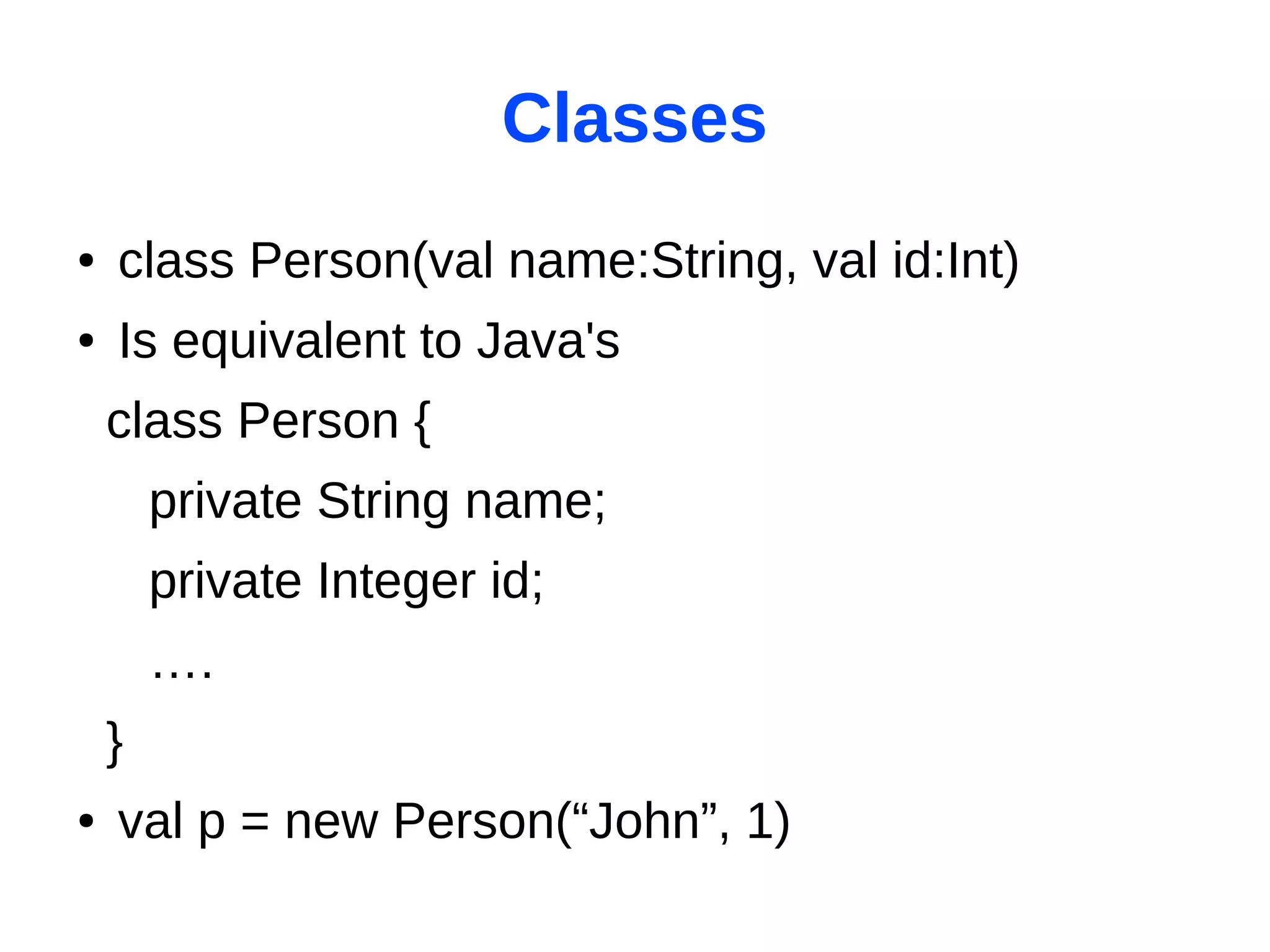
Classes
●   class Person(val name:String, val id:Int)
●   Is equivalent to Java's
    class Person {
        private String name;
        private Integer id;
        ….
    }
●   val p = new Person(“John”, 1)
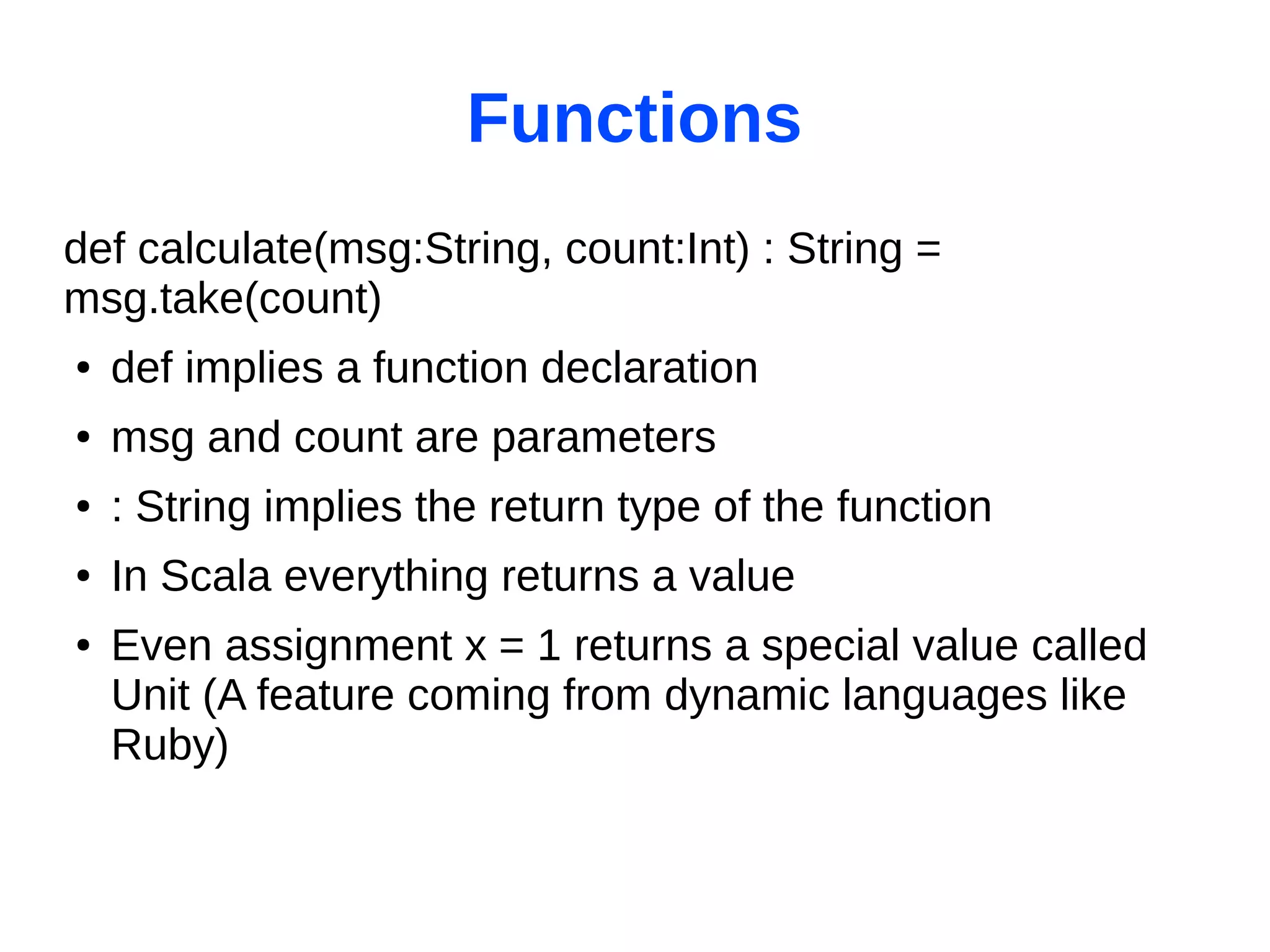
Functions
def calculate(msg:String, count:Int) : String =
msg.take(count)
●   def implies a function declaration
●   msg and count are parameters
●   : String implies the return type of the function
●   In Scala everything returns a value
●   Even assignment x = 1 returns a special value called
    Unit (A feature coming from dynamic languages like
    Ruby)
Tuples are DTO's – Ted Neward
●   Returning multiple values from a function
●   def calculate() : Tuple2[Int, String] = (2, "Ted")
●   val v = calculate // Scala convention no parenthesis
●   Accessing each of the values
    –   v._1 : refers to the first return value
    –   v._2 : refers to the second value
●   Scala has had a big impact from dynamic languages
    like Ruby
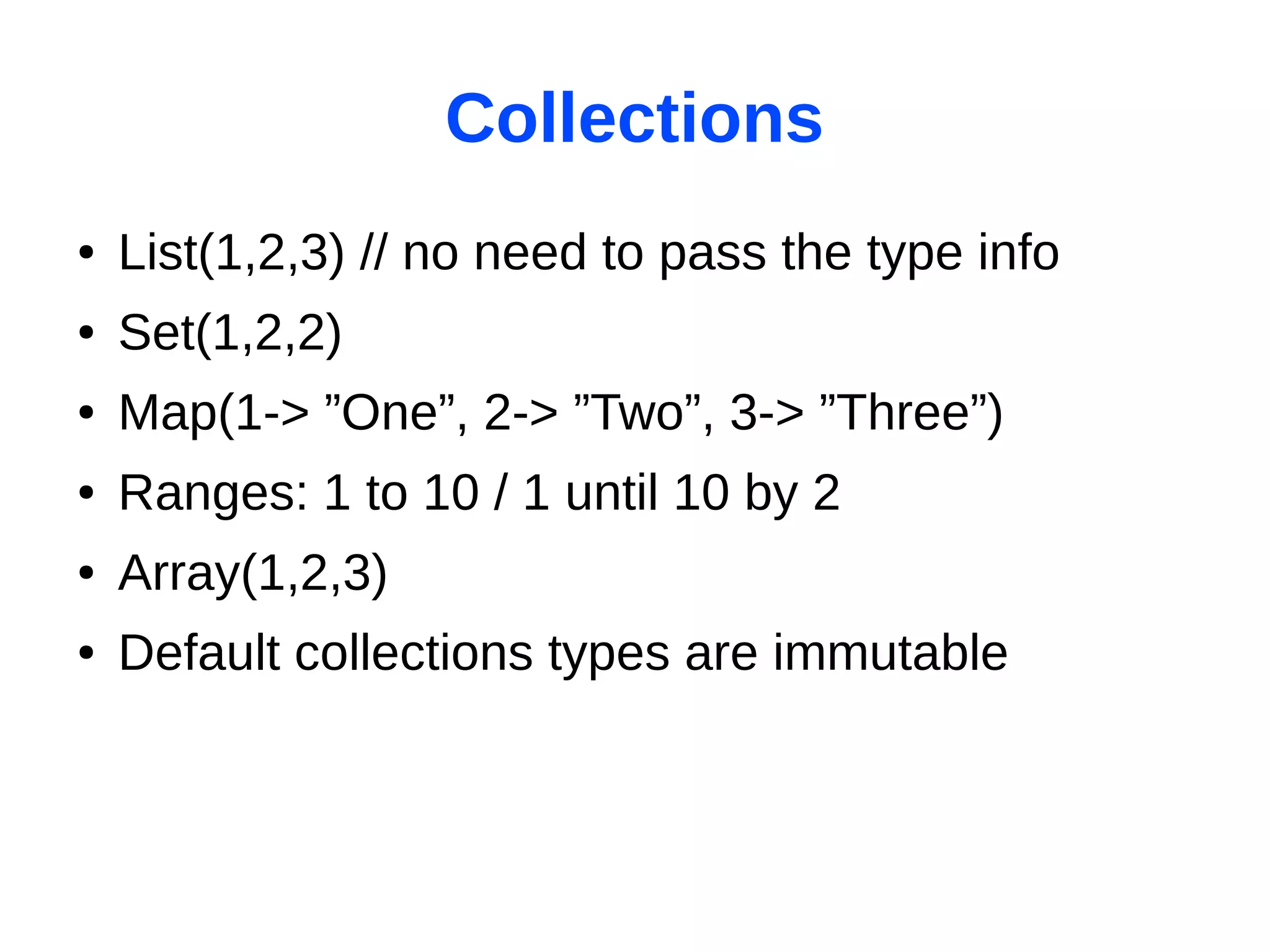
Collections
●   List(1,2,3) // no need to pass the type info
●   Set(1,2,2)
●   Map(1-> ”One”, 2-> ”Two”, 3-> ”Three”)
●   Ranges: 1 to 10 / 1 until 10 by 2
●   Array(1,2,3)
●   Default collections types are immutable
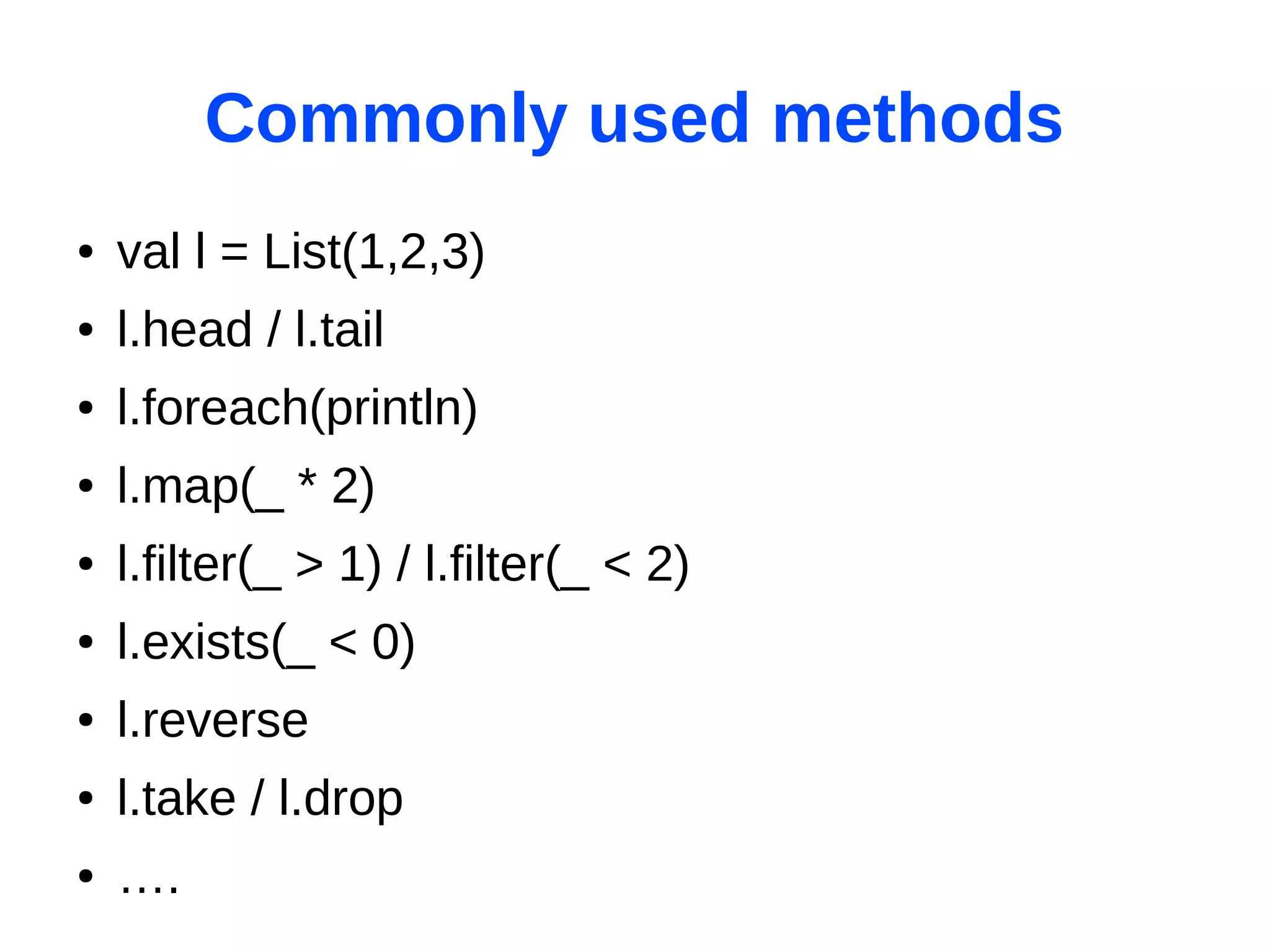
Commonly used methods
●   val l = List(1,2,3)
●   l.head / l.tail
●   l.foreach(println)
●   l.map(_ * 2)
●   l.filter(_ > 1) / l.filter(_ < 2)
●   l.exists(_ < 0)
●   l.reverse
●   l.take / l.drop
●   ….
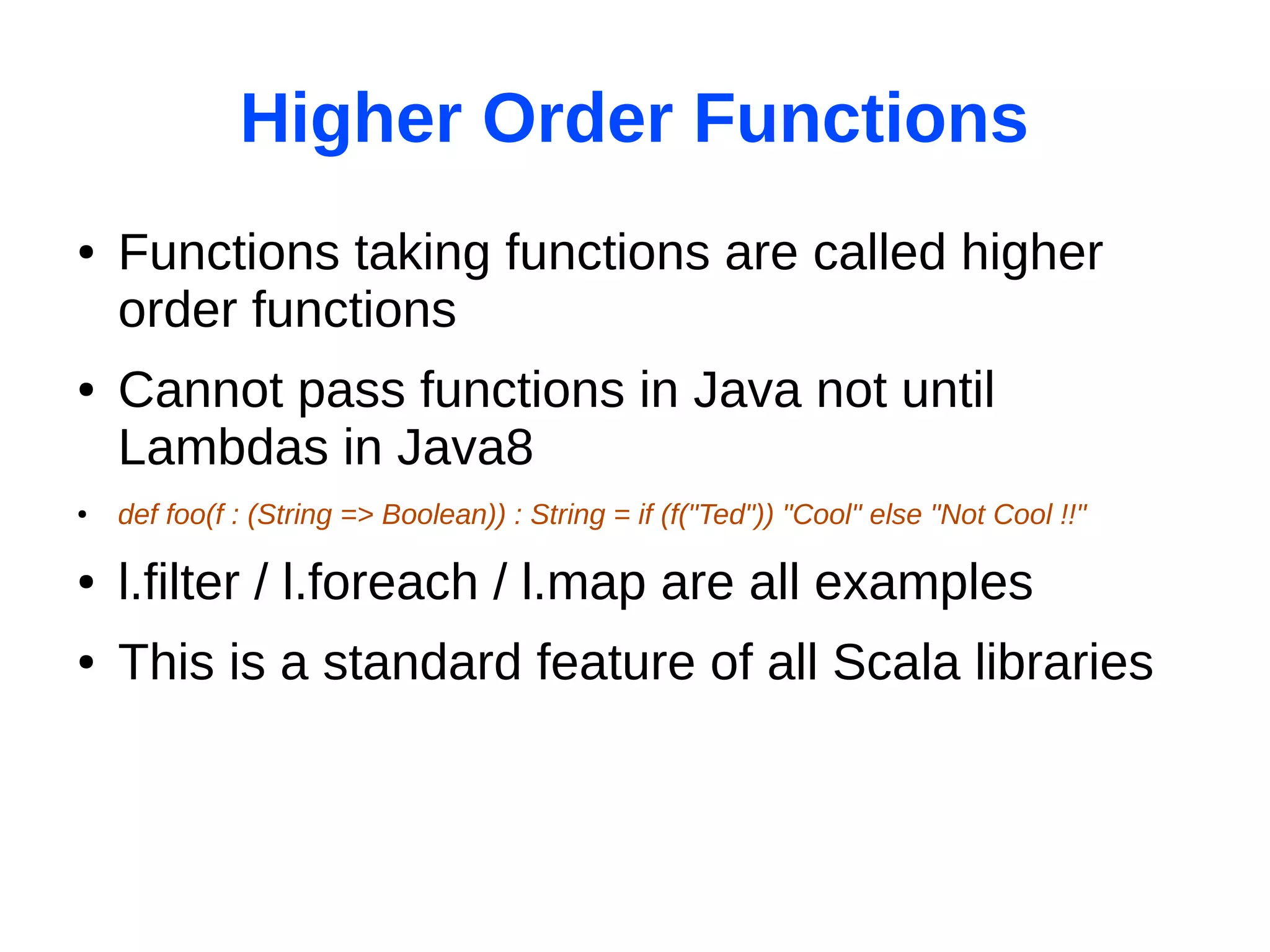
Higher Order Functions
●   Functions taking functions are called higher
    order functions
●   Cannot pass functions in Java not until
    Lambdas in Java8
●   def foo(f : (String => Boolean)) : String = if (f("Ted")) "Cool" else "Not Cool !!"

●   l.filter / l.foreach / l.map are all examples
●   This is a standard feature of all Scala libraries
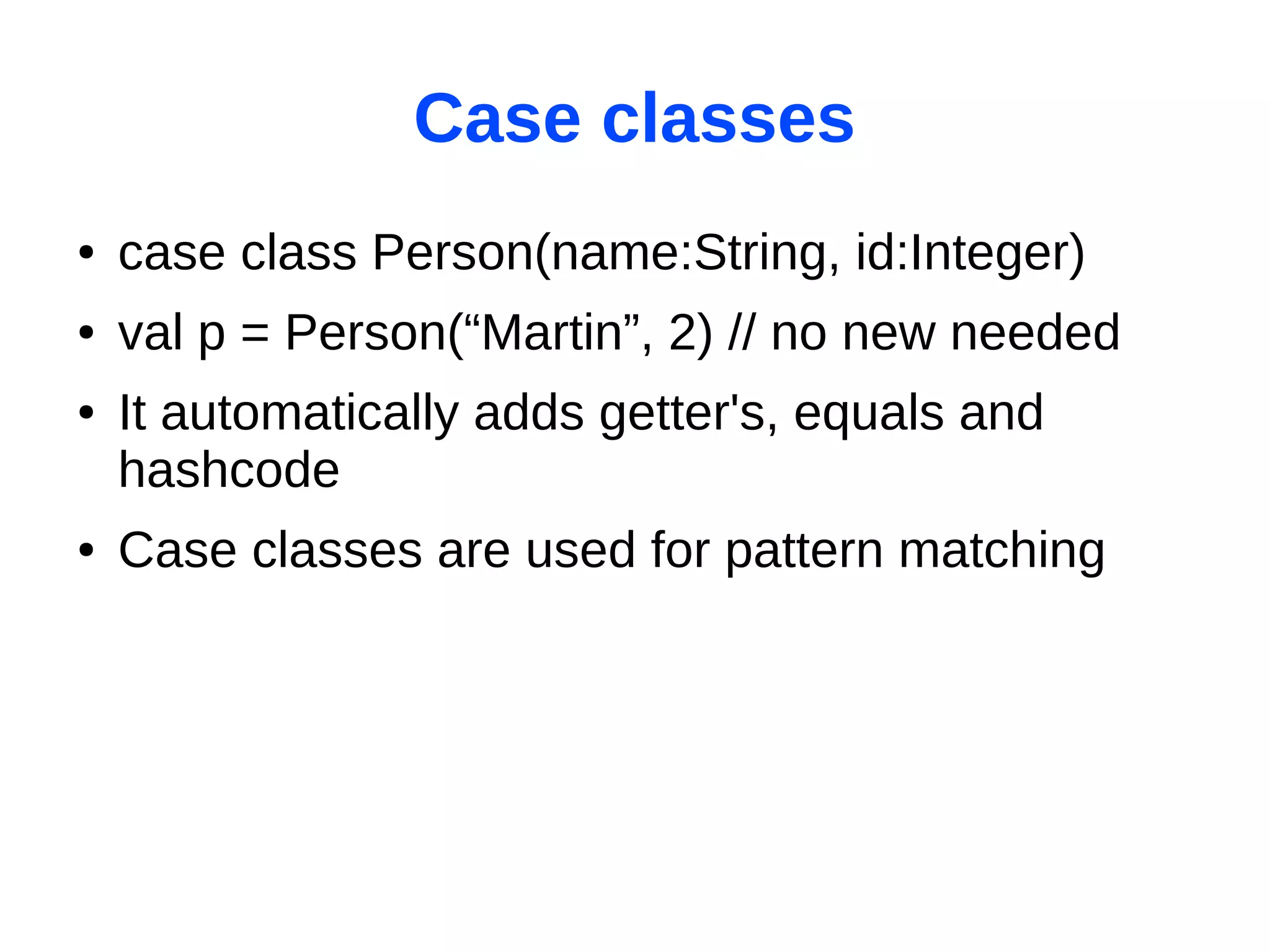
Case classes
●   case class Person(name:String, id:Integer)
●   val p = Person(“Martin”, 2) // no new needed
●   It automatically adds getter's, equals and
    hashcode
●   Case classes are used for pattern matching
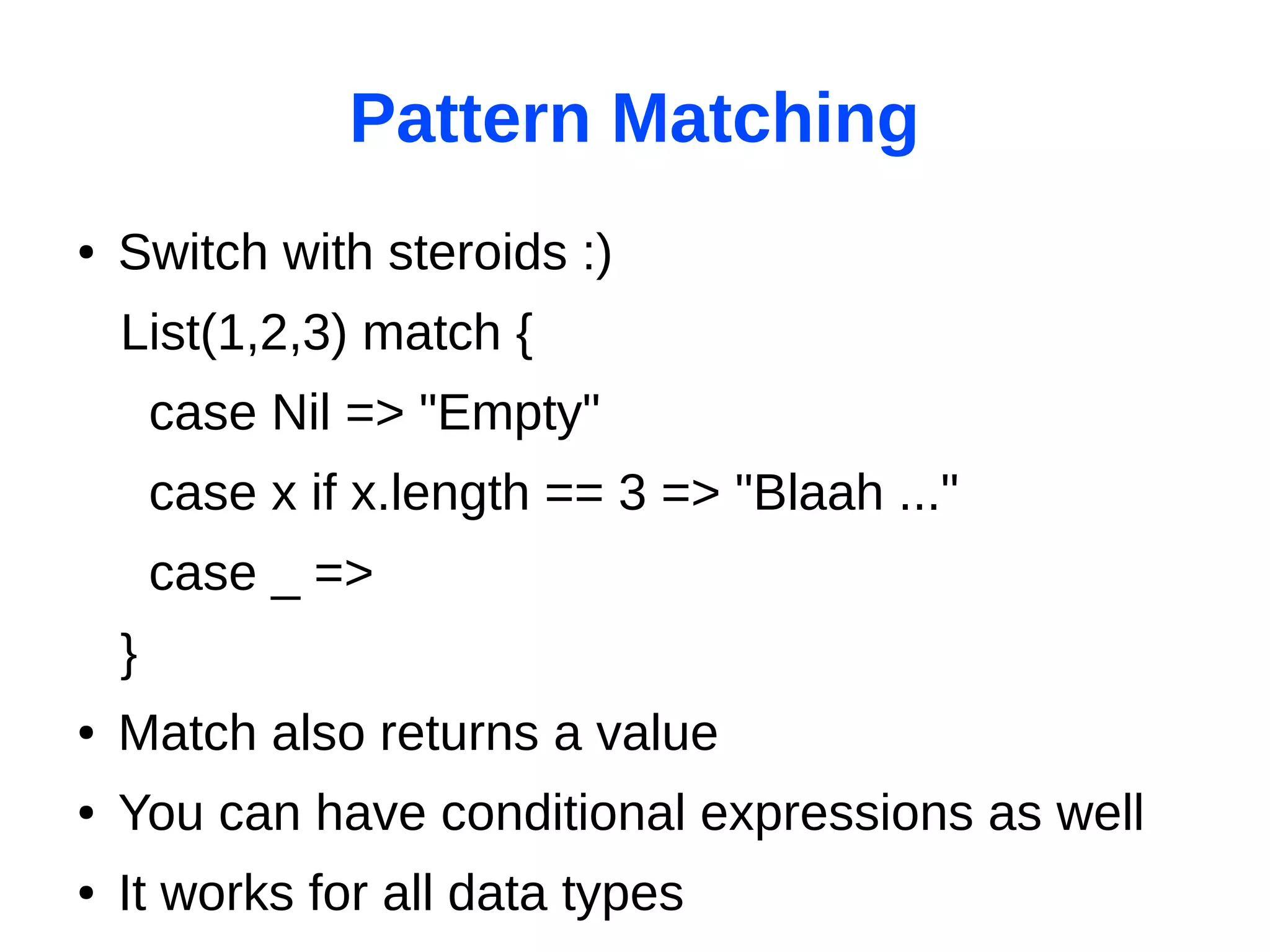
Pattern Matching
●   Switch with steroids :)
    List(1,2,3) match {
        case Nil => "Empty"
        case x if x.length == 3 => "Blaah ..."
        case _ =>
    }
●   Match also returns a value
●   You can have conditional expressions as well
●   It works for all data types
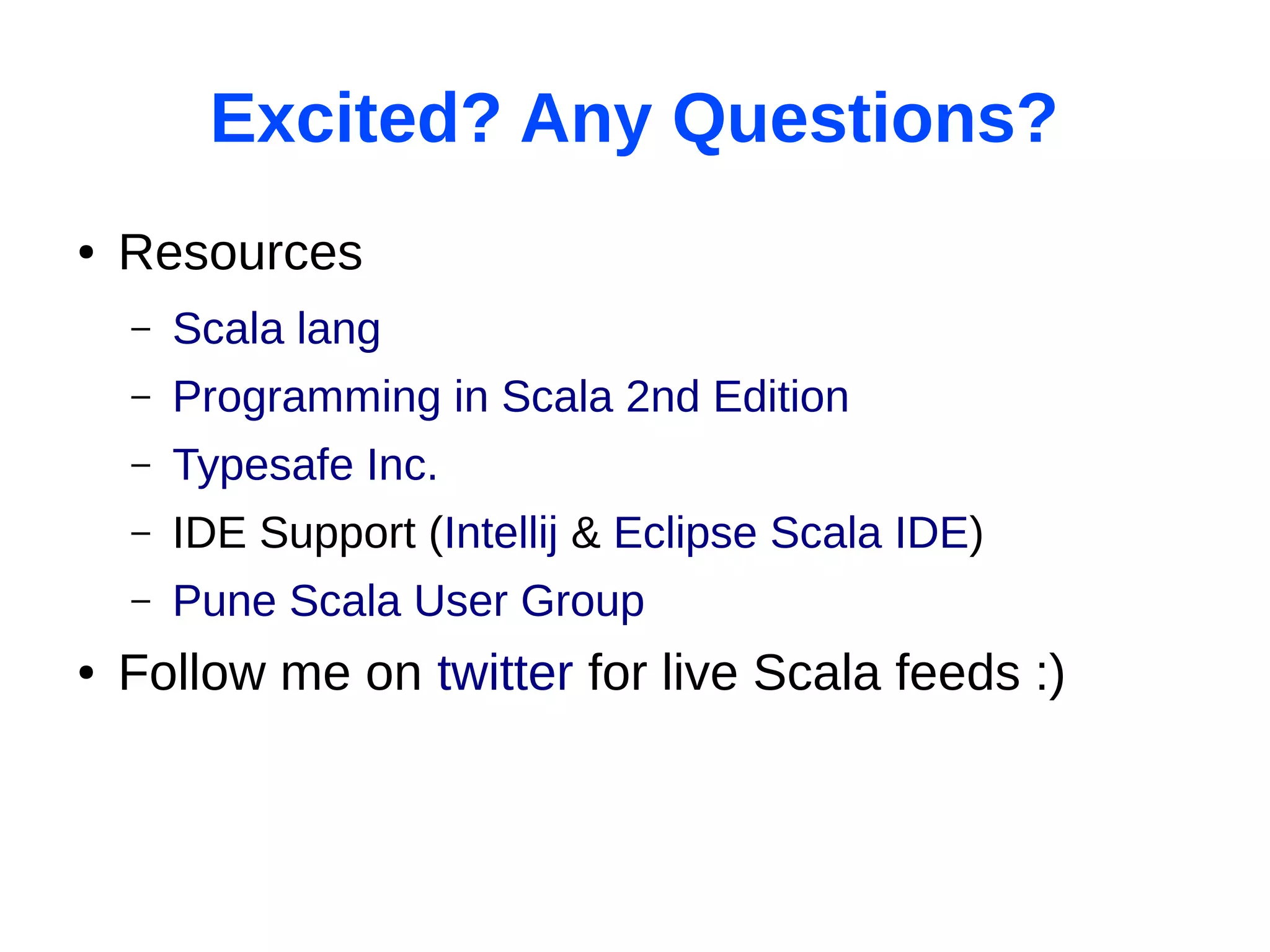
Excited? Any Questions?
●   Resources
    –   Scala lang
    –   Programming in Scala 2nd Edition
    –   Typesafe Inc.
    –   IDE Support (Intellij & Eclipse Scala IDE)
    –   Pune Scala User Group
●   Follow me on twitter for live Scala feeds :)

Introduction To Scala

  • 1.
    scala> “Hello Scala” Scalastands for “scalable language.” The language is so named because it was designed to grow with the demands of its users.
  • 2.
    History ● The design of Scala started in 2001 at the (EPFL) by Martin Odersky, Odersky had previously worked on Generic Java and javac, Sun's Java compiler ● Scala was released late 2003/early 2004 on the Java platform ● Recent Scala release 2.10.0 ● On 12 May 2011, Odersky and collaborators launched Typesafe Inc., a company to provide commercial support, training, and services for Scala
  • 3.
    Scala Adopters ● Twitter ● FourSqaure ● LinkedIn ● Sony ● OPOWER ● Siemens
  • 4.
    Features ● Scala is OO ● Scala is Functional ● Strongly Typed – even more so than Java ● Type Invariance ● Implicits – Analogous to Ruby's open classes ● Duck Typing – anything that quacks is a duck ● String Interpolation
  • 5.
    Hello Scala object Greeting{ def main(args: Array[String]) { println("Hello World !!!") } } ● Look maa no semicolon ● Object ?
  • 6.
    Variables object Greeter { def main(args:Array[String]) { val message = “Hello” // final equivalent message = “Bye !!” // won't work var num = 2 num = 3 // will work } }
  • 7.
    Classes ● class Person(val name:String, val id:Int) ● Is equivalent to Java's class Person { private String name; private Integer id; …. } ● val p = new Person(“John”, 1)
  • 8.
    Functions def calculate(msg:String, count:Int): String = msg.take(count) ● def implies a function declaration ● msg and count are parameters ● : String implies the return type of the function ● In Scala everything returns a value ● Even assignment x = 1 returns a special value called Unit (A feature coming from dynamic languages like Ruby)
  • 9.
    Tuples are DTO's– Ted Neward ● Returning multiple values from a function ● def calculate() : Tuple2[Int, String] = (2, "Ted") ● val v = calculate // Scala convention no parenthesis ● Accessing each of the values – v._1 : refers to the first return value – v._2 : refers to the second value ● Scala has had a big impact from dynamic languages like Ruby
  • 10.
    Collections ● List(1,2,3) // no need to pass the type info ● Set(1,2,2) ● Map(1-> ”One”, 2-> ”Two”, 3-> ”Three”) ● Ranges: 1 to 10 / 1 until 10 by 2 ● Array(1,2,3) ● Default collections types are immutable
  • 11.
    Commonly used methods ● val l = List(1,2,3) ● l.head / l.tail ● l.foreach(println) ● l.map(_ * 2) ● l.filter(_ > 1) / l.filter(_ < 2) ● l.exists(_ < 0) ● l.reverse ● l.take / l.drop ● ….
  • 12.
    Higher Order Functions ● Functions taking functions are called higher order functions ● Cannot pass functions in Java not until Lambdas in Java8 ● def foo(f : (String => Boolean)) : String = if (f("Ted")) "Cool" else "Not Cool !!" ● l.filter / l.foreach / l.map are all examples ● This is a standard feature of all Scala libraries
  • 13.
    Case classes ● case class Person(name:String, id:Integer) ● val p = Person(“Martin”, 2) // no new needed ● It automatically adds getter's, equals and hashcode ● Case classes are used for pattern matching
  • 14.
    Pattern Matching ● Switch with steroids :) List(1,2,3) match { case Nil => "Empty" case x if x.length == 3 => "Blaah ..." case _ => } ● Match also returns a value ● You can have conditional expressions as well ● It works for all data types
  • 15.
    Excited? Any Questions? ● Resources – Scala lang – Programming in Scala 2nd Edition – Typesafe Inc. – IDE Support (Intellij & Eclipse Scala IDE) – Pune Scala User Group ● Follow me on twitter for live Scala feeds :)