Recommendation Systems
Pawan Goyal
CSE, IITKGP
October 29-30, 2015
Pawan Goyal (IIT Kharagpur) Recommendation Systems October 29-30, 2015 1 / 61
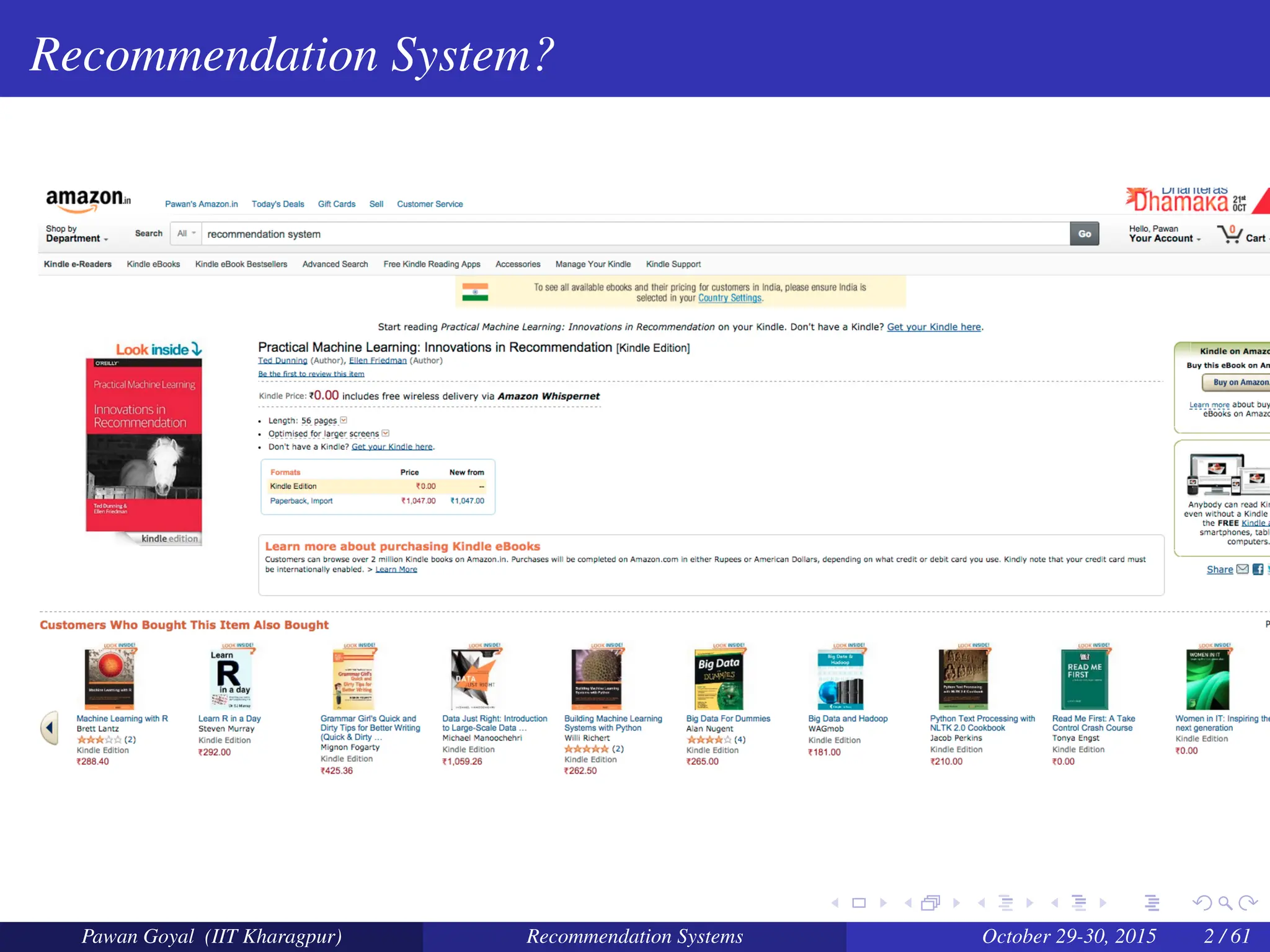
Recommendation System?
Pawan Goyal (IIT Kharagpur) Recommendation Systems October 29-30, 2015 2 / 61
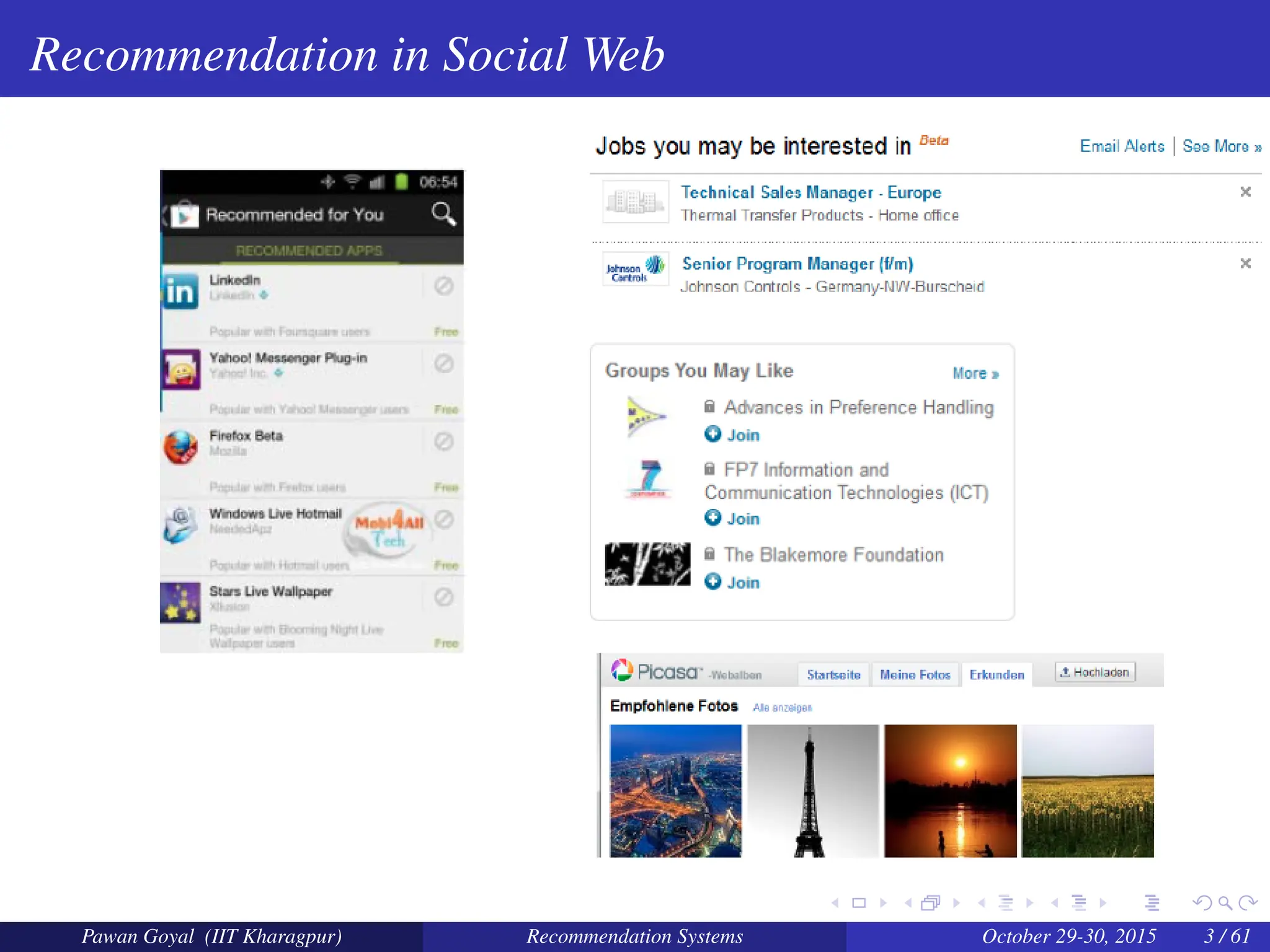
Recommendation in Social Web
Pawan Goyal (IIT Kharagpur) Recommendation Systems October 29-30, 2015 3 / 61
Why using Recommender Systems?
Value for the customers
Find things that are interesting
Narrow down the set of choices
Discover new things
Entertainment ...
Pawan Goyal (IIT Kharagpur) Recommendation Systems October 29-30, 2015 4 / 61
Why using Recommender Systems?
Value for the customers
Find things that are interesting
Narrow down the set of choices
Discover new things
Entertainment ...
Value for the provider
Additional and unique personalized service for the customer
Increase trust and customer loyalty
Increase sales, click through rates, conversion etc
Opportunity for promotion, persuasion
Obtain more knowledge about customers
Pawan Goyal (IIT Kharagpur) Recommendation Systems October 29-30, 2015 4 / 61
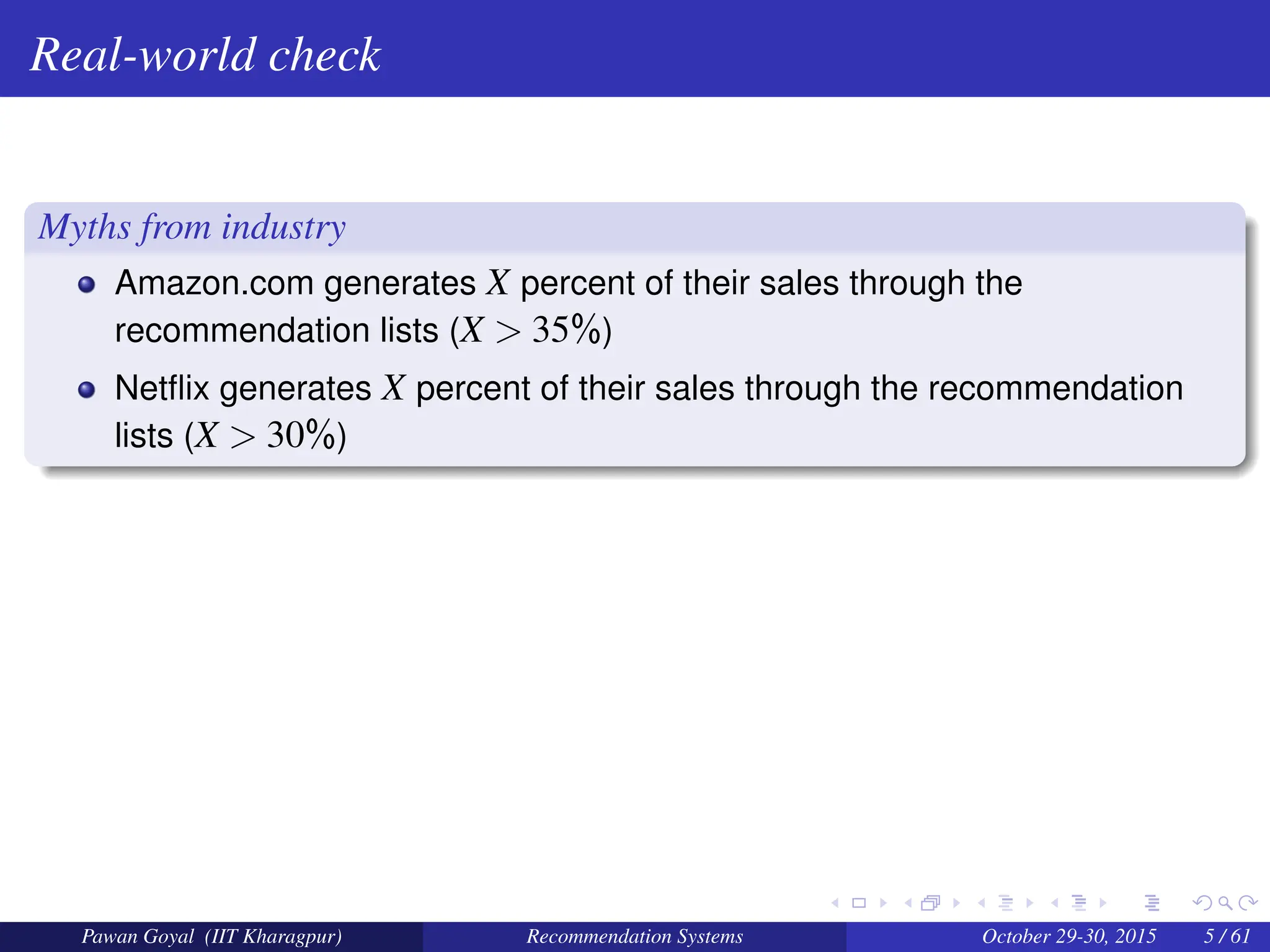
Real-world check
Myths from industry
Amazon.com generates X percent of their sales through the
recommendation lists (X > 35%)
Netflix generates X percent of their sales through the recommendation
lists (X > 30%)
Pawan Goyal (IIT Kharagpur) Recommendation Systems October 29-30, 2015 5 / 61
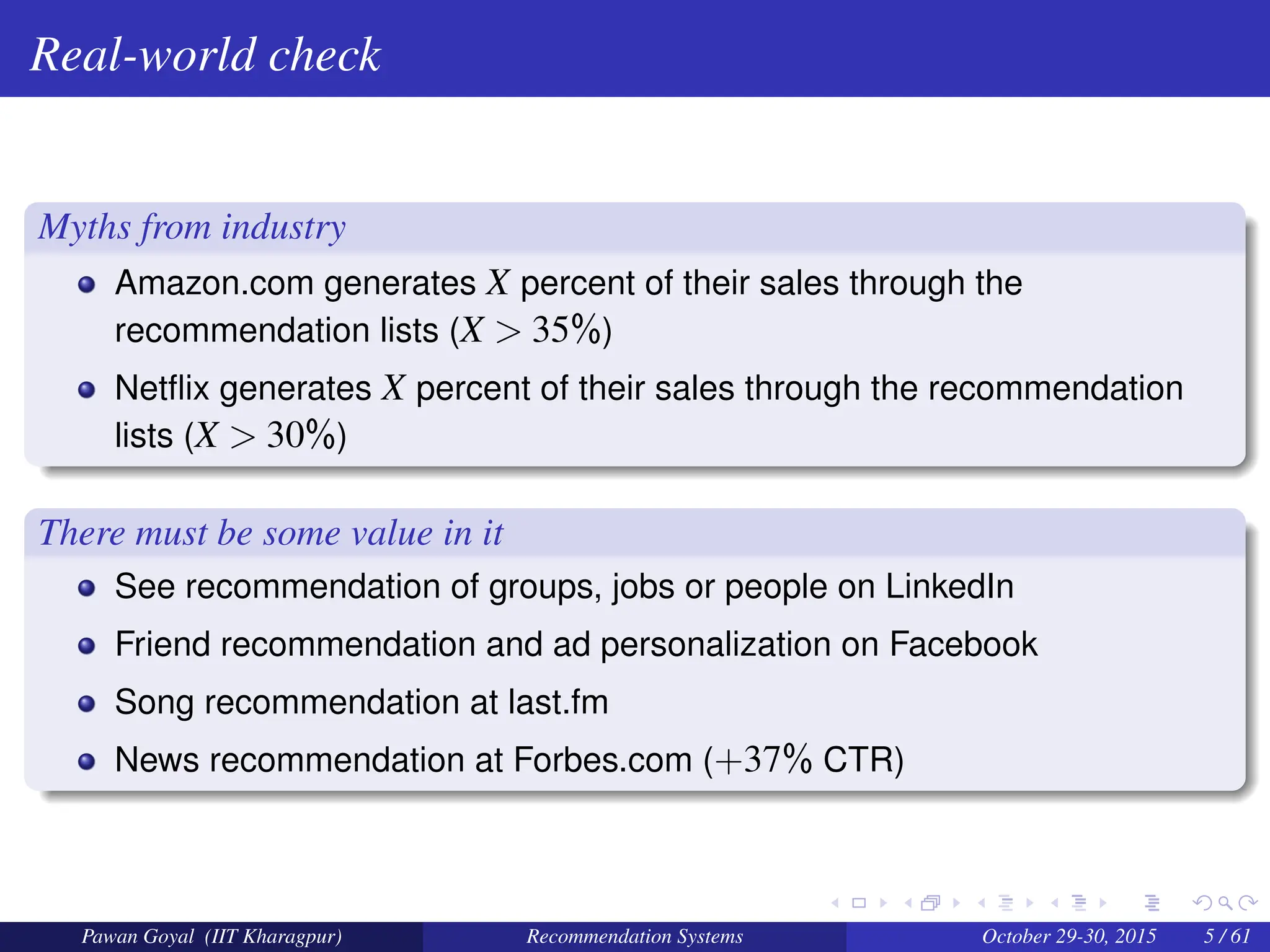
Real-world check
Myths from industry
Amazon.com generates X percent of their sales through the
recommendation lists (X > 35%)
Netflix generates X percent of their sales through the recommendation
lists (X > 30%)
There must be some value in it
See recommendation of groups, jobs or people on LinkedIn
Friend recommendation and ad personalization on Facebook
Song recommendation at last.fm
News recommendation at Forbes.com (+37% CTR)
Pawan Goyal (IIT Kharagpur) Recommendation Systems October 29-30, 2015 5 / 61
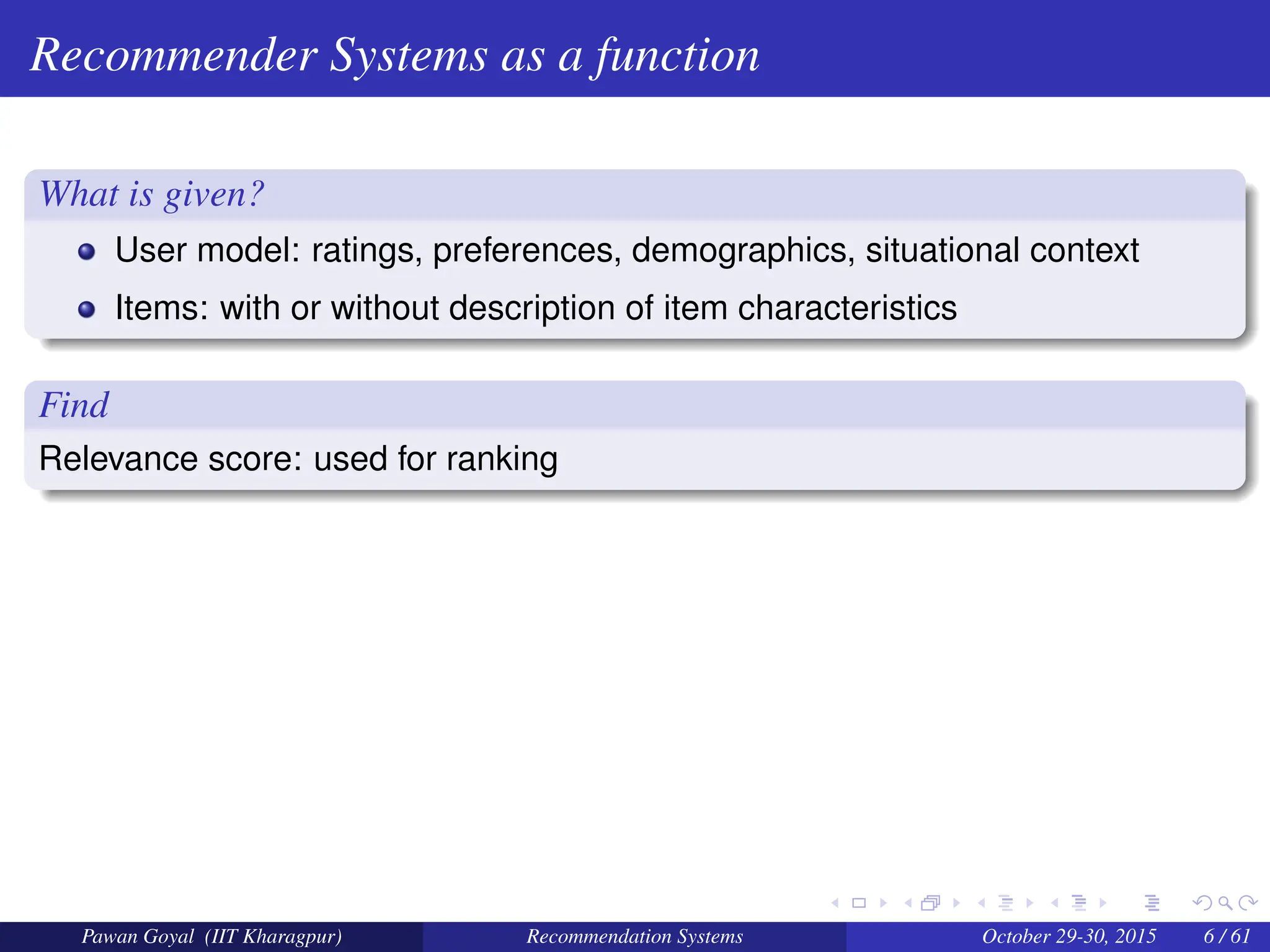
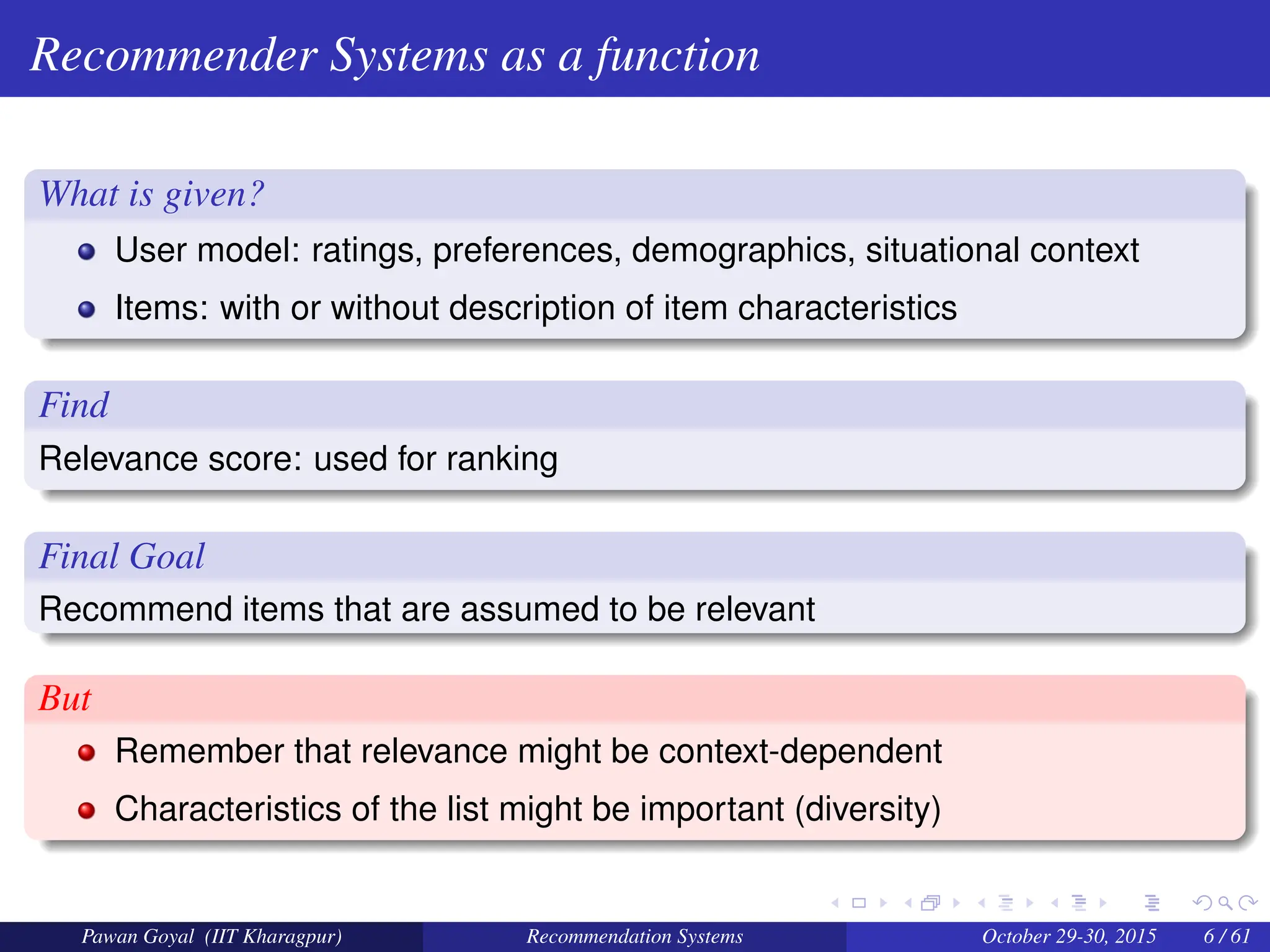
Recommender Systems as a function
What is given?
User model: ratings, preferences, demographics, situational context
Items: with or without description of item characteristics
Pawan Goyal (IIT Kharagpur) Recommendation Systems October 29-30, 2015 6 / 61
Recommender Systems as a function
What is given?
User model: ratings, preferences, demographics, situational context
Items: with or without description of item characteristics
Find
Relevance score: used for ranking
Pawan Goyal (IIT Kharagpur) Recommendation Systems October 29-30, 2015 6 / 61
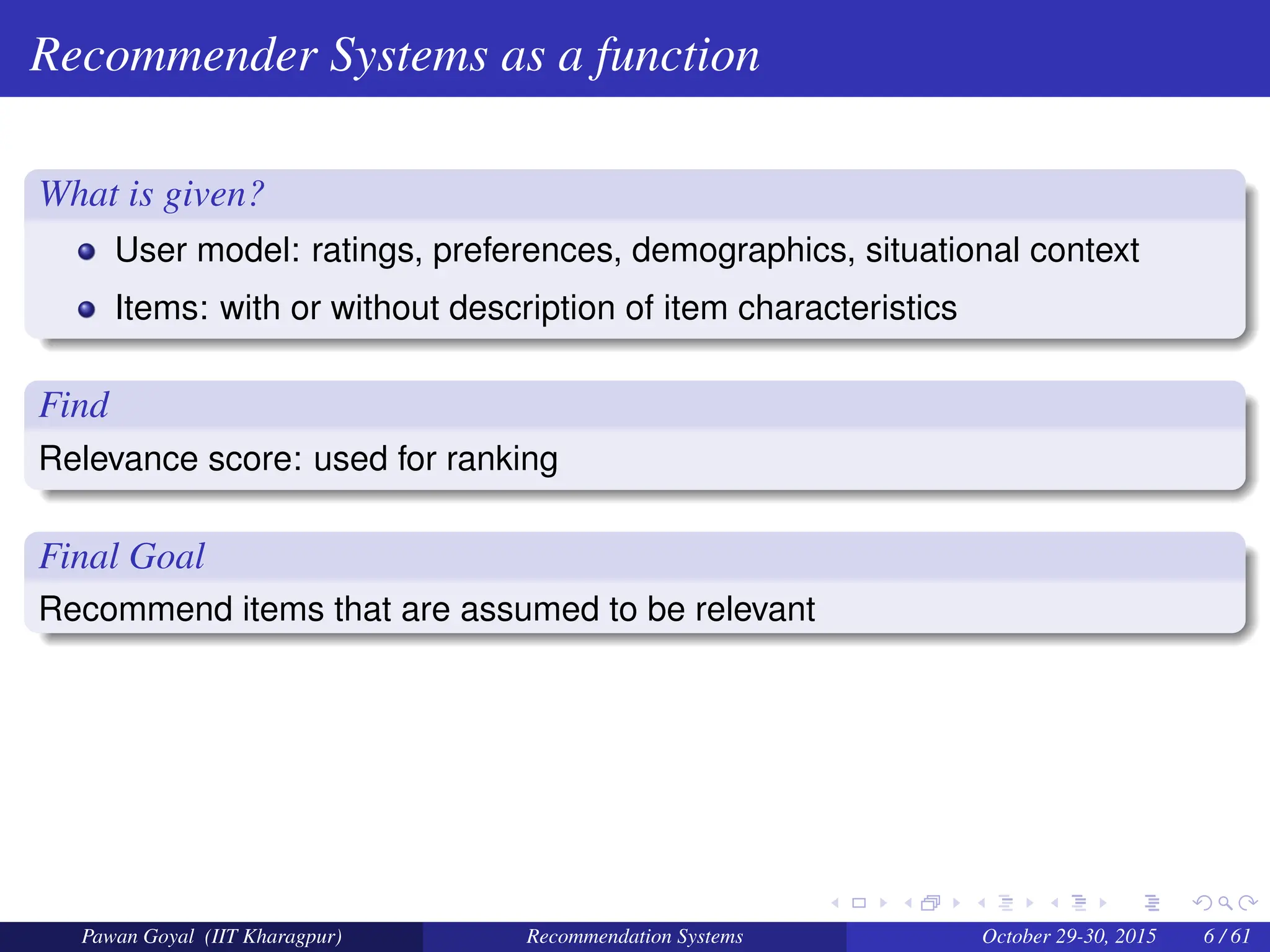
Recommender Systems as a function
What is given?
User model: ratings, preferences, demographics, situational context
Items: with or without description of item characteristics
Find
Relevance score: used for ranking
Final Goal
Recommend items that are assumed to be relevant
Pawan Goyal (IIT Kharagpur) Recommendation Systems October 29-30, 2015 6 / 61
Recommender Systems as a function
What is given?
User model: ratings, preferences, demographics, situational context
Items: with or without description of item characteristics
Find
Relevance score: used for ranking
Final Goal
Recommend items that are assumed to be relevant
But
Remember that relevance might be context-dependent
Characteristics of the list might be important (diversity)
Pawan Goyal (IIT Kharagpur) Recommendation Systems October 29-30, 2015 6 / 61
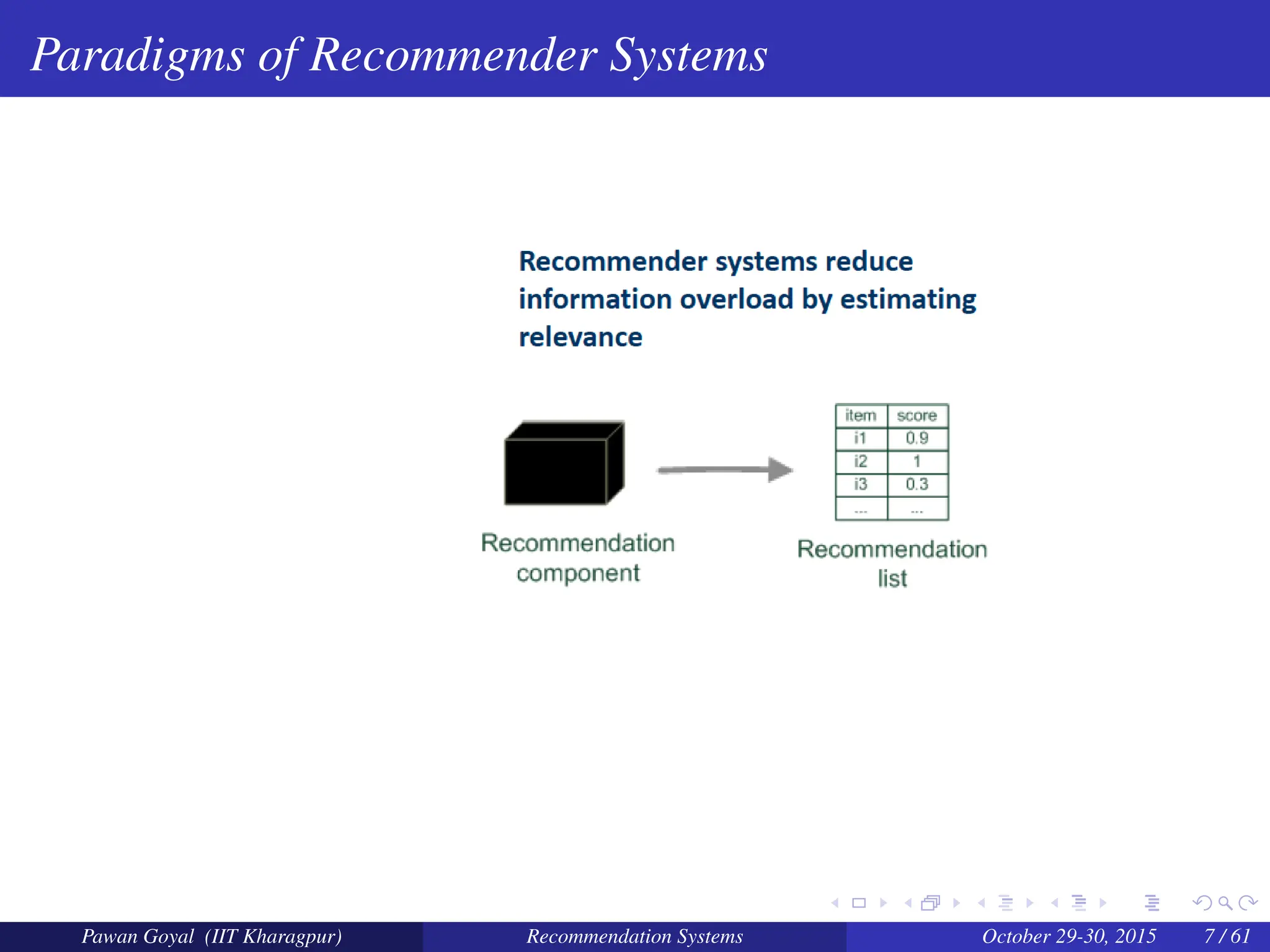
Paradigms of Recommender Systems
Pawan Goyal (IIT Kharagpur) Recommendation Systems October 29-30, 2015 7 / 61
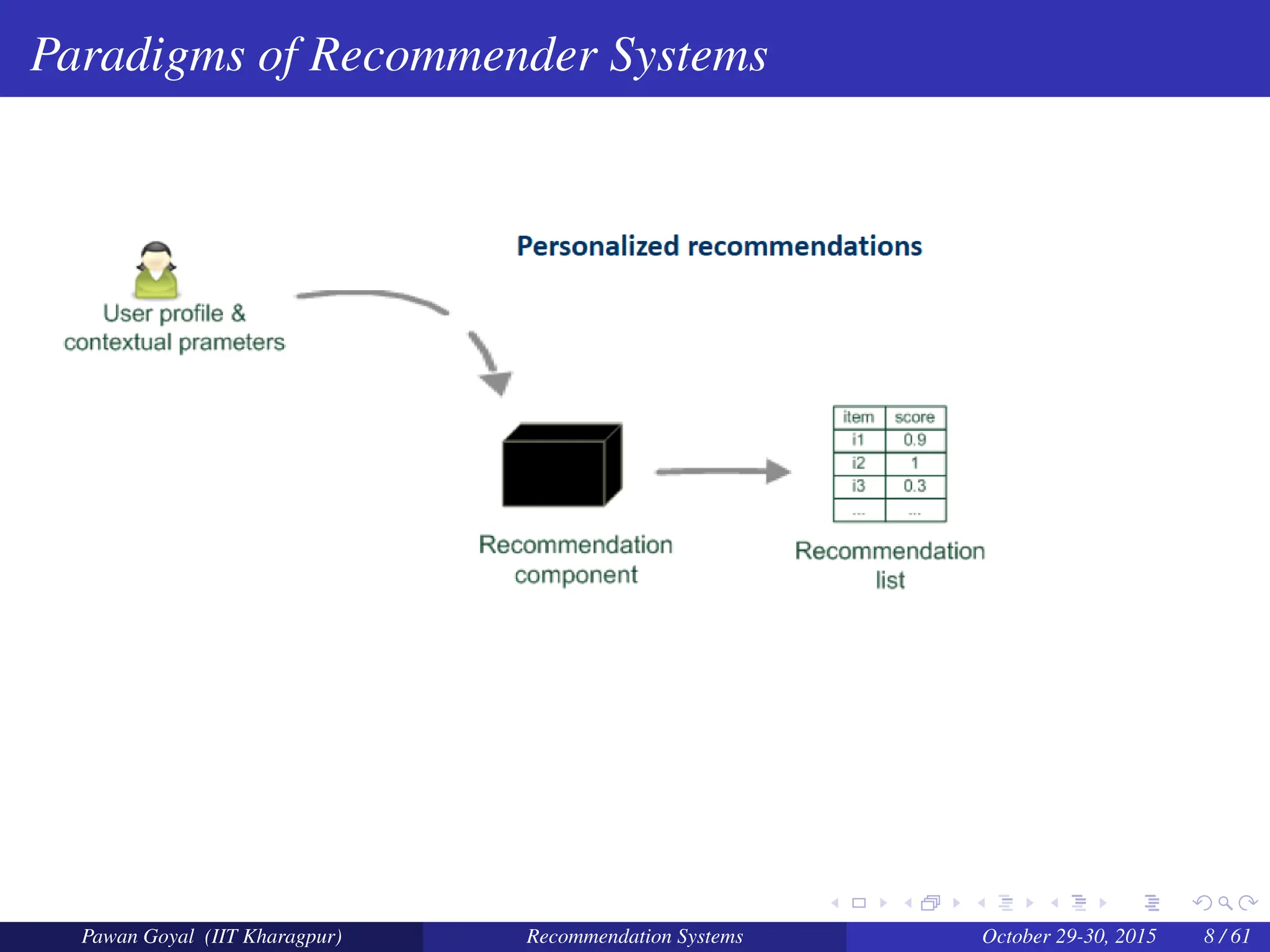
Paradigms of Recommender Systems
Pawan Goyal (IIT Kharagpur) Recommendation Systems October 29-30, 2015 8 / 61
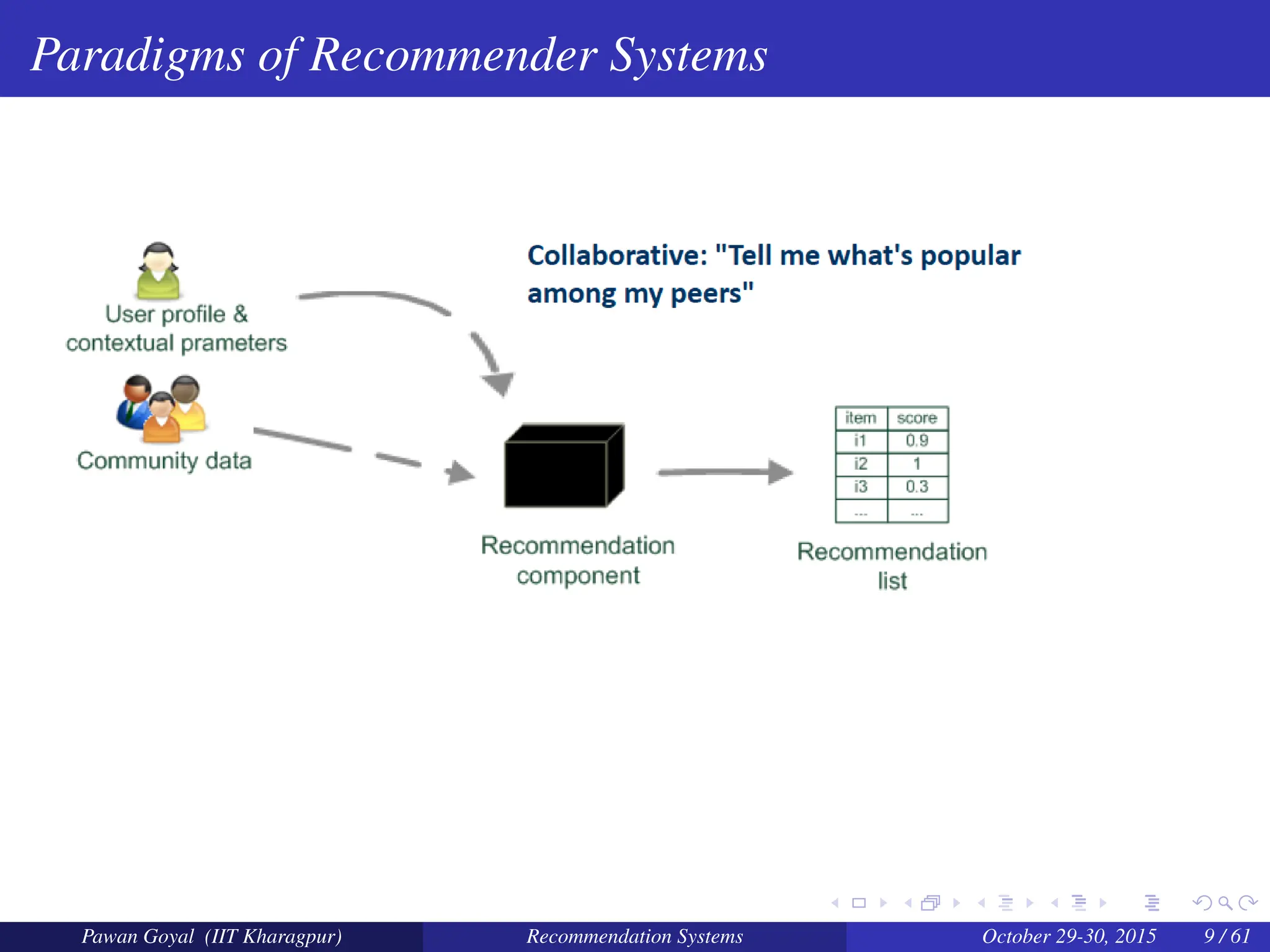
Paradigms of Recommender Systems
Pawan Goyal (IIT Kharagpur) Recommendation Systems October 29-30, 2015 9 / 61
Paradigms of Recommender Systems
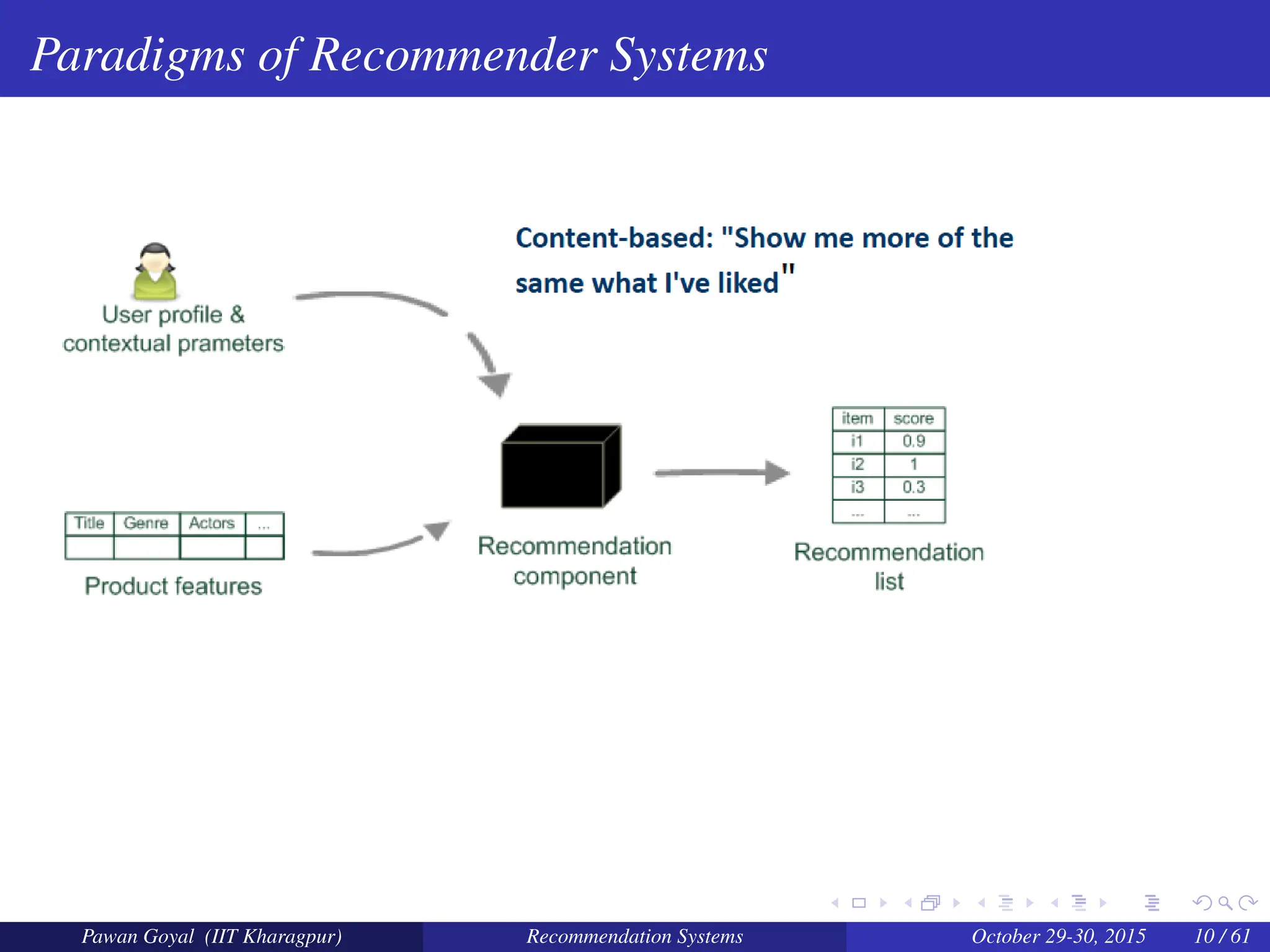
Pawan Goyal (IIT Kharagpur) Recommendation Systems October 29-30, 2015 10 / 61
Paradigms of Recommender Systems
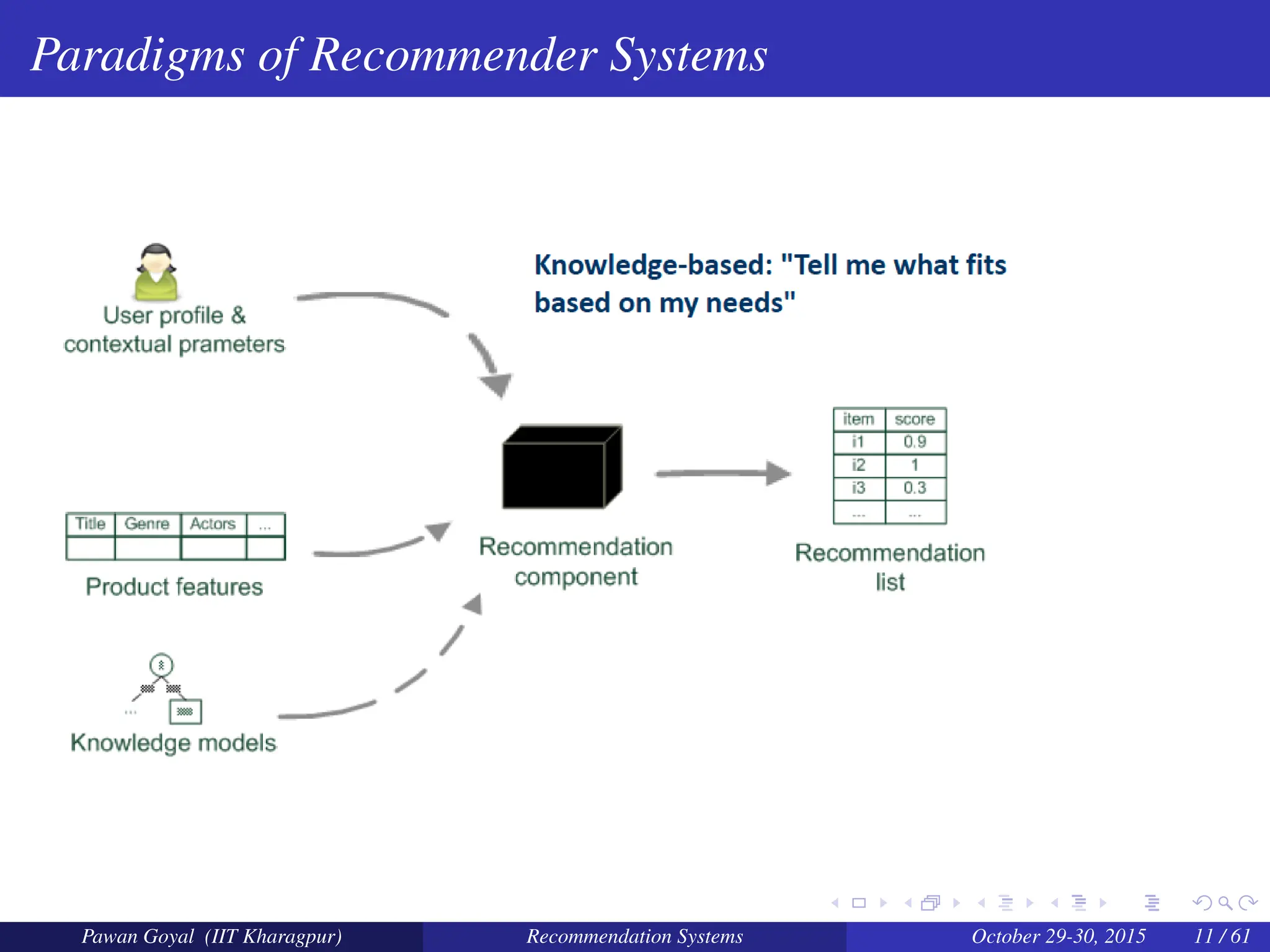
Pawan Goyal (IIT Kharagpur) Recommendation Systems October 29-30, 2015 11 / 61
Paradigms of Recommender Systems
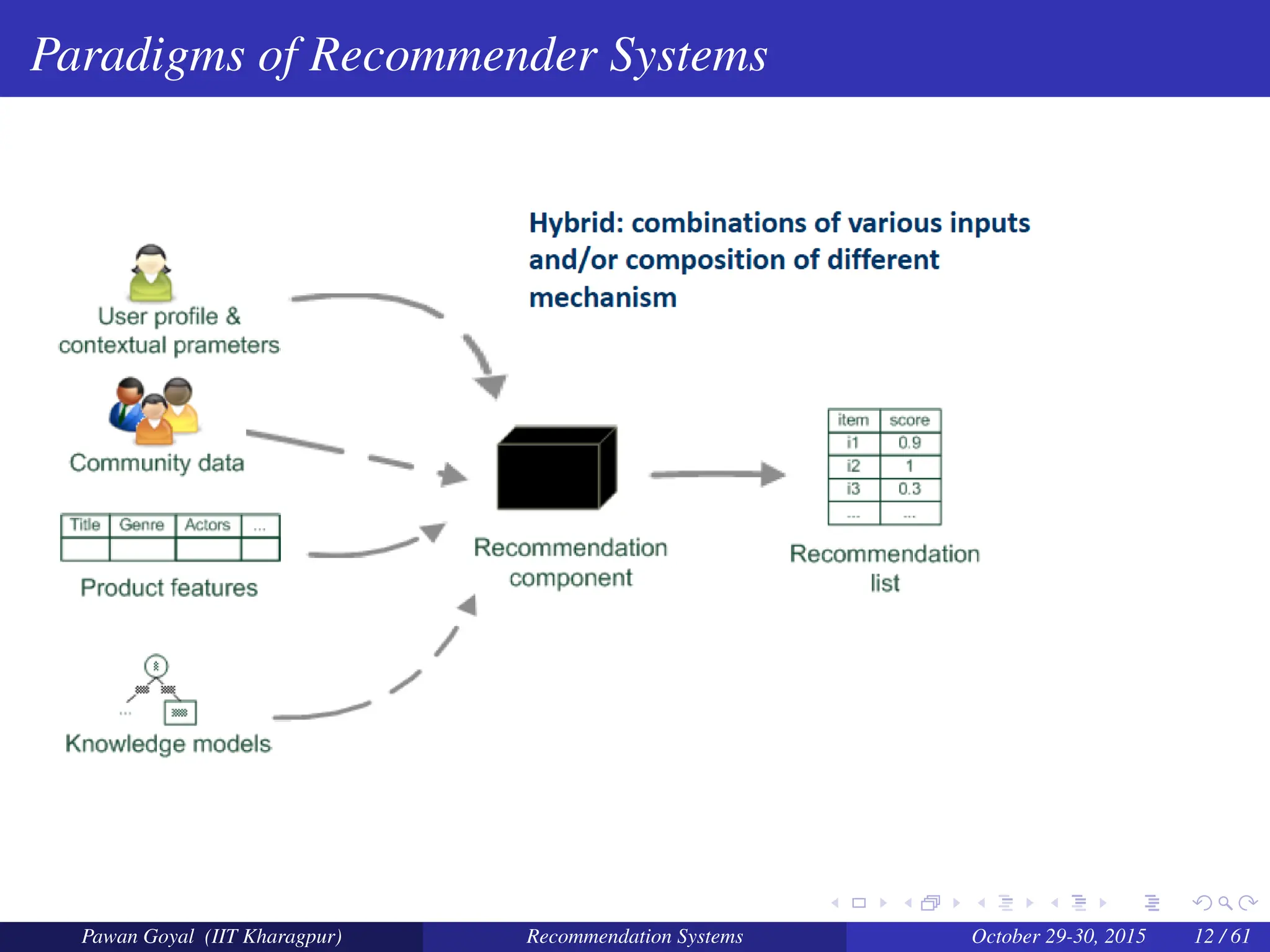
Pawan Goyal (IIT Kharagpur) Recommendation Systems October 29-30, 2015 12 / 61
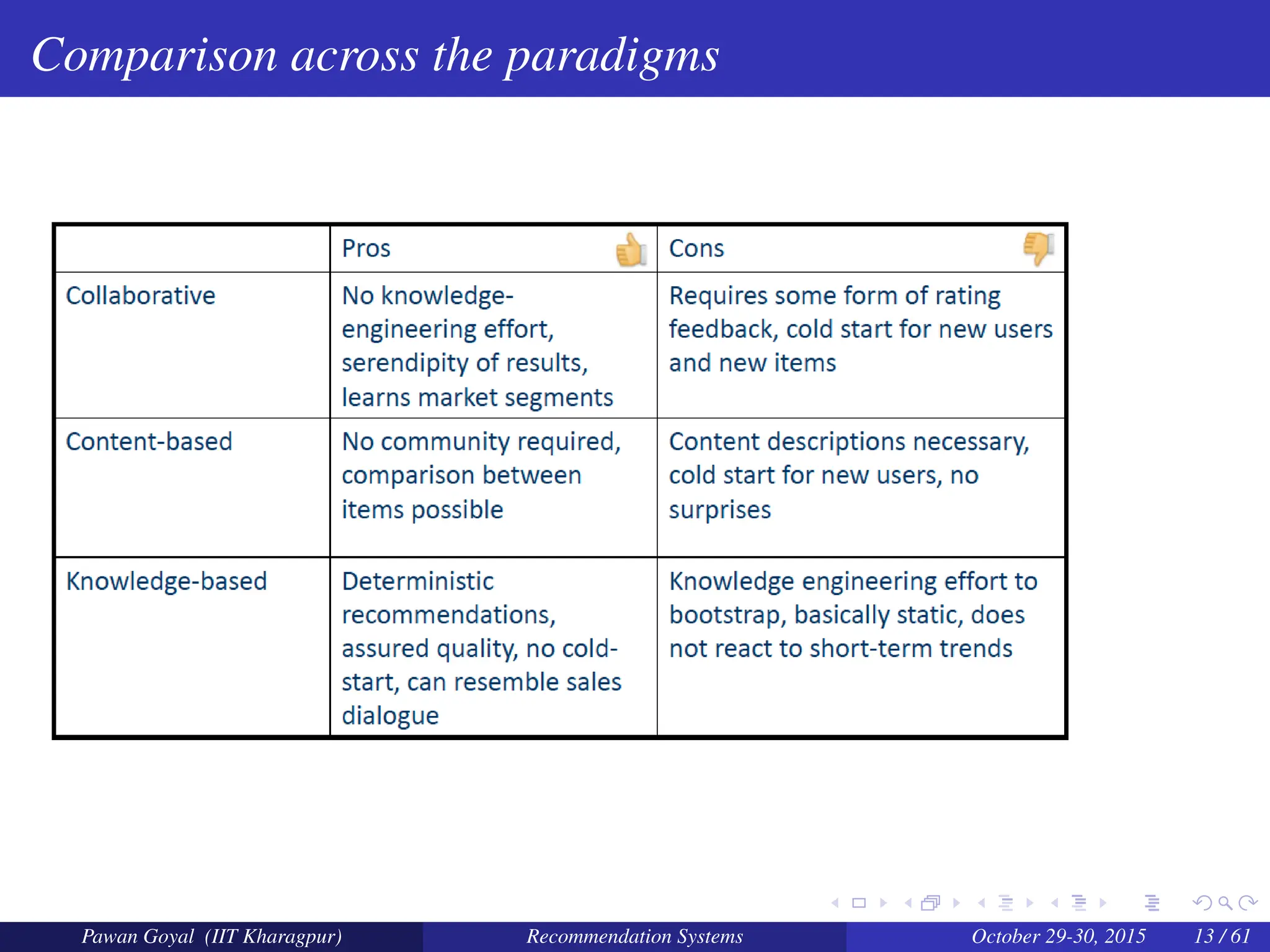
Comparison across the paradigms
Pawan Goyal (IIT Kharagpur) Recommendation Systems October 29-30, 2015 13 / 61
Collaborative Filtering (CF)
The most prominent approach to generate recommendations
Used by large, commercial e-commerce sites
well-understood, various algorithms and variations exist
applicable in many domains (book, movies, ...)
Pawan Goyal (IIT Kharagpur) Recommendation Systems October 29-30, 2015 14 / 61
Collaborative Filtering (CF)
The most prominent approach to generate recommendations
Used by large, commercial e-commerce sites
well-understood, various algorithms and variations exist
applicable in many domains (book, movies, ...)
Approach
Use the “wisdom of the crowd” to recommend items
Pawan Goyal (IIT Kharagpur) Recommendation Systems October 29-30, 2015 14 / 61
Collaborative Filtering (CF)
The most prominent approach to generate recommendations
Used by large, commercial e-commerce sites
well-understood, various algorithms and variations exist
applicable in many domains (book, movies, ...)
Approach
Use the “wisdom of the crowd” to recommend items
Basic assumption and idea
Users give ratings to catalog items (implicitly/explicitly)
Customers with certain tastes in the past, might have similar tastes in the
future
Pawan Goyal (IIT Kharagpur) Recommendation Systems October 29-30, 2015 14 / 61
User-based Collaborative Filtering
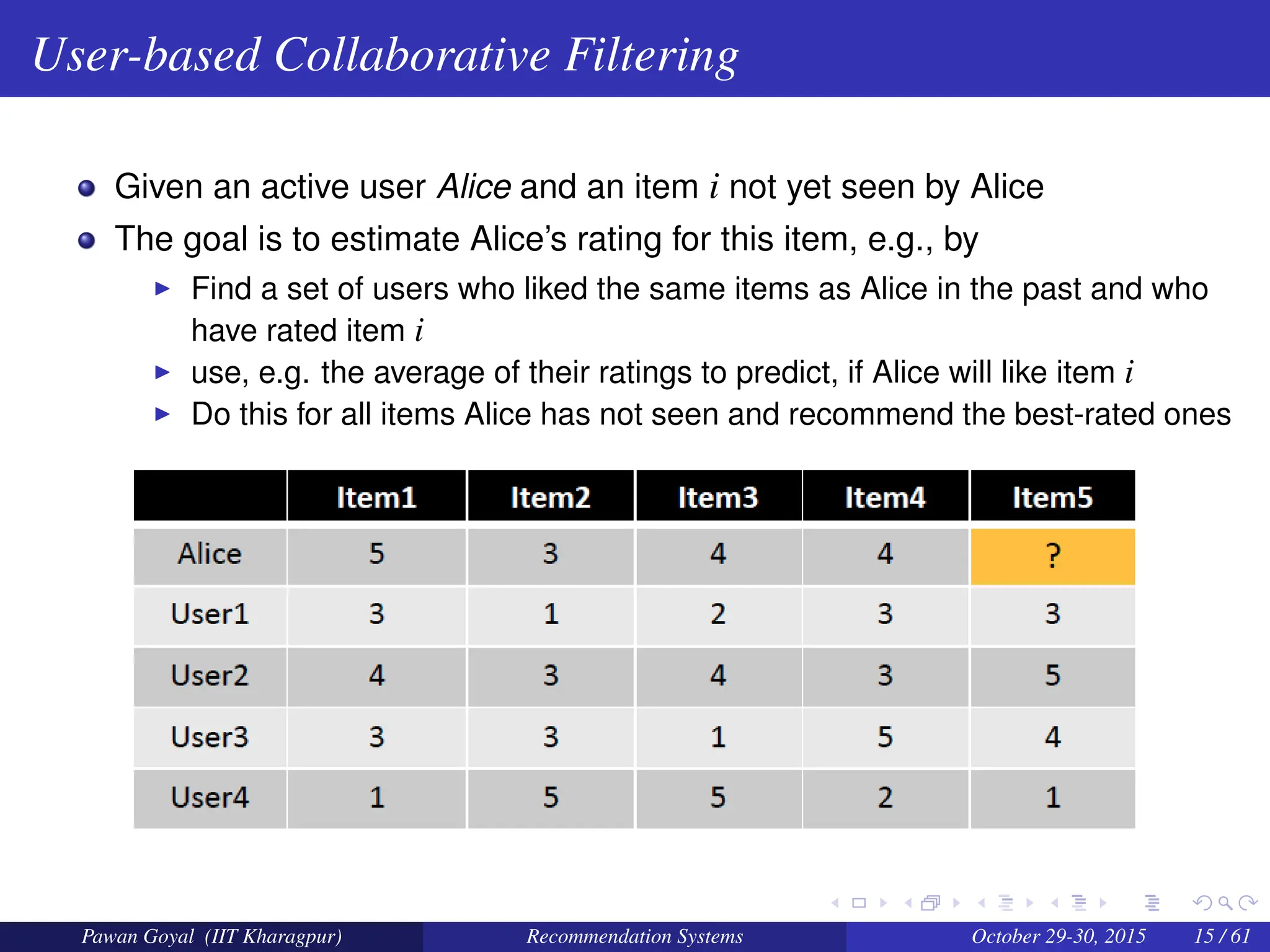
Given an active user Alice and an item i not yet seen by Alice
The goal is to estimate Alice’s rating for this item, e.g., by
Pawan Goyal (IIT Kharagpur) Recommendation Systems October 29-30, 2015 15 / 61
User-based Collaborative Filtering
Given an active user Alice and an item i not yet seen by Alice
The goal is to estimate Alice’s rating for this item, e.g., by
I Find a set of users who liked the same items as Alice in the past and who
have rated item i
I use, e.g. the average of their ratings to predict, if Alice will like item i
I Do this for all items Alice has not seen and recommend the best-rated ones
Pawan Goyal (IIT Kharagpur) Recommendation Systems October 29-30, 2015 15 / 61
User-based Collaborative Filtering
Some first questions
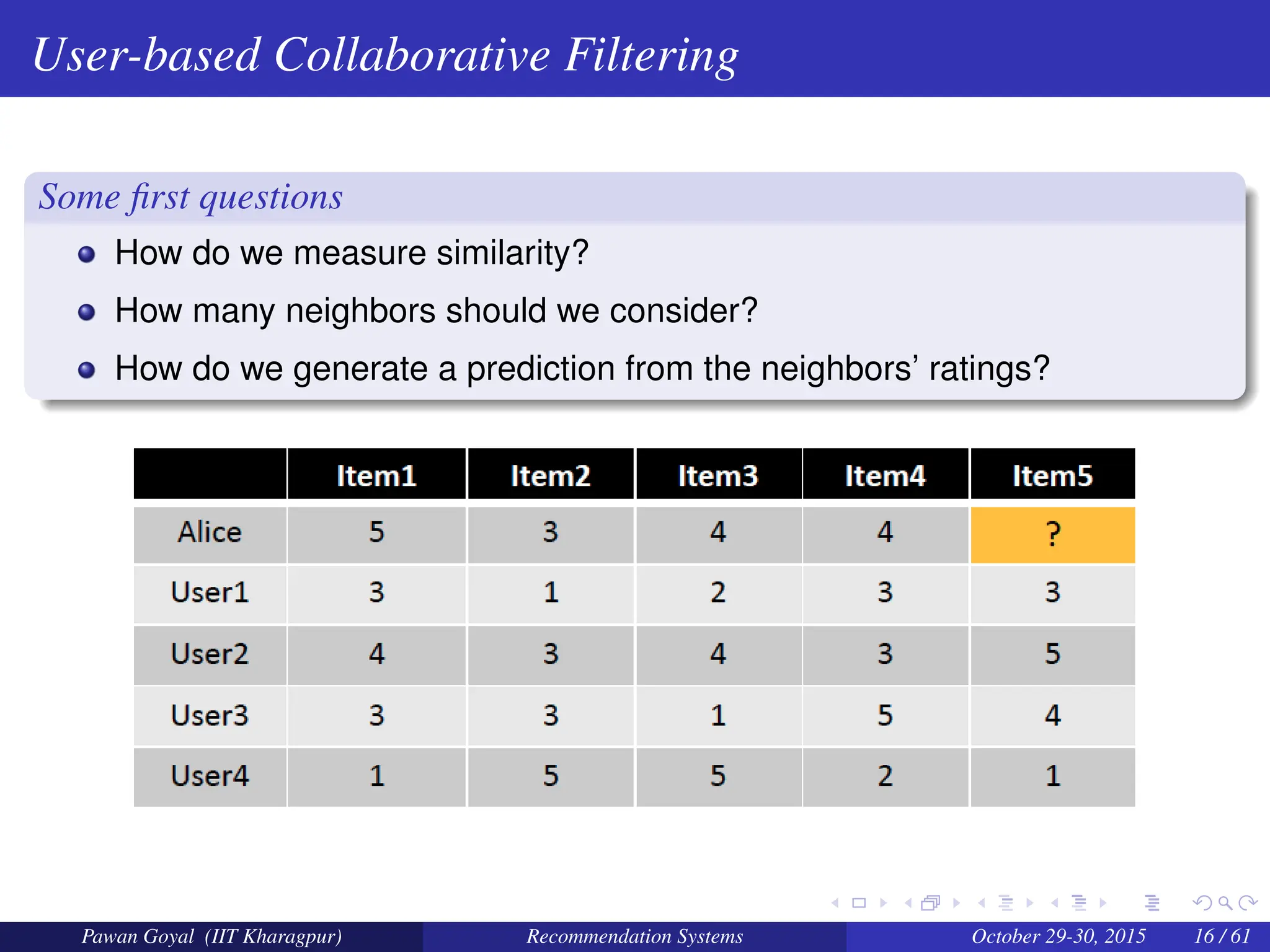
How do we measure similarity?
How many neighbors should we consider?
How do we generate a prediction from the neighbors’ ratings?
Pawan Goyal (IIT Kharagpur) Recommendation Systems October 29-30, 2015 16 / 61
Popular similarity model
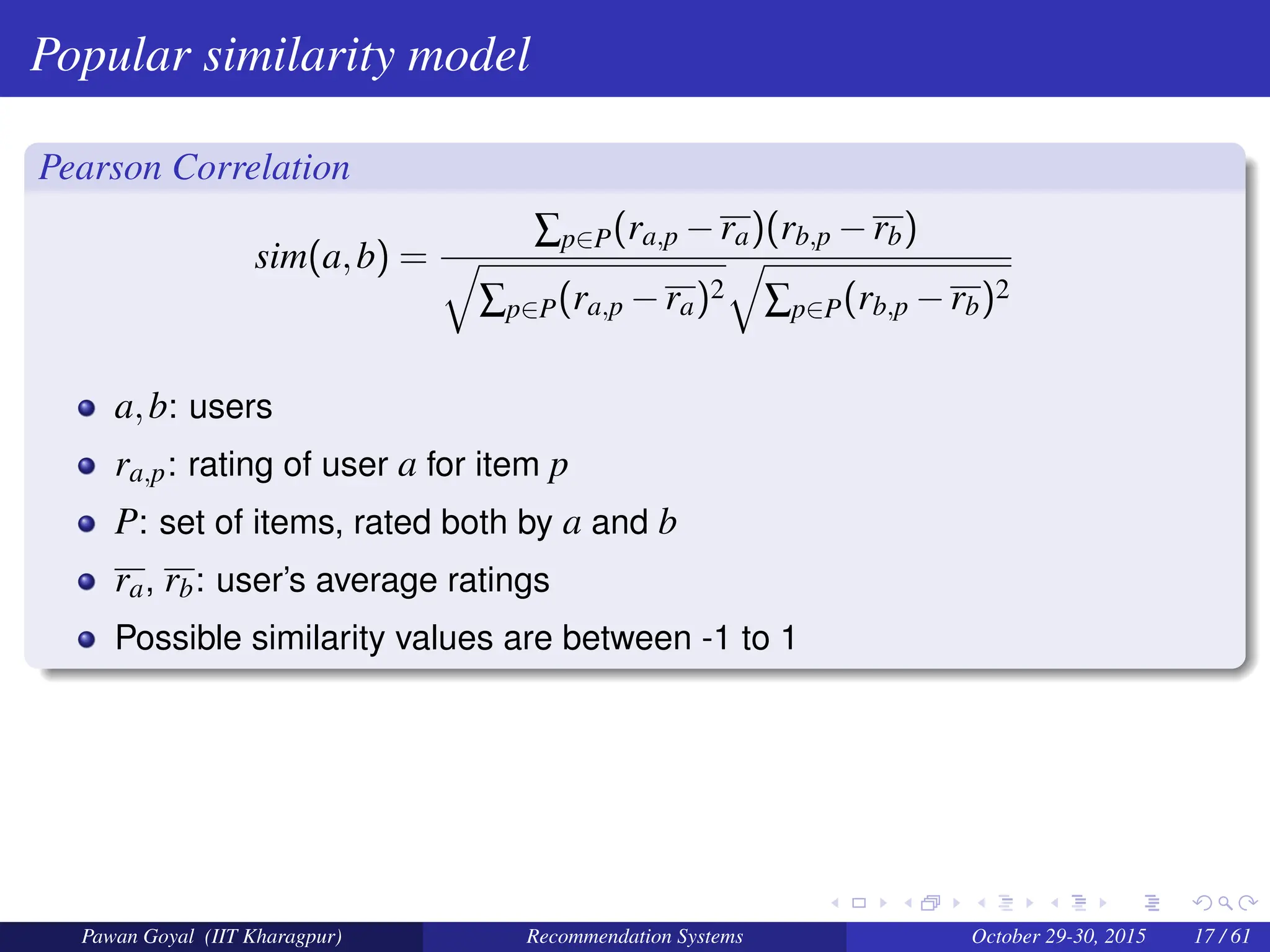
Pearson Correlation
sim(a,b) =
∑p∈P(ra,p −ra)(rb,p −rb)
q
∑p∈P(ra,p −ra)2
q
∑p∈P(rb,p −rb)2
a,b: users
ra,p: rating of user a for item p
P: set of items, rated both by a and b
ra, rb: user’s average ratings
Possible similarity values are between -1 to 1
Pawan Goyal (IIT Kharagpur) Recommendation Systems October 29-30, 2015 17 / 61
Popular similarity model
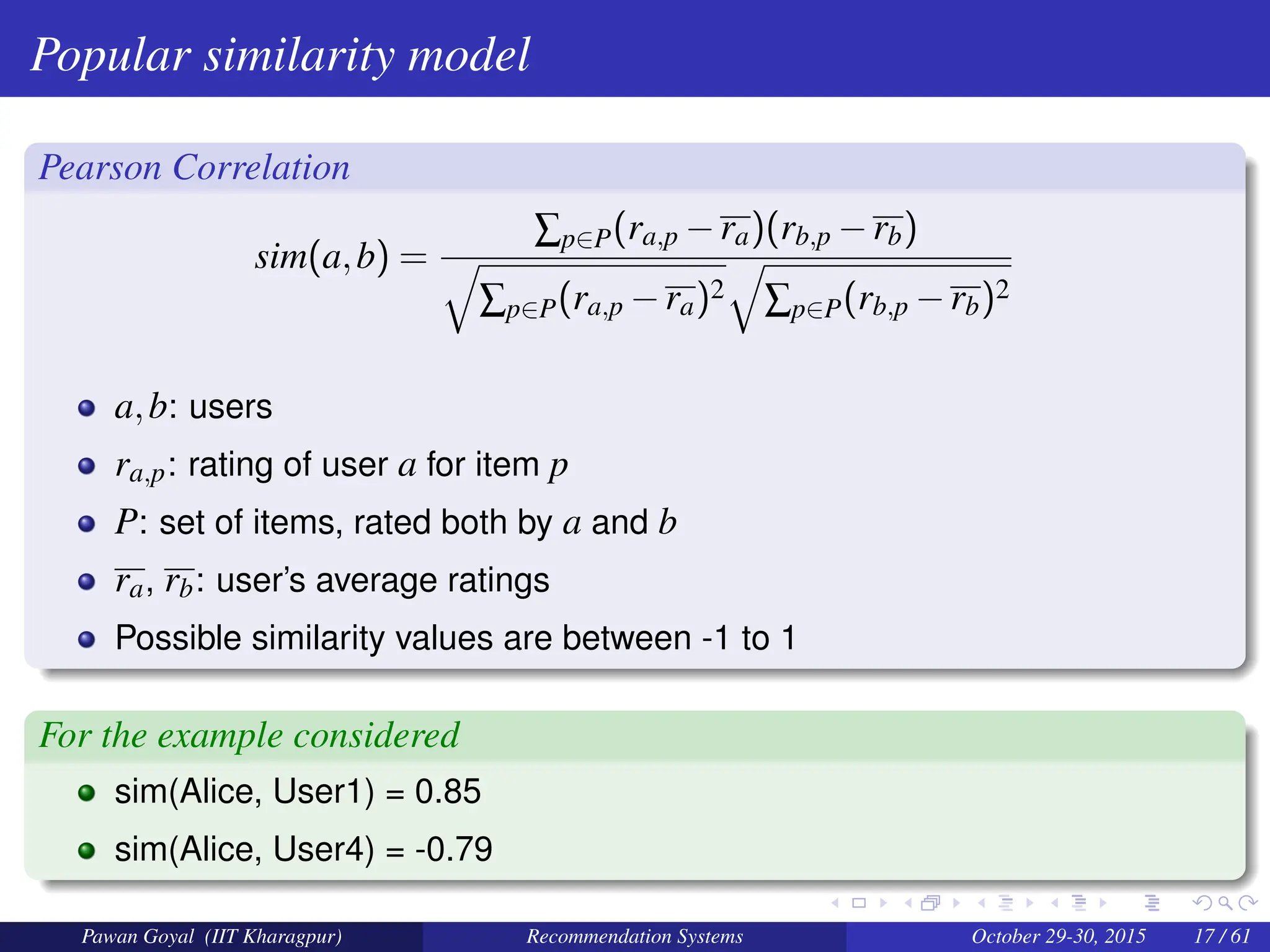
Pearson Correlation
sim(a,b) =
∑p∈P(ra,p −ra)(rb,p −rb)
q
∑p∈P(ra,p −ra)2
q
∑p∈P(rb,p −rb)2
a,b: users
ra,p: rating of user a for item p
P: set of items, rated both by a and b
ra, rb: user’s average ratings
Possible similarity values are between -1 to 1
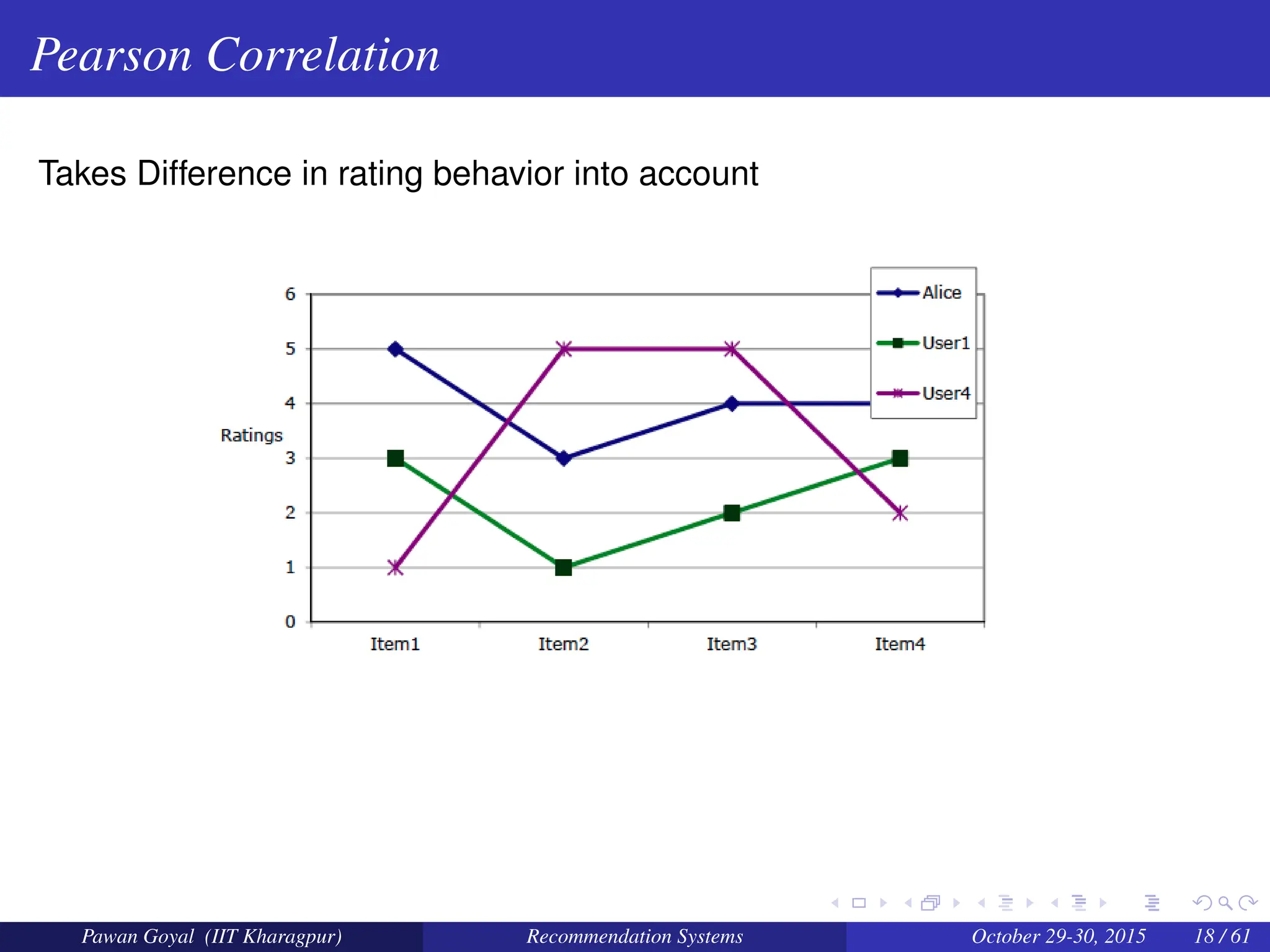
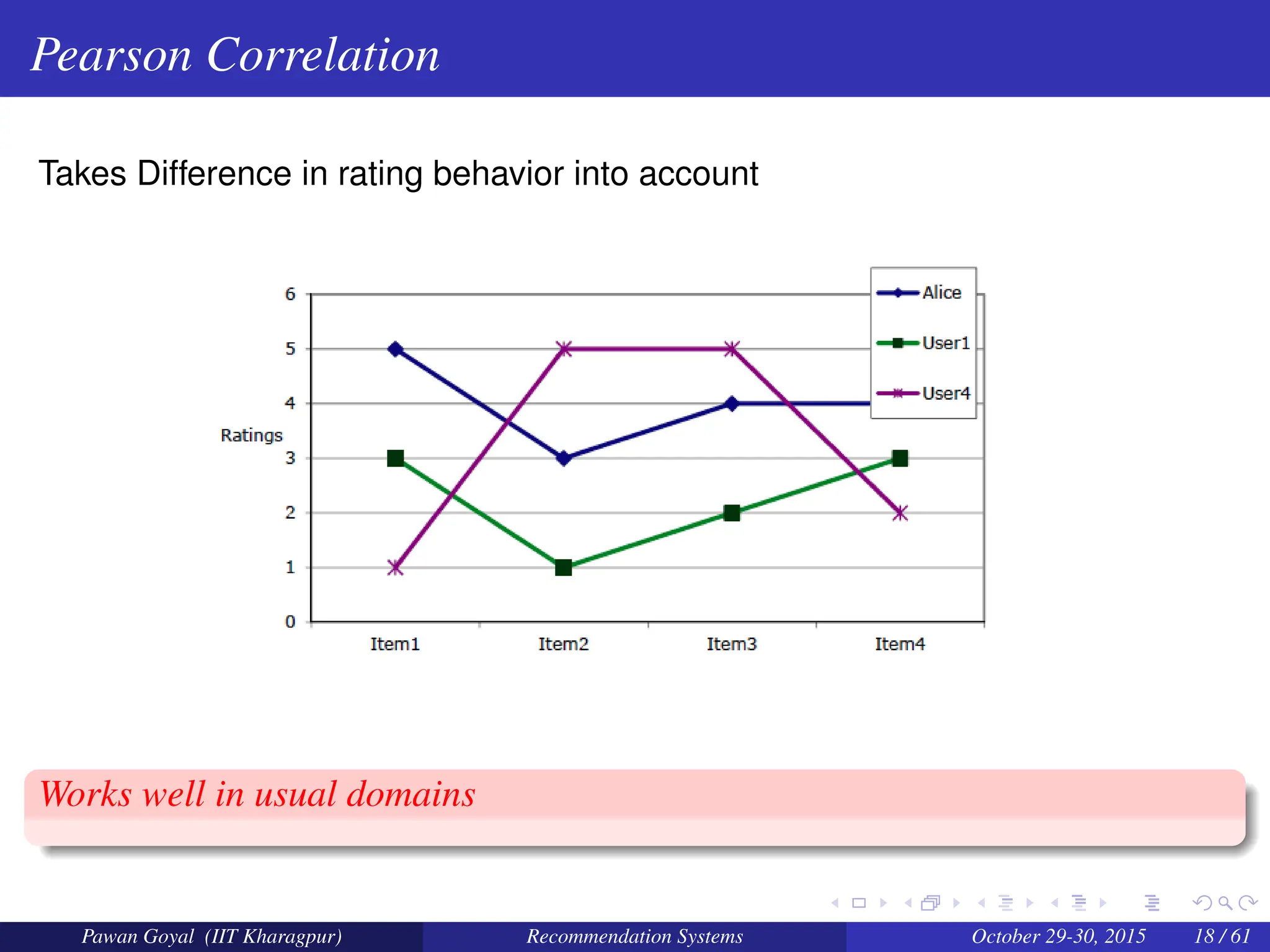
For the example considered
sim(Alice, User1) = 0.85
sim(Alice, User4) = -0.79
Pawan Goyal (IIT Kharagpur) Recommendation Systems October 29-30, 2015 17 / 61
Pearson Correlation
Takes Difference in rating behavior into account
Pawan Goyal (IIT Kharagpur) Recommendation Systems October 29-30, 2015 18 / 61
Pearson Correlation
Takes Difference in rating behavior into account
Works well in usual domains
Pawan Goyal (IIT Kharagpur) Recommendation Systems October 29-30, 2015 18 / 61
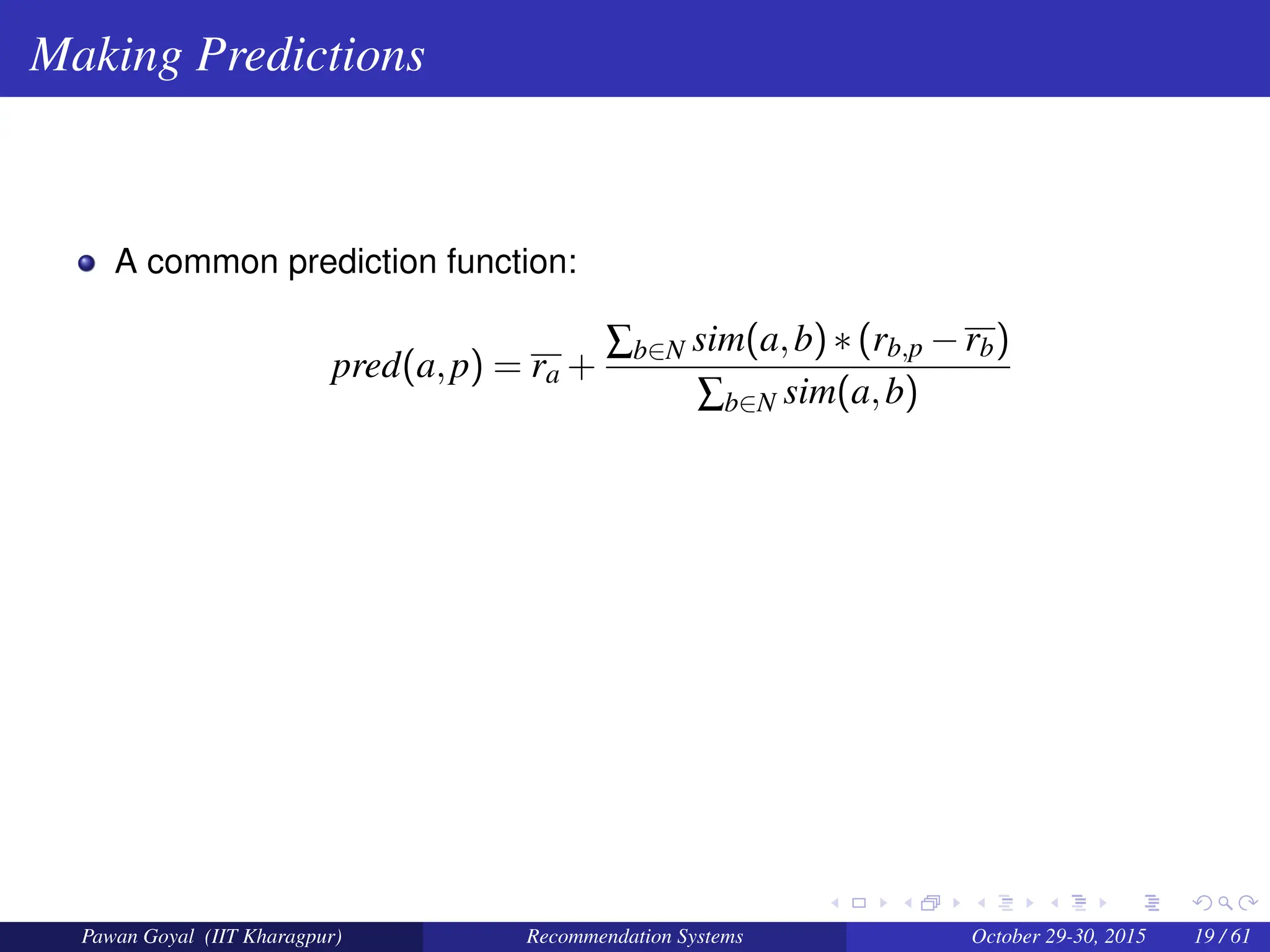
Making Predictions
A common prediction function:
pred(a,p) = ra +
∑b∈N sim(a,b)∗(rb,p −rb)
∑b∈N sim(a,b)
Pawan Goyal (IIT Kharagpur) Recommendation Systems October 29-30, 2015 19 / 61
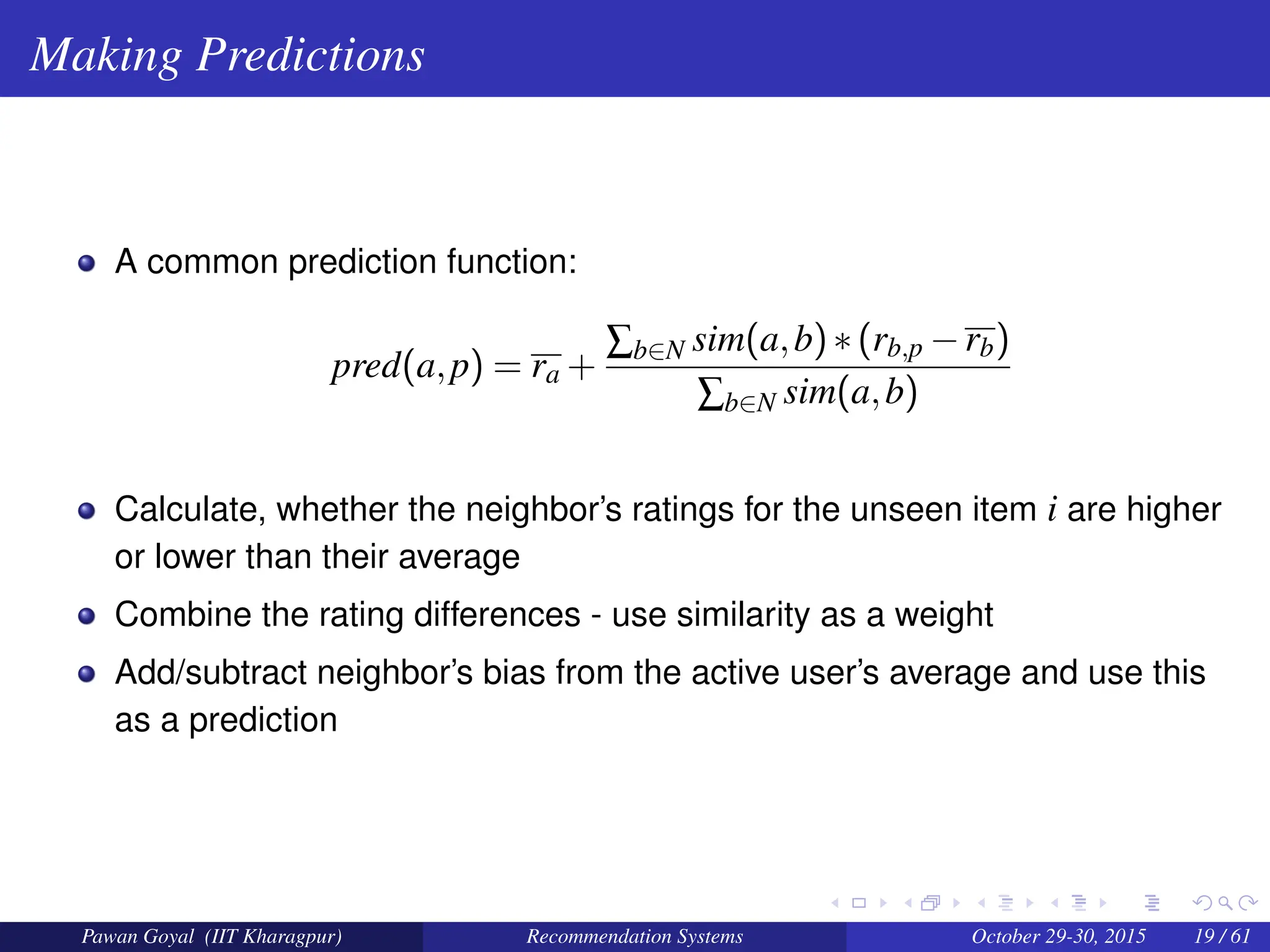
Making Predictions
A common prediction function:
pred(a,p) = ra +
∑b∈N sim(a,b)∗(rb,p −rb)
∑b∈N sim(a,b)
Calculate, whether the neighbor’s ratings for the unseen item i are higher
or lower than their average
Combine the rating differences - use similarity as a weight
Add/subtract neighbor’s bias from the active user’s average and use this
as a prediction
Pawan Goyal (IIT Kharagpur) Recommendation Systems October 29-30, 2015 19 / 61
Item-based Collaborative Filtering
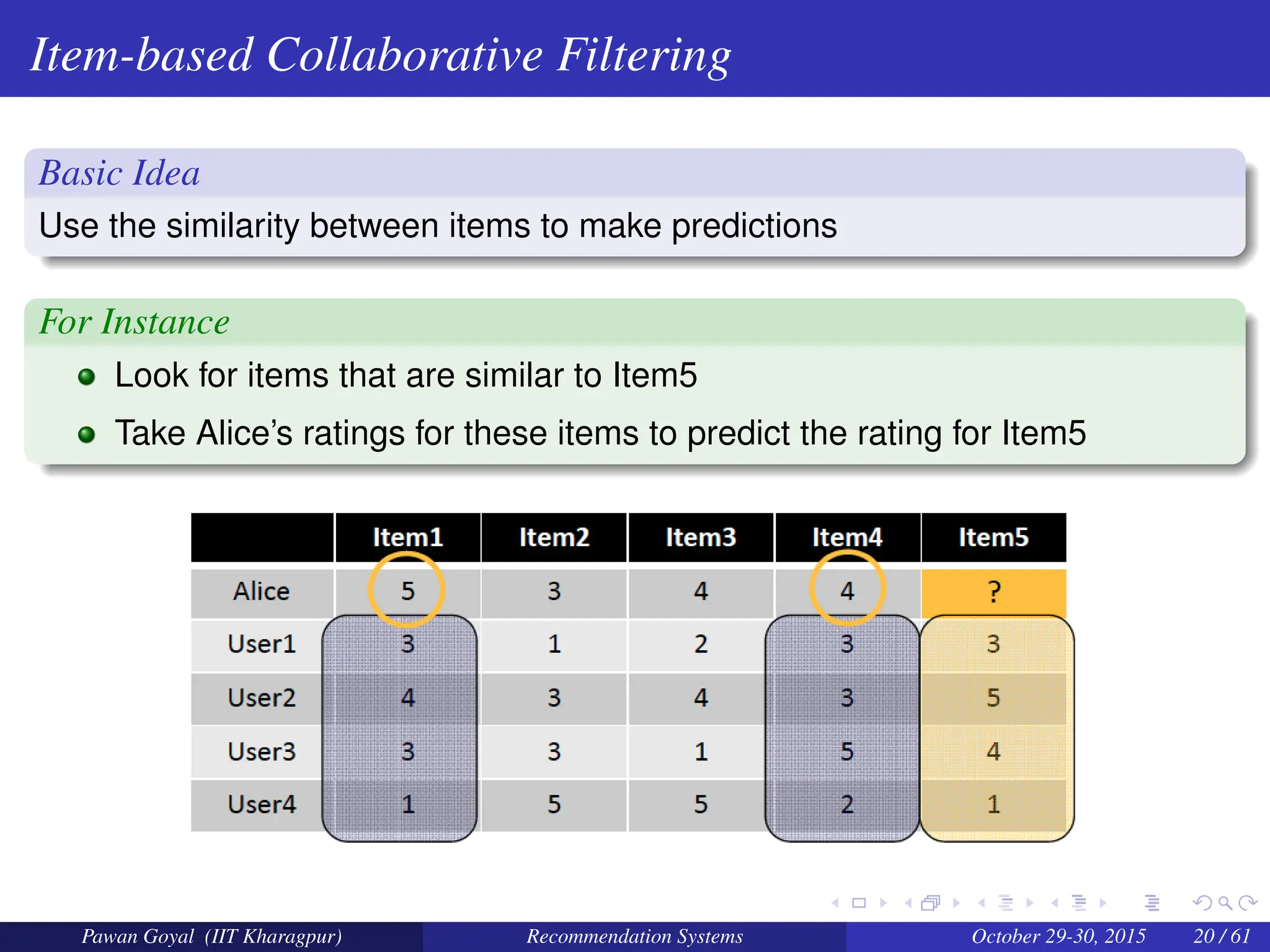
Basic Idea
Use the similarity between items to make predictions
Pawan Goyal (IIT Kharagpur) Recommendation Systems October 29-30, 2015 20 / 61
Item-based Collaborative Filtering
Basic Idea
Use the similarity between items to make predictions
For Instance
Look for items that are similar to Item5
Take Alice’s ratings for these items to predict the rating for Item5
Pawan Goyal (IIT Kharagpur) Recommendation Systems October 29-30, 2015 20 / 61
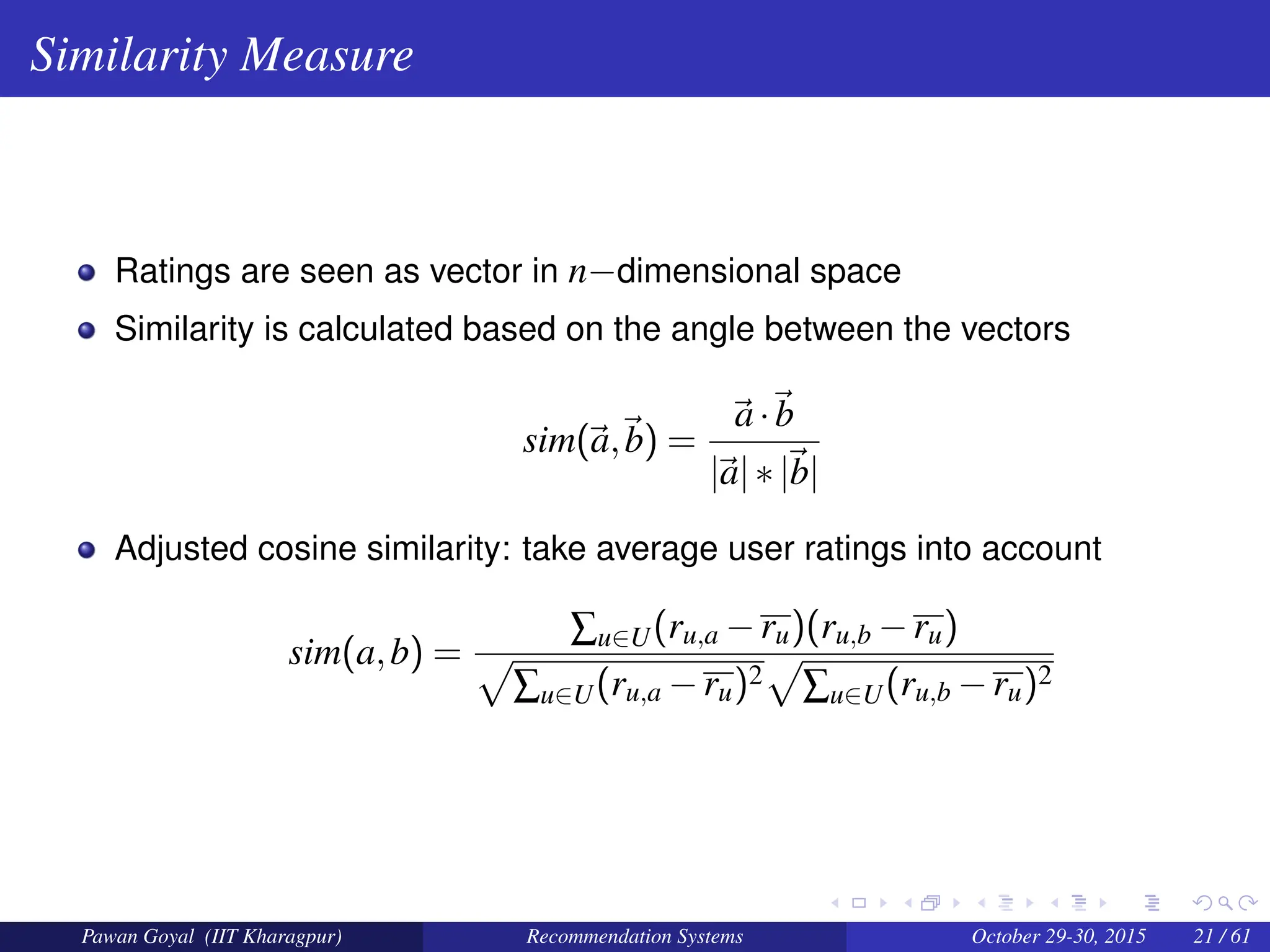
Similarity Measure
Ratings are seen as vector in n−dimensional space
Similarity is calculated based on the angle between the vectors
sim(~
a,~
b) =
~
a·~
b
|~
a|∗|~
b|
Adjusted cosine similarity: take average user ratings into account
sim(a,b) =
∑u∈U(ru,a −ru)(ru,b −ru)
p
∑u∈U(ru,a −ru)2
p
∑u∈U(ru,b −ru)2
Pawan Goyal (IIT Kharagpur) Recommendation Systems October 29-30, 2015 21 / 61
Pre-processing for Item-based filtering
Calculate all pair-wise item similarities in advance
The neighborhood to be used at run-time is typically rather small,
because only those items are taken into account which the user has rated
Item similarities are supposed to be more stable than user similarities
Pawan Goyal (IIT Kharagpur) Recommendation Systems October 29-30, 2015 22 / 61
More on ratings
Pure CF-based systems only rely on the rating matrix
Explicit ratings
Most commonly used (1 to 5, 1 to 10 response scales)
Research topics: what about multi-dimensional ratings?
Challenge: Sparse rating matrices, how to stimulate users to rate more
items?
Pawan Goyal (IIT Kharagpur) Recommendation Systems October 29-30, 2015 23 / 61
More on ratings
Pure CF-based systems only rely on the rating matrix
Explicit ratings
Most commonly used (1 to 5, 1 to 10 response scales)
Research topics: what about multi-dimensional ratings?
Challenge: Sparse rating matrices, how to stimulate users to rate more
items?
Implicit ratings
clicks, page views, time spent on some page, demo downloads ..
Can be used in addition to explicit ones; question of correctness of
interpretation
Pawan Goyal (IIT Kharagpur) Recommendation Systems October 29-30, 2015 23 / 61
Data sparsity problems
Cold start problems
How to recommend new items? What to recommend to new users?
Pawan Goyal (IIT Kharagpur) Recommendation Systems October 29-30, 2015 24 / 61
Data sparsity problems
Cold start problems
How to recommend new items? What to recommend to new users?
Straight-forward approach
Use another method (e.g., content-based, demographic or simply
non-personalized) in the initial phase
Pawan Goyal (IIT Kharagpur) Recommendation Systems October 29-30, 2015 24 / 61
Data sparsity problems
Cold start problems
How to recommend new items? What to recommend to new users?
Straight-forward approach
Use another method (e.g., content-based, demographic or simply
non-personalized) in the initial phase
Alternatives
Use better algorithms (beyond nearest-neighbor approaches)
Example: Assume “transitivity” of neighborhoods
Pawan Goyal (IIT Kharagpur) Recommendation Systems October 29-30, 2015 24 / 61
Example algorithms for sparse datasets
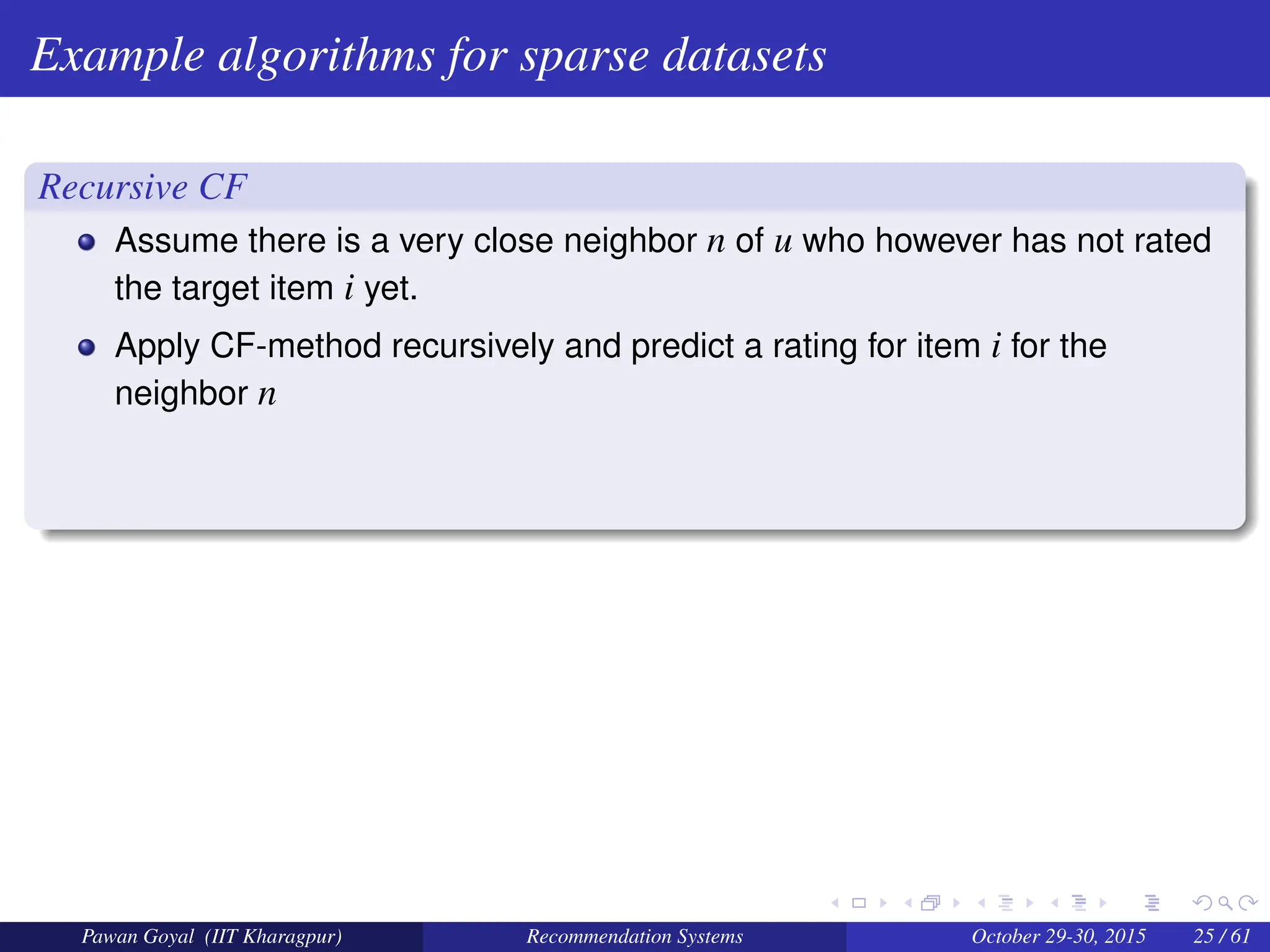
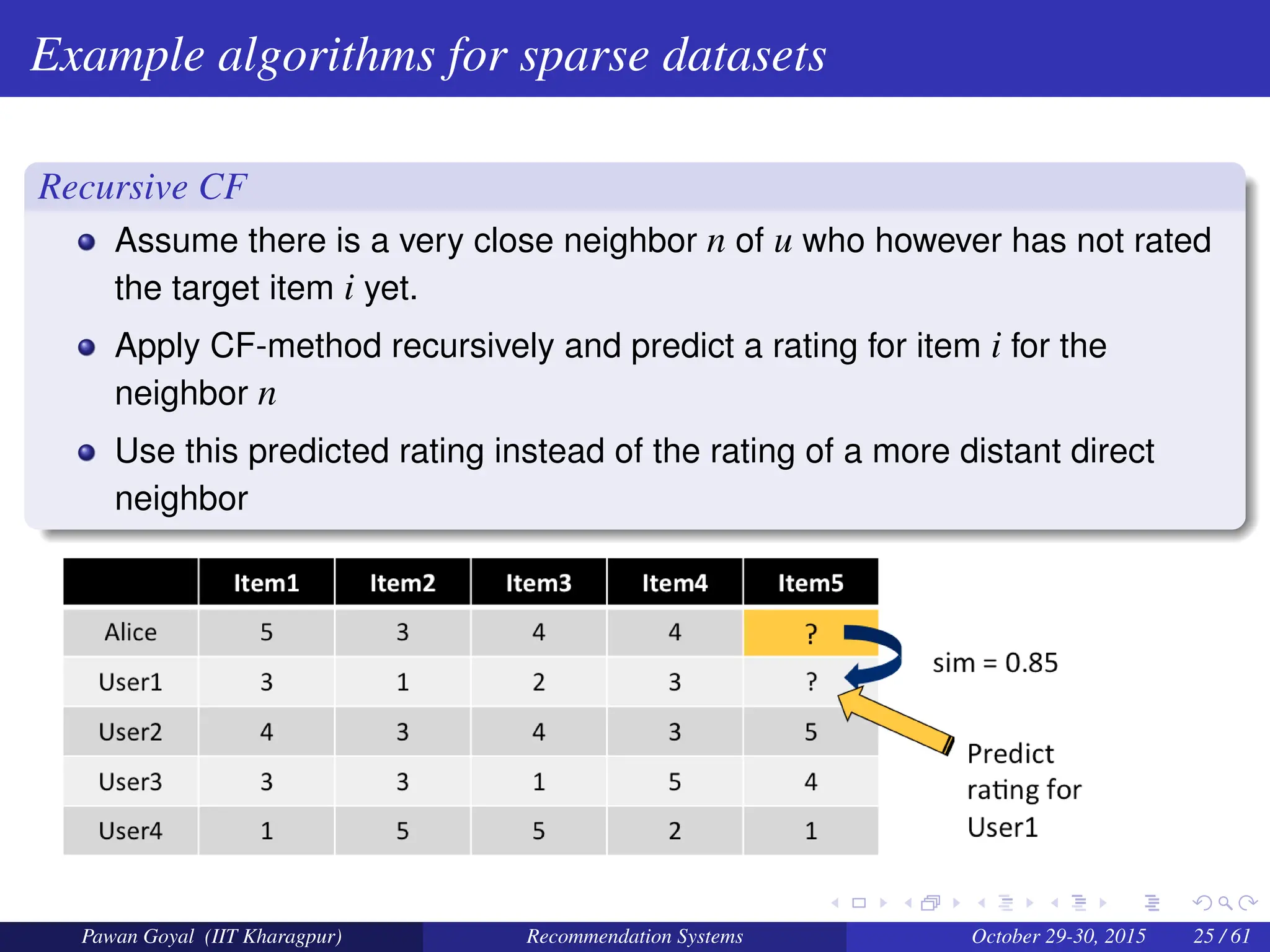
Recursive CF
Assume there is a very close neighbor n of u who however has not rated
the target item i yet.
Pawan Goyal (IIT Kharagpur) Recommendation Systems October 29-30, 2015 25 / 61
Example algorithms for sparse datasets
Recursive CF
Assume there is a very close neighbor n of u who however has not rated
the target item i yet.
Apply CF-method recursively and predict a rating for item i for the
neighbor n
Pawan Goyal (IIT Kharagpur) Recommendation Systems October 29-30, 2015 25 / 61
Example algorithms for sparse datasets
Recursive CF
Assume there is a very close neighbor n of u who however has not rated
the target item i yet.
Apply CF-method recursively and predict a rating for item i for the
neighbor n
Use this predicted rating instead of the rating of a more distant direct
neighbor
Pawan Goyal (IIT Kharagpur) Recommendation Systems October 29-30, 2015 25 / 61
Example algorithms for sparse datasets
Graph-based methods: Spreading activation
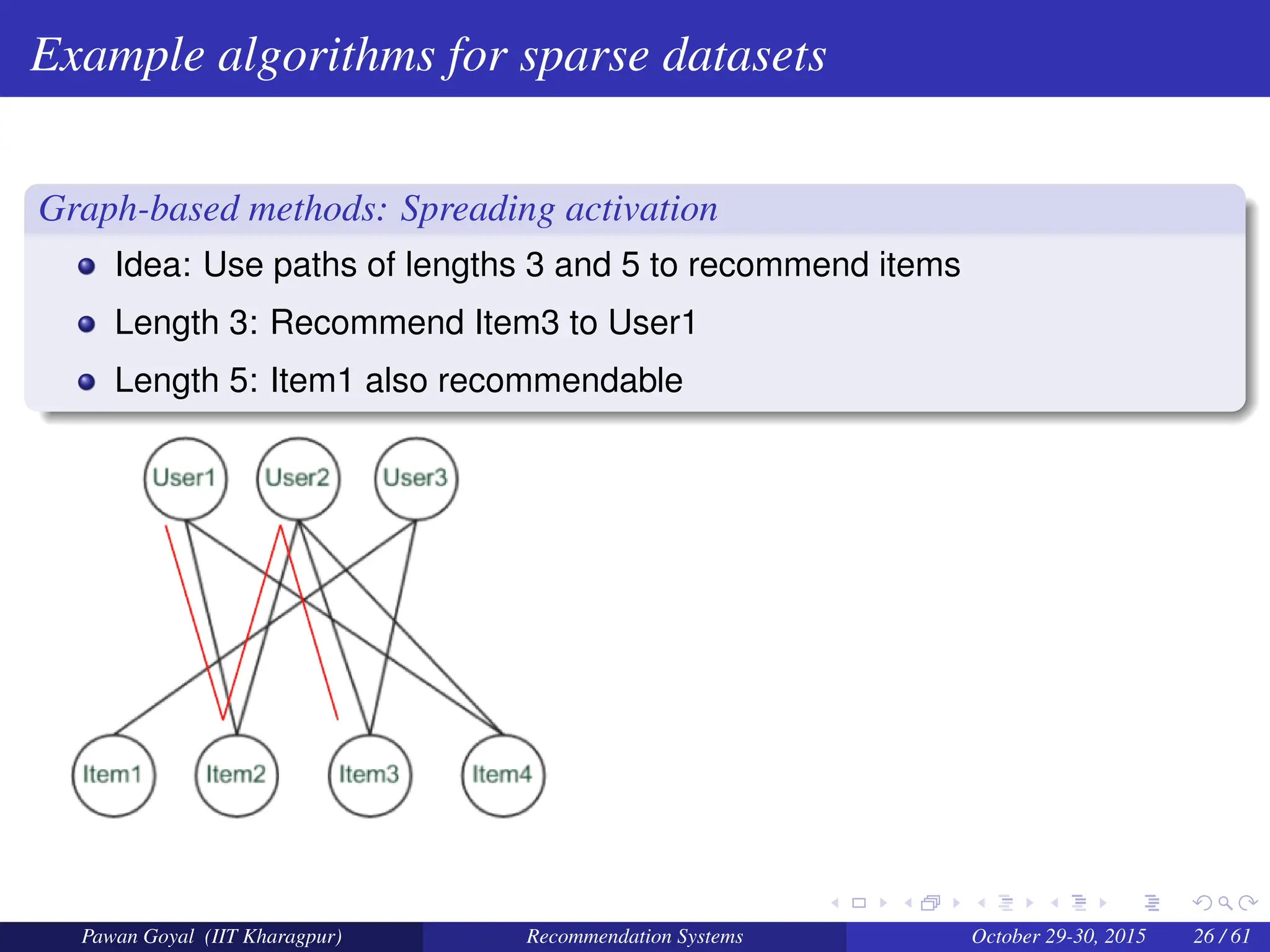
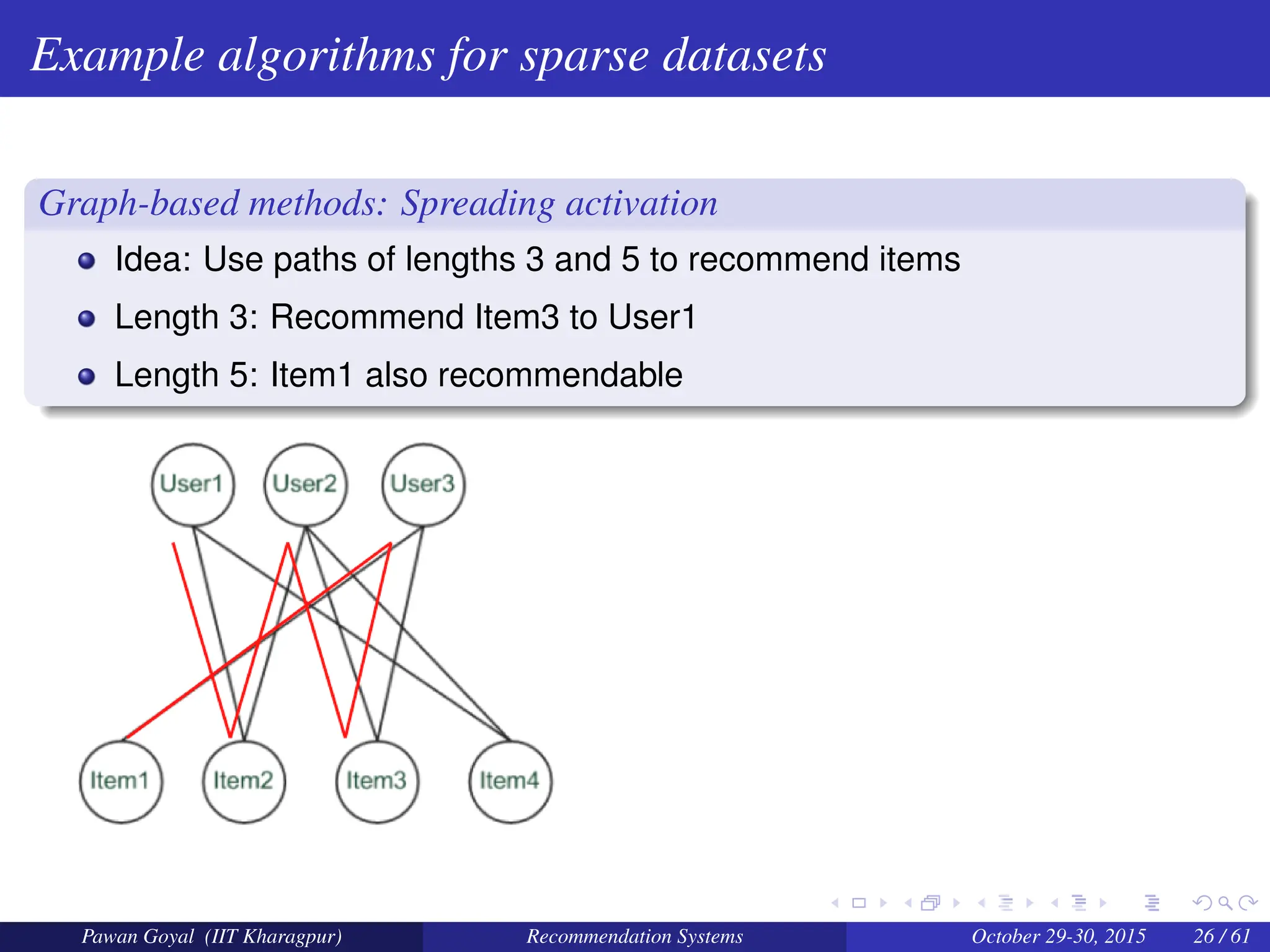
Idea: Use paths of lengths 3 and 5 to recommend items
Length 3: Recommend Item3 to User1
Length 5: Item1 also recommendable
Pawan Goyal (IIT Kharagpur) Recommendation Systems October 29-30, 2015 26 / 61
Example algorithms for sparse datasets
Graph-based methods: Spreading activation
Idea: Use paths of lengths 3 and 5 to recommend items
Length 3: Recommend Item3 to User1
Length 5: Item1 also recommendable
Pawan Goyal (IIT Kharagpur) Recommendation Systems October 29-30, 2015 26 / 61
Matrix Factorization Methods
Are shown to be superior to the classic nearest-neighbor techniques for
product recommendations
Allow the incorporation of additional information such as implicit
feedback, temporal effects, and confidence levels
Pawan Goyal (IIT Kharagpur) Recommendation Systems October 29-30, 2015 27 / 61
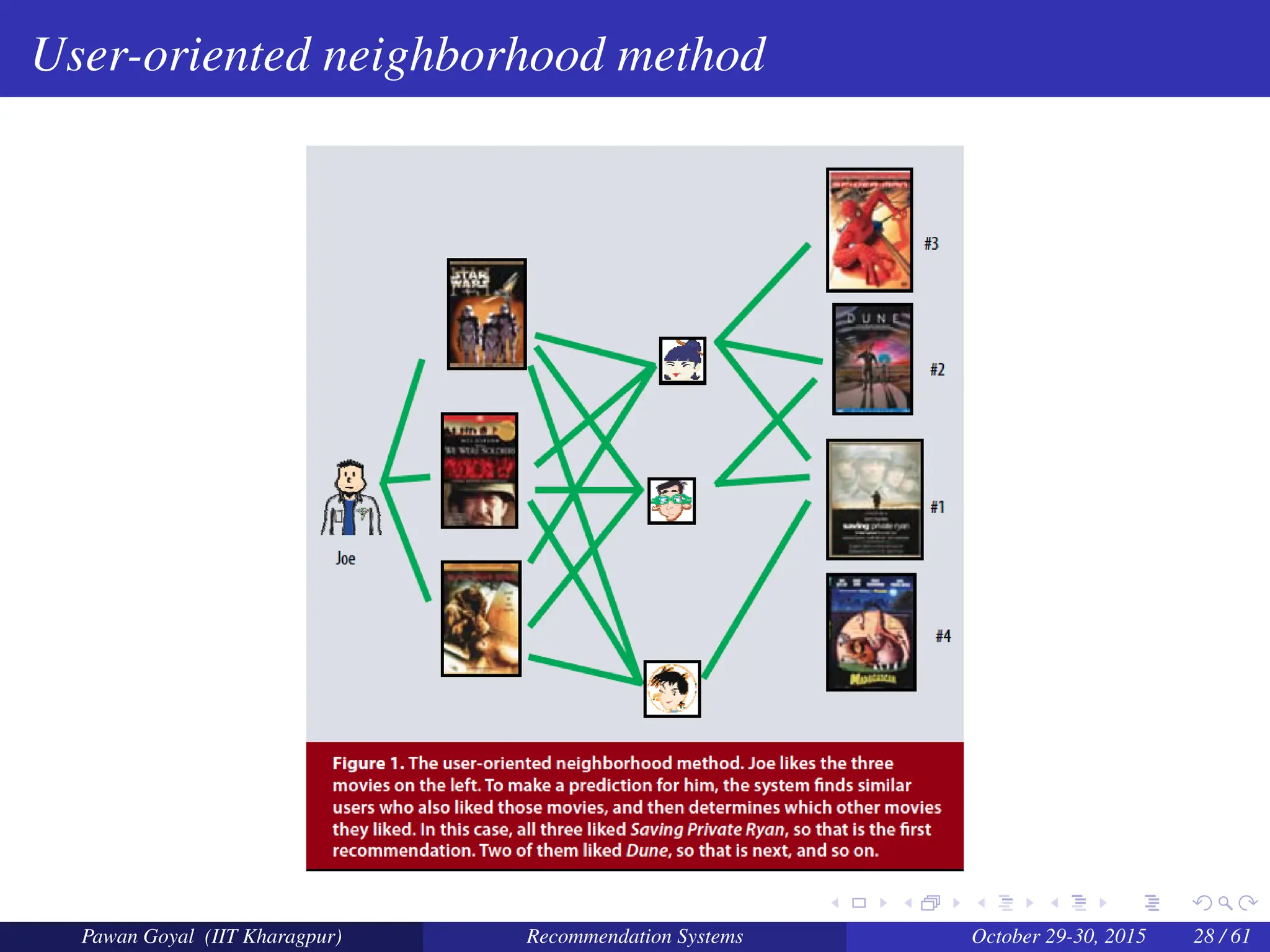
User-oriented neighborhood method
Pawan Goyal (IIT Kharagpur) Recommendation Systems October 29-30, 2015 28 / 61
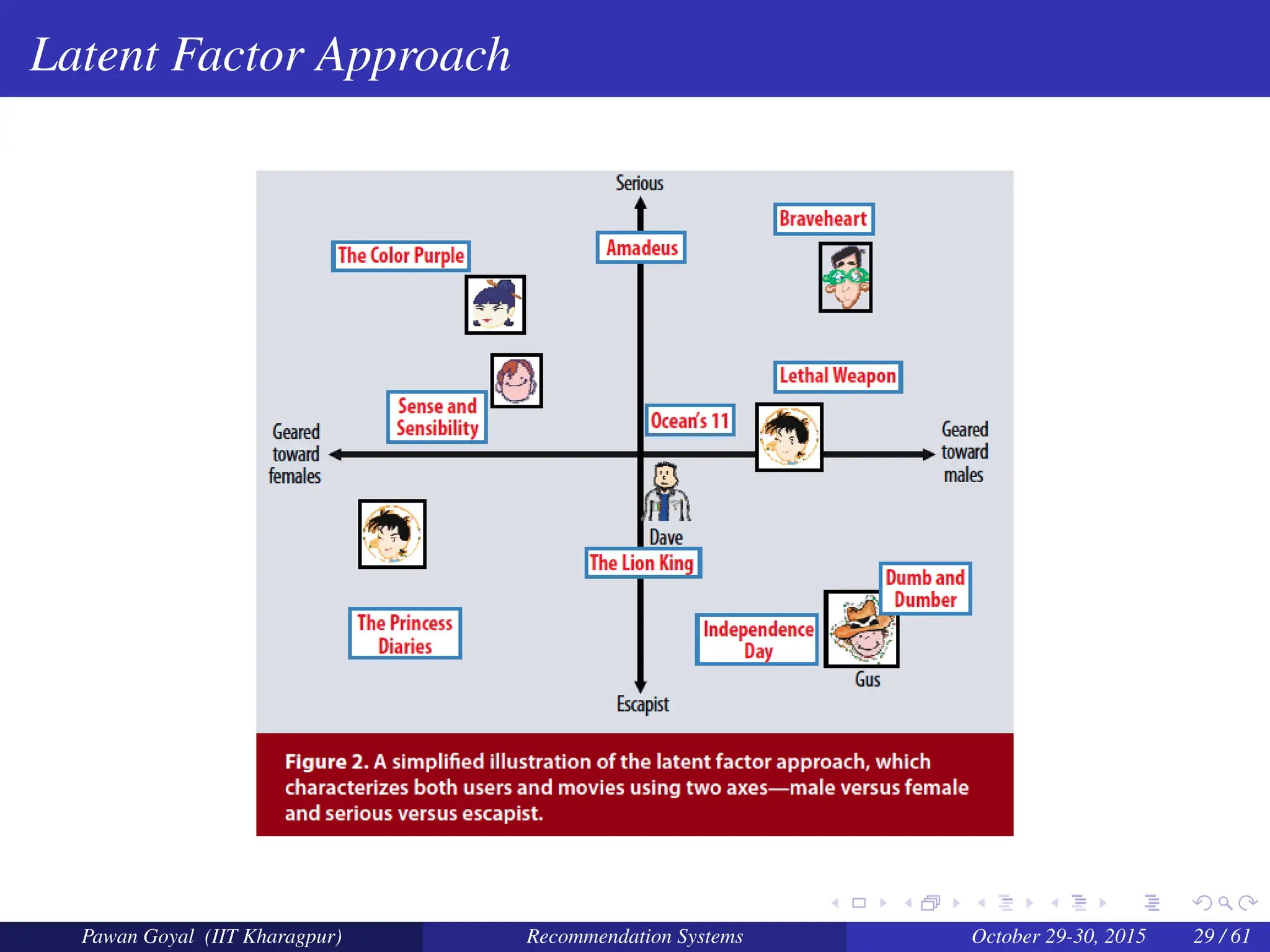
Latent Factor Approach
Pawan Goyal (IIT Kharagpur) Recommendation Systems October 29-30, 2015 29 / 61
Matrix Factorization Methods
Basic Idea
Both users and items are characterized by vectors of factors, inferred
from item rating patterns
High correspondence between item and user factors leads to a
recommendation.
Pawan Goyal (IIT Kharagpur) Recommendation Systems October 29-30, 2015 30 / 61
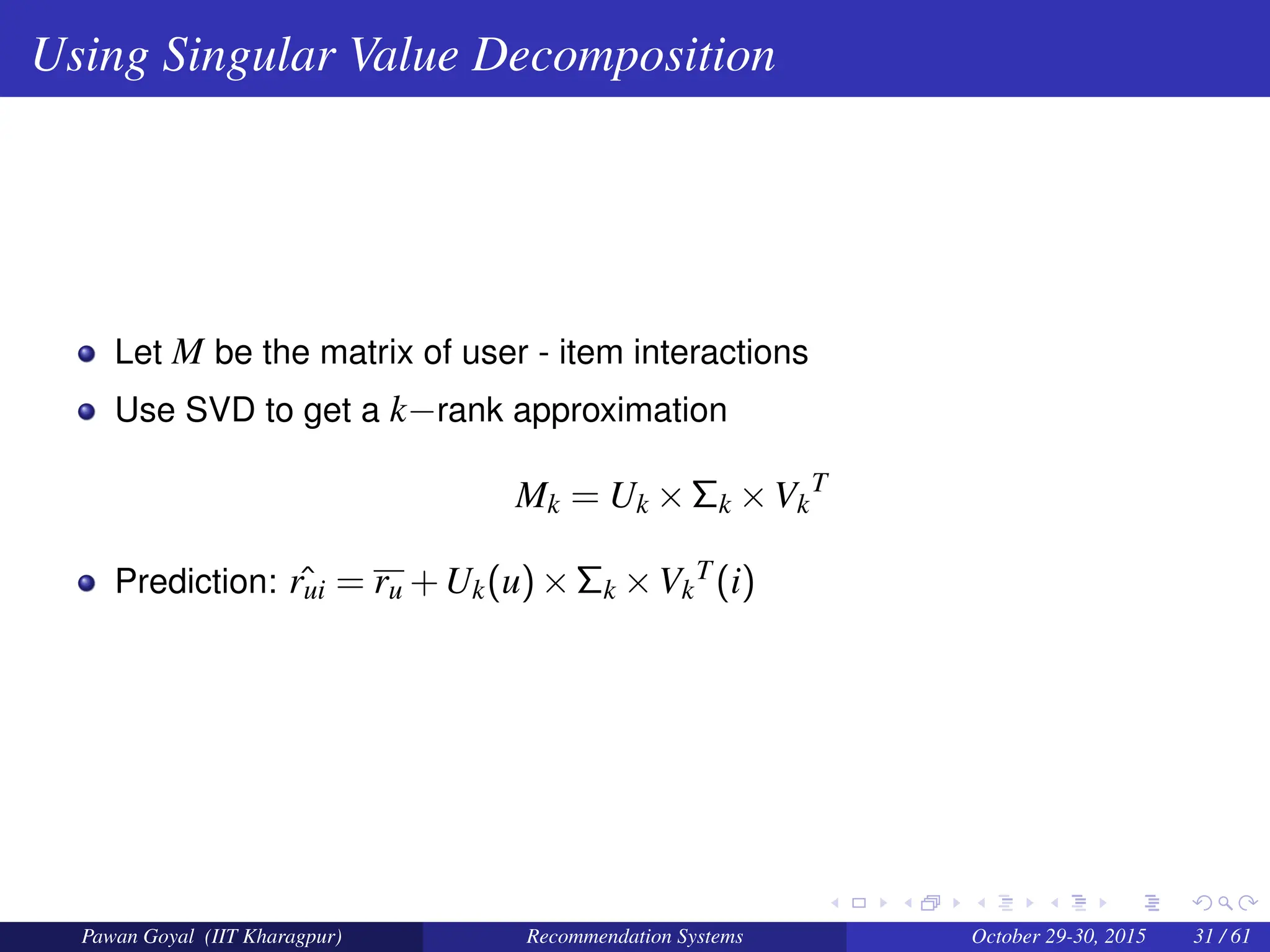
Using Singular Value Decomposition
Let M be the matrix of user - item interactions
Use SVD to get a k−rank approximation
Mk = Uk ×Σk ×Vk
T
Prediction: ˆ
rui = ru +Uk(u)×Σk ×Vk
T(i)
Pawan Goyal (IIT Kharagpur) Recommendation Systems October 29-30, 2015 31 / 61
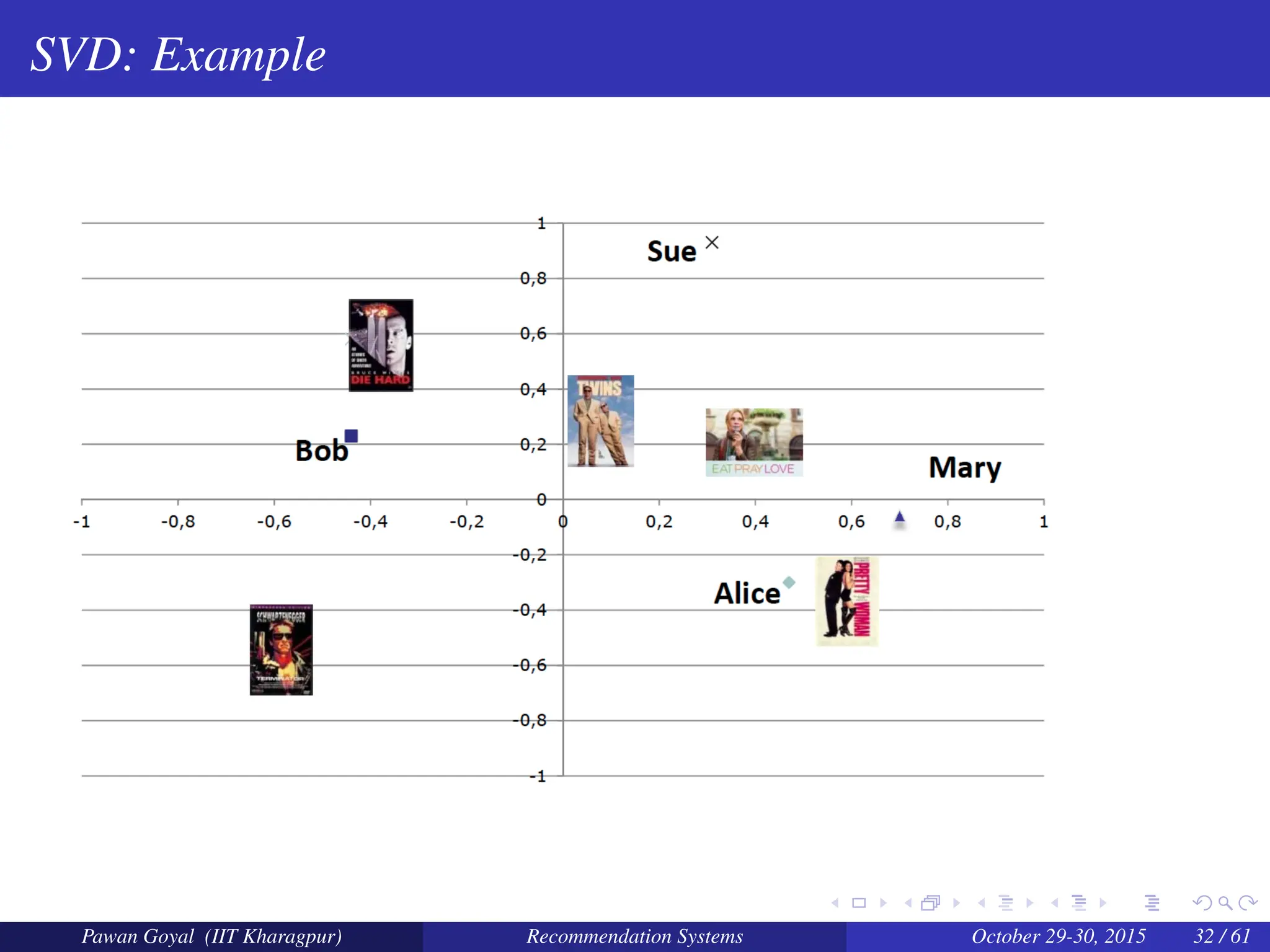
SVD: Example
Pawan Goyal (IIT Kharagpur) Recommendation Systems October 29-30, 2015 32 / 61
SVD: Example
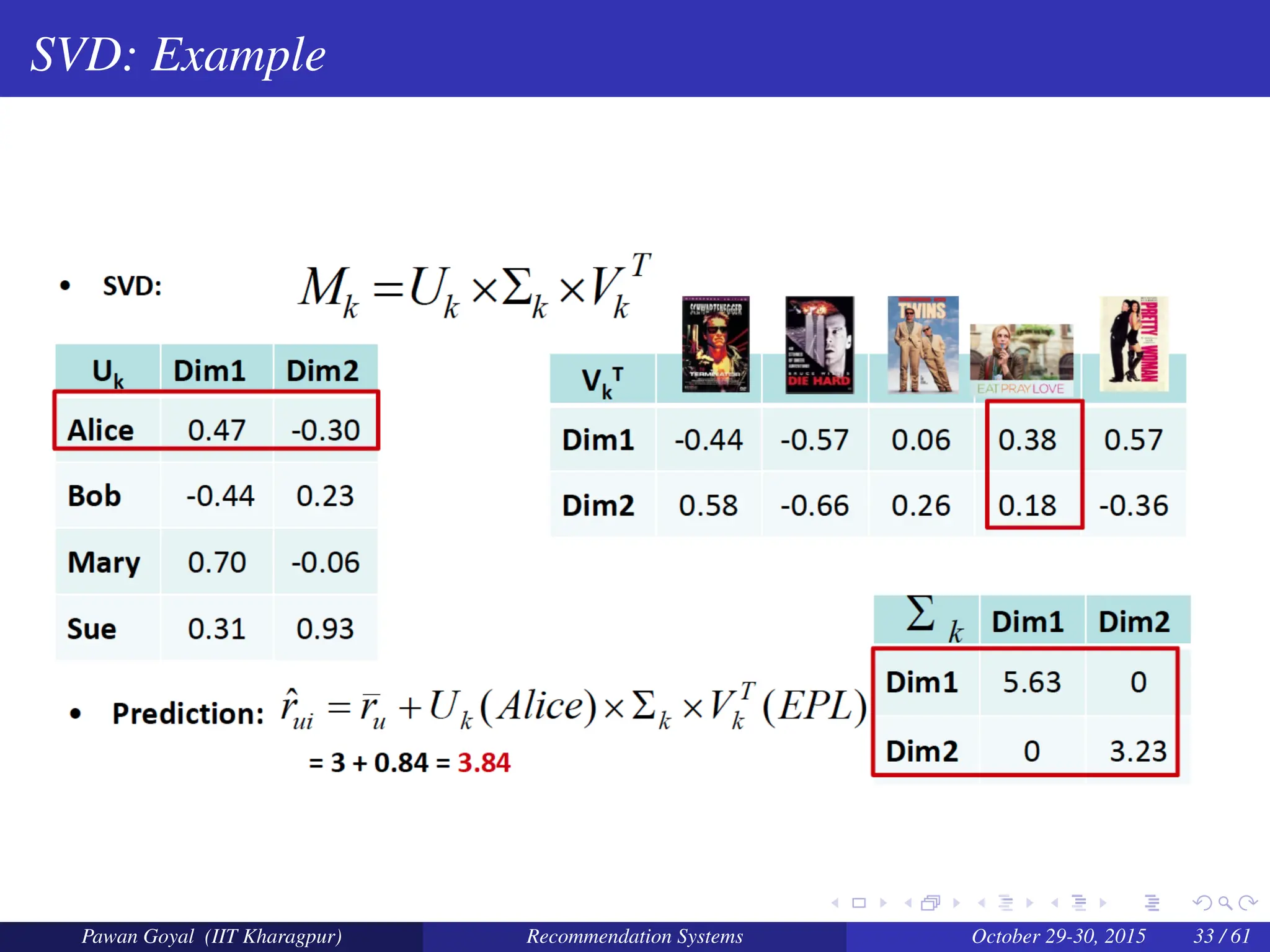
Pawan Goyal (IIT Kharagpur) Recommendation Systems October 29-30, 2015 33 / 61
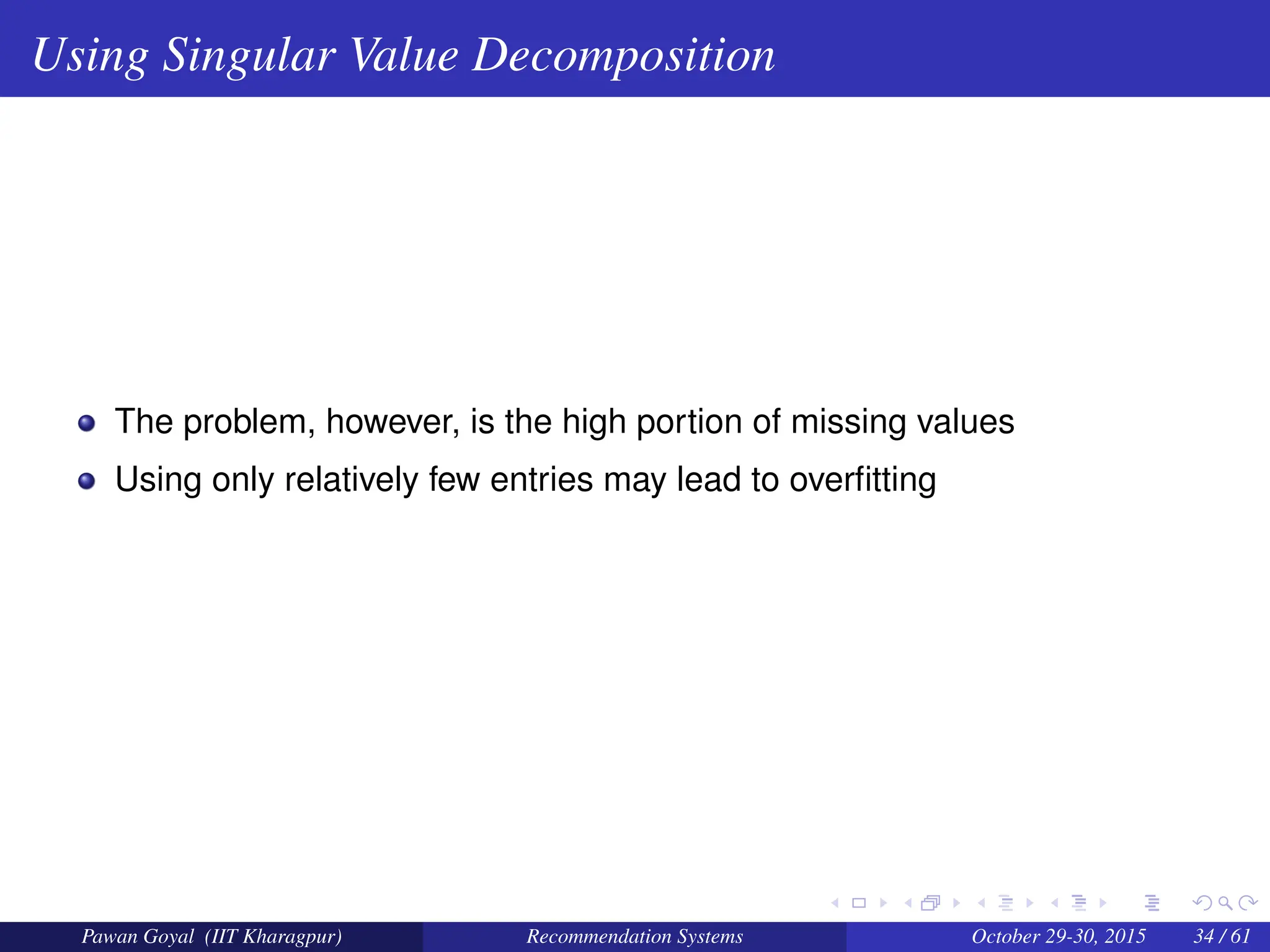
Using Singular Value Decomposition
The problem, however, is the high portion of missing values
Using only relatively few entries may lead to overfitting
Pawan Goyal (IIT Kharagpur) Recommendation Systems October 29-30, 2015 34 / 61
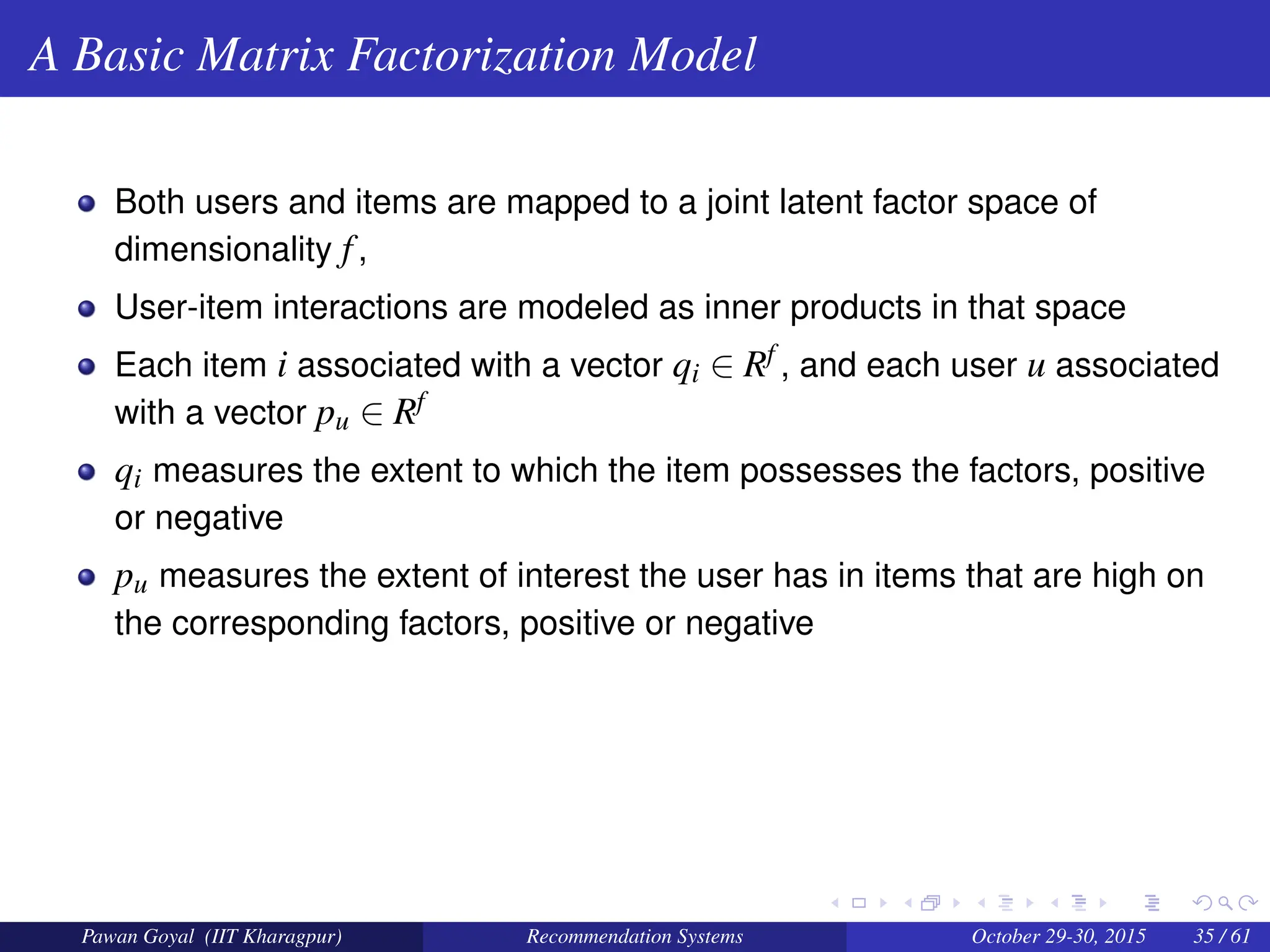
A Basic Matrix Factorization Model
Both users and items are mapped to a joint latent factor space of
dimensionality f,
Pawan Goyal (IIT Kharagpur) Recommendation Systems October 29-30, 2015 35 / 61
A Basic Matrix Factorization Model
Both users and items are mapped to a joint latent factor space of
dimensionality f,
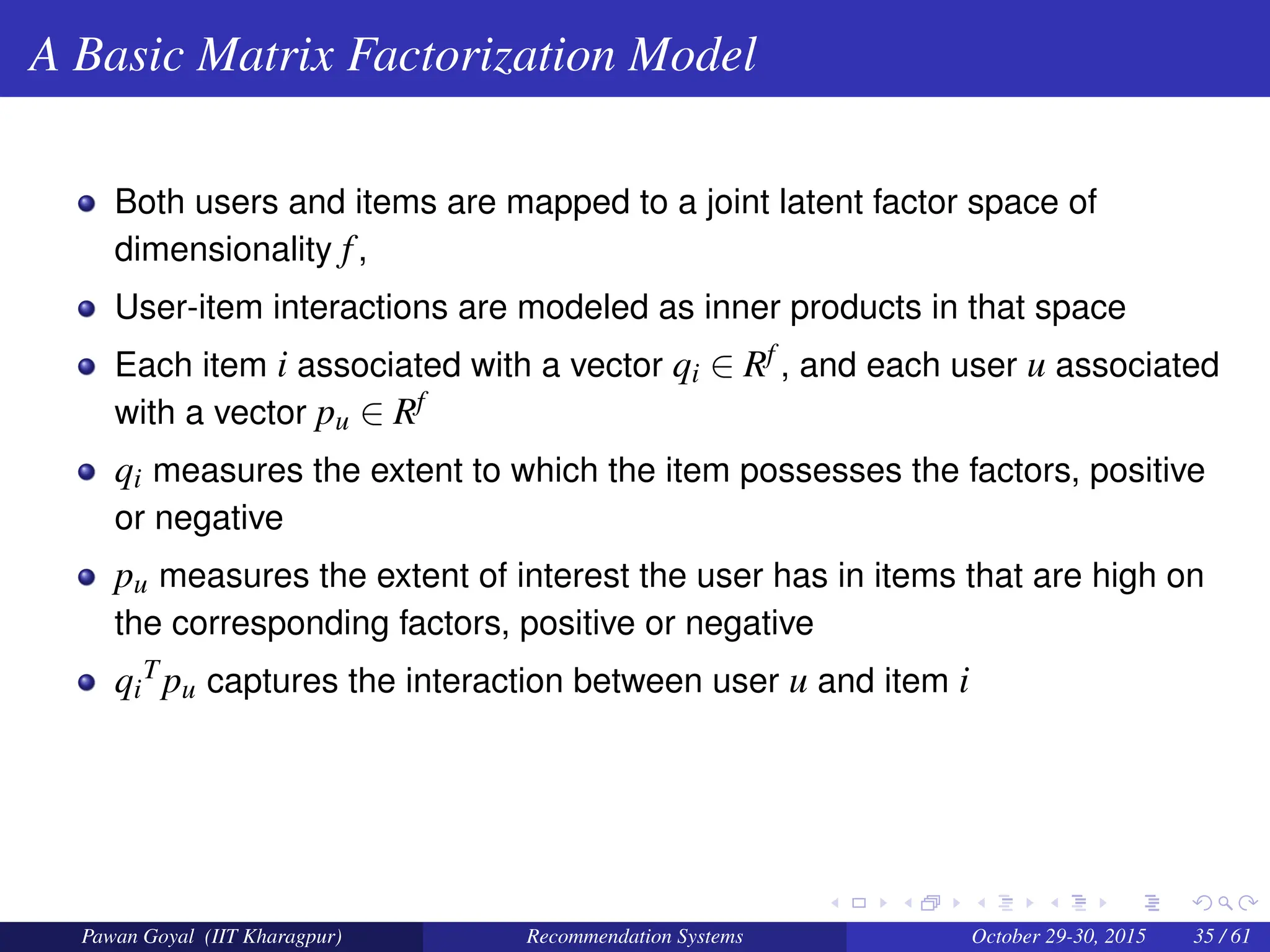
User-item interactions are modeled as inner products in that space
Pawan Goyal (IIT Kharagpur) Recommendation Systems October 29-30, 2015 35 / 61
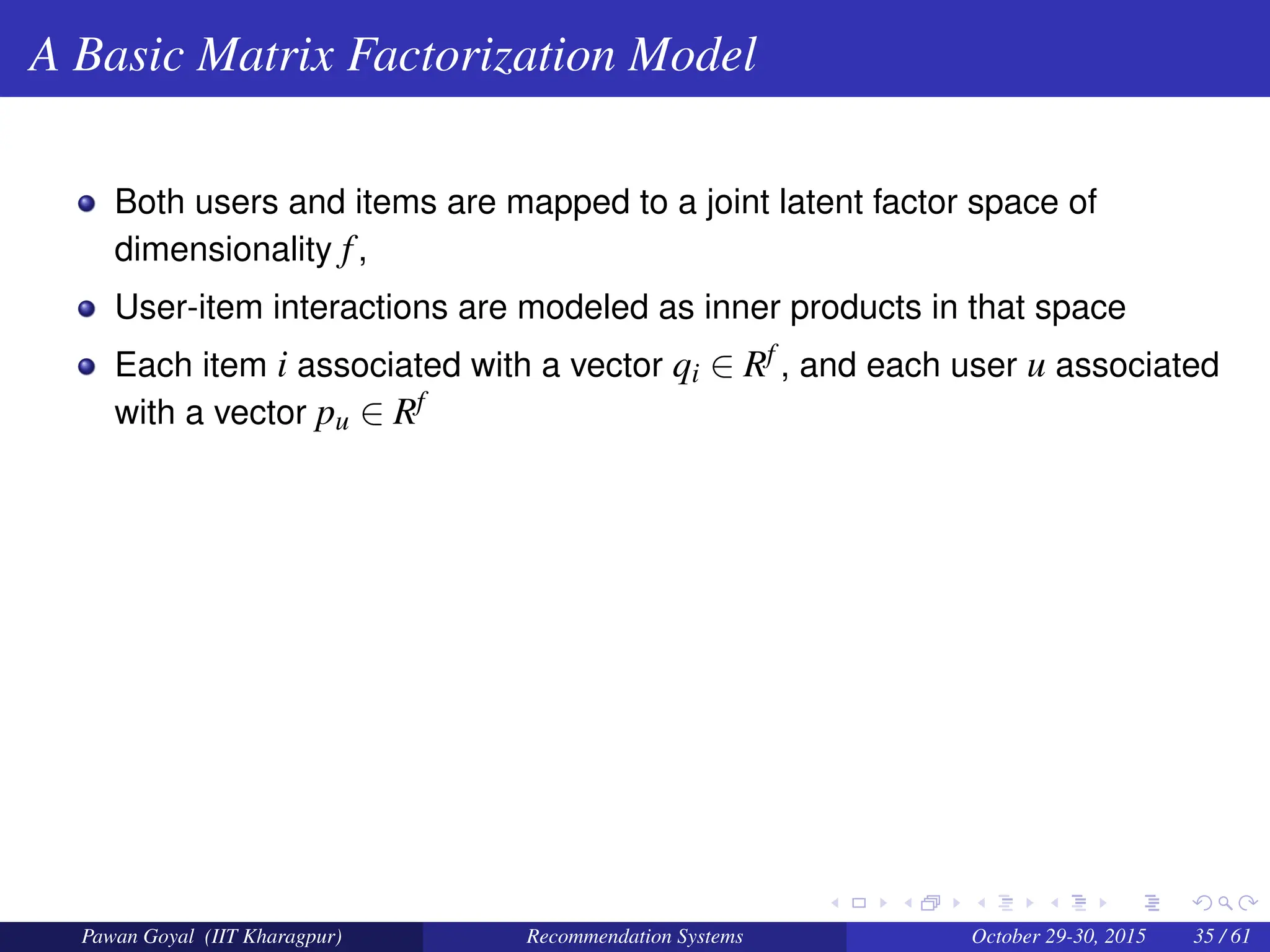
A Basic Matrix Factorization Model
Both users and items are mapped to a joint latent factor space of
dimensionality f,
User-item interactions are modeled as inner products in that space
Each item i associated with a vector qi ∈ Rf , and each user u associated
with a vector pu ∈ Rf
Pawan Goyal (IIT Kharagpur) Recommendation Systems October 29-30, 2015 35 / 61
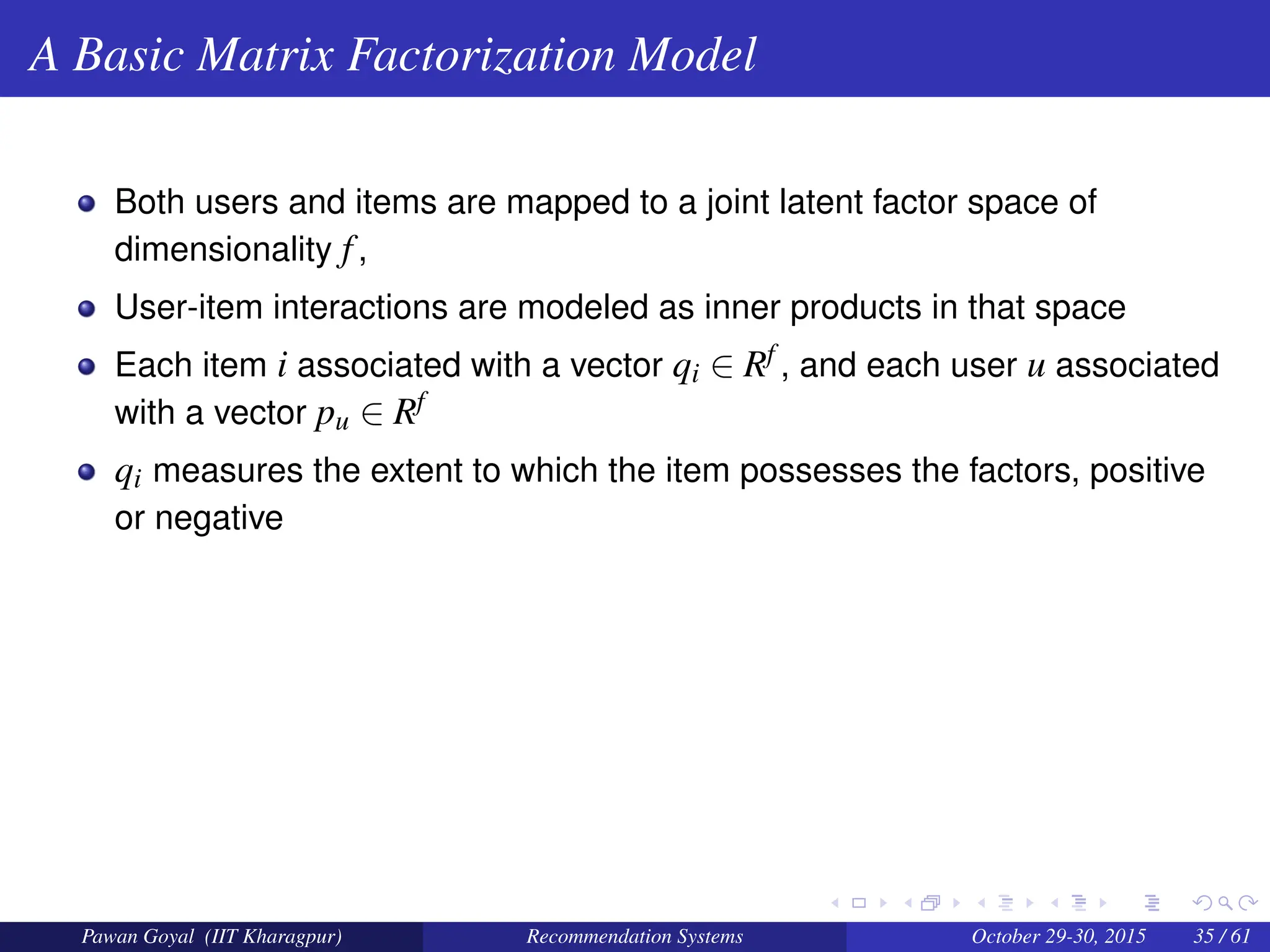
A Basic Matrix Factorization Model
Both users and items are mapped to a joint latent factor space of
dimensionality f,
User-item interactions are modeled as inner products in that space
Each item i associated with a vector qi ∈ Rf , and each user u associated
with a vector pu ∈ Rf
qi measures the extent to which the item possesses the factors, positive
or negative
Pawan Goyal (IIT Kharagpur) Recommendation Systems October 29-30, 2015 35 / 61
A Basic Matrix Factorization Model
Both users and items are mapped to a joint latent factor space of
dimensionality f,
User-item interactions are modeled as inner products in that space
Each item i associated with a vector qi ∈ Rf , and each user u associated
with a vector pu ∈ Rf
qi measures the extent to which the item possesses the factors, positive
or negative
pu measures the extent of interest the user has in items that are high on
the corresponding factors, positive or negative
Pawan Goyal (IIT Kharagpur) Recommendation Systems October 29-30, 2015 35 / 61
A Basic Matrix Factorization Model
Both users and items are mapped to a joint latent factor space of
dimensionality f,
User-item interactions are modeled as inner products in that space
Each item i associated with a vector qi ∈ Rf , and each user u associated
with a vector pu ∈ Rf
qi measures the extent to which the item possesses the factors, positive
or negative
pu measures the extent of interest the user has in items that are high on
the corresponding factors, positive or negative
qi
Tpu captures the interaction between user u and item i
Pawan Goyal (IIT Kharagpur) Recommendation Systems October 29-30, 2015 35 / 61
A Basic Matrix Factorization Model
Both users and items are mapped to a joint latent factor space of
dimensionality f,
User-item interactions are modeled as inner products in that space
Each item i associated with a vector qi ∈ Rf , and each user u associated
with a vector pu ∈ Rf
qi measures the extent to which the item possesses the factors, positive
or negative
pu measures the extent of interest the user has in items that are high on
the corresponding factors, positive or negative
qi
Tpu captures the interaction between user u and item i
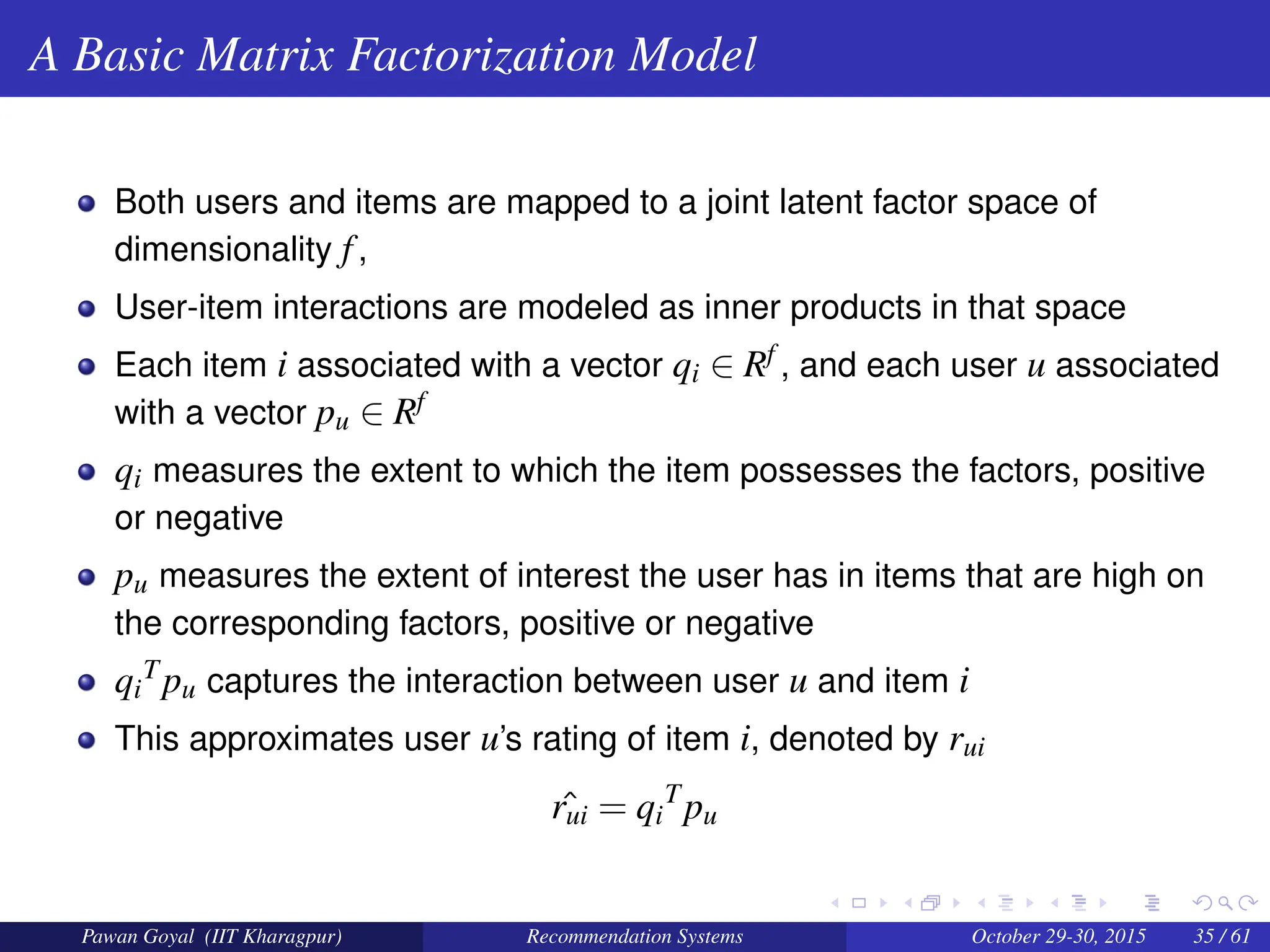
This approximates user u’s rating of item i, denoted by rui
ˆ
rui = qi
T
pu
Pawan Goyal (IIT Kharagpur) Recommendation Systems October 29-30, 2015 35 / 61
A Basic Matrix Factorization Model
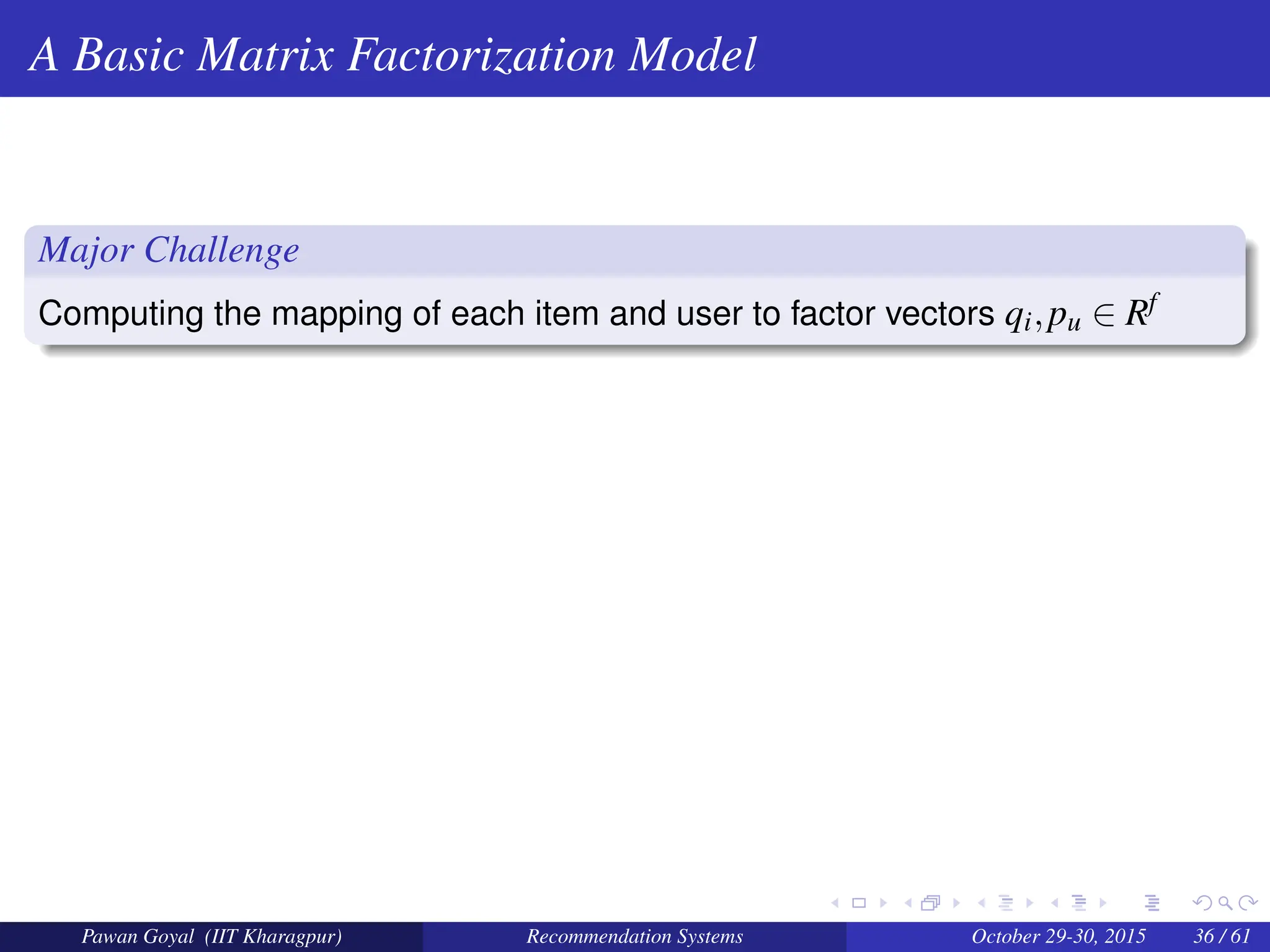
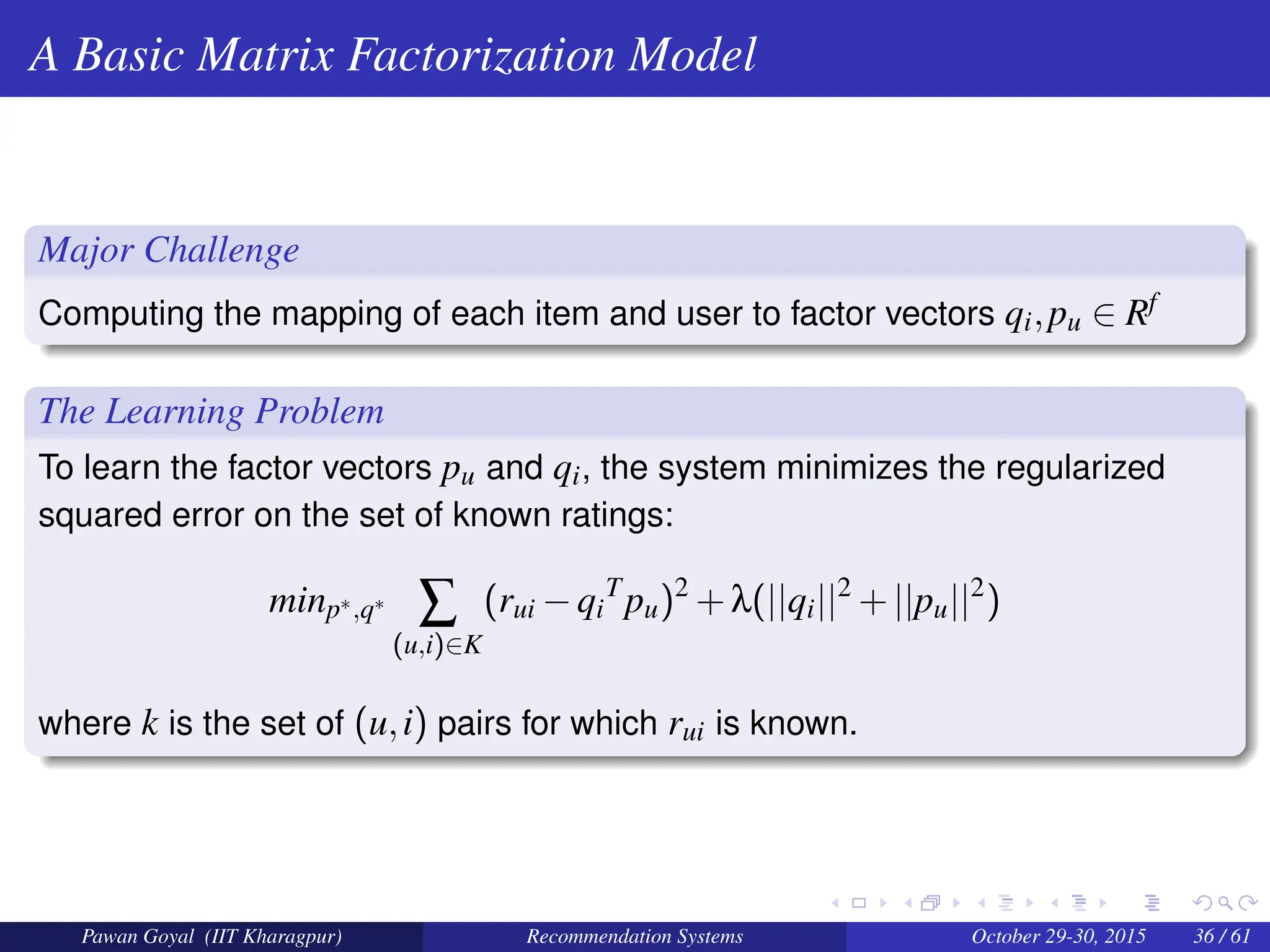
Major Challenge
Computing the mapping of each item and user to factor vectors qi,pu ∈ Rf
Pawan Goyal (IIT Kharagpur) Recommendation Systems October 29-30, 2015 36 / 61
A Basic Matrix Factorization Model
Major Challenge
Computing the mapping of each item and user to factor vectors qi,pu ∈ Rf
The Learning Problem
To learn the factor vectors pu and qi, the system minimizes the regularized
squared error on the set of known ratings:
minp∗,q∗
∑
(u,i)∈K
(rui −qi
T
pu)2
+λ(||qi||2
+||pu||2
)
where k is the set of (u,i) pairs for which rui is known.
Pawan Goyal (IIT Kharagpur) Recommendation Systems October 29-30, 2015 36 / 61
Stochastic Gradient Descent
minp∗,q∗
∑
(u,i)∈K
(rui −qi
T
pu)2
+λ(||qi||2
+||pu||2
)
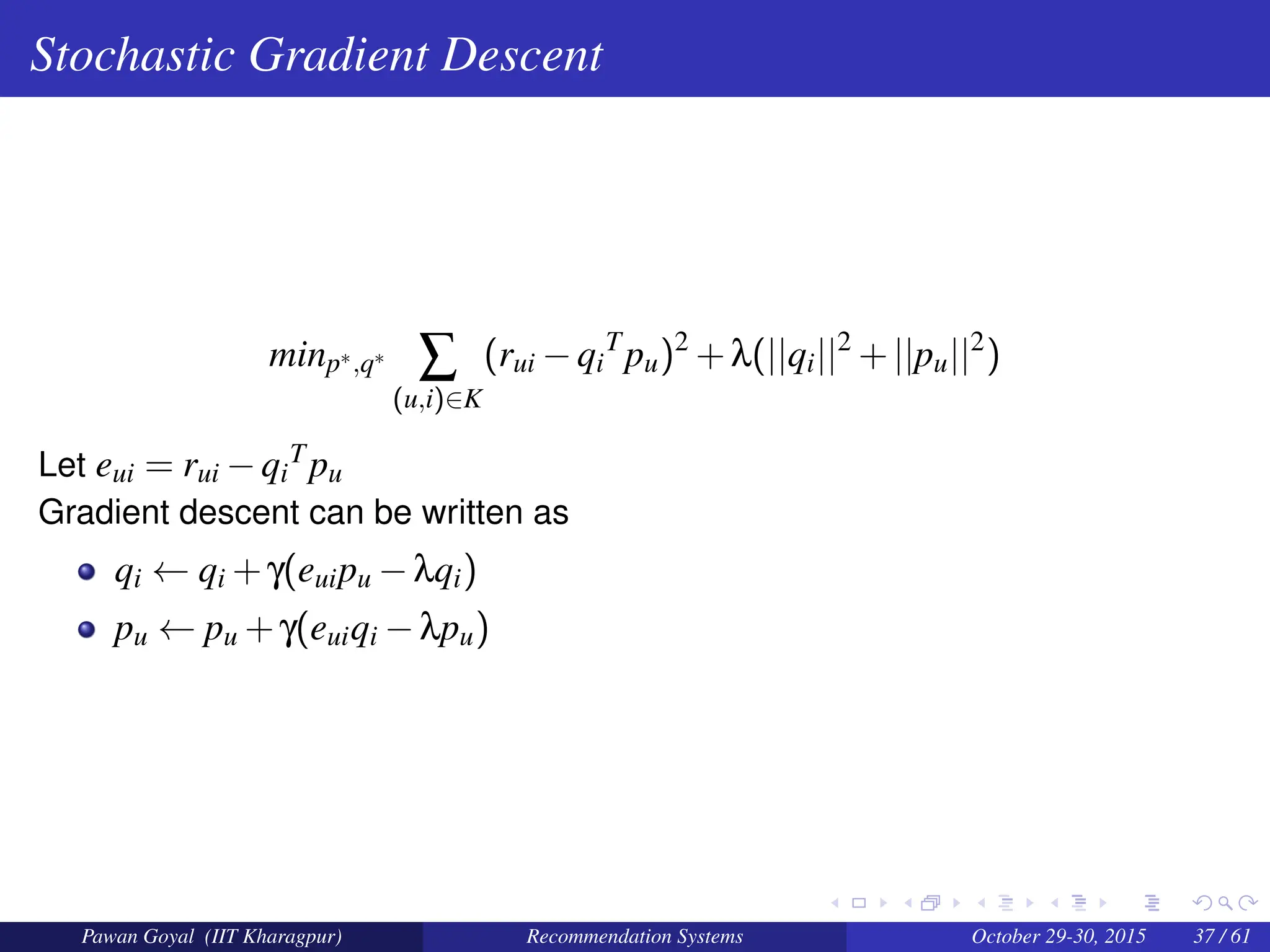
Let eui = rui −qi
Tpu
Gradient descent can be written as
qi ← qi +γ(euipu −λqi)
pu ← pu +γ(euiqi −λpu)
Pawan Goyal (IIT Kharagpur) Recommendation Systems October 29-30, 2015 37 / 61
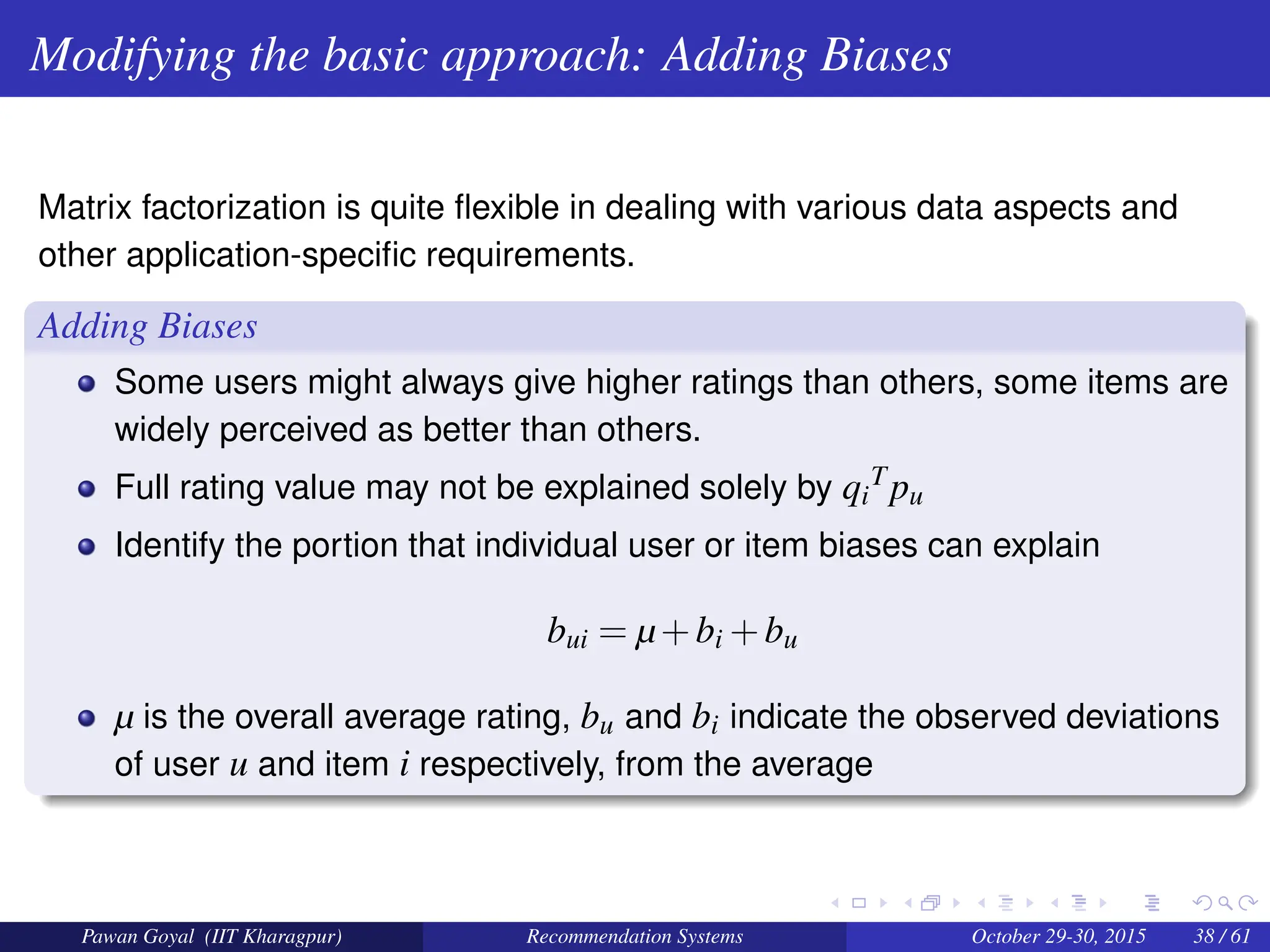
Modifying the basic approach: Adding Biases
Matrix factorization is quite flexible in dealing with various data aspects and
other application-specific requirements.
Pawan Goyal (IIT Kharagpur) Recommendation Systems October 29-30, 2015 38 / 61
Modifying the basic approach: Adding Biases
Matrix factorization is quite flexible in dealing with various data aspects and
other application-specific requirements.
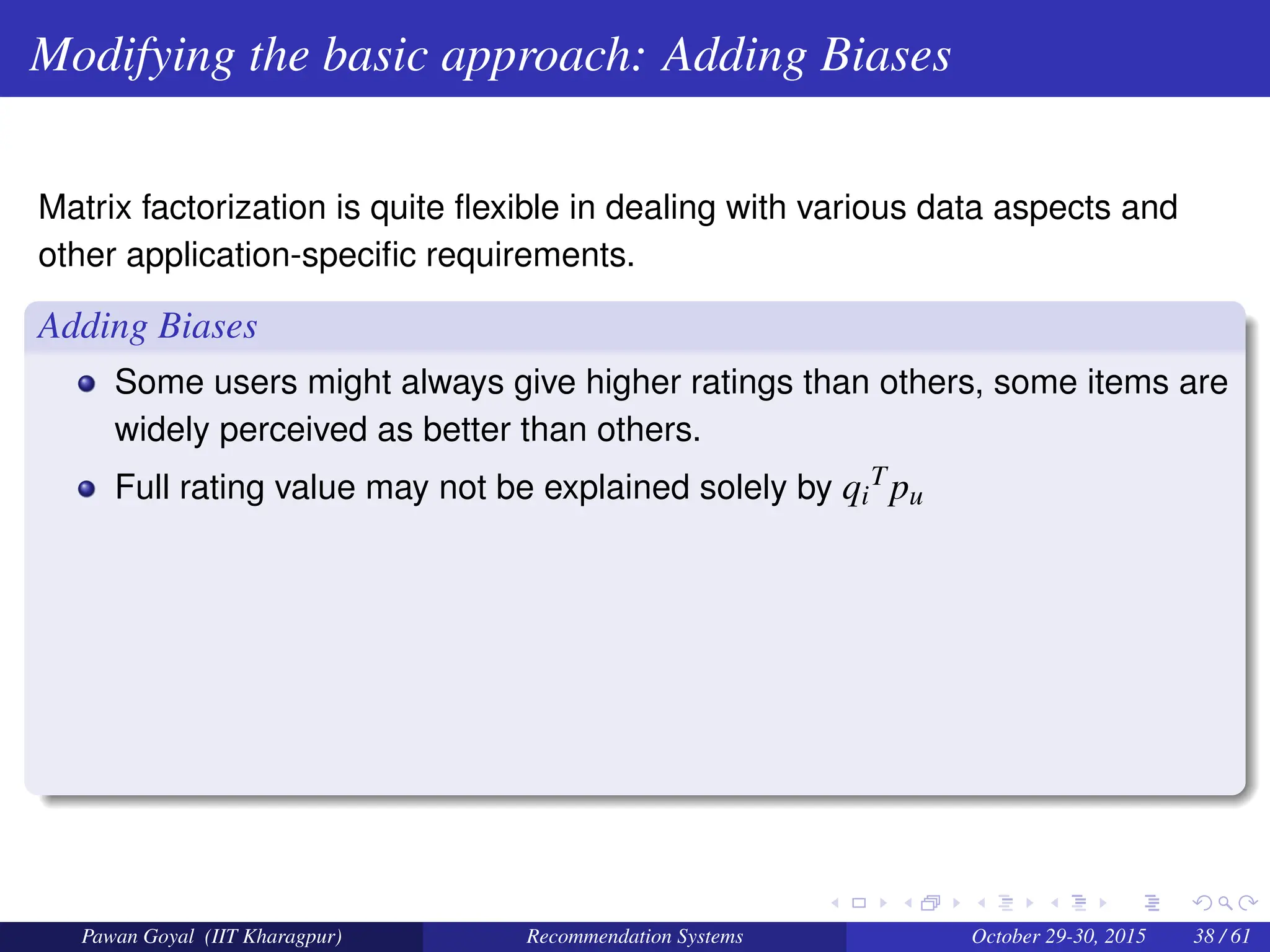
Adding Biases
Some users might always give higher ratings than others, some items are
widely perceived as better than others.
Full rating value may not be explained solely by qi
Tpu
Pawan Goyal (IIT Kharagpur) Recommendation Systems October 29-30, 2015 38 / 61
Modifying the basic approach: Adding Biases
Matrix factorization is quite flexible in dealing with various data aspects and
other application-specific requirements.
Adding Biases
Some users might always give higher ratings than others, some items are
widely perceived as better than others.
Full rating value may not be explained solely by qi
Tpu
Identify the portion that individual user or item biases can explain
bui = µ+bi +bu
µ is the overall average rating, bu and bi indicate the observed deviations
of user u and item i respectively, from the average
Pawan Goyal (IIT Kharagpur) Recommendation Systems October 29-30, 2015 38 / 61
Adding Biases
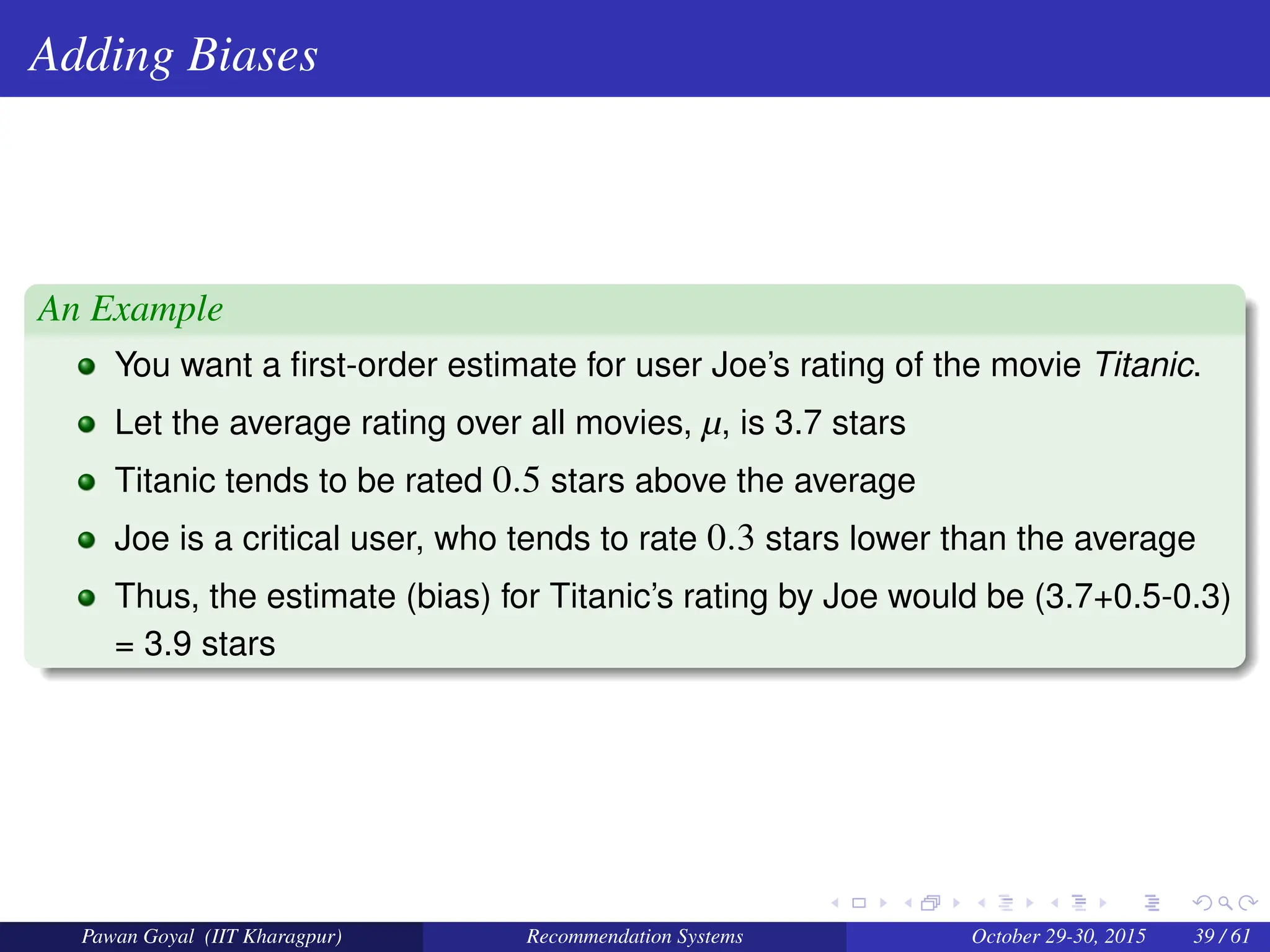
An Example
You want a first-order estimate for user Joe’s rating of the movie Titanic.
Let the average rating over all movies, µ, is 3.7 stars
Titanic tends to be rated 0.5 stars above the average
Joe is a critical user, who tends to rate 0.3 stars lower than the average
Thus, the estimate (bias) for Titanic’s rating by Joe would be (3.7+0.5-0.3)
= 3.9 stars
Pawan Goyal (IIT Kharagpur) Recommendation Systems October 29-30, 2015 39 / 61
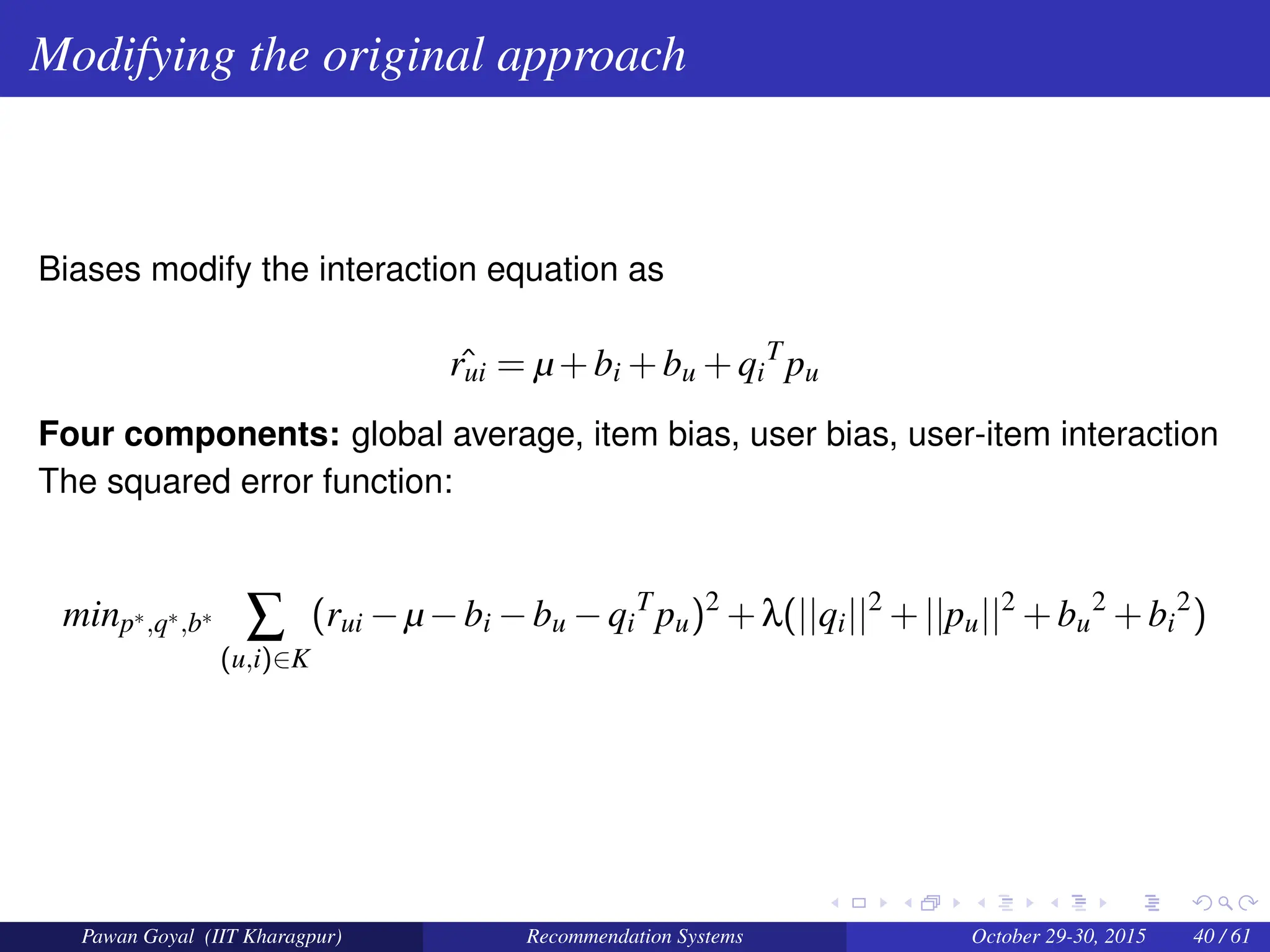
Modifying the original approach
Biases modify the interaction equation as
ˆ
rui = µ+bi +bu +qi
T
pu
Four components: global average, item bias, user bias, user-item interaction
The squared error function:
minp∗,q∗,b∗
∑
(u,i)∈K
(rui −µ−bi −bu −qi
T
pu)2
+λ(||qi||2
+||pu||2
+bu
2
+bi
2
)
Pawan Goyal (IIT Kharagpur) Recommendation Systems October 29-30, 2015 40 / 61
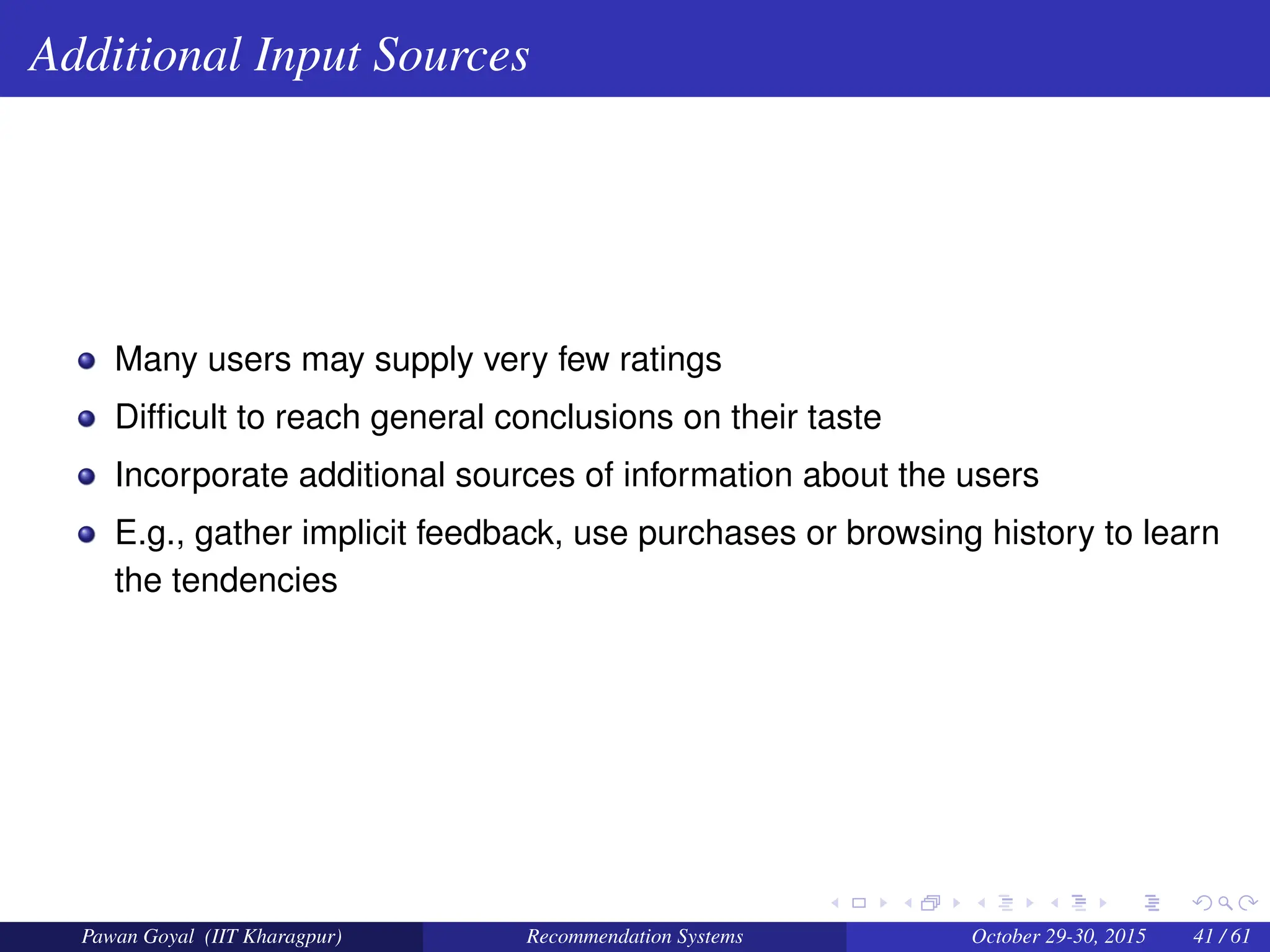
Additional Input Sources
Many users may supply very few ratings
Difficult to reach general conclusions on their taste
Pawan Goyal (IIT Kharagpur) Recommendation Systems October 29-30, 2015 41 / 61
Additional Input Sources
Many users may supply very few ratings
Difficult to reach general conclusions on their taste
Incorporate additional sources of information about the users
E.g., gather implicit feedback, use purchases or browsing history to learn
the tendencies
Pawan Goyal (IIT Kharagpur) Recommendation Systems October 29-30, 2015 41 / 61
Modeling Implicit Feedback
Boolean Implicit Feedback
N(u): set of items for which user u expressed an implicit preference
Let item i be associated with xi ∈ Rf [xi is different from qi]
The user can be characterized by the vector ∑
i∈N(u)
xi
Normalizing the sum:
∑
i∈N(u)
xi
√
|N(u)|
Pawan Goyal (IIT Kharagpur) Recommendation Systems October 29-30, 2015 42 / 61
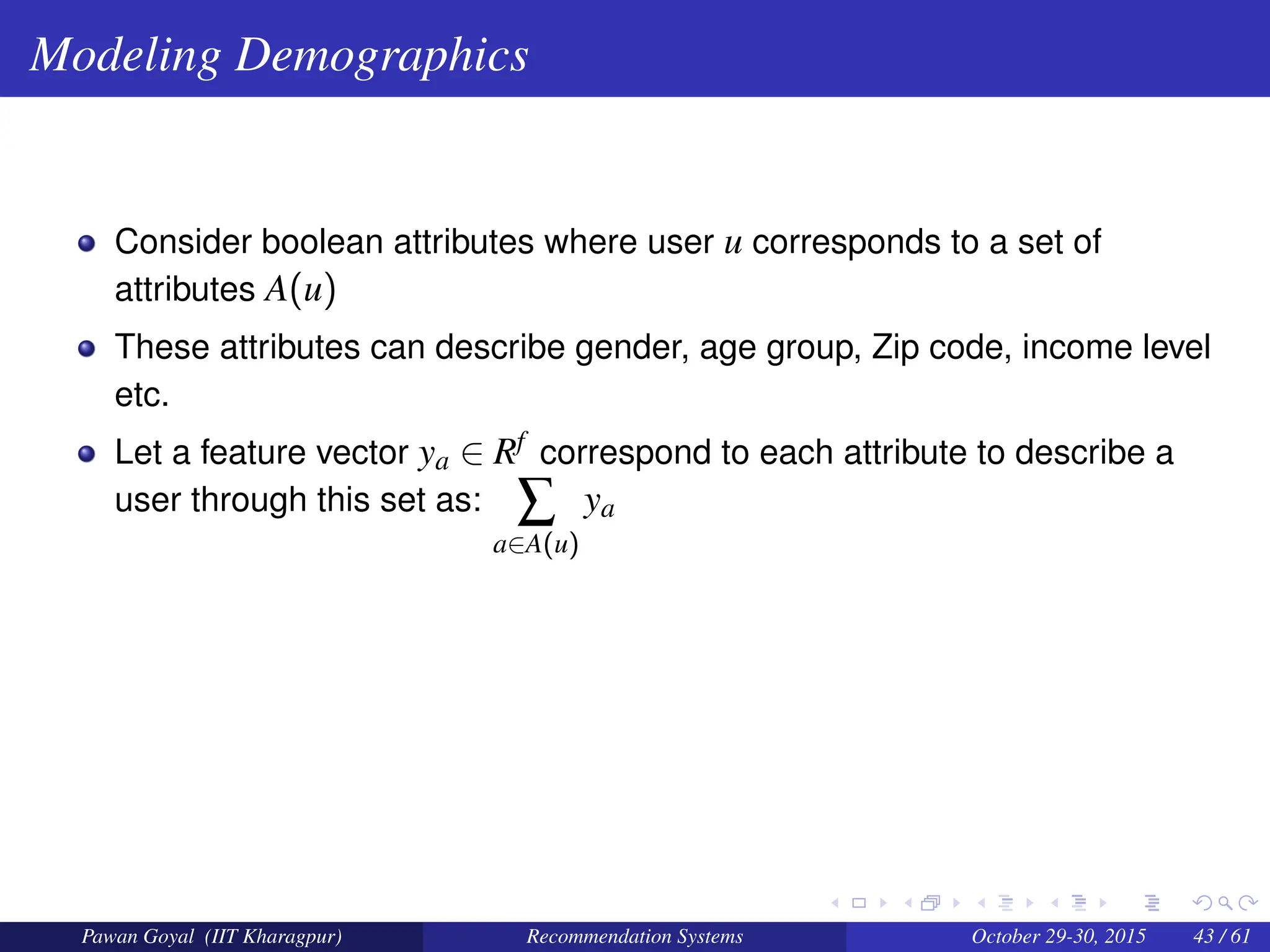
Modeling Demographics
Consider boolean attributes where user u corresponds to a set of
attributes A(u)
These attributes can describe gender, age group, Zip code, income level
etc.
Let a feature vector ya ∈ Rf correspond to each attribute to describe a
user through this set as: ∑
a∈A(u)
ya
Pawan Goyal (IIT Kharagpur) Recommendation Systems October 29-30, 2015 43 / 61
Modeling Demographics
Consider boolean attributes where user u corresponds to a set of
attributes A(u)
These attributes can describe gender, age group, Zip code, income level
etc.
Let a feature vector ya ∈ Rf correspond to each attribute to describe a
user through this set as: ∑
a∈A(u)
ya
Integrating enhanced user representation in the matrix factorization model:
ˆ
rui = µ+bi +bu +qi
T
[pu +|N(u)|−0.5
∑
i∈N(u)
xi + ∑
a∈A(u)
ya]
Pawan Goyal (IIT Kharagpur) Recommendation Systems October 29-30, 2015 43 / 61
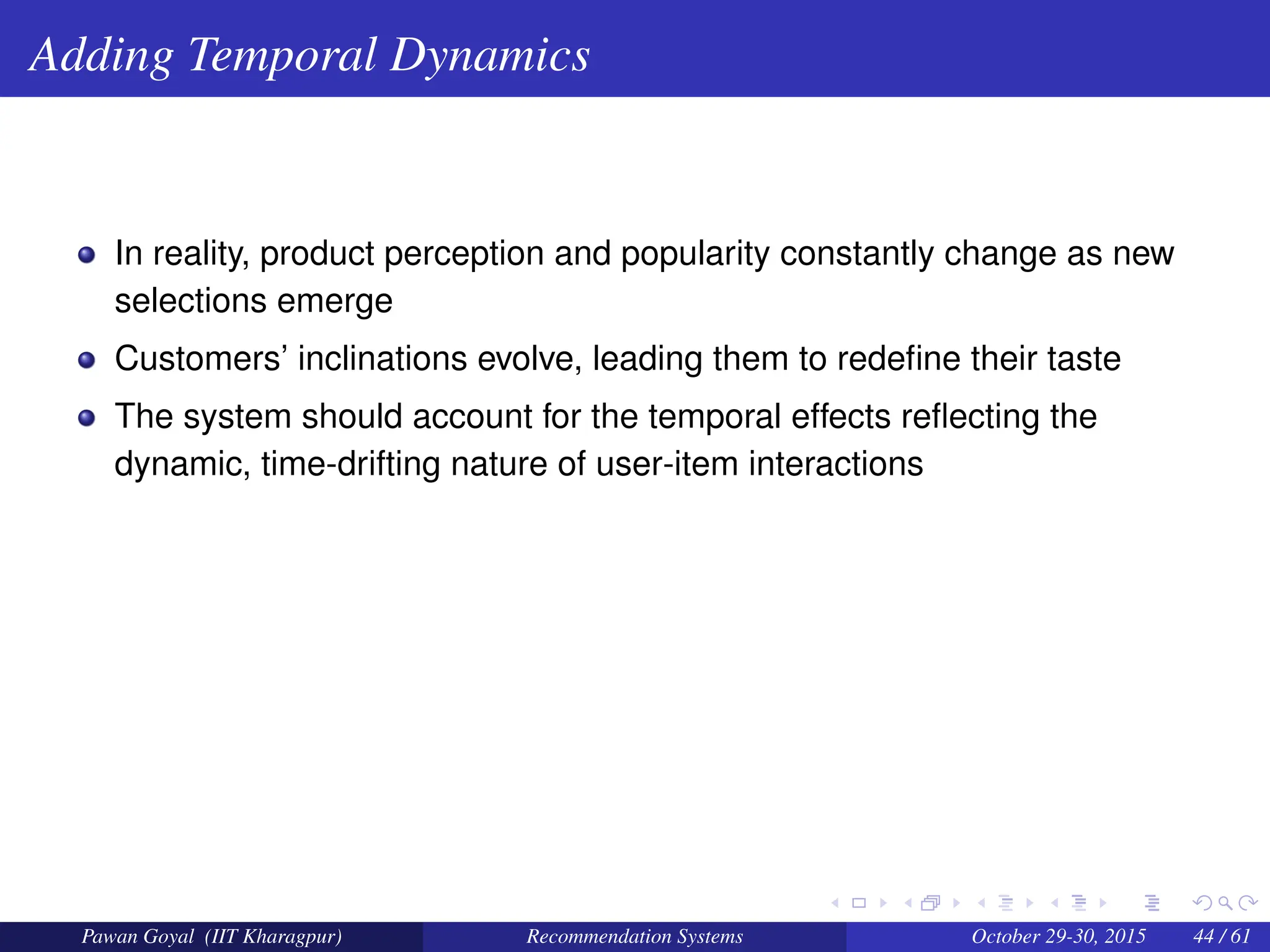
Adding Temporal Dynamics
In reality, product perception and popularity constantly change as new
selections emerge
Customers’ inclinations evolve, leading them to redefine their taste
The system should account for the temporal effects reflecting the
dynamic, time-drifting nature of user-item interactions
Pawan Goyal (IIT Kharagpur) Recommendation Systems October 29-30, 2015 44 / 61
Adding Temporal Dynamics
In reality, product perception and popularity constantly change as new
selections emerge
Customers’ inclinations evolve, leading them to redefine their taste
The system should account for the temporal effects reflecting the
dynamic, time-drifting nature of user-item interactions
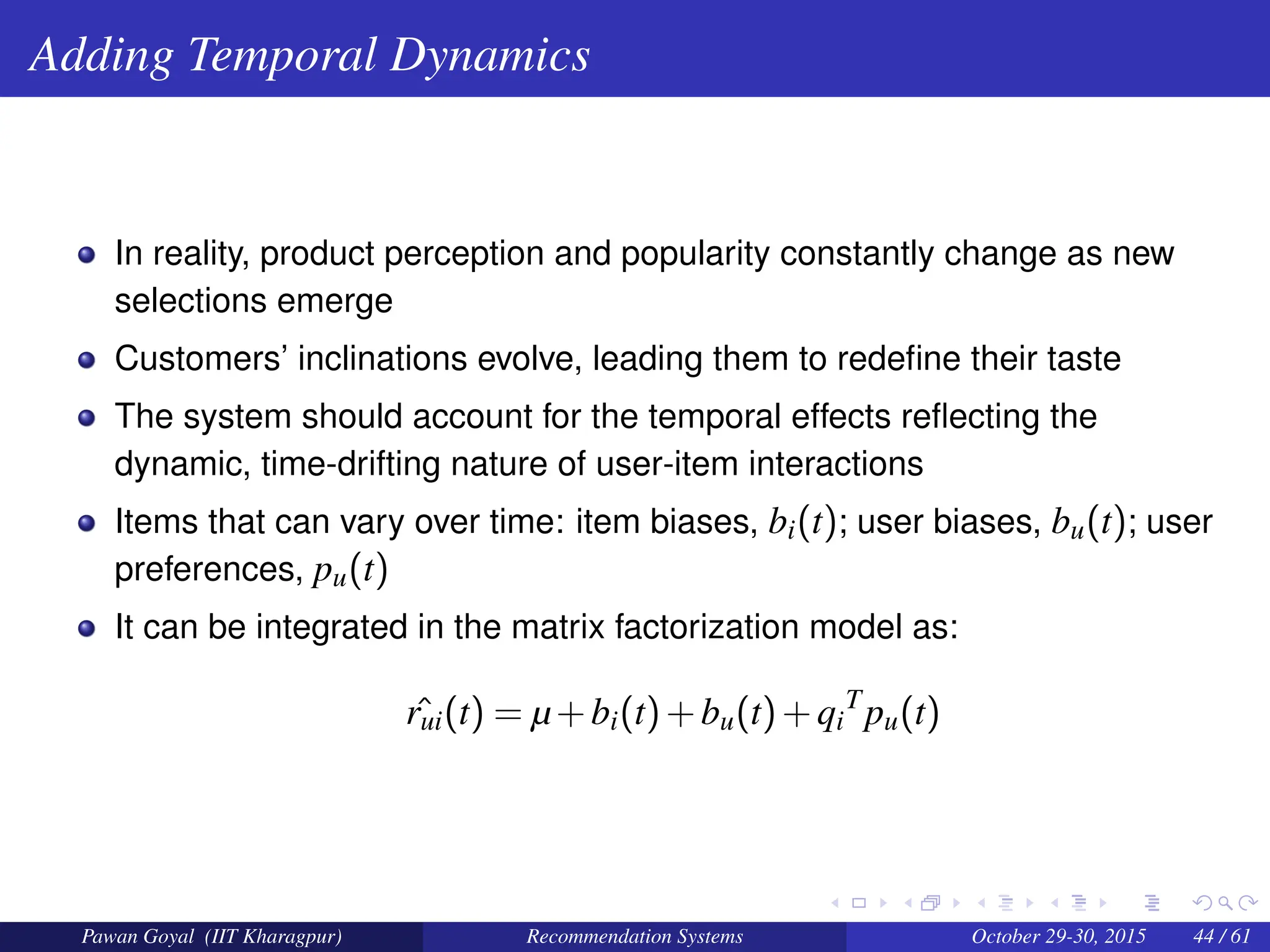
Items that can vary over time: item biases, bi(t); user biases, bu(t); user
preferences, pu(t)
It can be integrated in the matrix factorization model as:
ˆ
rui(t) = µ+bi(t)+bu(t)+qi
T
pu(t)
Pawan Goyal (IIT Kharagpur) Recommendation Systems October 29-30, 2015 44 / 61
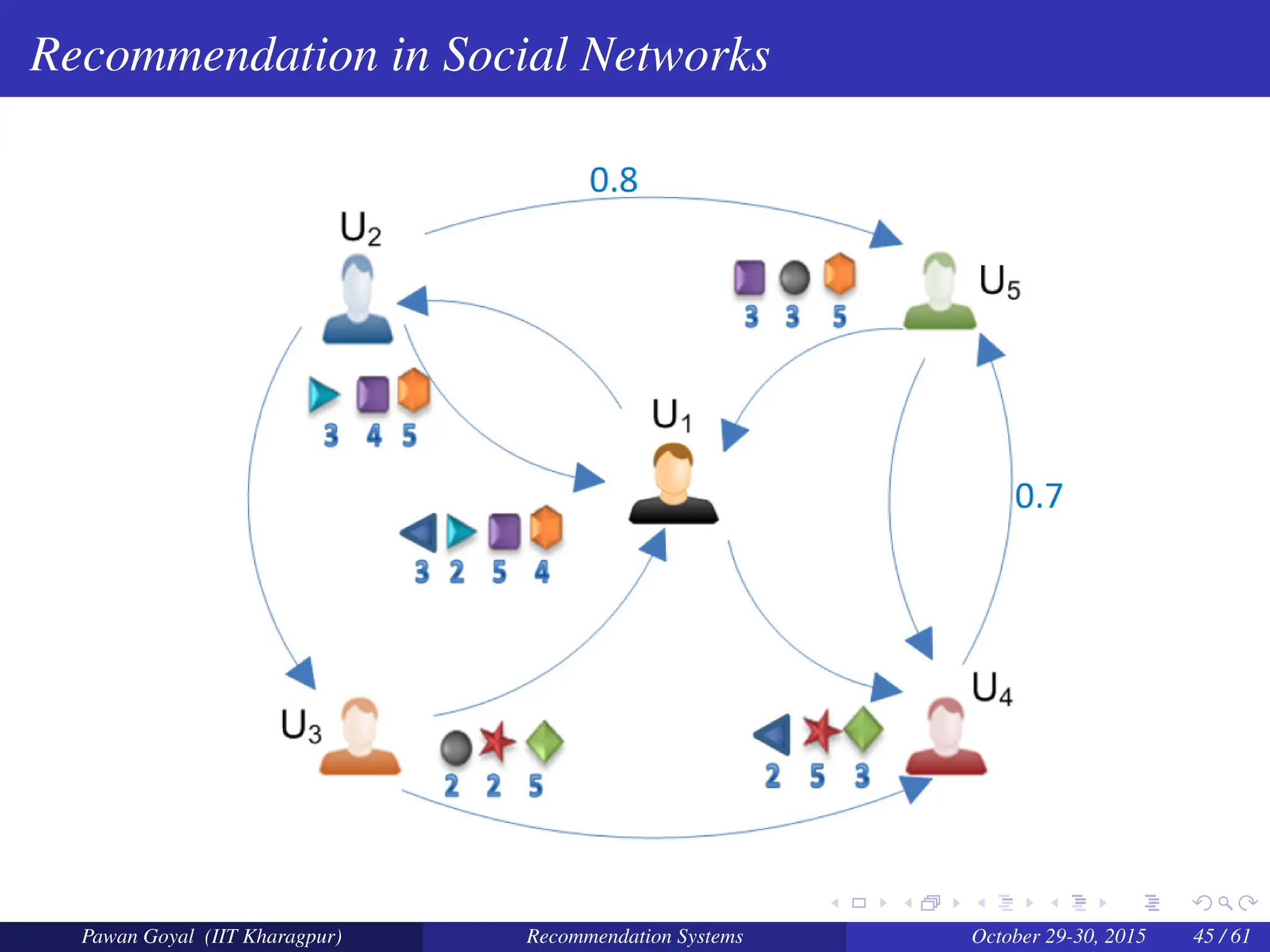
Recommendation in Social Networks
Pawan Goyal (IIT Kharagpur) Recommendation Systems October 29-30, 2015 45 / 61
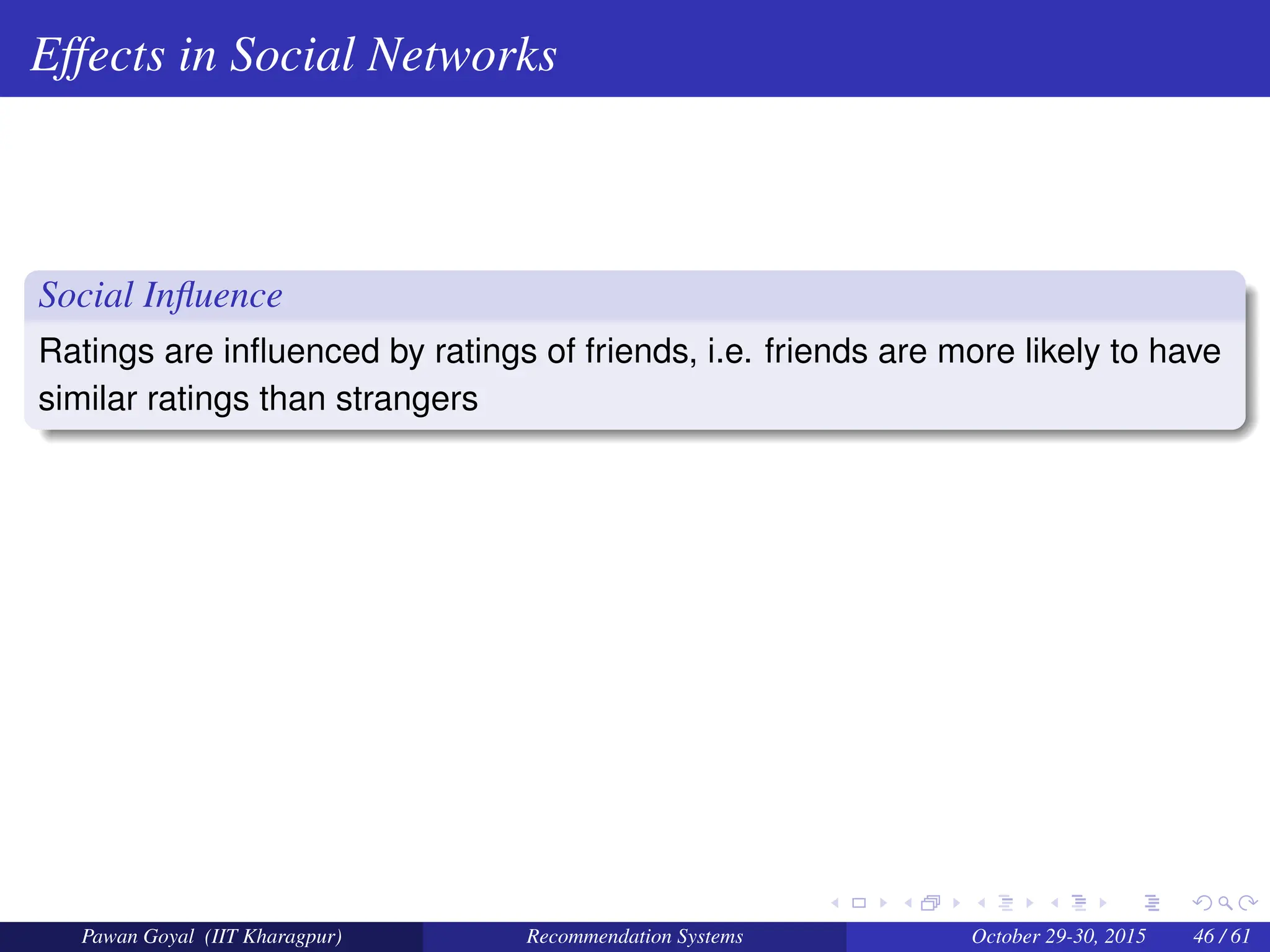
Effects in Social Networks
Social Influence
Ratings are influenced by ratings of friends, i.e. friends are more likely to have
similar ratings than strangers
Pawan Goyal (IIT Kharagpur) Recommendation Systems October 29-30, 2015 46 / 61
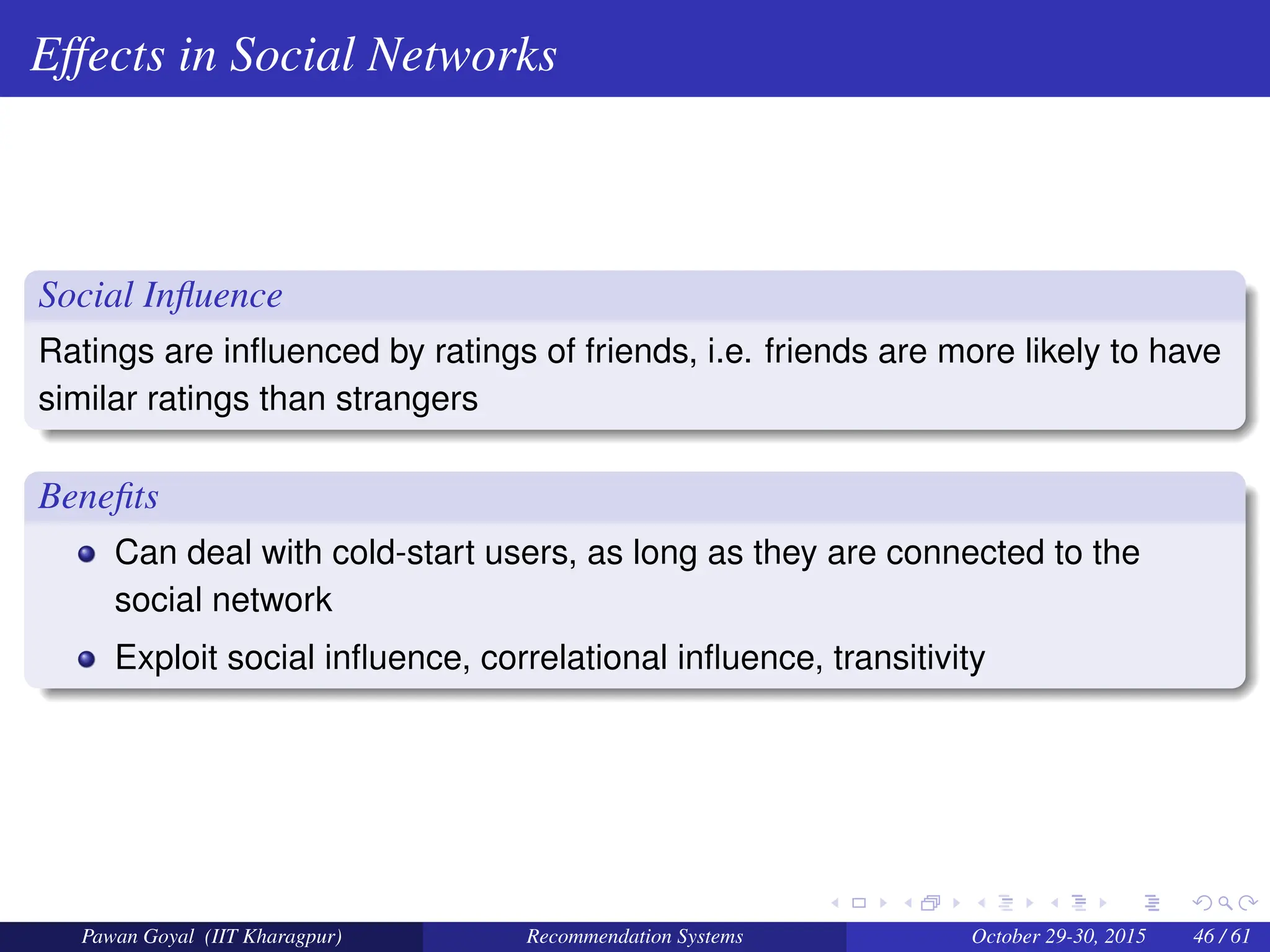
Effects in Social Networks
Social Influence
Ratings are influenced by ratings of friends, i.e. friends are more likely to have
similar ratings than strangers
Benefits
Can deal with cold-start users, as long as they are connected to the
social network
Exploit social influence, correlational influence, transitivity
Pawan Goyal (IIT Kharagpur) Recommendation Systems October 29-30, 2015 46 / 61
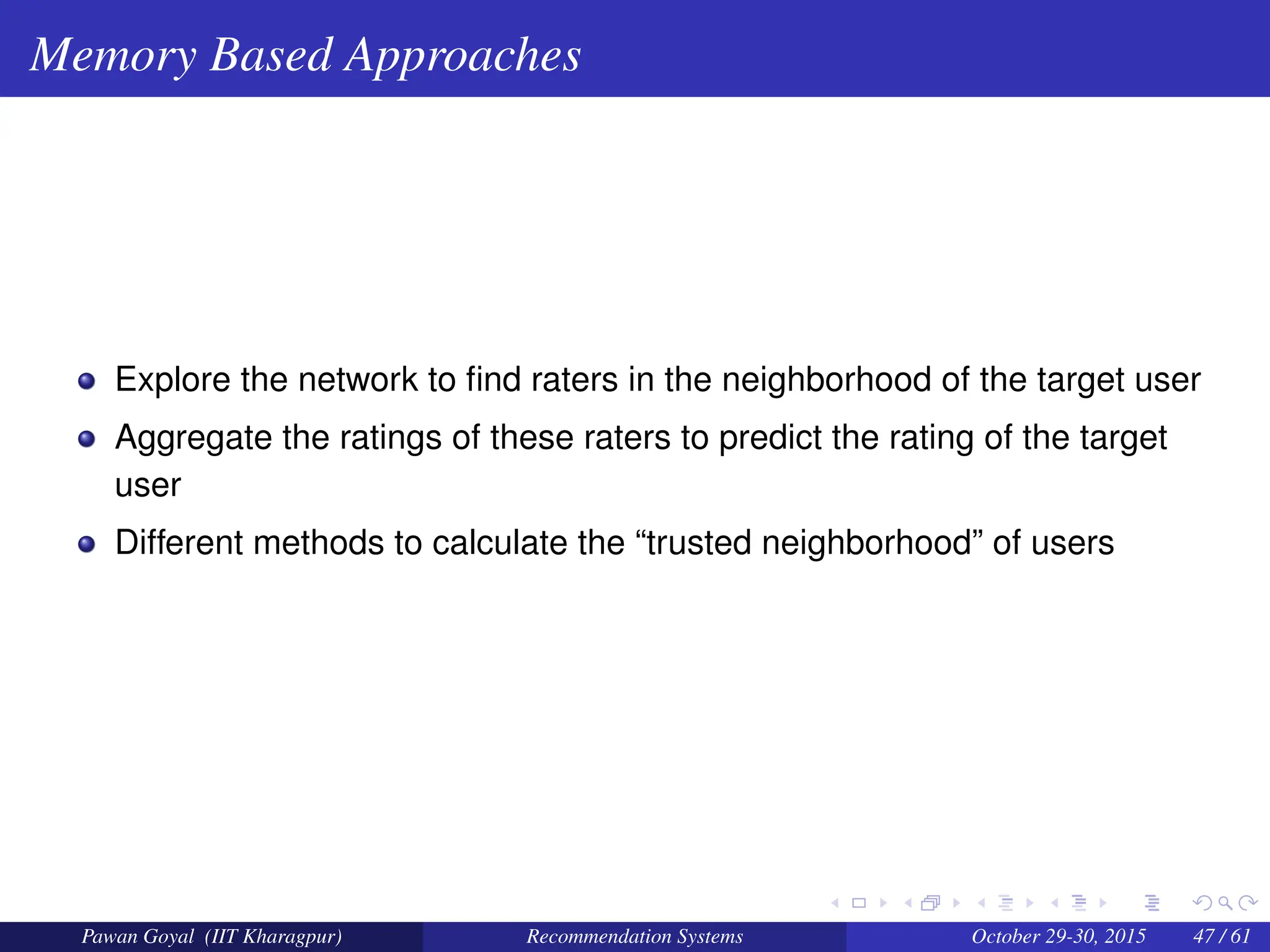
Memory Based Approaches
Explore the network to find raters in the neighborhood of the target user
Aggregate the ratings of these raters to predict the rating of the target
user
Different methods to calculate the “trusted neighborhood” of users
Pawan Goyal (IIT Kharagpur) Recommendation Systems October 29-30, 2015 47 / 61
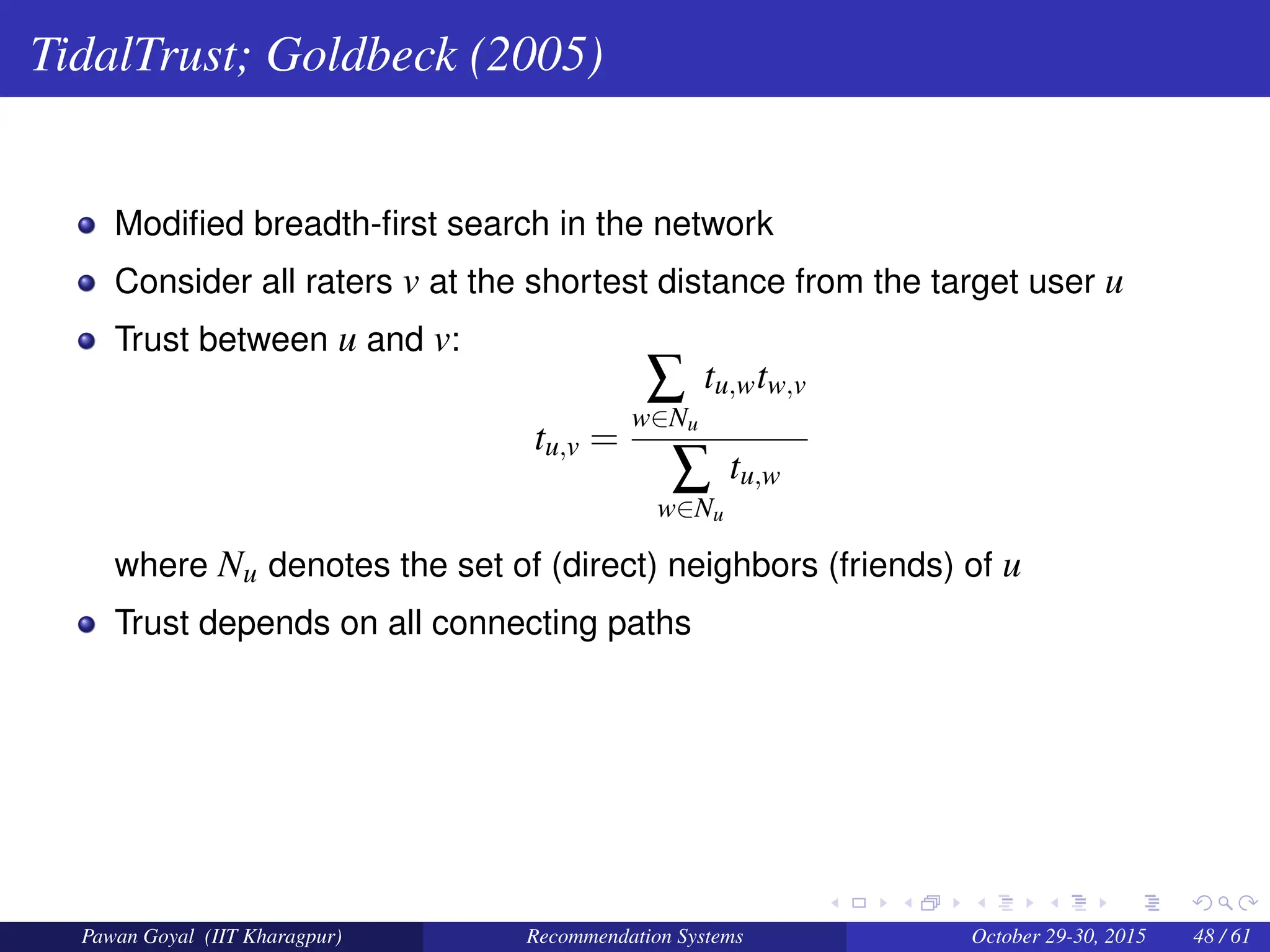
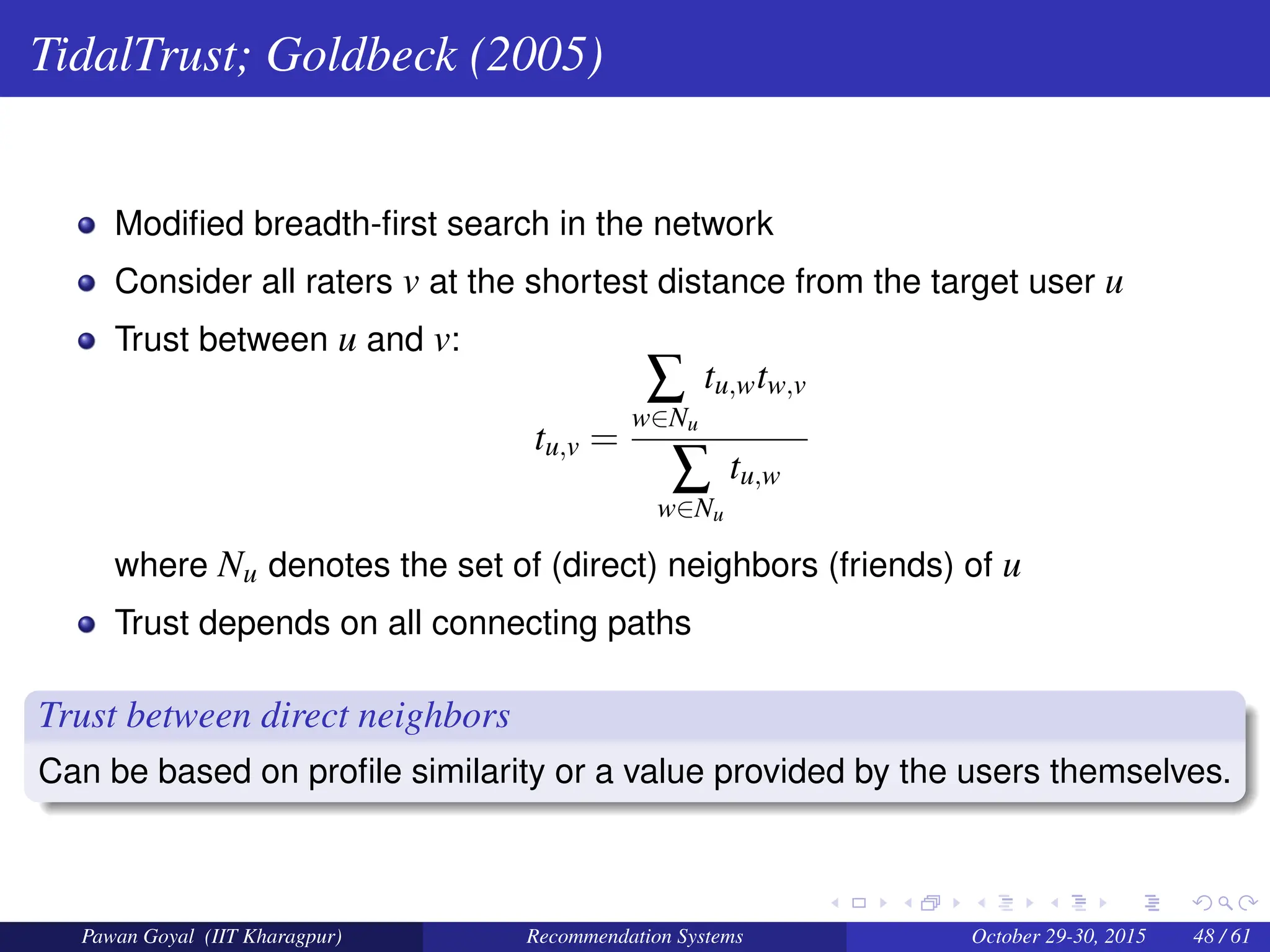
TidalTrust; Goldbeck (2005)
Modified breadth-first search in the network
Consider all raters v at the shortest distance from the target user u
Trust between u and v:
tu,v =
∑
w∈Nu
tu,wtw,v
∑
w∈Nu
tu,w
where Nu denotes the set of (direct) neighbors (friends) of u
Trust depends on all connecting paths
Pawan Goyal (IIT Kharagpur) Recommendation Systems October 29-30, 2015 48 / 61
TidalTrust; Goldbeck (2005)
Modified breadth-first search in the network
Consider all raters v at the shortest distance from the target user u
Trust between u and v:
tu,v =
∑
w∈Nu
tu,wtw,v
∑
w∈Nu
tu,w
where Nu denotes the set of (direct) neighbors (friends) of u
Trust depends on all connecting paths
Trust between direct neighbors
Can be based on profile similarity or a value provided by the users themselves.
Pawan Goyal (IIT Kharagpur) Recommendation Systems October 29-30, 2015 48 / 61
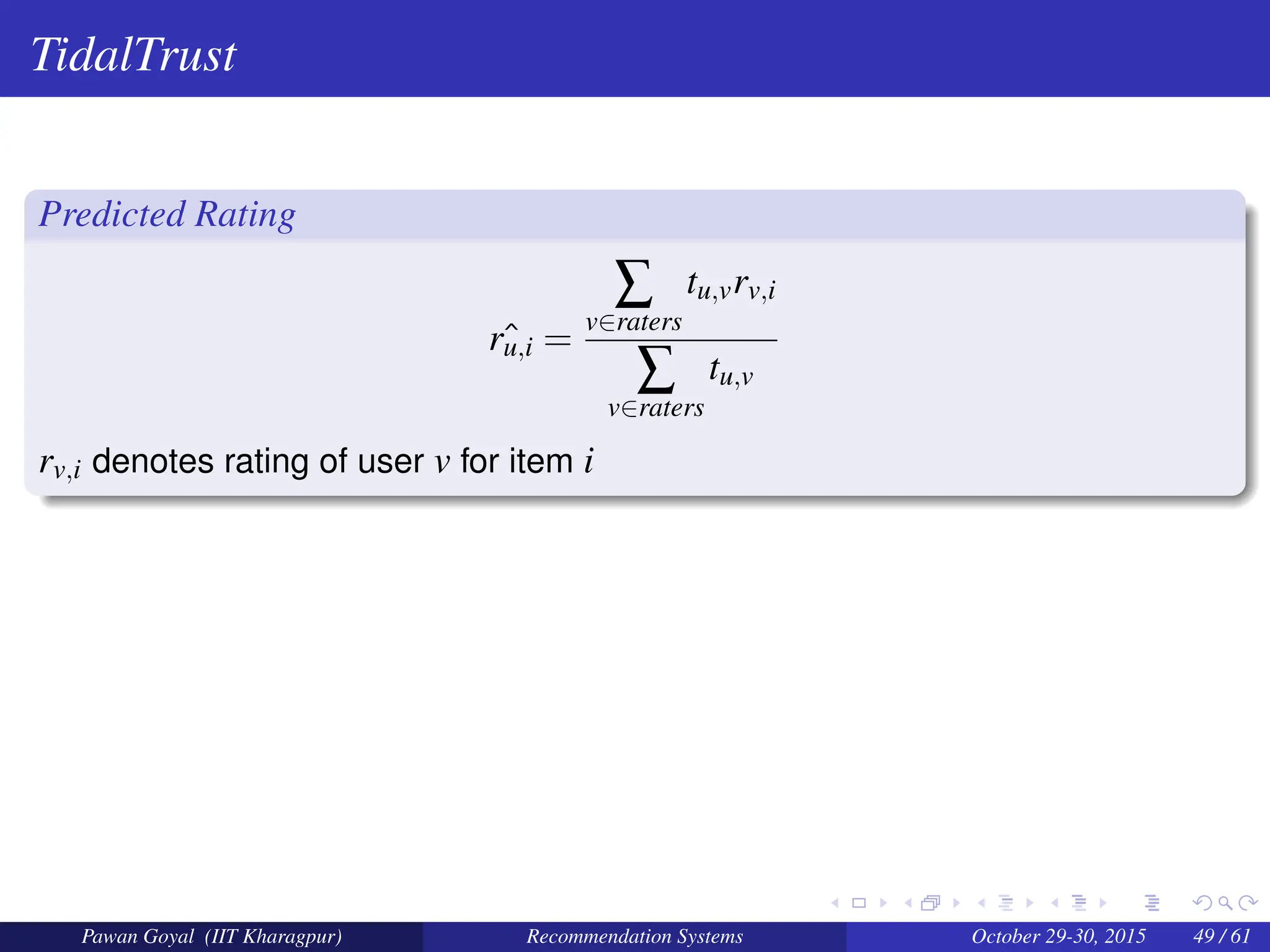
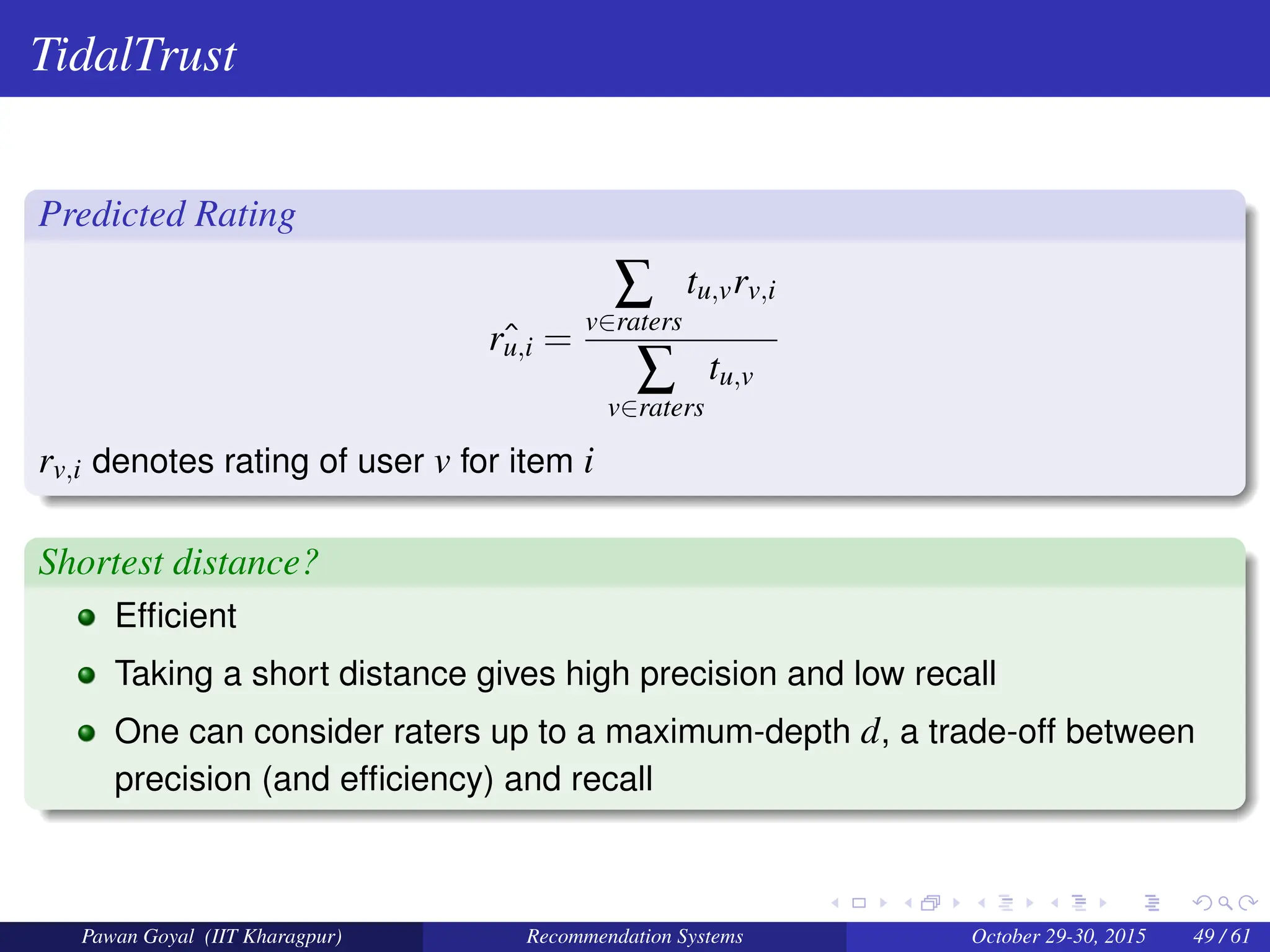
TidalTrust
Predicted Rating
ˆ
ru,i =
∑
v∈raters
tu,vrv,i
∑
v∈raters
tu,v
rv,i denotes rating of user v for item i
Pawan Goyal (IIT Kharagpur) Recommendation Systems October 29-30, 2015 49 / 61
TidalTrust
Predicted Rating
ˆ
ru,i =
∑
v∈raters
tu,vrv,i
∑
v∈raters
tu,v
rv,i denotes rating of user v for item i
Shortest distance?
Efficient
Taking a short distance gives high precision and low recall
One can consider raters up to a maximum-depth d, a trade-off between
precision (and efficiency) and recall
Pawan Goyal (IIT Kharagpur) Recommendation Systems October 29-30, 2015 49 / 61
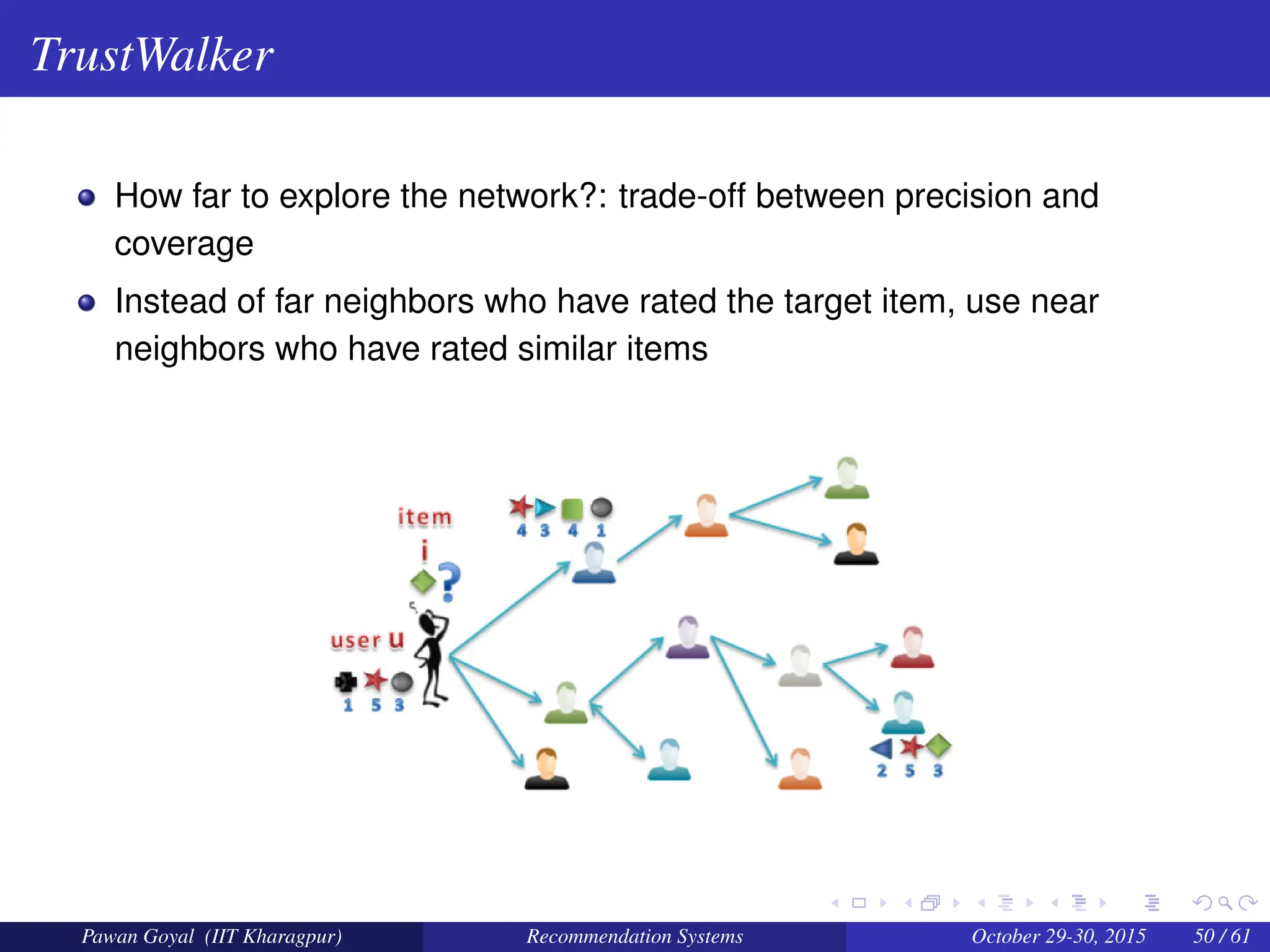
TrustWalker
How far to explore the network?: trade-off between precision and
coverage
Instead of far neighbors who have rated the target item, use near
neighbors who have rated similar items
Pawan Goyal (IIT Kharagpur) Recommendation Systems October 29-30, 2015 50 / 61
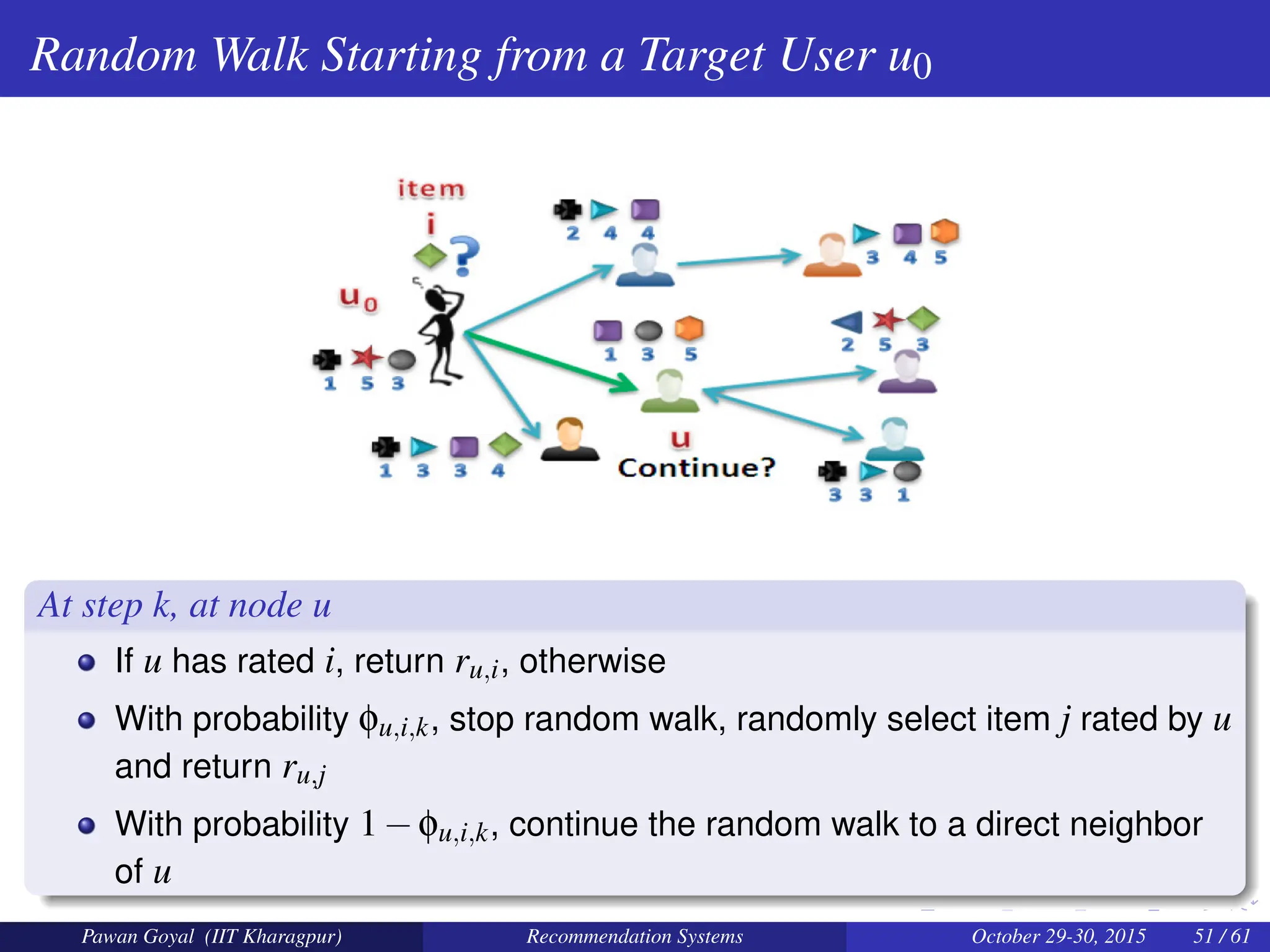
Random Walk Starting from a Target User u0
At step k, at node u
If u has rated i, return ru,i, otherwise
With probability φu,i,k, stop random walk, randomly select item j rated by u
and return ru,j
With probability 1−φu,i,k, continue the random walk to a direct neighbor
of u
Pawan Goyal (IIT Kharagpur) Recommendation Systems October 29-30, 2015 51 / 61
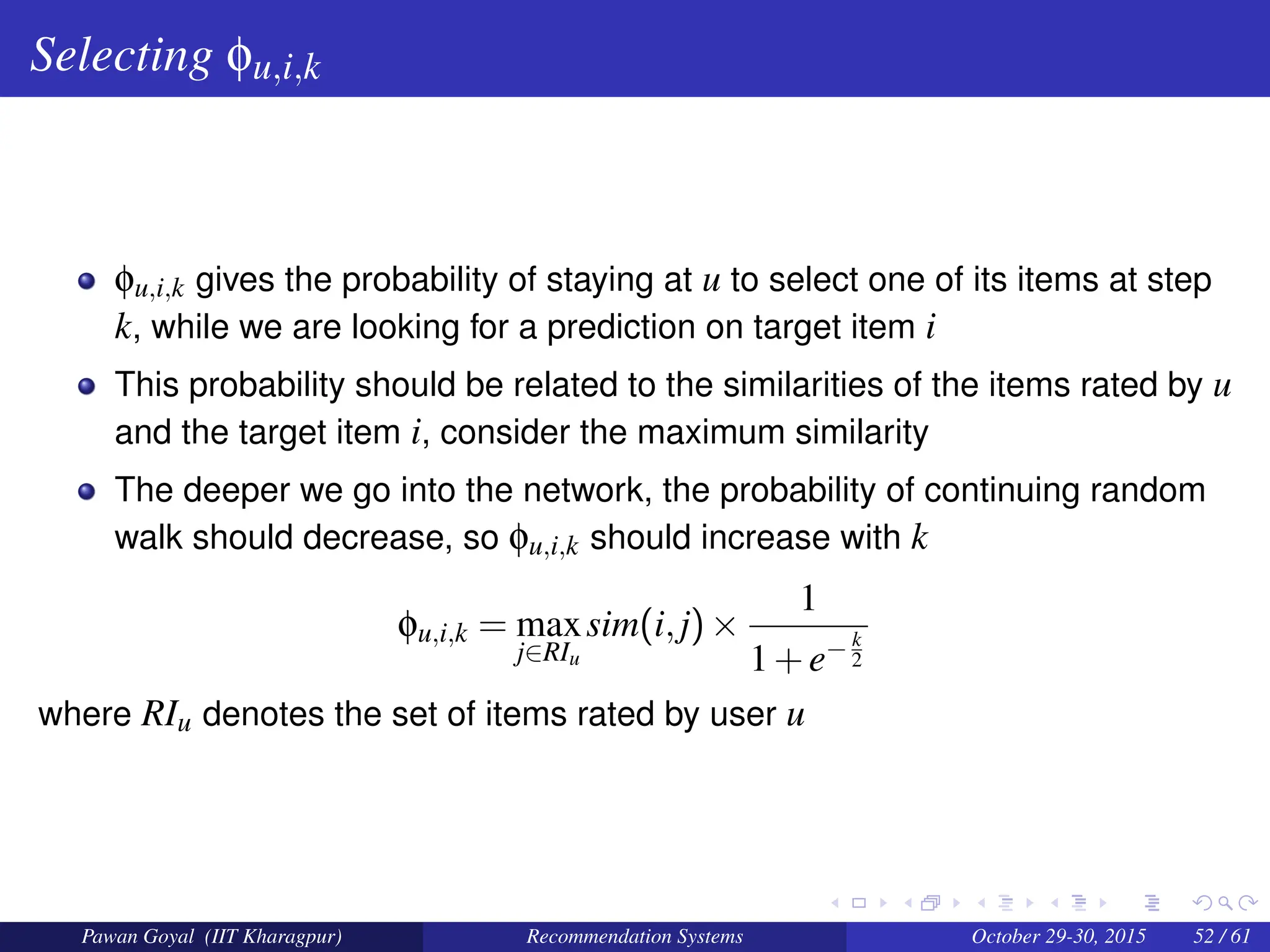
Selecting φu,i,k
φu,i,k gives the probability of staying at u to select one of its items at step
k, while we are looking for a prediction on target item i
This probability should be related to the similarities of the items rated by u
and the target item i, consider the maximum similarity
The deeper we go into the network, the probability of continuing random
walk should decrease, so φu,i,k should increase with k
φu,i,k = max
j∈RIu
sim(i,j)×
1
1+e− k
2
where RIu denotes the set of items rated by user u
Pawan Goyal (IIT Kharagpur) Recommendation Systems October 29-30, 2015 52 / 61
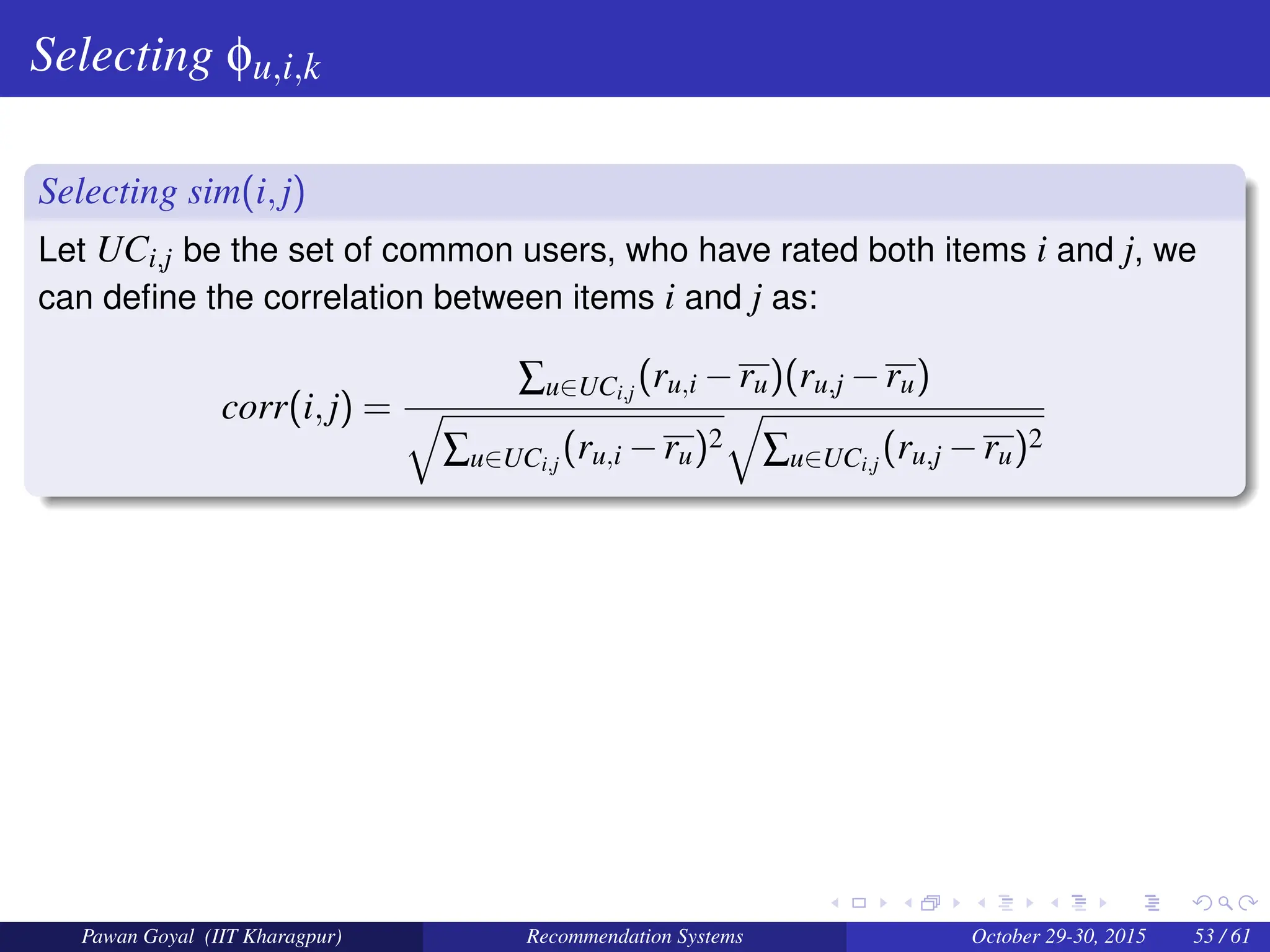
Selecting φu,i,k
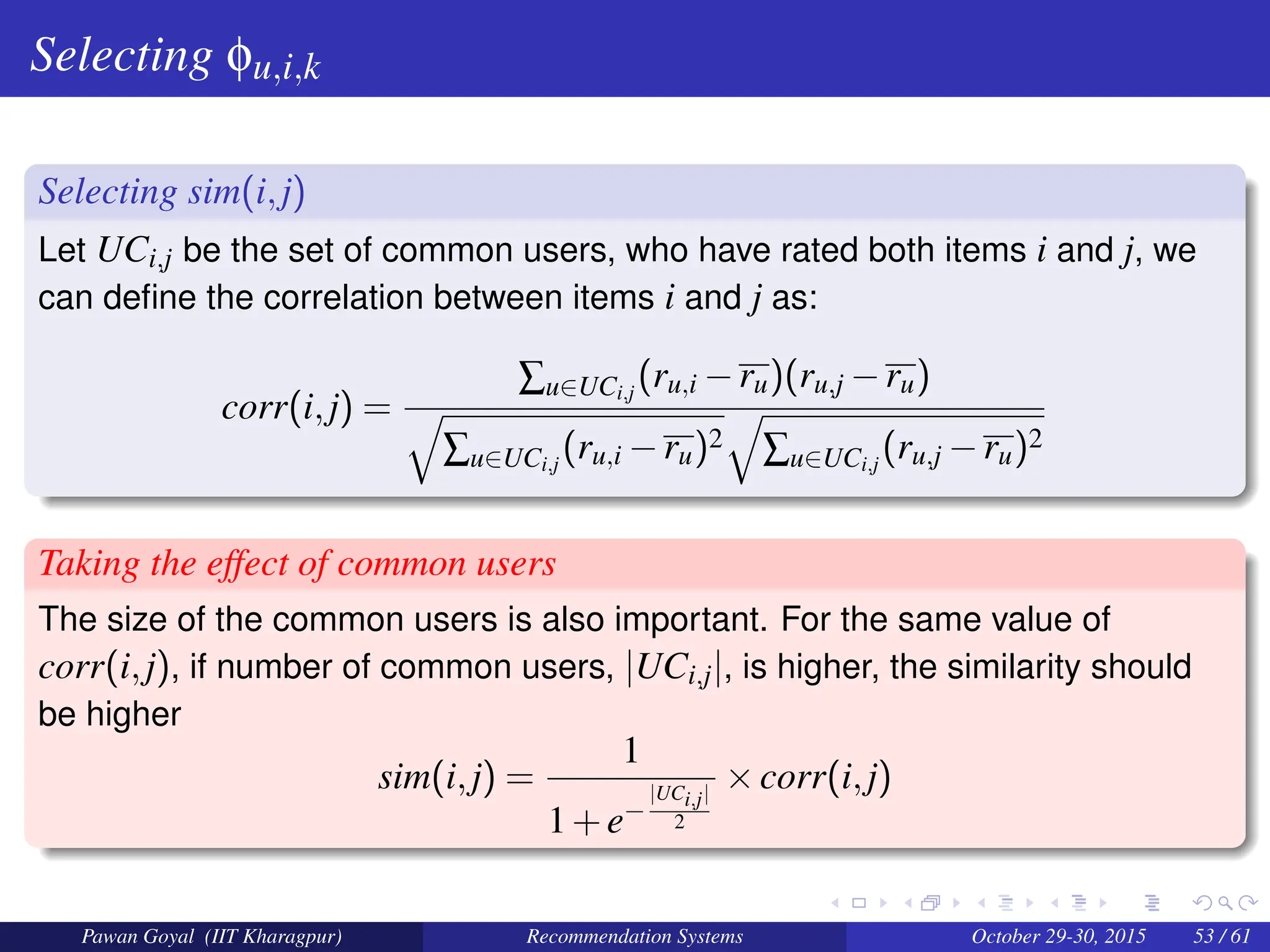
Selecting sim(i,j)
Let UCi,j be the set of common users, who have rated both items i and j, we
can define the correlation between items i and j as:
corr(i,j) =
∑u∈UCi,j
(ru,i −ru)(ru,j −ru)
q
∑u∈UCi,j
(ru,i −ru)2
q
∑u∈UCi,j
(ru,j −ru)2
Pawan Goyal (IIT Kharagpur) Recommendation Systems October 29-30, 2015 53 / 61
Selecting φu,i,k
Selecting sim(i,j)
Let UCi,j be the set of common users, who have rated both items i and j, we
can define the correlation between items i and j as:
corr(i,j) =
∑u∈UCi,j
(ru,i −ru)(ru,j −ru)
q
∑u∈UCi,j
(ru,i −ru)2
q
∑u∈UCi,j
(ru,j −ru)2
Taking the effect of common users
The size of the common users is also important. For the same value of
corr(i,j), if number of common users, |UCi,j|, is higher, the similarity should
be higher
sim(i,j) =
1
1+e−
|UCi,j|
2
×corr(i,j)
Pawan Goyal (IIT Kharagpur) Recommendation Systems October 29-30, 2015 53 / 61
When does a random walk terminate?
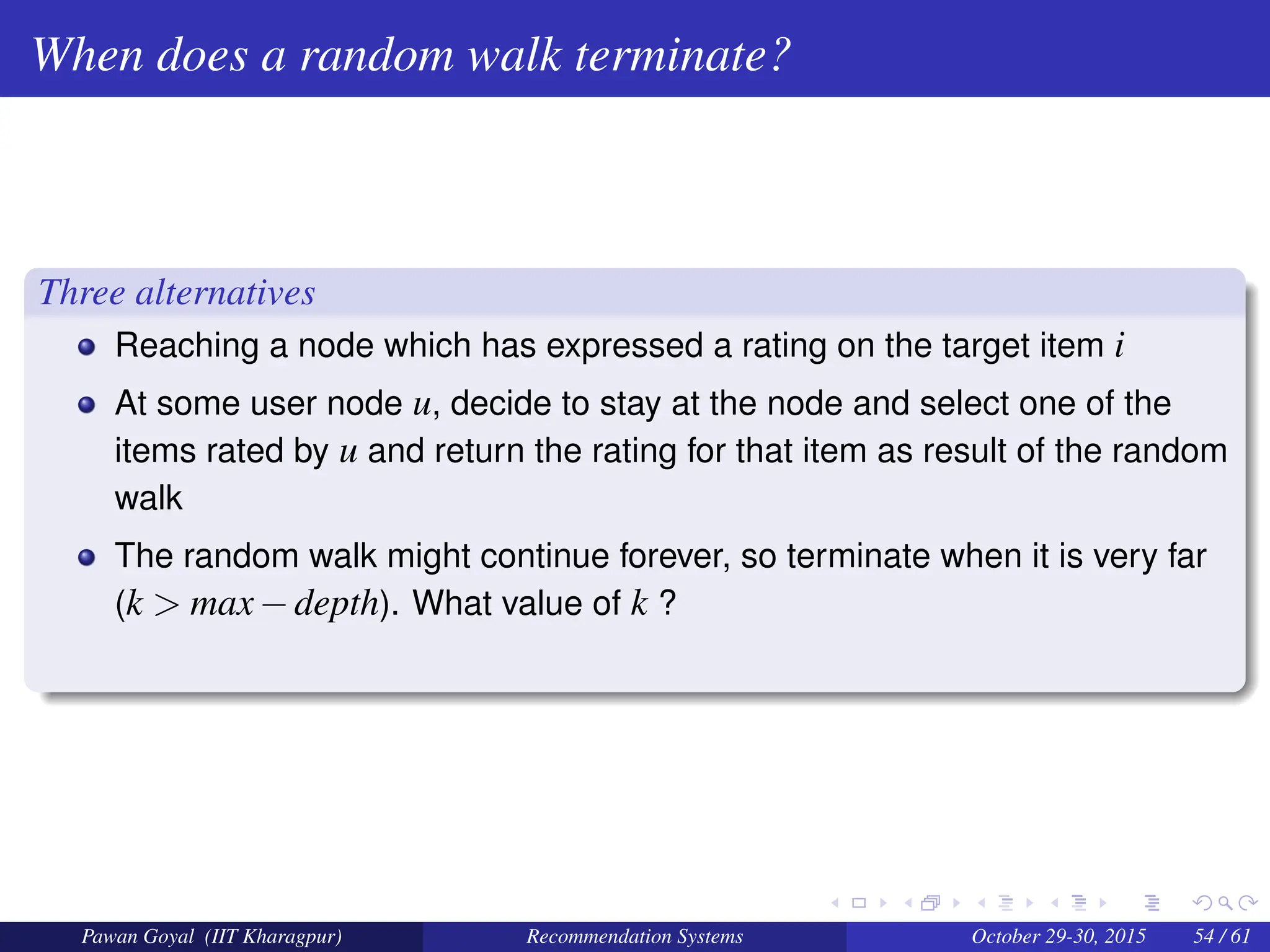
Three alternatives
Reaching a node which has expressed a rating on the target item i
At some user node u, decide to stay at the node and select one of the
items rated by u and return the rating for that item as result of the random
walk
The random walk might continue forever, so terminate when it is very far
(k > max−depth). What value of k ?
Pawan Goyal (IIT Kharagpur) Recommendation Systems October 29-30, 2015 54 / 61
When does a random walk terminate?
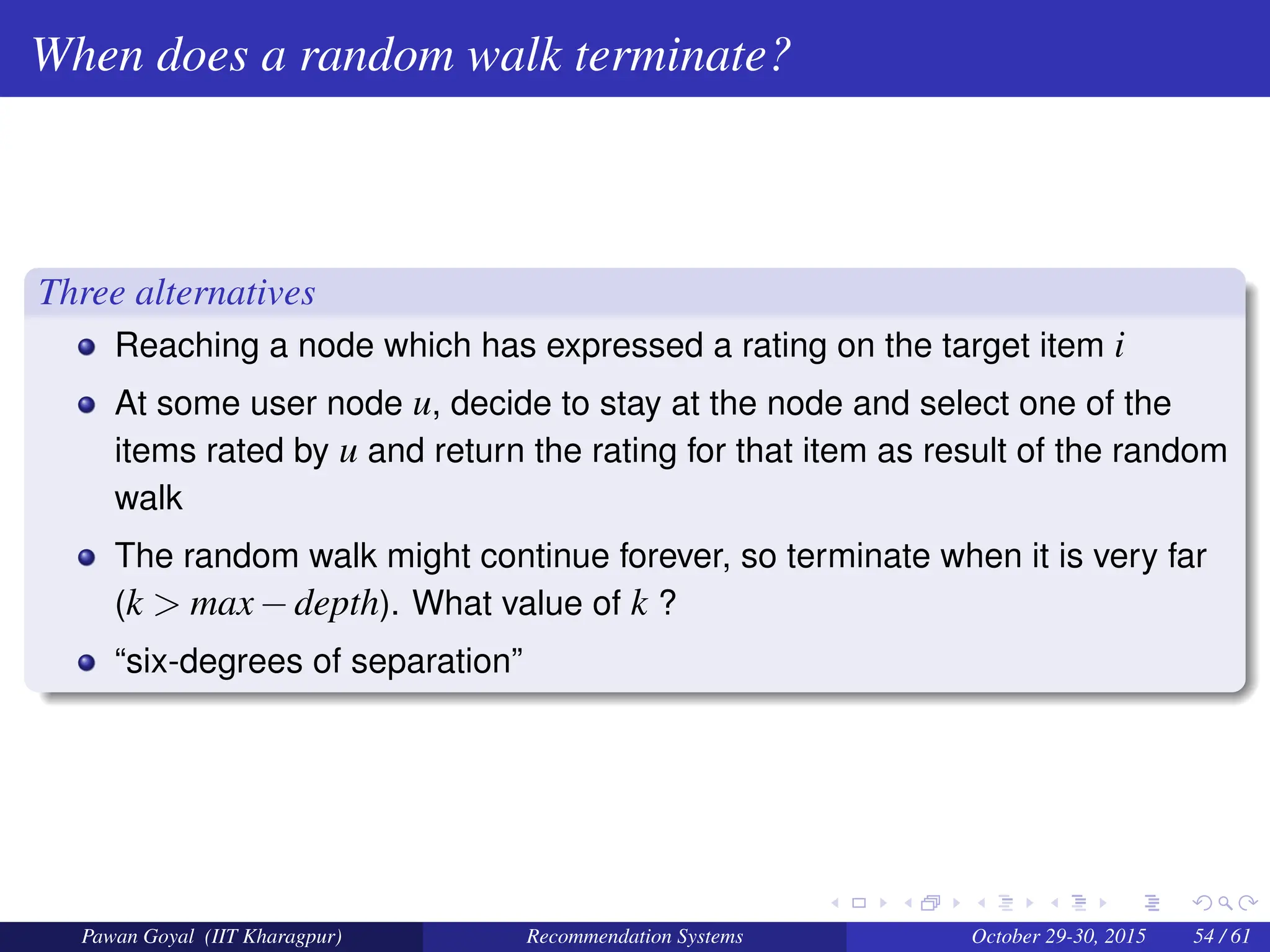
Three alternatives
Reaching a node which has expressed a rating on the target item i
At some user node u, decide to stay at the node and select one of the
items rated by u and return the rating for that item as result of the random
walk
The random walk might continue forever, so terminate when it is very far
(k > max−depth). What value of k ?
“six-degrees of separation”
Pawan Goyal (IIT Kharagpur) Recommendation Systems October 29-30, 2015 54 / 61
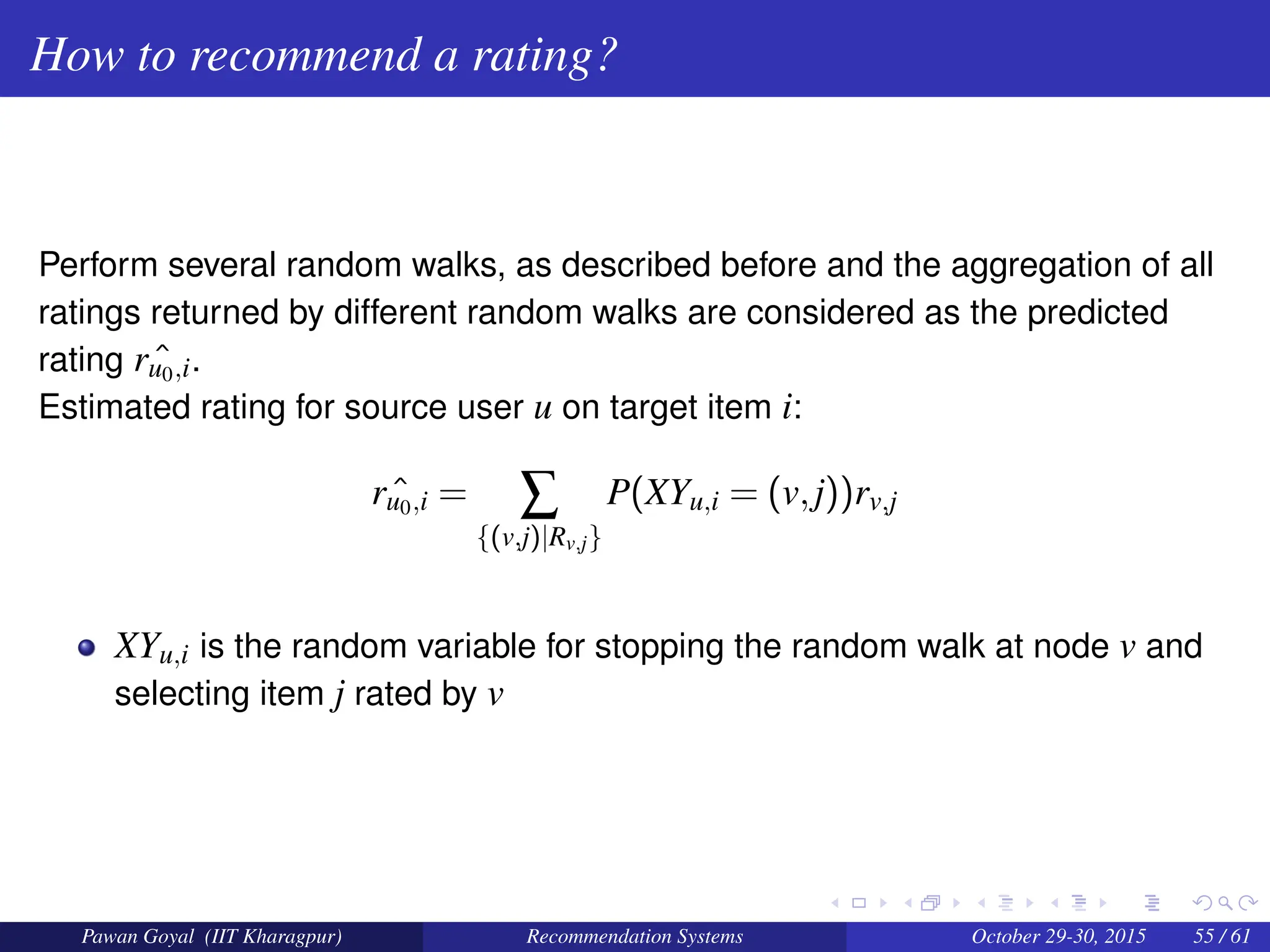
How to recommend a rating?
Perform several random walks, as described before and the aggregation of all
ratings returned by different random walks are considered as the predicted
rating ˆ
ru0,i.
Pawan Goyal (IIT Kharagpur) Recommendation Systems October 29-30, 2015 55 / 61
How to recommend a rating?
Perform several random walks, as described before and the aggregation of all
ratings returned by different random walks are considered as the predicted
rating ˆ
ru0,i.
Estimated rating for source user u on target item i:
ˆ
ru0,i = ∑
{(v,j)|Rv,j}
P(XYu,i = (v,j))rv,j
XYu,i is the random variable for stopping the random walk at node v and
selecting item j rated by v
Pawan Goyal (IIT Kharagpur) Recommendation Systems October 29-30, 2015 55 / 61
Social Matrix Factorization
Intuition
Can we incorporate the Social information in the matrix factorization methods?
Pawan Goyal (IIT Kharagpur) Recommendation Systems October 29-30, 2015 56 / 61
Social Matrix Factorization
Intuition
Can we incorporate the Social information in the matrix factorization methods?
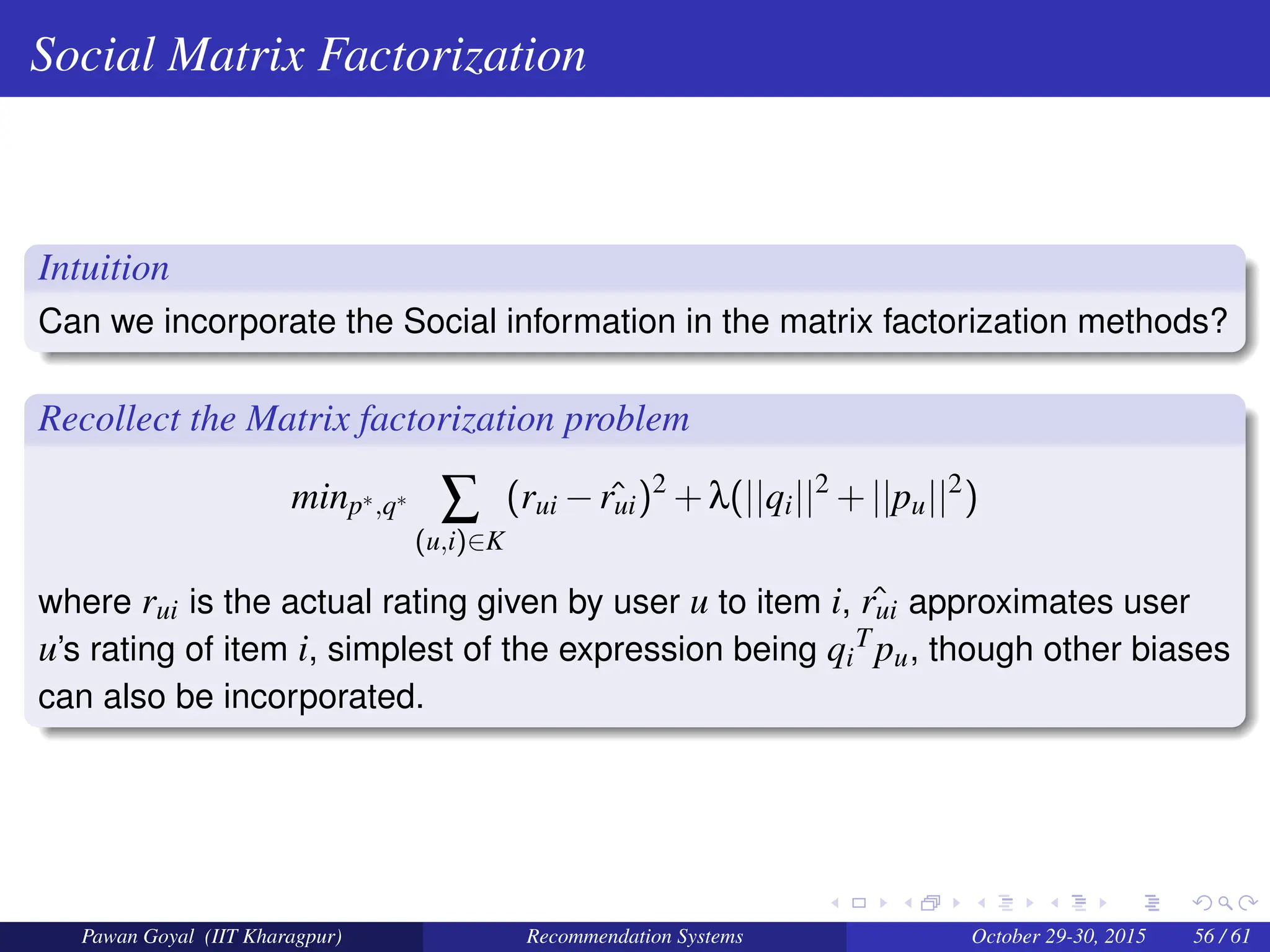
Recollect the Matrix factorization problem
minp∗,q∗
∑
(u,i)∈K
(rui − ˆ
rui)2
+λ(||qi||2
+||pu||2
)
where rui is the actual rating given by user u to item i, ˆ
rui approximates user
u’s rating of item i, simplest of the expression being qi
Tpu, though other biases
can also be incorporated.
Pawan Goyal (IIT Kharagpur) Recommendation Systems October 29-30, 2015 56 / 61
Social Matrix Factorization
Basic Idea
Neighbors in the social network may have similar interests.
Pawan Goyal (IIT Kharagpur) Recommendation Systems October 29-30, 2015 57 / 61
Social Matrix Factorization
Basic Idea
Neighbors in the social network may have similar interests.
Incorporating social factors
Let the social network information be represented by a matrix S ∈ Ru0×u0 , where
u0 is the number of users.
Su,v ∈ (0,1] denotes the directed and weighted social relationship of user u with
user v
Each of the rows of the social matrix S is normalized to 1, resulting in the new
matrix S∗, such that ∑v S∗
u,v = 1 for each user u
Pawan Goyal (IIT Kharagpur) Recommendation Systems October 29-30, 2015 57 / 61
Social Matrix Factorization
Basic Idea
Neighbors in the social network may have similar interests.
Incorporating social factors
Let the social network information be represented by a matrix S ∈ Ru0×u0 , where
u0 is the number of users.
Su,v ∈ (0,1] denotes the directed and weighted social relationship of user u with
user v
Each of the rows of the social matrix S is normalized to 1, resulting in the new
matrix S∗, such that ∑v S∗
u,v = 1 for each user u
Modified objective function
minp∗,q∗ ∑
(u,i)∈K
(rui − ˆ
rui)2
+β ∑
all u
((qu −∑
v
S∗
u,vqv)(qu −∑
v
S∗
u,vqv)T
)
+λ(||qi||2
+||pu||2
)
Pawan Goyal (IIT Kharagpur) Recommendation Systems October 29-30, 2015 57 / 61
Circle-based Social Recommendation
Basic Idea
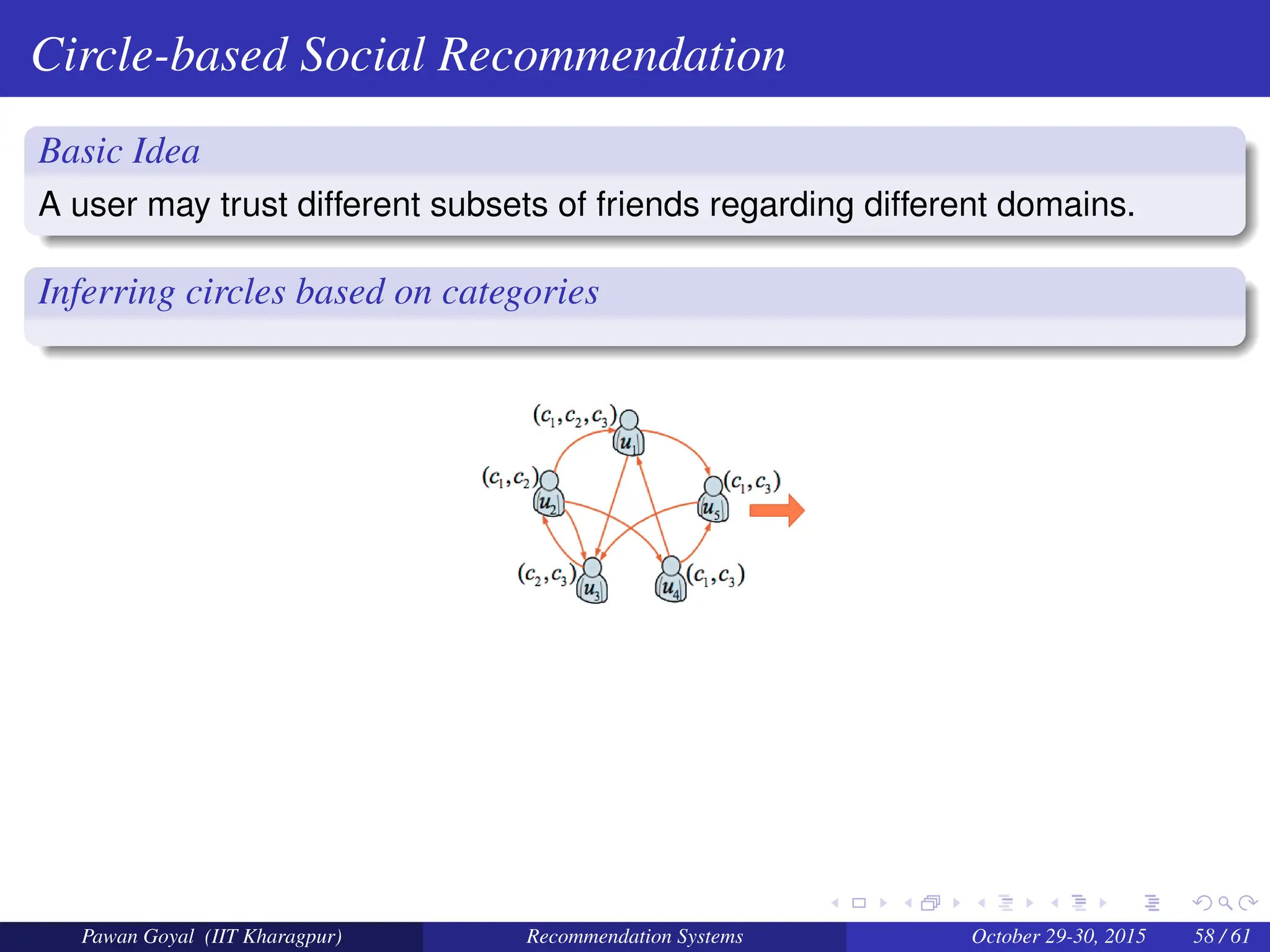
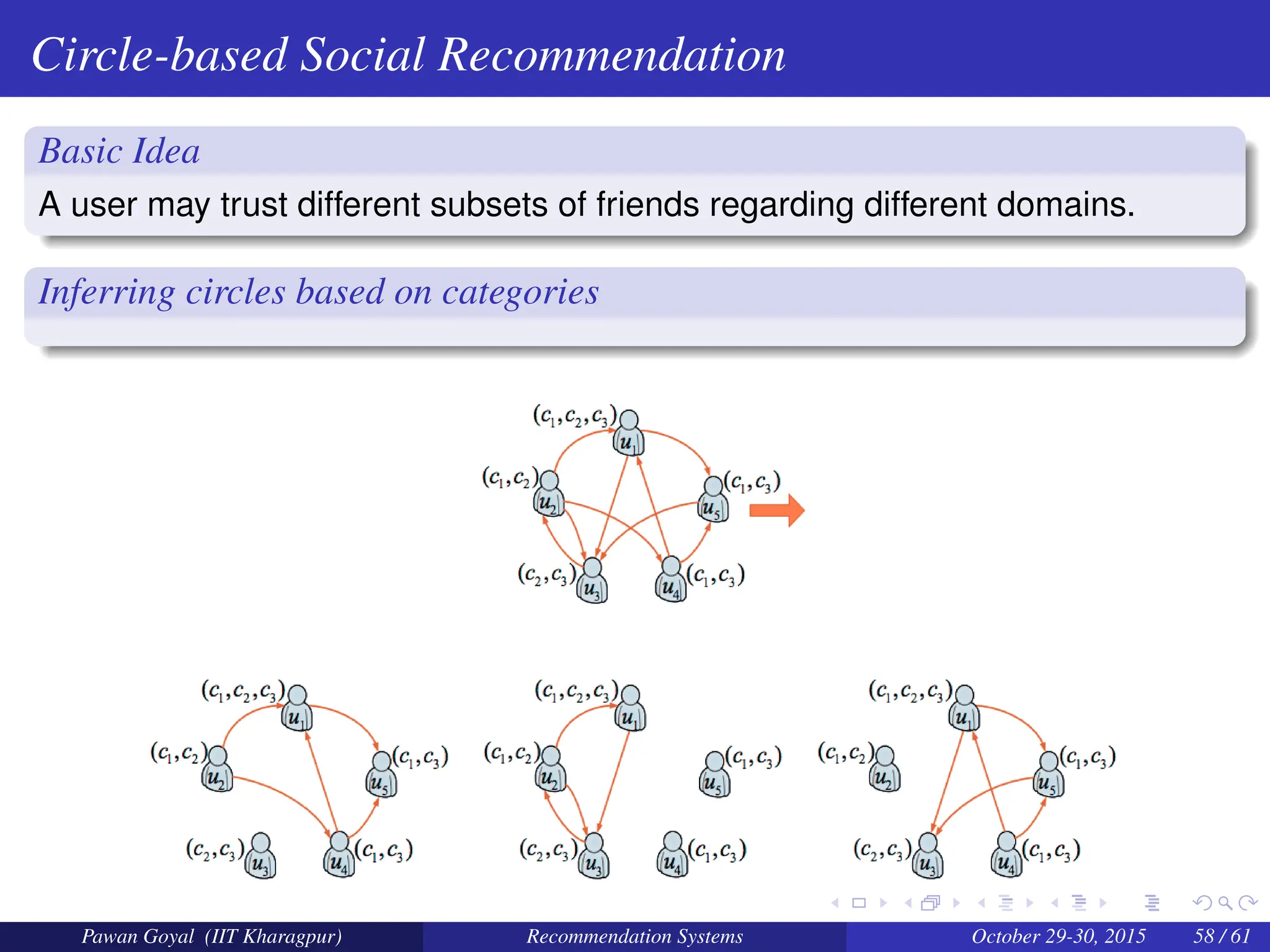
A user may trust different subsets of friends regarding different domains.
Pawan Goyal (IIT Kharagpur) Recommendation Systems October 29-30, 2015 58 / 61
Circle-based Social Recommendation
Basic Idea
A user may trust different subsets of friends regarding different domains.
Inferring circles based on categories
Pawan Goyal (IIT Kharagpur) Recommendation Systems October 29-30, 2015 58 / 61
Circle-based Social Recommendation
Basic Idea
A user may trust different subsets of friends regarding different domains.
Inferring circles based on categories
Pawan Goyal (IIT Kharagpur) Recommendation Systems October 29-30, 2015 58 / 61
Circle-based Social Recommendation
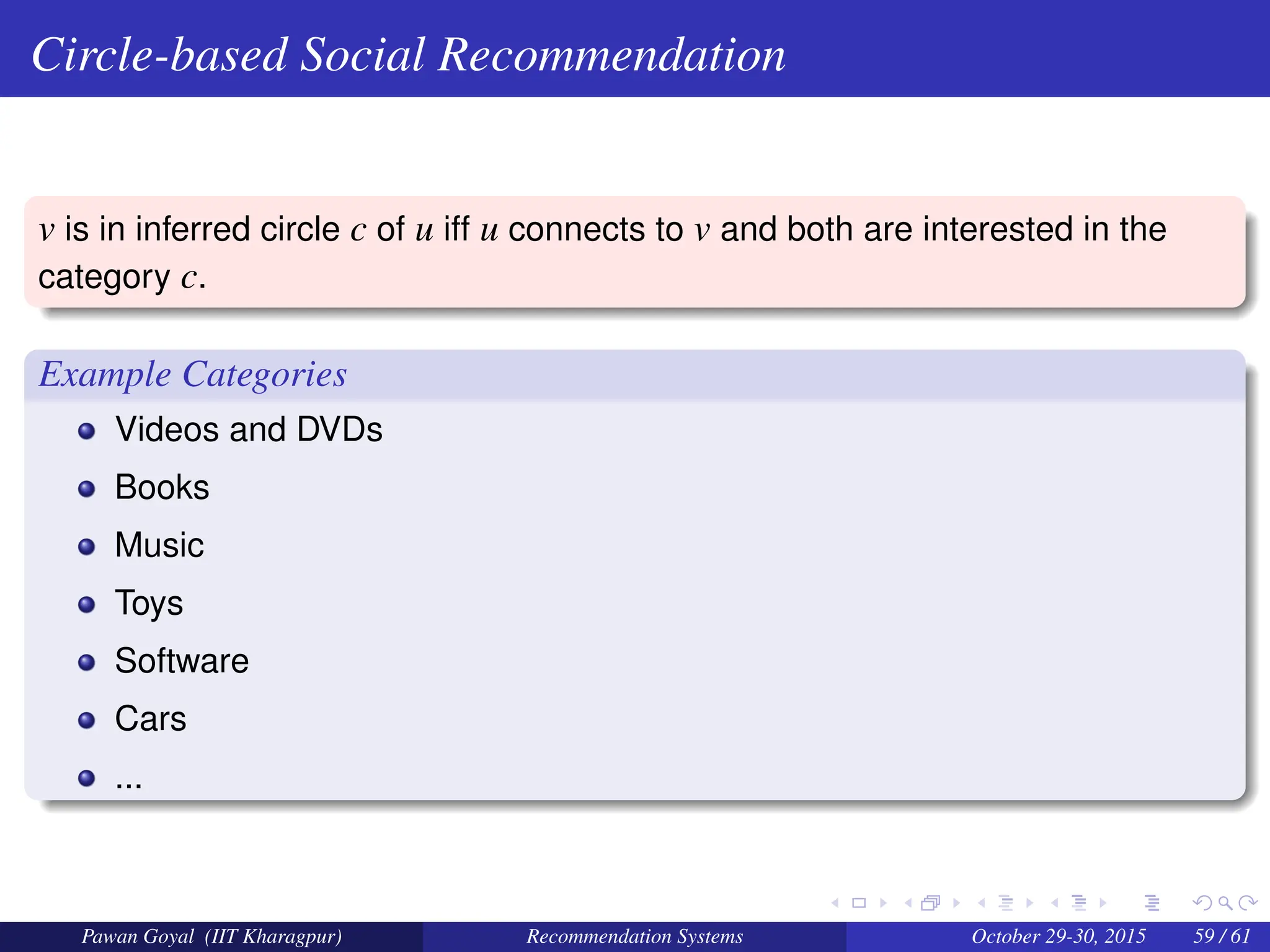
v is in inferred circle c of u iff u connects to v and both are interested in the
category c.
Pawan Goyal (IIT Kharagpur) Recommendation Systems October 29-30, 2015 59 / 61
Circle-based Social Recommendation
v is in inferred circle c of u iff u connects to v and both are interested in the
category c.
Example Categories
Videos and DVDs
Books
Music
Toys
Software
Cars
...
Pawan Goyal (IIT Kharagpur) Recommendation Systems October 29-30, 2015 59 / 61
Circle-based Social Recommendation
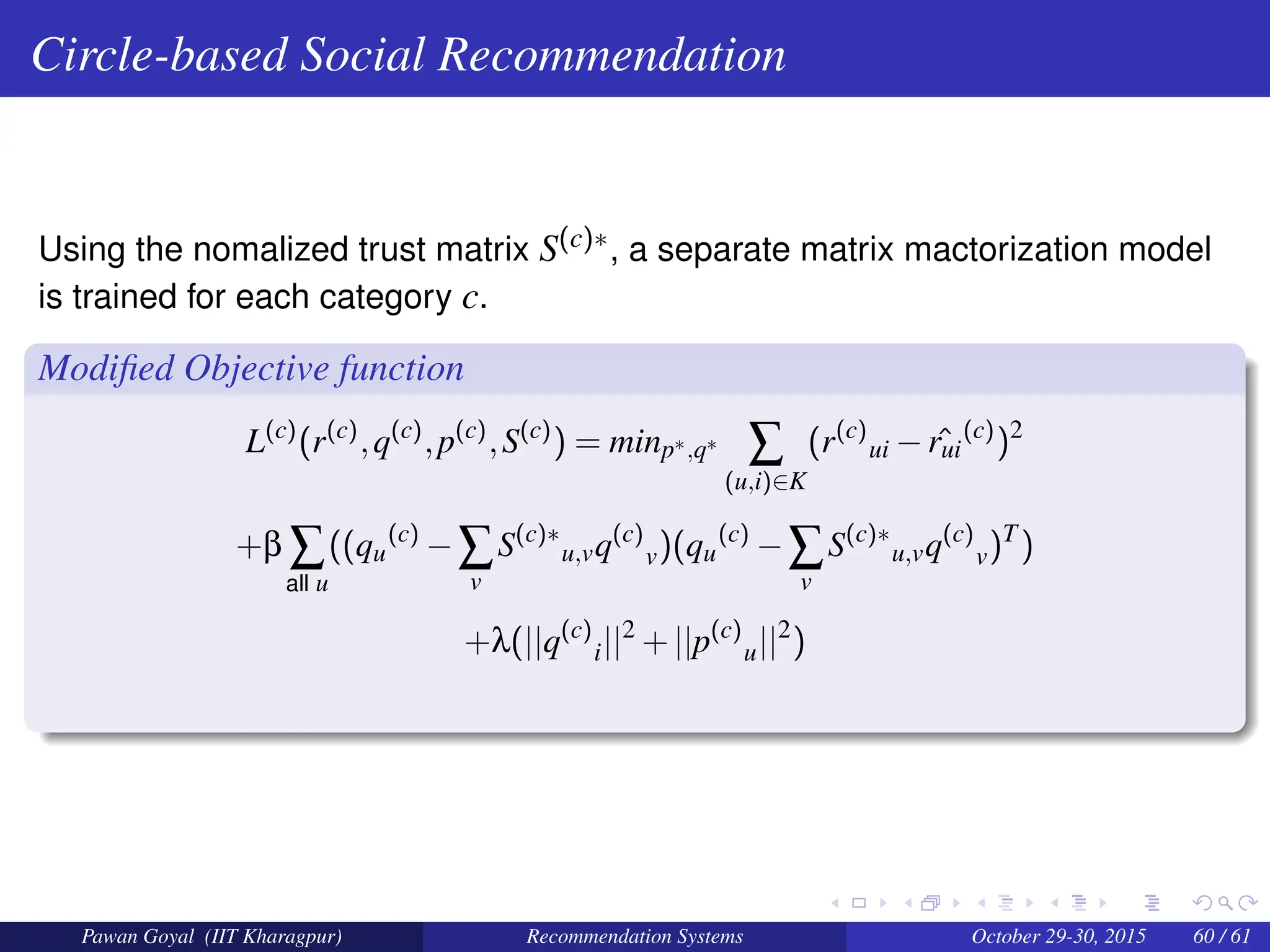
Using the nomalized trust matrix S(c)∗, a separate matrix mactorization model
is trained for each category c.
Pawan Goyal (IIT Kharagpur) Recommendation Systems October 29-30, 2015 60 / 61
Circle-based Social Recommendation
Using the nomalized trust matrix S(c)∗, a separate matrix mactorization model
is trained for each category c.
Modified Objective function
L(c)
(r(c)
,q(c)
,p(c)
,S(c)
) = minp∗,q∗ ∑
(u,i)∈K
(r(c)
ui − ˆ
rui
(c)
)2
+β ∑
all u
((qu
(c)
−∑
v
S(c)∗
u,vq(c)
v)(qu
(c)
−∑
v
S(c)∗
u,vq(c)
v)T
)
+λ(||q(c)
i||2
+||p(c)
u||2
)
Pawan Goyal (IIT Kharagpur) Recommendation Systems October 29-30, 2015 60 / 61
Class Problem
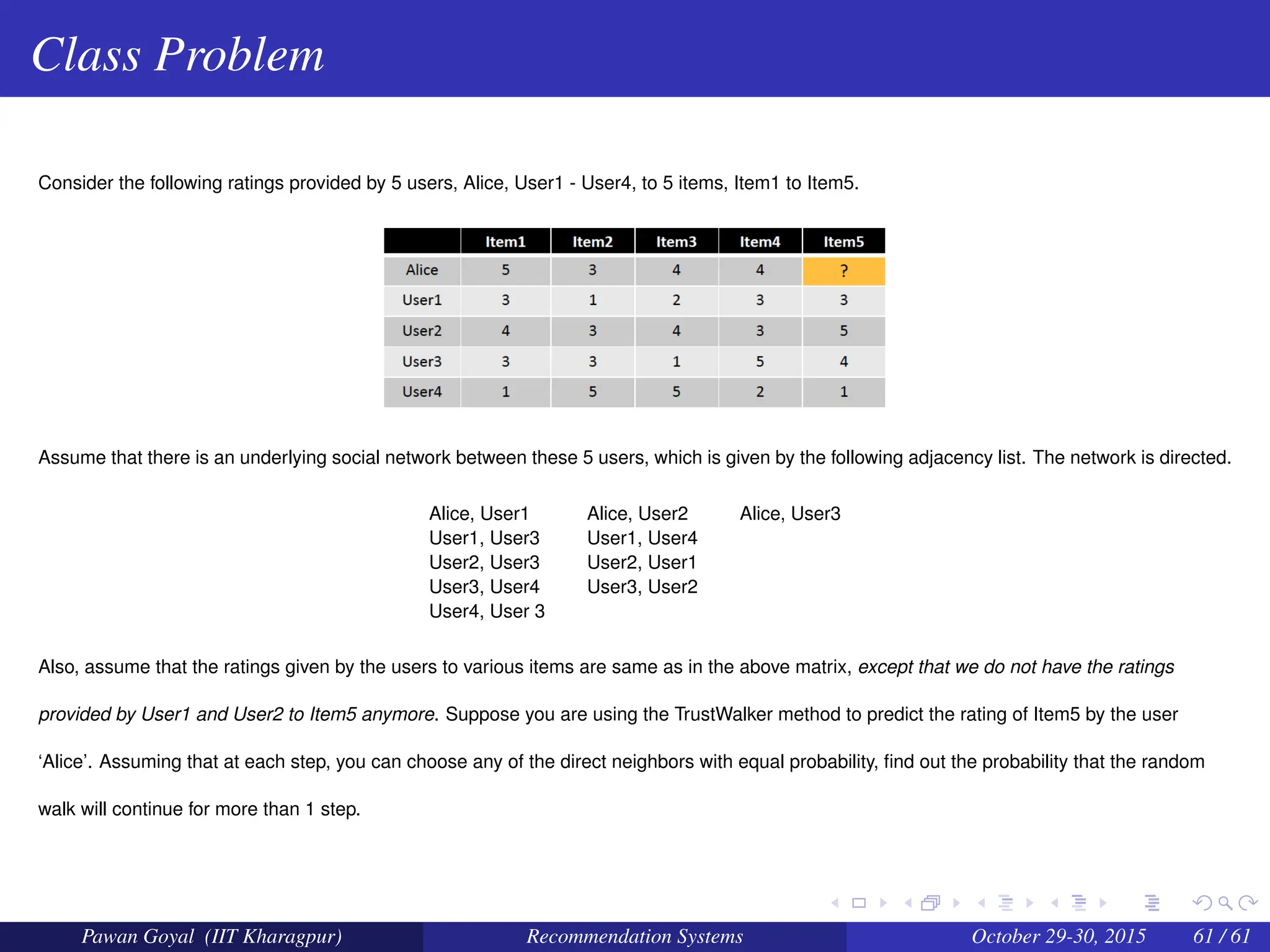
Consider the following ratings provided by 5 users, Alice, User1 - User4, to 5 items, Item1 to Item5.
Assume that there is an underlying social network between these 5 users, which is given by the following adjacency list. The network is directed.
Alice, User1 Alice, User2 Alice, User3
User1, User3 User1, User4
User2, User3 User2, User1
User3, User4 User3, User2
User4, User 3
Also, assume that the ratings given by the users to various items are same as in the above matrix, except that we do not have the ratings
provided by User1 and User2 to Item5 anymore. Suppose you are using the TrustWalker method to predict the rating of Item5 by the user
‘Alice’. Assuming that at each step, you can choose any of the direct neighbors with equal probability, find out the probability that the random
walk will continue for more than 1 step.
Pawan Goyal (IIT Kharagpur) Recommendation Systems October 29-30, 2015 61 / 61

Introduction to recomender systems new content

  • 1.
    Recommendation Systems Pawan Goyal CSE,IITKGP October 29-30, 2015 Pawan Goyal (IIT Kharagpur) Recommendation Systems October 29-30, 2015 1 / 61
  • 2.
    Recommendation System? Pawan Goyal(IIT Kharagpur) Recommendation Systems October 29-30, 2015 2 / 61
  • 3.
    Recommendation in SocialWeb Pawan Goyal (IIT Kharagpur) Recommendation Systems October 29-30, 2015 3 / 61
  • 4.
    Why using RecommenderSystems? Value for the customers Find things that are interesting Narrow down the set of choices Discover new things Entertainment ... Pawan Goyal (IIT Kharagpur) Recommendation Systems October 29-30, 2015 4 / 61
  • 5.
    Why using RecommenderSystems? Value for the customers Find things that are interesting Narrow down the set of choices Discover new things Entertainment ... Value for the provider Additional and unique personalized service for the customer Increase trust and customer loyalty Increase sales, click through rates, conversion etc Opportunity for promotion, persuasion Obtain more knowledge about customers Pawan Goyal (IIT Kharagpur) Recommendation Systems October 29-30, 2015 4 / 61
  • 6.
    Real-world check Myths fromindustry Amazon.com generates X percent of their sales through the recommendation lists (X > 35%) Netflix generates X percent of their sales through the recommendation lists (X > 30%) Pawan Goyal (IIT Kharagpur) Recommendation Systems October 29-30, 2015 5 / 61
  • 7.
    Real-world check Myths fromindustry Amazon.com generates X percent of their sales through the recommendation lists (X > 35%) Netflix generates X percent of their sales through the recommendation lists (X > 30%) There must be some value in it See recommendation of groups, jobs or people on LinkedIn Friend recommendation and ad personalization on Facebook Song recommendation at last.fm News recommendation at Forbes.com (+37% CTR) Pawan Goyal (IIT Kharagpur) Recommendation Systems October 29-30, 2015 5 / 61
  • 8.
    Recommender Systems asa function What is given? User model: ratings, preferences, demographics, situational context Items: with or without description of item characteristics Pawan Goyal (IIT Kharagpur) Recommendation Systems October 29-30, 2015 6 / 61
  • 9.
    Recommender Systems asa function What is given? User model: ratings, preferences, demographics, situational context Items: with or without description of item characteristics Find Relevance score: used for ranking Pawan Goyal (IIT Kharagpur) Recommendation Systems October 29-30, 2015 6 / 61
  • 10.
    Recommender Systems asa function What is given? User model: ratings, preferences, demographics, situational context Items: with or without description of item characteristics Find Relevance score: used for ranking Final Goal Recommend items that are assumed to be relevant Pawan Goyal (IIT Kharagpur) Recommendation Systems October 29-30, 2015 6 / 61
  • 11.
    Recommender Systems asa function What is given? User model: ratings, preferences, demographics, situational context Items: with or without description of item characteristics Find Relevance score: used for ranking Final Goal Recommend items that are assumed to be relevant But Remember that relevance might be context-dependent Characteristics of the list might be important (diversity) Pawan Goyal (IIT Kharagpur) Recommendation Systems October 29-30, 2015 6 / 61
  • 12.
    Paradigms of RecommenderSystems Pawan Goyal (IIT Kharagpur) Recommendation Systems October 29-30, 2015 7 / 61
  • 13.
    Paradigms of RecommenderSystems Pawan Goyal (IIT Kharagpur) Recommendation Systems October 29-30, 2015 8 / 61
  • 14.
    Paradigms of RecommenderSystems Pawan Goyal (IIT Kharagpur) Recommendation Systems October 29-30, 2015 9 / 61
  • 15.
    Paradigms of RecommenderSystems Pawan Goyal (IIT Kharagpur) Recommendation Systems October 29-30, 2015 10 / 61
  • 16.
    Paradigms of RecommenderSystems Pawan Goyal (IIT Kharagpur) Recommendation Systems October 29-30, 2015 11 / 61
  • 17.
    Paradigms of RecommenderSystems Pawan Goyal (IIT Kharagpur) Recommendation Systems October 29-30, 2015 12 / 61
  • 18.
    Comparison across theparadigms Pawan Goyal (IIT Kharagpur) Recommendation Systems October 29-30, 2015 13 / 61
  • 19.
    Collaborative Filtering (CF) Themost prominent approach to generate recommendations Used by large, commercial e-commerce sites well-understood, various algorithms and variations exist applicable in many domains (book, movies, ...) Pawan Goyal (IIT Kharagpur) Recommendation Systems October 29-30, 2015 14 / 61
  • 20.
    Collaborative Filtering (CF) Themost prominent approach to generate recommendations Used by large, commercial e-commerce sites well-understood, various algorithms and variations exist applicable in many domains (book, movies, ...) Approach Use the “wisdom of the crowd” to recommend items Pawan Goyal (IIT Kharagpur) Recommendation Systems October 29-30, 2015 14 / 61
  • 21.
    Collaborative Filtering (CF) Themost prominent approach to generate recommendations Used by large, commercial e-commerce sites well-understood, various algorithms and variations exist applicable in many domains (book, movies, ...) Approach Use the “wisdom of the crowd” to recommend items Basic assumption and idea Users give ratings to catalog items (implicitly/explicitly) Customers with certain tastes in the past, might have similar tastes in the future Pawan Goyal (IIT Kharagpur) Recommendation Systems October 29-30, 2015 14 / 61
  • 22.
    User-based Collaborative Filtering Givenan active user Alice and an item i not yet seen by Alice The goal is to estimate Alice’s rating for this item, e.g., by Pawan Goyal (IIT Kharagpur) Recommendation Systems October 29-30, 2015 15 / 61
  • 23.
    User-based Collaborative Filtering Givenan active user Alice and an item i not yet seen by Alice The goal is to estimate Alice’s rating for this item, e.g., by I Find a set of users who liked the same items as Alice in the past and who have rated item i I use, e.g. the average of their ratings to predict, if Alice will like item i I Do this for all items Alice has not seen and recommend the best-rated ones Pawan Goyal (IIT Kharagpur) Recommendation Systems October 29-30, 2015 15 / 61
  • 24.
    User-based Collaborative Filtering Somefirst questions How do we measure similarity? How many neighbors should we consider? How do we generate a prediction from the neighbors’ ratings? Pawan Goyal (IIT Kharagpur) Recommendation Systems October 29-30, 2015 16 / 61
  • 25.
    Popular similarity model PearsonCorrelation sim(a,b) = ∑p∈P(ra,p −ra)(rb,p −rb) q ∑p∈P(ra,p −ra)2 q ∑p∈P(rb,p −rb)2 a,b: users ra,p: rating of user a for item p P: set of items, rated both by a and b ra, rb: user’s average ratings Possible similarity values are between -1 to 1 Pawan Goyal (IIT Kharagpur) Recommendation Systems October 29-30, 2015 17 / 61
  • 26.
    Popular similarity model PearsonCorrelation sim(a,b) = ∑p∈P(ra,p −ra)(rb,p −rb) q ∑p∈P(ra,p −ra)2 q ∑p∈P(rb,p −rb)2 a,b: users ra,p: rating of user a for item p P: set of items, rated both by a and b ra, rb: user’s average ratings Possible similarity values are between -1 to 1 For the example considered sim(Alice, User1) = 0.85 sim(Alice, User4) = -0.79 Pawan Goyal (IIT Kharagpur) Recommendation Systems October 29-30, 2015 17 / 61
  • 27.
    Pearson Correlation Takes Differencein rating behavior into account Pawan Goyal (IIT Kharagpur) Recommendation Systems October 29-30, 2015 18 / 61
  • 28.
    Pearson Correlation Takes Differencein rating behavior into account Works well in usual domains Pawan Goyal (IIT Kharagpur) Recommendation Systems October 29-30, 2015 18 / 61
  • 29.
    Making Predictions A commonprediction function: pred(a,p) = ra + ∑b∈N sim(a,b)∗(rb,p −rb) ∑b∈N sim(a,b) Pawan Goyal (IIT Kharagpur) Recommendation Systems October 29-30, 2015 19 / 61
  • 30.
    Making Predictions A commonprediction function: pred(a,p) = ra + ∑b∈N sim(a,b)∗(rb,p −rb) ∑b∈N sim(a,b) Calculate, whether the neighbor’s ratings for the unseen item i are higher or lower than their average Combine the rating differences - use similarity as a weight Add/subtract neighbor’s bias from the active user’s average and use this as a prediction Pawan Goyal (IIT Kharagpur) Recommendation Systems October 29-30, 2015 19 / 61
  • 31.
    Item-based Collaborative Filtering BasicIdea Use the similarity between items to make predictions Pawan Goyal (IIT Kharagpur) Recommendation Systems October 29-30, 2015 20 / 61
  • 32.
    Item-based Collaborative Filtering BasicIdea Use the similarity between items to make predictions For Instance Look for items that are similar to Item5 Take Alice’s ratings for these items to predict the rating for Item5 Pawan Goyal (IIT Kharagpur) Recommendation Systems October 29-30, 2015 20 / 61
  • 33.
    Similarity Measure Ratings areseen as vector in n−dimensional space Similarity is calculated based on the angle between the vectors sim(~ a,~ b) = ~ a·~ b |~ a|∗|~ b| Adjusted cosine similarity: take average user ratings into account sim(a,b) = ∑u∈U(ru,a −ru)(ru,b −ru) p ∑u∈U(ru,a −ru)2 p ∑u∈U(ru,b −ru)2 Pawan Goyal (IIT Kharagpur) Recommendation Systems October 29-30, 2015 21 / 61
  • 34.
    Pre-processing for Item-basedfiltering Calculate all pair-wise item similarities in advance The neighborhood to be used at run-time is typically rather small, because only those items are taken into account which the user has rated Item similarities are supposed to be more stable than user similarities Pawan Goyal (IIT Kharagpur) Recommendation Systems October 29-30, 2015 22 / 61
  • 35.
    More on ratings PureCF-based systems only rely on the rating matrix Explicit ratings Most commonly used (1 to 5, 1 to 10 response scales) Research topics: what about multi-dimensional ratings? Challenge: Sparse rating matrices, how to stimulate users to rate more items? Pawan Goyal (IIT Kharagpur) Recommendation Systems October 29-30, 2015 23 / 61
  • 36.
    More on ratings PureCF-based systems only rely on the rating matrix Explicit ratings Most commonly used (1 to 5, 1 to 10 response scales) Research topics: what about multi-dimensional ratings? Challenge: Sparse rating matrices, how to stimulate users to rate more items? Implicit ratings clicks, page views, time spent on some page, demo downloads .. Can be used in addition to explicit ones; question of correctness of interpretation Pawan Goyal (IIT Kharagpur) Recommendation Systems October 29-30, 2015 23 / 61
  • 37.
    Data sparsity problems Coldstart problems How to recommend new items? What to recommend to new users? Pawan Goyal (IIT Kharagpur) Recommendation Systems October 29-30, 2015 24 / 61
  • 38.
    Data sparsity problems Coldstart problems How to recommend new items? What to recommend to new users? Straight-forward approach Use another method (e.g., content-based, demographic or simply non-personalized) in the initial phase Pawan Goyal (IIT Kharagpur) Recommendation Systems October 29-30, 2015 24 / 61
  • 39.
    Data sparsity problems Coldstart problems How to recommend new items? What to recommend to new users? Straight-forward approach Use another method (e.g., content-based, demographic or simply non-personalized) in the initial phase Alternatives Use better algorithms (beyond nearest-neighbor approaches) Example: Assume “transitivity” of neighborhoods Pawan Goyal (IIT Kharagpur) Recommendation Systems October 29-30, 2015 24 / 61
  • 40.
    Example algorithms forsparse datasets Recursive CF Assume there is a very close neighbor n of u who however has not rated the target item i yet. Pawan Goyal (IIT Kharagpur) Recommendation Systems October 29-30, 2015 25 / 61
  • 41.
    Example algorithms forsparse datasets Recursive CF Assume there is a very close neighbor n of u who however has not rated the target item i yet. Apply CF-method recursively and predict a rating for item i for the neighbor n Pawan Goyal (IIT Kharagpur) Recommendation Systems October 29-30, 2015 25 / 61
  • 42.
    Example algorithms forsparse datasets Recursive CF Assume there is a very close neighbor n of u who however has not rated the target item i yet. Apply CF-method recursively and predict a rating for item i for the neighbor n Use this predicted rating instead of the rating of a more distant direct neighbor Pawan Goyal (IIT Kharagpur) Recommendation Systems October 29-30, 2015 25 / 61
  • 43.
    Example algorithms forsparse datasets Graph-based methods: Spreading activation Idea: Use paths of lengths 3 and 5 to recommend items Length 3: Recommend Item3 to User1 Length 5: Item1 also recommendable Pawan Goyal (IIT Kharagpur) Recommendation Systems October 29-30, 2015 26 / 61
  • 44.
    Example algorithms forsparse datasets Graph-based methods: Spreading activation Idea: Use paths of lengths 3 and 5 to recommend items Length 3: Recommend Item3 to User1 Length 5: Item1 also recommendable Pawan Goyal (IIT Kharagpur) Recommendation Systems October 29-30, 2015 26 / 61
  • 45.
    Matrix Factorization Methods Areshown to be superior to the classic nearest-neighbor techniques for product recommendations Allow the incorporation of additional information such as implicit feedback, temporal effects, and confidence levels Pawan Goyal (IIT Kharagpur) Recommendation Systems October 29-30, 2015 27 / 61
  • 46.
    User-oriented neighborhood method PawanGoyal (IIT Kharagpur) Recommendation Systems October 29-30, 2015 28 / 61
  • 47.
    Latent Factor Approach PawanGoyal (IIT Kharagpur) Recommendation Systems October 29-30, 2015 29 / 61
  • 48.
    Matrix Factorization Methods BasicIdea Both users and items are characterized by vectors of factors, inferred from item rating patterns High correspondence between item and user factors leads to a recommendation. Pawan Goyal (IIT Kharagpur) Recommendation Systems October 29-30, 2015 30 / 61
  • 49.
    Using Singular ValueDecomposition Let M be the matrix of user - item interactions Use SVD to get a k−rank approximation Mk = Uk ×Σk ×Vk T Prediction: ˆ rui = ru +Uk(u)×Σk ×Vk T(i) Pawan Goyal (IIT Kharagpur) Recommendation Systems October 29-30, 2015 31 / 61
  • 50.
    SVD: Example Pawan Goyal(IIT Kharagpur) Recommendation Systems October 29-30, 2015 32 / 61
  • 51.
    SVD: Example Pawan Goyal(IIT Kharagpur) Recommendation Systems October 29-30, 2015 33 / 61
  • 52.
    Using Singular ValueDecomposition The problem, however, is the high portion of missing values Using only relatively few entries may lead to overfitting Pawan Goyal (IIT Kharagpur) Recommendation Systems October 29-30, 2015 34 / 61
  • 53.
    A Basic MatrixFactorization Model Both users and items are mapped to a joint latent factor space of dimensionality f, Pawan Goyal (IIT Kharagpur) Recommendation Systems October 29-30, 2015 35 / 61
  • 54.
    A Basic MatrixFactorization Model Both users and items are mapped to a joint latent factor space of dimensionality f, User-item interactions are modeled as inner products in that space Pawan Goyal (IIT Kharagpur) Recommendation Systems October 29-30, 2015 35 / 61
  • 55.
    A Basic MatrixFactorization Model Both users and items are mapped to a joint latent factor space of dimensionality f, User-item interactions are modeled as inner products in that space Each item i associated with a vector qi ∈ Rf , and each user u associated with a vector pu ∈ Rf Pawan Goyal (IIT Kharagpur) Recommendation Systems October 29-30, 2015 35 / 61
  • 56.
    A Basic MatrixFactorization Model Both users and items are mapped to a joint latent factor space of dimensionality f, User-item interactions are modeled as inner products in that space Each item i associated with a vector qi ∈ Rf , and each user u associated with a vector pu ∈ Rf qi measures the extent to which the item possesses the factors, positive or negative Pawan Goyal (IIT Kharagpur) Recommendation Systems October 29-30, 2015 35 / 61
  • 57.
    A Basic MatrixFactorization Model Both users and items are mapped to a joint latent factor space of dimensionality f, User-item interactions are modeled as inner products in that space Each item i associated with a vector qi ∈ Rf , and each user u associated with a vector pu ∈ Rf qi measures the extent to which the item possesses the factors, positive or negative pu measures the extent of interest the user has in items that are high on the corresponding factors, positive or negative Pawan Goyal (IIT Kharagpur) Recommendation Systems October 29-30, 2015 35 / 61
  • 58.
    A Basic MatrixFactorization Model Both users and items are mapped to a joint latent factor space of dimensionality f, User-item interactions are modeled as inner products in that space Each item i associated with a vector qi ∈ Rf , and each user u associated with a vector pu ∈ Rf qi measures the extent to which the item possesses the factors, positive or negative pu measures the extent of interest the user has in items that are high on the corresponding factors, positive or negative qi Tpu captures the interaction between user u and item i Pawan Goyal (IIT Kharagpur) Recommendation Systems October 29-30, 2015 35 / 61
  • 59.
    A Basic MatrixFactorization Model Both users and items are mapped to a joint latent factor space of dimensionality f, User-item interactions are modeled as inner products in that space Each item i associated with a vector qi ∈ Rf , and each user u associated with a vector pu ∈ Rf qi measures the extent to which the item possesses the factors, positive or negative pu measures the extent of interest the user has in items that are high on the corresponding factors, positive or negative qi Tpu captures the interaction between user u and item i This approximates user u’s rating of item i, denoted by rui ˆ rui = qi T pu Pawan Goyal (IIT Kharagpur) Recommendation Systems October 29-30, 2015 35 / 61
  • 60.
    A Basic MatrixFactorization Model Major Challenge Computing the mapping of each item and user to factor vectors qi,pu ∈ Rf Pawan Goyal (IIT Kharagpur) Recommendation Systems October 29-30, 2015 36 / 61
  • 61.
    A Basic MatrixFactorization Model Major Challenge Computing the mapping of each item and user to factor vectors qi,pu ∈ Rf The Learning Problem To learn the factor vectors pu and qi, the system minimizes the regularized squared error on the set of known ratings: minp∗,q∗ ∑ (u,i)∈K (rui −qi T pu)2 +λ(||qi||2 +||pu||2 ) where k is the set of (u,i) pairs for which rui is known. Pawan Goyal (IIT Kharagpur) Recommendation Systems October 29-30, 2015 36 / 61
  • 62.
    Stochastic Gradient Descent minp∗,q∗ ∑ (u,i)∈K (rui−qi T pu)2 +λ(||qi||2 +||pu||2 ) Let eui = rui −qi Tpu Gradient descent can be written as qi ← qi +γ(euipu −λqi) pu ← pu +γ(euiqi −λpu) Pawan Goyal (IIT Kharagpur) Recommendation Systems October 29-30, 2015 37 / 61
  • 63.
    Modifying the basicapproach: Adding Biases Matrix factorization is quite flexible in dealing with various data aspects and other application-specific requirements. Pawan Goyal (IIT Kharagpur) Recommendation Systems October 29-30, 2015 38 / 61
  • 64.
    Modifying the basicapproach: Adding Biases Matrix factorization is quite flexible in dealing with various data aspects and other application-specific requirements. Adding Biases Some users might always give higher ratings than others, some items are widely perceived as better than others. Full rating value may not be explained solely by qi Tpu Pawan Goyal (IIT Kharagpur) Recommendation Systems October 29-30, 2015 38 / 61
  • 65.
    Modifying the basicapproach: Adding Biases Matrix factorization is quite flexible in dealing with various data aspects and other application-specific requirements. Adding Biases Some users might always give higher ratings than others, some items are widely perceived as better than others. Full rating value may not be explained solely by qi Tpu Identify the portion that individual user or item biases can explain bui = µ+bi +bu µ is the overall average rating, bu and bi indicate the observed deviations of user u and item i respectively, from the average Pawan Goyal (IIT Kharagpur) Recommendation Systems October 29-30, 2015 38 / 61
  • 66.
    Adding Biases An Example Youwant a first-order estimate for user Joe’s rating of the movie Titanic. Let the average rating over all movies, µ, is 3.7 stars Titanic tends to be rated 0.5 stars above the average Joe is a critical user, who tends to rate 0.3 stars lower than the average Thus, the estimate (bias) for Titanic’s rating by Joe would be (3.7+0.5-0.3) = 3.9 stars Pawan Goyal (IIT Kharagpur) Recommendation Systems October 29-30, 2015 39 / 61
  • 67.
    Modifying the originalapproach Biases modify the interaction equation as ˆ rui = µ+bi +bu +qi T pu Four components: global average, item bias, user bias, user-item interaction The squared error function: minp∗,q∗,b∗ ∑ (u,i)∈K (rui −µ−bi −bu −qi T pu)2 +λ(||qi||2 +||pu||2 +bu 2 +bi 2 ) Pawan Goyal (IIT Kharagpur) Recommendation Systems October 29-30, 2015 40 / 61
  • 68.
    Additional Input Sources Manyusers may supply very few ratings Difficult to reach general conclusions on their taste Pawan Goyal (IIT Kharagpur) Recommendation Systems October 29-30, 2015 41 / 61
  • 69.
    Additional Input Sources Manyusers may supply very few ratings Difficult to reach general conclusions on their taste Incorporate additional sources of information about the users E.g., gather implicit feedback, use purchases or browsing history to learn the tendencies Pawan Goyal (IIT Kharagpur) Recommendation Systems October 29-30, 2015 41 / 61
  • 70.
    Modeling Implicit Feedback BooleanImplicit Feedback N(u): set of items for which user u expressed an implicit preference Let item i be associated with xi ∈ Rf [xi is different from qi] The user can be characterized by the vector ∑ i∈N(u) xi Normalizing the sum: ∑ i∈N(u) xi √ |N(u)| Pawan Goyal (IIT Kharagpur) Recommendation Systems October 29-30, 2015 42 / 61
  • 71.
    Modeling Demographics Consider booleanattributes where user u corresponds to a set of attributes A(u) These attributes can describe gender, age group, Zip code, income level etc. Let a feature vector ya ∈ Rf correspond to each attribute to describe a user through this set as: ∑ a∈A(u) ya Pawan Goyal (IIT Kharagpur) Recommendation Systems October 29-30, 2015 43 / 61
  • 72.
    Modeling Demographics Consider booleanattributes where user u corresponds to a set of attributes A(u) These attributes can describe gender, age group, Zip code, income level etc. Let a feature vector ya ∈ Rf correspond to each attribute to describe a user through this set as: ∑ a∈A(u) ya Integrating enhanced user representation in the matrix factorization model: ˆ rui = µ+bi +bu +qi T [pu +|N(u)|−0.5 ∑ i∈N(u) xi + ∑ a∈A(u) ya] Pawan Goyal (IIT Kharagpur) Recommendation Systems October 29-30, 2015 43 / 61
  • 73.
    Adding Temporal Dynamics Inreality, product perception and popularity constantly change as new selections emerge Customers’ inclinations evolve, leading them to redefine their taste The system should account for the temporal effects reflecting the dynamic, time-drifting nature of user-item interactions Pawan Goyal (IIT Kharagpur) Recommendation Systems October 29-30, 2015 44 / 61
  • 74.
    Adding Temporal Dynamics Inreality, product perception and popularity constantly change as new selections emerge Customers’ inclinations evolve, leading them to redefine their taste The system should account for the temporal effects reflecting the dynamic, time-drifting nature of user-item interactions Items that can vary over time: item biases, bi(t); user biases, bu(t); user preferences, pu(t) It can be integrated in the matrix factorization model as: ˆ rui(t) = µ+bi(t)+bu(t)+qi T pu(t) Pawan Goyal (IIT Kharagpur) Recommendation Systems October 29-30, 2015 44 / 61
  • 75.
    Recommendation in SocialNetworks Pawan Goyal (IIT Kharagpur) Recommendation Systems October 29-30, 2015 45 / 61
  • 76.
    Effects in SocialNetworks Social Influence Ratings are influenced by ratings of friends, i.e. friends are more likely to have similar ratings than strangers Pawan Goyal (IIT Kharagpur) Recommendation Systems October 29-30, 2015 46 / 61
  • 77.
    Effects in SocialNetworks Social Influence Ratings are influenced by ratings of friends, i.e. friends are more likely to have similar ratings than strangers Benefits Can deal with cold-start users, as long as they are connected to the social network Exploit social influence, correlational influence, transitivity Pawan Goyal (IIT Kharagpur) Recommendation Systems October 29-30, 2015 46 / 61
  • 78.
    Memory Based Approaches Explorethe network to find raters in the neighborhood of the target user Aggregate the ratings of these raters to predict the rating of the target user Different methods to calculate the “trusted neighborhood” of users Pawan Goyal (IIT Kharagpur) Recommendation Systems October 29-30, 2015 47 / 61
  • 79.
    TidalTrust; Goldbeck (2005) Modifiedbreadth-first search in the network Consider all raters v at the shortest distance from the target user u Trust between u and v: tu,v = ∑ w∈Nu tu,wtw,v ∑ w∈Nu tu,w where Nu denotes the set of (direct) neighbors (friends) of u Trust depends on all connecting paths Pawan Goyal (IIT Kharagpur) Recommendation Systems October 29-30, 2015 48 / 61
  • 80.
    TidalTrust; Goldbeck (2005) Modifiedbreadth-first search in the network Consider all raters v at the shortest distance from the target user u Trust between u and v: tu,v = ∑ w∈Nu tu,wtw,v ∑ w∈Nu tu,w where Nu denotes the set of (direct) neighbors (friends) of u Trust depends on all connecting paths Trust between direct neighbors Can be based on profile similarity or a value provided by the users themselves. Pawan Goyal (IIT Kharagpur) Recommendation Systems October 29-30, 2015 48 / 61
  • 81.
    TidalTrust Predicted Rating ˆ ru,i = ∑ v∈raters tu,vrv,i ∑ v∈raters tu,v rv,idenotes rating of user v for item i Pawan Goyal (IIT Kharagpur) Recommendation Systems October 29-30, 2015 49 / 61
  • 82.
    TidalTrust Predicted Rating ˆ ru,i = ∑ v∈raters tu,vrv,i ∑ v∈raters tu,v rv,idenotes rating of user v for item i Shortest distance? Efficient Taking a short distance gives high precision and low recall One can consider raters up to a maximum-depth d, a trade-off between precision (and efficiency) and recall Pawan Goyal (IIT Kharagpur) Recommendation Systems October 29-30, 2015 49 / 61
  • 83.
    TrustWalker How far toexplore the network?: trade-off between precision and coverage Instead of far neighbors who have rated the target item, use near neighbors who have rated similar items Pawan Goyal (IIT Kharagpur) Recommendation Systems October 29-30, 2015 50 / 61
  • 84.
    Random Walk Startingfrom a Target User u0 At step k, at node u If u has rated i, return ru,i, otherwise With probability φu,i,k, stop random walk, randomly select item j rated by u and return ru,j With probability 1−φu,i,k, continue the random walk to a direct neighbor of u Pawan Goyal (IIT Kharagpur) Recommendation Systems October 29-30, 2015 51 / 61
  • 85.
    Selecting φu,i,k φu,i,k givesthe probability of staying at u to select one of its items at step k, while we are looking for a prediction on target item i This probability should be related to the similarities of the items rated by u and the target item i, consider the maximum similarity The deeper we go into the network, the probability of continuing random walk should decrease, so φu,i,k should increase with k φu,i,k = max j∈RIu sim(i,j)× 1 1+e− k 2 where RIu denotes the set of items rated by user u Pawan Goyal (IIT Kharagpur) Recommendation Systems October 29-30, 2015 52 / 61
  • 86.
    Selecting φu,i,k Selecting sim(i,j) LetUCi,j be the set of common users, who have rated both items i and j, we can define the correlation between items i and j as: corr(i,j) = ∑u∈UCi,j (ru,i −ru)(ru,j −ru) q ∑u∈UCi,j (ru,i −ru)2 q ∑u∈UCi,j (ru,j −ru)2 Pawan Goyal (IIT Kharagpur) Recommendation Systems October 29-30, 2015 53 / 61
  • 87.
    Selecting φu,i,k Selecting sim(i,j) LetUCi,j be the set of common users, who have rated both items i and j, we can define the correlation between items i and j as: corr(i,j) = ∑u∈UCi,j (ru,i −ru)(ru,j −ru) q ∑u∈UCi,j (ru,i −ru)2 q ∑u∈UCi,j (ru,j −ru)2 Taking the effect of common users The size of the common users is also important. For the same value of corr(i,j), if number of common users, |UCi,j|, is higher, the similarity should be higher sim(i,j) = 1 1+e− |UCi,j| 2 ×corr(i,j) Pawan Goyal (IIT Kharagpur) Recommendation Systems October 29-30, 2015 53 / 61
  • 88.
    When does arandom walk terminate? Three alternatives Reaching a node which has expressed a rating on the target item i At some user node u, decide to stay at the node and select one of the items rated by u and return the rating for that item as result of the random walk The random walk might continue forever, so terminate when it is very far (k > max−depth). What value of k ? Pawan Goyal (IIT Kharagpur) Recommendation Systems October 29-30, 2015 54 / 61
  • 89.
    When does arandom walk terminate? Three alternatives Reaching a node which has expressed a rating on the target item i At some user node u, decide to stay at the node and select one of the items rated by u and return the rating for that item as result of the random walk The random walk might continue forever, so terminate when it is very far (k > max−depth). What value of k ? “six-degrees of separation” Pawan Goyal (IIT Kharagpur) Recommendation Systems October 29-30, 2015 54 / 61
  • 90.
    How to recommenda rating? Perform several random walks, as described before and the aggregation of all ratings returned by different random walks are considered as the predicted rating ˆ ru0,i. Pawan Goyal (IIT Kharagpur) Recommendation Systems October 29-30, 2015 55 / 61
  • 91.
    How to recommenda rating? Perform several random walks, as described before and the aggregation of all ratings returned by different random walks are considered as the predicted rating ˆ ru0,i. Estimated rating for source user u on target item i: ˆ ru0,i = ∑ {(v,j)|Rv,j} P(XYu,i = (v,j))rv,j XYu,i is the random variable for stopping the random walk at node v and selecting item j rated by v Pawan Goyal (IIT Kharagpur) Recommendation Systems October 29-30, 2015 55 / 61
  • 92.
    Social Matrix Factorization Intuition Canwe incorporate the Social information in the matrix factorization methods? Pawan Goyal (IIT Kharagpur) Recommendation Systems October 29-30, 2015 56 / 61
  • 93.
    Social Matrix Factorization Intuition Canwe incorporate the Social information in the matrix factorization methods? Recollect the Matrix factorization problem minp∗,q∗ ∑ (u,i)∈K (rui − ˆ rui)2 +λ(||qi||2 +||pu||2 ) where rui is the actual rating given by user u to item i, ˆ rui approximates user u’s rating of item i, simplest of the expression being qi Tpu, though other biases can also be incorporated. Pawan Goyal (IIT Kharagpur) Recommendation Systems October 29-30, 2015 56 / 61
  • 94.
    Social Matrix Factorization BasicIdea Neighbors in the social network may have similar interests. Pawan Goyal (IIT Kharagpur) Recommendation Systems October 29-30, 2015 57 / 61
  • 95.
    Social Matrix Factorization BasicIdea Neighbors in the social network may have similar interests. Incorporating social factors Let the social network information be represented by a matrix S ∈ Ru0×u0 , where u0 is the number of users. Su,v ∈ (0,1] denotes the directed and weighted social relationship of user u with user v Each of the rows of the social matrix S is normalized to 1, resulting in the new matrix S∗, such that ∑v S∗ u,v = 1 for each user u Pawan Goyal (IIT Kharagpur) Recommendation Systems October 29-30, 2015 57 / 61
  • 96.
    Social Matrix Factorization BasicIdea Neighbors in the social network may have similar interests. Incorporating social factors Let the social network information be represented by a matrix S ∈ Ru0×u0 , where u0 is the number of users. Su,v ∈ (0,1] denotes the directed and weighted social relationship of user u with user v Each of the rows of the social matrix S is normalized to 1, resulting in the new matrix S∗, such that ∑v S∗ u,v = 1 for each user u Modified objective function minp∗,q∗ ∑ (u,i)∈K (rui − ˆ rui)2 +β ∑ all u ((qu −∑ v S∗ u,vqv)(qu −∑ v S∗ u,vqv)T ) +λ(||qi||2 +||pu||2 ) Pawan Goyal (IIT Kharagpur) Recommendation Systems October 29-30, 2015 57 / 61
  • 97.
    Circle-based Social Recommendation BasicIdea A user may trust different subsets of friends regarding different domains. Pawan Goyal (IIT Kharagpur) Recommendation Systems October 29-30, 2015 58 / 61
  • 98.
    Circle-based Social Recommendation BasicIdea A user may trust different subsets of friends regarding different domains. Inferring circles based on categories Pawan Goyal (IIT Kharagpur) Recommendation Systems October 29-30, 2015 58 / 61
  • 99.
    Circle-based Social Recommendation BasicIdea A user may trust different subsets of friends regarding different domains. Inferring circles based on categories Pawan Goyal (IIT Kharagpur) Recommendation Systems October 29-30, 2015 58 / 61
  • 100.
    Circle-based Social Recommendation vis in inferred circle c of u iff u connects to v and both are interested in the category c. Pawan Goyal (IIT Kharagpur) Recommendation Systems October 29-30, 2015 59 / 61
  • 101.
    Circle-based Social Recommendation vis in inferred circle c of u iff u connects to v and both are interested in the category c. Example Categories Videos and DVDs Books Music Toys Software Cars ... Pawan Goyal (IIT Kharagpur) Recommendation Systems October 29-30, 2015 59 / 61
  • 102.
    Circle-based Social Recommendation Usingthe nomalized trust matrix S(c)∗, a separate matrix mactorization model is trained for each category c. Pawan Goyal (IIT Kharagpur) Recommendation Systems October 29-30, 2015 60 / 61
  • 103.
    Circle-based Social Recommendation Usingthe nomalized trust matrix S(c)∗, a separate matrix mactorization model is trained for each category c. Modified Objective function L(c) (r(c) ,q(c) ,p(c) ,S(c) ) = minp∗,q∗ ∑ (u,i)∈K (r(c) ui − ˆ rui (c) )2 +β ∑ all u ((qu (c) −∑ v S(c)∗ u,vq(c) v)(qu (c) −∑ v S(c)∗ u,vq(c) v)T ) +λ(||q(c) i||2 +||p(c) u||2 ) Pawan Goyal (IIT Kharagpur) Recommendation Systems October 29-30, 2015 60 / 61
  • 104.
    Class Problem Consider thefollowing ratings provided by 5 users, Alice, User1 - User4, to 5 items, Item1 to Item5. Assume that there is an underlying social network between these 5 users, which is given by the following adjacency list. The network is directed. Alice, User1 Alice, User2 Alice, User3 User1, User3 User1, User4 User2, User3 User2, User1 User3, User4 User3, User2 User4, User 3 Also, assume that the ratings given by the users to various items are same as in the above matrix, except that we do not have the ratings provided by User1 and User2 to Item5 anymore. Suppose you are using the TrustWalker method to predict the rating of Item5 by the user ‘Alice’. Assuming that at each step, you can choose any of the direct neighbors with equal probability, find out the probability that the random walk will continue for more than 1 step. Pawan Goyal (IIT Kharagpur) Recommendation Systems October 29-30, 2015 61 / 61