12/05/2024
By:Tekle. H
By;Tekle H.
1
INTRODUCTION TO PHYSIOLOGY
12/05/2024
By:Tekle. H
Contents of the module
2
 Introduction to Physiology
 Definition
 Historical background
 Levels of body organization
 Homeostasis and principle of physiological regulation
 Cellular Physiology
 Body fluid compartments and composition
 Plasma membrane and membrane transport mechanisms
 Resting membrane potential and Action potential of excitable tissues
12/05/2024
By:Tekle. H
3
INTRODUCTION TO PHYSIOLOGY
AND HOMEOSTASIS
12/05/2024
By:Tekle. H
Introduction to Physiology
4
Physiology
 Is biological science that deals with the study of the functions of living things
 Focuses on the mechanism of action occurring in the body
 Deals with the physical and chemical processes responsible for the origin,
development, and progression of life
 Studied from the simplest virus to the largest tree or the complicated human
being
 Viral physiology, bacterial physiology, cellular physiology, plant physiology,
invertebrate physiology, vertebrate physiology, mammalian physiology, human
physiology, …
12/05/2024
By:Tekle. H
5
 More specifically - deals with the mechanisms of maintaining constancy (balance) in
the internal environment = Homeostasis
 Attempts to explain the specific mechanisms in our body that makes us a living being
 To attain that balance, there are complex control systems in our body
 Studied at many levels of organization (Cellular to Organismal level)
 Cells are the smallest structural and functional living units of the body
 Two approaches explain physiological events occurring in our body
 Purpose – why is something happening?
 Mechanism – how is a given event happening – the way
 Structure and function are inseparable
12/05/2024
By:Tekle. H
6
RELATIONSHIP with other disciplines
 ANATOMY AND PHYSIOLOGY
 Structure (Anatomy) determines function (Physiology)
 Because functions of the body is carried out by its constituent
structures
 BIOCHEMISTRY
 PATHOLOGY
 PHARMACOLOGY
 MEDICINE AND PHYSIOLOGY
 “Mother” of modern medicine
 Discoveries in Physiology used in modern medical practices eg. hormonal
therapies
12/05/2024
By:Tekle. H
7
HOMEOSTASIS
12/05/2024
By:Tekle. H
8
HOMEOSTASIS
 Its concept was proposed by Claude Bernard (1857)
 Homeostasis coined by W.B. Cannon (1929)
 Homeo = same; Stasis = standing
 Homeostasis can be defined as the bodily mechanisms important in
maintaining constancy in the internal environment (ECF) in spite of
the continuous internal & external changes
 Is relative (not complete) constancy within working range or normal
value
 There is continuous disturbance of body parameters – but corrective
physiologic measures take it back to it’s working range
 There is NO single “normal” value for any body parameter – there is a
range of workable values
12/05/2024
By:Tekle. H
Cont…
9
 Each body cells should contribute in maintaining the composition of
the internal environment shared by all cells
 So that this fluid continuously remains suitable to support the existence of
all body cells
 So homeostasis is defined as having dynamic steady state in the
internal env’t
 Examples of homeostatically regulated factors include
 Concentration of nutrients, oxygen, carbon dioxide, waste products
 pH, temperature
 Fluid volume, blood pressure
 Concentration of salt and other electrolytes
12/05/2024
By:Tekle. H
10
THE SETPOINT
 Is the "ideal" or "normal" value of the variable at the middle
of the range that is previously "set" or "stored" in memory
 The diagram indicates the range over which a given
parameter is maintained by a negative feedback mechanism.
 Values for the parameter swing above and below a normal
value within a physiological normal range
12/05/2024
By:Tekle. H
11
HOMEOSTASIS CONTROL SYSTEMS
 The major control systems of our body are the Nervous
system and Endocrine System
 The nervous system is generally fast (milliseconds)
 Nervous system uses an electrical system
 The endocrine system is generally slow (seconds to hours)
 Endocrine system uses chemical messenger called hormones
 Three important steps are needed to have constancy
 Detecting change/deviation
 Integrating/interpreting information
 Making appropriate adgustment or response
12/05/2024
By:Tekle. H
12
12/05/2024
By:Tekle. H
Homeostasis Usually uses Neural Pathway
13
Many homeostatic mechanisms
use a nerve pathway to
produce their effects.
These pathways involve:
 an afferent path which
brings sensory messages from
receptors into the CNS
 an efferent path which
carries outgoing nerve
messages from CNS to
effectors.
HOMEOSTATIC LOOP
12/05/2024
By:Tekle. H
14
12/05/2024
By:Tekle. H
15
TYPES OF HOMEOSTATIC REGULATION MECHANISMS
A. Negative feedback
 Commonest type of feedback mechanism
 Acts in opposite direction of the stimulus or triggering factor
 Tends to stabilize a system, correcting deviations from the set point.
 Decreases the intensity of condition, leading to stability.
 Operates at all levels: from cellular to organism level
 Has a survival value
 Examples:
 Thermoregulation
 PaO2 /PaCo2 regulation,
 pH regulation
 BP control,
 Blood sugar regulation .............................many more
12/05/2024
By:Tekle. H
16
12/05/2024
By:Tekle. H
EXAMPLES OF NEGATIVE FEEDBACK
17
1. CONTROLLING GLUCOSE LEVELS
 Your cells need adequate amount of glucose in the blood.
 Excess glucose gets turned into glycogen and stored in the
liver
 Glycogen can also be converted back to glucose when needed
 This can be regulated by 2 major hormones from pancreas:
Insulin and Glucagon
12/05/2024
By:Tekle. H
18
12/05/2024
By:Tekle. H
2. CONTROLLING BODY TEMPERATURE
19
All mammals maintain a constant body temperature
(homo-thermic)
Human beings have a body temperature of about 37o
C.
 If your body is in a hot environment your body
temperature is about 37o
C
 If your body is in a cold environment your body
temperature is still about 37o
C
12/05/2024
By:Tekle. H
20
12/05/2024
By:Tekle. H
21
3. REGULATION OF BLOOD PRESSURE- SHORT &
LONG TERM REGULATION
Short-Term Regulation
 Short-term changes in blood pressure (seconds to minutes)
 are mediated by the autonomic nervous system:
 sympathetic stimulation results in increased BP
 parasympathetic leads to lowered BP
eg. DECREASED BP
12/05/2024
By:Tekle. H
22
Long term regulation of BP:(hours-days) by RAAS
12/05/2024
By:Tekle. H
B. Positive feedback
23
 With positive feedback the disturbance is sensed and action is taken
that reinforce the initial change of the variable
 The response is in the same direction as the stimulus favors
instability
 It is rare in physiology because in many cases it cause instability,
leading to death.
 A mild degree of positive feedback can be overcome by negative
feedback mechanism of the body & vicious circle fails to develop
 If positive feedback is left unchecked, it can lead to a vicious cycle and
dangerous situation even death
12/05/2024
By:Tekle. H
24
Positive feedback exhibits Intensification of stress :
During a positive feedback process, the initial imbalance or stress is
worsened rather than reduced as in case of negative feedback.
12/05/2024
By:Tekle. H
25
Examples of positive feedback:
 The nerve impulse/action potential,
 Parturition,
 LH surge in the mid menstrual cycle
 Severe shock,
 Viral infection,
 Drug addiction
12/05/2024
By:Tekle. H
Parturition
26
12/05/2024
By:Tekle. H
C. Feed forward
27
 The disturbance is sensed and corrective actions are taken in anticipation
of a change.
 Works in concert with negative feedback
 Rapid
 Advantages:
 Increases speed of response
 Minimizes fluctuation of regulated variable (reduces variation from set point)
Examples of feed forward mechanism:
 Rates of heart beat and breathing increase before a person begins to exercise
 Increased secretion of saliva and gastric juice as a person sees food
12/05/2024
By:Tekle. H
28
Levels of body organization
12/05/2024
By:Tekle. H
29
 To understand physiology, it is best to first understand the way in which the
body is organized.
 Levels of Organization of the Human Body:
 The Chemicals
 The Organelle
 The Cell
 The Tissue
 The Organ
 The System
 The Organism
12/05/2024
By:Tekle. H
30
1. Chemical level - all chemical substances necessary for life.
A. Atoms:- basic building blocks for everything, living or not
 The major constituents are O, C, H, N
 Minerals- Ca, P, K, S, Na, Cl, Mg
 Trace- Fe, I, Zn
B. Molecules:- the larger chemical grouping of atoms
 Eg. H2O, CO2, PO4, octane (gasoline or petrol: C8H18) …..
 Molecules come together to form macromolecules:
 Can be biological and non-biological macromolecules.
C. Biomolecules:
 Are four types: carbohydrates, lipids, proteins, and nucleic
acids.
12/05/2024
By:Tekle. H
31
I. Carbohydrates
 About 3% of the dry mass of a typical cell
 Composed of C, H, & O (e.g., glucose is C6H12O6)
 An important source of energy for cells
 Types include:
 Monosaccharides: (eg. glucose)- most contain 5 or 6 C atoms
 Disaccharides:-2 monosaccharides linked together
 Examples: sucrose (composed of glucose & fructose)
: lactose (milk sugar; composed of glucose & galactose)
 Polysaccharides:-several monosaccharides linked together
 Examples: starch ( made up of many glucose molecules)
: glycogen (commonly stored in the liver)
12/05/2024
By:Tekle. H
32
II. Proteins
 About 50 - 60% of the dry mass of a typical cell
 Composed of amino acids linked by peptide bonds
 Two functional categories:
 Structural proteins Eg. Membrane proteins
 Functional proteins eg. enzymes
 Enzymes are catalysts.
 Enzymes bind temporarily to one or more of the reactants of the
reaction they catalyze.
 In doing so, they lower the amount of activation energy needed and
thus speed up the reaction.
12/05/2024
By:Tekle. H
33
III. Lipids
Composed largely of carbon & hydrogen
 About 40% of the dry mass of a typical cell
 Generally insoluble in water
 Functions:
 Involved mainly with long-term energy storage
 Structural components ( Eg. phospholipids in cell membranes)
 As hormones
 Subclasses include:
 Triglycerides:- consist of one glycerol molecule + 3 fatty acids
 Fatty acids typically consist of chains of 16 or 18 carbons
 plus lots of hydrogens
 Phospholipids:- a phosphate group (-PO4) substitutes for one fatty acid
 Steroids:- include testosterone, estrogen, & cholesterol
12/05/2024
By:Tekle. H
34
VI. Nucleic Acids
 DNA
 RNA (including mRNA, tRNA, & rRNA)
 There are three different types of RNA, each of which plays an
independent and entirely different role in protein formation:
 Messenger RNA- carries the genetic code to the cytoplasm for
controlling the type of protein formed.
 Transfer RNA- transports activated amino acids to the ribosomes
to be used in assembling the protein molecule.
 Ribosomal RNA- along with about 75 different proteins, forms
ribosomes,
12/05/2024
By:Tekle. H
35
2. Organelle Level
 Organelles: Sub-cellular structures composed of
biomolecules
 are the underlying machinery found within cells that are
responsible for the functioning of the cell.
 Organelles are reliant on the cell for their survival, as
they will die if removed.
 At the same time, the cell too will die if the organelles
are removed from it.
 Individual organelles, their function, and how they are
composed will be discussed in a later section.
12/05/2024
By:Tekle. H
36
3. Cellular Level
 The cell is the smallest unit that possesses and exhibits
the basic characteristics of living matter.
 It is the smallest living unit of the human body.
 The cell is also the most numerous of units, with
estimates being 100 trillion cells in the average adult
human (that would be a 1 followed by 14 zeroes!).
 To put that in perspective: if you count 1000 cells every
second until you counted them all, it would take you
nearly 3,171 years before you made it to 100 trillion.
12/05/2024
By:Tekle. H
37
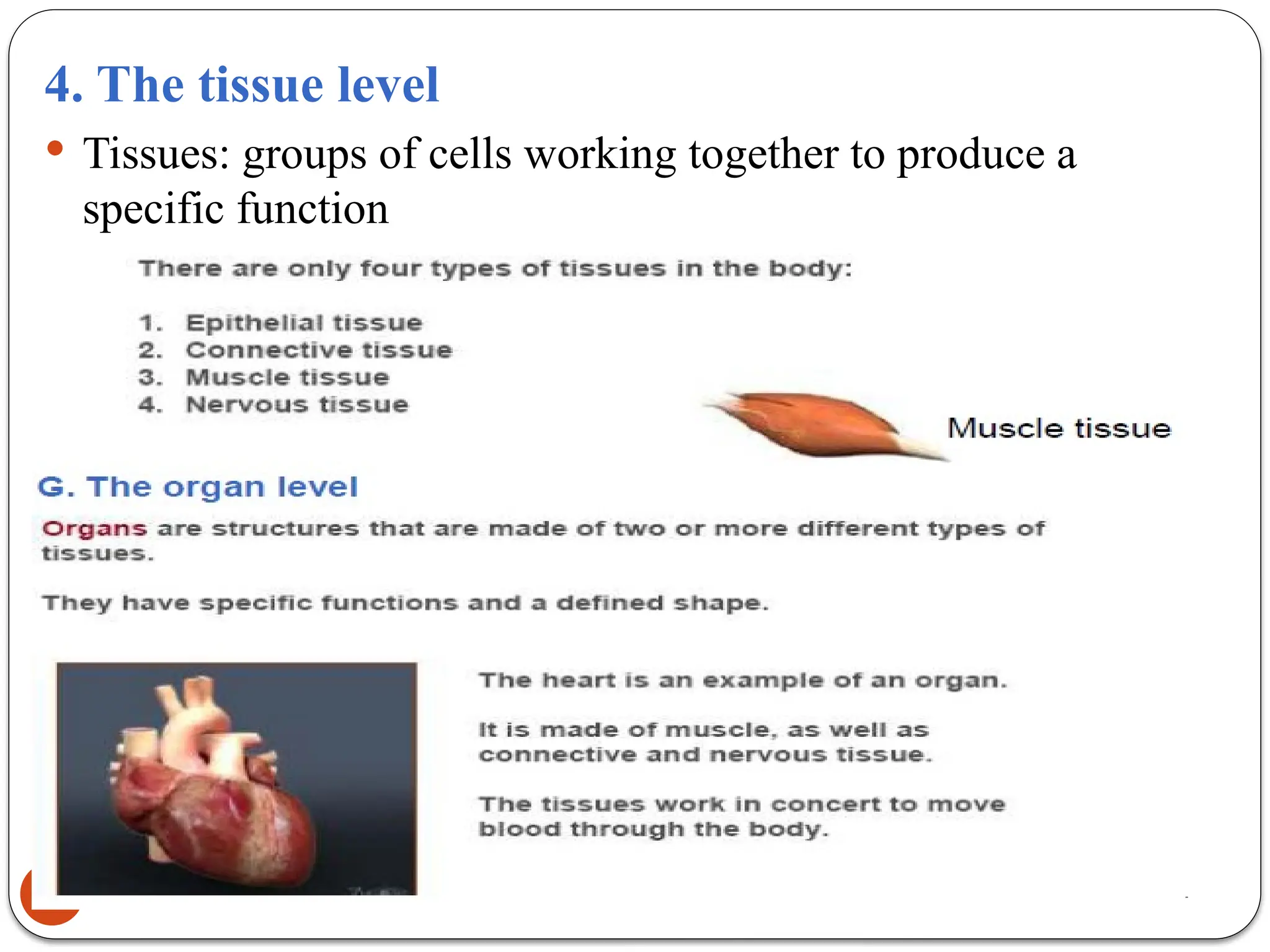
4. The tissue level
 Tissues: groups of cells working together to produce a
specific function
12/05/2024
By:Tekle. H
38
5. The system level
 Systems are an association of organs that have common function.
 Each system does not function independently; they are all inter-reliant.
12/05/2024
By:Tekle. H
6. The organism level
39
12/05/2024
By:Tekle. H
40
CELLULAR PHYSIOLOGY
12/05/2024
By:Tekle. H
41
Cells
 Are the smallest functional & structural unit of the body.
 Are the building blocks of the body
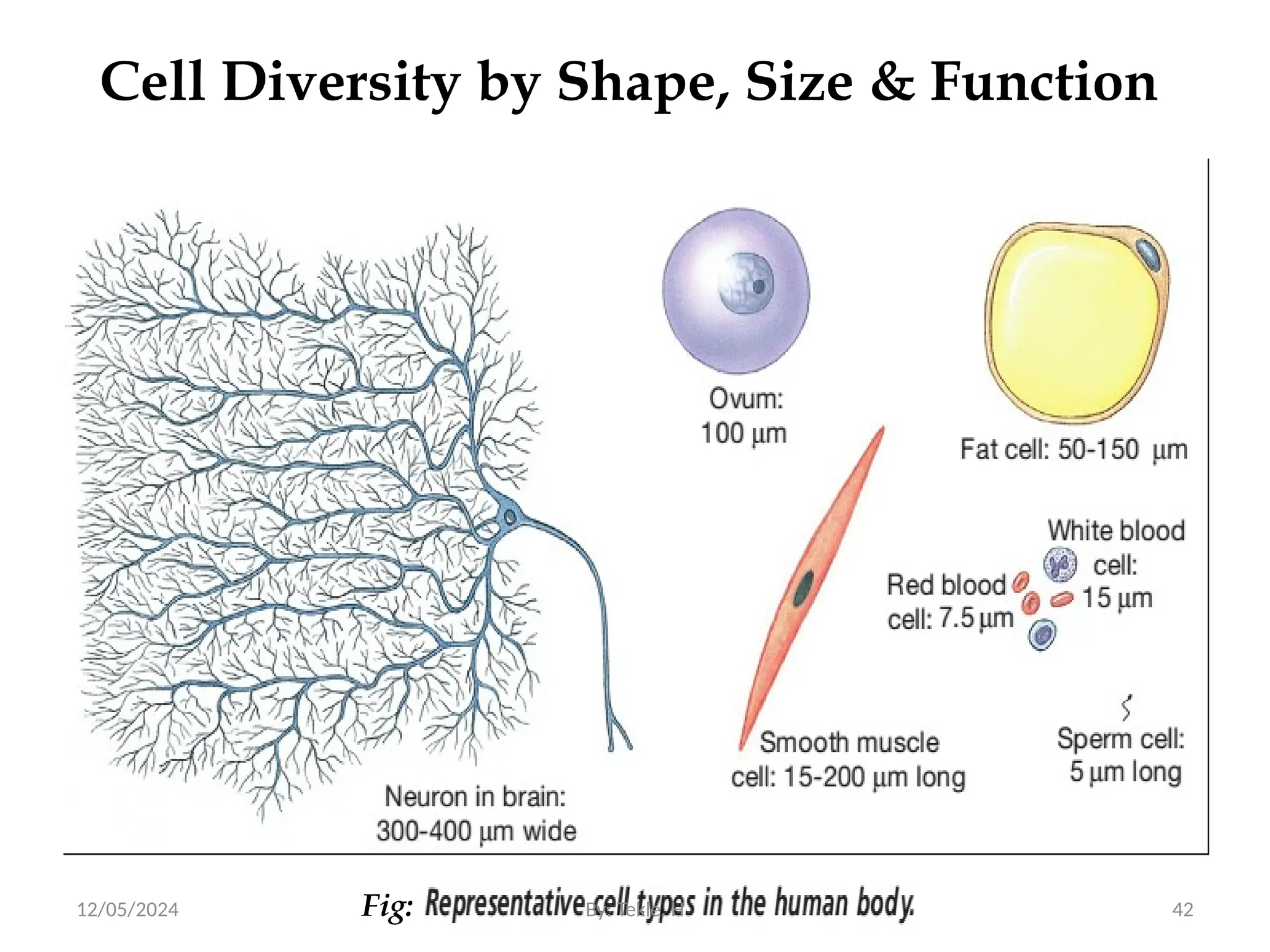
 Small in size 10 – 20um
 There are nearly 100 trillion cells in an average adult
 25% of these are RBC
 Can be classified into about 200 cell types.
 All cells work to maintain homeostasis/constancy in the internal environment
Cell Diversity by Shape, Size & Function
Fig:
12/05/2024 By: Tekle. H 42
12/05/2024
By:Tekle. H
43
Basic cell functions:-
 Obtain nutrients & O2 from the env’t surrounding the cell
 Perform chemical reactions that use nutrients & O2 for metabolic energy
production
 Eliminate waste products (CO2 & other bi-products)
 Synthesis of materials for cellular structure, growth, & carrying out cellular
functions
 Sensitivity & responsiveness to changes in its immediate env’t
 Control of material exchanges b/n the cell & its surroundings.
 Reproduction (most cells); except nerve & muscle cells
Cell Death
Apoptosis
 Apoptosis: is the natural or
programed death of the cell under
genetic control.
 This type of programmed cell death
is a normal phenomenon and it is
essential for normal development
of the body.
 Apoptosis does not produce
inflammatory reactions in the
neighboring tissues.
Necrosis
 Necrosis: is the uncontrolled and
unprogramed death of cells due to
unexpected and accidental damage.
 It is also called ‘cell murder’
because the cell is killed by
extracellular or external events.
 After necrosis, the harmful chemical
substances released from the dead
cells cause damage & inflammation
of neighboring tissues.
12/05/2024 By: Tekle. H 44
12/05/2024
By:Tekle. H
45
3 main parts of the cells are:
I. Plasma membrane or cell membrane
 The outer covering of the cells
II. Cytoplasm - the region b/n the plasma
membrane & nucleus.
 Most organs are suspended within the cytoplasm in the
intracellular fluid known as cytosol
III. Nucleus - the largest organelle in the cell
12/05/2024
By:Tekle. H
46
12/05/2024
By:Tekle. H
I. Plasma membrane
47
 Is very thin structure that covers the outer surface of a cell with about
7-10 nm thick
 Delimits the ICF within the cell from the ECF, and also the cell from
the surrounding.
 It is composed almost entirely of proteins and lipids.
 The approximate composition is:
 Proteins, 55%
 Lipids, 42%
 Phospholipids, 25%
 Cholesterol, 13%
 Other lipids, 4%
 Carbohydrates, 3%
12/05/2024
By:Tekle. H
48
12/05/2024
By:Tekle. H
49
 Plasma membrane is phospholipid bilayer.
-Polar heads (hydrophilic-water love) and Non-polar tails
(hydrophobic-water hate)
 Polar heads are facing to ECF & ICF and Non polar tails are
facing towards the center of the membrane.
 Non-polar tails makes the membrane selectively permeable.
 Phospholipids are soft and oily structures and cholesterol
helps to ‘pack’ the phospholipids in the membrane.
 Cholesterol is responsible for the structural integrity of lipid
layer of the cell membrane.
12/05/2024 By: Tekle. H 50
51
 The basic lipid bilayer is composed of phospholipid molecules.
 One end of each phospholipid molecule is soluble in water;
 It is hydrophilic: glycerol back bone + phosphorylated head of
phospholipid
 In contact with water of ICF & ECF
 The other end is soluble only in fats;
 it is hydrophobic - the two HC chains of the fatty acid portion
 Repelled by water but are mutually attracted to one another
 Impermeable to the usual water-soluble substances, such as ions,
glucose, and urea.
 Fat-soluble substances, such as O2, CO2, and alcohol can penetrate
this portion of the membrane with ease.
 Thus phospholipids are amphiphilic; having hydrophobic & hydrophilic
ends
By:
Tekle.
H
12/05/2024
12/05/2024
By:Tekle. H
52
Permeability of Plasma Membrane…
 Lipid layer of the cell
membrane is a semipermeable
membrane and allows only the
fat-soluble substances to pass
through it.
 Fat-soluble substances like
oxygen, carbon dioxide and
alcohol can pass through this
lipid layer.
 The water-soluble substances
such as glucose, urea and
electrolytes cannot pass through
12/05/2024 By: Tekle. H 53
12/05/2024
By:Tekle. H
54
Cell Membrane Proteins
 There are two types of proteins: Integral and
peripheral
A. Integral proteins
 Protrude all the way through the membrane
 Also called trans-membrane proteins
 Can not be removed with out disrupting the bilayer
because they are embedded in lipid bilayer
12/05/2024
By:Tekle. H
55
12/05/2024
By:Tekle. H
56
Functions of integral membrane proteins:
Many of them provide structural channels (or pores)
 Pores through which water and water-soluble substances, especially ions, can
diffuse between the ECF and ICF.
Other integral proteins act as carrier proteins
 To transport substances that could not penetrate the lipid bilayer.
 For facilitated and active transports
Still others act as enzymes.
Also serve as receptors for water-soluble chemicals, such
as peptide hormones, that do not easily penetrate the cell
membrane.
12/05/2024
By:Tekle. H
57
B. peripheral proteins
 Are on membrane surface, mostly the cytosolic side i.e. not
embedded in lipid bilayer (loosely attached)
 Can be removed without damaging the cell membrane.
 Often attached to the integral proteins
 Function almost entirely as enzymes or as controllers of
transport of substances through the cell membrane "pores”
Glycoproteins and some Glycolipids serve as surface
receptors for cell recognition & identification
 Develop ability of immune system to distinguish self antigen
from foreign antigens
12/05/2024
By:Tekle. H
58
Generally the cell membrane is important to:
 Support & retain the cytoplasm
 Provide selectively permeable barrier
 Transport
 Communication via receptors
12/05/2024
By:Tekle. H
II. Organelles – sub-cellular structures
59
12/05/2024
By:Tekle. H
60
1. Nucleus
 The nucleus is the control center of the cell
 Contains large quantities of DNA, which are the genes.
 The genes determine the characteristics of cell's proteins:
 The structural proteins, as well as functional proteins
Usually single per cell
 But could be multiple like in skeletal muscle cells, osteoclasts,
syncytiotrophoblast……
 Matured RBC, cornified cells in the skin, hair and nails has no
nucleus.
It is surrounded by bilayer nuclear membrane
12/05/2024
By:Tekle. H
61
Major components of the nucleus:
A. Chromatin- is made up of DNA + RNA + protein
 During mitosis, the chromatin material organizes in the form of highly
structured chromosomes,
 Chromosomes can then be easily identified using the light microscope
B. Nucleolus - does not have a limiting membrane.
 Is an accumulation of large amounts of RNA and proteins of the types found in
ribosomes.
 Becomes considerably enlarged when the cell is actively synthesizing proteins.
 One per nucleus but may be >1 w/n the cell is immature or rapidly dividing
 Thus acute leukemia, blasts cells may have 5 or 6 nucleoli.
C. Nucleoplasm- is fluid w/c lies within the nucleus.
12/05/2024
By:Tekle. H
62
12/05/2024
By:Tekle. H
63
2. Ribosome
 Is RNA + protein => 65% RNA and 35% proteins
 Factory of protein or site of protein synthesis
 Prominent in cells with high rate of protein synthesis eg.
Liver
 Function as free in the cytosol or bound to ER.
o Most proteins made by free ribosomes function in the cytosol.
 Eg. Proteins in hemoglobin, mitochondria …
o Bound ribosomes make proteins destined for secretion.
Eg. peptide hormones.
 Prominent in cells specializing in protein secretion
 Eg. Pancreatic cells.
12/05/2024
By:Tekle. H
64
3. Endoplasmic reticulum
 Network of folded membrane b/n cell membrane &
nucleus
 Exists in two forms:
 A. Rough Endoplasmic reticulum (RER) or granular-
 The surface is coated with ribosomes
 Concerned with synthesizes of proteins in the cells
 Prominent in cells secreting hormones & enzymes:
Eg. pancreas cells
 B. Smooth endoplasmic reticulum (SER) or agranular-
 Has no bound ribosomes, hence SER
 Synthesizes lipids, especially phospholipids and cholesterol.
12/05/2024
By:Tekle. H
65
 Other Functions the SER:
 Provides the enzymes that control glycogenolysis
 Provides enzymes detoxifying the toxic substances
 Eg. Liver smooth SER has enzymes that detoxify drugs
 Storage of Ca++ in muscles
 Sarcoplasmic reticulum stores Ca++ ions (trigger for muscle contraction)
 SER can be seen best in:
 Cells that synthesize lipid hormones eg. ovary, testes, adrenal
cortex
 Cells that detoxify drugs eg. liver
12/05/2024
By:Tekle. H
66
4. Golgi apparatus
 A set of stacked membrane compartments
 The compartments have different functions:
 Golgi finishes proteins: adds sugar molecules to side groups
 Packages proteins into vesicles for secretion or internal use
 Sorts proteins & routes them to the right destination
 Some to internal use, others to cell membranes for secretion
 Found in all cells but well developed in cells that secrete materials:
 Plasma cells: secrete antibodies
 Pancreatic acinar cells: secrete digestive enzymes.
12/05/2024
By:Tekle. H
67
 Fig. Formation of proteins, lipids, and cellular vesicles by the ER and Golgi apparatus
12/05/2024
By:Tekle. H
68
5. Mitochondria
 The Powerhouses of the Cell
 Have small amounts of DNA; make their own proteins
 Covered by bilayer membranes (double membrane):
 Smooth outer membrane
 Is highly permeable to small solutes,
 But it blocks passage of proteins and other macromolecules
 Convoluted inner membrane
 Contains embedded enzymes for cellular respiration.
 Has infoldings or cristae increase surface area for enzymatic reaction
 Site of cell respiration (Krebs cycle & electron transport)
 Require oxygen
 Produce 36 ATPs/glucose molecule- major source of cell energy
12/05/2024
By:Tekle. H
69
6. Lysosomes
 Unit membrane bound
 Formed by breaking off from the Golgi apparatus and then dispersing
throughout the cytoplasm.
 Contain about 40 hydrolytic enzymes: lipases, proteases, nucleases etc.
 Used in break down of old proteins, many wastes, phagosytosis
 The unit membrane prevents the enzymes from being released
 Therefore, prevents autodigestion of the cell itsef
 Under pathological conditions, the unit membrane can disintegrate
 Release of acidhydrolases → digestion of the cell it self (auto digestion)
 That is why they are called sucide bags.
12/05/2024
By:Tekle. H
70
7. Peroxisomes
 Are unit membrane bound organelles
 Formed by self-replication or perhaps by budding off from SER
 Contain ‘catalase’ type enzymes which destroy H2O2.
 Catalase a type of oxidase which converts: H2O2→ H2O + ½ O2
 H2O2 is formed from poisons or alcohol, which enter the cell
 When ever H2O2 is formed in the cell,
 The peroxisomes are ruptured and oxidative enzymes are released
 Destroy the H2O2.
 About half the alcohol a person drinks is detoxified by Peroxisomes of the liver cells in this
manner.
12/05/2024
By:Tekle. H
71
9. Cytoskeleton
 Skeletal or bony structure of the cell
 Gives mechanical support to the cell and helps maintain its shape
 Enables a cell to change shape in an adaptive manner
 Associated with motility by interacting with specialized proteins
called motor molecules
 e.g., organelle movement, muscle contraction, locomotor
organelles…
 Plays a regulatory role by mechanically transmitting signals from
cell's surface to its interior.
12/05/2024
By:Tekle. H
72
Three types of filaments make up the cytoskeleton:
1. Microtubules
 Found in cytoplasm of all eukaryotic cells
 Straight hollow fibers 25 nm diameter & 200 nm – 25 µm in length
 Constructed from globular proteins called tubulin that Consists of one
α- tubulin and one β-tubulin molecule
 Constitute such structures like cilia, neural process (dendron), and
mitotic spindle
 Without mitotic spindles cells could not reproduce
 These microtubules can contract b/c they have contractile proteins.
12/05/2024
By:Tekle. H
73
2. Microfilaments (actin filaments)
 Solid rods about 7 nm in diameter
 Built from globular protein monomers, G-actin
 Two actin chains are wound into a helix
 Provide cellular support
 Participate in muscle contraction
3. Intermediate filaments
 Filaments that are intermediate in diameter (8-12 nm) between
microtubules and microfilaments
 Constructed from keratin subunits
 More permanent than microfilaments and microtubules
12/05/2024
By:Tekle. H
74
12/05/2024
By:Tekle. H
75
BODY FLUID COMPARTMENTS AND TRANSPORT
ACROSS THE CELL MEMBRANE
12/05/2024
By:Tekle. H
BODY FLUID COMPARTMENTS
76
TOTAL BODY WATER (TBW):
 Term baby: 75-80% of body weight
 At 3 months: 65-70% of body weight
 At the age of one year, TBW equals the adult level: 60%
 60% of BW in average adult male
 55% of BW in average adult female (due to high fat deposition)
 Lean individuals have a greater water volume than obese ones (20-30%
more).
Body Fluid Compartments
1. Extracellular fluid (14L)-Fluid
found outside the cells, which is
also called the internal
environment
– ECF has 2 components:
1. Blood plasma
2. Interstitial fluid
2. Intracellular fluid (28L) - Fluid
contained within all body cells ICF
ICF
Fig: Body fluid compartments
12/05/2024 By: Tekle. H 77
12/05/2024
By:Tekle. H
78
12/05/2024
By:Tekle. H
79
 ECF:- 1/3 of TBW =14L
 Have 3 compartments :
 Interstial fluids : 15% of BODY WT or 3/4th
of ECF (10.5L)
 Intravascular fluid (plasma): 4% of TBW (3L) ~1/3rd
of ECF
 Transcelluar body fluids:1% of TBW (0.5L)
 Always enlarges when there is a net gain of fluid by the body
 A net loss of body fluid decreases extracellular volume.
 Principal cations; Na+
 Principal anions; Cl-, HCO3-
12/05/2024
By:Tekle. H
80
 Effect of adding different solutions to ECF after osmotic equilibrium.
 The normal state indicated by solid lines, and the changes by shaded
areas.
 ICF and ECF volumes are shown in the X-axis of each diagram,
 ICF and ECF osmolarities are shown on the y-axis.
12/05/2024
By:Tekle. H
81
12/05/2024
By:Tekle. H
82
 Fluid loss could be through:
 Lung- with expired air (350ml/d)
 Loss increases with increase in RR
 Skin - with perspiration (350ml/d)
 Loss increases with fever (by 10-12% each o
c)
 Faces-100ml/d
 Urine:- ranges from 1000-2000ml/d
 Approximately 60% ( 400ml/d) are required to excrete
metabolic products.
 Mainly under ADH control.
12/05/2024
By:Tekle. H
83
12/05/2024
By:Tekle. H
84
12/05/2024
By:Tekle. H
85
12/05/2024
By:Tekle. H
Examples
86
 Na+
= SODIUM ION
 90% of total ECF cations
 138 -145 mEq / L
 Pairs with Cl-
, HCO3-
to neutralize charge
 Low in ICF
 Function:
 Most important ion in regulating water balance
 Membrane potential
 Important in nerve and muscle function
 The kidney is the major site of control of sodium
balance
12/05/2024
By:Tekle. H
87
 K+
= POTASSIUM ION
 Major intracellular cation
 major osmotically active solute in the cells
 ICF concentration = 140 mEq/ L
 Important for:
 Maintenance of membrane potential or electrical
excitability of cells
 Regulates fluid, ion balance inside cell
 pH or acid-base balance
 The kidney is the major site of potassium balance control
12/05/2024
By:Tekle. H
88
DISTURBANCES OF VOLUME & ELECTROLYES
 The general clinical terms for volume abnormalities are:
 Dehydration and overhydration.
 Both conditions are associated with a change in ECF
volume.
 Tonicity of a solution is related to the effect of [solution] on
the volume of a cell (e.g. erythrocytes)
 In the Dx & Tx of fluid and electrolyte imbalances,
clinicians rely on ECF particularly on plasma
12/05/2024
By:Tekle. H
89
12/05/2024
By:Tekle. H
90
12/05/2024
By:Tekle. H
TRANSPORT ACROSS THE CELL MEMBRANES
91
12/05/2024
By:Tekle. H
92
TWO MAJOR TYPES OF TRANSPORT
A. PASSIVE TRANSPORT: FROM HIGH CONCENTRATION TO LOW
- SIMPLE DIFFUSION
- FACILITATED DIFFUSION
B. ACTIVE TRANSPORT: PUMP AGAINST GRADIENT USING ENERGY
- SOURCE OF ENERGY: ATP (PRIMARY) OR ANOTHER GRADIENT
(SECONDARY)
12/05/2024
By:Tekle. H
1. Passive transport
93
WHAT DETERMINES THE RATE OF PASSIVE TRANSPORT?
1. The concentration gradient
 The bigger the concentration gradient, the faster the rate of diffusion.
2. Temperature
 Higher temperatures give molecules or ions more kinetic energy.
 Molecules move around faster, so diffusion is faster.
3. The surface area
 The greater the surface area, the faster the rate of diffusion
 Because the more molecules or ions can cross the membrane at any one
moment.
4. The type of molecule or ion diffusing
 Larger molecules diffuse more slowly
 Non-polar molecules diffuse more easily than polar molecules
 Because they are soluble in the non-polar phospholipid tails.
12/05/2024
By:Tekle. H
94
A. SIMPLE DIFFUSION
 Does not require integral membrane proteins
 Diffusion occurs from area of high to low concentration
 The end result is an even distribution called equilibrium
 Small uncharged & hydrophobic molecules cross the lipid bilayer by
simple diffusion
 eg. urea, ethanol…
 The rate is proportional to concentration gradient & the process is not
saturated
 Molecules in aqueous solution dissolves in lipid bilayer cross
the membrane
12/05/2024
By:Tekle. H
95
DIFFUSION THROUGH PHOSPHOLIPID BILAYER
 What molecules can get through directly?
 Fats & other lipids
 Oxygen – Non-polar & high solubility on lipid bilayer so diffuses
very quickly.
 Carbon dioxide – high solubility on lipid bilayer so diffuses quickly.
 Alcohol – high solubility on lipid bilayer so diffuses quickly.
 Water (osmosis) – Polar but also very small so diffuses quickly.
12/05/2024
By:Tekle. H
96
12/05/2024
By:Tekle. H
97
12/05/2024
By:Tekle. H
98
B1. Carrier-mediated diffusion
 Depend on specific integral membrane protein,
often called uniports.
 Includes the transport of hydrophilic molecules
 Eg. glucose & other sugars, amino acids
 The movement of molecule is downhill: from
area of higher concentration to area of lower
concentration
12/05/2024
By:Tekle. H
99
12/05/2024
By:Tekle. H
100
B2. Diffusion through protein channels
 Large integral proteins that form pathways for
transmembrane movement of ions
 Channels move specific molecules across cell membrane
 No energy needed
12/05/2024
By:Tekle. H
101
Ion Channels
 Def.: ∼ proteins that form pores in the membrane to allow
ion flow.
 Its rapid opening & closing mediate signaling in the NS & MS.
Features of Ion Channels
High permeation rate: 108 ions/s/channel → current flow →
Em.
Passive: allow inorganic ions (Na+, K+, Ca2+, Cl-) with no use
of energy
Selective: ions of appropriate size & charge.
Fluctuate between open & closed states
12/05/2024
By:Tekle. H
102
12/05/2024
By:Tekle. H
103
Types of Ion Channels
i. Voltage-gated ion Channels
 change of electrical potential at the cell
membrane causes these channels to open
ii. Ligand-gated ion channels
 The binding of an extracellular molecule (e.g.,
hormone, NT) causes these channels to open.
iii. Mechanically-gated ion Channels
 stretch or mechanical pressure opens these
channels
iv. Leak Channels
12/05/2024
By:Tekle. H
104
12/05/2024
By:Tekle. H
105
C) Osmosis
 Is the net movement of water over a semi-permeable
membrane from an area of low to high solute
concentration
12/05/2024
By:Tekle. H
2. Active transport
106
 The movement of molecule is uphill: from low
to high concentration
 Requires an input of metabolic energy.
 This energy can be derived from:
 Direct hydrolysis of ATP - primary active
transport
 Coupling to the movement of an ion down its
concentration gradient – secondary active
transport
12/05/2024
By:Tekle. H
107
12/05/2024
By:Tekle. H
108
2. Calcium pump or Ca2+
ATPase
1. Ca2+ binds to receptor site from area of low [Ca2+
]
2. ATP phosphorylates carrier conformational change
3. Conformational change releases Ca2+
into area of high [Ca2+
]
4. Dephosphorylation returns carrier to the original conformation
12/05/2024
By:Tekle. H
109
B. Secondary active transport
Ω Uses the energy stored in ion gradients to actively
transport molecules across membranes
$ The flow of the molecule across the membrane is coupled to the flow of
an ion (usually Na+ or H+)
$ Symport: If the molecule & the ion move in the same direction
$ The protein involved in the process is symporter.
 Eg. Na+/glucose and Na+/amino acid symporters
 The energy required for the flow of glucose against its gradient
comes from the flow of Na+ down its gradient.
$ Antiport: If both move in opposite direction
$ The protein involved in the process is antiporter
 Eg. Cl- & HCO3- antiporters
12/05/2024
By:Tekle. H
110
12/05/2024
By:Tekle. H
111
12/05/2024
By:Tekle. H
112
12/05/2024
By:Tekle. H
113
12/05/2024
By:Tekle. H
114
1. Endocytosis: - uptake of extracellular
macromolecules across the plasma membrane into the
cell.
 Can be divided into 3 depending on:
 The size of the ingested macromolecules
 Whether specific cell surface receptors are involved.
A. Phagocytosis – ‘cell eating’
 The ingestion of large particles via endocytic vesicles
called phagosomes
 Eg. uptake of bacteria, dead RBCs, & inorganic cell
debris by phagocytes
12/05/2024
By:Tekle. H
115
12/05/2024
By:Tekle. H
116
B. Pinocytosis (cell drink)
 Cell drinking or fluid- phase endocytosis
 The nonspecific uptake of extra cellular fluid
 Small area of the plasma membrane is infolded
in the form of a small pinocytic vesicle that are
later returned to the cell surface
12/05/2024
By:Tekle. H
117
C. Receptor mediated Endocytosis
 Selective uptake of macromolecules via clathrin-
coated pit & vesicles
 Macromolecules specifically bind to the cell surface
receptor
 Receptor-macromolecule complex accumulates in a
clathrin-coated pit & is then endocytosed in a
clathrin-coated vesicle
best examples include:
 Uptake of cholesterol by mammalian cells
 Entry of many viruses & toxins to animal cells.
12/05/2024
By:Tekle. H
118
12/05/2024
By:Tekle. H
119
2. Exocytosis:- release of intracellular macromolecules
 Eg. protein, neurotransmitter out of the cell across the cell
membrane
 The proteins are translated on ribosomes of RER
 Vesicles containing these proteins then buds off from the RER,
 Migrate through the cytosol & fuse with membrane of Golgi
apparatus
 Extruded in to secretary granules or vesicles
 Fuse with cell membrane, & the area of fusion breaks down
Move to extra cellular
12/05/2024
By:Tekle. H
120
12/05/2024
By:Tekle. H
121
Resting Membrane Potential
&
Action Potential OF Excitable Cells
12/05/2024
By:Tekle. H
Resting Membrane Potential (RMP)
122
 Resting Membrane Potential (RMP): is the voltage difference
(concentration difference of charges) across PM at resting cell.
 RMP is formed due to electrical charge difference b/n ECF & ICF
across cell membrane.
 Sodium and potassium are the most important ions involved in
development of RM in nerve & muscle cell
 Nerve cell & Muscle cells are excitable tissues that are capable of
generating rapidly changing electrochemical impulses at their
membranes, and these impulses are used to transmit signals along
the nerve or muscle membranes.
12/05/2024
By:Tekle. H
Recording of Membrane Potential
123
Fig: Volt meter
12/05/2024
By:Tekle. H
Causes of Resting Membrane Potential (-70 mV)
124
1. Permeability of Membrane to ions: plasma membrane is more
permeable to potassium than sodium (40 times)
 K+ leak out through K open channels than sodium.
 Thus diffusion of potassium contributes far RMP.
2. The Na+-K+ pump: constantly pumping 3 Na+ ions outward and 2
K+ ions inward for every ATP used.
 More positive charge is leaving out of cell than entering into cell.
3. Negatively charged non-diffusible proteins within the ICF that
cannot travel through the membrane.
 All contribute to RMP (-70mv) which is negative inside.
12/05/2024
By:Tekle. H
Causes of RMP (-70 mv)
125
The inside of the cell is negative with respect to the outside.
The interior (inside) has less positive charge than the exterior.
Anion proteins
12/05/2024
By:Tekle. H
Polarization (polarized cell)
126
12/05/2024
By:Tekle. H
Action Potential
127
 Action potential- is a rapid, reversible, and
conductive change of the resting membrane
potential after the cell is stimulated.
 Nerve signals are transmitted by action potentials.
 Depolarization–is opening of voltage gated Na+
channels→ Na+
influx in to the cell.
 Repolarization- is an opening of voltage gated K+
channels → K+
efflux out of the cell.
12/05/2024
By:Tekle. H
Stages of Action Potential…
128
12/05/2024
By:Tekle. H
Stages of Action Potential…
129
 When an action potential is generated
 Voltage-gated Na+ channels open first and Na+ flows into the cell.
 During the rising phase, the threshold is crossed, and the
membrane potential increases.
 During the falling phase, voltage-gated Na+ channels become
inactivated; voltage-gated K+ channels open, and K+ flows out of
the cell.
 During the undershoot, membrane permeability to K+ is at first
higher than at rest, then voltage-gated K+ channels close and
resting potential is restored.
12/05/2024
By:Tekle. H
Stages of Action Potential…
130
12/05/2024
By:Tekle. H
Basic Electrophysiological Terms
131
12/05/2024
By:Tekle. H
132
12/05/2024
By:Tekle. H
133
 Voltage-gated ion channels open when the membrane potential
changes beyond a certain threshold value. Channels of this type are
involved in the conduction of action potentials along nerve axons
and they include sodium and potassium channels (see Chapter 3).
 Voltage-gated ion channels are found in many cell types.
 It is thought that some charged amino acids located in a
membrane-spanning alpha-helical segment of the channel protein
are sensitive to the transmembrane potential.
 Changes in the membrane potential cause these amino acids to
move and induce a conformational change of the protein that opens
the way for the ions.
12/05/2024
By:Tekle. H
134
 Ligand-gated (or, chemically gated) ion channels cannot open unless
they first bind to a specific agonist.The opening of the gate is
produced by a conformational change in the protein induced by the
ligand binding.
 The ligand can be a neurotransmitter arriving from the extracellular
medium. It also can be an intracellular second messenger, produced in
response to some cell activity or hormone action, that reaches the ion
channel from the inside of the cell.
 The nicotinic acetylcholine receptor channel found in the postsynaptic
neuromuscular junction (see Chapters 3 and 9) is a ligandgated ion
channel that is opened by an extracellular ligand (acetylcholine).
12/05/2024
By:Tekle. H
Operation of chemical Gated Channel
135
12/05/2024
By:Tekle. H
Operation of a Voltage-Gated Channel
136
12/05/2024
By:Tekle. H
Action Potential Vs RMP
137
12/05/2024
By:Tekle. H
138
12/05/2024
By:Tekle. H
Propagation of Action Potential
139
If an action potential started at any one point on an excitable
membrane (axon), it usually excites adjacent portions of the
membrane resulting in propagation of the action potential
along membrane.
12/05/2024
By:Tekle. H
Absolute Refractory Period
140
Absolute Refractory Period: Once an action potential has
begun, second action potential cannot be triggered, no
matter how large the stimulus.
 During the refractory period after an action potential, a
second action potential cannot be initiated
 The refractory period is a result of a temporary inactivation
of the Na+ channels
 Because of this, action potentials cannot be summed.
 During the relative refractory period, a higher-than-normal
graded potential is required to trigger an action potential.
12/05/2024
By:Tekle. H
Threshold Potential
141
12/05/2024
By:Tekle. H
142
12/05/2024
By:Tekle. H
Graded Potentials & Action Potentials…
143
12/05/2024
By:Tekle. H
All-or-None Principle
144
12/05/2024
By:Tekle. H
All-or-None Principle (Law)
145
 Once an action potential is elicited (produced) at
threshold stimulus, it depolarizes to its full extent
(all-or-none response); it cannot depolarize partially.
12/05/2024
By:Tekle. H
146
Thank you

Introduction to physiology power point.pptx

  • 1.
  • 2.
    12/05/2024 By:Tekle. H Contents ofthe module 2  Introduction to Physiology  Definition  Historical background  Levels of body organization  Homeostasis and principle of physiological regulation  Cellular Physiology  Body fluid compartments and composition  Plasma membrane and membrane transport mechanisms  Resting membrane potential and Action potential of excitable tissues
  • 3.
    12/05/2024 By:Tekle. H 3 INTRODUCTION TOPHYSIOLOGY AND HOMEOSTASIS
  • 4.
    12/05/2024 By:Tekle. H Introduction toPhysiology 4 Physiology  Is biological science that deals with the study of the functions of living things  Focuses on the mechanism of action occurring in the body  Deals with the physical and chemical processes responsible for the origin, development, and progression of life  Studied from the simplest virus to the largest tree or the complicated human being  Viral physiology, bacterial physiology, cellular physiology, plant physiology, invertebrate physiology, vertebrate physiology, mammalian physiology, human physiology, …
  • 5.
    12/05/2024 By:Tekle. H 5  Morespecifically - deals with the mechanisms of maintaining constancy (balance) in the internal environment = Homeostasis  Attempts to explain the specific mechanisms in our body that makes us a living being  To attain that balance, there are complex control systems in our body  Studied at many levels of organization (Cellular to Organismal level)  Cells are the smallest structural and functional living units of the body  Two approaches explain physiological events occurring in our body  Purpose – why is something happening?  Mechanism – how is a given event happening – the way  Structure and function are inseparable
  • 6.
    12/05/2024 By:Tekle. H 6 RELATIONSHIP withother disciplines  ANATOMY AND PHYSIOLOGY  Structure (Anatomy) determines function (Physiology)  Because functions of the body is carried out by its constituent structures  BIOCHEMISTRY  PATHOLOGY  PHARMACOLOGY  MEDICINE AND PHYSIOLOGY  “Mother” of modern medicine  Discoveries in Physiology used in modern medical practices eg. hormonal therapies
  • 7.
  • 8.
    12/05/2024 By:Tekle. H 8 HOMEOSTASIS  Itsconcept was proposed by Claude Bernard (1857)  Homeostasis coined by W.B. Cannon (1929)  Homeo = same; Stasis = standing  Homeostasis can be defined as the bodily mechanisms important in maintaining constancy in the internal environment (ECF) in spite of the continuous internal & external changes  Is relative (not complete) constancy within working range or normal value  There is continuous disturbance of body parameters – but corrective physiologic measures take it back to it’s working range  There is NO single “normal” value for any body parameter – there is a range of workable values
  • 9.
    12/05/2024 By:Tekle. H Cont… 9  Eachbody cells should contribute in maintaining the composition of the internal environment shared by all cells  So that this fluid continuously remains suitable to support the existence of all body cells  So homeostasis is defined as having dynamic steady state in the internal env’t  Examples of homeostatically regulated factors include  Concentration of nutrients, oxygen, carbon dioxide, waste products  pH, temperature  Fluid volume, blood pressure  Concentration of salt and other electrolytes
  • 10.
    12/05/2024 By:Tekle. H 10 THE SETPOINT Is the "ideal" or "normal" value of the variable at the middle of the range that is previously "set" or "stored" in memory  The diagram indicates the range over which a given parameter is maintained by a negative feedback mechanism.  Values for the parameter swing above and below a normal value within a physiological normal range
  • 11.
    12/05/2024 By:Tekle. H 11 HOMEOSTASIS CONTROLSYSTEMS  The major control systems of our body are the Nervous system and Endocrine System  The nervous system is generally fast (milliseconds)  Nervous system uses an electrical system  The endocrine system is generally slow (seconds to hours)  Endocrine system uses chemical messenger called hormones  Three important steps are needed to have constancy  Detecting change/deviation  Integrating/interpreting information  Making appropriate adgustment or response
  • 12.
  • 13.
    12/05/2024 By:Tekle. H Homeostasis Usuallyuses Neural Pathway 13 Many homeostatic mechanisms use a nerve pathway to produce their effects. These pathways involve:  an afferent path which brings sensory messages from receptors into the CNS  an efferent path which carries outgoing nerve messages from CNS to effectors.
  • 14.
  • 15.
    12/05/2024 By:Tekle. H 15 TYPES OFHOMEOSTATIC REGULATION MECHANISMS A. Negative feedback  Commonest type of feedback mechanism  Acts in opposite direction of the stimulus or triggering factor  Tends to stabilize a system, correcting deviations from the set point.  Decreases the intensity of condition, leading to stability.  Operates at all levels: from cellular to organism level  Has a survival value  Examples:  Thermoregulation  PaO2 /PaCo2 regulation,  pH regulation  BP control,  Blood sugar regulation .............................many more
  • 16.
  • 17.
    12/05/2024 By:Tekle. H EXAMPLES OFNEGATIVE FEEDBACK 17 1. CONTROLLING GLUCOSE LEVELS  Your cells need adequate amount of glucose in the blood.  Excess glucose gets turned into glycogen and stored in the liver  Glycogen can also be converted back to glucose when needed  This can be regulated by 2 major hormones from pancreas: Insulin and Glucagon
  • 18.
  • 19.
    12/05/2024 By:Tekle. H 2. CONTROLLINGBODY TEMPERATURE 19 All mammals maintain a constant body temperature (homo-thermic) Human beings have a body temperature of about 37o C.  If your body is in a hot environment your body temperature is about 37o C  If your body is in a cold environment your body temperature is still about 37o C
  • 20.
  • 21.
    12/05/2024 By:Tekle. H 21 3. REGULATIONOF BLOOD PRESSURE- SHORT & LONG TERM REGULATION Short-Term Regulation  Short-term changes in blood pressure (seconds to minutes)  are mediated by the autonomic nervous system:  sympathetic stimulation results in increased BP  parasympathetic leads to lowered BP eg. DECREASED BP
  • 22.
    12/05/2024 By:Tekle. H 22 Long termregulation of BP:(hours-days) by RAAS
  • 23.
    12/05/2024 By:Tekle. H B. Positivefeedback 23  With positive feedback the disturbance is sensed and action is taken that reinforce the initial change of the variable  The response is in the same direction as the stimulus favors instability  It is rare in physiology because in many cases it cause instability, leading to death.  A mild degree of positive feedback can be overcome by negative feedback mechanism of the body & vicious circle fails to develop  If positive feedback is left unchecked, it can lead to a vicious cycle and dangerous situation even death
  • 24.
    12/05/2024 By:Tekle. H 24 Positive feedbackexhibits Intensification of stress : During a positive feedback process, the initial imbalance or stress is worsened rather than reduced as in case of negative feedback.
  • 25.
    12/05/2024 By:Tekle. H 25 Examples ofpositive feedback:  The nerve impulse/action potential,  Parturition,  LH surge in the mid menstrual cycle  Severe shock,  Viral infection,  Drug addiction
  • 26.
  • 27.
    12/05/2024 By:Tekle. H C. Feedforward 27  The disturbance is sensed and corrective actions are taken in anticipation of a change.  Works in concert with negative feedback  Rapid  Advantages:  Increases speed of response  Minimizes fluctuation of regulated variable (reduces variation from set point) Examples of feed forward mechanism:  Rates of heart beat and breathing increase before a person begins to exercise  Increased secretion of saliva and gastric juice as a person sees food
  • 28.
  • 29.
    12/05/2024 By:Tekle. H 29  Tounderstand physiology, it is best to first understand the way in which the body is organized.  Levels of Organization of the Human Body:  The Chemicals  The Organelle  The Cell  The Tissue  The Organ  The System  The Organism
  • 30.
    12/05/2024 By:Tekle. H 30 1. Chemicallevel - all chemical substances necessary for life. A. Atoms:- basic building blocks for everything, living or not  The major constituents are O, C, H, N  Minerals- Ca, P, K, S, Na, Cl, Mg  Trace- Fe, I, Zn B. Molecules:- the larger chemical grouping of atoms  Eg. H2O, CO2, PO4, octane (gasoline or petrol: C8H18) …..  Molecules come together to form macromolecules:  Can be biological and non-biological macromolecules. C. Biomolecules:  Are four types: carbohydrates, lipids, proteins, and nucleic acids.
  • 31.
    12/05/2024 By:Tekle. H 31 I. Carbohydrates About 3% of the dry mass of a typical cell  Composed of C, H, & O (e.g., glucose is C6H12O6)  An important source of energy for cells  Types include:  Monosaccharides: (eg. glucose)- most contain 5 or 6 C atoms  Disaccharides:-2 monosaccharides linked together  Examples: sucrose (composed of glucose & fructose) : lactose (milk sugar; composed of glucose & galactose)  Polysaccharides:-several monosaccharides linked together  Examples: starch ( made up of many glucose molecules) : glycogen (commonly stored in the liver)
  • 32.
    12/05/2024 By:Tekle. H 32 II. Proteins About 50 - 60% of the dry mass of a typical cell  Composed of amino acids linked by peptide bonds  Two functional categories:  Structural proteins Eg. Membrane proteins  Functional proteins eg. enzymes  Enzymes are catalysts.  Enzymes bind temporarily to one or more of the reactants of the reaction they catalyze.  In doing so, they lower the amount of activation energy needed and thus speed up the reaction.
  • 33.
    12/05/2024 By:Tekle. H 33 III. Lipids Composedlargely of carbon & hydrogen  About 40% of the dry mass of a typical cell  Generally insoluble in water  Functions:  Involved mainly with long-term energy storage  Structural components ( Eg. phospholipids in cell membranes)  As hormones  Subclasses include:  Triglycerides:- consist of one glycerol molecule + 3 fatty acids  Fatty acids typically consist of chains of 16 or 18 carbons  plus lots of hydrogens  Phospholipids:- a phosphate group (-PO4) substitutes for one fatty acid  Steroids:- include testosterone, estrogen, & cholesterol
  • 34.
    12/05/2024 By:Tekle. H 34 VI. NucleicAcids  DNA  RNA (including mRNA, tRNA, & rRNA)  There are three different types of RNA, each of which plays an independent and entirely different role in protein formation:  Messenger RNA- carries the genetic code to the cytoplasm for controlling the type of protein formed.  Transfer RNA- transports activated amino acids to the ribosomes to be used in assembling the protein molecule.  Ribosomal RNA- along with about 75 different proteins, forms ribosomes,
  • 35.
    12/05/2024 By:Tekle. H 35 2. OrganelleLevel  Organelles: Sub-cellular structures composed of biomolecules  are the underlying machinery found within cells that are responsible for the functioning of the cell.  Organelles are reliant on the cell for their survival, as they will die if removed.  At the same time, the cell too will die if the organelles are removed from it.  Individual organelles, their function, and how they are composed will be discussed in a later section.
  • 36.
    12/05/2024 By:Tekle. H 36 3. CellularLevel  The cell is the smallest unit that possesses and exhibits the basic characteristics of living matter.  It is the smallest living unit of the human body.  The cell is also the most numerous of units, with estimates being 100 trillion cells in the average adult human (that would be a 1 followed by 14 zeroes!).  To put that in perspective: if you count 1000 cells every second until you counted them all, it would take you nearly 3,171 years before you made it to 100 trillion.
  • 37.
    12/05/2024 By:Tekle. H 37 4. Thetissue level  Tissues: groups of cells working together to produce a specific function
  • 38.
    12/05/2024 By:Tekle. H 38 5. Thesystem level  Systems are an association of organs that have common function.  Each system does not function independently; they are all inter-reliant.
  • 39.
  • 40.
  • 41.
    12/05/2024 By:Tekle. H 41 Cells  Arethe smallest functional & structural unit of the body.  Are the building blocks of the body  Small in size 10 – 20um  There are nearly 100 trillion cells in an average adult  25% of these are RBC  Can be classified into about 200 cell types.  All cells work to maintain homeostasis/constancy in the internal environment
  • 42.
    Cell Diversity byShape, Size & Function Fig: 12/05/2024 By: Tekle. H 42
  • 43.
    12/05/2024 By:Tekle. H 43 Basic cellfunctions:-  Obtain nutrients & O2 from the env’t surrounding the cell  Perform chemical reactions that use nutrients & O2 for metabolic energy production  Eliminate waste products (CO2 & other bi-products)  Synthesis of materials for cellular structure, growth, & carrying out cellular functions  Sensitivity & responsiveness to changes in its immediate env’t  Control of material exchanges b/n the cell & its surroundings.  Reproduction (most cells); except nerve & muscle cells
  • 44.
    Cell Death Apoptosis  Apoptosis:is the natural or programed death of the cell under genetic control.  This type of programmed cell death is a normal phenomenon and it is essential for normal development of the body.  Apoptosis does not produce inflammatory reactions in the neighboring tissues. Necrosis  Necrosis: is the uncontrolled and unprogramed death of cells due to unexpected and accidental damage.  It is also called ‘cell murder’ because the cell is killed by extracellular or external events.  After necrosis, the harmful chemical substances released from the dead cells cause damage & inflammation of neighboring tissues. 12/05/2024 By: Tekle. H 44
  • 45.
    12/05/2024 By:Tekle. H 45 3 mainparts of the cells are: I. Plasma membrane or cell membrane  The outer covering of the cells II. Cytoplasm - the region b/n the plasma membrane & nucleus.  Most organs are suspended within the cytoplasm in the intracellular fluid known as cytosol III. Nucleus - the largest organelle in the cell
  • 46.
  • 47.
    12/05/2024 By:Tekle. H I. Plasmamembrane 47  Is very thin structure that covers the outer surface of a cell with about 7-10 nm thick  Delimits the ICF within the cell from the ECF, and also the cell from the surrounding.  It is composed almost entirely of proteins and lipids.  The approximate composition is:  Proteins, 55%  Lipids, 42%  Phospholipids, 25%  Cholesterol, 13%  Other lipids, 4%  Carbohydrates, 3%
  • 48.
  • 49.
  • 50.
     Plasma membraneis phospholipid bilayer. -Polar heads (hydrophilic-water love) and Non-polar tails (hydrophobic-water hate)  Polar heads are facing to ECF & ICF and Non polar tails are facing towards the center of the membrane.  Non-polar tails makes the membrane selectively permeable.  Phospholipids are soft and oily structures and cholesterol helps to ‘pack’ the phospholipids in the membrane.  Cholesterol is responsible for the structural integrity of lipid layer of the cell membrane. 12/05/2024 By: Tekle. H 50
  • 51.
    51  The basiclipid bilayer is composed of phospholipid molecules.  One end of each phospholipid molecule is soluble in water;  It is hydrophilic: glycerol back bone + phosphorylated head of phospholipid  In contact with water of ICF & ECF  The other end is soluble only in fats;  it is hydrophobic - the two HC chains of the fatty acid portion  Repelled by water but are mutually attracted to one another  Impermeable to the usual water-soluble substances, such as ions, glucose, and urea.  Fat-soluble substances, such as O2, CO2, and alcohol can penetrate this portion of the membrane with ease.  Thus phospholipids are amphiphilic; having hydrophobic & hydrophilic ends By: Tekle. H 12/05/2024
  • 52.
  • 53.
    Permeability of PlasmaMembrane…  Lipid layer of the cell membrane is a semipermeable membrane and allows only the fat-soluble substances to pass through it.  Fat-soluble substances like oxygen, carbon dioxide and alcohol can pass through this lipid layer.  The water-soluble substances such as glucose, urea and electrolytes cannot pass through 12/05/2024 By: Tekle. H 53
  • 54.
    12/05/2024 By:Tekle. H 54 Cell MembraneProteins  There are two types of proteins: Integral and peripheral A. Integral proteins  Protrude all the way through the membrane  Also called trans-membrane proteins  Can not be removed with out disrupting the bilayer because they are embedded in lipid bilayer
  • 55.
  • 56.
    12/05/2024 By:Tekle. H 56 Functions ofintegral membrane proteins: Many of them provide structural channels (or pores)  Pores through which water and water-soluble substances, especially ions, can diffuse between the ECF and ICF. Other integral proteins act as carrier proteins  To transport substances that could not penetrate the lipid bilayer.  For facilitated and active transports Still others act as enzymes. Also serve as receptors for water-soluble chemicals, such as peptide hormones, that do not easily penetrate the cell membrane.
  • 57.
    12/05/2024 By:Tekle. H 57 B. peripheralproteins  Are on membrane surface, mostly the cytosolic side i.e. not embedded in lipid bilayer (loosely attached)  Can be removed without damaging the cell membrane.  Often attached to the integral proteins  Function almost entirely as enzymes or as controllers of transport of substances through the cell membrane "pores” Glycoproteins and some Glycolipids serve as surface receptors for cell recognition & identification  Develop ability of immune system to distinguish self antigen from foreign antigens
  • 58.
    12/05/2024 By:Tekle. H 58 Generally thecell membrane is important to:  Support & retain the cytoplasm  Provide selectively permeable barrier  Transport  Communication via receptors
  • 59.
    12/05/2024 By:Tekle. H II. Organelles– sub-cellular structures 59
  • 60.
    12/05/2024 By:Tekle. H 60 1. Nucleus The nucleus is the control center of the cell  Contains large quantities of DNA, which are the genes.  The genes determine the characteristics of cell's proteins:  The structural proteins, as well as functional proteins Usually single per cell  But could be multiple like in skeletal muscle cells, osteoclasts, syncytiotrophoblast……  Matured RBC, cornified cells in the skin, hair and nails has no nucleus. It is surrounded by bilayer nuclear membrane
  • 61.
    12/05/2024 By:Tekle. H 61 Major componentsof the nucleus: A. Chromatin- is made up of DNA + RNA + protein  During mitosis, the chromatin material organizes in the form of highly structured chromosomes,  Chromosomes can then be easily identified using the light microscope B. Nucleolus - does not have a limiting membrane.  Is an accumulation of large amounts of RNA and proteins of the types found in ribosomes.  Becomes considerably enlarged when the cell is actively synthesizing proteins.  One per nucleus but may be >1 w/n the cell is immature or rapidly dividing  Thus acute leukemia, blasts cells may have 5 or 6 nucleoli. C. Nucleoplasm- is fluid w/c lies within the nucleus.
  • 62.
  • 63.
    12/05/2024 By:Tekle. H 63 2. Ribosome Is RNA + protein => 65% RNA and 35% proteins  Factory of protein or site of protein synthesis  Prominent in cells with high rate of protein synthesis eg. Liver  Function as free in the cytosol or bound to ER. o Most proteins made by free ribosomes function in the cytosol.  Eg. Proteins in hemoglobin, mitochondria … o Bound ribosomes make proteins destined for secretion. Eg. peptide hormones.  Prominent in cells specializing in protein secretion  Eg. Pancreatic cells.
  • 64.
    12/05/2024 By:Tekle. H 64 3. Endoplasmicreticulum  Network of folded membrane b/n cell membrane & nucleus  Exists in two forms:  A. Rough Endoplasmic reticulum (RER) or granular-  The surface is coated with ribosomes  Concerned with synthesizes of proteins in the cells  Prominent in cells secreting hormones & enzymes: Eg. pancreas cells  B. Smooth endoplasmic reticulum (SER) or agranular-  Has no bound ribosomes, hence SER  Synthesizes lipids, especially phospholipids and cholesterol.
  • 65.
    12/05/2024 By:Tekle. H 65  OtherFunctions the SER:  Provides the enzymes that control glycogenolysis  Provides enzymes detoxifying the toxic substances  Eg. Liver smooth SER has enzymes that detoxify drugs  Storage of Ca++ in muscles  Sarcoplasmic reticulum stores Ca++ ions (trigger for muscle contraction)  SER can be seen best in:  Cells that synthesize lipid hormones eg. ovary, testes, adrenal cortex  Cells that detoxify drugs eg. liver
  • 66.
    12/05/2024 By:Tekle. H 66 4. Golgiapparatus  A set of stacked membrane compartments  The compartments have different functions:  Golgi finishes proteins: adds sugar molecules to side groups  Packages proteins into vesicles for secretion or internal use  Sorts proteins & routes them to the right destination  Some to internal use, others to cell membranes for secretion  Found in all cells but well developed in cells that secrete materials:  Plasma cells: secrete antibodies  Pancreatic acinar cells: secrete digestive enzymes.
  • 67.
    12/05/2024 By:Tekle. H 67  Fig.Formation of proteins, lipids, and cellular vesicles by the ER and Golgi apparatus
  • 68.
    12/05/2024 By:Tekle. H 68 5. Mitochondria The Powerhouses of the Cell  Have small amounts of DNA; make their own proteins  Covered by bilayer membranes (double membrane):  Smooth outer membrane  Is highly permeable to small solutes,  But it blocks passage of proteins and other macromolecules  Convoluted inner membrane  Contains embedded enzymes for cellular respiration.  Has infoldings or cristae increase surface area for enzymatic reaction  Site of cell respiration (Krebs cycle & electron transport)  Require oxygen  Produce 36 ATPs/glucose molecule- major source of cell energy
  • 69.
    12/05/2024 By:Tekle. H 69 6. Lysosomes Unit membrane bound  Formed by breaking off from the Golgi apparatus and then dispersing throughout the cytoplasm.  Contain about 40 hydrolytic enzymes: lipases, proteases, nucleases etc.  Used in break down of old proteins, many wastes, phagosytosis  The unit membrane prevents the enzymes from being released  Therefore, prevents autodigestion of the cell itsef  Under pathological conditions, the unit membrane can disintegrate  Release of acidhydrolases → digestion of the cell it self (auto digestion)  That is why they are called sucide bags.
  • 70.
    12/05/2024 By:Tekle. H 70 7. Peroxisomes Are unit membrane bound organelles  Formed by self-replication or perhaps by budding off from SER  Contain ‘catalase’ type enzymes which destroy H2O2.  Catalase a type of oxidase which converts: H2O2→ H2O + ½ O2  H2O2 is formed from poisons or alcohol, which enter the cell  When ever H2O2 is formed in the cell,  The peroxisomes are ruptured and oxidative enzymes are released  Destroy the H2O2.  About half the alcohol a person drinks is detoxified by Peroxisomes of the liver cells in this manner.
  • 71.
    12/05/2024 By:Tekle. H 71 9. Cytoskeleton Skeletal or bony structure of the cell  Gives mechanical support to the cell and helps maintain its shape  Enables a cell to change shape in an adaptive manner  Associated with motility by interacting with specialized proteins called motor molecules  e.g., organelle movement, muscle contraction, locomotor organelles…  Plays a regulatory role by mechanically transmitting signals from cell's surface to its interior.
  • 72.
    12/05/2024 By:Tekle. H 72 Three typesof filaments make up the cytoskeleton: 1. Microtubules  Found in cytoplasm of all eukaryotic cells  Straight hollow fibers 25 nm diameter & 200 nm – 25 µm in length  Constructed from globular proteins called tubulin that Consists of one α- tubulin and one β-tubulin molecule  Constitute such structures like cilia, neural process (dendron), and mitotic spindle  Without mitotic spindles cells could not reproduce  These microtubules can contract b/c they have contractile proteins.
  • 73.
    12/05/2024 By:Tekle. H 73 2. Microfilaments(actin filaments)  Solid rods about 7 nm in diameter  Built from globular protein monomers, G-actin  Two actin chains are wound into a helix  Provide cellular support  Participate in muscle contraction 3. Intermediate filaments  Filaments that are intermediate in diameter (8-12 nm) between microtubules and microfilaments  Constructed from keratin subunits  More permanent than microfilaments and microtubules
  • 74.
  • 75.
    12/05/2024 By:Tekle. H 75 BODY FLUIDCOMPARTMENTS AND TRANSPORT ACROSS THE CELL MEMBRANE
  • 76.
    12/05/2024 By:Tekle. H BODY FLUIDCOMPARTMENTS 76 TOTAL BODY WATER (TBW):  Term baby: 75-80% of body weight  At 3 months: 65-70% of body weight  At the age of one year, TBW equals the adult level: 60%  60% of BW in average adult male  55% of BW in average adult female (due to high fat deposition)  Lean individuals have a greater water volume than obese ones (20-30% more).
  • 77.
    Body Fluid Compartments 1.Extracellular fluid (14L)-Fluid found outside the cells, which is also called the internal environment – ECF has 2 components: 1. Blood plasma 2. Interstitial fluid 2. Intracellular fluid (28L) - Fluid contained within all body cells ICF ICF Fig: Body fluid compartments 12/05/2024 By: Tekle. H 77
  • 78.
  • 79.
    12/05/2024 By:Tekle. H 79  ECF:-1/3 of TBW =14L  Have 3 compartments :  Interstial fluids : 15% of BODY WT or 3/4th of ECF (10.5L)  Intravascular fluid (plasma): 4% of TBW (3L) ~1/3rd of ECF  Transcelluar body fluids:1% of TBW (0.5L)  Always enlarges when there is a net gain of fluid by the body  A net loss of body fluid decreases extracellular volume.  Principal cations; Na+  Principal anions; Cl-, HCO3-
  • 80.
    12/05/2024 By:Tekle. H 80  Effectof adding different solutions to ECF after osmotic equilibrium.  The normal state indicated by solid lines, and the changes by shaded areas.  ICF and ECF volumes are shown in the X-axis of each diagram,  ICF and ECF osmolarities are shown on the y-axis.
  • 81.
  • 82.
    12/05/2024 By:Tekle. H 82  Fluidloss could be through:  Lung- with expired air (350ml/d)  Loss increases with increase in RR  Skin - with perspiration (350ml/d)  Loss increases with fever (by 10-12% each o c)  Faces-100ml/d  Urine:- ranges from 1000-2000ml/d  Approximately 60% ( 400ml/d) are required to excrete metabolic products.  Mainly under ADH control.
  • 83.
  • 84.
  • 85.
  • 86.
    12/05/2024 By:Tekle. H Examples 86  Na+ =SODIUM ION  90% of total ECF cations  138 -145 mEq / L  Pairs with Cl- , HCO3- to neutralize charge  Low in ICF  Function:  Most important ion in regulating water balance  Membrane potential  Important in nerve and muscle function  The kidney is the major site of control of sodium balance
  • 87.
    12/05/2024 By:Tekle. H 87  K+ =POTASSIUM ION  Major intracellular cation  major osmotically active solute in the cells  ICF concentration = 140 mEq/ L  Important for:  Maintenance of membrane potential or electrical excitability of cells  Regulates fluid, ion balance inside cell  pH or acid-base balance  The kidney is the major site of potassium balance control
  • 88.
    12/05/2024 By:Tekle. H 88 DISTURBANCES OFVOLUME & ELECTROLYES  The general clinical terms for volume abnormalities are:  Dehydration and overhydration.  Both conditions are associated with a change in ECF volume.  Tonicity of a solution is related to the effect of [solution] on the volume of a cell (e.g. erythrocytes)  In the Dx & Tx of fluid and electrolyte imbalances, clinicians rely on ECF particularly on plasma
  • 89.
  • 90.
  • 91.
  • 92.
    12/05/2024 By:Tekle. H 92 TWO MAJORTYPES OF TRANSPORT A. PASSIVE TRANSPORT: FROM HIGH CONCENTRATION TO LOW - SIMPLE DIFFUSION - FACILITATED DIFFUSION B. ACTIVE TRANSPORT: PUMP AGAINST GRADIENT USING ENERGY - SOURCE OF ENERGY: ATP (PRIMARY) OR ANOTHER GRADIENT (SECONDARY)
  • 93.
    12/05/2024 By:Tekle. H 1. Passivetransport 93 WHAT DETERMINES THE RATE OF PASSIVE TRANSPORT? 1. The concentration gradient  The bigger the concentration gradient, the faster the rate of diffusion. 2. Temperature  Higher temperatures give molecules or ions more kinetic energy.  Molecules move around faster, so diffusion is faster. 3. The surface area  The greater the surface area, the faster the rate of diffusion  Because the more molecules or ions can cross the membrane at any one moment. 4. The type of molecule or ion diffusing  Larger molecules diffuse more slowly  Non-polar molecules diffuse more easily than polar molecules  Because they are soluble in the non-polar phospholipid tails.
  • 94.
    12/05/2024 By:Tekle. H 94 A. SIMPLEDIFFUSION  Does not require integral membrane proteins  Diffusion occurs from area of high to low concentration  The end result is an even distribution called equilibrium  Small uncharged & hydrophobic molecules cross the lipid bilayer by simple diffusion  eg. urea, ethanol…  The rate is proportional to concentration gradient & the process is not saturated  Molecules in aqueous solution dissolves in lipid bilayer cross the membrane
  • 95.
    12/05/2024 By:Tekle. H 95 DIFFUSION THROUGHPHOSPHOLIPID BILAYER  What molecules can get through directly?  Fats & other lipids  Oxygen – Non-polar & high solubility on lipid bilayer so diffuses very quickly.  Carbon dioxide – high solubility on lipid bilayer so diffuses quickly.  Alcohol – high solubility on lipid bilayer so diffuses quickly.  Water (osmosis) – Polar but also very small so diffuses quickly.
  • 96.
  • 97.
  • 98.
    12/05/2024 By:Tekle. H 98 B1. Carrier-mediateddiffusion  Depend on specific integral membrane protein, often called uniports.  Includes the transport of hydrophilic molecules  Eg. glucose & other sugars, amino acids  The movement of molecule is downhill: from area of higher concentration to area of lower concentration
  • 99.
  • 100.
    12/05/2024 By:Tekle. H 100 B2. Diffusionthrough protein channels  Large integral proteins that form pathways for transmembrane movement of ions  Channels move specific molecules across cell membrane  No energy needed
  • 101.
    12/05/2024 By:Tekle. H 101 Ion Channels Def.: ∼ proteins that form pores in the membrane to allow ion flow.  Its rapid opening & closing mediate signaling in the NS & MS. Features of Ion Channels High permeation rate: 108 ions/s/channel → current flow → Em. Passive: allow inorganic ions (Na+, K+, Ca2+, Cl-) with no use of energy Selective: ions of appropriate size & charge. Fluctuate between open & closed states
  • 102.
  • 103.
    12/05/2024 By:Tekle. H 103 Types ofIon Channels i. Voltage-gated ion Channels  change of electrical potential at the cell membrane causes these channels to open ii. Ligand-gated ion channels  The binding of an extracellular molecule (e.g., hormone, NT) causes these channels to open. iii. Mechanically-gated ion Channels  stretch or mechanical pressure opens these channels iv. Leak Channels
  • 104.
  • 105.
    12/05/2024 By:Tekle. H 105 C) Osmosis Is the net movement of water over a semi-permeable membrane from an area of low to high solute concentration
  • 106.
    12/05/2024 By:Tekle. H 2. Activetransport 106  The movement of molecule is uphill: from low to high concentration  Requires an input of metabolic energy.  This energy can be derived from:  Direct hydrolysis of ATP - primary active transport  Coupling to the movement of an ion down its concentration gradient – secondary active transport
  • 107.
  • 108.
    12/05/2024 By:Tekle. H 108 2. Calciumpump or Ca2+ ATPase 1. Ca2+ binds to receptor site from area of low [Ca2+ ] 2. ATP phosphorylates carrier conformational change 3. Conformational change releases Ca2+ into area of high [Ca2+ ] 4. Dephosphorylation returns carrier to the original conformation
  • 109.
    12/05/2024 By:Tekle. H 109 B. Secondaryactive transport Ω Uses the energy stored in ion gradients to actively transport molecules across membranes $ The flow of the molecule across the membrane is coupled to the flow of an ion (usually Na+ or H+) $ Symport: If the molecule & the ion move in the same direction $ The protein involved in the process is symporter.  Eg. Na+/glucose and Na+/amino acid symporters  The energy required for the flow of glucose against its gradient comes from the flow of Na+ down its gradient. $ Antiport: If both move in opposite direction $ The protein involved in the process is antiporter  Eg. Cl- & HCO3- antiporters
  • 110.
  • 111.
  • 112.
  • 113.
  • 114.
    12/05/2024 By:Tekle. H 114 1. Endocytosis:- uptake of extracellular macromolecules across the plasma membrane into the cell.  Can be divided into 3 depending on:  The size of the ingested macromolecules  Whether specific cell surface receptors are involved. A. Phagocytosis – ‘cell eating’  The ingestion of large particles via endocytic vesicles called phagosomes  Eg. uptake of bacteria, dead RBCs, & inorganic cell debris by phagocytes
  • 115.
  • 116.
    12/05/2024 By:Tekle. H 116 B. Pinocytosis(cell drink)  Cell drinking or fluid- phase endocytosis  The nonspecific uptake of extra cellular fluid  Small area of the plasma membrane is infolded in the form of a small pinocytic vesicle that are later returned to the cell surface
  • 117.
    12/05/2024 By:Tekle. H 117 C. Receptormediated Endocytosis  Selective uptake of macromolecules via clathrin- coated pit & vesicles  Macromolecules specifically bind to the cell surface receptor  Receptor-macromolecule complex accumulates in a clathrin-coated pit & is then endocytosed in a clathrin-coated vesicle best examples include:  Uptake of cholesterol by mammalian cells  Entry of many viruses & toxins to animal cells.
  • 118.
  • 119.
    12/05/2024 By:Tekle. H 119 2. Exocytosis:-release of intracellular macromolecules  Eg. protein, neurotransmitter out of the cell across the cell membrane  The proteins are translated on ribosomes of RER  Vesicles containing these proteins then buds off from the RER,  Migrate through the cytosol & fuse with membrane of Golgi apparatus  Extruded in to secretary granules or vesicles  Fuse with cell membrane, & the area of fusion breaks down Move to extra cellular
  • 120.
  • 121.
    12/05/2024 By:Tekle. H 121 Resting MembranePotential & Action Potential OF Excitable Cells
  • 122.
    12/05/2024 By:Tekle. H Resting MembranePotential (RMP) 122  Resting Membrane Potential (RMP): is the voltage difference (concentration difference of charges) across PM at resting cell.  RMP is formed due to electrical charge difference b/n ECF & ICF across cell membrane.  Sodium and potassium are the most important ions involved in development of RM in nerve & muscle cell  Nerve cell & Muscle cells are excitable tissues that are capable of generating rapidly changing electrochemical impulses at their membranes, and these impulses are used to transmit signals along the nerve or muscle membranes.
  • 123.
    12/05/2024 By:Tekle. H Recording ofMembrane Potential 123 Fig: Volt meter
  • 124.
    12/05/2024 By:Tekle. H Causes ofResting Membrane Potential (-70 mV) 124 1. Permeability of Membrane to ions: plasma membrane is more permeable to potassium than sodium (40 times)  K+ leak out through K open channels than sodium.  Thus diffusion of potassium contributes far RMP. 2. The Na+-K+ pump: constantly pumping 3 Na+ ions outward and 2 K+ ions inward for every ATP used.  More positive charge is leaving out of cell than entering into cell. 3. Negatively charged non-diffusible proteins within the ICF that cannot travel through the membrane.  All contribute to RMP (-70mv) which is negative inside.
  • 125.
    12/05/2024 By:Tekle. H Causes ofRMP (-70 mv) 125 The inside of the cell is negative with respect to the outside. The interior (inside) has less positive charge than the exterior. Anion proteins
  • 126.
  • 127.
    12/05/2024 By:Tekle. H Action Potential 127 Action potential- is a rapid, reversible, and conductive change of the resting membrane potential after the cell is stimulated.  Nerve signals are transmitted by action potentials.  Depolarization–is opening of voltage gated Na+ channels→ Na+ influx in to the cell.  Repolarization- is an opening of voltage gated K+ channels → K+ efflux out of the cell.
  • 128.
    12/05/2024 By:Tekle. H Stages ofAction Potential… 128
  • 129.
    12/05/2024 By:Tekle. H Stages ofAction Potential… 129  When an action potential is generated  Voltage-gated Na+ channels open first and Na+ flows into the cell.  During the rising phase, the threshold is crossed, and the membrane potential increases.  During the falling phase, voltage-gated Na+ channels become inactivated; voltage-gated K+ channels open, and K+ flows out of the cell.  During the undershoot, membrane permeability to K+ is at first higher than at rest, then voltage-gated K+ channels close and resting potential is restored.
  • 130.
    12/05/2024 By:Tekle. H Stages ofAction Potential… 130
  • 131.
  • 132.
  • 133.
    12/05/2024 By:Tekle. H 133  Voltage-gatedion channels open when the membrane potential changes beyond a certain threshold value. Channels of this type are involved in the conduction of action potentials along nerve axons and they include sodium and potassium channels (see Chapter 3).  Voltage-gated ion channels are found in many cell types.  It is thought that some charged amino acids located in a membrane-spanning alpha-helical segment of the channel protein are sensitive to the transmembrane potential.  Changes in the membrane potential cause these amino acids to move and induce a conformational change of the protein that opens the way for the ions.
  • 134.
    12/05/2024 By:Tekle. H 134  Ligand-gated(or, chemically gated) ion channels cannot open unless they first bind to a specific agonist.The opening of the gate is produced by a conformational change in the protein induced by the ligand binding.  The ligand can be a neurotransmitter arriving from the extracellular medium. It also can be an intracellular second messenger, produced in response to some cell activity or hormone action, that reaches the ion channel from the inside of the cell.  The nicotinic acetylcholine receptor channel found in the postsynaptic neuromuscular junction (see Chapters 3 and 9) is a ligandgated ion channel that is opened by an extracellular ligand (acetylcholine).
  • 135.
    12/05/2024 By:Tekle. H Operation ofchemical Gated Channel 135
  • 136.
    12/05/2024 By:Tekle. H Operation ofa Voltage-Gated Channel 136
  • 137.
  • 138.
  • 139.
    12/05/2024 By:Tekle. H Propagation ofAction Potential 139 If an action potential started at any one point on an excitable membrane (axon), it usually excites adjacent portions of the membrane resulting in propagation of the action potential along membrane.
  • 140.
    12/05/2024 By:Tekle. H Absolute RefractoryPeriod 140 Absolute Refractory Period: Once an action potential has begun, second action potential cannot be triggered, no matter how large the stimulus.  During the refractory period after an action potential, a second action potential cannot be initiated  The refractory period is a result of a temporary inactivation of the Na+ channels  Because of this, action potentials cannot be summed.  During the relative refractory period, a higher-than-normal graded potential is required to trigger an action potential.
  • 141.
  • 142.
  • 143.
    12/05/2024 By:Tekle. H Graded Potentials& Action Potentials… 143
  • 144.
  • 145.
    12/05/2024 By:Tekle. H All-or-None Principle(Law) 145  Once an action potential is elicited (produced) at threshold stimulus, it depolarizes to its full extent (all-or-none response); it cannot depolarize partially.
  • 146.