Presented by:
Reza Zanjirani Farahani
Kingston Business School
Kingston University
26 September 2018
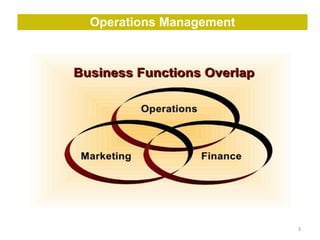
OPERATIONS
MANAGEMENT (OM)
2
LEARNING OUTCOMES
• Understanding concept of OM
3
Operations Management
4
An example and solutions: How can we increase the number of
customers in our restaurant during weekdays (NOT weekend)?
• A finance solution: Offering promotion when it is not rush
hour.
• A marketing solution: Investing on TV commercials.
• An OM/ SCM solution:
 Change the location, redesign the layout, provide new
services like home delivery, use fresh materials etc.
 Set up partnership with some brand new suppliers.
Operations Management
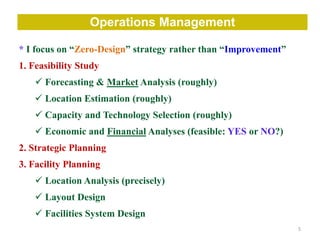
* I focus on “Zero-Design” strategy rather than “Improvement”
1. Feasibility Study
 Forecasting & Market Analysis (roughly)
 Location Estimation (roughly)
 Capacity and Technology Selection (roughly)
 Economic and Financial Analyses (feasible: YES or NO?)
2. Strategic Planning
3. Facility Planning
 Location Analysis (precisely)
 Layout Design
 Facilities System Design
5
Operations Management
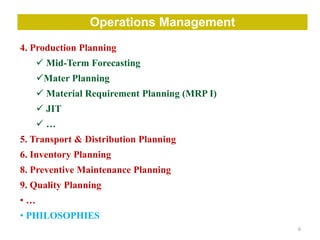
4. Production Planning
 Mid-Term Forecasting
Mater Planning
 Material Requirement Planning (MRP I)
 JIT
 …
5. Transport & Distribution Planning
6. Inventory Planning
8. Preventive Maintenance Planning
9. Quality Planning
• …
• PHILOSOPHIES
6
Operations Management
7
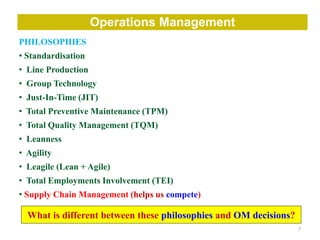
PHILOSOPHIES
• Standardisation
• Line Production
• Group Technology
• Just-In-Time (JIT)
• Total Preventive Maintenance (TPM)
• Total Quality Management (TQM)
• Leanness
• Agility
• Leagile (Lean + Agile)
• Total Employments Involvement (TEI)
• Supply Chain Management (helps us compete)
What is different between these philosophies and OM decisions?
Operations Management
8
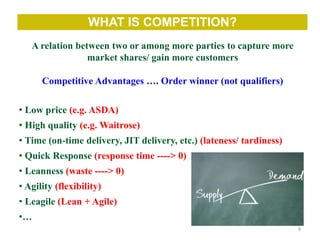
A relation between two or among more parties to capture more
market shares/ gain more customers
Competitive Advantages …. Order winner (not qualifiers)
• Low price (e.g. ASDA)
• High quality (e.g. Waitrose)
• Time (on-time delivery, JIT delivery, etc.) (lateness/ tardiness)
• Quick Response (response time ----> 0)
• Leanness (waste ----> 0)
• Agility (flexibility)
• Leagile (Lean + Agile)
•…
WHAT IS COMPETITION?
9
Pure competition
• Small bars and restaurants
• Variety stores, convenience stores
(Londis, Sainsbury's Local, etc.)
• Nail salons, barbers
• Small grocery stores
• Doughnut shops
• Professional services (dentist,
doctor, architects)
Monopolistic Competition
• Google
• Amazon
Monopoly
• NHS
• National Rail
• Heathrow airport
Oligopoly
• Banking industry (HSBC,
Barclays, Lloyds, etc.)
• Petrol stations (Shell, BP, etc.)
• Insurance companies
• Big four retailers (Asda, Tesco,
Sainsbury’s and Morrisons)
When the world started to see competition almost everywhere?
TYPES OF COMPETITION [2]
[1] William J. Stevenson, Operations Management (chapter
1), 8th edition, Mc Graw Hill, 2008.
[2] http://www.witiger.com/marketing/typesofcompetition.htm
[3] Hartmut Stadtler and Christoph Kilger (Eds.) Supply
Chain Management and Advanced Planning, Springer, Berlin,
Heidelberg, 2008.
[4] Reza Zanjirani Farahani and Nasrin Asgari, Combination
of MCDM and covering techniques in a hierarchical model for
facility location: A case study, European Journal of
Operational Research 176 (2007) 1839–1858
10
REFERENCES
11
11
Thanks for your attention …
Questions?

Introduction to Operations Management Functions

  • 1.
    Presented by: Reza ZanjiraniFarahani Kingston Business School Kingston University 26 September 2018 OPERATIONS MANAGEMENT (OM)
  • 2.
  • 3.
  • 4.
    4 An example andsolutions: How can we increase the number of customers in our restaurant during weekdays (NOT weekend)? • A finance solution: Offering promotion when it is not rush hour. • A marketing solution: Investing on TV commercials. • An OM/ SCM solution:  Change the location, redesign the layout, provide new services like home delivery, use fresh materials etc.  Set up partnership with some brand new suppliers. Operations Management
  • 5.
    * I focuson “Zero-Design” strategy rather than “Improvement” 1. Feasibility Study  Forecasting & Market Analysis (roughly)  Location Estimation (roughly)  Capacity and Technology Selection (roughly)  Economic and Financial Analyses (feasible: YES or NO?) 2. Strategic Planning 3. Facility Planning  Location Analysis (precisely)  Layout Design  Facilities System Design 5 Operations Management
  • 6.
    4. Production Planning Mid-Term Forecasting Mater Planning  Material Requirement Planning (MRP I)  JIT  … 5. Transport & Distribution Planning 6. Inventory Planning 8. Preventive Maintenance Planning 9. Quality Planning • … • PHILOSOPHIES 6 Operations Management
  • 7.
    7 PHILOSOPHIES • Standardisation • LineProduction • Group Technology • Just-In-Time (JIT) • Total Preventive Maintenance (TPM) • Total Quality Management (TQM) • Leanness • Agility • Leagile (Lean + Agile) • Total Employments Involvement (TEI) • Supply Chain Management (helps us compete) What is different between these philosophies and OM decisions? Operations Management
  • 8.
    8 A relation betweentwo or among more parties to capture more market shares/ gain more customers Competitive Advantages …. Order winner (not qualifiers) • Low price (e.g. ASDA) • High quality (e.g. Waitrose) • Time (on-time delivery, JIT delivery, etc.) (lateness/ tardiness) • Quick Response (response time ----> 0) • Leanness (waste ----> 0) • Agility (flexibility) • Leagile (Lean + Agile) •… WHAT IS COMPETITION?
  • 9.
    9 Pure competition • Smallbars and restaurants • Variety stores, convenience stores (Londis, Sainsbury's Local, etc.) • Nail salons, barbers • Small grocery stores • Doughnut shops • Professional services (dentist, doctor, architects) Monopolistic Competition • Google • Amazon Monopoly • NHS • National Rail • Heathrow airport Oligopoly • Banking industry (HSBC, Barclays, Lloyds, etc.) • Petrol stations (Shell, BP, etc.) • Insurance companies • Big four retailers (Asda, Tesco, Sainsbury’s and Morrisons) When the world started to see competition almost everywhere? TYPES OF COMPETITION [2]
  • 10.
    [1] William J.Stevenson, Operations Management (chapter 1), 8th edition, Mc Graw Hill, 2008. [2] http://www.witiger.com/marketing/typesofcompetition.htm [3] Hartmut Stadtler and Christoph Kilger (Eds.) Supply Chain Management and Advanced Planning, Springer, Berlin, Heidelberg, 2008. [4] Reza Zanjirani Farahani and Nasrin Asgari, Combination of MCDM and covering techniques in a hierarchical model for facility location: A case study, European Journal of Operational Research 176 (2007) 1839–1858 10 REFERENCES
  • 11.
    11 11 Thanks for yourattention … Questions?